Explain what schemas are and how they shape perception, memory and behaviour, evaluate schema theory with research such as Brewer and Treyens (1981), and apply it to behaviour in different contexts.
Each is in the Psychology glossary, with every other term in the subject.
In Piaget’s theory, the process of changing an existing schema, or creating a new one, when new information does not fit what is already known.
In Piaget’s theory, the process of fitting new information into an existing schema without changing the schema.
A mental framework of organised knowledge about an object, person, event or situation, built from experience, that creates expectations and guides how new information is processed.
A cognitive theory proposing that knowledge is organised into mental frameworks, called schemas, that guide perception, attention, encoding and retrieval of new information.
A schema for a familiar sequence of events, such as eating in a restaurant, that specifies the usual actions, roles and order in which they happen.
A schema containing a person’s organised beliefs and knowledge about themselves, which guides attention to and memory for information relevant to the self.
A schema about a social group that attributes the same characteristics to all its members, regardless of individual differences.
Processing of information that is guided by prior knowledge, expectations and schemas, as opposed to processing driven only by the features of the incoming stimulus.
Describe what a schema is and the main types of schema, including scripts, self-schemas and stereotypes.
Explain how schemas affect perception, attention, encoding and retrieval.
Explain how schemas develop and change through assimilation and accommodation.
Describe research that supports schema theory, including Bartlett (1932), Bransford and Johnson (1972), Anderson and Pichert (1978) and Brewer and Treyens (1981).
Evaluate schema theory with reference to measurement, perspective and bias.
Apply schema theory to explain behaviour in an unfamiliar situation in one of the contexts.
Schema theory proposes that people interpret new information through organised knowledge built up from past experience. It explains why two people can witness the same event and remember it differently, why a familiar topic is easier to learn than an unfamiliar one, and why expectations about groups of people can distort what is noticed about an individual.
Schema theory is part of the cognitive approach, but it links closely to the sociocultural approach, because many schemas are learned from culture, and to the biological approach, because schemas are stored and used by the brain. Research on schemas raises problems of measurement, since a schema cannot be observed directly, and of perspective, since the theory has been tested mainly on Western participants.
With a free account, Augment remembers where you stopped and what you have practiced.
A schema (plural schemas or schemata) is a mental framework of knowledge about a particular object, person, event or situation. A “restaurant” schema, for example, holds knowledge that restaurants have tables, menus and waiters, that people order before they eat and pay at the end. Schemas are stored in long-term memory and built from repeated experience; each new experience adds to or adjusts them.
Schemas have “slots” for typical features, each with a default value. A schema for “office” has slots for furniture, equipment and objects, with defaults such as a desk, a chair and books. When a slot is not filled by what a person actually sees, the default value can be filled in automatically. This makes processing fast and efficient, but it also makes errors predictable, because people tend to remember what usually happens in place of what actually happened.
Schema theory is the set of claims about how these frameworks work. Its central claim is that processing is driven not only by incoming information (bottom-up) but also by what a person already knows and expects (top-down). The theory goes back to Frederic Bartlett’s research on remembering in the 1930s and to Jean Piaget’s research on children’s thinking, and was developed further in the 1970s by researchers in cognitive psychology and artificial intelligence.
Researchers distinguish several types of schema by what they represent. The categories overlap, and one experience can activate several schemas at once.
A script is a schema for a familiar sequence of events, such as going to a restaurant, attending a lesson or catching a bus. Schank and Abelson (1977) used the restaurant script to show how much knowledge people need to understand even a simple story: “John went to a restaurant. He ordered lobster. He paid the bill and left” is understood easily only because readers fill in the waiter, the eating and the menu from their script. Bower, Black and Turner (1979) found that people who read script-based stories later tended to remember actions that fit the script but had not been stated.
A self-schema is organised knowledge about oneself, such as “I am sporty” or “I am bad at mathematics”. Markus (1977) found that students who saw independence as central to their self-concept judged independence-related adjectives as self-descriptive more quickly than other students and resisted information that contradicted that view of themselves. Self-schemas therefore act like other schemas: they speed processing of information that fits and filter out information that does not.
A stereotype is a schema about a social group that assigns the same characteristics to all its members. Like other schemas, stereotypes simplify a complex social world, but they also lead people to notice and remember information that fits the stereotype and to overlook information that does not. Cohen (1981) showed participants a video of a woman having a birthday dinner with her husband; those told she was a librarian remembered more “librarian-like” details (such as wearing glasses), and those told she was a waitress remembered more “waitress-like” details.
Other schemas include role schemas (expectations about people in particular roles, such as doctors or teachers) and object schemas (knowledge of what an object is and how it is used). The table summarises the main types.
Type of schema | What it represents | Example |
|---|---|---|
Script (event schema) | A familiar sequence of actions | Checking in at an airport |
Self-schema | Beliefs and knowledge about oneself | “I am a good listener” |
Stereotype | Beliefs about a social group | “Engineers are not creative” |
Role schema | Expected behaviour of people in a role | Teachers explain and set work |
Object schema | What an object is and how it works | A chair has a seat and is for sitting |
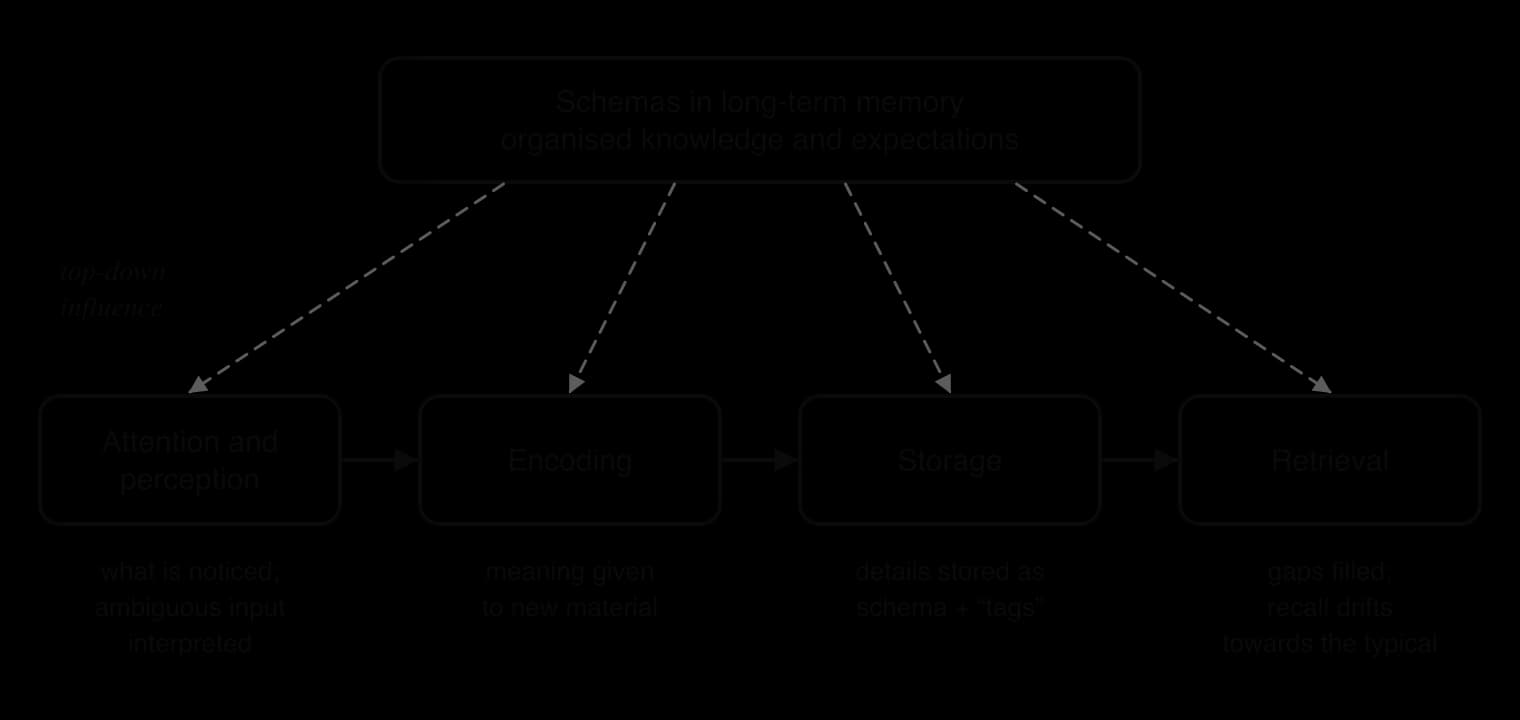
Schemas act at every stage of cognitive processing, from what a person notices to what they later remember. Because they work from existing knowledge towards new input, their effects are described as top-down processing.
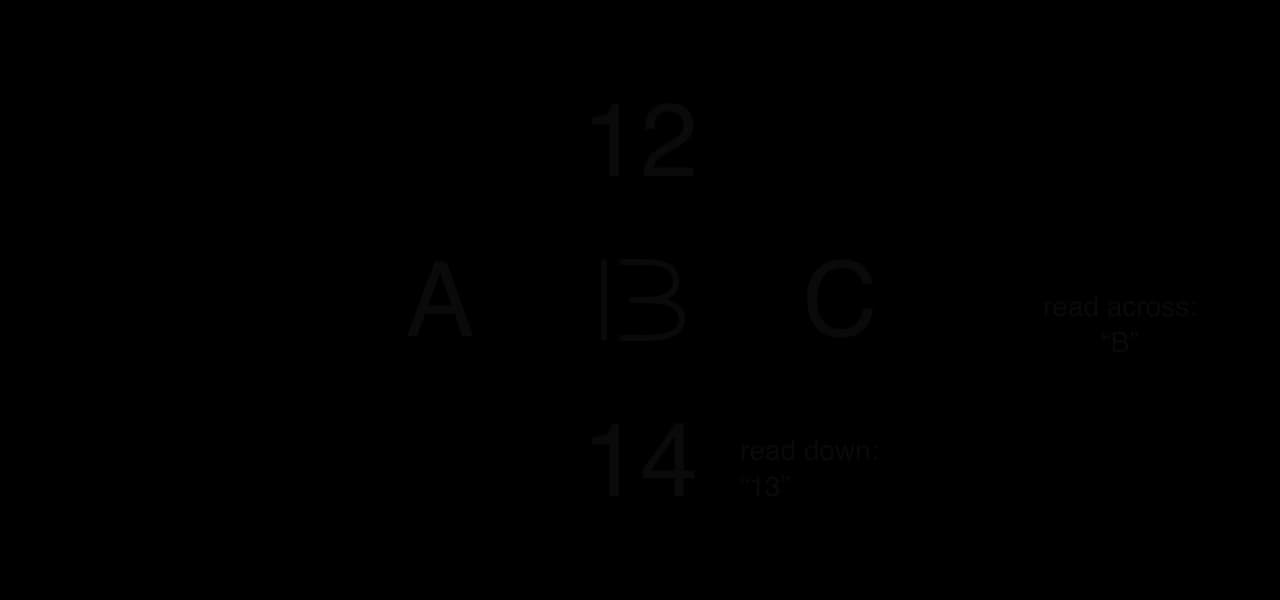
In perception, schemas help the brain interpret information that is incomplete or ambiguous. Bruner and Minturn (1955) showed participants a figure that could be read as either the letter B or the number 13. Participants who had just seen a series of letters tended to report a B; those who had just seen numbers tended to report 13. The physical stimulus was identical, so the difference came from the expectation created by the context.
Schemas also direct attention. People tend to look longer at things that do not fit a schema (a skull in an office) and to process expected things quickly without much attention. This can be efficient in familiar settings, but it means that expected details are often not looked at closely, and are later “remembered” from the schema rather than from the scene.
New material is understood and stored much more effectively when a relevant schema is activated at the start. In a study by Bransford and Johnson (1972), participants listened to a passage that described an everyday procedure in deliberately vague terms, such as arranging items into different groups and doing a few things at once rather than too many. Without a title, participants rated the passage as hard to understand and recalled little of it. Participants told before hearing it that it was about washing clothes rated it as much easier to understand and recalled far more.
Participants given the title only after the passage did no better than those given no title. This result matters because the words and the information were the same in every condition; what differed was whether a schema was available while the passage was being processed. This shows that schemas affect encoding, not only recall: material that cannot be linked to a schema is stored as a set of disconnected sentences that are difficult to retrieve.
Schemas also act as a retrieval plan. Anderson and Pichert (1978) asked participants to read a story about two boys skipping school at one boy’s house, taking the perspective of either a burglar or a person thinking of buying a house. The story included details relevant to a burglar (a coin collection, a colour television) and to a homebuyer (a leaky roof, a damp basement). After a first recall, half the participants were asked to switch perspective and recall the story again.
On the first recall, participants remembered more details relevant to their own perspective. After switching, they recalled additional details important to the new perspective that they had not reported before, even though they had not read the story again. The details must have been stored all along; the new schema provided a different route for searching memory. The study shows that schemas influence retrieval as well as encoding.
Schema theory explains why memory is reconstructive rather than a recording: when people remember, they rebuild the event from stored fragments and from what their schemas say usually happens. Bartlett (1932) asked British participants to read “The War of the Ghosts”, a Native American folk tale whose events and supernatural elements were unfamiliar to them, and to reproduce it from memory several times, over intervals of minutes to months.
The reproductions became shorter and more conventional. Unfamiliar details were dropped (levelling), some details were exaggerated or given new importance (sharpening), and details were changed to fit English cultural expectations, for example “canoes” becoming “boats”. Bartlett called the active search for meaning “effort after meaning”: people make unfamiliar material fit what they already understand.
Bartlett’s method was informal: there were no standard instructions, participants were not given a fixed time, and the analysis was qualitative. Hunter (1964) found the same kinds of change using Bartlett’s serial-reproduction method, but the original study is better seen as a rich demonstration than as an experiment. Later research on eyewitness memory, such as the effect of a leading question on what witnesses report, applies the same idea of reconstruction under controlled conditions.
 YouTube
Schemas are not fixed. Piaget, whose theory of children’s cognitive development is built on them, described two processes by which schemas deal with new experience. In assimilation, new information is fitted into an existing schema without changing it: a toddler who knows dogs may call a horse a “dog”. In accommodation, the schema is changed, or a new one is created, because the information does not fit: the toddler learns that horses are a different kind of animal and forms a new schema for them.
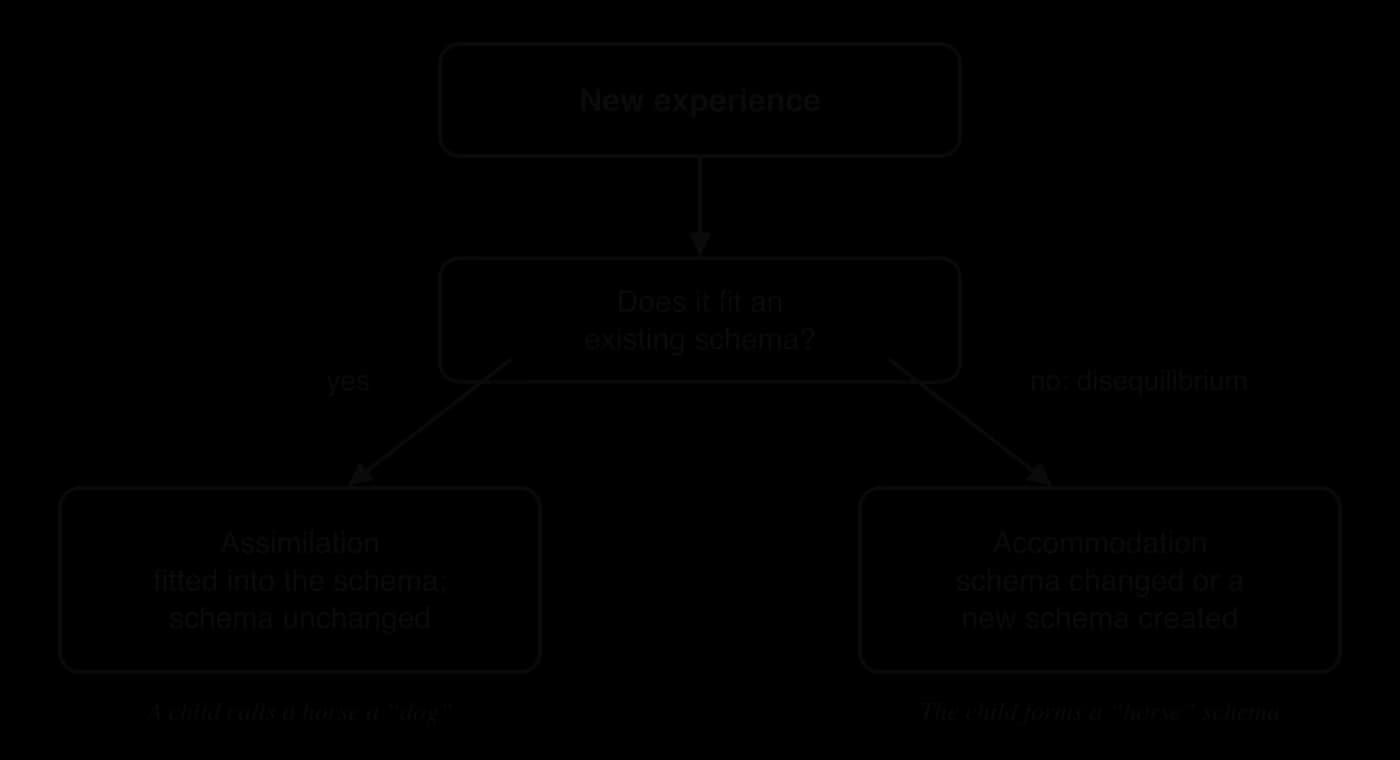
Piaget argued that a mismatch between a schema and experience creates an uncomfortable state of disequilibrium, which motivates accommodation and restores balance (equilibrium). The same two processes continue into adulthood, for example when a student revises a stereotype after getting to know members of a group, or when a new employee builds a script for how meetings run in an unfamiliar workplace.
Schemas often resist change. Because they guide attention and interpretation, information that fits a schema is noticed and remembered, while information that does not is ignored, explained away or forgotten. This is one reason why stereotypes persist, and it links schema theory to confirmation bias, the tendency to seek and interpret information in a way that confirms existing beliefs.
 YouTube
Many schemas are learned from the culture a person grows up in, through enculturation. Scripts for greeting someone, eating a meal, attending a wedding or behaving in a classroom differ between cultures, and so do stereotypes and expectations about stories. Because schemas guide processing, people from different cultures can perceive, understand and remember the same material differently.
Kintsch and Greene (1978) had American college students listen to a Grimm fairy tale and an Apache story and retell them, each to the next person, in chains of five. The familiar European tale was passed on well, while the Apache story, which did not fit the students’ story schema, usually fell apart by the last retelling. The researchers acknowledged a limit of the design: without a group of Apache listeners there was no way to show that the Apache story was not simply harder in itself. Studies that test readers from both cultures on material from both cultures solve this problem and are a stronger test of cultural schemas.
Schema theory is one of the most widely applied ideas in psychology. The same mechanism, expectations from stored knowledge shaping processing, appears in each context.
Context | Schemas at work | Example |
|---|---|---|
Health and well-being | Negative self-schemas maintain depression; therapy aims to change them | A person who believes “I am a failure” notices criticism and forgets praise |
Human development | Children build and revise schemas through assimilation and accommodation; gender schemas guide what children attend to | A child pays more attention to toys labelled as “for boys” or “for girls” |
Human relationships | Stereotypes and relationship scripts shape impressions and expectations | A first date goes badly when two people follow different scripts about who pays |
Learning and cognition | Prior knowledge makes new material easier to understand; schemas distort eyewitness memory | Students learn a chemistry topic faster when the teacher links it to cooking |
In health, Beck’s cognitive model of depression proposes that a negative self-schema formed in childhood leads people to interpret events in a biased way, so that ambiguous events confirm their low opinion of themselves. In development, gender schema theory proposes that children organise information around what is “for boys” and “for girls”, which then guides what they attend to and remember. In relationships, stereotypes affect how members of other groups are perceived and can feed prejudice. In learning, schemas explain why prior knowledge is one of the strongest predictors of how much a student learns from a lesson.
It explains a wide range of findings with one idea. The same mechanism accounts for ambiguous perception (Bruner and Minturn), better comprehension with a title (Bransford and Johnson), perspective effects at retrieval (Anderson and Pichert), stereotype-consistent memory (Cohen) and reconstructive errors (Bartlett; Brewer and Treyens).
Its predictions about errors are specific. Schema theory predicts not only that memory will be inaccurate but in which direction: towards what is typical. Brewer and Treyens’s false recall of books is the kind of error the theory predicts and a simple decay account does not.
It has practical applications. It explains why activating prior knowledge helps learning, why leading questions can distort eyewitness reports, and how negative self-schemas maintain depression, which has guided teaching methods, police interviewing and cognitive therapy.
It connects the approaches. Schemas are learned through culture (sociocultural), stored in long-term memory networks in the brain (biological) and used in processing (cognitive), which makes the theory a useful bridge between perspectives.
A schema cannot be observed. Researchers infer that a schema was active from what participants recall, how quickly they respond or what errors they make, and the same result can often be explained without schemas. In Brewer and Treyens’s study, for instance, participants who “recalled” books may have been guessing what an office usually contains, a response bias at the moment of reporting, rather than truly misremembering. Studies that measure schemas directly, for example by asking participants beforehand what they expect in a setting, help, but they still measure beliefs about schemas, not the schemas themselves.
Critics argue that the theory is too vague to be tested properly. It does not say exactly how schemas are acquired, how many there are or how a particular schema is chosen in a given situation. Because schemas can be used after the event to explain almost any result (good recall shows a helpful schema; poor recall shows a missing or conflicting one), the theory is hard to falsify. It is better described as a framework of ideas than as a precise model with testable components.
Schema theory focuses on errors, but much of memory is accurate. Wynn and Logie (1998) asked first-year university students to recall details of their first week at university on four occasions between November and May and found that their accounts stayed largely accurate and consistent. Memory for distinctive or emotionally important events may be less open to schema-driven change than memory for an unfamiliar folk tale or the contents of a room seen for 35 seconds.
The theory was built partly on cross-cultural observation: Bartlett’s British participants distorted a Native American story precisely because their schemas came from a different culture. Yet most later research has used Western university students (WEIRD samples) and Western materials, so it shows how schemas work for one cultural group more than how they vary. Research with readers from different cultures is needed to show whether the processes are universal while the contents differ, an important question for the theory’s generalisability.
Many schema studies depend on participants not knowing what is being tested. In Brewer and Treyens’s study, participants were misled about the purpose of the waiting room; in Cohen’s study, the label “waitress” or “librarian” was invented. The deception is mild and participants can be debriefed, but research that activates stereotypes must also consider whether it reinforces them, which makes it a form of socially sensitive research.
Concept | Strength or limitation of schema theory |
|---|---|
Measurement | Schemas are inferred from recall and errors; alternative explanations such as guessing are hard to rule out |
Causality | Experiments that manipulate a schema (a title, a perspective, a label) show it causes changes in memory |
Perspective | A cognitive theory with clear links to culture and biology; its vagueness makes it hard to falsify |
Bias | Mainly Western participants and materials, although the theory predicts cultural differences |
Change | Assimilation and accommodation explain how knowledge develops, but the theory is vague about how schemas form |
Responsibility | Deception about the purpose of studies; research on stereotypes is socially sensitive |
Brewer and Treyens aimed to investigate whether schemas affect memory for objects in a real place, and specifically whether people would remember objects that fit their schema for an office better than objects that did not, and whether they would falsely remember objects that a typical office would contain.
The participants were 86 university students, tested one at a time. Each arrived for what they thought was an experiment and was asked to wait in the researcher’s “office” while the previous participant finished. The office contained objects that fit an office schema (a desk, a chair, a pencil), objects that did not fit (a skull, a wine bottle), and lacked some objects that would normally be expected, notably books. After 35 seconds, the participant was taken to another room and unexpectedly asked to remember what had been in the office.
Participants were tested in different ways: some wrote down everything they could recall, some drew the room, and some wrote down what they recalled and then completed a recognition test, choosing from a list of objects those that had been present. Before the study, separate groups of participants rated how strongly each object was expected in an office (schema expectancy) and how noticeable it was (saliency), so that recall could be related to these ratings. Using incidental learning, where participants do not know a test is coming, meant that recall reflected ordinary processing rather than deliberate memorising.
Feature | Detail |
|---|---|
Design | Laboratory study with incidental learning; recall related to each object’s schema expectancy |
Participants | 86 university students, tested individually |
Exposure | 35 seconds alone in an office, believed to be a waiting room |
Memory measures | Written recall, drawing recall, or written recall followed by recognition |
Critical items | Expected and present (desk), unexpected and present (skull), expected but absent (books) |
Objects with high schema expectancy, such as the desk and chair, were recalled most often, and how noticeable an object was had almost no relation to recall. Schema-inconsistent objects, such as the skull and the wine bottle, were generally recalled less often than schema-consistent ones. Participants also reported objects that had not been present but fit the office schema: of the 30 participants who wrote down what they recalled, 9 reported seeing books.
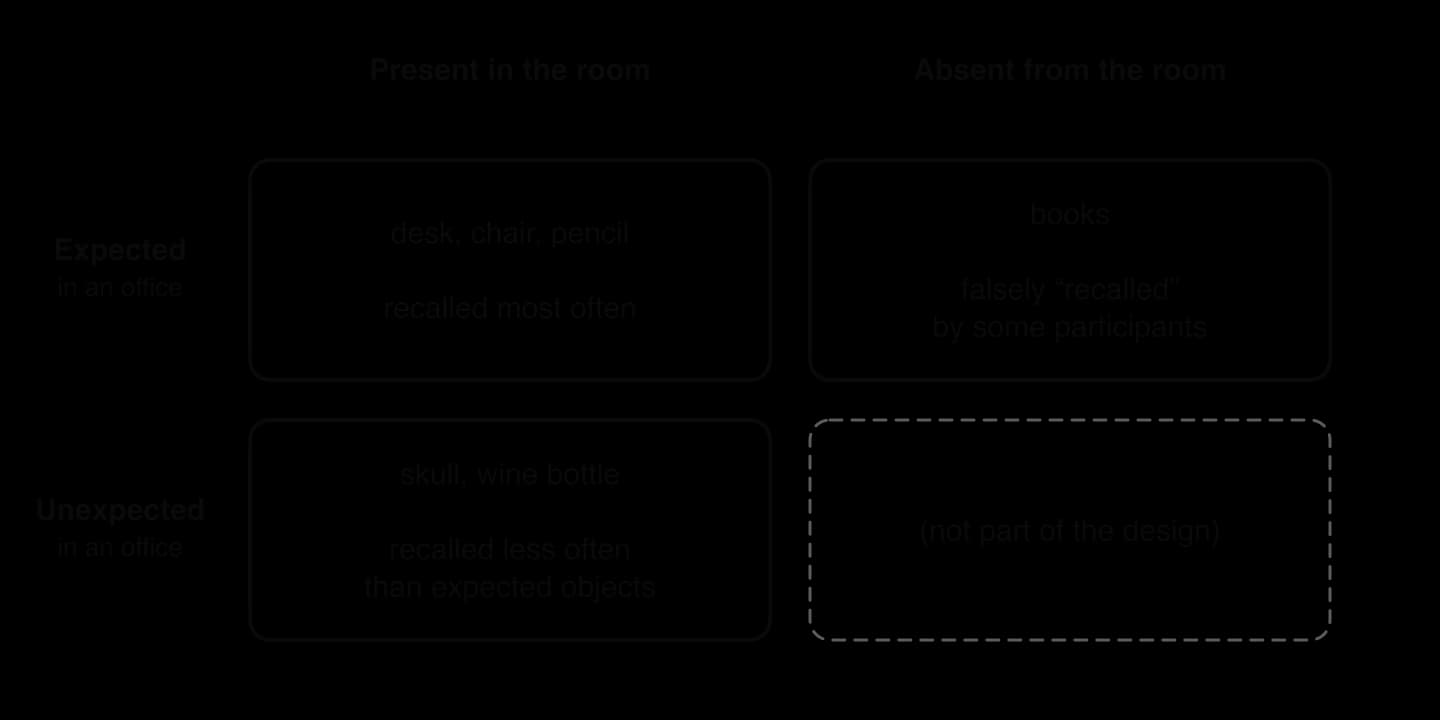
The way participants described objects also followed the schema. Typical objects were usually named without detail (“a wine bottle”), while features that did not fit the schema were mentioned, so a chair made of an unusual material was reported as a “plastic chair”. Schemas therefore seem to shape what people choose to report as well as what they remember.
Brewer and Treyens concluded that place schemas play an important and complex role in memory for places. Part of the link between schema expectancy and recall came from the office schema acting as a retrieval plan, guiding which objects were searched for and reported, and the false recall of books showed general schema knowledge being combined with the memory of the room. The findings support schema theory’s claim that memory is partly reconstructed from general knowledge, which produces predictable, schema-consistent errors.
The study related recall to independently rated schema expectancy, which gives a more objective measure of “fit” than the researchers’ own judgement. However, false recall of books may reflect guessing at the moment of report (a response bias) rather than a changed memory; participants asked to list everything in an office may simply have written down what offices contain. Because some participants drew the room and others wrote lists or chose from a list, conclusions also depend on how memory was measured.
Using a real room and an unexpected test gives higher ecological validity than word lists, because the situation resembles everyday incidental remembering. But only one room and one schema were used, the participants were US university students who share a very clear office schema, and 35 seconds is a short, low-stakes exposure, so the results may not generalise to important or emotional events, or to people with different cultural schemas of a workplace.
Participants were deceived about the purpose of the waiting room and were not told in advance that their memory would be tested. The deception was necessary, because warning them would have changed how they looked at the room, and the risk of harm was very low, but participants needed to be debriefed and given the right to withdraw their data.
Sources: Brewer, W. F., & Treyens, J. C. (1981). Role of schemata in memory for places. _Cognitive Psychology, 13(2), 207–230._
Schema theory appears in Paper 1 Section A as a term to explain with an example, and in Section B as a theory to apply to an unseen scenario from any context. In both, the example or scenario must be explained through the theory, not just mentioned.
A schema is a mental framework of organised knowledge, built from experience, that creates expectations and guides processing from the top down.
Types of schema include scripts (event sequences), self-schemas, stereotypes, role schemas and object schemas.
Schemas affect perception (the ambiguous B/13 figure), encoding (a title before a vague passage), retrieval (switching from a burglar’s to a homebuyer’s perspective) and reconstruction (the War of the Ghosts).
Through assimilation, new information is fitted into an existing schema; through accommodation, the schema changes; schemas often resist change.
Brewer and Treyens (1981) found that recall of an office followed schema expectancy, and 9 of 30 written-recall participants reported absent books.
Schema theory explains a wide range of findings and has applications in education, eyewitness memory and therapy.
Schemas are inferred, not observed; the theory is vague, hard to falsify and focused on errors; most research uses Western participants.
I can describe what a schema is and give examples of scripts, self-schemas and stereotypes.
I can explain how schemas affect perception, attention, encoding and retrieval, with a study for each.
I can explain assimilation and accommodation with an example.
I can describe the aim, method, results and conclusions of Brewer and Treyens (1981).
I can evaluate schema theory with reference to measurement, perspective and bias.
I can apply schema theory to explain behaviour in an unfamiliar scenario.