 YouTube
Explain how consequences shape behaviour through reinforcement, punishment, schedules and shaping, describe the token economy research of Ayllon and Azrin, and evaluate operant conditioning across contexts.
Each is in the Psychology glossary, with every other term in the subject.
Thorndike’s principle that responses followed by satisfying consequences become more likely to recur in the same situation, and those followed by unpleasant consequences less likely.
Strengthening a behaviour because it removes, ends or avoids an unpleasant stimulus, such as pain, anxiety or a loud noise.
A form of learning in which the likelihood of a voluntary behaviour changes as a result of its consequences: reinforced behaviour becomes more likely and punished behaviour less likely.
The decrease in intrinsic motivation for an enjoyable activity that can follow an expected external reward for doing it, as the activity comes to be seen as done for the reward.
Reinforcing a behaviour only some of the times it occurs, which slows learning but makes the behaviour much more resistant to extinction than continuous reinforcement.
Strengthening a behaviour by following it with a desirable stimulus, such as food, praise or money.
A reinforcer that satisfies a biological need and works without learning, such as food, water, warmth or relief from pain.
Any consequence that makes a behaviour less likely, either by adding an unpleasant stimulus (positive punishment) or removing a desirable one (negative punishment).
Describe the process of operant conditioning, from Thorndike’s law of effect to Skinner’s research.
Explain the difference between positive and negative reinforcement and positive and negative punishment, with an example of each.
Explain how schedules of reinforcement affect the rate of responding and resistance to extinction.
Describe how shaping is used to produce new behaviour.
Explain the role of operant conditioning in behaviour in health, development, relationships and learning.
Describe and evaluate the token economy research of Ayllon and Azrin (1965).
Evaluate operant conditioning with reference to causality, change, perspective and responsibility, including the overjustification effect.
Apply operant conditioning to explain or change behaviour in an unfamiliar situation.
Operant conditioning is learning in which the consequences of a behaviour change how likely it is to happen again. Behaviour that is followed by a desirable consequence tends to be repeated, and behaviour followed by an undesirable one tends to stop. It explains how a child learns to say “please”, why people keep checking their phones for messages, and why gambling can be so hard to give up.
Operant conditioning was developed within behaviourism by B. F. Skinner, who argued that behaviour can be explained by its history of consequences without reference to thoughts. Like classical conditioning, it is now taught within the cognitive approach, because research has shown that what organisms learn depends on expectations about consequences and on how they interpret rewards. The topic is closely tied to change: it provides some of the most widely used methods for changing behaviour in schools, hospitals and families, and raises questions of
With a free account, Augment remembers where you stopped and what you have practiced.
Any consequence of a behaviour that increases the likelihood that the behaviour will be repeated.
The rule deciding which responses are reinforced, such as after a fixed or variable number of responses (ratio) or a fixed or variable amount of time (interval).
A stimulus that has become reinforcing through association with a primary reinforcer, such as money, praise or tokens.
A technique for producing new behaviour by reinforcing successive approximations to it, gradually raising the requirement until only the target behaviour is reinforced.
The first systematic studies of learning from consequences were carried out by Edward Thorndike in the 1890s. He placed hungry cats in wooden “puzzle boxes” that could be opened from inside by pulling a loop or pressing a lever, with food outside. At first a cat scratched, bit and pushed at random until it happened to operate the release. Over repeated trials, the useless actions dropped out and the cat escaped faster and faster, producing a gradually falling learning curve.
Thorndike concluded that the animal was not reasoning its way out, since the time to escape fell gradually rather than suddenly. Instead, the satisfying consequence of escaping and eating strengthened the connection between the situation and the successful response. He called this principle the law of effect.
B. F. Skinner developed the law of effect into a full theory. He called behaviour that acts on the environment to produce consequences “operant” behaviour, to distinguish it from the reflexive “respondent” behaviour studied by Pavlov. To study it precisely, Skinner built the operant chamber, often called a Skinner box: a small cage containing a lever (for rats) or a key to peck (for pigeons), a device that delivers food pellets, and sometimes a light, a loudspeaker or an electrified floor.
Each lever press was recorded automatically on a moving paper roll called a cumulative recorder, which drew a line that rose with every response. The steeper the line, the faster the animal was responding. This gave Skinner an objective, continuous measure of behaviour, and allowed him to show in detail how different consequences changed the rate of responding.
Feature | Classical conditioning | Operant conditioning |
|---|---|---|
What is learned | An association between two stimuli (CS and UCS) | An association between a behaviour and its consequence |
Type of behaviour | Reflexive, involuntary responses (salivation, fear, nausea) | Voluntary actions (pressing a lever, doing homework) |
Order of events | The stimulus comes before the response | The consequence comes after the behaviour |
Role of the learner | Passive: responses are drawn out by stimuli | Active: the learner operates on the environment |
Key researchers | Pavlov; Watson and Rayner | Thorndike; Skinner |
Example | Feeling anxious at the sound of a dentist’s drill | Doing homework to avoid a detention |
The two forms of learning often work together. In avoidance learning, for example, a fear is first acquired through classical conditioning, and then avoiding the feared object is maintained by operant conditioning, because avoiding it brings relief.
YouTubeSkinner described consequences by their effect on behaviour. Any consequence that makes a behaviour more likely to be repeated is reinforcement, and any consequence that makes it less likely is punishment. A consequence is defined by what it does to behaviour, not by whether it seems pleasant: a teacher’s attention may reinforce a pupil’s misbehaviour even when the teacher intends it as a telling-off.
Both reinforcement and punishment can work by adding something to the situation (called positive) or by taking something away (called negative). “Positive” and “negative” here mean plus and minus, not good and bad. Crossing the two distinctions gives four kinds of consequence.

In the grid, the left-hand column holds the two kinds of reinforcement and the right-hand column the two kinds of punishment. The top row adds a stimulus and the bottom row removes one.
In positive reinforcement, a behaviour is followed by something desirable, so the behaviour becomes more frequent. A rat that receives a food pellet each time it presses a lever presses more often; a student praised for answering in class answers more often; an employee paid a bonus for meeting a target works harder towards the next target.
In negative reinforcement, a behaviour is followed by the removal or avoidance of something unpleasant, so the behaviour becomes more frequent. A rat learns to press a lever that switches off an electric current in the floor; a person with a headache takes a painkiller because doing so has ended headaches before. Negative reinforcement includes escape (ending an unpleasant situation) and avoidance (preventing it from starting).
In positive punishment, an unpleasant stimulus is added after a behaviour, such as a fine for speeding or extra homework for talking in class. In negative punishment, something desirable is removed, such as a phone confiscated for lying or a footballer sent off the pitch. Removing a person from all sources of reinforcement for a short period, called “time out”, is a form of negative punishment often used with young children.
Some reinforcers satisfy biological needs and work without any learning: food, water, warmth and relief from pain. These are primary reinforcers. Others gain their value through being associated with primary reinforcers. Money, grades, praise, stickers and tokens have no value in themselves, but they can be exchanged for, or have been paired with, things that do.
Secondary reinforcers are very useful in practice because they can be given immediately, in small amounts, without satisfying the learner’s needs and so reducing the reward’s value. A dog trainer’s clicker and a teacher’s points system are both secondary reinforcers. The way a neutral click becomes reinforcing is itself an example of classical conditioning, which shows how closely the two forms of learning are linked.
Reinforcement works best when it follows the behaviour immediately. A rat given food several seconds after a lever press learns much more slowly than one fed at once, because other behaviours occur in the gap and may be reinforced instead. In humans, language allows longer delays to be bridged (such as a promised trip at the weekend for a finished essay), but immediate consequences still tend to have stronger effects than delayed ones. This helps to explain why behaviours with immediate rewards and delayed costs, such as smoking or eating sugary food, are so hard to change.
Reinforcement must also be contingent: it must depend on the behaviour. If rewards arrive whether or not the behaviour happens, there is nothing to learn about the link between action and outcome. When animals or people experience outcomes that do not depend on what they do, they can learn that their behaviour makes no difference, which Seligman called learned helplessness.
When reinforcement stops, operant behaviour gradually declines, a process also called extinction. A rat whose lever presses no longer produce food eventually stops pressing. Before the decline, there is often a brief increase in the behaviour, called an extinction burst: a person whose lift button does not work presses it repeatedly and harder before giving up. Parents who stop giving in to a child’s tantrums often see the tantrums get worse before they get better, which is a common reason for giving up too soon.
Operant behaviour is also controlled by the situation in which it is reinforced. A discriminative stimulus signals that a behaviour will be reinforced. A rat may learn to press the lever only when a light is on, because only then does pressing produce food. In daily life, a ringing phone signals that picking it up will be reinforced by a conversation, and a teacher’s presence signals which classroom behaviours will be praised or punished. This explains why behaviour learned in one setting may not appear in another.
Skinner’s most influential discovery was that the pattern in which reinforcement is given has powerful effects on behaviour. Reinforcing every correct response, called continuous reinforcement, is the fastest way to establish a new behaviour. Most behaviour in everyday life, however, is reinforced only some of the time, which is called partial reinforcement.
Partial reinforcement can follow four basic schedules of reinforcement, depending on whether reinforcement depends on the number of responses (ratio schedules) or on the time that has passed (interval schedules), and whether the requirement is fixed or varies unpredictably.
Schedule | Rule | Pattern of responding | Everyday example |
|---|---|---|---|
Fixed ratio (FR) | Reinforcement after a set number of responses (e.g. every 10th) | High rate, with a short pause after each reinforcer | Piece-work pay; a coffee card giving a free drink after 9 purchases |
Variable ratio (VR) | Reinforcement after an unpredictable number of responses, around an average | Very high, steady rate; most resistant to extinction | Slot machines; lottery tickets; loot boxes in video games |
Fixed interval (FI) | The first response after a set time is reinforced | Pause after reinforcement, then speeding up as the time approaches (“scalloping”) | Studying more as a weekly test approaches; checking an oven near the end of the cooking time |
Variable interval (VI) | The first response after an unpredictable time is reinforced | Moderate, steady rate | Checking for messages or social media notifications; fishing |
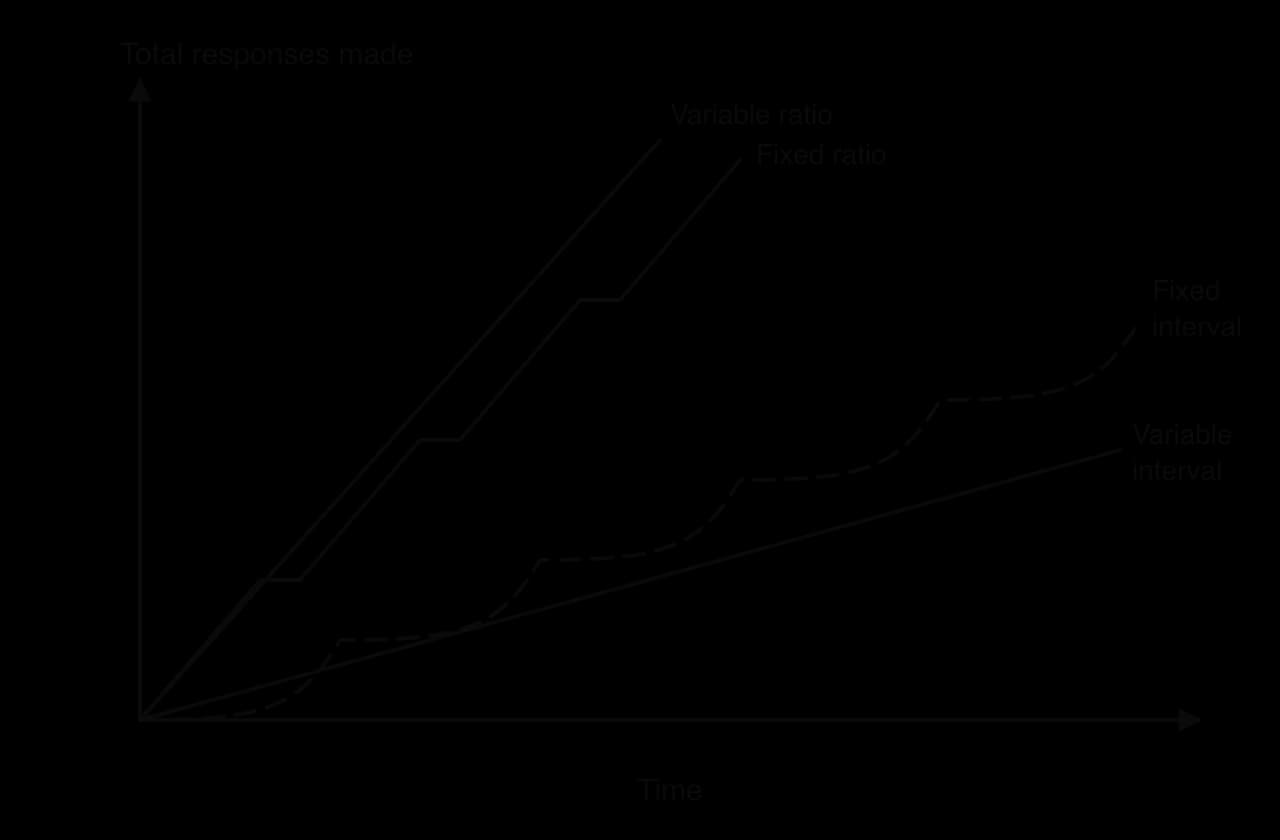
The figure shows cumulative records of the kind Skinner drew. Ratio schedules produce steeper lines than interval schedules because, on a ratio schedule, responding faster brings reinforcement sooner. Variable schedules produce steadier lines than fixed ones because the learner cannot predict when the next reinforcer will come, so there is no reason to pause.
 YouTube
Behaviour learned under partial reinforcement, especially a variable ratio schedule, takes much longer to extinguish than behaviour learned under continuous reinforcement. This is called the partial reinforcement extinction effect. If reinforcement has always arrived after every response, its sudden absence is easy to notice; if it has arrived unpredictably, a long run of unrewarded responses looks just like the normal situation, so the learner keeps responding.
Variable ratio schedules help to explain the persistence of gambling. A slot machine pays out after an unpredictable number of plays, so every play might be the winning one. Many video games use similar schedules in “loot boxes”, which give random rewards for money or play, and social media platforms deliver likes, comments and messages unpredictably. Sherman and colleagues (2016) found that when adolescents viewed photos that appeared to have many likes, there was more activity in brain regions involved in reward processing, which suggests that social approval online acts as a reinforcer.
Reinforcement can only strengthen a behaviour that already occurs. To produce entirely new behaviour, Skinner used shaping: reinforcing behaviour that comes closer and closer to the target. To teach a rat to press a lever, the trainer first reinforces it for facing the lever, then for moving towards it, then for touching it, and finally only for pressing it. Each step is called a successive approximation.
Using shaping, Skinner trained pigeons to turn in circles, play a simple form of table tennis and peck at targets. Shaping is also used with humans, for example to teach language to children with autism, to help patients relearn movement after a stroke, and to build up exercise gradually. Much everyday teaching works in the same way: a beginner musician is praised for any recognisable tune, and the standard for praise rises as skill improves.
Skinner (1948) gave hungry pigeons food at regular intervals, whatever they were doing. Several birds developed odd, repeated rituals, such as turning in circles or tossing their heads, which Skinner explained as accidental reinforcement: whatever a bird happened to be doing when food arrived was strengthened. He compared this to human superstitions, such as a footballer’s lucky routine. Staddon and Simmelhag (1971) repeated the procedure and found that much of the behaviour reflected the birds’ natural food-seeking actions, which suggests that biological tendencies, not only reinforcement, shape what animals do.
Punishment can suppress behaviour quickly, but research shows it has serious drawbacks. It tells the learner what not to do but not what to do instead; it may suppress behaviour only while the punisher is present; it can produce fear of, and avoidance of, the person who punishes; and physical punishment models aggression. Psychologists therefore usually recommend reinforcing desirable alternative behaviour rather than relying on punishment.
Gershoff and Grogan-Kaylor (2016) carried out meta-analyses of research on spanking, combining 111 effect sizes from studies involving 160,927 children. Thirteen of the 17 average effects were statistically significant, and all of them linked spanking with a higher risk of harmful outcomes for children, such as aggression and mental health problems. Most of these studies were correlational, so it is possible that children with more behaviour problems are spanked more, but the consistent pattern across designs is one reason many countries have banned physical punishment.
Culture affects the meaning of punishment. Lansford and colleagues (2005) interviewed 336 mothers and their children in China, India, Italy, Kenya, the Philippines and Thailand. Physical discipline was less strongly linked to children’s aggression and anxiety where it was seen as normal in the community, but in every country, more physical discipline was associated with more aggression and anxiety.
Operant conditioning helps to explain behaviour in every context of the course, because almost all voluntary behaviour has consequences. In each context, reinforcement and punishment can create, maintain and change behaviour, often without anyone intending it.
Drugs such as nicotine, alcohol and opioids act as powerful reinforcers. Taking the drug is positively reinforced by its pleasant effects, which involve the release of dopamine in the brain’s reward system. Once a person is dependent, taking the drug is also negatively reinforced, because it ends the unpleasant symptoms of withdrawal. Both kinds of reinforcement are immediate, while the costs to health are delayed, which helps to explain why addiction is so hard to overcome.
Lewinsohn (1974) proposed that depression can develop when a person receives too little positive reinforcement that depends on their own behaviour, for example after losing a job or a partner. With fewer rewards, the person does less, which brings even fewer rewards. Behavioural activation, a treatment for depression, applies this idea by helping people schedule rewarding activities again.
Many interactions between parents and children are shaped by reinforcement in both directions. Patterson’s research on coercive family cycles described how a child’s whining or tantrums can be positively reinforced when a parent gives in, while the parent’s giving in is negatively reinforced because the tantrum stops. Over time both behaviours become stronger. Parenting programmes based on operant principles teach parents to reinforce cooperative behaviour with attention and praise, ignore minor misbehaviour so that it extinguishes, and use mild, consistent consequences such as time out.
Attention, smiles, approval and affection are powerful social reinforcers. Behaviour that brings approval from friends tends to be repeated, which is one way in which group norms are learned and maintained. Online, likes, comments and shares work as unpredictable social reinforcers. In relationships, social exchange approaches propose that people stay in relationships when the rewards they receive outweigh the costs, an idea that extends reinforcement to long-term choices.
Teachers use reinforcement constantly, through praise, grades, merits and privileges, and punishment, through detentions or loss of privileges. Learning apps and personalised learning platforms use the same principles: correct answers are followed by immediate feedback, points or badges, the difficulty is raised step by step as skill improves (a form of shaping), and rewards are often delivered on variable schedules to keep learners returning. The application of operant conditioning to change behaviour in schools, through token economies and gamified learning, is studied in the learning and cognition context.
Context | Behaviour | Consequence | Type |
|---|---|---|---|
Health and well-being | Smoking a cigarette | Pleasant nicotine effects | Positive reinforcement |
Health and well-being | Smoking when craving | Withdrawal symptoms end | Negative reinforcement |
Human development | A child’s tantrum in a shop | Parent buys sweets | Positive reinforcement of the tantrum |
Human development | Parent buying sweets | Tantrum stops | Negative reinforcement of giving in |
Human relationships | Posting a photo | Likes arrive unpredictably | Variable schedule of positive reinforcement |
Learning and cognition | Talking during a test | Loss of break time | Negative punishment |
Teodoro Ayllon and Nathan Azrin aimed to find out whether the principles of operant reinforcement, developed with animals in laboratories, could be used to increase useful everyday behaviour in long-stay patients in a psychiatric hospital. They also wanted to show that this behaviour could be measured objectively and that changes in it were caused by the reinforcement procedure itself.
The research took place on a ward of Anna State Hospital in Illinois, USA, from 1961 onwards, and was reported as a series of six experiments. The participants were long-stay patients diagnosed with psychotic disorders, who did little for themselves on the ward. Ward attendants ran the programme, using written, standardised criteria for each behaviour.
Target behaviours were useful ward jobs and self-care, each defined in observable terms so that it could be counted. Patients earned tokens for each completed job. The tokens were secondary reinforcers, used to bridge the delay between behaviour and reward, and could later be exchanged for activities and items that the patients chose often when they were freely available, such as privacy, a walk in the grounds, a chat with staff, and sweets.
The experiments used a reversal or ABA design. In phase A, tokens were contingent on doing the jobs. In phase B, patients received the same tokens whether or not they worked. In the final phase A, tokens again depended on the work.
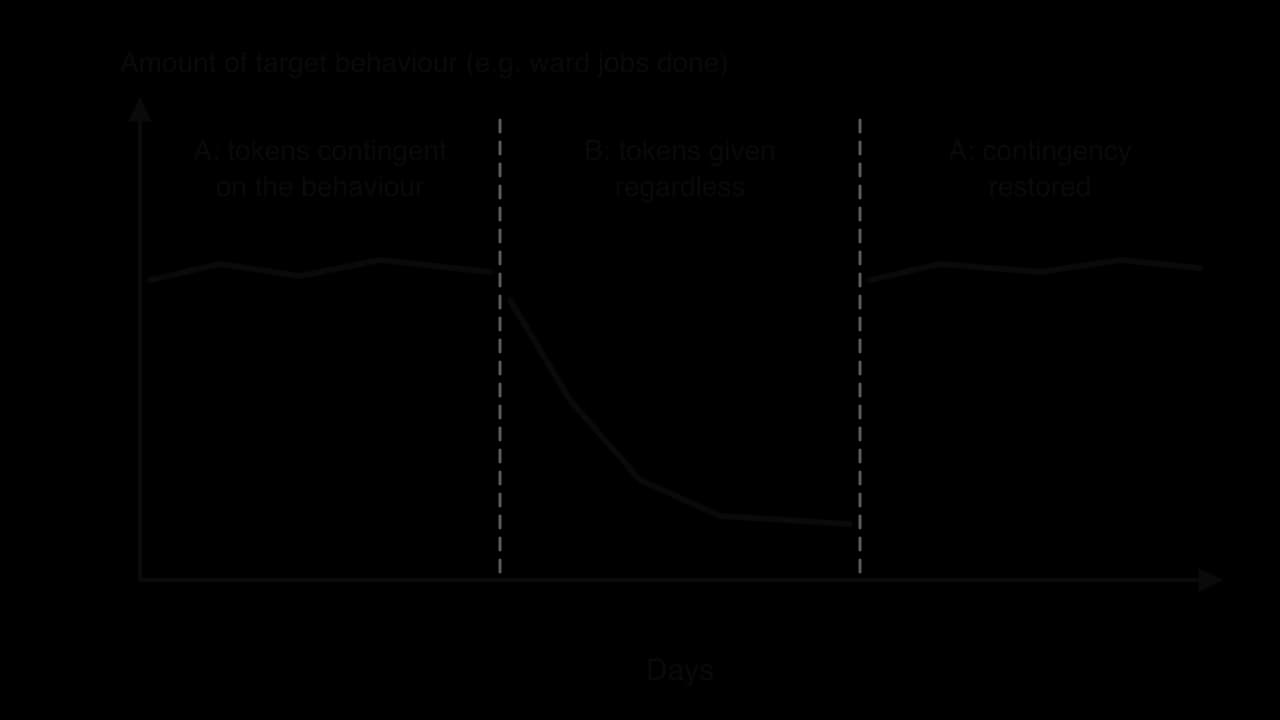
While tokens were contingent on work, the patients carried out jobs at a high, stable level. When tokens were given regardless of behaviour, the amount of work fell sharply. When the contingency was restored, work rose immediately to its earlier level.
The authors concluded that the reinforcement procedure was effective for a whole ward of patients, but only while it was in operation: the useful behaviours were reduced considerably when it was stopped. The work was later developed in their book The Token Economy (1968) and led to token economies being introduced in hospitals, prisons, schools and homes for people with learning disabilities.
Sources: Ayllon, T. and Azrin, N. H. (1965). The measurement and reinforcement of behavior of psychotics. _Journal of the Experimental Analysis of Behavior, 8(6), 357–383; Ayllon, T. and Azrin, N. H. (1968). The Token Economy._
Operant conditioning, using secondary reinforcers exchangeable for valued activities, could increase useful behaviour even in patients whose illness was severe and long-lasting. The reversal design showed that the changes were caused by the contingency between behaviour and tokens. The choice of backup reinforcers from activities the patients already chose often anticipated what became known as the Premack principle.
Because each patient’s behaviour was measured across conditions, and behaviour rose and fell as the contingency was switched on and off, the design gives strong evidence of a causal effect within this group. Alternative explanations, such as patients improving over time or simply becoming used to the ward, cannot explain why work fell when the contingency was removed and recovered when it returned.
The same reversal results show the main limitation: the behaviour depended on the programme continuing and did not maintain itself. Whether skills learned on the ward transferred to life outside hospital was not tested. Later research, such as Paul and Lentz (1977), found that a social learning programme including a token economy helped more long-stay patients to be discharged than standard hospital care, but token economies became less common as long hospital stays were replaced by community care, so the findings come from a type of institution that hardly exists today.
Token economies in institutions raise serious ethical questions. Patients who could not consent freely may have had access to privacy, walks or social contact made dependent on working, and critics argued that this turned basic rights into privileges and treated patients as workers for the institution. Later legal and ethical standards required that basic needs and rights could not be used as backup reinforcers. The question of who decides which behaviours are “appropriate” is a further issue of power between staff and vulnerable patients.
Operant conditioning is supported by a very large body of controlled research. Because the researcher decides when reinforcement is given, experiments can show that a consequence causes a change in behaviour, and reversal designs like Ayllon and Azrin’s show causality even in small groups of real patients. Skinner’s emphasis on observable, countable behaviour also improved measurement in psychology.
The theory has led to some of the most widely used methods of changing behaviour: token economies, applied behaviour analysis for children with developmental disabilities, behavioural parenting programmes, contingency management for drug use (in which people earn vouchers for drug-free urine tests) and classroom behaviour management. Its principles also explain the design of many modern technologies, from loyalty cards to video games, which has made it valuable for understanding both helpful and harmful uses of reinforcement.
Operant conditioning predicts that rewarding a behaviour makes it more likely. Research on the overjustification effect shows that this is not always true for activities people already enjoy. Lepper, Greene and Nisbett (1973) studied 51 children aged about three to five at the Bing Nursery School on the Stanford University campus, chosen because they showed interest in drawing with felt-tip pens during free play. Each child drew pictures for six minutes in a separate room under one of three conditions: they were promised a “Good Player Award” certificate for drawing (expected award), they received the same award as a surprise afterwards (unexpected award), or they received no award.
One to two weeks later, the pens were put out again in the classroom and observers behind a one-way mirror, who did not know each child’s condition, recorded how much free time each child spent drawing. Children who had drawn in order to win the award spent about half as much time drawing as children in the other two conditions.
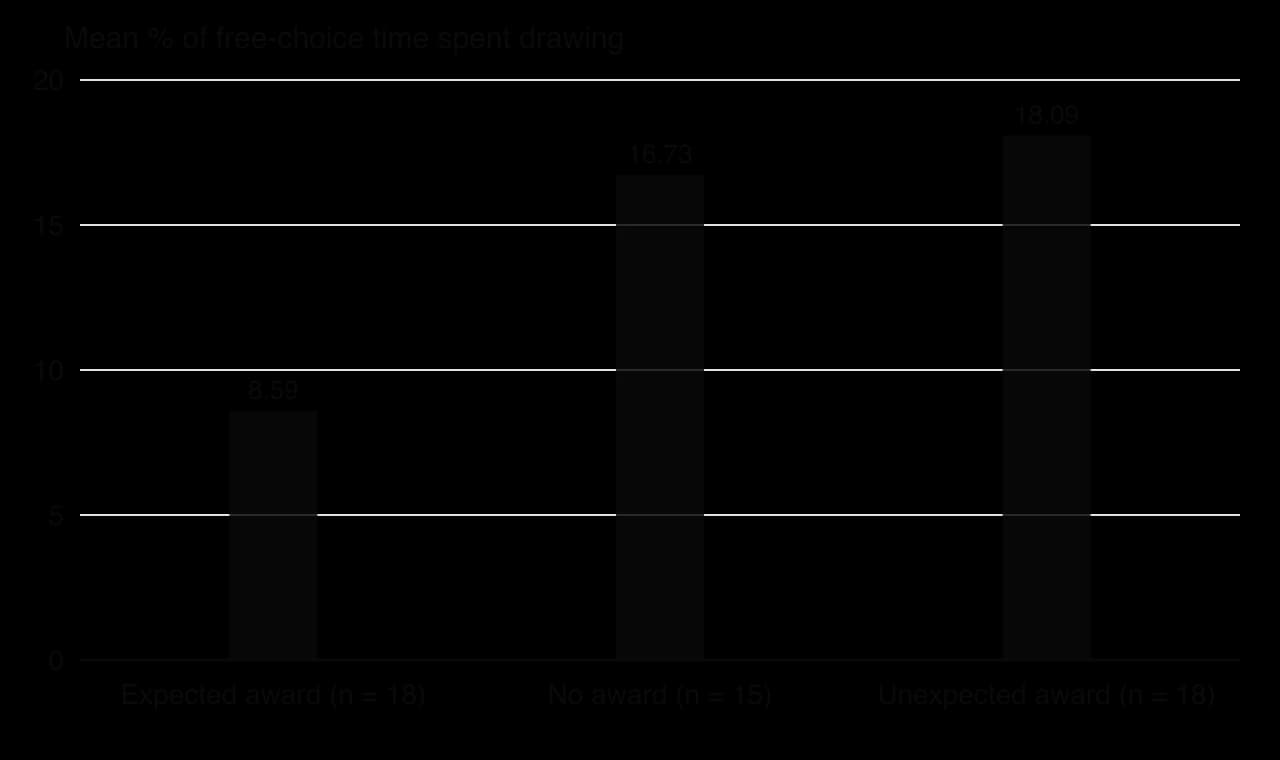
Lepper and colleagues explained the result cognitively: children who drew for a promised reward came to see their drawing as something done to get a reward, so once no reward was available, they had less reason to draw. A meta-analysis by Deci, Koestner and Ryan (1999) of 128 experiments found that expected, tangible rewards reliably reduced free-choice intrinsic motivation, while positive verbal feedback tended to increase it. Other researchers, such as Cameron and Pierce, argued that the undermining effect is limited to specific conditions, so the debate now concerns the conditions under which rewards reduce interest.
Skinner assumed that any behaviour an animal can perform can be reinforced equally well. Breland and Breland (1961), former students of Skinner who trained animals for advertising and entertainment, reported cases where this failed. Raccoons trained to put coins into a box for food began rubbing the coins together instead of dropping them, and pigs trained to carry wooden coins to a “piggy bank” began dropping and rooting at them, even though this delayed their food. The animals’ natural food-related behaviours took over, which the Brelands called instinctive drift. Like biological preparedness in classical conditioning, this shows that what can be learned depends on the species’ evolved tendencies.
Strict operant theory says that behaviour must be performed and reinforced to be learned. Research on observational learning shows that people and animals can learn by watching others and seeing what happens to them, without being reinforced themselves, which is central to social learning theory. Tolman’s research on latent learning also found that rats allowed to explore a maze without food learned its layout, which they used at once when food was later introduced. These findings suggest that reinforcement affects whether learned behaviour is performed more than whether it is learned, and they support a cognitive account in which learners form expectations and mental maps.
Skinner argued that free will is an illusion and that behaviour is fully determined by its history of reinforcement. This is a strongly environmental determinist position and is reductionist, because it ignores thoughts, emotions, culture and biology as causes of behaviour. Many psychologists accept that consequences matter while arguing that people interpret consequences, set their own goals and can act against immediate reinforcement.
Using operant conditioning to control others’ behaviour raises questions of responsibility: who decides which behaviours are desirable, whether the people being conditioned have consented, and whether techniques are used for their benefit or for someone else’s, as in apps designed to maximise time spent on them. Animal research in operant chambers raises further questions about deprivation (animals are usually kept hungry so that food works as a reinforcer) and the use of electric shock.
Concept | How it applies to operant conditioning |
|---|---|
Causality | Controlled experiments and reversal designs show that consequences cause changes in behaviour; most research on punishment in families is correlational. |
Change | The basis of token economies, parenting programmes and contingency management, though behaviour often fades when reinforcement stops. |
Measurement | Behaviour is operationalised as countable responses (lever presses, jobs completed, time spent drawing), which is objective but leaves out thoughts and feelings. |
Perspective | A behaviourist view of learning; latent learning and the overjustification effect support a cognitive view; instinctive drift supports a biological one. |
Responsibility | Who chooses the target behaviour; consent of vulnerable people; using basic rights as rewards; animal deprivation and shock; persuasive technology. |
Bias | Much early research used rats and pigeons, so applying it to humans assumes that learning works the same way across species and cultures. |
Operant conditioning is a cognitive approach term, so it can be asked about in Paper 1 Section A (explain it with an example) or applied to a context scenario in Section B. Through the learning and cognition context it can also appear in a Section C essay, especially on its use to change behaviour.
Operant conditioning is learning in which the consequences of a voluntary behaviour change how likely it is to be repeated; it grew from Thorndike’s law of effect and Skinner’s research.
Reinforcement increases behaviour and punishment decreases it; “positive” means adding a stimulus and “negative” means removing one.
Primary reinforcers meet biological needs; secondary reinforcers such as money, praise and tokens gain value through association.
Reinforcement works best when immediate and contingent; when it stops, behaviour extinguishes, often after an extinction burst.
Partial reinforcement makes behaviour persistent; variable ratio schedules produce the highest, most extinction-resistant responding, as in gambling.
Shaping produces new behaviour by reinforcing successive approximations.
Ayllon and Azrin (1965) showed with a reversal design that tokens increased useful behaviour in psychiatric patients only while tokens depended on it.
Punishment has side effects; spanking is consistently linked with worse child outcomes, even where it is culturally normal.
Limits include the overjustification effect found by Lepper et al. (1973), instinctive drift, learning without reinforcement, determinism and ethical concerns about control.
I can describe the process of operant conditioning, including Thorndike’s law of effect and Skinner’s research.
I can explain positive and negative reinforcement and positive and negative punishment, with an example of each.
I can explain the four schedules of reinforcement and why partial reinforcement resists extinction.
I can describe how shaping produces new behaviour.
I can explain the role of operant conditioning in behaviour in each of the four contexts.
I can describe and evaluate Ayllon and Azrin’s token economy research.
I can evaluate operant conditioning with reference to concepts, including the overjustification effect.
I can apply operant conditioning to explain or change behaviour in a new scenario.