Explain how the limits of working memory shape learning, distinguish intrinsic, extraneous and germane load, apply the instructional effects the theory predicts, and evaluate its research and measurement.
Each is in the Psychology glossary, with every other term in the subject.
The amount of working memory resources required to carry out a task at a given time; when demands exceed the capacity available, cognitive overload impairs learning and performance.
A theory of learning which proposes that working memory has a limited capacity for new information, so instruction should avoid overloading it and direct its capacity towards building schemas in long-term memory.
The degree to which the elements of information in a task must be processed together because they depend on one another; high element interactivity produces high intrinsic load.
The finding that instructional techniques which help novices by reducing cognitive load lose their benefit, or impair learning, for more knowledgeable learners, for whom the guidance is redundant.
The cognitive load imposed by the way information is presented or by the learning activity, when that design does not contribute to learning, such as searching between separate sources.
The working memory resources a learner devotes to processing the material and constructing schemas; the revised theory treats it as part of the capacity used for intrinsic load.
The cognitive load imposed by the inherent complexity of the material, which depends on how many interacting elements must be processed at once relative to the learner’s existing knowledge.
Describe the assumptions about working memory and long-term memory on which cognitive load theory is built.
Explain the difference between intrinsic, extraneous and germane load, and how the theory has been revised.
Explain the worked example, split-attention, redundancy, modality and expertise reversal effects in terms of cognitive load.
Describe how cognitive load is measured and explain the problems of measuring it.
Describe the aim, method, results and conclusions of research by Chen, Kalyuga and Sweller (2015) on worked examples and expertise.
Apply cognitive load theory to behaviour in learning, health, development and relationships.
Evaluate cognitive load theory with reference to measurement, causality, bias, perspective and change.
Cognitive load theory explains learning in terms of the limited capacity of working memory. It predicts that people learn badly when a task asks them to hold and process more new information at once than working memory can manage, and it uses this idea to design teaching materials, from textbook diagrams to software tutorials.
The theory belongs to the cognitive approach, which explains behaviour through mental processes such as attention, memory and reasoning. It builds directly on cognitive models of memory, and research on it raises questions of measurement, because the load in a person’s working memory cannot be observed, and of change, because the theory is used to change how people are taught.
With a free account, Augment remembers where you stopped and what you have practiced.
The finding that learners learn more when a diagram is accompanied by a spoken rather than a written explanation, because visual and auditory channels together increase effective working memory capacity.
The finding that adding information which repeats what is already understandable, such as reading aloud text learners can see, impairs learning because it uses working memory without adding anything new.
The finding that learning is impaired when learners must divide attention between separate sources that only make sense together, such as a diagram and a separate text, and that integrating them helps.
The finding that novices learn a procedure more effectively by studying step-by-step worked examples than by solving equivalent problems, because examples avoid the heavy load of searching for a solution.
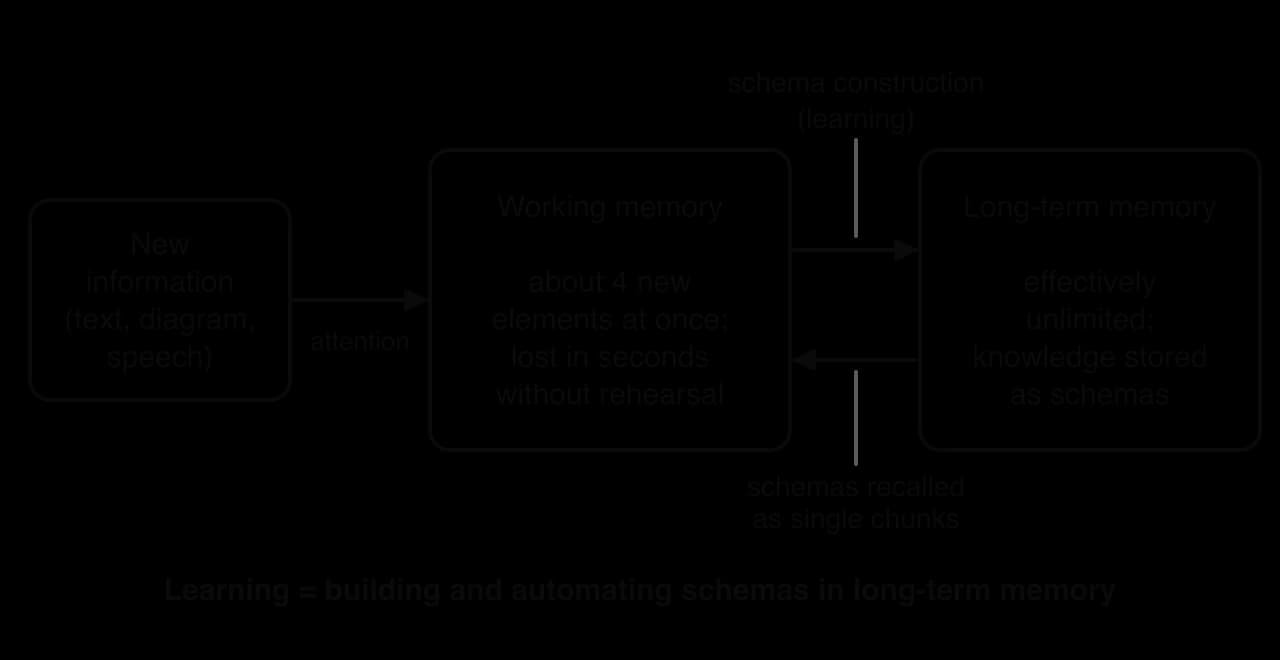
The limited-capacity memory system that temporarily holds and manipulates the information a person is currently thinking about, holding only a few new elements for a few seconds without rehearsal.
Scope: An approach term in the cognitive approach. Questions can ask about cognitive load theory with any example of behaviour, and it is applied in the learning and cognition context and in scenarios from the other three contexts.
Cognitive load theory was developed by the Australian educational psychologist John Sweller from the 1980s. It does not propose a new model of memory. Instead it takes well-established findings about how memory works and asks what they mean for learning. Four assumptions about human cognitive processes form its base.
Working memory is the system that holds and manipulates information that a person is currently thinking about. Miller (1956) estimated that people can hold about seven, plus or minus two, items in immediate memory. Later research by Cowan (2001) suggested that the true limit for new, unrelated items is closer to four chunks when people cannot rehearse or group them. Without rehearsal, information in working memory is also lost within a few seconds.
Working memory also processes information as well as holding it. When elements have to be processed together, for example compared, combined or rearranged, even fewer can be handled at once. A student solving an equation has to keep track of the equation, the goal and the rule being applied at the same time, and each of these takes up some of the limited capacity.
Long-term memory has no known capacity limit. Knowledge in it is organised into schemas: mental structures that combine many separate elements into a single unit. A schema for “photosynthesis” or for “solving a linear equation” contains many facts and steps, but once it has been learned it can be brought into working memory as one chunk.
This is why experts can handle information that overwhelms novices. A chess master looking at a game sees a familiar attacking formation, which counts as one element, where a beginner sees twenty separate pieces. A fluent reader sees whole words where a child learning to read sees individual letters. The limit on working memory applies to new information, and information already organised into schemas in long-term memory is not limited in the same way.
With enough practice, a schema can be used with little conscious processing. Experienced drivers change gear while holding a conversation, and fluent readers decode words without thinking about letters. Automation frees working memory for other demands, so a task that once used most of a learner’s capacity can later use almost none of it.
From these assumptions, cognitive load theory defines learning as the construction and automation of schemas in long-term memory. Instruction succeeds when it helps learners build schemas. It fails when working memory is so busy with other demands that no capacity is left for schema construction, even if the learner is working hard.
The central variable in the theory is cognitive load: the demand a task places on working memory at a given moment.
Not all load is the same. The original theory distinguished three sources of load, each with a different cause and a different implication for teaching. Only extraneous load is treated as unnecessary, so it is the main target of instructional design.
Intrinsic load comes from the material itself. Its size depends on element interactivity: the number of elements that must be processed together because they depend on one another. Learning the vocabulary of a foreign language is low in element interactivity, because each word can be learned on its own. Learning the grammar of that language is high in element interactivity, because the ending of a verb depends on its subject, its tense and the rest of the sentence.
Intrinsic load is always relative to the learner. For a novice, every element of a chemistry equation is separate and must be held in mind. For a chemist, the same equation activates a schema and imposes very little load. A teacher therefore cannot remove intrinsic load without changing what is learned, but can manage it, for example by teaching the parts of a complex procedure separately before combining them.
Extraneous load is caused by the design of the instruction rather than by the material. A diagram whose labels are explained in a separate paragraph, a slide that repeats aloud exactly what is written on it, or a page cluttered with decorative images all make learners spend working memory on activities that do not help them learn. This load is unnecessary, so cognitive load theory aims above all to reduce it.
Germane load is the working memory capacity that a learner devotes to understanding the material and building schemas, for example by comparing two worked examples to find the rule they share. In the original version of the theory the three types of load were treated as additive. If intrinsic and extraneous load together fill working memory, nothing is left for germane processing and little is learned.

The figure shows the practical logic of the theory. A teacher who cannot simplify a hard topic can still reduce the extraneous load that comes with it, and the capacity this frees can then be spent on the intrinsic material.
 YouTube
Critics argued that germane load could not be separated from intrinsic load or measured independently, because any effort spent on the material could be labelled germane after the event. In a review of twenty years of research, Sweller, van Merriënboer and Paas (2019) described only two sources of load, intrinsic and extraneous. Germane load is now treated as the share of working memory resources that a learner actually devotes to the intrinsic material, which increases when extraneous load falls.
The revision does not change the main teaching recommendations, but it matters for evaluation. A model that adds a category whenever results need explaining becomes hard to test, and narrowing the theory to two sources of load made its predictions clearer.
Cognitive load theory is valued because it makes specific, testable predictions about teaching. Each prediction is called an effect, and each was tested by comparing two ways of presenting the same content to randomly allocated groups of learners. If the version with lower extraneous load produces better test performance, the effect is supported.
Sweller (1988) argued that solving conventional problems is an inefficient way for novices to learn. A novice who does not know the method usually uses means–ends analysis: comparing the current state of the problem with the goal, looking for a step that reduces the difference, and repeating. This strategy can find the answer, but it requires the learner to hold the current state, the goal, the differences between them and possible next steps in mind at once. Working memory is then used for searching, not for learning the solution method, so a learner can solve many problems and still not acquire a schema.
The alternative is to study worked examples, which show every step of a solution. Sweller and Cooper (1985) tested this idea with high-school students learning to solve algebra equations, using pairs of a worked example followed by a similar problem to solve.
Students who studied the worked examples performed better on later similar problems than students who had solved the same problems themselves, and they learned faster. Sweller and Cooper explained the difference by schema acquisition: studying an example directs working memory to the solution method, while solving a problem by means–ends analysis uses it for search.
The worked example effect is the founding finding of cognitive load theory and the one most widely used in classrooms. Later research refined it: examples work best in pairs with a similar problem to solve, and they work better when steps are removed gradually (“fading”) as the learner gains knowledge, until the learner solves whole problems alone.
 YouTube
Chandler and Sweller (1991) reported a series of experiments using technical materials, such as diagrams of electrical circuits and of the body. When a diagram and its explanatory text could only be understood together, learners did better when each piece of text was placed on the diagram where it applied than when the text was presented separately. With separate sources, learners had to search back and forth and mentally combine the two before they could begin to learn, which added extraneous load. This is the split-attention effect.
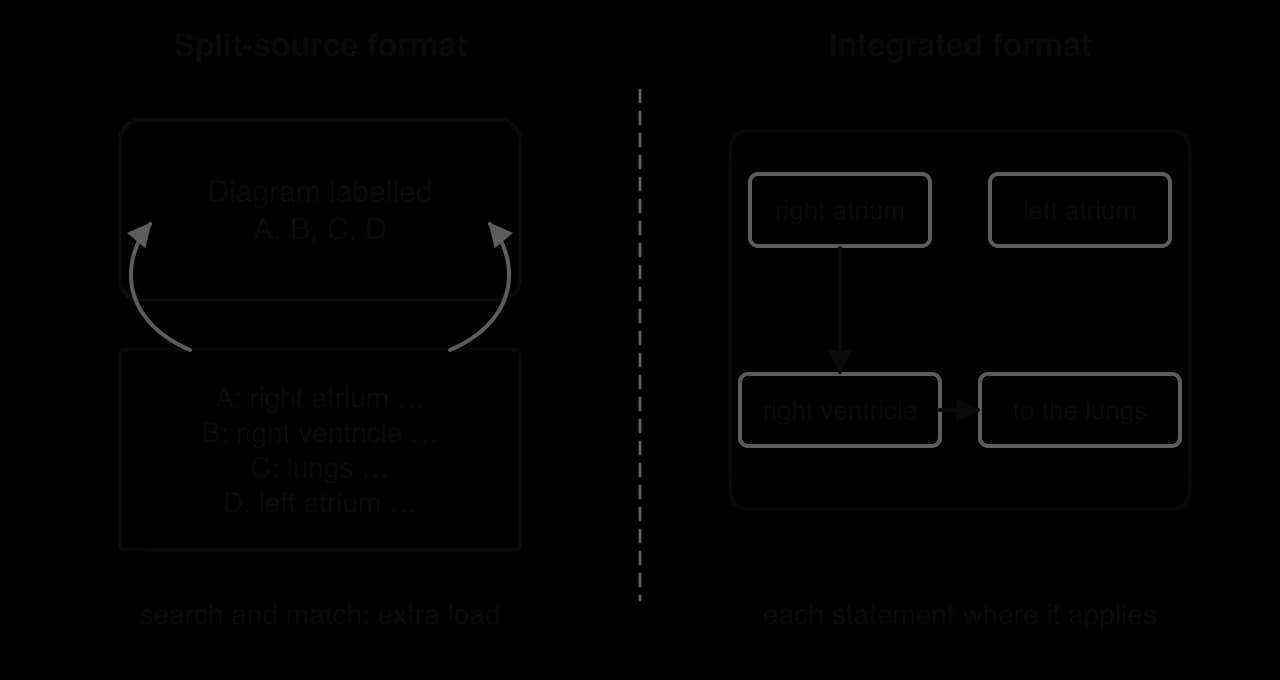
The same experiments by Chandler and Sweller (1991) found something less obvious. When a diagram was understandable on its own, adding a text that repeated its information made learning worse, even when the text was integrated into the diagram. Learners processed the extra text anyway, and this used capacity without adding anything new. This is the redundancy effect. Reading aloud a slide that students can read for themselves is an everyday example of it.
Mousavi, Low and Sweller (1995) reported six experiments in which school students studied geometry worked examples. Students who saw a diagram while hearing the explanation learned more than students who saw the diagram and read the same explanation, a result known as the modality effect. The explanation draws on the working memory model: visual and verbal information are handled partly by separate subsystems (the visuospatial sketchpad and the phonological loop), so using both channels spreads the load and increases the effective capacity of working memory.
The modality effect has limits. When a spoken explanation is long, it disappears as soon as it is heard and must be held in working memory, whereas written text can be reread. For long or complex explanations, written text can therefore be better than speech.
Kalyuga, Ayres, Chandler and Sweller (2003) named the expertise reversal effect after reviewing experiments showing that techniques which help novices often stop helping, and can harm learning, as learners gain knowledge. Worked examples, integrated explanations and extra guidance all reduce extraneous load for a novice. For a more knowledgeable learner who already has the relevant schemas, the same guidance is redundant: it must still be read and checked against what the learner knows, so it becomes extraneous load.
The expertise reversal effect is one of the most important refinements of the theory, because it shows that no presentation is best for everyone. The right amount of guidance depends on the learner’s existing schemas, which is why the theory recommends fading worked examples as learners improve.
Effect | What it predicts | Explanation in terms of load |
|---|---|---|
Worked example | Novices learn more from studying worked examples than from solving the same problems | Means–ends problem solving uses working memory for search, not for building schemas |
Split attention | Integrated text and diagrams lead to better learning than separate ones | Searching between sources and combining them mentally adds extraneous load |
Redundancy | Removing information that repeats what is already clear improves learning | Processing unnecessary repetition uses capacity without adding information |
Modality | A diagram with spoken explanation beats a diagram with written explanation | Visual and auditory channels together increase effective working memory capacity |
Expertise reversal | Guidance that helps novices does not help, or harms, more expert learners | For experts, guidance duplicates existing schemas and becomes extraneous load |
Cognitive load theory began in mathematics and science teaching, but its central idea, that overloaded working memory produces poorer performance, applies wherever people must process new information under pressure.
Sana, Weston and Cepeda (2013) asked Canadian university students to attend a simulated lecture while taking notes on laptops. Students who were told to complete unrelated online tasks during the lecture scored lower on a later comprehension test than students who only took notes. In a second experiment, students who could see a peer multitasking on a laptop also scored lower than students who could not, although they had not multitasked themselves. In load terms, the online tasks and the distracting screen both added extraneous load that competed with processing the lecture.
Strayer and Johnston (2001) gave American students a simulated driving task. Listening to the radio or to a book did not affect performance, but holding a conversation on a mobile phone, whether hand-held or hands-free, doubled the rate at which participants failed to notice simulated red lights and slowed their reactions to the lights they did notice. Because hands-free phones had the same effect, the load appears to come from the conversation itself, which competes for limited cognitive resources. The finding is widely cited in debates about hands-free phone use while driving.
Working memory capacity is not fixed across the lifespan. Gathercole, Pickering, Ambridge and Wearing (2004) tested children aged 4 to 15 on tasks measuring each component of the working memory model and found that each component expanded steadily through childhood into adolescence. Because capacity is smaller in younger children, the same task imposes a heavier load on a seven-year-old than on a fifteen-year-old, which is one reason why instruction for young children must break material into smaller steps.
Gilbert, Pelham and Krull (1988) asked American students to watch a woman who appeared anxious while discussing anxiety-provoking topics. Students who were not busy took the situation into account and judged her as less anxious by nature; students who had to perform an extra memory task while watching did not correct for the situation and judged her as an anxious person. Correcting a first impression appears to need working memory capacity, so people under cognitive load are more likely to blame another person’s character than their circumstances, a pattern relevant to misunderstandings in relationships.
Cognitive load is a construct: it cannot be observed directly and has to be inferred from something that can be measured. How it is operationalised matters, because each measure captures a different aspect of load and has its own weaknesses.
Method | How it works | Strengths | Limitations |
|---|---|---|---|
Subjective rating | After a task, learners rate the mental effort they invested, for example on the 9-point scale developed by Paas (1992), from “very, very low” to “very, very high” mental effort | Quick and cheap; sensitive to differences between conditions; widely used, so results can be compared across studies | Self-reported data; one overall number cannot separate intrinsic from extraneous load; ratings may reflect motivation or what learners think the researcher expects |
Dual-task (secondary task) performance | Learners respond to a second simple signal (a tone, a colour change) while learning; slower responses indicate that the main task is using more capacity | Objective; measured during learning rather than afterwards | The secondary task itself adds load and may interfere with learning |
Physiological measures | Pupil size, heart-rate variability, EEG activity or eye movements recorded during the task | Continuous and not dependent on self-report | Expensive; also affected by emotion, arousal and light, not only by load |
Performance and efficiency | Test scores combined with effort ratings: high scores with low effort indicate efficient instruction | Links load directly to learning outcomes | Indirect; good performance may reflect prior knowledge rather than lower load |
The dual-task technique has a long history in memory research, and its logic is the same as in experiments on the working memory model: if two tasks compete for the same limited resource, performance on one falls when the other becomes harder. Subjective ratings are by far the most common measure in cognitive load research, which is a weakness, because a theory whose main variable is usually measured by a single self-rating is hard to test precisely.
Most early research on cognitive load theory used Australian students. This series of experiments tested two of its central predictions, the worked example effect and the expertise reversal effect, with primary and secondary-school students in Chengdu, China, and asked whether the level of element interactivity decides when guidance helps.
To test whether the benefit of worked examples depends on how complex the material is (its element interactivity) and on how much the learners already know, as cognitive load theory predicts.
The research comprised five experiments with the same 2 × 2 design. Two of them were published as Chen, Kalyuga and Sweller (2015), and all five are reported in Ouhao Chen’s doctoral thesis (2016), the source of the results reported. The first independent variable was the level of guidance: high (studying worked examples) or low (solving problems without help). The second was the level of element interactivity of the material: low (memorising separate geometry formulae) or high (calculating the area of composite shapes, which requires many steps to be combined). Students were randomly allocated to conditions within their school.
Experiments 1 to 3 used the same kind of geometry material with students of increasing expertise: 41 Grade 4 students aged about 10, who had never been taught to solve such problems; 50 Grade 6 students aged about 12; and 38 Grade 7 students aged about 13, who had been taught to solve them about a year earlier. A few students who did not complete the procedure were excluded, leaving 33, 47 and 36 students in the analyses.
Each phase lasted one class period. In the high-element-interactivity phase, all students first studied a booklet of formulae for 10 minutes. The worked example group then studied two worked examples, each followed by a similar problem to solve, while the problem-solving group solved the same four problems without examples. Finally, all students had 8 minutes to solve five test problems. The dependent variable was the percentage of marks gained on the test, with marks awarded for each correct step.
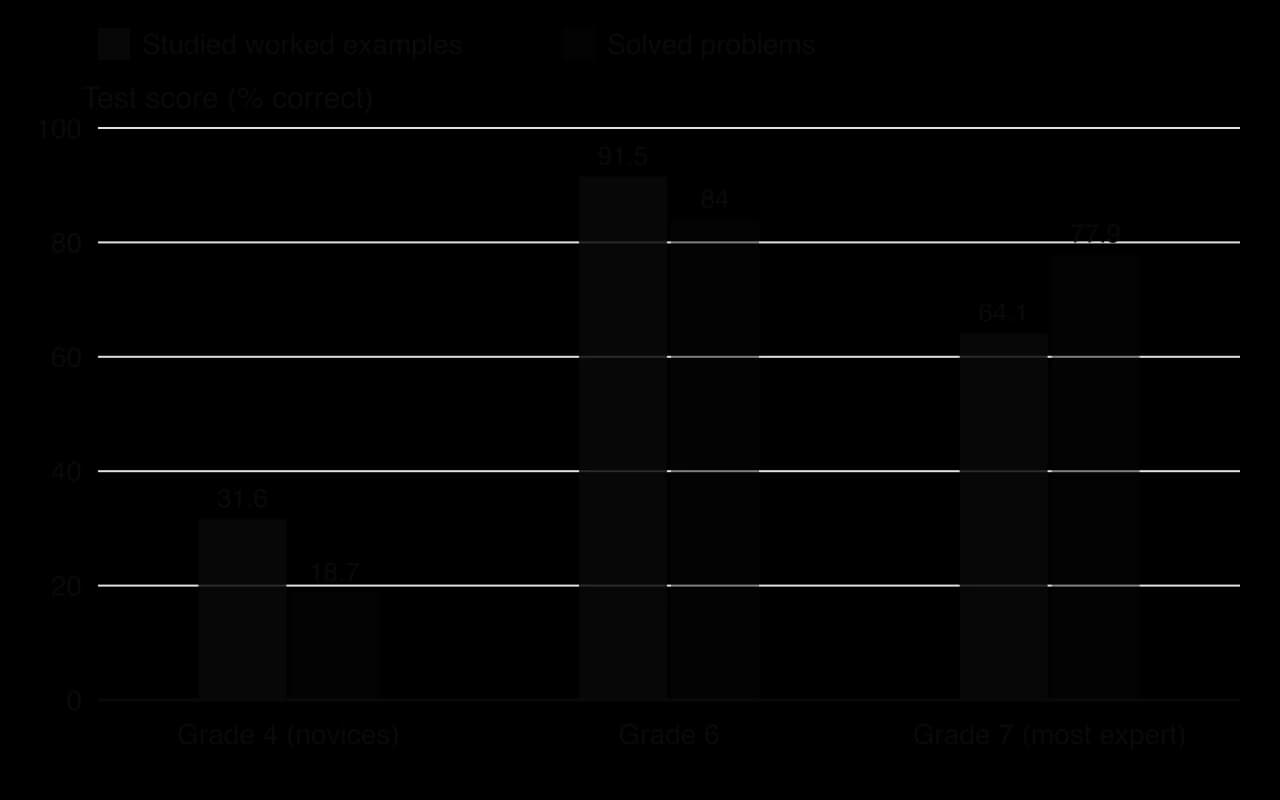
For the Grade 4 novices, students who studied worked examples scored 31.6% on the test, compared with 18.7% for those who solved problems, a significant worked example effect. In Grade 6 the advantage was smaller (91.5% against 84.0%). In Grade 7 the pattern reversed: students who had solved problems scored 77.9%, against 64.1% for those who studied worked examples.
For the low-element-interactivity material (memorising formulae), the pattern was different from the start. In all three experiments students who generated the formulae from memory recalled more than students who simply studied them again, so less guidance was better for simple material at every level of expertise. Experiments 4 and 5, with older students learning trigonometry, produced the same interaction on an immediate test and on a delayed test.
Worked examples help when material is high in element interactivity for the learner. As students gain knowledge, the same material imposes less intrinsic load, worked examples become redundant, and problem solving becomes the better way to learn. The results support both the worked example effect and the expertise reversal effect, and they explain why research on other kinds of material sometimes finds that less guidance is better.
Causality. Random allocation and a standardised procedure allow the differences in test scores to be attributed to the type of guidance. The interaction between guidance and expertise across experiments is stronger evidence than a single comparison, because it is the specific pattern the theory predicts, and the replication with older students and a delayed test adds weight.
Measurement. Cognitive load was not measured directly. Element interactivity was estimated by the researchers counting how many elements a task involved, and the role of load was inferred from test scores. In several of the experiments, one test question was dropped from the analysis after the data were collected to improve the test’s reliability, a reasonable statistical step but one that gives researchers some flexibility in how results are analysed.
Bias. The samples were small (about 16 to 25 students per condition), and the comparisons between grades used intact year groups that differed in age and teaching as well as in expertise. The research was carried out by the developers of the theory, so independent replications are important. On the other hand, a Chinese sample in ordinary schools extends a body of evidence that came mostly from one country.
Sources: Chen, O., Kalyuga, S., & Sweller, J. (2015). The worked example effect, the generation effect, and element interactivity. _Journal of Educational Psychology, 107(3), 689–704. Chen, O. (2016). The worked example effect, the generation effect, and element interactivity (doctoral thesis, University of New South Wales), which reports all five experiments and is the source of the figures._
Cognitive load theory has generated hundreds of experiments and has had a large influence on teaching, especially in mathematics and science. Its strengths and weaknesses are clearest when it is viewed through the concepts.
Most evidence for the theory comes from true experiments in which two versions of the same material are given to randomly allocated groups. Because only the presentation differs, differences in learning can be attributed to it. The effects have been replicated across many subjects and countries, and the theory predicted some results, such as the redundancy and expertise reversal effects, that were not obvious beforehand.
What the experiments establish, though, is that one format leads to better learning than another. The claim that cognitive load is the cause is an inference. Other differences between materials, such as how interesting or clear they are, could contribute, and only studies that measure load directly can rule them out.
De Jong (2010) argued that the theory’s central constructs are difficult to measure separately. A single effort rating cannot show whether load was intrinsic, extraneous or germane, and if a result is explained after the event as “high germane load” or “high extraneous load”, the theory becomes hard to falsify. The 2019 revision, which removed germane load as a separate source, was partly a response to this criticism.
Different measures of load also do not always agree. A participant may rate a task as easy while their pupils dilate, or perform well while reporting high effort. This is a problem of construct validity: it is not clear that the measures capture one underlying construct.
Most of the original research was conducted by one group of researchers, with students in Australia, learning well-structured material that has one correct answer, such as algebra, geometry and electrical circuits, usually over a single short session with an immediate test. It is less clear that the effects hold for open-ended tasks such as writing an essay or designing an experiment, or for learning measured weeks later. Research in other settings, such as Chen and colleagues’ experiments in China, broadens the evidence, but the theory’s reach outside structured subjects remains less tested.
Cognitive load theory explains learning through the capacity of working memory alone. It says little about motivation, emotion, interest or the social setting of a classroom, all of which affect whether a learner invests effort at all. A theory that reduces learning to the management of a limited store is a form of reductionism, useful for designing materials but incomplete as an account of why students learn.
Some researchers also disagree with its preference for strong guidance. Kirschner, Sweller and Clark (2006) argued, on cognitive load grounds, that minimally guided discovery learning is inefficient for novices. Research on “productive failure” in Singapore schools suggests a qualification: Kapur and Bielaczyc (2012) found that Grade 7 mathematics students who first struggled with complex problems on their own and then received teacher-led instruction outperformed students taught by direct instruction from the start. One interpretation is that early struggle can prepare learners to benefit from later explanation, a finding that cognitive load theory does not easily predict.
The theory has had a direct effect on teaching. Worked examples with fading, labelled diagrams, explanations spoken over visuals rather than read from slides, and removing decorative clutter are now common recommendations for teachers and designers of educational software. Because its predictions are concrete, schools can test them in their own classrooms, and the expertise reversal effect warns against applying them in the same way to every learner.
Concept | How it applies to cognitive load theory |
|---|---|
Measurement | Load is a construct inferred from self-ratings, secondary tasks or physiology; the measures can disagree, and germane load proved especially hard to measure |
Causality | Randomised experiments show that one format causes better learning; that load is the mechanism is an inference |
Bias | Much of the evidence comes from one research group, well-structured subjects, short sessions and immediate tests |
Perspective | A cognitive, working-memory explanation that leaves out motivation, emotion and social context |
Change | Clear, cheap design principles that have changed classroom practice and educational software |
Cognitive load theory is an approach term, so it can appear in Paper 1 Section A as a short-answer question with no context given, and in Paper 1 Section B as the theory to apply to an unseen scenario from any of the four contexts. Its evaluation is useful in Paper 1 Section C essays on learning and cognition, especially on measurement and change.
Cognitive load theory explains learning through a small, short-lived working memory and an effectively unlimited long-term memory that stores knowledge as schemas.
Learning is the construction and automation of schemas; it fails when the cognitive load of a task exceeds working memory capacity.
Intrinsic load comes from the complexity (element interactivity) of the material relative to the learner; extraneous load comes from poor presentation; germane load, now treated as part of intrinsic processing, is capacity spent on building schemas.
The theory predicts the worked example, split-attention, redundancy and modality effects, each tested by comparing two versions of the same material.
The expertise reversal effect shows that guidance which helps novices can hinder experts, so load depends on the learner as well as the material.
Chen, Kalyuga and Sweller (2015) found that worked examples helped Grade 4 novices in China (31.6% vs 18.7%) but not more knowledgeable Grade 7 students (64.1% vs 77.9%).
Load is a construct measured by effort ratings, secondary tasks or physiology, and the measures do not always agree.
The theory has a strong experimental base and has changed teaching practice, but it is based mainly on structured tasks and short sessions, and it leaves out motivation and emotion.
I can describe the assumptions about working memory and long-term memory on which cognitive load theory is built.
I can explain intrinsic, extraneous and germane load and how the theory has been revised.
I can explain the worked example, split-attention, redundancy, modality and expertise reversal effects.
I can describe how cognitive load is measured and explain why it is difficult to measure.
I can describe the aim, method, results and conclusions of Chen, Kalyuga and Sweller (2015).
I can apply cognitive load theory to examples from learning, health, development and relationships.
I can evaluate cognitive load theory with reference to measurement, causality, bias, perspective and change.