 YouTube
Explain what a cognitive model is and how models are built and tested, describe and evaluate the multi-store and working memory models, and apply them to behaviour in several contexts.
Each is in the Psychology glossary, with every other term in the subject.
A research technique in which participants repeat an irrelevant sound, such as “the, the, the”, to block subvocal rehearsal in the phonological loop.
The component of the working memory model that directs attention, coordinates the other components and switches between tasks; it has limited capacity and stores no information itself.
A strategy of grouping separate items into larger meaningful units, so that more information can be held within the limited capacity of short-term memory.
A simplified representation of a cognitive process, usually drawn as components linked by the flow of information, used to explain the process, generate testable hypotheses and make predictions.
A pattern of results in which one factor affects process A but not process B, while a second factor affects B but not A, which is evidence that the two processes are separate.
A research method in which participants perform two tasks at once; if performance falls, the tasks are assumed to compete for the same limited-capacity component.
The process of converting information into a form that can be stored in memory, for example as sounds (acoustic encoding) or meanings (semantic encoding).
Describe what a cognitive model is and explain why psychologists use models to study cognitive processes.
Explain how cognitive models are built, tested and revised, with reference to research methods and evidence.
Describe the multi-store model of memory, including the features of each store and the processes that link them.
Describe the working memory model and the function of each of its components.
Evaluate the multi-store and working memory models using research evidence.
Compare and contrast the multi-store and working memory models.
Discuss the value and limitations of cognitive models with reference to the concepts of measurement and perspective.
Apply a cognitive model to explain behaviour in an unfamiliar situation.
A cognitive model is a simplified description of how a mental process such as memory or attention works, usually drawn as a set of components with arrows showing how information moves between them. Models matter because cognitive processes cannot be seen directly: a model turns an invisible process into something that can be described, tested against evidence and used to solve practical problems, from teaching children to read to helping patients after brain injury.
Cognitive models are the central tool of the cognitive approach, which explains behaviour through the mental processes that come between a stimulus and a response. They raise questions of measurement, because the components of a model are inferred from behaviour rather than observed, and of perspective, because describing the mind as an information-processing system leaves out biological, emotional and cultural influences.
With a free account, Augment remembers where you stopped and what you have practiced.
The component added to the working memory model by Baddeley (2000): a limited-capacity store that combines information from the other components and long-term memory into integrated episodes.
A view of cognition that treats the mind as a system that takes in, transforms, stores and retrieves information in stages, often by analogy with a computer.
A memory store that holds information for periods from minutes to a lifetime, with a capacity that is practically unlimited.
A model of memory proposed by Atkinson and Shiffrin (1968) in which information passes through three separate stores, sensory memory, short-term memory and long-term memory, linked by attention, rehearsal and retrieval.
The component of the working memory model that holds speech-based information, made up of a phonological store (inner ear) and an articulatory rehearsal process (inner voice).
The repetition of information in short-term memory, which keeps it active and, in the multi-store model, transfers it to long-term memory.
The process of bringing stored information back into conscious awareness when it is needed, for example by recall or recognition.
A memory store that holds a brief, unprocessed copy of input from each sense for a fraction of a second to a few seconds, with a large capacity.
The tendency to recall items at the start of a list (primacy effect) and at the end of a list (recency effect) better than items in the middle.
A memory store of limited capacity, about five to nine items, that holds information for up to about 18–30 seconds unless it is rehearsed.
The component of the working memory model that holds and manipulates visual and spatial information, such as images, shapes and the layout of a space.
The finding that people recall fewer long words than short words from a list, because the phonological loop holds only as much as can be said in about two seconds.
A model of short-term memory proposed by Baddeley and Hitch (1974) that divides it into a central executive controlling a phonological loop, a visuospatial sketchpad and, from 2000, an episodic buffer.
Psychologists use the word “model” for a simplified representation of a complex process. A model of memory claims that memory behaves as if it were organised in a particular way, for example as three stores joined by arrows, so that the model can explain what people remember and forget and can predict what they will do in new situations.
A model is narrower than a theory. A theory is an organised set of principles that explains a wide range of behaviour; a model usually describes the structure or steps of one process. The two are closely linked, because a theory of memory is often expressed as a model of memory, and a model is judged by the same standard as a theory: whether its predictions are supported by evidence.
Most cognitive models come from the information processing approach, which developed in the 1950s and 1960s alongside the first computers. It treats the mind as a system that receives input from the senses, transforms it, stores it and produces output in the form of behaviour. Like a computer, the mind is thought to have stores of limited capacity and processes that move information from one store to another in a fixed order.
Computer | Human mind (information-processing view) |
|---|---|
Input from a keyboard or camera | Input from the senses (sights, sounds, touch) |
Processing by the central processor | Attention, encoding, comparison with stored knowledge |
Temporary storage in working memory (RAM) | Short-term memory or working memory |
Permanent storage on a hard drive | Long-term memory |
Output to a screen or printer | Behaviour: speech, writing, action |
The computer analogy was useful because it gave psychologists a precise vocabulary (input, storage, capacity, retrieval) for processes that had previously been described only vaguely. It also has clear limits. Human memory is not a perfect record: people forget, reconstruct and distort what they store, they process many things in parallel rather than one step at a time, and their thinking is shaped by emotion, motivation and culture in ways no computer is.
YouTubeCognitive models do four jobs. They describe a process in a form that can be communicated and compared. They explain existing findings, such as why people remember the first and last items of a list better than the middle ones. They predict what should happen in a new situation, which makes them testable. They guide applications, such as how to present information in a classroom or how to assess memory after brain damage.
The testing role is the most important. A model that predicts nothing cannot be shown to be wrong, so it cannot be improved. A model that makes specific predictions can be supported or challenged by research, and the challenges are often the most useful results, because they show which part of the model needs to change.
Models are built from existing findings and then tested in a cycle. Researchers propose components and processes that would explain what is already known, derive a hypothesis about something not yet tested, test it, and then keep, revise or abandon the model. The working memory model began in exactly this way: evidence that did not fit a single short-term store led Baddeley and Hitch to split it into several components.

Because the components of a model cannot be observed, researchers test them indirectly. Four kinds of evidence are common:
Laboratory experiments manipulate one variable and measure memory or attention. If a delay removes one effect but leaves another unchanged, the two effects probably depend on different components.
Case studies of brain-damaged patients show whether one ability can be lost while another survives. A patient with intact long-term memory but very poor short-term memory, for example, suggests the two are separate.
The dual-task technique asks participants to do two tasks at once. If the tasks interfere with each other, they are assumed to share a component; if they do not, they are assumed to use different ones.
Brain imaging shows whether tasks thought to use different components activate different brain areas.
The strongest evidence that two components are separate is a double dissociation. This occurs when one factor affects process A but not process B, while a second factor affects B but not A. A single dissociation can arise because one task is simply harder than the other; a double dissociation rules this out, because each task is affected by something that leaves the other untouched.
The multi-store model was proposed by Atkinson and Shiffrin (1968). It describes memory as three separate stores that information passes through in a fixed order: sensory memory, short-term memory and long-term memory. Each store has its own capacity (how much it holds), duration (how long it holds it) and form of encoding (the code in which information is held). Information moves between stores through attention, rehearsal and retrieval.
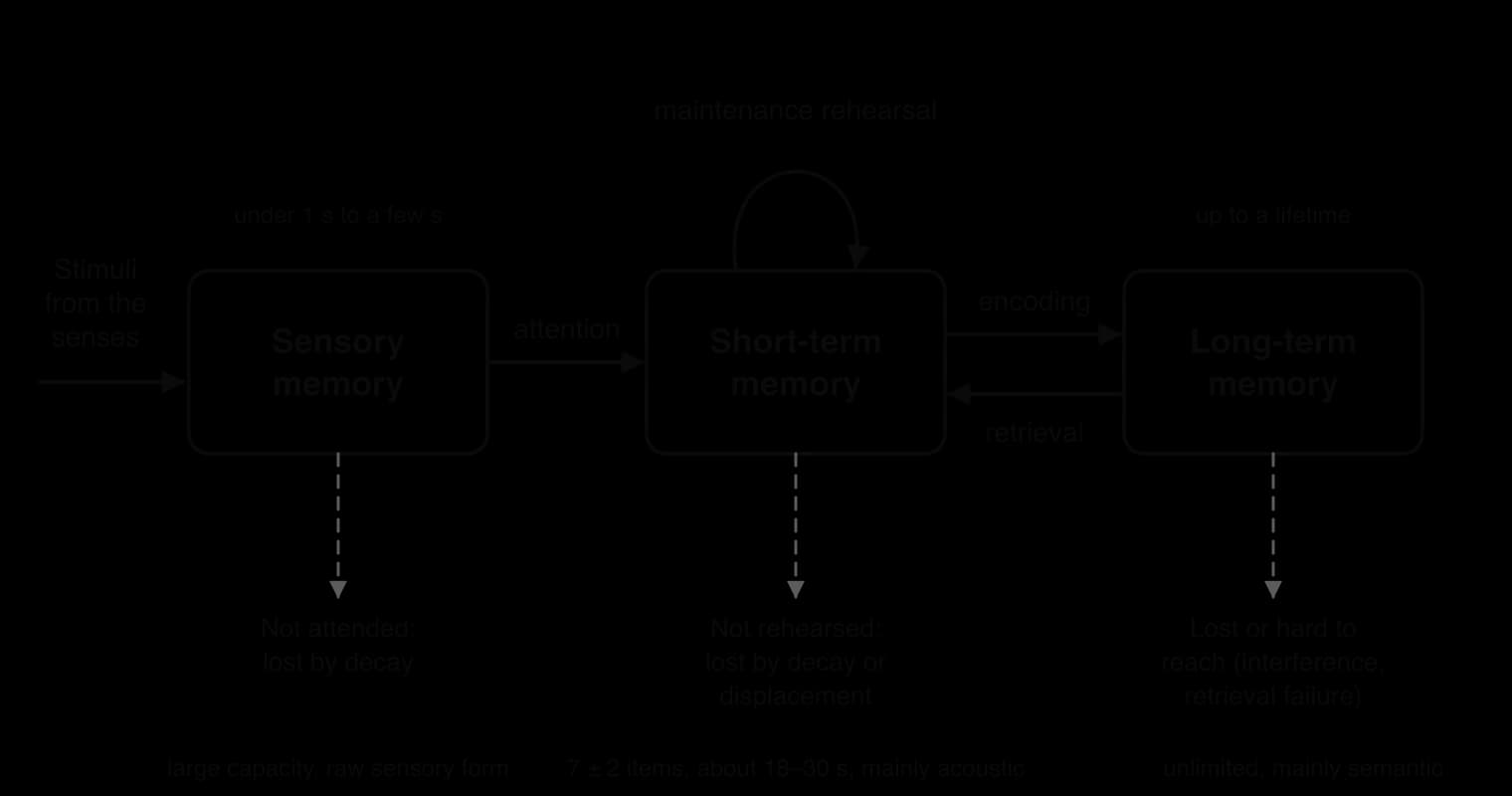
The model shows information entering from the senses on the left. Only what is attended to passes into short-term memory; only what is rehearsed there is encoded into long-term memory; and stored information is used by retrieving it back into short-term memory. The dashed arrows show that each store loses information in its own way.
Sensory memory holds a brief, unprocessed copy of everything the senses take in. There is a separate sensory store for each sense: iconic memory for vision and echoic memory for hearing are the best studied. Capacity is very large, but the information fades within a fraction of a second (iconic) to a few seconds (echoic) unless it is attended to.
In a study by Sperling (1960), participants saw a grid of 12 letters for about 50 milliseconds. Asked to report the whole grid, they recalled only about four or five letters. When a tone played just after the grid told them which single row to report, they could recall most of that row, whichever row was cued. This shows that almost the whole grid was briefly available in sensory memory, but it faded before more than a few letters could be reported.
Short-term memory holds the small amount of information a person is aware of at a given moment, such as a phone number being dialled. It differs from sensory memory in all three features.
Capacity. Miller (1956) reviewed research on memory span and concluded that people can hold about seven items, plus or minus two. Later work, notably by Cowan (2001), suggests the true limit is closer to four meaningful units once people are prevented from grouping items.
Duration. Peterson and Peterson (1959) showed students three-consonant trigrams (such as KTD) and then made them count backwards in threes to prevent rehearsal. Recall was good after 3 seconds but fell to about 10% after 18 seconds, which suggests that unrehearsed information is lost from short-term memory within about 18–30 seconds.
Encoding. In a study by Baddeley (1966), lists of words that sound alike (cat, cab, can) were harder to recall immediately than lists of words with similar meanings, but after a delay the pattern reversed. This suggests short-term memory mainly uses an acoustic (sound-based) code and long-term memory a semantic (meaning-based) one.
The limit of short-term memory is measured in units, not in letters or digits, and people can enlarge the units. Chunking is grouping separate items into a larger meaningful unit: the twelve letters FBIBBCUSAIBM are hard to hold, but as four familiar acronyms (FBI, BBC, USA, IBM) they take up only four places. Chunking depends on knowledge already in long-term memory, a point that later becomes a problem for the model.
Information leaves short-term memory in two ways. It may decay, fading with time if it is not rehearsed, or it may be displaced, pushed out by new items when the store is full. Peterson and Peterson interpreted their results as decay, but Keppel and Underwood (1962) argued that earlier trigrams interfered with later ones, so the same results could reflect interference rather than time alone.
Long-term memory holds information for anything from a few minutes to a lifetime, and its capacity appears to be unlimited. Bahrick et al. (1975) tested people aged 17 to 74 on the names and faces of their high-school classmates: recognition of faces was about 90% accurate 15 years after leaving school and still about 70–80% after nearly 50 years. Encoding in long-term memory is mainly semantic, although sounds, images and skills are also stored.
Forgetting from long-term memory is usually explained as interference from other memories or as retrieval failure, where the information is stored but cannot be found without the right cue. In the multi-store model, long-term memory is a single store; later research divided it into several types, a point developed in the evaluation of the model.
Three processes move information through the model. Attention selects which part of sensory memory enters short-term memory. Rehearsal keeps information active in short-term memory and, in the original model, is the main route into long-term memory: the longer an item is rehearsed, the stronger its long-term trace. Retrieval brings stored information back into short-term memory when it is needed.
Feature | Sensory memory | Short-term memory | Long-term memory |
|---|---|---|---|
Capacity | Very large | About 7 ± 2 items (perhaps 4 chunks) | Practically unlimited |
Duration | Under 1 s (iconic) to a few s (echoic) | About 18–30 s without rehearsal | Minutes to a lifetime |
Main encoding | Raw sensory form | Acoustic | Semantic |
How information is lost | Decay if not attended to | Decay or displacement | Interference or retrieval failure |
Key evidence | Sperling (1960) | Miller (1956); Peterson and Peterson (1959) | Bahrick et al. (1975) |
 YouTube
The model’s central claim is that short-term and long-term memory are separate stores. The serial position effect supports this: in free recall of a list, the first items (the primacy effect) and the last items (the recency effect) are remembered better than the middle ones. The model explains the primacy effect as early items receiving more rehearsal and reaching long-term memory, and the recency effect as the last items still being in short-term memory at the moment of recall. Glanzer and Cunitz (1966) tested this explanation directly, as described in the key study.
Brain damage gives a second line of evidence. Henry Molaison, known in research as H.M., had large parts of both medial temporal lobes, including the front part of the hippocampus, removed in 1953 to treat severe epilepsy. Afterwards his short-term memory was normal, but he could not form new long-term memories of facts or events. This dissociation fits the claim that the two stores are separate and that transfer between them depends on the hippocampus.
The model’s first problem is that short-term memory is not a single store. Shallice and Warrington (1970) studied a patient, KF, whose brain injury left him with a digit span of about two items for spoken material, yet his long-term learning was largely intact and his memory for visually presented material was much better. If information can only reach long-term memory through a single short-term store, KF should not have been able to learn normally. His case suggests that short-term memory has separate parts for different kinds of information.
A second problem is that rehearsal is neither necessary nor sufficient for long-term storage. People remember many events they never rehearsed, such as a frightening near-accident, and forget much of what they repeat. The levels of processing model proposed instead that how deeply information is processed, especially for meaning, matters more than how long it is repeated.
A third problem is that long-term memory is not one store. Researchers now distinguish procedural memory (skills) from declarative memory (facts and events), which itself includes episodic memory (personal events) and semantic memory (general knowledge). H.M. and the musician Clive Wearing, who lost the ability to form new episodic memories after a brain infection in 1985 but could still play the piano and conduct, both kept procedural memory while losing declarative memory.
Finally, the flow of information is not one way. Chunking letters into FBI and BBC requires knowledge from long-term memory while the letters are still in short-term memory, so long-term memory must influence short-term memory from the start rather than only at retrieval. Much of the supporting evidence also comes from laboratory tasks with lists of unrelated words or consonant trigrams, which say little about how people remember conversations, stories or skills.
Baddeley and Hitch (1974) proposed the working memory model to replace the single short-term store of the multi-store model. Their starting point was that short-term memory serves as a workspace for reasoning, understanding language and solving problems, as well as holding information on its way to long-term memory. They called this active workspace “working memory” and divided it into components that can work at the same time.
In their early dual-task studies, Baddeley and Hitch asked participants to hold a list of up to six spoken digits while answering reasoning questions about the order of two letters (for example, true or false: “A is followed by B — BA”). If short-term memory were a single store of about seven items, a six-digit load should have filled it and made reasoning almost impossible. Instead, reasoning slowed only modestly and errors stayed low. The digits and the reasoning task seemed to draw on partly separate resources, which a single short-term store could not explain.
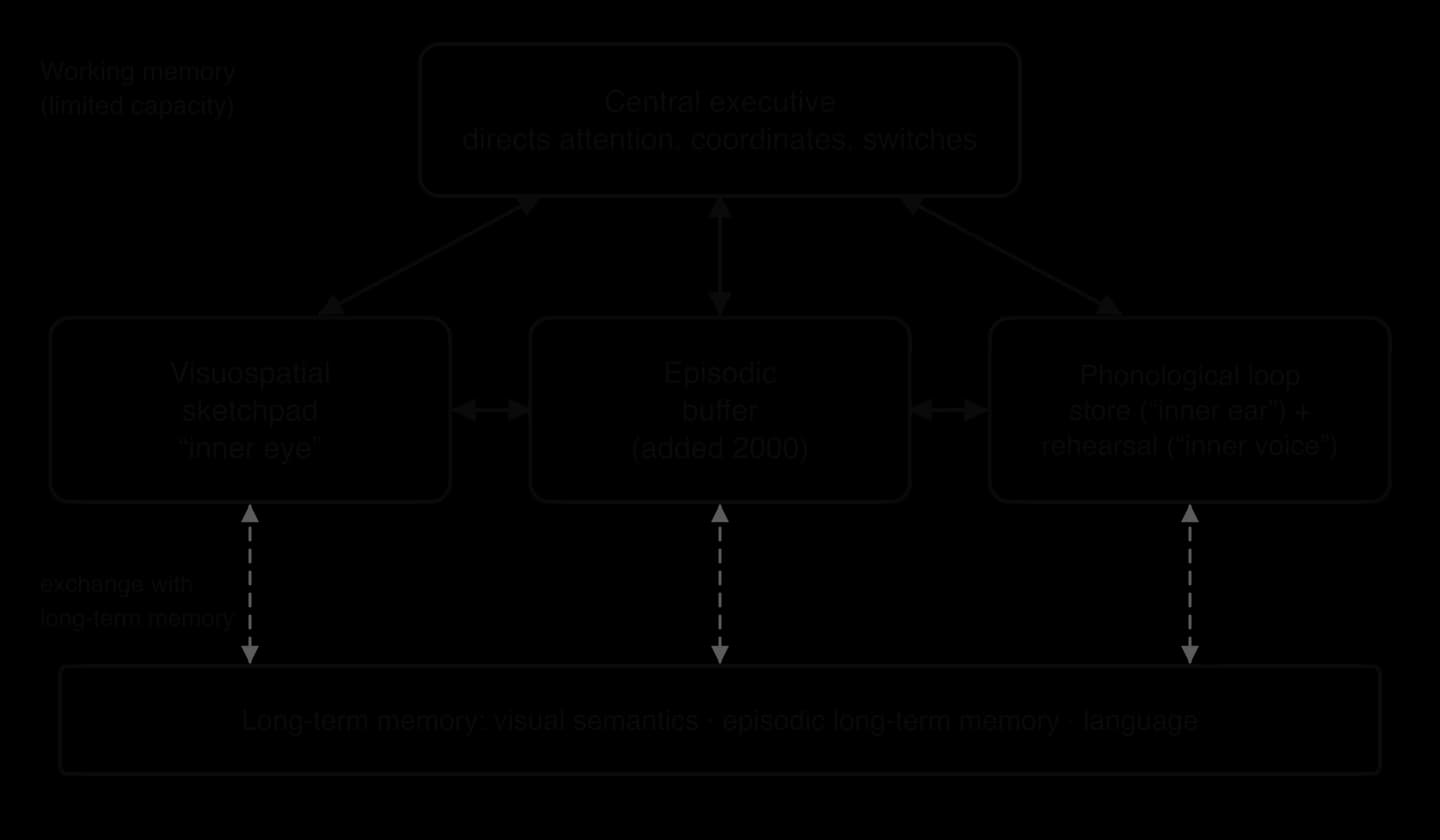
The central executive is at the top of the model. It directs attention to the task in hand, allocates the limited resources of the other components, switches between tasks and links working memory to long-term memory. It has very limited capacity and stores no information itself.
The phonological loop holds speech-based information. It has two parts: a phonological store (the “inner ear”), which holds sounds for about two seconds, and an articulatory rehearsal process (the “inner voice”), which repeats them silently to keep them active. Written words are converted into sound by the inner voice so they can enter the store.
The visuospatial sketchpad (the “inner eye”) holds and manipulates visual and spatial information, such as the layout of a room or the route to school. Logie (1995) later proposed that it has a visual part for shape and colour and a spatial part for location and movement.
The episodic buffer was added by Baddeley (2000), 26 years after the original model. The three original components could not explain how sounds, images and meanings are combined into a single experience, or how some patients with dense amnesia could recall a long prose passage immediately, far beyond the capacity of the phonological loop. The buffer is a limited store, holding about four chunks, that binds information from the other components and long-term memory into integrated episodes.
The word-length effect is the best-known support for the phonological loop. Baddeley, Thomson and Buchanan (1975) found that participants recalled lists of short words (such as yield, brake) better than lists of long words (such as university, operation). The effect remained when the words had the same number of syllables but took longer to say, and people recalled about as many words as they could say in about two seconds. This fits a loop whose capacity is set by speaking time, not by the number of items.
Articulatory suppression tests the rehearsal process directly. Participants repeat an irrelevant word such as “the, the, the” while learning a list, which occupies the inner voice. Under suppression the word-length effect disappears for written lists, because written words can no longer be converted into sound and rehearsed; Baddeley, Thomson and Buchanan (1975) reported this pattern in the same series of experiments. For spoken lists, which enter the phonological store directly, the effect largely remains. The pattern supports a loop with two separate parts: a store and a rehearsal process.
The phonological similarity effect points the same way. Conrad and Hull (1964) found that sequences of letters that sound alike, such as B, D, G, P, T, are harder to recall in order than letters that sound different, even when they are seen rather than heard. The confusions are about sound, which suggests that verbal information is held in a sound-based code.
The model predicts that two tasks using the same component interfere, while two tasks using different components do not. Baddeley and colleagues found that participants had difficulty following a moving spot of light (a spatial task) while picturing a block capital letter and tracing its corners in their mind, but much less difficulty when the second task was verbal. Dual-task studies of this kind are the main method used to separate the components.
KF is the clearest case evidence. His verbal short-term memory for spoken material was severely impaired while his memory for visual material was much better, which is what the working memory model predicts if the phonological loop is damaged and the visuospatial sketchpad is not. Brain imaging adds that verbal working-memory tasks mainly activate areas in the left hemisphere, while spatial tasks activate more of the right, and that executive tasks involve the frontal lobes.
The central executive is the weakest part of the model. It is defined by what it does (attention, coordination, switching) rather than by how it works, and its capacity has never been measured. Because almost any result can be explained by saying the central executive was “overloaded”, this part of the model is hard to test or falsify. Later research also suggests that executive functions, such as inhibiting a response and switching between tasks, can be impaired separately, so the executive may be several processes rather than one.
The episodic buffer was added to solve problems with the original model, which shows the model being revised by evidence, but its workings are still not well specified. The model also says little about long-term memory or sensory memory, so it is a model of short-term processing rather than of memory as a whole. Most supporting evidence comes from laboratory tasks with digits, letters and words, and from a small number of patients such as KF, whose damage may have affected more than one system.
The two models agree that there is a limited-capacity system for holding information over seconds, separate from long-term memory. They differ in how they describe that system and what they think it does.
Point of comparison | Multi-store model (1968) | Working memory model (1974, revised 2000) |
|---|---|---|
What it describes | The whole of memory, from senses to long-term storage | Short-term memory in detail; long-term memory only as a background store |
Short-term memory | One store, mainly acoustic | Several components: central executive, phonological loop, visuospatial sketchpad, episodic buffer |
Function of short-term memory | Passive holding stage on the way to long-term memory | Active workspace for reasoning, comprehension and problem-solving |
Route to long-term memory | Rehearsal | Not the model’s focus; links in both directions through the buffer |
Key evidence | Serial position effect; H.M.; Peterson and Peterson (1959) | Dual-task studies; word-length effect; articulatory suppression; KF |
Main weakness | Too simple: single short-term and long-term stores, rehearsal over-emphasised | Central executive vague and hard to test |
Models of memory were built in laboratories, but their value lies in what they explain outside them. The same way of thinking, breaking a process into components and testing each one, is used in all four contexts.
Clinical psychologists use cognitive models of mental health disorders. Beck’s cognitive model of depression proposes that negative beliefs about the self, the world and the future lead to biased processing of everyday events, which maintains low mood; therapy then targets the components of the model. Memory models are also used in neuropsychological assessment: dual-task tests based on the working memory model have shown that people with Alzheimer’s disease find it especially hard to do two tasks at once, even when each task alone is set at a level they can manage, which points to an impaired central executive.
Working memory capacity increases through childhood, and the phonological loop helps explain how children learn words. Children who are better at repeating unfamiliar non-words, a measure of phonological loop capacity, tend to learn new vocabulary more quickly, and the same link has been found in adults learning a second language. A model therefore helps to identify which component may be weak in a child who is struggling with language, rather than treating “poor memory” as a single problem.
In education, the limited capacity of working memory is the starting point of cognitive load theory, which recommends presenting material so that it does not overload the learner. A teacher who explains a diagram aloud, instead of printing long text beside it, spreads the information across the phonological loop and the visuospatial sketchpad. Models of attention, memory and decision-making are compared and evaluated in their own right in the learning and cognition context.
The idea of a limited-capacity working memory also helps explain everyday social behaviour. Holding a conversation while checking a phone draws on the same verbal and attentional resources, so one task suffers; people who are distracted in this way tend to remember less of what was said and respond less sensitively. The model explains why the two activities interfere, although the social effects themselves depend on many factors besides memory.
Cognitive models are judged in the same way as theories: by the quality of their evidence and by what they explain. The six concepts give a structured way to evaluate them.
They are testable. Each model makes specific predictions (rehearsal blocked → recency lost; two verbal tasks → interference), so evidence can support or challenge it.
They improve over time. The history from the multi-store model to the working memory model, and the later addition of the episodic buffer, shows models being revised when evidence does not fit.
They are useful. Models guide the assessment of brain-injured patients, the design of teaching materials and the planning of therapy.
They integrate different kinds of evidence. Experiments, case studies and brain imaging can all be used to test the same component, which allows triangulation.
No researcher can observe a short-term store or a central executive. Each component is inferred from performance on tasks such as recalling word lists or digit spans, so the conclusions depend on how memory has been operationalised. Recalling consonant trigrams or unrelated words is a precise and reliable measure, but it captures only a narrow kind of remembering, which limits the ecological validity of the models built on it. The central executive is especially hard to measure, because it is defined only by its effects.
The models take an information-processing perspective, describing the mind as a set of stores and processes. This makes them precise, but it is a form of reductionism: emotion, motivation and meaning are largely absent from the boxes and arrows, although they strongly affect what people remember. A biological perspective adds how memory is supported by brain structures such as the hippocampus, and a sociocultural perspective adds how what people remember, and how they talk about it, is shaped by culture.
Most research on memory models has used students and other adults from Western, educated, industrialised, rich and democratic societies (WEIRD samples) recalling lists in a laboratory. This raises a question of cultural bias about how far the models describe memory in general. Case studies such as H.M. and KF give strong evidence of separable systems, but a single patient’s damage is rarely limited to one structure, so they cannot show on their own that a particular component causes a particular ability.
Much of the key evidence comes from patients who could not easily refuse or fully understand what was being asked of them. H.M. took part in research for over 50 years, was identified only by his initials until his death in 2008, and in his later years consent for testing was also given on his behalf by a legal guardian. Such cases raise questions about informed consent and anonymity that researchers must weigh against the value of the knowledge gained.
Concept | How it applies to cognitive models |
|---|---|
Measurement | Components are inferred from task performance; narrow lab tasks give reliable but low-ecological-validity measures |
Perspective | The information-processing view is precise but reductionist; it leaves out emotion, biology and culture |
Bias | WEIRD samples and Western word-list tasks may limit how far the models generalise |
Causality | Experiments allow cause-and-effect conclusions about tasks; single case studies do not isolate one component |
Change | Models change as evidence accumulates (episodic buffer added in 2000) |
Responsibility | Key evidence comes from patients whose consent and privacy need special protection |
Glanzer and Cunitz aimed to test the multi-store model’s explanation of the serial position effect: that the primacy effect comes from long-term memory and the recency effect from short-term memory. If this is right, a variable that affects long-term storage should change the start of the curve but not the end, and a variable that affects short-term memory should change the end but not the start.
The study had two laboratory experiments, both with US Army enlisted men as participants, who were not randomly selected. The dependent variable in both was the proportion of words recalled at each position in the list, using free recall (participants wrote down the words in any order).
Experiment 1 (240 men) varied the rate of presentation. Lists of 20 common words were presented at one word every 3, 6 or 9 seconds, with some words repeated. A slower rate gives more time to rehearse each word, so it should strengthen long-term storage.
Experiment 2 (46 men) varied the delay before recall. Each man was shown fifteen 15-word lists, with a new word every 3 seconds. After each list, a signal told him to recall immediately, or to count aloud from a given number for 10 or 30 seconds before recalling. Counting blocks rehearsal, so it should empty short-term memory without affecting what is already in long-term memory.
Experiment | Independent variable | What the multi-store model predicts |
|---|---|---|
1 (240 participants) | Presentation rate: 3, 6 or 9 s per word | Slower rate → better recall of early and middle words (more rehearsal into long-term memory); last words unchanged |
2 (46 participants) | Delay before recall: 0, 10 or 30 s of counting | Delay → recency effect reduced or lost (short-term memory emptied); early words unchanged |
In Experiment 1, slower presentation improved recall of words from the beginning and middle of the list but made little difference to the last few words. In Experiment 2, immediate recall produced the usual U-shaped serial position curve. A 10-second delay reduced the recency effect, and after a 30-second delay it had disappeared, while recall of the early and middle words was essentially unaffected.
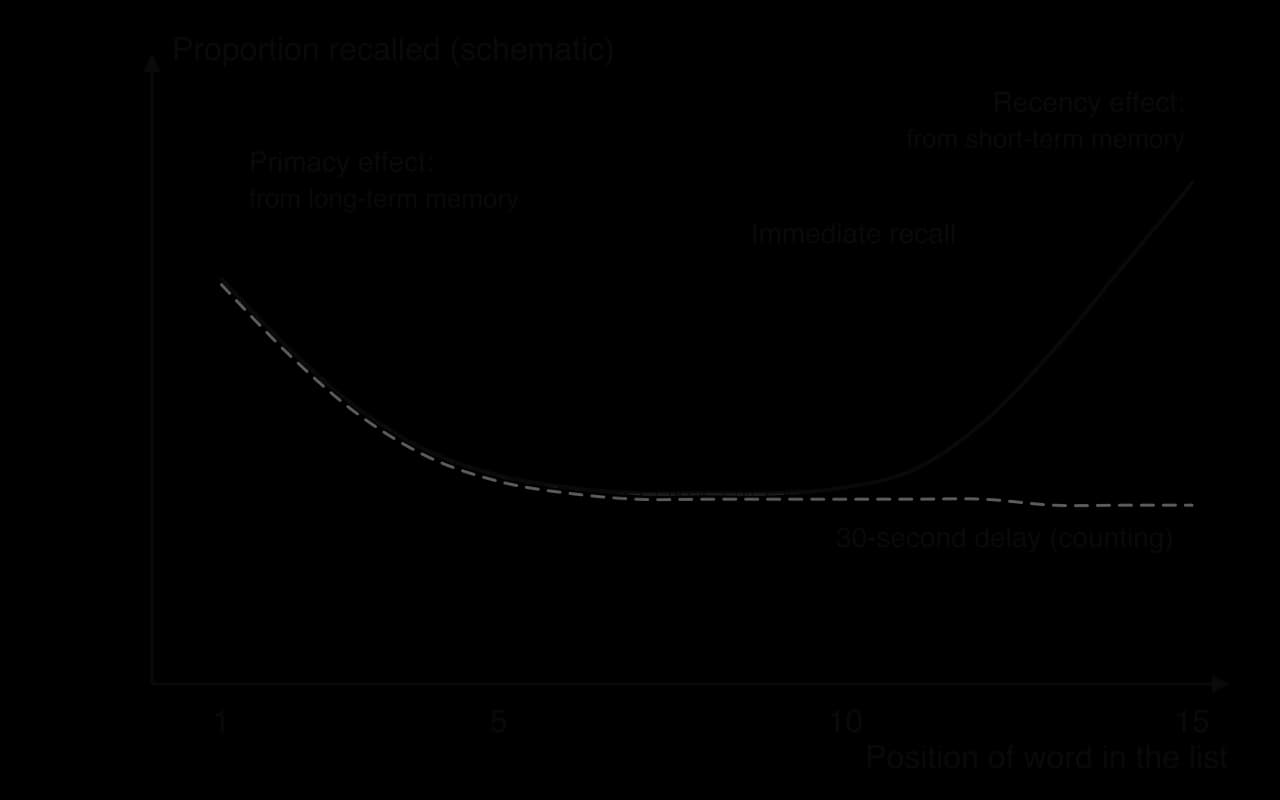
The two experiments together form a double dissociation. Presentation rate affected the primacy part of the curve but not the recency part; delay affected the recency part but not the primacy part. This is the pattern the multi-store model predicts if the two ends of the curve depend on two different stores.
Glanzer and Cunitz concluded that free recall draws on two storage mechanisms: a long-term store, which produces the primacy effect and benefits from rehearsal time, and a short-term store, which produces the recency effect and loses its contents within about 30 seconds if rehearsal is blocked. The study shows how a model can be tested by deriving a precise prediction and checking whether each part of the data behaves as predicted.
Both experiments manipulated one variable and held the materials and procedure constant, and each participant in Experiment 2 experienced every delay condition, so differences between the curves are unlikely to be due to individual differences. The double dissociation is stronger evidence than either result alone, because it rules out the explanation that one part of the curve is simply easier to disrupt.
Free recall of unrelated common words is a reliable, easily scored measure, but it is far from everyday remembering, which usually involves meaningful material such as conversations and stories. Counting aloud was used to block rehearsal, yet it may also have caused interference, so the loss of the recency effect could reflect interference as well as the emptying of a short-term store.
All participants were men from one US Army population, which limits how far the results generalise across genders, ages and cultures. Later research also found recency effects that the model cannot easily explain.
Sources: Glanzer, M., & Cunitz, A. R. (1966). Two storage mechanisms in free recall. _Journal of Verbal Learning and Verbal Behavior, 5(4), 351–360._
Cognitive models appear in Paper 1 in two ways. In Section A, a question may ask you to describe or explain a model, or the role of models, with reference to one example; no context is named, and the details of studies are not credited for their own sake. In Section B, a short unseen scenario from one of the contexts, often a study testing a new model, asks you to apply what you know about models to it.
A cognitive model is a simplified representation of a cognitive process, showing components and the flow of information, used to explain, predict and test.
Models come from the information-processing approach and its computer analogy, which gives precision but leaves out emotion, biology and culture.
Models are tested indirectly through experiments, case studies, dual-task studies and brain imaging; a double dissociation is the strongest evidence that two components are separate.
The multi-store model of Atkinson and Shiffrin (1968) has sensory, short-term and long-term stores linked by attention, rehearsal and retrieval, each with its own capacity, duration and encoding.
The working memory model of Baddeley and Hitch (1974) divides short-term memory into a central executive, phonological loop, visuospatial sketchpad and, from 2000, an episodic buffer.
Glanzer and Cunitz (1966) found that a 30-second delay removed the recency effect but not the primacy effect, supporting separate short-term and long-term stores.
KF, the word-length effect, articulatory suppression and dual-task studies support separate components of short-term memory; the central executive remains vague.
Both models rely on laboratory tasks and a few patients, which raises issues of measurement, ecological validity and cultural bias.
I can describe what a cognitive model is and explain why psychologists use models.
I can explain how a model is built, tested and revised, including what a double dissociation shows.
I can describe the multi-store model, with the capacity, duration and encoding of each store and the processes that link them.
I can describe the four components of the working memory model and what each does.
I can evaluate both models using research such as Glanzer and Cunitz (1966), KF and the word-length effect.
I can compare and contrast the two models point by point.
I can discuss cognitive models with reference to measurement and perspective.
I can apply a cognitive model to explain behaviour in an unfamiliar situation.