Paper 2: short and extended responses
How Paper 2 questions are structured and marked: setting out calculations, "show that" parts, explanations that reach every mark point, sketches and drawings, and synoptic questions, with fully worked questions and markschemes.
- IB Physics
- Exam skills
- SL and HL
Paper 2 is a written paper of structured questions. Each question starts from a concrete situation, such as a satellite, a kettle, a guitar string or a medical tracer, and asks a series of parts that build on one another. Some parts need a calculation, some an explanation, some a sketch or a diagram. At SL the paper covers SL content only; at HL it adds questions on the additional higher level content. The paper usually ends with a longer extended-response question that draws on several themes at once.
Unlike in Paper 1A, marks are given for method as well as for answers. A wrong number early in a question does not doom the rest of it, and a clear explanation in the right physics words earns marks even when it is short. The skill is knowing exactly what each part is asking for and giving that, no more and no less.
How a Paper 2 question is built
A question begins with a stem of two to five sentences, often with a diagram or a list of data. The parts that follow usually climb in demand:
State or outline a fact or a definition (1 mark).
Show that a quantity has a given value, which later parts will use (1–2 marks).
Calculate or determine a further quantity, often in several steps (2–3 marks).
Explain, discuss, predict or suggest what happens when something changes, or evaluate a result (2–3 marks).
New information often arrives between parts, as a sentence such as "The heater is now switched off" or "The initial activity of the source is 42 kBq". It applies only to the parts that follow. Reading every lead-in sentence matters, because the later parts cannot be answered without it.
Most parts are worth 1 to 3 marks and almost none more than 4. A typical short question totals 4 to 7 marks; a longer one 8 to 12. The final extended-response question is larger, with many parts spread across several areas of physics.
Setting out a calculation
A calculation earns marks in stages, so the working must show each stage clearly. A reliable layout is:
Write the equation you are using, in symbols, as it appears in the data booklet or rearranged for the unknown.
Substitute the values, converted to SI units, so the examiner can see every number you used.
Give the answer with a unit and a sensible number of significant figures, usually 2 or 3, matching the data.
Error carried forward
ECF works only if the examiner can see what you did. If a later part needs a value you could not find, use the "show that" value given in the question, or make a sensible estimate and say so. A later part answered with a clearly stated wrong value can still earn full marks.
Units, significant figures and powers of ten
Convert prefixes before substituting: 25 kPa is Pa, 3.0 mm is m, 450 nm is m.
Temperatures in the gas laws and in the Stefan–Boltzmann law are in kelvin.
A final answer to 2 or 3 significant figures is almost always acceptable. A part may ask for a particular number of significant figures, and then only that number scores.
A power-of-ten error usually costs the final mark only; the method marks remain.
"Show that" parts
A "show that" part gives the answer, so the marks are for the route to it. There are two kinds.
Numerical "show that"
The question gives a rounded target: "Show that the speed of the ball is about 4 m s⁻¹." To earn the marks, show the full substitution into the equation, and give the result to at least one more significant figure than the target, for example 4.3 m s⁻¹. Writing only " m s⁻¹" proves nothing and earns nothing.
Algebraic "show that"
A derivation, such as "Show that ", is marked on the key physics step (here, equating gravitational and centripetal force, or using ) and on the algebra that follows. Start from a named principle or a data-booklet equation, write each step on its own line, and end with the expression asked for.
Explanations that hit the mark points
An explanation gives reasons or causes. A markscheme breaks it into separate points, each worth one mark, and an answer scores for each point it makes clearly. The best answers are short chains of cause and effect, each link written in the precise words of physics.
Several habits make explanations score:
Count the marks and plan that many points before writing.
Name quantities precisely: "the mean kinetic energy of the molecules", not "the energy"; "the resultant force", not "the force".
Link each statement to the next with "so", "therefore" or "because", so that the chain is visible.
Refer to the situation in the question, not a general rule only.
Answer the actual question. If it asks why the pressure increases, the last link of the chain must be about pressure.
Describe, outline, explain, discuss
These four command terms ask for different things. Outline asks for a brief account, one or two points. Describe asks for a detailed account of what happens or what is done, without reasons. Explain asks for the reasons. Discuss asks for a balanced review of more than one factor or point of view, ending with a conclusion where appropriate.
Sketches and drawings
"Sketch" and "draw" ask for different levels of precision. A sketch shows the general shape of a graph with its important features labelled, on axes that need not be scaled. A drawing is accurate: free-body diagrams with arrows of the right relative length, field lines that start and end in the right places, ray diagrams drawn with a ruler.
Drawing forces
A free-body diagram shows the forces acting on one body only. Each force is an arrow starting on the body, at its point of application or at the centre of mass, pointing in the direction of the force, with a length that represents its size, and with a label. The free-body diagrams of a skydiver show how relative lengths carry the physics.
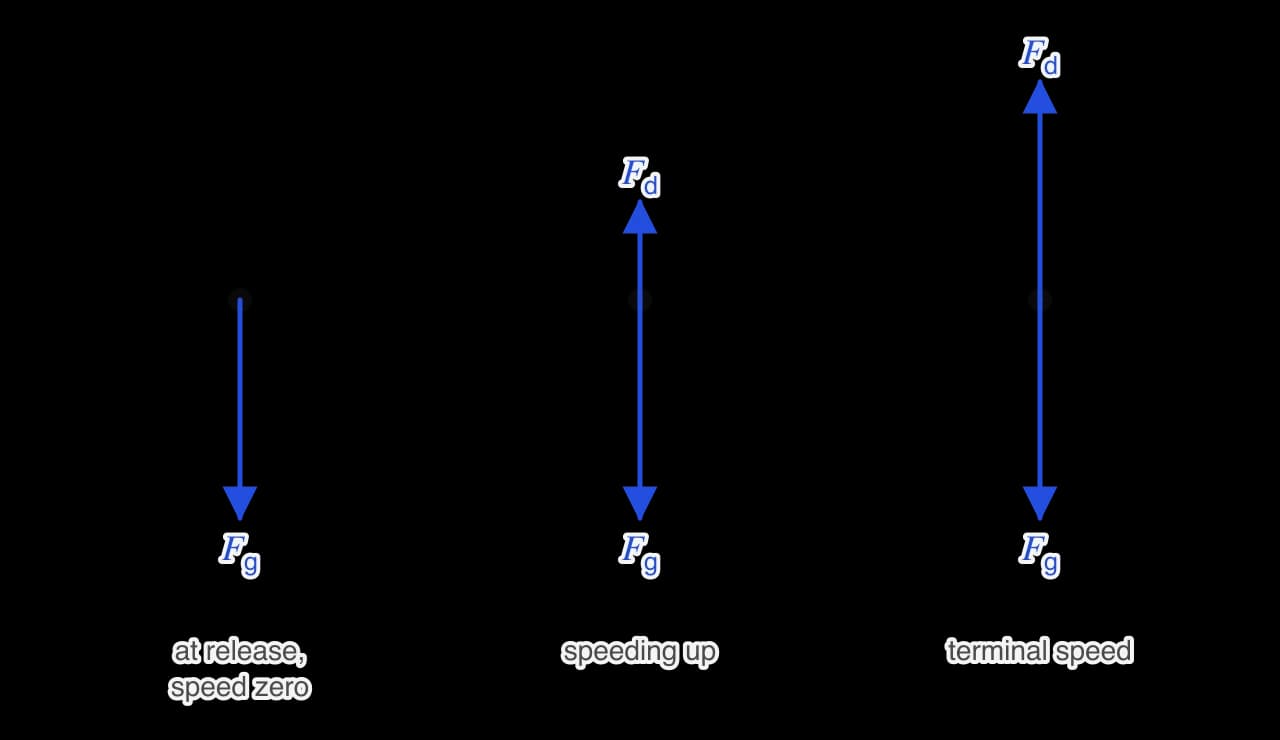
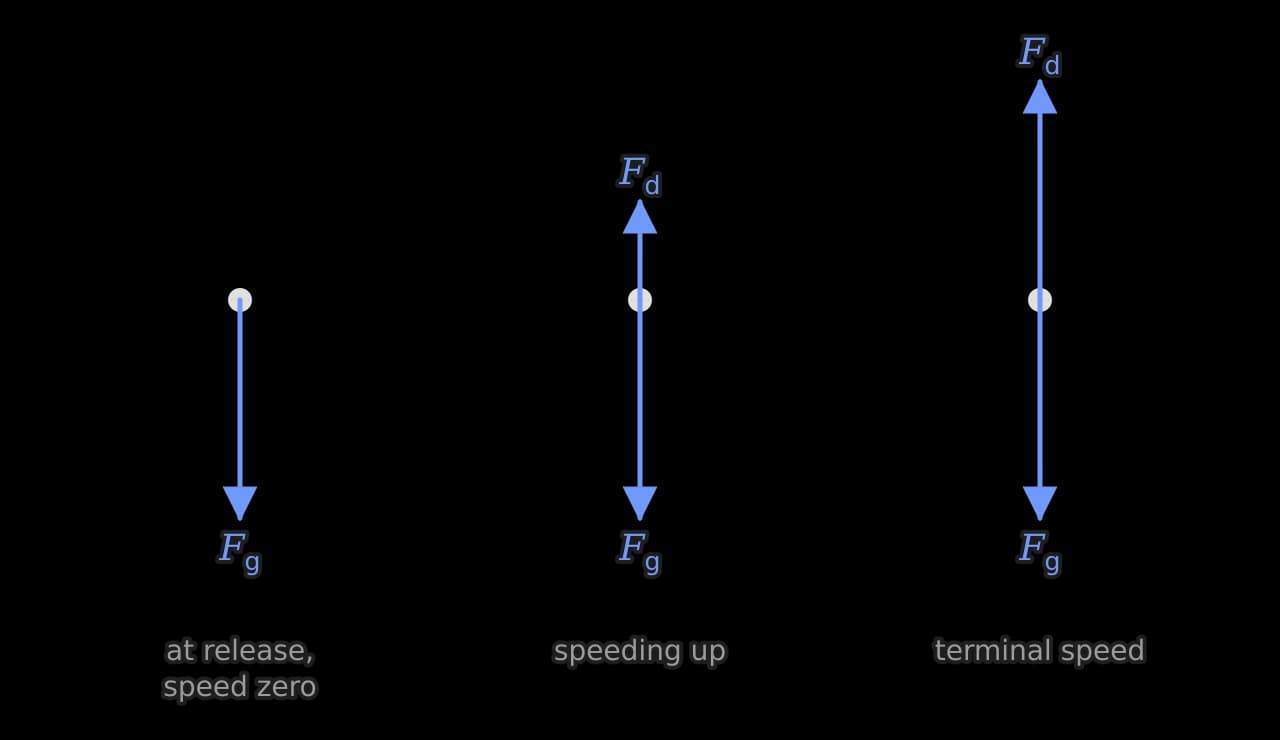
A markscheme for such a drawing typically gives one mark for both forces in the correct directions with labels, and one for their relative lengths, judged by eye. Arrows drawn from different points, or a force from another body included by mistake, lose marks.
Sketching graphs
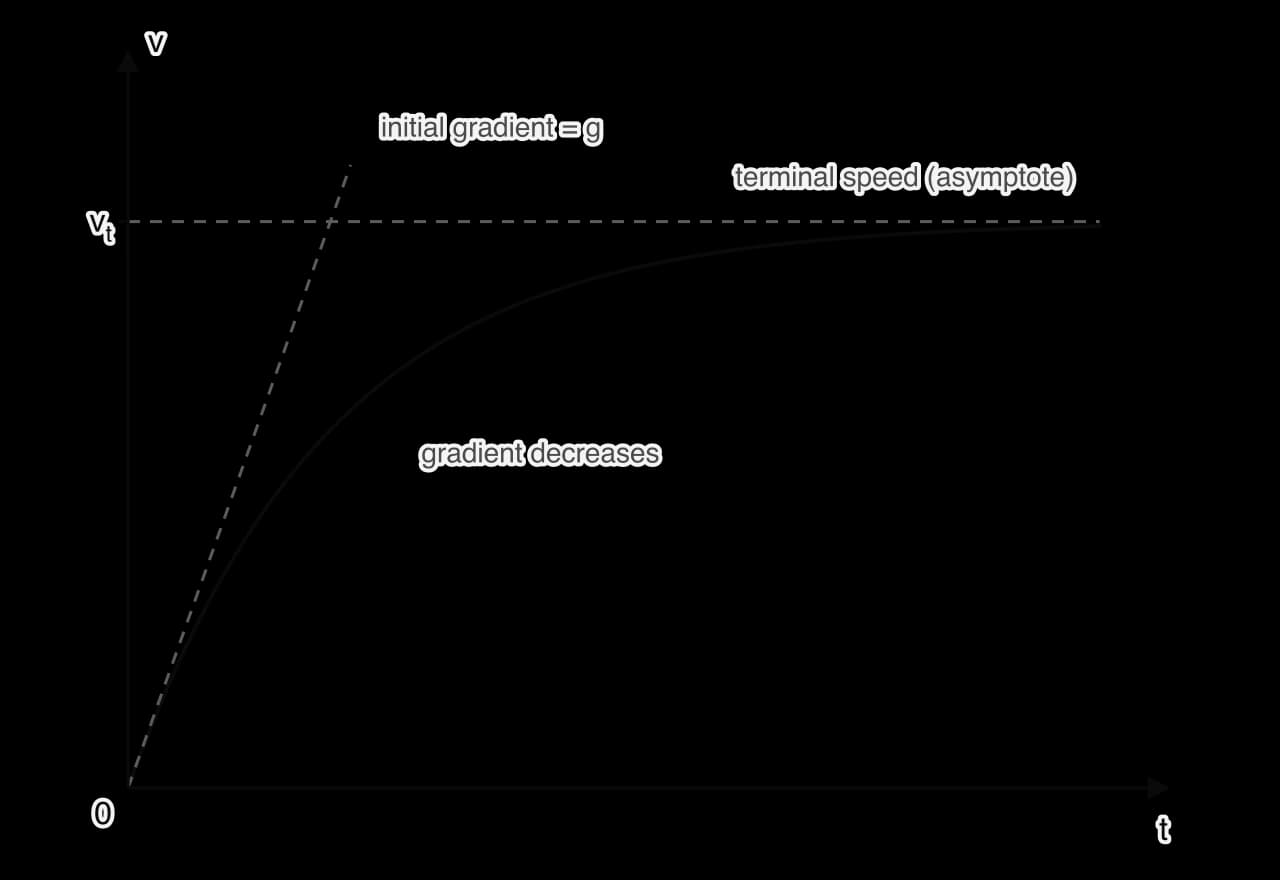
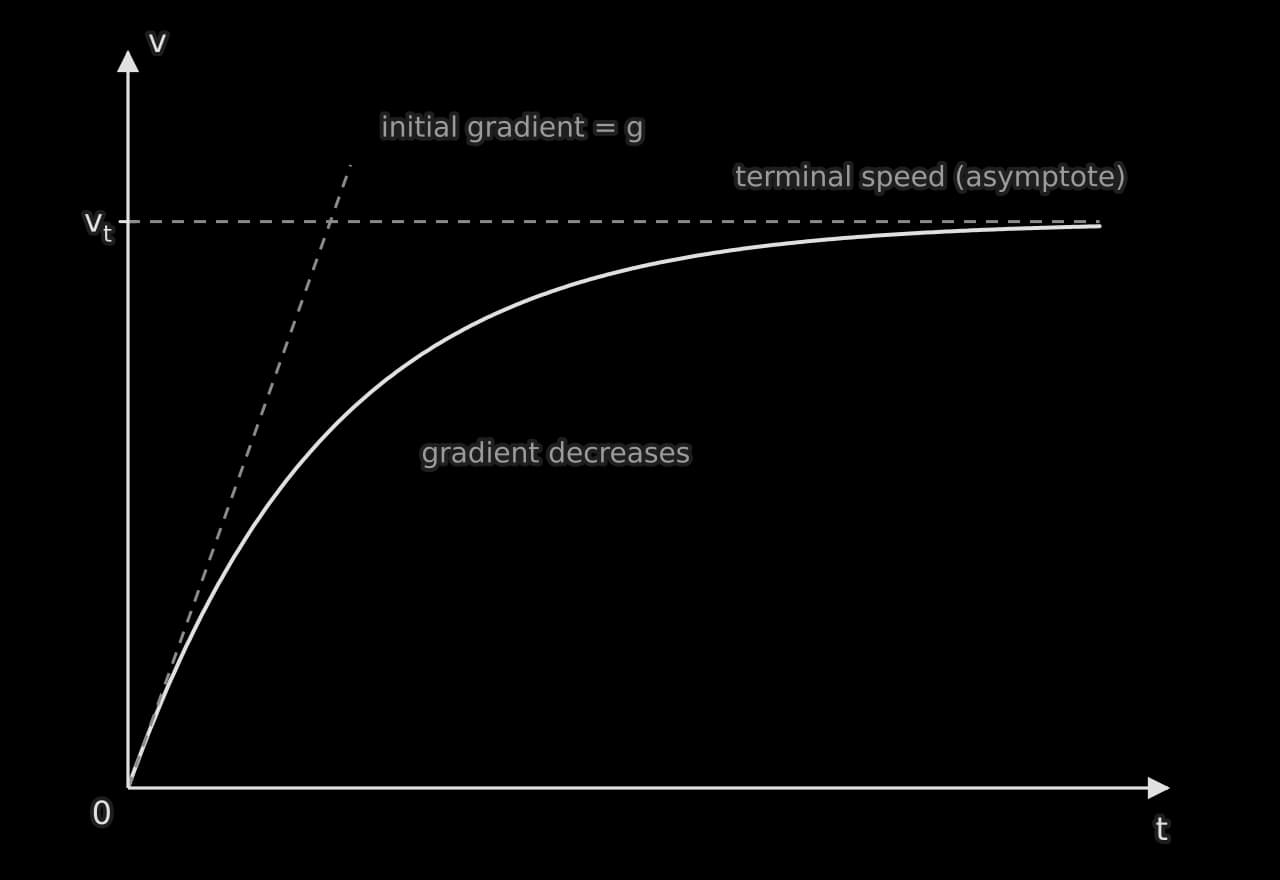
For a sketch graph, label both axes with the quantities (and units if the axes are scaled), and show every feature the physics predicts: where the line starts, whether it is straight or curved, its initial gradient, any maximum or minimum, and any asymptote. The sketch of speed against time for a falling object shows all of these.
Parts that use a graph or a diagram
Many parts say "Determine, using the graph, …" or "taking appropriate measurements from the diagram". These words mean the value must come from the figure, and the working must show where it came from: mark the points read on the graph, draw any tangent or construction line on it, and write the readings in the answer. Values read from a graph cannot be exact, so markschemes accept a range, typically one or two small squares either side of the true reading.
Questions on graphs reward the same habits as Paper 1B. Read the axes, including any prefix or power of ten in the label (" / ms", " / Bq"). Use the whole line: a half-life or a period read over several cycles or several halvings is more precise than one read over a single step. Draw a tangent long enough to give a gradient from a large triangle.
- activity of the sample
Deduce and predict: linked marks
In a "deduce" or "predict" part the conclusion mark is usually linked to the reasoning mark. The markscheme awards the conclusion only if it follows from correct, or consistently carried-forward, working. A bald "yes, it can still be used" scores nothing in part (b), even though it is the right answer, because nothing shows how it was reached. Write the calculation or the reason first, then state the conclusion in words that answer the question exactly as it was asked.
Synoptic questions
Many Paper 2 questions combine two or more areas of physics, and the final extended-response question always does. A question on an electric scooter climbing a hill uses circuits, energy and forces; one on a radioactive source powering a cell uses decay, energy and current; one on a satellite uses gravitation, circular motion and energy. These are called synoptic questions.
They are not harder in each step than other questions. The difficulty is recognising which area of physics each part belongs to. Before answering a part, ask which quantity it wants and which equation contains it, then look back through the stem for the values. A list of the given data, with their symbols and SI values, written beside the stem at the start, saves time later.
Worked question 1: a projectile
A stone is launched from ground level with a speed of 18.0 m s⁻¹ at an angle of 35° above the horizontal. Fluid resistance is negligible.
Part (b) shows why the command "using energy considerations" matters: the energy method needs only the speed and the height, because energy is a scalar. A kinematics method for the vertical motion alone gives only the vertical component, not the speed.
Worked question 2: heating water
An electric kettle has a power rating of 2.0 kW. It contains 0.80 kg of water at 18 °C. The specific heat capacity of water is and its specific latent heat of vaporisation is .
Part (d) is an estimate with a stated assumption. Either assumption is acceptable if it is stated and used consistently, which is typical of an "estimate" command. Part (e) needs both halves of the argument: what the energy does, and why that leaves the temperature unchanged.
Worked question 3: a synoptic question on an electric scooter
An electric scooter and its rider have a total mass of 95 kg. The scooter’s battery has an emf of 36 V and an internal resistance of 0.20 Ω. The scooter climbs a straight hill inclined at 4.0° to the horizontal at a constant speed of 5.0 m s⁻¹, and the current in the battery is 15 A.
The scooter question moves between circuits (a, b, f), energy and power (c, d, g) and Newton’s second law (e). Each part on its own is routine; the skill is recognising which part of the course each one draws on. Part (c) shows the usual "show that" pattern: the true value, 325 W, rounds to the "about 320 W" in the question, and part (d) then uses it.
Common ways marks are lost
What happens | How to avoid it |
|---|---|
A bald answer to a "show that" part | Show the full substitution and give one more significant figure than the target |
The answer to a slightly different question | Reread the last line of the part before writing; check the quantity and the units asked for |
One point given for a two-mark "discuss" or "compare" | Count the marks; make that many distinct points |
Unconverted units (mm, kPa, °C) in the working | Convert every value to SI before substituting |
An explanation that stops one step short | Finish the chain at the quantity the question names |
A diagram without labels or with arrows of arbitrary length | Label every arrow and line; make relative lengths match the physics |
A blank part because an earlier part went wrong | Use the "show that" value or a clearly stated estimate and carry on |
Self-check
- To do:
I can use the mark allocation of a part to decide how much to write.
- To do:
I can set out a calculation as equation, substitution and answer with a unit.
- To do:
I can explain how error carried forward protects later marks, and use a "show that" value when I need it.
- To do:
I can answer a numerical "show that" with full substitution and an extra significant figure, and an algebraic one from a named principle.
- To do:
I can write an explanation as a chain of linked physics statements with one point per mark.
- To do:
I can distinguish outline, describe, explain and discuss.
- To do:
I can draw a free-body diagram with correctly placed, labelled arrows of sensible relative lengths.
- To do:
I can sketch a graph showing all the relevant features: labelled axes, intercepts, gradients and asymptotes.
- To do:
I can take readings from a graph or diagram, show where they came from, and write a deduce answer with reasoning before the conclusion.
- To do:
I can identify which area of physics each part of a synoptic question draws on.
Carry on with Physics in Augment
With a free account, Augment remembers where you stopped in the notes and which questions you have marked.