Augment Education
    • Question bank
    • Quick fire
    • Worksheets
    • Flashcards
    • Notes
    • Try a quick-fire round
    • All features
    • Business
    • Digital Society
    • Economics
    • Geography
    • Global Politics
    • History
    • Philosophy
    • Psychology
    • Anthropology
    • World Religions
    • Biology
    • Chemistry
    • Physics
    • Computer Science
    • Design Technology
    • ESS
    • SEHS
    • Language and literature
    • Language acquisition
    • Maths AA
    • Maths AI
    • Dance
    • Film
    • Music
    • Theatre
    • Visual Arts
    • Grade calculator
    • Grade boundaries
    • Subject checker
    • Focus timer
    • Exam countdown
    • All free tools
    • IB guide
    • All subjects
  • Blog

Search

Search subjects, the syllabus, glossary terms, the booklets, the IB guide, help and the blog

Log inStart free
augment

Augment Education

IB Diploma revision built around the syllabus.

contact@augment-education.com

Product

  • Features
  • Question bank
  • Quick fire
  • Worksheets
  • Flashcards
  • Notes
  • Subjects
  • What's new

Learn

  • IB guide
  • Booklets, explained
  • Glossary
  • Blog
  • Free tools
  • Grade calculator
  • Subject checker

Company

  • About
  • Help
  • For parents
  • For teachers
  • Comparisons

Subjects

  • English A Lit
  • English A Lang & Lit
  • Chinese A Lit
  • Chinese A Lang & Lit
  • Spanish A Lit
  • Spanish A Lang & Lit
  • English Lit & Perf
  • Spanish Lit & Perf
  • English B
  • Mandarin B
  • Spanish B
  • English ab initio
  • Mandarin ab initio
  • Spanish ab initio
  • Business
  • Digital Society
  • Economics
  • Geography
  • Global Politics
  • History
  • Philosophy
  • Psychology
  • Anthropology
  • World Religions
  • Biology
  • Chemistry
  • Physics
  • Computer Science
  • Design Technology
  • ESS
  • SEHS
  • Maths AA
  • Maths AI
  • Dance
  • Film
  • Music
  • Theatre
  • Visual Arts

Augment Education is developed independently of the International Baccalaureate Organization and is not endorsed by it. “IB” and “International Baccalaureate” are its trademarks.

© 2026 Augment Education. All rights reserved.

  • Privacy
  • Terms
  1. Subjects
  2. Physics
  3. Calculations, units and the data booklet

Calculations, units and the data booklet

SI base and derived units, prefixes and conversions, checking equations by their units, significant figures and standard form, orders of magnitude and estimation, and what the data booklet gives and what must be recalled.

  • IB Physics
  • Exam skills
  • SL and HL

18 min readLast reviewed 14 Oct 2026

Almost every physics question ends in a number with a unit. Getting that number right depends on a small set of habits that apply in every topic: working in SI units, converting prefixes correctly, checking that an equation makes sense by its units, rounding to a sensible precision, and knowing roughly how big the answer should be. This set of skills is tested directly in some question parts, and indirectly in nearly all of them.

Key points

  • Six SI base units are used in the course: kg, m, s, A, K and mol. Every other unit can be written in terms of them.

  • Both sides of a correct equation have the same units; checking this catches many errors.

  • Convert every value to SI units before substituting, taking particular care with squared and cubed prefixes.

  • Give answers to the same number of significant figures as the least precise data, usually 2 or 3.

  • An order-of-magnitude estimate tells you whether an answer is reasonable.

  • The data booklet gives equations, constants, prefixes and conversions, but some relationships and every definition must be recalled.

SI base units

The International System of Units (SI) is built on a small number of base units, defined independently of one another. All other units are derived units, products and quotients of base units. Physics in this course uses six of the seven SI base units; the seventh, the candela for luminous intensity, does not appear.

Quantity

Base unit

Symbol

Mass

kilogram

kg

Length

metre

m

Time

second

s

Electric current

ampere

A

Thermodynamic temperature

kelvin

K

Amount of substance

mole

mol

Definition

An SI base unit is one of the seven fundamental units of the International System (kg, m, s, A, K, mol, cd) from which all other SI units are derived.

Common mistake

Treating the coulomb as a base unit. Charge is derived from current and time: 1 C=1 A s1 C=1 A s. The ampere, not the coulomb, is the base unit.

Derived units

A derived unit is found from the defining equation of its quantity. The newton comes from F=maF=ma, so 1 N=1 kg m s−21 N=1 kg m s−2; the joule comes from work done, W=FsW=Fs, so 1 J=1 N m=1 kg m2 s−21 J=1 N m=1 kg m2 s−2. Writing a unit in base units means following these definitions back until only base units remain.

Quantity

Unit

Defining equation

In SI base units

Force

newton, N

F=maF=ma

kg m s−2kg m s−2

Energy, work

joule, J

W=FsW=Fs

kg m2 s−2kg m2 s−2

Power

watt, W

P=WtP=tW​

kg m2 s−3kg m2 s−3

Pressure

pascal, Pa

p=FAp=AF​

kg m−1 s−2kg m−1 s−2

Frequency

hertz, Hz

f=1Tf=T1​

s−1s−1

Charge

coulomb, C

q=Itq=It

A sA s

Potential difference

volt, V

V=WqV=qW​

kg m2 s−3 A−1kg m2 s−3 A−1

Resistance

ohm, Ω

R=VIR=IV​

kg m2 s−3 A−2kg m2 s−3 A−2

Magnetic flux density

tesla, T

F=qvBF=qvB

kg s−2 A−1kg s−2 A−1

Worked example

Express the volt in SI base units.

Show the solution

Start from a definition. Potential difference is energy per unit charge, V=WqV=qW​, so 1 V=1 J C−11 V=1 J C−1.

J=kg m2 s−2C=A sV=kg m2 s−2A s=kg m2 s−3 A−1JCV​=kg m2 s−2=A s=A skg m2 s−2​=kg m2 s−3 A−1​

The same result comes from P=IVP=IV: a watt is kg m2 s−3kg m2 s−3, and dividing by an ampere gives the volt.

Tip

Remember three chains and most derived units follow: N = kg m s⁻²; J = N m; W = J s⁻¹. Then V = W A⁻¹ and Ω = V A⁻¹.

Checking equations by their units

A physically correct equation is homogeneous: every term on each side has the same units. Checking this is a quick way to catch an error in an equation that has been recalled or rearranged, and it can identify the unit of an unknown constant.

Worked example

Show that the equation s=ut+12at2s=ut+21​at2 is homogeneous.

Show the solution
[s]=m[ut]=m s−1×s=m[12at2]=m s−2×s2=m[s][ut][21​at2]​=m=m s−1×s=m=m s−2×s2=m​

Every term has the unit of length, so the equation is homogeneous. The number ½ has no unit and does not affect the check.

The last point is the limitation of the method. A units check cannot detect a wrong dimensionless factor such as ½, 2π2π or 22​. A homogeneous equation can still be wrong; an equation that is not homogeneous is certainly wrong.

Worked example

The fluid resistance on a car at high speed is modelled as F=kv2F=kv2. Determine the unit of kk in SI base units.

Show the solution

Rearrange for the unknown. k=Fv2k=v2F​.

[k]=kg m s−2(m s−1)2=kg m s−2m2 s−2=kg m−1[k]=(m s−1)2kg m s−2​=m2 s−2kg m s−2​=kg m−1

A constant with the unit kg m−1kg m−1 is a mass per unit length, which fits a model in which the car sweeps aside a column of air whose mass depends on its density and on the car’s cross-sectional area.

Exam tip

A question that asks for a unit "in fundamental units" or "in SI base units" will not accept a derived unit. "Pa m" or "N s" score nothing there; write kg s⁻² or kg m s⁻¹.

Prefixes and conversions

Prefixes multiply a unit by a power of ten. The data booklet lists them from peta to femto, so they need not be memorised; converting them correctly takes practice.

Prefix

Symbol

Factor

Prefix

Symbol

Factor

peta

P

10151015

deci

d

10−110−1

tera

T

10121012

centi

c

10−210−2

giga

G

109109

milli

m

10−310−3

mega

M

106106

micro

μ

10−610−6

kilo

k

103103

nano

n

10−910−9

hecto

h

102102

pico

p

10−1210−12

deca

da

101101

femto

f

10−1510−15

Squared and cubed units

When a unit is squared or cubed, so is its prefix. Since 1 cm=10−2 m1 cm=10−2 m, 1 cm2=(10−2 m)2=10−4 m21 cm2=(10−2 m)2=10−4 m2 and 1 cm3=10−6 m31 cm3=10−6 m3. Similarly 1 mm2=10−6 m21 mm2=10−6 m2, which matters for the cross-sectional area of a wire.

Worked example

Convert a density of 2.7 g cm⁻³ to kg m⁻³, and a speed of 72 km h⁻¹ to m s⁻¹.

Show the solution
2.7 g cm−3=2.7×10⁻³ kg10−6 m3=2.7×10³ kg m−32.7 g cm−3=10−6 m32.7×10−3 kg​=2.7×10³ kg m−3
72 km h−1=72×103 m3600 s=20 m s−172 km h−1=3600 s72×103 m​=20 m s−1

Dividing a speed in km h⁻¹ by 3.6 gives m s⁻¹. A density in g cm⁻³ multiplied by 1000 gives kg m⁻³: water is 1.0 g cm⁻³, or 1000 kg m⁻³.

Common mistake

Converting a wire diameter of 0.50 mm to an area by writing A=πr2=π×0.252=0.196A=πr2=π×0.252=0.196 and then using 0.196×10⁻³ m20.196×10−3 m2. The area is 0.196 mm2=1.96×10⁻⁷ m20.196 mm2=1.96×10⁻⁷ m2, a factor of 1000 smaller. Convert the radius to metres before squaring.

Non-SI units

Some fields use units that are more convenient than SI ones. The data booklet gives their conversions; each must be converted to SI before being used in an equation that contains SI constants.

Unit

Used for

Conversion

electronvolt, eV

energies of particles and photons

1 eV=1.60×10⁻¹⁹ J1 eV=1.60×10⁻¹⁹ J

atomic mass unit, u

masses of nuclei and particles

1 u=1.661×10⁻²⁷ kg=931.5 MeV c−21 u=1.661×10⁻²⁷ kg=931.5 MeVc−2

kilowatt-hour, kWh

electrical energy bought from a supplier

1 kWh=3.60×10⁶ J1 kWh=3.60×10⁶ J

light-year, ly

distances to stars

1 ly=9.46×10¹⁵ m1 ly=9.46×10¹⁵ m

parsec, pc

distances to stars

1 pc=3.26 ly1 pc=3.26 ly

astronomical unit, AU

distances in the Solar System

1 AU=1.50×10¹¹ m1 AU=1.50×10¹¹ m

degree Celsius, °C

everyday temperatures

T/K=θ/∘C+273T/K=θ/∘C+273

hour, day, year

times

1 h=3600 s1 h=3600 s; 1 year≈3.2×10⁷ s1 year≈3.2×10⁷ s (recalled, not in the booklet)

degree, °

angles

1 rad=180∘π1 rad=π180∘​

Worked example

An electron is accelerated through a potential difference of 2.0 kV. Calculate its kinetic energy in electronvolts and in joules.

Show the solution

The energy gained is qVqV. For one electron, accelerated through 2.0 kV, this is 2.0 keV, or 2.0×1032.0×103 eV.

Ek=2.0×103×1.60×10−19=3.2×10⁻¹⁶ JEk​=2.0×103×1.60×10−19=3.2×10⁻¹⁶ J

The electronvolt is convenient because the energy in eV equals the accelerating pd in volts for a particle with charge e.

A temperature difference has the same size in kelvin and in degrees Celsius, so a change of 20 °C is a change of 20 K. Only an absolute temperature, in gas laws or in L=σAT4L=σAT4, must be converted.

Significant figures and standard form

Counting significant figures

The significant figures of a number are the digits that carry meaning about its precision. Non-zero digits are always significant. Zeros between non-zero digits are significant (2.05 has three). Leading zeros are not (0.0042 has two). Trailing zeros after a decimal point are significant (3.40 has three), because the writer chose to include them.

Standard form (scientific notation) writes a number as a×10na×10n with 1≤a<101≤a<10. It removes any doubt about trailing zeros: 4500 could have two, three or four significant figures, but 4.5×1034.5×103 has two and 4.50×1034.50×103 has three.

How precise should an answer be?

  • For multiplication and division, give the answer to the same number of significant figures as the least precise piece of data. 2.0×3.14=6.32.0×3.14=6.3, not 6.28.

  • For addition and subtraction, the number of decimal places is limited by the least precise value: 12.6 m + 0.85 m = 13.5 m.

  • Keep extra figures in intermediate steps and round only the final answer.

  • In practice, 2 or 3 significant figures, matching the data, are almost always accepted.

Worked example

A trolley travels 0.85 m in 1.3 s. A student records its average speed as 0.653846 m s⁻¹. Comment on this value.

Show the solution

The data have two significant figures each (0.85 and 1.3), so the speed should be given to two: 0.65 m s−10.65 m s−1. The six figures quoted claim a precision about ten thousand times greater than the measurements justify.

Exam tip

Unless a question says otherwise, significant figures are not penalised in Paper 2 within a sensible range. A part that says "give your answer to an appropriate number of significant figures" is different: then the significant figures earn the mark.

Orders of magnitude and estimation

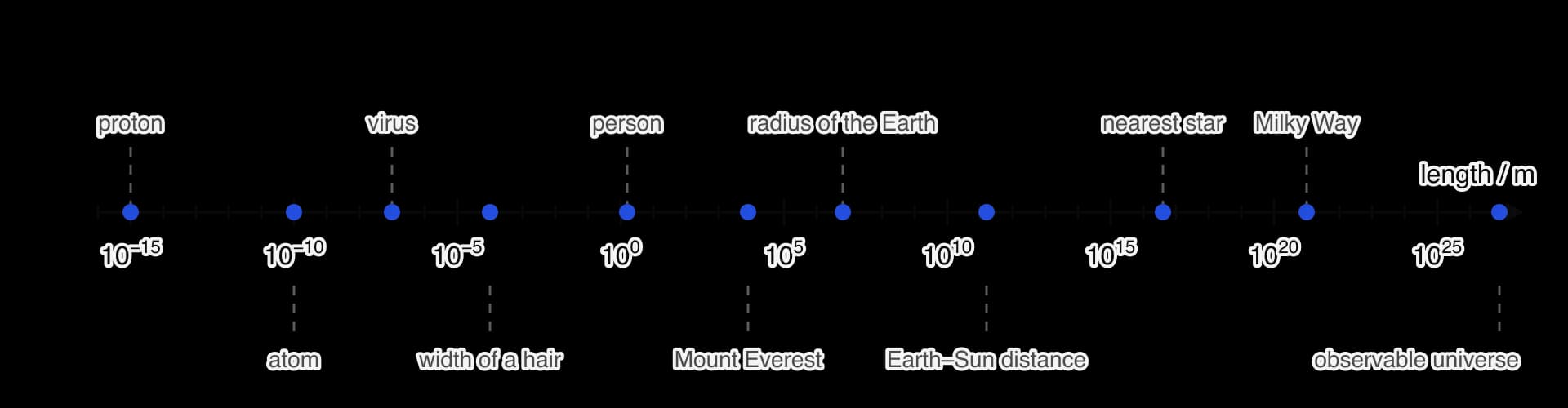
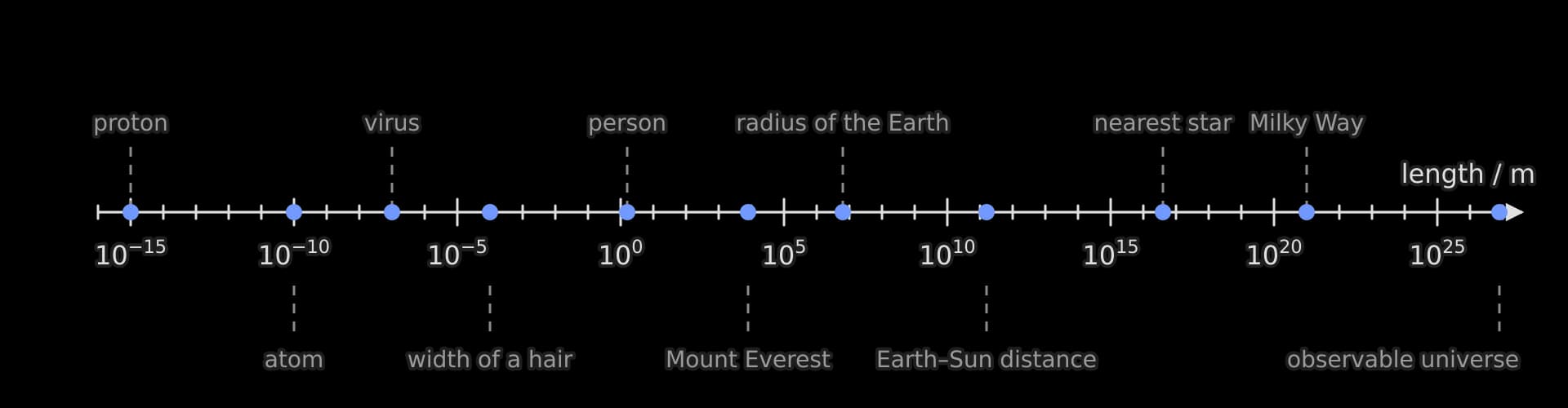
The order of magnitude of a quantity is the power of ten closest to it. A person’s mass of 70 kg is of order 102102 kg; the Earth’s radius, 6.4×1066.4×106 m, is of order 107107 m (on a logarithmic scale, 6.4 is nearer 10 than 1). Two quantities "differ by three orders of magnitude" when their ratio is about 103103.

A logarithmic length scale from 10^-15 m to 10^26 m with ticks every power of ten. Marked: proton 10^-15 m, atom 10^-10 m, virus 10^-7 m, width of a hair 10^-4 m, person about 1.7 m, Mount Everest about 9 km, radius of the Earth 6.4 × 10^6 m, Earth–Sun distance 1.5 × 10^11 m, nearest star 4 ×…A logarithmic length scale from 10^-15 m to 10^26 m with ticks every power of ten. Marked: proton 10^-15 m, atom 10^-10 m, virus 10^-7 m, width of a hair 10^-4 m, person about 1.7 m, Mount Everest about 9 km, radius of the Earth 6.4 × 10^6 m, Earth–Sun distance 1.5 × 10^11 m, nearest star 4 ×…
On a logarithmic scale each step is a factor of ten. The observable universe is about 42 orders of magnitude larger than a proton.

The length scale spans about 42 orders of magnitude from a proton to the observable universe. A few reference values in each quantity make it possible to judge whether any answer is reasonable:

Quantity

Small

Everyday

Large

Mass

electron 9×10−319×10−31 kg, proton 2×10−272×10−27 kg

person 70 kg, car 1×1031×103 kg

Earth 6×10246×1024 kg, Sun 2×10302×1030 kg

Time

light crossing a nucleus 10−2310−23 s

heartbeat 1 s, day 9×1049×104 s, year 3×1073×107 s

human lifetime 2×1092×109 s, age of the universe 4×10174×1017 s

Energy

photon of visible light 4×10−194×10−19 J

kinetic energy of a sprinter 4×1034×103 J

energy reaching the Earth from the Sun each second 2×10172×1017 J

Making an estimate

An estimate replaces exact data with sensible rounded values and works to one or two significant figures. State each assumed value, keep the arithmetic in powers of ten, and check the answer against experience.

Worked example

Estimate the number of water molecules in a glass of water.

Show the solution

Assume a glass holds about 250 cm³ of water, a mass of 0.25 kg. The molar mass of water is 18 g mol⁻¹, or 0.018 kg mol⁻¹.

n=0.250.018≈14 molN=nNA≈14×6.0×1023≈8×1024nN​=0.0180.25​≈14 mol=nNA​≈14×6.0×1023≈8×1024​

The number is of order 10251025. An answer from 10241024 to 10251025 would be accepted, depending on the size of glass assumed.

Tip

After any calculation, ask whether the size of the answer is believable. A car with a kinetic energy of 10⁹ J, a wavelength of visible light of 5 m or a current of 3000 A in a phone charger all point to a slipped prefix or a wrong equation.

Rearranging equations and using a calculator

Rearranging an equation in symbols before substituting numbers is quicker and safer than substituting first. The algebra is easier to check, the units can be checked on the rearranged form, and the same expression can be reused if the data change.

Worked example

A satellite experiences a gravitational force of 3.1 kN from the Earth, of mass 5.97×10245.97×1024 kg. The satellite’s mass is 420 kg. Determine its distance from the centre of the Earth.

Show the solution

Rearrange first. From F=GMmr2F=r2GMm​, r=GMmFr=FGMm​​.

r=6.67×10−11×5.97×1024×4203.1×103=7.3×10⁶ mr=3.1×1036.67×10−11×5.97×1024×420​​=7.3×10⁶ m

This is about 900 km above the surface (the Earth’s radius is 6.4 × 10⁶ m), a reasonable height for a satellite in a low orbit. The force was converted from kN to N before substituting.

On a calculator, enter powers of ten with the exponent key (EXP, EE or ×10ˣ), not by typing "× 10 ^". Typing 6.67×10∧−116.67×10∧−11 without brackets can be evaluated in the wrong order inside a fraction. Put the whole numerator and the whole denominator in brackets, or evaluate them separately.

Ratios and proportionality

Many calculations become simpler when written as ratios. If y∝xny∝xn, then y2y1=(x2x1)ny1​y2​​=(x1​x2​​)n, and every constant cancels. For example, the intensity from a point source obeys I∝1d2I∝d21​, so moving three times as far away reduces the intensity by a factor of 32=932=9, whatever the power of the source.

Worked example

The kinetic energy of a car increases by 44 %. Calculate the percentage increase in its speed.

Show the solution

Ek∝v2Ek​∝v2, so v∝Ekv∝Ek​​.

v2v1=E2E1=1.44=1.20v1​v2​​=E1​E2​​​=1.44​=1.20

The speed increases by 20 %. Halving or doubling percentages, as if the relation were linear, is the most common error in this kind of question.

Tip

To find a percentage change, form the ratio new/old, subtract 1 and multiply by 100 %. A ratio of 1.20 is a 20 % increase; a ratio of 0.75 is a 25 % decrease.

Scalars, vectors and their components

A scalar has a magnitude only: mass, time, energy, speed, temperature. A vector has both a magnitude and a direction: displacement, velocity, acceleration, force, momentum, field strength. Scalars add by ordinary arithmetic. Vectors add by taking their directions into account, either with a scale diagram or with components.
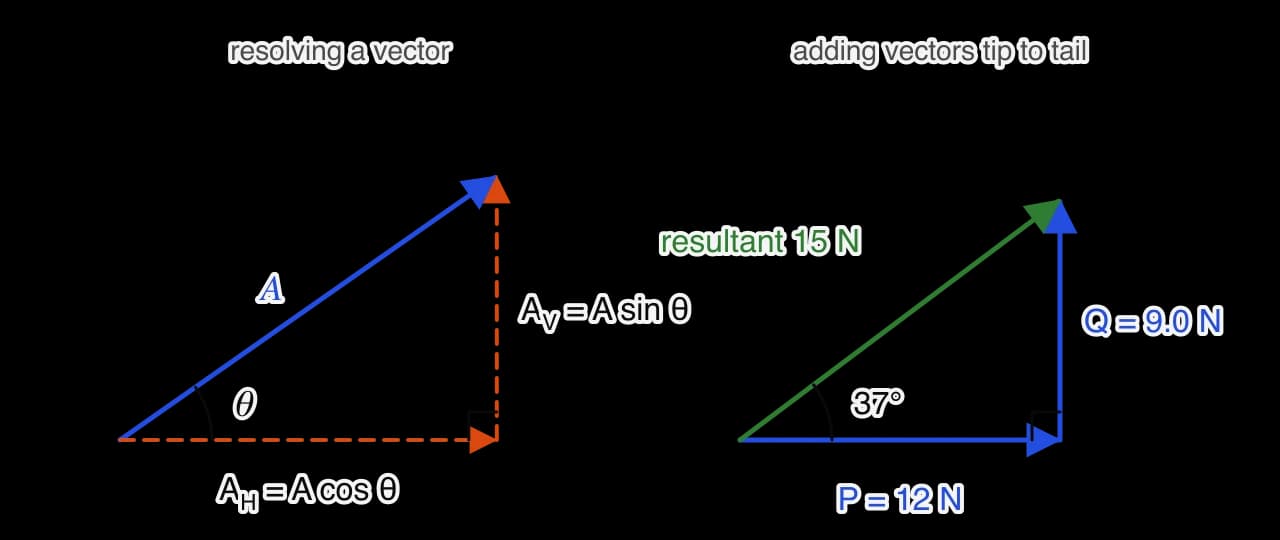
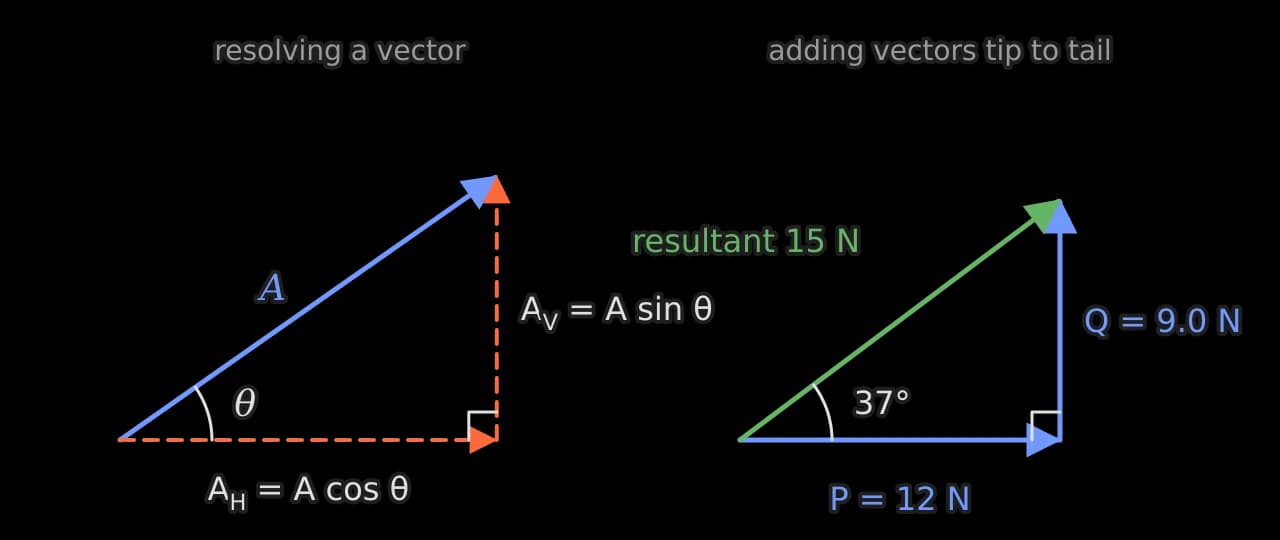
Left: a blue vector A at angle θ above the horizontal, with orange dashed components A_H = A cos θ along the horizontal and A_V = A sin θ vertically up to the tip of A.Left: a blue vector A at angle θ above the horizontal, with orange dashed components A_H = A cos θ along the horizontal and A_V = A sin θ vertically up to the tip of A.
Resolving replaces one vector (blue) by two perpendicular components (orange) that have the same effect. Adding places vectors tip to tail; the resultant (green) runs from the first tail to the last tip.

Resolving a vector

Any vector can be replaced by two perpendicular components that together have the same effect. For a vector of magnitude AA at an angle θθ to the horizontal, the data booklet gives

AH=Acos⁡θAV=Asin⁡θAH​=AcosθAV​=Asinθ

The cosine always goes with the component adjacent to the angle. If the angle is measured from the vertical instead, the roles swap: the vertical component is Acos⁡θAcosθ and the horizontal one Asin⁡θAsinθ. Resolution is always into two perpendicular directions, usually horizontal and vertical, or along and perpendicular to a slope.

Adding vectors

To add vectors, draw them tip to tail: the resultant runs from the tail of the first to the tip of the last. Two perpendicular vectors give a right-angled triangle, so Pythagoras and the tangent give the magnitude and direction. For vectors at other angles, resolve each one, add the horizontal components and the vertical components separately, then combine the two totals. Subtracting a vector is adding its negative, a vector of the same size pointing the opposite way, which is how a change in velocity Δv=v−uΔv=v−u is found. Multiplying a vector by a scalar changes its magnitude (and reverses it if the scalar is negative) but not its line of action.

Worked example

Two horizontal forces act on a crate: 12 N due east and 9.0 N due north. Determine the magnitude and direction of the resultant force.

Show the solution

The forces are perpendicular, so the resultant is the hypotenuse of a right-angled triangle.

F=122+9.02=15 Ntan⁡θ=9.012  ⇒  θ=37∘Ftanθ​=122+9.02​=15 N=129.0​⇒θ=37∘​

The resultant is 15 N at 37° north of east. It is larger than either force but smaller than their sum, 21 N, as a resultant of two forces at an angle must be.

Common mistake

Using cos⁡θcosθ for the vertical component whenever a question has a vertical. The cosine belongs to the component next to the angle. Sketch the triangle and mark the angle before choosing sine or cosine.

Worked example

A rope pulls a sledge with a force of 80 N at 25° above the horizontal. Calculate the horizontal and vertical components of the force.

Show the solution
FH=80cos⁡25∘=73 NFV=80sin⁡25∘=34 NFH​FV​​=80cos25∘=73 N=80sin25∘=34 N​

Check. 732+342≈80732+342​≈80 N, and the horizontal component is the larger because the angle to the horizontal is less than 45°.

Variables and relationships

A continuous variable can take any value within a range (length, time, temperature, current). A discrete variable takes only separate values, often whole numbers (the number of coils, the number of slits, the number of layers of insulation). The distinction matters when choosing a graph: continuous data are plotted as points joined by a line or curve of best fit, while discrete or categorical data are often shown as a bar chart.

Relationship

Meaning

Graph of y against x

Direct proportion, y∝xy∝x

y=kxy=kx: doubling xx doubles yy

Straight line through the origin

Linear, y=mx+cy=mx+c

Equal steps in xx give equal steps in yy

Straight line, intercept c

Inverse proportion, y∝1xy∝x1​

xyxy is constant: doubling xx halves yy

Curve approaching both axes; a straight line through the origin if yy is plotted against 1/x1/x

Positive correlation

yy tends to increase as xx increases

Points scattered about a rising trend

Negative correlation

yy tends to decrease as xx increases

Points scattered about a falling trend

Every proportional relationship is linear, but a linear relationship is proportional only when its intercept is zero. A correlation describes a trend in data and does not by itself show that one variable causes the other.

Percentage change and percentage difference

A percentage change compares a new value with an original one: new−originaloriginal×100 %originalnew−original​×100%. A percentage difference between an experimental value and an accepted value is ∣experimental−accepted∣accepted×100 %accepted∣experimental−accepted∣​×100%; it is sometimes called the percentage error. A student who measures the speed of sound as 352 m s⁻¹ against an accepted 343 m s⁻¹ has a percentage difference of 9343×100 %=2.6 %3439​×100%=2.6%.

Approximations and neglecting small effects

Physics models routinely leave out effects that are too small to matter: fluid resistance on a dense ball falling a short distance, the internal resistance of a fresh cell compared with a large external resistance, the mass of a light string. A useful test is whether the neglected effect would change the answer by more than the uncertainty in the data. If a 1 % correction is applied to data known only to 5 %, it makes no difference to the result.

What the data booklet gives

A clean copy of the physics data booklet is available for every paper. Knowing its layout saves time and errors. It contains:

  • Mathematical equations: areas and volumes of common shapes (but not the surface area of a sphere), and the resolution of vectors.

  • The rules for propagating uncertainties through sums, products, quotients and powers.

  • Fundamental constants, with the values to use: g=9.8 m s−2g=9.8 m s−2, G=6.67×10⁻¹¹ N m2 kg−2G=6.67×10⁻¹¹ N m2 kg−2, c=3.00×10⁸ m s−1c=3.00×10⁸ m s−1, e=1.60×10⁻¹⁹ Ce=1.60×10⁻¹⁹ C, h=6.63×10⁻³⁴ J sh=6.63×10⁻³⁴ J s, and others.

  • SI prefixes and unit conversions (eV, u, kWh, ly, pc, AU, radians).

  • Electrical circuit symbols and a chart of the electromagnetic spectrum with typical wavelengths.

  • Equations for each theme, A to E, with the additional higher level equations listed separately.

What must be recalled

The booklet lists equations, not definitions, and it leaves out some relationships that follow from others. These must be remembered or derived:

  • The definitions of quantities and units, such as pressure, specific heat capacity, emf, the volt and the ampere.

  • The surface area of a sphere, 4πr24πr2, needed for luminosity and intensity.

  • The wavelengths of harmonics on strings and in pipes, from the pattern of nodes and antinodes.

  • The refractive index as n=cvn=vc​, and the critical angle from Snell’s law with a refraction angle of 90°.

  • The radius of a charged particle’s path in a magnetic field, from qvB=mv2rqvB=rmv2​.

  • Kepler’s third law, from equating gravitational and centripetal force.

  • The number of nuclei remaining after nn half-lives, N=N0(12)nN=N0​(21​)n.

  • The mean intensity of sunlight over the whole Earth's surface, S/4S/4.

Data that are not constants, such as the mass and radius of the Earth, specific heat capacities, latent heats, refractive indices or the speed of sound in air, are given in the question when they are needed.

Exam tip

Use the data booklet even for equations you know. Checking the exact form, the symbols and the value of a constant takes seconds, and it prevents errors such as using 9.81 instead of 9.8 or confusing ε for emf with the permittivity ε₀.

Common mistake

Choosing an equation from the booklet only because its symbols match the quantities in the question. The same symbol can mean different things in different themes (λλ for wavelength and for decay constant, PP for power and for pressure, ΦΦ for magnetic flux and for work function). Find the right theme first.

Self-check

  • To do:

    I can name the six SI base units used in physics and the quantities they measure.

  • To do:

    I can express any derived unit in SI base units by following its defining equation.

  • To do:

    I can check an equation for homogeneity and find the unit of an unknown constant.

  • To do:

    I can convert prefixes, including squared and cubed units and speeds in km h⁻¹.

  • To do:

    I can convert between eV and J, u and kg, kWh and J, and °C and K.

  • To do:

    I can count significant figures, write numbers in standard form and round answers sensibly.

  • To do:

    I can state the order of magnitude of a quantity and make an estimate with stated assumptions.

  • To do:

    I can find equations and constants quickly in the data booklet and know which relationships must be recalled.

Keep your place

In Augment the notes remember where you stopped and which pages you have finished.

Open in Augment

More IB Physics notes

  • Command termsThe page before this.
  • Uncertainties and graphsThe next page.
  • Physics assessmentEach Physics paper, the internal assessment and grade boundaries.
  • IB PhysicsThe Physics syllabus, how it is assessed and every notes page.

Carry on with Physics in Augment

With a free account, Augment remembers where you stopped in the notes and which questions you have marked.

Start free