The mathematical exploration
What the exploration is, how much it counts, how long it should be, how the work is organised from first idea to final version, what your teacher can and cannot do, and the rules of academic integrity.
- IB Mathematics: Applications and Interpretation
- Internal assessment
- SL and HL
Introduction
The internal assessment in Mathematics: applications and interpretation is a single piece of written work called the mathematical exploration. You choose a real situation or a mathematical question that interests you, investigate it with mathematics from the course, and write up what you did, what you found and what it means. Your teacher marks it against five criteria, and the IB checks a sample of each school's marks.
The exploration is the only part of the course that is not done under exam conditions. There is no time limit in a hall and no unseen question, so the qualities it rewards are different from those of Papers 1 and 2: choosing a good question, organising a long argument, explaining mathematics clearly, and judging honestly how well your results answer your question. Because the work is spread over several months, steady planning from early in the course makes a large difference to the final mark.
Why the exploration matters
Weighting and marks
The exploration carries 20% of the final assessment at both SL and HL, and it is marked out of 20. The other 80% comes from the written papers. For an SL student that is Paper 1 and Paper 2 (40% each); for an HL student it is Paper 1 and Paper 2 (30% each) and Paper 3 (20%).
Component | SL weighting | HL weighting |
|---|---|---|
Paper 1 | 40% | 30% |
Paper 2 | 40% | 30% |
Paper 3 | none | 20% |
Mathematical exploration | 20% | 20% |
Because the exploration has only 20 marks, each mark is worth a lot. One mark of the 20 is 1% of the final result at both levels. On the HL papers, by comparison, Paper 1 has 110 marks for 30% of the grade, so a single Paper 1 mark is worth about of the final result. One exploration mark is therefore worth almost four HL Paper 1 marks.
At SL, Paper 1 has 80 marks for 40%, so each Paper 1 mark is worth 0.5% and the ratio is . One exploration mark is worth two SL Paper 1 marks.
It is compulsory
The exploration is not optional. A student who does not submit one receives no grade for the mathematics course at all, whatever their exam results. That rule applies at SL and HL, and it also means that an exploration which is handed in but contains serious academic misconduct can put the whole subject grade at risk.
What the exploration is for
The exploration exists because some mathematical skills cannot be tested in a 90-minute paper. The IB describes its purposes in terms of the student: developing your own insight into what mathematics is and learning to ask your own questions about it; completing a substantial piece of work over weeks rather than minutes; applying mathematical processes independently and experiencing how useful (and how beautiful) they can be; using technology as a genuine mathematical tool; and developing patience, persistence and the habit of reflecting on what your results mean.
The course's assessment objectives show the same shift of emphasis. Each component tests the six objectives in different proportions, and the exploration leans much more heavily on inquiry than the papers do.
Assessment objective | Papers 1 and 2 | Exploration |
|---|---|---|
Knowledge and understanding | 20–30% | 5–15% |
Problem solving | 20–30% | 5–20% |
Communication and interpretation | 20–30% | 15–25% |
Technology | 20–35% | 10–20% |
Reasoning | 5–20% | 5–25% |
Inquiry approaches | 5–20% | 25–35% |
Source: IB, Mathematics: applications and interpretation guide (first assessment 2021), assessment objectives in practice. The Papers 1 and 2 column combines the two papers' ranges.
The inquiry share of 25–35% is the largest single objective in the exploration. Inquiry means investigating an unfamiliar situation, organising and analysing information, making conjectures, drawing conclusions and testing whether they hold. An exploration that only repeats a known calculation, however neatly, misses most of that.
Length, format and presentation
About 12 to 20 pages
The finished report should be about 12 to 20 pages with double line spacing. That count includes graphs, tables and diagrams but not the bibliography. The page range is guidance rather than a target, and the quality of the mathematical writing counts for far more than the number of pages. A tight 13-page exploration that reaches its aim can score higher than a 24-page one padded with repeated calculations. A report that runs well past 20 pages often contains irrelevant or repetitive material, which costs marks for conciseness under the presentation criterion.
The report can be word-processed or handwritten. Most students type it, using an equation editor for the mathematics, because that makes drafting and revising easier. Whatever the format, every stage of the work should be explained so that it shows real understanding, and the writing should be clear enough for a classmate taking the same course to follow without help. There is no requirement to present the exploration to the class.
The cover page and the bibliography
Two details go on the cover page: the title of the exploration and the number of pages. A clear title tells the reader what to expect; a question form is fine ("How well does a logistic model describe the spread of ...?") as long as the report answers it.
The report also needs a detailed bibliography, and every source is acknowledged where it is used, with direct quotations marked. References are not marked under any criterion, but an exploration without them can be investigated as a breach of academic integrity. How to cite data, formulae, images and software is covered in "Writing, technology and referencing".
Graphs, tables and appendices
Relevant graphs, tables and diagrams belong in the body of the report, next to the text that discusses them. Appendices are only for material a reader does not need in order to follow the argument: a large raw data set, extra graphs of the same kind, or long tables of repeated results. A key graph placed in an appendix breaks the flow of the argument and is penalised under the presentation criterion.
Time and the stages of the work
How much time
Schools are recommended to give the exploration about 10 to 15 hours of class time in total. That time covers your teacher explaining the requirements and the criteria, lessons in which you work on the exploration and ask questions, individual consultations, and time for the teacher to monitor progress and check that the work is your own. It sits inside the 30 hours of the course set aside for inquiry, modelling and investigation skills.
Most students also spend considerably longer outside lessons collecting data, learning the mathematics they need, writing and rewriting. Starting to think about topics early in the course gives you time to notice ideas in lessons and in daily life, and it leaves room for a first idea that turns out to be unworkable.
From first idea to final version
Every school sets its own calendar, but the work always passes through the same stages, and there are at least three firm deadlines: one for the topic with a short outline, one for the draft, and one for the final version. The flow of eight stages shows the order and where the deadlines fall.
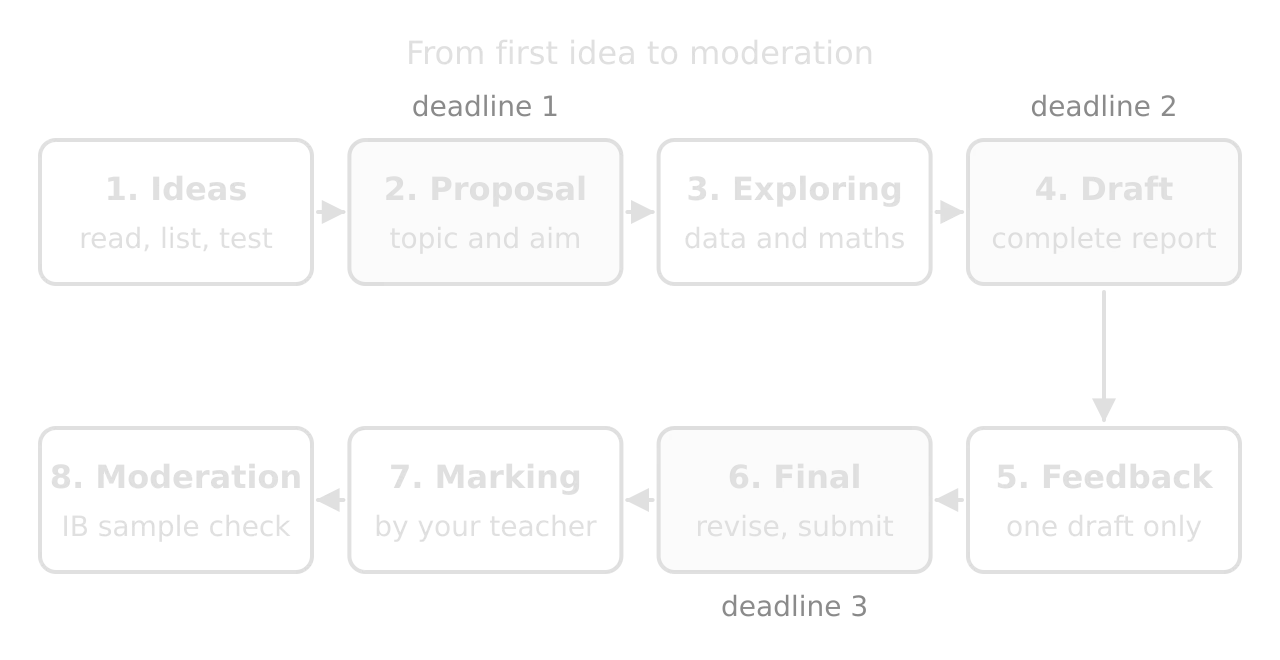
Ideas. Read, notice and list possible questions; test each for mathematical depth and for whether the data exist (see "Choosing a topic and an aim").
Proposal. Agree a topic and a precise aim with your teacher, with a short outline of the mathematics you expect to use.
Exploring. Collect or source data, try the mathematics, and keep a log of what worked, what did not and why. Notes from this stage feed the reflection later.
Draft. Write a complete report: introduction, aim, the full mathematical development, conclusion and bibliography.
Feedback. Your teacher reads the draft once and gives oral or written advice.
Final version. Act on the feedback, check against the criteria (see "Final checks before submission"), and submit.
Marking. Your teacher marks the exploration against the five criteria and confirms that it is your own work.
Moderation. The IB re-marks a sample of the school's explorations and adjusts the school's marks if needed (see moderation).
Planning backwards from the final deadline
A plan built backwards from the final deadline shows how little slack there is. The schedule in the table is a hypothetical example for a school whose final deadline falls in week 20 of the plan; the weeks are illustrative, and your school's dates take priority.
Week | Stage | Output at the end of the stage |
|---|---|---|
1–3 | Ideas | Three possible topics, each with a draft aim and a data source |
4 | Proposal | One topic, one aim, an outline approved by the teacher (deadline 1) |
5–10 | Exploring | Data collected and cleaned, main mathematics done, research log |
11–13 | Draft | Complete report of about 12–20 pages (deadline 2) |
14–15 | Feedback | Teacher's comments on the one draft |
16–19 | Final version | Revised report checked against every criterion |
20 | Submission | Final version and authenticity declaration (deadline 3) |
The longest stage is exploring, because that is where unexpected problems appear: a data set with missing years, a model that fits badly, a test whose conditions are not met. When such a problem is handled well and written up honestly, the decisions it forced become some of the best evidence of personal engagement and reflection.
The teacher's role
What your teacher does
The exploration must be your own work, but you are not meant to choose a title and then work alone. Your teacher guides you through planning and writing. Before you start, they make sure you understand the requirements of the task, the IB's rules on academic integrity and the assessment criteria; the IB recommends that the criteria are shared with students, and your work has to address them.
During the work, your teacher can point you towards more productive lines of inquiry, suggest sources of information and data, and advise on content and on clarity at the writing stage. Discussions should happen throughout, and you are encouraged to start them: asking for guidance is part of the process and is never penalised.
Feedback on one draft
The most important rule concerns feedback. Your teacher reads and comments on one draft of the work, orally or in writing, saying how it could be improved. They do not edit the draft or rewrite parts of it, and when they find a mathematical error they can tell you that an error exists, but they do not correct it for you. The next version you hand in is the final version.
That rule has a practical consequence. The draft should be as complete as you can make it: full mathematics, conclusion, reflection, graphs labelled, bibliography included. Feedback on a half-finished draft can only comment on half the work, and the second half will then be marked without any advice at all.
Academic integrity
Your own work, authenticated
Your teacher must authenticate every exploration, not only those sent to the IB, and must not submit any work where malpractice is known or suspected. You also confirm that the work is your own authentic final version. Once the final version has been officially submitted, it cannot be withdrawn and replaced.
Teachers have several ways to check authenticity: talking with you about the content, comparing the final version with your proposal and your draft, checking the references, comparing the writing style with your other work, and running the report through a plagiarism detection service such as Turnitin. A student who wrote the work can explain any step of it in conversation; a student who copied it usually cannot.
The same piece of work cannot be submitted both as the mathematics exploration and as an extended essay. If you write a mathematics extended essay, the two must be on clearly different work.
Collaboration: what is allowed
Working with others is encouraged at many stages, as long as the exploration itself stays individual.
Allowed and encouraged | Not allowed |
|---|---|
Talking through ideas and possible topics | Two students writing up the same exploration |
Helping each other choose a topic | Using a classmate's analysis or graphs as your own |
Sharing useful sources and data repositories | Copying text or calculations from any source without citing it |
Learning a new skill together (a regression in a spreadsheet, a test) | Having someone else check and correct your mathematics line by line |
Giving and receiving peer feedback on clarity of writing | Submitting work an AI tool wrote or calculated as your own |
Marks are awarded for your own development and contribution, not for work found in the literature or done by others. When an idea came from a conversation or a source, say so and show how you built on it.
Data from a group
Some explorations need measurements that are easier to take with others, such as timing a pendulum or surveying a year group. In that case each student must still collect their own data. Data from several students can be combined to give enough for an individual analysis, but the report must describe clearly who collected what and how it was combined.
Citing everything, including AI tools
Every source must be cited, and that includes pictures, diagrams, graphs and formulae, not only text. A formula copied from a website or textbook is cited where it first appears. A graph made by someone else is cited in its caption, even if you redraw it.
Generative AI tools are treated in the same way as any other source. In the IB's academic integrity guidance, text, code, images or calculations produced by an AI tool are not your own work: if you use any, they must be acknowledged at the point of use and listed in the bibliography, and the mathematics and the writing that earn the marks must still be yours. Schools often add their own rules, so check your school's policy before using such tools at all.
 YouTube
Ethics
Any data collection must follow the IB's ethical guidelines. Surveys and experiments on people need informed consent, must not cause harm or distress, and must protect participants' privacy, usually by keeping responses anonymous. Collecting personal data from classmates without permission, or carrying out an experiment that puts anyone (or any animal) at risk, is not acceptable however interesting the question.
How the exploration is assessed
Five criteria are applied to every exploration, giving a total out of 20. Criteria A to D are worded identically at SL and HL; criterion E, Use of mathematics, has a separate HL version that asks for more.
Criterion | What it assesses | Marks |
|---|---|---|
Organisation, coherence and conciseness | 4 | |
Notation, terminology, defined variables, forms of representation | 4 | |
Making the mathematics your own: independent thinking, own perspective | 3 | |
Reviewing, analysing and evaluating the work throughout | 3 | |
Relevant mathematics at the level of the course, its correctness and your understanding | 6 | |
Total | 20 |
The criteria are applied using a best-fit approach: the teacher finds the level descriptor that matches the work most closely, without demanding that every phrase is met. The top level of each criterion does not mean faultless work. Each criterion, with what each level looks like and how to move up, is treated in "The assessment criteria".
What makes a good AI exploration
The AI course is about mathematics applied to real situations, and the strongest explorations reflect that. Typical shapes include:
Modelling a real process with data: fitting and comparing functions, testing a model on data not used to build it, and using it to predict or optimise.
Statistics on a real question: designing a sample, collecting data ethically, choosing a test whose conditions are met, and interpreting the result in context.
Networks and geometry: finding efficient routes, spanning trees or Voronoi regions for a real map, with the assumptions made clear.
Finance: comparing loans, savings plans or annuities with real interest rates, deriving the sums by hand and checking them with the TVM solver.
Optimisation: using calculus or graph algorithms to find the best design or route under real constraints.
Differential equations (HL): modelling growth, cooling, epidemics or interacting populations, with Euler's method or a phase portrait.
The mathematics should be part of the course or at a similar level, and it must not rely entirely on prior learning such as percentages or basic area formulas. At HL the mathematics may go slightly beyond the syllabus, though that is never needed for top marks. Doing a few things well is better than doing many things superficially, and a single subtopic used thoroughly and with understanding can earn high marks.
Summary
The mathematical exploration is a written report on a topic you choose, marked out of 20 by your teacher and moderated by the IB.
It counts for 20% of the final mark at both SL and HL, and without it no grade is awarded for the course.
It should be about 12–20 double-spaced pages including graphs and tables, excluding the bibliography; quality matters, not length.
The cover page gives the title and the number of pages; key graphs and tables belong in the body, large data sets in appendices.
Schools give about 10–15 hours of class time; there are deadlines for the proposal, the draft and the final version.
Your teacher advises on one draft only, points out errors without correcting them, and never edits the work.
Academic integrity: the work is yours, every source (including formulae, images, data and AI output) is cited, collaboration stops short of a shared exploration, and each student collects their own data.
Five criteria (A Presentation 4, B Mathematical communication 4, C Personal engagement 3, D Reflection 3, E Use of mathematics 6) are applied best-fit; only E differs between SL and HL.
Carry on with Maths AI in Augment
With a free account, Augment remembers where you stopped in the notes and which questions you have marked.