Choosing a topic and an aim
Find exploration ideas, test each one for mathematical depth, data and scope, and turn the best into a precise aim, with weak and strong aims for modelling, statistics, networks, finance and optimisation.
- IB Mathematics: Applications and Interpretation
- Internal assessment
- SL and HL
Introduction
The choice of topic shapes every mark the exploration can earn. A topic with real mathematics at the level of the course, data you can actually obtain and a question you genuinely care about makes the work easier to write and easier to mark well. A topic chosen in a hurry, because it sounded impressive or because a friend did something similar, often runs into trouble halfway: the data do not exist, the mathematics turns out to be prior learning, or the question is too large to answer in 20 pages.
Choosing well takes several steps spread over a few weeks. You collect possible questions, test each against a few simple checks, narrow the strongest down to one precise aim, and write it up as a short proposal for your teacher. A problem found at this stage costs an hour to fix, whereas the same problem found after the draft can cost weeks.
Where ideas come from
Start from what you already notice
The best explorations usually begin with something the student already knows well: a sport they play, a game they are good at, a part-time job, a journey they make every day, a problem in their community, or a question from another subject. That personal knowledge gives you an angle no textbook has, and it makes personal engagement much easier to show, because your decisions about the mathematics come from understanding the context.
Lessons are the other rich source. AI is built on applications, so almost every subtopic suggests a question: a regression lesson suggests modelling something you care about, a lesson on Voronoi diagrams suggests mapping the nearest facilities in your town, and a finance lesson suggests comparing real loan offers. Keep a running list as the course goes on.
Interest | Possible question | Mathematics it might use | Possible data |
|---|---|---|---|
Running | How does my pace change over a long run, and can a model predict my time for a longer race? | Linear and non-linear models, residuals | Own GPS watch records (primary) |
Climate | Is the decline in September Arctic sea-ice extent better described by a linear or a non-linear model, and how far ahead is either reliable? | Model comparison, regression, residuals, extrapolation | NSIDC Sea Ice Index (secondary) |
School life | Is the time students spend on phones independent of their year group? | Chi-squared test for independence | Anonymous survey (primary) |
Cycling to school | What is the shortest route that visits every bike rack on campus for a maintenance check? | Graph theory, route problems | Own map and measured distances (primary) |
First car | Is it cheaper over five years to lease a car or to buy one with a loan? | TVM solver, geometric series, depreciation | Real dealer and bank offers (secondary) |
Local services | Which areas of my town are furthest from a pharmacy, and where should a new one go? | Voronoi diagrams, perpendicular bisectors | Open map data (secondary) |
The table shows the move from an interest to a question: an interest on its own ("running", "climate") is not a topic. Each row names a question that has an answer, the mathematics that might answer it, and where the data would come from.
Ideas that suit the AI course
AI explorations tend to fall into a few broad families. All of them can reach the top marks, and each suits a different kind of student and needs a different kind of care.
Modelling explorations fit functions to real data, compare models, test them and use the best one. They need data that show a clear trend and a context in which the choice of model can be justified.
Statistical explorations start with a question about a population, collect data by a sound sampling method and use descriptive statistics and a hypothesis test. They need a sample large enough for the test and a design that avoids obvious bias.
Network and geometry explorations use graph theory or Voronoi diagrams on a real map. They need a realistic but manageable network and honest assumptions about distances or costs.
Financial explorations compare loans, savings, pensions or leases. They need real rates and terms, and the strongest ones derive the formulae rather than only using the TVM solver.
Optimisation explorations find the best design, route or decision, using calculus or algorithms. They need a real constraint that makes the problem worth solving.
Differential-equation explorations (HL) model growth, decay, cooling, epidemics or competing populations, solved numerically with Euler's method or studied with a phase portrait.
 YouTube
Testing an idea
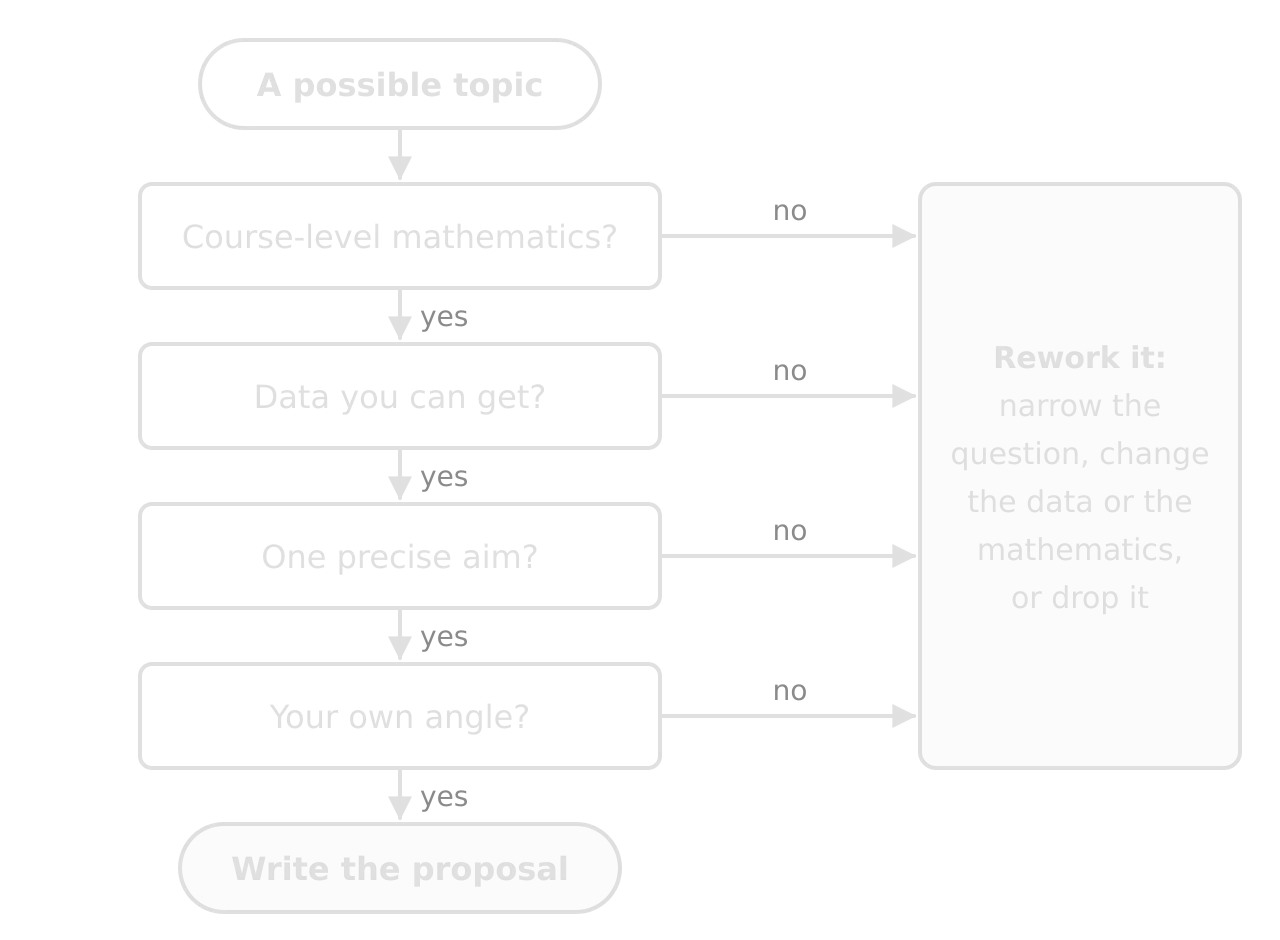
Before committing to a topic, put it through four checks in turn. The flowchart of the four checks shows that a single "no" sends the idea back to be reworked, which is far cheaper at this stage than in week 10.
Check 1: mathematics at the level of the course
The mathematics must be part of the course or at a similar level, and it must not rely only on prior learning. Percentages, averages, bar charts, Pythagoras' theorem and basic areas are prior learning; an exploration built only on them caps the use of mathematics mark however good the context is. At HL the mathematics can go slightly beyond the syllabus, though that is never required for the top marks.
The opposite trap matters too. Mathematics far beyond the course, copied from a university textbook and not understood, scores badly, because understanding has to be demonstrated, and overly complicated mathematics where simpler mathematics would do is not counted as relevant. The target is mathematics you understand well, used with care.
A quick way to apply the check is to list the subtopics the exploration would use. If the list contains only prior learning, or a single routine calculation, the idea needs more depth.
Check 2: data you can get
Most AI explorations stand or fall on their data. Before committing, find the actual data set or plan exactly how you will collect it. Data that "should be online somewhere" often turn out to be unavailable, behind a paywall, or recorded in a form that cannot answer the question.
Ask four questions of any data source:
Does it exist and can I access it? Download it or record a sample before choosing the topic.
Is there enough of it? A trend needs enough points to tell one model from another; a hypothesis test needs a sample large enough for its conditions (expected frequencies above 5 for chi-squared).
Is it reliable? Official statistics agencies and scientific bodies document their methods; an anonymous web page usually does not.
Can I collect it ethically? Surveys of people need consent and anonymity; some questions (health, income, personal habits) need particular care or are best avoided.
Primary data that you collect yourself give strong personal engagement but take time and need a careful design. Secondary data from an official source are quicker and often larger, but you must understand how they were collected and you must cite them. Both kinds are covered in "Modelling and statistics in the exploration".
Check 3: one question, the right size
An exploration of 12 to 20 pages can answer one focused question thoroughly. Topics such as "climate change", "the stock market" or "football" are areas, not questions, and an exploration that tries to cover an area ends up describing many things without analysing any of them properly. The usual fix is to narrow the topic several times until a single answerable question remains.
Stage | Example |
|---|---|
Area | Football |
Narrower | Penalty kicks |
Narrower still | Where penalties are placed and whether they are saved |
Answerable question | Is the outcome of a penalty (scored or not) independent of the zone of the goal it is aimed at, in one league's recorded penalties? |
Each step removes possibilities. The final question names the variables (outcome, zone), the population (one league's penalties) and implies the mathematics (a contingency table and a chi-squared test), so it can be answered in the space available.
Check 4: your own angle
The last check is about personal engagement. Ask what you will add that a reader could not find in a textbook or on a website. Famous results that appear in many online explorations (the golden ratio in art, the Monty Hall problem, Fibonacci numbers in sunflowers) are not forbidden, but reproducing a well-known exposition without your own perspective is unlikely to reach the higher levels of criterion C. A personal angle can come from your own data, your own context, a comparison nobody else has made, or a decision you need to make yourself.
Writing a clear aim
The aim is the reference point for the whole report. The presentation criterion asks whether the exploration describes its aim and meets it, the reflection criterion rewards linking results back to it, and the use of mathematics criterion judges whether the mathematics is relevant to it. An aim that is vague makes all three harder.
A strong aim has four features. It names the real situation and the variables or objects involved; it says what kind of result is wanted (a model, a decision, a test of a claim, an optimum); it fixes the scope (which data, which place, which period); and it is answerable, so that the conclusion can say clearly how far it was achieved. A good aim often hints at the mathematics, but it does not need to list every method.
A research question and an aim do the same job. Some students prefer a question ("To what extent ...?", "Which model ...?"), others a statement ("The aim is to determine ..."). Either is fine as long as it has the four features.
Weak and strong aims by type of exploration
The table pairs a weak aim with a stronger version for each family of AI exploration. In every case the stronger aim is narrower, names the data and states what kind of answer it wants.
Type | Weak aim | Stronger aim |
|---|---|---|
Modelling | To model the growth of my sunflower. | To determine whether a logistic model fits the height of my sunflower measured every three days better than a quadratic model, and to estimate its maximum height. |
Statistics | To see if boys and girls sleep differently. | To test, at the 5% level, whether the mean hours of sleep on school nights differ between male and female students in my year group, using a random sample of 30 students of each sex. |
Networks | To look at the bus routes in my city. | To find a minimum spanning tree connecting the eight bus stations in my city by road distance, and to compare its length with the existing route network. |
Finance | To learn about student loans. | To compare the total cost and the length of repayment of two real student loan plans for a graduate on three different salary paths. |
Optimisation | To design the best box. | To find the dimensions of an open-topped cuboid box made from a 30 cm by 40 cm sheet that maximise its volume, and to compare the result with a commercial box of the same material. |
Geometry | To see where to build a school. | To use a Voronoi diagram of the five primary schools in my district to find the point furthest from any school, as a candidate site for a sixth. |
Differential equations (HL) | To study cooling. | To test whether Newton's law of cooling describes the temperature of a cup of tea I measured every minute for 40 minutes, solving the model with Euler's method and comparing it with the analytic solution. |
Aims that change
An aim is allowed to change while you work. Data may turn out to be unusable, a model may fail in an interesting way, or the first result may raise a better question. When that happens, revise the aim in the final version so that the introduction and the conclusion match, and say briefly why it changed. A change of direction explained honestly is evidence of genuine reflection. An introduction that promises something the report never delivers, by contrast, damages coherence.
The proposal
Most schools ask for a short written proposal at the first deadline. It is usually one or two pages and it lets your teacher spot problems before you invest weeks of work. A useful proposal covers six points.
A working title.
The aim, in one or two sentences with the four features of a strong aim.
Why the topic matters to you, in two or three sentences of specific detail.
The data: what they are, where they come from (with a link or a collection plan), how much there is, and any ethical issues.
The mathematics you expect to use, by subtopic.
The difficulties you can foresee and how you might handle them.
Traps when choosing
Common reasons a topic fails
The same few problems appear again and again in weak explorations, and each of them can be avoided at the choosing stage.
Problem | How it shows in the report | Criteria affected |
|---|---|---|
Context chosen for interest, mathematics at prior-learning level | Pages of description, one simple calculation | E, C |
Textbook result reproduced without an own angle | A tidy exposition that could have been copied | C, D |
Topic far too broad | Many topics touched, none finished | A, E |
Data unavailable or too few | Invented assumptions to fill the gaps, weak conclusions | E, D |
Mathematics beyond the student's understanding | Formulae used but not explained; errors | E, B |
Unethical or intrusive data collection | Work that cannot be submitted as it stands | Academic integrity |
Choosing the mathematics for the question
The question should determine the mathematics used. Starting with "I want to use eigenvectors" and searching for a context to attach them to usually produces a forced exploration in which the mathematics is not relevant to any genuine aim. Starting with a real question and asking which mathematics answers it best gives a natural argument, and it often leads to comparing two approaches, which is good evidence of reflection and, at HL, of sophistication.
Summary
Ideas come from your own interests, daily life, other subjects and the applications met in lessons; turn each interest into a question that data can answer.
AI explorations usually model data, test a statistical question, analyse a network or map, compare financial options, optimise, or (HL) solve a differential equation.
Test every idea: course-level mathematics, data you can actually get, one question of the right size, and an angle of your own.
Find the data before committing to a topic; check it exists, is large enough, is reliable and can be collected ethically.
A strong aim names the situation, the variables, the kind of result and the scope, and it is answerable.
Narrow broad areas step by step until one question remains; phrase aims as open questions that the mathematics can settle.
An aim may change during the work: update the introduction and conclusion to match and explain why.
A short proposal (aim, reason, data, mathematics, difficulties) lets your teacher catch problems early.
Carry on with Maths AI in Augment
With a free account, Augment remembers where you stopped in the notes and which questions you have marked.