D.1 Geophysical systems questions for IB Geography
81 questions on Geophysical systems, written by Augment in the style of IB exam papers. Six of them are below in full, to answer on paper.
- IB Geography
- Part of D Geophysical hazards
- SL and HL
Questions by paper and level
SL and HL questions are for students at either level. HL only questions cover what only HL students study.
| Paper | SL and HL | HL only | All |
|---|---|---|---|
| Paper 1 | 78 | 0 | 78 |
| Paper 2 | 3 | 0 | 3 |
| Every paper | 81 | 0 | 81 |
Counted on
Questions to try
Written by Augment in the style of IB exams, not past papers. Answer them on paper, then check each one against its markscheme with a free account.
Examine the relationship between plate boundary processes and the global distribution of earthquake and volcanic hazards.
10 marks
The table shows information about five volcanic eruptions, A–E, and the change in global mean surface temperature in the year after each eruption.
Eruption | Latitude | Volcanic Explosivity Index (VEI) | Sulphur dioxide released (million tonnes) | Height of eruption column (km) | Change in global mean temperature in the following year (°C) |
|---|---|---|---|---|---|
A | 15°N | 6 | 18 | 35 | −0.4 |
B | 5°S | 5 | 7 | 25 | −0.2 |
C | 46°N | 5 | 1 | 24 | 0.0 |
D | 64°N | 4 | 10 | 9 | −0.05 |
E | 8°S | 7 | 60 | 43 | −0.7 |
- (a)
Describe the relationship between the sulphur dioxide released and the change in global mean temperature shown.
2 marks
- (b)
Suggest two reasons why Eruption D had little effect on global temperature. [2+2]
4 marks
- (c)
Explain two reasons why the cooling effect of volcanic eruptions lasts only a few years. [2+2]
4 marks
Examine why the global distribution of mass movement hazards differs from that of earthquake and volcanic hazards.
10 marks
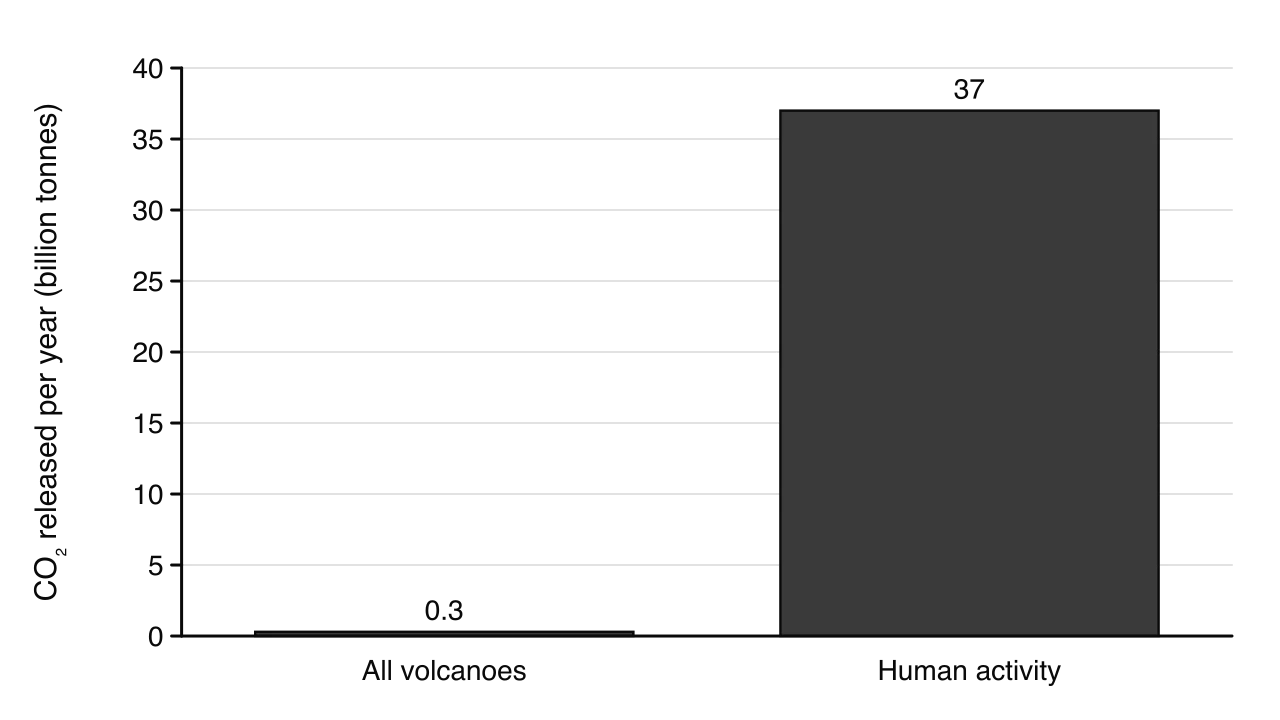
The infographic compares the effects of volcanoes and human activity on the climate.
VOLCANOES vs PEOPLE: WHO REALLY CHANGES THE CLIMATE?
Carbon dioxide released each year
Big eruptions, big effects
Eruption | Year | Effect on climate |
|---|---|---|
Tambora, Indonesia | 1815 | 1816 became the "year without a summer" in Europe and North America |
Pinatubo, Philippines | 1991 | Global temperature fell by about 0.5°C in 1992 |
Nature controls our climate, not us! One volcano can change the whole planet's weather.
Volcanic eruptions release sulphur dioxide, water vapour, CO₂ and ash.
There are about 1350 potentially active volcanoes on land.
- (a)(i)
State the amount of CO₂ released each year by human activity, according to the bar graph.
1 mark
- (a)(ii)
Estimate how many times more CO₂ is released by human activity than by all volcanoes.
1 mark
- (b)
Using evidence from the table only, explain one reason why large volcanic eruptions affect global temperatures for only a short time.
2 marks
- (c)
To what extent does the evidence in the infographic support the view that natural processes, rather than human activity, are the main cause of changes in the global energy balance?
6 marks
Examine the relative importance of mantle convection and slab pull as mechanisms of plate movement.
10 marks
Outline how large volcanic eruptions can cause global dimming. [2]
2 marks
Practice all 81 in Augment
Free with an account. Every question has its markscheme, and Augment keeps the ones you got wrong so you can come back to them.
More questions in Geophysical hazards
- D.1Geophysical systemsThis page
- D.2Geophysical hazard risks
- D.3Hazard risk and vulnerability
- D.4Future resilience and adaptation
Check your answers in Augment
A free account opens all 81 questions on Geophysical systems with their markschemes, and keeps a record of what you have marked.