Assessment criteria and final checks
Understand what each IA criterion rewards at every mark level, avoid the weaknesses that cost marks most often, meet the rubric and academic integrity rules, and check the portfolio before submission.
- IB Economics
- Internal assessment
- SL and HL
How the portfolio is marked
Each of the three commentaries is marked on five assessment criteria, A to E, for a total of 14 marks. A sixth criterion, F, is applied once to the whole portfolio for 3 marks. The maximum is therefore 3 × 14 + 3 = 45 marks.
Criterion | What it assesses | Marks | Applied to |
|---|---|---|---|
A Diagrams | Constructing and explaining relevant diagrams | 3 | Each commentary |
B Terminology | Using economic terms appropriately | 2 | Each commentary |
C Application and analysis | Applying and analysing theory in the article’s context | 3 | Each commentary |
D Key concept | Linking one key concept to the article | 3 | Each commentary |
E Evaluation | Judgments supported by reasoned argument | 3 | Each commentary |
F Rubric requirements | Units, sources and article dates | 3 | The whole portfolio |
Your teacher marks the portfolio first. A sample of each school’s portfolios is then sent to the IB for moderation: a moderator re-marks the sample, and if the teacher’s marks are consistently too generous or too harsh, the marks of every student in the school are adjusted. A mark from your teacher is therefore not final.
Best fit
Each criterion has a short description for each mark. The marker reads them in order and chooses the one that best describes the work, even if not every part of it is met. A commentary with an excellent diagram and a thin explanation may sit between two descriptions; the marker then weighs which one fits better. Top marks do not require perfect work, only work that matches the top description more closely than the one below it.
The criteria are also independent. A commentary can score 3 on A and 1 on E. That makes it useful to check each criterion on its own when revising: a strong diagram does not make up for a missing judgment.
Criterion A: Diagrams (3 marks)
Criterion A assesses how well a commentary constructs and explains diagrams. In words other than the official ones, the levels look like this:
Mark | What the work looks like |
|---|---|
0 | No diagram, or a diagram that does not relate to the article. |
1 | A relevant diagram is included, but it is not explained, or the explanation is wrong. |
2 | The diagram is relevant, accurate and correctly labelled, but the explanation is limited: it says what moves without saying why, or does not connect the diagram to the article. |
3 | The diagram is relevant, accurate and correctly labelled, and the explanation is full: the reason for each movement, the new equilibrium, and what determines the size of the change, all in the article’s context. |
Three words decide the mark. Relevant means the diagram shows the change the article reports, in the unit the commentary is based on. Accurate means the economics is right: the correct curve shifts, in the correct direction, by the correct kind of movement (a parallel shift for a specific tax, a pivot for an ad valorem tax). Correctly labelled means titled axes, labelled curves, marked equilibria and arrows for shifts.
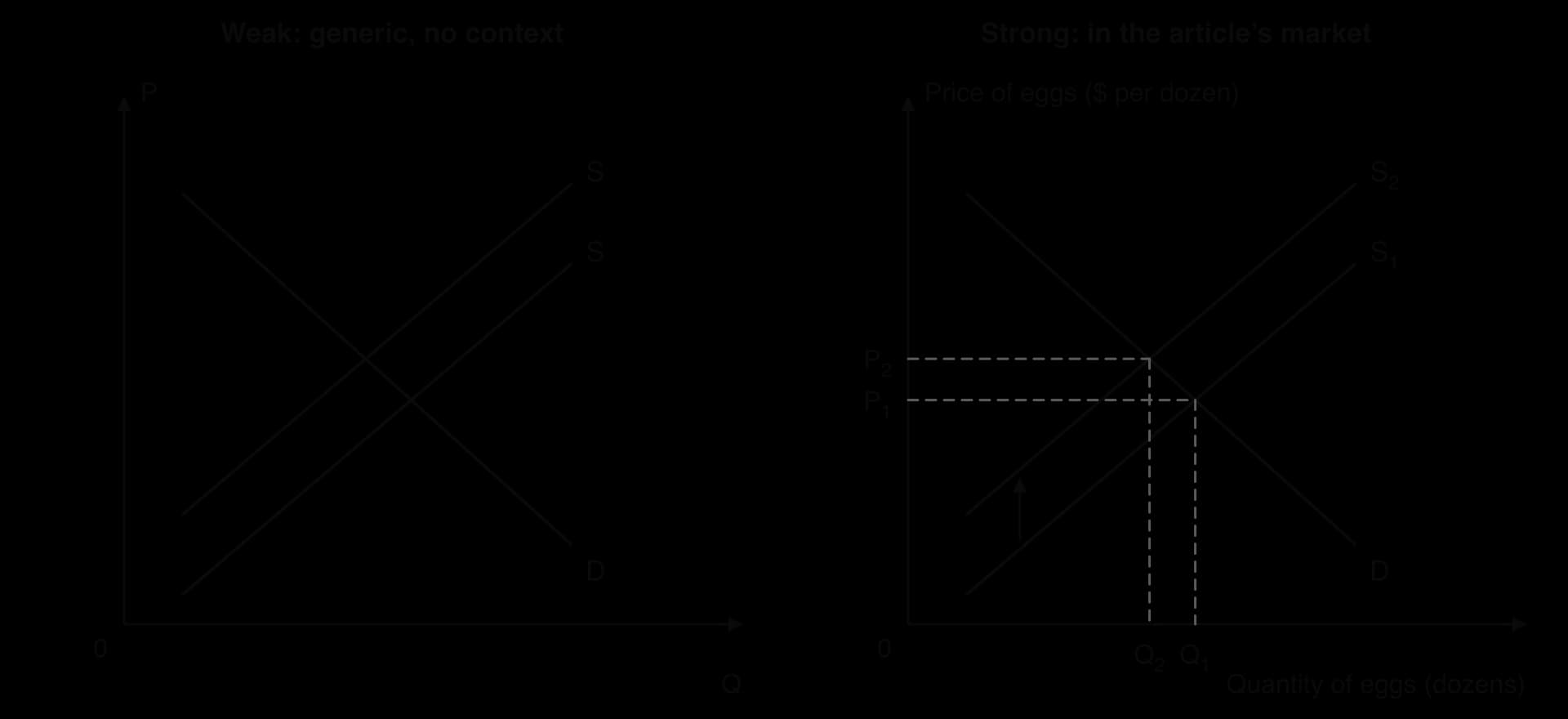
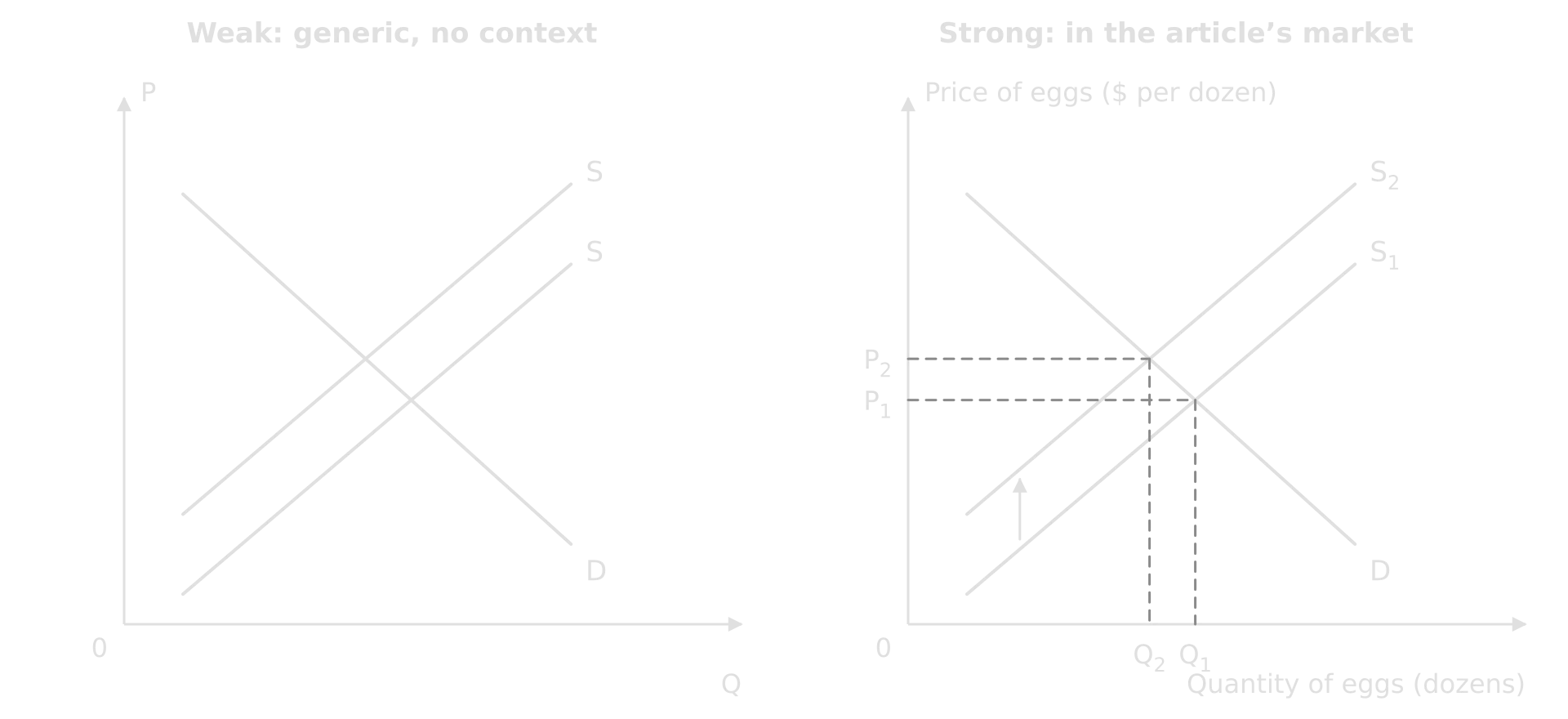
The weak diagram in the figure would earn at most 1 mark, however good the writing: the moderator cannot tell which curve is the original or what has changed. The strong diagram meets the standard for 2 or 3 marks, but the mark depends on the text: with no explanation it still earns only 1, a limited explanation lifts it to 2, and a full one to 3.
Common weaknesses on criterion A
A diagram copied from a textbook, website or the article itself. It shows no skill and earns little.
Generic labels (“P”, “Q”, “D”, “S”) that could belong to any market.
Two curves with the same label, missing arrows, or equilibria not marked on the axes.
An inaccurate shift: demand moved for a tax, a specific tax drawn as a pivot, a welfare loss shaded in the wrong place.
An explanation that only names the movement (“supply shifts left”) without the article’s reason for it.
A diagram that the text never mentions, or mentions only as “see Figure 1”.
Several diagrams, each briefly explained, where one fully explained diagram would earn more.
Criterion B: Terminology (2 marks)
Criterion B assesses the use of economic terminology. It has only two levels above zero.
Mark | What the work looks like |
|---|---|
0 | Little or no economic vocabulary; everyday language throughout. |
1 | Relevant economic terms appear in the commentary, but not consistently, or some are used loosely or wrongly. |
2 | Terms relevant to the article are used appropriately throughout the commentary. |
“Throughout” is the difference between 1 and 2. A commentary that defines three terms in its first paragraph and then slips into everyday language (“prices went up a lot”, “people bought less”) reaches 1. One that writes “the equilibrium price rose”, “quantity demanded fell”, “demand is price inelastic” in every paragraph reaches 2.
Common weaknesses on criterion B
Confusing related terms: demand and quantity demanded; inflation and high prices; deficit and debt; depreciation and devaluation.
Long definitions that take words from analysis and evaluation.
Definitions placed in footnotes, which is not allowed: footnotes are for references only.
Vague words where a precise term exists: “cost” for “price”, “money” for “income”, “the economy grows” for “real GDP rises”.
Criterion C: Application and analysis (3 marks)
Criterion C assesses how far a commentary recognises, applies and analyses economic theory in the context of the article. It carries as many marks as the diagram and rewards application and analysis together.
Mark | What the work looks like |
|---|---|
0 | No relevant theory, or a summary of the article with no economics. |
1 | Relevant theory is applied to the article, but the analysis is limited: mostly description, or theory stated without being worked through. |
2 | Relevant theory is applied to the article throughout, and the analysis is appropriate: the main mechanism is explained correctly. |
3 | Relevant theory is applied throughout, and the analysis is effective: the mechanism is followed step by step into the article’s particular conditions, using its details and data. |
The step from 2 to 3 is the hardest in the portfolio. Appropriate analysis explains what textbook theory predicts. Effective analysis asks what is different about this case: an elasticity that makes the effect larger or smaller, a feature of the market that limits the policy, a figure in the article that shows the scale. In the model commentary on removing taxes on dyed diesel, the analysis reaches 3 because it shows that the tax cut applies only where dyed diesel can be bought, and that inelastic supply lets sellers keep part of it.
Common weaknesses on criterion C
Summarising or paraphrasing the article instead of analysing it.
General theory that is never applied to the article’s market, people or numbers.
Assertions without a mechanism: “this will cause unemployment” with no explanation of how.
Analysis drifting into another unit’s theory.
Ignoring the data in the article, or quoting it without using it.
Criterion D: Key concept (3 marks)
Criterion D assesses how far a commentary recognises, understands and links a key concept to the article. The chosen concept is the commentary’s key concept lens.
Mark | What the work looks like |
|---|---|
0 | No key concept identified, or the concept has already been used in another commentary in the portfolio. |
1 | A key concept is named and there is an attempt to link it to the article, usually a sentence or two that asserts the link. |
2 | The concept is identified and the link is partly explained: the commentary shows how the concept applies, but only in one place or without developing it. |
3 | The concept is identified and the link is fully explained: why the article’s issue is a question of this concept, used in the analysis and in the judgment. |
The 0 for a repeated concept is the harshest rule in the portfolio: a commentary can explain its concept perfectly and still score nothing on D if another commentary used the same one first. Check all three concepts before submitting.
A full explanation does more than say that the concept is present. For the concept of equity, it says whose fairness is at stake and by what standard; for sustainability, which resource or future generation is affected and how; for intervention, why the government acts and whether the action achieves its aim. The concept then shapes the evaluation: the judgment should answer the question the concept raises.
Criterion E: Evaluation (3 marks)
Criterion E assesses how far the commentary’s judgments are supported by reasoned argument.
Mark | What the work looks like |
|---|---|
0 | No judgment, or judgments with no reasoning at all. |
1 | Judgments are made, but the reasoning behind them is limited: a few points listed, often general, with no weighing. |
2 | Judgments are supported by appropriate reasoning: relevant points developed with reference to the article. |
3 | Judgments are supported by effective and balanced reasoning: points weighed against each other in the article’s context, considering more than one side, leading to a clear conclusion. |
Balanced means more than one side is considered: the gainers and the losers, the strengths of a policy and its limits, the short run and the long run. Effective means the points are weighed rather than listed, so that the conclusion follows from them. A commentary that lists four disadvantages and no advantages is unbalanced; one that lists two of each and concludes “there are pros and cons” is balanced but not effective.
Evaluation tool | A question to ask of the article |
|---|---|
Stakeholders | Who gains, who loses, and by how much? |
Time | Does the effect last, grow or reverse in the long run? Are there time lags? |
Assumptions | Does the theory behind the diagram hold in this market? |
Magnitude and evidence | How large is the effect, compared with what? What do the article’s figures show? |
Elasticity | How do PED, PES or YED change the result? |
Alternatives | Would a different policy reach the aim better, and at what cost? |
Priorities | Which objective matters more here, and to whom? |
Common weaknesses on criterion E
No final judgment, or one that sits on the fence.
Evaluation squeezed into the last 50 words because the analysis ran long.
Generic points that could apply to any policy: “it may take time”, “it depends on many factors”.
A judgment that contradicts the analysis, or is not supported by it.
Personal opinion without economic reasoning: “I think this is unfair.”
Criterion F: Rubric requirements (3 marks)
Criterion F applies to the whole portfolio and gives one mark for each rubric requirement met.
Requirement | Met when | Commonly broken by |
|---|---|---|
Different units | One commentary is based on each of Units 2, 3 and 4 | Two commentaries on macroeconomics; a commentary based on Unit 1 |
Different and appropriate sources | Three different written news publications | Two articles from the same newspaper or website; a TV or radio clip |
Contemporary articles | Each article published no more than one year before its commentary was written | Articles saved early and written about much later |
These marks depend only on planning and record-keeping, and they are the easiest in the portfolio to secure. They can also be lost by a single careless choice made early in the course.
Academic integrity
Every commentary must be your own work, and academic integrity matters as much in the IA as in any other IB component. Each student confirms that the portfolio is authentic, and the teacher must be able to confirm it too.
What the rules mean in practice
Choose your own articles. A teacher may not give the class articles to use. Two students may choose the same article by chance, but each commentary must be written independently.
No collaboration on the writing. Discussing economics in class is learning; sharing drafts, planning a commentary together or writing parts of each other’s work is collusion.
Acknowledge every source. Facts and ideas from the article or any other source are cited in the body and referenced in a footnote or endnote. Short quotations go in quotation marks.
Draw your own diagrams. A diagram copied from a textbook or website is someone else’s work and earns no credit.
AI tools. Text, diagrams or ideas produced by an AI tool must be acknowledged like any other source; presenting them as your own work is misconduct. A commentary must be your own analysis, and your teacher may ask you to explain any part of it.
One piece of work, one purpose. The same work cannot be submitted for both the IA and the extended essay.
Teachers check authenticity in several ways: by discussing the work with the student, and by comparing the final version with the student’s choice of articles, the first draft, the references cited and the style of the student’s other work. Plagiarism-detection software may also be used. A student who can explain every sentence of a commentary has nothing to worry about.
The one-draft rule
Your teacher reads and comments on one draft of each commentary, giving advice on how to improve it, but must not edit or correct it. The next version you hand in is the final one. Once the final version is submitted, it cannot be withdrawn and rewritten.
The final checks
Use this checklist on each commentary and then on the portfolio as a whole, before the draft goes to your teacher and again before the final version is submitted.
Each commentary
- To do:
The article was published no more than one year before the date the commentary is written.
- To do:
The cover information is complete: title, source and access date, publication date, writing date, word count, unit, key concept.
- To do:
The commentary is 800 words or fewer, counted correctly (diagrams, short labels, short diagram headings, data tables, calculations, citations and references excluded).
- To do:
The diagram is my own, relevant to the article, accurate, titled and fully labelled in the article’s market, with arrows and equilibria.
- To do:
The text explains every movement on the diagram, with the article’s reason for it.
- To do:
Economic terms are used precisely in every paragraph; only essential terms are defined, briefly, in the body.
- To do:
Every paragraph uses the article’s facts, people or numbers; nothing is a general essay or a summary.
- To do:
The key concept is named in the opening, explained in the article’s terms and used in the judgment.
- To do:
The evaluation considers more than one side (stakeholders, time, assumptions, magnitude, alternatives) and weighs the points.
- To do:
The commentary ends with a clear, specific judgment that follows from the analysis.
- To do:
Every source is cited in the body and referenced in footnotes or endnotes; quotations are short and in quotation marks.
- To do:
The full article is attached, with the relevant section highlighted if it is long, and a translation if it is in another language.
The whole portfolio
- To do:
One commentary on each of Unit 2, Unit 3 and Unit 4; none on Unit 1.
- To do:
Three different publications, all written news media (no TV or radio).
- To do:
Three different key concepts.
- To do:
Every article published within one year of its commentary’s writing date.
- To do:
All three commentaries are my own work, and I can explain every sentence and diagram in them.
Summary
The portfolio is marked out of 45: criteria A–E (14 marks) on each commentary, and criterion F (3 marks) on the whole portfolio; teachers mark and the IB moderates a sample.
Criterion A rewards a relevant, accurate, labelled diagram with a full explanation; criterion B rewards precise terms used throughout.
Criterion C rewards theory applied to the article’s details with effective analysis; criterion D rewards a key concept fully linked to the article, and scores 0 for a repeated concept.
Criterion E rewards balanced, weighed reasoning leading to a specific judgment.
Criterion F gives a mark each for different units, different sources and recent articles.
The work must be your own: own articles, own diagrams, no collaboration, every source and any AI use acknowledged, one draft read by your teacher.
Carry on with Economics in Augment
With a free account, Augment remembers where you stopped in the notes and which questions you have marked.