Command terms
Read every IB Computer Science command term correctly, match the depth of your answer to the term and the marks, and plan your revision and exam day around them.
- IB Computer Science
- Exam skills
- SL and HL
Every part of an IB Computer Science exam question starts with a verb such as state, outline, explain or evaluate. That verb tells you how much to write and what kind of thinking the examiner will reward. Two questions about the same idea, such as cache memory, can ask for one word or for a balanced argument, and the answer that scores full marks on one scores almost nothing on the other.
Each command term has a fixed meaning, an assessment objective and a recognisable shape of full-mark answer in computer science. Knowing them also shapes how you revise and how you spend your time on the day.
How command terms work
The IB publishes a fixed list of command terms for the course, each with an official meaning and an assessment objective. The meanings are the same in every question and every year, so learning them once pays off in every answer you write.
Each command term is linked to one of the course's assessment objectives. The written papers assess three of them; a fourth, solving a real-world problem with computational thinking, is assessed only through the internal assessment.
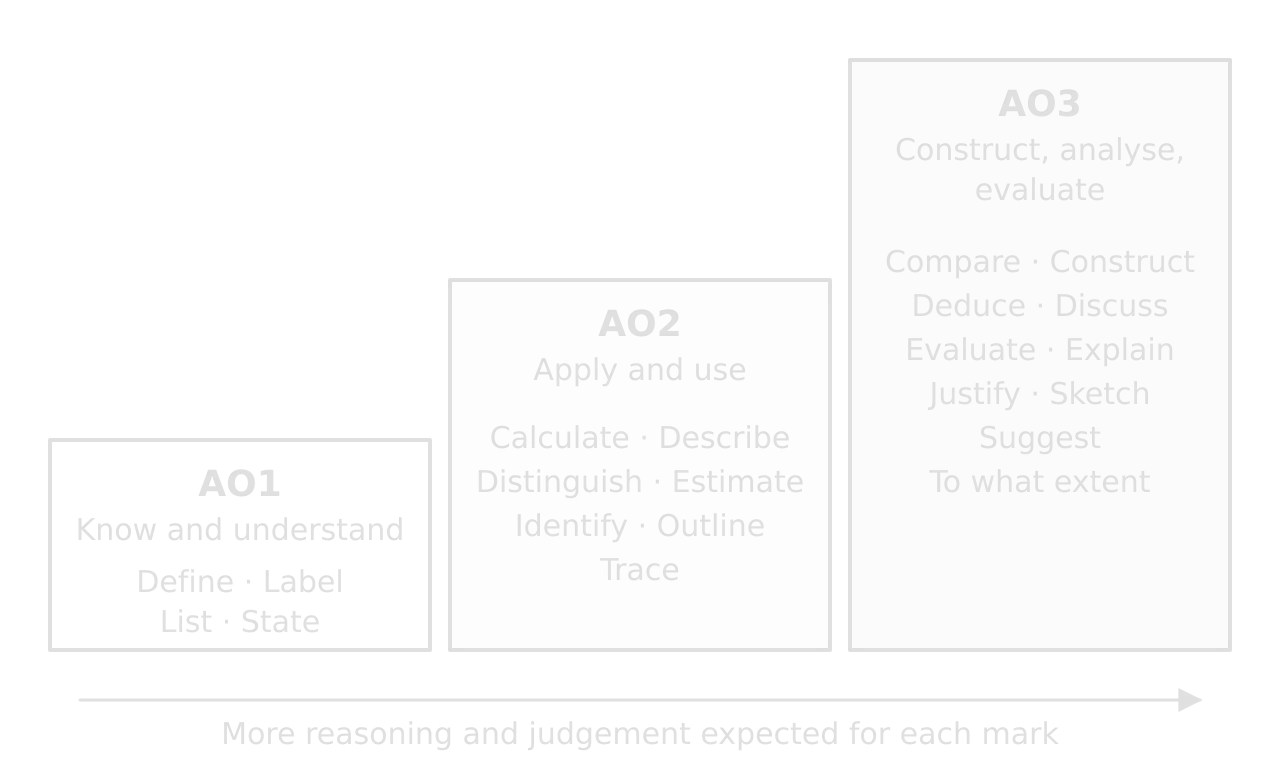
The AO staircase groups all 21 command terms by objective. The higher the step, the more reasoning each mark needs: an AO1 mark is earned by a correct fact, while an AO3 mark is earned by a reason, a judgement or something you build.
Both Paper 1 and Paper 2 split their marks roughly 50% AO1 and AO2 together, and 50% AO3. Half of every paper is therefore questions that ask you to explain, compare, construct, discuss, evaluate or justify. Recalling and applying facts, however well, can earn only the other half.
What a markscheme is
Examiners mark against a markscheme written for each paper. Knowing how markschemes are laid out explains most exam advice: why one point earns one mark, why the second half of an explanation matters, and why extra answers don't help.
The command terms one by one
The tables group the terms by AO. Each row gives the term's meaning in plain words, what it demands in a computer science answer, and a short example question with a typical mark value. The marks in the examples are realistic, not fixed: the same term can carry different marks in different questions.
AO1: knowledge and understanding
AO1 terms test whether you know a fact precisely. The answers are short, and the marks are lost through vagueness more than through missing knowledge.
Term | Meaning | What it demands in CS | Example question |
|---|---|---|---|
Define | Give the precise meaning of a word, phrase or concept | One accurate sentence with the key qualifying words; no example needed | Define the term cache hit. [1] |
Label | Add labels to a diagram | The correct name on each part, with a clear line to it | Label the address bus and the data bus on the diagram. [2] |
List | Give a sequence of brief answers with no explanation | The number of items asked for, one per line | List two types of secondary storage. [2] |
State | Give a specific name, value or brief answer with no explanation or calculation | A word, a value or a short phrase | State the purpose of the program counter. [1] |
The difference between a 0 and a 1 on a Define question is usually one qualifying phrase. "A cache hit is when data is in the cache" misses what makes the event matter: the data is found in the cache, so it is supplied without reading the slower main memory.
AO2: applying and using knowledge
AO2 terms ask you to use what you know: give an account, work something out, pick the right answer, or follow an algorithm. Identify and Trace are AO2 in this course, even though some other subjects treat them differently.
Term | Meaning | What it demands in CS | Example question |
|---|---|---|---|
Calculate | Get a numerical answer, showing the relevant stages of working | The method, the substituted values and the answer with units | Calculate the file size of a 1920 × 1080 image with a colour depth of 24 bits. [2] |
Describe | Give a detailed account | Features or steps in a logical order, each with detail; reasons not required | Describe the role of the MAR in the fetch stage. [2] |
Distinguish | Make the differences between two or more items clear | Contrast on the same aspect: "X …, whereas Y …" | Distinguish between lossy and lossless compression. [2] |
Estimate | Get an approximate value | A sensible rounded value and how you got it | Estimate the time to download the same image on a 50 Mbit/s connection. [2] |
Identify | Give an answer from a number of possibilities | Pick or name the right item; no explanation | Identify the protocol that gives a new device its IP address. [1] |
Outline | Give a brief account or summary | One sentence per mark, covering the main idea | Outline one advantage of a star topology. [2] |
Trace | Follow and record the actions of an algorithm | A trace table or a step-by-step record of every variable and the output | Trace the code and state its output. [3] |
The Calculate and Estimate rows use the same image, which shows how the two terms differ. Calculate wants an exact figure with every stage shown; Estimate accepts a rounded figure as long as the method is sensible.
Trace questions appear mainly in Paper 2, but the technique is the same wherever they appear: one column per variable, one row each time a value changes, and the output recorded when it happens. This short program adds up the even numbers from 1 to 4.
Python
total = 0
for i in range(1, 5):
    if i % 2 == 0:
        total = total + i
print(total)
Java version
Java
int total = 0;
for (int i = 1; i < 5; i++) {
    if (i % 2 == 0) {
        total = total + i;
    }
}
System.out.println(total);AO3: constructing, analysing and evaluating
AO3 terms need reasons, judgement or something built from scratch. Construct and Sketch belong here: both ask you to produce a working artefact (a truth table, a query, a diagram) from the information in the question, not to reproduce one from memory.
Term | Meaning | What it demands in CS | Example question |
|---|---|---|---|
Compare | Give an account of the similarities between two or more items, referring to all of them throughout | Point-by-point, both items in every sentence; similarities and differences | Compare the client–server and peer-to-peer models. [4] |
Construct | Display information in a diagrammatic or logical form | A complete, correct truth table, circuit, SQL query, code, trace table or diagram | Construct an SQL query that lists the names of all Year 12 students. [3] |
Deduce | Reach a conclusion from the information given | The conclusion plus the step that leads to it | Deduce the output of the query for the table shown. [2] |
Discuss | Offer a balanced review of a range of arguments, with a clearly stated, supported conclusion | Arguments on more than one side, weighed, and a conclusion | Discuss the ethical implications of using facial recognition in a school. [6] |
Evaluate | Weigh up strengths and limitations | Strengths and limitations in context, then a judgement | Evaluate the use of cloud storage for a school's coursework. [4] |
Explain | Give a detailed account including reasons or causes | Each point followed by "because", "so" or "this means" | Explain why a larger cache can improve performance. [3] |
Justify | Give valid reasons or evidence to support an answer | Reasons tied to the scenario that support a given choice | Justify the use of a star topology for a computer room. [3] |
Sketch | Represent by a diagram or graph giving the general shape or relationship, with relevant features | A labelled diagram or graph; neatness not needed, key features required | Sketch a star topology with four computers. [2] |
Suggest | Propose a solution, hypothesis or other possible answer | A plausible answer for an unfamiliar situation, often with a brief reason | Suggest why a video call loses quality while a download on the same network does not. [2] |
To what extent | Consider the merits of an argument or concept, with a clear, supported conclusion | A judgement of degree ("largely", "only partly") argued from both sides | To what extent should a hospital rely on a machine learning model to prioritise patients? [6] |
Compare is the term students misread most. The official wording asks for similarities, referring to both items throughout. In practice, good answers give similarities and differences, each sentence naming both items, because a comparison with no differences rarely says much about two technologies. Some syllabus statements say "compare and contrast" (subtopic A2.2, on networking models, is one), which asks for both explicitly.
Quirks of the course's list
Four details of this course's list catch students who learned the terms in another subject or from older Computer Science material.
Identify is AO2. It still needs only the right item, but it often asks you to pick from code or a diagram, which is an application skill.
Trace is AO2. It is a method question: marks go to the record of each step.
Construct and Sketch are AO3. Building a correct query or diagram is treated as a higher-order skill, and these parts often carry 3–6 marks.
Contrast is not on the list. The guide says other terms may sometimes be used, and "contrast" appears in some syllabus statements. If it appears in a question, read it in its ordinary meaning: differences only, like Distinguish.
One idea at three depths
Answering the same question at three depths shows how Outline, Describe and Explain differ. The topic here is why a computer with more cache can run a program faster.
Command term and marks | What the extra marks are for | Model answer |
|---|---|---|
Outline [2] | The main idea, briefly | Cache is a small, fast memory close to the CPU [1]. Keeping frequently used data there means the CPU reads it from cache more often instead of from slower RAM [1]. |
Describe [3] | The mechanism, in order, with detail | The CPU checks the cache first for each instruction or item of data it needs [1]. If it is there (a cache hit), it is read at cache speed [1]. If not (a cache miss), it is fetched from RAM and copied into the cache for next time [1]. |
Explain [4] | The mechanism plus why it improves performance | Cache is faster than RAM, so a hit takes far less time than a miss [1]. Programs reuse the same data and nearby data (locality of reference) [1], so a larger cache holds more of what will be needed next, giving more hits [1]. With fewer misses the CPU spends less time waiting for RAM, so it completes more instructions per second [1]. |
Each sentence of the Explain answer contains a cause and an effect, and the final mark goes to linking the mechanism back to the question's "faster". A student who writes six true facts about cache without the links can still score only two.
How marks scale
Command terms and mark values work together. The term says what kind of point earns a mark; the number in brackets says how many such points the examiner expects. The patterns in the table, like the rules after it, are inferred from earlier IB Computer Science papers, so treat them as a guide, not a guarantee.
Marks | Usual meaning | Plan |
|---|---|---|
[1] | One fact, value or item | One line; no explanation |
[2] | Two points, or one point and its development | Two separate sentences, or "point, because reason" |
[3]–[4] | Three or four distinct points, or two developed points | A short paragraph or a list; every point different |
[4]–[6] on Discuss, Evaluate, To what extent | Usually marked by level, not point by point | Arguments on both sides, applied to the context, and a conclusion |
[6]–[8] on Construct | Features of a correct artefact | Every required element present and connected correctly |
Some rules apply across every term:
Answer the number of items asked for. If a question says "two", examiners mark only your first two. A third answer earns nothing, and a wrong one listed first can cost a mark.
Don't repeat a point in other words. "It is faster" and "it has less delay" are usually the same point and score once.
Write each point as a separate idea. A list or one sentence per point makes it easy for the examiner to award each mark.
Use the scenario. When the question gives a context, markschemes often say the answer must be applied to it, and generic answers can be capped.
Show working. In calculations, traces and constructions, method marks can be earned even when the final answer is wrong, and a wrong value carried correctly into a later part can still score there.
Answers to AO3 terms that build or judge
Evaluate, Discuss and To what extent need the most practice, because they carry the most marks per question and are marked as a whole, often against level descriptors. The shorter AO3 terms, Justify and Suggest, follow the same logic in fewer marks: a claim, then a reason that depends on the scenario.
Construct and Deduce are AO3 too, but they are marked by the correctness of what you produce. For SQL, that means the right columns, the right table, the right condition and the right order.
SQL
SELECT name
FROM Student
WHERE year_group = 12 AND house = 'Blue'
ORDER BY name;Common pitfalls with command terms
Most lost marks on command terms come from a small number of habits. Each is easy to fix once you can see it in your own answers.
Another common slip is writing a definition that uses the word being defined ("Encryption is when data is encrypted"). Define questions need the meaning in other words, such as "converting plaintext into ciphertext using an algorithm and a key so that only someone with the right key can read it".
Students also over-answer AO1 terms. A State question needs a value or a name, and any explanation added is ignored. The time is better spent on the AO3 parts at the end of the question.
Revising with command terms
Good revision turns every syllabus statement into the questions it can produce. The statement's command term tells you the main depth to prepare, so you can predict most question types for a topic before you have seen a paper.
Plan by teaching hours and paper
The recommended teaching hours give a rough guide to where the marks fall. Topics with more hours have more content and appear in more questions, so they deserve more revision time.
Area | SL hours | HL hours | Examined in |
|---|---|---|---|
A1 Computer fundamentals | 11 | 18 | Paper 1 Section A |
A2 Networks | 11 | 18 | Paper 1 Section A |
A3 Databases | 11 | 18 | Paper 1 Section A |
A4 Machine learning | 5 | 18 | Paper 1 Section A |
B1 Computational thinking | 5 | 5 | Paper 2 |
B2 Programming | 40 | 42 | Paper 2 |
B3 Object-oriented programming | 7 | 23 | Paper 2 |
B4 Abstract data types (HL only) | – | 23 | Paper 2 (HL) |
Case study | 15 | 30 | Paper 1 Section B |
Source: IB Computer Science guide, first assessment 2027, recommended teaching hours.
Programming alone is 40 of the SL course's 105 hours of syllabus content (the case study included), which is why Paper 2 is dominated by code. At HL, theme A's four topics have 72 hours and the case study 30, against 93 for theme B, so Paper 1 needs at least as much revision time as Paper 2.
Active recall, not rereading
Rereading notes feels productive but builds little memory. Retrieval practice, where you answer from memory and then check, works far better. Three methods suit this course:
Definition cards. Put each glossary term on a card or in a flashcard app, with the definition on the back. Test yourself until you can write each one with its qualifying words.
Command-term drills. Take one syllabus statement, write a 2-mark Outline, a 3-mark Describe and a 4-mark Explain on it, then check them against your notes.
Past-style questions under time. No past papers for this course exist yet, so use the specimen papers from your teacher and exam-style questions written for each subtopic. Mark your answers strictly against the markscheme, one point at a time.
Write code by hand
Paper 2 is written without an IDE, a compiler or autocomplete. Practise writing functions and methods on paper, then type them in and run them to find your mistakes. Pay attention to indentation in Python and braces and semicolons in Java; markschemes usually tolerate small syntax slips but not ambiguous logic, so clear layout protects your marks. Some Paper 2 questions also ban built-in functions such as sort, max or len, so revise the hand-written loop for each one as well as the one-line call. Layout, marking and the hand-written replacements are covered in full on the page "Paper 2: reading and writing code".
On the day
Exam technique is mostly about reading carefully and spending time where the marks are. The following routine works for every question on both papers.
Read the whole question first, including every part, so you know where it is going and don't use up a good point too early.
Mark the command term and the marks for each part. Decide how many points the part needs before you write.
Mark the context. Underline the scenario's names and details, and use them in your answer.
Answer the number of items asked for, each as a separate sentence or bullet.
Show working for calculations, traces and constructions.
Keep time for the long parts. Discuss, Evaluate and To what extent parts often come last in a question and carry the most marks.
Leave a few minutes at the end to check that every part has an answer. A blank part scores nothing, and a short attempt often scores a mark.
Paper 1's two sections are sat together without a break, so you decide how to split your time between them; the page "Paper 1: concepts questions" gives the split for each level.
Checklist
- To do:
I can give the meaning of all 21 command terms and the AO each belongs to.
- To do:
I know that Identify and Trace are AO2, and Construct and Sketch are AO3.
- To do:
I can answer one question at Outline, Describe and Explain depth and say what each extra mark is for.
- To do:
I write Compare answers that name both items in every point.
- To do:
I can tell how many points a part needs from its command term and marks.
- To do:
I answer only the number of items asked for.
- To do:
I show working in every Calculate, Trace and Construct answer.
- To do:
I give strengths, limitations and a conclusion in every Evaluate and Discuss answer.
- To do:
I revise with active recall, using definition cards and timed questions.
- To do:
I can write code by hand, including the hand-written version of common built-ins.
- To do:
I can pace a paper at about 1.5 minutes per mark.
Carry on with Computer Science in Augment
With a free account, Augment remembers where you stopped in the notes and which questions you have marked.