The pre-released case study
Understand how the pre-released case study works, research its challenges with a clear plan, and answer Paper 1 Section B questions, including unseen stimulus, with applied, balanced and justified answers.
- IB Computer Science
- Exam skills
- SL and HL
Paper 1 Section B is the only part of the written exams that you can prepare for with the actual material in your hands. A year before the May exams, the IB publishes a case study booklet describing a scenario and a set of challenges, and the questions in Section B are about that scenario. The marks reward research done months in advance, so the way you prepare matters more than anything you do on the day.
A new booklet is expected each year, so notes and model answers from earlier years cover a different scenario. The preparation method, from mapping the booklet to research plans and timed practice, works for any scenario.
What the case study is
The case study is a booklet that sets out a scenario in computing: a fictional organisation facing a decision about current developments, emerging technologies or ethical issues. It explains the technical background, introduces the terms the scenario uses, and ends with the challenges the organisation faces.
The booklet appears on the IB's Programme Resource Centre 12 months before the May session, which is 18 months before the November session of the same year. Your teacher gives it to you; it is IB copyright and is not freely published. Booklets set for other years are good practice in method, but only this year's booklet is examined.
The challenges
The core of the booklet is a short list of challenges: problems the organisation must solve, each pointing to an area of computer science that needs research beyond the booklet. At SL there are two challenges, and Section B's 12 marks are short-response questions about the scenario and those two challenges.
What Section B tests
Section B questions can test six different things about the case study. The guide gives each one an assessment objective, which tells you how deep the answer must go. The example questions use command terms at the same AO level; real questions may mix levels within one part.
What is tested | AO | What a question might ask |
|---|---|---|
How the system in the case study works | AO1 | State what a component of the system does; define a term from the booklet |
The computational thinking behind the system | AO1 | State an abstraction the system uses; list the parts the problem is decomposed into |
Course concepts applied to the case study | AO2 | Describe how a network, database or ML concept from theme A applies to the scenario |
How the scenario relates to other scenarios | AO2 | Outline how the same technique is used in a different organisation or industry |
Impacts and ethical issues | AO3 | Discuss the ethical implications for a named stakeholder |
Strategies, using the booklet, your research and new stimulus | AO3 | Evaluate a proposal given in the paper; justify a recommendation |
The last row needs particular attention. The exam paper can include new stimulus material that is not in the booklet, such as a table of figures, a short proposal, a quotation or a diagram (the guide doesn't specify the form). Questions then ask you to evaluate it using what you know. Students who memorised notes on the booklet but never practised applying them to new information find this the hardest part.
A research plan
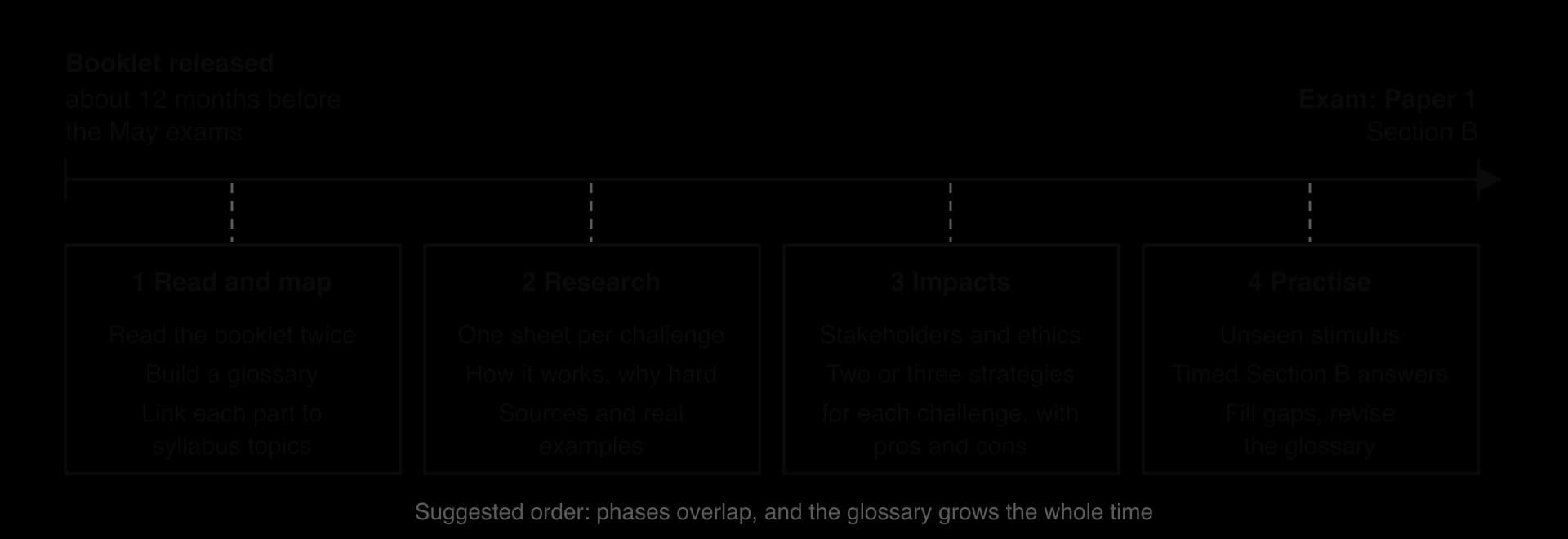
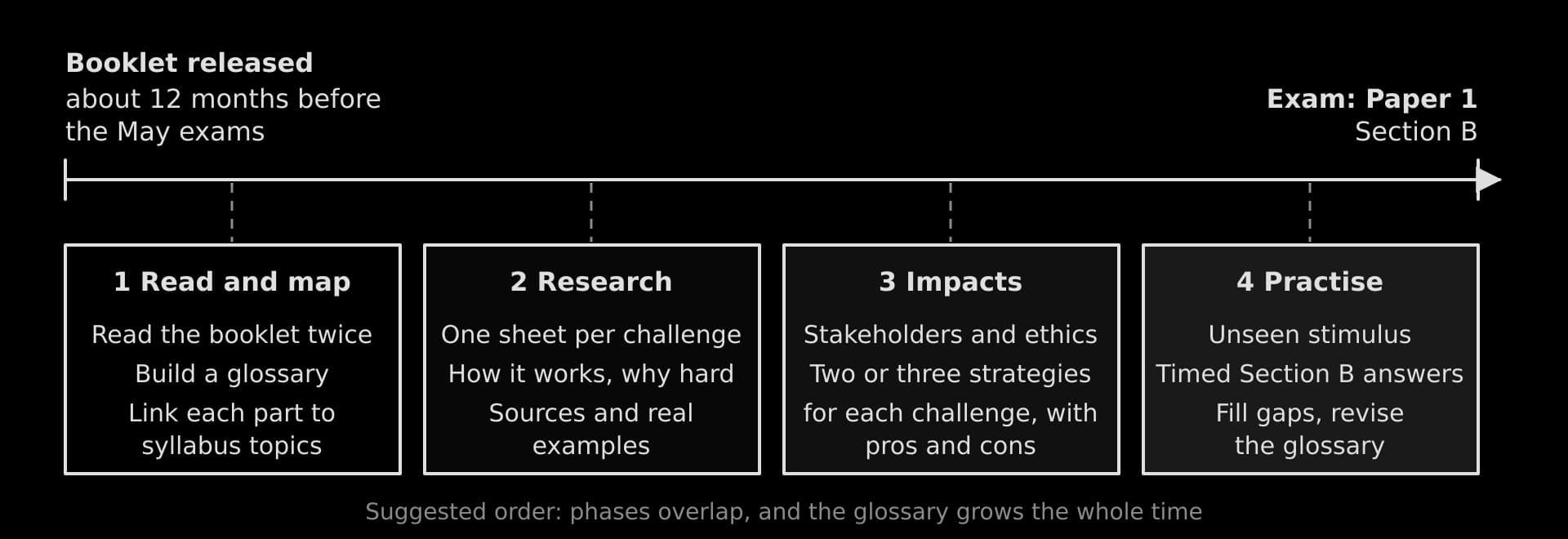
A year is a long time, and most students either start too late or spend months reading without producing anything they can revise from. A plan with four overlapping phases keeps the research focused and leaves you with usable notes.
Phase 1: read and map
Read the booklet twice: once quickly for the story, then slowly with a pen. On the second reading, mark every technical term, every number and every stakeholder.
Build a glossary. Every technical term in the booklet goes into a glossary in your own words, with a one-line example from the scenario. Define questions in Section B use the booklet's own terms, so this glossary is the first thing to revise.
Map the booklet to the course. For each paragraph and each challenge, note which subtopics it draws on. A scenario about a city's camera system, for example, links to A1 (hardware for processing video), A2 (networks and security), A3 (storing the data), A4 (machine learning and its ethics) and B1 (computational thinking).
List the stakeholders. Note everyone the scenario affects: the organisation, its staff, its customers or users, the people whose data is collected, and the wider public.
Phase 2: research each challenge
Make one challenge sheet for each challenge you are examined on (two at SL, four at HL). Each sheet answers the same questions, so you can revise them side by side.
Heading | What to write |
|---|---|
The challenge in one sentence | What the organisation has to solve, in your words |
How the technology works | The process in numbered steps or a labelled diagram, at the depth of a describe answer |
Why it is hard | The computational problem (speed, scale, accuracy, storage, security) or the ethical problem |
Strategies | Two or three ways to tackle it, each with advantages and disadvantages |
Real examples | Named organisations or systems that faced the same problem, with what they did and a source |
Links to the course | The subtopics and key terms involved |
Stakeholders and impacts | Who gains, who loses, and the social, ethical, economic and environmental effects |
The guide names the kinds of research that count: primary and secondary sources, interviews, guest speakers and field trips. A conversation with someone who works with the technology, or a visit to an organisation that uses it, often gives you specific details that no textbook has.
Judge each source before you trust it. Official documentation, peer-reviewed research and reputable news organisations are stronger than anonymous blogs. A company's own claims about its product are useful evidence of what the company says, but not proof that the product works.
Phase 3: impacts and strategies
The AO3 questions ask you to discuss impacts and evaluate strategies, so your notes need arguments ready to use. For each challenge, write two or three strategies with a strength and a limitation for each, and decide which you would recommend for the organisation and why.
Then map the impacts by stakeholder. A short table per challenge works well: one row per stakeholder, with the benefit and the harm for each. This stops answers from treating "people" as one group, when the organisation, its customers and the public usually gain and lose different things.
Phase 4: practise under time
From about three months before the exam, practise answering questions, not just reading notes. Write your own questions in the shapes in the table of what Section B tests, swap them with classmates, and answer them in timed conditions: about 18 minutes for SL's 12 marks and about 36 minutes for HL's 24.
The most valuable practice is with unseen stimulus. Ask a classmate or teacher to give you a short table, a proposal or a news extract related to the scenario that you have not seen, then evaluate it in ten minutes. That is the skill the last row of the table tests.
Answer technique
Section B answers follow the same command-term rules as the rest of Paper 1. Two features are special to the case study: everything must be applied to the scenario, and some questions give you new information to work with.
Short-response items
Short items (1–4 marks) usually test AO1 and AO2: a definition of a booklet term, a description of how part of the system works, or an explanation of a concept in the scenario. Use your glossary wording and add a detail from the scenario wherever the marks allow.
The worked examples use a practice scenario invented for this purpose. It is not an IB case study.
Questions about relating the scenario to other scenarios (AO2) want a genuine link: the same technique or problem in a different setting, with what is similar and what is different. A good preparation habit is to keep one or two real examples per challenge on each challenge sheet for exactly this purpose.
The longer AO3 response
The AO3 parts ask you to discuss impacts or to evaluate a strategy. SL Section B contains only short-response questions, so SL AO3 parts are shorter versions of the same skill; HL Section B adds extended-response questions, which can be among the longest answers on the paper. The structure is the same as any judgement answer: brief technical explanation, arguments on both sides applied to the scenario, a weighing step, and a justified conclusion or recommendation. Three habits matter most in Section B:
Use the scenario's names for the organisation, its systems and its stakeholders in every paragraph.
Use the stimulus. If the paper gives a table or proposal, quote figures from it and say what they mean for the organisation.
Recommend. When the question asks which option, or whether to proceed, give a clear answer and the condition under which it would change.
The new stimulus in the next worked example is a table of figures. Both options and every figure in it are invented for practice, and the 6-mark length is closer to an HL extended response; at SL, expect the same reasoning in fewer marks.
Option A: cloud processing | Option B: edge processing | |
|---|---|---|
Where the model runs | Council's cloud provider | A computer at each junction |
Time from camera frame to light change | About 400 ms, varies with network load | About 40 ms |
Video leaving the junction | All footage streamed to the cloud | Only counts sent; footage deleted after processing |
Cost to set up for 60 junctions | Low | High (60 computers) |
Updating the model | Once, centrally | Sent to 60 devices |
If the network fails | Junctions fall back to fixed timers | Junctions keep adapting |
The model answer uses four figures or facts from the table, ties both options to the booklet's challenges, and ends with a recommendation plus a fallback. Those three features are what move an answer from listing to evaluating.
Ethics in Section B
Every case study raises ethical questions, because the scenarios are chosen from current developments and emerging technologies. Use the ethics vocabulary from theme A, especially A4.4: stakeholders, privacy, consent, algorithmic bias, accountability and transparency. Each term needs a consequence for a named group to earn credit.
Common mistakes with the case study
The case study rewards steady, applied preparation, and most problems come from leaving it until the final weeks or from preparing the wrong things.
Starting late. A year of short, regular sessions produces far better notes than a week of cramming.
Learning only the booklet. The questions test research beyond the booklet; the booklet is the starting point.
Preparing generic notes. A page on machine learning in general is not a challenge sheet; it needs the scenario's stakeholders, strategies and examples.
Not practising unseen stimulus. The AO3 marks depend on evaluating new information under time.
Quoting the booklet at length. It wastes time and shows recall, not understanding. Paraphrase, then apply.
Checklist
- To do:
I have confirmed this year's case study title with my teacher.
- To do:
I know how many challenges I am examined on (two at SL, four at HL) and how many marks Section B carries.
- To do:
I can state the six things Section B tests and the AO of each.
- To do:
I have a glossary of every technical term in the booklet, in my own words.
- To do:
I have mapped each part of the booklet to course subtopics.
- To do:
I have a challenge sheet for each challenge: how it works, why it is hard, strategies, real examples, links and stakeholders.
- To do:
I have recorded and judged the sources of my research.
- To do:
I can link each challenge to a real scenario outside the booklet.
- To do:
I have practised evaluating unseen stimulus in timed conditions.
- To do:
My longer answers name the scenario, use the stimulus, weigh both sides and end with a justified recommendation.
Carry on with Computer Science in Augment
With a free account, Augment remembers where you stopped in the notes and which questions you have marked.