Paper 1A: multiple choice
How Paper 1A multiple-choice questions are built, a routine and time-saving strategies for answering them, the slips behind the wrong options, and thirteen worked questions.
- IB Chemistry
- Exam skills
- SL and HL
Paper 1A is the multiple-choice part of Paper 1. Each question has four options, labelled A to D, and exactly one is correct. Every question is worth one mark and no marks are deducted for a wrong answer, so no question should be left blank. A calculator and a clean copy of the data booklet are available, but the numbers are chosen so that the arithmetic is short: most questions test whether the right chemistry is chosen, not whether a long calculation is done.
The questions run roughly in syllabus order, from the particulate nature of matter to organic reaction types, and they sample every part of the course. About three quarters are conceptual (bonding, trends, definitions, mechanisms, practical techniques) and about a quarter need some arithmetic. SL papers test SL content only; HL papers test both the SL content and the additional HL content, and some questions appear on both.
How the questions are built
A typical stem is short, often a single line of 10 to 25 words, sometimes with an equation, a data line or a figure (an energy profile, a structure, a graph or a spectrum). Most stems are direct questions beginning "Which …?" or "What is …?". When a number is asked for, the unit sits in the stem ("What is the amount, in mol, of …?") and the options are bare numbers, usually in ascending order.
Format | What it looks like | How to approach it |
|---|---|---|
Statements | Four sentences or phrases, such as four explanations of why a catalyst increases the rate | Decide in a few words what you would write, then find the option that says it |
Combination table | Four rows that each pair two answers, such as "electron domain geometry / molecular geometry" or "oxidation state / charge" | Decide each column on its own; the row that matches both is the key |
Formulas, expressions or orders | Four equations, four expressions, four bond-enthalpy sums, or four orders such as "" | Check one feature at a time: state symbols, coefficients, signs, which end of the order |
Numbers | Four values, almost always in ascending order, or from negative to positive | Work out an answer or a rough size first; neighbouring options are often a factor of 2, 10 or a sign away |
I, II and III | Three statements; options A "I and II only", B "I and III only", C "II and III only", D "I, II and III" | Judge each statement true or false separately, then pick the combination |
The options are written so that each wrong one is reached by a real mistake: a mole ratio not applied, a sign reversed, a temperature left in degrees Celsius, the molecular formula given when the empirical formula was asked for. A student who makes that slip finds their answer among the options. "My answer is there, so it must be right" is therefore not a safe check.
Stems also contain cue words that carry chemistry. "At the same temperature and pressure" means equal volumes of gases contain equal amounts. "Excess" tells you which reactant is limiting. "Aqueous", "dilute" and "concentrated" affect what happens at an electrode or how far an acid ionizes. "In the dark" or "in UV light" separates addition to an alkene from substitution in an alkane. "Assume complete combustion" fixes the products as carbon dioxide and water. A question that seems to lack information usually has the missing piece in one of these phrases.
A routine for every question
Read the whole stem, including the last line. Underline what is asked for and any cue word. Many marks are lost by answering a slightly different question: the empirical formula instead of the molecular formula, the reverse activation energy instead of the forward one, the number of molecules instead of the number of atoms.
Cover the options and predict. For a calculation, get a value or at least its size. For a conceptual question, say in a few words what the answer should be.
Match and check. Find your prediction among the options. Then ask which slip produces each neighbouring option. If you can explain every distractor, you can be confident in the key.
If stuck, eliminate. Cross out options with the wrong sign, an impossible value (a pH above 14, a negative amount), a broken trend or a state symbol that cannot be right. Choosing between two options is far better than guessing between four.
Mark and move on. If a question resists you for more than a couple of minutes, choose the best remaining option, mark the question number, and return to it at the end.
Strategies for each type of question
Combination tables
A two-column table asks two questions at once, such as "What are the electron domain geometry and the molecular geometry of …?" or "What is the oxidation state of the metal and the overall charge of the complex?". Answer the column you are surest of first. Usually only two rows survive, and the second column then decides between them. Rows that are internally inconsistent, such as a trigonal planar electron domain geometry with a trigonal pyramidal molecular geometry, can be crossed out without any thought about the molecule.
Statements I, II and III
Judge each statement on its own and write T or F beside it before looking at the options. Because the four combinations are fixed, deciding that one statement is false removes two or three options at once: if statement III is false, only A ("I and II only") can be right, provided I and II are both true. Read each statement as a whole; a statement that is half right is false.
Expressions instead of values
Questions on bond enthalpies, Hess's law and equilibrium constants often give four unevaluated expressions, such as "", so that the method is tested without the arithmetic. Check three things in order: the direction of the subtraction, the coefficients, and that every bond or species is counted. For bond enthalpies, ; for enthalpies of formation, the opposite order, products minus reactants, applies. For an equilibrium constant expression, products go on top and every concentration is raised to the power of its coefficient.
Orders and trends
For "What is the order of increasing …?" questions, decide the two ends first: the substance with the lowest boiling point, the smallest radius or the weakest acid. That often leaves one option. Then check whether the question involves a known exception to the general trend, which is exactly what the distractors test: the electron configurations of chromium and copper, or the lower first ionization energies of the group 13 and group 16 elements at HL.
Short calculations
Calculation questions are designed to take a minute or less. Write the equation or the mole ratio, find the amount in moles, and scale. Then compare the size of your answer with the options: if they differ by factors of 2, the slip is usually a mole ratio or a coefficient; if they differ by factors of 10, it is a unit conversion ( to , to ) or a power of ten in the Avogadro constant.
Practical and data questions
One to three questions on each paper test practical work directly: which technique purifies a solid (recrystallization), how a reading should be recorded (to the precision of the instrument, so a balance reading to is recorded as , not ), what the percentage uncertainty of a reading is, which property can be monitored to follow a rate, or which graph shows a change in conductivity during a titration. The ideas are those of Paper 1B, asked in a single step.
Traps hidden in the distractors
The same slips appear across the whole course. Recognising them makes most distractors easy to reject.
Trap | Example of the distractor |
|---|---|
Stoichiometry ignored | The 1 : 2 mole ratio in an equation not applied; two ions per forgotten; the number of atoms per molecule not counted |
A power of ten | for ; a volume left in when was needed |
A reversed sign or subtraction | Bond enthalpy "formed minus broken"; the cell potential calculated the wrong way round; the reverse activation energy taken for the forward one |
Right number, wrong question | The molecular formula offered when the empirical formula is asked for; the number of molecules when atoms are asked for |
State symbols | in a lattice enthalpy equation; where the standard state is liquid; deposition confused with condensation |
Sublevels overlooked | for chromium; a p orbital said to hold six electrons (a p sublevel holds six) |
Inverted proportionality | Volume taken as proportional to pressure; a temperature left in in a gas-law ratio |
Terms confused | Surface area and particle size; emission and absorption; Lewis and Brønsted–Lowry acids; "more collisions" in place of "more collisions with enough energy" |
Bonds broken on boiling | Covalent bonds broken when a molecular substance boils; a giant covalent solid described as ionic |
Worked multiple-choice questions
Each question is followed by its answer, the reasoning and the slip behind each distractor. Try each one before opening the solution. Questions 1 to 11 and 13 use SL content; question 12 is HL.
Question 1: counting atoms
Question 2: a gas under new conditions
Question 3: a molecular shape
The options for this question are given as a combination table.
Electron domain geometry | Molecular geometry | |
|---|---|---|
A. | trigonal planar | bent |
B. | tetrahedral | tetrahedral |
C. | linear | linear |
D. | tetrahedral | bent |
Question 4: an order of boiling points
Question 5: a bond-enthalpy expression
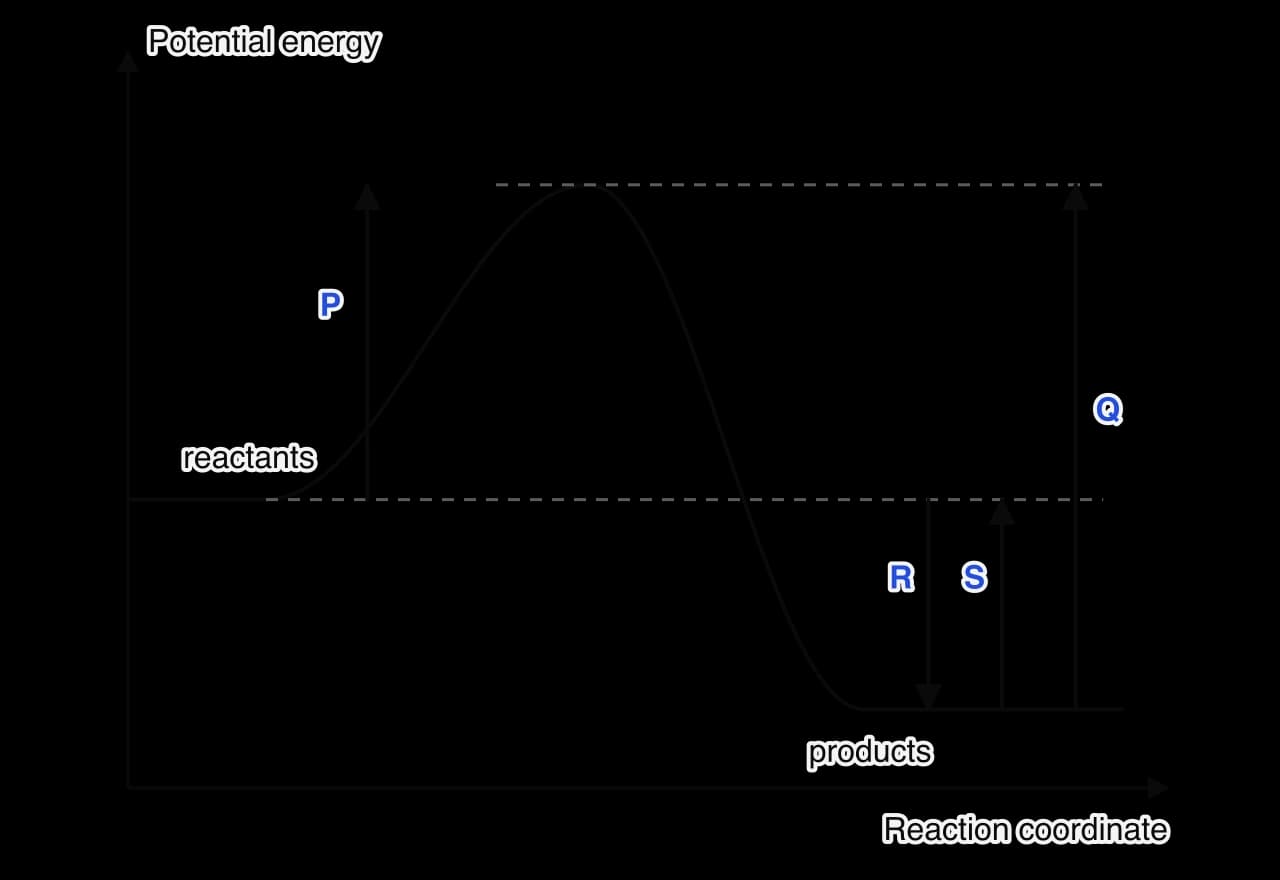
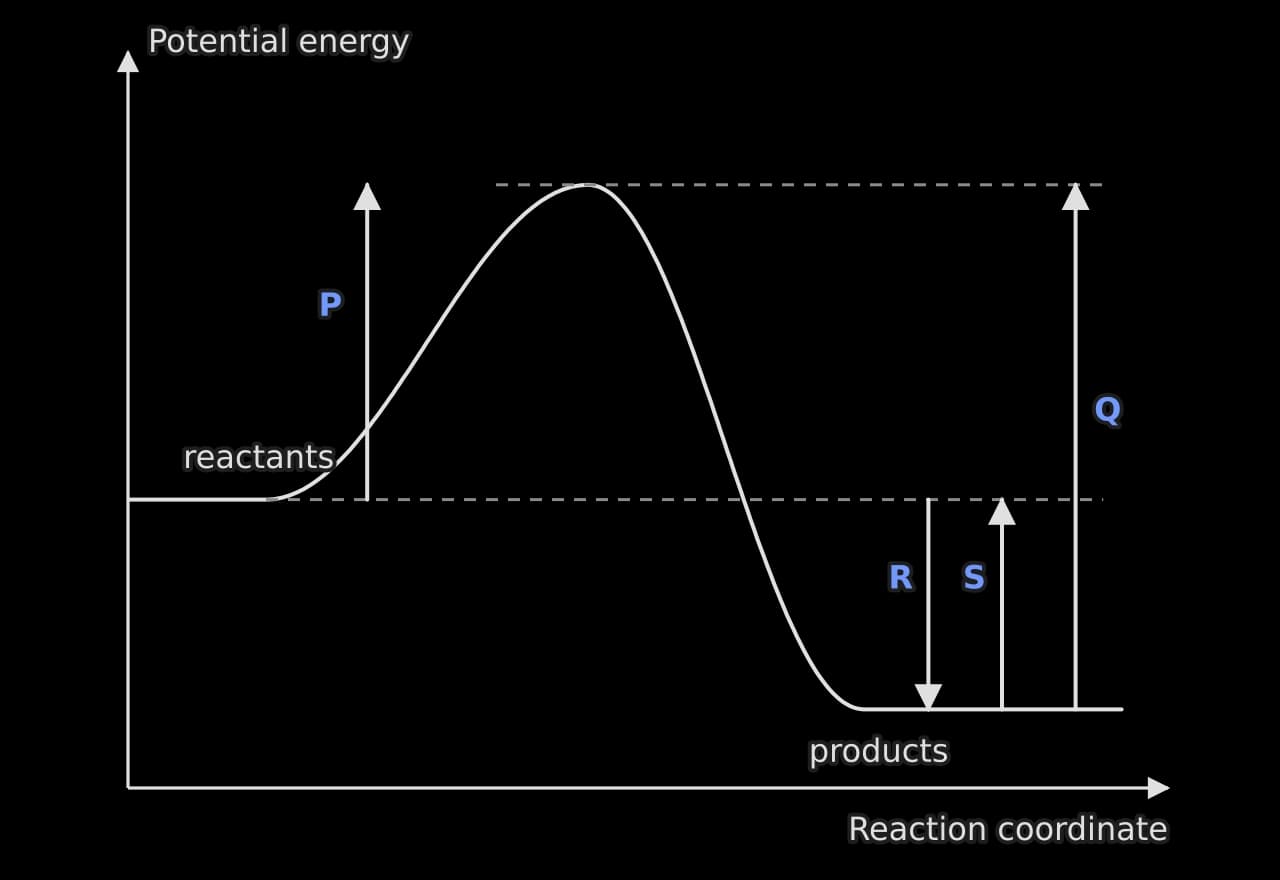
Question 6: reading an energy profile
Question 7: rate and amount of product
Question 8: the equilibrium constant
Question 9: diluting a strong acid
Question 10: recognising reduction
Question 11: recording a measurement
Question 12: a Lewis acid (HL)
Question 13: structural isomers
Using the whole paper well
Paper 1A and Paper 1B are taken together in one sitting, and you decide how to divide the time between them. Many students answer the multiple-choice questions first, because they are quick and build confidence, and then move to the data-based questions with the remaining time. Whichever order you choose, decide it before the exam and keep an eye on the clock.
Keep a steady pace. Most questions take well under two minutes. A question that is taking much longer is better left, with a provisional answer marked, than allowed to eat into the rest of the paper.
Answer every question. There is no penalty for a wrong answer, so a blank is a mark given away. When unsure, eliminate what you can and choose from what is left.
Change an answer only for a reason. A second reading that finds a definite error (a missed coefficient, a misread unit) is worth acting on; a vague feeling is not. First answers reached by sound reasoning are more often right.
Ignore patterns in the letters. Keys are spread roughly evenly over A to D, but runs of the same letter happen. Choose each answer on its own merits.
Check the answer sheet. Make sure each answer is entered against the right question number, especially after skipping a question.
Self-check
- To do:
I can recognise the five common formats of a Paper 1A question and the quickest approach to each.
- To do:
I can predict an answer before reading the options and then explain the slip behind each distractor.
- To do:
I can solve a combination-table question by deciding one column at a time.
- To do:
I can judge statements I, II and III independently and use the fixed option set to eliminate quickly.
- To do:
I can check a bond-enthalpy, Hess or equilibrium expression for direction, coefficients and completeness.
- To do:
I can spot the common traps: mole ratios, powers of ten, reversed signs, state symbols, °C for K.
- To do:
I can distinguish between a change in the position of equilibrium and a change in the value of K.
- To do:
I can answer short practical questions on precision, uncertainty and the choice of technique.
- To do:
I can pace the paper, mark questions to return to, and leave no question unanswered.
Carry on with Chemistry in Augment
With a free account, Augment remembers where you stopped in the notes and which questions you have marked.