T.14 Critical path analysis questions for IB Business Management
23 questions on Critical path analysis, written by Augment in the style of IB exam papers. Six of them are below in full, to answer on paper.
- IB Business Management
- Part of T Business management toolkit
- HL only
Questions by paper and level
| Paper | Questions |
|---|---|
| Paper 2 | 23 |
Counted on
Questions to try
Written by Augment in the style of IB exams, not past papers. Answer them on paper, then check each one against its markscheme with a free account.
Clínica Dental Arcos in Guadalajara, Mexico, must close while it is renovated, losing about MXN 40 000 of revenue a day. The tasks are shown in Table 1.
Table 1: Renovation tasks
Task | Description | Preceded by | Duration (days) |
|---|---|---|---|
A | Strip out old fittings | – | 2 |
B | Rewire the surgeries | A | 3 |
C | Install power and lighting for the X-ray room | A | 2 |
D | Plumbing for the dental chairs | A | 4 |
E | Plaster and paint | B, C | 3 |
F | Install dental chairs | D, E | 2 |
G | Clean and inspect | F | 1 |
- (a)
Determine the minimum number of days needed for the renovation (show all your working).
2 marks
- (b)
The clinic has only one electrician, who must do both task B and task C. Calculate the new minimum duration (show all your working).
2 marks
- (c)
Explain one way in which the clinic could avoid the extra delay.
2 marks
Mavuno Builders Ltd is a construction company in Nairobi, Kenya. For small house extensions its site managers use Gantt charts. For a new six-storey school building, with more than 40 activities and a penalty clause for late completion, the operations director, Nyambura Kinyua, wants the managers to use critical path analysis (CPA) as well.
Distinguish between a Gantt chart and critical path analysis as planning tools for Mavuno Builders.
4 marks
Dapur Rempah Sdn Bhd (DR)
DR runs a popular Malay restaurant in Kuala Lumpur, Malaysia. It has signed a lease for a second outlet in Petaling Jaya. Its founder, Aisyah Rahman, wants it open before Ramadan, which begins at the start of week 11 of the project. During Ramadan, buffets for the evening breaking of the fast (buka puasa) are DR’s busiest and most profitable trade: the new outlet is forecast to earn a contribution of RM150 000 in that month.
DR’s plan uses its own two carpenters and some casual workers for the fit-out, which would take 7 weeks and cost RM290 000 (Figure 1). A contractor has offered to complete the fit-out in 4 weeks for RM380 000. DR’s carpenters, who also maintain the first restaurant, built its much-praised wooden interior; the contractor’s work on other restaurants has received mixed reviews. Council permits for restaurants in Petaling Jaya have taken between 4 and 7 weeks this year.
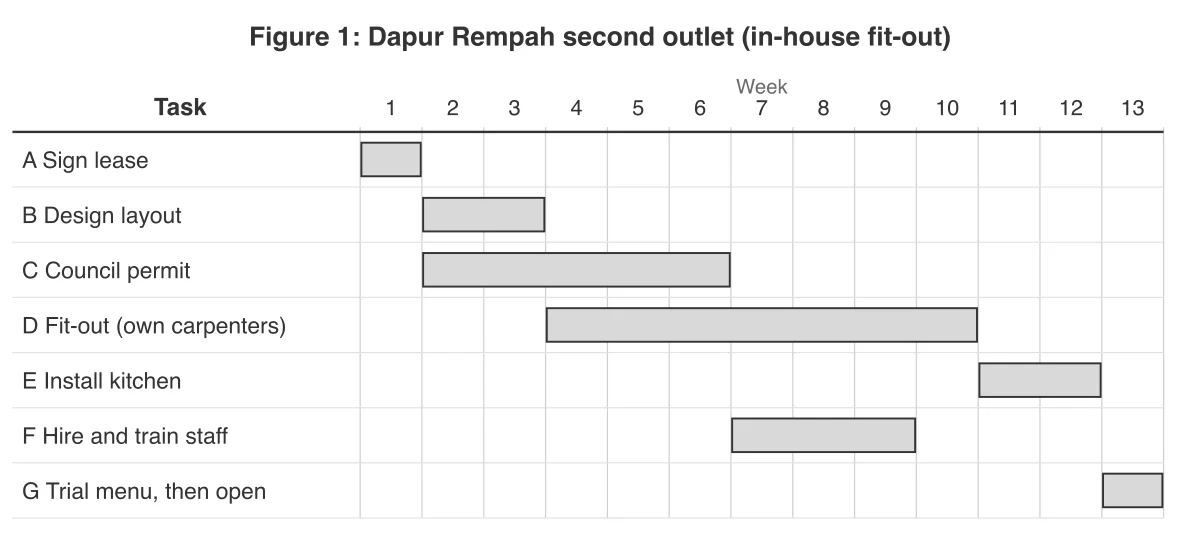
The fit-out (D) starts when the layout design (B) is finished, and the kitchen (E) is installed after the fit-out. Task F can start only after the council permit (C) is granted. Task G needs tasks E and F to be finished.
- (a)
Describe one feature of a Gantt chart.
2 marks
- (b)(i)
Using Figure 1, state the week in which the new outlet would open with the in-house fit-out.
1 mark
- (b)(ii)
Calculate the week in which the outlet would open if the contractor does the fit-out (show all your working).
2 marks
- (b)(iii)
Using your answer to (b)(ii), identify the tasks that would have no spare time (float) if the contractor is used.
1 mark
- (c)
Calculate the net financial gain from using the contractor, if it allows the outlet to open for Ramadan and the in-house option would earn none of the RM150 000 (show all your working).
2 marks
- (d)
Explain one reason why the actual opening date may differ from the date shown in a Gantt chart.
2 marks
- (e)
Using the information in the stimulus, recommend whether DR should use the contractor for the fit-out.
10 marks
Kibo Printers Ltd in Arusha, Tanzania, has won an order to print 20 000 school textbooks. The production manager, Juma Shirima, has drawn the network in Figure 1 (durations in days). The activities are: A approve artwork; B deliver paper; C make cover plates; D cut cover board; E print text pages; F print covers. The books are bound by another firm once E and F are complete.
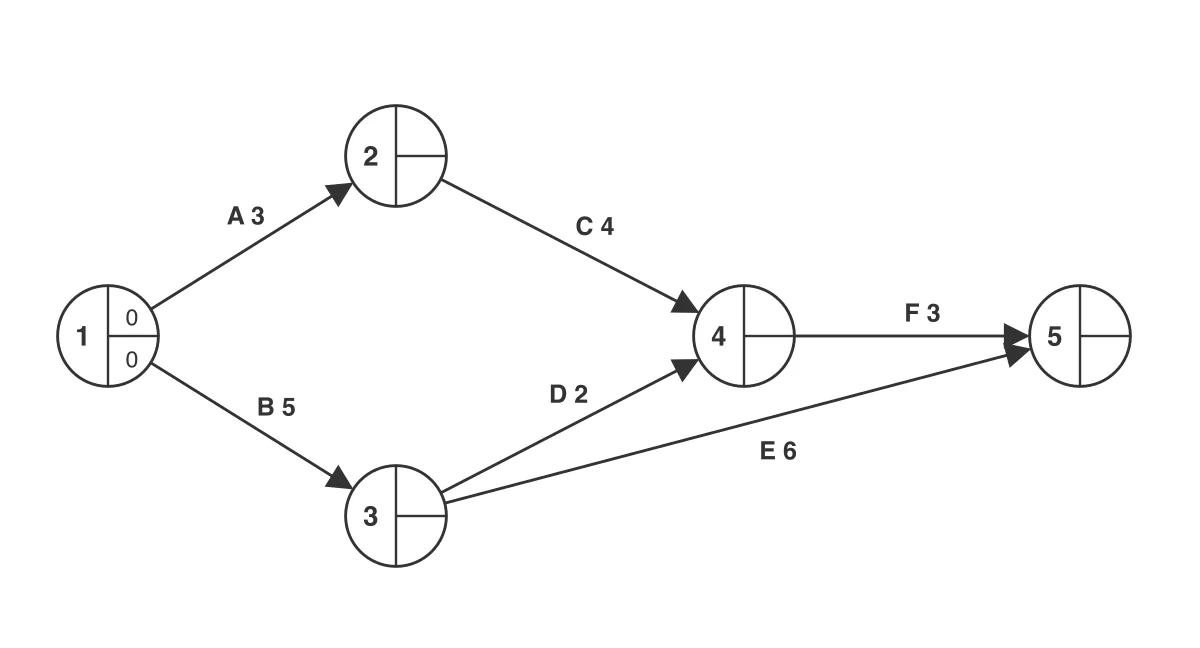
Key: each node shows the node number (left), the earliest start time, EST (top right) and the latest finish time, LFT (bottom right). Arrows show activities with their durations.
Complete the network in Figure 1 by adding the missing earliest start times (EST) and latest finish times (LFT).
3 marks
Tanjong Pay Pte Ltd is a fintech start-up in Singapore. It is developing a mobile payment app for hawker-centre stalls. Figure 1 shows the project network (durations in weeks). The activities are: A market research; B security planning; C design the app; D build the payment system; E build the user interface; F connect to banks; G prepare the marketing campaign; H beta testing with stallholders.
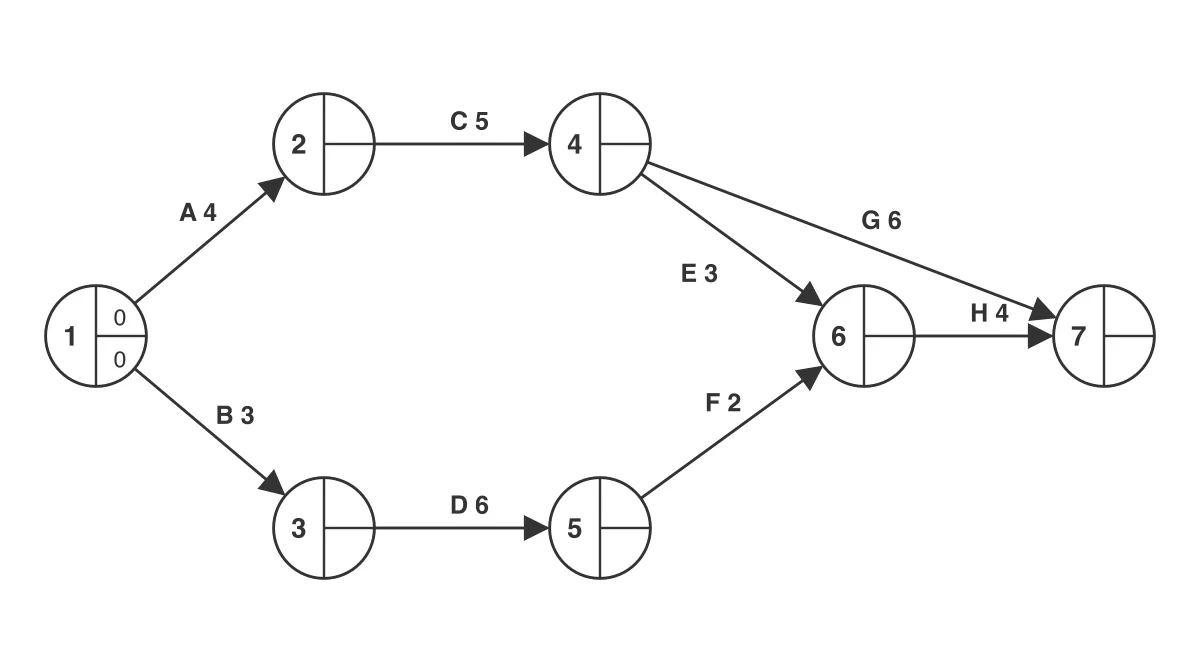
Key: each node shows the node number (left), the earliest start time, EST (top right) and the latest finish time, LFT (bottom right). Arrows show activities with their durations.
- (a)
Complete the network in Figure 1 by adding the missing EST and LFT values.
3 marks
- (b)
Identify the critical path.
1 mark
- (c)
State the minimum duration of the project.
1 mark
Riad Zitouna is a guest house in the old city of Fes, Morocco. It must close while it is renovated. The owner, Youssef Bennani, has been given the completed network in Figure 1 (durations in days). The activities are: A repair the roof; B strip old plaster; C rewire the rooms; D restore the courtyard fountain and tiles; E re-plaster the rooms; F furnish and clean.
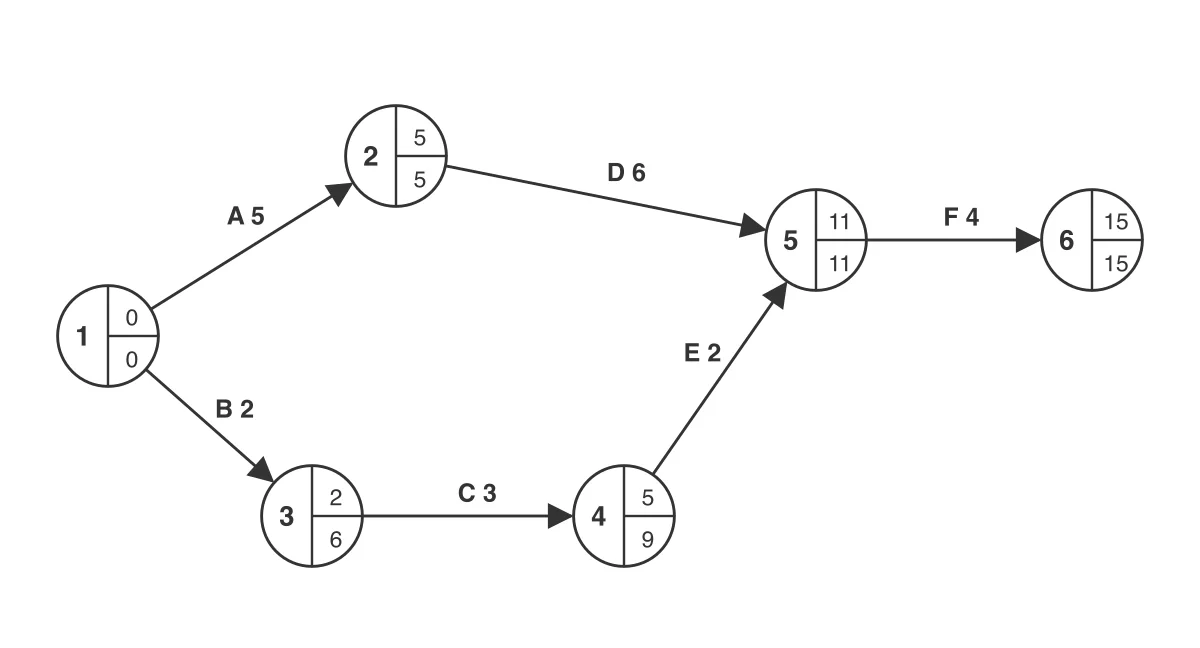
Key: each node shows the node number (left), the earliest start time, EST (top right) and the latest finish time, LFT (bottom right). Arrows show activities with their durations.
- (a)
Calculate the total float for activity B and for activity E (show all your working).
2 marks
- (b)
Calculate the free float for activity B and for activity E (show all your working).
2 marks
- (c)
Using your answers to (a) and (b), explain the difference between total float and free float for activity B.
2 marks
Practice all 23 in Augment
Free with an account. Every question has its markscheme, and Augment keeps the ones you got wrong so you can come back to them.
More questions in Business management toolkit
- T.1SWOT analysis
- T.2Ansoff matrix
- T.3STEEPLE analysis
- T.4Boston Consulting Group (BCG) matrix
- T.5Business plan
- T.6Decision trees
- T.7Descriptive statistics
- T.8Circular business models
- T.9Force field analysis
- T.10Gantt chart
- T.11Hofstede’s cultural dimensions
- T.12Porter’s generic strategies
- T.13Contribution
- T.14Critical path analysisThis page
Check your answers in Augment
A free account opens all 23 questions on Critical path analysis with their markschemes, and keeps a record of what you have marked.