2.2 Organisational structure questions for IB Business Management
49 questions on Organisational structure, written by Augment in the style of IB exam papers. Six of them are below in full, to answer on paper.
- IB Business Management
- Part of 2 Human resource management
- SL and HL
Questions by paper and level
SL and HL questions are for students at either level. HL only questions cover what only HL students study.
| Paper | SL and HL | HL only | All |
|---|---|---|---|
| Paper 1 | 30 | 0 | 30 |
| Paper 2 | 6 | 10 | 16 |
| Paper 3HL only | 0 | 3 | 3 |
| Every paper | 36 | 13 | 49 |
Counted on
Questions to try
Written by Augment in the style of IB exams, not past papers. Answer them on paper, then check each one against its markscheme with a free account.
Mvule Logistics
[1] Mvule Logistics (ML) is a privately held company that runs two large warehouses on the outskirts of Nairobi, Kenya. It stores and distributes goods for supermarkets, pharmaceutical wholesalers and online retailers across East Africa. ML employs 310 people. Most of the 240 warehouse operatives have worked for ML for more than six years and were trained by the same shift supervisors.
[2] Demand for ML’s services has grown quickly because of the rise of online shopping. Its largest client, an online retailer, now expects orders received before 22:00 to be dispatched the same night. To meet this, the chief executive, Wanjiru Mwangi, plans to install an automated warehouse management system in 2026. Hand-held scanners and conveyor sorting would replace most paper-based picking, and some tasks would be carried out by robots.
[3] Wanjiru estimates that the new system will reduce the number of warehouse operatives needed by about 20 %. She also wants the remaining operatives to work flexible shifts, some starting at 16:00 and finishing at 01:00. Several younger operatives have already left to work as self-employed delivery riders through mobile apps, which pay per delivery and let them choose their own hours.
[4] When rumours of the new system spread, absenteeism rose. Joseph Otieno, a shift supervisor for 14 years, told Wanjiru: “My team know nothing about computers, and nobody has told us who will keep their job. They think the robots are coming for them.” Many supervisors also worry that the system will report each picker’s speed directly to head office, so they will no longer be needed to check their team’s work.
[5] ML’s HR manager, Peter Kamau, has proposed two possible approaches. Option 1 is to introduce the system in one warehouse first, involve operatives in testing it and offer retraining to all staff who want it. Option 2 is to install the system in both warehouses at the same time over a four-week shutdown, so that ML can meet the client’s deadline quickly, and to offer a cash bonus to operatives who accept the new shift patterns.
- (a)
Define the term human resource planning.
2 marks
- (b)
Explain two reasons why ML’s supervisors and operatives may resist the introduction of the automated warehouse management system (paragraph 4).
4 marks
- (c)
Explain two external factors that may influence ML’s human resource planning.
4 marks
- (d)
Discuss whether ML should choose Option 1 or Option 2 to introduce the automated warehouse management system (paragraph 5).
10 marks
Mzizima Packaging makes cardboard boxes and paper bags in Dar es Salaam, Tanzania. Its managing director, Neema Mushi, has three directors reporting to her. Joseph Massawe, the production director, is responsible for the factory manager, Baraka Mollel, and for the quality manager. Aisha Juma, the sales director, manages the domestic sales manager and the export sales manager, Rehema Said. Grace Kimaro, the finance director, works with one accountant.
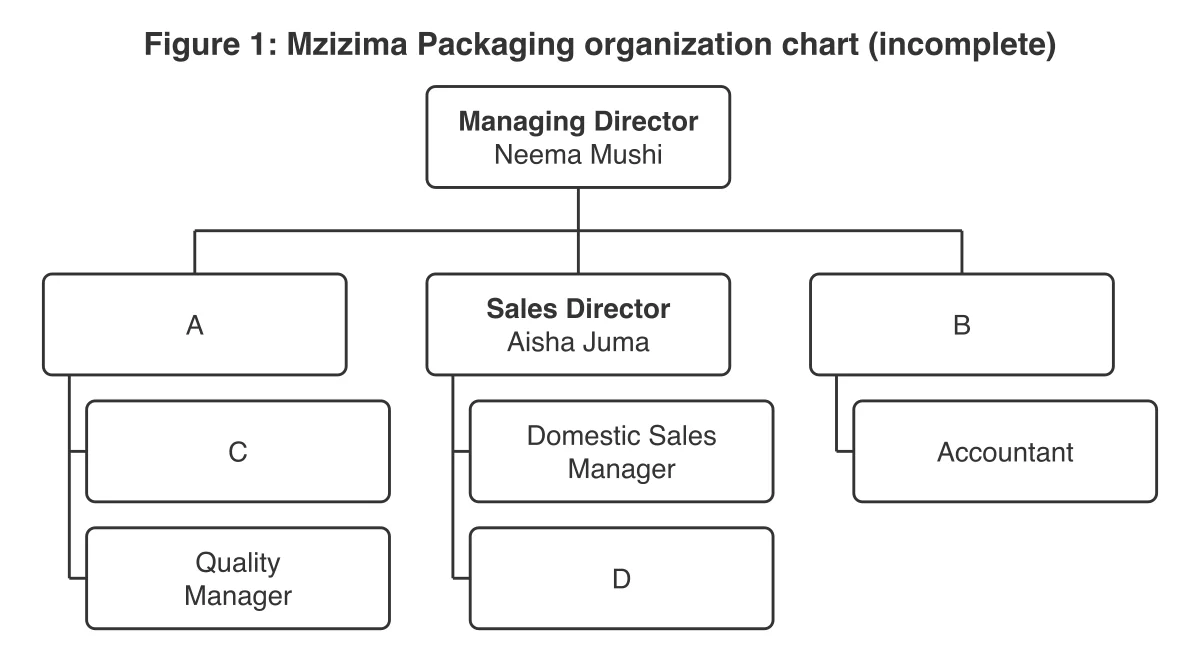
- (a)
Using the information above, complete Figure 1 by identifying the job title and name for boxes A, B, C and D.
4 marks
- (b)
State the type of organization chart shown in Figure 1.
1 mark
- (c)
State the span of control of Neema Mushi.
1 mark
Nkabom Savings Ltd (NS)
Read the resources and answer the questions that follow.
Nkabom Savings Ltd (NS) is a for-profit social enterprise in Kumasi, Ghana, founded in 2016 by Akosua Boateng, a former bank manager. It modernizes susu, a traditional savings system in which a collector visits market traders every day to collect small deposits. NS’s 420 agents visit about 38 000 traders, most of them women, and record each deposit on the NS app. Traders can withdraw their savings at any time and, after six months of saving, can borrow small loans to buy stock. NS’s mission is “a safe place for every cedi”. The agents are self-employed and paid commission. Six regional supervisors manage them, reporting to an operations manager at head office.
Image: a smiling agent in a green NS waistcoat holding a phone up to a market trader seated behind piles of tomatoes and onions; the phone screen shows “Deposit received: GHS 20.00 – thank you, Auntie Ama”.
Resource 1 – News article from the *Ashanti Business Mirror*
Regulator to tighten rules on susu collectors after fraud cases
Ghana’s central bank has proposed new rules for microfinance companies that use susu agents. From 2027 every agent must be registered, trained every year and supervised by a team leader responsible for no more than 20 agents. The proposals follow several cases of collectors disappearing with traders’ money. NS, one of the fastest-growing digital susu companies, says it supports the rules but admits that its own fraud losses have risen.
Table 1: NS key figures
2023 | 2024 | 2025 | |
|---|---|---|---|
Customers | 21 000 | 30 000 | 38 000 |
Agents | 240 | 330 | 420 |
Fraud losses (GHS) | 48 000 | 112 000 | 236 000 |
Resource 2 – Social media posts from Ama, a trader at Kejetia market
My old susu man ran away with three months of my money in 2019. NS is different – every cedi I give shows on my phone. Last month I used my NS loan to buy two extra bags of rice. #NkabomNS [1/2]
But last week our agent did not come for nine days and his phone was off. NS paid us back after five weeks, but nobody at the office answers the phone. Who is checking these agents? [2/2]
Resource 3 – Internal email from Kwabena Yeboah, operations manager, to Akosua Boateng
From: Kwabena Yeboah, Operations Manager
To: Akosua Boateng, CEO
Subject: Restructuring our agent network
Each of our six supervisors is responsible for 70 agents. They cannot visit them, let alone check their records. We will not meet the regulator’s rule. I see three options:
Option A – employ all agents on contracts at GHS 1 400 a month (plus 13 % social security) instead of commission, organized in 30 teams under employed team leaders paid GHS 2 500 a month.
Option B – keep agents self-employed on commission, but add 30 employed team leaders (GHS 2 500 a month each), buy GPS-tracked tablets for all agents (GHS 150 000 in total) and rotate agents’ routes every six months.
Option C – move customers to depositing by mobile money themselves and reduce the network to 150 agents, who would then mainly sign up new customers and deal with loans.
CONFIDENTIAL: this email and any attachments are intended only for the named recipients.
Resource 4 – NS’s agent economics, 2025
Item | Amount |
|---|---|
Average deposits collected per agent per month | GHS 50 000 |
Fee charged to customers | 3 % of deposits |
Agent’s commission | 2 % of deposits (average GHS 1 000 a month) |
NS’s share of the fee | 1 % of deposits (average GHS 500 per agent a month) |
NS’s interest income from loans, 2025 | GHS 3.1 million |
Resource 5 – Survey of NS customers (600 replies)
Statement | % agree |
|---|---|
I trust my agent personally | 81 |
I would deposit by mobile money on my own instead of using an agent | 34 |
I can read the SMS receipts NS sends me | 46 |
A deposit of mine went missing in the past year | 7 |
Resource 6 – Interview with Yaw Owusu, an NS agent for nine years
“I know 95 traders by name and I know which ones are having a bad month. That is why they trust NS. But I am not an employee – no sick pay, no training since 2019, and I have met my supervisor twice. When an agent steals, everybody looks at all of us. If NS gave me a contract and a team leader I could talk to, I would stay for life. If NS replaces us with an app, the women at the market will go back to the old susu men.”
- (1)
Using an appropriate business management theory, describe a human need that NS meets for market traders.
2 marks
- (2)
Explain two challenges facing NS.
6 marks
- (3)
Using all the resources provided and your knowledge of business management, recommend a plan of action to reorganize NS so that it can grow safely over the next three years.
17 marks
Mercado Araucária is a chain of 26 supermarkets in Curitiba, Brazil. To cut costs and speed up decisions, its directors plan to replace the department supervisors in each store (produce, bakery, butchery and so on) with self-managed teams. Teams would agree their own rotas and order stock directly. Supervisors would become team members with a small pay supplement for training others.
Explain two reasons why Mercado Araucária’s supervisors may resist this change.
4 marks
Notecka Freight is a road haulage company in northern Poland with depots in Bydgoszcz and Toruń. Figure 2 shows its management structure. Each shift supervisor is directly responsible for 14 lorry drivers (not shown in Figure 2).
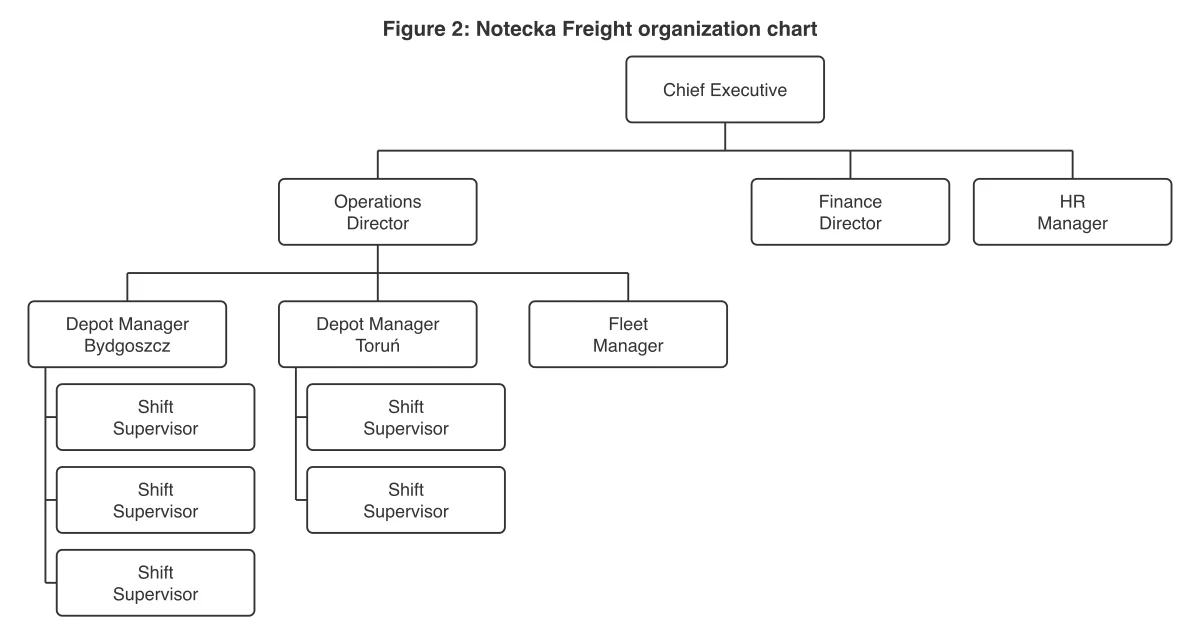
- (a)
State the span of control of the operations director.
1 mark
- (b)
State the number of levels of hierarchy at Notecka Freight, including the lorry drivers.
1 mark
- (c)
Calculate the total number of lorry drivers (no working required).
1 mark
- (d)
Explain one advantage and one disadvantage for Notecka Freight of the shift supervisors’ span of control of 14.
4 marks
Tearmann Cafés and Ladder Youth Skills
Read the resources and answer the questions that follow.
Tearmann Cafés (TC) is a social enterprise that runs five cafés in Cork and Limerick, Ireland. It was founded in 2011 by Úna Doherty, who had herself recovered from addiction. About 30 % of its 46 staff are in recovery from addiction or have left prison. Tearmann is the Irish word for sanctuary. Ladder Youth Skills (LYS) is a larger non-governmental organization (NGO) in Dublin that trains unemployed young people aged 16–24, mainly through contracts with the state. In 2026 the two organizations agreed to merge into one company, the Ladder Tearmann Group (LTG). LYS’s chief executive, Declan Fitzgerald, will lead LTG, and Úna will become Director of Social Enterprise.
Image: a busy café counter with a chalkboard menu; a barista in a green apron smiles as she hands a coffee to a customer. Above the counter a hand-painted sign reads “Tearmann – everyone deserves a second cup”.
Resource 1 – News article from *Munster Business Weekly*
Café with a heart joins forces with training charity
Supporters say the merger is a natural fit: LYS trainees will gain work experience in TC’s cafés, and both organizations will save money by sharing finance, HR and IT. LYS’s strong relationships with government funders could help TC open more cafés. But some TC staff are nervous. “It’s like a family business being bought by a government department,” said one.
Table 1: The two organizations in 2025
Tearmann Cafés | Ladder Youth Skills | |
|---|---|---|
Staff | 46 | 88 |
Income | €2.1 m (95 % from café sales) | €5.6 m (78 % from state contracts) |
Surplus | €40 000 | €260 000 |
Staff turnover | 22 % | 9 % |
Written HR policies and procedures | 3 | 41 |
Resource 2 – Social media posts from Ciarán, a TC barista
When I got out of prison, nobody would hire me. Úna sat me down, made me a coffee and said “you start Monday”. Five years later I train the new lads. Tearmann is my family. [1/2]
Since the merger we have a 40-page staff handbook, timesheets on an app and “performance reviews”. Head office emails us in words I don’t understand. It feels like a government office now, not a café. Three of my friends have already left. [2/2]
Resource 3 – Internal email from Declan Fitzgerald to LTG’s board
From: Declan Fitzgerald, CEO, LTG
To: Board of directors
Subject: Integration: the next steps
To keep our state training contracts, which are 78 % of LYS’s income, every LTG workplace where trainees aged under 18 are placed must meet the funder’s rules by next September:
• all staff must be vetted by the police;
• a drug and alcohol policy with random testing for staff who supervise trainees;
• one set of HR procedures and pay scales across the group.
I know some of this will be difficult in the cafés. But if we have two cultures we will have two organizations, and we will lose the savings that justified the merger. I propose that the cafés adopt LYS’s procedures in full within six months.
CONFIDENTIAL: this email and any attachments are intended only for the named recipients.
Resource 4 – Staff culture survey, 2026 (TC: 41 replies; LYS: 76 replies)
Statement | TC staff (% agree) | LYS staff (% agree) |
|---|---|---|
Important decisions are made by one or two people at the top | 74 | 22 |
Rules and procedures are written down and followed | 18 | 81 |
People are trusted to do things their own way | 70 | 29 |
I feel part of a family at work | 85 | 34 |
I am worried about the merger | 67 | 38 |
Resource 5 – Interview with Úna Doherty
“I agreed to the merger because I can’t keep doing everything myself, and our people need the training and security a bigger organization can give. But our staff are not trainees, they are adults rebuilding their lives. Random drug tests would tell people in recovery that we don’t trust them – and some have criminal records that vetting will show. If we lose them, we lose what Tearmann is. Declan is a good manager, but he manages by spreadsheet. Our cafés run on relationships.”
Resource 6 – Finance director’s summary of the merger
Item | Amount |
|---|---|
Annual savings from shared finance, HR and IT | €310 000 |
Annual cost of raising TC pay scales to LYS levels | €96 000 |
One-off cost of vetting, policy training and new systems | €45 000 |
TC staff resignations: 12 months before the merger / 4 months since | 10 / 6 |
Average cost of recruiting and training a new café employee | €3 500 |
- (1)
Using an appropriate business management theory, describe a human need that TC meets for people recovering from addiction or leaving prison.
2 marks
- (2)
Explain two challenges facing LTG following the merger.
6 marks
- (3)
Using all the resources provided and your knowledge of business management, recommend a plan of action to integrate the cultures of the two organizations successfully over the next three years.
17 marks
Practice all 49 in Augment
Free with an account. Every question has its markscheme, and Augment keeps the ones you got wrong so you can come back to them.
More questions in Human resource management
- 2.1Introduction to human resource management
- 2.2Organisational structureThis page
- 2.3Leadership and management
- 2.4Motivation and demotivation
- 2.5Organisational (corporate) cultureHL only
- 2.6Communication
- 2.7Industrial/employee relationsHL only
Check your answers in Augment
A free account opens all 49 questions on Organisational structure with their markschemes, and keeps a record of what you have marked.