2.2 Organisational structure
Explain the language of organisational structure, construct and interpret organisation charts, and evaluate which structure suits a business as its environment changes, including (HL) project-based and shamrock organisations.
- IB Business Management
- Part of 2 Human resource management
- SL and HL
Key terms introduced here
Each is in the Business glossary, with every other term in the subject.
- Accountability
The obligation of an employee or manager to explain and justify their decisions and results to a superior, and to accept the consequences.
- Authority
The formal right of a person, given by their position in the organisation, to make decisions and to direct the work of others.
- Bureaucracy
An organisational system that relies on formal rules, written procedures, paperwork and a clear hierarchy of authority, which can make decision-making slow and inflexible.
- Centralisation
An organisational structure in which most decision-making authority is kept by senior managers at the top of the hierarchy or at head office.
- Chain of command
The formal line of authority through which instructions pass down an organisation, and information and accountability pass up, from the top to the bottom of the hierarchy.
- Contractual fringe
In Handy's shamrock organisation, the outside individuals and firms contracted to carry out specialist or non-core work, paid for results rather than time.
- Decentralisation
An organisational structure in which decision-making authority is spread from senior managers or head office to lower levels of the hierarchy, departments or branches.
- Delayering
The removal of one or more levels of hierarchy from an organisational structure, usually layers of middle management, which widens the remaining spans of control.
- Delegation
The passing of authority to carry out a task or make a decision from a manager to a subordinate, while the manager keeps overall responsibility for the outcome.
- Flat structure
An organisational structure with few levels of hierarchy and wide spans of control, giving a short chain of command.
- Flexible labour force
In Handy's shamrock organisation, the part-time, temporary and seasonal workers hired as demand requires, usually with less security and fewer benefits than core staff.
- Handy's shamrock organisation
Charles Handy's model of an organisation made up of three groups of workers: a permanent professional core, a contractual fringe of outside suppliers, and a flexible labour force.
- Levels of hierarchy
The number of layers of management and authority in an organisation, from the most senior position down to the front-line employees.
- Matrix structure
An organisational structure in which employees report to two managers at once, a functional manager and a project or product manager, so that teams from different departments work together on projects.
- Organisation chart
A diagram that shows the formal structure of an organisation: its roles and departments, the levels of hierarchy, the chains of command and the spans of control.
- Organisational structure
The formal way in which an organisation arranges its roles, departments and lines of authority, communication and accountability.
- Professional core
In Handy's shamrock organisation, the permanent, highly skilled employees and managers whose knowledge is essential to the organisation and who are hard to replace.
- Project-based organisation
An organisational structure in which work is arranged around temporary projects, with teams formed from people with the necessary skills and disbanded when each project ends.
- Responsibility
The duty to complete a task or achieve an outcome; a manager who delegates a task can pass on authority but keeps overall responsibility for it.
- Span of control
The number of subordinates who report directly to one manager or supervisor.
- Structure by function
An organisational structure in which employees are grouped into departments by the function they perform, such as marketing, finance, human resources and operations.
- Structure by product
An organisational structure in which the business is divided into divisions based on its products or product lines, each with its own functional staff.
- Structure by region
An organisational structure in which the business is divided into divisions based on geographical areas, each responsible for its operations in that region.
- Subordinate
An employee who reports directly to a manager or supervisor above them in the hierarchy and works under that person's authority.
- Tall structure
An organisational structure with many levels of hierarchy and narrow spans of control, giving a long chain of command.
Notes on 2.2 Organisational structure
Learning objectives
Define delegation, span of control, levels of hierarchy, chain of command, bureaucracy, centralisation, decentralisation, delayering and matrix structure.
Distinguish between authority, responsibility and accountability.
Explain the relationship between the span of control and the number of levels of hierarchy.
Construct and interpret flat, tall, functional, product-based and regional organisation charts.
Analyse the advantages and disadvantages of each type of organisational structure.
Evaluate the appropriateness of different organisational structures when external factors change.
Evaluate changes in organisational structures, including project-based organisation and Handy's shamrock organisation (HL).
Introduction
Every organisation with more than a handful of people has to decide who does what, who reports to whom and who takes which decisions. Its organisational structure is the answer to those questions, and it affects how quickly the business can act, how well people communicate, how much the business spends on managers and how motivated its employees are.
Structures are not fixed. Businesses restructure as they grow, enter new markets or face new competitors and technology, so organisational structure is closely tied to the key concepts of the course.
Key concept | How it applies to organisational structure |
|---|---|
Change | Growth, new technology, globalisation and crises lead businesses to add or remove layers, regroup departments or move decisions closer to customers. |
Creativity | Flat, decentralised, matrix and project-based structures give employees more freedom to suggest and test new ideas. |
Ethics | Restructuring often means redundancies, especially of middle managers; how those decisions are made and communicated is an ethical question. |
Sustainability | A structure that relies heavily on insecure peripheral workers may cut costs now but weaken social sustainability and long-term commitment. |
Organisational structure and the organisation chart
An organisational structure is the formal pattern of roles and relationships in a business. It shows how work is divided into jobs and departments, who has authority over whom, and how instructions and information are supposed to flow.
Structures are shown in an organisation chart. Each box is a role, not a named person, and the lines show who reports to whom. Boxes at the same height are at the same level of authority.
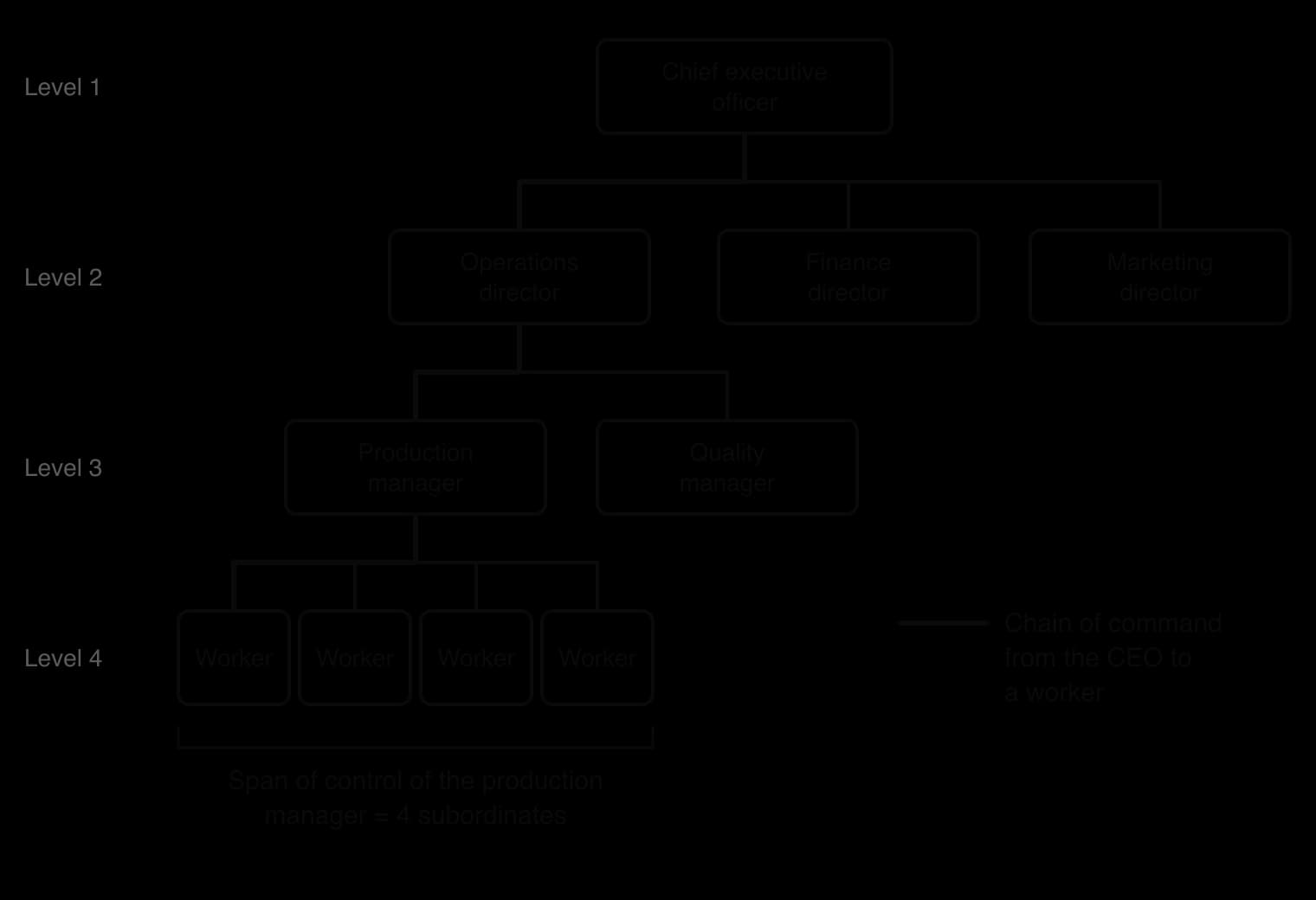
The annotated chart shows the three measurements that describe any structure. Counting the rows gives the number of levels of hierarchy (four). Following the lines from the top to a box gives a chain of command (chief executive officer to operations director to production manager to worker). Counting the boxes directly beneath one manager gives that manager's span of control (four for the production manager, three for the chief executive, two for the operations director).
An organisation chart shows only the formal structure. Every business also has an informal structure, made up of friendships, the grapevine and people whose influence is greater than their job title suggests. Charts also date quickly when people move, and they say nothing about how well the structure works in practice.
Levels of hierarchy and the chain of command
A hierarchy is the ranking of roles in an organisation by authority. The levels of hierarchy are the layers in that ranking, from the chief executive down to front-line employees. Each employee below the top level is a subordinate of the manager directly above them.
The chain of command is the route that instructions follow down the hierarchy, and that information, requests and accountability follow back up. In a formal structure, a worker takes instructions from their own manager, and a director who wants something done passes the instruction through each level in turn.
A long chain of command has clear lines of authority but slows communication. Each extra level is another point at which a message can be delayed, filtered or changed, and front-line staff who deal with customers are far from those who decide. A short chain carries messages quickly, but each manager has more people to deal with.
Span of control
The span of control is the number of subordinates who report directly to one manager. A narrow span means few direct reports, so the manager can supervise each one closely. A wide span means many direct reports, so each subordinate works with more independence.
Wide and narrow spans compared
Narrow span of control | Wide span of control | |
|---|---|---|
Supervision | Close supervision and quick help for each subordinate | Less supervision; subordinates must work independently |
Communication | Easy within the team, but more levels in the business overall | Fewer levels, so messages travel faster up and down |
Cost | More managers, so higher management costs | Fewer managers, so lower costs |
Motivation | Can feel over-controlled; fewer chances to take responsibility | More trust and responsibility (empowerment), if staff are capable |
Risk | Fewer mistakes by inexperienced staff | Managers may be overloaded; problems may go unnoticed |
Suits | Complex or high-risk work; new or less skilled staff | Routine or similar tasks; skilled, experienced, motivated staff |
The best span depends on the situation. Managers can handle a wider span when subordinates are skilled and motivated, when their tasks are similar and routine, when the manager is experienced, and when technology makes it easy to share information and monitor results. A narrower span suits complex, varied or dangerous work, such as surgery, research or air traffic control, and teams of new or inexperienced staff.
How the span of control and the levels of hierarchy are linked
For a given number of employees, the span of control and the number of levels of hierarchy move in opposite directions. Narrow spans need more managers, stacked in more levels, to supervise the same front-line workforce. Wide spans need fewer managers and fewer levels. This inverse relationship explains why delayering (removing levels) always widens the spans of the managers who remain.
Tall and flat structures
A tall structure (vertical structure) has many levels of hierarchy and narrow spans of control. A flat structure (horizontal structure) has few levels and wide spans. The two charts that follow show 15 people organised each way.
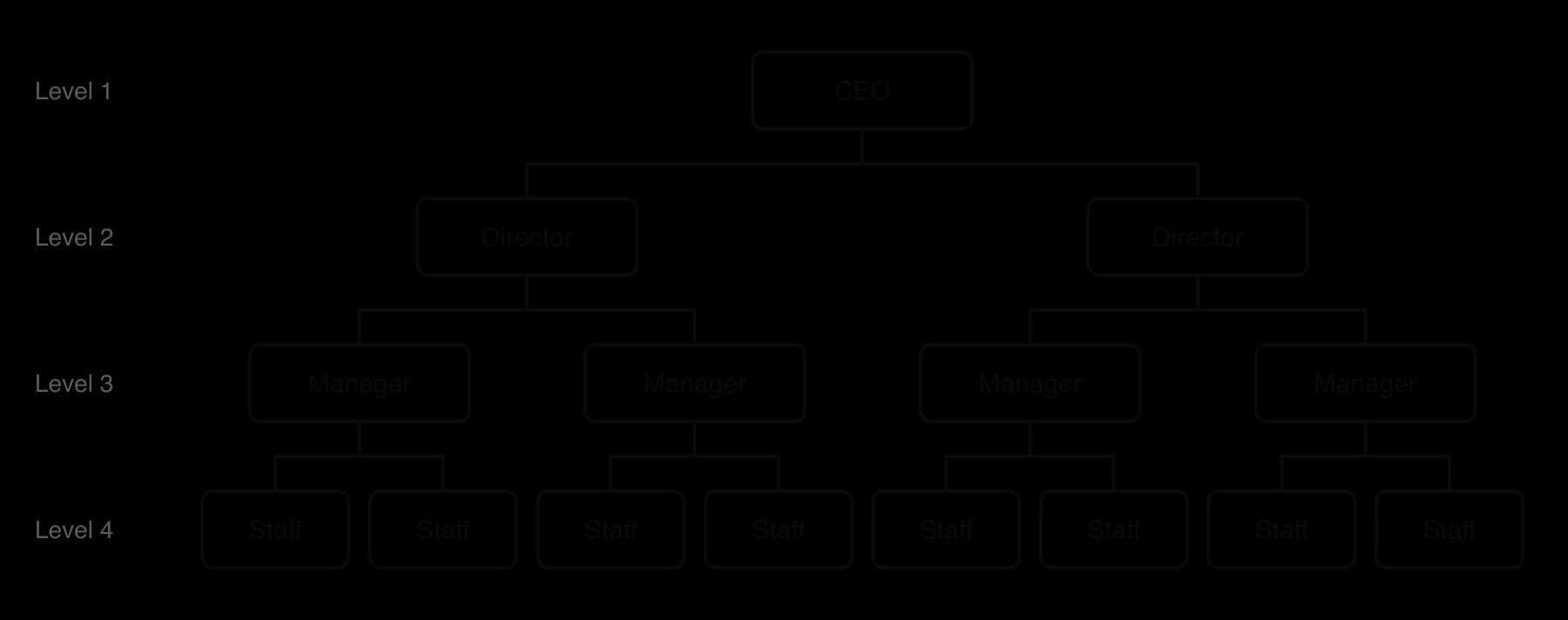
The tall chart shows why tall structures suit close control. Each manager has only two subordinates, there is a clear ladder of promotion, and each role is narrowly defined. The cost is seven managers out of 15 people and a chain of command four levels long.
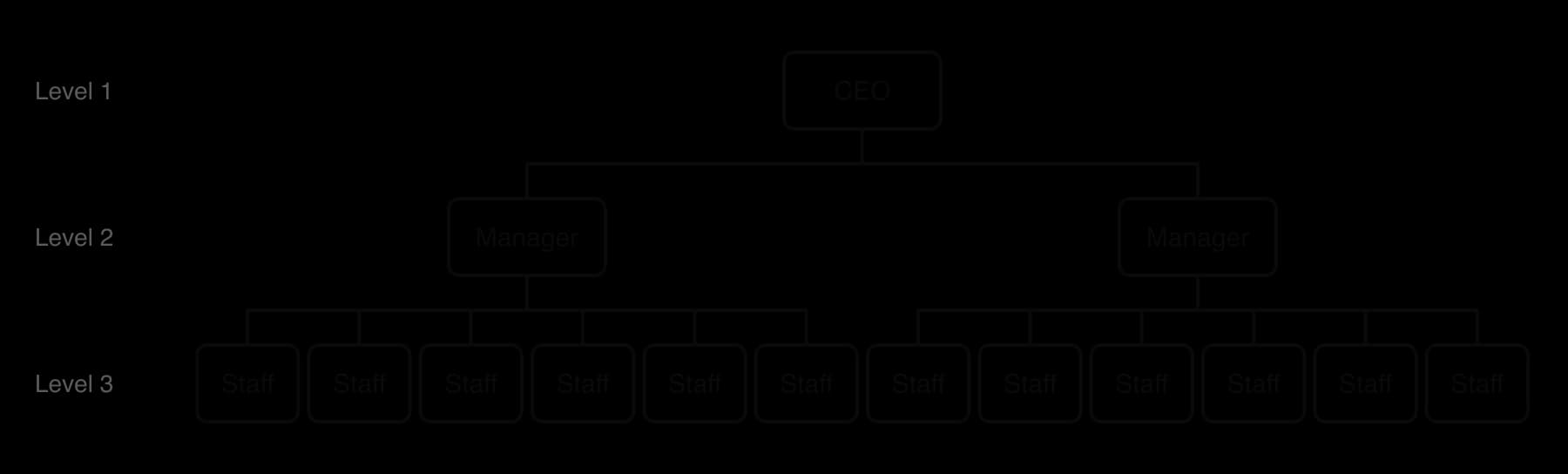
The flat chart has the same number of people but only three levels, so there are fewer managers and messages pass through fewer people. Staff have more freedom, because each manager has less time to supervise them, and fewer promotion steps are available.
Tall structure | Flat structure | |
|---|---|---|
Communication | Slow vertical communication; messages can be distorted through many levels | Fast communication between top and bottom; closer to customers |
Control | Close supervision; clear roles and authority | Less supervision; relies on capable, trusted staff |
Costs | High management costs | Lower management costs |
Motivation | Many promotion steps; but staff may feel distant from decisions | More responsibility and involvement; fewer promotion opportunities |
Decision-making | Slower; decisions passed up for approval | Faster; decisions taken closer to the problem |
Suits | Large organisations needing control and consistency (armed forces, some public services, banks) | Small firms, start-ups and creative or technology businesses |
Neither structure is better in all situations. A tall structure suits organisations where mistakes are costly and consistency matters, such as an army, a nuclear power plant or a large bank's compliance function. A flat structure suits businesses that compete on speed and new ideas, where staff are highly skilled, such as software firms and design agencies.
Valve, the US video game company that runs the Steam platform, is an extreme example of a flat structure. Apart from executive management, it has no formal bosses, and employees choose which projects to work on and can move between teams. Its founder, Gabe Newell, has described the approach as one that suits some people and makes Valve a very difficult place to work for others.
Sources: Valve Corporation, Wikipedia (citing interviews with Gabe Newell and Doug Lombardi), accessed October 2026.
 YouTube
Authority, responsibility, accountability and delegation
Three words describe the relationship between a manager and the work of a team. They are often confused, but they mean different things.
Authority comes from the job, not from the person. A newly appointed store manager has the authority to set staff rotas from the first day, whatever their experience.
Responsibility is the duty to make sure something is done and done well. Accountability is the obligation to explain and justify the result to someone higher up, and to accept the consequences, good or bad.
Delegation
Delegation is the passing of authority from a manager to a subordinate to carry out a task or make a decision. A head chef who lets the sous-chef plan the week's menu, or a sales director who lets regional managers set local discounts, is delegating.
Delegation frees managers' time for strategic work, uses the knowledge of staff who are closer to the problem, speeds up decisions and develops subordinates' skills, which can motivate them and prepare them for promotion. It is essential with a wide span of control, because one manager cannot take every decision for many people.
Delegation has limits. It fails if the subordinate lacks the skills, information or confidence to do the task, if the manager delegates the task but not the authority needed to complete it, or if the manager will not let go and keeps interfering. Some decisions, such as those with major legal or financial risks, are rarely delegated.
Bureaucracy
A bureaucracy is an organisation run through formal rules, written procedures, records and a clear hierarchy. The German sociologist Max Weber described it as an efficient way to run large organisations, because rules make decisions consistent, fair and predictable, and roles are filled by qualified people rather than friends of the boss.
In everyday use "bureaucracy" usually means excessive red tape: too many forms, approvals and meetings. Tall structures tend to become bureaucratic, because each level adds a step of approval. The result is slow decisions, high administrative costs, frustration among staff and a weak response to customers and competitors.
Some bureaucracy is necessary. Hospitals, airlines, banks and governments need strict procedures for safety, fairness and legal compliance. The aim is to keep the rules that protect quality and safety while removing those that only slow the business down.
Centralisation and decentralisation
Every organisation must decide where decisions are taken. In a centralised organisation most decisions are made by senior managers at head office. In a decentralised one, authority is delegated to lower levels, departments, branches or regions.
Centralisation gives consistency and control. A fast-food chain that wants every outlet to offer the same menu, prices and service decides centrally. Senior managers see the whole business, so they can coordinate decisions and use the purchasing power of head office to gain economies of scale.
Decentralisation brings decisions closer to customers and local conditions. A regional manager in another country knows local tastes, laws and competitors better than head office does. Decentralisation also motivates managers lower in the hierarchy and frees senior managers to focus on strategy.
Centralisation | Decentralisation | |
|---|---|---|
Speed | Slow for local decisions, which must go up to head office; fast for business-wide decisions in a crisis | Fast local decisions; slower to coordinate across the business |
Consistency | Same standards, brand and policies everywhere | Products, prices and service may vary between branches |
Knowledge used | Senior managers' overview of the whole business | Local managers' knowledge of customers and markets |
Costs | Economies of scale in buying and administration; fewer senior roles duplicated | Duplication of roles and systems in each unit |
Motivation | Lower for managers below the top; few chances to decide | Higher; local managers are trusted and accountable |
Risk | Head office may be out of touch; overloaded senior managers | Local units may pursue their own goals rather than the business's |
Evaluation: how much to decentralise
Most businesses mix the two. They centralise decisions where consistency, control or scale matter most (brand, finance, major investment, compliance) and decentralise decisions where local knowledge and speed matter most (staffing, local promotions, product range in some markets). The right balance depends on the size and geographical spread of the business, the skills and experience of local managers, how different local markets are, the leadership style and culture of the business, the quality of its information systems, and the risks involved.
The balance also shifts over time. In a crisis, businesses often centralise so that decisions are quick and coordinated, while in stable growth they may decentralise to encourage initiative. Good communication and information systems allow a business to decentralise decisions while head office still monitors results.
Delayering
Delayering is the removal of one or more levels of hierarchy, usually layers of middle management. It turns a taller structure into a flatter one and widens the spans of control of the managers who remain.
Meta Platforms, the owner of Facebook and Instagram, is a recent example. In March 2023 its chief executive, Mark Zuckerberg, announced a "Year of Efficiency" in which the company would "make our organization flatter by removing multiple layers of management", ask many managers to become individual contributors and reduce its workforce by around 10,000 people.
Sources: Meta, "Update on Meta's Year of Efficiency", 14 March 2023.
Benefits of delayering | Costs and risks of delayering |
|---|---|
Lower management costs (fewer salaries, offices and benefits) | Redundancy payments and the loss of experienced managers' knowledge |
Shorter chains of command, so faster communication and decisions | Wider spans can overload the remaining managers |
More delegation and empowerment for front-line staff | Fewer promotion steps, which can demotivate ambitious staff |
Senior managers closer to customers and front-line problems | Fear and low morale among survivors, who may resist further change |
Less bureaucracy and duplication | Staff may lack the skills or training to take on new responsibilities |
Delayering works best when the remaining staff are skilled and trained to take decisions, when information systems let managers supervise wider teams, and when the change is managed carefully, because it creates the kind of resistance to change that HR managers must handle. Done only to cut costs, it can save money in the short term while damaging motivation and leaving the business short of managers when it grows again.
Organisation charts by function, product and region
As well as being tall or flat, a structure can group people in different ways. The three main bases are function (what people do), product (what they make or sell) and region (where they work). Large businesses often combine them.
Structure by function
In a structure by function, employees are grouped into departments according to their specialism: marketing, finance, human resources and operations. It is the most common structure in small and medium-sized businesses with one main product or market.
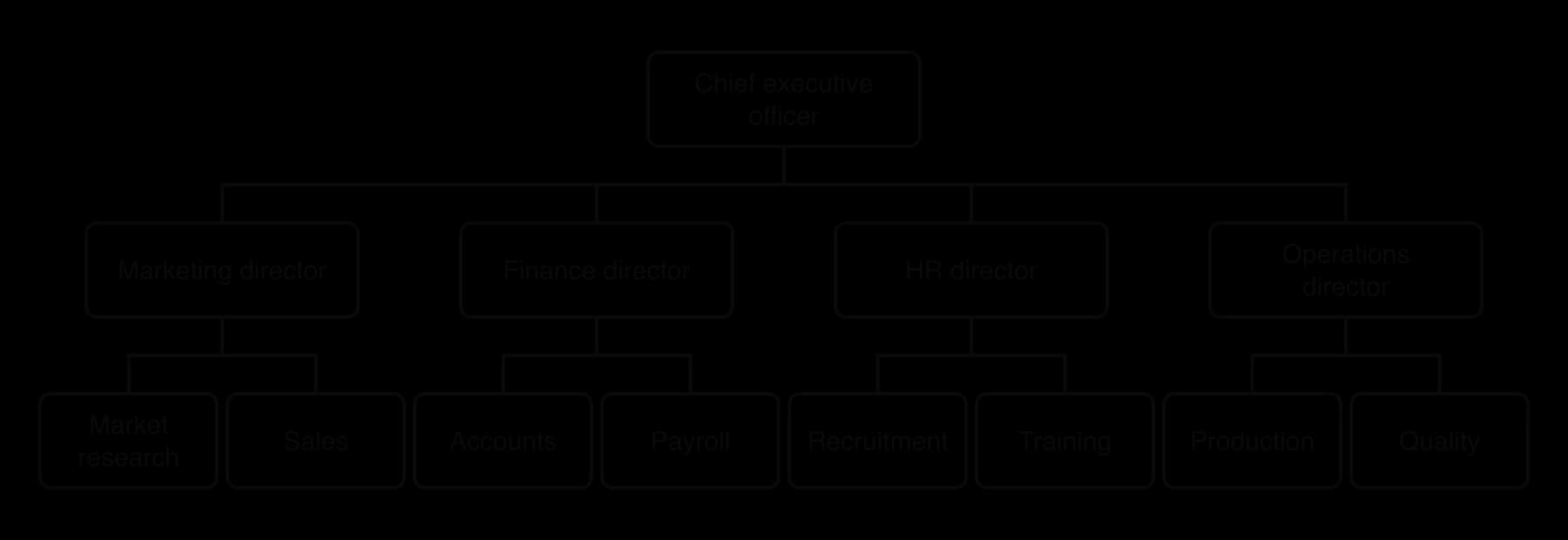
The chart shows four specialist departments under the chief executive. Grouping specialists together builds expertise, avoids duplicating roles and gives clear career paths within each function. The main drawback is that departments can become "silos" that focus on their own goals, so coordination across functions for a new product or a customer problem is slow and relies on senior managers.
Structure by product
In a structure by product, the business is divided into divisions, each responsible for one product or product range and each with its own functional staff. It suits businesses with very different products, such as a group that makes both semiconductors and consumer electronics.
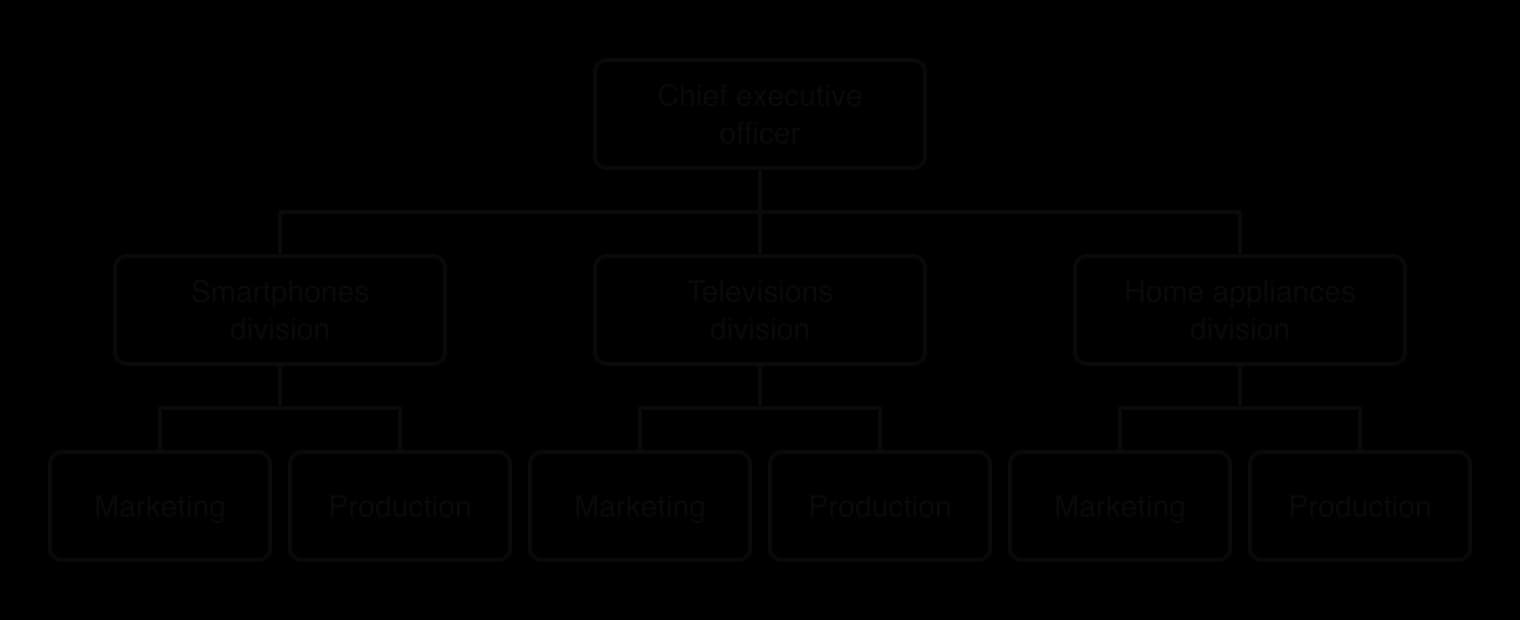
The chart shows that each division runs almost like a separate business, so managers can respond quickly to their own market and each division's performance is easy to measure; divisions are often run as profit centres. The drawbacks are duplication (three marketing departments, three production departments), higher costs and possible rivalry between divisions for funds. Samsung Electronics is organised mainly by product: its Device eXperience (DX) division covers products such as smartphones, televisions and home appliances, while its Device Solutions (DS) division covers memory chips, system chips and contract manufacturing of chips (foundry).
Sources: Samsung Electronics, Wikipedia (company organisation), accessed October 2026.
Structure by region
In a structure by region, the business is divided into geographical divisions, each responsible for operations in its area. It is common for multinational companies whose markets differ in tastes, languages, laws and distribution.
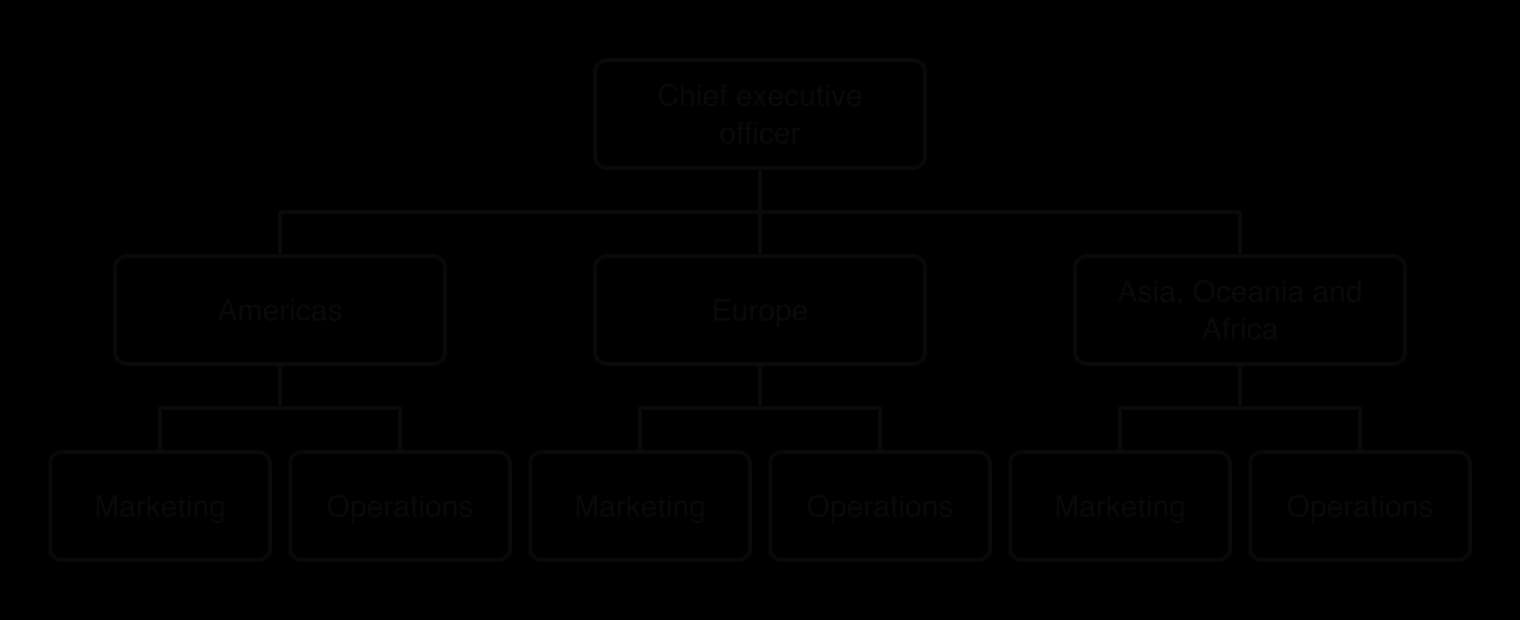
The chart shows how regional managers can adapt products, prices and promotion to local conditions and respond quickly to local competitors. The drawbacks are again duplication of functions in each region, the risk that regions act inconsistently with the global brand, and possible conflict between regional managers and head office. Nestlé, the Swiss food and drinks multinational, manages most of its food and beverage business through three geographic zones (Americas; Europe; and Asia, Oceania and Africa), each run by its own chief executive, while some businesses such as Nespresso are managed globally. Its structure is therefore a hybrid of region and product.
Sources: Nestlé, "Management" (company website), accessed October 2026.
Basis | Main advantage | Main disadvantage | Best suited to |
|---|---|---|---|
Function | Specialist expertise; no duplication | Silos; slow cross-department coordination | One main product and market |
Product | Focus on each product's market; clear profit responsibility | Duplication; rivalry between divisions | Several very different product lines |
Region | Adaptation to local markets and laws | Duplication; inconsistency with the global brand | Businesses operating in many countries |
Matrix structure
In a matrix structure, employees belong to a functional department and, at the same time, to a project or product team. A designer, for example, reports to the head of design for professional standards and to a project manager for the project they are working on. The structure combines the specialist expertise of a functional structure with the focus of a project team.
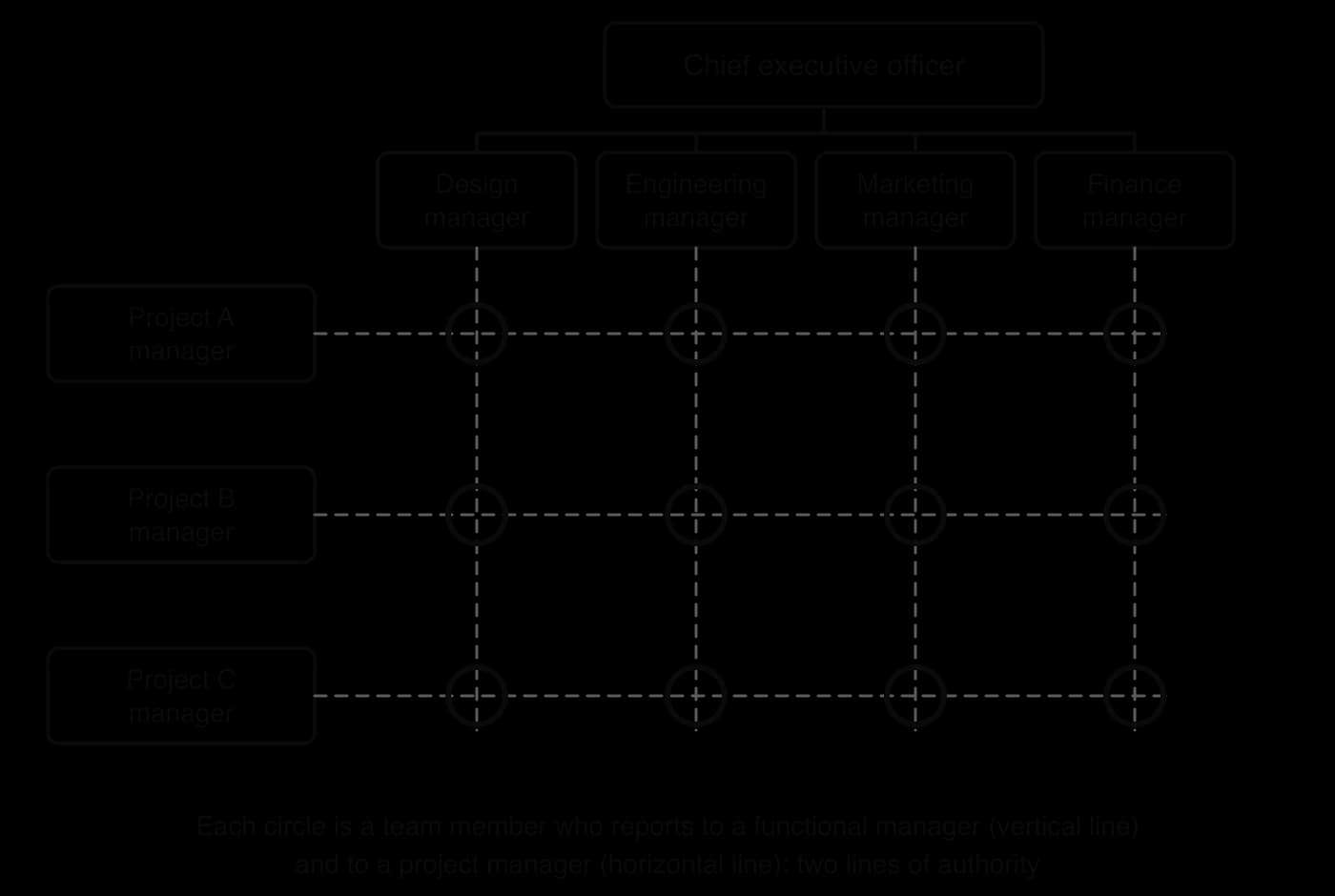
The diagram shows the defining feature of a matrix: two lines of authority. Each project team brings together the skills it needs from every department, which suits complex projects such as developing a new aircraft, building a hospital or launching a new car model. Matrix structures are common in engineering, consultancy, advertising and large technology businesses.
Advantages of a matrix structure | Disadvantages of a matrix structure |
|---|---|
Teams combine specialists from different functions, which improves coordination and creativity | Two managers can give conflicting instructions; unclear authority and accountability |
Specialist skills are shared across projects rather than duplicated | Employees can feel stressed by competing demands on their time |
Faster response to projects and customers than a purely functional structure | More meetings and communication are needed, which raises costs and slows routine decisions |
Staff gain wide experience, which develops them for senior roles | Power struggles between functional and project managers |
Choosing a structure when external factors change
A widely quoted idea in management is that structure follows strategy: a business first decides what it wants to achieve and then organises itself to do it. When external factors change, the strategy changes, and the structure that suited the old situation may no longer fit. A STEEPLE analysis helps managers identify the external changes that matter.
Change in external factors | Likely change in structure | Reasoning |
|---|---|---|
Rapid technological change and new competitors | Flatter, more decentralised, matrix or project teams | Decisions must be fast and close to customers; cross-functional teams develop products quickly |
Expansion into many countries | Structure by region, or a hybrid of region and product | Local managers adapt to local tastes, laws and competitors |
Diversification into very different products | Structure by product (divisions) | Each product market needs its own focus and accountability |
Recession or falling demand | Delayering; centralisation of spending decisions | Cutting management costs and controlling spending protect profit and cash |
A crisis (a product recall, a cyber attack, a pandemic) | Temporary centralisation | Quick, coordinated decisions and consistent communication from the top |
Stricter regulation (data protection, financial rules, safety) | More central control and formal procedures | Compliance needs consistent rules and clear accountability |
Growth of remote and hybrid working | Flatter structures with more delegation; teams organised around tasks | Close supervision is harder at a distance; managers judge results rather than presence |
Ageing population and skills shortages | Flexible structures that use part-time, temporary and contract workers | Businesses build structures around the labour they can find |
The table shows that each external change pushes structure in a particular direction, but the effects can conflict. A multinational facing both fast technological change and a recession might want decentralised teams for speed and centralised control of spending at the same time. This is why many large businesses use hybrid structures: functional at head office, regional for sales and operations, and matrix or project teams for innovation.
Evaluation: what the right structure depends on
No structure is right for every business, and changing structure is costly and disruptive in the short run. When judging whether a structure is appropriate after an external change, managers consider:
Size and growth: small firms work well with flat, functional structures; large and growing ones need more layers or divisions.
Nature of the product and market: one product in one market suits a functional structure; many products or countries suit divisions.
Pace of change in the environment: fast-changing markets need speed and flexibility; stable ones can benefit from the control of a taller structure.
Skills and attitudes of the workforce: wide spans and decentralisation need capable, trusted and motivated staff.
Leadership style and organisational culture: an autocratic leader is unlikely to run a decentralised structure successfully, and a culture of control resists delayering.
Costs of change: redundancy pay, retraining, new systems and lost output during the transition.
Risk: in safety-critical or heavily regulated work, consistency and control may matter more than speed.
A justified judgment weighs these factors for the business in question. For example, a small software start-up facing rapid technological change benefits from a flat structure with project teams, while a national bank facing new regulation may need tighter central control of compliance even as it delayers its branch network.
Changes in organisational structures (HL only)
Traditional structures assume that most work is done by permanent, full-time employees in fixed departments. Since the 1980s many businesses have moved away from this, in response to faster change, global competition, digital technology and the growth of flexible working and the gig economy. Two models describe the change.
Project-based organisation
In a project-based organisation, work is organised around a series of temporary projects rather than permanent departments. For each project, a team is formed from people with the skills it needs, led by a project manager. When the project ends, the team is disbanded and its members move to new projects. Film production, construction, engineering consultancies, architecture firms, event management and software development often work this way.
A project-based structure differs from a matrix structure in where authority lies. In a matrix, the functional departments remain the permanent home of each employee and project managers share authority with them. In a project-based organisation, the project is the main unit and the project manager holds most of the authority while the project lasts.
Advantages of project-based organisation | Disadvantages of project-based organisation |
|---|---|
Teams are built around the exact skills each project needs | Little job security between projects; staff may leave |
Clear goals, deadlines and accountability for each project | Knowledge can be lost when teams break up |
Flexibility: the business can take on very different projects | Hard to build long-term relationships and a shared culture |
Variety and challenge can motivate skilled staff | Competition for the best staff between project managers; gaps between projects are costly |
Handy's shamrock organisation
Charles Handy, a British management writer, described the shamrock organisation in The Age of Unreason (1989). A shamrock is a plant with three leaves on one stem. Handy argued that organisations were increasingly made up of three distinct groups of workers, each with different contracts, expectations and loyalty.
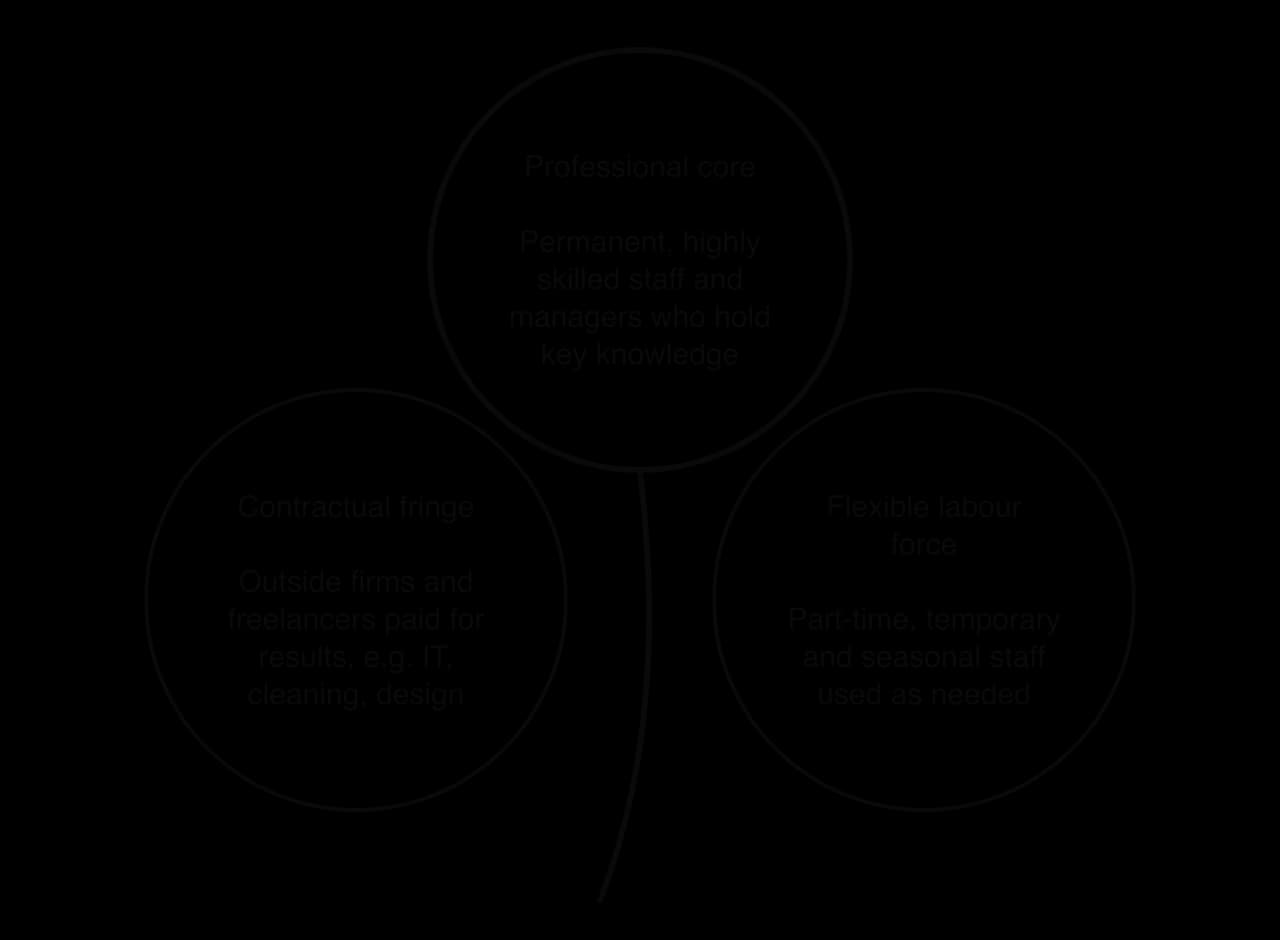
The diagram shows the three leaves. Each is managed differently, because each group has a different relationship with the organisation.
The professional core is the small group of permanent, highly skilled managers, technicians and professionals whose knowledge is essential to the organisation. They are well paid, expected to work long hours and show strong commitment, and they are hard to replace, so the business invests in their training and retention.
The contractual fringe consists of outside individuals and firms that carry out work the organisation does not need to do itself, such as IT support, cleaning, catering, payroll, advertising or design. They are paid for results (a fee for a contract) rather than for time. This is the logic of outsourcing: the business buys in specialist services instead of employing staff to provide them.
The flexible labour force is made up of part-time, temporary and seasonal workers hired when demand requires. Retailers hiring extra staff for the holiday season, farms hiring pickers at harvest and delivery firms using gig workers at peak times are examples. These workers usually have less security, lower pay and fewer benefits than the core.
Flexible and remote work patterns
Digital technology has made shamrock and project-based structures easier to run. Freelancers can be hired through online platforms, project teams can work across countries using video calls and shared documents, and teleworking lets businesses employ core staff far from head office. These changes allow flatter structures, because managers judge results rather than supervising people in person, but they make it harder to build a shared culture and to train new staff informally.
Evaluation of flexible structures
Project-based and shamrock structures give a business more control over its labour costs, but they can weaken the commitment, skills and motivation of the people it relies on.
Benefits for the business | Drawbacks and risks |
|---|---|
Labour costs vary with demand; fewer permanent salaries and benefits | Lower commitment and loyalty from peripheral workers |
Specialist skills bought in only when needed | Loss of control over quality and confidentiality when work is outsourced |
Faster response to change; easy to scale up or down | Skills and knowledge leave with contractors; less investment in training |
Core staff can focus on the most valuable work | A two-tier workforce can cause resentment and weaken teamwork |
Lower office costs with remote and flexible work | Ethical and reputational risks if peripheral workers are treated poorly; legal risk over employment status |
The value of a flexible structure depends on the business. It suits firms with uneven demand (seasonal retailers, tourism, events), firms whose work comes in distinct projects, and those that need specialist skills only occasionally. It is less suitable where quality, safety or customer relationships depend on experienced, committed staff, or where the knowledge of the workforce is the main source of competitive advantage.
There is also a wider social question. A structure that saves costs by relying on insecure workers shifts risk from the business to individuals. Court rulings on gig workers' employment status, minimum wage rises and reputational pressure have raised the cost of this model in some countries, so businesses increasingly weigh short-term flexibility against long-term social sustainability and their reputation as employers.
Case study: Haier's rendanheyi model
Haier is a Chinese maker of household appliances, founded in Qingdao in 1984 and led for most of its history by Zhang Ruimin. It grew from a struggling refrigerator factory into one of the largest appliance makers in the world, with brands including Haier, Casarte, GE Appliances, Fisher & Paykel and Candy. Its listed company, Haier Smart Home, reported revenue of more than RMB 300 billion in 2025.
Like many large manufacturers, Haier had a tall, bureaucratic hierarchy. In September 2005 Zhang proposed a different model, which he called rendanheyi. In Haier's own explanation, "ren" stands for employees, "dan" for the value created for users, and "heyi" for the link between the two. The idea was that every employee should be directly connected to the needs of users, rather than to the instructions of a boss.
What changed in the structure
To make this happen, Haier removed most of its middle management. Zhang has said that the company let go more than 10,000 middle managers. The large functional departments were replaced by many small, self-managing units called micro-enterprises, each focused on a product, a group of users or a service, and each responsible for its own results. Micro-enterprises were given the right to make decisions, including choosing their own staff and deciding how to share profits, and they buy services from shared platforms in areas such as finance, HR and the supply chain.
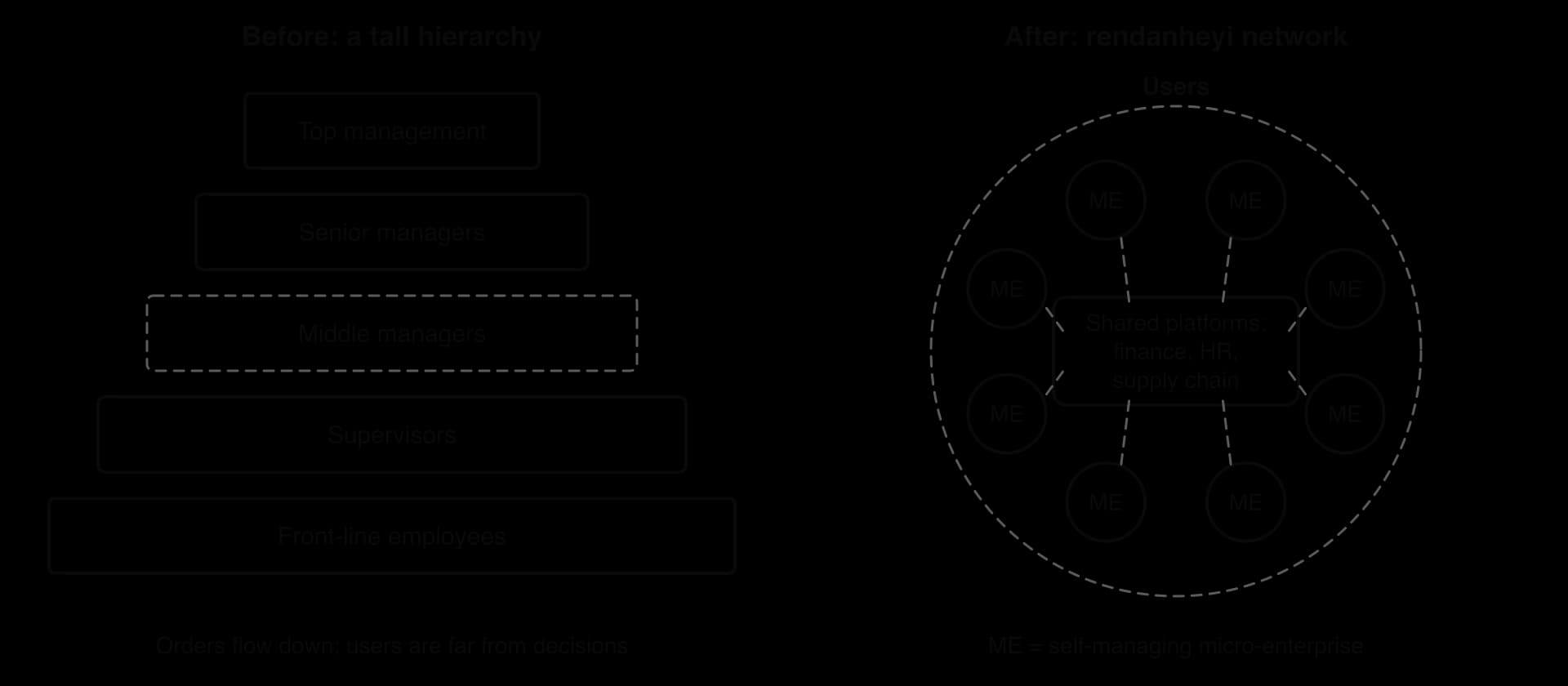
The diagram shows the change in terms of organisational structure. Removing the middle managers was delayering on a very large scale. Giving micro-enterprises authority over decisions, hiring and pay was radical decentralisation. Each micro-enterprise leader, accountable for results to users and to the platform, has a wide span of influence, and the chain of command from a user's complaint to a decision became very short.
 YouTube
Taking the model to GE Appliances
In June 2016 Haier completed its purchase of GE Appliances, the US appliance business of General Electric, for US$5.6 billion. Rather than imposing its own managers, Haier introduced rendanheyi step by step, beginning with a pilot micro-enterprise and growing to seven by 2018. According to Zhang, one of the best-performing micro-enterprises earned a profit of US$12 million in 2017, after a loss of US$3 million the year before. In 2025 Haier described the integration of Carrier Commercial Refrigeration, which it bought in 2024, in similar terms: decentralised decision-making, bottom-up goal setting and profit-sharing, with each micro-enterprise keeping its own accounts.
Measure | Figure | Year |
|---|---|---|
Middle managers let go during the move to rendanheyi | More than 10,000 | Reported 2018 |
Price paid for GE Appliances | US$5.6 billion | 2016 |
Micro-enterprises at GE Appliances | 7 (from one pilot) | 2018 |
Haier Smart Home operating revenue | RMB 274.2 billion | 2023 |
Haier Smart Home operating revenue | RMB 286.0 billion | 2024 |
Haier Smart Home operating revenue | RMB 302.3 billion | 2025 |
Share of 2025 principal revenue from outside China | About 51% | 2025 |
Employees (Haier Smart Home) | About 130,000 | 2025 |
The table shows a business that is still growing and earns about half of its revenue outside China. Revenue rose by about 10% between 2023 and 2025. Haier credits rendanheyi with much of its success, and thousands of businesses have studied the model.
Sources: Knowledge at Wharton, interview with Zhang Ruimin, 20 April 2018; INSEAD Knowledge, "The Multinational Fuelled by Thousands of Entrepreneurs", 21 January 2019; GE Appliances press release, 6 June 2016; Haier Smart Home Co., Ltd., Annual Report 2025.
What the case shows, and its limits
Haier shows that a large manufacturer can move from a tall, centralised structure to a flat, decentralised one, and that the change can be carried to businesses in very different cultures, such as the United States. The model fits a market where consumer tastes and technology change fast and where small teams close to users can respond quickly. It also shows the scale of the HR consequences: thousands of managers lost their roles, and the employees who stayed had to accept far more responsibility and risk, with pay linked to the results of their micro-enterprise.
The evidence has limits. Haier's growth also came from acquisitions (GE Appliances, Fisher & Paykel, Candy, Carrier Commercial Refrigeration), the growth of the Chinese economy and investment in premium brands, so its revenue figures cannot show how much of its success is due to its structure alone. Much of the information about rendanheyi comes from Haier and its founder, who have an interest in presenting it favourably. Zhang himself has said the change could not be completed overnight and that cultural barriers can make it harder in some countries.
Explain how rendanheyi changed Haier's levels of hierarchy, spans of control and degree of centralisation.
Analyse two risks for Haier of giving micro-enterprises authority over hiring and pay.
To what extent could the rendanheyi model work in a business in a different industry, such as a bank or a hospital?
Exam practice
Organisational structure is one of the few topics with a construction task outside finance: questions often ask you to construct an organisation chart from a description and then identify spans of control, levels and chains of command. Evaluation questions ask whether a structure suits a business after a change in its environment.
A precise definition names what is removed (levels of hierarchy) and its usual target (middle management); adding the effect on spans of control secures the second mark.
Questions with "explain two" need two distinct points, each developed in the context given. In a question on a matrix structure at a car manufacturer, for example, both points must be about the matrix structure itself, not about electric cars in general.
Summary
An organisation chart shows the formal structure: levels of hierarchy, chains of command and spans of control.
For a given workforce, wider spans of control mean fewer levels of hierarchy and fewer managers; delayering removes levels and widens spans.
Authority can be delegated, but the manager keeps responsibility and remains accountable for the result.
Tall structures give close control and clear promotion paths; flat structures give faster communication, lower costs and more empowerment.
Centralisation gives consistency and control; decentralisation gives speed and local knowledge; most businesses combine them.
Structures by function, product and region, and matrix structures, each balance specialist expertise against focus, flexibility and duplication.
Structure follows strategy: changes in technology, markets, the economy and regulation call for different structures, and the right choice depends on size, culture, skills, costs and risk.
HL: project-based and shamrock organisations increase flexibility and cut costs, at the risk of lower commitment, lost knowledge and ethical concerns.
Self-check
- To do:
I can define delegation, span of control, levels of hierarchy, chain of command, bureaucracy, centralisation, decentralisation, delayering and matrix structure.
- To do:
I can distinguish between authority, responsibility and accountability.
- To do:
I can explain why wider spans of control mean fewer levels of hierarchy.
- To do:
I can construct an organisation chart from a description and identify spans of control, levels and chains of command on it.
- To do:
I can analyse the advantages and disadvantages of tall, flat, functional, product-based, regional and matrix structures.
- To do:
I can evaluate centralisation, decentralisation and delayering for a given business.
- To do:
I can evaluate whether a structure is appropriate after a change in external factors.
- To do:
I can evaluate project-based organisation and Handy's shamrock organisation (HL).
Questions on 2.2
49 exam-style questions on this subtopic, written in the style of the IB papers. The first has its markscheme open. Counted on
Question 1 · BM-0007920 marks
Mvule Logistics
[1] Mvule Logistics (ML) is a privately held company that runs two large warehouses on the outskirts of Nairobi, Kenya. It stores and distributes goods for supermarkets, pharmaceutical wholesalers and online retailers across East Africa. ML employs 310 people. Most of the 240 warehouse operatives have worked for ML for more than six years and were trained by the same shift supervisors.
[2] Demand for ML’s services has grown quickly because of the rise of online shopping. Its largest client, an online retailer, now expects orders received before 22:00 to be dispatched the same night. To meet this, the chief executive, Wanjiru Mwangi, plans to install an automated warehouse management system in 2026. Hand-held scanners and conveyor sorting would replace most paper-based picking, and some tasks would be carried out by robots.
[3] Wanjiru estimates that the new system will reduce the number of warehouse operatives needed by about 20 %. She also wants the remaining operatives to work flexible shifts, some starting at 16:00 and finishing at 01:00. Several younger operatives have already left to work as self-employed delivery riders through mobile apps, which pay per delivery and let them choose their own hours.
[4] When rumours of the new system spread, absenteeism rose. Joseph Otieno, a shift supervisor for 14 years, told Wanjiru: “My team know nothing about computers, and nobody has told us who will keep their job. They think the robots are coming for them.” Many supervisors also worry that the system will report each picker’s speed directly to head office, so they will no longer be needed to check their team’s work.
[5] ML’s HR manager, Peter Kamau, has proposed two possible approaches. Option 1 is to introduce the system in one warehouse first, involve operatives in testing it and offer retraining to all staff who want it. Option 2 is to install the system in both warehouses at the same time over a four-week shutdown, so that ML can meet the client’s deadline quickly, and to offer a cash bonus to operatives who accept the new shift patterns.
- (a)
Define the term human resource planning.
2 marks
Markscheme (a)
Award [1] for a partial definition that shows some understanding, e.g. “planning how many workers a business needs” or “working out staffing”.
Award [2] for a full definition, e.g. the process of forecasting the number and type (skills) of employees an organization will need in the future, and planning how to meet that need, for example through recruitment, training or redeployment.
Award [0] for a tautological answer that only repeats the term.
Candidates are not expected to word their definition exactly as above.
- (b)
Explain two reasons why ML’s supervisors and operatives may resist the introduction of the automated warehouse management system (paragraph 4).
4 marks
Markscheme (b)
Reasons may include:
Job insecurity / fear of redundancy: Wanjiru expects a 20 % cut in operatives and “nobody has told us who will keep their job”, so operatives see the robots as a direct threat.
Fear of the unknown / lack of skills: Joseph says his team “know nothing about computers”; long-serving staff fear they will not cope with scanners and new software.
Loss of status or power: supervisors may no longer be needed to check work because picking speed is reported straight to head office, reducing their role and authority.
Poor communication / low trust: change is spreading through rumours rather than official information, which increases anxiety (absenteeism has risen).
Disruption of habits and social relationships: staff trained by the same supervisors for years are used to the paper-based routine.
Accept any other relevant reason.
Mark as 2 + 2. For each reason, award [1] for identifying a relevant reason for resistance and [1] for explaining it with reference to ML.
Award a maximum of [2] in total for a theoretical answer with no reference to ML.
- (c)
Explain two external factors that may influence ML’s human resource planning.
4 marks
Markscheme (c)
Factors may include:
The gig economy: younger operatives are leaving to work as app-based delivery riders, so ML may find it harder to keep and recruit staff; it must plan for higher labour turnover or offer more flexibility.
Technological change: automation reduces the number of operatives needed and changes the skills required (IT and scanner skills rather than manual picking).
Changing customer demand / growth of online shopping: same-night dispatch requires evening and night shifts, so ML must plan for flexible working patterns (flexi-time / shift work).
Labour market conditions: the availability of workers with IT skills in Nairobi affects whether ML can recruit externally or must retrain.
N.B. Do not credit internal factors (e.g. ML’s budget or objectives) unless clearly linked to an external cause.
Mark as 2 + 2. For each factor, award [1] for identifying a relevant external factor and [1] for explaining its effect on ML’s HR planning.
- (d)
Discuss whether ML should choose Option 1 or Option 2 to introduce the automated warehouse management system (paragraph 5).
10 marks
Markscheme (d)
Option 1 (phased introduction with involvement and retraining):
Involving operatives in testing the system (participation) reduces fear of the unknown and gives staff a sense of ownership; resistance and absenteeism may fall.
Retraining addresses Joseph’s concern that staff “know nothing about computers” and lets ML keep loyal, experienced staff, reducing recruitment costs.
Problems can be found and fixed in one warehouse before the second, lowering operational risk.
However, it is slower: ML may not meet the online retailer’s same-night dispatch deadline and could lose its largest client. Running two systems at once is also costly and complex, and retraining costs money and time.
Option 2 (simultaneous installation with a cash bonus):
Faster: ML meets its largest client’s requirement and protects revenue in a growing market.
A cash bonus (negotiation / incentive) may persuade operatives to accept late shifts; it competes with the flexibility of gig-economy work.
However, a four-week shutdown risks disrupting service to all clients at once; any failure affects both warehouses.
A bonus does not remove fear of redundancy or lack of skills; resistance may continue or turn into low morale, more absenteeism and staff leaving. It may be seen as “buying” compliance, damaging trust.
Neither option addresses communication: staff still do not know who keeps their job.
Possible conclusion: a judgement such as Option 1, combined with clear and early communication about the 20 % reduction and redeployment, because the main causes of resistance (fear, lack of skills, low trust) are better addressed by involvement and training; or Option 2 if keeping the largest client is judged critical. A combination (phased roll-out with targeted incentives) can be credited. Any well-supported judgement can reach full marks.
Limitations of the case that strong answers may note: no data on the costs of each option, on how long Option 1 would take, on the client’s willingness to wait, or on how many operatives would accept retraining.
Additional guidance: Marks should be allocated according to the markbands. If only one option is discussed, award a maximum of [5]. If there is no reference to the case (e.g. the 20 % cut, the same-night deadline, Joseph’s comments), award a maximum of [4]. A response without a conclusion is unlikely to exceed [6].
Markbands (10-mark extended response, Papers 1 and 2)
Marks
Level descriptor
0
The response does not reach the standard described below.
1–2
Little understanding of what the question demands. Business management tools and theories are barely used, or are irrelevant or inaccurate. Little or no reference to the stimulus material. No arguments are made.
3–4
Some understanding of what the question demands. Some use of tools and theories, but mostly inaccurate or not relevant. Use of the stimulus is superficial, often no more than the name of the organisation or person. Arguments are mostly unsubstantiated.
5–6
Understands what the question demands but addresses it only partially. Some relevant, accurate use of tools and theories. Some relevant use of the stimulus beyond names, but it does not effectively support the argument. Arguments are substantiated but mostly one-sided.
7–8
Mostly addresses what the question demands. Mostly relevant, accurate use of tools and theories. The stimulus generally supports the argument, with some lapses in clarity or relevance. Arguments are substantiated and show some balance.
9–10
Clear focus on what the question demands. Relevant, accurate use of tools and theories. Relevant stimulus material is integrated effectively to support the argument. Arguments are substantiated and balanced, and the limitations of the case or stimulus material are explained.
A response with no judgement or conclusion is unlikely to reach the top band of a discuss, evaluate, examine or recommend question.
Question 2 · BM-005374 marks
Mercado Araucária is a chain of 26 supermarkets in Curitiba, Brazil. To cut costs and speed up decisions, its directors plan to replace the department supervisors in each store (produce, bakery, butchery and so on) with self-managed teams. Teams would agree their own rotas and order stock directly. Supervisors would become team members with a small pay supplement for training others.
Explain two reasons why Mercado Araucária’s supervisors may resist this change.
4 marks
Answer it, then compare with the markscheme.Check this one with a free account
Question 3 · BM-0093316 marks
Bereket Market
[1] Bereket Market (BM) is a public limited company that runs 210 supermarkets across western Turkey from its head office in İzmir. Its organizational structure is tall: there are seven levels of hierarchy between the chief executive and the 9 000 store employees, including regional directors, area managers, store managers, department managers and shift supervisors.
[2] Instructions from head office pass down through every level. A recent price promotion was announced to customers on social media before many stores had received the instructions, and some stores applied the wrong discount. Suggestions from store employees, for example about products that local customers ask for, take months to reach head office, if they arrive at all. In a staff survey, 62 % of store employees said head office “does not listen”.
[3] New chief executive Elif Demir proposes removing the level of area managers. Store managers would report directly to regional directors, each of whom would then be responsible for about 30 stores instead of 6 area managers. BM would also introduce a staff app through which head office could send messages directly to all employees and employees could submit suggestions.
- (a)
Define the term chain of command.
2 marks
- (b)
Explain how BM’s tall structure has acted as a barrier to communication (paragraph 2).
4 marks
- (c)
Discuss whether Elif’s proposals are the best way to improve communication at BM.
10 marks
Answer it, then compare with the markscheme.Check this one with a free account
Flashcards for 2.2
The official deck for this part of the syllabus.
2.2 Organisational structure · front
Define organisational structure.
2.2 Organisational structure · front
State three things an organisational structure shows about a business.
- 2.2 Organisational structure135 cards
Carry on with 2.2 in Augment
With a free account, Augment remembers where you stopped and what you have practiced.