D Continuity and change
How theme D fits together: how genes, cells, bodies and ecosystems persist and change, the twelve subtopics across four levels, and what HL adds.
- IB Biology
- SL and HL
12 subtopics in Continuity and change
Each one has its own page once something is published for it.
- D1.1DNA replication41 questions · notes · 1 quick fire
- D1.2Protein synthesis47 questions · notes · 1 quick fire
- D1.3Mutations and gene editing42 questions · notes
- D2.1Cell and nuclear division45 questions · notes · 1 quick fire
- D2.2Gene expressionHL only37 questions · notes
- D2.3Water potential36 questions · notes
- D3.1Reproduction39 questions · notes
- D3.2Inheritance37 questions · notes · 1 quick fire
- D3.3Homeostasis46 questions · notes
- D4.1Natural selection48 questions · notes
- D4.2Stability and change37 questions · notes
- D4.3Climate change38 questions · notes
Key terms introduced here
Each is in the Biology glossary, with every other term in the subject.
- Continuity
The persistence of biological structures, information and conditions over time, for example through DNA replication, inheritance, homeostasis and the stability of ecosystems.
An overview of D Continuity and change
Continuity and change is the theme of how living systems persist and how they alter over time. DNA is copied and passed from cell to cell and from parent to offspring, bodies keep their internal conditions steady, and ecosystems can stay stable for centuries; yet mutation, selection and environmental change alter all of them.
Each subtopic deals with one side of this balance or with the interaction between the two: accurate copying and its errors, inheritance and variation, homeostasis and disturbance, stable ecosystems and climate change.
Subtopics in Continuity and change
The grid of themes and levels of organisation places the twelve subtopics of Continuity and change in the last row.
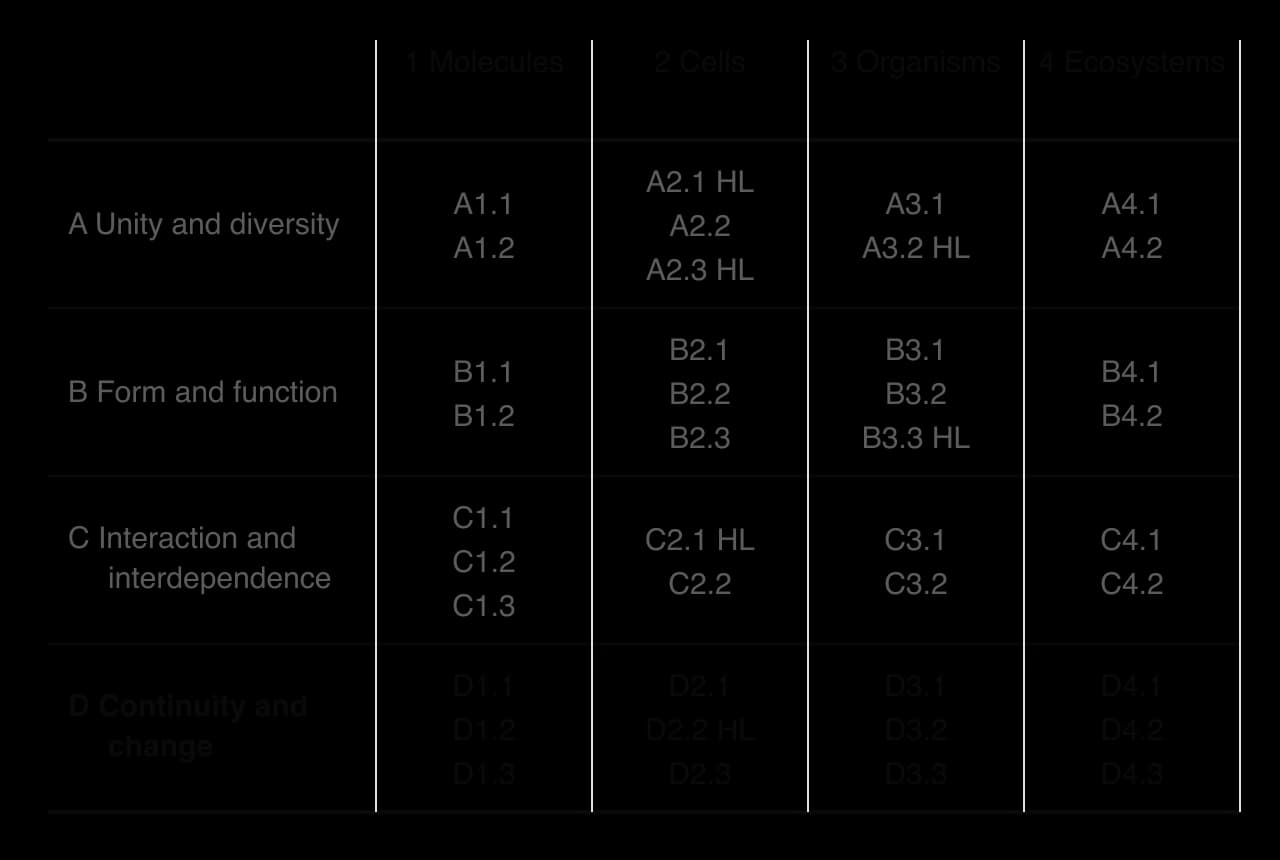
Subtopic | Level of organisation | SL or HL | Central question |
|---|---|---|---|
D1.1 DNA replication | Molecules | SL and HL | How is DNA copied accurately, and how are copying tools used in biotechnology? |
D1.2 Protein synthesis | Molecules | SL and HL | How does a cell turn a sequence of DNA bases into a sequence of amino acids? |
D1.3 Mutations and gene editing | Molecules | SL and HL | How do genes change, and what are the consequences? |
D2.1 Cell and nuclear division | Cells | SL and HL | How are genetically identical cells produced, and how does meiosis produce variation? |
D2.2 Gene expression | Cells | HL only | How is gene expression controlled, and how can patterns of expression be inherited? |
D2.3 Water potential | Cells | SL and HL | What determines the direction of water movement into and out of cells? |
D3.1 Reproduction | Organisms | SL and HL | How do sexual and asexual reproduction work in humans and flowering plants? |
D3.2 Inheritance | Organisms | SL and HL | What patterns of inheritance exist, and what is their molecular basis? |
D3.3 Homeostasis | Organisms | SL and HL | How does the body keep its internal environment constant? |
D4.1 Natural selection | Ecosystems | SL and HL | How does natural selection change allele frequencies in a population? |
D4.2 Stability and change | Ecosystems | SL and HL | What keeps ecosystems stable, and what human changes threaten them? |
D4.3 Climate change | Ecosystems | SL and HL | What drives climate change, and how is it affecting ecosystems and species? |
How continuity and change connect across the levels
Each level has its own form of continuity and its own sources of change.
At the level of molecules, DNA replication (D1.1) copies genetic information with very few errors, and protein synthesis (D1.2) turns that information into polypeptides. Mutations (D1.3) are the changes that escape copying and repair, and gene editing makes deliberate changes.
At the level of cells, mitosis produces genetically identical cells, while meiosis produces varied gametes (D2.1). Differences in solute concentration decide whether a cell gains or loses water by osmosis (D2.3), a movement described at HL by water potential, and gene expression (D2.2, HL only) controls which genes a cell uses.
At the level of organisms, reproduction (D3.1) and inheritance (D3.2) pass genes from one generation to the next, and homeostasis (D3.3) keeps the internal environment within narrow limits. At the level of ecosystems, natural selection (D4.1) changes allele frequencies in populations, ecosystems resist or give way to disturbance (D4.2), and climate change alters where species live and when they breed (D4.3).
Links to the other themes
Unity and diversity (A). DNA replication depends on the base pairing described in A1.2, and natural selection in D4.1 is the mechanism behind the evolution and speciation of A4.1.
Form and function (B). Protein synthesis produces the polypeptides whose structure and function are the subject of B1.2.
Interaction and interdependence (C). Homeostasis relies on the nervous and hormonal coordination of C3.1, and the stability of ecosystems depends on the energy flow and nutrient cycles of C4.2.
How HL differs in this theme
HL students study everything that SL students study, plus one HL-only subtopic, D2.2 Gene expression, and the sections marked HL only inside the SL subtopics. Every SL subtopic in this theme carries additional HL sections:
D1.1 DNA replication: directionality of DNA polymerases, leading and lagging strands, the enzymes of replication and proofreading.
D1.2 Protein synthesis: directionality, promoters, non-coding DNA, splicing and alternative splicing, initiation of translation, polypeptide modification and proteasomes.
D1.3 Mutations and gene editing: gene knockout, CRISPR–Cas9 and conserved sequences.
D2.1 Cell and nuclear division: cell proliferation for growth, replacement and repair, the phases of the cell cycle and cell growth during interphase, control by cyclins and the consequences of mutations in cell-cycle genes, including tumours.
D2.3 Water potential: water potential itself as the potential energy of water per unit volume, water movement from higher to lower water potential, the contributions of solute potential and pressure potential, and water movements in plant tissue.
D3.1 Reproduction: hormonal control of puberty, spermatogenesis and oogenesis, the prevention of polyspermy, the blastocyst and implantation, pregnancy testing, the placenta, the hormones of pregnancy and childbirth, and hormone replacement therapy.
D3.2 Inheritance: segregation and independent assortment in meiosis, dihybrid crosses, the loci of human genes, autosomal gene linkage, recombinants and the chi-squared test.
D3.3 Homeostasis: the kidney in excretion and osmoregulation, and changes in blood supply to organs.
D4.1 Natural selection: the gene pool, allele frequencies of isolated populations and their change by natural selection, directional, disruptive and stabilising selection, the Hardy–Weinberg equation and its conditions, and artificial selection.
D4.2 Stability and change: ecological succession and its causes, primary succession, cyclical succession, and climax communities and arrested succession.
D4.3 Climate change: phenology, the disruption of synchrony between phenological events, extra insect life cycles in a year, and evolution in response to climate change.
Carry on with D in Augment
With a free account, Augment remembers where you stopped and what you have practiced.