Explain what keeps ecosystems stable, how tipping points, overharvesting, eutrophication, biomagnification and plastics threaten them, and how rewilding and succession restore them.
Each is in the Biology glossary, with every other term in the subject.
A rapid increase in the population of algae or cyanobacteria in a body of water, usually caused by an increased supply of nutrients such as nitrate and phosphate.
A predator at the top of a food chain that is not preyed upon by any other species as an adult.
Succession prevented from reaching the climax community by a continuing factor, often a human activity such as grazing, burning or drainage, so the community is held at an earlier stage (a plagioclimax).
The build-up of a substance, such as a pollutant, in the tissues of an individual organism over its lifetime, because it is absorbed faster than it is broken down or excreted.
The mass of dissolved oxygen used by aerobic microorganisms to decompose the organic matter in a water sample, usually over five days at 20 °C in the dark; a high value indicates organic pollution.
The increase in the concentration of a persistent pollutant in the tissues of organisms at successively higher trophic levels of a food chain.
The total amount of greenhouse gases, expressed as the equivalent mass of carbon dioxide, released directly and indirectly by an activity, product, organisation or person.
Ecosystems can persist for very long periods, but they depend on a continuous supply of energy, recycling of nutrients and suitable conditions. Human activities such as deforestation, overharvesting, fertiliser use and pollution can push ecosystems beyond the limits within which they recover.
The same principles explain how ecosystems are damaged and how they can be repaired: by harvesting no faster than replacement, by reducing pollution at its source, and by restoring the natural processes and keystone species that hold communities together.
37 exam-style questions on this subtopic, written in the style of the IB papers. The first has its markscheme open. Counted on
Human activities are changing ecosystems across the world.
Describe how the leaching of fertilizers can lead to eutrophication of lakes and rivers.
4 marks
a. fertilizers contain nitrate / phosphate / ammonium (ions);
b. excess fertilizer is washed / leached from soil into lakes and rivers by rain;
c. the water becomes enriched with nutrients;
d. rapid growth of algae / algal bloom;
e. algae block light, so submerged plants die;
f. dead algae / plants are decomposed by (aerobic) bacteria / saprotrophs;
g. increased biochemical oxygen demand (BOD);
h. dissolved oxygen falls, so fish / aquatic animals die;
[4 max]
Outline the causes of the loss of mixed dipterocarp forest in Southeast Asia.
4 marks
a. logging of (valuable) dipterocarp hardwood trees for timber;
b. logging roads give access for further clearance / settlement / hunting;
c. clearance for oil palm plantations / palm oil production;
d. clearance for other plantations, such as rubber / pulpwood (acacia);
e. land cleared for (small-scale) agriculture;
f. fires used to clear land, which spread into forest;
g. drainage of peat swamps makes forest / peat more likely to burn;
The official deck for this part of the syllabus.
Define ecosystem.
Define ecosystem stability.
With a free account, Augment remembers where you stopped and what you have practiced.
A pattern of succession in which a community passes through a series of stages and then returns to an earlier stage, repeating the cycle instead of progressing to a single stable climax.
The sequence of changes in the species composition of a community over time, in which one group of species replaces another, often ending in a relatively stable climax community.
The capacity of an ecosystem to persist over time, keeping its structure and functioning despite disturbances, either by resisting change or by returning to its previous state.
The enrichment of a body of water with mineral nutrients, especially nitrate and phosphate, causing excessive growth of algae and other producers and leading to depletion of dissolved oxygen.
A species that has a disproportionately large effect on the structure of its ecological community relative to its abundance; its removal causes major changes and risks ecosystem collapse.
The loss of soluble mineral ions, such as nitrate, from soil as water drains through it, carrying them below the reach of plant roots and into groundwater and rivers.
A large piece of plastic debris, larger than 5 mm, such as a bag, bottle, packaging or fishing net, which can entangle or be swallowed by animals.
The largest harvest that can be taken from a population year after year without reducing its size, obtained by keeping the population at about half its carrying capacity, where growth rate is greatest.
A small experimental ecosystem, enclosed in a container such as a sealed glass vessel, set up to investigate the effects of variables on a community under controlled conditions.
A piece of plastic smaller than 5 mm, either manufactured at that size or formed by the breakdown of larger plastic items.
Describes a material that cannot be broken down into simpler substances by decomposers such as bacteria and fungi, so it persists in the environment.
The first organisms to colonise bare ground in primary succession; they tolerate harsh conditions and begin soil formation, for example lichens and mosses on bare rock.
Succession that begins in an area with no soil and no previous community, such as bare rock, a new volcanic island or ground exposed by a retreating glacier.
Ecological restoration that re-establishes natural processes in an ecosystem, for example by reintroducing apex predators and keystone species, reconnecting habitats and reducing human impact, so the ecosystem becomes self-sustaining.
Succession that occurs where an existing community has been disturbed or removed but the soil remains, for example after a fire or on abandoned farmland.
The removal of soil, especially fertile topsoil, by wind or water faster than new soil forms, often after the vegetation that protects it has been cleared.
Removing organisms from a natural population at a rate no greater than the rate at which the population replaces them by reproduction and growth, so that harvesting can continue indefinitely.
A critical threshold at which a small additional change pushes an ecosystem into a different state, which is often self-sustaining and difficult or impossible to reverse.
An ecosystem is a community of interacting organisms together with its abiotic environment. Most natural ecosystems change from day to day and from season to season, yet many keep the same broad structure for very long periods: the same kinds of producers, the same food webs and roughly the same population sizes. This ability to persist is called stability.
Ecologists separate two parts of stability. Resistance is the ability to stay largely unchanged when a disturbance happens, as when an old forest loses a few trees in a storm but its canopy and species stay the same. Resilience is the ability to recover after a disturbance has caused change, as when grassland grows back within a year or two after a fire. An ecosystem with high stability usually has both.
The strongest evidence for stability comes from ecosystems that have existed in roughly the same form for thousands or millions of years. Fossil pollen, plant remains and the present distribution of ancient lineages allow ecologists to estimate how long a forest or desert has persisted.
Daintree Rainforest, Queensland, Australia. Part of the Wet Tropics World Heritage Area, it is one of the oldest surviving tropical rainforests and is often described as more than 100 million years old. It contains many ancient lineages of flowering plants, including families that are found nowhere else, which suggests continuous rainforest cover since the time of the dinosaurs.
Namib Desert, southern Africa. Running along the Atlantic coast of Namibia, it is thought to have been arid or semi-arid for at least 55 million years, which makes it one of the oldest deserts on Earth. Its endemic organisms, such as the welwitschia plant (Welwitschia mirabilis) and fog-basking beetles, have adaptations that could only evolve over a long period of dry conditions.
Boreal forest and tundra. Much younger, having formed after the last ice sheets retreated about 10,000 years ago, but stable over that time apart from fire cycles and insect outbreaks.
Ecosystems that persist for long periods still change continually. Individual trees die and are replaced, populations rise and fall, and species move in and out. The ecosystem is stable because these changes are balanced, so that the overall structure and the processes of energy flow and nutrient cycling continue. In terms of continuity and change, stability is continuity at the level of the ecosystem while change happens continually at the level of individual organisms.
An ecosystem can only persist if the processes that sustain it continue indefinitely. Four conditions are needed: a continuous supply of energy, recycling of nutrients, enough genetic diversity, and climatic variables that stay within the tolerance limits of the organisms present.
Requirement | Why it is needed | What happens if it fails |
|---|---|---|
Continuous supply of energy | Energy flows through ecosystems and is lost as heat at each trophic level, so it must be replaced. Almost all ecosystems depend on sunlight captured by photosynthesis. | Primary production falls and energy can no longer reach higher trophic levels; for example, a lake permanently shaded by an algal bloom loses its rooted plants. |
Recycling of nutrients | The supply of elements such as carbon, nitrogen and phosphorus is finite. Decomposers release them from dead organic matter so that producers can reuse them. | Nutrients are lost, for example by leaching or by removal of crops and timber, and productivity falls. |
Genetic diversity | Variation within populations allows some individuals to survive new diseases or changes in conditions, and allows populations to adapt by natural selection. | A genetically uniform population can be wiped out by a single pathogen or a change in climate. |
Climatic variables within tolerance levels | Each species can survive only within a range of temperature, rainfall and other abiotic conditions. | Species die or move away, food webs are disrupted, and the ecosystem may change to a different type. |
Energy is the one requirement that cannot be met by recycling. Energy enters an ecosystem as light, is converted to chemical energy in primary production and passes along food chains, but each transfer releases heat through cell respiration. Heat cannot be converted back into chemical energy by organisms, so the supply must be continuous. Chemical elements behave in the opposite way: they are not used up, only moved between organisms and the environment, so recycling them by decomposers keeps them available.
Genetic diversity links ecosystem stability to evolution. A population with many alleles is more likely to contain individuals that survive an unusual drought or a new pathogen. Climatic variables matter because every species has a range of tolerance for each abiotic factor. If the climate moves outside that range for long enough, the species declines, and the species that depend on it decline too.
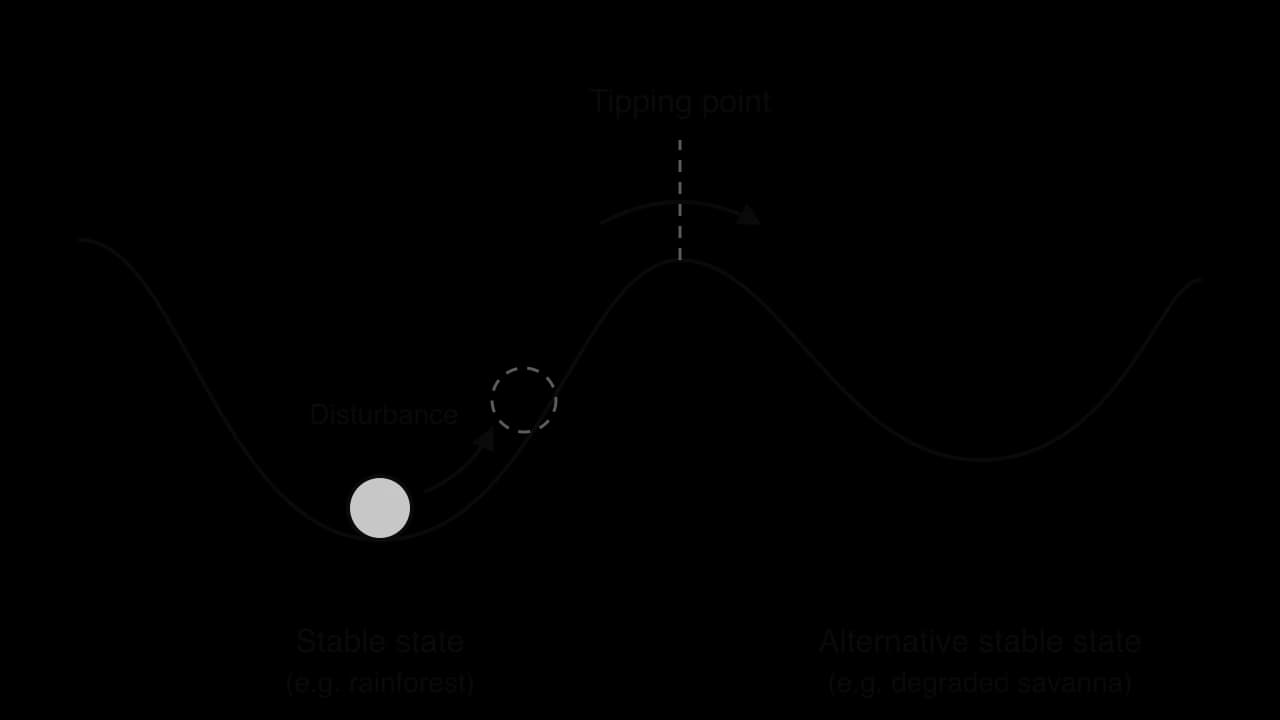
A stable ecosystem can absorb a certain amount of disturbance and still recover. Beyond a certain level of disturbance, however, the processes that maintain the ecosystem may stop working, and it changes rapidly to a different state that is also stable. The point at which this happens is called a tipping point.
Ecologists often represent stable states with a ball-in-a-valley model. The diagram of a landscape with two valleys shows each valley as a stable state. Small disturbances push the ball a little way up the side of its valley, but it rolls back. A large enough disturbance pushes it over the ridge, and it then settles in the other valley. Returning it needs much more effort than the disturbance that moved it, which is why crossing a tipping point is so serious.
The Amazon rainforest covers most of the Amazon basin in South America and is the largest tropical rainforest on Earth. Moist air blowing in from the Atlantic Ocean brings rain to the eastern edge of the forest. The trees then return much of this water to the air by transpiration, the loss of water vapour from leaves. The water vapour forms clouds again and falls as rain further west. Water is recycled several times in this way as the air moves across the continent towards the Andes.
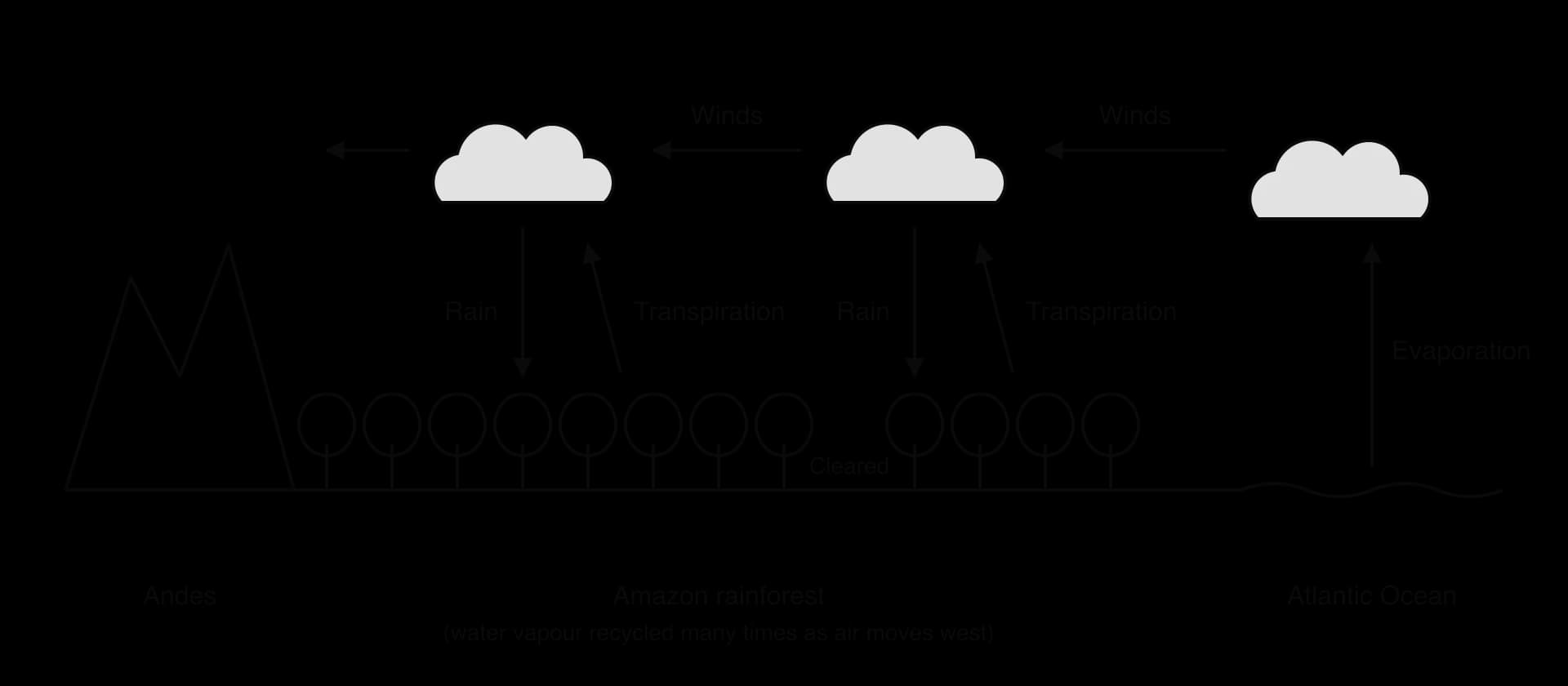
Transpiration also affects temperature and air movement. Evaporation of water from leaves absorbs a large amount of heat, so a forest is much cooler than cleared land. The water vapour that rises releases this heat again when it condenses into clouds, which drives air currents that pull more moist air in from the ocean. These processes depend on a large, continuous area of forest. If enough trees are removed, rainfall falls, dry seasons become longer, and the remaining trees become more vulnerable to drought and fire.
Deforestation of the Amazon is driven mainly by clearance for cattle pasture, soya farming, logging and roads. By about 2018 roughly 17% of the original forest had been lost. Climate models suggest that if too much forest is lost, large parts of the eastern, southern and central Amazon could change into a dry, degraded savanna with far fewer species and much lower carbon storage. The savanna would then be self-sustaining, because it would no longer generate enough rainfall to support rainforest.
The minimum area of forest needed to keep the rainfall system working is uncertain. Earlier models placed the tipping point at about 40% deforestation. When the combined effects of climate change and fire are included, more recent estimates place it at only 20–25% deforestation. Scientists cannot test this by experiment on a whole continent, so the estimate depends on models, observations of rainfall and forest health, and the comparison of deforested and intact regions. This uncertainty is a strong argument for caution, because the tipping point may only be recognised after it has been crossed.
Deforestation is usually measured as a percentage change from the original forest area, which allows regions of different sizes to be compared.
Whole ecosystems are too large and complex for controlled experiments, so ecologists often use models. A mesocosm is a small, enclosed experimental ecosystem that contains producers, consumers and decomposers, set up so that the effect of one variable on the stability of the community can be investigated under controlled conditions.
Mesocosms can be open tanks, such as large tanks of pond water outdoors. In an open tank, however, matter enters and leaves: water evaporates, rain falls in, gases exchange with the air and insects arrive and leave. A sealed glass vessel, such as a large jar with an airtight lid, prevents any entry or exit of matter. Light still passes in through the glass and heat passes out, so energy transfer continues. A sealed vessel is therefore a better model of an ecosystem that relies only on internal nutrient cycling.
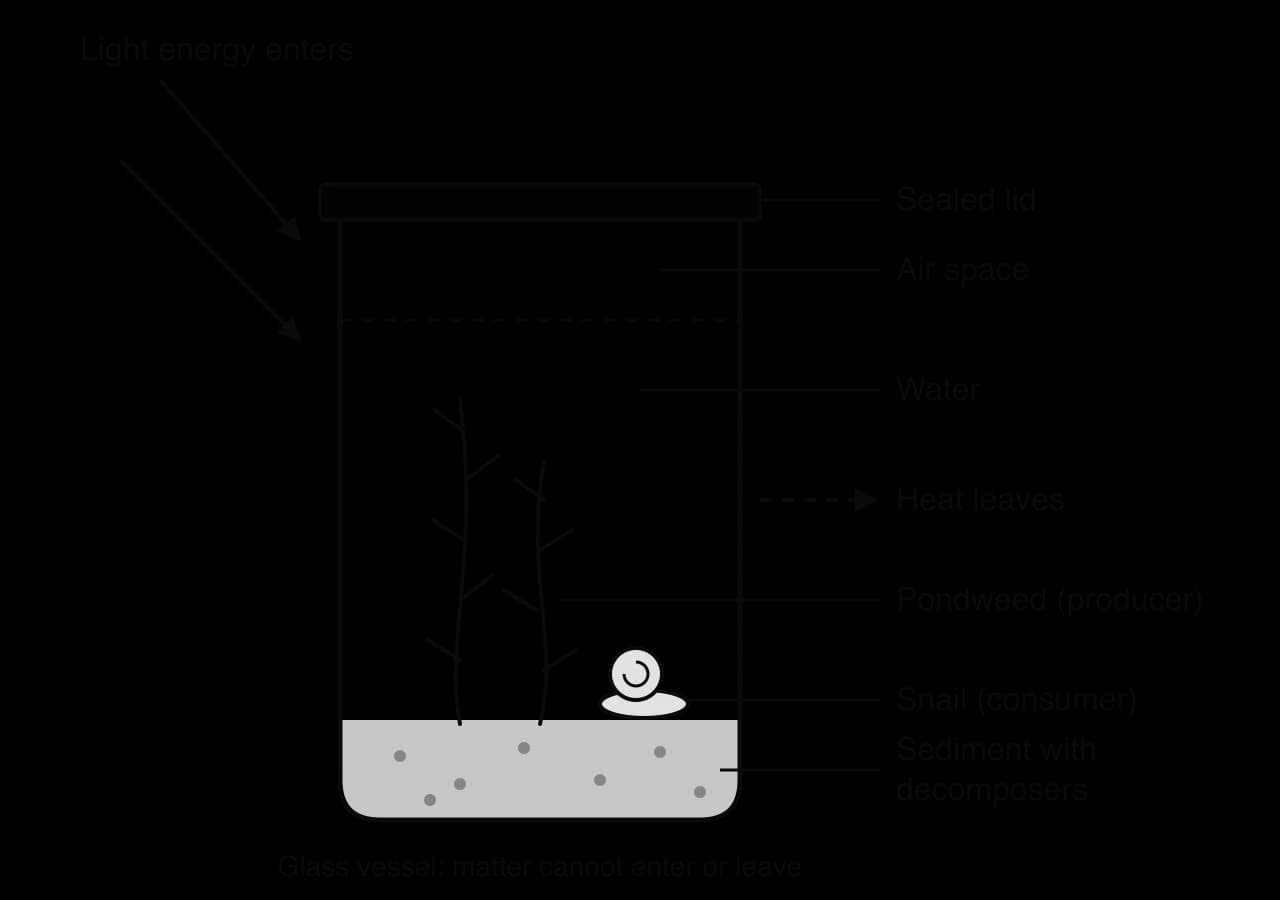
For the community in a sealed mesocosm to persist, every requirement for stability must be met inside the vessel. The pondweed must photosynthesise enough to supply oxygen and food for the snail and the decomposers; the snail and decomposers must release enough carbon dioxide for photosynthesis; and decomposers in the sediment must recycle nitrogen and phosphorus from wastes and dead material. Aquatic or microbial mesocosms work better than terrestrial ones, because gases and minerals mix easily in water and small organisms complete their life cycles quickly. Terrestrial mesocosms tend to suffer from mould, waterlogging or drying out.
A mesocosm investigation tests how one independent variable affects the stability of the community. Several identical mesocosms are set up and only the independent variable is changed between them.
Possible independent variables: light intensity (distance from a lamp, or layers of shade cloth), temperature, the number of consumers added, the mass of producer, or the addition of a pollutant such as fertiliser.
Dependent variables (measures of stability): dissolved oxygen concentration (oxygen probe), pH (CO₂ concentration changes it), the survival and number of consumers, the growth of the producer, the cloudiness of the water caused by microbial growth, measured over several weeks.
Control variables: volume and source of water and sediment, size of the vessel, the species and number of organisms (other than the independent variable), temperature and light period.
Replication: at least three mesocosms at each level of the independent variable, so that mean values can be calculated and the variability of results judged.
Animals in mesocosms must be treated ethically. Ecological practical work should follow accepted guidelines on animal welfare: invertebrates such as snails and water fleas are used rather than vertebrates, organisms are collected in small numbers and returned to their habitat where possible, and no experiment should be designed to cause suffering or death. A mesocosm in which consumers are dying should be ended and the organisms rescued. This is a good example of how scientific inquiry is constrained by ethical judgement.
Some species have a much larger effect on their community than their numbers or biomass would suggest. These are keystone species, named after the central stone at the top of an arch, which holds the other stones in place. If a keystone species is removed, the structure of the community changes greatly, and the ecosystem can collapse into a much less diverse state.
The keystone idea came from experiments by the American ecologist Robert Paine on the rocky shores of Mukkaw Bay, Washington, USA. The ochre sea star (Pisaster ochraceus) is the top predator in this intertidal community. It eats mussels, barnacles, chitons, limpets and whelks. The food web of the shore shows that almost every other animal is eaten by Pisaster.
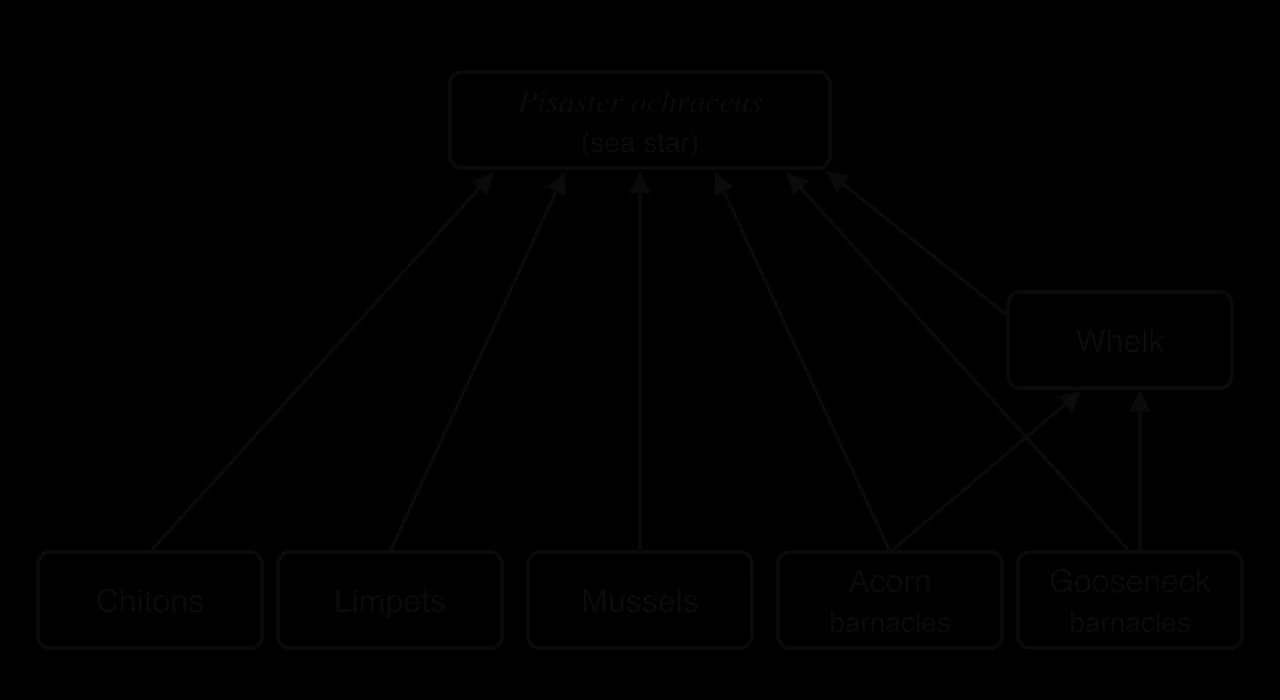
From 1963 Paine regularly removed every Pisaster from an area of shore and left a nearby area untouched as a control. On the rocks without Pisaster, the California mussel (Mytilus californianus) spread rapidly and covered the rock surface, crowding out barnacles, algae and the animals that grazed on them. Within about three years the number of species in the experimental area had fallen from 15 to 8, while the control area kept its diversity. Pisaster was not abundant, but by eating mussels it prevented one competitor from taking over the limited space, and so it allowed many species to coexist.
The same pattern has since been found in other ecosystems. Sea otters (Enhydra lutris) on the Pacific coast of North America eat sea urchins, which graze on kelp. Where otters were hunted almost to extinction, urchin numbers rose and the kelp forests were reduced to bare rock known as "urchin barrens"; where otters returned, the kelp forests recovered. Effects like these, passing down through several trophic levels, are called trophic cascades.
 YouTube
Many keystone species are an apex predator, a predator at the top of a food chain that has no natural predators of its own, but not all are. Keystone species can also be:
Ecosystem engineers that physically change the habitat, such as the Eurasian beaver (Castor fiber), whose dams create ponds and wetlands used by many other species.
Keystone mutualists, such as fig trees in tropical forests, which fruit all year round and feed many fruit-eating animals when other fruit is scarce.
Keystone herbivores, such as the African elephant, which pushes over trees and keeps savanna open as grassland.
Humans harvest many organisms from natural ecosystems: timber, fruit, nuts and medicinal plants from forests, and fish and shellfish from the sea. These are renewable resources, because the populations reproduce and replace what is taken. Harvesting is sustainable only if the rate of harvest does not exceed the rate at which the population replaces itself.
The rate at which a population replaces itself depends on its size. In the sigmoid growth curve, a small population grows slowly because there are few breeding individuals, and a population near the carrying capacity (K) grows slowly because resources are limited. The growth rate is fastest at about half the carrying capacity. If a population is harvested so that it stays near K/2, the number of individuals removed each year can be as large as possible while still being replaced. This harvest is the maximum sustainable yield.
Maximum sustainable yield is an ideal that is hard to achieve in practice. Population sizes are difficult to measure accurately, carrying capacity changes from year to year with the weather and food supply, and harvesters are often under economic pressure to take more. Many fisheries are therefore managed with a margin of safety, aiming for catches below the estimated maximum.
The Brazil nut tree (Bertholletia excelsa) grows wild in the Amazon rainforest. Its seeds are collected from the forest floor by local people and sold worldwide, providing income without felling trees. Collecting seeds looks harmless, but it removes the seeds that would otherwise grow into new trees. Surveys of 23 Brazil nut populations across the Amazon showed that stands that had been harvested heavily for a long time contained very few young trees, while lightly harvested or unharvested stands had many. The adult trees in heavily harvested stands were still producing seeds, but they were not being replaced, so the population would eventually decline.
This example shows how sustainability of plant harvesting is assessed. Ecologists measure the age or size structure of the population: a sustainable population has enough seedlings and young trees to replace the adults that die. They also estimate the proportion of seeds harvested and compare it with the number needed for regeneration. Management can then set limits, such as leaving a proportion of seeds uncollected or protecting areas where no collection takes place.
The Atlantic cod (Gadus morhua) off Newfoundland, Canada, supported one of the largest fisheries in the world for nearly 500 years. After the 1950s, large factory trawlers greatly increased the catch, and the government set annual quotas based on estimates of the stock that turned out to be far too optimistic. By 1992 the spawning stock (the fish old enough to breed) had fallen to about 1% of its estimated peak. A fishing moratorium was declared in July 1992, and about 30,000 people in Newfoundland and Labrador lost their jobs. The cod population has recovered only partly since then.
The cod collapse shows that harvesting faster than replacement can destroy a resource completely. Fish stocks are assessed using several kinds of evidence:
Stock assessment surveys: research vessels fish in a standard way at fixed sites each year, giving an index of population size.
Catch per unit effort: the mass of fish caught per hour of fishing; a falling value suggests a falling population, though new technology can hide a decline.
Age structure of the catch: if most fish caught are young and few old, large breeding fish are being removed faster than they are replaced.
Size at maturity: heavy fishing selects for fish that mature at a smaller size, which is a warning sign.
Managers use these data to set a total allowable catch, minimum mesh sizes so that young fish escape, closed seasons during breeding, and marine protected areas where fishing is banned. For Newfoundland cod, falling catch per unit effort and a catch dominated by young fish were early warning signs that were not acted on in time.
Agriculture replaces natural ecosystems with crops or pasture managed for food production. Sustainable agriculture can continue producing food indefinitely without degrading the soil, water and other ecosystems it depends on. Five factors determine whether a farming system is sustainable: soil erosion, leaching of nutrients, the supply of fertilisers and other inputs, pollution by agrochemicals, and the carbon footprint.
Soil forms very slowly, often taking hundreds of years to produce a few centimetres, but it can be lost quickly once the vegetation that protects it is removed. Ploughing leaves soil bare between crops, and overgrazing removes grass cover from pasture, so wind and rain carry the fertile topsoil away.
The Dust Bowl of the 1930s in the southern Great Plains of the USA is a well-known example. Deep ploughing of prairie grassland followed by years of drought allowed winds to strip topsoil from millions of hectares. Erosion can be reduced by keeping the soil covered with cover crops between harvests, by no-till farming (sowing seed without ploughing), by contour ploughing and terracing on slopes, and by planting hedgerows or shelter belts as windbreaks.
Crops take up mineral ions from the soil, and harvesting removes these ions from the field. Farmers replace them with fertilisers. Nitrate (NO₃⁻) ions are very soluble and are not held by soil particles, so rain washing through the soil carries them down below the roots and into groundwater, streams and rivers. This process is called leaching. Phosphate binds more strongly to soil particles but is lost when eroded soil is washed into water.
Leaching wastes the farmer's money and harms aquatic ecosystems downstream. It is reduced by applying fertiliser only when crops are growing and can absorb it, avoiding application before heavy rain, using the right amount for the crop (precision farming with soil testing), and planting buffer strips of vegetation along rivers to absorb runoff.
Modern intensive agriculture depends on large inputs from outside the farm. Nitrogen fertiliser is made by the Haber process, which uses natural gas both as a raw material and as an energy source. Phosphate fertiliser is made from phosphate rock, a finite resource that is mined in only a few countries. Pesticides, machinery, fuel and irrigation water are also inputs. A farming system that depends on finite or energy-intensive inputs cannot continue indefinitely, and its costs rise as the inputs become scarce. More sustainable alternatives include crop rotation with legumes (which fix nitrogen through bacteria in root nodules), the use of manure and compost, and recycling of phosphorus from sewage.
Agrochemicals include fertilisers, pesticides (insecticides, herbicides and fungicides) and veterinary drugs. Pesticides can kill organisms other than the target, such as pollinating insects, the natural predators of pests, and soil organisms. Some, such as the neonicotinoid insecticides, have been linked to declines in bees; several countries, including the member states of the European Union, have restricted their use outdoors. Persistent pesticides such as DDT can also become concentrated along food chains by biomagnification.
Agriculture releases greenhouse gases at every stage, from making fertiliser and running machinery to the methane released by livestock and rice paddies. The total release is described by a carbon footprint.
Different foods have very different footprints. Beef has one of the highest per kilogram, because cattle produce methane during digestion, need large areas of pasture (often made by clearing forest) and convert only a small proportion of the energy in their food into meat. Plant foods such as peas and cereals generally have far smaller footprints. This is a consequence of energy loss along food chains: eating at a lower trophic level uses much less land and energy per unit of food.
Factor | How it makes agriculture unsustainable | Ways to reduce it |
|---|---|---|
Soil erosion | Fertile topsoil is lost faster than it forms; yields fall | Cover crops, no-till farming, terracing, windbreaks |
Leaching of nutrients | Nitrate and phosphate are lost from fields and pollute water | Apply fertiliser when crops can use it, buffer strips, soil testing |
Supply of inputs | Depends on finite phosphate rock and fossil fuels | Legumes in rotation, manure and compost, phosphorus recycling |
Agrochemical pollution | Kills non-target species, contaminates water and food chains | Integrated pest management, biological control, targeted spraying |
Carbon footprint | Releases CO₂, methane and nitrous oxide, adding to climate change | Less fertiliser and fuel, fewer livestock, plant-based diets |
When fertilisers are leached from farmland, or when sewage enters water, the concentration of nitrate and phosphate in rivers, lakes and coastal seas rises. In most freshwater lakes phosphate is the limiting nutrient for producers, and in many coastal waters nitrate is. Adding these nutrients causes rapid growth of producers, followed by a chain of events that removes oxygen from the water. This process is called eutrophication.
The flow chart of eutrophication shows the stages in order. Each stage causes the next, so an explanation must give them in sequence.
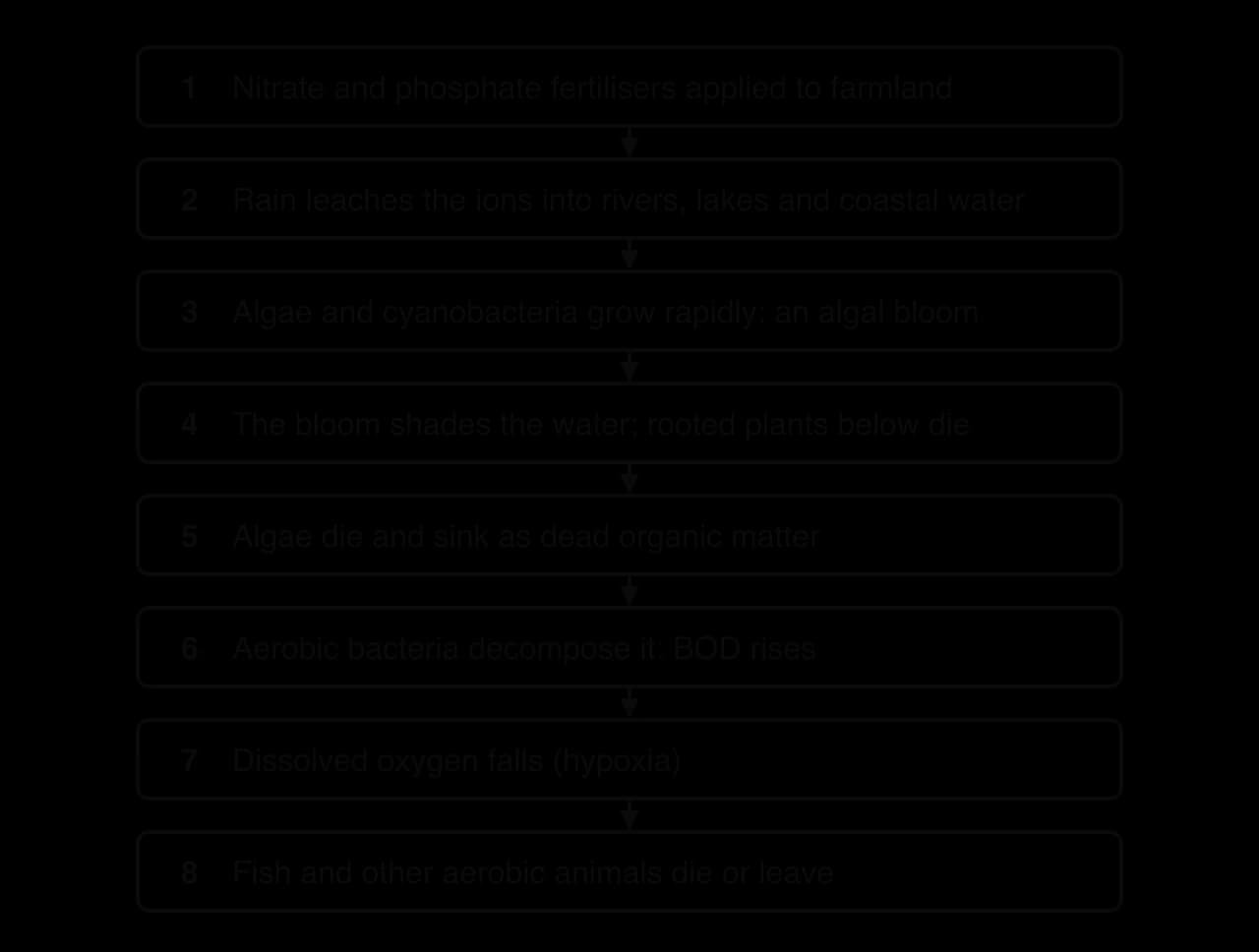
Nutrient input. Nitrate and phosphate enter the water by leaching and runoff from farmland, or from sewage and some detergents.
Algal bloom. The nutrients are no longer limiting, so algae and cyanobacteria grow and reproduce very rapidly, forming an algal bloom that colours the water green.
Shading. The bloom absorbs light near the surface, so rooted aquatic plants and algae deeper in the water can no longer photosynthesise, and they die.
Death of algae. Algae have short lives and many die as nutrients are used up or the bloom ends. Dead algae and plants sink.
Decomposition. Aerobic bacteria feed on the dead organic matter and multiply rapidly. Their aerobic respiration uses large amounts of dissolved oxygen.
Oxygen depletion. Dissolved oxygen falls, especially in deeper water, which is not mixed with air at the surface. Water with very low oxygen is described as hypoxic; with none, as anoxic.
Death of animals. Fish and other aerobic animals suffocate or move away. Their death adds more organic matter for decomposers, and anaerobic bacteria may release toxic hydrogen sulfide.
The amount of organic pollution in water is measured by its biochemical oxygen demand (BOD). A water sample is saturated with oxygen, its dissolved oxygen concentration is measured, and then it is kept in the dark at 20 °C for five days, so that no photosynthesis can occur. The dissolved oxygen is measured again. The fall in oxygen concentration shows how much oxygen the microorganisms used while decomposing organic matter in the sample.
Clean river water typically has a BOD of only a few milligrams of oxygen per dm³ (mg dm⁻³), while untreated sewage has a BOD many times higher. Downstream of a source of organic pollution, BOD is high where the pollution enters and decreases with distance as the organic matter is broken down. Dissolved oxygen shows the opposite pattern: it falls to a minimum a short distance downstream and then recovers as oxygen dissolves from the air and the BOD declines.
Lake Erie, on the border between the USA and Canada, is the shallowest and warmest of the North American Great Lakes. It is surrounded by cities and intensively farmed land, and it receives water from rivers that drain large areas of cropland. By the 1960s it was widely described as a "dead lake": thick algal blooms covered the surface every summer, fish kills were common, and the bottom water of its central basin became anoxic each year. The main nutrient responsible was phosphorus, from untreated sewage, phosphate detergents and farm runoff.
The governments of the two countries responded with the Great Lakes Water Quality Agreement of 1972, which set limits on phosphorus inputs. Sewage treatment works were upgraded to remove phosphate, and phosphate detergents were restricted. The phosphorus load to the lake fell steeply, the blooms became much smaller and the lake recovered for about two decades.
Year | Event | Phosphorus load to Lake Erie |
|---|---|---|
Late 1960s | Severe algal blooms; anoxic bottom water each summer | About 29,000 tonnes per year |
1972 | Great Lakes Water Quality Agreement limits phosphorus inputs | Target reduced to 14,600 tonnes per year |
1978 | Agreement renewed with a lower target | Target 11,000 tonnes per year |
2011 | Largest bloom of the cyanobacterium Microcystis recorded | Dissolved phosphorus from farm runoff increasing |
2014 | About 400,000–500,000 people in and around Toledo, Ohio, told not to drink tap water for three days because of microcystin toxin | Blooms continue each summer |
2016 | Canada and the USA agree a new target | 40% cut, to 6,000 tonnes per year to the central basin |
Sources: US Environmental Protection Agency, Great Lakes Water Quality Agreement; Michalak et al., PNAS, 2013; City of Toledo, 2014.
From the mid-1990s the blooms returned. The main source was now dissolved phosphate washed from farmland, especially in the catchment of the Maumee River, which drains intensively farmed land in Ohio and Indiana. Heavy spring rain, made more frequent by climate change, carried fertiliser off the fields and into the lake. The 2011 bloom of the cyanobacterium Microcystis, the largest on record, covered much of the western basin. In August 2014 a bloom near the water intake for Toledo, Ohio, produced the liver toxin microcystin at concentrations above 1 µg dm⁻³, and about 400,000–500,000 people were told not to drink tap water for three days.
Lake Erie shows three ideas together. Eutrophication follows the same sequence whether the nutrients come from sewage or from farms. It can be reversed when nutrient inputs are reduced, because aquatic ecosystems have high resilience once the cause is removed. Finally, the sustainability of agriculture depends on its effects beyond the farm: fertiliser leached from fields in one region damaged drinking water for a city and the ecology of a whole lake.
Some pollutants are not broken down by organisms and are not easily excreted. When an organism absorbs them faster than it can remove them, they build up in its tissues over its lifetime. This is called bioaccumulation. Fat-soluble pollutants such as the insecticide DDT and the metal compound methylmercury are stored in fatty tissue and are hardly excreted at all.
When a consumer eats many prey organisms, it takes in all the pollutant stored in their bodies. Only about 10% of the energy in one trophic level is passed to the next, so a consumer must eat a large biomass of prey to grow. The pollutant from that large biomass is retained in its much smaller body mass. The concentration of the pollutant therefore increases at each step along a food chain, and is highest in the top predators, the process known as biomagnification.
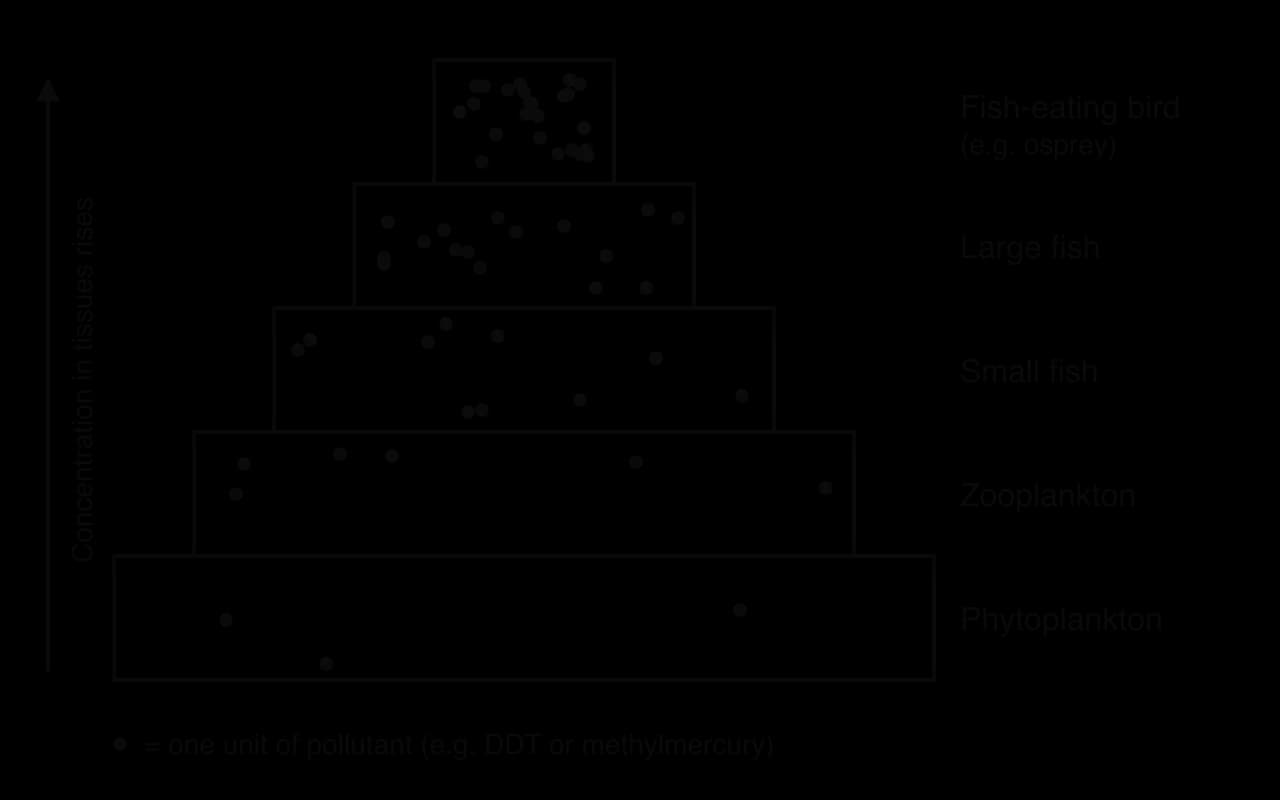
DDT (dichlorodiphenyltrichloroethane) is an insecticide that was used widely from the 1940s to kill mosquitoes that spread malaria and insect pests of crops. It is very persistent and fat-soluble. When it was sprayed on land and water, small amounts entered aquatic food chains, and the concentration rose at each trophic level. Fish-eating birds of prey, such as the osprey (Pandion haliaetus), peregrine falcon (Falco peregrinus) and bald eagle (Haliaeetus leucocephalus), accumulated concentrations hundreds of thousands of times higher than in the water.
In these birds a breakdown product of DDT interferes with the deposition of calcium carbonate in the eggshell. The thin-shelled eggs broke under the weight of the incubating parent, so breeding failed and populations crashed in North America and Europe in the 1950s and 1960s. Public awareness of the problem grew after the publication of Rachel Carson's book Silent Spring in 1962, and the USA banned most uses of DDT in 1972, followed by many other countries. Populations of all three birds have since recovered; the bald eagle was removed from the US list of endangered species in 2007.
Mercury is released into the environment by burning coal, by mining and by some industrial processes. Bacteria in water and sediment convert it into methylmercury, which is absorbed by organisms, binds to proteins and is excreted very slowly. It biomagnifies along aquatic food chains, so large predatory fish such as tuna, swordfish and shark contain the highest concentrations.
The most serious case of mercury poisoning occurred at Minamata, Japan. From the 1930s the Chisso chemical factory released wastewater containing mercury into Minamata Bay. Methylmercury became concentrated in fish and shellfish, which were the main food of local fishing families. A severe neurological illness, causing loss of coordination, numbness, damage to hearing and speech, and in severe cases death, was first identified in 1956 and named Minamata disease. Babies were born with brain damage because methylmercury crosses the placenta. The disaster led to the Minamata Convention on Mercury, an international treaty that came into force in 2017 to limit mercury use and release.
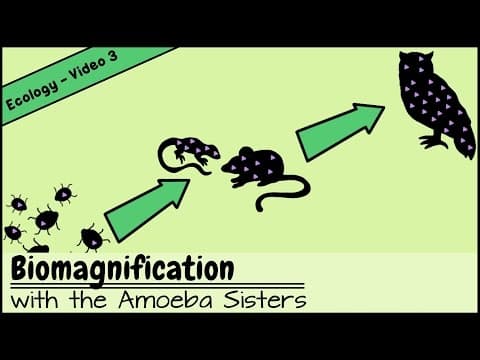 YouTube
Plastics are synthetic polymers, mostly made from oil and natural gas. They are cheap, light and durable, and several hundred million tonnes are produced each year. A large proportion is used only once, and much of it is not recycled. Plastic reaches the oceans from rivers, coastlines, ships and fishing fleets.
Most plastics are non-biodegradable: decomposers such as bacteria and fungi do not have enzymes that can break down their long hydrocarbon chains. Sunlight and wave action break plastic into smaller and smaller pieces, but the material does not decompose, so plastic persists in the environment for decades or centuries.
Plastic pollution is classified by size. Macroplastics are large pieces, such as bags, bottles, packaging and fishing nets. Microplastics are fragments smaller than 5 mm. Some microplastics are made at that size, such as microbeads once used in cosmetics, and fibres shed from synthetic clothing in washing machines; others form when macroplastics break up.
Type | Examples | Effects on marine life |
|---|---|---|
Macroplastic (larger than 5 mm) | Bags, bottles, packaging, lost or discarded fishing nets ("ghost nets") | Entanglement: seals, turtles, whales and seabirds are trapped in nets and rings, causing injury, drowning or starvation. Ingestion: sea turtles eat plastic bags that resemble jellyfish; albatrosses feed plastic fragments to their chicks. Plastic fills the gut, giving a false feeling of fullness, so animals starve. |
Microplastic (smaller than 5 mm) | Fragments, fibres from clothing, microbeads, pellets used to make plastic products | Ingestion by filter feeders and plankton: zooplankton, mussels, oysters and fish take in particles, which can reduce feeding and growth. Transfer of toxins: persistent pollutants stick to the surface of microplastics and enter food chains, where they may biomagnify. |
The Laysan albatross (Phoebastria immutabilis) on Midway Atoll in the North Pacific is a widely studied example. Adults forage over huge areas of ocean surface and pick up floating plastic along with squid and fish eggs, then regurgitate it into their chicks. Dead chicks are often found with stomachs full of bottle caps, lighters and fragments.
For many years scientists published research on plastic in the oceans with little public response. Public concern rose sharply when the effects on marine life were shown clearly in the media. The BBC series Blue Planet II, broadcast in 2017, included scenes of albatrosses feeding plastic to their chicks and of a pilot whale carrying her dead calf, possibly poisoned by pollutants. Its audience around the world was very large, and surveys afterwards showed that many viewers had changed their use of single-use plastic.
In the following years many governments introduced measures that scientists had recommended for some time: charges for single-use plastic bags, bans on microbeads in rinse-off cosmetics, and in England a ban on the supply of plastic straws, stirrers and cotton buds from 2020. This shows how scientists can influence the actions of citizens and governments when they communicate research clearly and accurately, and how the media carries scientific findings to a wide audience.
Many ecosystems have been degraded by farming, hunting, drainage or the introduction of invasive species. Rewilding aims to restore the natural processes of an ecosystem so that it can then sustain itself with little human management. Unlike traditional conservation, which often manages a site intensively to protect particular species, rewilding reduces management to a minimum and allows natural processes to operate.
Rewilding usually involves three approaches:
Reintroduction of apex predators and other keystone species that have been lost, so that their effects on the community return. The Eurasian beaver, for example, was reintroduced to Scotland in a trial at Knapdale from 2009 and became a legally protected species there in 2019; its dams create wetlands that hold water, trap sediment and support many other species.
Re-establishment of connectivity between habitats over large areas, using wildlife corridors, so that populations are not isolated, animals can move to find food and mates, and gene flow maintains genetic diversity.
Minimisation of human impact, by ending activities such as grazing, drainage or hunting, and by ecological management where it is still needed, for example removing invasive species or controlling introduced herbivores until natural processes take over.
Hinewai Reserve is on Banks Peninsula, near Christchurch, on the South Island of New Zealand. The peninsula was once covered by native forest, but most of it was cleared for sheep farming in the 19th century. Abandoned farmland was invaded by gorse (Ulex europaeus), a spiny shrub from Europe that is regarded in New Zealand as a serious invasive weed. Farmers usually cleared gorse with fire, herbicides or grazing.
In 1987 the Maurice White Native Forest Trust bought a 109 ha block of hill farm, and the botanist Hugh Wilson began managing it with a policy of minimal interference. Grazing animals were removed, fire was prevented and no herbicides were used. Gorse was left to grow, because it acts as a nurse crop: it shelters native seedlings from wind, frost and browsing animals, and its root nodules fix nitrogen, enriching the soil. Native trees such as kānuka (Kunzea species) and broadleaved species grew up through the gorse, shaded it out and replaced it. The reserve has since grown to about 1,600 ha, much of it regenerating native forest with a recovering bird population.
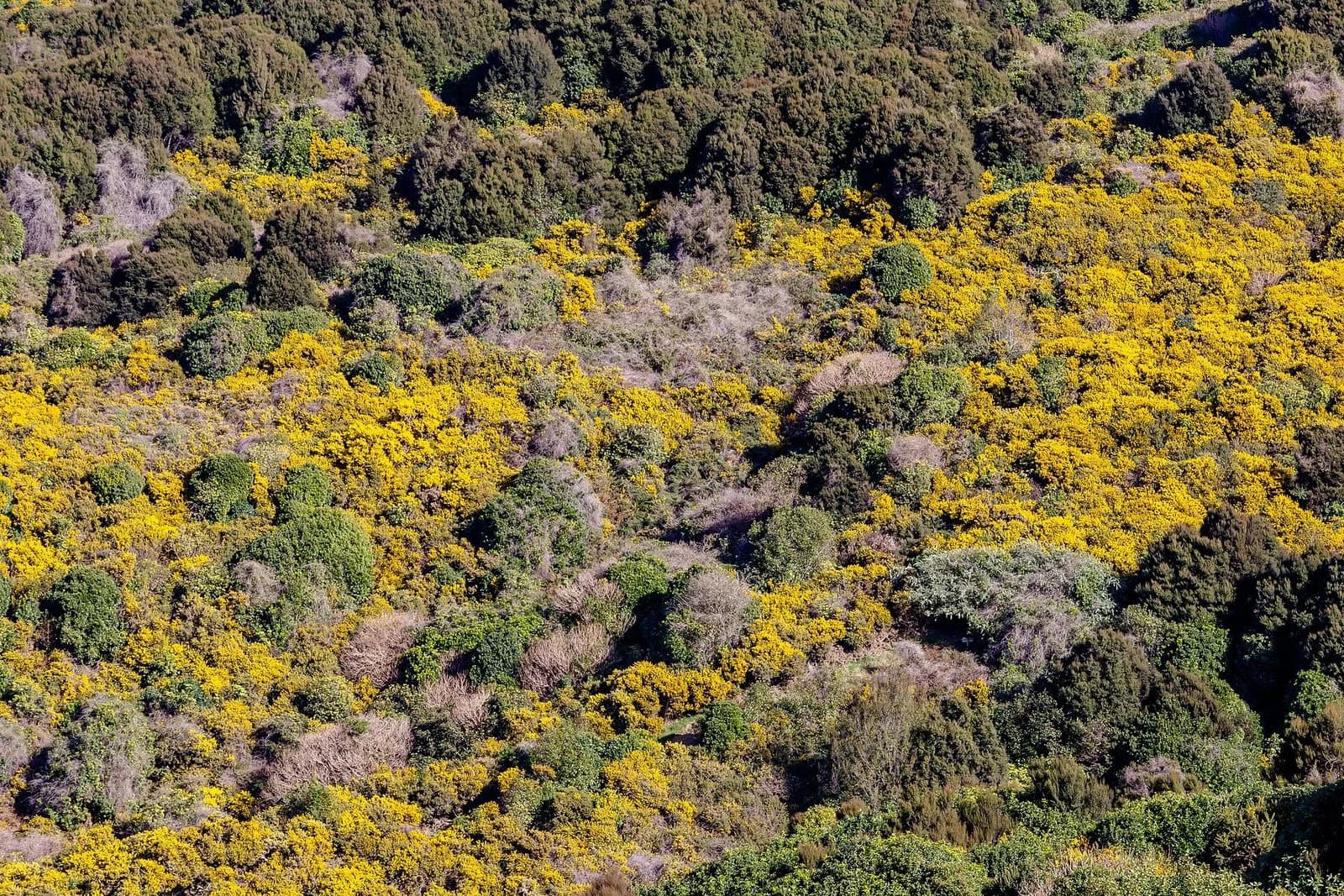
Hinewai is an example of rewilding by minimising human impact and letting natural processes, here the natural replacement of one plant community by another, restore the ecosystem. Many local farmers at first regarded leaving gorse to spread as a mistake. The regeneration of native forest over more than three decades shows how a hypothesis about ecological processes, tested over a long period, can change accepted practice.
Long-lasting ecosystems such as the Daintree Rainforest did not appear in their present form. Every community develops through a series of changes in which groups of species replace one another over time. This process is called ecological succession, and each stage in the series is called a seral stage.
Succession can be triggered by changes in the abiotic environment or by changes in biotic factors.
Abiotic triggers create new land or change conditions over a large area: a volcanic eruption forming a new island or lava field, a glacier retreating and exposing bare rock, wind building new sand dunes on a coast, a landslide, a flood that deposits silt, or a change in climate.
Biotic triggers come from organisms: the arrival of a new species, the death of a dominant tree from disease, the removal of grazing animals from a field, or the activity of the organisms themselves as they change the conditions around them.
The main driver of succession is the reciprocal interaction between organisms and their environment. The species present at each stage change the abiotic conditions where they live: they add organic matter to the soil, increase its depth and water-holding capacity, add nitrogen, provide shade and shelter, and reduce wind speed and temperature extremes at ground level. These changes often make the area more suitable for other species and less suitable for the species that caused them. A pioneer lichen, for example, makes soil in which mosses and grasses can grow, and the grasses then shade out the lichen. In this way the environment and the community change together.
There are two types of succession, primary succession and secondary succession, depending on the starting point.
Feature | Primary succession | Secondary succession |
|---|---|---|
Starting point | Bare ground with no soil and no previous community | Soil already present after an existing community was disturbed or removed |
Examples of triggers | New volcanic island, lava flow, rock exposed by a retreating glacier, new sand dune | Forest fire, abandoned farmland, a storm that flattens trees, felling of a forest |
First colonisers | Pioneer species such as lichens and mosses, or specialised plants of sand and shingle | Fast-growing annual plants and grasses, often from seeds already in the soil |
Speed | Slow: soil must form first, taking hundreds to thousands of years | Faster: seeds, roots and nutrients are already present; decades to a century or two |
Secondary succession is the more common type. When arable land in temperate Europe is abandoned, annual weeds appear in the first year, perennial grasses and herbs within a few years, then shrubs such as bramble and hawthorn, and eventually woodland of birch, oak or ash if nothing stops it.
Primary succession begins with organisms that can survive on bare rock or sand, where there is no soil, little water, few nutrients and extreme temperatures. These pioneer species are usually lichens and mosses on rock, or salt- and drought-tolerant plants on sand and shingle.
Lichens are a mutualistic partnership between a fungus and a photosynthetic alga or cyanobacterium. They attach to bare rock, release acids that slowly weather its surface into mineral particles, and trap windblown dust. When they die, their remains add organic matter. Mosses then grow in the thin layer of material that forms, holding water and trapping more particles. Over time a shallow soil forms, which grasses and small herbs can root in. Their roots break up the rock further, and their dead leaves add humus. Deeper, richer soil then supports shrubs, and later trees, until a forest develops. The diagram of the stages of primary succession shows this series and the steady deepening of the soil.
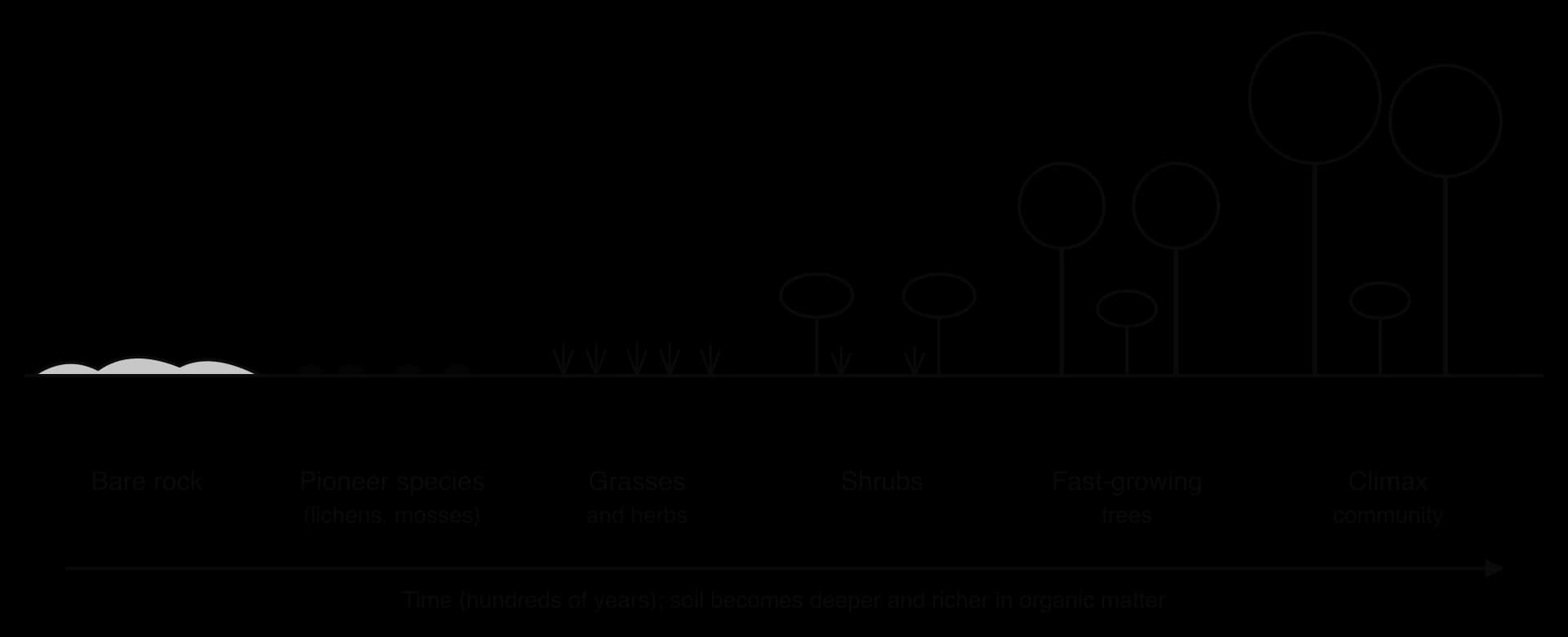
As succession proceeds, the community changes in predictable ways:
Feature | Change during primary succession | Reason |
|---|---|---|
Plant size | Increases, from lichens and mosses to grasses, shrubs and trees | Deeper soil holds more water and nutrients and supports larger root systems |
Primary production | Increases | More and larger plants with more leaf area capture more light energy; biomass builds up |
Species diversity | Increases, often peaking in the middle or late stages | More niches are created by layers of vegetation, shelter and more varied soil; at climax a few dominant species may outcompete others |
Complexity of food webs | Increases | More producers and habitats support more herbivores, predators, decomposers and parasites, with more links between them |
Nutrient cycling | Increases; more nutrients are held in the soil and biomass | Organic matter builds up, and decomposers in the deeper soil recycle nutrients faster; less is lost by leaching |
Soil | Becomes deeper, richer in humus and better at holding water | Weathering of rock and addition of dead organic matter over time |
Surtsey is a volcanic island that rose from the sea off the south coast of Iceland in eruptions between 1963 and 1967. It was protected from the start, and only scientists are allowed to land, so it has been studied as a natural experiment in primary succession. The first vascular plant, sea rocket (Cakile arctica), was found in 1965, carried by the sea, but it did not survive the winter. Shore plants such as sea sandwort (Honckenya peploides) became established from the late 1960s, while mosses and lichens colonised the lava.
For years succession was slow, because the lava and ash contained almost no nitrogen. After gulls began to breed on the island in large numbers in the mid-1980s, their droppings, food remains and nest material added nutrients brought from the sea. A lush grassland developed around the gull colony, and seeds carried by birds brought many new species. Most of the rest of the island remained barren. By 2008, 69 species of vascular plant had colonised the island, although only about half of them had formed lasting populations; by 2015 the total had reached 74. Surtsey shows how pioneer species and soil formation set the pace of primary succession, and how one biotic change, the arrival of breeding seabirds, accelerated it.
Succession does not always progress in one direction to a single, permanent climax. In some ecosystems the community passes through a series of stages and then returns to the first, in a repeating cycle. This is called cyclical succession.
The best-known example is heather (Calluna vulgaris) on the moorlands of Scotland and northern England, described by the ecologist A. S. Watt in 1947. Each heather bush passes through four phases over a few decades. In the pioneer phase, seedlings establish in a bare gap. In the building phase, the plants grow vigorously and form a dense canopy that shades out most other species. In the mature phase the canopy becomes less dense and opens in the middle, and mosses and lichens grow in the light that reaches the ground. In the degenerate phase the old central stems die and collapse, leaving a bare gap, which is colonised by heather seedlings again.
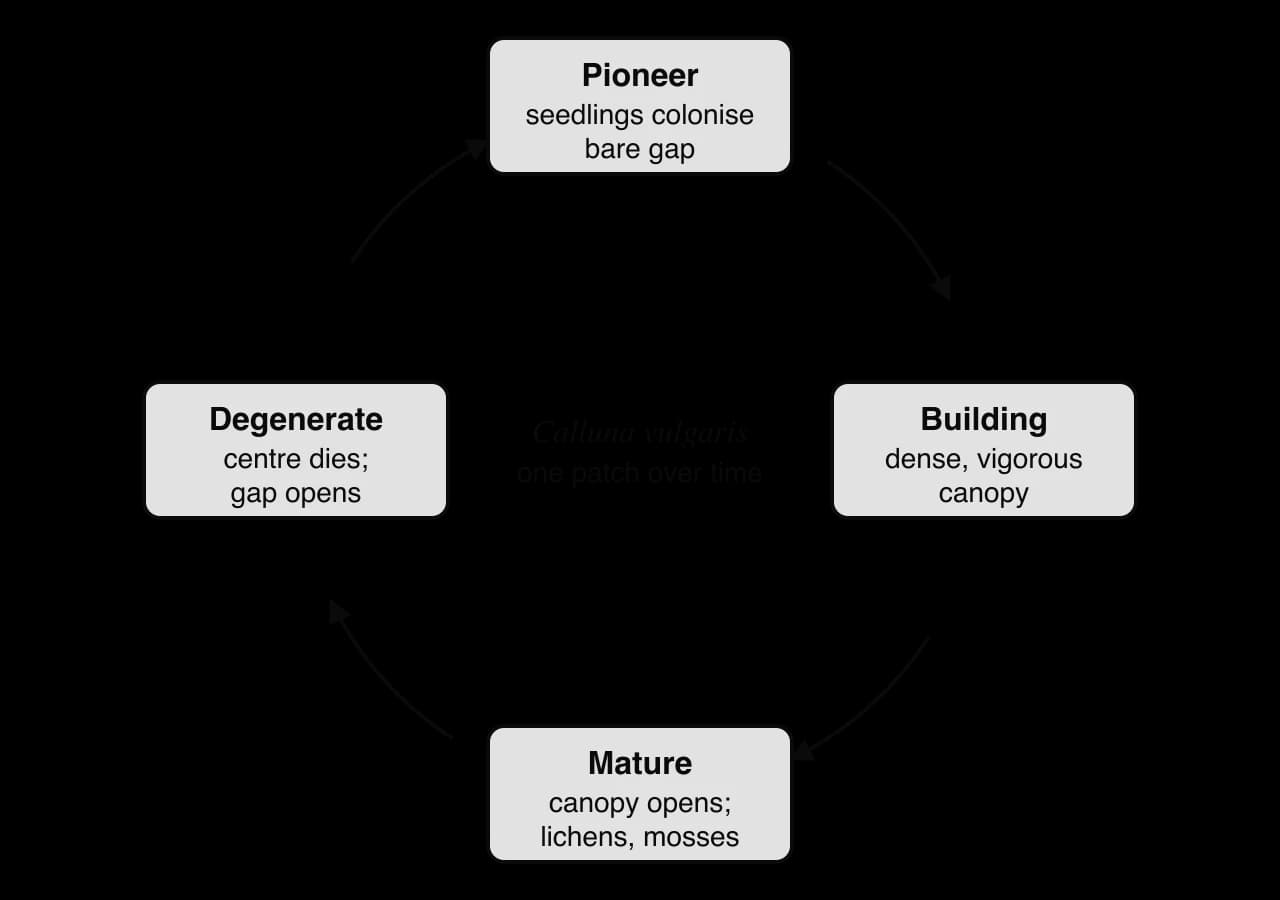
Because patches across a moor are at different phases, the moorland as a whole looks the same from decade to decade, even though every patch is changing. Many heather moors are also managed by burning small patches in rotation (called muirburn in Scotland), which resets the cycle to the pioneer phase and keeps young, nutritious heather for red grouse and sheep.
Some other ecosystems are maintained by fire in a similar way. In fire-maintained ecosystems, such as the longleaf pine savannas of the south-eastern USA and many Australian eucalyptus woodlands, regular fires kill shrubs and young trees of fire-sensitive species, release nutrients from dead vegetation and stimulate the germination of seeds of fire-adapted species. In the absence of fire, succession would turn these communities into denser forest of different species, so regular burning returns them repeatedly to an earlier stage.
If succession is allowed to continue, it eventually produces a community that changes little over time. This is the climax community. Its species are in balance with the climate and soil, and it can persist for centuries or longer until a major disturbance resets it.
Specific environmental conditions tend to produce a particular type of climax community. Climate is the main factor, especially temperature and rainfall. In lowland western Europe the climax is usually temperate deciduous forest of oak, beech and ash; in the far north, coniferous boreal forest; in hot, wet regions, tropical rainforest; in dry continental interiors, grassland, because there is too little water for trees. Local conditions such as waterlogged soil, thin soil over limestone or exposure to strong salt-laden winds produce different climax communities within the same climate.
Human activities often stop succession before it reaches the climax. The community is then held at an earlier seral stage for as long as the human influence continues. This is arrested succession, and the community it produces is called a plagioclimax.
Most of the open grassland and heather moorland in the uplands of Britain would become woodland if left alone. Sheep, and in some areas red deer, eat the seedlings of trees and shrubs, so woody plants cannot establish, while grasses survive because they grow from the base of the leaf and recover after grazing. The chalk grasslands of southern England, which are rich in wildflowers, are another plagioclimax maintained by sheep and rabbits. When grazing stops, as happened in some places after rabbit numbers crashed from the disease myxomatosis in the 1950s, scrub of hawthorn and other shrubs spreads quickly and succession resumes.
Wetlands undergo their own succession. Open water gradually fills with sediment and dead plant material; reeds and sedges colonise; peat builds up; and eventually wet woodland (carr) of alder and willow forms. Draining a wetland for agriculture stops this process. The Fens of eastern England, once a huge area of reed beds and peat, were drained from the 17th century onwards and turned into arable farmland. The water table is kept low by drainage ditches and pumps, and ploughing and crops keep the land at a very early, simplified stage. Once drained, peat dries out and is oxidised, releasing carbon dioxide and lowering the land surface. Restoring a natural wetland requires the drainage to be reversed.
Questions on stability and change appear in Paper 1A as multiple-choice items on definitions (keystone species, BOD, biomagnification, tipping point), in Paper 1B as data on mesocosms, dissolved oxygen and BOD or forest area, and in Paper 2 as short-answer data questions and extended responses such as "Explain how the use of fertilisers can lead to the death of fish in a lake" or "Discuss the sustainability of agriculture". The command terms most often used are explain, outline, calculate, suggest, evaluate and discuss.
Calculations are usually percentage change (forest area, population size, phosphorus load) or ratios of concentrations along a food chain. Show the formula, the substituted values and the answer with its sign or unit.
The practice question uses data from a river survey. A student measured the biochemical oxygen demand (BOD) and dissolved oxygen in a river at five sites, starting where a drain from a dairy farm entered the river.
Distance downstream / km | 0 | 1 | 2 | 4 | 8 |
|---|---|---|---|---|---|
BOD / mg dm⁻³ | 18 | 14 | 9 | 5 | 2 |
Dissolved oxygen / mg dm⁻³ | 7.8 | 3.1 | 4.0 | 6.2 | 8.9 |
Several of these human impacts are also causes of climate change. Deforestation of the Amazon, the carbon footprint of agriculture and the drainage of peat-forming wetlands all release carbon dioxide.
I can define ecosystem stability and give evidence of long-persisting ecosystems.
I can explain the four requirements for stability in ecosystems.
I can explain how deforestation could make the Amazon pass a tipping point, and calculate percentage change in forest area.
I can describe a sealed mesocosm and outline how to use one to investigate a variable.
I can explain what a keystone species is, using Paine's Pisaster experiment.
I can explain maximum sustainable yield and how sustainability of harvesting is assessed for a plant and a fish.
I can discuss the factors that affect the sustainability of agriculture.
I can explain eutrophication and the rise in BOD, and interpret dissolved oxygen and BOD data.
I can distinguish bioaccumulation from biomagnification and explain the cases of DDT and mercury.
I can describe the effects of macroplastics and microplastics and outline rewilding at Hinewai Reserve.
I can explain the causes of succession and the changes during primary succession. (HL)
I can describe cyclical succession and explain arrested succession by grazing and drainage. (HL)
[4 max]
Explain why a combination of different approaches is needed to conserve biodiversity.
7 marks
a. no single approach can conserve all species / habitats;
b. in situ conservation protects species in their natural habitat;
c. it conserves interactions between species / ecosystem processes / natural selection continues;
d. nature reserves need active management, such as removing invasive species / preventing poaching / controlling succession;
e. reserves may be too small / fragmented, so corridors linking them are needed;
f. rewilding restores natural processes, for example by reintroducing apex predators / keystone species, with less human management;
g. reclamation of degraded ecosystems increases the area of habitat available;
h. ex situ conservation in zoos / botanic gardens protects species whose wild populations are very small / whose habitat has been lost;
i. captive breeding produces individuals for reintroduction into the wild;
j. seed banks store the genetic diversity of many plant species in a small space for a long time;
k. tissue banks / frozen gametes / embryos store germ plasm of animals or of plants whose seeds cannot be dried;
l. ex situ populations lose genetic diversity / natural behaviours, so they cannot replace in situ conservation;
m. in situ conservation alone is at risk from disease / fire / climate change, so ex situ collections act as insurance;
[7 max]
One additional mark is available for the construction of the answer.
Which observation provides the strongest evidence that an ecosystem has been stable over a long period of time?
Which are requirements for the stability of an ecosystem?
I. A continuous supply of energy
II. Recycling of nutrients
III. Climatic variables that stay exactly the same from year to year