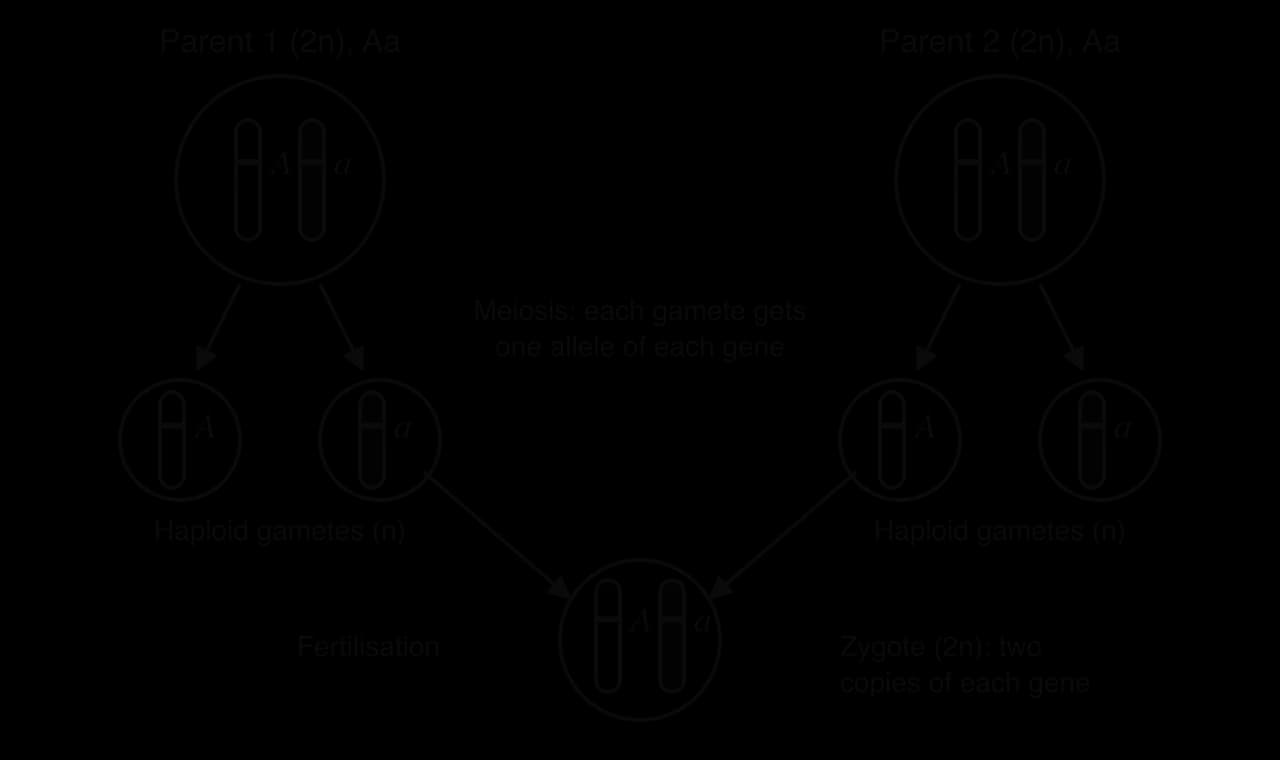
Predict and explain patterns of inheritance, from Punnett grids and pedigrees to multiple alleles, sex linkage, polygenic traits and, at HL, dihybrid crosses, linkage and chi-squared.
Each is in the Biology glossary, with every other term in the subject.
A graph showing the distribution of a continuous variable by its minimum, lower quartile, median, upper quartile and maximum, with outliers plotted separately.
An individual who is heterozygous for a recessive allele that causes a disease, and so can pass the allele on without showing the disease.
A pattern of inheritance in which both alleles are expressed in a heterozygote, giving a dual phenotype, for example both A and B antigens in blood group AB.
A genetic cross that follows the inheritance of two different genes at the same time.
An allele that has the same effect on the phenotype whether it is present in the homozygous or the heterozygous state.
The first generation of offspring produced by crossing two parents (the P generation).
The second generation of offspring, produced by crossing F1 individuals with each other or by self-pollination of the F1.
The tendency of alleles of genes on the same chromosome to be inherited together, so that they do not assort independently.
Inheritance is the passing of genetic information from parents to offspring. Its patterns explain why children resemble their parents but are never identical to them, why some diseases run in families, and how breeders produce new varieties of crops.
The rules of inheritance were first worked out from crosses of pea plants, long before DNA was discovered. They follow directly from the behaviour of chromosomes in meiosis and fertilisation, and they apply to every organism with a sexual life cycle.
37 exam-style questions on this subtopic, written in the style of the IB papers. The first has its markscheme open. Counted on
Body cells of the garden pea (Pisum sativum) contain 14 chromosomes. Which row shows the number of chromosomes in a male gamete from a pollen grain and in the zygote formed when it fertilizes an egg?
Row | Male gamete | Zygote |
|---|---|---|
A | 14 | 28 |
B | 7 | 7 |
C | 7 | 14 |
D | 14 | 14 |
Gametes are haploid, so a pea gamete has one chromosome of each pair (7); fusion of two haploid gametes restores the diploid number (14) in the zygote. A assumes gametes are diploid, which would double the chromosome number every generation. B forgets that the egg also contributes 7 chromosomes, and D gives the gamete the diploid number.
One of 1 short multiple-choice questions on D3.2. Pick an answer to see why it's right or wrong.
Two heterozygous parents () have offspring. What fraction is expected to be ?
The official deck for this part of the syllabus.
Define inheritance.
Explain why the same rules of inheritance apply to every organism with a sexual life cycle.
With a free account, Augment remembers where you stopped and what you have practiced.
All the alleles of all the genes in an interbreeding population.
A mating between two chosen parents, used to study the inheritance of characteristics or to produce offspring with a desired combination of alleles.
The combination of alleles of a gene (or genes) that an organism has inherited.
A sex-linked genetic disease in which blood clots slowly or not at all, caused by a recessive allele of an X-linked gene for a clotting factor (factor VIII or IX).
Having two different alleles of a gene, for example Rr.
Having two identical alleles of a gene, for example RR or rr.
A pattern of inheritance in which a heterozygote has a phenotype intermediate between those of the two homozygotes, for example pink flowers from red and white parents.
The random and independent distribution of the alleles of different genes into gametes, caused by the random orientation of pairs of homologous chromosomes in meiosis I.
The difference between the upper quartile and the lower quartile, which measures the spread of the middle 50% of the data.
The particular position of a gene on a chromosome.
The middle value of a set of data arranged in order; for an even number of values, the mean of the two middle values.
The most frequent value, or class, in a set of data.
A genetic cross that follows the inheritance of a single gene.
The existence of more than two alleles of a gene in the gene pool of a population; each individual still has only two of them.
A value that lies unusually far from the rest of the data; in a box-and-whisker plot, more than 1.5 × IQR above the upper quartile or below the lower quartile.
The parental generation in a series of genetic crosses: the two individuals (often pure-breeding) crossed first.
A diagram that shows the occurrence of a characteristic in the members of a family over several generations, used to deduce its pattern of inheritance.
The observable characteristics of an organism, resulting from its genotype and the effects of the environment.
The capacity of an organism to develop traits suited to its environment by changing patterns of gene expression, without any change in its genotype.
An inherited disease caused by a recessive allele of the gene for phenylalanine hydroxylase, so phenylalanine cannot be converted to tyrosine and builds up in the blood.
The inheritance of a characteristic that is controlled by two or more genes, each with a small additive effect, which gives continuous variation.
A table that shows all the possible combinations of gametes from two parents, used to predict the genotypes and phenotypes of their offspring and their expected ratios.
An allele that affects the phenotype only in the homozygous state, when no dominant allele is present.
A gamete or offspring with a new combination of alleles, not present in either of the combinations inherited by its parent, produced by independent assortment or by crossing over.
The separation of the two alleles of a gene into different gametes, caused by the separation of homologous chromosomes in meiosis I.
The pattern of inheritance of a gene carried on a sex chromosome (usually the X chromosome), which differs between males and females.
A cross between an individual of unknown genotype (or a heterozygote) and a homozygous recessive individual, so that the offspring phenotypes show the alleles in the gametes of the first individual.
Offspring resemble their parents because they inherit genes from them. A gene is a length of DNA that codes for a polypeptide or another product and occupies a specific position on a chromosome. Many genes exist in two or more forms, called alleles, which differ from each other by one or a few bases. A gene for seed shape in pea plants, for example, has one allele that gives round seeds and another that gives wrinkled seeds.
Inheritance in every eukaryote with a sexual life cycle follows the same pattern. Each parent produces haploid gametes by meiosis, and each gamete carries one chromosome of every type, so it carries one copy of each gene. At fertilisation two gametes fuse to form a diploid zygote, which therefore has two copies of each chromosome and two copies of each gene, one from each parent.
The two copies of a gene in a diploid cell sit at the same position on a pair of homologous chromosomes. For genes on autosomes (all chromosomes except the sex chromosomes), every diploid cell has two copies. The two copies may be the same allele or different alleles. Because meiosis separates the two copies, each gamete receives only one, chosen at random. This separation of the two copies in meiosis, followed by their reunion at fertilisation, is the basis of every pattern of inheritance in sexually reproducing organisms.
A genetic cross is a deliberate mating between two chosen parents to find out how a characteristic is inherited, or to combine characteristics in the offspring. Flowering plants are well suited to crosses: they produce many offspring, some (such as peas) grow quickly, and the breeder can control which pollen reaches which stigma.
Pollination is needed to cross two plants, because pollen contains the male gametes and the female gametes are in the ovules inside the ovary. Many plants, including the garden pea (Pisum sativum), can self-pollinate: pea flowers stay closed while their own pollen reaches the stigma. To cross two chosen plants, a breeder therefore prevents self-pollination and transfers pollen by hand.

Crosses are described by generation. The P generation (parental generation) is the pair of plants crossed first, usually two pure-breeding plants that differ in one characteristic. Their offspring are the F1 generation (first filial generation). When F1 plants are crossed with each other, or allowed to self-pollinate, their offspring are the F2 generation.
Gregor Mendel used crosses of garden peas in the 1850s and 1860s to work out the rules of inheritance. When he crossed pure-breeding round-seeded plants with pure-breeding wrinkled-seeded plants, all the F1 seeds were round. When the F1 plants self-pollinated, both types reappeared in the F2 generation: 5,474 round seeds and 1,850 wrinkled seeds, a ratio of 2.96 : 1, very close to 3 : 1. The wrinkled characteristic had been present but hidden in the F1 plants.
A monohybrid cross follows the inheritance of a single gene. Its outcome is predicted with a Punnett grid, a table in which the possible gametes of one parent head the columns and those of the other head the rows, and each cell shows the genotype formed when those two gametes fuse. Each gamete type of a heterozygous parent is equally likely, so every cell of the grid is equally likely.
Genetic crosses are not only for research. Plant breeders use them to produce new varieties of crops and ornamental plants that combine useful characteristics, such as high yield from one parent and disease resistance from another. The breeder crosses the two parents, then selects F2 or later plants with the desired combination and breeds from them until the variety breeds true.
The genotype of an organism is the combination of alleles it has inherited. For a single gene with two alleles, R and r, three genotypes are possible: RR, Rr and rr. An organism with two identical alleles of a gene is homozygous for that gene (RR is homozygous dominant and rr is homozygous recessive). An organism with two different alleles is heterozygous (Rr).
Organisms that are homozygous for a gene are said to be pure-breeding for it: when two homozygous plants of the same genotype are crossed, or one self-pollinates, all the offspring have the same genotype as the parents.
The difference between a gene and an allele causes many errors. A gene is the heritable factor that controls a characteristic, such as seed shape, and is found at one position on a chromosome. Alleles are the alternative forms of that gene, such as round and wrinkled. Every pea plant has the seed-shape gene, but different plants have different alleles of it.
The phenotype of an organism is its observable traits: its structure, physiology and behaviour. Phenotype results from the genotype together with the effects of the environment. Some human traits are determined almost entirely by genotype, some by the environment, and many by both.
Cause of the trait | Human examples |
|---|---|
Genotype only | ABO blood group; the ability to taste the bitter chemical PTC; genetic diseases such as cystic fibrosis |
Environment only | A scar from an injury; a language spoken; a tattoo |
Both genotype and environment | Height (alleles and nutrition); skin colour (alleles and exposure to sunlight); body mass (alleles, diet and exercise) |
In a heterozygote, the two alleles often do not have equal effects on the phenotype. A dominant allele has the same effect on the phenotype whether it is present with a copy of itself or with a different allele. A recessive allele affects the phenotype only when no dominant allele is present, which means only in the homozygous recessive genotype. Dominant alleles are shown by a capital letter and recessive alleles by the lower-case form of the same letter.
The reason lies in what the alleles code for. Most dominant alleles code for a functional protein, often an enzyme, and the matching recessive allele codes for a protein that does not work or is not made at all. In a heterozygote, the one functional allele usually produces enough of the protein for the normal phenotype, so the heterozygote looks the same as the homozygous dominant organism. Wrinkled pea seeds are a clear case. The recessive allele r contains an inserted section of DNA that disrupts the gene for a starch-branching enzyme. Without the enzyme, rr seeds store less starch and more sugar, absorb more water as they develop and wrinkle as they dry. Seeds with one R allele make enough enzyme to be round.
The same genotype can produce different phenotypes in different environments. Phenotypic plasticity is the capacity of an organism to develop traits suited to the environment it experiences, by varying the pattern of gene expression: which genes are switched on, and how strongly. It does not involve any change in genotype, and the changes in traits may be reversible during the lifetime of the individual.
Bigleaf hydrangea (Hydrangea macrophylla) has blue flowers in acidic soils, where aluminium ions are available to the roots and bind to the flower pigments, and pink flowers of the same plant in alkaline soils.
Water fleas (Daphnia) grow a protective helmet and tail spine when chemicals released by predators are present in the water, and not when they are absent.
Human skin darkens after exposure to sunlight, as melanocytes increase production of melanin, and fades again in winter.
Muscles of a person who exercises regularly grow larger, and they shrink again if the exercise stops.
Plasticity is an advantage in an environment that varies, because one genotype can respond to whichever conditions an individual meets. It also shows why phenotype cannot be predicted from genotype alone.
Phenylketonuria (PKU) is a human genetic disease caused by a recessive allele of an autosomal gene, PAH, on chromosome 12. The gene codes for the enzyme phenylalanine hydroxylase, which converts the amino acid phenylalanine to another amino acid, tyrosine, in the liver. Mutations in the gene give an enzyme that does not work, or works very poorly.
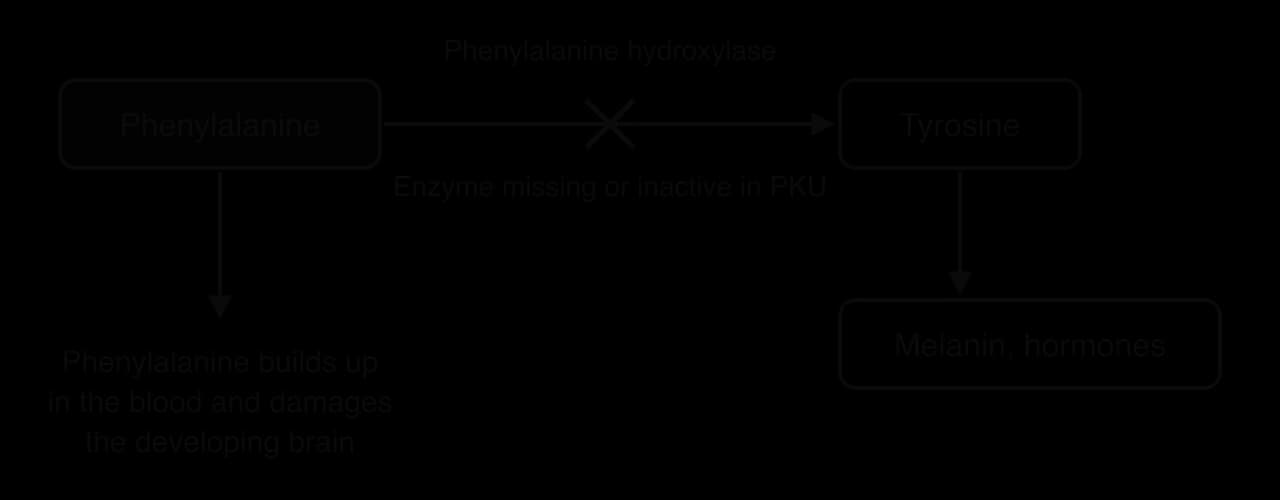
A person with PKU has two copies of the recessive allele (genotype pp). Without treatment, phenylalanine from protein in the diet builds up in the blood and damages the developing brain, leading to severe intellectual disability. Heterozygous people (Pp) have one functional allele, which makes enough enzyme, so they are unaffected. They are carriers: they can pass the recessive allele to their children without showing the disease. When two carriers have children, each child has a 1 in 4 chance of inheriting PKU.
PKU is now detected in newborn babies by a heel-prick blood test, first developed by Robert Guthrie in the early 1960s. In Europe about 1 in 10,000 babies is born with PKU. Affected babies are given a diet very low in phenylalanine from birth (no meat, fish, eggs or dairy, with a special protein supplement), and they then develop normally. PKU is a clear example of the environment changing the phenotype produced by a genotype: the genotype stays the same, but the diet prevents the disease.
New alleles arise by mutation. Most alleles of a gene differ from each other at only one or a few bases. A position in the genome where the base varies between individuals is called a single-nucleotide polymorphism (SNP). A gene usually contains several SNPs, and each combination of bases at those positions is a different allele.
All the alleles of all the genes in an interbreeding population make up its gene pool.
Any number of alleles of a gene can exist in the gene pool. The PAH gene alone has hundreds of known disease-causing alleles. Each individual, however, can inherit only two alleles of each autosomal gene, one from each parent, because a diploid cell has only two copies of each chromosome. When a gene has more than two alleles in the gene pool, it has multiple alleles. The S-gene that controls self-incompatibility in apples and other plants is an example, with many different alleles in a population.
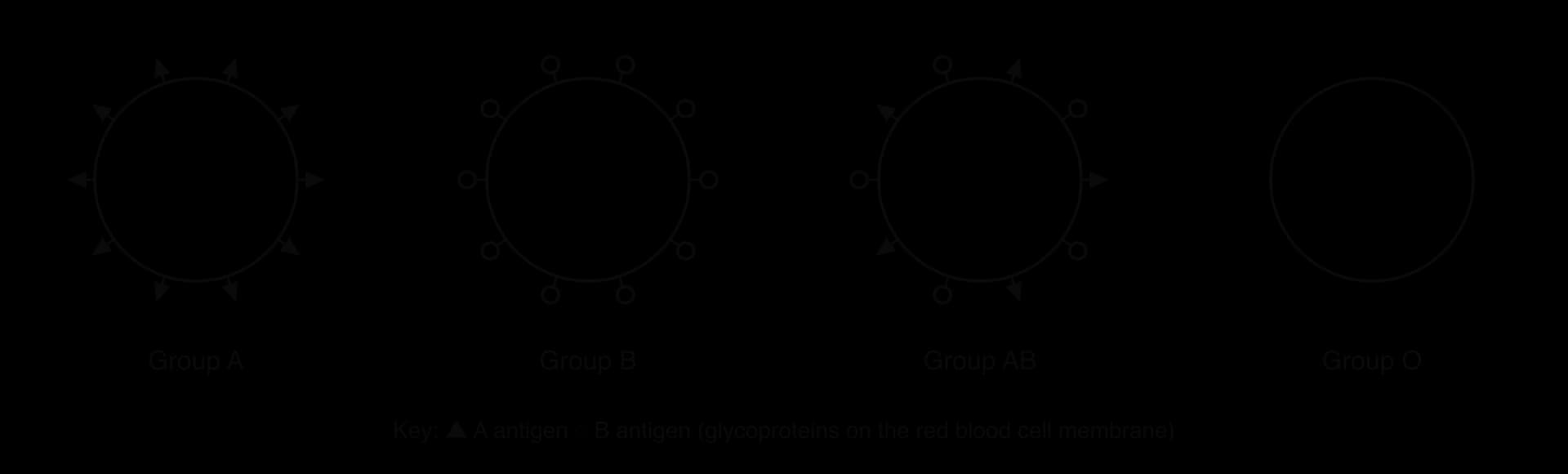
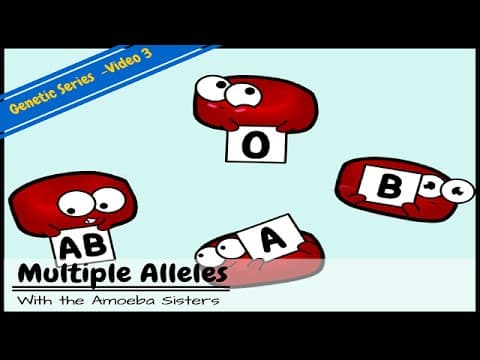
Human ABO blood groups are controlled by a single gene with three alleles. The gene codes for an enzyme that adds a sugar to a glycoprotein on the surface of red blood cells, and the alleles differ in which sugar is added. The added sugars make the glycoprotein act as an antigen, which the immune system can recognise.
Allele | Effect |
|---|---|
Iᴬ | Codes for an enzyme that adds a sugar forming the A antigen |
Iᴮ | Codes for an enzyme that adds a different sugar, forming the B antigen |
i | Codes for an inactive enzyme, so no sugar is added and there is neither an A nor a B antigen |
Iᴬ and Iᴮ are both dominant to i. When Iᴬ and Iᴮ are present together, both are expressed and the red blood cells carry both antigens: the alleles are codominant. Six genotypes and four phenotypes are therefore possible.
Genotype | Antigens on red blood cells | Blood group (phenotype) |
|---|---|---|
IᴬIᴬ or Iᴬi | A | A |
IᴮIᴮ or Iᴮi | B | B |
IᴬIᴮ | A and B | AB |
ii | Neither | O |
 YouTube
Not every pair of alleles shows simple dominance. In some heterozygotes both alleles affect the phenotype, in one of two ways.
In codominance, both alleles are fully expressed in the heterozygote, which therefore has a dual phenotype showing both characteristics. Blood group AB is the standard example: an IᴬIᴮ person has both A and B antigens on the red blood cells, not an intermediate antigen.
In incomplete dominance, the heterozygote has a phenotype intermediate between those of the two homozygotes. In the four o'clock flower (Mirabilis jalapa), a plant homozygous for the allele for red flowers crossed with one homozygous for the allele for white flowers gives F1 plants that all have pink flowers. A heterozygote has only one allele that makes red pigment, which produces too little pigment to colour the petals fully red, so the flower is pink. Because neither allele is dominant, the alleles are shown with superscripts on one letter, here Cᴿ (red) and Cᵂ (white).
Humans have 23 pairs of chromosomes: 22 pairs of autosomes and one pair of sex chromosomes. The sex chromosomes are X and Y. Most female-typical bodies have two X chromosomes (XX) and most male-typical bodies have one X and one Y (XY). The X chromosome is large and carries about 800 protein-coding genes, most of them with nothing to do with sex. The Y chromosome is much smaller and carries fewer than 100 genes.
All eggs carry an X chromosome. Meiosis in a male produces equal numbers of sperm carrying an X and sperm carrying a Y. The sex chromosome in the sperm therefore determines whether the zygote develops male-typical or female-typical traits. A key gene on the Y chromosome, SRY (sex-determining region Y), codes for a protein that switches on the development of testes in the embryo at about 6–7 weeks. The testes then secrete testosterone, which causes the development of the other male-typical features. Without SRY, ovaries develop instead.
Gametes | X (sperm) | Y (sperm) |
|---|---|---|
X (egg) | XX (female) | XY (male) |
X (egg) | XX (female) | XY (male) |
The Punnett grid shows why roughly equal numbers of boys and girls are born: each child has a 1 in 2 chance of receiving the father's Y chromosome.
Genes carried on the X chromosome show sex linkage: their pattern of inheritance differs between males and females. A female has two X chromosomes and so two copies of each X-linked gene; she can be homozygous or heterozygous. A male has only one X chromosome, and the much smaller Y carries no copy of most X-linked genes. A male therefore has only one copy of each X-linked gene, and whichever allele he has is expressed, even if it is recessive. A male inherits his X chromosome from his mother and passes it only to his daughters.
Haemophilia is a disease in which the blood does not clot properly, so injuries and internal bleeding (for example into joints) can be dangerous. It is caused by a recessive allele of a gene on the X chromosome that codes for a blood-clotting protein: factor VIII in haemophilia A (gene F8) and factor IX in the rarer haemophilia B (gene F9). Haemophilia A is the more common type, affecting roughly 1 in 4,000 to 1 in 5,000 boys at birth.
Alleles of X-linked genes are written as superscript letters on an upper-case X: Xᴴ for the normal allele and Xʰ for the haemophilia allele. The Y chromosome is written without a superscript, because it has no copy of the gene. The possible genotypes are:
Genotype | Phenotype |
|---|---|
XᴴXᴴ | Unaffected female |
XᴴXʰ | Carrier female: normal clotting, but can pass the allele to her children |
XʰXʰ | Affected female (very rare: needs an affected father and a carrier mother) |
XᴴY | Unaffected male |
XʰY | Affected male |
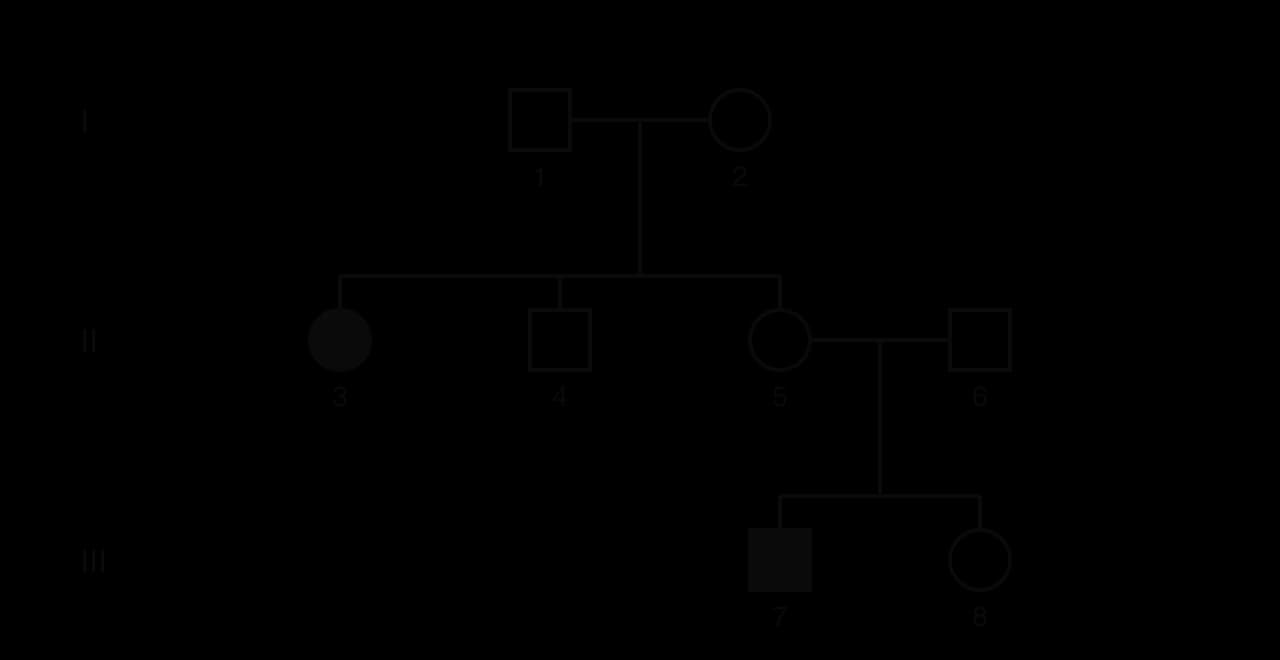
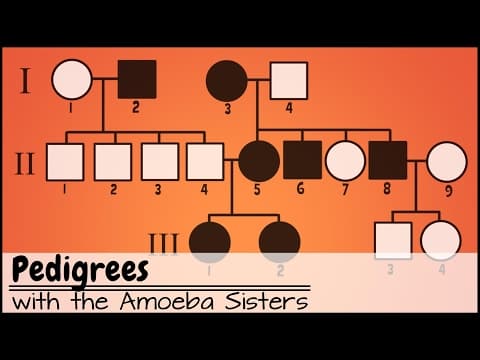
A pedigree chart shows the inheritance of a characteristic through several generations of a family. Pedigrees allow geneticists to deduce the pattern of inheritance of a human disease, because crosses cannot be carried out in humans and families are small.
Squares are males and circles are females.
Shaded symbols are affected individuals; unshaded symbols are unaffected. Carriers, if known, are shown with a dot or half-shading.
A horizontal line between a male and a female is a mating; a vertical line leads down to their children, who are joined by a horizontal line in birth order from left to right.
Generations are numbered with Roman numerals (I, II, III) and individuals in each generation with Arabic numerals.
A few key observations allow the pattern to be deduced:
Recessive: two unaffected parents have an affected child. The parents must both be carriers.
Dominant: an affected child always has at least one affected parent, and two affected parents can have an unaffected child.
X-linked recessive: many more males than females are affected; affected males usually have unaffected (carrier) mothers; the condition is never passed from father to son, because a father gives his son a Y chromosome, not an X.
Autosomal: males and females are affected about equally, and there is father-to-son transmission, or an affected daughter has an unaffected father (which rules out X-linked recessive inheritance).
 YouTube
Reading a pedigree uses two kinds of reasoning. Inductive reasoning draws a general conclusion from some, but not all, possible observations: from one part of a pedigree, such as two unaffected parents with an affected child, a geneticist infers that the condition is recessive. Deductive reasoning then works from that general rule to specific conclusions: if the condition is recessive, every affected person must be homozygous recessive, so both of their parents must carry the allele. An inductive conclusion can be overturned by new observations, while a deduction is only as reliable as the rule it starts from.
Haemophilia in the European royal families is the best-known pedigree of a sex-linked disease. Queen Victoria of the United Kingdom (1819–1901) was a carrier of a haemophilia allele, probably the result of a new mutation, since no earlier members of her family are known to have been affected. One of her four sons, Leopold, had haemophilia. At least two of her five daughters, Alice and Beatrice, were carriers. Through marriages between royal families, they passed the allele into the royal families of Germany, Spain and Russia.
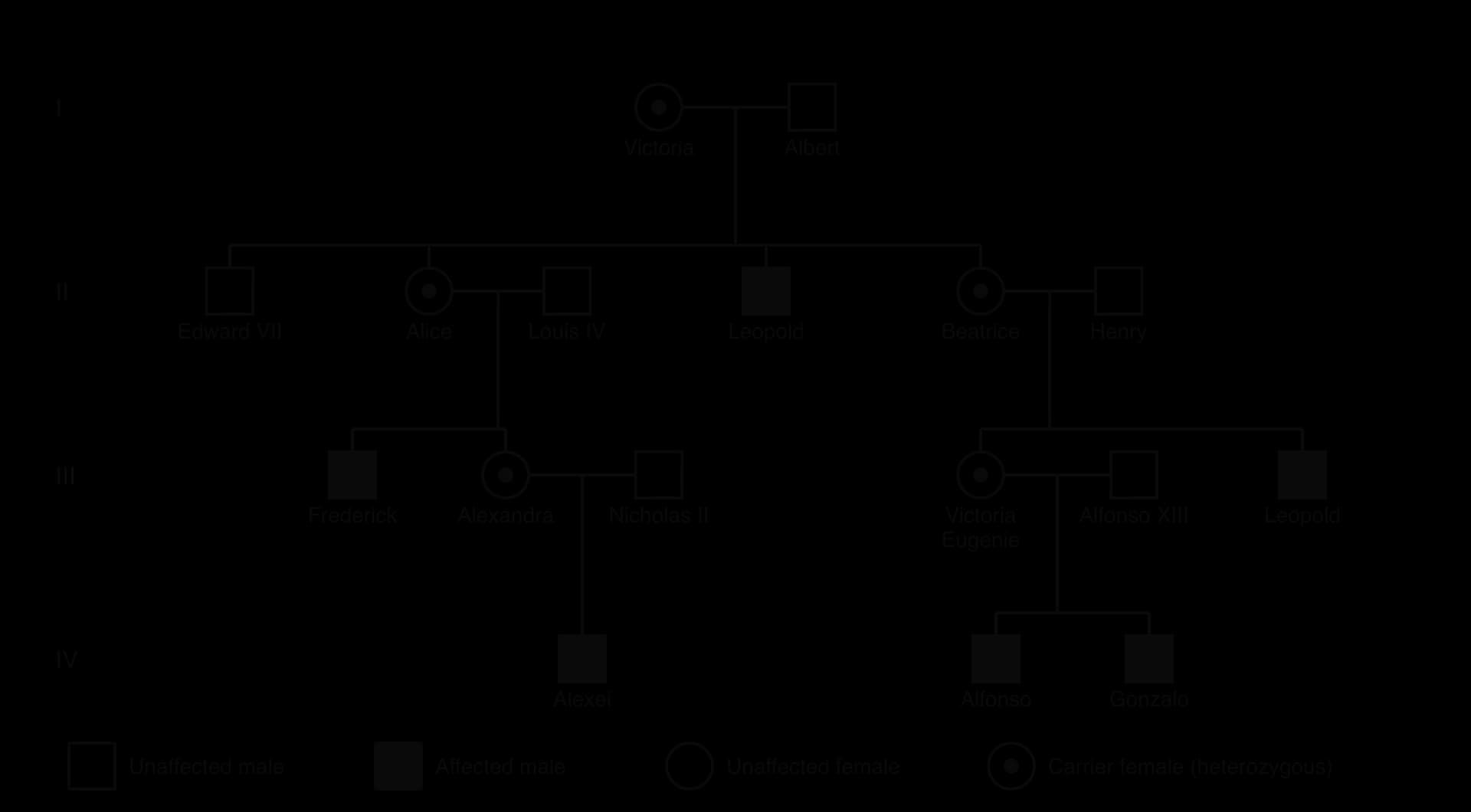
The pedigree of Victoria's descendants shows every feature of X-linked recessive inheritance. All the affected individuals are males. Each received the allele from a mother who was unaffected but a carrier. The allele passes down female lines: Alice gave it to her daughter Alexandra, who married Tsar Nicholas II of Russia, and their only son, Tsesarevich Alexei, had haemophilia. Victoria's son Edward VII did not inherit the allele, so the British royal family descended from him has no haemophilia.
For most of the 20th century it was not known which type of haemophilia the royal family carried. In 2009 a team analysed DNA from the remains of the Russian royal family, killed in 1918, and found the answer. Alexei carried a mutant allele of the F9 gene, so the disease was haemophilia B. The mutation is a single base substitution (A→G) in an intron, three bases before the start of the next exon. It creates a new splice site, so the mRNA is spliced wrongly and the factor IX protein is not made correctly. His mother Alexandra was heterozygous for the same allele, as the pedigree predicts, and one of his sisters was also found to carry it.
Individual | Genotype deduced from the pedigree | Genotype confirmed by DNA analysis |
|---|---|---|
Empress Alexandra | Carrier (XᴴXʰ) | Heterozygous for the F9 mutation |
Tsesarevich Alexei | Affected (XʰY) | Mutant F9 allele only |
One of Alexei's sisters | Could be XᴴXᴴ or XᴴXʰ | Heterozygous (a carrier) |
Source: Rogaev et al., Science 326:817, 2009.
The royal haemophilia pedigree shows how evidence from different methods can support the same conclusion. Pedigree analysis, using inductive and deductive reasoning, had identified the disease as X-linked recessive and Alexandra as a carrier a century earlier. Molecular analysis confirmed those conclusions and added detail that the pedigree could not provide: the gene, the exact mutation and how it disrupts the protein.
The characteristics studied so far show discrete variation: each individual falls into one of a few distinct categories, such as blood group A, B, AB or O, with no intermediates. Many other characteristics, such as height, body mass and skin colour, show continuous variation: individuals vary over a continuous range between two extremes.
Feature | Discrete variable | Continuous variable |
|---|---|---|
Values | A few distinct categories | Any value within a range |
Example | ABO blood group; pea seed shape | Human height; skin colour |
Usual cause | One gene with a few alleles; little environmental effect | Many genes (polygenic) and/or the environment |
Graph used | Bar chart | Histogram, often bell-shaped (normal distribution) |
Polygenic inheritance is the inheritance of a characteristic controlled by two or more genes, each with a small additive effect. Human skin colour is an example. Many genes affect the type and amount of melanin made by melanocytes, including SLC24A5, SLC45A2 and MC1R, and each variant adds or removes a small amount of pigment.
A simplified model shows why polygenic inheritance produces continuous variation. Suppose three genes each have an allele that adds a unit of dark pigment and an allele that adds none. If two people who are heterozygous for all three genes have children, each child can inherit from 0 to 6 pigment-adding alleles. There are 64 equally likely combinations of gametes, and the numbers of children with 0, 1, 2, 3, 4, 5 or 6 pigment-adding alleles are in the ratio 1 : 6 : 15 : 20 : 15 : 6 : 1.
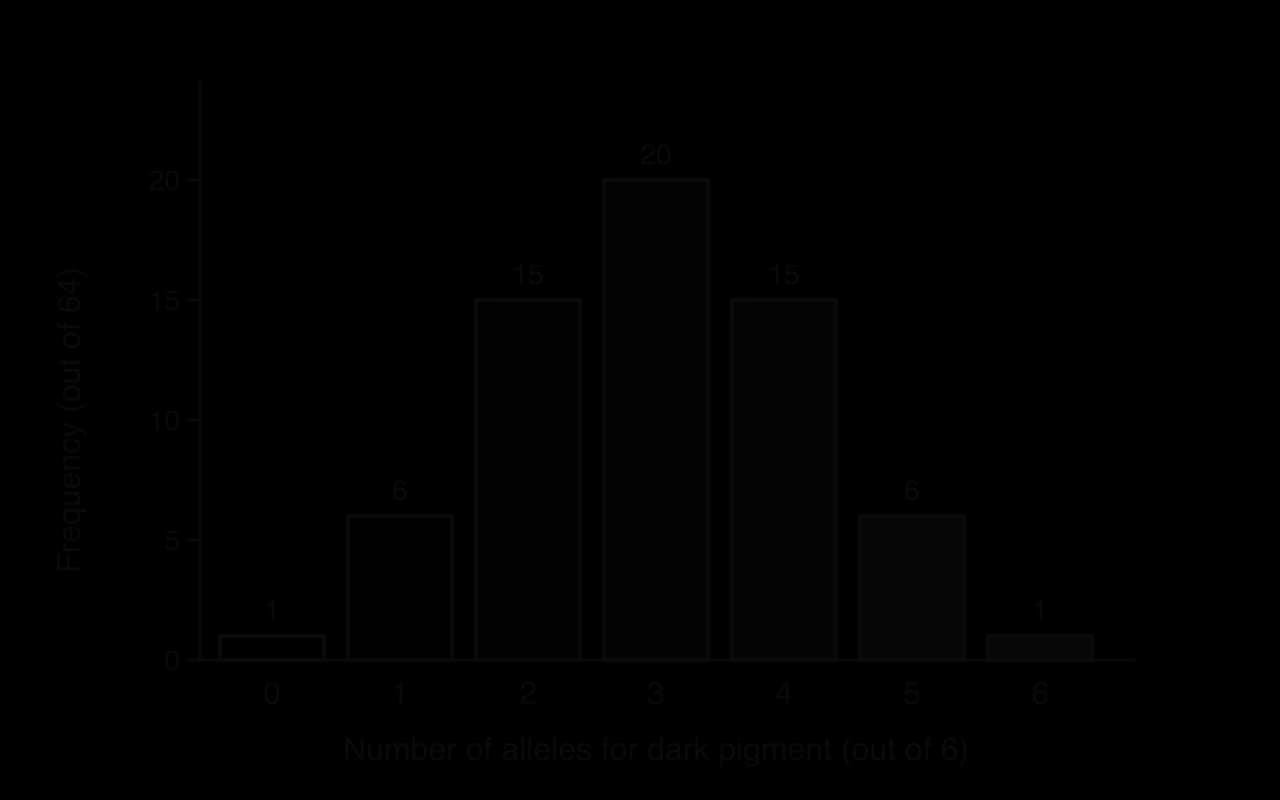
With more genes, the number of classes increases and the differences between them become smaller. Environmental effects, such as exposure to sunlight, blur the classes further, until the distribution is a smooth, bell-shaped curve, the normal distribution typical of continuous variables.
Three measures of central tendency summarise a set of values. The mean is the sum of all the values divided by the number of values. The median is the middle value when the values are arranged in order. The mode is the most frequent value (or class). In a normal distribution the three are equal. In a skewed distribution they differ, and the median is often a better summary because it is not pulled towards a few extreme values.
A box-and-whisker plot shows the spread of a continuous variable, such as the heights of the students in a class, using five values and any outliers. It makes it easy to compare two or more groups, for example the heights of two classes.
A box-and-whisker plot shows six aspects of the data:
Median: the middle value, shown as a line inside the box.
Lower quartile (Q1): the median of the lower half of the data, the left (or lower) edge of the box.
Upper quartile (Q3): the median of the upper half of the data, the right (or upper) edge of the box. The box therefore contains the middle 50% of the values.
Minimum: the lowest value that is not an outlier, the end of the lower whisker.
Maximum: the highest value that is not an outlier, the end of the upper whisker.
Outliers: values more than 1.5 × the interquartile range above the upper quartile or below the lower quartile, plotted as separate points.
The interquartile range (IQR) is the upper quartile minus the lower quartile. It measures the spread of the middle half of the data. An outlier is a value that lies unusually far from the rest of the data, and the 1.5 × IQR rule is used to identify which values count as outliers.
The patterns of inheritance discovered by Mendel are explained by two processes in the behaviour of chromosomes in meiosis: segregation and independent assortment.
Segregation is the separation of the two alleles of a gene into different gametes. It happens because the two alleles are on a pair of homologous chromosomes, and the homologous chromosomes are pulled to opposite poles in anaphase I. A gamete therefore receives either one allele or the other, never both. Mendel described this as his first law, the law of segregation.
Independent assortment means that the alleles of one gene are distributed to gametes independently of the alleles of another gene. It happens when the two genes are on different chromosomes (unlinked genes). In metaphase I, each pair of homologous chromosomes lines up on the equator with a random orientation, independently of every other pair. Which allele of the first gene goes to a pole therefore has no effect on which allele of the second gene goes with it.
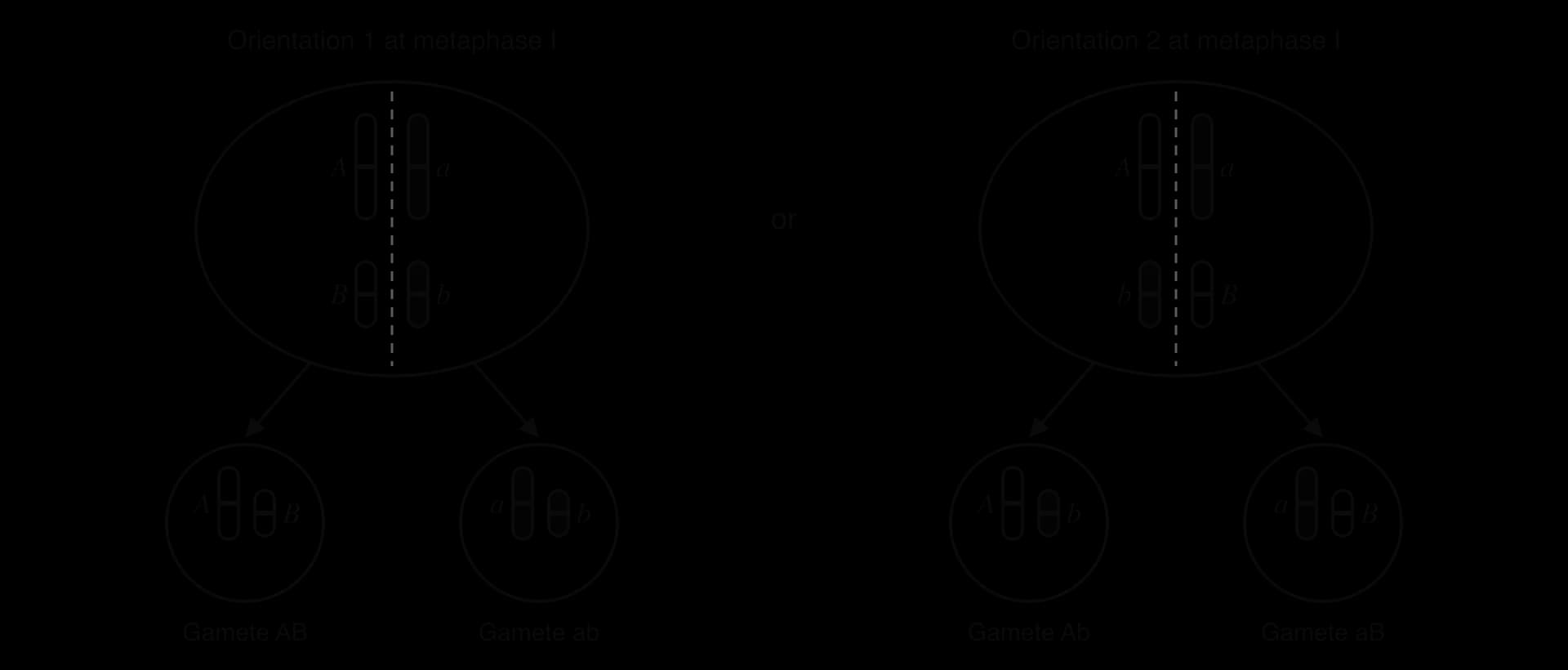
The diagram of the two orientations shows the outcome for a parent heterozygous for two unlinked genes, AaBb. Because both orientations are equally likely across the many cells undergoing meiosis, the parent produces four types of gamete in equal numbers: AB, Ab, aB and ab, each with a probability of 1/4. Two of these (AB and ab) carry the same combinations of alleles that the parent inherited, if it received AB from one parent and ab from the other; the other two (Ab and aB) are new combinations.
A dihybrid cross follows the inheritance of two genes at the same time. Mendel crossed pea plants that differed in both seed shape (round R, dominant to wrinkled r) and seed colour (yellow Y, dominant to green y).
When pure-breeding round yellow plants (RRYY) are crossed with pure-breeding wrinkled green plants (rryy), all the F1 plants are RrYy and have round yellow seeds. Each F1 plant produces four types of gamete in equal proportions (RY, Ry, rY and ry), so a cross between two F1 plants needs a 4 × 4 Punnett grid with 16 equally likely cells.
Gametes | RY | Ry | rY | ry |
|---|---|---|---|---|
RY | RRYY | RRYy | RrYY | RrYy |
Ry | RRYy | RRyy | RrYy | Rryy |
rY | RrYY | RrYy | rrYY | rrYy |
ry | RrYy | Rryy | rrYy | rryy |
Counting the phenotypes in the grid gives the F2 ratio:
Phenotype | Genotypes | Number of cells out of 16 |
|---|---|---|
Round yellow | R_Y_ (at least one R and one Y) | 9 |
Round green | R_yy | 3 |
Wrinkled yellow | rrY_ | 3 |
Wrinkled green | rryy | 1 |
The ratio 9 : 3 : 3 : 1 is the product of two independent 3 : 1 ratios: 3/4 of the offspring are round and, independently, 3/4 are yellow, so 3/4 × 3/4 = 9/16 are round and yellow. This independence is the result of independent assortment.
A test cross is a cross between an organism and a homozygous recessive individual. Because the homozygous recessive parent produces only one type of gamete (ry), carrying recessive alleles, the phenotype of each offspring shows directly which gamete it received from the other parent. A test cross of a double heterozygote (RrYy × rryy) therefore gives four phenotypes in the ratio 1 : 1 : 1 : 1, one for each of the four gamete types. Test crosses with a single gene are also used to find out whether an organism with the dominant phenotype is homozygous or heterozygous.
Each gene occupies a specific position on a particular chromosome, called its locus (plural loci). Human gene loci are written with the chromosome number (or X or Y), the arm (p for the short arm, q for the long arm) and the band number counted from the centromere. The haemoglobin β gene HBB, for example, is at 11p15.4: chromosome 11, short arm, band 15.4.
Databases such as OMIM (Online Mendelian Inheritance in Man), NCBI Gene and Ensembl give the locus of every known human gene, the polypeptide it codes for and the diseases caused by its mutant alleles. Searching for a gene by name or symbol returns its locus, its position in base pairs and a description of its product.
Gene | Locus | Polypeptide product | Associated condition or note |
|---|---|---|---|
HBB | 11p15.4 | β-globin chain of haemoglobin | Sickle cell disease |
HBD | 11p15.4 | δ-globin chain (of a minor adult haemoglobin) | Lies next to HBB on chromosome 11 |
PAH | 12q23.2 | Phenylalanine hydroxylase | Phenylketonuria |
CFTR | 7q31.2 | CFTR chloride channel protein | Cystic fibrosis |
F8 | Xq28 | Clotting factor VIII | Haemophilia A |
F9 | Xq27.1 | Clotting factor IX | Haemophilia B |
ABO | 9q34.2 | Glycosyltransferase that adds the A or B sugar | ABO blood groups |
Source: NCBI Gene and OMIM, accessed 2026.
Database searches allow pairs of genes to be compared. PAH (chromosome 12) and CFTR (chromosome 7) are on different chromosomes, so they are unlinked and assort independently. HBB and HBD are close together on the same chromosome, so they are linked and are usually inherited together.
Genes whose loci are on the same chromosome show gene linkage. Linked genes are inherited together, because the chromosome passes into a gamete as one unit. Their alleles do not assort independently: the combination of alleles on each homologous chromosome tends to stay together in the gametes.
In crosses involving linked genes, the alleles are written beside vertical lines that represent the homologous chromosomes. A double heterozygote with A and B on one chromosome and a and b on the other is written:
Each vertical line is one chromosome, read from top to bottom. A double heterozygote with A and b on one chromosome and a and B on the other has the same genotype in letters (AaBb) but a different arrangement, written with Ab on one line and aB on the other. The arrangement matters, because it determines which combinations are parental and which are new.
If linked genes always stayed together, a double heterozygote with AB on one chromosome and ab on the other would produce only AB and ab gametes. In fact a small proportion of gametes carry Ab or aB. These arise by crossing over in prophase I of meiosis, when non-sister chromatids of a bivalent exchange sections at a chiasma. If the crossover happens between the two loci, the two chromatids involved swap one allele, as the diagram of crossing over in a bivalent shows.

The further apart two loci are on a chromosome, the more likely it is that a crossover happens between them, and the more recombinant gametes are produced. Very close genes, such as HBB and HBD, are almost never separated.
A recombinant is a gamete, or an offspring produced from such a gamete, with a combination of alleles different from either of the combinations its parent inherited. Recombinants arise in two ways: by independent assortment in unlinked genes, and by crossing over between the loci in linked genes.
The easiest way to identify recombinants is a test cross between a double heterozygote and a double homozygous recessive. The recessive parent contributes only recessive alleles, so each offspring phenotype matches exactly the alleles in the gamete from the double heterozygote. Offspring with the same phenotype combinations as the original parents of the heterozygote are parental types; offspring with new combinations are recombinants.
Unlinked genes: the four classes are equal (1 : 1 : 1 : 1), so half the offspring are recombinants.
Linked genes: the two parental classes are large and the two recombinant classes are small. The proportion of recombinants is less than half.
Thomas Hunt Morgan and his students worked out the principles of linkage from crosses of the fruit fly Drosophila melanogaster, starting in 1910 with a white-eyed mutant male that showed sex linkage. In one of their crosses of two autosomal genes, a female heterozygous for grey body (b⁺) and normal wings (vg⁺), with both dominant alleles on one chromosome, was test crossed with a black-bodied, vestigial-winged male (b vg / b vg).
Offspring phenotype | Alleles from the heterozygous female | Type | Number |
|---|---|---|---|
Grey body, normal wings | b⁺ vg⁺ | Parental | 965 |
Black body, vestigial wings | b vg | Parental | 944 |
Grey body, vestigial wings | b⁺ vg | Recombinant | 206 |
Black body, normal wings | b vg⁺ | Recombinant | 185 |
Data from T. H. Morgan's Drosophila crosses, as reported in Campbell Biology.
Morgan's student Alfred Sturtevant realised in 1913 that the percentage of recombinants could be used as a measure of the distance between two genes, since a larger distance gives more chances for a crossover. From recombination frequencies he drew the first genetic map, the order and relative positions of genes on the X chromosome of Drosophila.
Observed results of a cross rarely match the expected ratio exactly, because which gametes fuse is a matter of chance. The offspring counted are a sample that represents all the offspring that the cross could produce. The chi-squared test (χ² test) is a statistical test of whether the difference between the observed and expected numbers is small enough to be due to chance, or large enough to suggest that the expected ratio is wrong (for example because the genes are linked).
State the null hypothesis (H₀): there is no significant difference between the observed and expected numbers; the results fit the expected ratio (for example 9 : 3 : 3 : 1, meaning the genes assort independently).
State the alternative hypothesis (H₁): there is a significant difference; the results do not fit the ratio (for example because the genes are linked).
Calculate the expected number (E) in each class from the total number of offspring and the expected ratio.
For each class calculate (O − E)² ÷ E, where O is the observed number, then add the values to find χ².
Find the degrees of freedom: the number of classes minus 1. A dihybrid cross with four phenotype classes has 4 − 1 = 3 degrees of freedom.
Compare χ² with the critical value from a table, at the 0.05 level of statistical significance.
If χ² is less than the critical value, the difference is not significant and H₀ is accepted. If χ² is greater than the critical value, the difference is significant at p < 0.05 and H₀ is rejected.
Degrees of freedom | 1 | 2 | 3 | 4 |
|---|---|---|---|---|
Critical value at p = 0.05 | 3.84 | 5.99 | 7.81 | 9.49 |
A significance level of p = 0.05 means that H₀ is rejected only if a difference as large as the one observed would happen by chance alone less than 5% of the time when H₀ is true. Rejecting H₀ at this level accepts a 5% risk of being wrong.
The same test applied to Morgan's fruit-fly data gives a very different result. The expected number in each class for a 1 : 1 : 1 : 1 ratio is 2,300 ÷ 4 = 575. The observed numbers (965, 944, 206 and 185) differ so much from 575 that χ² is about 1,000, far above the critical value of 7.81, so the null hypothesis of independent assortment is rejected, as expected for linked genes.
Inheritance is examined in every paper. Paper 1A questions often ask for the ratio from a cross, the genotype that fits a phenotype, or the pattern shown by a pedigree. Paper 1B and Paper 2 Section A use pedigree charts, genetic-cross data and statistics such as box-and-whisker plots and (HL) chi-squared tests. Paper 2 also asks for complete genetic diagrams, and Section B can include extended responses on sex linkage, multiple alleles or (HL) linkage and independent assortment. The command terms most often used are determine, deduce, predict, explain, calculate and distinguish.
Most inheritance problems come back to a small set of expected ratios and the conditions that produce them. A ratio that departs clearly from the expected one is evidence that something else is at work, such as sex linkage or (HL) gene linkage, and the chi-squared test separates real departures from those caused by chance.
I can explain how haploid gametes and a diploid zygote carry genes from parents to offspring.
I can describe how to cross two plants and use P, F1, F2 and Punnett grids to predict outcomes.
I can distinguish gene from allele, genotype from phenotype and homozygous from heterozygous.
I can explain why heterozygotes usually have the same phenotype as homozygous dominant individuals.
I can explain phenotypic plasticity and the inheritance and treatment of PKU.
I can explain multiple alleles, codominance and incomplete dominance using ABO blood groups and four o'clock flowers.
I can explain sex determination and solve crosses involving haemophilia using X-linked notation.
I can deduce patterns of inheritance and genotypes from a pedigree chart.
I can explain polygenic inheritance and calculate mean, median, mode, quartiles and outliers.
I can explain segregation and independent assortment and predict 9 : 3 : 3 : 1 and 1 : 1 : 1 : 1 ratios. (HL)
I can identify recombinants in crosses with linked and unlinked genes and find gene loci in a database. (HL)
I can carry out a chi-squared test on the results of a dihybrid cross and interpret it. (HL)
The answer is C.
Which statement distinguishes a gene from an allele?
In a species of plant, allele R codes for an enzyme that makes a red petal pigment, and allele r codes for a non-functional version of the enzyme. Why do plants with genotypes RR and Rr have the same phenotype?