2 Biological approach
See how the biological approach explains behaviour through the brain, chemical messengers and genes, how its nine terms fit together, and how it links to the concepts and the contexts, and how it is assessed.
- IB Psychology
- SL and HL
What 2 covers
From the subject guide: what you need to know and be able to do.
How the brain, genes and body chemistry influence behaviour.
9 subtopics in Biological approach
Each one has its own page once something is published for it.
- 2.1Animal research and animal modelsnotes
- 2.2Biological reductionismnotes
- 2.3Brain imaging techniquesnotes
- 2.4Chemical messengersnotes
- 2.5Diathesis-stress modelnotes
- 2.6Genetic inheritancenotes
- 2.7Localisation of functionnotes
- 2.8Neuroplasticitynotes
- 2.9Neurotransmissionnotes
Key terms introduced here
Each is in the Psychology glossary, with every other term in the subject.
- Autonomic nervous system
The part of the nervous system that controls involuntary body functions; its sympathetic branch prepares the body for action and its parasympathetic branch returns it to a resting state.
- Biological approach
A perspective in psychology that explains behaviour and mental processes through physiological factors such as the brain, neurotransmitters, hormones and genes, and through their evolution.
An overview of 2 Biological approach
The biological approach explains behaviour and mental processes through the body: the brain and nervous system, the chemical messengers that carry signals, and the genes that influence how these develop. Its central assumption is that every thought, emotion and action has a physical basis, so studying that basis can help to explain, predict and sometimes change behaviour.
Modern biological psychology is increasingly interactionist. It studies how genes, brain and body chemistry interact with experience and culture, rather than treating biology as acting alone, and it uses evidence from animal research, brain imaging, genetics and experiments with drugs and hormones.
Questions the biological approach tries to answer
How do nerve cells and chemical messengers produce thoughts, emotions and actions?
Are particular functions, such as language or memory, carried out by particular parts of the brain?
How does experience change the brain, and how far can the brain recover from damage?
How much of the variation between people in behaviour and mental health is inherited, and how do genes interact with the environment?
What can studies of animals and pictures of the living brain show about human behaviour, and where can they mislead?
Is a biological explanation ever enough on its own?
The systems the approach studies
The nervous system is divided into the central nervous system (the brain and spinal cord) and the peripheral nervous system, which connects them to the rest of the body. Part of the peripheral system, the autonomic nervous system, controls functions that happen without conscious effort, such as heart rate, breathing and digestion. Its sympathetic branch prepares the body for action when a threat is detected, and its parasympathetic branch returns the body to a resting state.
Alongside the nervous system, the endocrine system releases hormones into the blood, which act more slowly and over longer periods than neurotransmitters. Genes, inherited from parents, influence how all of these systems are built, and experience changes how genes are expressed, a process studied in epigenetics. The nine terms of the approach study these systems, and the methods and arguments used to investigate them.
The subtopics
Subtopic | What it covers |
|---|---|
2.1 Animal research and animal models | Why psychologists study animals to understand humans, how well an animal model stands for a human condition, and the ethics of animal research (the 3Rs, cost–benefit analysis) |
2.2 Biological reductionism | Explaining behaviour by its biological parts: strengths, limitations such as the treatment–aetiology fallacy, and alternatives such as the biopsychosocial model |
2.3 Brain imaging techniques | What MRI, fMRI, PET and EEG measure, spatial and temporal resolution, and the limits of indirect, correlational imaging data |
2.4 Chemical messengers | Neurotransmitters and hormones, how they differ, and the role of messengers such as oxytocin, cortisol and serotonin in behaviour |
2.5 Diathesis-stress model | How an inherited or biological vulnerability combines with environmental stress to produce a disorder |
2.6 Genetic inheritance | How far behaviour is inherited: heritability, family, twin, adoption and molecular studies, and epigenetics |
2.7 Localisation of function | The links between brain areas and functions, from Broca’s patients to brain networks, and the limitations of the localisation argument |
2.8 Neuroplasticity | How experience changes the brain (long-term potentiation, dendritic branching, pruning), experience-expectant and experience-dependent plasticity, environmental factors such as practice and enrichment, and functional reorganisation after damage |
2.9 Neurotransmission | How neurons pass signals across the synapse, agonists and antagonists, and how this knowledge is used in treatment |
How the subtopics connect
The nine terms fall into three groups. Five describe what the biology is: neurotransmission, chemical messengers, localisation of function, neuroplasticity and genetic inheritance. One, the diathesis-stress model, describes how biology meets the environment. The remaining three describe how the biology is studied and judged: animal research and brain imaging are the main methods, and biological reductionism is the critical question asked of every biological explanation.
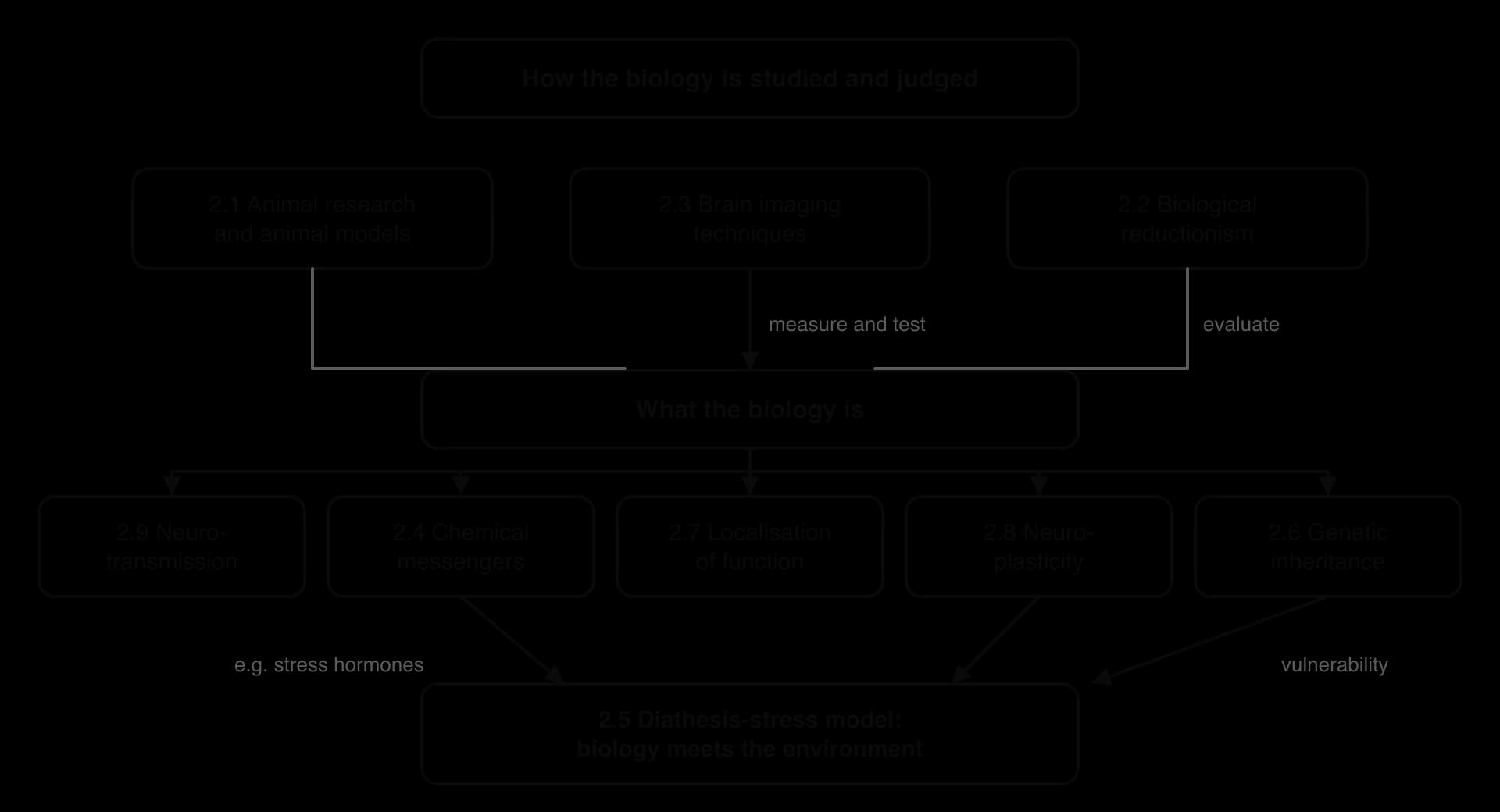
The groups depend on each other. Evidence for localisation and neuroplasticity comes largely from brain imaging and animal research; chemical messengers act through neurotransmission; genetic inheritance and the diathesis-stress model explain why the same environment affects people differently. The concept of reductionism asks, for each of these, whether the biological level gives a full explanation or only part of one.
The approach, the concepts and the contexts
Every subtopic raises questions through the six concepts: bias, causality, change, measurement, perspective and responsibility. The table shows the links that come up most often.
Concept | Where it is central in the biological approach |
|---|---|
Causality | Correlational brain and hormone differences versus experiments with drugs and animals; gene–environment interaction |
Measurement | Indirect measures: the BOLD signal, hormone levels in saliva or blood, heritability estimates; the validity of animal models |
Perspective | Reductionism versus holism and the biopsychosocial model; the limits of a single approach |
Bias | Small and WEIRD samples in imaging; anthropomorphism; male-only animal studies; publication bias in candidate-gene research |
Responsibility | Animal welfare and the 3Rs; socially sensitive findings about violence and mental illness; communicating uncertain findings such as the “chemical imbalance” story |
Change | Neuroplasticity; drug treatments that change neurotransmission; epigenetic change across the lifespan |
Biological terms are used throughout the four contexts. In health and well-being, they explain mental health disorders, stress and the biological treatment of depression. In human development, they explain brain development and the effects of early experience. In human relationships, chemical messengers such as oxytocin and dopamine are an area of study in their own right. In learning and cognition, biological factors such as the hippocampus and acetylcholine explain memory. In each context, biological explanations are strongest when combined with cognitive and sociocultural ones.
How SL and HL differ
SL and HL students study the same biological approach content, word for word, and answer the same questions on it in Papers 1 and 2. HL students do not study extra biological content. Their HL extensions build on it. The extensions on culture, motivation and technology examine how these factors shape behaviour within the contexts, where biological explanations are often one part of the evidence, and the extension on data analysis and interpretation develops the statistical reasoning needed to judge imaging and genetic research, such as sample size, significance and multiple comparisons. These extensions are assessed in Paper 3 at HL.
Assessment
The biological approach is assessed mainly in Paper 1, and its research appears in Paper 2.
Paper 1 Section A: short-answer questions on two of the three approaches. A biological question asks students to explain or describe one of the nine terms with reference to one example of human behaviour, without naming a context. Knowledge of the details of studies is not assessed; the explanation of the term and of the example is.
Paper 1 Section B: short-answer questions that apply an approach term to an unseen scenario in one of the four contexts, for example explaining the value of animal research or brain imaging for the study described.
Paper 1 Section C: concept-based essays on context areas of study. Biological content is often the evidence, for example a biological explanation of a mental health disorder evaluated through perspective or causality.
Paper 2 Section B: the unseen study may be a biological one, such as an imaging, hormone or animal study, to be discussed through concepts such as measurement, causality and responsibility.
Carry on with 2 in Augment
With a free account, Augment remembers where you stopped and what you have practiced.