Describe how neurons pass signals across the synapse, explain how agonists and antagonists change neurotransmission, and evaluate how this knowledge is used to treat depression, memory loss and addiction.
Each is in the Psychology glossary, with every other term in the subject.
A brief electrical impulse that travels along the axon when the charge inside a neuron reaches a threshold; it is all-or-none, so the neuron either fires fully or not at all.
A substance that increases the effect of a neurotransmitter, by binding to and activating its receptors or by increasing the amount available in the synaptic gap.
A substance that reduces the effect of a neurotransmitter, usually by binding to its receptors without activating them, which blocks the neurotransmitter.
The long fibre of a neuron that carries the action potential away from the cell body towards the axon terminals.
A short, branching extension of a neuron that receives signals from other neurons and carries them towards the cell body.
Describes an effect of a neurotransmitter that makes the postsynaptic neuron more likely to fire an action potential.
Gamma-aminobutyric acid: the main inhibitory neurotransmitter in the brain, which makes neurons less likely to fire and is the target of alcohol and anti-anxiety drugs such as benzodiazepines.
The main excitatory neurotransmitter in the brain, involved in almost all fast signalling between neurons and in strengthening synapses during learning and memory.
Describe the structure of a neuron and how an action potential travels along it.
Describe the process of synaptic transmission, from the arrival of an action potential to reuptake or enzymatic breakdown.
Explain the difference between excitatory and inhibitory effects and how a neuron sums its inputs.
Explain how agonists and antagonists change neurotransmission, with examples of drugs that act in each way.
Explain how knowledge of neurotransmission is used to improve health and wellness, including antidepressants, treatments for memory loss and the treatment of addiction and overdose.
Describe and evaluate the study by Antonova et al. (2011) on acetylcholine and spatial memory.
Evaluate research on neurotransmission with reference to causality, measurement and responsibility.
Apply the process of neurotransmission to an unfamiliar situation in one of the contexts.
Neurotransmission is the process by which one nerve cell passes a signal to another. Every thought, memory, emotion and movement depends on it, and many of the most widely used medicines, from antidepressants to drugs that reverse an opioid overdose, work by changing it.
Neurotransmission belongs to the biological approach, which explains behaviour through the nervous system, hormones and genes. Understanding it is the basis for understanding chemical messengers, drug treatments for mental health disorders and the biology of learning and memory. Research on it raises questions of causality, because changing a chemical and observing a change in behaviour does not always show what normally causes that behaviour, and of
With a free account, Augment remembers where you stopped and what you have practiced.
Describes an effect of a neurotransmitter that makes the postsynaptic neuron less likely to fire an action potential.
A fatty insulating layer, formed by glial cells, that wraps axons in segments and greatly speeds the conduction of action potentials.
A nerve cell that carries information through the nervous system, electrically along its own length and chemically to other cells.
The process by which a neuron passes a signal to another cell: an action potential causes release of a neurotransmitter that crosses the synaptic gap and binds to receptors.
A protein on the membrane of a cell with a binding site that fits a particular chemical messenger; when the messenger binds, the receptor changes the activity of the cell.
The reabsorption of a neurotransmitter from the synaptic gap into the presynaptic neuron by transporter proteins, which ends its action and allows it to be reused.
The junction between two neurons, or between a neuron and a muscle or gland cell, made up of the presynaptic terminal, the synaptic gap and the postsynaptic membrane.
The tiny space, a few tens of nanometres wide, between the presynaptic terminal and the postsynaptic membrane, across which neurotransmitters diffuse.
A small membrane sac in the axon terminal that stores neurotransmitter and releases it into the synaptic gap when an action potential arrives.
An experimental technique that temporarily lowers brain serotonin by giving a diet and amino acid drink lacking tryptophan, the amino acid from which serotonin is made.
The nervous system is made of two main kinds of cell. Glial cells support, protect and insulate. Neurons carry information: they receive signals from other cells, combine them and pass a signal on. The human brain contains tens of billions of neurons, and each one can connect with thousands of others.
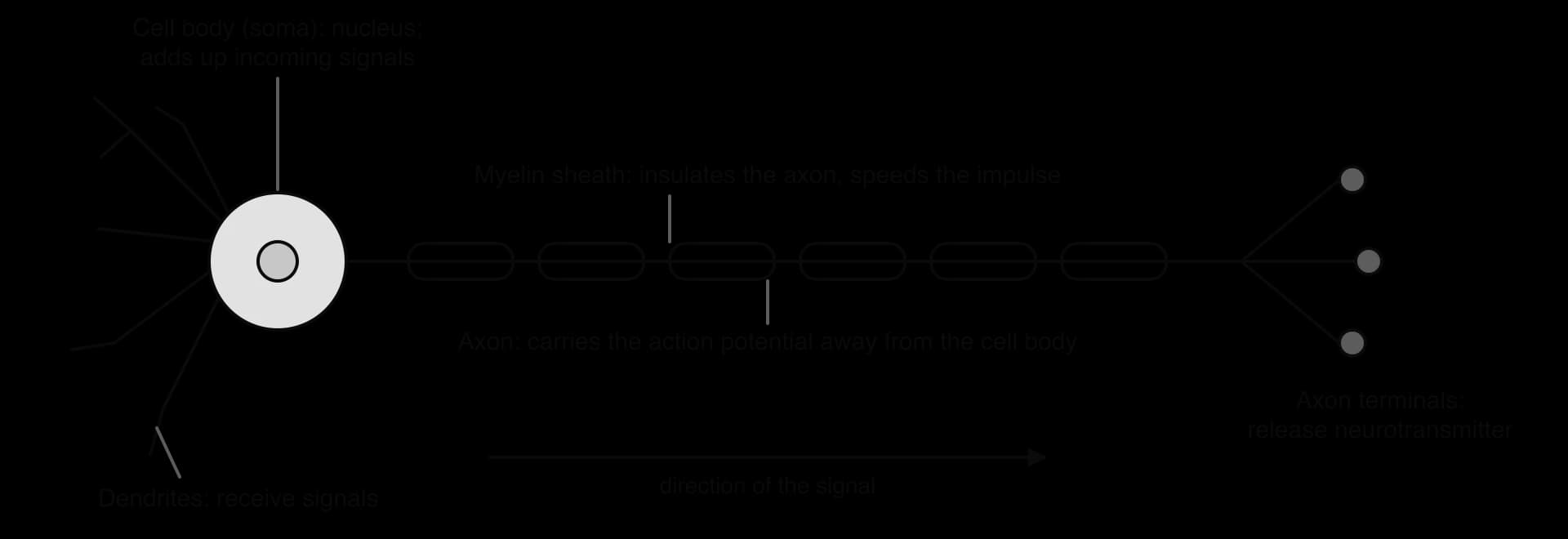
Neurons vary in shape and size, but most share four parts. Dendrites are short, branching extensions that receive signals from other neurons. The cell body (soma) contains the nucleus and adds up the signals arriving from the dendrites. The axon is a single long fibre that carries the signal away from the cell body, sometimes over a metre in the case of neurons running down the spinal cord. At its end, the axon divides into axon terminals, which release chemicals onto the next cell.
Many axons are wrapped in a myelin sheath, a fatty layer formed by glial cells. Myelin insulates the axon in segments with small gaps between them, and the signal jumps from gap to gap, which makes it many times faster than in an unmyelinated axon. The importance of myelin is clear in multiple sclerosis, a disease in which the immune system damages myelin in the brain and spinal cord, slowing or blocking signals and causing problems with movement, vision and thinking.
Inside a neuron the signal is electrical. At rest, the inside of the cell is negatively charged compared with the outside, at about −70 millivolts. This difference, called the resting potential, exists because the cell membrane keeps different concentrations of charged particles (ions), mainly sodium and potassium, on each side.
Signals arriving from other neurons change this charge a little. If the change at the start of the axon is large enough to reach a threshold, channels in the membrane open and positively charged sodium ions rush in. For about a millisecond the inside of the cell becomes positive (depolarisation). Potassium ions then flow out and restore the negative charge (repolarisation). This brief reversal of charge is the action potential, and it travels down the axon like a wave until it reaches the axon terminals.
Because the action potential is all-or-none, a neuron cannot send a “stronger” impulse. A more intense stimulus, such as a brighter light or a louder sound, is signalled by a higher rate of firing and by more neurons firing at once. The size of each impulse stays the same.
Neurons do not touch. Between the axon terminal of one neuron and the dendrite of the next there is a tiny gap, only a few tens of nanometres wide. The electrical impulse cannot jump across it, so the signal is carried across by chemicals instead. The whole junction is called a synapse: the presynaptic terminal (the sending side), the synaptic gap and the postsynaptic membrane (the receiving side).
The chemicals that carry the signal across the gap are neurotransmitters, a type of chemical messenger. They are made in the presynaptic neuron and stored in small sacs called synaptic vesicles in the axon terminal. Synaptic transmission happens in six steps.
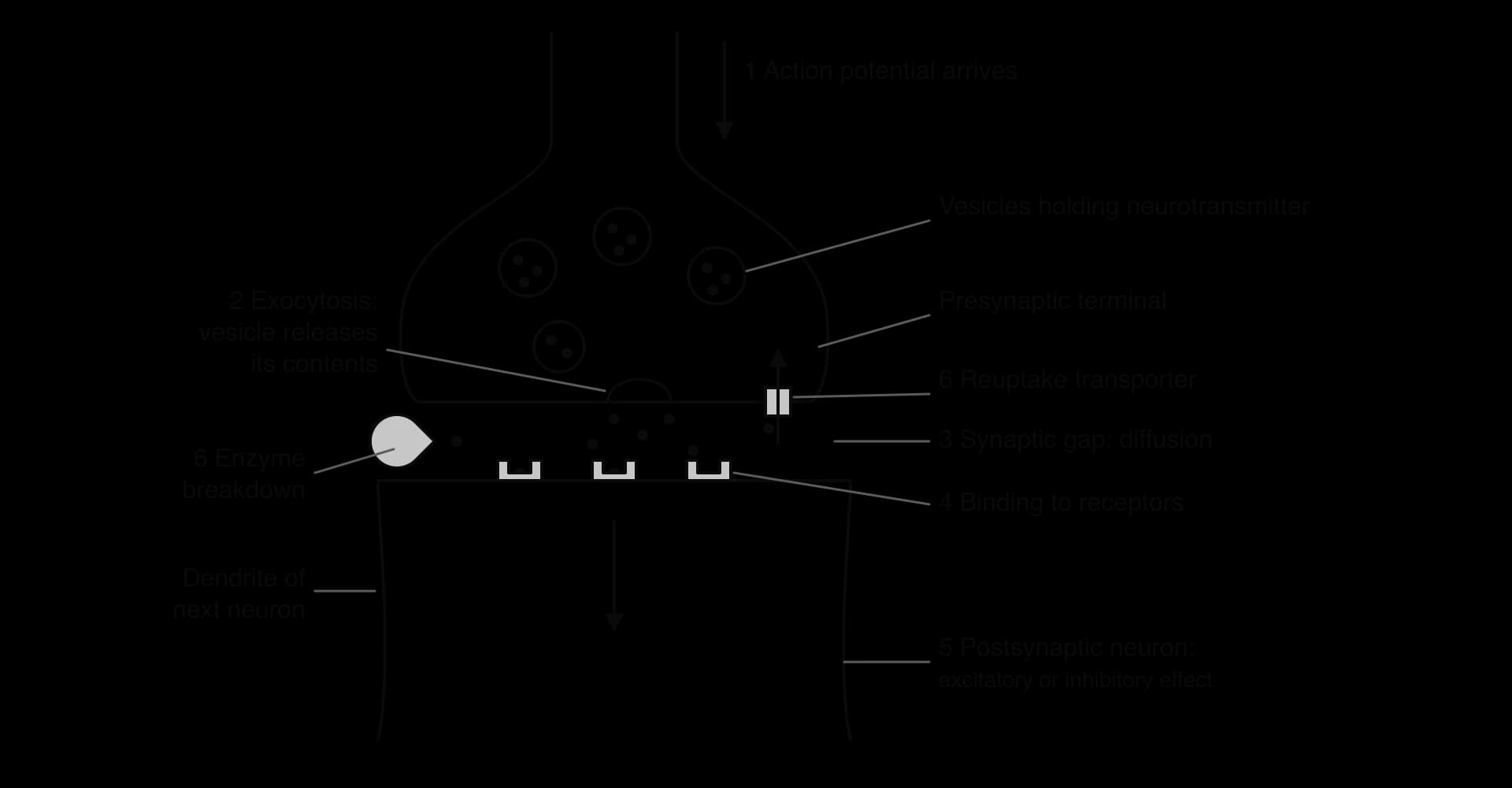
An action potential arrives at the axon terminal of the presynaptic neuron.
Vesicles release the neurotransmitter. The change in charge opens channels that let calcium ions into the terminal. Calcium causes the vesicles to fuse with the presynaptic membrane and empty their neurotransmitter into the synaptic gap, a process called exocytosis.
The neurotransmitter diffuses across the gap, which takes a fraction of a millisecond.
It binds to receptors on the postsynaptic membrane. Each type of receptor has a binding site shaped to fit particular molecules, in the way that a lock accepts only certain keys.
The postsynaptic neuron responds. Binding opens ion channels or starts chemical changes inside the cell. The effect is either excitatory (the postsynaptic neuron becomes more likely to fire) or inhibitory (less likely to fire).
The signal is ended. The neurotransmitter is removed from the gap so that the synapse can respond to the next signal: it is taken back into the presynaptic neuron by transporter proteins (reuptake) or broken down by enzymes.
 YouTube
A neurotransmitter has an effect only where there are receptors that fit it. This is why the same chemical can have different effects in different parts of the brain: what matters is which receptors are present on the receiving cell. Dopamine, for example, acts on at least five receptor types, some excitatory and some inhibitory, and serotonin acts on more than a dozen.
Receptors also explain how drugs work. A drug that is shaped enough like a neurotransmitter can fit its receptor, and a drug that changes how many receptors are available, or how long a neurotransmitter stays in the gap, changes the strength of the signal. The same ideas explain how agonists and antagonists work.
 YouTube
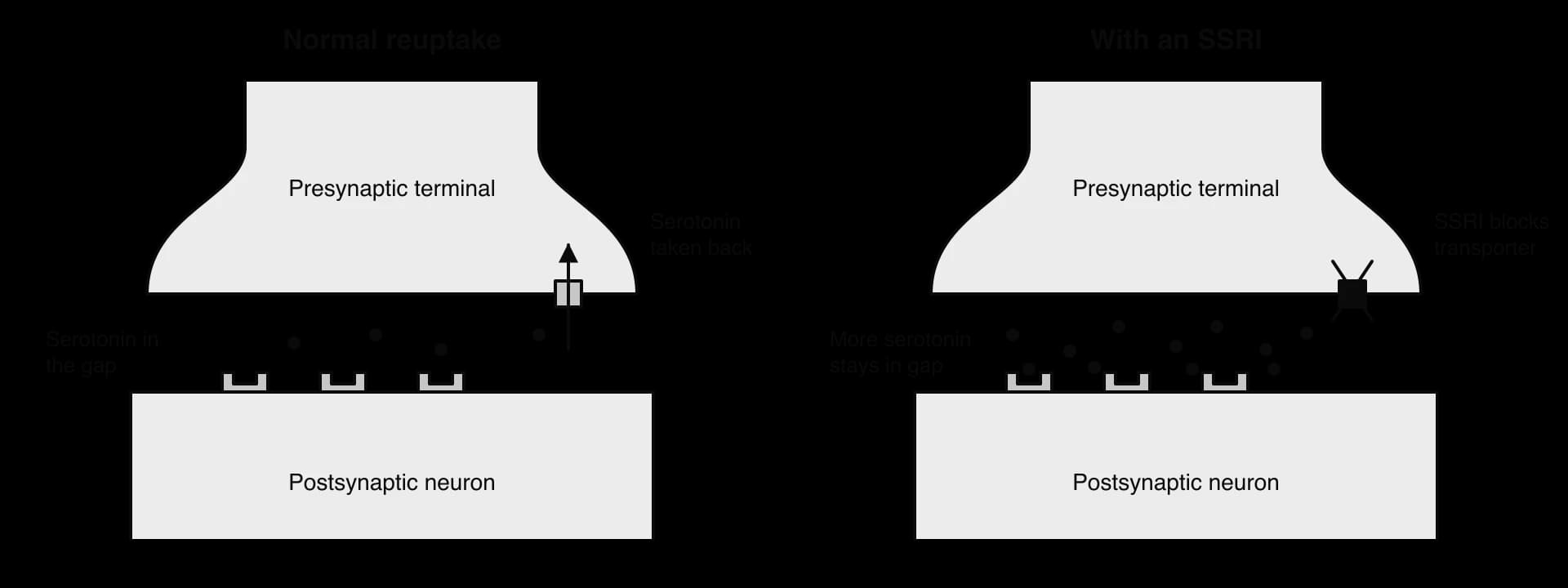
If a neurotransmitter stayed in the synaptic gap, it would keep stimulating the receptors and the synapse could not send a new message. Two processes clear it. In reuptake, transporter proteins in the presynaptic membrane carry the neurotransmitter back into the neuron that released it, where it is recycled into new vesicles. Serotonin, dopamine and noradrenaline are mainly cleared in this way.
In enzymatic breakdown, an enzyme in the gap splits the neurotransmitter into inactive parts. Acetylcholine is broken down by the enzyme acetylcholinesterase within milliseconds. Monoamine oxidase (MAO), an enzyme inside the terminal, breaks down serotonin, dopamine and noradrenaline. Both routes are targets for medicines: blocking reuptake or blocking an enzyme leaves more neurotransmitter in the gap for longer.
A neurotransmitter does not “carry” a message in the sense of a word or an instruction. It simply makes the receiving neuron more or less likely to fire. An excitatory effect moves the charge inside the postsynaptic neuron towards the threshold, so it becomes more likely to produce an action potential. An inhibitory effect moves the charge further away from threshold, so it becomes less likely to fire.
The brain’s main excitatory neurotransmitter is glutamate, which is involved in almost all fast signalling, including the strengthening of synapses during learning. The main inhibitory neurotransmitter is GABA (gamma-aminobutyric acid), which calms neural activity. A healthy brain depends on a balance between the two: too much excitation can produce seizures, and too much inhibition produces sedation.
A single neuron receives input from thousands of synapses at once, some excitatory and some inhibitory. At the cell body these inputs are added together, a process called summation. Only if the total excitation outweighs the inhibition enough to reach threshold does the neuron fire an action potential of its own.
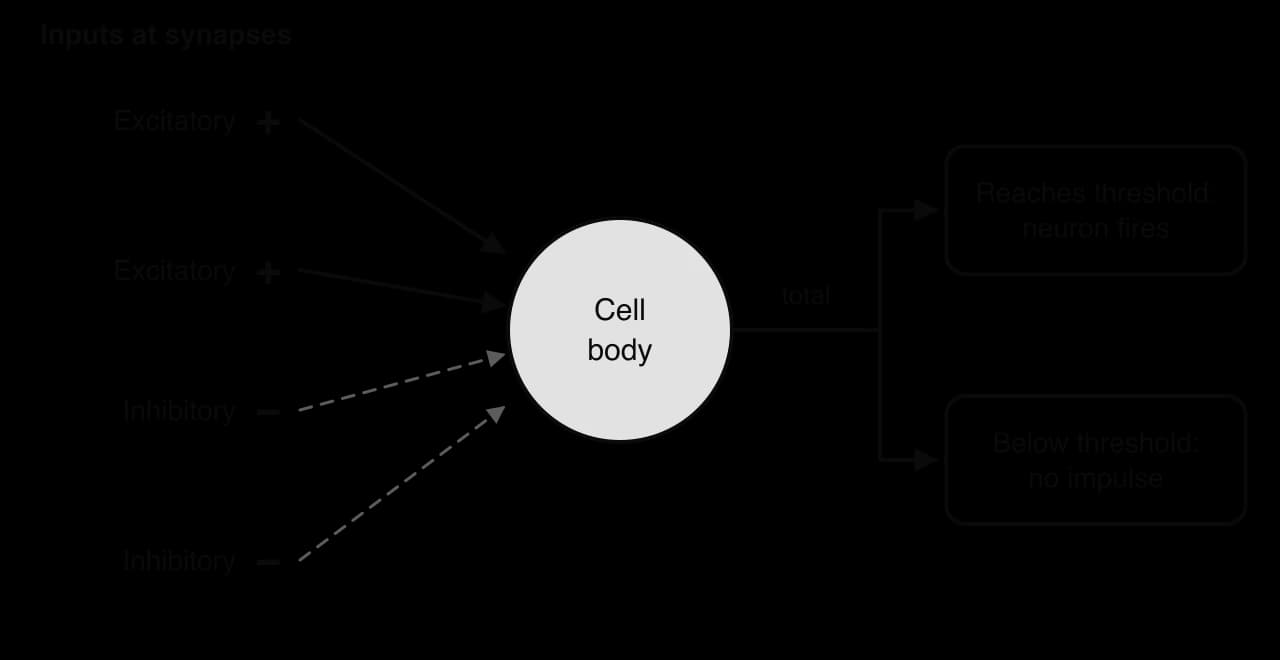
Summation explains why the same input can have different effects at different times. A sound that wakes a person at night may not reach threshold during a busy day, because other inputs are adding inhibition or competing for attention. It also explains why many calming drugs work by strengthening inhibition: alcohol and benzodiazepines (such as diazepam) increase the effect of GABA at its receptors, which makes neurons across the brain less likely to fire, producing relaxation, slowed reactions and, at high doses, loss of consciousness.
More than a hundred chemicals act as neurotransmitters, but a small number account for most of what psychologists study. Each is released by particular groups of neurons and acts on particular receptors, so each is linked to particular functions. Neurotransmitters act only across synapses, which distinguishes them from hormones, chemical messengers carried in the blood. The table gives the main ones and the functions and disorders they are most linked to.
Neurotransmitter | Usual effect | Main functions | Linked to |
|---|---|---|---|
Acetylcholine | Mostly excitatory | Muscle contraction; attention, learning and memory (especially in the hippocampus) | Alzheimer’s disease (loss of acetylcholine neurons) |
Dopamine | Excitatory or inhibitory, depending on receptor | Movement; reward, motivation and learning from reward | Parkinson’s disease; addiction; schizophrenia |
Serotonin | Mostly inhibitory | Mood, sleep, appetite, impulse control | Depression and anxiety (target of SSRIs) |
Noradrenaline | Mostly excitatory | Arousal, alertness, the stress response | Depression; attention problems |
Glutamate | Excitatory | Fast signalling; strengthening synapses in learning | Seizures; memory |
GABA | Inhibitory | Reducing neural activity; calm | Anxiety (target of benzodiazepines); alcohol effects |
Endorphins | Inhibitory | Reducing pain; pleasure | Target of opioid drugs |
The table simplifies a great deal. Each neurotransmitter has several functions, and each function involves several neurotransmitters working together. Linking one chemical to one behaviour is a useful first step, but it is a form of reductionism, since behaviour depends on many interacting systems.
A psychoactive drug is any substance that changes how the brain works and so changes mood, thinking or behaviour. Almost all of them act at synapses. Psychologists classify their effects on a given neurotransmitter system in two broad ways: they either strengthen transmission or weaken it.
A direct agonist is shaped enough like the neurotransmitter to fit its receptor and activate it. Nicotine, for example, activates one type of acetylcholine receptor (the nicotinic receptor), and morphine and heroin activate the receptors that normally respond to endorphins. An indirect agonist increases the amount of neurotransmitter in the gap without binding to the receptor itself, for example by causing more release or by blocking reuptake or breakdown. Cocaine blocks the transporters that take dopamine back into the presynaptic neuron, so dopamine builds up in the gap; SSRIs do the same for serotonin.
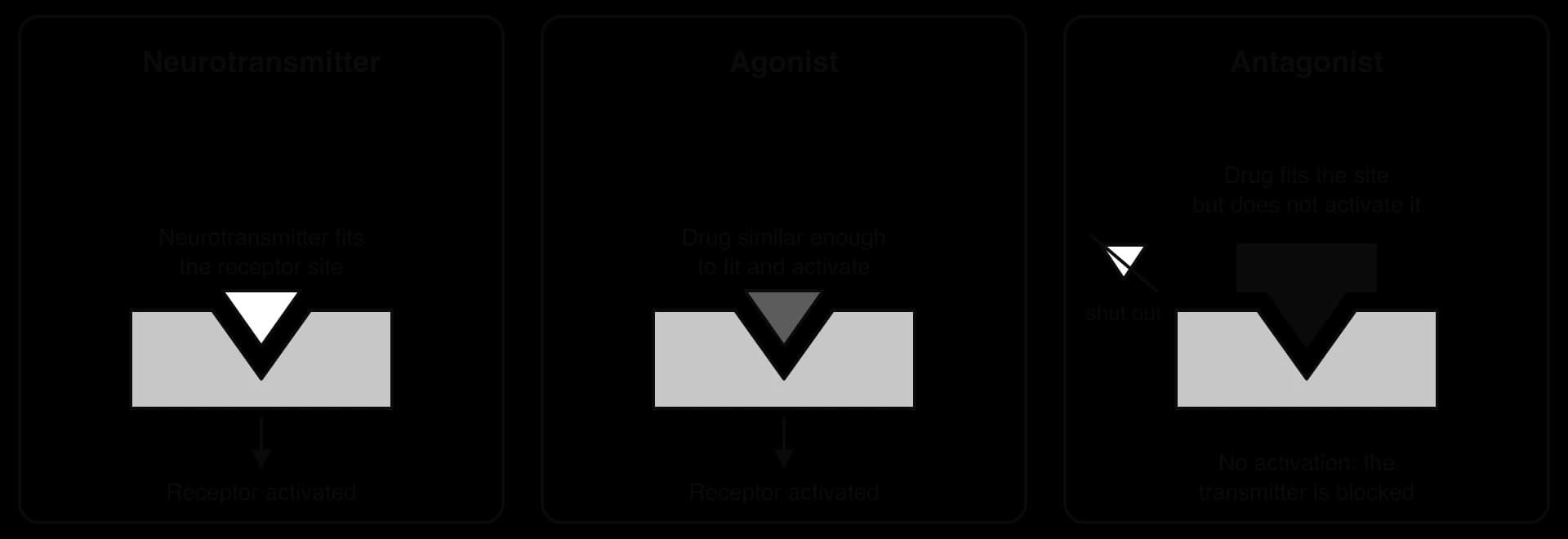
An antagonist fits the receptor but does not activate it, like a key that enters a lock but does not turn. While it occupies the binding site, the natural neurotransmitter is shut out. Scopolamine, a drug used against travel sickness, blocks one type of acetylcholine receptor (the muscarinic receptor), and at higher doses it impairs memory. Naloxone blocks opioid receptors so strongly that it pushes heroin and other opioids off them, and it is used by paramedics to reverse overdoses within minutes.
Some antagonists work before the synapse: botulinum toxin (used medically as Botox) stops the release of acetylcholine at the junction between nerve and muscle, so the muscle cannot contract.
Drug | Neurotransmitter system | Action | Effect on behaviour or health |
|---|---|---|---|
Nicotine | Acetylcholine | Agonist at nicotinic receptors | Alertness; strongly addictive because it also triggers dopamine release |
Cocaine | Dopamine (also serotonin, noradrenaline) | Indirect agonist: blocks reuptake | Euphoria and energy; high risk of addiction |
SSRIs (e.g. fluoxetine) | Serotonin | Indirect agonist: blocks reuptake | Treatment of depression and anxiety |
L-dopa | Dopamine | Precursor: the brain converts it into dopamine | Treatment of Parkinson’s disease |
Benzodiazepines (e.g. diazepam) | GABA | Strengthen GABA’s effect at its receptor | Reduce anxiety; sedation |
Scopolamine | Acetylcholine | Antagonist at muscarinic receptors | Prevents travel sickness; impairs memory at higher doses |
Naloxone | Endorphins (opioid receptors) | Antagonist | Reverses opioid overdose |
Caffeine | Adenosine | Antagonist | Alertness, reduced tiredness |
Whether a drug counts as an agonist or antagonist depends on the system being described, not on whether its effect is pleasant. Caffeine is a stimulant, yet it is an antagonist at adenosine receptors. Naloxone causes withdrawal symptoms in a person dependent on opioids, yet it saves their life in an overdose. The labels describe what happens at the receptor; the behavioural effect then depends on what that receptor normally does.
Knowledge of synapses has given medicine some of its most widely used treatments. Each one starts from the same logic: if a disorder is linked to too little or too much activity in one neurotransmitter system, a drug that acts as an agonist or antagonist in that system may reduce the symptoms. How well this works varies a great deal between disorders, and success with a drug does not prove that the disorder was caused by the chemical the drug targets.
Selective serotonin reuptake inhibitors (SSRIs), such as fluoxetine (Prozac), sertraline and citalopram, are the most commonly prescribed treatment for major depressive disorder. They block the serotonin transporter, so serotonin released into the synaptic gap stays there longer and keeps binding to receptors. Older drugs work through the same systems in other ways: monoamine oxidase inhibitors (MAOIs) block the enzyme that breaks down serotonin, dopamine and noradrenaline.
The evidence that these drugs help comes mainly from randomised, double-blind trials against a placebo. In the largest analysis so far, Cipriani et al. (2018) combined 522 trials with 116,477 adults with major depressive disorder and found that all 21 antidepressants studied were more effective than placebo over the first weeks of treatment. The differences were modest, and the certainty of much of the evidence was rated moderate to very low. Whether the benefit is large enough to matter for patients, especially those with milder depression, is still debated.
A puzzle about SSRIs is their timing. They block reuptake within hours, but mood usually improves only after several weeks. This delay suggests that the benefit comes from slower changes that follow the rise in serotonin, such as changes in the number of receptors or in the growth of new connections, rather than directly from the extra serotonin.
Serotonin is made in the brain from tryptophan, an amino acid that comes from food. In tryptophan depletion, participants eat a low-tryptophan diet and then drink a mixture of amino acids without tryptophan, which lowers the amount of tryptophan reaching the brain for a few hours and so reduces serotonin production. This makes it possible to lower serotonin temporarily in a controlled experiment.
Delgado et al. (1990) used this method with 21 patients whose depression had gone into remission while taking antidepressants. In a double-blind crossover design, each patient took part in a tryptophan-depletion session and a control session. During depletion, 14 of the 21 patients had a temporary return of depressive symptoms, and they recovered within one to two days of eating normally again. The control session had no significant effect.
Measure | Result |
|---|---|
Patients (remitted, taking antidepressants) | 21 |
Fall in total plasma tryptophan during depletion | 87% |
Fall in free plasma tryptophan during depletion | 91% |
Patients with a temporary depressive relapse | 14 of 21 (67%) |
Return to remission after normal food | 24–48 hours |
Sources: Delgado, P. L. et al. (1990). Serotonin function and the mechanism of antidepressant action. _Archives of General Psychiatry, 47(5), 411–418._
The result suggests that, for many patients, the benefit of antidepressants depends on serotonin being available. It does not show that low serotonin caused their depression in the first place. In healthy people without a family history of depression, tryptophan depletion has little effect on mood, which is one of the findings behind the current view that the “chemical imbalance” explanation of depression is too simple.
Alzheimer’s disease involves the loss of neurons, including many that release acetylcholine into the hippocampus and cortex, regions central to memory. The most common drugs for its early stages, such as donepezil, are cholinesterase inhibitors: they block acetylcholinesterase, the enzyme that breaks acetylcholine down in the synaptic gap, so the acetylcholine that is still released lasts longer. These drugs produce modest improvements in memory and daily functioning for some patients, but they do not stop the disease from progressing, because they do nothing about the death of neurons.
Animal research supports the link between acetylcholine and memory. Hunsaker, Rogers and Kesner (2007) infused drugs directly into the hippocampus of rats. Scopolamine, an acetylcholine antagonist, impaired the rats’ ability to notice that objects had been moved or replaced, while physostigmine, which blocks the breakdown of acetylcholine, improved it. Antonova et al. (2011) tested whether the same system works in the human brain.
Many addictive drugs act, directly or indirectly, on dopamine in the reward system, a network running from the midbrain to the nucleus accumbens and the prefrontal cortex. Cocaine blocks dopamine reuptake, amphetamines cause extra dopamine release, and nicotine and opioids trigger dopamine release through their own receptors. Dopamine in this system signals that something is rewarding and worth repeating, which helps explain why drug use can become compulsive.
Treatments for addiction and overdose use the same knowledge. Varenicline for smoking and methadone for heroin dependence are agonists that occupy the receptors in a steadier, less rewarding way. Naloxone, an antagonist at opioid receptors, reverses the slowed breathing that kills people in an opioid overdose; because of this, many countries now give naloxone kits to drug users, their families and police officers.
Although drug treatments are its best-known use, neurotransmission is part of the explanation of behaviour in every context.
Context | Example of neurotransmission at work |
|---|---|
Health and well-being | SSRIs block serotonin reuptake in the treatment of depression; naloxone reverses opioid overdose. |
Learning and cognition | Acetylcholine in the hippocampus supports the encoding of new memories; blocking it with scopolamine reduces hippocampal activity. |
Human relationships | Dopamine release in the reward system is active when people in love see their partner; oxytocin acts at its own receptors in bonding. |
Human development | Myelination of axons continues through adolescence, which speeds transmission in the prefrontal cortex. |
Animal studies had shown for decades that blocking acetylcholine reduces activity in the hippocampus and impairs spatial memory, for example in rats learning the position of a hidden platform in a water maze. Elena Antonova and colleagues at King’s College London aimed to find out whether blocking acetylcholine receptors in humans would also disrupt hippocampal activity while people learned the location of an object in space.
The participants were 20 healthy, right-handed men aged 23 to 35 (mean age 28). The study used a randomised, double-blind, crossover design: every participant was tested twice, once after an injection of scopolamine (0.4 mg) and once after an injection of saline (a placebo), with the order randomised and neither participants nor researchers knowing which injection had been given. Scopolamine is an antagonist at muscarinic acetylcholine receptors, so the independent variable was whether acetylcholine transmission was blocked.
Seventy to ninety minutes after the injection, participants lay in an fMRI scanner and performed the Arena task, a virtual-reality version of the water maze used with animals. They moved around a circular arena on a screen and had to learn the location of a hidden target in relation to cues around the walls. This kind of memory, for where things are in relation to landmarks rather than to one’s own body, is called allocentric spatial memory and depends on the hippocampus. The dependent variable was brain activation, measured by the BOLD signal, while participants encoded the target’s location.
Compared with placebo, scopolamine produced a significant reduction in activation of the hippocampus and the neighbouring parahippocampal gyrus during encoding. The two conditions also used different memory systems. Under placebo, the hippocampal system was more active; under scopolamine, the striatum (part of a system used for learning habits and routes) was more active, together with the amygdala.
Brain region | Placebo (saline) | Scopolamine (acetylcholine blocked) |
|---|---|---|
Hippocampus and parahippocampal gyrus | Higher activation | Significantly reduced activation |
Striatum | Lower activation | Higher activation |
Amygdala | Not specifically activated | Activated alongside the striatum |
Sources: Antonova, E., Parslow, D., Brammer, M., Simmons, A., Williams, S., Dawson, G. R. & Morris, R. (2011). Scopolamine disrupts hippocampal activity during allocentric spatial memory in humans: an fMRI study using a virtual reality analogue of the Morris Water Maze. _Journal of Psychopharmacology, 25(9), 1256–1265._
Acetylcholine transmission at muscarinic receptors is needed for the hippocampus to be fully engaged when people encode spatial memories. When it is blocked, the brain appears to shift towards a different, striatal memory system. The study extends findings from animals to humans and supports the view that the loss of acetylcholine neurons in Alzheimer’s disease contributes to its memory problems, which is the rationale for cholinesterase-inhibitor drugs.
Because scopolamine was given by the researchers, with a placebo control and double-blind procedure, the difference in hippocampal activation can be attributed to the drug rather than to expectations or to differences between people. The crossover design meant that each participant was compared with himself, which removed participant variables such as natural differences in memory or brain anatomy. This is much stronger evidence of cause and effect than a correlation between acetylcholine levels and memory would be.
However, scopolamine acts on muscarinic receptors throughout the brain and body, and causes side effects such as drowsiness and a dry mouth, so the effect on the hippocampus may be partly indirect, for example through reduced attention.
Brain activation differs a great deal between people, because of differences in anatomy, blood flow and strategy. In an independent-samples design, a difference between a scopolamine group and a placebo group could be caused by these differences rather than by the drug. Testing every participant in both conditions removes this problem, and randomising the order of the two sessions stops practice on the Arena task from favouring one condition.
fMRI measures changes in blood oxygen, which is an indirect measure of neural activity, and it cannot measure acetylcholine itself. The study therefore infers a role for a neurotransmitter from a change in blood flow in a brain region. The task was also artificial: a virtual arena on a screen is not the same as finding one’s way in a real environment, so the ecological validity of the memory measure is limited. The strength of the conclusion comes from triangulation: the human imaging result matches decades of animal studies using direct measures and lesions.
Twenty young men is a small sample, which reduces the power to detect smaller effects and limits generalisability. Women were not included, possibly to avoid hormonal variation across the menstrual cycle, but this means the findings cannot simply be assumed to apply to women. Most importantly for applications, the participants were young and healthy, whereas the people who might benefit, older adults with Alzheimer’s disease, have brains that already lack acetylcholine neurons.
Giving a drug that impairs memory to healthy people raises questions of protection from harm. The dose was low, the effects of scopolamine wear off within hours, and the drug has a long history of medical use, so the risk was small and temporary. Participants gave informed consent, and the potential benefit for understanding and treating dementia supports the study on a cost-benefit analysis.
Research on neurotransmission is one of the strongest areas of biological psychology, because neurotransmitter systems can be manipulated directly with drugs in controlled experiments. Its limitations come mainly from the gap between what happens at a synapse and what a person thinks, feels and does.
Experiments that give an agonist or antagonist under double-blind, placebo-controlled conditions, such as Antonova et al. (2011) and Delgado et al. (1990), can show that changing a neurotransmitter system changes behaviour or brain activity. They do not show that this system is the normal or only cause of the behaviour. Many studies outside the laboratory are correlational, for example comparing neurotransmitter markers in people with and without a disorder, and these cannot separate cause from effect: low levels of a neurotransmitter might be a result of a disorder, its treatment or the person’s lifestyle, which is a problem of bidirectional ambiguity.
There is no way to observe a single synapse in a living human brain. Researchers infer neurotransmitter activity from blood or spinal fluid samples, from the effects of drugs, from PET scans that show where a labelled drug binds, and from fMRI activation, each of which is indirect. Animal research allows more direct measures, such as recording from neurons, but raises questions of extrapolation to humans. Because each method has its own weaknesses, researchers look for findings that agree across methods.
Explaining a behaviour such as depression or addiction through one neurotransmitter is a form of biological reductionism. It produces testable predictions and useful treatments, but it leaves out cognitive and social factors. Whether a person develops an addiction, for example, depends on drug availability, peers, stress and expectations as well as on dopamine; and the same drug can feel very different in different settings. Neurotransmission is therefore one mechanism through which these cognitive and social factors act.
Drug challenge studies often use small samples of young men, and most come from Western countries, which raises questions of sampling bias and cultural generalisability. Clinical trials of antidepressants have also been affected by publication bias, with trials that showed little benefit less likely to be published, which once made the drugs look more effective than they are. Analyses such as Cipriani et al. (2018) tried to correct this by including unpublished trials.
Knowledge of neurotransmission has led to treatments that relieve suffering and save lives, which is the strongest argument for this research. It also brings responsibilities. Telling patients that depression is simply a “chemical imbalance” may reduce self-blame but can also make them feel that they have little control over their recovery, so researchers and clinicians have a responsibility to communicate the uncertainty in the evidence honestly. Studies that deliberately cause relapse, such as tryptophan depletion in recovered patients, are acceptable only because the effects are brief, participants consent fully and the knowledge gained is valuable.
Concept | How it applies to neurotransmission research |
|---|---|
Causality | Drug manipulations in controlled experiments show cause and effect within a system, but a drug’s effect does not show the natural cause of a behaviour. |
Measurement | Synaptic activity is measured indirectly (fMRI, PET, blood markers, drug effects), so conclusions rest on inference and triangulation. |
Perspective | Single-neurotransmitter explanations are reductionist; behaviour reflects interaction with cognitive and social factors. |
Bias | Small, male and Western samples; publication bias in drug trials. |
Responsibility | Risks to participants in drug studies; honest communication about “chemical imbalance” claims. |
Change | Agonists and antagonists are used deliberately to change health behaviour and symptoms. |
Neurotransmission can appear in Paper 1 Section A as a direct question on the process (“Describe the process of neurotransmission”) or as a term to explain with an example of behaviour. In Section B it can be applied to a scenario, most often in the health and well-being or learning and cognition contexts. In Section C it supports essays on biological explanations or treatments in health and well-being, and on biological factors in cognitive processes.
Neurons carry signals electrically along the axon as all-or-none action potentials, and chemically across synapses.
Synaptic transmission has six steps: an action potential arrives, vesicles release neurotransmitter, it crosses the synaptic gap, binds to receptors, has an excitatory or inhibitory effect, and is removed by reuptake or enzymes.
A neuron fires only if the sum of its excitatory and inhibitory inputs reaches threshold.
Agonists strengthen a neurotransmitter’s effect (by activating receptors or increasing its availability); antagonists weaken it (usually by blocking receptors).
SSRIs block serotonin reuptake, cholinesterase inhibitors block the breakdown of acetylcholine, and naloxone blocks opioid receptors: each uses knowledge of the synapse to improve health.
Antonova et al. (2011) found that blocking acetylcholine receptors with scopolamine reduced hippocampal activation during spatial memory encoding in 20 men.
Drug experiments show cause and effect within a neurotransmitter system, but a drug’s effect does not show what normally causes a behaviour or disorder.
Synaptic activity in humans is measured indirectly, and single-neurotransmitter explanations are reductionist.
I can describe the parts of a neuron and how an action potential travels along the axon.
I can describe the six steps of synaptic transmission in the correct order with the correct terms.
I can explain the difference between excitatory and inhibitory effects and what summation is.
I can explain how agonists and antagonists work, with at least two examples of each.
I can explain how SSRIs, cholinesterase inhibitors and naloxone use knowledge of neurotransmission to improve health.
I can describe and evaluate Antonova et al. (2011).
I can evaluate research on neurotransmission through causality, measurement and responsibility.
I can apply neurotransmission to an unfamiliar scenario in one of the contexts.