Explain how neurotransmitters and hormones carry signals in the body, describe the role of specific chemical messengers in behaviour, and evaluate the research, including the oxytocin and trust studies.
Each is in the Psychology glossary, with every other term in the subject.
A neurotransmitter that makes muscles contract and, in the brain, supports attention, learning and the encoding of new memories in the hippocampus.
An endocrine gland on top of each kidney that releases adrenaline and noradrenaline (from its centre) and cortisol (from its outer layer) in response to stress.
A hormone released by the adrenal glands in response to a threat, which raises heart rate, blood pressure and energy supply as part of the fight-or-flight response.
A substance released by one cell that carries a signal to other cells by binding to their receptors; the main types are neurotransmitters and hormones.
A hormone released by the adrenal glands in response to stress that raises blood sugar, suppresses non-essential functions such as immune responses, and affects memory.
A neurotransmitter involved in movement, motivation and reward, which signals that an outcome is valuable and strengthens the behaviour that led to it.
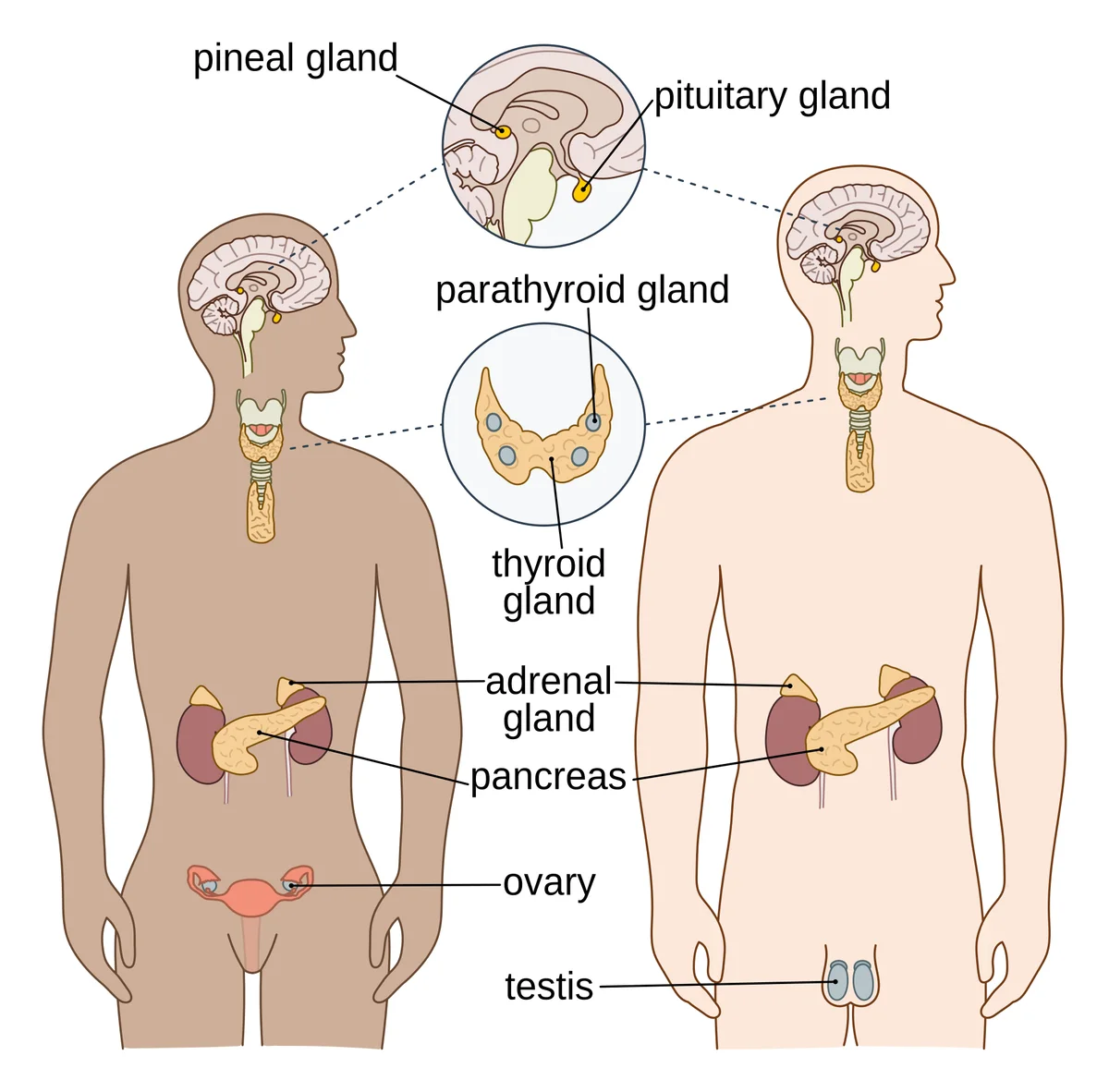
The network of glands, including the pituitary and adrenal glands and the testes and ovaries, that secrete hormones into the bloodstream to regulate the body and behaviour.
A chemical messenger secreted by an endocrine gland into the bloodstream, which carries it to target cells throughout the body that have receptors for it.
Describe what chemical messengers are and explain the difference between neurotransmitters and hormones.
Describe how the endocrine system releases hormones and how their release is regulated by the brain and by the situation.
Explain the role of one or more chemical messengers in human behaviour, using serotonin, dopamine, acetylcholine, cortisol, adrenaline, testosterone and oxytocin as examples.
Describe and evaluate the study by Kosfeld et al. (2005) on oxytocin and trust, including later attempts to replicate it.
Explain why chemical messengers and the environment interact in producing behaviour.
Evaluate research on chemical messengers with reference to causality, measurement and perspective.
Apply knowledge of chemical messengers to behaviour in different contexts.
Chemical messengers are substances that carry signals from one cell to another. The two main kinds are neurotransmitters, which act across the tiny gaps between nerve cells, and hormones, which travel in the blood. Together they influence mood, motivation, memory, stress, aggression and how people bond with and trust each other.
Chemical messengers belong to the biological approach. They link the body to behaviour in every context: cortisol in stress and health, acetylcholine in memory, dopamine and oxytocin in relationships. Research on them raises questions of causality, since a link between a chemical and a behaviour can run in either direction, of measurement, since levels in the blood or saliva are only rough guides to activity in the brain, and of reductionism, since no chemical acts on behaviour on its own.
With a free account, Augment remembers where you stopped and what you have practiced.
A control process in which a rise in a hormone’s level acts back on the hypothalamus and pituitary gland to reduce further release, keeping the level stable.
A chemical messenger released by a neuron into the synaptic gap that binds to receptors on a neighbouring cell and makes it more or less likely to fire.
A chemical messenger that acts as a neurotransmitter in the brain and as a hormone released by the adrenal glands, increasing arousal, alertness and the body’s readiness for action.
A hormone and brain chemical messenger, released by the pituitary gland and by neurons in the brain, involved in childbirth, breastfeeding and social behaviours such as bonding and trust.
A small endocrine gland below the hypothalamus that releases hormones controlling most other glands, and releases oxytocin and vasopressin into the blood.
A network of dopamine pathways, running from the ventral tegmental area to the nucleus accumbens and prefrontal cortex, that is activated by rewards and motivates behaviour that leads to them.
A neurotransmitter involved in regulating mood, sleep, appetite and impulse control, and the main target of SSRI antidepressants.
A hormone, produced mainly by the testes and in smaller amounts by the ovaries and adrenal glands, that influences sexual development, sex drive, competitiveness and dominance.
An economic game in which an investor decides how much money to send to a trustee, the amount is multiplied, and the trustee decides how much to return; the amount sent is used as a measure of trust.
Cells in the body need to coordinate their activity. A neuron in the brain must signal to other neurons, and the brain must signal to the heart, muscles and organs when the body has to prepare for danger. Both kinds of communication rely on chemicals released by one cell and detected by another. The receiving cell responds only if it has receptors that fit the chemical.
The idea of receptors is what makes chemical messengers specific. A messenger may reach millions of cells, but it changes the activity only of those with matching receptors. The same chemical can also have different effects in different tissues, because the receptors there are of different types.
Neurotransmitters are released by neurons at a synapse. When an action potential reaches the end of the axon, the neurotransmitter is released into the synaptic gap, crosses it in a fraction of a millisecond, binds to receptors on the next neuron and makes it more or less likely to fire. It is then removed by reuptake or by enzymes. This process, neurotransmission, is the basis of all fast communication in the nervous system.
Neurotransmitters act over a very short distance, on one specific cell, and their effect lasts only milliseconds. This makes them suited to fast, precise processing: seeing, moving, remembering and thinking.
Hormones are made in glands and released into the bloodstream. The blood carries them around the whole body, and they act on any cell that has the right receptors, including neurons in the brain. Because they travel further and are cleared more slowly, they act more slowly than neurotransmitters, often over seconds to hours, and their effects can last for hours or, in the case of hormones that guide development, for years.
The glands that release hormones make up the endocrine system. The most important for psychology are the hypothalamus, a small brain region that controls much of the system; the pituitary gland just below it, which releases hormones that instruct the other glands; the adrenal glands above the kidneys, which release cortisol and adrenaline; and the testes and ovaries, which release testosterone, oestrogen and progesterone.
 YouTube
Neurotransmitters and hormones work on the same principle of a chemical binding to a receptor, but they differ in where they are released, how far they travel and how long their effects last.

Feature | Neurotransmitters | Hormones |
|---|---|---|
Released by | Neurons, at axon terminals | Endocrine glands |
Route | Across the synaptic gap | Through the bloodstream |
Distance | A few tens of nanometres | The whole body |
Speed of effect | Milliseconds | Seconds to hours |
Duration | Brief: removed by reuptake or enzymes | Longer: cleared slowly by the liver and kidneys |
Targets | One specific neighbouring cell | Every cell with the right receptors |
Examples | Serotonin, dopamine, acetylcholine, glutamate, GABA | Cortisol, adrenaline, testosterone, oestrogen, oxytocin |
The division is not always clean. Several chemicals act as both. Noradrenaline is a neurotransmitter in the brain and a hormone when released by the adrenal glands. Oxytocin is a hormone when the pituitary gland releases it into the blood, for example during childbirth and breastfeeding, and it also acts directly on receptors in the brain, released by neurons. Chemicals such as oxytocin and dopamine are sometimes called neuromodulators: rather than passing a single message, they change how whole groups of neurons respond for a period of time.
Most hormone systems are controlled by the brain. The hypothalamus detects the body’s state and the person’s situation, and sends releasing hormones to the pituitary gland. The pituitary then releases hormones into the blood that stimulate a target gland, such as the adrenal cortex or the testes, to release its own hormone. This chain explains how a thought or a social situation, processed by the brain, can change hormone levels within minutes.
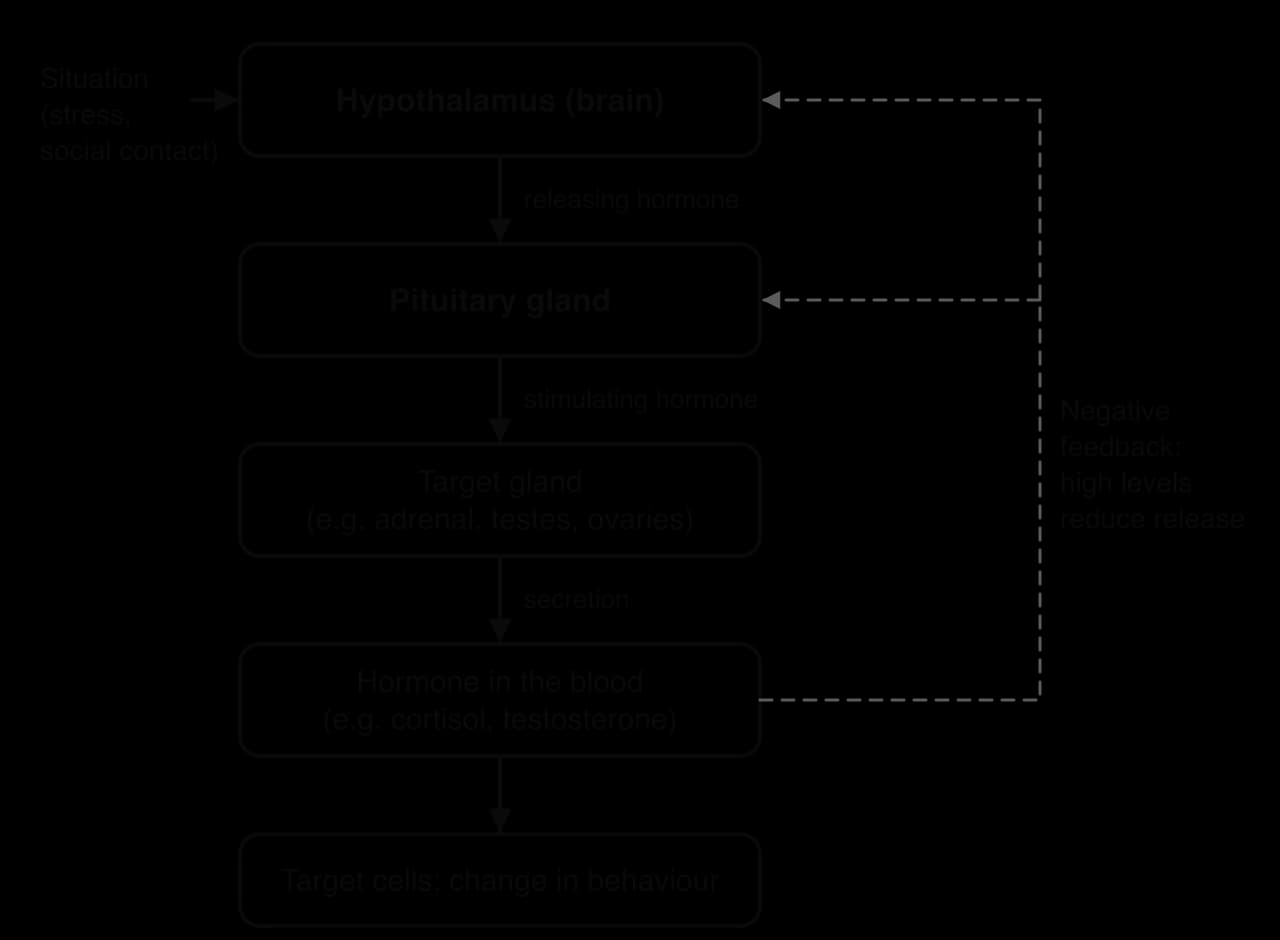
Release is kept in balance by negative feedback. When the hormone in the blood reaches a certain level, it acts on the hypothalamus and pituitary to reduce their signals, so the gland releases less. The system works like a thermostat. If feedback fails, hormone levels can stay high for long periods, which is one way in which chronic stress is thought to damage health.
Because the hypothalamus responds to what a person perceives, hormone levels depend on the situation as well as on the body. Cortisol rises when a person faces a threat they appraise as hard to control, such as public speaking in front of judges; oxytocin is released during touch and close social contact; testosterone levels change around competition and with life events such as becoming a parent. The relationship therefore runs both ways: hormones influence behaviour, and behaviour and situations influence hormones.
This two-way relationship is a clear example of interactionism. It is also a reason to be careful with studies that simply measure a hormone and a behaviour at the same time: such correlations cannot show which came first. Experiments that give a hormone or block it, under placebo-controlled conditions, are needed to test whether it causes a change in behaviour.
More than a hundred chemical messengers are known. Psychologists focus on a small number whose links with behaviour are best established and which appear across many areas of life. For each, the evidence comes from three main sources: experiments that raise or lower the messenger and observe the effect, correlational studies that measure its level in people who differ in a behaviour, and animal research.
 YouTube
Serotonin is a neurotransmitter released by neurons whose cell bodies lie in the brainstem and whose axons reach almost the whole brain. It is involved in mood, sleep, appetite and the control of impulses, and it is the target of the most widely used antidepressants, the SSRIs, which block its reuptake. Its role in depression is more complicated than the popular “chemical imbalance” idea suggests: large reviews have found no consistent evidence that depression is caused by low serotonin.
Serotonin also plays a role in social decisions. Crockett et al. (2008) lowered serotonin in healthy volunteers at Cambridge using tryptophan depletion and asked them to play the ultimatum game, in which a player accepts or rejects a split of money offered by another player; if the offer is rejected, neither receives anything. With serotonin lowered, participants rejected a higher proportion of unfair offers, but not fair ones, even though their mood and their judgements of how fair the offers were did not change. The researchers concluded that serotonin helps people regulate their emotional reactions to unfair treatment, so lowering it made them more likely to punish unfairness at a cost to themselves.
Dopamine is a neurotransmitter with several separate pathways in the brain. One, from the substantia nigra to the striatum, controls movement: its degeneration causes the tremor and slowness of Parkinson’s disease. Another, the reward system, runs from the ventral tegmental area in the midbrain to the nucleus accumbens and the prefrontal cortex. It is active when people anticipate or receive rewards such as food, money, social approval and drugs, and it motivates them to seek those rewards again.
Research on monkeys by Wolfram Schultz showed that dopamine does more than signal pleasure. Schultz, Dayan and Montague (1997) described how dopamine neurons fired when a monkey received an unexpected drop of juice. Once a light reliably predicted the juice, the neurons fired to the light instead, and if the predicted juice did not arrive, their activity dropped below normal. Dopamine therefore signals a reward prediction error: the difference between the reward expected and the reward received. This makes it a teaching signal that helps the brain learn which actions lead to rewards.
The reward system helps explain why some activities are hard to stop. Addictive drugs increase dopamine in the nucleus accumbens directly, and apps and games that deliver rewards at unpredictable moments make use of the same prediction-error signal. In relationships, dopamine-rich reward areas are active when people who are in love look at a photograph of their partner.
Acetylcholine was the first neurotransmitter to be discovered. Outside the brain it makes muscles contract; inside the brain it supports attention and the encoding of new memories, especially in the hippocampus. Neurons that release acetylcholine are among the first to be lost in Alzheimer’s disease, and the most common drugs for the disease work by slowing its breakdown. Antonova et al. (2011) blocked acetylcholine receptors with the drug scopolamine in 20 healthy men and used fMRI to show that activity in the hippocampus during a spatial memory task fell compared with a placebo.
Cortisol is a hormone released by the outer layer of the adrenal glands as the final step of the HPA axis, the body’s slower response to stress. It increases the supply of glucose to the muscles and brain, suppresses functions not needed in an emergency, such as digestion and parts of the immune response, and feeds back on the brain to switch the stress response off. Short bursts help people cope with a challenge; long periods of high cortisol are linked to poorer health.
The hippocampus has many cortisol receptors, which makes memory sensitive to stress. Newcomer et al. (1999) gave 51 healthy adults cortisol tablets or a placebo for four days in a randomised, double-blind design. Two doses were used, one matching the cortisol levels of mild stress (40 mg a day) and one matching those of major stress (160 mg a day).
The higher dose reduced verbal declarative memory, measured by recall of a paragraph, but did not affect attention, executive function or memory for non-verbal material, and memory recovered within six days of stopping. Because the hormone was given by the researchers, the study shows that cortisol at stress levels can cause a temporary, specific impairment of memory.
Adrenaline is released by the centre of the adrenal glands within seconds of a threat, as part of the fight-or-flight response. It raises heart rate and blood pressure, opens the airways and releases stored energy, preparing the body for action. Noradrenaline, a closely related chemical, is released at the same time, both as a hormone and as a neurotransmitter in the brain.
Adrenaline and noradrenaline also help explain why emotional events are remembered well. Cahill et al. (1994) gave participants either propranolol, a drug that blocks the beta-adrenergic receptors on which these chemicals act, or a placebo, before they were shown either an emotionally arousing short story or a closely matched neutral one. In a later memory test, the placebo group remembered the emotional story better than the neutral one, as expected, but propranolol removed this advantage, while having no effect on memory for the neutral story. The study suggests that arousal hormones strengthen the storage of emotional memories.
Testosterone is a hormone released mainly by the testes in males and, in smaller amounts, by the ovaries and adrenal glands in females. It shapes the development of the body before birth and at puberty, and in adults it is linked to sex drive, competitiveness and the pursuit of status. Its link with aggression is the most studied and the most often misunderstood.
Dabbs et al. (1995) measured testosterone in saliva from 692 male prison inmates in the United States and compared it with their criminal records and behaviour in prison. Inmates with higher testosterone had more often committed violent, personal crimes and broke more prison rules, especially through confrontation. The study is correlational: it cannot show whether testosterone led to violence, whether a violent, competitive life raised testosterone, or whether a third factor influenced both. An earlier study by Dabbs, Jurkovic and Frady (1991) of 113 young offenders found that the link between testosterone and violence depended on cortisol levels, which shows that one hormone’s effect depends on others.
Oxytocin is a hormone made in the hypothalamus and released into the blood by the pituitary gland, where it causes contractions in childbirth and the release of milk during breastfeeding. It is also released by neurons within the brain, where it acts on receptors in areas involved in social behaviour. Animal research, especially on voles, linked it to the formation of bonds between mothers and offspring and between mating partners, and this led researchers to ask whether it also influences human social behaviour, including trust in strangers.
Michael Kosfeld, Markus Heinrichs, Paul Zak, Urs Fischbacher and Ernst Fehr, working at the University of Zurich, aimed to find out whether oxytocin causes an increase in trust between people. They also wanted to know whether any effect was specific to trusting other people or simply reflected a greater willingness to take risks of any kind.
The study was a double-blind, placebo-controlled experiment with an independent samples design. The participants were healthy male university students in Zurich. Each received a single dose of 24 international units of oxytocin or a placebo through a nasal spray, and waited for it to take effect before taking part. Neither the participants nor the researchers who ran the sessions knew who had received oxytocin.
Trust was operationalised with the trust game. Each participant was given 12 monetary units (MU), later exchanged for real money. In the role of investor, he could send 0, 4, 8 or 12 MU to an anonymous trustee. The experimenter tripled whatever was sent, and the trustee then decided how much to return, which could be nothing at all. Sending money is a measure of trust because the investor gains only if the trustee chooses to be fair. In the trust experiment, 29 investors received oxytocin and 29 received the placebo, and each made four investment decisions with different trustees.
A separate risk experiment served as a control. Its investors faced the same choices and the same uncertain returns, but the amount returned was decided by a random mechanism instead of by a person. If oxytocin simply made people more willing to take risks, it should increase investment in both experiments; if it specifically increased trust in people, it should affect only the trust game.
In the trust game, investors given oxytocin sent more money than those given the placebo: on average about 17% more. The difference was clearest at the top of the scale. Thirteen of the 29 oxytocin investors (45%) showed the maximal level of trust, sending all 12 MU, compared with 6 of the 29 placebo investors (21%). In the risk experiment, oxytocin had no effect on how much investors sent. Oxytocin also did not change how much trustees returned, so it did not make people more generous in general.
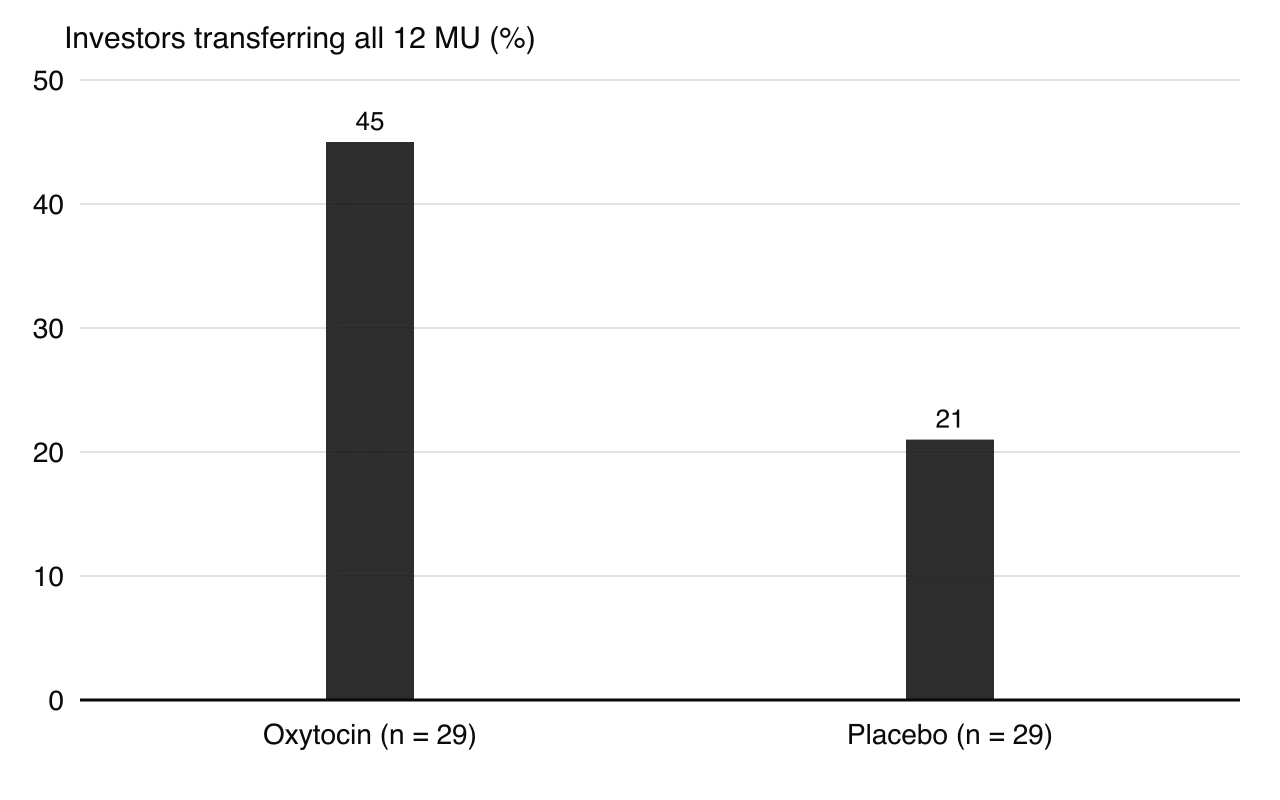
Sources: Kosfeld, M., Heinrichs, M., Zak, P. J., Fischbacher, U. & Fehr, E. (2005). Oxytocin increases trust in humans. _Nature, 435, 673–676._
Kosfeld and colleagues concluded that oxytocin increases trust in humans, and that it does so by increasing willingness to accept the social risks of relying on another person, not by increasing risk-taking in general. The finding fitted animal research on oxytocin and social approach, and it suggested a biological basis for trust, a behaviour on which friendships, families and economic exchange all depend.
As a true experiment with a placebo control, random allocation and a double-blind procedure, the study could test cause and effect, which correlational studies of oxytocin levels in the blood cannot. The risk-game control was a particular strength: by holding the financial risk constant and changing only whether a person decided the outcome, it ruled out the alternative explanation that oxytocin simply made people bolder.
The trust game turns an abstract construct into a number, which makes trust measurable, but sending money to an anonymous stranger in a laboratory is a narrow version of trust compared with trusting a friend or partner over years. There is also uncertainty about the dose. It is not clear how much intranasally sprayed oxytocin reaches the brain, so the effect may come partly from oxytocin acting elsewhere in the body.
The most serious problem is that the result has not been reliably reproduced. In a review, Nave, Camerer and McCullough (2015) concluded that the finding that intranasal oxytocin increases trust “has not replicated well”, that studies measuring oxytocin in the blood used unreliable methods, and that large genetic studies found no consistent link between oxytocin-related genes and trust.
Larger replications have since tested the original design directly. Declerck et al. (2020), in a pre-registered replication with 321 participants, found no effect of oxytocin on trust. Kroll et al. (2026), in a second pre-registered replication with 211 participants, also found no effect, and pooling the two datasets (532 participants) suggested that any effect is too small to detect in normal laboratory studies.
The sample was small and consisted only of young male students in one Swiss city, which limits generalisability. Oxytocin is known to interact with sex hormones, so the effect in women may differ. The small sample also makes a type I error, a false positive, more likely, which may help explain why later, larger studies did not find the effect.
Popular reports called oxytocin a “love hormone” or “cuddle chemical”. Research does not support this simple label. De Dreu et al. (2011) gave Dutch men oxytocin or a placebo and found that oxytocin increased favouritism towards their own group (Dutch people) and, to a smaller degree, negative attitudes towards out-group members. Oxytocin seems to strengthen bonds within a group rather than making people kinder to everyone, and its effects depend on who the other person is and on the setting.
Because chemical messengers affect almost every behaviour, they appear in all four contexts. The same messenger can play different roles in different contexts, and in each case it interacts with cognitive and social factors.
Context | Messenger | Example of its role |
|---|---|---|
Health and well-being | Serotonin; cortisol | SSRIs act on serotonin in the treatment of depression; long-term high cortisol is linked to stress-related illness. |
Learning and cognition | Acetylcholine; cortisol; adrenaline | Acetylcholine supports memory encoding; high cortisol impairs verbal memory; arousal hormones strengthen emotional memories. |
Human relationships | Oxytocin; dopamine; testosterone | Oxytocin is linked to bonding and in-group favouritism; dopamine reward areas are active in romantic love; testosterone is associated with competition and dominance. |
Human development | Testosterone; oestrogen; cortisol | Sex hormones drive the changes of puberty; early chronic stress can alter how the cortisol system responds later in life. |
Research on chemical messengers uses two kinds of evidence with very different strengths. Experiments that give a hormone or drug, or lower a neurotransmitter, under double-blind placebo-controlled conditions can show that the chemical causes a change, as Newcomer et al. (1999) and Cahill et al. (1994) did.
Many studies, especially of hormones and complex social behaviour, are correlational, like Dabbs et al. (1995). These are open to bidirectional ambiguity and third variables, which matters because behaviour and situations themselves change hormone levels.
Chemical messengers in the living human brain are almost never measured directly. Researchers use levels in blood, saliva or urine, which may not reflect levels in the brain; they give chemicals by nasal spray or tablet, without knowing how much reaches the brain; or they block receptors with drugs that also act elsewhere. Methods for measuring oxytocin in the blood have been shown to be unreliable, which undermined many early correlational findings. These problems of measurement mean that conclusions are often weaker than headlines suggest.
Explaining trust by oxytocin or aggression by testosterone is a form of biological reductionism. It gives precise, testable claims, but it can suggest that behaviour is fixed by body chemistry, which ignores evidence that chemical effects depend on the situation and on other chemicals. Oxytocin increases favouritism towards the in-group rather than trust in everyone; the link between testosterone and violence depends on cortisol and on social circumstances. An interactionist explanation, in which chemical messengers change how people respond to their situations, fits the evidence better.
Many key studies used only men, often to avoid the effects of the menstrual cycle, which leaves large gaps in what is known about women. Most samples are also Western students. The way findings are communicated carries responsibility: claims that a “trust spray” or a “love hormone” exists, or that high testosterone explains violent crime, can be misused, for example in marketing or to excuse behaviour, while the evidence is uncertain. The failure of the oxytocin and trust finding to replicate is also a reminder of publication bias, since exciting first results are published and widely reported more easily than later null results.
Chemical messengers can appear in Paper 1 Section A as a direct question on the role of a messenger in a behaviour, in Section B applied to a scenario in any context, and in Section C as evidence in essays on biological explanations in health and well-being or chemical messengers in interpersonal relationships.
Chemical messengers carry signals between cells by binding to receptors; the two main types are neurotransmitters and hormones.
Neurotransmitters cross the synaptic gap in milliseconds and act on one cell; hormones travel in the blood, act more slowly and reach every cell with the right receptors.
The endocrine system is controlled largely by the hypothalamus and pituitary gland, with negative feedback, and hormone release responds to the situation.
Serotonin is linked to mood and impulse control, as Crockett et al. (2008) showed with tryptophan depletion; dopamine to reward prediction and motivation; acetylcholine to memory.
Cortisol at stress levels impaired verbal memory in Newcomer et al. (1999); blocking adrenaline’s receptors removed the advantage for emotional memories in Cahill et al. (1994).
Testosterone is associated with dominance and violent crime, as in Dabbs et al. (1995), but the evidence is correlational and the relationship is bidirectional.
Kosfeld et al. (2005) found that oxytocin increased trust (45% vs 21% maximal trust), but later, larger studies have not replicated the effect.
Research faces problems of causality, indirect measurement, reductionism and male-only samples; explanations work best when they show messengers interacting with the situation.
I can explain the difference between neurotransmitters and hormones, with examples of each.
I can describe how the endocrine system releases hormones and how negative feedback controls them.
I can explain the role of at least three chemical messengers in specific behaviours, with evidence.
I can describe and evaluate Kosfeld et al. (2005), including the replication problem.
I can explain why the relationship between hormones and behaviour runs in both directions.
I can evaluate research on chemical messengers with reference to causality, measurement and perspective.
I can apply knowledge of chemical messengers to an unfamiliar scenario in one of the contexts.