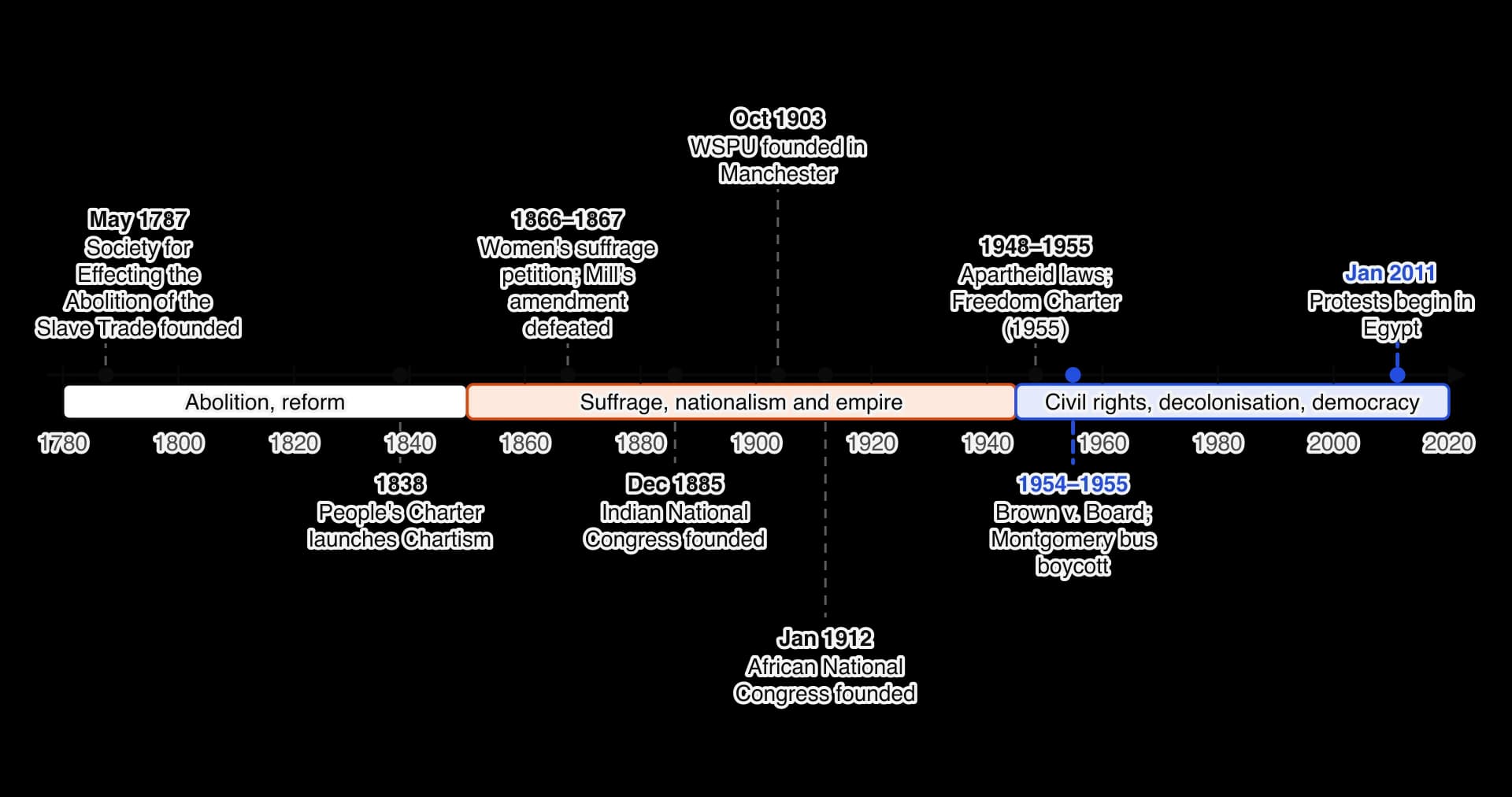
Explain why popular movements emerged from 1750, weighing political, economic, ideological and social factors across six movements in four regions.
Each is in the History glossary, with every other term in the subject.
South Africa's main African nationalist organisation, founded in January 1912 as the South African Native National Congress; banned from 1960 to 1990, it won the first democratic election in 1994.
The belief that Africans should govern themselves and lead their own liberation from colonial or white-minority rule.
The political organisation founded at Dhaka in December 1906 to represent the interests of Indian Muslims; from 1940 it demanded a separate state, Pakistan.
The youth wing of the ANC founded in 1944 by activists including Nelson Mandela, Walter Sisulu and Oliver Tambo, which pushed the ANC towards African nationalism and mass action.
Afrikaans for "separateness": the system of racial classification and segregation enforced by law in South Africa from 1948 until the early 1990s.
An Egyptian activist group formed online in 2008 to support a planned strike at Mahalla al-Kubra; it helped to organise the protests of 25 January 2011.
The South African law of 1953 that placed African schooling under state control with a curriculum designed to prepare Africans for manual and subordinate work.
Popular movements are one of the main ways in which ordinary people have changed history since the eighteenth century. The campaigns against the slave trade, for women's votes, for Indian independence, for civil rights in the United States, against apartheid and against dictatorship in Egypt each began with a small group and grew into a movement of hundreds of thousands or millions. Explaining why they emerged, and why at that moment, is the first step to understanding what they achieved.
With a free account, Augment remembers where you stopped and what you have practiced.
British rule over India from 1858 to 1947, through a viceroy responsible to the British government.
One of three cross-party bills of 1910–1912 that would have given the vote to a limited number of propertied women; all failed, which angered the suffrage movement.
The alliance of the ANC with Indian, Coloured, white democratic and trade union organisations in South Africa in the 1950s, which adopted the Freedom Charter in 1955.
The non-violent campaign launched by the ANC and the South African Indian Congress in June 1952, in which volunteers deliberately broke apartheid laws and accepted arrest.
The campaign launched by the Black newspaper the Pittsburgh Courier in February 1942 for victory over fascism abroad and over racism at home.
The argument, made by Dadabhai Naoroji and others from the 1870s, that British rule drained India's wealth to Britain through payments to London, salaries, pensions and profits.
In Egypt, the law in force almost continuously from 1981 to 2012 that allowed detention without trial, banned most demonstrations and gave the security police wide powers.
The eighteenth-century intellectual movement that judged beliefs and institutions by reason and argued for natural rights, religious toleration and limits on arbitrary power.
A Protestant revival movement of the eighteenth and nineteenth centuries that stressed personal conversion, the authority of the Bible and a duty to reform society's sins.
President Truman's order of 26 July 1948 requiring equality of treatment and opportunity in the US armed forces, which led to their desegregation.
Indian nationalists such as Tilak, Lajpat Rai and Bipin Chandra Pal who from the 1890s demanded swaraj and supported boycotts and mass protest; the name was given by opponents.
Presenting a problem in a way that names who is to blame, what should change and why ordinary people can change it, so that people see their situation as unjust and fixable.
The statement of principles adopted by the Congress of the People at Kliptown on 26 June 1955, declaring that South Africa belongs to all who live in it and demanding equal rights and a democratic state.
A sense shared by a group that it is being treated unjustly, for example denied rights, exploited, humiliated or ignored.
The South African law of 1950 that assigned separate residential and business areas to each racial group and was used to remove people by force from areas declared for whites.
A general stoppage of work and business as a form of protest, a long-standing practice in South Asia that Gandhi used on a national scale from 1919.
The political organisation founded in Bombay in December 1885 that led the movement for Indian self-government and independence.
The killing of unarmed Indians in an enclosed ground at Amritsar on 13 April 1919 by troops under Brigadier-General Dyer: 379 dead by the official count, about 1,000 by a Congress estimate.
"Enough": the Egyptian Movement for Change of 2004–2005, a coalition of activists that protested against a fifth term for Hosni Mubarak and the succession of his son Gamal.
The campaign by Indian Muslims from 1919 to protect the Ottoman sultan as caliph after the First World War; Gandhi allied with it in the non-cooperation movement.
A political ideology stressing individual rights and freedoms, equality before the law, limited government and government by consent.
Jacquelyn Dowd Hall's term (2005) for a civil rights movement that began in the labour and left-wing politics of the 1930s and 1940s and continued beyond 1968.
In South Africa, the system by which African men worked on fixed contracts in mines and cities far from home while their families stayed in the rural reserves.
The organisations and networks (churches, unions, colleges, clubs, online groups) through which a movement recruits members, raises money and coordinates action.
The early leaders of the Indian National Congress, such as Gokhale and Naoroji, who sought gradual reform and self-government through petitions and constitutional methods.
The national campaign of 1920–1922 led by Gandhi and the Indian National Congress, in which Indians boycotted British courts, schools, councils, titles and cloth. Gandhi called it off after the violence at Chauri Chaura in February 1922.
The principle that a society should not be organised by race at all; in South Africa, the idea that the struggle was against apartheid as a system, not against a racial group.
The South African organisation founded in 1959 by Robert Sobukwe and others who left the ANC, arguing that Africans should lead the liberation struggle alone.
Laws in South Africa that required Africans to carry documents showing where they were allowed to live and work, used to control their movement into towns.
The US Supreme Court ruling of 1896 that racial segregation was constitutional if the separate facilities were equal, the legal basis of Jim Crow until 1954.
The features of a political system at a given time that make collective action more or less likely to succeed, such as allies in power, divisions among elites, court rulings or a weakened ruler; Doug McAdam's term (1982).
A sustained, organised campaign by large numbers of ordinary people to change, or to defend, the political, social or economic order, mainly through action outside the formal institutions of government.
The South African law of 1950 that classified every person by race, the foundation on which other apartheid laws were built.
The gap between what people believe they deserve and what they actually get; Ted Robert Gurr argued (1970) that this gap, more than absolute poverty, drives protest.
The Indian law of March 1919 that extended wartime powers to detain suspected revolutionaries without trial, provoking Gandhi's first all-India campaign.
Gandhi's method of non-violent resistance, meaning "truth-force" or "holding firmly to truth", in which protesters refuse to obey unjust laws and accept punishment without using violence.
A system in which a farmer works land owned by someone else in return for a share of the crop, common among Black families in the US South after 1865 and often leaving them in debt.
Charles Tilly's term for a sustained campaign of public claims on authorities, carried out through a repertoire of actions such as meetings, petitions and marches, and through public displays of worthiness, unity, numbers and commitment.
The committee founded in London in May 1787, mostly by Quakers, with Thomas Clarkson and Granville Sharp among its members, to campaign for an end to the British slave trade through petitions, publications and lobbying.
The Quakers, a Protestant Christian group founded in seventeenth-century England, who believed in the equal worth of every person and led the early campaign against the slave trade.
The 1772 ruling by Lord Mansfield that James Somerset, an enslaved man in England, could not be forcibly removed from the country; it was widely taken to mean that slavery could not exist in England.
"Self-rule": the goal of Indian nationalists, meaning self-government within the empire for some and full independence for others; Gandhi also used it for moral self-control.
Charles Tilly's shorthand for what a social movement displays in public to show its strength: worthiness, unity, numbers and commitment.
A population in which a very large share of people are young adults, usually after a period of high birth rates; it can increase pressure for jobs and political change.
The killing in 1781 of more than 130 enslaved Africans thrown overboard from the British slave ship Zong; the owners' insurance claim of 1783 made the case a scandal for abolitionists.
People have always protested, rioted and rebelled. What is new after about 1750 is the popular movement: a campaign that lasts for years, has its own organisations, makes public demands on those in power and recruits ordinary people in large numbers. Unlike a bread riot, which ended when the crowd dispersed, a movement kept its organisation and its demands alive between protests.
The American sociologist Charles Tilly, in Social Movements, 1768–2004 (2004), dates the first modern social movement to London in 1768, when supporters of the radical journalist John Wilkes organised meetings, petitions and processions for him after his election as MP for Middlesex and his imprisonment; the campaign grew in 1769, when the House of Commons repeatedly expelled him and refused to let him take his seat. Tilly argued that a social movement has three parts: a campaign of claims on authorities, a repertoire of public actions (meetings, petitions, marches, boycotts, pamphlets) and public displays of what he called WUNC: worthiness, unity, numbers and commitment.
Tilly's definition explains why popular movements appear at roughly the same time as parliaments that could be petitioned, newspapers that could report them and towns large enough to hold mass meetings. It also explains why the movements studied here took different forms. In Britain, a parliamentary state with a free press, abolitionists and suffragists could petition and lobby. In colonial India, apartheid South Africa and Mubarak's Egypt, where most people had no vote, movements had to build their power in the street, the workplace and the boycott.
Kind of movement | What it wants | Examples from 1750 |
|---|---|---|
Reform and rights | Changes in the law within an existing state: the vote, equal rights, the end of a practice | British abolitionism (1787–1838); Chartism (1838–c.1858); women's suffrage (1866–1928); US civil rights (1954–1968) |
National and anti-colonial | Self-government or independence for a people under foreign rule | Indian national movement (1885–1947); the Wafd in Egypt (1919); Kenyan nationalism |
Revolutionary and democratic | The overthrow of a ruler or regime | Anti-apartheid (1948–1994); Solidarity in Poland (1980–1989); Egypt (2011) |
Labour and economic | Better pay and conditions, land, control of resources | Trade unions; the agrarian movement of Emiliano Zapata in Mexico (1910–1919) |
Indigenous, environmental and identity | Land rights, recognition, protection of the environment | Indigenous rights in Canada (from the 1960s); Chipko in India (1973–); the Green Belt Movement in Kenya (1977–) |
The categories overlap. The anti-apartheid movement was a rights movement, a national movement and, for some of its members, a socialist one. The Indian national movement included peasant and labour campaigns as well as constitutional politics. The categories are still useful, because the factors behind a movement often depend on its kind: economic distress weighs more heavily in labour movements, foreign rule in national ones.
Six movements serve as the core cases for explaining why popular movements emerged. The table of the six movements gives their regions, dates and aims; together they come from all four regions and span more than two centuries.
Movement | Region | Dates | What it wanted |
|---|---|---|---|
British abolitionism | Europe (with the Caribbean and West Africa) | 1787–1838 | An end to the British slave trade (achieved 1807), then to slavery in the British Empire (1833–1838) |
British women's suffrage | Europe | 1866–1928 | Votes for women on the same terms as men |
Indian national movement | Asia and Oceania | 1885–1947 | Self-government, then full independence (purna swaraj) from Britain |
US civil rights movement | The Americas | 1954–1968 | An end to segregation and to the denial of Black Americans' right to vote |
Anti-apartheid movement | Africa and the Middle East | 1948–1994 | An end to apartheid and a non-racial democracy |
Egyptian revolution of 2011 | Africa and the Middle East | January–February 2011 | The fall of Hosni Mubarak; "bread, freedom, social justice" |
The simplest explanation of a movement is that people were angry about something. Historians accept that grievance matters, but point out that it explains too little. Most poor, oppressed or excluded people in history never joined a movement, and many movements formed when conditions were improving, not when they were at their worst. Explanations therefore look for what turned grievance into collective action.
A grievance is a sense that a group is being treated unjustly: denied rights, exploited, humiliated or ignored. Early theories of protest stressed grievance. The political scientist Ted Robert Gurr, in Why Men Rebel (1970), argued that what drives protest is relative deprivation: the gap between what people believe they deserve and what they actually get. James C. Davies (1962) suggested that revolutions are most likely when a period of rising expectations is followed by a sudden reversal, so that hopes are disappointed.
Relative deprivation helps to explain why movements often came from groups whose position was improving. Educated Indian lawyers, Black war veterans returning to the American South in 1945 and university graduates without jobs in Cairo in 2010 all had rising expectations that the existing order blocked. Its weakness is that it is hard to measure, and it still does not explain why some deprived groups organised while others did not.
In Political Process and the Development of Black Insurgency, 1930–1970 (1982), the sociologist Doug McAdam argued that the US civil rights movement emerged because the political system opened up. The Great Migration made Black voters important in Northern cities, the Democratic Party needed their votes, the Supreme Court began to strike down segregation and the Cold War made racism an embarrassment abroad. McAdam called this changing set of conditions the political opportunity structure.
Movements need people who can organise, places to meet, money, means of communication and networks of trust. Sociologists call these mobilising structures. In The Origins of the Civil Rights Movement (1984), Aldon Morris showed that the Montgomery bus boycott of 1955–1956 was built on Black churches, their ministers and congregations, and on existing groups such as the Women's Political Council. In other movements the same role was played by Quaker meetings, trade unions, universities, mosques, women's colleges and, in 2011, Facebook pages.
People join movements when they come to see their situation as unjust and changeable, not as natural or the will of God. Ideas do this work. Sociologists call it framing: presenting a problem in a way that names who is to blame, what should change and why ordinary people can change it. Abolitionists framed the slave trade as a national sin; Indian nationalists framed poverty as the result of British policy, not of fate; the Freedom Charter framed South Africa as a country that "belongs to all who live in it".
Even when grievances, opportunities, resources and ideas are present, a movement usually needs a trigger: an event that turns quiet resentment into public action. Triggers in the cases studied here include the partition of Bengal in 1905, the Amritsar massacre of 1919, the murder of Emmett Till in 1955 and the fall of Tunisia's president in January 2011. A trigger explains the timing of a movement more than its underlying causes.
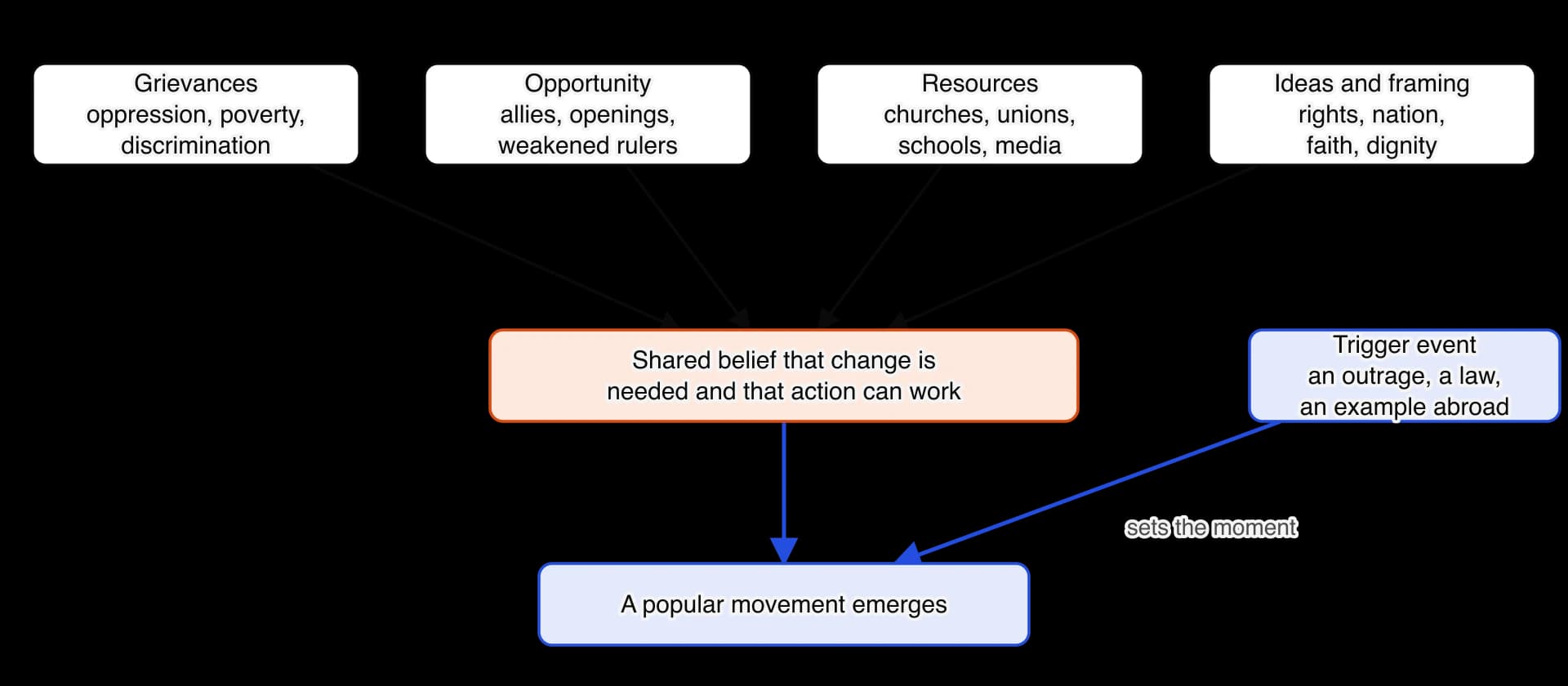
The framework diagram brings the five elements together. No single element is enough. A useful habit is to ask, for any movement, which elements were present for a long time and which changed just before it emerged: the elements that changed usually explain why it emerged when it did.
Political factors are the ways in which power was organised and used: who could vote, who made the laws, how the state treated its critics and whether it was open to change. They work in two directions. Exclusion and repression create grievances; openings and weaknesses in the political system create opportunities. Most movements in the core set grew out of both at once.
The British women's suffrage movement was a direct response to exclusion. The Great Reform Act of 1832 was the first law to state that voters in parliamentary elections must be "male persons", so a custom became a rule. In the following decades Parliament widened the franchise for men step by step while women remained shut out, whatever their wealth or education.
Date | Who could vote in parliamentary elections | Women |
|---|---|---|
Before 1832 | A small minority of men, under property qualifications that varied from place to place | No law excluded them, but in practice they did not vote |
1832 (Great Reform Act) | Male owners and tenants of property worth £10 a year in the boroughs, plus county freeholders | Excluded by the words "male persons" |
1867 (Second Reform Act) | All male householders in the boroughs; the electorate of England and Wales roughly doubled, from about one to two million men | Excluded; Mill's amendment to include them defeated |
1884 (Third Reform Act) | Householder franchise extended to the counties; about 60 per cent of adult men | Excluded |
1918 (Representation of the People Act) | All men aged 21 and over | Women aged 30 and over who met a property qualification |
1928 (Equal Franchise Act) | All adults aged 21 and over | Equal terms with men |
Data: UK Parliament, Living Heritage.
The second of these reforms gave the movement its starting point. In June 1866 John Stuart Mill, the philosopher and newly elected MP for Westminster, presented a petition signed by 1,499 women asking for the vote. When the Second Reform Act was debated, Mill moved an amendment on 20 May 1867 to replace the word "man" with "person". It was defeated by 196 votes to 73. Suffrage societies were founded in Manchester, London and Edinburgh within months, and in 1897 they joined in the National Union of Women's Suffrage Societies (NUWSS) under Millicent Fawcett.
Political exclusion was made sharper by partial inclusion. The Municipal Franchise Act of 1869 allowed unmarried women who paid local rates to vote in town council elections, and from 1870 women could vote for and sit on school boards. Women therefore took part in local government, ran charities and campaigned for parties, yet could not vote for Parliament. Each time the franchise was widened for men, including working men with less education and property than many women, the exclusion of women looked less like a principle and more like prejudice.
The founding of Emmeline Pankhurst's Women's Social and Political Union (WSPU) in Manchester on 10 October 1903, with the motto "Deeds not words", and its turn to militancy are linked to political opportunity as well as exclusion. A Liberal government won a landslide in January 1906, and many Liberal MPs said they supported women's suffrage. The new prime minister, Henry Campbell-Bannerman, and his successor from 1908, H. H. Asquith, would not make it government policy. Rising hopes followed by repeated disappointment, including the failure of three Conciliation Bills in 1910–1912, fit the pattern of relative deprivation and explain why the movement grew and radicalised in these years.
In South Africa, political exclusion was total and increasingly enforced by law. From the creation of the Union of South Africa in 1910, most Black South Africans could not vote for Parliament. The African National Congress (ANC), founded in January 1912 as the South African Native National Congress, was itself a response to this exclusion. For its first three decades it was a cautious organisation of chiefs, clergy, teachers and lawyers who sent petitions and delegations to Pretoria and London.
The victory of the National Party in the whites-only election of May 1948 turned exclusion into a system. Apartheid ("separateness") classified every person by race and separated every part of life. Within five years the government passed the core laws:
the Prohibition of Mixed Marriages Act (1949), banning marriage across the colour line;
the Population Registration Act (1950), classifying every South African as White, Coloured, Native (African) or, later, Asian;
the Group Areas Act (1950), assigning separate residential and business areas to each race and allowing forced removals;
the Suppression of Communism Act (1950), defining "communism" so widely that almost any opposition to apartheid could be banned;
the Bantu Education Act (1953), placing African schooling under a state department designed to prepare Africans for manual work;
the Reservation of Separate Amenities Act (1953), segregating public facilities.
These laws were added to older pass laws, which forced African men (and from the 1950s women) to carry documents showing where they could live and work. Apartheid gave Africans, Coloured and Indian South Africans a common enemy and made petitions useless. The ANC Youth League, founded in 1944 by younger activists including Nelson Mandela, Walter Sisulu and Oliver Tambo, used the moment to push the ANC into mass action. In December 1949 the ANC adopted the Youth League's Programme of Action, which called for boycotts, strikes and civil disobedience. The Defiance Campaign of 1952 followed, and ANC membership rose from a few thousand to about 100,000.
The Egyptian revolution of 2011 emerged from thirty years of authoritarian rule. Hosni Mubarak became president in October 1981 after the assassination of Anwar Sadat and governed under an emergency law that was renewed throughout his presidency. It allowed detention without trial, banned most demonstrations and gave the security police wide powers. Elections were held, but the ruling National Democratic Party (NDP) always won them.
Three political grievances came together in 2010. The first was police brutality: in June 2010 a young man from Alexandria, Khaled Said, was beaten to death by two police officers, and photographs of his face spread online. The second was electoral fraud: in the parliamentary elections of November and December 2010 the NDP won the great majority of seats, after which the Muslim Brotherhood and other opposition groups withdrew. The third was succession: Mubarak was 82, and many Egyptians believed he was preparing his son Gamal to succeed him, which would turn a republic into a hereditary regime.
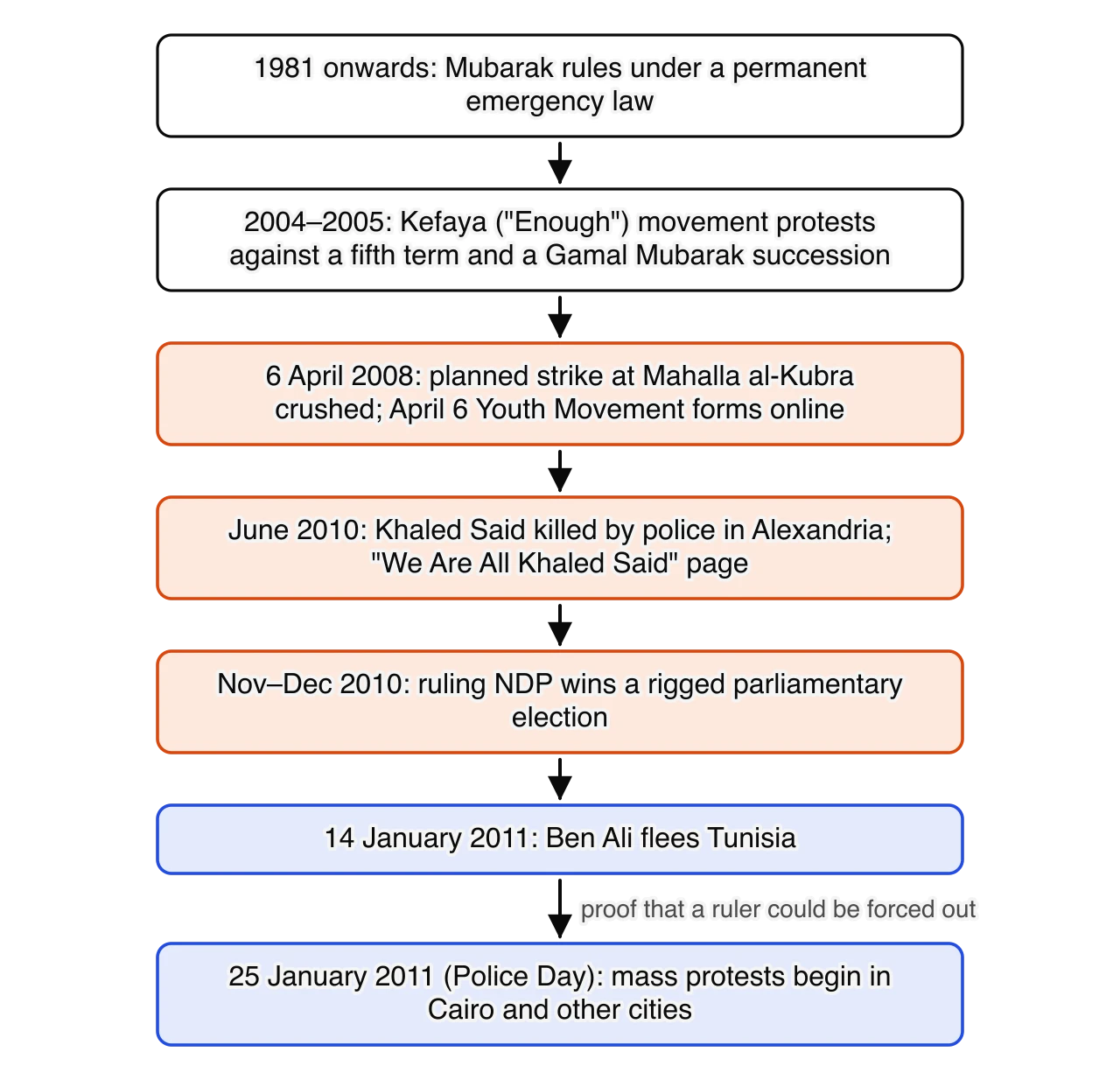
The chain of events from 1981 to 2011 shows how political grievances built up and how the protest movements of the 2000s prepared the ground. The Kefaya ("Enough") movement of 2004–2005, a coalition of liberal, leftist and Islamist intellectuals, broke the taboo on attacking Mubarak by name. Small and mostly middle-class, it never became a mass movement, but many of its activists reappeared in 2011.
Political exclusion was also at the heart of the US civil rights movement. After Reconstruction ended in 1877, Southern states used poll taxes, literacy tests and all-white primary elections, backed by violence, to stop Black citizens voting. In 1896 the Supreme Court ruled in Plessy v. Ferguson that racial segregation was lawful if facilities were "separate but equal". These Jim Crow laws governed schools, transport, housing and public places across the South, and they were enforced by terror as well as law: thousands of Black Americans were lynched between the 1880s and the 1950s. In August 1955 Emmett Till, a 14-year-old boy from Chicago visiting relatives in Mississippi, was murdered for allegedly whistling at a white woman. His mother insisted on an open coffin, photographs of his body were published in the Black press, and an all-white jury acquitted his killers. The case showed a new generation that the law would not protect them, three months before the Montgomery bus boycott began.
What changed in the 1940s and 1950s was political opportunity. In 1941 the labour leader A. Philip Randolph threatened a march on Washington, and President Franklin Roosevelt issued Executive Order 8802, banning racial discrimination in defence industries. In July 1948 President Harry Truman issued Executive Order 9981, ordering equality of treatment in the armed forces. On 17 May 1954 the Supreme Court ruled unanimously in Brown v. Board of Education that segregated public schools were unconstitutional. Each decision showed Black Americans that parts of the federal government could be allies against the Southern states.
The Cold War sharpened the opening. The historian Mary Dudziak, in Cold War Civil Rights (2000), shows that the Soviet Union used American racism in its propaganda across Asia and Africa, and that the US Department of Justice told the Supreme Court in the Brown case that segregation harmed the country's standing abroad. The end of European empires had the same effect: when Ghana became independent in 1957, Black Americans could see Africans governing themselves while they were still barred from voting in Mississippi.
British abolitionism is the case where political oppression of the campaigners mattered least. Its founders were free, mostly prosperous Britons who could petition Parliament. The enslaved people on whose behalf they campaigned had no political voice in Britain at all. The political factors behind abolitionism lay elsewhere: in a Parliament that could be lobbied, in court rulings that questioned slavery's legality, and in the crisis of empire after the American Revolution.
In 1772 Lord Mansfield ruled in the Somerset case that James Somerset, an enslaved man who had escaped in London, could not be forcibly taken out of England to be sold in Jamaica. The ruling was narrow, but it was widely believed to mean that slavery could not exist in England. The loss of the thirteen American colonies in 1783 then forced Britons to ask what kind of empire they wanted. The historian Christopher Leslie Brown, in Moral Capital (2006), argues that abolitionism offered a way to restore Britain's moral standing after defeat by colonists who had claimed liberty while holding slaves.
Economic factors are the material conditions of people's lives: poverty and inequality, exploitation at work, loss of land, unemployment and rising prices. They matter in almost every movement, because hardship gives people a reason to join and because economic grievances can unite people who disagree about politics. They are also the factor most often over-used in explanations, since hardship is far more common than movements.
Chartism, the first mass working-class movement in Britain, shows economic distress and political exclusion working together. The People's Charter of May 1838 made six political demands, beginning with a vote for every man over 21 and a secret ballot. Its support came from an economic crisis: the depression of 1837–1842, the collapse of handloom weavers' wages as factories spread, and the New Poor Law of 1834, which forced the destitute into harsh workhouses. At a mass meeting on Kersal Moor near Manchester on 24 September 1838, the former Methodist preacher Joseph Rayner Stephens called universal suffrage "a knife and fork question": a question of food on the table, decent clothes and fair wages.
Chartists asked for the vote because they believed that a Parliament elected only by property owners would never protect the poor. Support rose in the bad years of 1839, 1842 and 1848 and fell when trade recovered, a pattern that shows how closely the movement followed the economy. Economic hardship explains its mass support; the ideas of radical reform, older than the depression, explain why that support took the form of a demand for the vote.
In South Africa, the economic and political grievances were inseparable. The Natives Land Act of 1913 banned Africans from buying or renting land outside the reserves, which made up about 7 per cent of the country; the Native Trust and Land Act of 1936 aimed to raise this to about 13 per cent. Africans, about two-thirds of the population, were confined to a small and overcrowded fraction of the land.
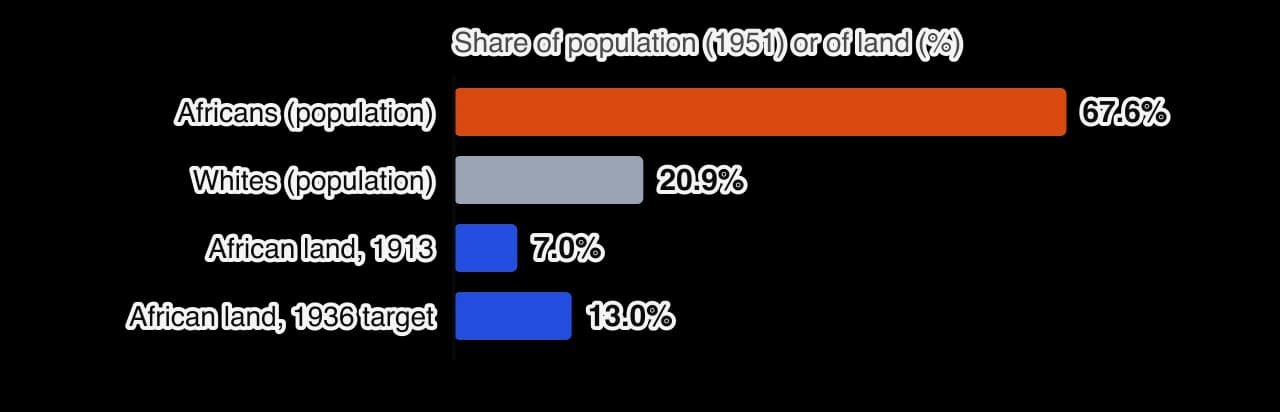
The figures for population and land show the scale of the imbalance. Land shortage pushed African men into the migrant labour system: they worked on contracts in the gold mines and cities while their families stayed in the reserves, and the pass laws controlled their movement. The colour bar reserved skilled jobs for whites. In August 1946 between about 70,000 and 100,000 African mineworkers (estimates vary) struck for higher wages and were driven back to work by police; the strike convinced the ANC Youth League that the old methods of petition had failed. Land, wages and the pass laws remained the grievances that brought ordinary people into the anti-apartheid movement, as the Freedom Charter's demand that "the land shall be shared among those who work it" shows.
Egypt's revolution had deep economic roots. From 2004 the government of Prime Minister Ahmed Nazif sold state companies and cut subsidies in a programme of market reforms that raised growth rates. The benefits went mainly to business people close to the regime, including allies of Gamal Mubarak, while the cost of food rose sharply, especially in 2008. Official figures put unemployment among Egyptians aged 15 to 24 at about 25 per cent in 2010, and over half among young women. Educated young people, who had expected the education system to lead to jobs, made up a large share of the unemployed.
Workers protested before anyone else. According to the historian Joel Beinin, more than two million Egyptian workers took part in more than 3,000 strikes, sit-ins and other protests between 1998 and 2010; Beinin describes this wave as the largest social movement in the Arab world since the Second World War. The most important was at the state-owned Misr Spinning and Weaving Company in Mahalla al-Kubra, a textile town in the Nile Delta. A planned strike there on 6 April 2008 was crushed by security forces, but young activists who had called for a general strike in support formed the April 6 Youth Movement, one of the groups that organised the first protests of January 2011. The slogan of 2011, "bread, freedom, social justice", put the economic demand first.
In the American South, most Black families before the Second World War worked as sharecroppers or labourers, in debt to white landowners and with little chance of owning land. Economic grievance alone did not produce a movement in the 1930s, when poverty was at its worst. The movement grew after the war, when the mechanisation of cotton farming and wartime jobs drew millions of Black southerners to cities. Urban Black communities had higher incomes, their own businesses, churches and colleges, and a middle class that did not depend on white employers. This made people less vulnerable to economic revenge for protesting, and it gave them economic power. Black passengers made up most of the riders on Montgomery's buses, which is why a boycott could work.
The role of economics in British abolitionism is one of the longest-running debates about any popular movement. In Capitalism and Slavery (1944), the Trinidadian historian (and later prime minister) Eric Williams argued that the British Caribbean sugar economy was in decline after 1776, and that the new industrial capitalists who favoured free trade had no further use for slavery. Humanitarian arguments, in his view, gave moral cover to a change that economic interest already demanded.
In Econocide (1977), Seymour Drescher used trade figures to argue the opposite: in 1807 the British slave economy was still expanding and profitable, so abolition was a form of economic suicide that only moral and political pressure can explain. Most historians now accept much of Drescher's evidence, but Williams's question about the links between slavery and British capitalism remains central to the history of the period.
Economic pressure also came from the enslaved themselves. Revolts in Saint-Domingue (from 1791), Barbados (1816), Demerara (1823) and Jamaica (the Baptist War of 1831–1832, involving tens of thousands of people) raised the cost and danger of slavery and, in the case of Jamaica, persuaded many in Parliament that emancipation was safer than further rebellion. The Haitian Revolution is a focused study of its own; here it matters as a sign to British opinion that slavery could not be maintained by force forever.
Across the cases, economic grievances explain who joined movements and why they were angry. They explain much less about when movements formed: Chartism peaked in bad years, but the Egyptian revolution came during a period of economic growth, the civil rights movement during the post-war boom and abolitionism when the slave trade was most profitable. Rising expectations and political openings often mattered as much as hardship.
Ideas turn a grievance into a cause. They tell people that their situation is wrong (not natural or deserved), who is responsible and what a better world would look like. They also connect people who have never met: a Quaker in Manchester and an enslaved man in Jamaica, a lawyer in Bombay and a peasant in Bihar. The role of ideas includes formal ideologies such as liberalism, nationalism and socialism, religious beliefs, shared values such as dignity and equality, and the leaders and examples that inspired people to act.
Two traditions of thought made the slave trade appear a national sin to many Britons in the 1780s. The first was religious. The Society of Friends (Quakers) had condemned slave trading among its own members from the 1750s and 1760s, and in 1783 its London Yearly Meeting sent the first petition against the slave trade to Parliament. Evangelicalism, a revival movement within the Church of England and Methodism that stressed personal conversion and moral duty, spread the same message more widely. John Wesley, the founder of Methodism, published Thoughts upon Slavery in 1774.
The second was the Enlightenment, the eighteenth-century intellectual movement that judged institutions by reason and natural rights. Writers such as Montesquieu and Adam Smith attacked slavery as unjust or economically wasteful. Together, these ideas made the Society for Effecting the Abolition of the Slave Trade, founded in London on 22 May 1787 by twelve men (nine of them Quakers), possible. Its leading organiser was Thomas Clarkson, a young Anglican who had written a prize-winning Cambridge essay against slavery; the lawyer Granville Sharp, who had fought the Somerset case, became its chairman; and the evangelical MP William Wilberforce agreed to lead the cause in Parliament.
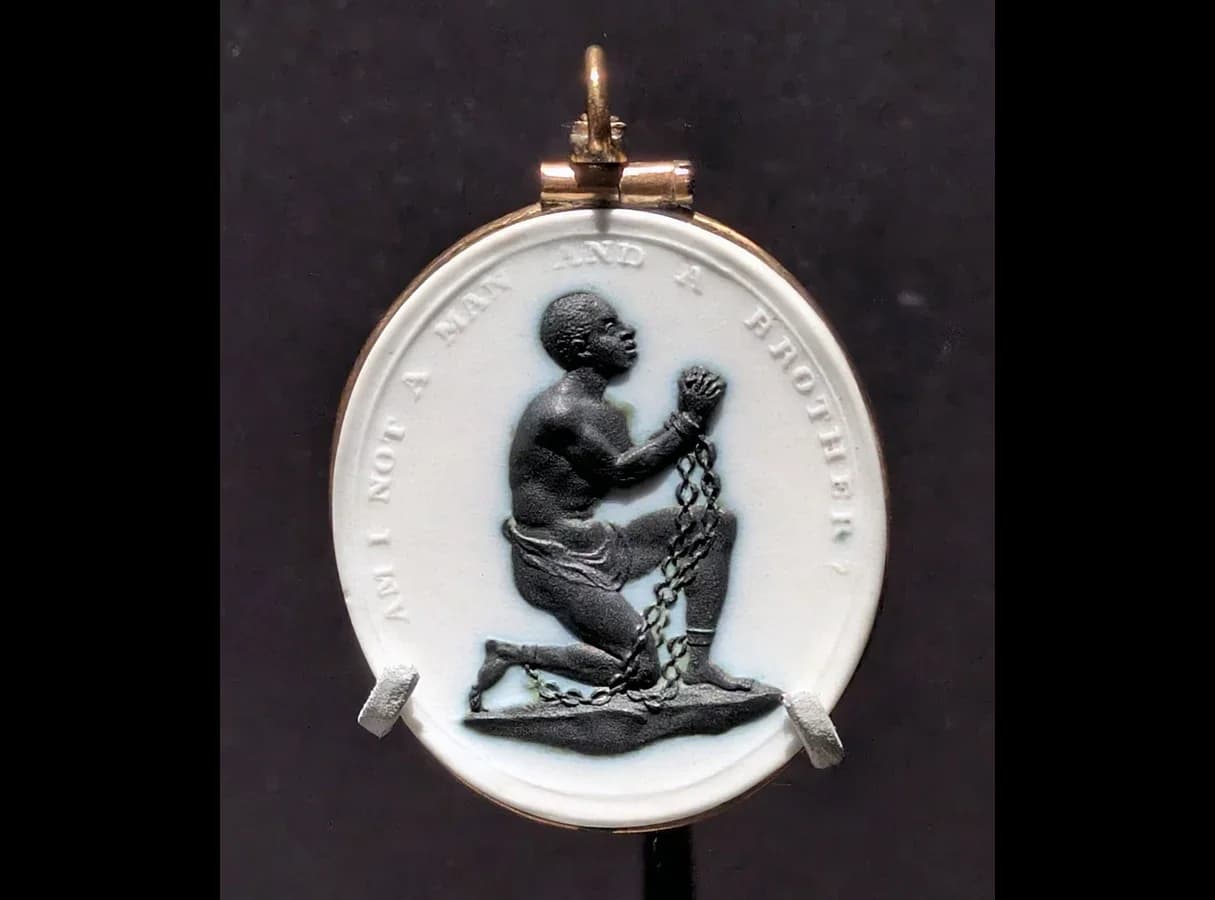
The Society's emblem, the kneeling figure on Wedgwood's cameo, expressed its central idea in a single question. Its appeal was religious and humanitarian: it asked free Britons to recognise a common humanity. A further shock came from the Zong massacre. In 1781 the crew of the Liverpool slave ship Zong threw more than 130 enslaved Africans overboard, and in 1783 its owners went to court to claim insurance for them as lost cargo. Granville Sharp publicised the case, and it gave abolitionists an example of what treating people as property meant.
Africans living in Britain were among the first to make the case in print. Ottobah Cugoano, who had been enslaved in Grenada, published Thoughts and Sentiments on the Evil and Wicked Traffic of the Slavery and Commerce of the Human Species in 1787. Olaudah Equiano, who had been enslaved as a boy and bought his freedom in 1766, published his autobiography in 1789. It became a bestseller and went through nine editions in his lifetime. In it he described the sale of captives in Barbados.
O, ye nominal Christians! might not an African ask you, learned you this from your God, who says unto you, Do unto all men as you would men should do unto you? Is it not enough that we are torn from our country and friends to toil for your luxury and lust of gain? Must every tender feeling be likewise sacrificed to your avarice?
Olaudah Equiano, The Interesting Narrative of the Life of Olaudah Equiano, or Gustavus Vassa, the African, 1789. Equiano wrote for a British, Christian readership while Parliament was first debating the slave trade, and he used their own religion against them: the source shows how Black abolitionists framed the trade as a betrayal of Christian values. Its authority came from his claim to have experienced the Middle Passage himself; some historians have questioned whether he was born in Africa, which affects how it is read as a personal account but not as evidence of the abolitionist argument.
The women's suffrage movement drew on liberalism, the belief that individuals have natural rights and should be free and equal before the law. Mary Wollstonecraft's A Vindication of the Rights of Woman (1792) argued that women appeared inferior only because they were denied education. The fullest liberal case came from John Stuart Mill, whose The Subjection of Women (1869), which he said owed much to his late wife, Harriet Taylor Mill, opens with its central claim.
That the principle which regulates the existing social relations between the two sexes—the legal subordination of one sex to the other—is wrong in itself, and now one of the chief hindrances to human improvement; and that it ought to be replaced by a principle of perfect equality, admitting no power or privilege on the one side, nor disability on the other.
John Stuart Mill, The Subjection of Women, 1869. Mill was a famous philosopher and former MP writing for an educated public, and he deliberately argued from principle rather than from women's experience. The extract shows how suffragists could present their demand as the logical extension of the liberal ideas that had already justified widening the vote for men.
The movement also drew on other ideas. Many suffragists were active Christians who believed women would bring moral reform to politics. Others came from the labour movement: the Pankhursts began in the Independent Labour Party, and textile workers in Lancashire formed their own suffrage societies. The idea that women's distinct moral nature fitted them for politics sat uneasily with the liberal idea that they were simply equal to men, but both justified the vote.
The ideas behind the civil rights movement came from the Black church, from American constitutional ideals and from abroad. Christian teaching about the equality of all people before God and the possibility of redemption, preached in Black churches for generations, gave the movement its moral language and its leaders. Martin Luther King Jr., a 26-year-old Baptist minister when he was chosen to lead the Montgomery bus boycott in December 1955, joined this tradition to the ideas of Gandhi, whose method of non-violent resistance had helped to win Indian independence in 1947.
The American creed of the Declaration of Independence and the Constitution gave Black Americans a standard by which to judge their country. The Double V campaign, launched by the Pittsburgh Courier, a Black newspaper, in February 1942, called for victory over fascism abroad and over racism at home. It made the war's language of freedom and democracy into a weapon against segregation.
In South Africa, competing ideas both inspired and divided resistance. The ANC's founding generation were often mission-educated Christians who appealed to British liberal values. In the 1940s the Youth League adopted African nationalism: the belief that Africans must lead their own liberation. In the 1950s the ANC joined Indian, Coloured and white democratic organisations in the Congress Alliance, which met at Kliptown near Johannesburg on 26 June 1955 and adopted the Freedom Charter.
We, the People of South Africa, declare for all our country and the world to know: that South Africa belongs to all who live in it, black and white, and that no government can justly claim authority unless it is based on the will of all the people; that our people have been robbed of their birthright to land, liberty and peace by a form of government founded on injustice and inequality.
The Freedom Charter, adopted by the Congress of the People, Kliptown, 26 June 1955. The Charter was drafted from demands collected across the country by volunteers and read out to about 3,000 delegates, so it presents itself as the voice of "the people". Its claim that the country belonged to "black and white" expressed non-racialism, the idea that the struggle was against a system, not against a race. Its context explains its wording: it was written to hold together an alliance of different racial groups.
Not everyone accepted this. In 1959 a group led by Robert Sobukwe left the ANC to form the Pan Africanist Congress (PAC), arguing that Africans should lead the struggle alone. In the late 1960s Steve Biko's Black Consciousness movement argued that Black people must first free themselves from feelings of inferiority created by white rule. Different ideas therefore produced different organisations, which helped the movement grow but also divided it. Socialist ideas mattered too: the Communist Party of South Africa (re-formed underground in 1953 as the South African Communist Party) was one of the few organisations open to all races, and its members worked closely with the ANC. Later, Black trade unions, which grew rapidly after strikes in Durban in 1973 and formed the Congress of South African Trade Unions (COSATU) in 1985, brought workplace grievances into the struggle.
Ideas need people to spread them. Leaders gave movements a voice, a strategy and a public face: Clarkson travelled thousands of miles collecting evidence about the slave trade; Emmeline Pankhurst made the WSPU a national force; Gandhi and King turned non-violence into a method that ordinary people could practise. The great man theory of history, which explains events through the actions of exceptional individuals, flatters these figures. Many historians stress instead that leaders emerged from movements that already existed. Rosa Parks, whose arrest began the Montgomery boycott, had been secretary of the local NAACP branch for twelve years, and the boycott was first organised by Jo Ann Robinson of the Women's Political Council.
Inspiration also came from other movements. Movements have tended to emerge in international waves: the revolutions of 1848 across Europe, the anti-colonial movements after 1945, the student and civil rights movements of the 1960s, the fall of communist regimes in Eastern Europe in 1989 and the Arab uprisings of 2010–2011. Each success made the next seem possible. Egyptian activists watched Tunisians force Zine el-Abidine Ben Ali from power on 14 January 2011 and called their own protest for 25 January, a national holiday in honour of the police.
Social factors are changes in how people lived, learned, communicated and were treated by others. They are often slow and easy to overlook, because they rarely make headlines. Yet they determine who is able to organise: a movement needs people who can read, travel, meet and share information, and a group that feels itself treated as inferior.
Education created many movements' leaders and members. In India, the universities founded at Calcutta, Bombay and Madras in 1857 produced a class of English-speaking lawyers, teachers and journalists who read Mill and Mazzini, and who resented being kept out of high office. In Britain, the opening of higher education to women, at Girton College, Cambridge (founded 1869) and later at other colleges, created a generation of educated women who could see no reason why they should not vote. The Married Women's Property Acts of 1870 and 1882 let married women keep their own earnings and property, and growing numbers of women worked as teachers, clerks, nurses and textile workers. Women who earned, owned and paid taxes found it harder to accept that they had no say in how those taxes were spent. In the American South, Black colleges such as Fisk and Howard trained ministers, lawyers and teachers, and in 1960 Black college students began the sit-in movement.
Education also raised expectations that the existing order did not meet. Egypt expanded its universities rapidly from the 1990s, but its economy did not create enough jobs for their graduates. Educated young people without work, waiting years to marry because they could not afford a home, had the skills to organise and the frustration to want to.
New means of communication allowed movements to reach people beyond face-to-face networks. The abolitionists used Britain's growing provincial press, the post and cheap printing to spread pamphlets, prints and petitions. In December 1787 more than 10,000 people in Manchester, a large share of its adult men, signed a petition against the slave trade. Indian nationalists used railways to travel to Congress sessions and founded newspapers in English and Indian languages. The civil rights movement emerged just as television spread across the United States, so that the white violence it met could be seen in Northern homes.
In Egypt, the internet and satellite television gave young people news that the state did not control. The Qatari channel Al Jazeera, founded in 1996, broadcast debate and criticism that Egyptian state television would not. After Khaled Said's death, Wael Ghonim, a Google marketing manager, set up the Facebook page "We Are All Khaled Said", which soon had hundreds of thousands of members and called the protest of 25 January 2011. Social media helped to coordinate the first protests, but most Egyptians did not use Facebook in 2011, and the crowds grew through neighbourhoods, mosques and workplaces as much as online.
Changes in population moved people into places where they could organise. The Great Migration took about six million Black Americans from the rural South to the cities of the North and West between about 1910 and 1970. In the North they could vote, which made them important to the Democratic Party; in Southern cities such as Montgomery, Birmingham and Atlanta, urban communities had the churches, businesses and colleges that rural sharecroppers lacked.
In South Africa, the growth of manufacturing during the Second World War drew Africans to the cities, where they built townships, joined trade unions and formed the bus boycotts and squatter movements of the 1940s. In Egypt, a youth bulge meant that a very large share of the population was in its teens and twenties in 2011. Young people with little stake in the regime and few prospects were more willing to take risks than their parents.
Discrimination on grounds of race, sex, caste or religion was a social grievance that crossed class lines. Wealthy Black Americans were turned away from the same restaurants as poor ones, and Indian judges and graduates suffered the same racial insults from Europeans as clerks. Shared humiliation gave people of different classes a common identity and a reason to organise together. It also explains why many movements demanded dignity and recognition as well as rights: the word "dignity" (karama) was central to the Arab uprisings of 2011.
 YouTube
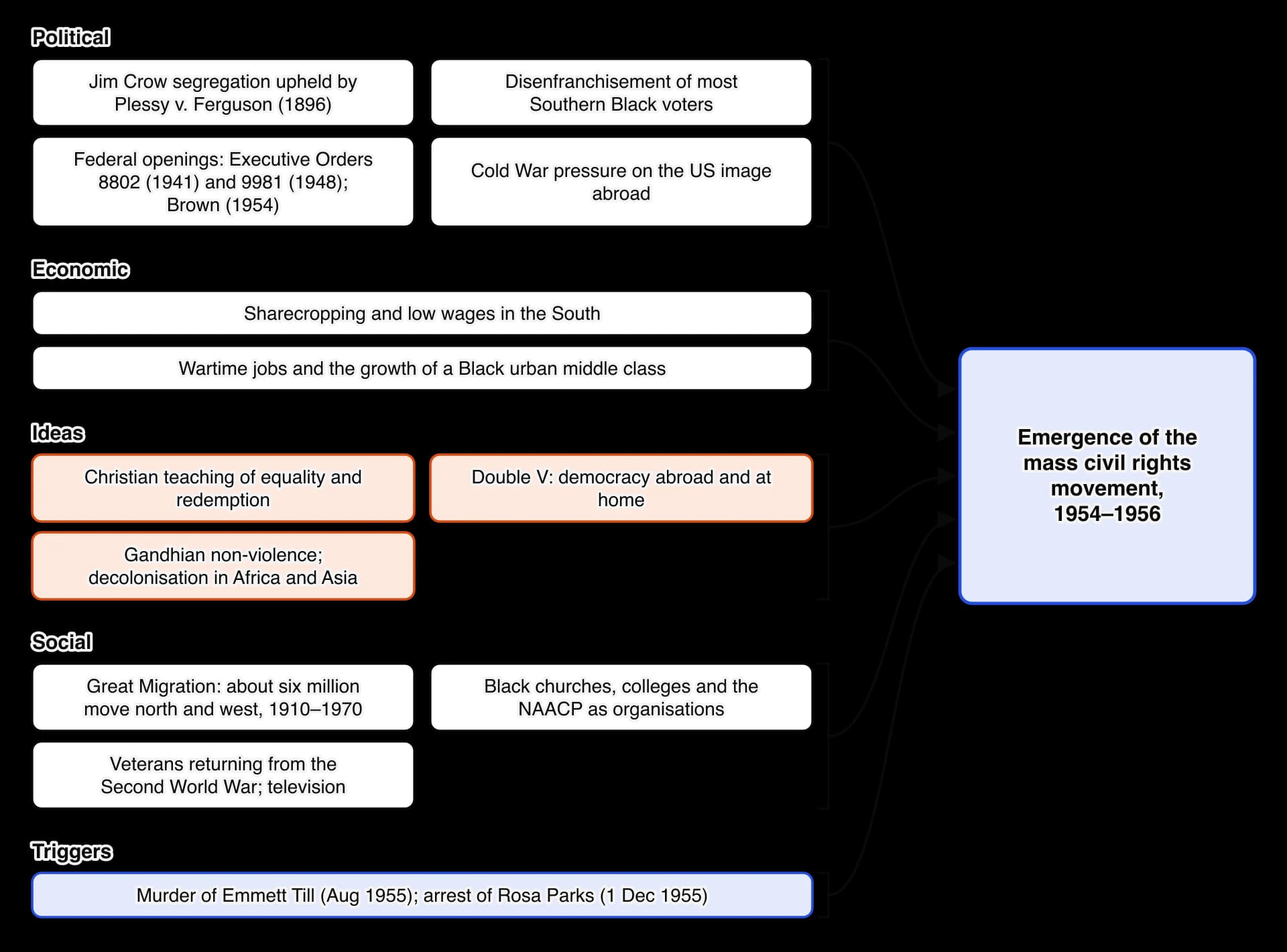
The diagram of the causes of the US civil rights movement shows how social factors connected with the others. Migration, war service and urban growth produced organisations and voters; these made political openings such as Brown possible; Christian and Gandhian ideas then gave a moral frame to action; and two events of 1955 supplied the triggers.
More than a million Black Americans served in the armed forces in the Second World War, in segregated units. Many returned determined not to accept segregation at home after fighting fascism abroad. Medgar Evers, who later led the NAACP in Mississippi, was a veteran who was turned away by an armed white crowd when he tried to vote in 1946. The NAACP grew from about 50,000 members in 1940 to about 450,000 by 1946.
The Indian national movement shows all four kinds of factor at work, and shows how their weight changed over time. It began in 1885 as an annual meeting of a few dozen educated men who asked politely for reform. By 1920 it had become a mass movement that called on millions of Indians to refuse to cooperate with British rule. Explaining that change requires both the long-term conditions created by colonial rule and the decisions and events of 1905–1920.
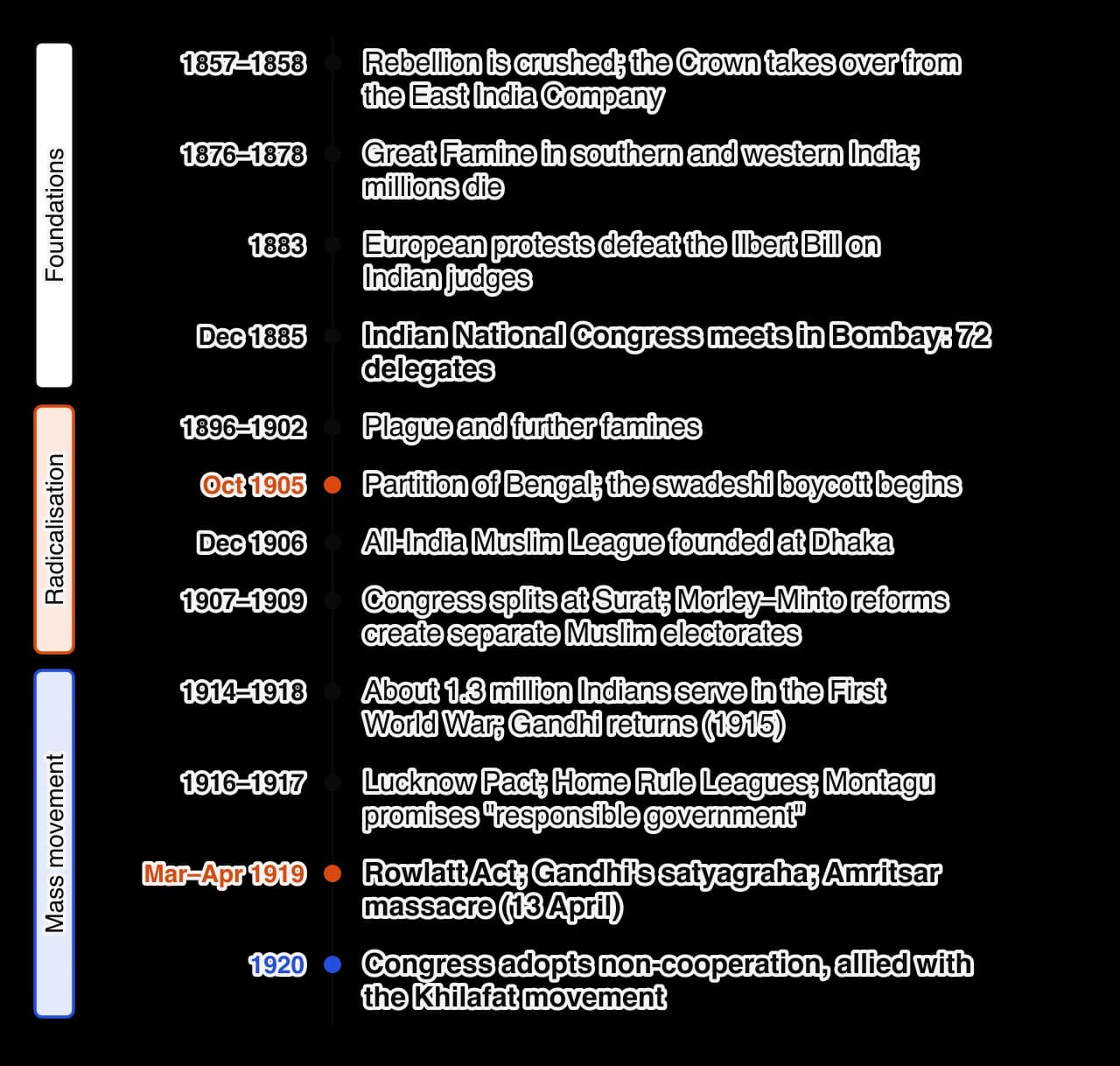
After the rebellion of 1857–1858, the British Crown took over the government of India from the East India Company. India was ruled by a viceroy responsible to London, advised by councils that Indians did not elect. The British Raj ("rule") governed through the Indian Civil Service (ICS), about a thousand senior officials who ran the districts. In principle Indians could join the ICS; in practice the competitive entrance test was held only in London, in 1876 the maximum age was cut to 19, and very few Indians got in. Surendranath Banerjea, one of the first to succeed, was dismissed in 1874 over a minor error and became a leading nationalist.
Political exclusion was made personal by racial arrogance. In 1883 the Ilbert Bill proposed to let Indian judges try Europeans in country districts. Europeans in India protested so fiercely that the government withdrew most of it. For educated Indians, the episode showed that British promises of equal treatment counted for little when Europeans objected, and that organised agitation, which the Europeans had used so effectively, could change government policy.
The most influential economic critique of British rule came from Dadabhai Naoroji, a Parsi businessman and teacher from Bombay who later became the first Indian elected to the British Parliament (1892). From the 1870s he argued that Britain drained India's wealth through the "home charges" paid to London, the pensions and salaries of British officials, interest on debt and profits sent home. This drain theory turned poverty from a fact of nature into a result of policy.
The former rulers were like butchers hacking here and there, but the English with their scientific scalpel cut to the very heart, and yet, lo! there is no wound to be seen, and soon the plaster of the high talk of civilisation, progress, and what not, covers up the wound! The English rulers stand sentinel at the front door of India, challenging the whole world, that they do and shall protect India against all comers, and themselves carry away by a back-door the very treasure they stand sentinel to protect.
Dadabhai Naoroji, Memorandum No. 2, "The Moral Poverty of India and Native Thoughts on the Present British Indian Policy", sent to the Secretary of State for India, 16 November 1880; republished in Poverty and Un-British Rule in India, 1901, pp. 211–212. Naoroji wrote as a loyal subject of the empire, addressing the India Office in the language of British liberalism, which is why he called the drain "un-British". His metaphor of the scalpel shows how nationalists made a hidden economic process visible and morally shocking.
The famines of the late nineteenth century gave the drain theory terrible evidence. Official figures put deaths in the famine of 1876–1878 at over five million, and further famines between 1896 and 1902 killed millions more; estimates by historians are higher and vary widely. Nationalists argued that India exported grain during famines and that high land revenue left peasants without reserves. British manufactured cloth, meanwhile, had undercut India's handloom weavers. In 1902 the economic historian Romesh Chunder Dutt, a former ICS officer, set out these arguments in The Economic History of India.
British rule itself created the people who would challenge it. Universities at Calcutta, Bombay and Madras (1857) produced graduates who studied English law, history and political philosophy. Railways, the telegraph and the post linked the presidency cities, and a lively press in English and Indian languages spread political news. By the 1880s there were thousands of Indian lawyers, journalists, teachers and officials who shared a language (English), a set of liberal ideas, and a sense that they were being denied the rights of British subjects.
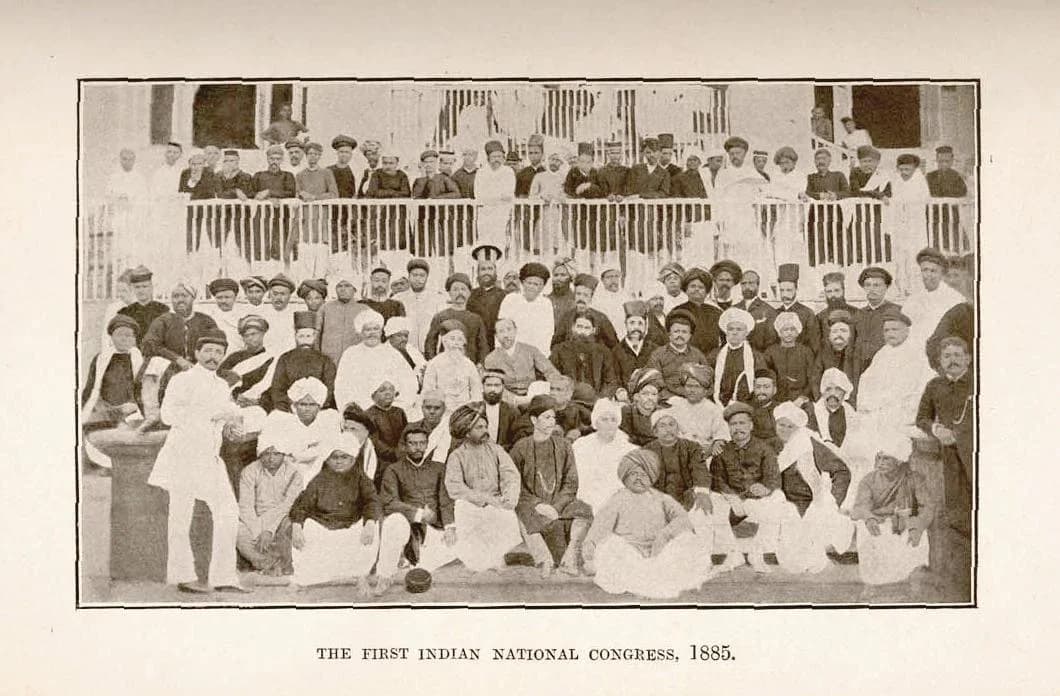
These men founded the Indian National Congress, which met for the first time in Bombay from 28 to 31 December 1885 with 72 delegates. Its first president was W. C. Bonnerjee, a Calcutta barrister, and its organiser was Allan Octavian Hume, a retired British civil servant. The early Congress was loyal to the empire. It asked for more elected Indians on the legislative councils, ICS examinations to be held in India as well as London, lower military spending and lighter land revenue.
The leaders known as the Moderates, including Naoroji, Gopal Krishna Gokhale and Pherozeshah Mehta, believed that British liberalism would eventually grant India self-government if Indians argued reasonably. Their methods were petitions, speeches and resolutions: constitutional nationalism. By the 1890s a younger group, called Extremists by their opponents, rejected this "mendicancy" (begging). Bal Gangadhar Tilak, a journalist from Pune, used Hindu festivals for the god Ganesh and for the Maratha king Shivaji to bring nationalism to ordinary people, and is remembered for the Marathi slogan usually translated as "Swaraj is my birthright and I shall have it". With Lala Lajpat Rai in the Punjab and Bipin Chandra Pal in Bengal, Tilak demanded swaraj (self-rule) and was prepared to use boycotts and mass protest.
Religious revival shaped both Hindu and Muslim politics. Hindu reform movements such as the Arya Samaj encouraged pride in India's past, which gave nationalism emotional force but could also make it sound Hindu to Muslim ears. Sayyid Ahmad Khan, the founder of the Muhammadan Anglo-Oriental College at Aligarh (1875), urged Muslims to stay out of Congress, fearing that a Hindu majority would dominate any elected system.
In 1905 the viceroy, Lord Curzon, divided the huge province of Bengal into two, creating a Muslim-majority province in the east. The official reason was administrative efficiency. Nationalists saw it as an attempt to divide and weaken educated Bengali Hindus, the most politically active group in India. The partition came into force on 16 October 1905, which was observed across Bengal as a day of mourning.
The protest turned into the swadeshi movement: a boycott of British goods, especially cloth, in favour of Indian-made products, with bonfires of foreign cloth, national schools and the song Bande Mataram ("Hail to the Motherland"). For the first time, students, shopkeepers and some peasants took part alongside the educated elite. The government responded with arrests, and a small number of young revolutionaries turned to bombings and assassinations. The partition was reversed in 1911.
Swadeshi also widened divisions. At Surat in December 1907 the Congress split between Moderates and Extremists, and Tilak was jailed for sedition from 1908 to 1914. In October 1906 a delegation of Muslim leaders asked the viceroy, Lord Minto, for separate electorates, and in December 1906 the All-India Muslim League was founded at Dhaka. The Morley–Minto reforms of 1909 enlarged the legislative councils and gave Muslims separate electorates, a decision that had lasting effects on Indian politics.
Mohandas Karamchand Gandhi developed the ideas that would transform the movement while working as a lawyer in South Africa from 1893 to 1914. In September 1906, at a mass meeting in Johannesburg, Indians in the Transvaal pledged to disobey a law requiring them to register and carry passes. Gandhi called the method satyagraha ("truth-force"): non-violent resistance to unjust laws, accepting punishment in order to change the opponent's heart. In Hind Swaraj (1909) he argued that true self-rule meant rejecting the materialism of modern Western civilisation, not just replacing British rulers with Indian ones.
Gandhi returned to India in January 1915. Between 1917 and 1918 he led local campaigns for indigo farmers in Champaran (Bihar), for peasants facing land revenue in Kheda (Gujarat) and for mill workers in Ahmedabad. These campaigns showed that satyagraha could mobilise peasants and workers who had never been part of Congress politics.
 YouTube
The First World War raised Indian hopes and hardships together. About 1.3 million Indians served in the war, as soldiers and labourers, in France, East Africa, Mesopotamia and elsewhere, and India paid heavily through taxes, war loans and requisitioned grain. Prices rose steeply, and in 1918 an influenza epidemic killed more than ten million Indians, though estimates vary widely. Many Indians expected their loyalty to be rewarded.
Political cooperation revived. In the Lucknow Pact of December 1916 the Congress and the Muslim League agreed on joint demands, and Tilak and the British theosophist Annie Besant founded Home Rule Leagues that held meetings across India. On 20 August 1917 the Secretary of State for India, Edwin Montagu, announced that British policy was "the progressive realisation of responsible government in India". The reforms that followed in 1919 gave Indians a share in provincial government but kept the central government in British hands, which disappointed many.
In March 1919 the government passed the Rowlatt Act, which extended wartime powers to detain suspected revolutionaries without trial. To Indians who had expected self-government, it looked like a betrayal. Gandhi called a nationwide hartal (a stoppage of work) in April 1919, his first all-India campaign. In the Punjab protests turned violent, and the authorities placed Amritsar under military control.
On 13 April 1919, Brigadier-General Reginald Dyer ordered troops to fire without warning on a crowd of several thousand unarmed people gathered in an enclosed ground in Amritsar, the Jallianwala Bagh massacre. The firing lasted about ten minutes. The official inquiry counted 379 dead and about 1,200 wounded; a Congress inquiry estimated about 1,000 killed. Martial law followed, with public floggings and an order forcing Indians to crawl along a street where a British woman had been attacked.
The British reaction made the massacre more damaging still. The Hunter Committee criticised Dyer and he was removed from his command, but many Britons treated him as a hero who had saved the Raj, and a fund raised by the Morning Post newspaper collected about £26,000 for him. The poet Rabindranath Tagore gave up his British knighthood in protest. For Gandhi and many moderate Indians, Amritsar and its aftermath ended their faith that the empire could be reformed from within.
Two grievances came together in 1920. Indian Muslims were angry that the Allies were dismantling the Ottoman Empire, whose sultan many regarded as caliph, leader of the world's Muslims; the Khilafat movement campaigned to protect him. Gandhi joined it, seeing a chance for Hindu–Muslim unity. At a special session in Calcutta in September 1920, confirmed at Nagpur in December, Congress adopted his programme of non-cooperation: Indians would boycott British courts, schools, councils, honours and cloth until swaraj was won.
Congress also changed its organisation. It created committees in every province based on language, a working committee to lead it and a low membership fee, so that peasants and workers could join, and its membership grew rapidly in 1921. The non-cooperation campaign that followed, and its sudden end in 1922, belong to the methods and challenges of the movement; here the point is that by 1920 an elite pressure group had become a mass movement.
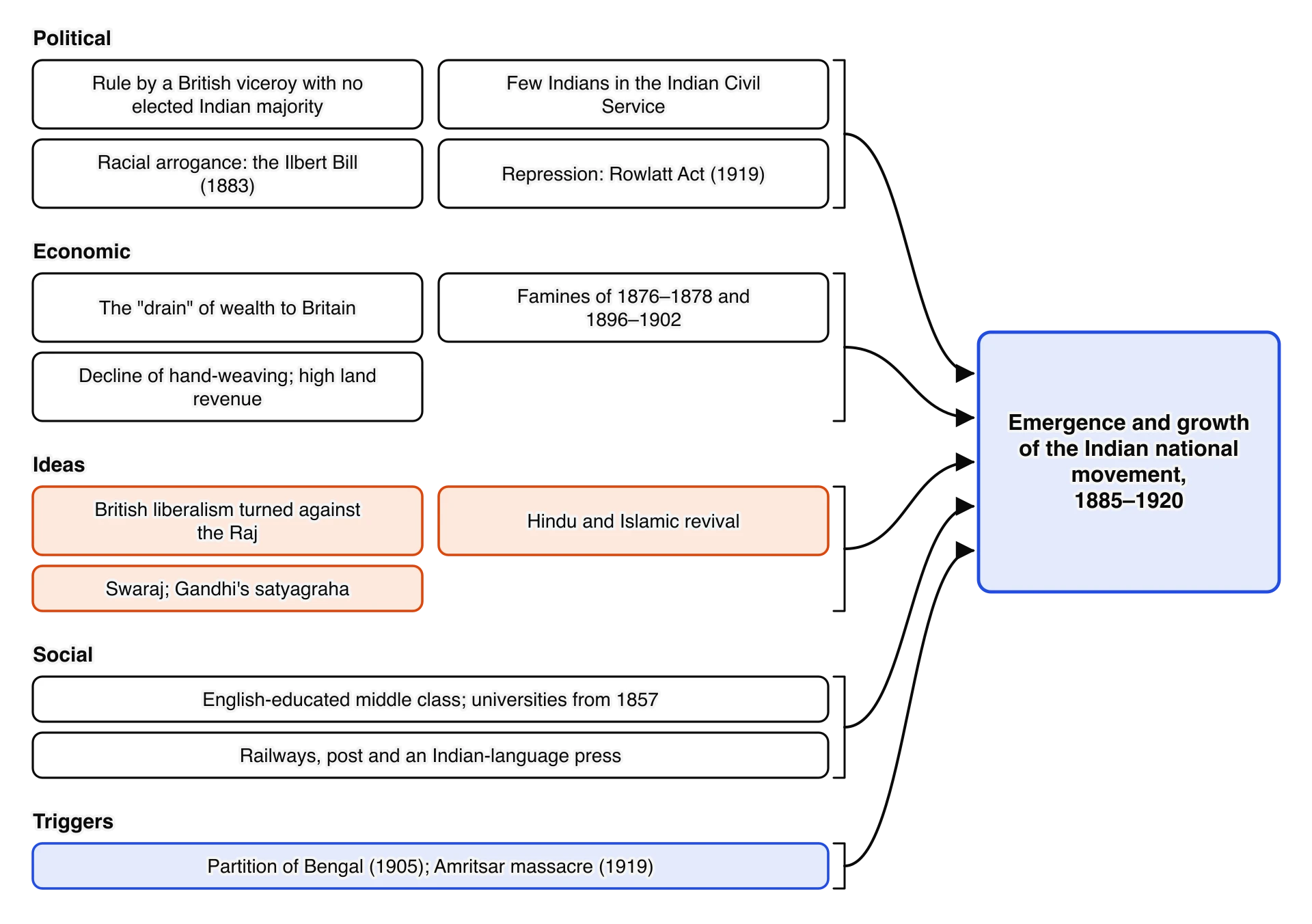
The diagram of the causes of the Indian national movement groups them by type, but their weight changed over time. Social change and political exclusion explain the emergence of the Congress in 1885: British education created a class that wanted a share of power and was denied it. Economic grievances, framed by the drain theory, gave the elite a case against British rule and later a link to the peasantry. Ideas explain the different forms the movement took, from Gokhale's liberalism to Tilak's religious nationalism and Gandhi's satyagraha.
The growth of the movement into a mass campaign came only when government actions (the partition of Bengal in 1905, the Rowlatt Act and Amritsar in 1919) turned elite grievances into popular anger, and when Gandhi offered a method that ordinary people could join. A reasonable judgement is that political factors, both long-term exclusion and short-term repression, were the most important, but that they produced a mass movement only in combination with Gandhi's ideas and leadership.
The comparative table sets the six core movements side by side under the four lines of inquiry, with the trigger that turned each into a mass movement.
Movement | Political factors | Economic factors | Role of ideas | Social factors | Trigger or catalyst |
|---|---|---|---|---|---|
British abolitionism (1787) | Parliament open to petitions; Somerset case (1772); loss of America (1783) | Debated: Williams (decline) vs Drescher (profitable trade); later, revolts of the enslaved | Quaker and evangelical Christianity; Enlightenment natural rights; Equiano and Cugoano | Provincial press, post and middle class; petitions from manufacturing towns | Zong case (1783); Clarkson's evidence; founding of the Society (1787) |
British women's suffrage (1866–1903) | Exclusion in 1832, 1867, 1884; Liberal disappointment after 1906 | Women's paid work; married women's property | Liberalism (Wollstonecraft, Mill); Christian morality; socialism | Women's education (Girton, 1869); local government roles | Mill's amendment defeated (1867); Liberal refusals (1906–1912) |
Indian national movement (1885–1920) | Viceroy rule; ICS barriers; Ilbert Bill; Rowlatt Act | Drain theory; famines; land revenue; decline of weaving | Liberalism; Hindu and Islamic revival; swaraj; satyagraha | Universities (1857); railways; press; English-educated class | Partition of Bengal (1905); Amritsar (1919) |
US civil rights (1954–1956) | Jim Crow; disenfranchisement; openings in 1941, 1948, 1954; Cold War | Sharecropping; urban incomes; the economic power of boycotts | Christianity; American creed; Gandhian non-violence; Double V | Great Migration; churches, colleges, NAACP; veterans; television | Emmett Till (1955); arrest of Rosa Parks (1955) |
Anti-apartheid (1948–1955) | Whites-only vote; apartheid laws from 1949; bans | Land Acts (1913, 1936); migrant labour; pass laws; colour bar | African nationalism; non-racialism; Africanism; Christianity; communism | Urbanisation; trade unions; townships; mission education | National Party victory (1948); Programme of Action (1949) |
Egypt (2011) | Emergency law; police brutality; rigged 2010 election; succession | Privatisation; food prices; youth unemployment; strikes | Dignity; democracy; inspiration of Tunisia | Youth bulge; graduates; Facebook and Al Jazeera | Khaled Said (2010); fall of Ben Ali (14 January 2011) |
Several patterns emerge from the comparison. First, political exclusion was present in every case except abolitionism, where the campaigners themselves had rights but the people they campaigned for had none. Movements were most likely where a group was denied a voice and had no legal route to change: in India, South Africa and Egypt, exclusion was total; in Britain and the USA, it was partial, which allowed movements to use the courts and Parliament as well as the street.
Second, economic grievances were widespread but uneven in importance. They were central in Chartism, the anti-apartheid movement and Egypt, where they gave movements a mass base among workers and the poor. They were less important in the founding of abolitionism and the suffrage movement, which were led by the comfortable middle classes. Even in Egypt, economic grievance had existed for years; it became revolutionary only when joined to political outrage and an example from abroad.
Third, ideas and leadership explain the form a movement took: whether it chose non-violence (Gandhi, King), militancy (the WSPU) or, in South Africa after 1960, armed struggle; whether it was religious, liberal or nationalist; and whether it was inclusive (the Freedom Charter) or exclusive (the PAC). Ideas also explain why middle-class people joined movements on behalf of others, as abolitionists did.
Fourth, social change created the capacity to organise: education produced leaders, cities and migration concentrated people, and new media spread information faster than governments could control it. Social change was usually slow and long-term, which is why it explains the possibility of a movement better than its timing.
Triggers explain timing. In most cases the trigger was an action by the authorities that made existing grievances suddenly intolerable or visible: the partition of Bengal, the Amritsar massacre, the killing of Khaled Said, the arrest of Rosa Parks. Repression could therefore create movements as well as crush them. Movements also emerged in waves across borders, as each success inspired others.
Wave | Movements | What connected them |
|---|---|---|
1780s–1790s | British and French abolitionists; the French Revolution; the Haitian Revolution | Enlightenment ideas of natural rights; Atlantic trade and print |
1848 | Revolutions in France, the German and Italian states, the Habsburg Empire; the last great Chartist petition | Economic crisis of 1846–1847; liberal and nationalist ideas; news by rail and telegraph |
1919 | Non-cooperation in India; the Egyptian revolution of 1919; the May Fourth Movement in China | Wilson's language of self-determination; disappointment at the peace settlement |
1950s–1960s | US civil rights; African independence movements; anti-apartheid; student movements | Decolonisation; the Cold War; television |
1989 | Solidarity in Poland; revolutions across Eastern Europe | Gorbachev's refusal to use Soviet force |
2010–2011 | Tunisia, Egypt, Libya, Yemen, Bahrain, Syria | Shared grievances; Al Jazeera and social media; the example of Tunisia |
The table of waves shows that international context belongs among the political factors. A weakened or distracted great power (Britain after 1918, the Soviet Union after 1985), a new idea in the air (self-determination in 1919) or a nearby success (Tunisia in 2011) could create an opportunity that local grievances alone did not.
Historians and social scientists disagree about why movements emerge, partly because they ask different questions. Some ask why people were angry, others why they were able to act, others why they acted together. Their answers also reflect where they look: at leaders and documents, or at local communities and the people who left few records.
The oldest debate is between explanations based on grievance and those based on opportunity and resources. Gurr's theory of relative deprivation (1970) explains protest by frustrated expectations. McAdam (1982) replied that grievances are almost constant among oppressed groups and so cannot explain why movements appear at particular times; what changes is political opportunity. The sociologists John McCarthy and Mayer Zald (1977) stressed resources: money, organisers and professional movement organisations. Morris (1984) agreed that organisation mattered but showed that in the civil rights movement the key resources were the community's own churches and networks, not outside help.
These views can be combined. Grievances explain why a group wants change; opportunities and resources explain whether and when it can act. Studies of Egypt in 2011 show all three: long-standing grievances, organisations built in the 2000s (Kefaya, the April 6 Youth Movement, independent unions) and a sudden opportunity created by Tunisia.
Popular histories often tell the story of movements through their leaders: Wilberforce, Pankhurst, Gandhi, King, Mandela. Since the 1970s many historians have written history from below, which looks at ordinary participants. Jill Liddington and Jill Norris, in One Hand Tied Behind Us (1978), showed that working-class women in the Lancashire cotton towns built a suffrage movement of their own, separate from the middle-class London societies. Charles Payne, in I've Got the Light of Freedom (1995), showed that the civil rights movement in Mississippi rested on local people and an "organising tradition" stretching back decades. Jacquelyn Dowd Hall, in an article in the Journal of American History (2005), argued for a long civil rights movement that began in the labour and left-wing politics of the 1930s and 1940s, not with Brown in 1954.
The longer view changes the question of emergence. If the movement began in the 1930s, then the events of 1954–1955 were less its cause than a moment when an existing movement became visible and national. Critics reply that stretching the movement this far blurs what was new in the mass, non-violent campaigns of the 1950s and 1960s.
Approach | Historians | Argument about the emergence of Indian nationalism | Evidence stressed |
|---|---|---|---|
Nationalist | Bipan Chandra and others, India's Struggle for Independence (1988) | An anti-imperialist movement of the Indian people, rooted in real economic exploitation and growing into a mass struggle | The drain theory; famines; mass participation in swadeshi and non-cooperation |
Cambridge School | Anil Seal, The Emergence of Indian Nationalism (1968); Judith Brown, Gandhi's Rise to Power (1972) | Educated elites competed for jobs, patronage and power that British reforms opened up; nationalism was their language, and Gandhi rose through local networks of supporters | The narrow social base of early Congress; regional and caste rivalries; the effects of constitutional reforms |
Subaltern Studies | Ranajit Guha and others, Subaltern Studies (from 1982) | Elite nationalism did not speak for peasants and workers, whose protests had their own aims and leaders | Peasant revolts; local protests that went beyond Congress instructions |
The three approaches answer different questions. The Cambridge School explains why educated men founded Congress in 1885 and why their politics was regional and competitive. The nationalist school explains why so many Indians came to believe that British rule was harmful. Subaltern historians show that the mass movement of 1919–1920 drew on peasant grievances that Gandhi and Congress tapped but did not create. A balanced explanation uses all three, while noting that each was shaped by its own context: the Cambridge School by British scepticism about nationalist myths in the 1960s, the nationalist school by the need of independent India for a national story, and Subaltern Studies by Marxist and postcolonial thought.
The debate between Eric Williams and Seymour Drescher has been widened by two further perspectives. Christopher Leslie Brown (2006) explains the timing of abolitionism by the political crisis of empire after 1783. Historians of the Caribbean, such as Richard Hart in Slaves Who Abolished Slavery (1980–1985), argue that resistance by the enslaved was itself a cause of abolition, so the movement cannot be explained only from Britain. Each perspective shifts the weight from British economics, to British politics and ideas, to the actions of enslaved people.
In 2011 many journalists called the Egyptian uprising a "Facebook revolution" or a "Twitter revolution", stressing young, educated activists and new technology. Wael Ghonim's own account, Revolution 2.0 (2012), encouraged this view. Scholars of Egyptian labour and society, such as Joel Beinin, stress instead the years of strikes and the economic grievances of workers and the poor, who made up most of the crowds once the protests spread. The difference is partly one of perspective: activists who used social media wrote the first accounts in English, and the role of workers and the urban poor was less visible to foreign reporters.
The questions that follow are written in the style of the IB. Section A asks about a historical concept, illustrated by one movement; Section B Part A asks for an explanation using one movement; Part B asks for an essay comparing movements from at least two regions.
I can define a popular movement and explain how it differs from a riot, a coup or a rebellion.
I can explain Tilly's idea of the social movement and why modern movements date from the late eighteenth century.
I can use the ideas of grievance, relative deprivation, political opportunity, resources and framing to explain why a movement emerged.
I can explain why grievances are a necessary but not a sufficient cause of a movement.
I can explain how political exclusion and repression led to the emergence of the women's suffrage movement, the anti-apartheid movement and the Egyptian revolution.
I can explain how political openings (the Liberal government, Executive Orders 8802 and 9981, Brown, the Cold War, Tunisia) helped movements to emerge.
I can explain the role of economic factors in Chartism, the anti-apartheid movement, Egypt and the US civil rights movement.
I can outline the Williams–Drescher debate on economics and abolition and reach a view.
I can explain how religious, Enlightenment, liberal, nationalist and non-violent ideas shaped abolitionism, women's suffrage, US civil rights and the anti-apartheid movement.
I can analyse the extracts from Equiano, Mill, the Freedom Charter and Naoroji for their context and perspective.
I can weigh the role of leaders against grassroots organisation in the emergence of a movement.
I can explain how education, communication, demography and discrimination created the conditions for movements.
I can explain why the Indian national movement emerged in 1885 and grew into a mass movement by 1920, using the drain theory, the partition of Bengal, Gandhi's satyagraha, the First World War, the Rowlatt Act and Amritsar.
I can compare the nationalist, Cambridge and Subaltern interpretations of Indian nationalism.
I can compare the causes of the six core movements in a table and identify patterns, triggers and international waves.
I can write a Part B essay plan on the most important cause of popular movements, using examples from two regions.