Notes on TS4.2 How did popular movements create change?
Popular movements set out to change laws, governments and the way people lived, but they usually began with little formal power. How they turned numbers, organisation and conviction into change is one of the central questions of modern history. The methods they used, from the petition and the boycott to the general strike and the armed uprising, were borrowed and adapted across continents: the US civil rights movement learned from Gandhi, and the anti-apartheid movement and the Egyptian protesters of 2011 learned from both.
How popular movements turn pressure into change
A popular movement is a sustained, organised campaign by large numbers of ordinary people to bring about (or resist) political, social or economic change, mostly through action outside the institutions of government. It differs from a single riot because it lasts and has aims, and from a political party because most of its supporters do not hold office. Many movements contained parties, unions or pressure groups, but their strength came from mass participation.
Tilly's idea that movements display WUNC, the worthiness, unity, numbers and commitment of their supporters, also helps to explain why particular methods were chosen. A petition with 400,000 names shows numbers; a disciplined, silent march in Sunday clothes shows worthiness; going to prison or on hunger strike shows commitment.
Four ways of creating pressure
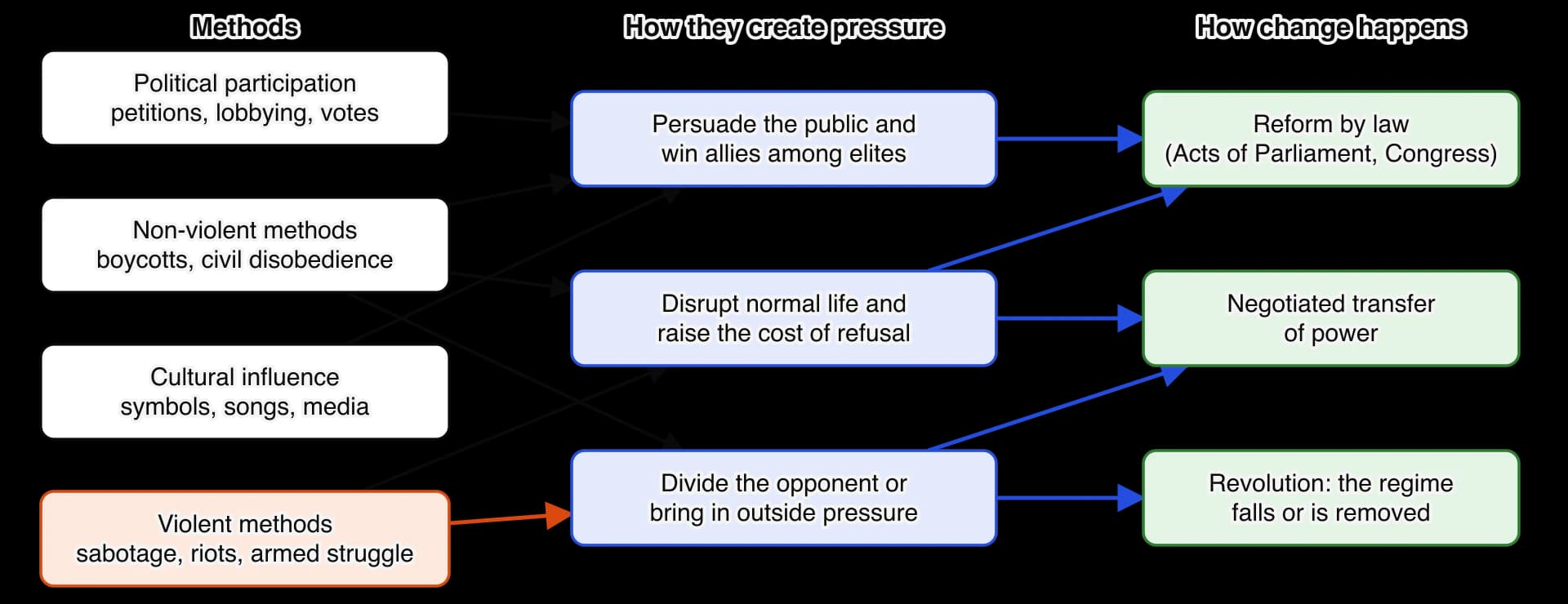
Popular movements rarely had the power to make change directly. They had to persuade or force someone else to make it: a parliament, a court, a colonial government, an army. Their methods worked through four kinds of pressure, and most movements used several at once.
Persuasion. Changing the opinions of the public, of voters and of members of the elite, so that the people with power came to accept the movement's aims as just or as politically necessary.
Disruption. Raising the cost of refusing the movement's demands, through boycotts that cost businesses money, strikes that stopped production, or civil disobedience that filled the jails and made government difficult.
Division of the opponent. Splitting the ruling group, so that some of its members (businessmen, moderate politicians, soldiers, foreign allies) came to see concession as less costly than resistance.
Force. Physically defeating or overthrowing the authorities, which few movements could do, or threatening a level of violence that made concession seem the safer course.
The diagram of methods and pressures shows how the four lines of inquiry connect to these forms of pressure and to the different ways in which change finally happened. The same method could produce different results in different states, because a democracy, a colonial empire and a dictatorship respond to pressure in different ways.
Leadership, organisation and allies
Methods needed organisation. Every successful core movement built institutions that could raise money, train activists, spread information and decide on strategy: the Society for Effecting the Abolition of the Slave Trade (1787), the National Union of Women's Suffrage Societies (1897), the Indian National Congress (1885), the Southern Christian Leadership Conference (1957), the African National Congress (1912). Leaders such as Gandhi, Martin Luther King Jr. and Nelson Mandela became symbols of their movements, but much of the work was done by local organisers whose names are less well known.
Movements also needed allies inside the system. The abolitionists relied on William Wilberforce, a member of Parliament, to present their case. The civil rights movement needed the federal government, and in particular Presidents Kennedy and Johnson, to propose laws and enforce them. Outside allies mattered too: international opinion was central to the anti-apartheid movement, and the decision of the Egyptian army not to defend Mubarak decided the outcome in 2011.
Political participation
Political participation means using the channels that a political system offers, or can be made to offer, to influence decisions: petitions, lobbying of members of parliament, public meetings, elections, legal cases in the courts and lawful marches and strikes. These methods accept the authority of the institutions while trying to change what they do. They were most effective where governments depended on public opinion and where a parliament or a court could change the law.
Political participation was also a way for people without the vote to act politically. Before 1918 no British woman could vote in a general election, and before 1832 most British men could not either, yet both groups signed petitions in their hundreds of thousands. Petitioning turned private opinion into a public, countable fact that members of Parliament could not ignore.
Abolitionist petitions and lobbying, 1787–1833
The British campaign against the slave trade is often described as the first modern mass movement. The Society for Effecting the Abolition of the Slave Trade, founded in London in May 1787 by twelve men, nine of them Quakers, chose to attack the trade in enslaved Africans before slavery itself, because Parliament could end the trade without touching the property of planters. Its members included Thomas Clarkson, who toured the ports to collect evidence from sailors, and Granville Sharp, a campaigner who had brought legal cases on behalf of Black people in England. William Wilberforce, the member of Parliament for Yorkshire, agreed to lead the cause in the House of Commons.
The society's main tool was the petition to Parliament. In 1788 about 100 petitions arrived. After the Commons rejected Wilberforce's bill in April 1791 by 163 votes to 88, the society organised a much larger wave: in 1792 Parliament received 519 petitions against the trade, signed by an estimated 350,000 to 400,000 people, more than had ever been sent to Parliament on a single issue. Manchester alone sent one with about 20,000 signatures. The Commons responded on 2 April 1792 by voting for "gradual" abolition, but the Lords delayed, and the war with revolutionary France from 1793 made any popular movement look dangerous.
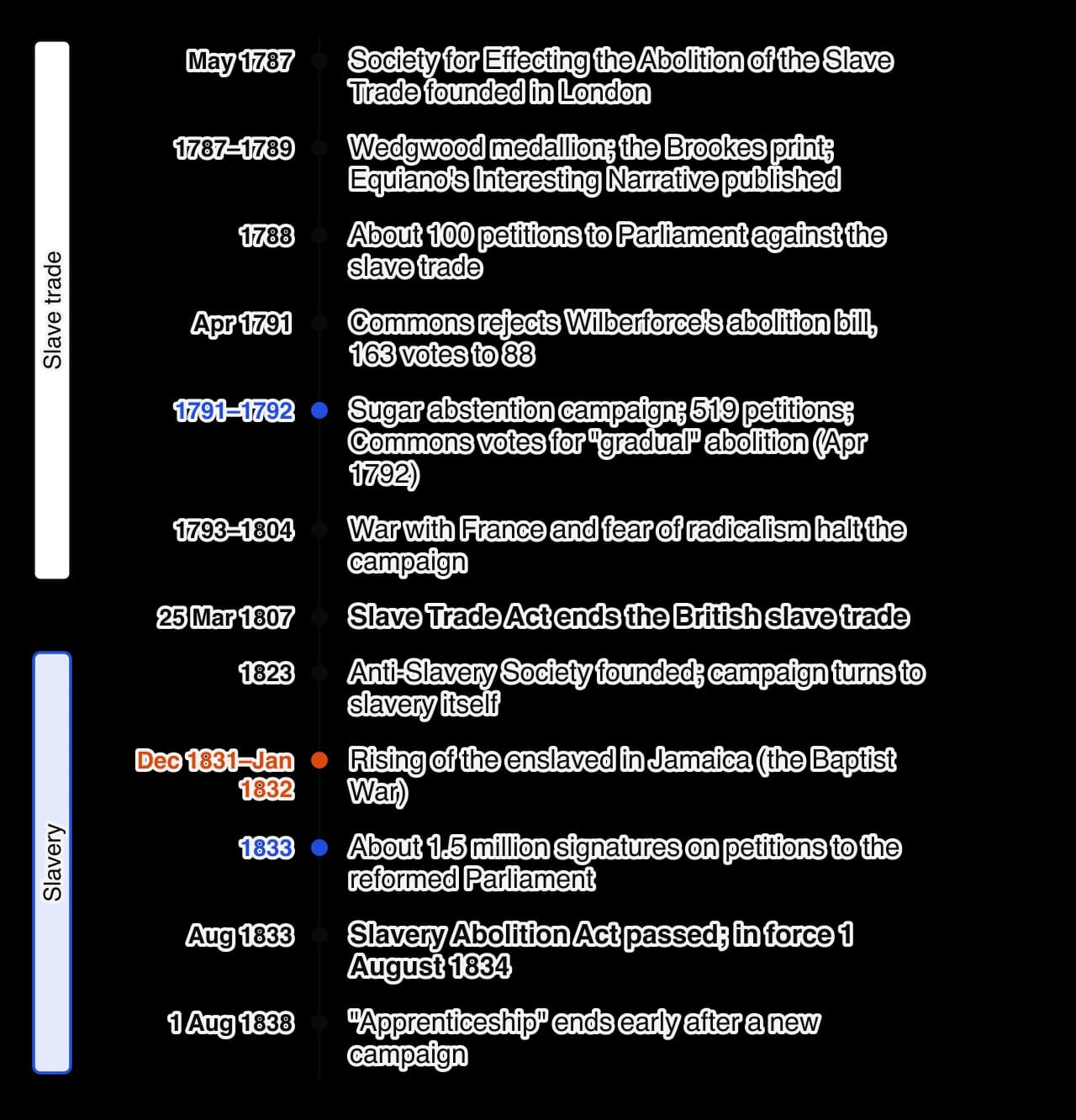
The timeline of the abolition campaign shows that the slave trade was abolished in 1807 at a moment of little popular agitation. By then the campaign worked mainly through lobbying and parliamentary tactics: the Foreign Slave Trade Act of 1806 banned British ships from supplying enemy and foreign colonies, which ended much of the trade, and the Whig government of 1806–1807 then carried the full Slave Trade Act, which received royal assent on 25 March 1807. The mass campaign of 1787–1792 had made abolition respectable, and the lobbyists turned that opinion into law when the political circumstances allowed it.
The second campaign, against slavery itself, returned to mass petitioning. The Anti-Slavery Society, founded in 1823, first pressed for gradual improvement, but from 1831 its more radical members, organised as the Agency Committee, sent paid lecturers across the country to demand immediate emancipation. Women's anti-slavery associations, the first of which was founded in Birmingham in 1825, organised much of this work. After the Reform Act of 1832 enlarged the electorate, abolitionists asked parliamentary candidates to pledge support for emancipation. In 1833 petitions with about 1.5 million signatures reached Parliament, including a single women's petition of about 187,000 names, and the Slavery Abolition Act was passed in August 1833.
Constitutional suffragists, 1866–1918
The British women's suffrage movement began with a petition. In 1866 a group of women collected about 1,500 signatures for votes for women, which John Stuart Mill, the philosopher and member of Parliament, presented to the Commons; in 1867 his amendment to the Reform Bill to give women the vote was defeated by 196 votes to 73. For the next forty years, local suffrage societies held meetings, sent petitions and persuaded friendly members to introduce bills, several of which passed a second reading and then fell for lack of government time.
The National Union of Women's Suffrage Societies (NUWSS), formed in 1897 under Millicent Fawcett, brought these societies together. It remained the largest suffrage organisation, with more than 50,000 members by 1914, and it kept to lawful methods. Its methods became more public after 1906: the "Mud March" of about 3,000 women through London in rain on 9 February 1907, and the Women's Pilgrimage of summer 1913, when marchers walked from all parts of Britain to a rally of about 50,000 people in Hyde Park on 26 July.
The NUWSS also changed its electoral strategy. In 1912, angry that the Liberal government had let the Conciliation Bills fail, it set up the Election Fighting Fund to support Labour candidates against Liberals in by-elections, since the Labour Party had committed itself to women's suffrage. The historian Sandra Stanley Holton argues that this alliance with Labour made the suffragists a serious threat to the Liberals and prepared the political ground for the reform of 1918.
Elections and the Indian National Congress
Political participation could also mean taking part in elections held under a colonial constitution. The Indian National Congress, founded in 1885, began as a body of educated, mostly professional Indians who petitioned the British for a greater share in government. After the Government of India Act 1935 widened the electorate to some 30–35 million people and gave elected Indian ministers control of the provinces, Congress contested the provincial elections of 1937 and won majorities or formed governments in most of the eleven provinces. Taking office showed that Congress could govern, and its ministers resigned in October 1939 when the viceroy declared India at war without consulting Indian leaders.
Courts, votes and strikes in the twentieth century
The US civil rights movement used the courts before it used the streets. The National Association for the Advancement of Colored People (NAACP), founded in 1909, spent decades challenging segregation in court. Its lawyers, led by Thurgood Marshall, won Brown v. Board of Education in May 1954, when the Supreme Court ruled that segregated public schools were unconstitutional. Later the movement made voter registration its central aim, because Black southerners who could vote could remove the officials who enforced segregation.
In apartheid South Africa, where Black people had no vote, political participation took other forms. Black trade unions, legalised in 1979 after a wave of strikes that began in Durban in 1973, became the most powerful organised force in the country; the Congress of South African Trade Unions (COSATU), founded in 1985, had about 460,000 members at its launch. The United Democratic Front (UDF), founded in August 1983, brought together more than 500 community, church, student and union organisations in a legal front that campaigned against the government's new constitution, which gave Indians and Coloured people separate parliamentary chambers while still excluding the Black majority.
Non-violent methods
Non-violent methods go further than political participation. They break normal routines, and often the law, to force the authorities to respond, but they refuse to use physical violence against people. The main forms were the boycott (refusing to buy, use or deal with something), the strike, the sit-in and occupation of public space, civil disobedience (openly breaking an unjust law and accepting the punishment) and mass non-cooperation (withdrawing the everyday cooperation on which any government depends).
The logic of non-violence was both moral and strategic. Morally, leaders such as Gandhi and King argued that means shaped ends, so a movement that used violence would produce a violent society. Strategically, non-violence allowed far more people (women, children, the old, the religious) to take part, made repression harder to justify, and could win over bystanders and even members of the security forces. The political scientist Gene Sharp, in The Politics of Nonviolent Action (1973), argued that all governments rest on the cooperation of the governed, so mass refusal to cooperate can make any government unworkable.
The sugar boycott, 1791–1792
The first mass consumer boycott among the core movements was the abstention from slave-grown sugar. After Parliament rejected abolition in 1791, the pamphleteer William Fox published An Address to the People of Great Britain, on the Propriety of Abstaining from West India Sugar and Rum (1791), which argued that every family that bought sugar shared in the guilt of slavery. Thomas Clarkson later estimated that about 300,000 people gave up sugar. Because shopping and cooking were largely run by women, the boycott gave women, who could not vote and often did not sign petitions, a direct role in the campaign; some grocers advertised that they sold only sugar from the East Indies, produced without enslaved labour. The boycott did not damage the planters seriously, but it spread the idea that ordinary consumers were responsible for slavery and kept the issue in every household.
Satyagraha and the Indian national movement
Gandhi returned to India in 1915 and first used satyagraha on local grievances: for indigo cultivators in Champaran in Bihar (1917) and for mill workers and peasants in Ahmedabad and Kheda (1918). These campaigns won concessions and made him a national figure. After the Amritsar massacre of April 1919, when troops under General Dyer fired on an unarmed crowd and killed at least 379 people (Indian estimates were far higher), he persuaded Congress to adopt a national campaign.
The Non-Cooperation Movement (1920–1922) asked Indians to withdraw from the institutions of British rule: to return British titles, boycott the law courts, government schools and the elections to the new councils, and burn or boycott imported cloth. Tens of thousands of students left government schools, many lawyers gave up practice, and imports of foreign cloth fell sharply. About 30,000 people were imprisoned by early 1922. Then, on 4 February 1922, a crowd at Chauri Chaura in the United Provinces set fire to a police station and killed 22 policemen. Gandhi called off the whole campaign, judging that India was not yet ready for disciplined non-violence. Many Congress leaders were dismayed, and the British arrested Gandhi in March 1922.
The Salt March and Civil Disobedience, 1930–1934
At its Lahore session in December 1929 Congress adopted complete independence (purna swaraj) as its aim, proclaimed across India on 26 January 1930, and gave Gandhi the leadership of a new campaign. He chose the salt tax as its target. Salt was a government monopoly, so making salt from seawater was illegal, yet every Indian needed salt and many could collect it for nothing on the coast. The issue linked the poorest peasants to the national cause and was hard for the British to defend. On 2 March Gandhi wrote to the viceroy, Lord Irwin, to warn him of what he intended.
If you cannot see your way to deal with these evils and my letter makes no appeal to your heart, on the eleventh day of this month I shall proceed with such co-workers of the Ashram as I can take, to disregard the provisions of the salt laws. I regard this tax to be the most iniquitous of all from the poor man's standpoint. As the independence movement is essentially for the poorest in the land, the beginning will be made with this evil.
M. K. Gandhi, letter to Lord Irwin, viceroy of India, 2 March 1930. The letter was written to be published as well as read by Irwin: by warning the viceroy in advance and offering him a way out, Gandhi presented himself as reasonable and placed the responsibility for what followed on the government. Its stress on "the poorest in the land" shows how he chose the salt tax to make a movement led by educated nationalists speak for the peasant majority.
The Salt March left Gandhi's ashram at Sabarmati on 12 March 1930 with 78 followers and reached the coast at Dandi, about 385 kilometres away, on 5 April. On the morning of 6 April Gandhi picked up a handful of salt from the beach, breaking the law. The slow, 24-day march gave newspapers in India and abroad time to report it day by day, and crowds gathered in every village on the route. Across India people made and sold illegal salt, picketed liquor shops and shops selling foreign cloth, refused to pay taxes and resigned from government posts. By the end of 1930 about 60,000 people had been arrested.
The most famous single episode came at the Dharasana salt works in May 1930, when columns of volunteers walked up to the police lines and were beaten down without resisting. Reports by the American journalist Webb Miller were printed in more than a thousand newspapers worldwide. Episodes like this shifted international opinion and damaged Britain's claim that it ruled India for Indians' benefit.
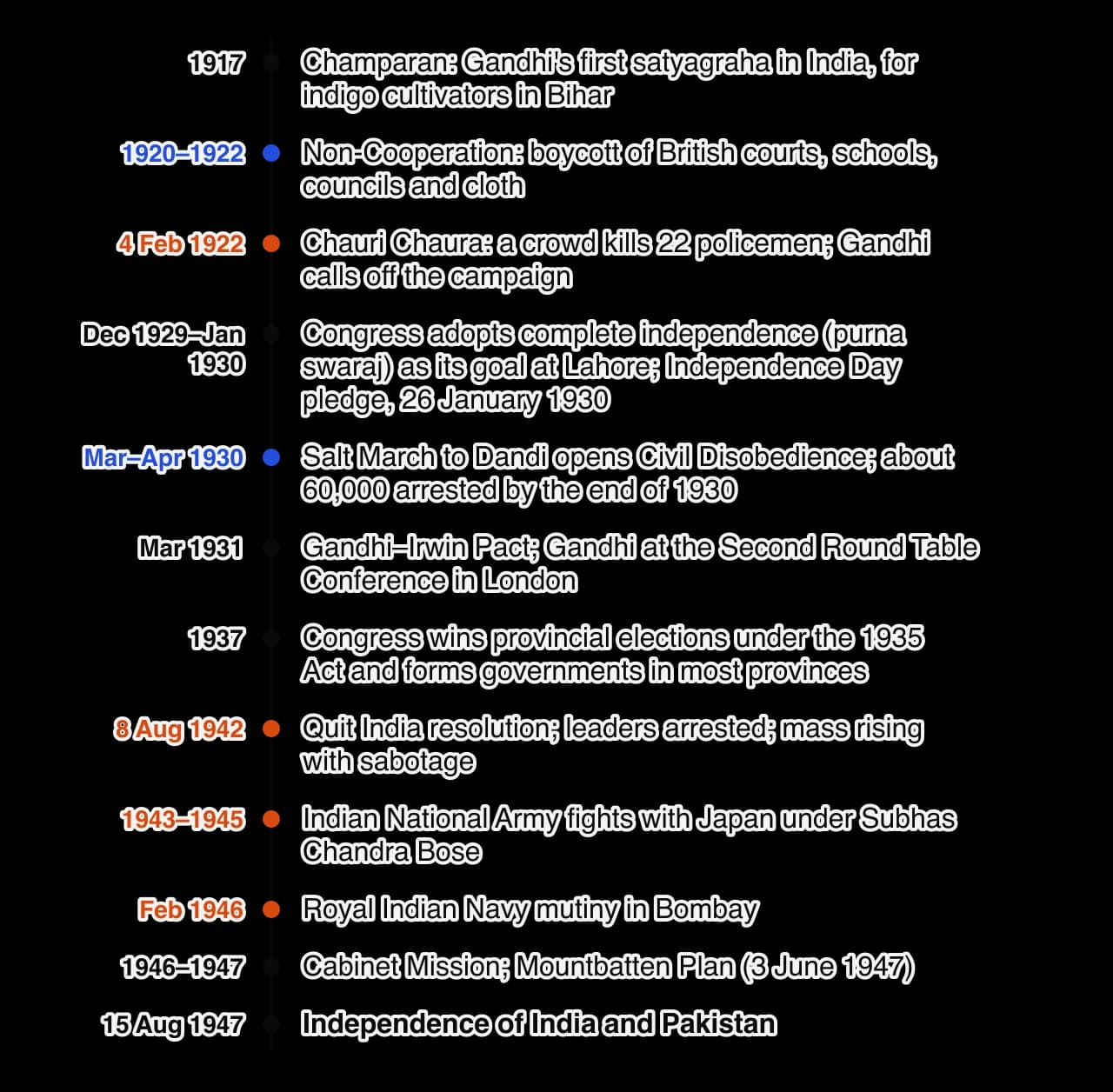
The results of Civil Disobedience were mixed. The British released Gandhi and in the Gandhi–Irwin Pact of March 1931 agreed to release prisoners and allow coastal villagers to make salt, while Gandhi agreed to suspend the campaign and attend the Second Round Table Conference in London. The conference achieved nothing, and the renewed campaign of 1932–1934 was crushed by mass arrests. Most Muslims, and many business leaders, stayed out. Yet the campaign turned Congress into a mass organisation, drew in women on a large scale for the first time, and showed that Britain could rule India only with the consent of many Indians. The timeline of the Indian campaigns shows that independence came seventeen years later, through negotiation, after further pressures had built up.
Mass defiance in South Africa, 1952–1960
The African National Congress (ANC) adopted mass non-violent methods in its Programme of Action of 1949, under pressure from its Youth League (Nelson Mandela, Walter Sisulu, Oliver Tambo). The Defiance Campaign began on 26 June 1952. Trained volunteers deliberately broke apartheid laws, entering "Europeans only" railway carriages and post office entrances or breaking curfew, and offered themselves for arrest. Between June and December about 8,000 to 8,500 people were arrested, ANC membership grew from about 7,000 to about 100,000, and the campaign drew in Indian activists of the South African Indian Congress. The campaign faded after riots in several cities in October and November 1952, and in early 1953 the government passed the Public Safety Act, which allowed it to declare a state of emergency, and the Criminal Law Amendment Act, which made breaking any law by way of protest punishable by flogging as well as prison.
Other non-violent campaigns followed. The Congress of the People at Kliptown on 26 June 1955 adopted the Freedom Charter, which declared that "South Africa belongs to all who live in it, black and white". On 9 August 1956 about 20,000 women, led by Lilian Ngoyi and Helen Joseph, marched to the government's Union Buildings in Pretoria to protest against the extension of passes to women. In 1957 thousands of people in Alexandra township walked up to 15 kilometres to work for three months rather than pay a higher bus fare, until employers agreed to subsidise the fares. Each of these showed discipline and numbers, but none changed the apartheid laws, because the government did not depend on Black consent at the ballot box and was willing to use force.
Occupation and strikes in Egypt, 2011
The Egyptian uprising of 2011 shows non-violent methods used against a dictatorship. Hosni Mubarak had ruled since 1981 under a state of emergency, and his National Democratic Party won elections through fraud. Protests had grown in the 2000s, led by the Kefaya ("Enough") movement from 2004, and by striking workers. After the fall of President Ben Ali in neighbouring Tunisia on 14 January 2011, youth groups called a protest for 25 January, National Police Day.
The central method was the occupation of Tahrir Square in central Cairo, and of squares in Alexandria, Suez and other cities. Protesters set up a camp with clinics, food stalls and a stage, checked arrivals for weapons and prayed together, Muslims and Christians guarding each other. The occupation showed numbers and unity and denied the regime control of the capital's centre. In the last days, waves of strikes in textile mills, the Suez Canal zone and public services added economic pressure.
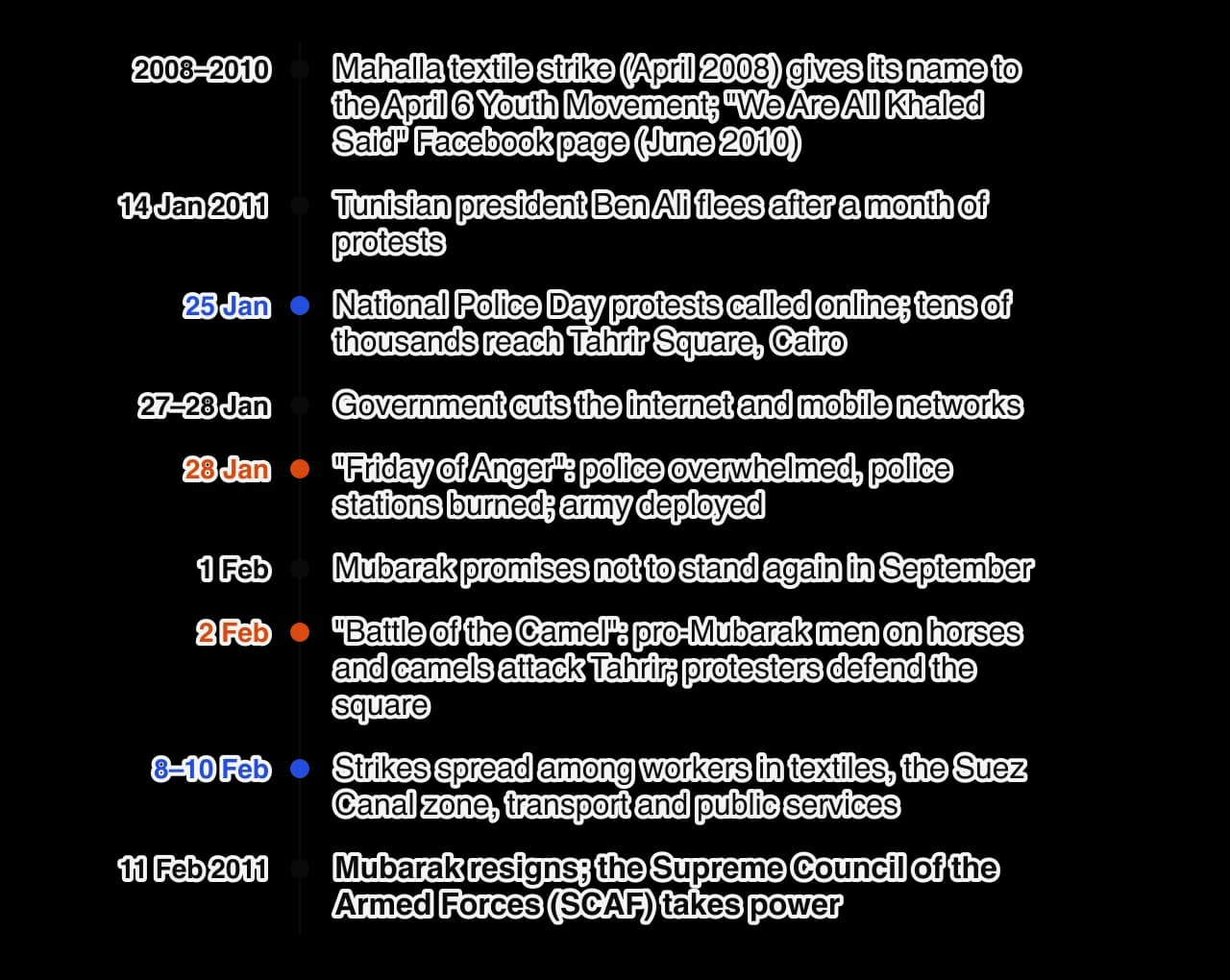
The timeline of the eighteen days shows that the uprising was not purely non-violent. On the "Friday of Anger" (28 January) crowds fought the police and burned dozens of police stations and the ruling party's headquarters, and protesters fought back with stones when pro-Mubarak gangs attacked the square on 2 February. About 846 people were killed during the uprising, most of them by the police. Most protesters, however, used non-violent methods, and their slogan silmiyya ("peaceful") helped persuade the army not to fire on the crowds. On 11 February the Supreme Council of the Armed Forces (SCAF) removed Mubarak, and the army, more than the protesters, then shaped the change that followed.
Case study: the methods of the US civil rights movement, 1955–1965
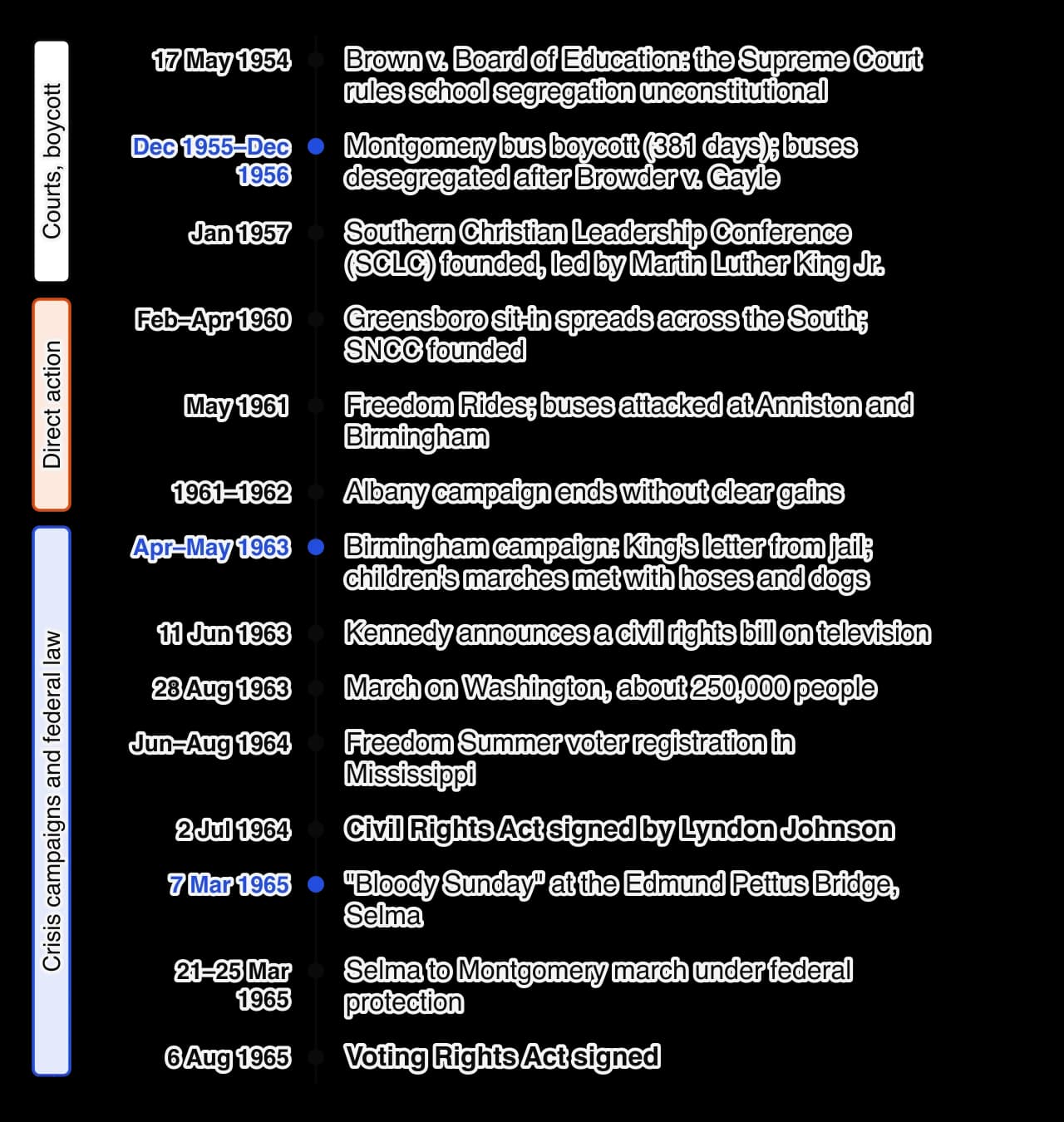
The US civil rights movement is the clearest example of a movement whose methods can be traced step by step to changes in the law. In 1955 racial segregation was enforced by law across the eleven states of the former Confederacy, under the system known as Jim Crow, and most Black southerners were kept from voting by literacy tests, poll taxes and intimidation. By 1965 the Civil Rights Act and the Voting Rights Act had made segregation and discrimination in voting illegal. The movement's methods changed several times in that decade, and the changes explain much of its success.
Montgomery: the boycott as a community weapon, 1955–1956
On 1 December 1955 Rosa Parks, a seamstress and secretary of the local NAACP branch, was arrested in Montgomery, Alabama, for refusing to give up her bus seat to a white passenger. Local activists had been waiting for a test case. That night Jo Ann Robinson of the Women's Political Council, an organisation of Black professional women, printed tens of thousands of leaflets calling for a one-day boycott of the buses on 5 December. The boycott was so complete that local leaders formed the Montgomery Improvement Association (MIA) to continue it, and chose a 26-year-old Baptist minister new to the city, Martin Luther King Jr., as its president.
The boycott worked because it hit the bus company where it was weakest: Black passengers made up about three-quarters of its riders. To keep it going for more than a year, the MIA organised a car pool of about 300 vehicles, with pick-up points across the city, and held weekly mass meetings in churches that kept up morale. The churches provided buildings, money and leaders, and Black domestic workers, many of whom walked miles to work, carried the main burden.
The city fought back with arrests of car-pool drivers, the indictment of 89 boycott leaders under an old anti-boycott law and, from white extremists, the bombing of King's house in January 1956. The boycott alone did not win: the decisive change came through the courts, when a federal court ruled in June 1956 that bus segregation was unconstitutional and the Supreme Court upheld the ruling in November. The boycott's achievement was to show that a whole Black community could act together for more than a year, to make King a national figure, and to lead to the founding of the Southern Christian Leadership Conference (SCLC) in January 1957, a network of Black churches committed to non-violent direct action.
 YouTube
Sit-ins and Freedom Rides: students take the lead, 1960–1961
The next wave came from students. On 1 February 1960 four Black students from North Carolina A&T College sat down at the whites-only lunch counter of the Woolworth's store in Greensboro and refused to leave when they were not served. Within two months sit-in protests had spread to dozens of southern cities. The sit-ins were a form of direct action: instead of asking for change, protesters acted as if segregation did not exist and made the authorities respond. Students were trained in advance to endure insults, food thrown over them and beatings without hitting back.
In April 1960 the student activists formed the Student Nonviolent Coordinating Committee (SNCC), with the support of Ella Baker, an experienced organiser who encouraged them to stay independent of King's SCLC. In May 1961 the Congress of Racial Equality (CORE) sent mixed groups of Black and white "Freedom Riders" on buses through the South to test a Supreme Court ruling against segregation in interstate bus terminals. A bus was burned near Anniston, Alabama, on 14 May and riders were beaten in Birmingham and Montgomery. When CORE wanted to stop, SNCC students from Nashville continued the rides, and hundreds of riders were jailed in Mississippi. In September 1961 the Interstate Commerce Commission, under pressure from the Kennedy administration, issued rules ending segregation in interstate travel facilities.
The Freedom Rides showed a pattern that leaders learned from. Federal action came only when violence against peaceful protesters created a public crisis. In Albany, Georgia (1961–1962), the police chief Laurie Pritchett avoided public brutality, arrested protesters politely and dispersed them to jails across the county, and the campaign won almost nothing. The lesson that King and his colleagues drew was that non-violent protest had to create a crisis that the nation could see.
Birmingham: creating a crisis, April–May 1963
The SCLC chose Birmingham, Alabama, the most segregated large city in the South, for its next campaign, "Project C" (for confrontation), in April 1963. The city's public safety commissioner, Eugene "Bull" Connor, was known for his hostility to integration. The campaign combined a boycott of downtown shops at Easter, sit-ins and marches. When a state court banned the marches, King deliberately broke the injunction and was arrested on 12 April. In jail he wrote a reply to eight white clergymen who had called the protests "unwise and untimely".
You may well ask: "Why direct action? Why sit ins, marches and so forth? Isn't negotiation a better path?" You are quite right in calling for negotiation. Indeed, this is the very purpose of direct action. Nonviolent direct action seeks to create such a crisis and foster such a tension that a community which has constantly refused to negotiate is forced to confront the issue. It seeks so to dramatize the issue that it can no longer be ignored.
Martin Luther King Jr., "Letter from Birmingham Jail", 16 April 1963. The letter was addressed to moderate white clergy, but King and the SCLC published it widely in the following months for a national, mostly white and Christian audience. Its value lies in showing how the movement's leaders understood their own method: non-violent protest was meant to create pressure ("crisis" and "tension"), not simply to appeal to conscience.
By the end of April the campaign was running short of adult volunteers willing to go to jail. The SCLC organiser James Bevel then recruited schoolchildren. On 2 May hundreds of children marched and were arrested; on 3 May Connor's police turned dogs and high-pressure fire hoses on young marchers. Photographs of the attacks appeared in newspapers across the United States and the world. With the jails full and downtown trade at a standstill, white business leaders agreed on 10 May to desegregate lunch counters and hire Black clerks.
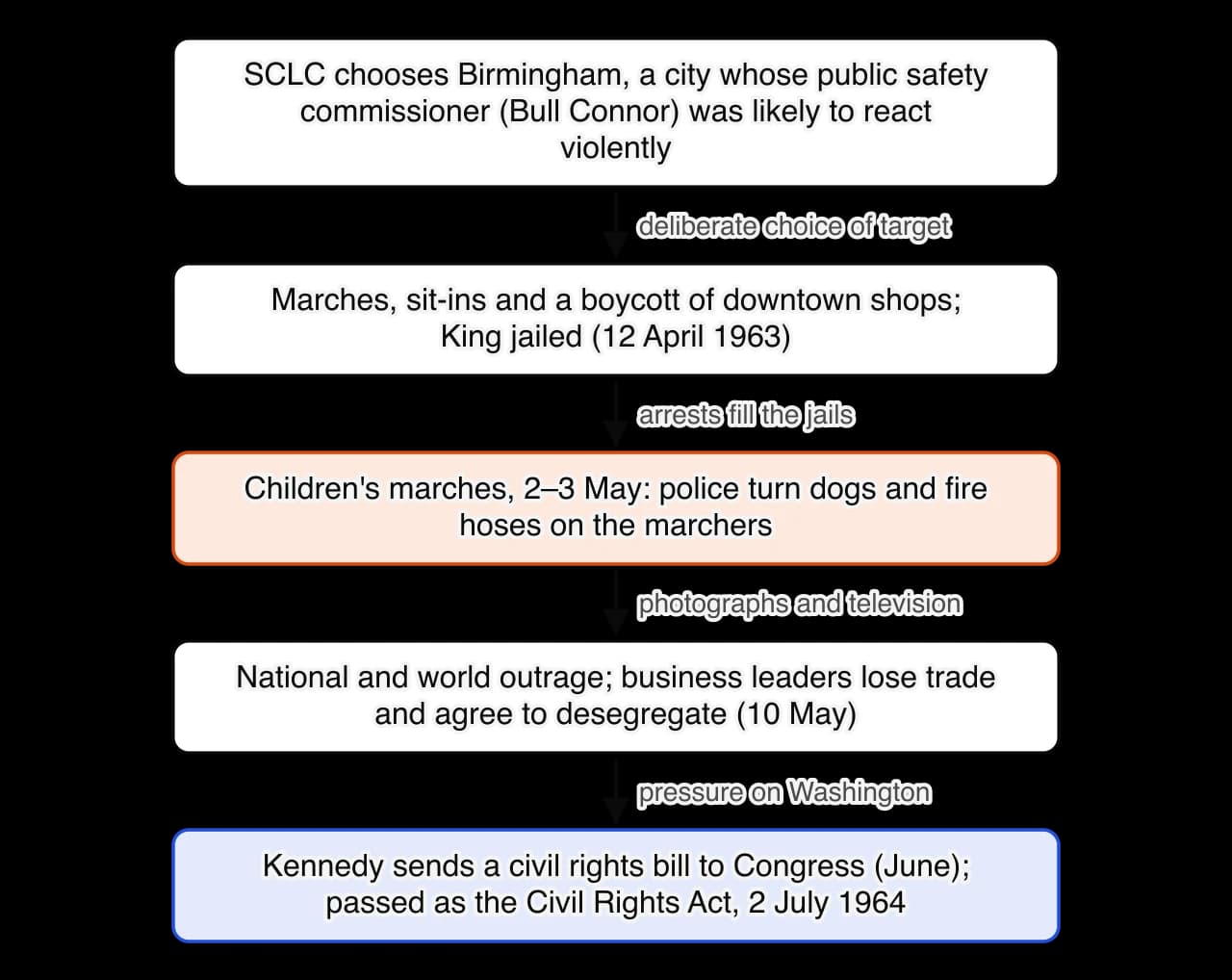
The chain from Birmingham to the Civil Rights Act shows how local direct action produced national change. On 11 June 1963 President Kennedy, who had been cautious about civil rights for fear of losing southern Democrats in Congress, spoke on television of a "moral issue" and sent a civil rights bill to Congress. The March on Washington on 28 August 1963, where about 250,000 people heard King's "I Have a Dream" speech, showed national support for the bill. After Kennedy's assassination in November, President Lyndon Johnson used his skill with Congress to pass it, and the Civil Rights Act of 1964 was signed on 2 July 1964. It outlawed segregation in public places such as hotels, restaurants and shops and banned discrimination in employment.
Selma and the vote, 1965
The Civil Rights Act did not deal with voting. In Mississippi only about 7 per cent of Black adults were registered to vote in 1964, and in Dallas County, Alabama, whose seat was Selma, only a few hundred of about 15,000 Black adults were on the rolls. SNCC had worked in Selma since 1963, and in January 1965 the SCLC joined the campaign. Daily marches to the courthouse met mass arrests by Sheriff Jim Clark. In February a state trooper shot Jimmie Lee Jackson, a young Black protester, who died eight days later.
On Sunday 7 March 1965, about 600 marchers led by John Lewis of SNCC and Hosea Williams of the SCLC set out to walk to the state capital, Montgomery. At the Edmund Pettus Bridge, state troopers and a mounted posse attacked them with clubs and tear gas. Television networks interrupted programmes to show film of "Bloody Sunday". On 15 March President Johnson addressed Congress, called for a voting rights bill and ended his speech with the movement's own words, "we shall overcome". The march finally went ahead from 21 to 25 March under the protection of federalised troops, and about 25,000 people reached Montgomery.
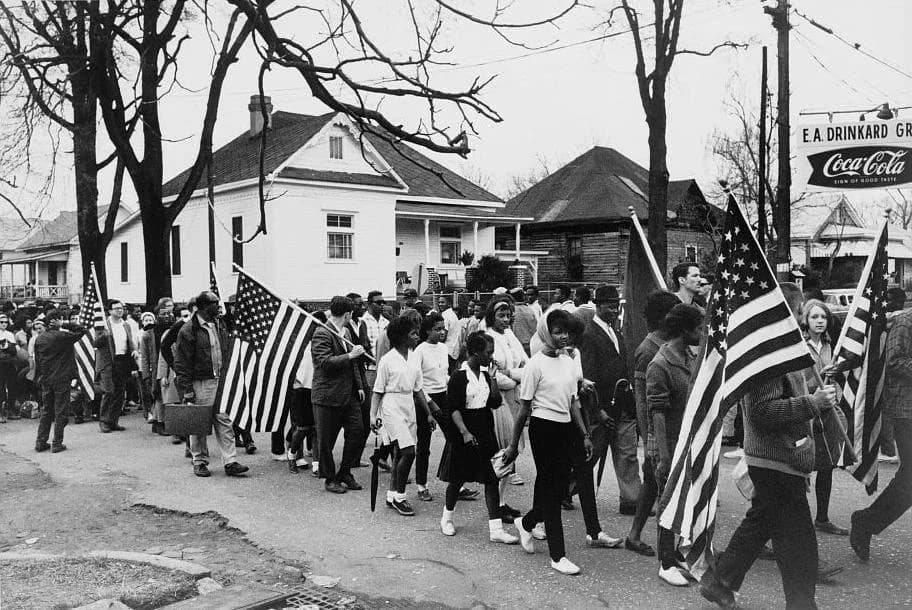
The Voting Rights Act, signed on 6 August 1965, suspended literacy tests in the states and counties with the lowest registration and allowed federal officials to register voters there. The historian David Garrow, in Protest at Selma (1978), argues that the campaign deliberately set out to provoke violence from officials like Clark in front of the national media, because the movement had learned that only such scenes moved Congress. Some activists, especially in SNCC, felt uneasy that this strategy depended on the suffering of local people.
Why did the methods work?
The success of the civil rights movement's methods between 1955 and 1965 depended on conditions that not every movement had. The United States was a democracy whose constitution, as interpreted by the Supreme Court after 1954, was on the movement's side. The federal government had the power to override the southern states, and presidents had reasons to use it: Cold War rivalry with the Soviet Union made scenes of racist violence an embarrassment abroad, and Black voters in the North mattered in elections. Television brought events in the South into homes across the country. The movement's methods were designed to use exactly these conditions.
Campaign | Main method | What created the pressure | Change that followed |
|---|---|---|---|
Montgomery, 1955–1956 | Economic boycott, car pool, mass meetings | Loss of fares; national attention; a court case | Bus segregation ended (Browder v. Gayle); SCLC founded |
Sit-ins, 1960 | Direct action at lunch counters | Loss of trade; arrests in many cities | Many lunch counters desegregated; SNCC founded |
Freedom Rides, 1961 | Direct action on interstate buses | Violent attacks seen nationally; jails filled | ICC rules against segregated terminals (Sept 1961) |
Birmingham, 1963 | Boycott, marches, children's marches, civil disobedience | Police violence on television; business losses | Local agreement; Kennedy's bill; Civil Rights Act 1964 |
Selma, 1965 | Voter registration drive, marches | "Bloody Sunday" on television | Voting Rights Act 1965 |
Cultural influence
Cultural influence covers the ways movements used images, symbols, songs, writing, clothing, newspapers and later television and social media. These methods did two jobs. Inside the movement they built a collective identity, a shared sense of who "we" were, which kept people committed through arrests and defeats. Outside it they reached the public, whose opinions decided whether governments felt able to resist. Cultural methods rarely changed a law directly, but they changed the climate in which laws were made.
Images and testimony in the abolition campaign
The abolitionists were among the first campaigners to use mass-produced images. In 1787 the potter Josiah Wedgwood, a member of the abolition committee, produced a small medallion of a kneeling, chained African man with the words "Am I not a man and a brother?". Thousands were made and given away. Clarkson recorded that they were worn on bracelets and hairpins and set into snuffboxes, so that a political message became a fashion. The image presented the enslaved as fellow human beings asking for pity, which made it acceptable to a respectable public, although it also showed them as passive and kneeling.
The most powerful image was the diagram of the slave ship Brookes (also spelled Brooks), first published by the Plymouth abolition committee in late 1788 and redrawn by the London committee in 1789. It showed how enslaved Africans were packed below decks, using the measurements allowed by the new law of 1788 that regulated the trade. Thousands of copies were printed as posters and in books, and Clarkson used a model of the ship in his speeches.
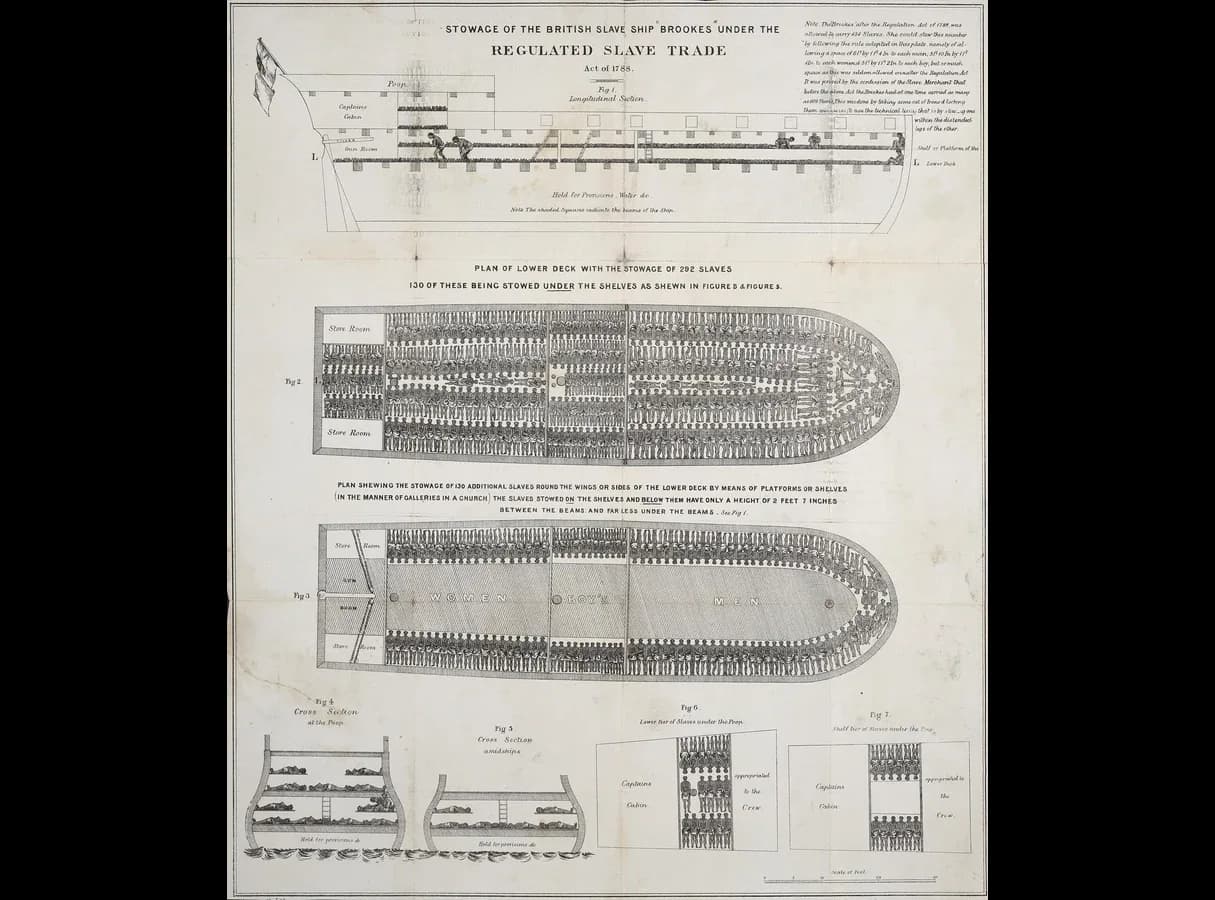
Testimony by formerly enslaved people added a voice that diagrams could not. Olaudah Equiano, who had been enslaved as a child and bought his freedom in 1766, published The Interesting Narrative of the Life of Olaudah Equiano in 1789. It went through nine editions in five years, and Equiano toured Britain and Ireland to sell it and speak against the trade. Together with Ottobah Cugoano's Thoughts and Sentiments on the Evil and Wicked Traffic of the Slavery and Commerce of the Human Species (1787), it gave the campaign the authority of first-hand experience.
Colours, newspapers and songs in the suffrage campaign
The suffrage movement used visual culture on a scale not seen before. In 1908 the WSPU adopted the colours purple (for dignity), white (for purity) and green (for hope). Supporters wore them as sashes, badges and dresses, and shops sold scarves and jewellery in the colours, so that a woman could declare her support in the street. For the WSPU's "Women's Sunday" rally in Hyde Park on 21 June 1908, attended by somewhere between 250,000 and 500,000 people, marchers in seven processions carried about 700 banners, many made by local WSPU branches. A week earlier, on 13 June, the NUWSS procession through London had carried banners designed by the Artists' Suffrage League.
Both wings ran newspapers, the WSPU's Votes for Women (from 1907, later replaced by The Suffragette) and the NUWSS's The Common Cause (from 1909), which members sold on street corners. The composer Ethel Smyth wrote "The March of the Women" (1911), with words by Cicely Hamilton, which became the WSPU's anthem; Smyth is said to have conducted it with a toothbrush from her cell window in Holloway prison in 1912. Plays, postcards and cartoons answered the anti-suffragists' claim that voting women would be unfeminine by showing respectable, educated and patriotic women denied a voice.
Movement | Symbols and images | Words and music | Media |
|---|---|---|---|
Abolition | Wedgwood medallion (1787); Brookes diagram (1788–1789) | Equiano's Narrative (1789); poems by William Cowper and Hannah More | Pamphlets, posters, lectures |
Women's suffrage | Purple, white and green (WSPU); red, white and green (NUWSS); banners | "The March of the Women" (1911); suffrage plays | Votes for Women, The Suffragette, The Common Cause; postcards |
Indian national movement | Khadi, the spinning wheel, the Gandhi cap; the Congress flag | "Bande Mataram"; Gandhi's writings in Young India | Nationalist press; world press at the Salt March |
US civil rights | Sunday clothes, American flags on marches | Freedom songs: "We Shall Overcome", "Ain't Gonna Let Nobody Turn Me Round" | Black press; national television, 1957–1965 |
Anti-apartheid | Mandela as the face of the struggle; the ANC colours | "Nkosi Sikelel' iAfrika"; freedom songs and the toyi-toyi; "Free Nelson Mandela" (1984) | Exile radio; concerts and sports boycotts abroad |
Egypt, 2011 | The Egyptian flag in Tahrir Square; graffiti | "The people want the fall of the regime"; Ramy Essam's songs | Facebook and Twitter; satellite television (Al Jazeera) |
The table of cultural methods shows a common pattern: each movement used the most modern media of its time, from the printed poster to television and the smartphone, and each joined them to older forms of shared culture such as hymns, folk songs, religious meetings and national symbols.
Khadi and the spinning wheel in India
Gandhi gave the Indian national movement its most effective symbols. He urged every Indian to spin and weave khadi, hand-made cloth, instead of buying cloth made in the mills of Lancashire. Khadi had an economic purpose: it was meant to revive village industry and reduce Britain's profits from India. Its cultural purpose was larger. Wearing coarse white khadi showed that a lawyer or merchant identified with the poorest peasants, and it made support for the movement visible in every street. During Non-Cooperation, bonfires of foreign cloth turned the boycott into public ritual. A spinning wheel was placed at the centre of the flag that Congress adopted in 1931.
The song "Bande Mataram" ("I bow to thee, Mother"), from a novel by Bankim Chandra Chatterjee (1882), became a nationalist anthem from the swadeshi agitation of 1905 onwards, and the British at times banned its singing at public meetings. Its Hindu religious imagery, however, made many Muslims uneasy, a sign that cultural symbols could divide a movement as well as unite it.
Freedom songs, television and the civil rights movement
Songs were central to the civil rights movement. In mass meetings, on marches and in jail cells, protesters sang adapted hymns and spirituals, such as "We Shall Overcome", which Guy Carawan of the Highlander Folk School taught to the student activists who founded SNCC in 1960. The singing kept up courage, gave everyone a role and expressed the movement's religious roots. The musicians Joan Baez, Mahalia Jackson and Bob Dylan performed at the March on Washington in 1963.
Television carried the movement's methods to a national audience. Ownership of television sets spread rapidly in the United States in the 1950s, and the evening news showed images of the Little Rock school crisis (1957), the Freedom Rides, Birmingham and Selma to millions of viewers. Civil rights leaders learned to plan their campaigns for the cameras, and the contrast between neatly dressed, non-violent protesters and violent officials was the movement's strongest argument.
Concerts, sport and the face of a prisoner: anti-apartheid culture
Inside South Africa, freedom songs and the toyi-toyi, a high-stepping protest dance, were part of every funeral, rally and march of the 1980s. Outside the country, the movement's cultural strategy aimed at isolating apartheid. South Africa was excluded from the Olympic Games from 1964 and expelled from the Olympic movement in 1970, and the Commonwealth's Gleneagles Agreement of 1977 discouraged sporting contacts. For white South Africans, who cared deeply about rugby and cricket, the sports boycott was a painful sign of their isolation.
The imprisoned Nelson Mandela became the symbol of the struggle. Images of him were banned in South Africa, but abroad the song "Free Nelson Mandela" by The Special AKA (1984) and the concert for his seventieth birthday at Wembley Stadium in London on 11 June 1988, broadcast in dozens of countries, made his release a cause for young people across the world. This campaign increased the pressure on Western governments to impose sanctions.
Social media and street art in Egypt
In Egypt in 2011, social media helped to organise protests that the state-controlled press would not report. The Facebook page "We Are All Khaled Said", set up after police beat to death a young man in Alexandria in June 2010, gained hundreds of thousands of followers and helped call the protest of 25 January. The government's decision to shut down the internet and mobile networks on 27–28 January shows that it took this threat seriously, but the shutdown brought more people into the streets to find out what was happening.
In Tahrir Square the uprising produced its own culture. The chant "al-sha'b yurid isqat al-nizam" ("the people want the fall of the regime") was taken from Tunisia, and the slogan "bread, freedom, social justice" summed up the protesters' demands. The singer Ramy Essam set the chants to music on the square, cartoons and graffiti mocked Mubarak, and satellite television, especially Al Jazeera, broadcast the scenes to the Arab world. These forms of cultural influence united a movement of very different groups, from secular students to members of the Muslim Brotherhood and football supporters' clubs, around a few simple demands.
Violent methods
Violent methods range from attacks on property (smashing windows, burning buildings, cutting telegraph wires) to riots, assassinations, armed uprisings and organised guerrilla war. Few of the core popular movements chose violence as their main method, and none of the six core movements won power by force of arms alone. Violence nonetheless appeared in all of them: sometimes as a strategy chosen by leaders, sometimes as the work of a militant wing, and often as the spontaneous reaction of crowds to repression.
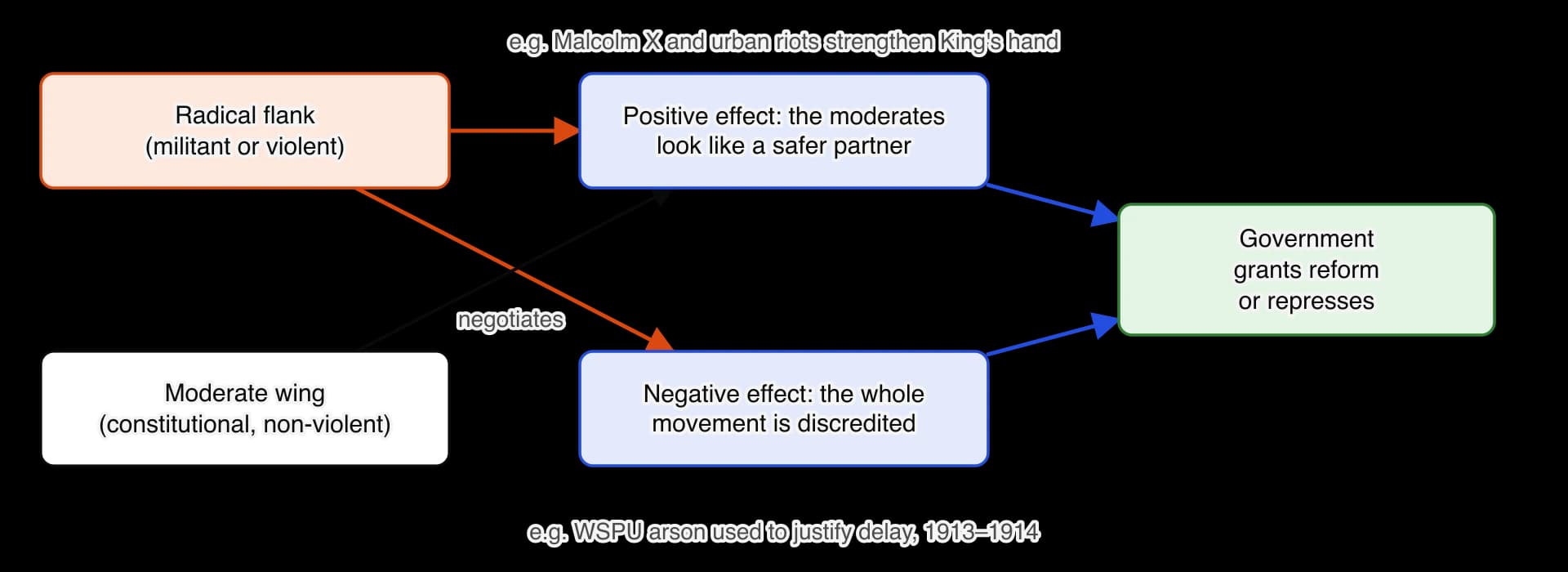
Violence could create change in three ways. It could raise the cost of the existing order until the authorities preferred concession. It could frighten rulers into reform to prevent something worse. And, through the radical flank effect, it could make the moderate wing of a movement look like a reasonable partner for negotiation. It also carried heavy risks: it justified repression, alienated supporters and bystanders, and could divide a movement.
Enslaved rebellion and British abolition
The most important violence in the history of British abolition was that of the enslaved themselves. In December 1831, enslaved people in western Jamaica, led by Samuel Sharpe, a Black Baptist deacon, began a strike for wages that turned into a rising involving perhaps 60,000 people, later called the Baptist War. Rebels set fire to cane fields and buildings on many estates. The colonial militia crushed the rising within weeks; about 14 white people were killed, while more than 500 enslaved people died in the fighting or were executed afterwards, including Sharpe in May 1832.
The rising and its suppression, together with the persecution of Baptist and Methodist missionaries by planters, convinced many in Britain that slavery could no longer be held in place without continuing bloodshed. Parliamentary inquiries in 1832 heard evidence on the rising, and ministers feared that further revolts would follow if emancipation were delayed. Historians such as Michael Craton, in Testing the Chains (1982), argue that the resistance of the enslaved was a central cause of emancipation; others stress the parliamentary campaign. Most now see the two as working together: the rebellion made the abolitionists' demand for immediate emancipation look like the safer course.
Suffragette militancy, 1905–1914
The Women's Social and Political Union (WSPU), founded in Manchester in 1903 by Emmeline Pankhurst and her daughters, adopted the motto "Deeds, not words". Its militancy grew in stages. From 1905 members heckled Liberal ministers and got themselves arrested; from 1908 some broke windows; from July 1909, when Marion Wallace Dunlop refused food in Holloway prison, imprisoned suffragettes went on hunger strike, and the government replied by force-feeding them. After the failure of the Conciliation Bills, the WSPU organised mass window-smashing in the West End of London on 1 and 4 March 1912, and more than 200 women were arrested.
In 1913–1914 a small number of members carried out a campaign of arson and bombing against empty buildings, post boxes, railway stations, churches and sports pavilions. A bomb damaged a house being built for the chancellor, David Lloyd George, in February 1913. On 4 June 1913 Emily Wilding Davison ran onto the racetrack during the Derby and was struck by the king's horse; she died four days later, and her funeral became a huge public procession. Emmeline Pankhurst justified militancy by arguing that women had been ignored for forty years of peaceful campaigning, and that the government responded only to pressure.
NUWSS (suffragists) | WSPU (suffragettes) | |
|---|---|---|
Founded and led | 1897; Millicent Fawcett | 1903; Emmeline, Christabel and Sylvia Pankhurst (Sylvia was expelled in 1914) |
Organisation | Federation of local societies; elected leadership; more than 50,000 members by 1914 | Centralised, controlled by Emmeline and Christabel Pankhurst; tens of thousands of supporters at its peak |
Main methods | Petitions, lobbying, meetings, peaceful marches (1907, 1913), Election Fighting Fund with Labour (1912) | Heckling, mass demonstrations, hunger strikes, window-smashing (1912), arson and bombs (1913–1914) |
View of the Liberals | Persuade them; from 1912 oppose them at by-elections | Oppose all Liberal candidates as the party of government |
In 1914 | Suspended most campaigning for relief work, but kept lobbying for the vote | Suspended militancy and supported the war effort |
The comparison of the NUWSS and the WSPU shows two strategies in one movement. The WSPU made votes for women the most talked-about issue in British politics, but by 1913–1914 its attacks on property alienated many supporters, including members of Parliament who had backed suffrage, and gave the government a reason to refuse concession under pressure. The vote for women over 30 came in 1918, after the WSPU had stopped militancy in August 1914 and women's war work had changed opinion, which is why the effect of militancy remains one of the main debates about the movement.
Revolutionaries, Quit India and mutiny in India
Alongside Gandhi's campaigns, small revolutionary groups used violence against British rule. In Punjab, Bhagat Singh and his comrades of the Hindustan Socialist Republican Association killed a British police officer, John Saunders, in December 1928 and threw harmless bombs into the Central Legislative Assembly in April 1929 to court arrest and publicity. Bhagat Singh was hanged on 23 March 1931 at the age of 23 and became a national martyr; in Bengal, Surya Sen's group raided the armouries at Chittagong in April 1930. These actions did not threaten British rule militarily, but they showed that young Indians were prepared to die for independence, and Congress leaders could present themselves as the moderate alternative.
The Quit India Movement was the largest rising against British rule since 1857. On 8 August 1942 Congress demanded an immediate British withdrawal, and Gandhi urged Indians to "do or die". The British arrested the whole Congress leadership the next morning. Without leaders, the movement became a mass rising: crowds attacked railway lines, police stations, post offices and telegraph wires, and in parts of Bihar, the United Provinces, Bengal and Maharashtra local "parallel governments" briefly took control. The British used troops, aircraft and mass arrests to crush it; more than 90,000 people had been arrested by the end of 1943 and about 1,000 killed by official figures, with nationalist estimates much higher.
After the war, violence and the threat of it came from within the institutions on which British rule depended. Subhas Chandra Bose, a former Congress president, led the Indian National Army from 1943, a force formed from Indian prisoners of war and expatriates with Japanese support; it fought alongside the Japanese in Burma in 1944. When the British put its officers on trial at the Red Fort in Delhi in late 1945, the trials provoked mass protest. In February 1946 sailors of the Royal Indian Navy mutinied in Bombay and other ports. The historian Sumit Sarkar stresses these upheavals of 1945–1946 in explaining why the British concluded that they could no longer rely on Indian soldiers and police to hold India.
From non-violence to armed struggle in South Africa
The ANC's turn to armed struggle followed a decade in which non-violent methods had been answered with repression. After the police killed 69 people at a protest against the pass laws at Sharpeville on 21 March 1960, the government banned the ANC and the Pan Africanist Congress (PAC). In June 1961 Mandela and other ANC leaders, with members of the South African Communist Party, decided to form Umkhonto we Sizwe ("Spear of the Nation", MK), which began a campaign of sabotage on 16 December 1961.
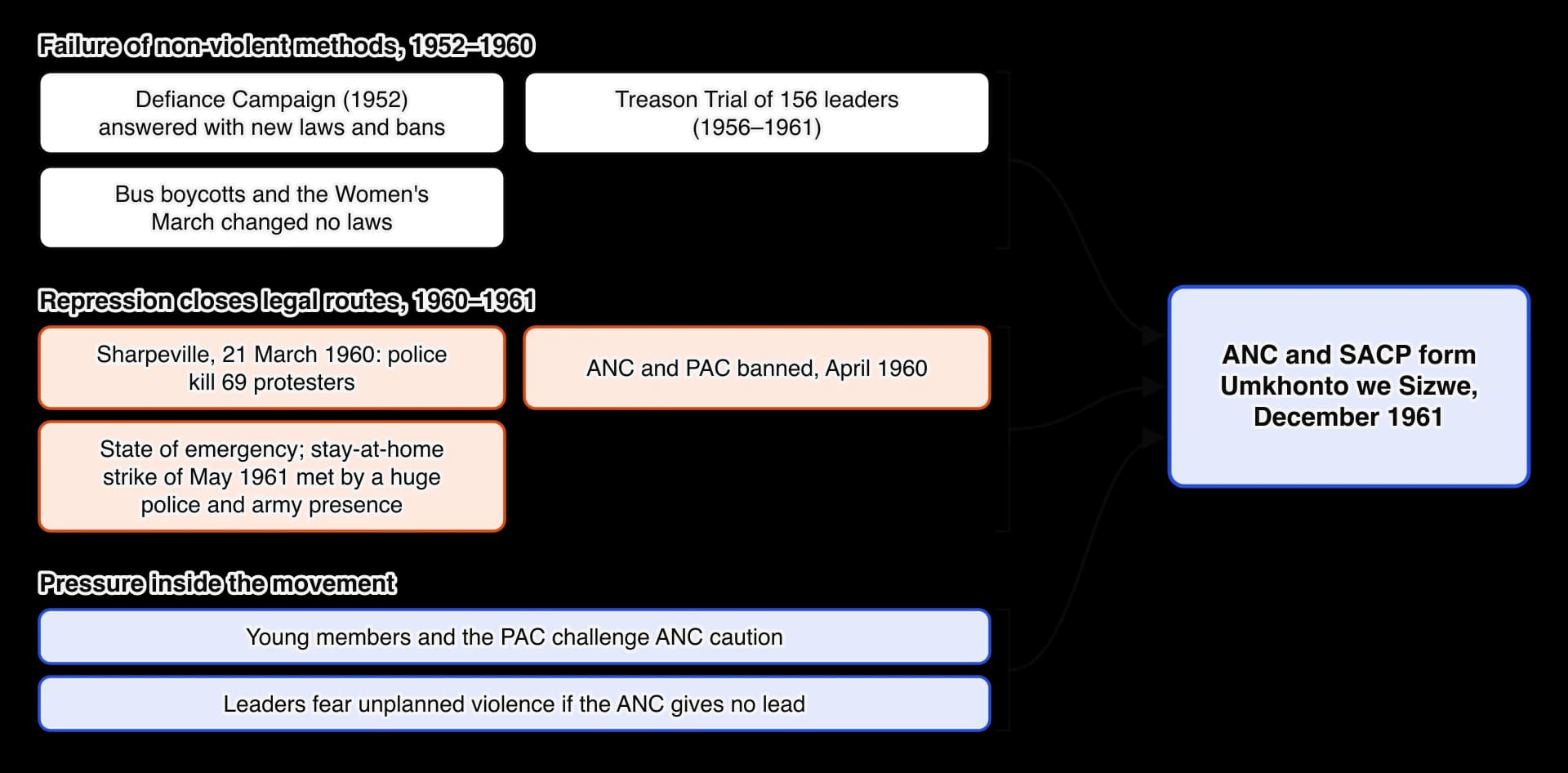
MK attacked power pylons, railway lines and government offices, and carried out about 200 acts of sabotage before most of its leaders were arrested at Liliesleaf Farm in Rivonia in July 1963. At the Rivonia Trial, Mandela explained the decision in a statement from the dock.
Four forms of violence were possible. There is sabotage, there is guerrilla warfare, there is terrorism, and there is open revolution. We chose to adopt the first method and to exhaust it before taking any other decision. In the light of our political background the choice was a logical one. Sabotage did not involve loss of life, and it offered the best hope for future race relations.
Nelson Mandela, statement from the dock at the Rivonia Trial, Pretoria, 20 April 1964. Mandela spoke to a court that could sentence him to death, but also, through the press, to South Africans and the world. His purpose was to show that the ANC had chosen violence reluctantly, after "all channels of peaceful protest had been barred", and in a limited form, so the statement presents the turn to arms in the most defensible way. It is strong evidence of the leaders' reasoning, though not of how MK's campaign developed later, when attacks killed civilians.
Mandela and seven others were sentenced to life imprisonment in June 1964. MK rebuilt in exile in Zambia, Tanzania and later Angola, and after the Soweto uprising of 1976 thousands of young people left South Africa to join it. In the late 1970s and 1980s MK carried out attacks on police stations, the Sasolburg fuel refinery (1980) and the Koeberg nuclear power station (1982); some attacks killed civilians, such as the car bomb outside the air force headquarters in Church Street, Pretoria, in May 1983, which killed 19 people. In the townships in 1984–1986, young "comrades" attacked people they saw as collaborators, sometimes killing them, a violence that divided communities and was used by the government to discredit the movement.
The historian Stephen Ellis, in External Mission (2012), argues that MK never came close to threatening the South African state militarily. Its importance was political: armed struggle kept the ANC at the centre of Black resistance and made it the organisation that the government eventually had to negotiate with. The diagram of pressures on the apartheid state shows the armed struggle as one pressure among several, alongside strikes, boycotts and international sanctions.
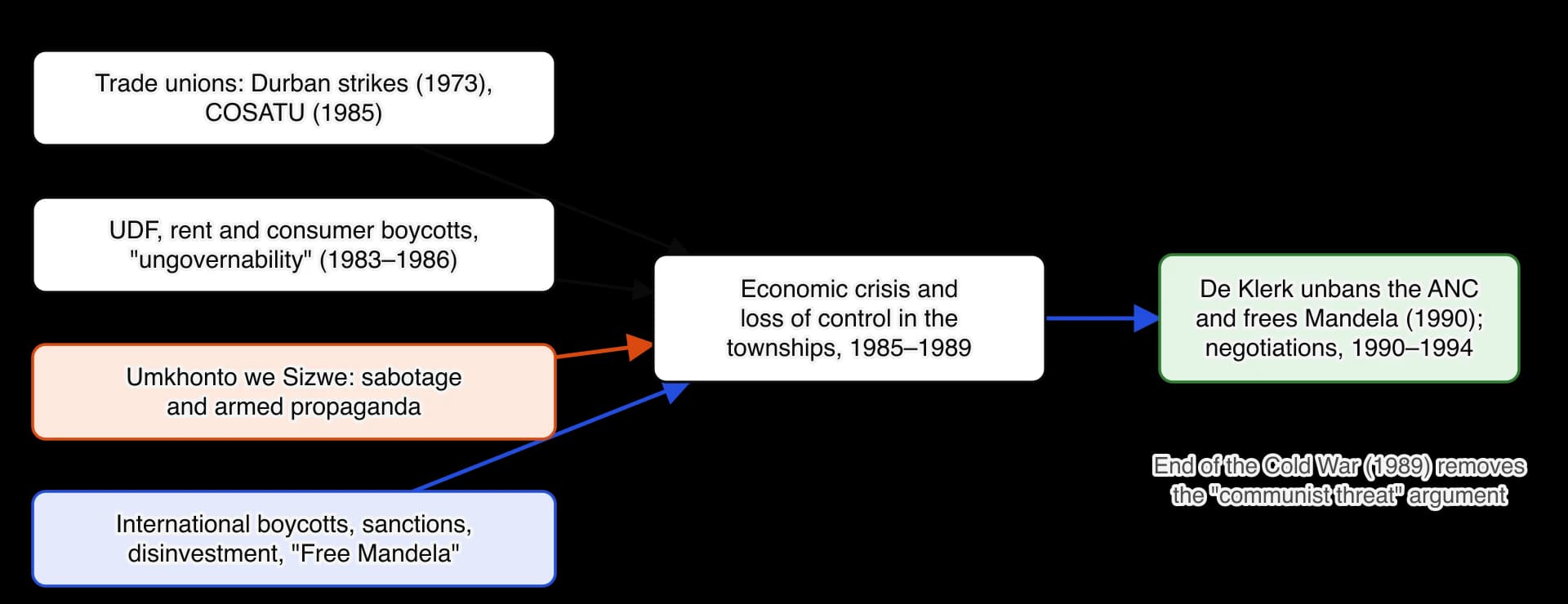
International pressure grew most quickly in the mid-1980s, when television showed the township risings and the states of emergency. In 1985 the American bank Chase Manhattan refused to renew its short-term loans to South Africa, other banks followed, and the currency collapsed. In October 1986 the US Congress passed the Comprehensive Anti-Apartheid Act over President Reagan's veto, banning new investment and many imports, and the European Community and the Commonwealth adopted their own sanctions. After F. W. de Klerk became president in 1989, he unbanned the ANC and released Mandela on 11 February 1990. Four years of negotiation, interrupted by violence between ANC supporters and the Inkatha Freedom Party, led to South Africa's first election by universal suffrage on 27 April 1994.
Armed self-defence, riots and Black Power in the USA
The US civil rights movement was not as purely non-violent as its public image suggests. Many Black southerners kept guns to protect their homes, and in Monroe, North Carolina, the NAACP leader Robert F. Williams organised armed self-defence against the Ku Klux Klan in the late 1950s. In Louisiana, the Deacons for Defense and Justice (1964) guarded civil rights workers with weapons. Malcolm X, the most famous spokesman of the Nation of Islam until 1964, rejected non-violence as a principle and argued that Black people had the right to defend themselves "by any means necessary".
From 1965, riots broke out in many northern and western cities, starting with Watts in Los Angeles in August 1965 (34 killed) and reaching a peak in Detroit and Newark in 1967 and after King's assassination in April 1968. Stokely Carmichael of SNCC popularised the slogan "Black Power" in 1966, and the Black Panther Party, founded in Oakland in October 1966, carried guns openly in police patrols. These developments had both radical flank effects. The sociologist Herbert Haines, in Black Radicals and the Civil Rights Mainstream (1988), found that donations to moderate organisations rose as radicals became more prominent, because funders saw moderates as the alternative to unrest. At the same time, the riots strengthened a white "backlash" that helped Richard Nixon win the presidency in 1968 on a promise of "law and order".
Comparing the movements: what made methods effective?
Every core movement used methods from all four lines of inquiry, but in different proportions and against very different opponents. The comparative table sets out the main methods of each movement and the route by which change finally came.
Movement | Political participation | Non-violent methods | Cultural influence | Violent methods | How change came |
|---|---|---|---|---|---|
British abolition, 1787–1838 (Europe and the Caribbean) | Petitions (1788, 1792, 1814, 1830–1833); lobbying; election pledges (1832) | Sugar boycott (1791–1792, 1820s) | Wedgwood medallion; Brookes diagram; Equiano | Enslaved risings, e.g. Jamaica 1831–1832 (not by British campaigners) | Acts of Parliament, 1807 and 1833 |
British women's suffrage, 1866–1928 (Europe) | Petitions; bills; Election Fighting Fund (1912) | Marches (1907, 1908, 1913); tax resistance; hunger strikes | Colours, newspapers, banners, songs | WSPU window-smashing, arson and bombs (1912–1914) | Acts of Parliament, 1918 and 1928, after the war |
Indian national movement, 1885–1947 (Asia) | Congress petitions; 1937 elections; ministries | Non-Cooperation (1920–1922); Civil Disobedience (1930–1934) | Khadi, spinning wheel, flag, "Bande Mataram" | Revolutionaries; Quit India sabotage (1942); INA; naval mutiny (1946) | Negotiated transfer of power, 1947 |
US civil rights, 1954–1968 (Americas) | NAACP court cases; voter registration | Bus boycott; sit-ins; Freedom Rides; marches | Freedom songs; Black press; television | Armed self-defence; urban riots (1965–1968) | Federal laws (1964, 1965) and court rulings |
Anti-apartheid, 1948–1994 (Africa) | Unions; UDF; lawful protest when allowed | Defiance Campaign; bus and rent boycotts; stay-aways |
Patterns in the evidence
Several patterns appear when the cases are compared. First, the kind of state a movement faced shaped which methods worked. In Britain and the United States, governments depended on elections and could change the law, so persuasion and political participation could succeed, backed by disruption. Colonial and authoritarian governments that did not depend on the votes of the people they ruled were harder to move: Indian and South African movements had to raise the cost of rule until the ruling power, weakened by war or economic crisis, decided to negotiate.
Second, successful movements combined methods. No core movement relied on one line of inquiry alone. The civil rights movement joined court cases, boycotts, direct action, songs and television into a single strategy; the Indian national movement alternated mass non-violent campaigns with negotiation and elections. Third, the decisive change often came from an ally or a split in the ruling group: Wilberforce and the Whig ministers of 1806–1807, Presidents Kennedy and Johnson, the British Labour government of 1945, F. W. de Klerk in 1989–1990 and the Egyptian army in 2011.
Fourth, outside events often decided when change came. War halted the abolition campaign in 1793 and helped the suffrage movement after 1914; the Second World War weakened Britain's hold on India; the end of the Cold War in 1989 removed the South African government's claim that the ANC was a communist threat. Methods made change possible, but the timing of change often depended on these wider conditions.
Non-violence and violence: the evidence of social science
In Why Civil Resistance Works (2011), Erica Chenoweth and Maria Stephan compared 323 campaigns between 1900 and 2006 that aimed to overthrow a government, expel a foreign occupier or win independence. They found that non-violent campaigns succeeded about 53 per cent of the time and violent campaigns about 26 per cent, so non-violent campaigns were roughly twice as likely to succeed. Their explanation is participation: non-violent campaigns attract far more people, because the physical, moral and practical barriers to joining are lower, and mass participation makes it more likely that security forces, officials and economic elites will defect.
Finding | Explanation offered by Chenoweth and Stephan | Example from the core cases |
|---|---|---|
Non-violent campaigns succeeded about twice as often as violent ones, 1900–2006 | Lower barriers to participation bring in larger and more varied numbers | Women, children and the elderly joined the Salt March campaign and the Birmingham marches |
Mass participation encourages defections from the regime | Soldiers and officials are less willing to attack fellow citizens who are peaceful | The Egyptian army refused to clear Tahrir Square in February 2011 |
Repression of non-violent protesters often backfires | Violence against peaceful people produces outrage and wider support | Dharasana (1930), Birmingham (1963), Selma (1965) |
Non-violent success is more likely to lead to democracy afterwards | The skills of mass organisation carry over into civilian politics | Contested by Egypt, where the army took power in 2013 |
Data: Erica Chenoweth and Maria J. Stephan, Why Civil Resistance Works: The Strategic Logic of Nonviolent Conflict (Columbia University Press, 2011).
Their findings have critics. The data measure success in a limited way (whether the campaign achieved its main aim within about a year of its peak), and many campaigns mixed violent and non-violent methods, so classifying them is a matter of judgement. Movements that sought rights within a state, such as the suffrage and civil rights movements, are not part of the main dataset. In later work Chenoweth and Kurt Schock (2015) found little evidence that armed wings improved the chances of non-violent campaigns, which challenges the idea of a positive radical flank effect.
 YouTube
Perspectives and debates
Arguments about how movements created change began among the activists themselves. Gandhi and the revolutionaries, King and Malcolm X, Fawcett and the Pankhursts all disagreed about methods. Historians have continued these arguments, and have added a further question: how far the change was caused by the movements at all, as against governments, elites, economic interests and wars.
Did militancy help or hinder votes for women?
Historian | Argument | Evidence stressed |
|---|---|---|
Martin Pugh, The March of the Women (2000) | WSPU militancy was counter-productive after 1912 and delayed reform; the constitutional suffragists and political change did more | Loss of support among MPs; defeat of the 1912 Conciliation Bill; the NUWSS–Labour alliance |
June Purvis, Emmeline Pankhurst: A Biography (2002) | The WSPU was a courageous movement that made votes for women impossible to ignore; its leaders have been unfairly portrayed | Mass support for the WSPU; the government's brutality (force-feeding); the publicity militancy won |
Sandra Stanley Holton, Feminism and Democracy (1986) | The "democratic suffragists" who allied with Labour created the political conditions for the 1918 reform | Election Fighting Fund (1912); links between suffragists and the labour movement |
Many historians now argue that the two wings needed each other. Militancy gave the movement publicity and urgency, while the NUWSS gave politicians a respectable partner, a form of the radical flank effect. The Representation of the People Act 1918 itself came from wartime decisions about the franchise for soldiers, so any judgement must also weigh the war.
What forced Britain to leave India?
Indian nationalist historians such as Bipan Chandra, in India's Struggle for Independence (1988), argue that the national movement won independence through a deliberate strategy of "struggle–truce–struggle": mass campaigns alternating with periods of negotiation and constructive work, which steadily destroyed the legitimacy of British rule. Judith Brown, in Gandhi: Prisoner of Hope (1989), is more cautious about the effect of Gandhi's campaigns, which often failed in their immediate aims, and stresses British calculations about the cost and value of India. Sumit Sarkar, in Modern India, 1885–1947 (1983), emphasises popular initiative "from below", including the violence of Quit India and the upheavals of 1945–1946, which often went beyond what Congress leaders wanted. Imperial historians such as John Darwin place more weight on Britain's weakness after the Second World War.
These views can be combined by distinguishing what the movement did from when change came. The campaigns of 1920–1942 made British rule depend increasingly on force and destroyed its claim to be accepted; the war and its aftermath made that force too costly to use. Most historians accept both points but disagree about their weight.
Leaders, local people and the federal government in the civil rights movement
Early histories of the civil rights movement focused on King and on national events. David Garrow (1978) and Adam Fairclough, in To Redeem the Soul of America (1987), a history of the SCLC, show how King's organisation planned campaigns to provoke national crises and federal action. Historians writing "from the bottom up", such as Charles Payne in I've Got the Light of Freedom (1995), a study of Mississippi, argue that patient local organising, much of it by women and by SNCC, did more to change people's lives than the dramatic national campaigns. Timothy Tyson, in Radio Free Dixie (1999), a biography of Robert F. Williams, shows that armed self-defence was part of the southern Black freedom struggle, not only a later northern development.
Other historians stress the role of the federal government. Presidents and the Supreme Court made the changes in law, and the Cold War gave them reasons to act. A balanced judgement sees the movement's methods as the means by which local grievances became national crises that federal leaders could not ignore.
Who abolished slavery?
The debate over British abolition is as much about causes as about methods: the argument between Eric Williams, who stressed the economic decline of the Caribbean, and Seymour Drescher, who stressed popular mobilisation, belongs to the emergence of the movement. On methods, Drescher, in Capitalism and Antislavery (1986), argues that the scale of petitioning made abolitionism the first mass movement to change national policy in this way. Historians of the Caribbean, such as Michael Craton (1982) and Hilary Beckles, argue that the resistance of the enslaved, culminating in the Jamaican rising of 1831–1832, did as much as the campaign in Britain to bring emancipation in 1833.
Egypt: networks, workers or the army?
Early accounts of the Egyptian uprising stressed young activists and social media. Later studies, such as the work of the historian Joel Beinin on Egyptian labour, stress the strikes of 2006–2011 and of the final days of the uprising, which showed that the regime was losing control of the economy. Others point out that the decisive act was the army's removal of Mubarak, made partly to protect its own power and business interests. The elections of 2011–2012 brought the Muslim Brotherhood's Mohamed Morsi to the presidency in June 2012, but after mass protests against him the army removed him on 3 July 2013, which shows how far the army controlled the outcome. These perspectives suggest that the methods of the protesters created a crisis, but that the form of change was decided by an institution the movement did not control.
Applying the ideas in exam questions
Paper 2 Section A: a concept question
Paper 2 Section B, Part A: cultural influence
A second Part A question on this guiding question could ask: Explain why a popular movement adopted violent methods. Use one example from your thematic study in your response. [4] The ANC's formation of Umkhonto we Sizwe in 1961 is the clearest example; a strong answer explains two reasons (for example, the failure of the non-violent campaigns of the 1950s and the banning of the ANC after Sharpeville) and links each to the decision.
Paper 2 Section B, Part B: violent and non-violent methods
Paper 2 Section B, Part B: political participation
Self-check
- To do:
I can explain the four ways in which movements created pressure (persuasion, disruption, division of the opponent, force) and the different routes by which change came.
- To do:
I can define a repertoire of contention, civil resistance, civil disobedience, satyagraha, direct action, sabotage and the radical flank effect.
- To do:
I can explain how petitions, lobbying, elections and court cases helped the abolitionist, suffrage, Indian and civil rights movements create change.
- To do:
I can explain how boycotts, non-cooperation, civil disobedience and occupation worked, using the sugar boycott, the Salt March, the Defiance Campaign and Tahrir Square.
- To do:
I can explain how the methods of the US civil rights movement changed from Montgomery to Selma, and how they led to the Civil Rights Act and the Voting Rights Act.
- To do:
I can explain how symbols, songs, newspapers, television and social media built identity and won outside support in at least three movements.
- To do:
I can explain why some movements or their radical wings used violence, with the Jamaican rising, WSPU militancy, Quit India, Umkhonto we Sizwe and Black Power as examples.
- To do:
I can compare the NUWSS and the WSPU and weigh the effect of militancy.
- To do:
I can compare the core movements and explain why the same method worked in one context and failed in another.
- To do:
I can outline Chenoweth and Stephan's findings and their limits.
- To do: