Notes on TS3.4 How was authoritarian rule challenged?
Every authoritarian regime faced challenges: rivals inside the ruling party, officers who plotted coups, churches that defended their own authority, peasants and workers who refused orders, and foreign states that went to war with it. How these challenges arose, how regimes dealt with them and why so few succeeded explains a great deal about how authoritarian states worked and why some lasted for decades.
Opposition, resistance and dissent
People challenged authoritarian regimes in very different ways, from telling a joke about the leader to trying to kill him. Historians use several terms to separate these, and the choice of term affects how widespread a challenge appears.
Resistance is narrower. It means deliberate action aimed at weakening or overthrowing the regime: printing and distributing leaflets, sabotage, armed revolt, helping victims escape, or plotting a coup. It was always the work of small minorities, because the risks were very high. Dissent is broader: the expression of disagreement, in private or in public, without necessarily trying to bring the regime down.
Below these lies everyday non-conformity: refusing to give the official greeting, missing party meetings, listening to banned music or foreign radio, working slowly, or telling political jokes. Such behaviour showed that a regime had not won people’s hearts, but it rarely threatened its power.

The scale of dissent shows how the German historian Detlev Peukert arranged these forms of behaviour in Inside Nazi Germany (1982; English edition 1987). Moving from left to right, behaviour became more public, more risky and more directly aimed at the regime. The model works for other regimes too: a Soviet peasant who slaughtered his cow in 1930 rather than give it to the collective farm was refusing; the women who rioted to take back their seed grain were protesting; the armed bands in Ukraine and the North Caucasus were resisting.
Resistenz: the Bavaria Project
In the 1970s and 1980s a research project at the Institute of Contemporary History in Munich, led by Martin Broszat, studied everyday life in Bavaria under the Nazis. Broszat borrowed the medical term Resistenz (immunity) to describe the ways in which institutions and groups, such as the Catholic Church, village communities and parts of the civil service, kept their own values and limited the regime’s reach, without trying to overthrow it.
The idea widened the history of resistance beyond the famous plotters to include ordinary people. Its critics, including Ian Kershaw, warned that it could blur the line between grumbling and real resistance and make the German population look less compliant than it was.
Four kinds of challenge
The challenges to authoritarian rule can be grouped by where they came from. Internal opposition came from inside the ruling elite or the institutions of the state. Popular resistance came from below, from workers, peasants, students and ethnic or religious communities. The impact of the regime’s own policies, such as economic failure, repression that went too far or attacks on cherished institutions, created discontent in both. External threats came from foreign states, through war, invasion, sanctions or diplomatic pressure.
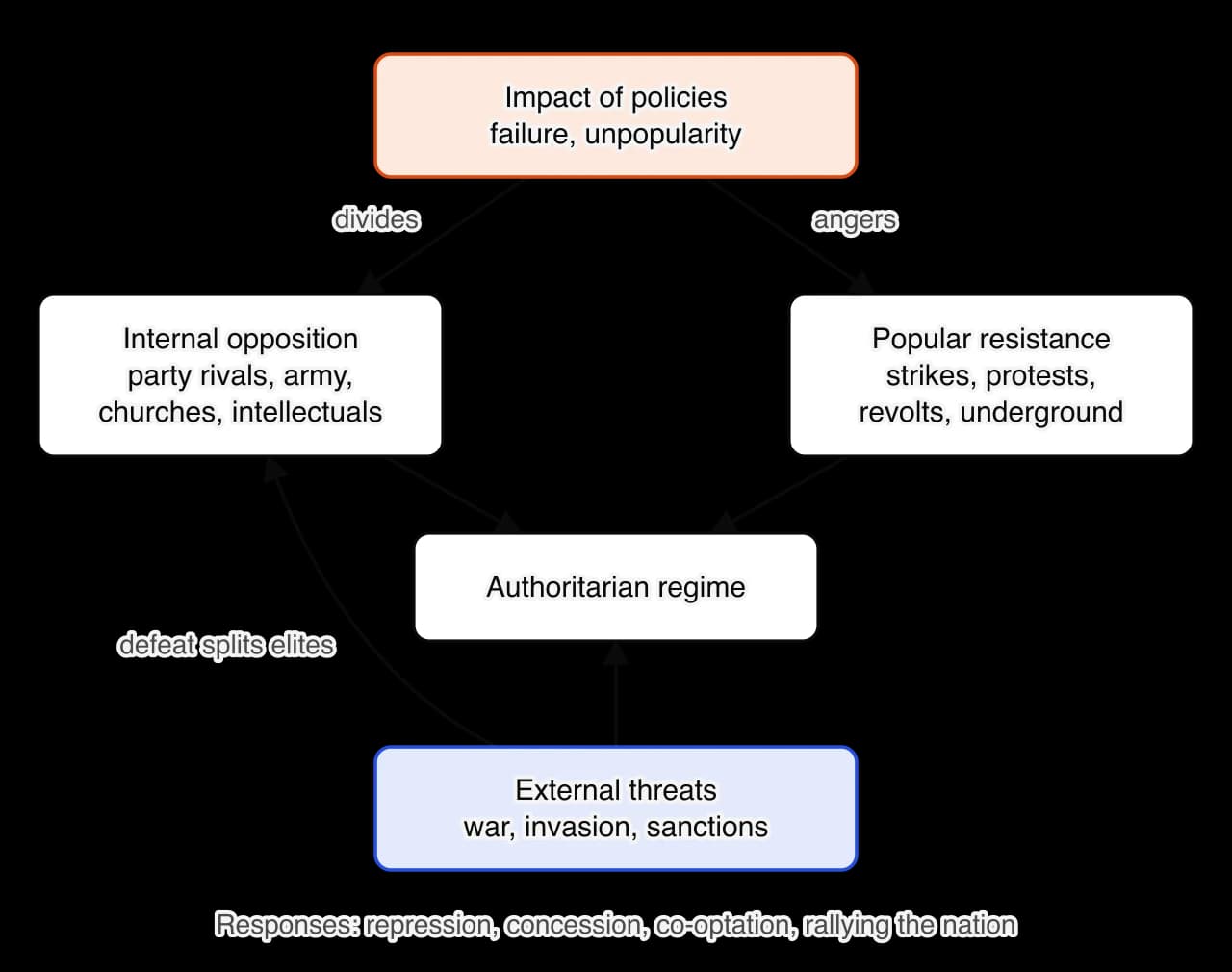
The diagram of the four kinds of challenge shows how they interacted. A failed policy could split the leadership (Mao’s Great Leap Forward led to criticism at the top of the party in 1959 and 1962) and anger the population at the same time. Defeat in war mattered most when it divided the elite: Mussolini was removed by his own Fascist Grand Council and the king in July 1943, after the Allied invasion of Sicily, not by Italian partisans.
How regimes responded
Regimes had four main ways of answering a challenge. Repression meant arrest, imprisonment, execution, deportation or the use of troops. Concession meant a tactical retreat: Stalin paused collectivisation in March 1930, Hitler suspended the main “euthanasia” programme in August 1941, and Nasser promised reform after the protests of 1968. Co-optation meant bringing critics into the system or buying off their followers, for example with promotion or benefits. Finally, a regime could present a challenge as the work of foreign enemies and use it to rally the nation behind the leader.
Internal opposition
Internal opposition came from people and institutions inside the regime or close to it: rival leaders in the ruling party, army officers, senior officials, church leaders and intellectuals. It was the most dangerous kind of challenge for three reasons. These groups had access to the leader, to weapons or to an organisation with its own loyal followers; they could claim to speak for the regime’s own ideals; and the regime depended on them to govern. A dictator could survive the hostility of millions of peasants as long as the army stayed loyal; the desertion of the army usually ended his rule.
For the same reason, authoritarian rulers watched their own elites most closely. Purges, the rotation of commanders, rival security agencies and the promotion of loyal mediocrities were all ways of making internal opposition impossible before it began. The challenges that arose despite these methods were nevertheless real, and what happened to them shows how effective the methods were.
Rivals in the ruling party: Stalin
Stalin’s main rivals, Trotsky on the Left and Bukharin on the Right, had been defeated by 1929. Opposition inside the Communist Party did not end there. In 1932, during the crisis of collectivisation and famine, a former Moscow party official, Martemyan Ryutin, circulated a long document known as the Ryutin Platform. It blamed Stalin personally for the disasters in the countryside and called for his removal as General Secretary. Ryutin and his small group were expelled and imprisoned, and anyone who had read the document without reporting it was punished. Ryutin was shot in 1937.
At the Seventeenth Party Congress in early 1934 some delegates are said to have voted against Stalin in the secret ballot for the Central Committee, and to have seen Sergei Kirov, the popular party leader in Leningrad, as an alternative. The evidence comes from later memoirs and is disputed; estimates of the votes against Stalin range from a handful to nearly 300. What is certain is that Kirov was murdered in December 1934 and that, as Khrushchev told the party in 1956, 1,108 of the 1,966 delegates to the congress were later arrested. Whether there was a real threat or Stalin only feared one, the Great Terror destroyed every possible source of opposition in the party, the army and the state.
The army and the conservative elites: Hitler
In Nazi Germany the first internal challenge came from within the movement itself. Ernst Röhm’s SA, with more than three million members by 1934, wanted a “second revolution” and control of the army. Hitler destroyed its leadership in the Night of the Long Knives (30 June–2 July 1934), which won him the support of the army generals. After that, the only organised groups able to challenge him from inside were the army officer corps, parts of the old conservative elite in the civil service and diplomacy, and the churches.
Conservative officers plotted against Hitler several times. In September 1938 a group around General Franz Halder and Colonel Hans Oster planned to arrest him if he went to war over Czechoslovakia; the Munich Agreement removed their reason to act. In March 1943 Henning von Tresckow had a bomb placed on Hitler’s aircraft, but it failed to explode. Civilian groups such as the Kreisau Circle, which met at the estate of Helmuth James von Moltke, discussed how Germany should be governed after Hitler.
The 20 July plot, 1944
The most serious attempt came after the Allied landings in Normandy, when defeat was certain. On 20 July 1944 Colonel Claus von Stauffenberg, chief of staff of the Reserve Army, placed a bomb in a briefcase at a conference in Hitler’s headquarters near Rastenburg in East Prussia. The bomb exploded, but a heavy table leg shielded Hitler, who was only slightly hurt. In Berlin the conspirators were slow to start Operation Valkyrie, the emergency plan they had adapted to take control of the capital, and when news came that Hitler was alive most officers stayed loyal. Stauffenberg and three others were shot that night.
The regime’s revenge was severe. Thousands were arrested, about 200 people linked to the plot were executed, many after show trials before the People’s Court under Roland Freisler, and Field Marshal Erwin Rommel was forced to take poison in October 1944. Party control over the army tightened: Himmler took command of the Reserve Army, and the Nazi salute replaced the military salute.
The plot shows both the potential and the limits of internal opposition. The army was the only institution with the means to remove Hitler, but most generals were bound by their oath of personal loyalty to him, by fear and by the habit of obedience, and the conspirators acted only when the war was already lost. Their aims are also debated. Many, such as Carl Goerdeler, the former mayor of Leipzig who was to have led the new government, were conservative nationalists who hoped to save Germany from total defeat and did not want to restore parliamentary democracy; others, including Tresckow and Stauffenberg, were moved above all by the regime’s crimes in the east.
Leaders inside the party: Mao
In Mao’s China internal opposition took the form of criticism from intellectuals and senior leaders, which Mao treated as a challenge to his authority. In the Hundred Flowers campaign of 1956–1957 Mao invited criticism of the party, and students, professors and members of the small non-communist parties attacked officials’ privileges and the party’s monopoly of power more sharply than he had expected. He answered with the Anti-Rightist Campaign of 1957, in which hundreds of thousands were labelled “rightists”, and few intellectuals dared to speak openly again. The most famous case came at the party conference at Lushan in July 1959. Peng Dehuai, the Minister of Defence and a marshal of the civil war, had seen hunger in his home province of Hunan. On 14 July he sent Mao a private letter of criticism of the Great Leap Forward.
The exaggeration trend has become so common in various areas and departments that reports of unbelievable miracles have appeared in newspapers and magazines to bring a great loss of prestige to the Party. According to what was reported, it seemed that communism was just around the corner, and this turned the heads of many comrades. … Though we were poor, we lived as if we were rich.
Peng Dehuai, letter to Mao Zedong, 14 July 1959, in Memoirs of a Chinese Marshal (Foreign Languages Press, 1984). Peng wrote privately, as a loyal party member, and was careful to praise Mao and to describe the mistakes as shared ("I am no exception"). Mao nevertheless had the letter printed for the whole conference and attacked it as a right-wing attack on the party. As a source it shows how cautious even the most senior critic had to be. The memoirs in which it was printed appeared only after Peng’s posthumous rehabilitation in 1978, when the party leadership under Deng Xiaoping was ready to admit that the Leap had been a mistake.
The response to Peng shows how internal opposition could strengthen a leader in the short term. Other leaders who privately agreed with Peng rallied to Mao, Peng was dismissed and replaced by Lin Biao, and a campaign against “right deviation” followed in the party. Officials who reported shortages were now at risk, so the Leap was pressed harder and the famine became worse.
Two later challenges came from the very top. In 1962 Liu Shaoqi, the head of state, and Deng Xiaoping, the party’s general secretary, led a retreat from the Leap, and Liu told a conference of 7,000 cadres in January 1962 that the disaster was largely man-made. Mao saw this as a threat to his position, and the Cultural Revolution of 1966 destroyed both men. In 1969 Lin Biao was named Mao’s successor in the party constitution, but relations broke down, and on 13 September 1971 Lin died when the aircraft in which he was fleeing to the USSR crashed in Mongolia. The party later accused him of plotting a coup. The affair shook belief in Mao, since the man he had chosen as his heir had turned out, in the official version, to be a traitor. The last struggle, between the radical Gang of Four around Mao’s wife Jiang Qing and the moderates around Zhou Enlai and Deng, was settled only after Mao’s death, when his successor Hua Guofeng had the four arrested in October 1976.
Officers and Islamists: Nasser
Nasser’s regime faced its main internal challenges in its first years and after defeat in 1967. In 1954 he fought a power struggle with General Muhammad Naguib, the popular senior officer who had been the public face of the 1952 coup. Naguib wanted a return to civilian, parliamentary rule and was backed for a time by the Wafd party, the Muslim Brotherhood, communists and some officers. Nasser won by organising support in the army and among trade unions, which staged strikes in March 1954 against a return to party politics. After a Brotherhood member fired at Nasser in Alexandria in October 1954, Naguib was removed and kept under house arrest, and the Brotherhood was crushed.
The Brotherhood remained the strongest underground opposition. In 1965 the regime announced the discovery of a new Brotherhood conspiracy; thousands were arrested, and the Islamist writer Sayyid Qutb, whose prison writings called for the overthrow of rulers who did not govern by Islamic law, was hanged in August 1966. After the defeat of June 1967 the army itself became a danger. Field Marshal Abd al-Hakim Amer, Nasser’s closest colleague and commander of the armed forces, was dismissed, arrested amid accusations of plotting a coup, and died in custody in September 1967; the official verdict was suicide.
Comrades and commanders: Castro
In Cuba the first internal challenge came from within the revolution. In October 1959 Huber Matos, a rebel commander and military governor of Camagüey province, resigned in protest at the growing influence of the communists. Castro had him arrested, accused him of treason, and Matos served twenty years in prison. Other moderates in the first revolutionary government resigned or went into exile in 1959–1960. Opposition among intellectuals was limited by Castro’s rule, set out in his speech to writers and artists in June 1961, that within the revolution everything was allowed and against it nothing.
Castro also dealt firmly with challenges from the armed forces. In 1989, as communism collapsed in Eastern Europe, General Arnaldo Ochoa, a decorated commander of the Cuban forces in Angola, was tried for drug trafficking and corruption and executed with three other officers. Many historians see the trial as a warning to anyone in the army who might be tempted by the reforms under way in the USSR.
Regime | Main internal challengers | How the regime responded | Outcome |
|---|---|---|---|
Stalin’s USSR | Ryutin group (1932); possible votes against Stalin (1934); imagined “Trotskyist” plots | Expulsion, then the Great Terror against party, army and state | All opposition destroyed by 1938 |
Hitler’s Germany | SA leadership (1934); army conspirators (1938, 1943, 20 July 1944); churches | Murder of SA leaders; executions after 20 July; arrests of clergy | Survived every internal challenge; ended by defeat in 1945 |
Mao’s China | Peng Dehuai (1959); Liu Shaoqi and Deng (1962); Lin Biao (1971) | Dismissal and campaigns; the Cultural Revolution; Lin’s death | Mao kept power until his death in 1976 |
Nasser’s Egypt | Naguib and the parties (1954); Muslim Brotherhood (1954, 1965); Amer and the army (1967) | House arrest, mass arrests, executions; purge of the high command | Regime survived Nasser’s death in 1970 |
Castro’s Cuba | Huber Matos (1959); liberal ministers; General Ochoa (1989) | Imprisonment, exile, a televised trial and execution | Castro ruled until 2006–2008 |
Perón’s Argentina | Army revolt (1951); navy and army (1955); Catholic Church | Purges of officers; arrests; then concessions in 1955 | Overthrown by the armed forces, September 1955 |
The table of internal challenges shows a clear pattern. Ruling parties with a strong ideology and a political police (the USSR, China and, by the 1960s, Cuba) dealt with internal challengers before they could act. Where the armed forces kept an identity of their own (Germany, Argentina), they were the most likely source of a successful challenge, but they acted only when the regime was already in deep trouble.
Popular resistance
Popular resistance is resistance from below, by people with no place in the ruling elite: peasants, workers, students, young people, and ethnic and religious communities. It took many forms. Some were open and collective, such as riots, strikes, demonstrations and armed revolts. Others were hidden: underground groups that printed leaflets, sheltered fugitives or committed sabotage. Most common of all was quiet refusal, such as working slowly, hiding grain or avoiding party events.
Popular resistance faced great obstacles. Authoritarian regimes banned independent organisations, so people found it hard to act together; the political police used informers to break up groups before they grew; and the penalties were imprisonment, deportation or death. Many people also supported the regime or its leader, or at least preferred it to the alternatives. For all these reasons, popular resistance in the core cases was usually local, short-lived or limited to small groups, and it was crushed whenever it became open and large.
Peasant resistance to collectivisation in the USSR
The largest popular challenge to Stalin came from the peasants, who made up about four-fifths of the Soviet population. When the regime forced them into collective farms in the winter of 1929–1930, many resisted. Secret police (OGPU) reports, studied by the historian Lynne Viola in Peasant Rebels under Stalin (1996), recorded 13,754 mass disturbances in 1930 alone, involving more than two million peasants. Officials and activists were attacked and some were killed, and in Ukraine, the North Caucasus and Central Asia there were armed uprisings that the army and the OGPU put down.
Women often led the protests. In the babi bunty ("women’s riots") village women blocked the removal of grain, livestock and church bells, and took back seed from the collective farm stores. They calculated that the authorities would treat women more leniently than men, and local officials often did hesitate to use force against them.
The most widespread form of resistance was the slaughter of livestock. Rather than hand over their animals to the collective farm, peasants killed and ate or sold them.
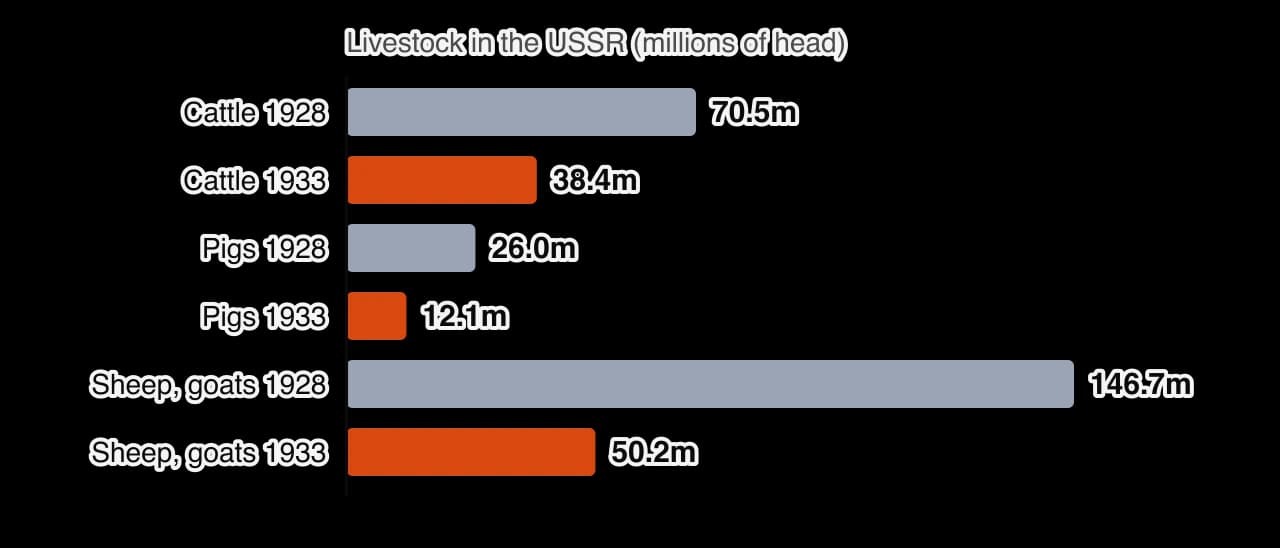
The chart of Soviet livestock shows the result: by 1933 the USSR had about half as many cattle and pigs as in 1928, and a third of its sheep and goats. The losses damaged Soviet agriculture for a generation, since animals provided draught power, manure, meat and milk.
The scale of resistance forced a temporary retreat. On 2 March 1930 Stalin published an article in Pravda, "Dizzy with Success", that blamed local officials for excesses and declared that "collective farms must not be established by force". Peasants left the collective farms in large numbers, and the share of households in them fell from more than half on 1 March 1930 to about a fifth by the autumn. The retreat was tactical. Collectivisation resumed in 1931 with heavier taxes, grain quotas and the deportation of hundreds of thousands of so-called kulaks, and by the late 1930s almost all peasant households were in collective farms. Peasant resistance changed the pace of collectivisation, but it could not stop it.
Resistance in the camps and borderlands continued throughout Stalin’s rule. In western Ukraine the nationalist Ukrainian Insurgent Army fought Soviet forces into the early 1950s. After Stalin’s death in March 1953, prisoners in the Gulag rose in the great strikes and uprisings at Norilsk and Vorkuta (1953) and Kengir (1954), where the rising was crushed with tanks. These risings helped to persuade Stalin’s successors to release large numbers of prisoners in the following years.
Resistance in Nazi Germany
Popular resistance in Nazi Germany came from small groups of very different kinds. The banned Communist (KPD) and Social Democratic (SPD) parties kept underground networks after 1933, but the Gestapo broke them up repeatedly, and tens of thousands of their members were imprisoned. The network that the Gestapo called the Red Orchestra passed information to the Soviet Union and printed leaflets until it was uncovered in 1942. A lone carpenter, Georg Elser, came closest to killing Hitler from below: his bomb in a Munich beer hall on 8 November 1939 exploded thirteen minutes after Hitler had left, killing eight people.
Some young people rejected the Hitler Youth. The Edelweiss Pirates, working-class teenagers in the Rhineland and the Ruhr, went hiking and singing banned songs, fought Hitler Youth patrols and, in Cologne in 1944, joined in armed attacks; thirteen people, including several of them, were hanged in public in Cologne-Ehrenfeld in November 1944. The Swing Youth, mainly middle-class teenagers in Hamburg, defied the regime by listening and dancing to American jazz.
The White Rose, 1942–1943
The best-known youth resistance group was the White Rose, formed by students at the University of Munich, among them Hans Scholl, his sister Sophie Scholl, Alexander Schmorell, Christoph Probst and Willi Graf, with the philosophy professor Kurt Huber. Several of the men had served as medical orderlies on the eastern front and had seen or heard of mass killings there. Between June 1942 and February 1943 they wrote six leaflets calling on Germans to resist.
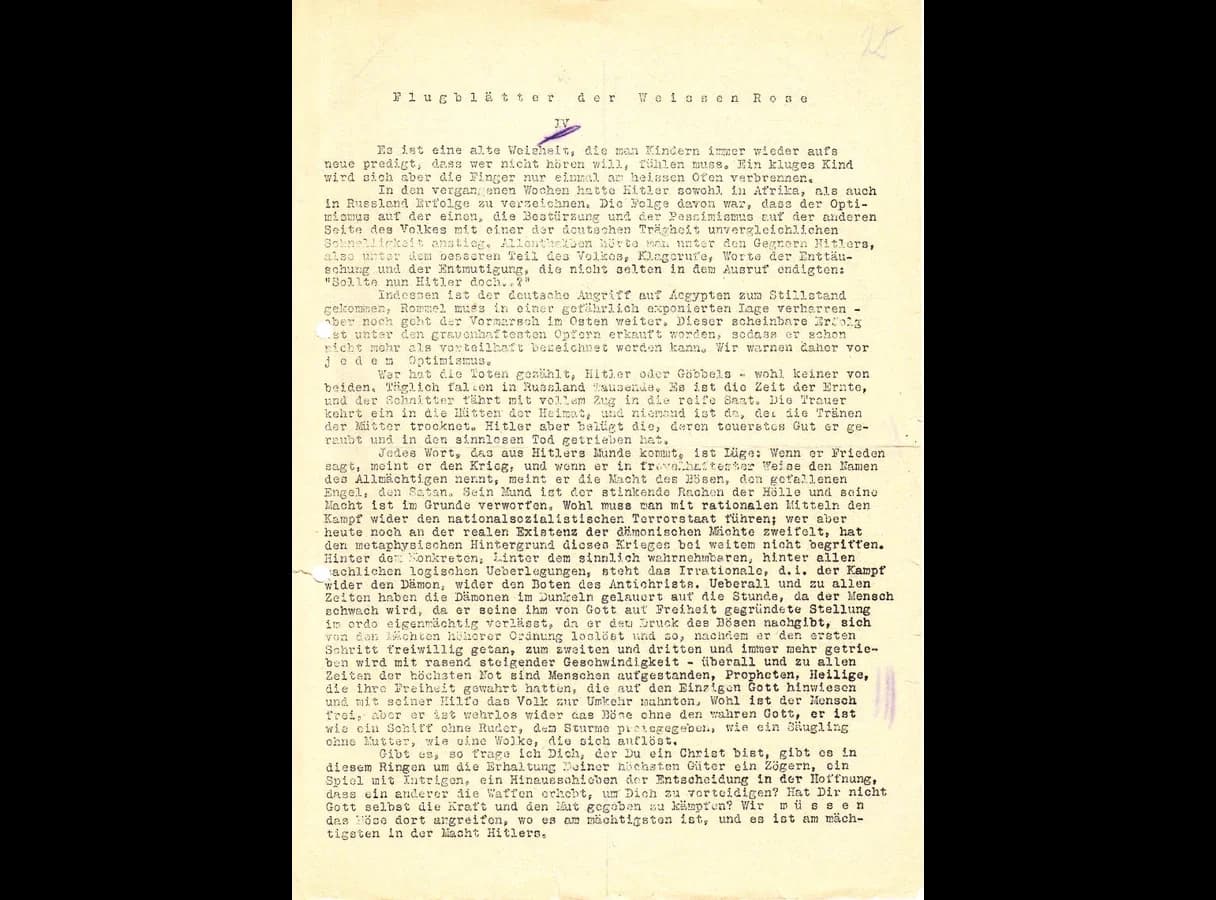
We wish expressly to point out that the White Rose is not in the pay of any foreign power. Though we know that National Socialist power must be broken by military means, we are trying to achieve a renewal from within of the severely wounded German spirit. … We will not be silent. We are your bad conscience. The White Rose will not leave you in peace!
The White Rose, fourth leaflet, Munich, July 1942 (English translation published by libcom.org). The authors wrote for educated Germans, posting copies to addresses chosen from directories, and appealed to Christian and humanist values. The passage shows how they tried to separate resistance from treason, since the regime presented any opposition in wartime as help to the enemy, and it accepts that only military defeat could end Nazi rule.
On 18 February 1943, after the German defeat at Stalingrad, Hans and Sophie Scholl scattered copies of the sixth leaflet in the main hall of the university. A caretaker saw them and they were arrested. Tried before the People’s Court, the Scholls and Probst were beheaded on 22 February 1943; Schmorell, Graf and Huber were executed later that year.
 YouTube
Industrial workers, who had lost their independent unions in 1933, resisted mostly through absenteeism, slow working and changing jobs, which the regime reported with growing concern once rearmament created a labour shortage after 1936. Open protest by ordinary people was rare, but it happened. In February and March 1943 hundreds of non-Jewish women gathered for several days outside a building in the Rosenstrasse in Berlin where their Jewish husbands were held after a round-up. The men were released. Historians disagree whether the protest saved them or whether the regime had never planned to deport them, but the event shows that the regime was reluctant to use force against German women in the street.
Group or person | Who they were | Methods | What happened |
|---|---|---|---|
Communist and SPD underground | Banned working-class parties | Secret cells, leaflets, contacts with exiles | Repeatedly broken by the Gestapo; thousands imprisoned |
Georg Elser | A carpenter acting alone | Time bomb in the Bürgerbräukeller, 8 Nov 1939 | Missed Hitler by thirteen minutes; executed in Dachau, April 1945 |
Edelweiss Pirates | Working-class youths in the Rhineland and Ruhr | Refusing the Hitler Youth; fights; some armed attacks in 1944 | Thirteen hanged in Cologne, November 1944 |
Swing Youth | Middle-class youths in Hamburg | Jazz, dancing, English fashions | Arrests; some sent to camps |
White Rose | Munich students and a professor | Six leaflets, 1942–1943; graffiti | Leaders executed, February–October 1943 |
Rosenstrasse protesters | Non-Jewish wives of Jewish men | Street protest, February–March 1943 | Husbands released |
The table of resistance in Germany shows how varied it was and how little it achieved against the regime itself. None of these groups had a realistic chance of overthrowing Hitler. Their significance lies in what they showed: that resistance was possible, that some Germans saw the regime’s crimes clearly, and, after 1945, they gave a defeated nation figures it could honour.
Popular resistance in Mao’s China
In China the largest revolt against Communist rule came in Tibet. The Chinese army had occupied Tibet in 1950, and attempts to impose land reform and collectivisation on Tibetan areas of the neighbouring provinces from 1955–1956 led to armed rebellion. In March 1959 crowds in Lhasa gathered to protect the Dalai Lama, Tibet’s religious and political leader, whom they feared the Chinese would seize. The People’s Liberation Army crushed the rising, the Dalai Lama fled to India, and tens of thousands of Tibetans followed him into exile.
During the Great Leap Forward, peasants resisted mostly in hidden ways: they ate crops in the fields before they ripened, hid grain from officials, and worked as little as possible on collective land. The best-known open protest came at the end of Mao’s life. In early April 1976, during the Qingming festival when the dead are remembered, hundreds of thousands of people brought wreaths and poems to Tiananmen Square in Beijing to honour the late premier Zhou Enlai, who had died in January. Many of the poems attacked the Gang of Four. On 5 April the square was cleared by militia and police, the protest was declared counter-revolutionary, and Deng Xiaoping was blamed and dismissed. The Tiananmen Incident showed how far support for the Cultural Revolution had worn away, and after Mao’s death the new leadership declared it a patriotic movement.
Popular resistance in Castro’s Cuba
Castro faced an armed popular challenge in the first years of the revolution. From 1959 to 1965 several thousand anti-communist guerrillas, many of them small farmers and some supplied by the CIA, fought in the Escambray mountains of central Cuba. The government called its campaign against them the “struggle against bandits”; it used tens of thousands of militia and moved peasant families out of the area. The rebellion was crushed by 1965.
After that, open resistance was rare for decades. The Committees for the Defence of the Revolution watched every street, and the regime let discontent leave the country: hundreds of thousands of Cubans emigrated, about 125,000 of them in the Mariel boatlift of 1980. Emigration acted as a safety valve that removed many potential opponents.
The worst crisis came after the collapse of the USSR, which had supported Cuba with cheap oil and high prices for its sugar. In the Special Period of the early 1990s Cuba’s economy shrank by about a third, food and fuel ran short, and power cuts lasted for hours. On 5 August 1994 thousands of people rioted along the Malecón, Havana’s seafront, in the Maleconazo, the largest protest since 1959. Castro went to the scene in person, and police and government supporters dispersed the crowds. He then announced that the coastguard would not stop people leaving, and about 35,000 balseros (rafters) set out for the United States in the following weeks until a new migration agreement with Washington.
Organised dissent grew in the 2000s. The Varela Project, led by the Catholic activist Oswaldo Payá, used a clause in the constitution to collect more than 11,000 signatures for a referendum on free speech and free elections in 2002. The government answered with a counter-petition that declared socialism “irrevocable” and, in March 2003, the Black Spring, when 75 dissidents, independent journalists and librarians were arrested and sentenced to long prison terms. Their wives and mothers formed the Ladies in White, who marched silently after Sunday Mass. Repression contained these movements, but they kept international attention on Cuba’s political prisoners.
Students and workers in Nasser’s Egypt
In Egypt popular protest followed defeat. In February 1968 workers in the industrial town of Helwan and then university students demonstrated against the light sentences given to air force commanders blamed for the disaster of June 1967; the protests soon became demands for freedom of the press and an end to police rule. They were the first large demonstrations against the regime since 1954. Nasser answered with concession and promise: the commanders were retried, and on 30 March 1968 he issued a programme that promised elections inside the ruling party and the rule of law. A second wave of student protests in November 1968 was put down more firmly. The promised reforms changed little, but the episode showed that defeat had weakened the regime’s claim to speak for the people.
The impact of policies
Many of the most serious challenges to authoritarian rule were created by the regimes themselves. A policy could provoke opposition in three main ways. Economic failure hurt the groups whose support the regime relied on and gave critics inside the leadership a case against the ruler. Repression could go too far, attacking groups that had been loyal or neutral, or offending widely held moral and religious beliefs. Finally, a ruler could take on an institution with its own loyal followers and its own sources of authority, such as a church or an army, and turn it into an opponent.
Seen this way, the impact of policies is less a separate kind of challenge than a cause of the others. It explains why internal opposition and popular resistance appeared at particular moments: the peasant revolts of 1930 followed forced collectivisation, the criticism of Mao in 1959 and 1962 followed the Great Leap famine, and the Maleconazo of 1994 followed the economic collapse of the Special Period.
Repression that offended belief: the “euthanasia” killings in Germany
The clearest case of a policy that provoked open protest in Nazi Germany was the killing of disabled people. From 1939, under a programme run from Tiergartenstrasse 4 in Berlin and known as Aktion T4, patients in asylums and hospitals judged “unworthy of life” were taken to killing centres and murdered, mostly by gas. About 70,000 had been killed by August 1941. The programme was secret, but families received false death certificates, and rumours spread through the towns near the killing centres.
On 3 August 1941 Clemens August von Galen, the Catholic Bishop of Münster, publicly condemned the killings in a sermon at St Lambert’s Church.
I am reliably informed that in hospitals and homes in the province of Westphalia, lists are being prepared of inmates who are classified as “unproductive members of the national community,” who are to be removed from these establishments and shortly thereafter killed.
Clemens August von Galen, sermon at St Lambert’s Church, Münster, 3 August 1941 (English translation from a pamphlet of St Lambert’s Church, in Beth Griech-Polelle, Bishop von Galen, 2002). Galen spoke from the pulpit to a Catholic congregation, and copies of the sermon were duplicated and passed from hand to hand across Germany; the British also dropped it as a leaflet. He used the language of the law (he cited the article of the penal code against murder) as well as of faith, which made it harder to dismiss him as a political enemy.
Some Nazi officials proposed that Galen be hanged, but Goebbels argued that punishing a popular bishop in wartime would turn the Catholic population of Westphalia against the regime. On 24 August 1941 Hitler ordered the gassing programme stopped. The killing of patients continued in a decentralised way, by starvation and lethal injection, and the staff and methods of T4 were transferred to the extermination of Jews in occupied Poland. Galen’s protest also had limits. He defended the Church and its moral teaching, and on 14 September 1941 he publicly supported the war against the Soviet Union as a struggle against “Judeo-Bolshevism”.
A similar retreat followed the crucifix struggle in Bavaria in 1941, when a Nazi minister ordered crucifixes removed from school classrooms. Protests by parents, petitions and refusals in Catholic villages forced the order to be withdrawn. In both cases the regime gave way to protest from a church with a mass following, at a moment when it wanted calm on the home front.
Economic failure: the Great Leap Forward and the Special Period
Economic failure created the main internal challenge to Mao. The Great Leap Forward (1958–1962) and the famine it caused killed tens of millions of people; demographers’ estimates mostly range from about 15 million to 45 million deaths, depending on the method used to calculate how many people would have died anyway. Its political effect was to divide the leadership. Peng Dehuai’s letter of 1959 was a response to it, and in 1962 Liu Shaoqi told the conference of 7,000 cadres that peasants in Hunan believed the disaster was three parts natural and seven parts man-made. The retreat that Liu and Deng then organised, allowing private plots and markets, restored food supplies but, in Mao’s eyes, put the revolution itself in danger.
In Cuba the regime’s economic dependence on the USSR left it exposed when Soviet aid ended in 1991. The Special Period produced the only mass riot of Castro’s rule and the rafter crisis of 1994. It also forced reforms: from 1993 Cubans could hold US dollars, some self-employment was legalised, and foreign tourism and investment were encouraged. The regime survived by combining these concessions with repression and with emigration, and by presenting the US embargo as the cause of the hardship.
Egypt shows a third pattern. Nasser’s nationalisations of 1956–1961, land reform and free education won mass support, but they also alienated landowners, the business class and the Brotherhood. The cost of the war in Yemen (1962–1967), in which up to 70,000 Egyptian troops were committed, slowed the economy and weakened the army before 1967.
Policy | Regime | Challenge it produced | Regime’s response |
|---|---|---|---|
Forced collectivisation, 1929–1930 | Stalin | Peasant riots, revolts and slaughter of livestock | Tactical retreat (March 1930), then deportation and famine |
“Euthanasia” killings, 1939–1941 | Hitler | Galen’s sermon; public unease | Gassing programme halted (August 1941); killing continued in secret |
Great Leap Forward, 1958–1962 | Mao | Criticism by Peng (1959) and Liu (1962) | Peng purged; retreat from the Leap; later the Cultural Revolution |
Dependence on Soviet aid | Castro | Special Period; Maleconazo, 1994 | Limited market reforms; emigration allowed |
War in Yemen and the road to 1967 | Nasser | Defeat; protests of 1968 | Purge of the high command; programme of 30 March 1968 |
Conflict with the Catholic Church, 1954–1955 | Perón | Church, middle class and navy united against him | Repression, then “pacification”; overthrown in September 1955 |
External threats
External threats came from outside the country: invasion and war, the threat of war, economic sanctions and embargoes, support for exiles and rebels, and diplomatic pressure. Their effects were double-edged. Defeat in war could destroy a regime directly or discredit it so badly that the army or the people turned against it. But a foreign threat could also strengthen a regime, by rallying the population behind the leader, by justifying repression of internal opponents as “traitors” and “foreign agents”, and by giving the regime someone to blame for its own failures.
Destroyed by war: Hitler and other cases
Nazi Germany is the clearest case of a regime ended by an external threat. Despite the 20 July plot and the many small acts of resistance, the regime remained in control of Germany until Allied armies occupied it. Hitler killed himself in Berlin on 30 April 1945, and Germany surrendered unconditionally on 7–8 May 1945. Only total defeat and occupation ended Nazi rule.
Several other regimes since 1750 fell after defeat in war. Napoleon III was captured with his army at Sedan in September 1870, and two days later a republic was proclaimed in Paris. Mussolini was removed by the Fascist Grand Council and the king in July 1943, after Allied forces landed in Sicily. In Argentina, the military junta that invaded the Falkland Islands in April 1982 to win popular support was defeated by Britain in June; General Leopoldo Galtieri resigned and the armed forces handed power to an elected government in 1983. In Africa and Asia, invasion by a neighbour ended two of the most violent regimes of the late 1970s: Vietnam overthrew Pol Pot’s Khmer Rouge in January 1979, and Tanzanian forces and Ugandan exiles drove Idi Amin from Uganda in April 1979, after Amin had attacked Tanzanian territory.
Surviving invasion: Stalin and the Second World War
The German invasion of the USSR on 22 June 1941 (Operation Barbarossa) was the greatest threat any core regime faced. Within months German forces were near Moscow and Leningrad, millions of Soviet soldiers had been captured, and in parts of Ukraine and the Baltic states some of the population at first welcomed the Germans as liberators from Soviet rule. Some captured soldiers later served in units on the German side, including the Russian Liberation Army of the captured general Andrei Vlasov.
Yet the regime survived and emerged stronger. Nazi racial policy in the occupied east turned potential collaborators into enemies; the regime appealed to Russian patriotism and allowed the Orthodox Church more freedom; and the planned economy moved industry east and out-produced Germany. Victory in the Great Patriotic War gave Stalin a legitimacy he had never had before. Before the war, too, the threat of invasion had served the regime. Many historians, including Oleg Khlevniuk, argue that Stalin’s fear of a “fifth column” in a future war was one of the main reasons for the mass operations of the Great Terror in 1937–1938.
Strengthened by threats: Castro and the United States
No core regime faced a longer external threat than Castro’s Cuba. The United States, 150 kilometres away, saw a communist government in the Caribbean as unacceptable, and from 1960 it tried to remove Castro by invasion, sabotage, assassination and economic pressure.
US action | Date | Effect on Castro’s rule |
|---|---|---|
Trade embargo: partial, then total | October 1960; February 1962 | Economic damage; pushed Cuba towards the USSR; gave Castro a lasting explanation for shortages |
Bay of Pigs invasion by about 1,400 CIA-trained exiles | 17–19 April 1961 | Defeated in three days; more than 1,100 captured; Castro declared the revolution socialist on the eve of the landing and became a national hero |
Operation Mongoose: sabotage, raids and assassination plots | From November 1961 | Failed; justified the build-up of the militia and the CDRs |
Cuban Missile Crisis | October 1962 | Soviet missiles withdrawn; the United States promised not to invade Cuba |
Cuban Democracy Act; Helms–Burton Act | 1992; 1996 | Tightened the embargo during the Special Period; presented by Castro as aggression |
The table of US actions shows why the external threat strengthened Castro more than it weakened him. The Bay of Pigs turned the defence of the revolution into the defence of the nation against the United States, which had dominated Cuba since 1898. Nationalism, which had brought Castro to power, now held his regime together. The threat also justified one-party rule, the militia, the CDRs and the treatment of all opponents as agents of the CIA, and the 1962 settlement removed the danger of a US invasion for good. Investigations by the US Senate in 1975 confirmed several CIA plots to kill Castro; all failed.
Defeat survived: Nasser, Suez and the Six-Day War
Nasser faced two great external threats and survived both, with opposite results. After he nationalised the Suez Canal Company on 26 July 1956, Israel invaded Sinai on 29 October, and Britain and France attacked the canal zone from 31 October, in a plan agreed secretly with Israel. Egypt was beaten militarily, but pressure from the United States, the USSR and the United Nations forced the invaders to withdraw. Nasser kept the canal and became the hero of Arab nationalism; the attack had strengthened him far more than it harmed him. His pan-Arab ambitions then created new external challenges. The union with Syria in the United Arab Republic (1958) ended when Syrian officers seceded in September 1961, a public humiliation, and from 1962 Egypt was drawn into the civil war in Yemen against Saudi-backed royalists.
In June 1967 the result was different. In the Six-Day War (5–10 June 1967) Israel destroyed most of the Egyptian air force on the ground on the first morning and occupied Sinai and Gaza. On 9 June Nasser spoke to the nation on radio and television.
I tell you truthfully and despite any factors on which I might have based my attitude during the crisis, that I am ready to bear the whole responsibility. I have taken a decision in which I want you all to help me. I have decided to give up completely and finally every official post and every political role and return to the ranks of the masses and do my duty like every other citizen.
Gamal Abdel Nasser, broadcast to the nation, 9 June 1967 (English translation in Walter Laqueur and Barry Rubin, eds, The Israel-Arab Reader, 2001). Earlier in the speech Nasser blamed American and British help for Israel’s victory, a claim for which there was no evidence. The speech accepted responsibility while presenting the defeat as the work of imperialism, and its appeal to the “masses” invited the response that followed.
Huge crowds filled the streets of Cairo and other Arab cities that evening and the next day to demand that Nasser stay, and on 10 June he withdrew his resignation. Historians still debate how far the demonstrations were spontaneous and how far they were organised by the ruling party, the Arab Socialist Union; most accept that both played a part. Nasser used the moment to remove Amer and the high command. The defeat did not end the regime, but it ended Nasser’s claim to lead the Arab world, made Egypt dependent on Soviet arms and Gulf money, and brought the first open protests in 1968.
Threat and opportunity: Mao and the USSR
For Mao, external threats were both dangers and tools. The Korean War (1950–1953) was used to launch campaigns against “counter-revolutionaries” at home. The Sino-Soviet split, open from 1960, removed China’s only powerful ally, and in March 1969 Chinese and Soviet troops fought on Zhenbao Island in the Ussuri River. Fear of a Soviet attack, possibly with nuclear weapons, led Mao to move industry inland and to seek better relations with the United States, ending in President Nixon’s visit to China in February 1972. The external threat strengthened Mao at home, since it justified militarisation and unity, and it allowed him to present the dramatic turn towards the United States as a defence of the nation.
Regime | External threat | Effect on the regime |
|---|---|---|
Hitler’s Germany | War with the Allies, 1939–1945 | Total defeat and occupation; regime destroyed |
Stalin’s USSR | German invasion, 1941 | Near collapse, then victory and new legitimacy |
Mao’s China | Korean War; Soviet threat, 1969 | Used to justify campaigns and unity; led to opening to the United States |
Castro’s Cuba | US invasion, sabotage and embargo, 1960 onwards | Rallied nationalism; justified one-party rule; economic damage |
Nasser’s Egypt | Suez, 1956; Six-Day War, 1967 | 1956 a political triumph; 1967 a defeat that weakened but did not end the regime |
Perón’s Argentina | No serious external threat | The challenge was internal |
Case study: the challenges to Perón and his overthrow, 1949–1955
Juan Perón’s regime in Argentina is the one core case that was overthrown from inside. Perón was elected president in 1946 and re-elected in 1951, and he ruled through a mass movement built on the trade unions of the Confederación General del Trabajo (CGT) and the urban workers, the descamisados. He also used the methods of authoritarian rule: control of the press and radio, a purged Supreme Court, a new constitution in 1949 that allowed his re-election, and the arrest of opponents. The challenges that ended his rule in September 1955 show all four kinds of challenge at work in one country.

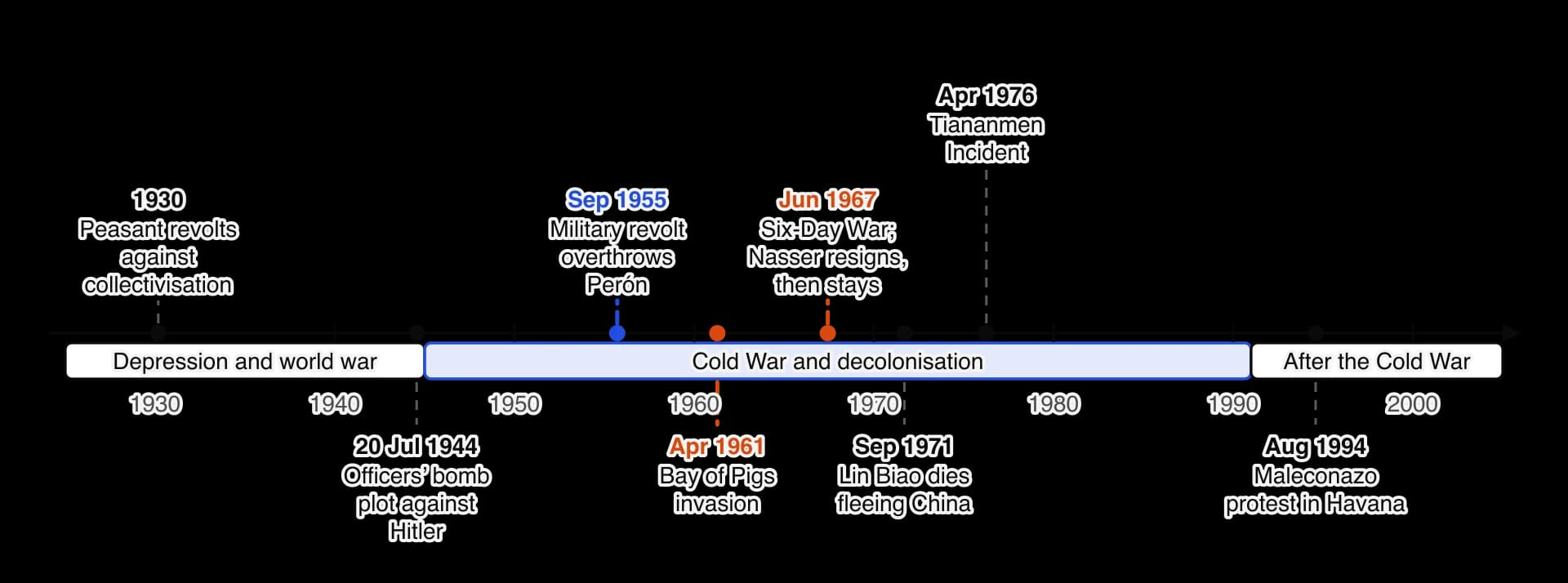
The timeline of Perón’s fall shows three phases: economic strain from 1949, a political crisis that began in November 1954, and a military revolt in September 1955 that ended the regime in four days.
Economic problems and the end of the boom, 1949–1953
Perón’s popularity in his first years rested on prosperity. Argentina had built up large reserves of foreign currency during the Second World War, and Europe’s need for food after 1945 kept the prices of its beef and grain high. The government used a state trading agency, the IAPI, to buy farm exports cheaply and sell them dearly abroad, and spent the profits on higher wages, social welfare, nationalisations and industry. Real wages for industrial workers rose sharply between 1946 and 1949.
From 1949 the conditions behind this boom disappeared. The reserves were spent, export prices fell, farmers who received low prices from the IAPI planted less, and the United States largely excluded Argentina from the purchases of food made under its Marshall Plan for Europe. Inflation rose to between about 25 and 40 per cent a year in 1949–1952, and severe drought in 1951–1952 ruined the harvest, so that Argentines, who were used to eating white bread and beef, faced shortages, bread made with mixed flour and restrictions on the sale of beef.
Perón responded with an austerity plan in 1952: a two-year freeze on wages and prices, incentives for farmers, appeals to save and to work harder, and later a law to attract foreign investment. Real wages fell. Some workers struck, most seriously on the railways in 1950–1951, when the government ended the strike by calling the strikers up under military law. The economic downturn did not, however, turn the working class against Perón. Most workers still saw him as their protector and blamed employers, speculators and the “oligarchy” for their losses.
The elites, the army and the death of Eva Perón
Opposition among the elites and in the armed forces had existed since 1945. Landowners resented the IAPI and rural labour laws; the middle class and the university students resented the regime’s control of the press and education and the cult of the Peróns; and many army officers disliked Perón’s alliance with the unions. In September 1951 General Benjamín Menéndez led a small army revolt that failed within hours. A month earlier, army opposition had forced Eva Perón to give up her campaign to be her husband’s vice-president.
Eva Perón’s death from cancer on 26 July 1952, at the age of 33, removed the regime’s strongest link with the working class and the women’s branch of the Peronist party. The regime turned her into an object of official devotion, which some Catholics saw as a rival cult. In April 1953 bombs exploded at a Peronist rally in the Plaza de Mayo, killing several people; that night Peronist crowds burned the headquarters of the Socialist and Radical parties and the Jockey Club, the meeting place of the landowning elite. Political life became a contest between two camps, Peronists and anti-Peronists, with little space between them.
The conflict with the Catholic Church, 1954–1955
The decisive change came when Perón quarrelled with the Catholic Church. The Church had supported him in 1946, and his government had made religious teaching in state schools law in 1947. By 1954 relations had broken down. The regime was building its own youth organisations and spreading the doctrine of Peronism in schools, while the Church’s lay organisation, Catholic Action, was growing and a Christian Democratic party was founded in 1954. Perón saw a rival movement forming among students, workers and the middle class.
In a speech on 10 November 1954 Perón attacked “hostile” priests and bishops. A series of laws followed. In December 1954 divorce was legalised; later, religious teaching in schools was ended, several Catholic holidays were removed, and in May 1955 Congress voted for a constitutional convention to separate Church and state. The conflict turned the Church, the largest institution outside the regime’s control, into the centre of the opposition. Its churches, processions and parishes offered the one public space where opponents of every kind could gather.
On 11 June 1955 the procession for the feast of Corpus Christi in Buenos Aires became a huge march against the government. The regime expelled two senior clergy, accusing them of organising it, and the Vatican answered with a decree of excommunication against those responsible for the expulsion. The army and navy, whose officers were mostly Catholic, now faced a choice between the government and the Church.
The bombing of the Plaza de Mayo, 16 June 1955
On 16 June 1955, five days after the Corpus Christi march, navy aircraft and some air force pilots, working with civilian nationalists, bombed and machine-gunned the Plaza de Mayo and the Casa Rosada, the presidential palace, in an attempt to kill Perón and seize power. Perón had moved to the army ministry, and army units loyal to him defeated the rebel marines by the afternoon; the pilots fled to Uruguay. The attack killed at least 308 people, most of them civilians in the square and the surrounding streets, according to the investigation published by Argentina’s National Memory Archive in 2010; estimates of the wounded range from several hundred to more than a thousand.
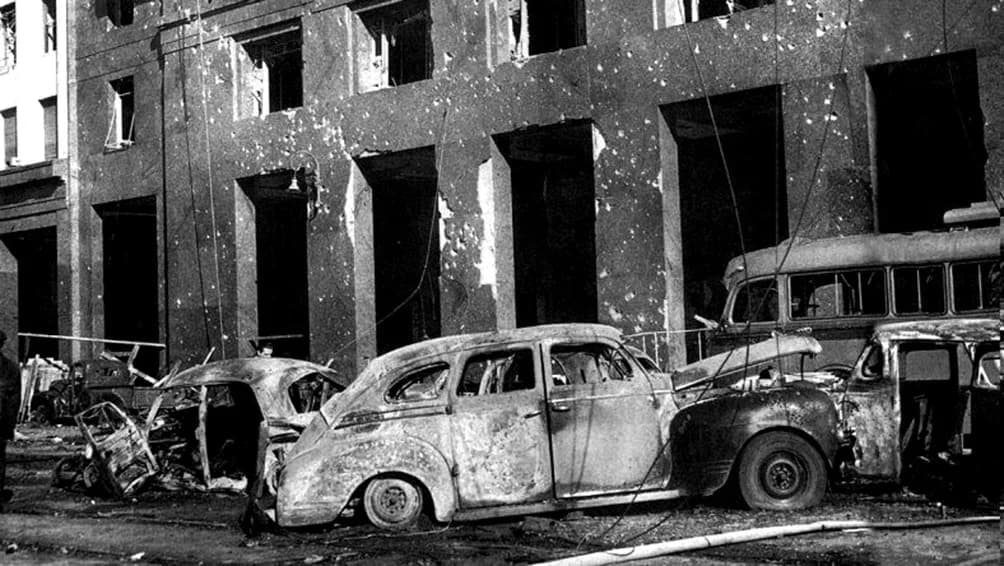
That night Peronist crowds set fire to the Curia, the archbishop’s offices, and to more than a dozen churches in central Buenos Aires, while the police did not intervene. The bombing showed that part of the armed forces was willing to kill civilians to remove Perón; the burning of the churches confirmed to the Catholic middle class and to many officers that Perón could no longer keep order.
Pacification and the “five for one” speech
In July 1955 Perón tried to reduce tension. He announced that the revolution was over and that he would govern as president of all Argentines, replaced some unpopular ministers and allowed opposition leaders, among them the Radical Arturo Frondizi, to speak on the radio for the first time in years. The opposition used the opportunity to attack the regime, and small groups continued to plot and to commit acts of violence.
On 31 August 1955 Perón offered to resign. The CGT called a general strike and filled the Plaza de Mayo, and Perón withdrew his offer in a speech from the balcony of the Casa Rosada.
The watchword for every Peronist, whether alone or within an organisation, is to answer a violent action with an even more violent one. And when one of ours falls, five of theirs will fall! … They will look for various pretexts. There will be reasons of freedom, of justice, of religion or of anything else, which they will hold up as a shield to reach the goals they pursue. But they seek only one thing: to turn the situation back to 1943.
Juan Perón, speech from the balcony of the Casa Rosada, 31 August 1955, as printed in La Prensa, 1 September 1955 (translated from the Spanish). Perón spoke to a crowd of his own supporters ten weeks after the bombing, and his purpose was to frighten his opponents and rouse the CGT. As a source it shows how Perón understood the challenge: in his account the Church question and the language of freedom were only “pretexts” for an attempt by the old elite to undo the social gains of the 1940s. It also shows why the speech backfired. Its threat of violence convinced many undecided officers that Perón meant civil war.
The Revolución Libertadora, September 1955
On 16 September 1955 General Eduardo Lonardi led an army revolt in Córdoba, and the navy under Admiral Isaac Rojas rose at the same time. The rebels were outnumbered, and for several days the outcome was uncertain. But most loyal commanders were unwilling to fight a civil war for Perón, and the navy shelled fuel depots at Mar del Plata and threatened to bombard the oil refinery at La Plata and the capital itself. On 19 September Perón sent a letter to the army offering to stand down; a junta of generals treated it as a resignation. Perón took refuge in the Paraguayan embassy and then on a Paraguayan gunboat in the port of Buenos Aires, and left for exile.
The new regime called itself the Revolución Libertadora (the Liberating Revolution). Lonardi, a nationalist Catholic, promised that there would be “neither victors nor vanquished”, but in November 1955 harder-line officers replaced him with General Pedro Aramburu. The Peronist party was dissolved, the CGT taken over, and in March 1956 Decree 4161 banned Peronist symbols, songs and even the names of Perón and Eva in public. In June 1956 a Peronist military rising led by General Juan José Valle was crushed, and its leaders and some civilians were shot.
Why did Perón fall?
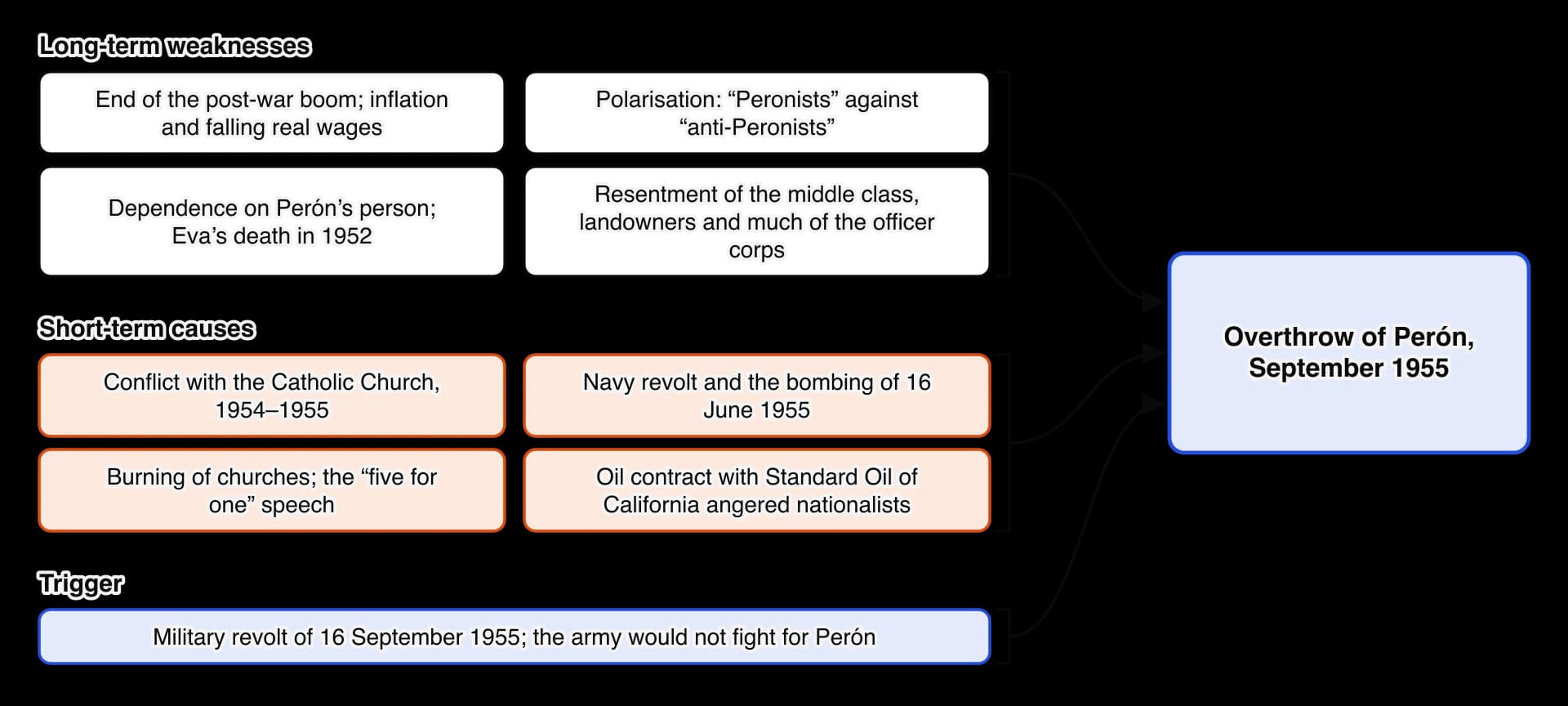
The diagram of the causes of Perón’s fall separates long-term weaknesses from the short-term crisis. The economic problems after 1949 ended the prosperity that had paid for Perón’s social policies and turned farmers and much of the middle class against him. They did not, by themselves, threaten the regime, because the working-class majority that had elected him in 1951 stayed loyal.
What turned discontent into a successful challenge was the conflict with the Church, which was largely a result of Perón’s own policies. It gave the scattered opposition a cause and a meeting place, and it divided the armed forces, whose officers were mostly Catholic and many of whom already resented Perón. The violence of June 1955, the bombing and the burning of churches, then convinced many officers who had stayed neutral that the regime was leading the country towards civil war.
The armed forces decided the outcome. In September 1955 the rebels were weaker than the loyal forces, but the loyal commanders would not fight for Perón, and Perón himself refused to arm the CGT, as some union leaders demanded. Without the army, mass support could not keep him in power. Seen through the four kinds of challenge, the impact of policies created internal opposition from the Church and the officer corps; popular resistance came mostly from the Catholic middle class; there was no external threat; and internal opposition in the armed forces was decisive.
After 1955: the Peronist resistance
The overthrow of Perón did not end Peronism. Through strikes, sabotage, underground union networks and illegal publications, the Peronist resistance kept the movement alive while it was banned. The historian Daniel James, in Resistance and Integration (1988), shows how workers defended both their union rights and their identity as Peronists in the factories. No elected government could rule Argentina without Peronist votes, and in 1973 Perón returned from exile in Spain and was elected president for a third time with about 62 per cent of the vote. He died on 1 July 1974. The Argentine case shows that removing an authoritarian ruler did not remove the social support on which his rule had rested.
Comparing the challenges: why did some regimes survive?
The six core regimes faced all four kinds of challenge, but with very different results. The comparative table sets out the main challenges to each and what happened to it.
Regime | Internal opposition | Popular resistance | Impact of policies | External threats | Outcome |
|---|---|---|---|---|---|
Stalin’s USSR (Europe) | Weak after 1929; Ryutin (1932); destroyed in the Great Terror | Peasant revolts (1930); Ukrainian insurgents; Gulag risings (1953–1954) | Collectivisation and famine | German invasion (1941) | Survived; Stalin died in office, 1953 |
Hitler’s Germany (Europe) | Army conspiracies; 20 July 1944 | Small groups: White Rose, Edelweiss Pirates, KPD underground | “Euthanasia” killings; crucifix struggle | Total war and defeat (1939–1945) | Destroyed by defeat, May 1945 |
Mao’s China (Asia) | Peng (1959); Liu and Deng (1962); Lin Biao (1971) | Tibet (1959); Tiananmen Incident (1976) | Great Leap Forward and famine | Sino-Soviet split; clashes of 1969 | Survived; Mao died in office, 1976 |
Castro’s Cuba (Americas) | Matos (1959); Ochoa (1989) | Escambray rebels; Maleconazo (1994); dissidents | Dependence on the USSR; Special Period | Bay of Pigs; Mongoose; embargo; Missile Crisis | Survived; Castro retired, 2006–2008 |
Nasser’s Egypt (Africa and the Middle East) | Naguib (1954); Brotherhood; Amer (1967) | Student and worker protests (1968) | Yemen war; cost of defeat | Suez (1956); Six-Day War (1967) | Survived; Nasser died in office, 1970 |
Three explanations stand out from the comparison.
The loyalty of the armed forces
The most consistent difference between the regimes that survived and the one that fell from within is the attitude of the armed forces. Stalin, Mao and Castro ruled through parties that had created their own armies in revolution or civil war, and they purged or controlled their commanders; the army’s fate was bound up with the regime’s. Nasser was himself an officer and purged the high command when it failed. Perón’s army, by contrast, was an older institution with its own traditions, many of its officers resented his alliance with the unions, and when it was divided by the conflict with the Church it would not defend him. Hitler’s army plotted but stayed loyal until defeat.
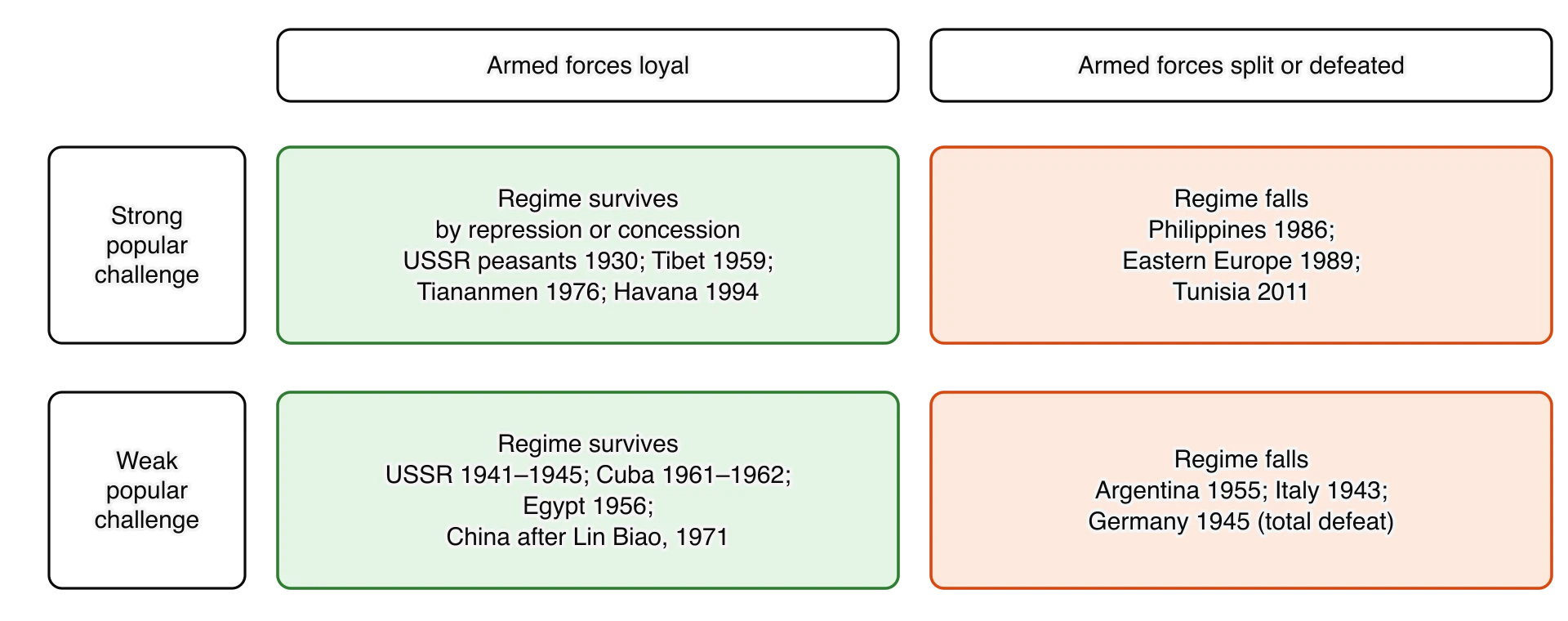
The grid of outcomes extends the comparison beyond the core cases. Where the armed forces stayed loyal, even mass popular resistance was crushed, as at Tiananmen Square in 1989. Where the army split or refused to fire, popular movements could succeed: in the Philippines in February 1986 the defection of the defence minister and the deputy chief of staff, protected by huge crowds in the People Power Revolution, forced Ferdinand Marcos into exile, and in Tunisia in January 2011 the army’s refusal to suppress protest helped bring down President Zine El Abidine Ben Ali.
Repression, concession and the use of threats
Regimes that survived combined repression with well-timed concessions. Stalin’s retreat of March 1930, Hitler’s halt of the gassing programme in August 1941, Castro’s opening of the coast in 1994 and Nasser’s programme of March 1968 all reduced pressure without weakening the regime’s hold on power. They also used external threats to rally support and to brand opponents as traitors. Perón, by contrast, alternated between repression and pacification in 1955 in a way that persuaded neither side.
The type of regime
Political scientists have found that the type of regime affects how it meets challenges. Barbara Geddes, comparing authoritarian regimes since 1945 (1999), found that single-party regimes usually lasted longest and military regimes broke down most easily, because officers often preferred to return to barracks than to see the army split. Steven Levitsky and Lucan Way, in Revolution and Dictatorship (2022), argue that regimes born in violent revolution, such as those of the USSR, China and Cuba, were unusually durable, because the struggle for power produced a united leadership and an army loyal to the party. Perón’s Argentina, a regime built on elections and a personal movement with no revolutionary army, fits these patterns.
 YouTube
When popular resistance succeeded
Popular resistance played a larger part in ending authoritarian rule in the late twentieth century than in the core cases. In Poland the independent trade union Solidarity, born in the strikes of August 1980, survived martial law from December 1981 underground and forced the communist government into round-table talks and partly free elections in 1989. In Chile, protests against Augusto Pinochet’s military regime from 1983 and a broad “No” campaign led to his defeat in the plebiscite of 5 October 1988, which he had expected to win, and to elections in 1989. In both cases popular movements succeeded because they made the cost of repression too high and divided the rulers, and because outside pressure, from Gorbachev’s USSR in Poland’s case and from the United States and Western Europe in Chile’s, made violent repression less likely.
Erica Chenoweth and Maria Stephan, in Why Civil Resistance Works (2011), compared 323 resistance campaigns between 1900 and 2006 and found that non-violent campaigns succeeded in about 53 per cent of cases, against about 26 per cent for violent ones, mainly because they attracted wider participation and were more likely to win over members of the security forces. Their findings support the conclusion of the core cases: what decided the outcome was whether a challenge divided the forces on which the regime depended.
Perspectives and debates
How widespread was resistance in Nazi Germany?
The history of resistance to Hitler has been shaped by the politics of the years after 1945. In West Germany the officers and conservatives of the 20 July plot were honoured as the “other Germany”; the historian Hans Rothfels, in The German Opposition to Hitler (1948), presented them as men of conscience who proved that not all Germans had supported Nazism. In East Germany, by contrast, the communist underground was celebrated as the true resistance and the plotters were treated as reactionaries who wanted to save their class.
From the 1960s historians questioned both pictures. Hans Mommsen showed that many of the conservative conspirators planned an authoritarian state of their own and had little sympathy for democracy. From the 1970s, social historians widened the subject. Martin Broszat’s Bavaria Project described Resistenz, the ways in which communities and institutions limited the regime’s reach, and Detlev Peukert’s Inside Nazi Germany (1987) placed everyday non-conformity, refusal and protest on a scale that ended with resistance. These studies suggested that the regime’s control of society was far from total.
Other historians warn against overstating dissent. Ian Kershaw, in Popular Opinion and Political Dissent in the Third Reich (1983), found that Bavarians grumbled widely about particular policies, especially those affecting the churches and their own living standards, but that this discontent rarely turned into opposition to the regime itself and existed alongside strong support for Hitler. Robert Gellately, in Backing Hitler (2001), stresses that the Gestapo depended on denunciations from ordinary Germans and that most people accepted the regime, including its repression of outsiders. Peter Hoffmann’s The History of the German Resistance, 1933–1945 (1977) remains the standard account of the plots, and shows how few the conspirators were.
Historian | Work | Argument | Evidence stressed |
|---|---|---|---|
Hans Rothfels | The German Opposition to Hitler (1948) | The conservative resistance proved the existence of “another Germany” | The 20 July plot and its moral motives |
Hans Mommsen | Essays on the resistance (from 1966) | Many conspirators were anti-democratic conservatives | The constitutional plans of Goerdeler and the Kreisau Circle |
Martin Broszat | Bavaria Project (1977–1983) | Resistenz: communities and institutions limited Nazi control | Local records of everyday life in Bavaria |
Detlev Peukert | Inside Nazi Germany (1987) | A scale from non-conformity to resistance; youth dissent was widespread | Edelweiss Pirates, Swing Youth, workers |
Ian Kershaw | Popular Opinion and Political Dissent (1983) | Widespread grumbling, little opposition; support for Hitler remained strong | SD and SPD-in-exile reports on opinion |
Robert Gellately | Backing Hitler (2001) | Most Germans consented; the Gestapo relied on denunciation | Gestapo files, the press |
The views can be weighed by asking what each defines as resistance and what evidence it uses. Broad definitions, based on local records of everyday behaviour, find much dissent; narrow definitions, based on actions aimed at overthrowing the regime, find very little. Both can be true: many Germans disagreed with particular policies, while very few acted against the regime as a whole.
Peasant resistance in the USSR
Historians of the Soviet countryside agree that peasants resisted collectivisation but disagree about what their resistance meant. Robert Conquest, in The Harvest of Sorrow (1986), presented the peasants, and above all the Ukrainians, as victims of a deliberate assault by the regime. Lynne Viola, using the OGPU reports opened in the 1990s, describes collectivisation as a kind of civil war between the state and the peasantry, with a peasant culture of resistance that included riots, rumour, women’s protests and violence. Sheila Fitzpatrick, in Stalin’s Peasants (1994), stresses what happened after the defeat of open resistance in 1930–1933: peasants adapted to the collective farms and resisted through everyday means such as working slowly, stealing from the farm and putting their effort into their private plots. Both views use the idea of “everyday resistance” developed by the political scientist James C. Scott for peasants in Southeast Asia.
Cuba: dissidents or mercenaries?
Perspectives on opposition in Cuba remain sharply divided. The Cuban government has described dissidents as “mercenaries” paid by the United States and presents the revolution’s survival as the victory of a small nation over a superpower. Cuban exiles in Florida and many human rights organisations present the same people as prisoners of conscience, and see Castro’s survival as the result of repression and emigration. Historians such as Lillian Guerra, in Visions of Power in Cuba (2012), have shown that in the 1960s many Cubans supported the revolution sincerely while the regime closed down the space for criticism. A judgement on Cuba needs to separate real support, which was strong in the early years, from the absence of any legal way to express opposition.
Why did Perón fall?
Historians of Argentina weigh the causes of 1955 differently. Robert Potash, in The Army and Politics in Argentina, 1945–1962 (1980), traces the fall to divisions inside the officer corps and shows how the Church conflict and the violence of 1955 changed the balance within it. Joseph Page’s biography Perón (1983) stresses Perón’s own mistakes, above all the needless quarrel with the Church after the death of Eva Perón. Daniel James and other social historians focus on the working class, showing that the regime fell without losing its popular base, which explains why Peronism dominated Argentine politics for decades afterwards. Peronist writers, then and since, presented 1955 as a coup by the “oligarchy”, the Church and foreign interests against a popular government; its supporters called it a liberation from dictatorship. The two names for the same event, the Revolución Libertadora and, for Peronists, the “Revolución Fusiladora” (the revolution of the firing squads), show how divided the perspectives remain.
Applying the ideas in exam questions
The strongest answers on this guiding question also explain why most challenges failed, because the survival of four of the six core regimes until their founders died or retired is as important to explain as the fall of Perón.
Paper 2 Section A: a concept question
Paper 2 Section B, Part A: internal opposition
Paper 2 Section B, Part B: external threats
Paper 2 Section B, Part B: popular resistance
Self-check
- To do:
I can define opposition, resistance, dissent and non-conformity, and explain Broszat’s idea of Resistenz and Peukert’s scale of dissent.
- To do:
I can name the four kinds of challenge to authoritarian rule and explain how they were connected.
- To do:
I can describe the four main ways in which regimes responded to challenges, with an example of each.
- To do:
I can explain the challenges to Stalin from the Ryutin group, from the peasants in 1930 and in the Gulag, and why they failed.
- To do:
I can describe the army conspiracies against Hitler, the 20 July plot and its aftermath, and explain why it failed.
- To do:
I can describe the White Rose, the Edelweiss Pirates, Georg Elser and the Rosenstrasse protest, and judge their significance.
- To do:
I can explain how Peng Dehuai, Liu Shaoqi and Lin Biao challenged Mao, and how Mao responded.
- To do:
I can explain the challenges to Nasser from Naguib, the Muslim Brotherhood and the army, and the protests of 1968.
- To do:
I can explain the challenges to Castro from inside the revolution, from the Escambray rebels, from dissidents and in the Maleconazo.
- To do:
I can explain how Galen’s sermon of 1941 and the Great Leap Forward show policies creating their own opposition.
- To do:
I can explain why external threats destroyed some regimes (Hitler) and strengthened others (Castro, Nasser in 1956), and how Stalin survived invasion.