A complete investigation, start to finish
A worked investigation, from first idea to bibliography, on the removal of Japanese Americans in 1942: how the question developed, how seven real sources were chosen, and model text for all three sections.
- IB History
- Internal assessment
- SL and HL
This page follows one historical investigation from start to finish: how the question took shape, how seven sources were chosen, and model text for each of the three sections, with commentary on why each part works. The topic is the decision of the United States government in early 1942 to remove all people of Japanese ancestry from the West Coast, most of whom were then held in camps for the rest of the Second World War. All seven sources are real and can be found in libraries or online.
A note on words. The US government spoke of "evacuation" and "relocation centers". Many historians and Japanese American organisations now prefer "forced removal" and "incarceration", because those held were not evacuated for their own safety, and because "internment" is properly the legal detention of enemy aliens, while about two-thirds of those held were US citizens. The model uses "removal" and "incarceration", and keeps the government's words when quoting it.
Step 1: from interest to question
The student's interest began with a family visit to the site of the Manzanar camp in California. The first topic, "Japanese American internment", covered four years and more than 120,000 people, so it could not be investigated in 2,200 words. The working question, "Why were Japanese Americans interned in 1942?", was narrower but open-ended: it invited a list of reasons.
Reading the 1982 report of the Commission on Wartime Relocation and Internment of Civilians showed the student where the disagreement lay. The government had justified the removal as a "military necessity" after the attack on Pearl Harbor of 7 December 1941; the commission concluded in 1982 that it was not. That gave the question a claim to test. Dates were set at December 1941 to March 1942, the months of the decision, and the question focused on removal from the West Coast, leaving the camps themselves to one side.
Stage | Wording | Problem or strength |
|---|---|---|
Topic | Japanese American internment | A subject, not a question; four years, 120,000 people |
Working question | Why were Japanese Americans interned in 1942? | Focused in time, but invites a list; "interned" is imprecise |
Refined question | To what extent was military necessity the main reason for the removal of Japanese Americans from the West Coast in 1942? | Names one explanation to test against others (race prejudice, economic and political pressure, leadership); focused on one decision; uses cause and consequence and perspectives |
Step 2: choosing seven sources
The student shortlisted twelve sources and chose seven that between them covered the people who made the decision, the groups who pressed for or against it, and later investigators. The diagram of the seven sources shows them grouped by perspective.
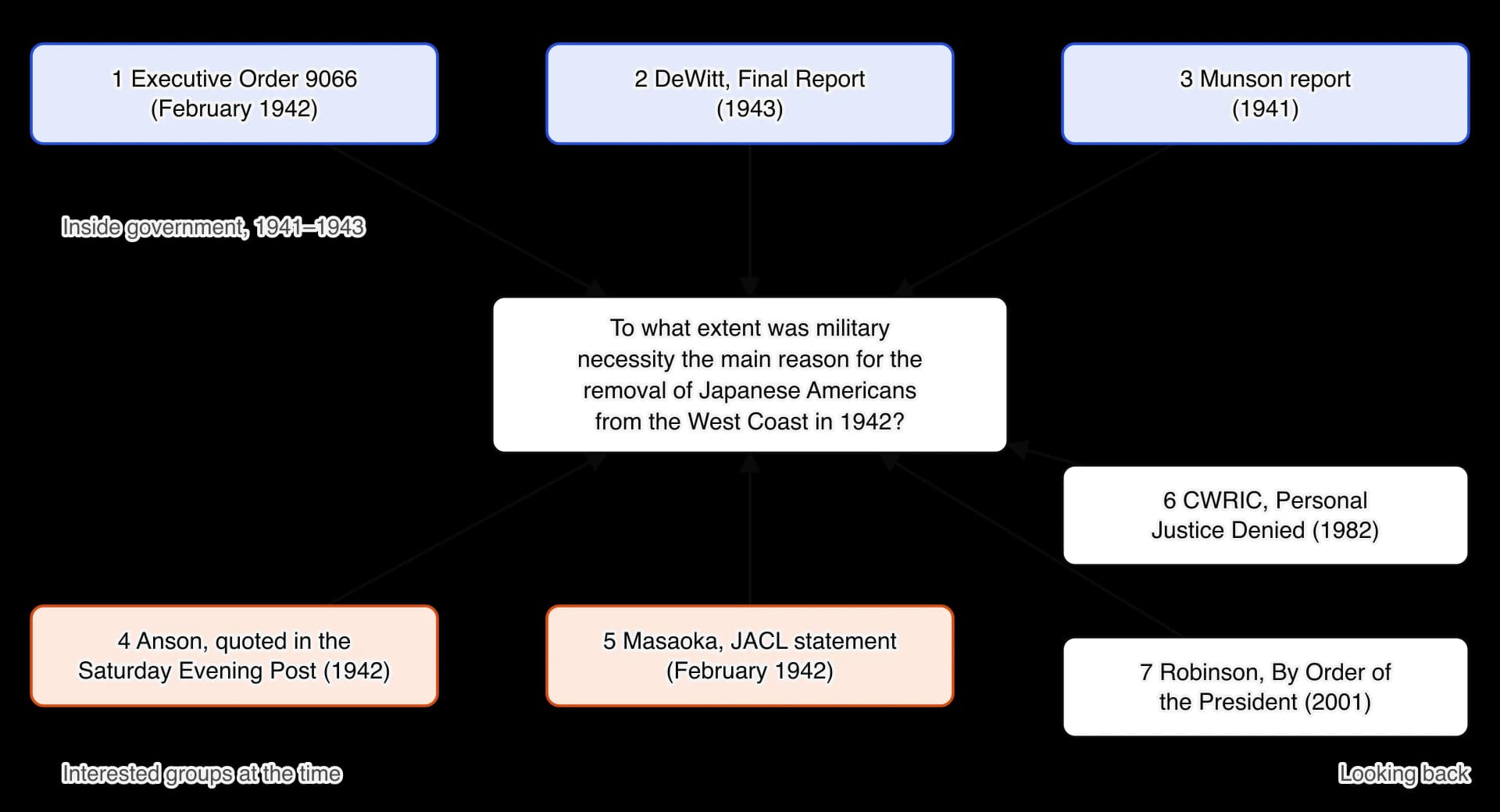
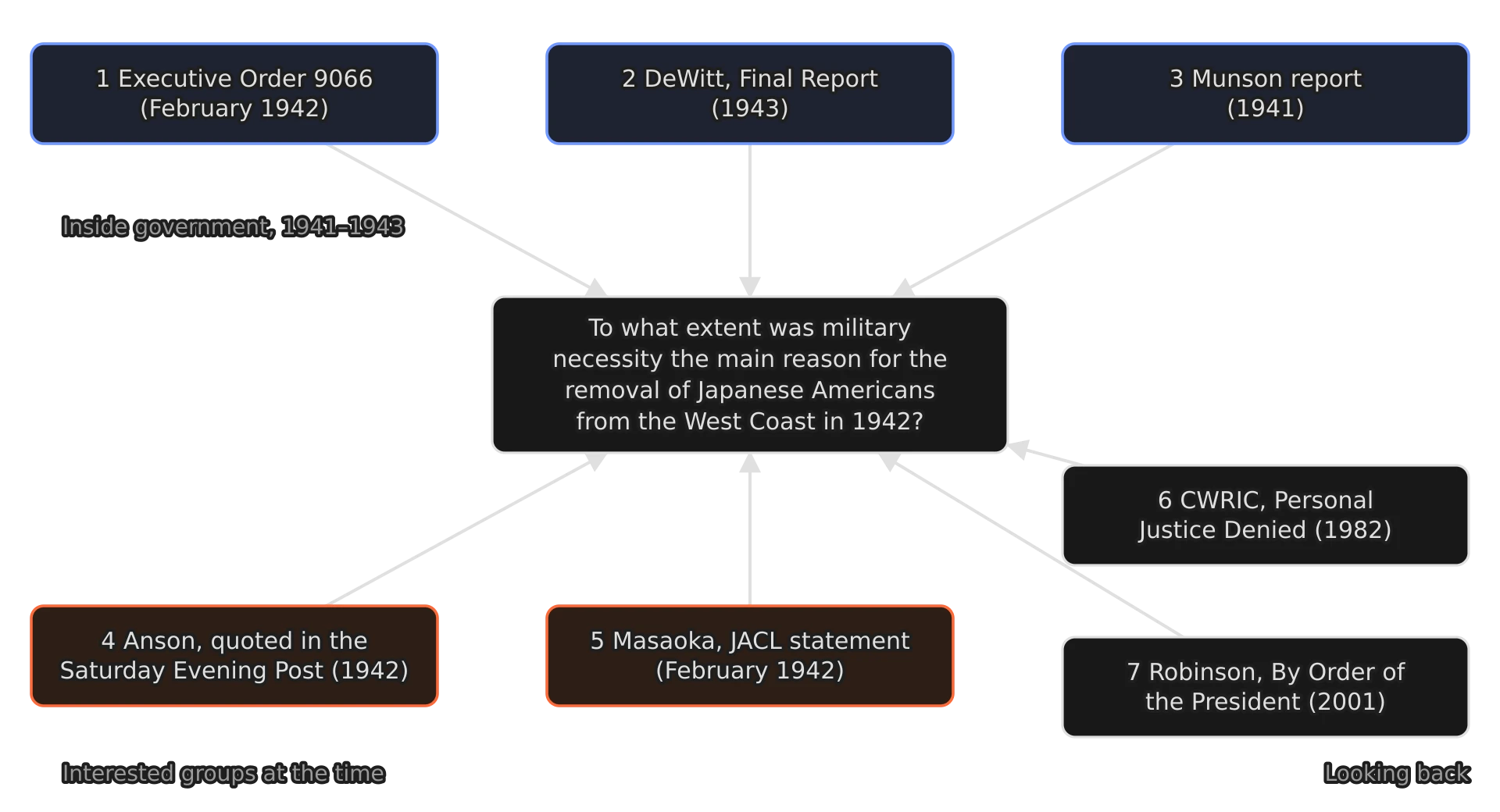
Source | Perspective | Why it was chosen | |
|---|---|---|---|
1 | Franklin D. Roosevelt, Executive Order 9066, 19 February 1942 | The President; the legal basis of the decision | States the official justification in the government's own words |
2 | J. L. DeWitt, Final Report: Japanese Evacuation from the West Coast, 1942 (Government Printing Office, 1943) | The army general who recommended and ran the removal | The fullest statement of the military case, including DeWitt's memorandum of 14 February 1942 |
3 | C. B. Munson, report on Japanese Americans on the West Coast (1941), reprinted in J. Y. S. Wu and M. Song (eds), Asian American Studies: A Reader (2000) | An investigator sent by the government before Pearl Harbor | Shows what intelligence on loyalty was available before the decision |
4 | Austin E. Anson, quoted in Frank J. Taylor, "The People Nobody Wants", Saturday Evening Post, 9 May 1942 | Californian farming interests who competed with Japanese American farmers | Tests the economic explanation |
5 | Mike Masaoka, statement for the Japanese American Citizens League to the House Select Committee Investigating National Defense Migration (Tolan Committee), San Francisco, February 1942 | Japanese American leaders | The only source giving the view of those removed |
6 | Commission on Wartime Relocation and Internment of Civilians, Personal Justice Denied (1982) | A federal inquiry forty years later, with access to government records and hearing testimony from survivors | The official retrospective verdict that the student set out to test |
7 | Greg Robinson, By Order of the President: FDR and the Internment of Japanese Americans (Harvard University Press, 2001) | A historian focusing on the President | Tests the role of political leadership and Roosevelt's own views |
Several sources were considered and left out. The Supreme Court's decision in Korematsu v. United States (1944) was rejected because it judged the order after the event; it explains how the courts saw military necessity, not why the decision was made. Books by David Lowman (2001) and Michelle Malkin (2004), which defend the decision on the basis of decoded Japanese diplomatic messages, were considered as the strongest statement of the military case. The student kept the army's own Final Report instead, because it shows what the decision-makers said at the time, but noted the argument in Section 3. A student who wanted to test military necessity harder could swap source 4 for one of these.
The key evidence
Three of the sources contain short passages that carry much of the argument. The first is the opening of the executive order itself.
Whereas the successful prosecution of the war requires every possible protection against espionage and against sabotage to national-defense material, national-defense premises, and national-defense utilities …
Franklin D. Roosevelt, Executive Order 9066, 19 February 1942 (National Archives). The order never mentions Japanese Americans: it authorises military commanders to exclude "any or all persons" from areas they designate. Its neutral security language is evidence of the justification the government wanted on record, but not of how the order would be used, which is why the army's report is needed beside it.
General John L. DeWitt, who commanded the Western Defense Command, set out his reasoning in a memorandum of 14 February 1942, reprinted in his Final Report.
The Japanese race is an enemy race and while many second and third generation Japanese born on United States soil, possessed of United States citizenship, have become "Americanized," the racial strains are undiluted.
J. L. DeWitt, memorandum of 14 February 1942, in Final Report: Japanese Evacuation from the West Coast, 1942, 1943. The same document argued that the absence of any sabotage so far was a sign that it was being planned. Written to justify the policy to the War Department and later to the public, it shows that the army's "military" case rested on assumptions about race, not on evidence of disloyalty, a point Justice Frank Murphy made in his dissent in the Korematsu case in 1944.
An economic motive was stated openly by the managing secretary of a Californian growers' association.
We're charged with wanting to get rid of the Japs for selfish reasons. We might as well be honest. We do. It's a question of whether the white man lives on the Pacific Coast or the brown men.
Austin E. Anson, Salinas Vegetable Grower-Shipper Association, quoted in Frank J. Taylor, "The People Nobody Wants", Saturday Evening Post, 9 May 1942. The racial slur is part of the historical evidence and is quoted as printed. Taylor reports that the association had sent Anson to Washington soon after Pearl Harbor to urge the removal of all Japanese from the area, so the lobbying came before the decision. But Anson was speaking after the order, to a national magazine, with an interest in presenting his group as influential, so the statement shows the motive of one interest group and its lobbying, not whether that lobbying shaped the decision in Washington.
Section 2: sources and perspectives
Step 3: planning Section 3
Before drafting Section 3, the student wrote a one-sentence answer and mapped the evidence onto a grid of points and sources. The grid showed that every point drew on at least two sources, and that the counter-argument would need careful handling because the military case appears mainly in the army's own words.
Point in the argument | Sources used | What the evidence shows |
|---|---|---|
1 The military case as presented at the time | 1, 2, 6 | A genuine fear after Pearl Harbor; but the order's security language and DeWitt's reasoning rest on race, not evidence |
2 Evidence available against it | 3, 5, 6 | Intelligence before the war found Japanese Americans loyal; no sabotage occurred; Hawaii, much nearer the war, saw no mass removal |
3 Pressure from outside the army | 4, 6, 7 | Economic rivals, West Coast politicians and newspapers demanded removal |
4 Leadership and the decision in Washington | 6, 7 | Roosevelt accepted the War Department's case over the Justice Department's objections, without examining it |
Counter-argument: the decision-makers believed it | 2, 7 (and the MAGIC debate) | Belief in a threat can be a real cause even if the threat was not; weighed in the conclusion |
One-sentence answer: Military necessity was the stated reason and a real fear, but it was not the main reason, because the military case was itself built on racial assumptions and accepted without scrutiny under political pressure.
Section 3: synthesis and evaluation
Step 4: references and bibliography
In the finished investigation each fact and quotation has a footnote. A sample of the footnotes for the model Section 3, in Chicago style:
J. L. DeWitt, Final Report: Japanese Evacuation from the West Coast, 1942 (Washington, DC: Government Printing Office, 1943), 34.
Commission on Wartime Relocation and Internment of Civilians, Personal Justice Denied (Washington, DC: Government Printing Office, 1982), [page].
Greg Robinson, By Order of the President: FDR and the Internment of Japanese Americans (Cambridge, MA: Harvard University Press, 2001), [page].
The bibliography lists exactly the seven sources, alphabetically by author or issuing body:
Commission on Wartime Relocation and Internment of Civilians. Personal Justice Denied. Washington, DC: Government Printing Office, 1982.
DeWitt, J. L. Final Report: Japanese Evacuation from the West Coast, 1942. Washington, DC: Government Printing Office, 1943.
Masaoka, Mike. Statement of the Japanese American Citizens League. In US House of Representatives, Select Committee Investigating National Defense Migration, Hearings, Part 29, San Francisco, February 1942.
Munson, C. B. "Japanese on the West Coast." In Asian American Studies: A Reader, edited by Jean Yu-wen Shen Wu and Min Song. New Brunswick, NJ: Rutgers University Press, 2000.
Robinson, Greg. By Order of the President: FDR and the Internment of Japanese Americans. Cambridge, MA: Harvard University Press, 2001.
Roosevelt, Franklin D. Executive Order 9066, 19 February 1942. National Archives. Accessed [date]. [URL].
Taylor, Frank J. "The People Nobody Wants." Saturday Evening Post, 9 May 1942.
The word count is stated at the start: Section 1 about 380 words, Section 2 about 430, and Section 3 about 1,350 in the full version, a total within 2,200 with footnotes and bibliography excluded.
Self-check
- To do:
I can explain how a topic becomes a refined, debatable inquiry question, and record each step for Section 1.
- To do:
I can choose up to seven sources for the range of perspectives they give, and explain why others were left out.
- To do:
I can write a Section 2 that groups sources by perspective and judges each for my question.
- To do:
I can plan Section 3 with a one-sentence answer and a grid of points and sources.
- To do:
I can write argued paragraphs that combine and evaluate evidence from several sources.
- To do:
I can answer the strongest counter-argument and write a conclusion that states the limits of my evidence.
- To do:
I can footnote every fact and quotation to one of my sources and produce a correct bibliography.
Carry on with History in Augment
With a free account, Augment remembers where you stopped in the notes and which questions you have marked.