Notes on TS2.4 How did the innovations affect people’s lives?
Innovations change more than economies and states. They change who works, for how long and for what reward, who is respected, and who is exposed to danger. Asking how innovations affected people’s lives means looking past the inventors and the national statistics to the experiences of particular groups, many of whom left few records of their own.
Winners and losers: analysing the effects of innovation
An innovation reaches people through several channels at once. It can change the kind of work people do and how much they earn, the prices they pay, their health and safety, their status in the family and the community, and their power over others. Because each group stands in a different position, the same innovation can reach each of them through a different channel.

The timeline of moments in people’s lives shows how varied these experiences were. A Christian translator in ninth-century Baghdad, a widow running a sixteenth-century printing house, a child in an English flax mill and a Kenyan market trader each met an innovation in a different role: as maker, manager, worker or customer.
Who gained, and how do historians know?
Historians usually ask four questions about the effects of an innovation. Distribution: who received the benefits and who bore the costs? Mechanism: did the change come through work, prices, law or status? Timescale: were the effects short-term disruptions or long-term gains? Difference: how did class, gender, ethnicity, religion and region change the experience?

The diagram of the four groups shows the four lines of inquiry into people’s lives. The groups overlap: a woman could also be poor, enslaved or a member of a religious minority, and an innovator could become a member of the elite. Historians now use the idea of intersectionality for the way such identities combine, so that a Dalit woman labourer in Punjab experienced the Green Revolution differently from a Dalit man or a landowning Jat woman.
Evidence is uneven. Innovators, patrons and elites wrote letters, petitions and memoirs; women and marginalised groups appear more often in the records of others: parliamentary inquiries, court cases, census returns, the observations of officials and missionaries. Historians of the last half-century have used oral history, working-class autobiographies, household surveys and archaeology to recover these experiences, an approach often called history from below.
Experiences of innovators
An innovator in the widest sense is anyone who develops or first puts a new technology or method to use: the inventor, but also the craft worker who improves it, the entrepreneur who makes it pay, the translator who brings knowledge from one culture to another, or the scientist who adapts a seed to new soils. Their experiences varied from great wealth and honour to poverty, imprisonment and obscurity.
Anonymous artisans and the problem of credit
Most innovators before modern times left no name. Song China’s great innovations, from new methods of rice farming to gunpowder weapons and paper money, were worked out by farmers, craftsmen, merchants and officials whose individual contributions were rarely recorded. One of the few named exceptions is Bi Sheng, who made movable type from baked clay in the 1040s, is known only because the scholar-official Shen Kuo described his method in the Dream Pool Essays (1088). Shen calls him a buyi, a commoner without office, and records that after Bi Sheng died his type passed into the hands of Shen’s own relatives.
Bi Sheng’s experience shows the position of an innovator without status in a society led by scholar-officials. He received no reward that is recorded, his method did not replace woodblock printing, and his name survived only in an official’s notebook. Woodblock printers, papermakers and ink makers, whose skills made Song print culture possible, are almost all anonymous.
Minority scholars in Abbasid Baghdad
The translators who carried Greek, Persian and Indian learning into Arabic in the ninth century were innovators of a different kind: they created a scientific vocabulary in Arabic and made the paper book the main medium of learning. Many came from religious minorities. The most productive, Hunayn ibn Ishaq (809–873), was a Christian of the Church of the East from al-Hira in Iraq. His Risāla, a list of the works of the Greek physician Galen and their translations, names 129 works, about a hundred of which Hunayn translated himself into Syriac, Arabic or both; he searched for Greek manuscripts in Iraq, Syria, Palestine and Egypt. Thabit ibn Qurra (c.836–901), a mathematician and translator, belonged to the Sabian community of Harran, which worshipped the stars. Others were Persian converts to Islam, such as the mathematician al-Khwarizmi (c.780–c.850), whose work on algebra was written for the caliph al-Ma’mun.
Non-Muslims under Muslim rule had the status of dhimmi: protected communities that could keep their religion in return for paying a special tax, the jizya, and accepting some legal restrictions. Patronage could lift such men to great wealth. Hunayn became personal physician to the caliph al-Mutawakkil (r. 847–861), and a later biographer, Ibn Abi Usaybi‘a (thirteenth century), tells a story that al-Ma’mun paid him the weight of his translations in gold, an anecdote historians treat as legend. Patronage also brought danger: the same biographer reports that Hunayn was imprisoned for a year after refusing a caliph’s order to prepare a poison.
Their experience shows that innovation could give minority scholars a route to wealth and influence, but one that depended on the favour of rulers. Their expertise made them valuable, and their religion did not stop their rise; it did make them more exposed when that favour changed.
Gutenberg, Fust and the business of printing
Johannes Gutenberg’s experience shows how an innovator could lose control of his invention to the people who financed it. To build his press in Mainz, Gutenberg borrowed 1,600 guilders in two loans from the merchant Johann Fust. In November 1455, as the 42-line Bible was being completed, Fust sued him for the debt with interest, and the court decided in Fust’s favour. Fust took over the Bible workshop and continued it with Gutenberg’s skilled assistant Peter Schöffer, who became Fust’s son-in-law.
In 1457 Fust and Schöffer published the Mainz Psalter, the first European book to name its printers and give a date. It praised the new art of printing but did not mention Gutenberg. He continued to print on a smaller scale, and in January 1465 Archbishop Adolf II of Mainz made him a courtier, with an annual allowance of clothing, grain and wine and freedom from taxes. He died in early 1468. He was not rich, but he did not die destitute.
Printing soon created a new kind of innovator: the scholar-printer who combined technical skill, capital and learning. Aldus Manutius in Venice (active 1494–1515) introduced italic type and small, portable editions of Greek and Latin classics. Such printers were businessmen as much as scholars, and many went bankrupt: the trade needed large stocks of paper and type, and books sold slowly.
Industrial inventors: fortune, imitation and anger
The British Industrial Revolution produced the first innovators who became rich and famous from their inventions, but also many who did not. Patents gave inventors a legal monopoly for fourteen years, yet patents were expensive, easy to copy and hard to defend in court.
Innovator | Innovation | What happened to him |
|---|---|---|
James Hargreaves (c.1720–1778) | Spinning jenny (c.1764) | Hand spinners near Blackburn, fearing for their work, turned against the machine; he moved to Nottingham. His 1770 patent came too late to stop copying. His widow received £400 when he died in 1778. |
Richard Arkwright (1732–1792) | Water frame (patent 1769) and the factory system at Cromford | Became the richest of the cotton pioneers: knighted in 1786 and left about £500,000. His main patents were annulled in 1785 after rivals showed that he had borrowed others’ ideas. A mill of his at Birkacre was destroyed by rioters in 1779. |
Samuel Crompton (1753–1827) | Spinning mule (1779) | Could not afford a patent, so manufacturers copied the mule freely. Parliament granted him £5,000 in 1812, a fraction of the value of his machine to the industry. |
Edmund Cartwright (1743–1823) | Power loom (1785) | Lost money in his own weaving mill; Parliament granted him £10,000 in 1809. |
James Watt (1736–1819) | Separate condenser (patent 1769) | Grew rich through his partnership with the manufacturer Matthew Boulton, which held the patent until 1800 and defended it fiercely against rivals. |
Data: Edward Baines, History of the Cotton Manufacture in Great Britain (1835), and later biographies.
The table of industrial inventors shows that success depended less on the quality of an invention than on capital, business skill and the ability to control a patent. Arkwright, the least original of the five, became the richest, because he organised water-powered mills employing hundreds of workers. Hargreaves and Crompton, the more original inventors of spinning machinery, gained little. Contemporaries argued about this unfairness, and Parliament’s grants to Crompton and Cartwright were early attempts to reward inventors whose ideas others had used.
Scientists, teams and the Green Revolution
By the twentieth century innovation was increasingly the work of teams in research institutions, funded by governments and foundations. The American plant breeder Norman Borlaug (1914–2009), who led the wheat programme of the Rockefeller Foundation in Mexico from the 1940s, became the public face of the Green Revolution and received the Nobel Peace Prize in 1970. His reward was fame and influence more than wealth: the seed was released to farmers without royalties.
Many others did the work. Mexican scientists in the programme bred and tested the varieties; in India the geneticist M. S. Swaminathan (1925–2023) organised the trials of Mexican wheat and its adaptation to Indian conditions, and Dilbagh Singh Athwal at the Punjab Agricultural University bred new varieties, while the agriculture minister C. Subramaniam pushed the programme through government. At the International Rice Research Institute in the Philippines, the breeders Peter Jennings and Henry Beachell developed IR8 rice (1966). The way credit was shared, with an American scientist often named alone, has been criticised as a narrow, Western-centred view of who innovates.
Innovators inside companies: mobile money
M-Pesa, the mobile money service launched in Kenya, was designed inside two companies. Nick Hughes, who worked on social responsibility projects at the British firm Vodafone, won matched funding from the UK Department for International Development to test mobile payments for microfinance in Kenya; Susie Lonie led the pilot in 2005–2006, and Michael Joseph, chief executive of Safaricom, launched the service in March 2007. Hughes and Lonie were salaried employees: the profits went to Safaricom and its shareholders, including Vodafone and the Kenyan government. The many shopkeepers who became M-Pesa agents, changing cash into electronic money and back, were also innovators of a sort, since they adapted the service to local needs.
Comparing the experiences of innovators
Across the cases, innovators’ fortunes depended on their position in society more than on the importance of their ideas. Those with patrons, capital or institutions behind them (Hunayn at the Abbasid court, Arkwright, Borlaug) gained wealth or honour; those without (Bi Sheng, Hargreaves, Crompton) gained little. Credit was distributed unequally by class, religion, gender and nationality, which is why historians now speak of innovation as collective work more than the achievement of single heroes.
Experiences of social elites
A social elite is the small group at the top of a society that holds most of its wealth, status or power: aristocrats and landowners, officials and scholars, senior clergy, wealthy merchants and industrialists. Elites met innovations from a position of strength. They could afford to adopt them early, they often controlled the institutions that regulated them, and they could shape how the benefits were shared. Their experiences fall into three patterns: profiting, adapting and, for some, losing status.
Courtiers, secretaries and patrons in Abbasid Baghdad
Paper reached Baghdad through the Abbasid court, and its first users were the elite who ran the caliphate. The Barmakid family, descendants of a Buddhist temple official from Balkh in Central Asia who had converted to Islam and who served as viziers to Harun al-Rashid (r. 786–809), are credited with setting up the first paper mill in Baghdad in the 790s. Paper suited a large bureaucracy: it was cheaper than parchment and harder to alter without trace than papyrus, so it became the medium of tax registers, correspondence and court records.
The innovation strengthened a new elite of secretaries, the kuttab, many of Persian background, whose skill in writing, accounting and correspondence made them indispensable to the caliphs. They built libraries, commissioned translations and wrote handbooks of their craft. Patronage of translators such as Hunayn ibn Ishaq, and of astronomers and physicians, gave courtiers prestige as men of learning.
The same court also shows how quickly elite fortunes could change. In 803 Harun al-Rashid turned against the Barmakids: Ja‘far ibn Yahya was executed and his father and brothers imprisoned. Their wealth and patronage had depended on the caliph’s favour, not on any independent base of power. Innovation enriched the court elite, but it did not make their position secure.
Song scholar-officials: print and the examinations
In Song China the elite were the scholar-officials, men who had passed the civil-service examinations on the Confucian classics and served the state. Printing and cheaper paper strengthened their position in two ways. Printed editions of the classics, commentaries and model examination essays made study cheaper and spread it to more families. At the same time, the state used print to standardise the texts that candidates had to master, so that official learning reached every prefecture in the same form.

The chart of Song examination candidates shows the result. The number of men sitting the examinations rose from tens of thousands in the late eleventh century to more than 400,000 by the mid-thirteenth, while the number of top degrees awarded, the jinshi, stayed at about 200 a year. Elite families adapted by investing heavily in education: they founded lineage schools and academies, bought books and hired tutors, and many families produced degree-holders over several generations.
For most candidates the system meant years of study and repeated failure. The historian Robert Hymes, in Statesmen and Gentlemen (1986), argues that many Southern Song elite families turned away from the hope of high office and built their status locally instead, through landholding, marriage alliances, charity and leadership in their home districts. Print widened the circle of educated men, but it also created a large class of educated men who never held office.
European elites and the uses of print
In Europe the first great customers of printing were the Church and the princes. Gutenberg’s workshop printed thousands of indulgences for the Church in 1454–1455, and bishops, monasteries and universities commissioned service books and textbooks. Rulers soon used the press for their own ends. The Holy Roman Emperor Maximilian I (r. 1493–1519) commissioned printed books and woodcuts celebrating his ancestry and deeds, such as the illustrated poem Theuerdank (1517).
Elites also used print to mark status. Wealthy collectors bought finely printed and hand-decorated books for their libraries, and humanist scholars won patronage and international reputations through printed editions and letters. The groups who lost status were below the elite: professional scribes and copyists, whose resistance is part of how the innovations were resisted. Some elites distrusted print as vulgar, and manuscript copies of poems and political writings continued to circulate among aristocrats into the seventeenth century.
Landowners, industrialists and their responsibilities in Britain
The British Industrial Revolution is sometimes presented as the victory of a new middle class over the landed aristocracy. In practice many aristocrats adapted and profited. Landowners leased land for mines and took royalties on every ton of coal; they sold land for canals, railways and urban building; and some invested directly in industry. Francis Egerton, third Duke of Bridgewater, built the Bridgewater Canal, opened in 1761, to carry coal from his mines at Worsley to Manchester, cutting the price of fuel in the town and multiplying his own income.
A new industrial elite of mill owners, ironmasters and bankers rose alongside them. Some of its members joined the old elite within a generation. Robert Peel, a Lancashire calico printer, became one of the richest manufacturers in Britain and was made a baronet in 1800; his son, Sir Robert Peel, became Conservative prime minister. Arkwright bought a country estate and built Willersley Castle near his mills. Wealth from industry was turned into land, titles and political influence, which helped the old and new elites to merge.
Elites also disagreed about their responsibilities to the people who worked for them. Some employers practised paternalism: Samuel Greg housed and fed the pauper apprentices at his Quarry Bank Mill in Cheshire, and Robert Owen at New Lanark in Scotland refused to employ children under ten and opened a school for workers’ children in 1816. Most employers rejected any duty imposed by the state. When the Mines Commission questioned coal owners in 1841, one of them, Thomas Wilson, objected to regulation in these terms.
I object on general principles to government interference in the conduct of any trade, and I am satisfied that in mines it would be productive of the greatest injury and injustice. The art of mining is not so perfectly understood as to admit of the way in which a colliery shall be conducted being dictated by any person, however experienced, with such certainty as would warrant an interference with the management of private business.
Thomas Wilson, owner of three collieries near Silkstone, Yorkshire, evidence to the Children’s Employment Commission (Mines), published 1842. Wilson spoke as an employer defending his control of his business against a commission that he knew was gathering evidence for reform; elsewhere in his evidence he said he wished to see women’s work underground ended, but only through the moral improvement of miners, not by law. The source shows the laissez-faire view of many industrial elites: the gains of innovation belonged to owners, and the welfare of workers was a private matter.
New elites of the twentieth and twenty-first centuries
The Green Revolution and mobile money produced their own elites. In Mexico, the historian Cynthia Hewitt de Alcántara showed in Modernizing Mexican Agriculture (1976) that the new wheat varieties benefited mainly large commercial farms in the irrigated north-west, especially the Yaqui Valley of Sonora, where Borlaug’s research station stood, while ejido farmers on rain-fed land gained little. In India the main winners were larger landowning farmers, whose experience is examined in the case study of Punjab.
In Kenya, Safaricom became the largest company on the Nairobi Securities Exchange, earning much of its profit from M-Pesa fees, and its shareholders (Vodafone, the Kenyan government and private investors) gained most of the financial return. The banks first lobbied against the service and then adapted: from 2012 the Commercial Bank of Africa offered savings and small loans through M-Pesa under the name M-Shwari. Elites who controlled the infrastructure gained most, as in earlier cases.
Comparing the experiences of elites
Case | Elites who gained or adapted | Elites who lost status or power |
|---|---|---|
Abbasid paper and learning | Caliphs and courtiers as patrons; the secretaries (kuttab) of the bureaucracy | Courtiers who lost the caliph’s favour, such as the Barmakids in 803 |
Song printing and examinations | Families able to pay for years of study; degree-holders | Unsuccessful candidates, who turned to local status |
Printing in Europe | Church, princes, humanist scholars, merchant printers | Scribes and copyists; Gutenberg himself lost his workshop |
British Industrial Revolution | Coal-owning aristocrats; mill owners and bankers who bought land and titles | Master handloom weavers and small clothiers; some landowners without minerals |
Green Revolution | Larger irrigated farmers in Punjab and Sonora; fertiliser and machinery firms | Few lost directly; elites in poorer, rain-fed regions fell further behind those of Punjab |
Mobile money | Safaricom and its shareholders; banks that partnered with it | Informal money couriers; banks lost customers until they partnered with Safaricom |
The table of elites shows a consistent pattern. Elites rarely resisted innovations for long when they could control them; they adopted them early and turned them to their own advantage. Their losses came where an innovation weakened the source of their income, as for master weavers, or where their position depended on a single ruler. Some historians also stress responsibility: elites decided whether the gains of innovation would be shared, through paternalism, charity or reform, and most chose to share them only under pressure.
Experiences of women
Innovations affected women through their paid work, their unpaid work in the household, their access to education and property, and the ideas about women’s proper place that innovations sometimes reinforced. Most women’s experiences are recorded indirectly, by men, so historians often reconstruct them from laws, tax and census records, inquiries and the rare writings of women themselves.
Women and the world of books in Abbasid Baghdad
The paper books and translations of Abbasid Baghdad were produced almost entirely by men: translators, copyists, booksellers and scholars. Elite women took part mainly as patrons. Zubayda (d. 831), wife of Harun al-Rashid, paid for wells, cisterns and reservoirs along the pilgrim road from Iraq to Mecca, later named the Darb Zubayda after her, and for an aqueduct to supply Mecca with water.
A smaller number of women took part in learning itself, mainly as transmitters of hadith, the reports of the sayings and deeds of the Prophet Muhammad, which scholars learned from teachers of either sex. Later biographical dictionaries name hundreds of women hadith scholars across the Islamic world. Far to the west, in Fez, a later tradition credits Fatima al-Fihri, the daughter of a wealthy merchant family, with founding the Qarawiyyin mosque in 859, which became one of the great centres of learning of North Africa; the tradition was first recorded centuries afterwards, so historians treat its details with caution.
Some enslaved women gained a kind of education through the court culture of the age. The qiyan (singular qayna) were enslaved women trained in music, poetry and witty conversation, bought and sold by elite households for large sums. The most famous, ‘Arib al-Ma’muniyya (c.797–890), was a celebrated singer, composer and poet at the court of several caliphs. Their skills made them valuable and sometimes influential, but they remained property. Women’s place in the new culture of books was therefore narrow: a few patrons and performers were visible, while the great majority of women, rural and urban, were untouched by it.
Song China: property, Neo-Confucian ideals and bound feet
The commercial growth of Song China changed women’s lives in contradictory ways. The historian Patricia Ebrey, in The Inner Quarters (1993), shows that rising wealth increased the size of dowries, which a wife brought into her marriage and could keep some control over. Song law gave daughters a share of family property in some circumstances, and widows often managed property and remarried. Women in peasant households spun and wove silk and hemp for taxes and for sale, so the commercial economy depended on their labour.
At the same time, Neo-Confucianism, the revived Confucian philosophy spread by printed commentaries and schools from the eleventh century onwards, stressed the separation of the sexes, the wife’s duty to her husband’s family and the virtue of widows who did not remarry. These ideals had limited effect in the Song itself but grew stronger in later dynasties.
The custom of foot-binding, in which girls’ feet were tightly wrapped from early childhood to keep them small, spread among elite families during the Song. The earliest archaeological evidence comes from the tomb of Huang Sheng, a young woman of an official family buried in 1243, whose feet were bound and who was buried with small shoes. In the thirteenth century the scholar Che Ruoshui wrote the first known criticism of the practice, objecting to the suffering of small girls. Ebrey links the spread of foot-binding to an elite culture that valued refinement and display, in which a bound foot marked a family’s status; historians disagree about why it spread, but agree that it affected elite women long before it reached the poor.
Print culture gave a small number of elite women a voice. Li Qingzhao (1084–c.1155), the most admired woman poet in Chinese history, married the scholar Zhao Mingcheng in 1101 and collected books, paintings and inscriptions with him. After the Jurchen took Kaifeng in 1127, she fled south and lost most of the collection. Her afterword to her husband’s catalogue of inscriptions describes their life as collectors and her losses, and her poems circulated widely in manuscript and print. She remained exceptional: women could write, but could not sit the examinations or hold office.
Women and the printing press
Printing was organised by guilds that did not accept women as apprentices or masters, but the family workshop gave some women a place in it. Wives and daughters worked as compositors, proof-readers and sellers, and a widow could inherit and run her husband’s business. Charlotte Guillard ran the Soleil d’Or press in Paris during two widowhoods, in 1519–1520 and from 1537 until her death in 1557. In her later years the business ran up to six presses with about forty workers, according to the historian Rémi Jimenes, and published well over 150 editions in all (counts vary), mostly theology and law in Latin and Greek. In Florence, nuns of the convent of San Jacopo di Ripoli worked as compositors for the convent’s press in the 1470s and 1480s.
Print also helped some women as readers. Cheap devotional books, almanacs and, after the Reformation, vernacular Bibles and catechisms gave more women access to reading, and some Protestant reformers encouraged girls’ schooling so that they could read scripture. Literacy rose more slowly for women than for men, and in most places women were far more likely to be able to read than to write.
Some historians argue that the age of print narrowed women’s opportunities more than it widened them. Joan Kelly’s essay "Did Women Have a Renaissance?" (1977) answered no: the new culture of the Renaissance, spread through print, gave elite women less freedom and influence than women of the high Middle Ages. Print also spread hostile ideas about women. The Malleus Maleficarum (Hammer of Witches), written by the Dominican inquisitor Heinrich Kramer and first printed at Speyer in 1486, argued that women were especially prone to witchcraft and was reprinted many times. During the European witch trials of about 1450–1750, between 40,000 and 60,000 people were executed for witchcraft, roughly 80 per cent of them women. Print did not cause the trials, which depended on local courts and fears, but printed manuals and pamphlets spread the idea of the witch across Europe.
Women in British mills and mines
The factory system created the first large group of women wage-earners working outside the home. In the cotton mills women and girls tended spinning frames and power looms and formed a large share of the workforce, often about half, because employers could pay them less than men and believed them to be more obedient. Women’s wages gave them some independence and allowed young women to leave home, but they were usually about half of men’s, and married women kept the burden of housework and childcare alongside paid work, a double burden.
Women also worked underground in many coalfields, carrying or pulling coal from the face to the shaft. The report of the Children’s Employment Commission in 1842, led by the reformer Lord Ashley, collected their evidence. Patience Kershaw, a seventeen-year-old from near Halifax, described her work as a "hurrier".
I go to pit at five o’clock in the morning and come out at five in the evening; I get my breakfast of porridge and milk first; I take my dinner with me, a cake, and eat it as I go; I do not stop or rest any time for the purpose; I get nothing else until I get home, and then have potatoes and meat, not every day meat. I hurry in the clothes I have now got on, trousers and ragged jacket; the bald place upon my head is made by thrusting the corves.
Patience Kershaw, aged 17, evidence to the Children’s Employment Commission (Mines), report of 1842. The evidence was recorded and edited by a sub-commissioner who added his own shocked comments, and the commission published it to persuade Parliament to act. Its value lies in the concrete detail of hours, food and injury; its selection of women wearing trousers and working near naked men also shows the commissioners’ concern with morality as well as safety.

The commission’s engravings and the testimony of women such as Patience Kershaw led directly to the Mines Act of 1842, which banned all women and girls from underground work. The law protected women from dangerous work, but it also took away their wages, and it was shaped by the belief that a respectable woman belonged in the home. Many women moved to lower-paid surface work at the pit head. The Factory Act of 1844 and the Ten Hours Act of 1847 limited women’s working hours in textile mills, the first time adult workers’ hours were restricted by law, an example of protective labour legislation.
The Lowell mill girls in the United States
In New England the textile industry was organised differently. From the 1820s the Boston merchants who built mills at Lowell, Massachusetts, recruited young unmarried women from farming families and housed them in company boarding houses with strict rules. Harriet Hanson Robinson, who worked in the Lowell mills from the age of eleven until 1848, later explained why the work mattered to women of her generation.
For hitherto woman had always been a money-saving, rather than a money-earning, member of the community, and her labor could command but small return. If she worked out as servant, or “help,” her wages were from fifty cents to one dollar a week; if she went from house to house by the day to spin and weave, or as tailoress, she could get but seventy-five cents a week and her meals.
Harriet H. Robinson, Loom and Spindle: Or, Life Among the Early Mill Girls, memoir, 1898. Robinson wrote half a century later, as a campaigner for women’s suffrage, so she stresses the independence that mill wages gave women and remembers her youth warmly. Her account is valuable for the motives of mill girls and for the comparison with earlier women’s earnings; it says less about the long hours and the speed-ups of the 1840s.

Mill wages paid in cash let women help their families, save for marriage or pay for a brother’s education, and the boarding houses created a community of women workers. That community also organised. When the companies cut wages in 1834 and raised boarding charges in 1836, the women went on strike, or "turned out"; Robinson, aged eleven, led her room out in 1836. In 1845 workers led by Sarah Bagley formed the Lowell Female Labor Reform Association, one of the first unions of working women in the United States, to campaign for a ten-hour day. By the 1850s Irish immigrant women, who had fewer alternatives and accepted lower wages, were replacing New England farm daughters in the mills.
Later innovations opened other new work to women. When the Boston Telephone Dispatch Company found that the boys it had first hired as telephone operators were impatient and rude to customers, it hired Emma Nutt in September 1878 as the first woman operator. Within a few decades switchboard operating, typing and office work had become largely women’s jobs: new, respectable and lower-paid than men’s work of similar skill.
Women and mobile money in Kenya
Mobile money is the core case in which women’s gains have been measured most carefully. Before M-Pesa, many Kenyan women had no bank account, part of the unbanked majority, and remittances sent home by husbands working in the cities was often carried by friends or bus drivers, or controlled by the men who sent it. The economists Tavneet Suri and William Jack, who tracked thousands of households from 2008 to 2014, summarised their findings in the journal Science.
We estimate that access to the Kenyan mobile money system M-PESA increased per capita consumption levels and lifted 194,000 households, or 2% of Kenyan households, out of poverty. The impacts, which are more pronounced for female-headed households, appear to be driven by changes in financial behavior—in particular, increased financial resilience and saving—and labor market outcomes, such as occupational choice, especially for women, who moved out of agriculture and into business.
Tavneet Suri and William Jack, "The long-run poverty and gender impacts of mobile money", Science, December 2016. The study is a statistical estimate based on how close households lived to M-Pesa agents, not a collection of women’s own accounts. It gives strong evidence that women in female-headed households gained most, by saving more safely and moving from farming into small businesses and trade.
Other researchers are more cautious. A study of rural women in western Kenya by Susan Wyche and colleagues (2016) found that many shared or borrowed phones owned by men, so mobile technology could reinforce husbands’ control over money and information. The economist Milford Bateman and his co-authors (2019) challenged Suri and Jack’s methods and argued that the poverty figures were exaggerated. The evidence suggests that mobile money gave many women more control over their own money, but that gains depended on owning a phone, having a business to move into, and the balance of power in the household.
Comparing the experiences of women
Across the cases, innovations most often helped women when they created work that paid wages directly to women or gave them control over money: the Lowell mills, the Paris printing workshop of a widow, a mobile money account in a woman’s name. They helped least, or harmed, when they reinforced ideas of women’s dependence (Neo-Confucian ideals and foot-binding, the printed demonology of the witch trials) or when the gains went to the household head. In almost every case, class mattered as much as gender: Li Qingzhao’s experience of print had little in common with that of a peasant woman weaving silk for taxes.
Experiences of marginalised groups
Marginalised groups had the least power to decide how an innovation was used and the fewest resources to profit from it. For them, innovations often meant harder work, new forms of exploitation or exclusion from the gains, although some innovations also gave them new tools and, eventually, new rights. Their experiences are the hardest to recover, because they wrote least and were described most often by those who employed, governed or opposed them.
Religious minorities and enslaved workers in the Abbasid world
The Christian, Jewish and Sabian scholars of Abbasid Baghdad show that a minority could be central to an innovation while remaining legally unequal. As dhimmi they paid the jizya and faced restrictions that rulers could tighten at will: in 850 the caliph al-Mutawakkil ordered Christians and Jews to wear distinctive clothing and barred them from some government posts, the same caliph who employed Hunayn as his physician. Their position depended on their usefulness to patrons.
The wealth that paid for paper, books and translations came partly from enslaved labour. In the marshes of southern Iraq, enslaved East Africans known as the Zanj were forced to clear salt from the land for cultivation; their great revolt of 869–883, the Zanj Rebellion, shook the caliphate. Nothing connects them directly to the paper mills, but their story is a reminder that the culture of the court rested on an economy in which many people had no share in its gains.
Peasants and tenants in Song China
Most people in Song China were farmers, and many were tenants who paid a large share of their harvest as rent to landlords. Champa rice, which ripened quickly and resisted drought, allowed double cropping in the south and supported the growth of the population to around 100 million. More food meant fewer deaths from famine, which was the most important improvement in ordinary lives that Song innovations brought.
The commercial economy also exposed peasants to new risks. The state increasingly demanded taxes in cash, so households had to sell grain or cloth in the market, often when prices were low after the harvest. When the government printed too much paper money in the twelfth and thirteenth centuries, prices rose and the notes lost value, harming those who held them. The reforms of Wang Anshi, which offered state loans to farmers, and the opposition to them are part of how the innovations were resisted; for peasants, the Song economy brought more food but not more security.
Jews and the printed word in Europe
Print spread hostile ideas as well as learning. In 1475 the disappearance and death of a two-year-old boy, Simon, in the city of Trent led to a blood libel: the false accusation that Jews had murdered him for a religious ritual. The Jewish men of the town were tortured and executed. Printed accounts of the case and woodcuts of the supposed murder circulated in Italy and Germany, and the Nuremberg Chronicle (1493), one of the most lavishly illustrated printed books of the century, included an image of it. Print made a local accusation into a story known across Europe.
Martin Luther, whose pamphlets made him the most printed author of the 1520s, published On the Jews and Their Lies in 1543. It urged rulers to burn synagogues and Jewish schools, destroy Jewish prayer books and seize Jewish property. Printed polemics of this kind did not create antisemitism, which was centuries older, but they gave it new reach and authority. Jewish communities also used the press: Hebrew printers such as the Soncino family in Italy published the complete Hebrew Bible in 1488, and print helped spread Jewish learning across the Mediterranean.
Children in British mills and mines
Children worked in agriculture and domestic industry long before the Industrial Revolution, but factories changed the conditions of their work. In a mill, children worked at the pace of a machine, under an overseer, for twelve hours or more in heat, noise and dust, away from their families. They were valued because they were cheap, small enough to crawl under machines and nimble enough to piece broken threads. At Arkwright’s mills at Cromford in the late eighteenth century, around two-thirds of the 1,150 workers were children.
In 1832 a parliamentary select committee chaired by the Tory reformer Michael Sadler, the Sadler Committee, heard evidence from mill workers and doctors. Elizabeth Bentley, aged 23, from Leeds, described her childhood in a flax mill.
What time did you begin to work at a factory? — When I was six years old. … What was your business in that mill? — I was a little doffer. What were your hours of labour in that mill? — From 5 in the morning till 9 at night, when they were thronged. … Suppose you flagged a little, or were too late, what would they do? — Strap us. … Girls as well as boys? — Yes.
Elizabeth Bentley, evidence to the Select Committee on the Bill to Regulate the Labour of Children in the Mills and Factories, 4 June 1832 (published 1832). Sadler wanted the committee to support his bill for a ten-hour day, chose witnesses who would support it and asked leading questions, and mill owners were not heard before the report appeared. The evidence is therefore one-sided, but the factory commission of 1833, which interviewed both sides, confirmed long hours and physical punishment in many mills.

The timeline of protective laws shows that reform came slowly and in stages. The Factory Act of 1833 banned children under nine from textile mills, limited the hours of those aged 9–13, required two hours of schooling a day and appointed four inspectors to enforce the law, although four men could not visit thousands of mills. Mines were regulated only after the 1842 report revealed children as young as five working underground in darkness as "trappers", opening and closing ventilation doors. For children, the innovation of the factory brought decades of harsh labour before the state began to protect them.
 YouTube
Enslaved people and the cotton gin
The British cotton industry depended on raw cotton grown by enslaved people in the Americas. In 1793 Eli Whitney, a young New Englander working in Georgia, built a cotton gin ("engine") that removed seeds from short-staple cotton far faster than by hand. Short-staple cotton grew across the interior of the South, so the gin made cotton farming profitable on a huge scale just as British mills demanded ever more fibre. US cotton production rose from about 730,000 bales in 1830 to about 2.1 million in 1850 and 3.8 million in 1860.
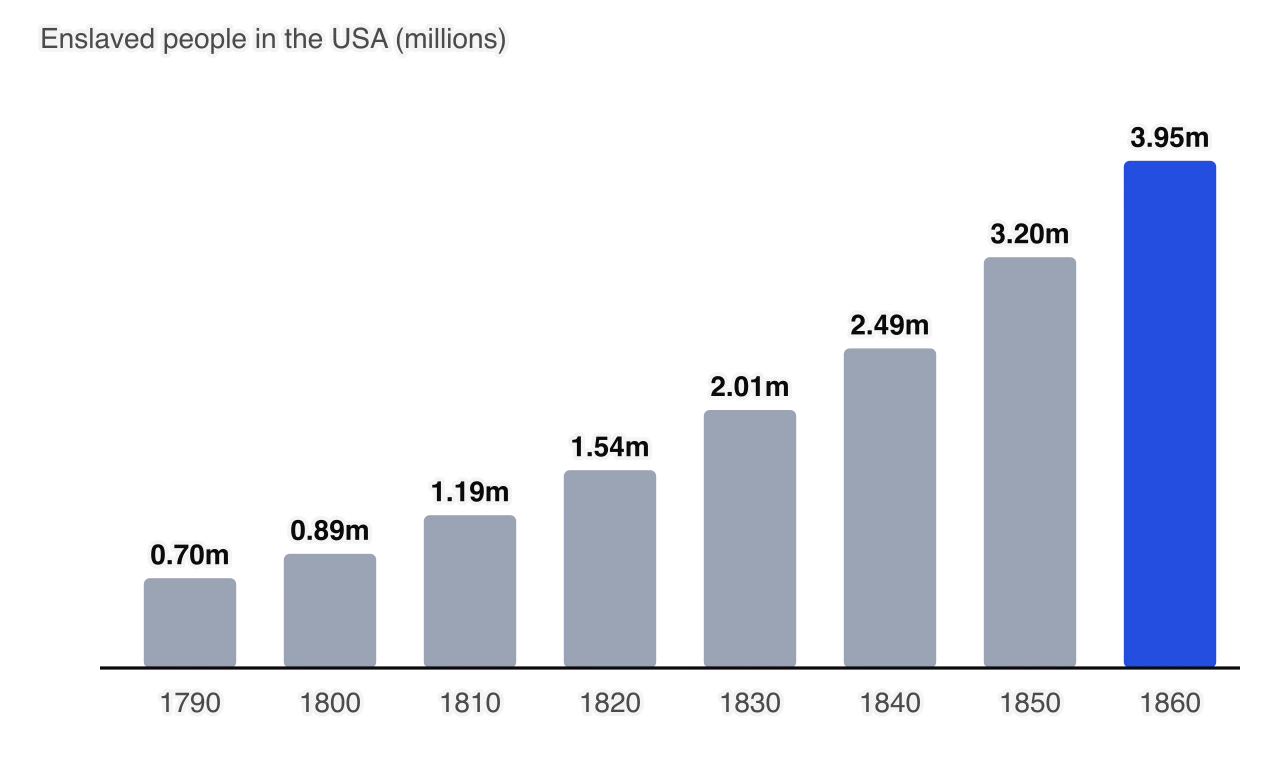
The chart of the enslaved population shows the result. Slavery, which some Americans in the 1780s had expected to decline, expanded with cotton. Planters moved west into Alabama, Mississippi, Louisiana and Texas, and about a million enslaved people were taken through the domestic slave trade from the older states of the Upper South to the cotton lands through sale or forced migration, breaking up families. Work on cotton plantations was organised in gangs under overseers, and picking quotas were enforced by the whip.
For enslaved people, therefore, an innovation that saved labour in one task brought more slavery, more family separation and harder work in another. Whitney himself made little money from the gin, because planters copied it freely, which shows again that inventors did not control how their innovations were used.
Indian handloom weavers
Before the Industrial Revolution, India was the world’s largest producer and exporter of cotton cloth, and its fine muslins and calicoes were sought across Asia, Africa and Europe. Machine-spun yarn and later power-woven cloth from Lancashire reversed this trade. By the 1820s and 1830s British cotton goods were being exported to India in rising quantities, helped by tariffs that favoured British imports under East India Company rule, and India became an exporter of raw cotton instead.
Hand spinners, almost all women, lost their market first, because Indian weavers could buy cheaper machine-made yarn. Weavers of fine cloth for export, especially in Bengal around Dhaka, also suffered, and many moved into farming. Historians disagree about how complete the ruin was: some weavers survived by using cheap British yarn to make coarse cloth for local markets, and the number of handlooms in India remained large into the twentieth century. The experience shows that an innovation in one region could make a skilled group in another region marginal, through trade and colonial power.
Irish migrants in industrial Britain
Industrial Britain also drew in migrants who worked at the bottom of the new economy. Irish labourers had crossed to Britain for seasonal harvest work for decades, and from the 1820s many settled in the textile towns and ports, above all Manchester, Liverpool and Glasgow. After the famine of 1845–1852 their numbers rose sharply: the census of 1851 counted more than 700,000 people born in Ireland living in Britain. They took the lowest-paid and least secure work, as handloom weavers, dock and building labourers and navvies on the canals and railways, and crowded into the poorest districts, such as the area of Manchester known as Little Ireland. As Catholics and as cheap labour they faced hostility from employers and from English workers who accused them of lowering wages, which shows that the gains of industrialisation were shared unequally by nationality and religion as well as by class.
The excluded and the indebted in the digital economy
Mobile money widened financial inclusion, reaching many poor Kenyans, but not all. People without a phone, without an identity card or living far from an agent were left out, and the fees on small transfers took a larger share from the poorest users. In 2019 Safaricom launched Fuliza, an overdraft service on M-Pesa, and digital lending apps spread rapidly; many borrowers ran up small, expensive debts, and large numbers were listed with credit bureaus for unpaid loans. The digital divide meant that the gains of mobile technology were shared unequally, as earlier innovations had been.
Mobile money also reached some of the most marginalised people in Kenya, the refugees in its large camps. From August 2015 the World Food Programme gave refugees in Kakuma camp part of their food aid as mobile credit, under a scheme called Bamba Chakula ("get food" in Swahili), which they spent with local traders, many of them refugees themselves. The scheme gave families more choice over what they ate and brought money into the camp economy, but refugees who lacked Kenyan identity documents had difficulty registering for full mobile money accounts, so their access remained limited by their legal status.
Comparing the experiences of marginalised groups
The marginalised groups in these cases were affected in three main ways. Some were exploited more intensively because an innovation raised the value of their labour to others: children in mills, enslaved people in the cotton South. Some were made redundant or excluded: Indian spinners and weavers, landless labourers replaced by machines, people outside the reach of mobile networks. Some were targeted by ideas that an innovation spread, as Jews were by printed polemic. Improvements came mainly from outside the innovation itself: from campaigns, laws and, for enslaved people in the United States, emancipation in 1865.
Case study: the Green Revolution in India and people’s lives, c.1965–2000
India adopted high-yielding varieties of wheat in 1966, after the failed monsoons of 1965 and 1966, and of rice from the late 1960s. The new seeds, with chemical fertiliser, pesticides and controlled irrigation, roughly doubled India’s wheat harvest within six years and ended the fear of mass famine that had dominated Indian politics since independence. Their effects on people were concentrated first in the north-western state of Punjab, which had the canals, wells and owner-farmers to use them, so Punjab is the clearest place to see who gained and who lost.
 YouTube
Punjab’s farmers: from scarcity to surplus
Punjab was chosen to lead the programme because it was already one of India’s most productive regions. Much of it was irrigated by canals built under British rule, holdings had been consolidated into compact farms in the 1950s, and most land was cultivated by its owners, many of them Jat Sikh farming families. These farmers adopted the Mexican dwarf wheats quickly, sank private tube-wells with diesel and electric pumps to control their water, and bought fertiliser with credit from banks and cooperatives. From the 1970s many added rice in the summer season, so that a field produced two cereal crops a year.
For owner-farmers with more than a few hectares the change was dramatic. Incomes rose, brick houses replaced mud ones, and tractors replaced bullocks in the 1970s. Wolf Ladejinsky, an American expert on land reform working for the World Bank in India, visited Punjab in 1969 and reported in the Economic and Political Weekly on the new prosperity of the larger farmers, alongside his worry that tenants and labourers were being left behind; his article "Ironies of India’s Green Revolution" in Foreign Affairs (1970) developed the point. By the 2010s Punjab, with about 3 per cent of India’s cultivated land, grew about a sixth of its wheat.
Prosperity gave farmers political weight. The political scientists Lloyd and Susanne Rudolph, in In Pursuit of Lakshmi (1987), described the rise of bullock capitalists: middling owner-cultivators who farmed with family labour and a pair of bullocks or a small tractor, too large to be poor peasants but too small to be landlords. Enriched by the new seeds, they formed farmers’ parties and unions that demanded higher guaranteed prices, cheap electricity and subsidised fertiliser, and they became one of the most powerful interest groups in Indian politics.

Small farmers and tenants
The diagram of the Green Revolution’s effects on four groups shows that the gains depended on land, water and credit. Small farmers with irrigation adopted the new seed more slowly but did benefit, and over time most farmers in Punjab used it. Tenants were in a weaker position. Because the new methods made direct farming more profitable, some landowners took back land they had rented out and farmed it themselves with hired labour and machines. Francine Frankel’s village studies of the late 1960s documented this pressure on tenants; in Punjab, where most farmers owned their land, it mattered less than in states with large tenant populations.
Landless labourers and Dalits
About a third of Punjab’s people (31.9 per cent in the 2011 census) are Dalits, members of castes formerly treated as "untouchable", the largest proportion of any Indian state. Very few Dalits owned farmland, so most worked as agricultural labourers for landowning farmers, often of the Jat caste. Their experience of the Green Revolution depended on the demand for their labour, not on the yield of their own fields.
At first the demand rose. Two crops a year, heavier harvests and more irrigation meant more days of work, and most studies found that the money wages and real wages of farm labourers in Punjab rose during the 1970s, though far less than farmers’ incomes. The landless did not share in the rising value of land, which was the main source of new wealth. From the late 1970s mechanisation (tractors, mechanical threshers and then combine harvesters) reduced the demand for labour in the busiest seasons, and Punjab farmers increasingly hired seasonal migrant workers from poorer states such as Bihar and eastern Uttar Pradesh, who accepted lower wages.
The Green Revolution therefore improved the material position of many Dalit labourers in absolute terms, through more work and higher wages, while widening their distance from landowners in wealth and power. Older forms of dependence, such as labourers attached to one farmer’s household for a year, gave way to casual daily labour: more freedom from a single master, but less security.
Women’s work and status
The effects on women varied by region, class and crop. The economist Bina Agarwal, whose studies of mechanisation in Punjab (Mechanization in Indian Agriculture, 1983) and of high-yielding rice made her the leading analyst of the subject, showed that the new technology changed the gender division of labour in different directions. High-yielding rice in southern and eastern India needed more transplanting and weeding, tasks usually done by women, so poor women found more paid work, at wages well below men’s. Mechanical threshing and milling, by contrast, removed post-harvest work that women had done for wages or payment in grain.
In Punjab, prosperity allowed more landowning families to withdraw women from work in the fields, which was seen as a mark of status, while women’s unpaid work in the household and with dairy animals remained heavy. Women rarely owned the land whose value the new seeds raised. Agarwal later argued, in A Field of One’s Own (1994), that the gap between men and women in owning and controlling property, above all land, was the most important economic cause of women’s disadvantage in South Asia. On that measure the Green Revolution, which raised the value of land owned overwhelmingly by men, widened the gap.
A darker trend appeared in the 1990s and 2000s. Punjab, one of India’s richest states, had one of the most unequal child sex ratios in the country: the 2001 census counted 798 girls aged 0–6 for every 1,000 boys. Historians and demographers link this to the sex-selective abortion of female foetuses after ultrasound scanning became available, and to the pressures of dowry and of keeping land within the male line. Prosperity from the new agriculture did not improve the position of girls, and some scholars argue that it made the pressure to have sons stronger.
Debt, water and health
The long-term costs fell most heavily on smaller farmers and labourers. The chain of rising costs and debt shows how a technology that raised incomes could also trap households. High-yielding farming needed cash for seed, fertiliser, pesticide, diesel and electricity every season, and the rice–wheat rotation pumped groundwater faster than rain replaced it, so wells had to be deepened and pumps replaced. Many farmers borrowed from commission agents, the traders who also bought their grain.

By the 1990s and 2000s indebtedness was widespread in rural Punjab, and suicides among farmers and farm labourers became a political issue. A door-to-door survey by economists at the Punjab Agricultural University counted 16,594 suicides in six districts of Punjab between 2000 and 2018: 9,291 farmers and 7,303 farm labourers, most of them from small or landless households and most linked to debt. Researchers agree that debt, rising costs and falling profitability contributed, but they disagree about how far these can be traced to the Green Revolution itself rather than to later changes in prices, land division between heirs and the wider rural economy. Concern about heavy pesticide use has also grown in the cotton-growing Malwa region of southern Punjab, where residents report high rates of cancer; the causes are still debated by scientists.
What the case study shows
The Indian Green Revolution shows, in one region and one generation, the patterns found across the other cases. The innovators gained honour and the state gained security; elites with land and water gained most; labourers gained some income but little power; women’s experience depended on class and crop, and on property they rarely owned; and long-term costs in debt, water and health fell unequally. It also shows why historians reach different judgements. Measured nationally, the new seeds ended the threat of famine and fed a growing population; measured in particular villages and households, they widened inequalities that already existed.
Comparing the effects of innovations on people’s lives
The comparative table of the core cases brings the four lines of inquiry together. Reading across a row shows how one innovation reached different groups; reading down a column shows how one group fared across twelve centuries and four regions.
Case (region) | Innovators | Social elites | Women | Marginalised groups |
|---|---|---|---|---|
Paper and translation, Abbasid Baghdad, c.750–1000 (Africa and the Middle East) | Minority scholars (Hunayn, Thabit) rose through patronage but depended on caliphs’ favour | Court, secretaries and patrons gained prestige; the Barmakids fell in 803 | Mostly excluded from the book culture; elite patrons (Zubayda) and enslaved court singers | Dhimmi status and restrictions (850); enslaved Zanj labour in the south |
Song China, 960–1279 (Asia) | Mostly anonymous; Bi Sheng known only through Shen Kuo | Scholar-officials widened by print and examinations; most candidates failed | Dowries and property; spread of foot-binding among elites; Li Qingzhao | More food for peasants (Champa rice) but cash taxes, rents and inflation |
Printing in Europe, c.1450–1600 (Europe) | Gutenberg lost his workshop to Fust; printers often went bankrupt | Church and princes used print for revenue and propaganda | Widows ran presses (Guillard); more women readers; printed witch-hunting manuals | Jews targeted by printed blood libels and polemic; Hebrew printing grew |
British Industrial Revolution, c.1760–1850 (Europe; links to the Americas and Asia) | Arkwright rich and knighted; Hargreaves and Crompton gained little | Landowners profited from coal and canals; new industrialists bought land and titles | Wage work in mills (and at Lowell); Mines Act 1842; double burden | Child labour; slavery expanded with the cotton gin; Indian weavers ruined |
Green Revolution, c.1943–1990s (the Americas; Asia) | Borlaug honoured; Indian and Mexican scientists less credited | Larger irrigated farmers in Punjab and Sonora gained most |
Patterns across the cases
Four patterns stand out from the comparison. First, access decided benefit: those who owned land, capital, patents or networks gained most from every innovation, whether Punjab farmers with tube-wells, mill owners or Safaricom shareholders. Second, innovations rarely created inequality but usually amplified it: the Green Revolution widened the gap between landowners and labourers, the factory system that between owners and workers, the cotton gin that between enslavers and the enslaved. Third, gains for women depended on control over income: where women earned and kept wages or controlled accounts, their independence grew; where gains went to husbands or to land, it did not. Fourth, marginalised groups gained mainly through later reforms and struggles, from the Factory Acts to emancipation, not from the innovations themselves.
What changed over time?
Some things changed across the twelve centuries. In the earlier cases, innovators depended on royal or noble patrons; by the nineteenth century, patents, markets and companies rewarded them; by the twentieth, research institutions and corporations employed them. States also changed their role: Abbasid and Song rulers patronised innovations, but only from the nineteenth century did states begin to regulate how innovations affected workers, through factory laws, inspectors and later minimum wages. The most recent case, mobile money, was the first in which effects on women and the poor were measured carefully while they were happening, which allows a sharper judgement than for earlier cases.
Perspectives and debates
Historians’ judgements about how innovations affected people depend on whose experience they study and what evidence they use. Aggregate statistics such as national output or average wages tend to show gains; the testimony of particular groups often shows loss and disruption. The debate about living standards in industrial Britain, between optimists and pessimists, is part of how the innovations transformed societies; four further debates concern particular groups.
Did innovations benefit women?
Older histories of technology often assumed that innovations freed women from drudgery. Feminist historians questioned this. Joan Kelly (1977) argued that elite women lost freedom and influence in the Renaissance, the age of print. Patricia Ebrey (1993) showed that Song women gained property and economic agency even as foot-binding and Neo-Confucian ideals spread, so that the same period brought gains and new constraints. For the Green Revolution, Bina Agarwal argued that the effect of a technology on women depends on their property rights and on which tasks it mechanises. For mobile money, Suri and Jack’s statistical evidence of gains for female-headed households contrasts with ethnographic research showing men’s control of phones in many rural households.
These perspectives can be weighed by asking which women each historian studies. Most of the positive evidence concerns women who earned and kept their own income; most of the negative evidence concerns elite women whose role was being redefined, or poor women whose paid tasks were mechanised. Both are accurate for the women they describe.
Cotton, slavery and capitalism
Since the 2010s a group of historians sometimes called the new history of capitalism has argued that slavery was central to industrialisation, not a backward survival beside it. Sven Beckert, in Empire of Cotton (2014), traced how British and American industry depended on cotton grown by enslaved people, and Edward Baptist, in The Half Has Never Been Told (2014), argued that the rising amount of cotton each enslaved person picked was extracted through violence and quotas, which he called the "pushing system". Economic historians Alan Olmstead and Paul Rhode (2018) challenged Baptist’s evidence, arguing that new cotton varieties that were easier to pick explain most of the rise in productivity. Both sides agree that the cotton economy expanded slavery and that enslaved people bore its cost; they disagree about how violence and technology combined to raise output.
Were Indian weavers ruined?
Nationalist writers in India from the late nineteenth century argued that British industry and colonial policy deliberately destroyed Indian handicrafts, and the historian Prasannan Parthasarathi, in Why Europe Grew Rich and Asia Did Not (2011), emphasises how Lancashire’s machines and British trade policy displaced India’s cotton exports. Tirthankar Roy and other economic historians accept that spinners and export weavers suffered, but stress that handloom weaving survived and adapted, using cheap machine-made yarn to serve local markets. The debate turns on which weavers are counted and over what period: export weavers of fine cloth around 1800–1840, or the whole handloom industry across the century.
Was child labour worse in the Industrial Revolution?
Clark Nardinelli, in Child Labor and the Industrial Revolution (1990), argued that families sent children to work as a rational response to poverty, that factory work was not always worse than farm work, and that child labour declined as incomes rose, not mainly because of the Factory Acts. Jane Humphries, in Childhood and Child Labour in the British Industrial Revolution (2010), used more than 600 working-class autobiographies to argue that child labour increased in the early industrial period, that children started work younger, and that their earnings were essential to families made poor by industrial change. The Sadler and Ashley reports support the pessimistic view, but were collected to persuade Parliament.
Historian | Work and date | Argument | Evidence stressed |
|---|---|---|---|
Joan Kelly | "Did Women Have a Renaissance?" (1977) | Elite women lost freedom and influence in the age of print and the Renaissance | Literature, courtly culture and laws of Italian city-states |
Patricia Ebrey | The Inner Quarters (1993) | Song women gained property and agency while new constraints spread | Epitaphs, legal cases, advice books, tombs |
Bina Agarwal | Mechanization in Indian Agriculture (1983); A Field of One’s Own (1994) | Technology’s effect on women depends on property rights and which tasks it mechanises | Punjab and rice-growing regions; land ownership |
Edward Baptist / Olmstead and Rhode | 2014 / 2018 | Cotton productivity rose through violence / mainly through new seed varieties | Planters’ records, testimony of the enslaved / picking rates by variety |
Prasannan Parthasarathi / Tirthankar Roy | 2011 / 1999 and later | Indian cotton manufacturing was displaced by British industry / weavers survived and adapted | Trade figures and policy / handloom numbers and local markets |
Clark Nardinelli / Jane Humphries | 1990 / 2010 | Child labour was a rational family choice that declined with incomes / child labour increased and was forced by poverty | Wages and laws / 600+ working-class autobiographies |
Tavneet Suri and William Jack / Milford Bateman et al. | 2016 / 2019 | Mobile money reduced poverty, especially for women / the gains are overstated |
The table of historians shows that most disagreements are about scale and mechanism more than direction. Few historians deny that elites gained from the innovations or that some marginalised groups were harmed; they disagree about how much, through what processes, and whether the innovation or the political and social context was responsible.
Applying the ideas in exam questions
Valid pairs of examples from different regions include the Industrial Revolution (Europe) with the Green Revolution in India (Asia), printing in Europe with Song printing (Asia), and the cotton economy of the United States (the Americas) with mobile money in Kenya (Africa and the Middle East).
Paper 2 Section A: a concept question on significance
Paper 2 Section B Part A: women
Paper 2 Section B Part A: a marginalised group
Paper 2 Section B Part B: social elites
Paper 2 Section B Part B: marginalised groups
Self-check
- To do:
I can explain why the effects of an innovation must be judged for particular groups, by a stated measure and over a stated period.
- To do:
I can compare the experiences of innovators, including Bi Sheng, Hunayn ibn Ishaq, Gutenberg, Arkwright, Crompton, Borlaug and the designers of M-Pesa, and explain why credit and reward were shared unequally.
- To do:
I can explain how social elites profited from, adapted to or lost status through innovations, with examples from Abbasid Baghdad, Song China, Europe, Britain, India and Kenya.
- To do:
I can explain how innovations both opened opportunities for women and created new limits, using Song China, printing, British mills and mines, the Lowell mills and mobile money.
- To do:
I can explain how innovations affected marginalised groups, including religious minorities, children, enslaved people, Indian weavers, Irish migrants, Jews in early modern Europe, refugees and the excluded in the digital economy.
- To do:
I can use the Green Revolution in India to show how one innovation affected farmers, tenants, Dalit labourers, women and indebted households differently.
- To do:
I can analyse primary sources such as the Sadler and Ashley evidence and Harriet Robinson’s memoir, taking account of their purpose and context.
- To do:
I can compare the core cases and identify the patterns in who gained and who lost from innovations.
- To do:
I can explain the debates over women and innovation, cotton and slavery, Indian weavers, child labour and mobile money, and use historians’ views to support an argument.
- To do: