TS2 Innovation and transformation (from 750 CE onwards)
Why new ideas, methods and technologies emerged from 750 CE to the present, how they changed societies, how they were resisted and whose lives they changed, and how this thematic study is studied and examined.
- IB History
- SL and HL
What TS2 covers
From the subject guide: what you need to know and be able to do.
Thematic study: innovations from different regions that transformed societies, compared in paper 2.
4 subtopics in Innovation and transformation (from 750 CE onwards)
Each one has its own page once something is published for it.
- TS2.1Why did new innovations emerge?notes
- TS2.2How did the innovations transform societies?notes
- TS2.3How were the innovations resisted?notes
- TS2.4How did the innovations affect people’s lives?notes
An overview of TS2 Innovation and transformation (from 750 CE onwards)
Innovation and transformation is a thematic study of new ideas, methods and technologies that changed the societies that adopted them, from 750 CE to the present. Innovations can be technological, such as paper, the printing press or the steam engine, but also economic, agricultural, artistic, religious or intellectual. The study compares innovations from different regions and centuries to explain why they appeared, what they changed, and who gained or lost.
Three terms are used throughout. An invention is a new idea or device; an innovation is its first practical use; diffusion is its spread to other people and places. The reasons for each are often different, so the study keeps them apart.
Four guiding questions
The study is organised around four guiding questions, each with its own page. The diagram of the guiding questions shows how they follow an innovation from its origins to its effects on people's lives.
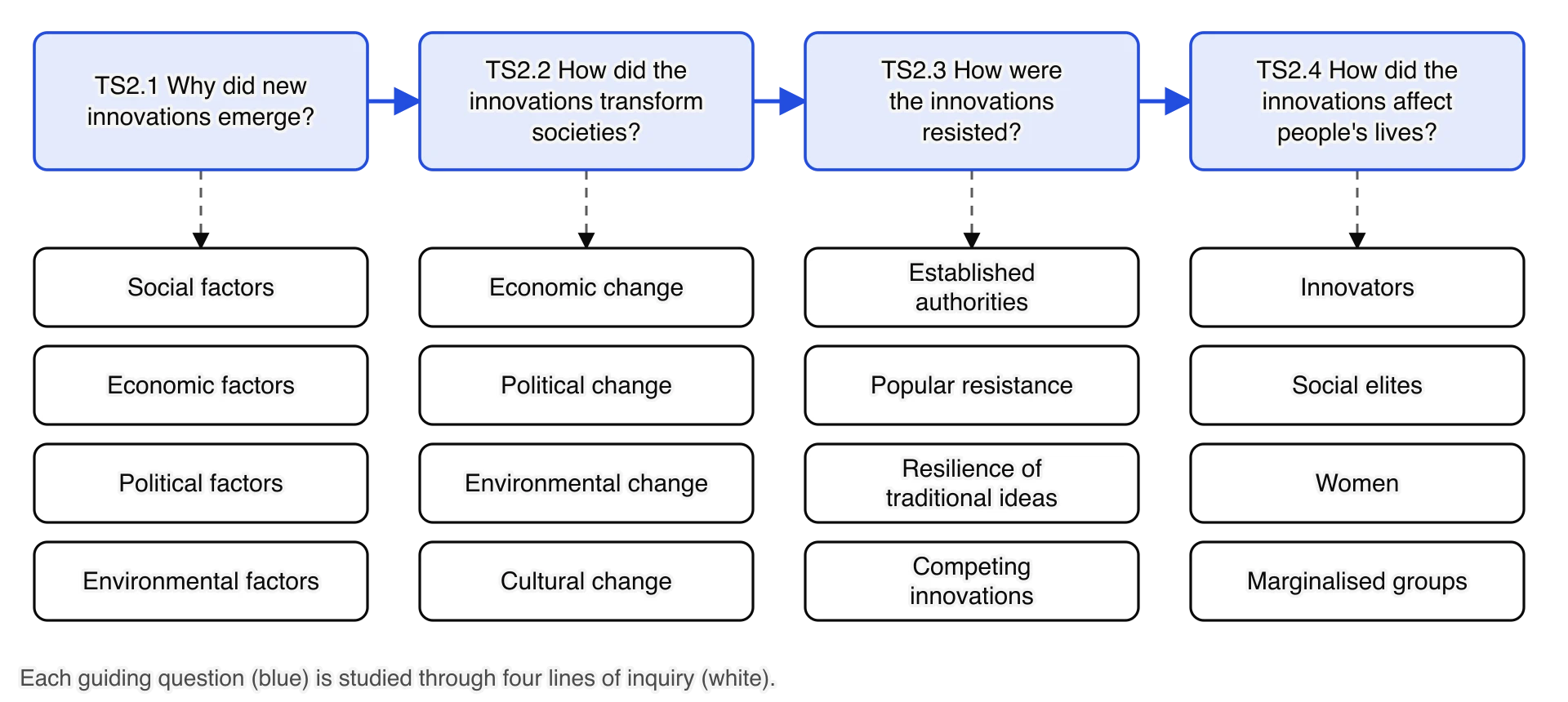
The questions overlap in practice. The factors that made an innovation emerge often shaped how far it transformed society; resistance could slow, redirect or limit its spread; and its effects on particular groups, such as workers who lost their skills or women who found new paid work, were often the cause of that resistance.
The core innovations
There is no fixed list of innovations; any well-evidenced innovation after 750 can be studied. The pages follow six core cases from four regions, with shorter examples from others. The table of the core innovations lists them.
Innovation | Region | What it shows |
|---|---|---|
Paper and the translation movement in Abbasid Baghdad (c. 750–1000) | Africa and the Middle East | Borrowing a technology from China and using it to store and spread learning |
Song China (960–1279) | Asia and Oceania | A cluster of innovations: printing, paper money, iron and new rice farming |
The printing press in Europe (c. 1450–1600) | Europe | How a new medium changed religion and politics |
The Industrial Revolution in Britain (c. 1760–1850) | Europe | Transformation of an economy and society in every dimension at once |
The Green Revolution in Mexico and India (c. 1943–1980) | The Americas; Asia and Oceania | New seeds that ended famine fears, with uneven gains and long-term costs |
Mobile money (M-Pesa) in Kenya (from 2007) | Africa and the Middle East | A recent innovation that brought banking to people without bank accounts |
Big ideas that run through the thematic study
Innovations emerged when a need or an opportunity met the knowledge, materials, skills and money to meet it. Most were borrowed and adapted: paper travelled from China to Baghdad and then to Europe, and the high-yielding wheat of the Green Revolution was bred from a Japanese dwarf variety. Explanations that credit a single genius, or that treat innovation as a European achievement, leave out much of the evidence. Historians weigh the factors differently: Robert Allen stresses wages and energy prices in the Industrial Revolution, Joel Mokyr ideas and knowledge, and Kenneth Pomeranz coal and colonies.
An innovation transformed a society only when it was widely adopted. Economic change usually came first and is easiest to measure; political change could run in both directions, strengthening states or giving new groups the means to challenge them; environmental change was often unintended and recognised late; and cultural change came through new ways of storing knowledge and new rhythms of daily life. Change came alongside continuity, and its pace and extent are debated, as in the arguments over how revolutionary the Industrial Revolution and the printing press really were.
Every major innovation met resistance, because every innovation created losers as well as winners. Rulers, churches and guilds used bans, censorship and regulation, often trying to control an innovation more than to destroy it; workers broke machines, petitioned and protested; traditional ideas and older technologies proved resilient. The final guiding question asks "for whom?": the same machine or seed could enrich one group and harm another, and the experiences of innovators, elites, women and marginalised groups often differed sharply from the general picture.
How the thematic study is studied and examined
All students, at SL and HL, take one of four thematic studies: Conflict, Innovation and transformation (both from 750 CE), Authoritarian rule and Popular movements (both from 1750). The thematic study takes about 80 teaching hours. Teachers choose the examples, which may include recent ones, and the Part B essay needs examples from at least two of the four regions (Africa and the Middle East; the Americas; Asia and Oceania; Europe), so students prepare examples from more than one. The study builds skill in making connections and comparisons between different examples.
The thematic study is assessed by Paper 2 (1 hour 45 minutes, 25 marks; 40 per cent of the SL grade and 25 per cent of the HL grade), the same paper at SL and HL. Section A sets two questions on the historical concepts, of which students answer one (6 marks), using one example from their thematic study. Section B sets two questions on each thematic study; students choose one and answer both parts. Part A asks students to explain how or why something happened, using one example (4 marks). Part B is an essay that begins "To what extent …?" and asks for examples from at least two different innovations in at least two regions (15 marks).
Carry on with TS2 in Augment
With a free account, Augment remembers where you stopped and what you have practiced.