Notes on TS2.3 How were the innovations resisted?
An innovation changes who has skills, wealth, authority and status, so it almost always provokes resistance to innovation. Studying who resisted, how and with what results shows the costs of innovations that later generations took for granted, and explains why the same technology spread quickly in one society and slowly in another.
Resistance to innovation: who, why, how and with what result
Resistance to innovation is any action that opposes, slows, limits or redirects the adoption of something new. It can come from the top of society or from the bottom, and it can be loud (a riot, a ban) or silent (people simply carrying on as before). Historians analyse it with four questions: who resisted, why, by what means, and with what outcome.

The timeline of resistance shows that no period or region was free of it. Caliphs and Muslim scholars clashed over the new learning in ninth-century Baghdad; Song officials fought over state finance in the eleventh century; churches and governments censored printing in early modern Europe; workers broke machines in industrial England; and twentieth- and twenty-first-century critics, banks and governments resisted new seeds, new payment systems and the internet.
Who resisted, and why
The most common motive was threatened interest. An innovation that made a skill unnecessary or a product cheaper hurt the people who lived by the old method: scribes and copyists when printing arrived, hand croppers and stocking knitters when machines came, banks when a phone company began to move money. Economists call these groups vested interests, and the economic historian Joel Mokyr argues in The Lever of Riches (1990) that their resistance is one of the main reasons technological progress in any society tends to slow down over time.
Interest was rarely the only motive. Rulers and churches feared that new ideas and new media would spread heresy or sedition. Religious and moral objections ran deep: a new practice could be seen as an unlawful bid‘a (innovation in religion) in Islamic thought, or as a threat to the moral order in Confucian China. From the nineteenth century, health and environmental fears became more important, as in the opposition to compulsory vaccination and to pesticides. Finally, innovations that arrived with foreign merchants or colonial rulers, such as railways in Qing China, could be resisted as symbols of outside domination.

The framework of motives, methods and outcomes shows that a single case usually fits several boxes at once. The Luddites were defending wages and status (interest), used machine-breaking and threatening letters (violence), and appealed to old laws and customs that protected their trades (tradition). Analysing a case in this way avoids the trap of treating resisters as either villains or heroes.
Outcomes: defeated, delayed, adapted or successful
Resistance seldom stopped an innovation completely. Four outcomes are more useful than "success" or "failure". Resistance could be defeated, as when the British state crushed the Luddites. It could delay an innovation, as the threshing machine was delayed in parts of southern England after 1830. It could force an innovation to be adapted or controlled, as when European censorship shaped what printers could publish. It could also be successful, as when Qing officials bought and dismantled the first railway in China in 1877, or when local protesters stopped a nuclear power station being built at Wyhl in West Germany in 1975.
Resistance is also evidence of significance, since people rarely rioted against trivial changes. The violence of the Luddites, the elaborate machinery of the Index of Forbidden Books and the lobbying of Kenyan banks all show that contemporaries understood how much the innovations threatened to change.
Resistance from established authorities
Established authorities are the people and institutions that already held power when an innovation appeared: rulers and their officials, churches and religious scholars, guilds and professional bodies, and, in modern economies, large companies and banks. Their resistance is usually the most effective kind, because they control law, money and force. It is also the most likely to be disguised as protection of the public: censors claimed to protect souls, regulators to protect savers, governments to protect order.
Authorities resisted in three main ways. They could ban an innovation outright. They could control it through licences, monopolies, censorship and taxes, so that it spread only in forms they approved. Or they could lobby and litigate against it, using their influence over governments and courts. In practice control was far more common than banning, because most rulers saw that an innovation could also serve them.
Controlling the press in Europe, 1470s–1690s
Printing with movable metal type spread from Mainz after about 1450 and reached more than 250 European towns by 1500. The Catholic Church was one of its first and biggest customers: the earliest dated printed documents from Gutenberg's workshop include letters of indulgence printed in 1454–1455, and churches ordered printed missals, breviaries and catechisms in large numbers. The authorities' concern was never printing as such. It was the loss of control over what was read, and by whom.
Controls began within a generation. In 1485 and 1486 Berthold von Henneberg, archbishop of Mainz, the city where printing began, ordered that German translations of religious and learned works be approved by appointed censors before they could be sold; he argued that translations into the vernacular let uneducated readers misunderstand sacred and learned texts. In 1487 Pope Innocent VIII extended the principle by requiring Church approval before books were printed, and in 1515 the Fifth Lateran Council made pre-publication licensing the rule throughout Catholic Christendom.

The timeline of the control of printing shows how the Reformation changed the scale of the problem. After Martin Luther's challenge to the Church in 1517, which began the Reformation, printed pamphlets and woodcuts carried Protestant arguments across the Holy Roman Empire within months. The Edict of Worms (1521) banned Luther's writings throughout the Empire, but the Empire was divided among hundreds of rulers and free cities, and printers in Protestant territories simply ignored it. In France, after Protestant placards attacking the Catholic Mass were posted in Paris and other towns in October 1534 and again in January 1535, Francis I briefly banned all printing in the kingdom, a measure that could not be enforced and was soon replaced by the licensing of printers.
Punishment of individual printers made the risks clear. Étienne Dolet, a scholar and printer in Lyon who published a French New Testament and other works the Sorbonne theologians considered heretical, was condemned by the Parlement of Paris for blasphemy and sedition and was hanged and burned with his books in the Place Maubert in Paris on 3 August 1546.
The Index of Forbidden Books
The Counter-Reformation, the Catholic Church's effort to reform itself and win back ground from Protestantism, produced the most systematic response. In 1559 Pope Paul IV issued the first Roman Index of Forbidden Books (Index Librorum Prohibitorum), which banned the entire works of some 550 authors as well as individual titles. Catholics were forbidden to print, sell, own or read the listed books. The Pauline Index was so severe that it met opposition even among Catholic scholars, and after the Council of Trent a revised and more workable version, the Tridentine Index, appeared in 1564 with general rules for censors. From 1571 a permanent Congregation of the Index in Rome updated the list.

The Index lasted far longer than the crisis that produced it. Copernicus's On the Revolutions of the Heavenly Spheres was suspended "until corrected" in 1616; Kepler, Descartes, Pascal, Montesquieu, Voltaire, Rousseau and Kant were among the authors listed over the following centuries. The last edition, of 1948, contained about 4,000 titles, and the Index lost its force of Church law only in 1966. Its effect varied greatly from place to place: it was enforced by the Inquisition in Spain and the Italian states, but had little force in Protestant Europe, where books banned in Rome were often printed and sold more readily because of the publicity.
Licensing and monopoly in England
Protestant states controlled print too. In England, Mary I granted a royal charter to the Stationers' Company of London in 1557, giving its members a monopoly of printing and the duty to search out unlicensed presses. The arrangement suited both sides: the crown gained a policing body for the book trade, and established printers gained protection from competition. After the civil wars the Licensing of the Press Act of 1662 required every book to be approved by an official licenser before printing.
Licensing provoked its own resistance. In 1644, during the civil war, the poet John Milton published Areopagitica, an appeal to Parliament against pre-publication licensing.
as good almost kill a Man as kill a good Book; who kills a Man kills a reasonable creature, Gods Image; but hee who destroyes a good Booke, kills reason it selfe, kills the Image of God, as it were in the eye.
John Milton, Areopagitica: A Speech for the Liberty of Unlicenc'd Printing, pamphlet, 1644 (original spelling). Milton wrote as a Protestant who had himself published without a licence, and his argument was limited: he did not defend toleration for Catholic books. Even so, the passage shows that by the 1640s some English writers treated the free circulation of print as a value in its own right, a view that helped persuade Parliament to let the Licensing Act lapse in 1695.
The European experience shows the limits of authority. Censorship made printing riskier and shaped what appeared in Catholic lands, but it could not stop the spread of the press, because Europe was politically divided: a book banned in Paris or Rome could be printed in Geneva, Amsterdam or London and smuggled back.
The Ottoman Empire and printing in Arabic script, 1493–1727
The Ottoman Empire offers a sharp contrast. Printing was known in Istanbul within half a century of Gutenberg. Jewish refugees from Spain had a Hebrew press working in the city by about 1493 or soon after; Armenian printing began there in 1567 and a Greek press opened in 1627, although Janissaries destroyed it in 1628. Sultan Murad III allowed the sale of Arabic-script books printed in Europe in 1588. Yet no Muslim-owned press printing Ottoman Turkish or Arabic operated until İbrahim Müteferrika received permission in 1727.

The chain of Ottoman printing shows that the delay was not ignorance of the technology. The question is why the Muslim majority did not adopt something its non-Muslim neighbours in the same city were already using. For a long time European writers had a simple answer: the sultans banned it. Reports that Bayezid II, in the 1480s, and Selim I, in 1515, prohibited printing in Arabic script on pain of death appear in many later books.
Recent research has weakened this answer. In "Did Ottoman Sultans Ban Print?" (Book History, 2017), the historian Kathryn Schwartz shows that no such decrees survive and that the story first appears in a book of 1584 by the French cosmographer André Thevet, who offered no evidence for it, repeated by later Europeans who wanted to explain what they saw as Ottoman backwardness. She does not deny that the Ottomans were slow to print; she denies that an imperial ban explains it.
Müteferrika's press
İbrahim Müteferrika was a Hungarian-born convert to Islam who served at the Ottoman court. In a treatise presented in 1726 he argued that printing would preserve books lost through war and decay, make learning cheaper and more accurate, and help the empire match its Christian rivals. He needed two kinds of approval, which shows where authority over the innovation lay. The chief religious official, the şeyhülislam Yenişehirli Abdullah Efendi, issued a fatwa (legal opinion) that printing was permissible, and Sultan Ahmed III issued a ferman (imperial decree) in 1727 licensing the press.
The licence came with a condition: the press could not print the Qur'an, hadith, Qur'anic commentary, Islamic law or theology. It printed dictionaries, histories, geography and works on science and navigation. Between 1729 and 1742 it produced 17 titles, in total perhaps 12,000 to 13,000 copies, and after Müteferrika's death in 1745 it printed only occasionally. Manuscripts remained the normal form of the book in the Ottoman world until printing spread through state and private presses in the nineteenth century.
Several explanations now compete. The exclusion of religious texts suggests that religious scholars were uneasy about printing sacred words with a mechanical process that could introduce errors. Calligraphers and copyists, who were numerous and respected in Istanbul, had an economic interest in the manuscript trade, and the ferman itself took account of them. Many historians stress demand: Ottoman readers valued beautifully written manuscripts, Arabic script with its many joined letter forms was harder and costlier to set in type, and the market for Müteferrika's books proved small. These explanations belong partly to resistance from authorities and partly to the resilience of tradition, which is why the case is so useful for comparison.
 YouTube
Song China: officials against the New Policies, 1069–1086
Some innovations were institutional rather than technical. In Song China, the reforming chief minister Wang Anshi persuaded Emperor Shenzong in 1069 to launch the New Policies, a programme that used the state's growing financial machinery in new ways. The best known, the green sprouts loans, lent money or seed to farmers in spring for repayment after harvest, so that peasants would not fall into debt to private moneylenders. Other measures set up state trading offices to buy and sell goods, replaced labour service with a cash tax, resurveyed land for taxation and organised villages into local militia (baojia).
The resistance came from within the ruling elite. Conservative officials led by the historian Sima Guang argued that the state should not compete with its subjects for profit, that the loans were forced on farmers by officials paid by results, and that the reforms broke with the practice of earlier dynasties. Sima Guang's ideal was a stable, hierarchical agrarian order in which local landowning families, not the state, supported society. When a famine in northern China in 1074 drove indebted farmers off their land, opponents blamed the reforms, and Wang Anshi resigned in 1074; he returned in 1075 but left office for good in 1076.
Reformers (Wang Anshi) | Conservatives (Sima Guang) | |
|---|---|---|
View of the state | An active state should manage the economy and raise revenue for defence | The state should govern by moral example and leave wealth with the people and local elites |
View of commerce | Markets and credit can be used by the state for public ends | Commerce encourages greed and social change; agriculture is the foundation |
Authority claimed | The ancient classics, reinterpreted | The practice of past dynasties and history |
Methods used | Imperial backing, new offices, demotion of critics | Memorials to the throne, factional alliances, repeal when in power |
The table of the two factions shows that this was a struggle between rival visions of government more than a simple clash of old and new. After Shenzong's death in 1085, the regent, Empress Dowager Gao, recalled Sima Guang, who repealed most of the New Policies in 1085–1086 before his own death in 1086. The reformers returned to power under Emperor Zhezong from 1094, after the empress dowager's death, and the factional struggle continued until the fall of the Northern Song in 1127. Resistance by authorities here produced a cycle of repeal and revival, not a final victory for either side.
Song paper money also met resistance, though more from users than from officials. After the state took over the Sichuan merchants' jiaozi notes in 1023–1024, governments printed more notes than they could redeem, especially to pay armies, and the notes repeatedly lost value. People who had been paid in depreciated paper learned to prefer copper coin and silver. The Ming dynasty issued paper notes from 1375 but could not keep their value, and by the middle of the fifteenth century silver and coin had replaced them in everyday trade.
The Song state also limited the spread of printed knowledge that it considered dangerous. It repeatedly forbade merchants to carry books across the border to the rival Khitan Liao state, for fear of giving away information about government and defence, and it restricted the private printing of calendars and works on military matters. Like the Church in Europe later, the Song authorities were heavy users of print who tried to control what it carried, not to suppress the technology.
Qing China and the Wusong railway, 1876–1877
In Asia during the nineteenth century, resistance from authorities often mixed economic and political fears with anger at foreign power. The British trading firm Jardine, Matheson and Company built China's first working railway, a short line from Shanghai to Wusong, in 1876 without the permission of the Qing government. Chinese officials had long listed objections to railways: they would help foreign armies penetrate the interior, take farmland, offend fengshui (the principles governing the harmony of buildings and land), and destroy the livelihoods of boatmen and porters on the canals.
When a man was killed by a train in August 1876, opposition hardened. After negotiations the Qing government agreed to buy the line for 285,000 taels, and in 1877, once it had paid, the viceroy Shen Baozhen had the track torn up. China did not build another line at Wusong for twenty years. Later writers often cited the episode as proof of Qing backwardness, but the line had been built illegally, and officials' objections to railways controlled by foreigners were political as well as cultural.
Kenya: banks against M-Pesa, 2008
Resistance from established interests continues in modern economies. M-Pesa, the mobile money service launched by Safaricom in March 2007, let Kenyans store and send money by text message through a network of shopkeepers acting as agents. Within two years this mobile money service had millions of users, most of whom had never had a bank account. In December 2008 a group of Kenyan banks lobbied the government to investigate the service. They argued that a phone company was taking deposits without being regulated as a bank, which could put customers' money at risk.
The acting finance minister, John Michuki, ordered an audit of M-Pesa. The Central Bank of Kenya, which had allowed the service to start under a cautious "test and learn" approach, defended it publicly, and the audit found the system sound. The banks' campaign failed, and by the end of 2011 M-Pesa had about 14 million registered users in Kenya, more than three-quarters of Safaricom's customers. The banks then changed strategy, turning from resistance to competition and co-operation: from 2010 they were allowed to use shops as agents themselves, and several formed partnerships with Safaricom, such as the M-Shwari savings and loans service launched with the Commercial Bank of Africa (now NCBA) in 2012.
Governments have also resisted digital communication directly. During the uprising against President Hosni Mubarak, the Egyptian government ordered internet service providers to cut almost all internet access on the night of 27–28 January 2011; access returned on 2 February. China has built the most elaborate system of control, the "Great Firewall", developed from 1998 to block foreign websites and filter content. Like the censors of the sixteenth century, these authorities did not reject the technology itself, which they use heavily, but tried to control what it carried.
Comparing resistance by authorities
The cases show a pattern. Authorities that were also major users of an innovation, such as the Catholic Church with printing or the Chinese state with the internet, tried to control its content. Authorities whose power or income depended on the old way, such as the Kenyan banks, tried to regulate or restrict the newcomer. Authorities that saw an innovation as foreign, such as Qing officials facing a British railway, were the most likely to block it outright. In every case the decisive question was whether the authority could enforce its will over the whole territory where the innovation might spread. Divided Europe could not stop printing, while a centralised empire such as the Ottoman state, or a single regulator such as Kenya's Central Bank, could decide the terms of adoption.
Forms of popular resistance
Popular resistance is resistance by ordinary people, usually those whose work, health or way of life an innovation directly affected. They lacked the legal powers of authorities, so they used the means they had: collective action in the form of riots, machine-breaking, strikes, threatening letters, petitions, demonstrations, boycotts and, most commonly of all, the refusal to adopt. The form chosen depended on what had worked before, on whether peaceful channels such as Parliament or the courts were open, and on how organised the resisters were.
Form | What it involved | Examples |
|---|---|---|
Machine-breaking and sabotage | Destroying the new machines or the buildings that housed them | Luddites, 1811–1816; Swing Riots, 1830 |
Riots and street protest | Crowds confronting authorities, sometimes with barricades | Revolta da Vacina, Rio de Janeiro, 1904 |
Threatening letters | Anonymous warnings to employers or officials | "Ned Ludd" letters, 1812; "Captain Swing" letters, 1830 |
Petitions and lobbying | Appeals to rulers or parliaments for protection | Handloom weavers' petitions to Parliament, 1800s–1830s |
Mass demonstrations and occupations | Peaceful but disruptive gatherings | Leicester anti-vaccination demonstration, 1885; Wyhl site occupation, 1975 |
Boycotts and symbolic rejection | Refusing to buy the product of an innovation | Gandhi's boycott of machine-made foreign cloth, 1920s |
Non-adoption | Quietly continuing old methods | Farmers keeping local rice and millet varieties |
The Luddites, 1811–1816
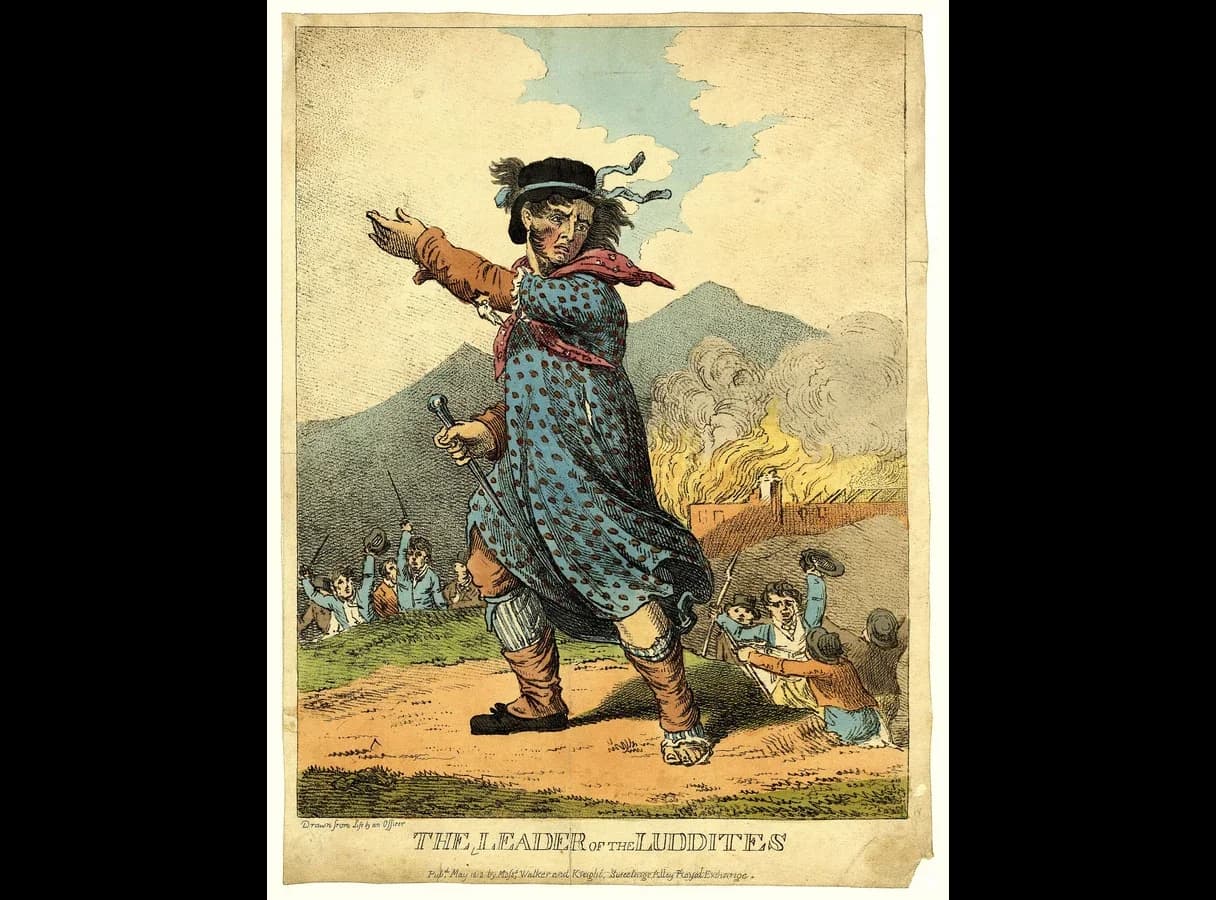
The Luddites were textile workers in the English Midlands and North who broke machines and threatened employers between 1811 and 1816. They took their name from "Ned Ludd" (also "General" or "King Ludd"), a legendary apprentice said to have smashed a knitting frame; letters signed in his name gave the movement an imaginary leader whom no magistrate could arrest. Their resistance had three regional strands, each aimed at a particular innovation that threatened a particular trade.
Nottinghamshire and the East Midlands, from late 1811: framework knitters (stockingers) broke the wide stocking frames used to make cheap "cut-ups", and frames belonging to hosiers who paid below the agreed rates. Their target was less the machine itself than its use to undercut wages and quality.
The West Riding of Yorkshire, from early 1812: skilled cloth finishers called croppers, who sheared the nap of woollen cloth by hand, attacked the shearing frames and gig mills that could do their work with a fraction of the labour. For them the machine did threaten the trade itself.
Lancashire and Cheshire, spring 1812: weavers and others attacked steam-powered looms and the mills that housed them, often during food riots and with more openly political demands.
The croppers' threatening letters show how they understood their actions. This one was sent in 1812 to Mr Smith, a master cloth dresser in the West Riding who had installed the new machinery.
Information has just been given to me that you are the holder of those detestable Shearing Frames, and I was desired by my Men to write to you and give you fair Warning to pull them down … you will take Notice that if they are not taken down by the end of next Week, I will detach one of my Lieutenants with at least 300 Men to destroy them
Letter signed "Ned Ludd Clerk" for "the General of the Army of Redressers", to Mr Smith, shearing frame holder, Hill End, Yorkshire, 1812, as printed in Kevin Binfield (ed.), Writings of the Luddites (2004). The writer uses the language of an army and of "fair warning", presenting machine-breaking as a disciplined, legitimate act of redress rather than a riot. The threat was real, but the letter also shows a negotiation: the owner was invited to remove the frames himself.

The timeline of the disturbances shows how quickly the state escalated its response. Parliament passed the Frame Breaking Act in March 1812, which made the destruction of stocking frames a capital crime. In April 1812 the croppers' attack on William Cartwright's mill at Rawfolds, which the owner had fortified and garrisoned with soldiers, was beaten off with gunfire, and two wounded attackers died. Later that month a group of croppers shot William Horsfall, a mill owner who had boasted of his determination to use the machines. By May more than 12,000 troops were stationed in the disturbed districts. At a special assize at York in January 1813, 17 men were hanged, including the three convicted of Horsfall's murder.
In the debate on the Frame Breaking Bill, the young poet Lord Byron used his first speech in the House of Lords to oppose the death penalty for frame-breaking.
How will you carry the Bill into effect? Can you commit a whole county to their own prisons? Will you erect a gibbet in every field and hang up men like scarecrows? … Are these the remedies for a starving and desperate populace?
Lord Byron, maiden speech in the House of Lords on the Frame-Work Bill, 27 February 1812, as recorded in Hansard. Byron owned land in Nottinghamshire and spoke as an opposition Whig attacking the government, so the speech is partly a political performance. It shows that some members of the elite saw the Luddites as victims of wartime distress, but it changed nothing: the bill passed by a large majority.
Why the Luddites failed
Machine-breaking had sometimes worked in the eighteenth century, when employers in small workshops could be pressured into keeping old rates. By 1812 it faced three obstacles. The machines were spreading through larger, fortified mills whose owners could afford defence. The government, at war with France and fearful of revolution, treated the disturbances as a threat to order and responded with troops, spies and hangings. Most importantly, Parliament had in 1809 repealed the old laws that had protected the woollen trades, so the croppers had lost the legal route to protection. Machine-breaking delayed the introduction of shearing frames in some districts, but by the 1820s the hand cropper's trade had largely disappeared.
 YouTube
The Swing Riots, 1830
Popular resistance moved from the textile towns to the countryside in 1830. Beginning in east Kent in the summer, farm labourers across southern and eastern England destroyed threshing machines, horse- or water-powered machines that separated grain from straw and so took away winter work that labourers had done by hand with flails. They also burned ricks and demanded higher wages and lower tithes. Threatening letters were signed by a mythical "Captain Swing".
The labourers' grievance was about more than the machine. Enclosure had taken away common land, wages had fallen after the end of the Napoleonic Wars, and poor relief was being cut. The threshing machine was the most visible symbol of a rural economy that no longer guaranteed them a living, which is why the riots were fiercest where other work was scarce.

The chart of punishments shows the scale of the state's response. Special commissions sentenced hundreds to death, though most sentences were commuted; 19 people were executed, 505 transported to the Australian penal colonies and 644 imprisoned. In the short term some farmers raised wages and put their machines away, and Eric Hobsbawm and George Rudé argue in Captain Swing (1969) that the threshing machine returned only slowly to the worst-affected counties. In the longer term the riots were defeated: mechanisation continued, and the New Poor Law of 1834 made relief harsher.
Machine-breaking was not the only working-class response to industrial innovation. The Combination Acts of 1799 and 1800 made trade unions illegal, which helps explain why the Luddites organised in secret; after their repeal in 1824 workers increasingly turned to unions, strikes and petitions. Handloom weavers, whose earnings collapsed as power looms spread, petitioned Parliament for minimum wages and protection, and a select committee heard their case in 1834–1835 without granting it. From the late 1830s many former machine-breakers and weavers joined Chartism, which sought the vote as the way to make Parliament protect workers from the effects of the new machines.
Resisting compulsory vaccination: England and Brazil
Vaccination against smallpox, introduced by Edward Jenner in 1796, shows popular resistance to an innovation imposed by the state for public health. Once governments made it compulsory, resistance focused as much on compulsion as on the vaccine. In England the Vaccination Act of 1853 required parents to have infants vaccinated, and later acts added repeated fines for refusal. An organised anti-vaccination movement grew from the 1860s, drawing on working-class distrust of state interference, religious objections and real fears about infection from the arm-to-arm method then used. Leicester became its centre: by the 1880s most parents there refused vaccination, and a mass demonstration was held in the town in 1885. Parliament gave way partly in 1898, when a "conscience clause" allowed parents to claim exemption.
In Brazil the same innovation provoked an uprising. In 1904 the government of President Rodrigues Alves, which was rebuilding Rio de Janeiro and fighting yellow fever, plague and smallpox under the public health director Oswaldo Cruz, passed a law on 31 October making smallpox vaccination compulsory. When regulations requiring vaccination certificates for school, jobs, travel, marriage and voting were published on 9 November, the Revolta da Vacina (Vaccine Revolt) broke out. For a week crowds fought police, burned trams and built barricades in the poor districts of the city, and a group of army officers used the unrest to attempt a coup.
The government suspended compulsory vaccination on 16 November and then crushed the revolt: about 30 people were killed, 945 arrested and 461 deported to the remote territory of Acre. Historians such as Jeffrey Needell (1987) argue that the revolt was less about the vaccine than about a modernising state that had demolished poor people's housing for new avenues and now sent health brigades into their homes. The episode shows that popular resistance could win a concession on the innovation (compulsion was dropped) while losing the wider confrontation; Rio suffered a severe smallpox epidemic in 1908.
Boycotts and protest in the twentieth century
Popular resistance did not have to be violent. In colonial India, Mohandas Gandhi turned the rejection of an industrial product into a mass political movement. From the Non-Cooperation campaign of 1920–1922, Indian nationalists boycotted machine-made cloth imported from Britain, burned foreign cloth in public bonfires and promoted khadi, cloth hand-spun and hand-woven in India, as part of swadeshi ("of one's own country"). Gandhi made the spinning wheel (charkha) the symbol of the national movement and required members of the Indian National Congress to spin. This was resistance less to machinery as such than to an industrial system that, in nationalist eyes, had ruined Indian handloom weavers and served British power.
Mass non-violent protest also stopped a modern technology. In February 1975 farmers and wine-growers occupied the site of a planned nuclear power station at Wyhl, in south-west West Germany. Television pictures of police dragging protesters through the mud won them wide sympathy; about 30,000 people reoccupied the site, a court withdrew the construction licence in March 1975, and the plant was never built. The success at Wyhl inspired anti-nuclear groups across Europe and North America and contributed to the rise of the Green Party in West Germany.
Comparing these forms shows how resistance changed. Machine-breaking was the tactic of workers with no vote and no legal protection; by the twentieth century resisters had mass media, parties and courts, and they increasingly argued in terms of national independence, health, safety and the environment rather than the defence of a single trade.
The resilience of traditional ideas
Traditional ideas are beliefs, values, customs and forms of knowledge inherited from the past: religious doctrines, moral codes, ideals of social order, craft standards and local knowledge of farming or healing. They can obstruct an innovation directly, by making it seem wrong, impious or dangerous. More often they simply survive alongside it, so that the old way of doing things persists for generations after the new one appears. Historians call this resilience: the capacity of traditions to adapt and endure under pressure, not just to resist.
Resilience is a question of continuity and change. It is easy to tell the story of an innovation as a clean break, from manuscript to print or from flail to machine. In practice old and new coexisted for long periods, and the persistence of the old often had good reasons: it was cheaper in some settings, carried more prestige, or fitted religious and social values better.
Religious scholarship and the new learning in Abbasid Baghdad
Paper itself met little resistance in the Islamic world. After the first paper mill was set up in Baghdad in the 790s, Abbasid officials adopted it quickly for government records, and booksellers and scholars followed. The resistance that historians examine in Abbasid Baghdad was to the ideas that paper helped to spread: the Greek philosophy and science translated into Arabic under caliphs such as al-Ma'mun (r. 813–833), and the rationalist theology that drew on them.
In 833 al-Ma'mun began the mihna ("trial" or "ordeal"), an inquisition that required judges and religious scholars to declare publicly that the Qur'an was created, a doctrine of the rationalist Mu'tazila school, rather than the eternal, uncreated word of God. Scholars who refused could lose their posts or be imprisoned. The most famous refuser was the Baghdad scholar of hadith Ahmad ibn Hanbal, who was imprisoned and flogged under al-Ma'mun's successor al-Mu'tasim. He was released after the flogging; some accounts say the authorities feared unrest among the people of Baghdad, who supported him. The mihna continued fitfully until the caliph al-Mutawakkil abandoned it around 848 and ended the debate by about 851.
The mihna was an attempt by an established authority, the caliph, to impose a new doctrine, and it was defeated by the resilience of a traditional one. Ibn Hanbal became a hero to ordinary Muslims and gave his name to one of the four Sunni schools of law. Historians disagree about how far the mihna was about the new learning at all. Some, following the caliphs' own letters, stress al-Ma'mun's wish to make the caliph, not the scholars, the final authority on religion; others link it to the prestige of Greek-inspired reasoning at his court. Either way, its outcome limited the political influence of rationalist theology.
The tension between falsafa (philosophy in the Greek tradition) and religious scholarship continued. In The Incoherence of the Philosophers (c.1095), the theologian al-Ghazali argued that the philosophers, following Aristotle, held some views that contradicted Islam, such as the eternity of the world. The Andalusian philosopher Ibn Rushd (Averroes) replied in The Incoherence of the Incoherence (c.1180). The debate shows tradition responding to new learning by argument, not by banning it: al-Ghazali used logic, itself a product of the translation movement, to attack the philosophers.
Older forms of the book also survived. Copyists of the Qur'an continued to use parchment for about two centuries after paper became common for other texts, because parchment carried prestige and religious dignity. Oral transmission remained central to learning: a scholar's authority rested on having heard a text from a teacher in a chain of transmission, not merely on having read it, and this habit of mind later helped make print seem unnecessary to some Muslim scholars.
Scribes and manuscript culture in Europe
In Europe, printing threatened a whole profession. Professional scribes, illuminators and monastic copyists had produced books by hand for centuries, and some reacted with alarm. In 1473–1474, Filippo de Strata, a friar and scribe at the convent of San Cipriano on Murano, near Venice, addressed a Latin poem to the doge Nicolò Marcello asking him to suppress the printers, who had arrived in the city only a few years before. It is the best-known written protest by a scribe against printing.
They shamelessly print, at a negligible price, material which may, alas, inflame impressionable youths, while a true writer dies of hunger. … Writing indeed, which brings in gold for us, should be respected and held to be nobler than all goods, unless she has suffered degradation in the brothel of the printing presses. She is a maiden with a pen, a harlot in print.
Filippo de Strata, Polemic against Printing, addressed to Doge Nicolò Marcello of Venice, 1473–1474, translated by Shelagh Grier (1986). De Strata wrote as a scribe whose income was threatened, so the moral argument about corrupted youth is mixed with an economic one about cheap books and hungry writers. His appeal to the doge was ignored, and Venice became the largest centre of printing in Europe by 1500.
Manuscript culture did not vanish. Scribes adapted by copying luxury books, legal documents and works too specialised to print. Among elites in England and elsewhere, poems, political papers and newsletters circulated in handwritten copies well into the seventeenth century, a practice historians call scribal publication. Handwriting allowed writers to control who read their work and to avoid the censors, so in an age of licensing the "old" technology could be the safer one.
Moral critics of the factory system in Britain
In industrial Britain, older religious and moral ideals produced a critique of mechanised work itself. The poet William Blake contrasted England's "green and pleasant land" with its "dark Satanic Mills" in the verses that preface his poem Milton (c.1804–1810). The essayist Thomas Carlyle, in "Signs of the Times" (1829), called his era "the Mechanical Age" and argued that the habits of machinery were reshaping minds and institutions as well as work. Later, the art critic John Ruskin argued in Unto This Last (1860) that an economy should be judged by the quality of the lives it produced, not by the wealth it accumulated.
These writers stopped no machine, but their ideas fed campaigns that limited how machines were used. Factory reformers such as Richard Oastler and Lord Ashley (later the Earl of Shaftesbury) drew on Tory paternalism and evangelical Christianity, the old ideal that the powerful had duties to the weak, to demand limits on child labour in the mills. The Factory Act of 1833, whose effects on children's lives are a story of their own, was a product of this campaign. It shows resistance adapting an innovation rather than reversing it: the factory survived, but on terms set partly by traditional moral ideas.
Local knowledge against the Green Revolution
The Green Revolution, the spread from the 1960s of high-yielding varieties of wheat and rice grown with chemical fertiliser, pesticides and irrigation, was resisted less by protest than by criticism and by farmers' choices. Many farmers adopted the new seeds rapidly where they had irrigation and credit. Others, especially smallholders on rainfed land, kept their local varieties, which needed fewer purchased inputs, tolerated drought better and suited local tastes and religious uses. Early varieties such as IR8 rice yielded heavily but were widely disliked for their cooking quality.

The diagram of critics and responses shows how resistance developed. Environmental critics drew on Rachel Carson's Silent Spring (1962), which warned of the effects of pesticides such as DDT on wildlife and people, and later pointed to falling water tables and declining soils in intensively farmed regions such as Punjab. Social critics argued that the benefits went mainly to larger farmers who could afford irrigation and fertiliser; in Mexico, the social scientist Cynthia Hewitt de Alcántara showed in Modernizing Mexican Agriculture (1976) that the programme served commercial farms in the irrigated north-west far more than the small ejido farmers of the centre and south. Political critics saw dependence on American foundations, aid and, later, seed and chemical companies.
In India, the uneven gains sharpened rural conflict. A 1969 report by India's Ministry of Home Affairs on the causes of agrarian tension warned that the new technology was widening the gap between larger farmers and landless labourers, in the same years as the Maoist Naxalite rising that began at Naxalbari in West Bengal in 1967. The Naxalites fought over land and wages rather than seeds, but the left-wing critique of the Green Revolution drew on the same grievances: smallholders and labourers bore the risks of costly inputs and debt, while the profits went mainly to those who already held land and water.
The best-known critic, the Indian environmental activist Vandana Shiva, who trained in physics,, argued in The Violence of the Green Revolution (1989; international edition 1991) that the new agriculture had damaged Punjab's soils and water and contributed to the social and political conflict there in the 1980s. Her organisation Navdanya ("nine seeds"), which began saving seed in 1987 and was registered as a trust in 1991, set up community seed banks to preserve traditional varieties and promote organic farming. Supporters of the Green Revolution reply that it averted famine for hundreds of millions of people, and that Shiva underestimates the gains in food supply. The debate itself is a form of resistance: it has shaped later agricultural policy towards more varied crops and less pesticide, without reversing the use of high-yielding seed.
Competing innovations
An innovation does not arrive in an empty field. It competes with older methods that still work and with rival new methods aimed at the same problem. This kind of resistance is often overlooked because it involves no bans or riots, only people choosing something else. Yet it explains many delays better than opposition does. A new technology spread fastest where it was clearly better and cheaper than every alternative, and slowest where an established method was good enough.
Woodblock and movable type in East Asia
The clearest case comes from the core example of Song China. Bi Sheng's movable type of baked clay, made in the 1040s and described by Shen Kuo in his Dream Pool Essays (1088), did not displace woodblock printing. Chinese uses thousands of different characters, so a printer needed a huge stock of type, and a carved woodblock could be stored and reprinted whenever more copies were wanted. For most Chinese books woodblock printing remained cheaper and more flexible until the nineteenth century.
In Korea, printers under the Goryeo dynasty used movable metal type: the Jikji, a Buddhist text printed at Heungdeok Temple in 1377, is the oldest surviving book printed with metal type, 78 years before the Gutenberg Bible. Even there, woodblock editions continued alongside metal type. The comparison with Europe shows that the "resistance" to movable type in East Asia was mainly a rational choice between competing methods suited to different writing systems, not hostility to new technology.
Old power and new power in industrial Britain
In industrial Britain, the steam engine had to compete with the water wheel. The first great cotton mills, such as Richard Arkwright's at Cromford (1771), were water-powered and built beside fast rivers. Water power was cheap where good sites existed, and improved iron water wheels kept it competitive. Steam engines spread fastest where water sites were scarce or towns were growing, and steam became the main source of power in British industry only in the 1830s and 1840s, more than half a century after Watt's first engines.
Transport followed the same pattern. Canal companies, which had earned high profits since the 1760s, fought the first inter-city railway. Their parliamentary opposition, together with that of landowners such as the Earl of Derby, helped defeat the first Liverpool and Manchester Railway bill in 1825; a revised bill passed in 1826, and the line opened in 1830. Canals then cut their charges and kept much of the bulk traffic for decades, until railway companies bought many of them. Here an established interest used both lobbying (resistance from authorities) and price competition (a competing innovation).
The war of the currents in the United States, 1886–1893
In the Americas, the introduction of electric power produced a famous contest between two new systems, known as the war of the currents. Thomas Edison's company had built city lighting networks from 1882 on low-voltage direct current (DC), which could only supply customers within about a mile of a power station. From 1886 George Westinghouse's company promoted alternating current (AC), which could use transformers to send electricity over long distances at high voltage and so supply far more customers from one station.
Edison's side fought back with a campaign claiming that AC was deadly. In 1888 the engineer Harold P. Brown, assisted by Edison's company, publicly killed animals with AC, and Edison's allies made sure that the first electric chair, adopted in New York State, used a Westinghouse AC generator. The campaign failed because AC was cheaper over distance. By 1892 Edison had lost control of his company, which merged with the AC firm Thomson-Houston to form General Electric, and in 1893 Westinghouse won the contracts to light the World's Columbian Exposition in Chicago and, with General Electric, to build the Niagara Falls power project. AC became the standard.
The war of the currents shows that competing innovations could be resisted with the same tactics as entirely new ones: fear campaigns about safety, lobbying for restrictive laws and patent lawsuits. It also shows that the more efficient system usually won once its economic advantage was clear.
Rival methods in agriculture and money
The two most recent core cases also show competition at work. Critics of the Green Revolution have promoted rival approaches, such as organic farming, agroecology and the breeding of improved local varieties, not only a return to the past. Mobile money in Kenya competed with bank branches, informal methods such as handing cash to bus drivers, and rival services such as Airtel Money; the banks' response after 2008 was to build their own agent networks and phone banking. In both cases competition modified the innovation without stopping it.
Comparing resistance across the core cases
The table of the core cases sets out how each innovation was resisted along the four lines of inquiry. Reading across a row shows the mix of resistance in one society; reading down a column shows how one kind of resistance varied between regions and periods.
Innovation (region) | Established authorities | Popular resistance | Traditional ideas | Competing innovations | Outcome |
|---|---|---|---|---|---|
Paper and Abbasid learning, c.750–1000 (Africa and the Middle East) | Caliph imposes rationalist doctrine in the mihna, 833–c.848 | Baghdad crowds support Ibn Hanbal | Traditionalist scholarship; parchment for Qur'ans; oral transmission | Papyrus and parchment for some uses | Paper adopted fast; rationalist doctrine defeated |
Song China, 960–1279 (Asia) | Sima Guang's conservatives repeal the New Policies, 1085–86 | Distrust of over-issued paper notes | Confucian ideal of agrarian order | Woodblock printing outcompetes movable type; coin and silver against paper money | Cycle of repeal and revival; paper money abandoned under the Ming |
Printing press, c.1450–1700 (Europe; Ottoman Empire) | Church censorship, the Index (1559), state licensing; Ottoman licence only in 1727 | Little popular resistance | Scribal culture; Ottoman calligraphy and manuscript prestige | Manuscripts and scribal publication | Europe: spread controlled but not stopped. Ottoman lands: delayed |
British Industrial Revolution, c.1760–1850 (Europe) | Canal owners and landowners oppose railways | Luddites, 1811–16; Swing Riots, 1830 | Customary trade regulation; Romantic critics | Water power against steam; canals against railways | Resistance defeated; some delay |
Green Revolution, c.1943–1980 (Americas and Asia) | Little: governments promoted it | Mainly non-adoption by smallholders |
Three patterns stand out. First, resistance from established authorities was the most effective kind, but only where one authority controlled the whole area into which an innovation could spread. Second, popular resistance was strongest where an innovation destroyed a skilled livelihood quickly and visibly, as in the English textile and farming districts, and weakest where the innovation's costs were spread thinly or arrived slowly. Third, the resilience of tradition and competition from other methods often explain delays better than open opposition does.

The diagram of conditions for successful resistance draws these points together. Resistance succeeded where the resisters held political power (the Qing officials who bought the Wusong railway), where the innovation offered limited gains over existing methods (movable type in China), or where public opinion backed the resisters (Wyhl in 1975). It failed where the innovation was very profitable and its opponents were workers without political power (the Luddites), or where the innovation served the state and a large public at once (vaccination in the long run, M-Pesa).
Continuity and change in resistance
Over twelve centuries the motives for resistance stayed remarkably similar: livelihoods, authority, faith and safety. The methods changed. Before about 1800 the most effective resistance came from rulers and religious authorities, who controlled licensing and censorship. In the nineteenth century, resistance by workers became more visible but was mostly defeated by states committed to industrial growth. In the twentieth and twenty-first centuries, resisters more often worked through courts, the media, elections and scientific argument, and concerns about health and the environment became central.
Perspectives and debates
How resistance to innovation is judged depends heavily on perspective. For contemporaries who gained from an innovation, resisters were obstacles to progress; for those who lost, they were defenders of livelihoods, faith or community. Historians have moved between these views, and the debates turn on three questions: were resisters rational, did resistance matter, and whose story is being told?
Were the Luddites rational?
For much of the nineteenth and early twentieth centuries the Luddites were remembered as ignorant men who smashed machines because they could not understand progress, and "Luddite" is still used as an insult for anyone who dislikes new technology. Two Marxist historians changed this view. In "The Machine Breakers" (Past & Present, 1952), Eric Hobsbawm argued that machine-breaking was a traditional and often effective method of putting pressure on employers, which he called "collective bargaining by riot", and that it was not directed against machines as such.
In The Making of the English Working Class (1963), E. P. Thompson went further. He presented the Luddites as defenders of a moral economy, a set of customary ideas about fair wages, proper workmanship and the protection of trades that had been part of English law and practice, and as an early stage in the making of a working-class consciousness. Thompson set out to rescue such workers "from the enormous condescension of posterity". Later historians such as Malcolm Thomis (The Luddites, 1970) argued that Luddism was mainly a series of local industrial disputes with little revolutionary purpose, while Kevin Binfield (Writings of the Luddites, 2004) and Adrian Randall (Riotous Assemblies, 2006) used the Luddites' own letters to show how differently the movement worked in each region.
Did resistance matter?
Economic historians ask a different question: how far did resistance shape the pace of innovation? Joel Mokyr, in The Lever of Riches (1990), argues that every society contains groups with a stake in existing technology, and that once they gain political influence they tend to slow innovation; he explains part of Europe's success by its political fragmentation, which let innovators escape hostile authorities. The Harvard scholar Calestous Juma, in Innovation and Its Enemies (2016), studied cases from coffee and printing to farm machinery and genetically modified crops. He argued that resistance is strongest when the benefits of an innovation go to a few while the risks fall on many, and when it threatens people's identity as well as their income, and he concluded that societies manage innovation better by including affected groups than by dismissing them.
On the printing press, the shift has been from "suppression" to "control" and "choice". Older accounts treated the Index and the alleged Ottoman ban as evidence that religious authorities blocked knowledge. Recent work, including Kathryn Schwartz's study of the Ottoman case (2017), stresses the limits of these authorities and the choices of readers and producers: censorship in Europe shaped what was printed but did not stop the press, and the Ottoman delay owed much to the strengths of manuscript culture.
Whose perspective? The Green Revolution
The Green Revolution remains the most openly contested case. Norman Borlaug and many agricultural scientists present it as a technical achievement that saved hundreds of millions of lives and made India self-sufficient in grain; critics of high-yielding agriculture are, in this view, comfortable outsiders who underestimate the reality of hunger. Vandana Shiva and other critics present the resistance of farmers and environmentalists as a defence of biodiversity, local knowledge and small farmers against a model imposed by foreign foundations and companies. Agricultural economists such as Prabhu Pingali (2012) take a middle position, accepting the large gains in food supply while recognising environmental costs and uneven benefits.
Historian or writer | Work | Argument about resistance | Evidence stressed |
|---|---|---|---|
Eric Hobsbawm | "The Machine Breakers" (1952) | Machine-breaking was a rational, traditional bargaining tactic | Earlier riots in the textile trades; negotiated outcomes |
E. P. Thompson | The Making of the English Working Class (1963) | Luddites defended a moral economy and helped form a working-class consciousness | Luddite oaths, letters and links to radical politics |
Malcolm Thomis | The Luddites (1970) | Luddism was mainly local industrial disputes, not a revolutionary movement | Regional differences; limited political aims |
Joel Mokyr | The Lever of Riches (1990) | Vested interests slow innovation once they gain political power; political fragmentation helps innovators escape them | Long-run comparison of European and non-European technology |
Kathryn Schwartz | "Did Ottoman Sultans Ban Print?" (2017) | No evidence of a sultanic ban; the idea came from European writers | Absence of decrees; origins of the claim in Thevet |
Calestous Juma | Innovation and Its Enemies (2016) | Resistance grows when benefits are concentrated and risks spread; inclusion reduces it | Cases from coffee and printing to GM crops |
Vandana Shiva | The Violence of the Green Revolution (1989) | Resistance to the Green Revolution defends ecology and small farmers |
The views in the table are not simply rival answers. Hobsbawm and Thompson explain why resisters acted; Mokyr and Juma explain why resistance succeeded or failed; Schwartz shows how a story about resistance can itself be a product of later prejudice. A strong analysis uses them together: it treats resisters as people with reasons, measures what their resistance achieved, and checks whether the evidence of resistance comes from the resisters or from their opponents.
Applying the ideas in exam questions
Section A: perspectives
Section B Part A: established authorities
Section B Part A: traditional ideas
Section B Part B: was popular resistance successful?
Section B Part B: traditional ideas as the main obstacle
Self-check
- To do:
I can define resistance to innovation and explain the main motives for it (interests, fear of heresy or disorder, religion and morality, health and environment, foreign or colonial power).
- To do:
I can explain the four possible outcomes of resistance (defeated, delayed, adapted, successful) with an example of each.
- To do:
I can explain how the Church and European states controlled printing, including the Mainz censors, papal licensing, the Index of 1559 and the Stationers' Company, and why they could not stop it.
- To do:
I can explain why printing in Arabic script was adopted late in the Ottoman Empire, the role of the 1727 fatwa and ferman, and why historians doubt the story of a sultanic ban.
- To do:
I can explain how Sima Guang's conservatives resisted Wang Anshi's New Policies and how users resisted Song paper money.
- To do:
I can explain why Qing officials removed the Wusong railway and why Kenyan banks lobbied against M-Pesa.
- To do:
I can describe and explain the Luddite disturbances in their three regions and the state's response.
- To do:
I can explain the causes and outcome of the Swing Riots and use the figures for their punishment.
- To do:
I can compare popular resistance to compulsory vaccination in England and in Rio de Janeiro.
- To do:
I can explain non-violent resistance through boycotts (swadeshi and khadi) and mass protest (Wyhl, 1975).
- To do:
I can explain how traditional ideas proved resilient, using the mihna, manuscript culture, moral critics of the factory system and local farming knowledge.