
Explain why authoritarian rule emerged, using ideas, social factors, conflict and economic factors, and compare Stalin, Hitler, Mao, Castro, Nasser and Perón.
Each is in the History glossary, with every other term in the subject.
Fidel Castro's revolutionary organisation, named after the attack on the Moncada barracks on 26 July 1953, which led the guerrilla war against Batista.
The belief that the Arabic-speaking peoples form one nation that should be free of foreign control, whether within existing states or through the pan-Arab aim of political union; Nasser became its leading voice in the 1950s.
The article of the Weimar constitution that allowed the president to take emergency measures, including issuing decrees with the force of law and suspending civil rights, if public order and security were seriously threatened.
A form of rule in which power is concentrated in a leader, party, army or colonial administration that cannot be removed through free and fair elections, and that limits political opposition and civil liberties.
The resolution of the Tenth Congress of the Russian Communist Party (March 1921) that forbade organised groups inside the party from opposing its leadership's policy.
Rule by a strong leader who takes power after revolution or disorder, claims to stand above parties and classes, and seeks approval through plebiscites, as Napoleon I and Napoleon III did.
Max Weber's term for power that rests on followers' belief in the exceptional qualities of a leader, as opposed to tradition or law.
With a free account, Augment remembers where you stopped and what you have practiced.
The party founded in Shanghai in July 1921 that, under Mao Zedong's leadership, won the civil war and has ruled the People's Republic of China since 1949.
An ideology, based on the work of Karl Marx, that aims at a classless society in which the means of production are owned in common; in the twentieth century, also the system of one-party rule by communist parties in the USSR, China, Cuba and elsewhere.
The sudden and illegal seizure of power by a small group, usually from within the army or the state, as by the Free Officers in Egypt in 1952.
"The shirtless ones": the Argentine urban workers who supported Perón, a name first used as an insult by his opponents and then adopted with pride after 17 October 1945.
Rule by one person or a small group with unlimited power, not limited by a constitution, elections or courts.
A nationalist and anti-communist ideology founded by Benito Mussolini in Italy in 1919 that glorified the nation, the leader, violence and war, rejected liberal democracy and sought to unite all classes in a single national community.
The secret group of young Egyptian army officers led by Gamal Abdel Nasser that overthrew King Farouk on 23 July 1952.
The "leader principle": the Nazi idea that authority flows down from a single leader whose will is law, replacing elections and debate.
A secret lodge of nationalist Argentine army officers, including Juan Perón, that played the leading part in the military government formed after the coup of 4 June 1943.
The worldwide economic collapse that followed the Wall Street Crash of October 1929, with falling trade, prices and production and mass unemployment into the mid-1930s.
Stalin's abandonment of the New Economic Policy in 1928–1929 for forced collectivisation of agriculture and rapid industrialisation under the Five-Year Plans.
The Chinese Nationalist Party founded by Sun Yixian (Sun Yat-sen) and led from 1926 by Jiang Jieshi (Chiang Kai-shek); it governed much of China from 1928 until its defeat by the communists in 1949.
The period in Argentina from the military coup of 1930 to the coup of 1943, when conservative governments kept power through electoral fraud.
The Communist Party of Germany, founded in 1918–1919; its rising vote in 1930–1932 increased middle-class and elite fear of revolution. It was banned in 1933.
The redistribution of land from large landowners to peasants or the state, used by the CCP in China, the Free Officers in Egypt (1952) and Castro in Cuba (1959) to win support and break the power of old elites.
"Living space": the Nazi aim of conquering land in eastern Europe for German settlement at the expense of the Slav peoples.
The Nazis' description of how they took and secured power in 1933–1934 through appointment, elections and laws such as the Enabling Act, while also using violence and intimidation.
The notes dictated by Lenin in December 1922 and January 1923 assessing the party's leaders, which warned against Stalin's power and rudeness and proposed removing him as General Secretary. It was read to delegates in 1924 but not published.
The retreat of the Red Army from its base in Jiangxi to Yan'an in north-west China, in October 1934 to October 1935, during which Mao became the CCP's leading figure.
The mobilisation of Mussolini's Fascist squads towards Rome in October 1922, after which King Victor Emmanuel III appointed Mussolini prime minister.
The official ideology of the Soviet Communist Party: Marx's theory of class struggle and proletarian revolution as adapted by Lenin, above all the idea that a disciplined vanguard party must lead the revolution and rule in the workers' name.
A government led by a committee of military officers, usually after a coup.
Hitler's failed attempt to seize power in Bavaria on 8–9 November 1923, after which he was tried and imprisoned.
The Islamist movement founded in Egypt by Hassan al-Banna in 1928 to build a society based on Islam; it was the Free Officers' main rival for popular support and was banned after an attempt on Nasser's life in 1954.
The ideology of Hitler's National Socialist German Workers' Party: an extreme racist form of fascism built on antisemitism, the idea of a racial national community, the leader principle and the conquest of living space in the east.
The National Socialist German Workers' Party, founded as the German Workers' Party in 1919 and led by Adolf Hitler from 1921; Germany's only legal party from July 1933.
Trotsky's argument that the Russian Revolution could survive only if it spread to other countries, so the Soviet state should promote world revolution.
The political movement and ideas of Juan Perón in Argentina, which he called justicialismo: nationalism, state-led industrialisation, social rights for workers and a "third position" between capitalism and communism.
The clause the United States forced into Cuba's 1901 constitution, giving it the right to intervene in Cuba and a naval base at Guantánamo; it was repealed in 1934 except for the base.
A German government of 1930–1933 (under Brüning, Papen and Schleicher) that depended on the president's power to issue decrees under Article 48 instead of on a majority in the Reichstag.
An electoral system in which each party's share of seats matches its share of the vote; in Weimar Germany it gave seats to many small parties and made stable majorities hard to form.
Stalin's doctrine, put forward in 1924, that the USSR could build socialism on its own without waiting for revolution in the more advanced countries of Europe.
A form of authoritarian rule that seeks total control over public and private life through an official ideology, a single mass party, terror, a monopoly of the media and state control of the economy. The term was developed by Hannah Arendt (1951) and by Carl Friedrich and Zbigniew Brzezinski (1956).
An alliance between the Guomindang and the Chinese Communist Party, first in 1923–1927 against the warlords and again from 1937 against Japan.
Lenin's idea of a small, disciplined party of professional revolutionaries that leads the working class to revolution because workers alone would not develop revolutionary consciousness.
"People's community": the Nazi ideal of a racially pure German nation united across classes, regions and religions, from which Jews and others defined as outsiders were excluded.
The period from about 1916 to 1928 when China was divided among regional military commanders after the collapse of central authority following the fall of the Qing dynasty.
The democratic German state of 1919–1933, named after the town where its constitution was drawn up.
The campaign of study, self-criticism and purges in the CCP in 1942–1944 that made Mao Zedong Thought the party's orthodoxy and removed his rivals' influence.
Political scientists and historians use several related terms for non-democratic government. They overlap, and a regime can move between them, so it helps to define them carefully before asking why such regimes appeared.
The Spanish sociologist Juan Linz, writing about Franco's Spain in 1964, described authoritarian regimes as having limited, not responsible, political pluralism: some groups such as the Church, the army or business keep their own influence, but no one can compete openly for power. Such regimes often have no detailed ideology and do not try to mobilise the whole population.
Totalitarianism is a more extreme form. In The Origins of Totalitarianism (1951) Hannah Arendt argued that Nazi Germany and Stalin's USSR were a new kind of state that used ideology and terror to dominate every part of life. Carl Friedrich and Zbigniew Brzezinski, in Totalitarian Dictatorship and Autocracy (1956), listed six features: an official ideology, a single mass party led by one man, a terroristic secret police, a monopoly of the mass media, a monopoly of weapons and central control of the economy. Many historians now treat this as an ideal type: no regime achieved total control, and the model fits Stalin's USSR and Hitler's Germany better than most other cases.
Authoritarian regimes differ in who holds power and how they justify it. The table of types shows the main forms found since 1750; several core cases combine more than one.
Type | Who holds power | How it is justified | Examples |
|---|---|---|---|
Absolutist monarchy | A hereditary ruler and court | Divine right, tradition, enlightened reform | Catherine II of Russia (1762–1796) |
Bonapartist or plebiscitary dictatorship | A strong leader, often from the army | Restoring order after revolution; approval by plebiscite | Napoleon I (1799), Napoleon III (1851) |
Fascist | A leader and a single mass party | National rebirth, unity of the nation, anti-communism | Mussolini's Italy (1922), Hitler's Germany (1933) |
Communist one-party state | A Marxist–Leninist party and its leader | Rule in the name of the working class and the revolution | Stalin's USSR, Mao's China, Castro's Cuba after 1961 |
Military regime | Army officers, often as a military junta | Saving the nation from corruption, chaos or communism | Egypt after 1952, Argentina 1943–1946, Pinochet's Chile (1973) |
Populist | An elected leader with a mass movement | Speaking for the "people" against an elite | Perón's Argentina (1946–1955) |
Colonial | An imperial power and its officials | A "civilising mission", order, development | German South West Africa (1884–1915) |
Explanations of why authoritarian rule emerged usually distinguish three things. The first is conditions, or preconditions: the long-term and short-term circumstances that made a society open to authoritarian solutions, such as a weak or discredited system of government, war, economic crisis and social division. The second is methods: how a particular leader or group actually took power. The third is leadership and organisation: the person, party or army able to use the opportunity.
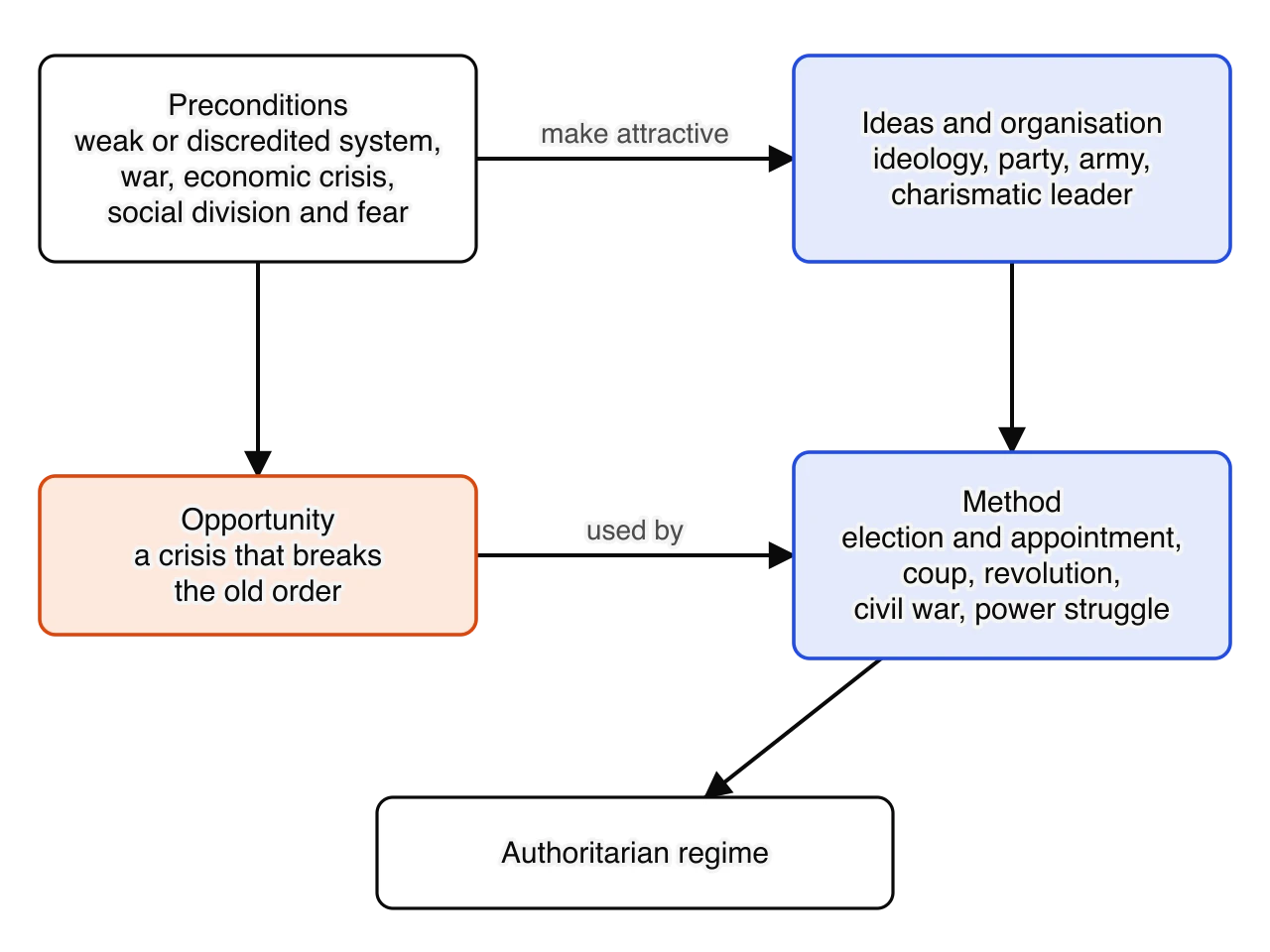
The model of emergence shows how these work together. Conditions do not produce a dictatorship on their own: Britain and the United States suffered in the Great Depression but stayed democracies. A crisis that breaks the old order opens an opportunity, and someone must be ready to take it, with ideas that seem to answer the crisis and an organisation (a party, an army, a guerrilla force) that can win or seize power.
Most authoritarian regimes followed the failure or collapse of an existing system. The tsarist state collapsed in 1917, the Weimar Republic lost the support of most Germans after 1930, the Qing dynasty fell in 1911 and China then broke apart, and Batista's Cuba and King Farouk's Egypt were seen by many of their own citizens as corrupt and dependent on foreign powers. A precondition of this kind explains why change was likely; it does not explain what kind of regime replaced the old one.
The route to power varied widely. Hitler was appointed Chancellor by the president after his party became the largest in parliament. Perón won a presidential election in 1946 after building support as a minister in a military government. Nasser and the Free Officers took power by a coup d'état in 1952. Castro won a guerrilla war, Mao a civil war, and Stalin a struggle for power inside a party that already ruled alone. The method mattered because it shaped how much of the old state survived and how much the new ruler owed to others.
The German sociologist Max Weber described charismatic authority, which rests on followers' belief in a leader's exceptional qualities. Hitler, Castro, Perón and Nasser all drew on it, and Ian Kershaw's biography of Hitler (1998) uses Weber's idea to explain his hold over his party. Stalin, by contrast, was not a gifted speaker; his strength was control of the party machine. Organisations mattered as much as individuals: the NSDAP and its stormtroopers, the Communist parties of Russia and China, the Egyptian army and the Argentine trade unions each gave a leader the means to act.
The pattern is visible long before the twentieth century. After ten years of revolution, war, inflation and coups, the government of the Directory in France had little support. On 9–10 November 1799 (18–19 Brumaire) General Napoleon Bonaparte, a popular war hero, overthrew it with the help of politicians inside the government. A new constitution made him First Consul, and a plebiscite with inflated official figures approved it in 1800. Fear of disorder, a discredited system, war and an ambitious general with an army combined.
Karl Marx later used the term Bonapartism for this kind of regime, in his account of how Napoleon's nephew Louis-Napoléon seized power in 1851 (The Eighteenth Brumaire of Louis Bonaparte, 1852). He argued that when no class was strong enough to rule, a strong leader could raise the state above them all. The idea has been applied since to Perón and to Nasser.
 YouTube
An ideology is a set of ideas that explains what is wrong with society, who is to blame and how the problem can be solved. Ideologies helped authoritarian rule to emerge in three ways. They offered a diagnosis and a promise in a crisis, which won followers; they justified the use of force and the destruction of the old order; and they held a party or movement together while it fought for power.
Four kinds of idea appear repeatedly in the emergence of authoritarian rule since 1750: nationalism, communism, fascism and religion. Most regimes combined several, and some leaders were more committed to their ideas than others.
Nationalism appears in all six core cases. It was strongest where a nation felt humiliated by defeat or dominated by foreigners. The Nazis promised to overturn the Treaty of Versailles and restore German greatness. Nasser and the Free Officers wanted to end British occupation, which had begun in 1882; by the early 1950s Britain kept roughly 80,000 troops at its Suez Canal base, far more than the 10,000 allowed by the Anglo-Egyptian treaty of 1936. Castro presented his movement as the heir of José Martí, the poet and leader of Cuba's war of independence against Spain, and attacked the dependence on the United States that the Platt Amendment of 1901 had written into Cuba's constitution.
In Argentina, Perón turned economic nationalism into a mass cause. When the United States ambassador, Spruille Braden, openly campaigned against him in 1945–1946, Perón's supporters answered with the slogan "Braden or Perón", presenting the election as a choice between the nation and a foreign power. Perón later called his doctrine justicialismo and presented it as a "third position" between capitalism and communism, combining nationalism, state-led industry and social rights for workers. In China the resistance of the Chinese Communist Party (CCP) to the Japanese invasion after 1937 allowed it to present itself as the most patriotic party, and many recruits joined it to fight Japan more than to build communism.
Nationalism mattered because it could unite people across classes. A worker, a farmer and an army officer might disagree about wages or land, but all could be told that their troubles came from foreigners or traitors, and that a strong leader would restore the nation.
Nasser set out his view of the 1952 revolution in a short book written after the coup, in which he described the Free Officers as a vanguard that had expected the nation to follow it.
After July 23rd I was shocked by the reality. The vanguard performed its task; it stormed the walls of the fort of tyranny; it forced Farouk to abdicate and stood by expecting the mass formations to arrive at their ultimate object. It waited and waited. Endless crowds showed up, but how different was the reality from the vision!
Gamal Abdel Nasser, The Philosophy of the Revolution, first published as press articles between August 1953 and January 1954 and as a booklet in 1954 (English edition, Mondiale Press, Cairo). Nasser wrote as the new ruler explaining why the army had not handed power back to civilians. The passage shows how the idea of a revolutionary vanguard was used to justify continued military rule: the people, in his account, were not yet ready, so the officers had to lead.
Communism gave the Bolsheviks in Russia and the communists in China a complete explanation of history and a programme. Karl Marx had argued that history was driven by class struggle and that the working class would overthrow capitalism. Lenin added the idea of the vanguard party, set out in What Is to Be Done? (1902): a small party of disciplined professional revolutionaries would lead the workers, because they would not reach revolutionary consciousness on their own. This idea, the core of Marxism–Leninism, made a one-party state seem natural once the Bolsheviks took power in 1917, since the party claimed to know the true interests of the working class.
Ideas also decided the struggle to succeed Lenin. In December 1924 Stalin put forward Socialism in One Country, the claim that the USSR could build socialism on its own. Trotsky's permanent revolution argued that the revolution could survive only if it spread abroad. Stalin's idea was more attractive to party members tired of war and revolution, and it was patriotic: it promised that Soviet Russia would become strong by its own efforts.
Mao Zedong adapted Marxism to a country of peasants. Orthodox Marxists, and the Soviet advisers of the 1920s, expected revolution to come from industrial workers in the cities. After the CCP was driven from the cities in 1927, Mao argued that the peasants were the main revolutionary force and that the party should build rural bases and a peasant army. In the Yan'an Rectification Movement of 1942–1944 his version, later called Mao Zedong Thought, became party orthodoxy, and rivals trained in Moscow lost influence. Mao also insisted that power depended on armed force.
In a speech to the party's Central Committee in November 1938, during the war against Japan, Mao told its leaders that "political power grows out of the barrel of a gun", and that the party must always command the gun and never be commanded by it. For Mao, ideology and organised violence were inseparable: the party's ideas would be carried into power by its own army, which the party had to control.
Fascism was founded by Benito Mussolini in Italy in 1919. It glorified the nation, the leader, discipline and violence; rejected liberal democracy, parliaments and Marxism; and promised to unite all classes in a reborn nation. Mussolini's Fascist squads attacked socialists and trade unions in 1920–1922, and after the March on Rome in October 1922 King Victor Emmanuel III appointed him prime minister.
Nazism shared these ideas and added a racial theory at its centre. The Nazis' programme of 1920 and Hitler's Mein Kampf (1925–1926) promised a Volksgemeinschaft, a racially pure "people's community" united across classes, from which Jews were excluded; Lebensraum, living space to be conquered in the east; and the Führerprinzip, under which all authority came from the leader. Antisemitism and anti-Marxism allowed the Nazis to blame Germany's defeat and economic troubles on internal enemies.
How far these ideas won votes is debated. Nazi propaganda in 1930–1932 often played down antisemitism and stressed national unity, jobs and the fight against communism. For the party's core members ideology mattered a great deal; for many voters the party was a vehicle of protest.
Religion could support authoritarian rule or compete with it. In Egypt the Muslim Brotherhood, founded by Hassan al-Banna in 1928, offered an Islamic alternative to both liberal politics and secular nationalism and had hundreds of thousands of members by the late 1940s. It cooperated with the Free Officers at first, but became their main rival; after a member fired at Nasser in Alexandria on 26 October 1954, the Brotherhood was banned and thousands of its members were arrested, which helped Nasser to win his struggle for power.
In Spain, Franco's Nationalists presented the civil war of 1936–1939 as a crusade to defend Catholic Spain, and the Church gave his regime legitimacy. In Iran in 1979 a revolution led by Ayatollah Ruhollah Khomeini replaced the authoritarian monarchy of the Shah with a theocracy, in which senior clergy held final authority under Khomeini's doctrine of rule by the Islamic jurist.
Ideas mattered most where a disciplined party with a clear doctrine fought for power: the Bolsheviks, the CCP and the Nazis. In these cases ideology shaped the party's aims, recruited and bound together its activists and decided what the regime would do once in power. Where an army or a broad movement took power, as in Egypt, Cuba and Argentina, ideas were looser. Nasser's Arab socialism, Castro's Marxism–Leninism and Perón's justicialismo were largely worked out after the leaders had taken office.
Ideas were also rarely sufficient on their own. Nazi ideas had existed since 1920, but the party won only 2.6 per cent of the vote in 1928; communist ideas were available in China from 1921, but the CCP was nearly destroyed in 1927–1934. Ideas became powerful when a crisis made people look for radical answers, which is why the role of ideas has to be weighed together with conditions.
Social factors are the divisions, inequalities, fears and hopes of the groups that make up a society. They help to explain who supported authoritarian movements and why. Four appear again and again: deep division between classes, regions or religions; inequality that made one group feel excluded; fear, above all fear of revolution or disorder; and a desire for change, often strongest among the young and among groups new to politics.
Weimar Germany was divided by class, religion and region, and its parties reflected these divisions: Catholics voted for the Centre Party, industrial workers for the Social Democrats (SPD) or the Communists (KPD), and the Protestant middle classes for a range of liberal and conservative parties. In 1930–1932 the Nazis drew voters away from the Protestant middle-class and conservative parties above all. Farmers, shopkeepers, artisans, white-collar employees, civil servants and pensioners, many of whom had lost their savings in the inflation of 1923, were over-represented among Nazi voters. Catholics and organised industrial workers were much less likely to vote Nazi.
Fear of communism linked these groups. The KPD's vote rose from 10.6 per cent in 1928 to 16.9 per cent in November 1932, it called openly for a Soviet Germany, and its Red Front fighters fought the Nazi SA in the streets. To property-owners, farmers and the churches, the Nazis looked like the strongest barrier to revolution. The Nazi promise of a Volksgemeinschaft also appealed to people who felt that class conflict was tearing the nation apart. It offered unity without saying clearly whose interests would give way.
In Argentina the key social change was the growth of an urban working class with no voice in politics. Argentina's wealth came from exports of beef and grain produced on the vast estates of the landowning estancieros, who dominated politics. In the 1930s and early 1940s industry grew to replace imports, and hundreds of thousands of migrants moved from the poor provinces of the interior to Buenos Aires. Many could not join the established unions or saw no party that spoke for them, while the conservative governments of the Infamous Decade kept power by fraud.
Juan Perón, a colonel and a leading member of the GOU, the secret lodge of nationalist officers behind the coup of June 1943, saw this group as a base of power. As head of the Secretariat of Labour and Welfare from November 1943 he settled strikes in workers' favour, supported unions that cooperated with him, extended pensions, and in October 1944 issued the Statute of the Rural Labourer, which set minimum wages and conditions for farm workers. Employers, landowners and the middle-class parties came to hate him; workers came to see him as their protector.
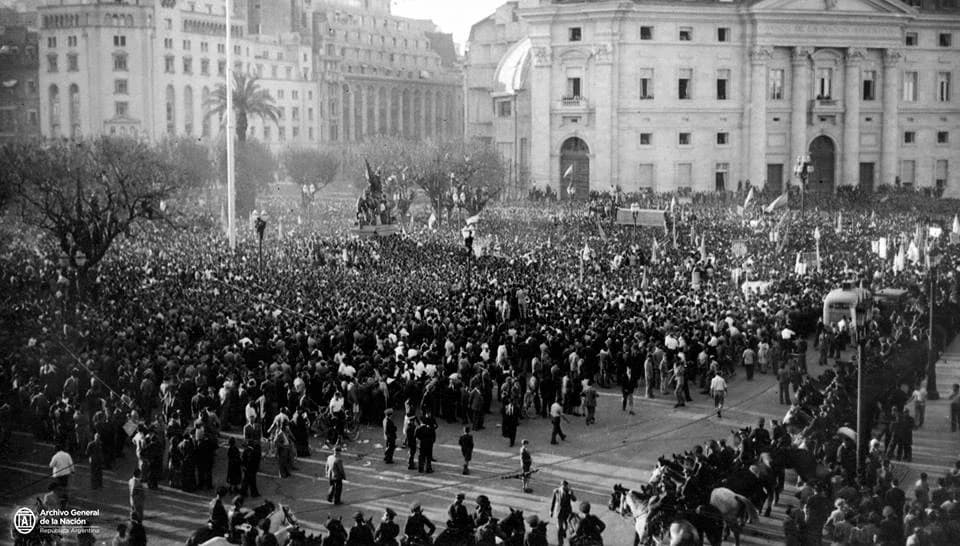
The test came in October 1945. Rival officers forced Perón to resign and arrested him on 13 October. On 17 October tens of thousands of workers from the industrial suburbs marched into the Plaza de Mayo, the square in front of the presidential palace, and stayed until the government released him; he spoke to them from the balcony that night. His opponents called the crowd the descamisados, "the shirtless ones"; Perón adopted the name with pride. Four months later, on 24 February 1946, he won the presidential election with about 54 per cent of the vote.
In China, Egypt and Cuba, most people were poor and land was concentrated in few hands. In much of China peasants rented land and commonly paid around half of their crop in rent, and debt to landlords was widespread. In the areas it controlled during the war against Japan, the CCP reduced rents and interest; during the civil war from 1946 it carried out radical land reform, taking land from landlords and giving it to peasants. Recruits for the Red Army came from peasant families who now had land to defend.
In Egypt before the land reform of 1952, about 0.4 per cent of owners controlled a third of the land, while 95 per cent of owners, the small owners, held only about 35 per cent of it between them, and 44 per cent of rural people owned no land at all. A feddan is about one acre. The Free Officers themselves came mostly from the lower middle class. Nasser was the son of a postal clerk and entered the Military Academy in 1937, after the Anglo-Egyptian treaty of 1936 led Egypt to expand its army and open officer training to young men from outside the old elite. These officers resented both the British and the landowning politicians who ran the country, and their first major reform, in September 1952, limited land holdings to 200 feddans.
Landownership in Egypt before 1952 | Share of all owners | Share of the land |
|---|---|---|
Largest owners | About 0.1 per cent | About one-fifth |
Large owners | About 0.4 per cent | About one-third |
Small owners | About 95 per cent | About 35 per cent |
Data: US Library of Congress, Egypt: A Country Study (1990), which also gives 44 per cent of rural inhabitants as landless. Other studies, using different definitions of ownership, put the share of the largest owners at between a third and two-fifths of the land.
In Cuba the gap ran between the countryside and the cities. Havana had a large middle class and one of the highest standards of living in Latin America, but rural labourers on the sugar estates had work for only a few months of the year. Many middle-class Cubans opposed Batista because of his corruption and his police's violence, and joined the urban resistance; Castro's victory depended on their support as much as on that of the peasants of the Sierra Maestra.
Fear could produce support for authoritarian rule from the top of society as well as the bottom. The coup of 1799 in France was welcomed by property-owners tired of revolution. In Italy in 1919–1920, the "two red years" of strikes and factory occupations drove landowners and industrialists to fund Mussolini's squads. In Chile, the socialist government of Salvador Allende (1970–1973) faced inflation of several hundred per cent, shortages and strikes by lorry owners and shopkeepers; many middle-class Chileans welcomed the military coup led by General Augusto Pinochet on 11 September 1973.
Conflict, meaning war, civil war, political violence and the crises they produce, was the most common precondition of authoritarian rule. War helped dictatorships emerge in four ways. It discredited governments that lost or mismanaged it; it brutalised politics and made violence normal; it gave armies and armed parties the means to take power; and it created emergencies in which people accepted strong government.
The First World War (1914–1918) destroyed the empires of Russia, Germany and Austria-Hungary and left Italy, a victor, bitter and divided. In Russia, military defeat, food shortages and inflation brought down the tsar in February 1917, and the weak Provisional Government that replaced him chose to continue the war. The Bolsheviks seized power in October 1917 (7 November in the Western calendar) promising "peace, land and bread".
The Russian Civil War of 1918–1921 then shaped the regime that Stalin would inherit. To survive, the Bolsheviks built a centralised party-state: the Cheka political police and the Red Terror, war communism with forced grain requisitioning, a Red Army of about five million men, and the suppression of all other parties. Stalin himself rose as a civil war commissar. When the war ended and sailors at Kronstadt rebelled in March 1921, the Tenth Party Congress adopted the ban on factions, which forbade organised opposition inside the party. The habits of war (command, obedience, the use of force against "class enemies") outlasted it.
In Germany the war ended in a defeat that many refused to accept. The army had still been on foreign soil in November 1918, so nationalists spread the stab-in-the-back myth: the claim that the army had been betrayed by socialists, Jews and the politicians who signed the armistice and the peace. The Treaty of Versailles (28 June 1919), with its loss of territory, reparations and the war guilt clause, was blamed on the new republic. Former soldiers formed armed groups (the Freikorps) and political murder became common. The statistician Emil Gumbel counted 354 political murders by the right and 22 by the left in 1919–1922, and found that the courts left almost all of the right-wing killings unpunished.
Italy had joined the Allies in 1915 but did not receive all the territory it had been promised, and nationalists spoke of a "mutilated victory". Demobilised soldiers filled Mussolini's squads. In each case war created people trained in violence, governments blamed for defeat or disappointment, and a political culture in which force seemed a legitimate way to settle disputes.
China's communist revolution grew out of decades of conflict. After the Qing dynasty fell in 1911, central authority collapsed into the warlord era. The May Fourth Movement of 1919, student protests against the decision at the Paris Peace Conference to hand Germany's rights in Shandong to Japan, turned many young Chinese towards radical ideas, and the CCP was founded in Shanghai in July 1921, with Mao among its early members. The Guomindang (GMD) of Jiang Jieshi (Chiang Kai-shek) reunified much of the country by 1928, but only after turning on its communist allies of the first United Front in Shanghai in April 1927. The communists survived in rural bases and, after the Long March of 1934–1935, in Yan'an in the north-west.
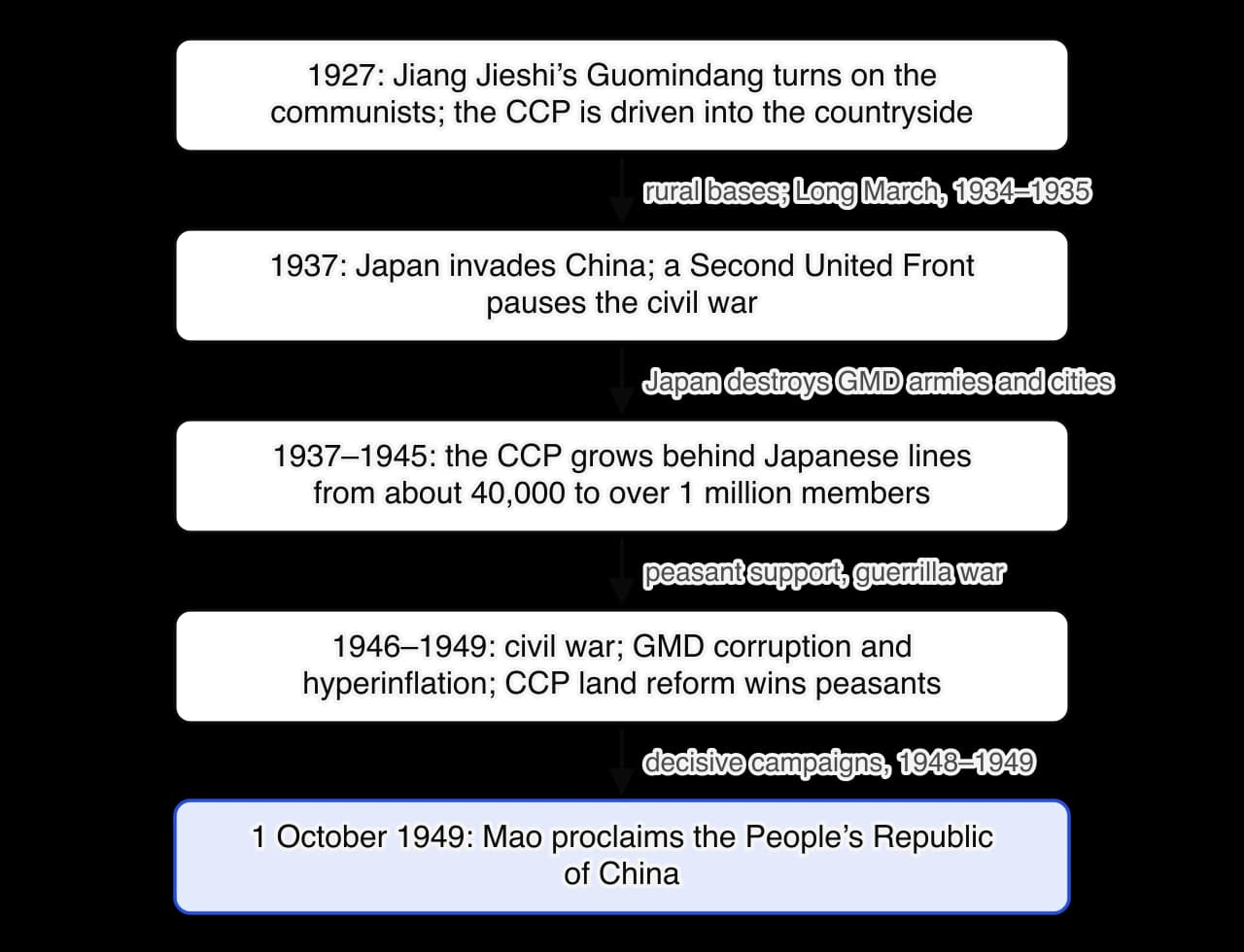
The chain of events from 1927 to 1949 shows why the Japanese invasion of 1937 was the turning point. Japan took the coastal cities that were the GMD's base and destroyed its best armies, while the Red Army fought a guerrilla war behind Japanese lines and set up governments in the countryside. In Peasant Nationalism and Communist Power (1962) the political scientist Chalmers Johnson argued that the war turned peasants into nationalists and that the CCP won because it led resistance to Japan. The civil war of 1946–1949 then decided the outcome: the GMD, weakened by corruption, inflation and the loss of popular support, lost its large armies in the campaigns of 1948–1949, and Mao proclaimed the People's Republic on 1 October 1949.
In Egypt, conflict worked through humiliation. The Egyptian army fought in the first Arab–Israeli war of 1948–1949 and was defeated; Nasser himself was besieged with his unit at Faluja. Officers blamed the king and the politicians for sending them to war badly prepared and with faulty weapons. The secret Free Officers grew in the years after the defeat.
In October 1951 the Egyptian government cancelled the treaty of 1936 with Britain, and guerrillas attacked British forces in the Suez Canal Zone. On 25 January 1952 British troops attacked a police station in Ismailia, killing between about 40 and 56 Egyptian auxiliary policemen (accounts differ). The next day, "Black Saturday", crowds burned hundreds of buildings in central Cairo, many of them foreign-owned, while the government failed to act. Six months of unstable governments followed, and on the night of 22–23 July 1952 the Free Officers seized Cairo almost without bloodshed. King Farouk abdicated on 26 July.
Castro's path to power was a war. After Batista's coup of March 1952 closed the route to power through elections, Castro attacked the Moncada barracks in Santiago de Cuba on 26 July 1953. The attack failed, but his trial made him famous. In December 1956 he landed from Mexico with 81 other men on the yacht Granma; most were killed or captured, and a small group reached the Sierra Maestra mountains.
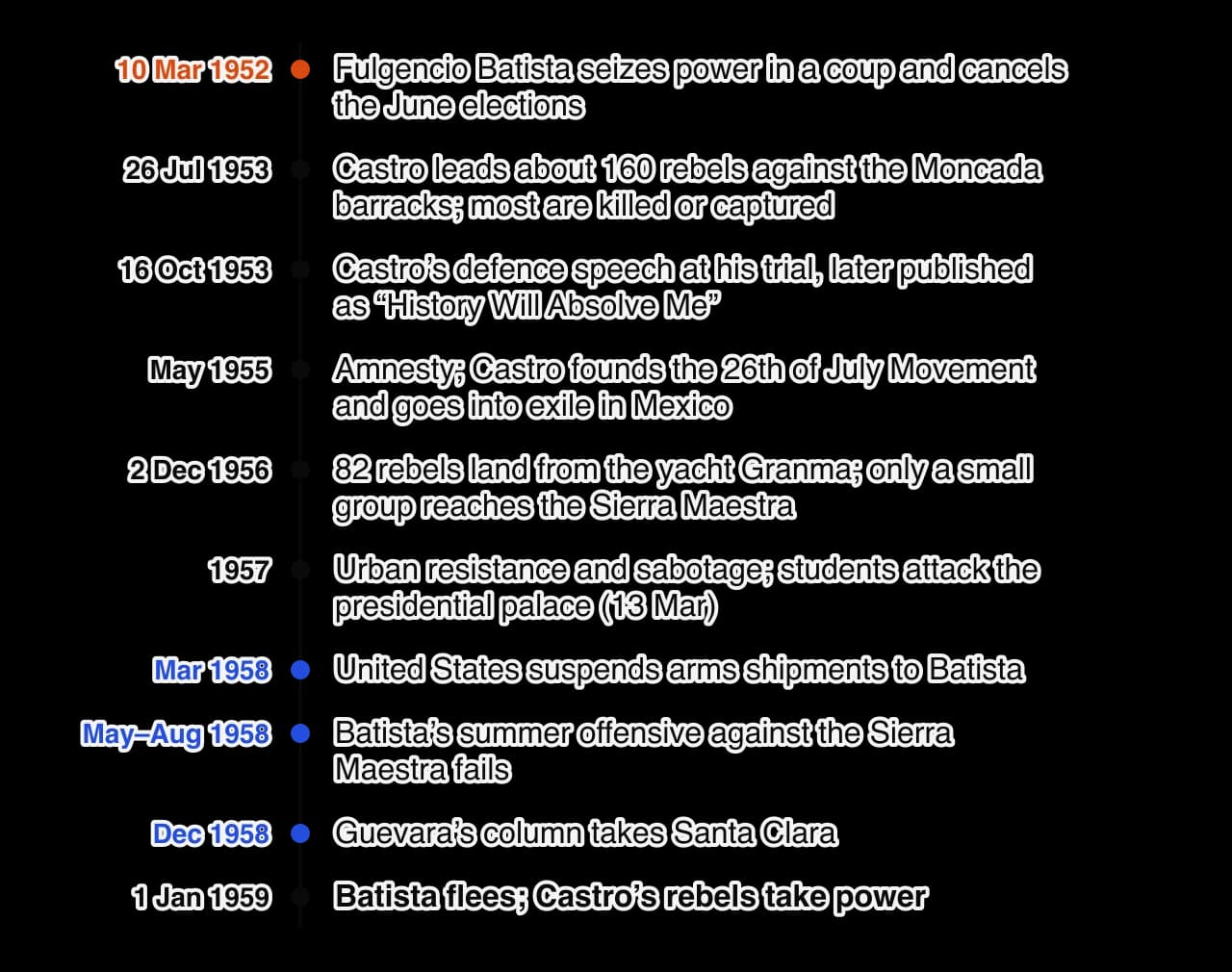
The timeline of the Cuban Revolution shows that Batista lost the war more than Castro won it. His army, though tens of thousands strong, was poorly led and demoralised, its brutality against civilians drove many Cubans to the rebels, and in March 1958 the United States suspended arms shipments to him. When his summer offensive of 1958 failed and Che Guevara's column took Santa Clara in December, Batista fled on 1 January 1959. The rebel army, the 26th of July Movement, became the only armed force left in Cuba, which gave Castro unchallenged power.
After 1945 the Cold War added a new kind of conflict. The superpowers backed rulers who promised to keep their rivals out. In the Congo, independent from Belgium in 1960, civil war and foreign intervention ended when the army commander Joseph-Désiré Mobutu, backed by the United States, took power on 24 November 1965. In Chile in 1973, American hostility to Allende's government contributed to the economic crisis that preceded Pinochet's coup. In Cuba, conflict with the United States after 1959 pushed Castro towards the USSR.
Economic factors include sudden crises (depression, inflation, the collapse of trade) and long-term conditions (inequality in land and wealth, dependence on one export or on foreign capital). They helped authoritarian rule emerge by destroying confidence in existing governments, by creating mass unemployment and poverty that made radical promises attractive, and by sharpening conflicts between classes that democratic politics could not settle.
Inflation destroys savings and fixed incomes, and with them the trust of the middle classes in the state. In Germany the government printed money to pay its debts and to support passive resistance after France occupied the Ruhr in January 1923; by November 1923 one US dollar was worth about 4.2 trillion marks. Hyperinflation wiped out the savings of the middle classes. It did not bring the Nazis to power, since the republic recovered after 1924, but it left a lasting memory that the Nazis used after 1929.
In China the GMD government financed the civil war by printing money. Prices rose many times over each year from 1946, and a new currency, the gold yuan, introduced in August 1948, lost almost all its value within months. Salaried officials, teachers and soldiers, the groups the government most needed, were impoverished, and many concluded that the communists could hardly be worse.
The Great Depression that followed the Wall Street Crash of October 1929 was the most important economic cause of authoritarian rule in the 1930s. World trade fell by about two-thirds in value between 1929 and 1933, prices for food and raw materials collapsed, and unemployment rose to levels never seen before.
Germany was hit especially hard because its recovery after 1924 had depended on short-term American loans under the Dawes Plan, which were recalled after 1929. Industrial production fell by about 40 per cent between 1928 and 1932. Chancellor Heinrich Brüning responded with deflation: cuts in wages, unemployment benefit and public spending, which deepened the slump.
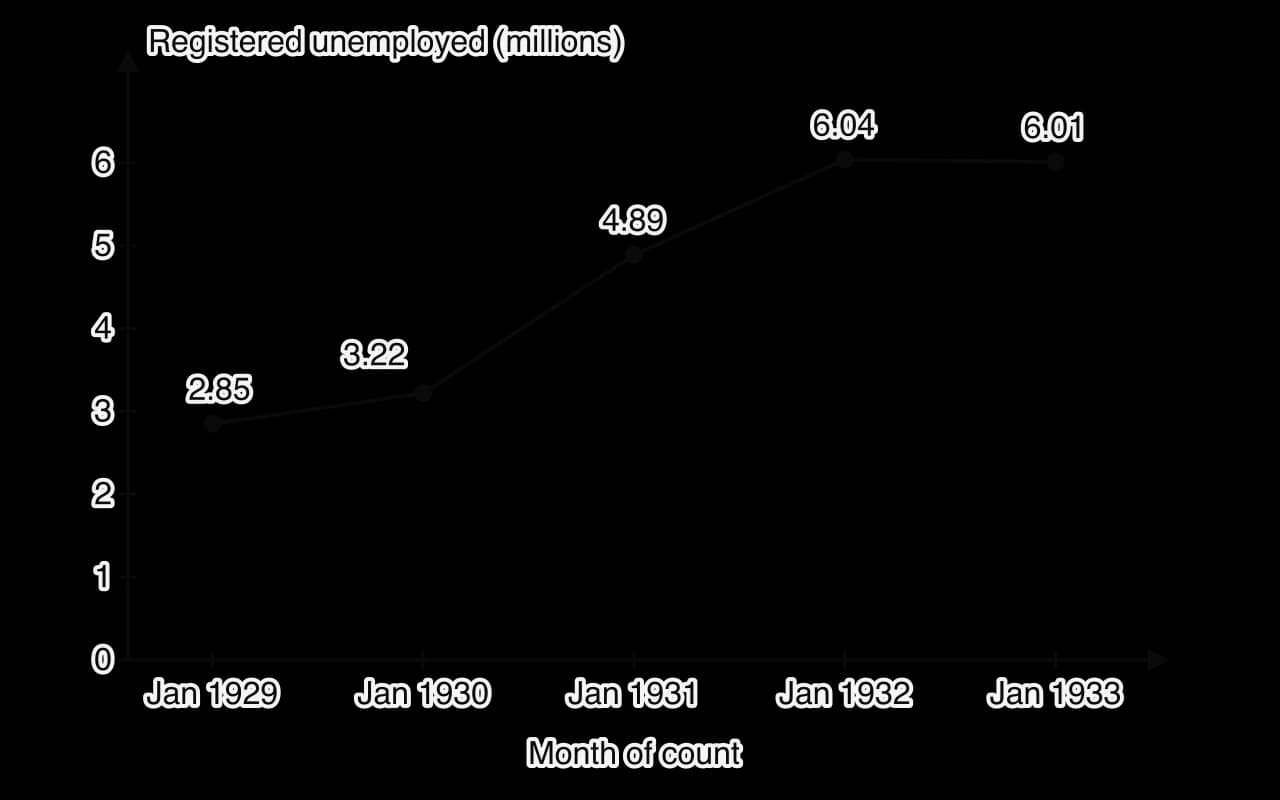
The graph of German unemployment shows the scale of the crisis: over six million registered unemployed in early 1932, and many more on short time or not registered. The Nazis did not win most of the unemployed themselves, who more often voted Communist, but the Depression destroyed confidence in the republic among those who feared for their jobs, farms and businesses. The Nazis offered a simple promise, made through posters such as the one of 1932 promising work and bread.

In Argentina the Depression ended a long period of export-led growth. The prices of grain and beef, on which the country's wealth depended, fell sharply. On 6 September 1930 the army overthrew the elected president, Hipólito Yrigoyen, the first of many military coups in twentieth-century Argentina. The conservative governments that followed kept power by electoral fraud, and the Roca–Runciman Pact of 1933, which protected Argentine beef sales to Britain on terms favourable to British companies, made them look like servants of foreign interests. Industry grew to replace imports, creating the new working class that Perón later mobilised.
Cuba, which depended on sugar for about four-fifths of its exports, suffered a collapse in sugar prices. Strikes and revolution in 1933 drove out the dictator Gerardo Machado, and on 4 September 1933 a "sergeants' revolt" led by Fulgencio Batista made him the most powerful man in the country, first behind civilian presidents and from 1940 as elected president. The same Batista returned by coup in 1952, and his second dictatorship provoked Castro's revolution, so the crisis of the 1930s shaped Cuban politics for a generation.
Long-term inequality gave revolutionaries a cause. Castro's defence speech of 1953, written to win support for his movement, set out the economic grievances of the Cuban poor.
Eighty-five per cent of the small farmers in Cuba pay rent and live under constant threat of being evicted from the land they till. More than half of our most productive land is in the hands of foreigners. In Oriente, the largest province, the lands of the United Fruit Company and the West Indian Company link the northern and southern coasts.
Fidel Castro, History Will Absolve Me, defence speech at his trial for the Moncada attack, 16 October 1953 (translated by Pedro Álvarez Tabío and Andrew Paul Booth). Castro reconstructed and published the speech while in prison, so it is a political manifesto as much as a court record. Its figures were chosen to persuade; the choice of land, foreign ownership and the United Fruit Company shows that he linked economic inequality to national independence, which allowed him to appeal to peasants and to middle-class nationalists at once.
The same link between inequality and foreign domination appears in Egypt, where British, Greek and other foreign interests dominated banking and the cotton trade, and large landowners sat in parliament. In both countries, economic grievances explain why the old regime had so few defenders, more than how the new rulers took power.
Economic factors also shaped who rose to the top inside a regime that was already authoritarian. Under the New Economic Policy (NEP), introduced in 1921, peasants sold their grain on the market. In the winter of 1927–1928 they sold too little to the state, because the prices it offered were low and there were few manufactured goods to buy. The war scare of 1927, when Britain broke off diplomatic relations, made the shortage seem dangerous. Stalin travelled to Siberia in January 1928 and ordered grain to be seized by force.
The grain crisis allowed Stalin to turn on his allies of the Right, Nikolai Bukharin, Alexei Rykov and Mikhail Tomsky, who wanted to keep the NEP. By arguing that the NEP had failed and that the USSR must industrialise fast to survive, Stalin won the support of party members impatient with the market, and in 1929 launched the Great Turn: forced collectivisation and the first Five-Year Plan. Here an economic crisis served as a weapon in a power struggle.
The Depression hit almost every country, but only some became dictatorships. Britain, the United States, France and the Scandinavian democracies survived it. Where democracy was new, contested or already weak, as in Germany, Argentina and much of eastern Europe and Latin America, economic crisis turned discontent into a crisis of the whole system. Economic factors were therefore usually a necessary condition, not a sufficient one, and they mattered more in some cases (Germany, Argentina, Cuba) than in others (Nasser's Egypt, where the cause was long-term inequality more than a sudden crisis; Stalin's USSR, where the crisis came inside a regime already authoritarian).
Conditions explain why authoritarian rule became possible; they do not explain why Stalin rather than Trotsky, or Nasser rather than Neguib, came out on top, or how each took power. That depended on leaders' skill, their organisations and the mistakes of their rivals.
Case | Route to power | Key organisation | Date power was secured |
|---|---|---|---|
Stalin (USSR) | Power struggle inside a one-party state | The Communist Party apparatus | 1929 (defeat of the Right) |
Hitler (Germany) | Elections, then appointment by the president; "legal revolution" | NSDAP and SA | August 1934 (Führer) |
Mao (China) | Guerrilla war, then civil war | CCP and the People's Liberation Army | 1 October 1949 |
Castro (Cuba) | Guerrilla war and urban resistance | 26th of July Movement and the Rebel Army | 1 January 1959 |
Nasser (Egypt) | Military coup, then a struggle within the junta | Free Officers and the army | November 1954 (Neguib removed) |
Perón (Argentina) | Military coup, then a ministry and election | Army (GOU) and the trade unions | 24 February 1946 (election) |
Stalin's rise is the clearest case of leadership and organisation deciding the outcome. In 1922 Stalin, a Georgian Bolshevik with a reputation as a dull administrator, became General Secretary of the party. The post gave him control of appointments to party offices across the country, and the officials he appointed chose the delegates to party congresses, which in turn elected the Central Committee. When Lenin had a series of strokes from May 1922, Stalin was building a following that his more brilliant rivals did not take seriously.
Lenin saw the danger. In notes dictated in December 1922 and January 1923, later known as his "Testament", he assessed the party's leaders.
Comrade Stalin, having become Secretary-General, has unlimited authority concentrated in his hands, and I am not sure whether he will always be capable of using that authority with sufficient caution.
Vladimir Lenin, "Letter to the Congress", dictated 24 December 1922, with an addition of 4 January 1923 proposing that Stalin be removed as General Secretary because he was "too rude" (Collected Works, vol. 36). Lenin was ill and partly cut off from politics, and he had just quarrelled with Stalin, who had insulted his wife, Nadezhda Krupskaya. The notes criticised every possible successor, including Trotsky, which helps to explain why the leadership could agree to read them only to delegates in May 1924 and not publish them. Stephen Kotkin (2014) has questioned whether Lenin dictated every part of the text, a doubt most historians treat as unproven.
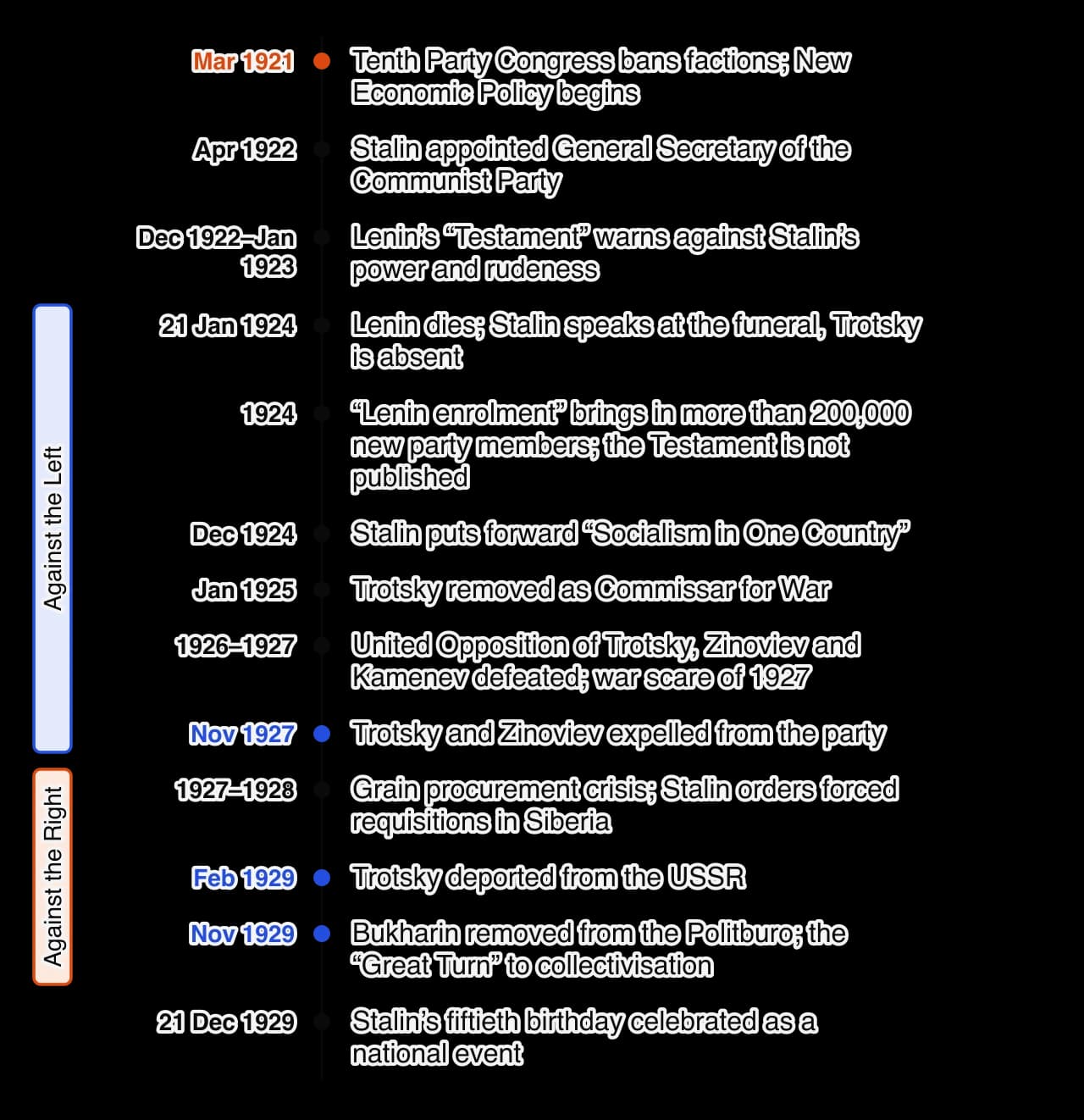
The timeline of the power struggle shows how Stalin used alliances. With Grigory Zinoviev and Lev Kamenev he isolated Trotsky in 1923–1925; with Bukharin and the Right he defeated Zinoviev, Kamenev and Trotsky when they joined in the United Opposition of 1926–1927; then he turned on Bukharin in 1928–1929. At each stage the ban on factions of 1921 allowed him to present his rivals as splitters of the party, and the new members recruited in the "Lenin enrolment" of 1924, many of them young workers who owed their careers to the apparatus, voted with the leadership.
Trotsky contributed to his own defeat. He missed Lenin's funeral in January 1924, did little to organise supporters, and was distrusted by many party members as a former critic of Lenin who had joined the Bolsheviks only in 1917, and as the commander of the Red Army who might become a "Bonaparte". Stalin's policies, especially Socialism in One Country, also suited the mood of a party that wanted stability.
The Free Officers took power in July 1952 with General Muhammad Neguib, a respected senior officer, as their public leader, while the real organiser, Lieutenant-Colonel Nasser, stayed in the background on the Revolutionary Command Council. The officers abolished political parties in January 1953 and declared a republic in June 1953 with Neguib as president.
A struggle followed between Neguib, who wanted a return to parliamentary government, and Nasser, who wanted the army to rule while it transformed society. In the crisis of February–March 1954 Neguib had the support of the old parties, the Muslim Brotherhood and part of the army, but Nasser controlled the officer corps and organised strikes by transport workers in his favour. The attempt on Nasser's life in October 1954 gave him the reason to crush the Brotherhood and remove Neguib, who was placed under house arrest in November 1954. In June 1956 a plebiscite in which he was the only candidate made Nasser president.
Perón, Castro and Mao each built an independent base of power before reaching the top. Perón used the Secretariat of Labour to turn the unions into a political machine loyal to him, which saved him in October 1945 and won him the election of 1946. Castro used the guerrilla war to become the unchallenged leader of a broad coalition: the Caracas Pact of July 1958 united most opposition groups behind his movement, and his Rebel Army was the only force left standing in 1959. Mao became the CCP's leading figure at the Zunyi conference during the Long March in January 1935, built his authority in Yan'an, and by 1945 was party chairman with his ideas written into the party's constitution.
Hitler's rise is the most studied case of the emergence of authoritarian rule, because a dictatorship that went on to wage war and genocide came to power through a democratic constitution. It shows all four lines of inquiry at work, and also the part played by individual decisions.
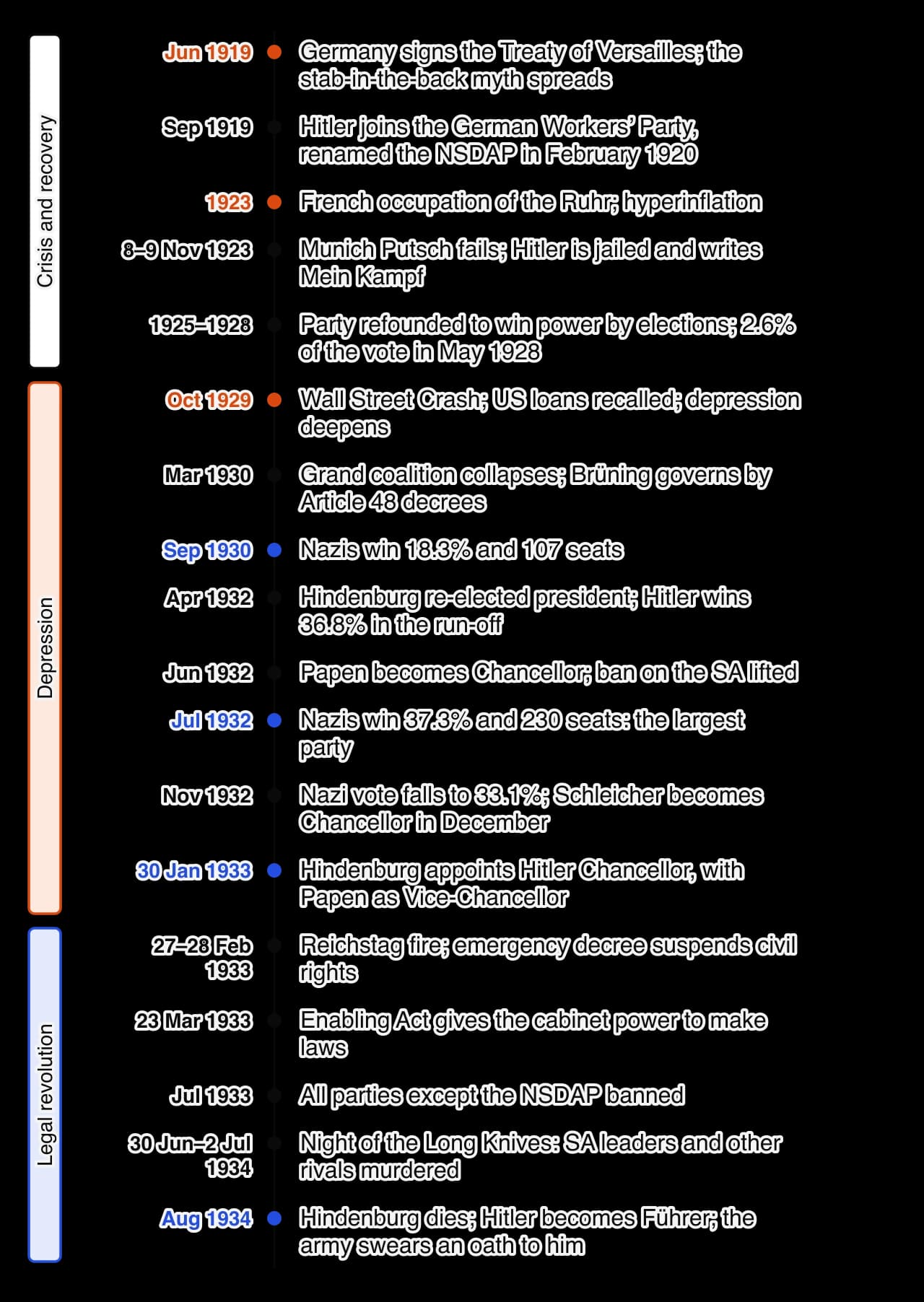
The Weimar Republic was born in defeat in 1918–1919 and blamed for the Treaty of Versailles. Its constitution was one of the most democratic of its time, with votes for all adults over twenty, but it had two features that later helped its enemies. Proportional representation gave seats to many small parties, so every government was a coalition, and between 1919 and 1933 Germany had about twenty cabinets. Article 48 allowed the president, in an emergency that seriously threatened public order and security, to take the measures needed to restore it, including issuing decrees with the force of law and suspending basic rights.
Many of the people who ran the state did not accept the republic. Army officers, senior civil servants, judges and university professors had served the empire and many looked back to it. When nationalist Freikorps units tried to seize Berlin in the Kapp Putsch of March 1920, the army refused to fire on them; the putsch failed only because of a general strike. President Paul von Hindenburg, elected in 1925, was a field marshal of the old army and a monarchist.
Hitler, an Austrian-born former corporal, joined the small German Workers' Party in Munich in September 1919. It became the National Socialist German Workers' Party (NSDAP) in 1920, adopted a 25-point programme of nationalism, antisemitism and vague social reform, and made Hitler its leader in July 1921. His speeches drew large crowds, and the party's stormtroopers, the SA, protected its meetings and attacked opponents.
In the crisis of 1923, with hyperinflation and the Ruhr occupation, Hitler tried to copy Mussolini's March on Rome. The Munich Putsch of 8–9 November 1923 collapsed when Bavarian police opened fire. At his trial Hitler used the courtroom to make nationalist speeches; the judges gave him the minimum sentence of five years, and he was released after about nine months. In prison he wrote Mein Kampf.
The failure of the putsch changed Nazi strategy. Hitler refounded the party in 1925 and decided to win power legally, through elections, while keeping the SA and the party's revolutionary aims. Joseph Goebbels, the party's leader in Berlin, explained the new strategy to the party's readers in 1928.
We are an anti-parliamentarian party that for good reasons rejects the Weimar constitution and its republican institutions. ... So why do we want to be in the Reichstag? We enter the Reichstag to arm ourselves with democracy's weapons. If democracy is foolish enough to give us free railway passes and salaries, that is its problem. It does not concern us. Any way of bringing about the revolution is fine by us.
Joseph Goebbels, "Why Do We Want to Join the Reichstag?", Der Angriff (Berlin), 30 April 1928 (translated by Randall Bytwerk, German Propaganda Archive). Goebbels wrote for party members during the campaign for the election of May 1928, so he could be open about the party's contempt for democracy. The article shows that the "legal" strategy was a tactic; it is less reliable as evidence of what most Nazi voters believed, since they never read it.
In the relatively prosperous years from 1924 to 1928 the Nazis remained on the fringe. They built a national organisation of regional branches, youth and women's groups and professional associations, and membership grew to about 100,000 by 1928, but the party won only 12 seats in May 1928.
The Nazis' breakthrough came with the Depression. In 1929 they joined the nationalist press owner Alfred Hugenberg in a campaign against the Young Plan, a new reparations settlement, which gave Hitler national publicity and respectable allies. In March 1930 the coalition led by the Social Democrats collapsed over the cost of unemployment insurance, and Hindenburg appointed Heinrich Brüning of the Centre Party as Chancellor at the head of a presidential cabinet that relied on Article 48 decrees. When the Reichstag rejected his measures, Brüning had it dissolved. In the election of September 1930 the Nazis rose from 12 to 107 seats.

The chart of the Nazi vote shows the party's rise to 37.3 per cent in July 1932, its fall in November 1932, and the higher vote of March 1933, when Hitler already held power. Several things explain the rise. Nazi propaganda, directed by Goebbels, was modern and relentless: mass rallies, films, posters aimed at different groups, and in 1932 Hitler's flights by aeroplane to speak in several cities a day. The SA, about 400,000 strong by 1932, fought communists in the streets and gave an impression of energy and discipline, while also creating the disorder the Nazis promised to end. And the Nazis presented themselves as a party of all Germans, not of one class or religion.
From 1930 the Reichstag lost its central role. Each year more laws were made by presidential decree and fewer by parliament, and the real power to choose governments passed to Hindenburg and the small circle around him: his son Oskar, his state secretary Otto Meissner, and the political general Kurt von Schleicher. These men wanted an authoritarian government without the Social Democrats, backed by the army. They hoped to use the Nazis' mass support while keeping control themselves.
In May 1932 they dropped Brüning and appointed Franz von Papen, a Catholic aristocrat with almost no support in the Reichstag. Papen lifted the ban on the SA and on 20 July 1932, using violence in Altona three days earlier as a pretext, removed the Social Democratic government of Prussia, Germany's largest state, by decree. In the election of July 1932 the Nazis became the largest party with 230 seats, but in August Hindenburg refused to make Hitler Chancellor, offering him only the post of Vice-Chancellor, which Hitler rejected.
By the end of 1932 the Nazis seemed to be in decline. In the election of November they lost two million votes, the party was in debt, and in December Gregor Strasser, the head of its organisation, resigned after Schleicher, now Chancellor himself, had tried to split the party by offering him office.
Hitler came to power after his popularity had begun to fall, through a deal among conservatives. Papen, resentful at being replaced by Schleicher, met Hitler secretly at the house of the Cologne banker Kurt von Schröder on 4 January 1933 and agreed to work for a government with Hitler as Chancellor and himself as Vice-Chancellor. Schleicher failed to win a majority or to split the Nazis, and lost the support of landowners and industrialists. On 28 January he resigned.
Papen persuaded Hindenburg that Hitler could be controlled: only three of the eleven members of the new cabinet would be Nazis, and Papen would have the president's ear. On 30 January 1933 Hindenburg appointed Hitler Chancellor. The army leadership accepted the decision; the left was divided between the Social Democrats and the Communists, who regarded each other as enemies.
Hitler turned his office into a dictatorship in eighteen months, a process that historians call the legal revolution because each step had a legal form. After the Reichstag fire of 27 February 1933 the Reichstag Fire Decree suspended civil liberties, and thousands of communists were arrested. In the election of 5 March the Nazis won 43.9 per cent. With Communist deputies arrested and the Centre Party's votes won by promises, the Enabling Act of 23 March passed by 444 votes to 94, only the Social Democrats voting against; it allowed the cabinet to make laws without the Reichstag. Trade unions were dissolved in May, and in July 1933 the NSDAP became the only legal party.
The last threats came from within. In the Night of the Long Knives (30 June–2 July 1934) the SS murdered the SA leader Ernst Röhm and other rivals, which reassured the army. When Hindenburg died on 2 August 1934, Hitler combined the offices of Chancellor and President as Führer, the army swore an oath of personal loyalty to him, and a plebiscite on 19 August approved the change with about 90 per cent of the vote. How these methods kept the regime in power after 1934 is a question of maintenance more than emergence.
 YouTube

The diagram of causes groups them by timescale. Each layer was necessary. Without defeat, Versailles and a republic that many Germans never accepted, there would have been no mass nationalist movement. Without the Depression, the Nazis would have remained a fringe party, as their 2.6 per cent in 1928 shows. Without the decision of Papen, Hindenburg and their circle, Hitler, whose vote was falling, might never have become Chancellor; no other route to power was open to him after the failure of the putsch, and he never won a majority.
The role of ideas is the most debated. Nazi ideology held the movement together and decided what it did with power, but many voters chose the Nazis as a protest against the Depression and the republic more than for their racial programme. The Nazis' social appeal across classes, their propaganda and the fear of communism turned economic despair into votes; the conservative elite's miscalculation turned votes into power.
Setting the six core cases side by side shows which factors appear everywhere, which only in some cases, and how they combined. The comparative table of the core cases ends with a judgement on each, which other historians might weigh differently.
Case (region) | Role of ideas | Social factors | Role of conflict | Economic factors | Most important (a judgement) |
|---|---|---|---|---|---|
Stalin, USSR, 1922–1929 (Europe) | Marxism–Leninism; vanguard party; Socialism in One Country | Party of new, young members; peasant majority wary of the regime | World war and civil war built a militarised one-party state | Grain crisis of 1927–1928 used against the Right | Leadership and organisation inside a regime already shaped by civil war |
Hitler, Germany, 1919–1934 (Europe) | Nazism: nationalism, antisemitism, Volksgemeinschaft | Middle-class fear of communism; class and religious division | Defeat, Versailles, stab-in-the-back myth; political violence | Hyperinflation (1923); Depression and six million unemployed | Depression, turned into power by the elite's decision of January 1933 |
Mao, China, 1921–1949 (Asia) | Marxism adapted to peasants; Mao Zedong Thought | Landlordism and rural poverty; land reform | Japanese invasion (1937–1945) and civil war (1946–1949) | GMD hyperinflation, 1947–1949 | Conflict: war with Japan weakened the GMD and built the CCP |
Castro, Cuba, 1952–1959 (Americas) | Nationalism (Martí), anti-imperialism; communism later | Rural poverty; middle-class opposition to Batista | Guerrilla war; Batista's brutality; US arms embargo | Sugar dependence; foreign ownership of land | Conflict, in a society alienated by dictatorship and dependence |
Nasser, Egypt, 1952–1954 (Africa and the Middle East) | Anti-colonial and Arab nationalism; rival Islamism | Land inequality; lower-middle-class officers | Defeat in 1948; Canal Zone clashes; Black Saturday | Concentrated landownership; foreign economic control | Conflict and colonial humiliation, acting through the army |
Perón, Argentina, 1943–1946 (Americas) | Economic nationalism; justicialismo | New urban working class excluded from politics | Little (the coup of 1943; Second World War neutrality) | Depression of 1930 and the export economy; growth of industry | Social factors: the mobilisation of workers |
Three patterns stand out. First, every case began with the failure of an existing government, whether a democracy (Weimar), a dictatorship (Batista), a monarchy (Farouk, the tsar) or a fraudulent oligarchy (Argentina in the 1930s). Authoritarian rule usually replaced a regime that had already lost the support of key groups.
Second, conflict was the factor present most often. War or civil war was central to the emergence of four core regimes (the USSR, China, Cuba and Egypt) and important to a fifth (Germany). Only in Argentina was it marginal. Economic crisis, by contrast, was decisive in Germany and important in Argentina and Cuba, but secondary elsewhere.
Third, the route to power reflected the factors. Where war had destroyed or divided the state (Russia, China, Cuba), power was taken by an armed party. Where the state survived but its rulers had lost legitimacy (Egypt, Argentina), the army stepped in. Where a democracy survived formally but had stopped working (Germany), power was handed over by the elite.
The same factors appear in the emergence of authoritarian rule outside the core set. The table of other cases gives short examples from all four regions.
Case | Region | Main factors | Route to power |
|---|---|---|---|
Napoleon Bonaparte, France, 1799 | Europe | Revolutionary disorder, war, a discredited Directory, fear of both royalists and Jacobins | Coup of 18–19 Brumaire, approved by plebiscite |
Benito Mussolini, Italy, 1922 | Europe | "Mutilated victory", the "two red years", weak coalition governments, Fascist violence | March on Rome; appointment by the king |
Park Chung-hee, South Korea, 1961 | Asia and Oceania | Unstable government after the student revolution of 1960; poverty; fear of North Korea | Military coup of 16 May 1961 |
Joseph-Désiré Mobutu, Congo, 1965 | Africa and the Middle East | Congo Crisis after independence (1960), secession, Cold War rivalry, US support | Military coup of 24 November 1965 |
Augusto Pinochet, Chile, 1973 | Americas | Polarisation under Allende, inflation, middle-class fear, US hostility | Military coup of 11 September 1973 |
Ruhollah Khomeini, Iran, 1979 | Africa and the Middle East | Opposition to the Shah's authoritarian rule, Shi'a Islam, economic dislocation after the oil boom | Revolution; referendum for an Islamic Republic |
These cases confirm the role of conflict and of discredited governments, and add one factor that matters more after 1945: foreign support. Mobutu and Pinochet came to power with the approval of the United States, which feared communism, just as Soviet backing had decided who ruled in eastern Europe after 1945.
Historians disagree about how authoritarian rule emerged in each of the core cases, and the disagreements usually turn on the same questions: how much weight to give to long-term structures and how much to individuals and their choices, and whether leaders came to power because of their ideas or in spite of them.
Some historians stress long-term structures. Hans-Ulrich Wehler (Das Deutsche Kaiserreich, 1973) argued that Germany followed a "special path" (Sonderweg): industrialisation without a liberal revolution left power with authoritarian elites, who later preferred Hitler to democracy. Karl Dietrich Bracher (Die Auflösung der Weimarer Republik, 1955) showed how the shift to presidential government after 1930 created a "power vacuum" that the Nazis filled. Marxist historians, following the Communist International's definition of 1935, saw Nazism as the instrument of big business.
Others stress contingency and choice. Henry Ashby Turner Jr, in German Big Business and the Rise of Hitler (1985), showed that big business gave the Nazis little money before 1933 and mostly backed conservative parties, and in Hitler's Thirty Days to Power (1996) argued that Hitler's appointment was not inevitable but the result of decisions by a handful of men in January 1933. Studies of voters by Thomas Childers (The Nazi Voter, 1983) and Jürgen Falter (Hitlers Wähler, 1991) found that the Nazis drew support from all classes, more than any other party, but above all from the Protestant middle classes; Falter called the NSDAP a "people's party of protest". Ian Kershaw (Hitler, 1998–2000) combines the approaches: the crisis made Hitler possible, his charismatic appeal made him the focus of hopes, and the elite's miscalculation gave him power.
Leon Trotsky, in The Revolution Betrayed (1936), argued that Stalin rose as the representative of a new bureaucracy that had grown up in a backward, isolated country, and that he betrayed the revolution. Stephen Cohen (Bukharin and the Bolshevik Revolution, 1973) argued that Bukharin's gradual path of the NEP was a real alternative, so Stalinism was not the only possible outcome of 1917. Richard Pipes (The Russian Revolution, 1990) saw strong continuity: Lenin's one-party state, terror and ban on factions created the machine that Stalin used, making him Lenin's heir. Stephen Kotkin (Stalin: Paradoxes of Power, 2014) stresses Stalin's own commitment to Marxism–Leninism and his skill, more than the bureaucracy alone.
Chalmers Johnson (1962) argued that peasants supported the CCP because it led national resistance to Japan, so the communists won as nationalists. Mark Selden (The Yenan Way in Revolutionary China, 1971) argued that the party's social and economic programme (rent reduction, land reform and participation in local government) won peasant support. Later regional studies found that the balance varied from place to place and that the party's organisation and coercion also mattered.
The sociologist Gino Germani argued in the 1950s and 1960s that Perón's support came mainly from new migrants from the interior, who lacked experience of unions and politics and were open to a charismatic leader. Miguel Murmis and Juan Carlos Portantiero (Estudios sobre los orígenes del peronismo, 1971) showed that established union leaders also backed Perón, making a rational alliance in return for real gains. Daniel James (Resistance and Integration, 1988) stressed that workers gained dignity and recognition as well as wages, which explains the emotional strength of 17 October 1945.
Hugh Thomas (Cuba: The Pursuit of Freedom, 1971) noted that Cuba was one of the more prosperous countries in Latin America, so the revolution cannot be explained by poverty alone; he stressed the political failure of the Batista years and the middle-class character of much of the opposition. Louis A. Pérez Jr (Cuba: Between Reform and Revolution, 1988) placed the revolution in the long history of Cuban nationalism and frustration at United States domination since 1898.
Debate | Historians | Argument | Evidence stressed |
|---|---|---|---|
Hitler: structures | Wehler (1973), Bracher (1955) | Authoritarian elites and the collapse of parliamentary government made Hitler possible | Continuity of elites from the empire; decree government from 1930 |
Hitler: contingency | Turner (1985, 1996) | Hitler was let in by a few men's choices in January 1933; business played little part | Party finances; the Papen–Hindenburg negotiations |
Hitler: voters | Childers (1983), Falter (1991) | A cross-class "people's party of protest", strongest among Protestant middle classes | Statistical analysis of election results |
Stalin | Trotsky (1936), Cohen (1973), Pipes (1990) | Bureaucratic betrayal; a real alternative in Bukharin; or continuity with Lenin | The party apparatus; the NEP; Lenin's one-party state and terror |
Mao | Johnson (1962), Selden (1971) | Peasant nationalism against Japan, or social reform | CCP growth during the war; land reform and rent reduction |
Perón | Germani, Murmis and Portantiero (1971), James (1988) | Manipulated migrants, rational union alliance, or a search for dignity | Migration data; union records; workers' testimony |
These perspectives are not simply right or wrong. Structural explanations show why authoritarian rule was likely in a society; studies of decisions show why it came at a particular moment and in a particular form. A balanced explanation uses both, and recognises that the evidence historians choose, from election statistics to the memoirs of politicians, shapes which factors they stress.
I can define authoritarianism and totalitarianism, explain how they differ, and identify the main types of authoritarian regime.
I can distinguish the conditions that made authoritarian rule possible from the methods by which leaders took power and from the role of leadership and organisation.
I can explain the role of nationalism, communism, fascism and religion in the emergence of authoritarian rule, and judge how much ideas mattered in different cases.
I can explain how division, inequality, fear and a desire for change created support for authoritarian leaders in Germany, Argentina, China, Egypt and Cuba.
I can explain how war, civil war and political violence helped authoritarian rule emerge in Russia, Germany, China, Egypt and Cuba.
I can explain how inflation, the Great Depression, inequality and economic dependence contributed, and why economic crisis was rarely sufficient on its own.
I can explain how Stalin won the power struggle of 1922–1929 and how Nasser defeated Neguib in 1954.
I can explain the long-term causes, short-term causes and trigger of Hitler's appointment in January 1933, and how he secured power by August 1934.
I can compare the six core cases and other cases from four regions, and judge which factors mattered most in each.
I can outline the debates on Hitler (Wehler, Bracher, Turner, Childers, Falter, Kershaw), Stalin (Trotsky, Cohen, Pipes, Kotkin), Mao (Johnson, Selden), Perón (Germani, Murmis and Portantiero, James) and Castro (Thomas, Pérez).
I can write a Part A explanation and plan a Part B essay on the emergence of authoritarian rule using examples from two regions.