
Explain how economic, political, social and environmental factors caused conflicts to break out, from the Crusades to the Algerian War, and weigh their importance across regions.
Each is in the History glossary, with every other term in the subject.
The movement to abolish slavery or the slave trade; in the USA before 1861 it demanded the end of slavery and turned it into a moral and political question for many Northerners.
The network of treaties that divided the European great powers into two blocs before 1914, the Triple Alliance and the Triple Entente.
A secret Serbian nationalist society of army officers, founded in 1911 and led by Colonel Dragutin Dimitrijević, which helped arm the assassins of Archduke Franz Ferdinand in 1914.
Germany's promise of 5–6 July 1914 to support Austria-Hungary fully in whatever action it took against Serbia after the Sarajevo assassination.
The Greek-speaking, Christian continuation of the Roman Empire in the east, ruled from Constantinople until its capture by the Ottomans in 1453.
The set of special rules and punishments, applied without trial by colonial officials, that governed colonised subjects in French Algeria (from 1881) and other French colonies until its abolition in 1944–1946.
The rule of one people by another, usually from a distant country, in which the colonising power controls the colony's government, land and economy and treats its people as subjects.
The Confederate States of America, formed in February 1861 by Southern states that seceded from the United States to protect slavery; it was defeated in 1865.
In history, a conflict is sustained, organised armed violence between states or organised groups over political, territorial, economic, religious or ideological aims. Explaining why such conflicts began is one of the oldest tasks of history: the Greek historian Thucydides already separated the stated grievances of the Peloponnesian War from what he saw as its real cause, the growth of Athenian power and the fear it caused in Sparta.
With a free account, Augment remembers where you stopped and what you have practiced.
A holy war called by the papacy, in which participants took a vow and received spiritual rewards; above all the expeditions to recover Jerusalem from Muslim rule from 1095 onwards.
An administrative division of France. Algeria was organised as three French départements from 1848, so most French politicians saw it as part of France rather than a colony.
The defensive alliance of Germany and Austria-Hungary signed in 1879, the core of the Triple Alliance.
The agreements of April 1904 by which Britain and France settled their colonial disputes; an understanding rather than a military alliance.
The debate set off by Fritz Fischer's book of 1961 arguing that Germany's leaders sought or deliberately risked a general war in 1914 to make Germany a world power.
The Algerian nationalist movement that began the armed struggle against French rule on 1 November 1954 and led Algeria to independence in 1962.
The deliberate destruction, in whole or in part, of a national, ethnic, racial or religious group. The word was coined by Raphael Lemkin in 1944 and made a crime by the UN Genocide Convention of 1948.
The US proposal handed to Japan by Secretary of State Cordell Hull on 26 November 1941, which demanded Japanese withdrawal from China and Indochina; Japan treated it as an ultimatum.
The policy of a state extending its power and rule over other territories and peoples, by conquest, colonisation or economic and political control.
In the medieval Catholic Church, a grant that reduced the punishment in purgatory due for sins, often obtained in return for a payment or a pious act and issued on written or printed forms.
The Allied court that tried Japan's wartime leaders in Tokyo from 1946 to 1948 for crimes against peace, war crimes and crimes against humanity; all 25 defendants judged were convicted and seven were hanged.
The struggle in the late eleventh and early twelfth centuries between the popes and lay rulers, above all the German emperors, over who had the right to appoint bishops and abbots.
In Islam, a struggle or striving in the path of God; in a military sense, a war to defend or extend Muslim lands, a cause invoked by leaders from Saladin to nineteenth-century West African reformers such as Usman dan Fodio.
The diplomatic crisis between the assassination at Sarajevo on 28 June 1914 and the outbreak of a general European war in early August 1914.
The Japanese army stationed in north-east China from 1906 to guard Japan's railway interests; its officers staged the Mukden incident of 1931 and seized Manchuria without government approval.
An interpretation of the Civil War spread by former Confederates, which presented the Confederacy as a noble cause defeated only by numbers and played down slavery as its cause.
The puppet state set up by Japan in Manchuria in 1932, nominally ruled by the last Qing emperor, Puyi, but controlled by the Japanese army until 1945.
Non-Arab converts to Islam in the early caliphates, who were attached as clients to Arab tribes and often treated as second-class Muslims; their grievances helped the Abbasid Revolution of 747–750.
The belief that a country should maintain strong armed forces and be ready to use them, often with the glorification of military values and a large political role for the armed forces.
The organisation of a society's population, wealth, industry, food and transport for war, including raising soldiers, money and war production.
The belief that people who share a language, culture, history or descent form a nation that should have its own state and govern itself.
The aim announced by Japanese Prime Minister Konoe Fumimaro in November 1938 of a bloc of Japan, Manchukuo and China under Japanese leadership; it was widened in 1940 into the Greater East Asia Co-Prosperity Sphere.
The French law of September 1947 that created an Algerian Assembly of 120 members, half elected by Europeans and a small minority of Muslims and half by more than eight million Muslim Algerians.
The nineteenth-century movement for the unity of the Slav peoples, which in Russia became the belief that Russia should protect and lead the Slavs, especially in the Balkans.
Church movements of the tenth and eleventh centuries that tried to protect clergy, the poor and property from knights' violence and to ban fighting on certain days.
A person of European origin born or settled in French Algeria; about 800,000 left for France in 1962.
A long period of unusually wet climate, such as the fifteen years of above-average moisture in central Mongolia from 1211 to 1225 shown by tree rings.
In the United States of the 1850s, the principle that the settlers of a territory should decide for themselves whether to allow slavery; more generally, the idea that political authority comes from the people.
The US political party founded in 1854 by opponents of the expansion of slavery into the western territories; its candidate Abraham Lincoln won the presidency in 1860.
A tax of one-tenth of income and movable goods imposed in England and France in 1188 to pay for the Third Crusade, on everyone who did not take the cross.
Germany's pre-1914 war plan for a war against France and Russia: defeat France quickly by marching through Belgium, then turn east against the slower Russian army.
The formal withdrawal of a state or region from a larger political union, such as the departure of eleven Southern states from the United States in 1860–1861.
The empire of the Seljuk Turks, Sunni Muslim rulers who took Baghdad in 1055 and defeated the Byzantines at Manzikert in 1071; it broke into rival states after 1092.
The misapplication of Darwin's theory of natural selection to nations, races and classes, claiming that they competed in a struggle in which only the strongest deserved to survive.
The doctrine that the individual states of the USA kept powers the federal government could not override; before 1861 it was used above all to defend slavery and to justify secession.
The treaty signed by Germany, Italy and Japan on 27 September 1940, in which each promised to help the others if attacked by a power not yet in the war, meaning above all the United States.
The alliance of Germany, Austria-Hungary and Italy formed in 1882; Italy declared neutrality in 1914 and joined the other side in 1915.
The informal grouping of France, Russia and Britain formed by the Franco-Russian Alliance (1894), the Entente Cordiale (1904) and the Anglo-Russian Entente (1907).
A final set of demands, with a time limit, whose rejection will lead to war or other serious action; for example, Austria-Hungary's ultimatum to Serbia of 23 July 1914.
A revolutionary movement of young South Slav nationalists in Bosnia and Herzegovina before 1914; its member Gavrilo Princip assassinated Archduke Franz Ferdinand.
Scope. This study covers conflicts from 750 CE to the present in all four regions of the world. It explains the economic, political, social and environmental factors that caused conflicts to break out, using six conflicts throughout: the Crusades (1095–1192), the Mongol conquest of Song China (1235–1279), the US Civil War (1861–1865), the First World War (1914–1918), the Second World War in Asia and the Pacific (1937–1945) and the Algerian War of Independence (1954–1962), with shorter examples from other conflicts.
Historians explain the outbreak of a conflict by identifying its causes and showing how they are connected. A list of causes is only the start. The historian also has to explain why the conflict began when it did rather than ten years earlier or later, and why the people involved chose to fight rather than to negotiate or back down.
Conflict | Region | Outbreak | Main sides |
|---|---|---|---|
The Crusades (First Crusade 1095–1099; Third Crusade 1189–1192) | Europe; Africa and the Middle East | Sermon of Pope Urban II at Clermont, November 1095 | Latin Christian armies against Seljuk and Fatimid rulers, later Saladin's Ayyubid state |
Mongol conquest of the Song, 1235–1279 | Asia and Oceania | Mongol invasion of 1235 after the Song advance on Kaifeng and Luoyang | The Mongol Empire (from 1271 the Yuan dynasty) against the Southern Song |
US Civil War, 1861–1865 | The Americas | Confederate attack on Fort Sumter, 12 April 1861 | The Union (United States) against the Confederate States of America |
First World War, 1914–1918 | Europe, with fronts in Africa, Asia and the Middle East | July Crisis after the assassination at Sarajevo, 28 June 1914 | The Entente (France, Russia, Britain, later Italy and the USA) against the Central Powers (Germany, Austria-Hungary, the Ottoman Empire, Bulgaria) |
Second World War in Asia and the Pacific, 1937–1945 | Asia and Oceania | Marco Polo Bridge incident, July 1937; Pearl Harbor, December 1941 | Japan against China, then also the USA, the British Empire, the Netherlands and (August 1945) the USSR |
Algerian War of Independence, 1954–1962 | Africa and the Middle East | FLN attacks of 1 November 1954 | The Front de Libération Nationale (FLN) against France and the European settlers |
The six conflicts in the table come from all four regions and span almost nine hundred years. They include a religious war, a war of conquest, a civil war, a war between great powers, a war of imperial expansion and a war of independence, so they show causes working in very different settings.
Historians sort causes in two ways. The first is by type: economic, political, social and environmental factors. The second is by timescale. Long-term causes are conditions that built up over decades and made conflict possible, such as the growth of slavery in the American South. Short-term causes are developments of the last few years that made it likely, such as the crises of the 1850s in the United States.
The two ways of sorting can be combined. The tensions between colonisers and colonised in Algeria were long-term social and economic causes; the closing of political routes to reform after 1945 was a short-term political cause; the French defeat in Indochina in May 1954 helped to trigger the rising of November 1954. The trigger can also be a decision, not an event: the Song decision to march on Kaifeng in 1234 and the Japanese decision to attack the United States in December 1941 were both choices made by small groups of leaders.
The diagram of the four kinds of factor shows a pattern found in almost every conflict. Environmental change works mostly through economic pressure; economic and social grievances become causes of war when governments or political movements act on them; and a war begins only when someone decides to fight.
A necessary cause is one without which the conflict would not have happened. A sufficient cause is one that would have produced the conflict on its own. Very few single factors are sufficient: wars usually need several necessary causes acting together. Slavery was a necessary cause of the US Civil War, because without the dispute over slavery there would have been no secession. It was not sufficient on its own, because slavery had existed in the United States since independence without causing war.
Some explanations stress structures: large, impersonal forces such as economic systems, alliance blocs, population growth or climate. Others stress agency: the choices of individuals and small groups. Most historians combine the two, using structures to explain why some outcomes were likely and decisions to explain why one of them actually happened.
The outbreak of the First World War shows both. The alliance system and the war plans of the great powers meant that a crisis in the Balkans could become a European war very quickly. Yet in July 1914 a few dozen ministers, generals and monarchs in Vienna, Berlin, St Petersburg, Paris and London made the decisions that turned the assassination at Sarajevo into a general war, and historians still argue about how far they could have chosen otherwise.
Economic factors are causes rooted in the production and distribution of wealth: land, food, raw materials, trade, money and labour. They lead to conflict in several distinct ways, and a precise explanation names which one is at work.
Competition for scarce resources: land, water, grazing, minerals or oil that two groups or states both want.
Plunder and tribute: war as a way of acquiring wealth directly, which can become a need for states or armies that depend on it.
Economic crisis: depression, debt or inflation that makes expansion look like a solution, discredits governments or radicalises people.
Imperial economic interests: the wish to secure markets, investments, trade routes and raw materials overseas.
Diverging economic systems: two parts of one state whose economies give them opposed interests, as in the United States before 1861.
Economic pressure from outside: embargoes and sanctions that threaten a state's ability to survive or to continue a war.
The Mongol Empire was built by Temüjin, who united the peoples of the Mongolian steppe and was proclaimed Chinggis Khan in 1206. The steppe economy was based on herding horses, sheep and cattle. It produced meat, milk, wool and above all cavalry, but little grain, metal, silk or tea, which had to come from settled neighbours through trade, tribute or raiding.
The anthropologist Anatoly Khazanov, in Nomads and the Outside World (1984), argues that this dependence on settled societies explains why steppe peoples so often attacked China. A great khan also had to reward his followers. Chinggis Khan held the steppe confederation together by sharing the plunder of conquest among his commanders and their men, so each victory created an expectation of the next. Thomas Barfield, in The Perilous Frontier (1989), shows that most earlier steppe empires preferred to extort tribute from China without conquering it, which makes the Mongols' decision to conquer and rule all of China unusual.
The Southern Song, ruling China south of the Huai River from its capital at Lin'an (Hangzhou), was probably the richest state in the world in the thirteenth century. Its commercial cities, rice farming, maritime trade and paper money made it the greatest prize available to Mongol armies. The economic motive therefore explains what the Mongols hoped to gain, but it does not explain why war began in 1235 rather than earlier; that depended on political decisions after the fall of the Jin.
Japan in the 1930s was an industrial power with few natural resources of its own. It imported most of its oil, iron ore, scrap iron, rubber and tin. Its exports, especially raw silk sold to the United States, paid for these imports. The Great Depression struck this system hard: American demand for silk collapsed after 1929, silk prices fell by more than half between 1929 and 1931, rice prices also fell, and many farming families, above all in the Tōhoku region of northern Japan, faced severe poverty and debt.
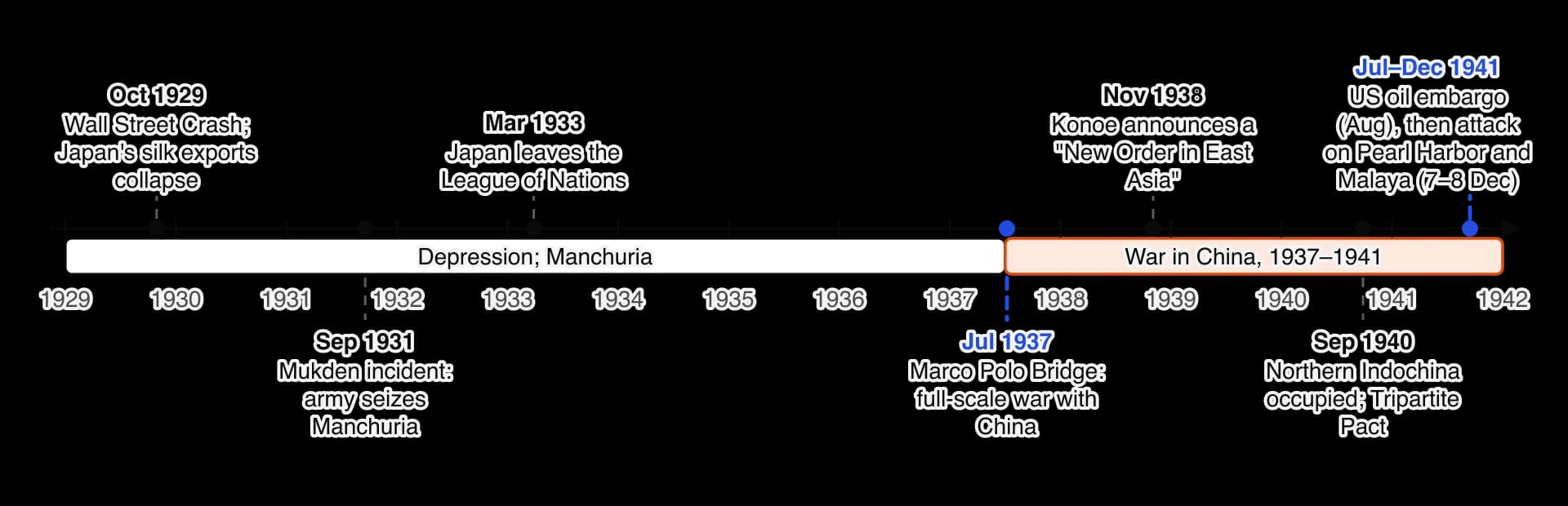
The Depression strengthened the argument, popular in the army and among nationalists, that Japan needed its own secure sources of raw materials and markets. On 18 September 1931 officers of the Kwantung Army, the Japanese force guarding Japanese railway interests in southern Manchuria, staged an explosion on the South Manchuria Railway near Mukden (Shenyang) and blamed it on Chinese troops. The army then occupied all of Manchuria, which was rich in coal, iron and farmland, without the approval of the government in Tokyo. In 1932 Japan set up the puppet state of Manchukuo.
The full-scale war with China that began after a clash at the Marco Polo Bridge near Beijing on 7 July 1937 did not end in the quick victory Japanese leaders expected. It made Japan more dependent on imports than ever: about 80 per cent of its oil imports came from the United States in the late 1930s (estimates range from about 75 to 85 per cent). This dependence gave the United States a means of pressure. It gave notice in July 1939 that it would end its commercial treaty with Japan, banned exports of scrap iron and steel in September 1940, and, after Japanese troops occupied southern French Indochina in July 1941, froze Japanese assets and stopped oil exports from 1 August 1941. Britain and the Dutch government in exile, which controlled the oil of the Netherlands East Indies, followed.
The embargo left Japan with oil stockpiles that would last perhaps two years. Its leaders faced a choice between giving up their war in China, as the United States demanded in the Hull note handed over by Secretary of State Cordell Hull on 26 November 1941, or seizing the oil of the Netherlands East Indies by force. Because the American fleet at Pearl Harbor and the US-held Philippines lay on the flank of any move south, the decision for war with the Dutch and British meant war with the United States as well. An Imperial Conference confirmed that decision on 1 December 1941.
Moreover, these two Powers, inducing other countries to follow suit, increased military preparations on all sides of Our Empire to challenge us. They have obstructed by every means our peaceful commerce, and finally resorted to a direct severance of economic relations, menacing gravely the existence of Our Empire. … Our Empire for its existence and self-defense has no other recourse but to appeal to arms and to crush every obstacle in its path.
Emperor Hirohito, Imperial Rescript declaring war on the United States and Britain, 8 December 1941 (official English text released by the Japanese Board of Information). The rescript was written to justify the war to the Japanese people at the moment of attack, so it presents economic pressure as aggression and leaves out what had provoked it: Japan's four-year war in China and its occupation of Indochina. Its value is that it shows how central the embargo had become to the way Japanese leaders understood their situation.
By 1860 the United States contained two very different economies. The North, with most of the population, had a growing industrial economy of factories, railways, banks and family farms worked by free labour; it held the great majority of the country's manufacturing. The South was overwhelmingly agricultural. Its wealth rested on cotton, tobacco, sugar and rice grown by enslaved people, and cotton made up more than half of all US exports by value.
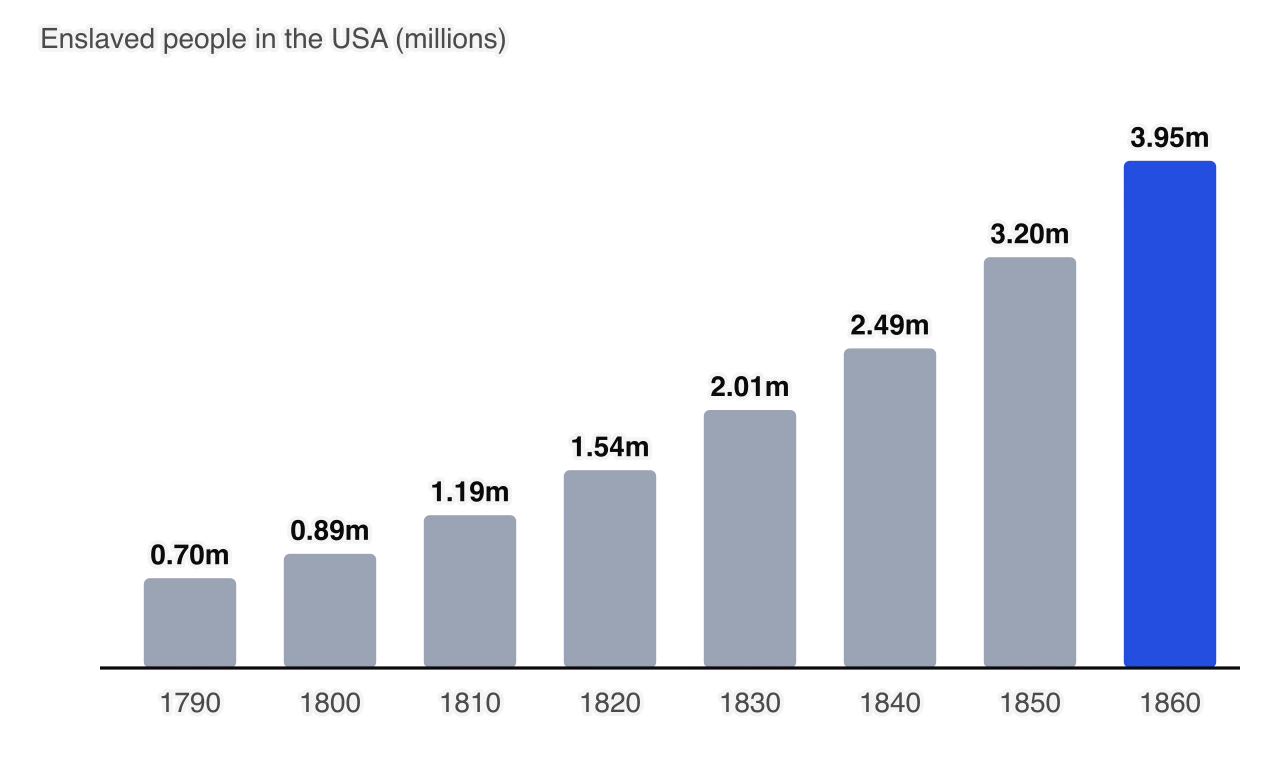
The bar chart of the enslaved population shows that slavery was expanding, not dying out. The almost four million enslaved people of 1860 were valued, as property, at roughly 3 to 3.5 billion dollars, more than the value of all the railways and factories in the country. Southern slaveholders therefore had an enormous economic stake in protecting slavery and in extending it to new land in the West, because cotton exhausted the soil and planters wanted new territory to grow it.
In The Rise of American Civilization (1927), Charles and Mary Beard argued that the war was at root a conflict between Northern industrial capitalism and Southern agrarian planters, fought over tariffs, banking and control of the federal government. Most historians now reject this as the main explanation. The tariff was low in 1860, many Northern businessmen wanted compromise to protect their Southern trade, and the documents of secession speak overwhelmingly about slavery, not tariffs.
Economic explanations are weaker for the First Crusade. An older view held that the crusaders were landless younger sons of nobles hoping to win estates. Jonathan Riley-Smith, in The First Crusaders, 1095–1131 (1997), used charters to show that crusading was very expensive: knights often sold or mortgaged land to pay for the journey, and most who survived went home. Material gain was a motive for some, and the Italian trading cities of Genoa, Pisa and Venice saw commercial opportunities in the ports of the Levant, but these interests became more important in later crusades than in 1095.
In Algeria, economic grievances were central but worked through social and political ones. European settlers owned much of the most fertile land in the coastal plains, and most of the Muslim population lived in rural poverty that grew worse as the population rose quickly after 1930. The FLN presented the war as a struggle against a colonial system in which land, jobs and wealth went to one community and poverty to another.
Political factors are causes rooted in power: who governs, how, and with what aims. They are present in every conflict, because war is a political act; even a war fought for religion or land has to be organised and declared by rulers, governments or political movements. The main political causes of conflict are:
Ambitions of states and rulers: expansion, conquest, prestige and security.
Alliances and the balance of power: commitments that widen a local quarrel, and fear of a rival growing stronger.
Nationalism and imperialism: the claims of nations to independence or unity, and of empires to rule others.
Ideology: systems of political ideas, such as fascism, communism or liberal democracy, that define enemies and aims.
Weak, divided or illegitimate government: rulers who cannot control their armies or their people, succession disputes, and the collapse of authority.
Failed diplomacy and miscalculation: leaders who misjudge an enemy's strength or will, or who see no way to back down.
The First Crusade began with a political appeal. In 1071 the army of the Byzantine Empire, the Greek-speaking Christian empire ruled from Constantinople, was defeated by the Seljuk Turks at Manzikert in eastern Anatolia. Over the next twenty years Turkish warbands occupied most of Anatolia. In March 1095 envoys of the Byzantine emperor Alexios I Komnenos asked Pope Urban II, at a church council at Piacenza in northern Italy, for help in recruiting Western soldiers.
Urban II had political reasons of his own to answer. He was a leader of the reform movement that sought to free the Church from control by lay rulers, a struggle known as the Investiture Contest. The German emperor Henry IV had set up a rival pope, Clement III, who held Rome for much of Urban's reign. Leading a great expedition of Western Christendom would show that Urban, not the emperor or his antipope, was its true head. It also offered a chance to heal the split between the Latin and Greek Churches, which had broken off relations in 1054.
The timing also depended on the politics of the Muslim world. After the deaths of the Seljuk sultan Malik-Shah and his chief minister Nizam al-Mulk in 1092, the Seljuk lands broke up into rival principalities, and the Fatimid caliphate of Egypt, a Shi'a rival of the Sunni Seljuks, competed with them for Syria and Palestine. This disunity was not a cause of the crusade, since nobody in the West knew much about it, but it helps to explain why the crusaders met no united resistance.
For a century before the Mongols arrived, northern China had been ruled by the Jin dynasty of the Jurchen people, who had driven the Song south in 1127. When the Mongols attacked the Jin from 1211, the Song saw a chance for revenge. In 1233 the Song agreed to join the Mongols against the Jin, and in February 1234 a joint siege took Caizhou, where the last Jin emperor killed himself.

The chain of events from alliance to war shows a political trigger. The Song court hoped to recover the old Northern Song capitals of Kaifeng and Luoyang, which had been lost for over a century. In the summer of 1234, Song armies marched north and occupied the ruined cities. Mongol forces drove them out, reportedly by breaking the dikes of the Yellow River to flood the Song camps. The Mongol leader Ögedei treated the advance as a breach of the alliance, and in 1235 Mongol armies invaded Song territory.
Mongol political ideas made a long war likely. The khans believed that Eternal Heaven (Tengri) had granted them rule over the whole world, so other rulers had to submit or be destroyed. The Song, as the legitimate Chinese dynasty, could not accept the status of a tributary. The war came in waves over 44 years, and political decisions repeatedly renewed it: in 1260 the Song chief minister Jia Sidao detained Khubilai Khan's envoy Hao Jing, who was held for some fifteen years, which gave Khubilai another reason to resume the conquest.
Japan's road to war shows how the weakness of civilian government could turn economic pressures into conflict. Under the Meiji Constitution of 1889 the army and navy answered to the emperor, not to the cabinet. From 1900 to 1913, and again from 1936, the army and navy ministers had to be serving officers, so the armed forces could bring down a government by refusing to provide one. In the early 1930s young officers and ultranationalists murdered leading politicians, including Prime Minister Inukai Tsuyoshi on 15 May 1932, and an attempted coup in Tokyo in February 1936 was put down only after several leading statesmen, including the finance minister Takahashi Korekiyo, had been killed.
Militarism meant that local commanders could make policy. The Mukden incident of 1931 was planned by Kwantung Army officers, and civilian governments accepted the conquest of Manchuria after it had happened. By the late 1930s, the political aims of Japan's leaders had become an ideology of regional domination: Prime Minister Konoe Fumimaro announced a New Order in East Asia in November 1938, and in September 1940 Japan signed the Tripartite Pact with Germany and Italy. Each step made compromise with the United States harder, because withdrawing from China would have meant admitting that the sacrifices of the war had been for nothing.
France invaded Algeria in 1830 and made it part of France itself in 1848, divided into three French départements. This set it apart from French protectorates such as Tunisia and Morocco: for most French politicians Algeria was not a colony to be given independence but French territory. The Muslim majority were French subjects rather than citizens until 1946, governed until 1944 under the Code de l'indigénat, a separate set of rules and punishments that applied only to them.

After the Second World War Algerian nationalists hoped for reform. Instead, the Organic Statute of Algeria of September 1947 created an Algerian Assembly of 120 members elected by two separate electoral colleges: one for about a million Europeans and a small minority of Muslims with full French citizenship, and one for more than eight million Muslim Algerians. Each college elected 60 members. The elections of 1948, under Governor-General Marcel-Edmond Naegelen, were openly rigged against nationalist candidates.
The nationalist movement itself was divided. The largest party, Messali Hadj's Movement for the Triumph of Democratic Liberties (MTLD), split in 1953–1954 between Messali's supporters and its central committee, while Ferhat Abbas's more moderate party still sought reform within a French framework. A group of younger activists, many of them from the MTLD's secret armed wing, broke away. In October 1954 they founded the Front de Libération Nationale (FLN), and on 1 November 1954 they launched coordinated attacks across Algeria.
The international setting supplied the timing. On 7 May 1954 the French army was defeated by the Viet Minh at Dien Bien Phu in Indochina, and in the same year France faced armed resistance in Tunisia and Morocco. For the FLN this showed that France could be beaten and that the moment to act had come. The French response showed how little room there was for compromise. On 12 November 1954 the interior minister, François Mitterrand, declared that "l'Algérie, c'est la France" ("Algeria is France"), and the government sent reinforcements to crush the rising.
In the United States, the political system had contained the dispute over slavery for forty years through compromises in Congress. These compromises broke down in the 1850s, as the timeline of the road to secession shows.
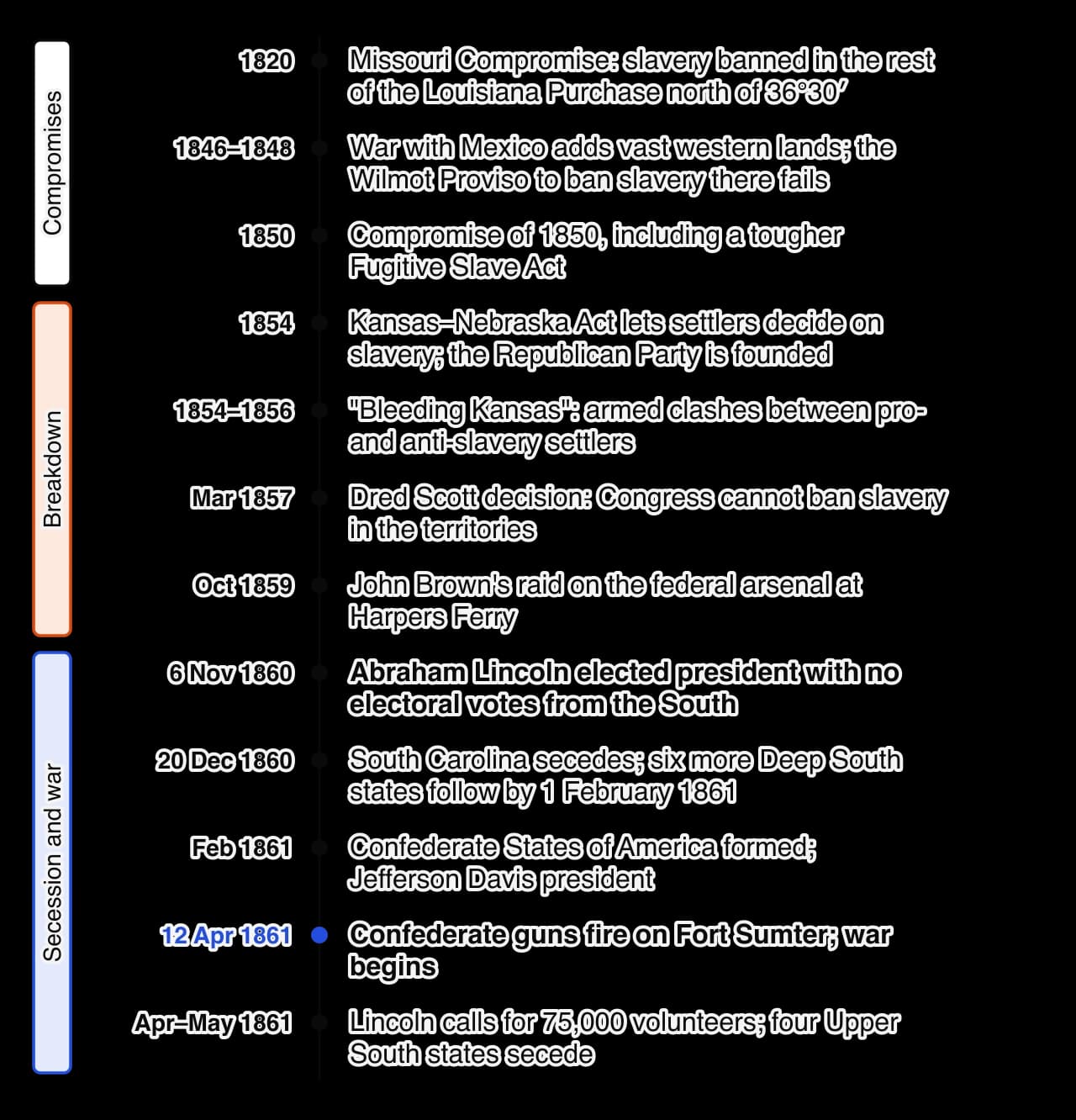
The Kansas–Nebraska Act of 1854 allowed settlers in two new territories to decide for themselves whether to permit slavery, a principle called popular sovereignty. It repealed the Missouri Compromise line and led to armed clashes in Kansas. In reaction, opponents of the expansion of slavery founded the Republican Party, which was based entirely in the North. In 1857 the Supreme Court ruled in the Dred Scott decision that Congress had no power to ban slavery in the territories, which made the Republican programme unconstitutional in the eyes of the South.
Secession was a political decision taken by state conventions dominated by slaveholders. Its leaders argued that the Union was a voluntary compact of sovereign states, a doctrine called states' rights. Lincoln held that the Union was perpetual and secession illegal. Once Confederate guns fired on Fort Sumter, a federal fort in Charleston harbour, on 12 April 1861, both sides believed they were fighting in self-defence: the South for its independence, the North for the survival of the Union.
Political legitimacy, the accepted right to rule, has caused conflicts throughout the period since 750. The Abbasid Revolution of 747–750 overthrew the Umayyad caliphs partly by uniting those who saw them as illegitimate: supporters of the Prophet's family, and non-Arab converts to Islam (the mawali) who resented their second-class status. Disputed successions have caused wars in every period. When Charles II of Spain died childless on 1 November 1700, his will left his throne to Philip of Anjou, a grandson of Louis XIV of France. Britain, the Dutch Republic and the Austrian Habsburgs feared that France and Spain would in effect become one power, formed the Grand Alliance in 1701 and fought the War of the Spanish Succession (1701–1714) to keep the two crowns apart.
In the twentieth century, ideology became a major cause of civil wars, often combined with class conflict. The Spanish Civil War began with a military rising on 17–18 July 1936 against the elected Popular Front government, by officers who saw themselves as defending Catholic Spain against liberalism, socialism and regional separatism. Behind the ideological divide lay bitter class tensions between great landowners and millions of landless labourers in the south, and between employers and the socialist and anarchist trade unions in the cities.
Social factors are causes rooted in how a society is organised and how its members see themselves and others: religion, ethnicity and national identity, race, class, and inequality between groups. They explain two things that economic and political factors alone cannot: why ordinary people were willing to fight, kill and die, and why enemies came to be seen as enemies at all.
Religion: holy war, the defence of sacred places, and the belief that fighting earns spiritual reward.
Ethnicity and identity: rivalry between groups defined by descent, language or culture, often sharpened by those in power.
Race and slavery: systems that rank people by race, and the fear among the dominant group of losing that position.
Inequality and injustice: class conflict, colonial discrimination and the humiliation of the ruled.
Public opinion and culture: nationalist feeling, militarist values and popular enthusiasm that push leaders towards war or make retreat difficult.
Religion is the clearest social cause of the Crusades. Western Christians of the eleventh century lived in a society in which fear of sin and hope of salvation shaped daily life. Pilgrimage to holy places, above all to Jerusalem, was a recognised way to do penance. Urban II joined pilgrimage to holy war: those who took the cross and fought to free the Christians of the East would earn forgiveness for their sins.
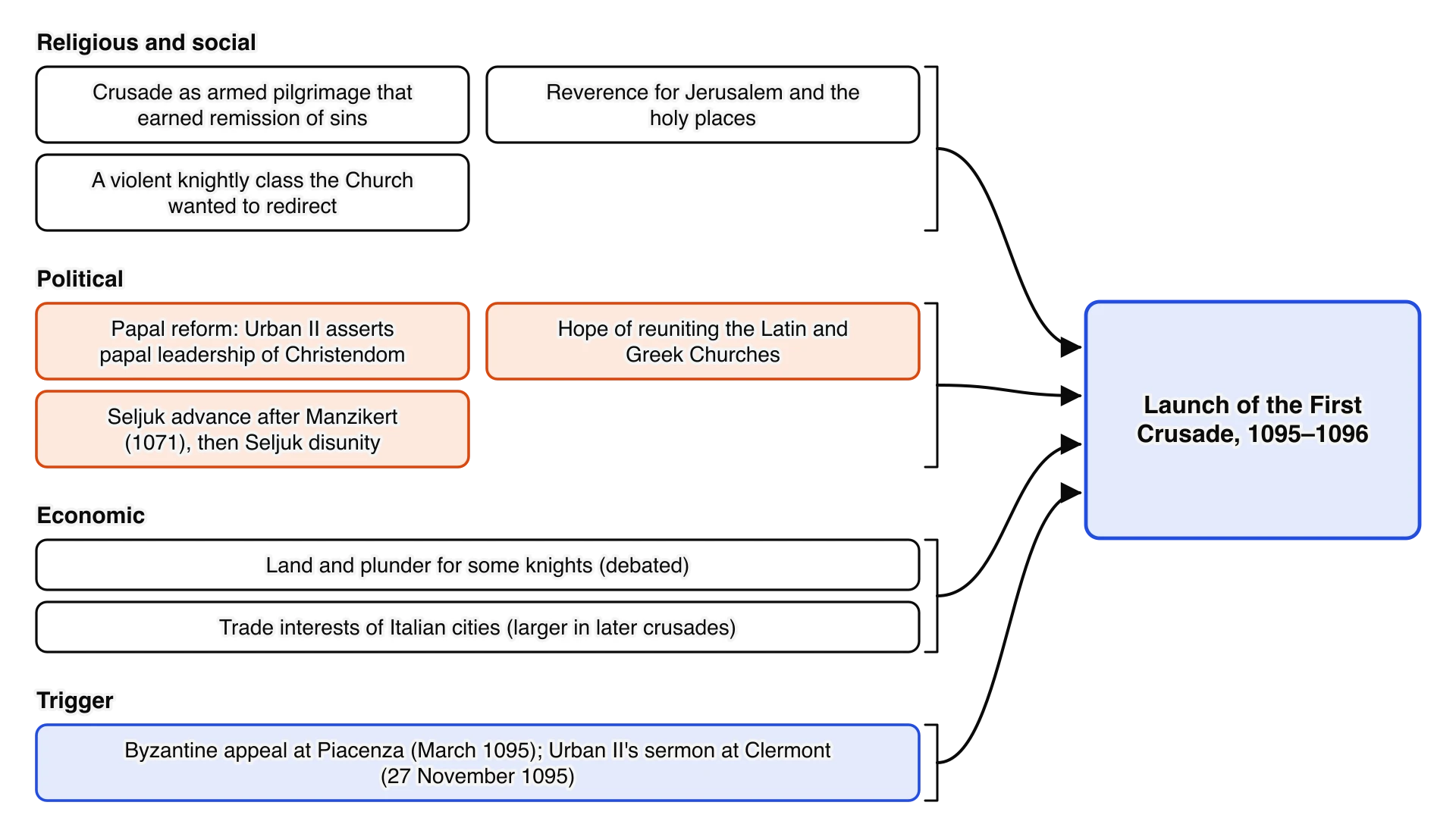
The diagram of the causes of the First Crusade shows why historians give religion such weight. Urban's sermon at Clermont on 27 November 1095 survives only in versions written down some years later by chroniclers, among them Fulcher of Chartres, who was probably present and who then went on the crusade himself.
For your brethren who live in the east are in urgent need of your help, and you must hasten to give them the aid which has often been promised them. … All who die by the way, whether by land or by sea, or in battle against the pagans, shall have immediate remission of sins. … Let those who have been accustomed unjustly to wage private warfare against the faithful now go against the infidels and end with victory this war which should have been begun long ago.
Pope Urban II, speech at the Council of Clermont, 27 November 1095, as recorded by Fulcher of Chartres in his History of the Expedition to Jerusalem (written in the early twelfth century; translation in O. J. Thatcher and E. H. McNeal, A Source Book for Medieval History, 1905). Fulcher wrote after the crusade had succeeded, so his version may shape the speech to fit what happened. It still shows the two social aims historians stress: spiritual reward for fighting, and the redirection of knightly violence away from fellow Christians.
The response was far larger than Urban expected. Popular preachers such as Peter the Hermit raised crowds of poor pilgrims as well as knights, and tens of thousands set out in 1096. The Church had for decades tried to limit warfare among Christians through the Peace and Truce of God, and the crusade gave a violent warrior class a holy outlet. On the Muslim side, religion became a cause of conflict more slowly: Nur al-Din and then Saladin used the ideal of jihad, holy war in defence of Islam, to unite Syria and Egypt against the crusader states in the twelfth century.
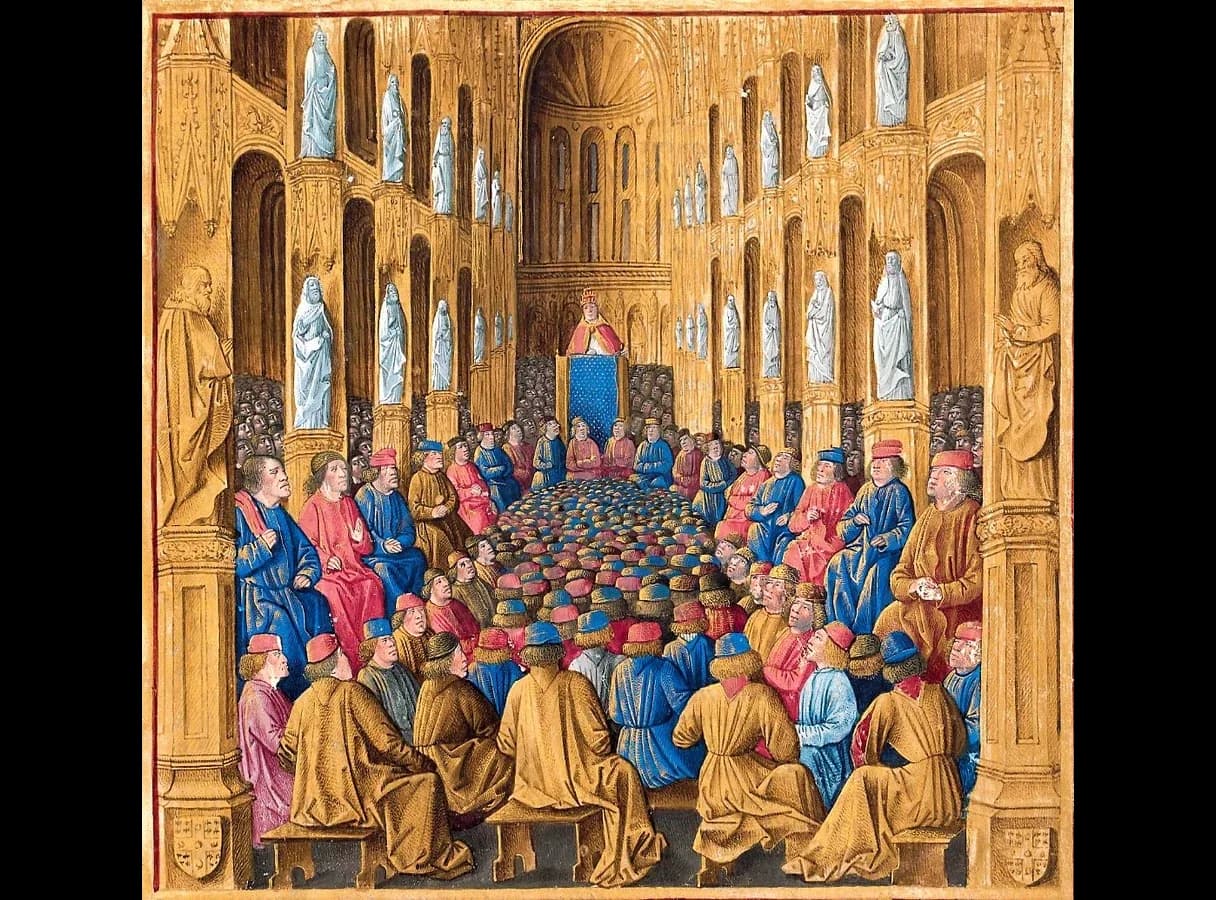
Religious motivation also explains the Third Crusade. Saladin destroyed the army of the Kingdom of Jerusalem at Hattin on 4 July 1187 and took Jerusalem on 2 October. Pope Gregory VIII called a new crusade in his bull Audita tremendi within weeks, and the kings of England and France and the German emperor took the cross. Governments raised a special tax, the Saladin Tithe, to pay for it.
In the United States, slavery was an economic system, but it was also a social order built on race. White Southerners of every class, including the three-quarters of white families who owned no slaves, were taught that slavery kept Black people in their place and that emancipation would bring disorder and racial equality. This fear explains why secession won support far beyond the planter class.
A geographical line has been drawn across the Union, and all the States north of that line have united in the election of a man to the high office of President of the United States, whose opinions and purposes are hostile to slavery.
South Carolina convention, Declaration of the Immediate Causes Which Induce and Justify the Secession of South Carolina from the Federal Union, 24 December 1860. Written to justify secession to other slave states and to the world, it presents Lincoln's victory as a sectional seizure of power. It shows that the leaders of secession saw the threat to slavery as the reason for leaving the Union.
Confederate leaders said the same thing openly. In a speech at Savannah, Georgia, on 21 March 1861, the Confederate vice-president Alexander Stephens declared that the new government's "corner-stone rests, upon the great truth that the negro is not equal to the white man". In the North, the growth of abolitionism, the movement to end slavery, made slavery a moral question for many voters. Harriet Beecher Stowe's novel Uncle Tom's Cabin (1852) sold hundreds of thousands of copies, and the resistance of Northern communities to the Fugitive Slave Act of 1850 convinced Southerners that the North would never respect their property.
Colonial rule divided Algerian society into two communities with unequal rights. The census of 1954 counted about 8.4 million Muslim Algerians and about 1 million Europeans, known as pieds-noirs, most of them born in Algeria. The Europeans controlled the administration, the best land and most skilled jobs. Muslim Algerians had little access to French schools, and most remained poor and illiterate.
The event that did most to turn grievance into hostility was the violence at Sétif and Guelma in May 1945. On 8 May 1945, the day of victory in Europe, Algerian nationalists marched at Sétif with the forbidden Algerian flag. Shooting broke out, and about a hundred Europeans were killed in the riots that followed. The French army, police and settler militias then took reprisals against the Muslim population for weeks. Estimates of Algerian deaths range from 1,020 (the figure in the first French official report) to 45,000 (the figure used by the Algerian state). No reliable count was made. Historians' estimates run from about 3,000 to 30,000: Charles-Robert Ageron put the figure at 5,000 to 6,000 and Jean-Pierre Peyroulou at about 6,500 to 8,000 across the two regions, while Jean-Louis Planche argues for 20,000 to 30,000. Many of the men who founded the FLN later said that May 1945 convinced them that only armed struggle could succeed.
Our action is directed solely against colonialism, the only and blind enemy, which has always refused to grant the slightest freedom by means of peaceful struggle. … Goal: national independence through the restoration of the sovereign, democratic and social Algerian state within the framework of Islamic principles, and respect for all fundamental freedoms without distinction of race or religion.
Front de Libération Nationale, Proclamation of 1 November 1954 (translated from the French text reprinted in Textes fondamentaux du Front de Libération Nationale, 1976). The proclamation was distributed on the night of the first attacks to win the support of Algerians and to explain the rising to the world. It presents violence as the only option left after peaceful methods had failed, and defines the nation by an Arab-Islamic identity, while promising equal rights to minorities to reassure outside opinion.
Identity mattered on both sides. Since the 1930s the Association of Algerian Muslim Ulama, led by Abd al-Hamid Ben Badis, had taught that Algerians were a Muslim, Arabic-speaking nation that could never be assimilated into France. The pieds-noirs, for their part, saw Algeria as their only home and feared becoming a minority in an independent Muslim state, which is one reason why they resisted every reform.
Popular attitudes can push leaders towards war. In Japan, the conquest of Manchuria in 1931–1932 was hugely popular. The historian Louise Young, in Japan's Total Empire (1998), shows how newspapers, radio, songs and mass organisations turned Manchukuo into a national project, so that later governments found it politically impossible to give up what had been won. Schools taught loyalty to the emperor and the duty to die for him. In Europe before 1914, as the case of the First World War shows, mass nationalism, popular newspapers and a culture that saw war as a test of national strength had similar effects.
Ethnic identity is often shaped by politics rather than fixed. In Rwanda, Belgian colonial rulers issued identity cards from 1933 that recorded every person as Hutu, Tutsi or Twa, and long favoured the Tutsi minority. These rigid categories, and the memory of colonial favouritism, became the basis of the political violence that led to the civil war of 1990–1994 and the genocide of the Tutsi in 1994.
Environmental factors are causes rooted in the natural world: climate and climate change, drought, floods and famine, the scarcity of land, water or pasture, and geography itself. They are the newest of the four kinds of cause in historical writing. Since the 1990s, environmental history and the use of scientific evidence such as tree rings, ice cores and pollen have allowed historians to reconstruct past climates and to test whether they shaped human conflict.
The most discussed environmental explanation of a conflict in this period concerns the Mongols. In 2014 a team of scientists and historians led by Neil Pederson and including the historian Nicola Di Cosmo published tree-ring evidence from ancient Siberian pines in central Mongolia in the journal Proceedings of the National Academy of Sciences. The rings showed a period of drought in the late twelfth century, followed by fifteen consecutive warm years of above-average moisture from 1211 to 1225, a pluvial without parallel in the 1,112 years covered by the record.
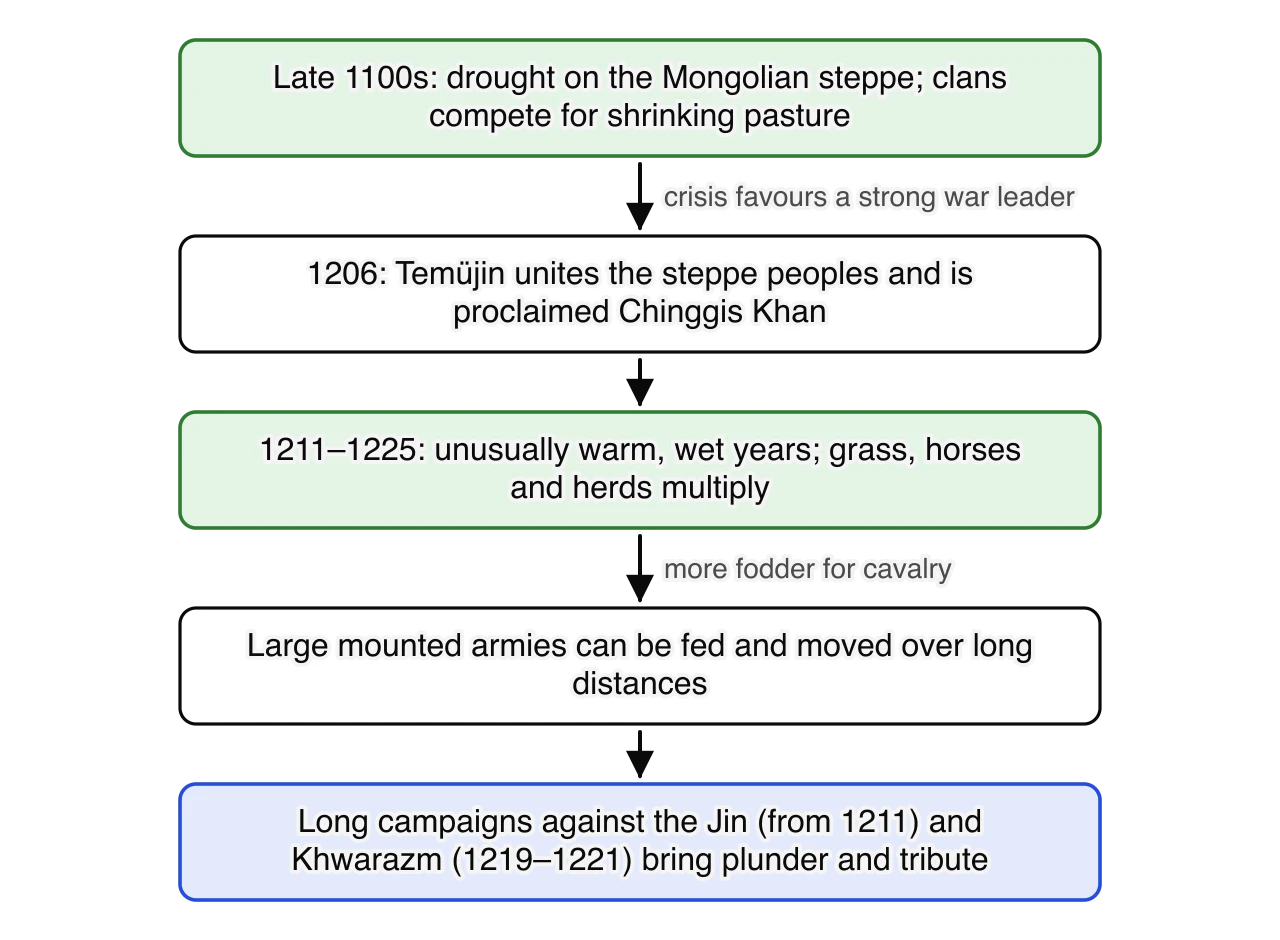
The authors suggest that the drought of the late twelfth century added to the disorder on the steppe from which Temüjin rose as a war leader, and that the wet years after 1211 produced more grass, so more horses and livestock. Since a Mongol warrior took several horses on campaign, abundant pasture made it possible to keep huge cavalry armies in the field. They argue that the climate helped to sustain the conquests at the moment Chinggis Khan launched them.
The hypothesis has limits, and the authors present it as a contributing factor. The Mongols attacked the Xi Xia kingdom in 1209, before the wet years began, and the conquest of the Song took place long after them. Most historians of the Mongols still put the emphasis on political and military causes: Chinggis Khan's reorganisation of the steppe peoples into units loyal to him, the need to reward followers with plunder, and the weakness and division of neighbouring states. The climate made the conquests easier to sustain; it did not decide that they would happen.
 YouTube
Between about 1300 and 1850 the northern hemisphere was cooler than before or since, a period called the Little Ice Age. In Global Crisis: War, Climate Change and Catastrophe in the Seventeenth Century (2013), the historian Geoffrey Parker argues that the coldest decades of the mid-seventeenth century brought harvest failures, famine and disease across the world, and that these helped to cause an unusual number of wars, revolts and revolutions in the middle decades of the century.
China gives the clearest example. Severe drought and cold in the 1630s and 1640s caused famine in northern China. Hungry peasants and unpaid soldiers joined rebel armies, one of which, led by Li Zicheng, took Beijing in April 1644, and the last Ming emperor hanged himself. The Manchus then crossed the Great Wall and founded the Qing dynasty. The climate did not cause the fall of the Ming on its own; it struck a dynasty already weakened by debt, corruption and frontier wars, and turned that weakness into collapse.
In the twenty-first century, the question of whether climate change causes war has become a political as well as a historical one. In Darfur, in western Sudan, conflict from 2003 between government-backed militias and rebel groups followed decades of drought and the spread of the desert, which pushed herders and farmers into competition for land and water. In 2007 the UN Secretary-General Ban Ki-moon described Darfur as, in part, an ecological crisis.
The Syrian civil war that began in 2011 has produced a sharper scientific debate. A study by Colin Kelley and colleagues (2015) argued that a severe drought from 2006 to 2010, made more likely by climate change, drove about 1.5 million rural people into Syria's cities and helped create the conditions for the uprising. Jan Selby and colleagues (2017) replied that the evidence for this chain was weak, and that the government's economic policies and the authoritarian response to the protests of 2011 explain the war far better. The debate shows the main difficulty with environmental explanations: it is hard to separate the effect of the climate from the effect of the decisions people made in response to it.
Sudden natural disasters can have the same effect when governments fail to respond. On 12 November 1970 the Bhola cyclone struck the coast of East Pakistan (now Bangladesh) and killed somewhere between 300,000 and 500,000 people. The slow relief effort of the government in West Pakistan deepened Bengali anger at rule from the west, and in the elections of December 1970 the Bengali nationalist Awami League won a majority in the national assembly. When the military government refused to hand over power and launched a crackdown in March 1971, the result was the Bangladesh Liberation War. The cyclone did not create Bengali grievances, which were political and economic, but it sharpened them at a decisive moment.
Environmental factors played little direct part in the Crusades, the US Civil War, the First World War or the Algerian War. Geography and scarcity still mattered indirectly. Japan's lack of oil, iron and rubber was a fact of geography that shaped its leaders' belief that they needed an empire. The cotton economy of the American South depended on climate and soil, and soil exhaustion helped drive the demand to take slavery west. Treating these as environmental factors is a matter of choice; many historians class them as economic.
The outbreak of the First World War is the most studied case of how a conflict begins. All four kinds of factor can be found in it, the long-term causes and the trigger are clearly separated, and the decisions of a small number of leaders in July 1914 are recorded in unusual detail. It is therefore the best case for seeing how causes of different types and timescales combine.
By 1914 the great powers of Europe were divided into two armed blocs. Germany and Austria-Hungary had been allied since 1879 (the Dual Alliance), and Italy joined them in the Triple Alliance of 1882. France, isolated after its defeat by Prussia in 1870–1871, allied with Russia in 1894. Britain, worried by German naval building, settled its colonial quarrels with France in the Entente Cordiale of 1904 and with Russia in 1907.
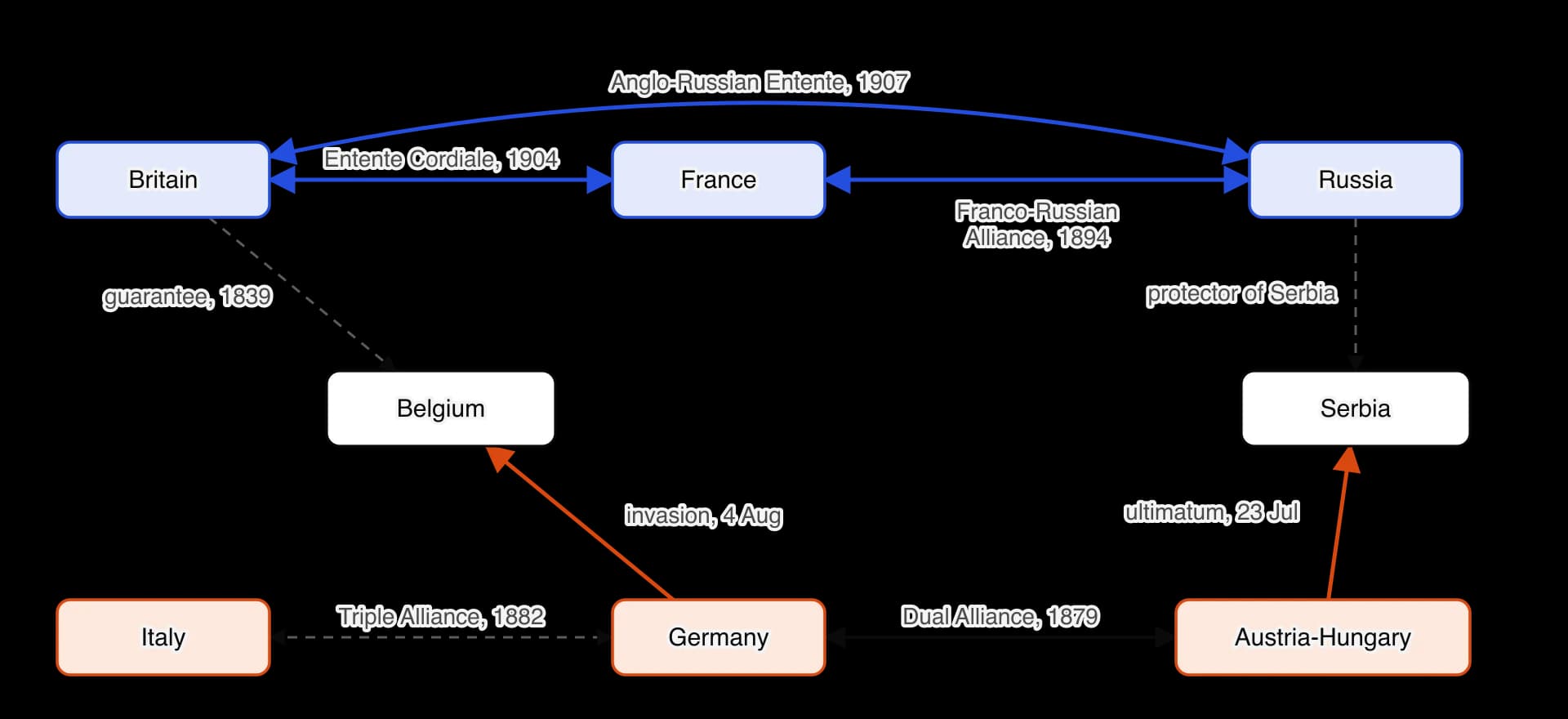
The diagram of the alliances shows why a quarrel between Austria-Hungary and Serbia was dangerous. Russia saw itself as the protector of Serbia and of the Slav peoples of the Balkans; Germany was committed to Austria-Hungary; France was committed to Russia. A local war could draw in every great power in a few days.
The alliances were matched by arms races. Under Admiral Alfred von Tirpitz, Germany passed Navy Laws in 1898 and 1900 to build a battle fleet that could challenge the Royal Navy. Britain answered with HMS Dreadnought (1906), a battleship so advanced that it made earlier designs obsolete, and the two powers raced to build more. On land, Germany, France and Russia all expanded their armies in 1912–1913. Military planning became rigid. The German Schlieffen Plan assumed that in a war with France and Russia, Germany must defeat France first, quickly, by marching through neutral Belgium, before the slow Russian army was ready. Once Russia mobilised, German generals believed they had to attack France at once.
Imperialism, the drive of states to acquire and rule overseas territory, created rivalries outside Europe. Germany, unified only in 1871, wanted its "place in the sun" as a world power, and twice challenged French control of Morocco, in 1905–1906 and 1911. Both crises ended in German diplomatic defeat and drew Britain closer to France. The economic rivalry between Britain and Germany was real, but it cut both ways: each was among the other's largest trading partners. In The Great Illusion (1910), the British writer Norman Angell argued that war between industrial nations would ruin the victors as well as the defeated, and so had become irrational.
Nationalism was the most dangerous force in south-eastern Europe. Austria-Hungary ruled many peoples, among them Czechs, Poles, Croats, Serbs and Romanians, and its leaders feared that the national movements of its Slav subjects would tear the empire apart. Independent Serbia hoped to unite the South Slavs, including those living in Austria-Hungary, in one state. In Russia, Pan-Slavism, the belief that Russia should protect and lead the Slav peoples, gave the tsar's government a popular reason to support Serbia.
Social and cultural attitudes made war seem acceptable. Many educated Europeans accepted Social Darwinism, the misapplication of Darwin's ideas to nations and races as a struggle in which only the strong survive. Popular newspapers fed national rivalry, and military values were admired in schools and youth movements. Some historians, following Hans-Ulrich Wehler, argue that German leaders also saw a successful war as a way to strengthen the monarchy against the growing Social Democratic Party, which became the largest party in the Reichstag in 1912.
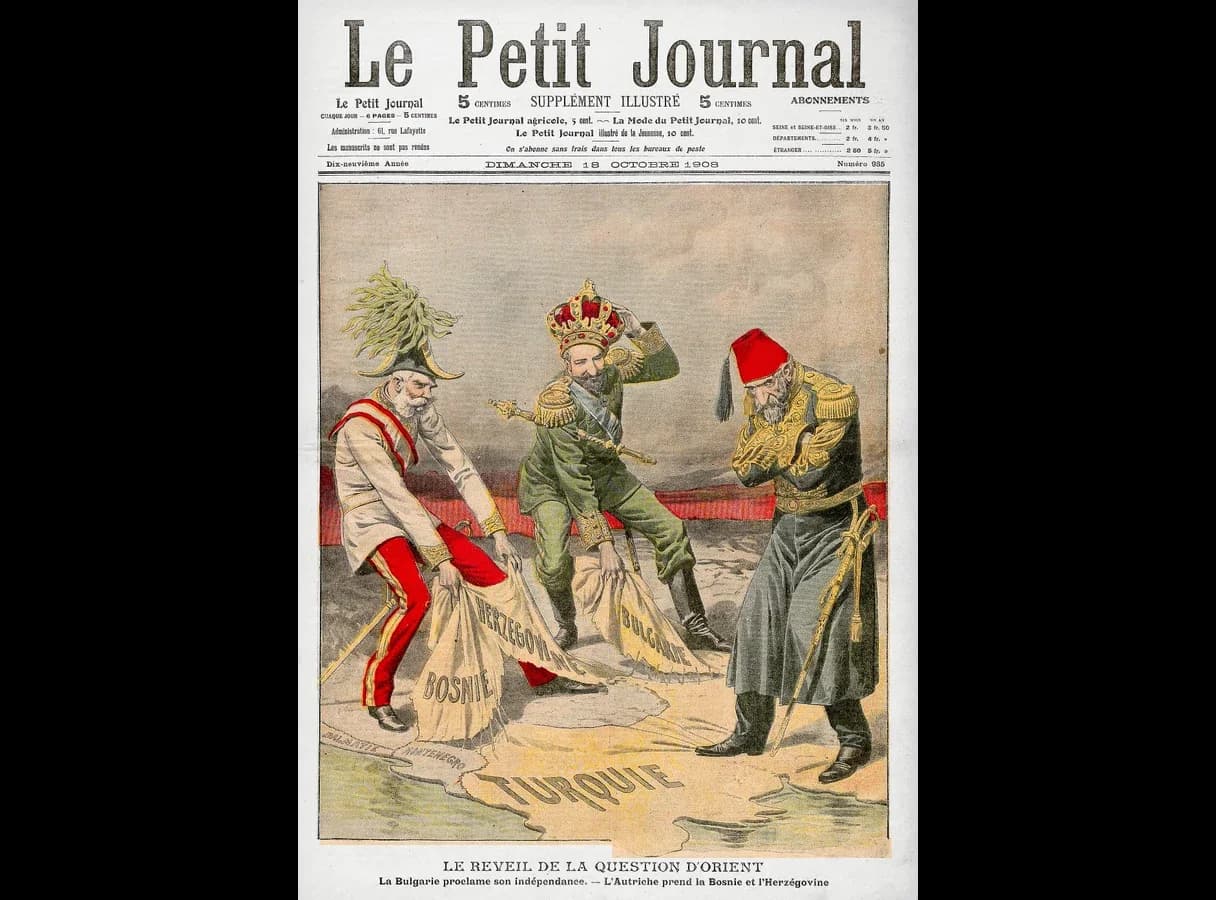
In October 1908 Austria-Hungary annexed Bosnia and Herzegovina, Ottoman provinces it had occupied since 1878, whose population included many Serbs. Serbia and Russia protested, but Russia, still weak after its defeat by Japan in 1904–1905, backed down in March 1909 under German pressure. Russian leaders resolved not to be humiliated again.
In the Balkan Wars of 1912–1913, Serbia, Greece, Bulgaria and Montenegro drove the Ottoman Empire out of almost all its European lands and then fought each other over the spoils. Serbia nearly doubled its territory and emerged confident and ambitious. In Vienna the chief of the general staff, Franz Conrad von Hötzendorf, had urged war on Serbia many times; by 1914 a growing number of Austro-Hungarian leaders agreed that Serbia had to be crushed before South Slav nationalism destroyed the empire.
On 28 June 1914 Archduke Franz Ferdinand, the heir to the Austro-Hungarian throne, and his wife Sophie were shot dead in Sarajevo, the capital of Bosnia, by Gavrilo Princip, a 19-year-old Bosnian Serb. Princip belonged to Young Bosnia, a revolutionary nationalist group, and had been armed with the help of the Black Hand, a secret society of Serbian army officers led by the head of Serbian military intelligence, Colonel Dragutin Dimitrijević. How much the Serbian government knew of the plot remains uncertain.
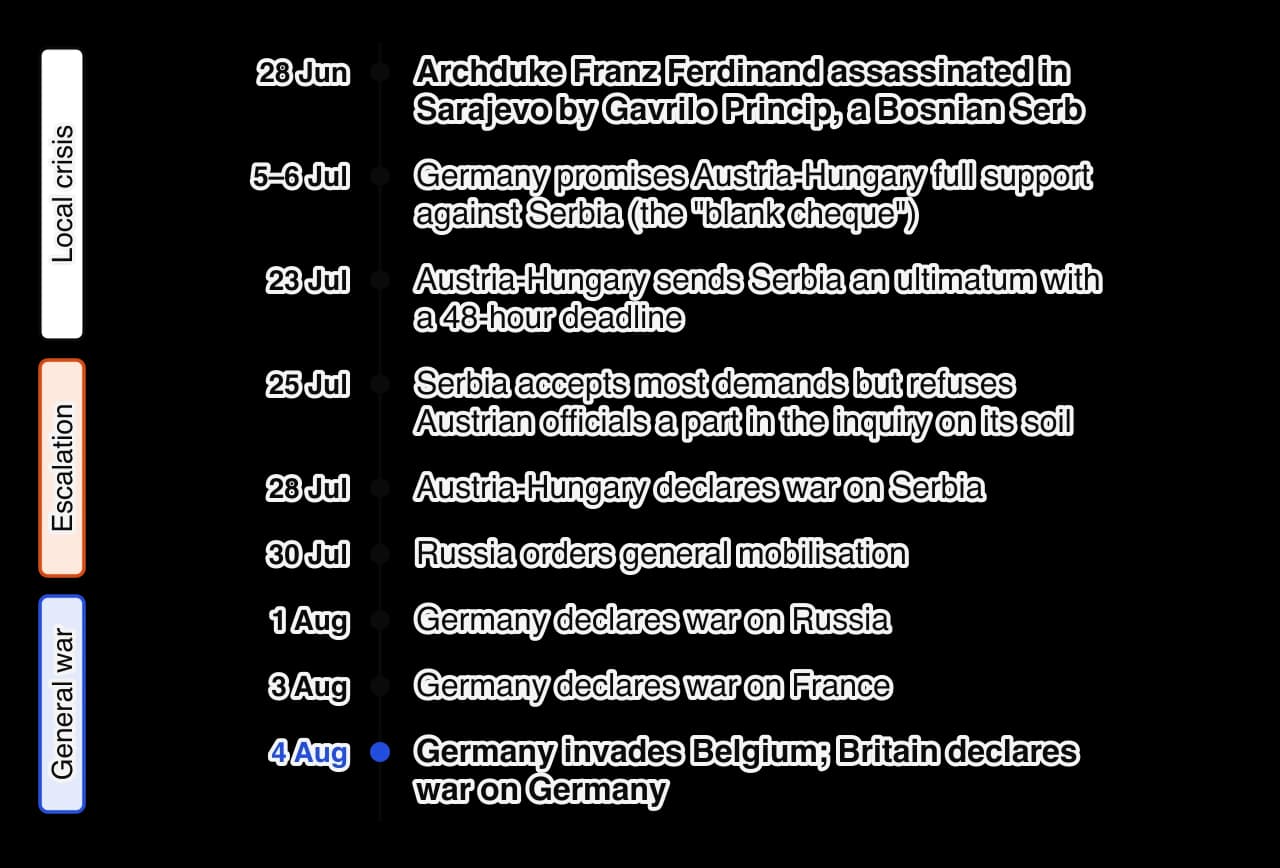
The timeline of the July Crisis shows that the assassination did not lead automatically to war. Vienna first asked Berlin for support. On 5–6 July Kaiser Wilhelm II and his chancellor, Theobald von Bethmann Hollweg, assured Austria-Hungary that it could count on Germany's full support whatever it decided against Serbia, a promise later called the blank cheque. Austria-Hungary then drafted an ultimatum designed to be rejected.
It is clear from the statements and confessions of the criminal authors of the assassination of the twenty-eighth of June, that the murder at Sarajevo was conceived at Belgrade … 5. to agree to the cooperation in Serbia of the organs of the Imperial and Royal Government in the suppression of the subversive movement directed against the integrity of the Monarchy; 6. to institute a judicial inquiry against every participant in the conspiracy of the twenty-eighth of June who may be found in Serbian territory; the organs of the Imperial and Royal Government delegated for this purpose will take part in the proceedings held for this purpose.
Austro-Hungarian ultimatum to Serbia, delivered in Belgrade on 23 July 1914 (English translation, World War I Document Archive). The ultimatum gave Serbia 48 hours to reply. Demands 5 and 6 would have allowed Austro-Hungarian officials to act inside Serbia, which no sovereign state could easily accept. The document shows that Vienna wanted war with Serbia, while presenting its demands as a reasonable response to a crime.
Serbia's reply of 25 July accepted almost every demand but refused to let Austro-Hungarian officials take part in the inquiry on Serbian soil. Even the Kaiser, on reading it, thought that it removed any reason for war. Austria-Hungary declared war on Serbia on 28 July anyway. Russia ordered general mobilisation on 30 July to protect Serbia and its own position in the Balkans. Germany, whose war plan depended on an immediate attack in the west, declared war on Russia on 1 August and on France on 3 August, and invaded Belgium. Britain, bound by the 1839 treaty guaranteeing Belgian neutrality and unwilling to see France defeated, declared war on Germany on 4 August.
 YouTube
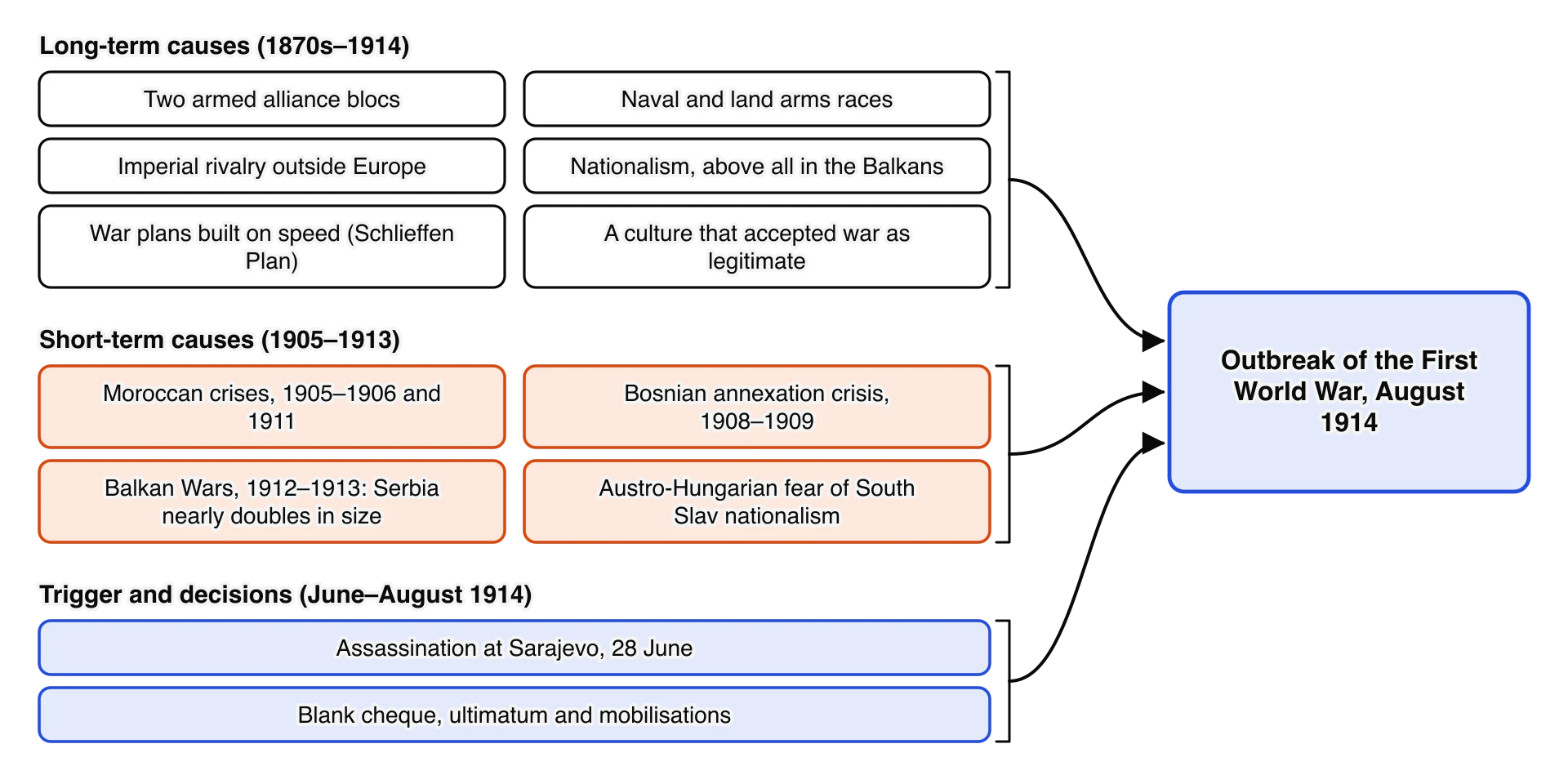
The diagram of the causes of the First World War groups them by timescale; the table of the four kinds of factor groups the same evidence by type.
Type of factor | Evidence from 1914 | How far does it explain the outbreak? |
|---|---|---|
Political | Alliance commitments; Austro-Hungarian fear of South Slav nationalism; the blank cheque; the decision to issue an ultimatum; Russian and German mobilisation | The strongest explanation: the war began through political decisions taken by a few leaders, shaped by alliances and the fear of decline |
Social | Nationalism in the Balkans and Pan-Slavism in Russia; Social Darwinism; popular nationalism and militarism; domestic pressures in Germany | Explains why a regional assassination mattered so much and why leaders expected popular support; it does not explain the timing |
Economic | Imperial and trade rivalry; the naval race; arms spending | Weakest as a direct cause: bankers and businessmen mostly wanted peace in July 1914; economic rivalry worked through political fears of decline |
Environmental | None of significance | Not a cause in this case |
Most historians now explain the outbreak of the war as the result of decisions taken under the pressure of structural forces. The alliances, arms races and nationalism made a general war possible and made leaders feel that time was against them. The war happened because the leaders of Austria-Hungary chose to use the assassination to crush Serbia, because Germany encouraged them, and because Russia, France and Britain chose to resist rather than accept an Austro-German victory in the Balkans.
Setting the six conflicts side by side shows which factors appear in every case, which matter only in some, and how they combine. The comparative table of the core conflicts gives a judgement for each; other historians weigh some cases differently.
Conflict | Economic | Political | Social | Environmental | Trigger | Most important (a judgement) |
|---|---|---|---|---|---|---|
Crusades, 1095–1192 | Land and plunder for some knights; Italian trade (later) | Papal reform and leadership; Byzantine appeal; Seljuk advance | Religious devotion, penance and pilgrimage; jihad on the Muslim side | Little evidence | Clermont, 1095; Hattin and the fall of Jerusalem, 1187 | Social (religious), working through papal politics |
Mongol–Song, 1235–1279 | Need for plunder and tribute to reward followers; Song wealth | Mongol claim to world rule; Song attempt to retake Kaifeng and Luoyang | Steppe warrior culture; Song refusal to submit to "barbarians" | Wet years 1211–1225 sustained cavalry armies (contested) | Song advance north, summer 1234 | Political and economic: an expansionist empire meeting a rich neighbour |
US Civil War, 1861–1865 | Slavery as the basis of Southern wealth; two diverging economies | Breakdown of compromises; Republican victory; secession | Racism; fear of emancipation; abolitionism | Soil exhaustion drove westward expansion (indirect) | Lincoln's election; Fort Sumter | Slavery, which was economic, social and political at once |
First World War, 1914–1918 | Imperial and naval rivalry | Alliances; war plans; decisions of July 1914 | Nationalism; Pan-Slavism; Social Darwinism | None | Sarajevo, 28 June 1914 | Political decisions under structural pressure |
War in Asia and the Pacific, 1937–1945 | Depression; lack of raw materials; US oil embargo, 1941 | Militarism; army autonomy; Tripartite Pact | Emperor-centred nationalism; popular support for empire | Lack of natural resources (geography) | Marco Polo Bridge, 1937; embargo, 1941 | Economic pressure, working through militarist politics |
Algerian War, 1954–1962 | Settler landholding; rural poverty | Algeria as part of France; rigged elections; no route to reform | Unequal citizenship; Sétif 1945; Arab-Islamic identity | Little evidence | Dien Bien Phu, May 1954; FLN attacks, 1 Nov 1954 | Political and social: colonial inequality with no peaceful remedy |
Political factors appear in every case because they are the channel through which other causes lead to war. Economic hardship and social grievance existed for long periods without conflict; war came when a government, ruler or movement decided to fight. This is why many historians treat political factors as the most important. The counter-argument is that political decisions themselves need explaining: Japanese leaders chose war in 1941 because of the oil embargo, and the FLN chose armed struggle because of decades of colonial inequality.
Economic factors are most important where a state's survival or a group's wealth is at stake. Japan in 1941 and the slaveholding South in 1860 both believed that their economic system could not survive without war or secession. Economic factors are weakest as an explanation of the First Crusade and of 1914, when the people who decided on war acted for religious, strategic or political reasons that often went against their material interests.
Social factors explain the scale and intensity of conflict. Religion explains why tens of thousands of people walked thousands of kilometres to Jerusalem in 1096–1099; racism explains why non-slaveholding white Southerners fought for a slaveholders' republic; colonial humiliation explains why the FLN found recruits. Social factors also make compromise harder, because people do not easily bargain over their faith or identity.
Environmental factors are the least important in these six cases, with the partial exception of the Mongols. In the longer view, however, climate shocks such as the seventeenth-century crisis show that they can weaken states and so make conflict more likely, especially in societies close to the limits of subsistence.
Explaining why a conflict began at a particular moment often means asking why leaders thought it was the right time. Several of the core cases show the same pattern: leaders acted because they believed a window of opportunity was closing.
The Song in 1234 moved because the fall of the Jin had removed the power that held the northern capitals.
German leaders in 1914 feared that Russian rearmament, due to be completed by about 1917, would soon make victory impossible.
Japanese leaders in 1941 knew that their oil was running out and that the American naval building programme of 1940 would soon give the United States overwhelming superiority in the Pacific.
The FLN in 1954 acted while France was weakened by defeat in Indochina and distracted by unrest in Tunisia and Morocco.
This reasoning links structural factors to decisions. Alliances, shortages of resources and colonial inequality created pressure over many years, and leaders' calculations about timing explain why that pressure led to war in a particular year.
The causes of almost every major conflict are disputed, by the people who fought it and by historians since. Contemporaries usually blamed the enemy and presented their own side as acting in self-defence. Historians' interpretations have changed as new evidence appeared and as their own societies asked new questions.
At the Paris Peace Conference the victors placed responsibility on Germany and its allies in Article 231 of the Treaty of Versailles (1919), and German governments spent the 1920s trying to disprove it. By the 1930s a more even view had spread: in his War Memoirs (1933–1936) the former British prime minister David Lloyd George described the nations as having slithered into a war that none of them really wanted.
In Griff nach der Weltmacht (1961; in English Germany's Aims in the First World War, 1967), the German historian Fritz Fischer reopened the question. Using German government archives, he argued that Germany's leaders had aims of expansion in Europe and overseas, deliberately encouraged Austria-Hungary in July 1914, and accepted the risk of a general war to achieve them. In a later book he stressed a meeting of the Kaiser with his military chiefs on 8 December 1912 as evidence that war was being prepared. The Fischer controversy shocked West Germany, because it suggested continuity between the aims of 1914 and those of the Nazi era.
Since the 1990s many historians have spread responsibility more widely. In The Sleepwalkers (2012), Christopher Clark argues that the crisis was the product of a shared political culture in which leaders in every capital, Belgrade and St Petersburg as well as Vienna and Berlin, made choices that brought war closer, often while misunderstanding one another. He asks how the war came about rather than who was guilty. Margaret MacMillan, in The War That Ended Peace (2013), stresses that war was not inevitable and that a few leaders could have chosen otherwise. Annika Mombauer and others reply that the decisions in Vienna and Berlin remain the decisive ones, because only they set out to start a war.
Historian or contemporary | Work | Argument | Evidence stressed |
|---|---|---|---|
Allied governments | Treaty of Versailles, Article 231 (1919) | Germany and its allies were responsible for the war | German support for Austria-Hungary; the invasion of Belgium |
V. I. Lenin | Imperialism, the Highest Stage of Capitalism (1917) | The war was a struggle between capitalist empires for markets and colonies | Imperial rivalry; the export of capital |
Fritz Fischer | Griff nach der Weltmacht (1961) | Germany deliberately risked or sought a general war to become a world power | German war aims; the blank cheque; the meeting of December 1912 |
Christopher Clark | The Sleepwalkers (2012) | Responsibility was shared; leaders across Europe acted with limited understanding of where their choices led | Serbian nationalism; Russian and French decisions; confused decision-making in every capital |
Margaret MacMillan | The War That Ended Peace (2013) | War was not inevitable; it resulted from the choices of a small number of leaders | The earlier crises that ended in peace; personalities of decision-makers |
Weighing these views depends on what is being asked. If the question is which governments set out to fight, the evidence points first to Vienna and Berlin. If the question is why a Balkan war became a world war, Clark's attention to every capital and to the alliance system is more convincing. Lenin's economic explanation fits the long-term rivalry of empires but has little support in the records of July 1914.
After 1865 many former Confederates rewrote the causes of the war. The Lost Cause, a view named after Edward Pollard's book The Lost Cause (1866), presented the South as fighting for states' rights and constitutional liberty, not slavery. Even Alexander Stephens, whose Cornerstone Speech of 1861 had named racial slavery as the foundation of the Confederacy, argued after the war that the conflict had been about the nature of the Union. The Lost Cause shaped school textbooks and monuments in the South for a century.
Historians have offered several other explanations. Charles and Mary Beard (1927) saw an economic clash between industrial capitalism and agrarian planters. In the 1930s and 1940s the revisionists Avery Craven and James G. Randall argued that the war was avoidable, the work of extremists on both sides and of what Randall called a "blundering generation" of politicians. Since the 1950s, and above all in James McPherson's Battle Cry of Freedom (1988), most historians have returned to the view of the secessionists themselves: slavery, and the dispute over its expansion, was the central cause of the war. The debate shows how a society's later needs, such as white reconciliation after Reconstruction, can shape how the causes of a war are remembered.
Contemporaries disagreed too. Western chroniclers such as Fulcher of Chartres presented the crusade as the work of God. The Byzantine princess Anna Komnene, daughter of Alexios I, wrote in the Alexiad (c. 1148) that while many crusaders were simple pilgrims, some of their leaders, above all the Norman Bohemond, wanted to seize Byzantine lands for themselves. The Muslim historian Ibn al-Athir, writing in the early thirteenth century, placed the crusade in a wider pattern of Frankish expansion that had already taken Toledo in Spain and Sicily.
Modern historians have moved between the same explanations. Writers in the Enlightenment and later Marxist historians stressed land hunger, plunder and trade. Jonathan Riley-Smith and his students, working from charters that record how individual crusaders raised money, have argued that religious motives were primary because crusading was so costly and dangerous. Christopher Tyerman, in God's War (2006), accepts the central place of faith but stresses that religion, family obligation, lordship and the hope of gain were bound together for most knights. Carole Hillenbrand, in The Crusades: Islamic Perspectives (1999), shows that Muslim rulers at first saw the invaders as one more threat among many, and that the idea of a counter-crusade took decades to develop.
The International Military Tribunal for the Far East (the Tokyo trials, 1946–1948) found that Japan's leaders had conspired since 1928 to dominate East Asia by aggression. Some Japanese nationalist writers, and the museum at the Yasukuni Shrine in Tokyo, have long presented the war instead as self-defence against encirclement by the United States, Britain, China and the Netherlands (the "ABCD" powers). Most historians reject both the idea of a single long conspiracy and the self-defence argument.
Michael Barnhart, in Japan Prepares for Total War (1987), argues that the search for economic security, above all the army's belief that Japan must control the resources needed for a long war, drove expansion from Manchuria to Indochina. Akira Iriye stresses the failure of diplomacy and the mutual misunderstanding of Japan and the United States. Eri Hotta, in Japan 1941 (2013), shows that many Japanese leaders believed Japan would probably lose a long war with the United States, yet none was willing to take responsibility for the retreat from China that peace would have meant.
The French state long refused to call the conflict a war. It was officially described as a set of "events" and operations to maintain order inside France, and a law of October 1999 first recognised it as the Algerian War. The FLN and the independent Algerian state presented it as a revolution of a united people against colonial oppression. The psychiatrist Frantz Fanon, who worked in Algeria and joined the FLN, argued in The Wretched of the Earth (1961) that colonialism was itself a system of violence, so that the violence of the colonised was a response to it. Historians such as Benjamin Stora and the former FLN member Mohammed Harbi have since written more complex accounts that include the FLN's internal divisions, its violence against rival nationalists, and the experiences of pieds-noirs and Algerians who sided with France.
Paper 2 tests this guiding question in Section B, through a Part A explanation of one example and a Part B essay across two regions, and the concept of causation in Section A.
I can define a conflict and distinguish long-term causes, short-term causes and triggers.
I can explain the difference between necessary and sufficient causes, and between structures and decisions, with an example.
I can explain the ways economic factors cause conflict, using the Mongols, Japan in 1929–1941, the US South and Algeria.
I can explain the political causes of conflict, including papal politics in 1095, the Song advance of 1234, Japanese militarism, the closed routes to reform in Algeria and secession in the United States.
I can explain how religion, race, identity and colonial inequality caused conflict, using the Crusades, the US Civil War and Algeria.
I can assess environmental explanations, including the Mongol climate hypothesis, the seventeenth-century crisis and the debate over Syria.
I can explain the long-term causes, short-term causes and trigger of the First World War, and weigh them.
I can compare the six core conflicts and judge which factors mattered most in each, and why conflicts began when they did.
I can outline the debates over 1914 (Fischer, Clark, MacMillan), the US Civil War (Lost Cause, Beards, revisionists, McPherson), the Crusades, Japan in 1941 and Algeria.
I can write a Part A explanation and plan a Part B essay on the causes of conflict using examples from two regions.