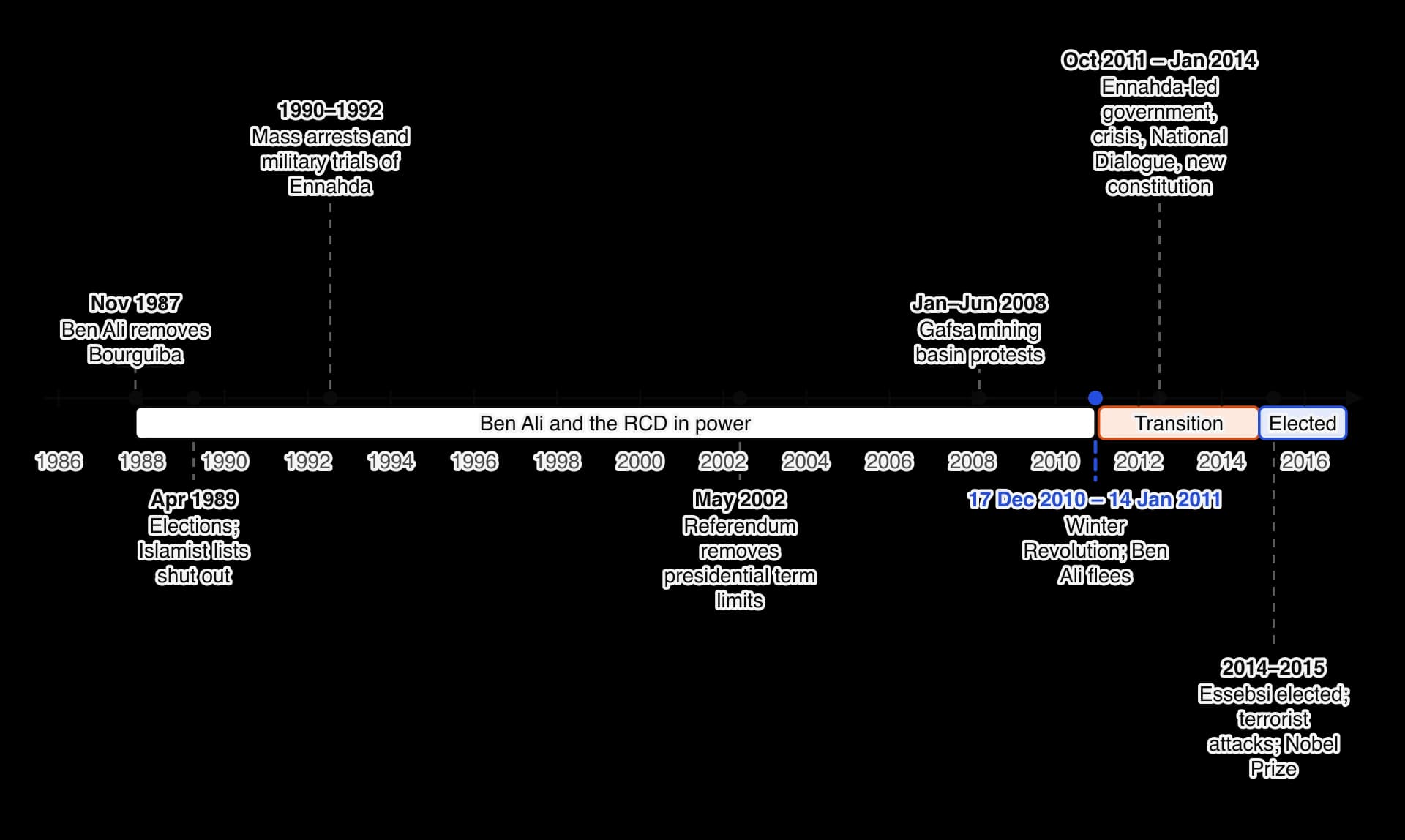
Why protest emerged under Ben Ali, how the Winter Revolution of 2010–2011 brought him down, and what the transition to 2015 changed for politics, religion, security and women.
Each is in the History glossary, with every other term in the subject.
A coalition of Tunisian opposition groups formed after a hunger strike in October 2005, which brought secular liberals, leftists and Islamists together to agree common positions on rights and freedoms.
A Tunisian jihadist group founded in April 2011 by Seifallah Ben Hassine (Abu Iyadh). It attacked the US embassy in Tunis in September 2012 and was declared a terrorist organisation in August 2013.
The UN Convention on the Elimination of All Forms of Discrimination against Women, adopted in 1979, which commits states to end discrimination against women in law and practice.
A state whose authority comes from its citizens and its laws rather than from religion or the army. Article 2 of Tunisia's 2014 constitution defines Tunisia as a civil state.
Tunisia's family law of 1956, which abolished polygamy, required the consent of both spouses to marriage and introduced judicial divorce open to women and men. Inheritance still followed Islamic law.
Tunisia's main Islamist movement, founded in 1981 as the Islamic Tendency Movement and renamed Ennahda ("Renaissance") in 1989. Banned and repressed under Ben Ali, it was legalised in 2011 and led the government from 2011 to 2014.
A person who travels to another country to join an armed group in a war there, such as the Tunisians who joined jihadist groups in Syria, Iraq and Libya after 2011.
The Tunisian revolution of 2010–2011 was the first of the uprisings that became known as the Arab Spring, and the only one that produced a lasting democratic constitution by 2015. It shows how a protest movement can bring down an entrenched authoritarian regime in a few weeks, and how hard it is to turn that success into political, social and economic change.
With a free account, Augment remembers where you stopped and what you have practiced.
Equal representation of women and men, for example through rules that require election lists to alternate between male and female candidates.
A strike in which workers in many industries and services stop work at the same time, usually with political as well as economic aims.
The use of computer hacking for political protest, such as blocking or defacing government websites or leaking documents.
The body chaired by Yadh Ben Achour in 2011 that brought together parties, unions and civil society to prepare Tunisia's transition, including the electoral law for the Constituent Assembly.
The part of an economy that is not registered, taxed or regulated by the state, such as unlicensed street trading; its workers have no contracts or legal protection.
Tunisia's independent electoral commission, created in 2011 to organise elections in place of the interior ministry.
A political ideology that holds that Islam should shape the laws, institutions and public life of a state. Islamist movements range from parties that compete in elections to groups that use violence.
The occupations of the Kasbah square in Tunis in January and February–March 2011 by protesters, many from the interior, which forced the resignation of the interim prime minister Mohamed Ghannouchi and led to the election of a constituent assembly.
The 217-member assembly elected in Tunisia in October 2011 to write a new constitution and act as the parliament until 2014.
An agreement of November 1988 between Ben Ali's government, the legal opposition parties, the UGTT and the Islamists, promising political pluralism and respect for Tunisia's Arab and Islamic identity. Its promises were soon abandoned.
The Tunisian nationalist party founded by Habib Bourguiba and others in 1934, which led the struggle for independence from France and became the ruling party after 1956.
A secular Tunisian party founded in 2012 by Béji Caïd Essebsi to oppose Ennahda. It won the parliamentary election of 2014 and included many former members of the RCD.
A state in which the government controls the population through a large security apparatus that watches citizens, arrests opponents without fair trial and uses fear to prevent dissent.
A territory that keeps its own ruler and some institutions but is controlled by a stronger state, which runs its foreign affairs, defence and often much of its government. Tunisia was a French protectorate from 1881 to 1956.
The process by which a person comes to support or take part in extreme political or religious ideas, including the use of violence to achieve them.
The Constitutional Democratic Rally, the ruling party of Tunisia under Ben Ali from 1988 to 2011, successor to Bourguiba's party. It was dissolved by a court in March 2011.
A vote in which the whole electorate decides directly on a single question, such as a new constitution, a change of territory or approval of a ruler; a vote used to approve a ruler or regime is often called a plebiscite.
A strict Sunni Muslim movement that seeks to return to the beliefs and practices of the first generations of Muslims. Most Salafists are non-violent, but jihadist groups draw on Salafist ideas.
The principle that the state and its laws should be separate from religion. In Tunisia, secularists generally opposed giving Islamic law a role in legislation.
Setting fire to oneself as an act of protest.
Islamic law, derived from the Qur'an and the example of the Prophet Muhammad as interpreted by religious scholars.
The promotion of women's rights by the state from above, as part of a government's own programme, rather than through an independent women's movement.
A package of free-market reforms, such as cutting subsidies and state spending, privatising state companies and opening the economy to trade, required by the IMF and World Bank in return for loans in the 1980s and 1990s.
A government of non-party experts appointed to run the state for a limited time, usually during a political crisis or before elections.
The measures a society uses to deal with large-scale wrongs after war or dictatorship, such as trials, truth commissions, compensation, purges and amnesties.
The coalition that governed Tunisia from 2011 to 2014, made up of the Islamist Ennahda and two secular centre-left parties, the Congress for the Republic and Ettakatol.
The Tunisian truth commission created by the transitional justice law of December 2013 to investigate human rights abuses by the state from 1955 to 2013 and recommend reparations.
A Tunisian human rights organisation founded in the 1970s, the oldest of its kind in Africa and the Arab world. It documented abuses under Ben Ali and was a member of the National Dialogue Quartet.
The Tunisian General Labour Union, the national trade union federation founded in 1946. Its regional branches helped lead the 2010–2011 revolution, and it chaired the National Dialogue Quartet in 2013.
Tunisia's main employers' federation, a member of the National Dialogue Quartet.
The uprising in Tunisia from 17 December 2010 to 14 January 2011 that forced President Ben Ali to flee. Western media called it the Jasmine Revolution, a name many Tunisians reject.
Scope. This study runs from Ben Ali's first presidential election in 1989 to 2015. It covers why protest movements emerged under the Ben Ali regime, how the protest movement challenged authority in the Winter Revolution of 2010–2011 and after, and what political, social and legal changes it achieved, with their limitations, including religious radicalisation, terrorism and the role and status of women.
Tunisia was a French protectorate from 1881 to 1956. The nationalist movement was led by Habib Bourguiba, a lawyer educated in France, and his Neo-Destour party, founded in 1934. Tunisia became independent on 20 March 1956. In 1957 the monarchy of the bey was abolished and Bourguiba became president of a republic, and in 1975 he was made president for life.
Bourguiba was a secular modernist. In August 1956 his government issued the Code of Personal Status, which abolished polygamy, required both partners to consent to a marriage, set a minimum age for marriage and allowed women as well as men to seek divorce through the courts. Free and compulsory education spread, and by the 1980s Tunisia had one of the most educated populations in the Arab world.
Political freedom did not follow social reform. Bourguiba ruled through a single party and crushed challengers. The Tunisian General Labour Union (UGTT), the country's powerful trade union federation, was suppressed after a general strike on 26 January 1978 ("Black Thursday"), when the army fired on crowds. In December 1983 and January 1984, a cut in bread subsidies set off riots across the country that left dozens dead. Religious opposition grew in the same years: the Islamic Tendency Movement (MTI), founded in 1981 by Rached Ghannouchi and Abdelfattah Mourou, called for an Islamic identity for Tunisian politics, and its leaders were repeatedly imprisoned.
By 1987 Bourguiba was 84 and in poor health. On 7 November 1987 his prime minister, Zine El Abidine Ben Ali, a former army officer and head of national security, had doctors declare Bourguiba medically unfit and took over as president under the constitution. Because no shots were fired, this is often called the "medical coup". Ben Ali promised democracy: he ended the presidency for life, freed many political prisoners, and in 1988 renamed the ruling party the Constitutional Democratic Rally (RCD) and signed a National Pact with the opposition parties, the UGTT and the Islamists, which promised political pluralism and respect for Tunisia's Arab and Islamic identity.
The protests of December 2010 surprised most observers, because the Ben Ali regime had looked secure for two decades. Their roots lay in three developments: a system of repression and censorship that closed every legal channel of opposition, an economic model that failed large parts of the population, and new ideas and information that spread despite the censors.
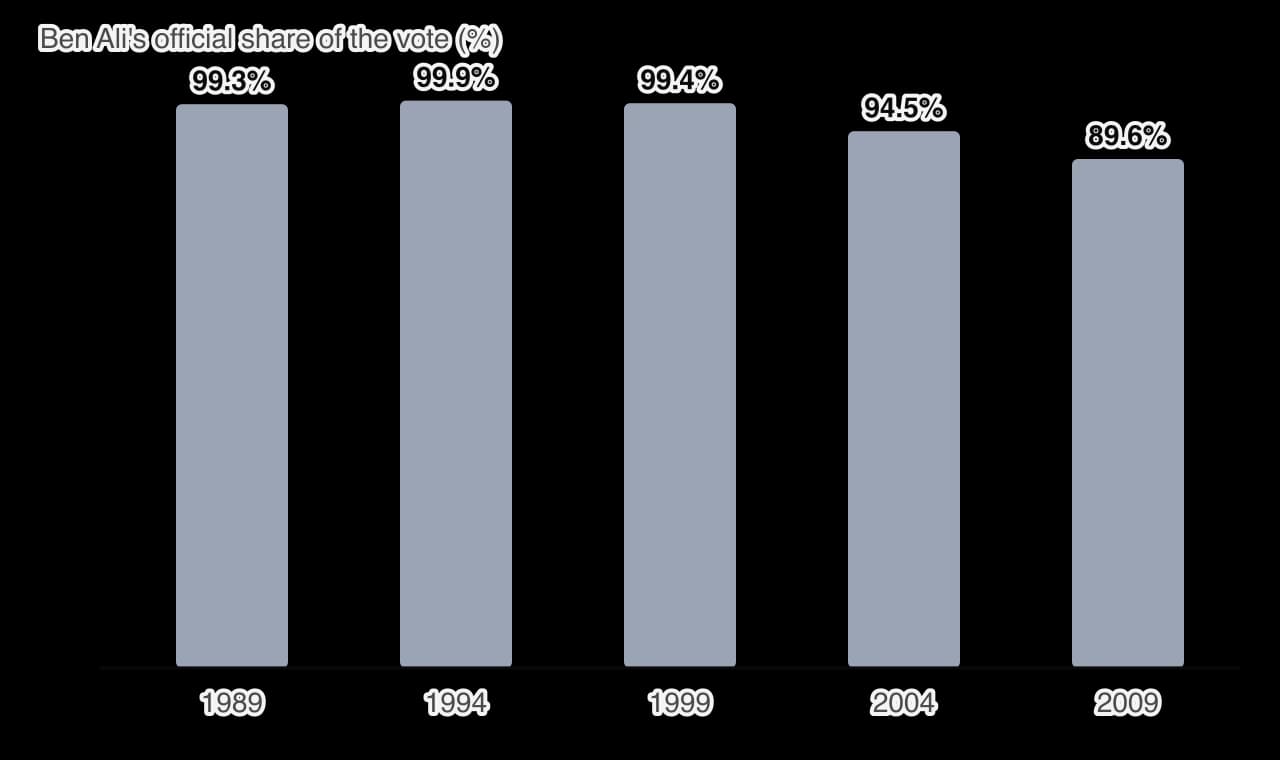
Ben Ali's promises were tested in the elections of 2 April 1989. He stood unopposed for president and officially won 99.27 per cent of the vote. In the parliamentary election the Islamists, who had renamed their movement Ennahda ("Renaissance") to meet a ban on religious party names, were refused legal status and ran as independents. The "official" figures quoted by different scholars give their lists between about 10 and 17 per cent of the vote nationally (most often about 14–15 per cent), and more in the poor districts of Tunis and other cities, but the RCD took every one of the 141 seats under a winner-takes-all list system.
The result showed Ben Ali that the Islamists were the only opposition with mass support, and he turned against them. Ghannouchi left Tunisia in 1989 and, after a period in Algeria, settled in London in 1991, where he lived in exile until 2011. Between 1990 and 1992 the security forces arrested thousands of Ennahda members and sympathisers, citing an arson attack on an RCD office in Bab Souika in February 1991 and an alleged plot against the president. In the summer of 1992 military courts tried 279 people in mass trials; Ghannouchi was sentenced in his absence to life imprisonment. Human rights organisations documented the systematic use of torture against detainees.
The campaign against Ennahda was popular with many secular Tunisians and with Western governments, who saw Ben Ali as a barrier against the Islamist violence of the Algerian civil war next door (1991–2002). The same methods were then turned on secular critics: human rights activists, independent lawyers, journalists and members of the small legal opposition parties.
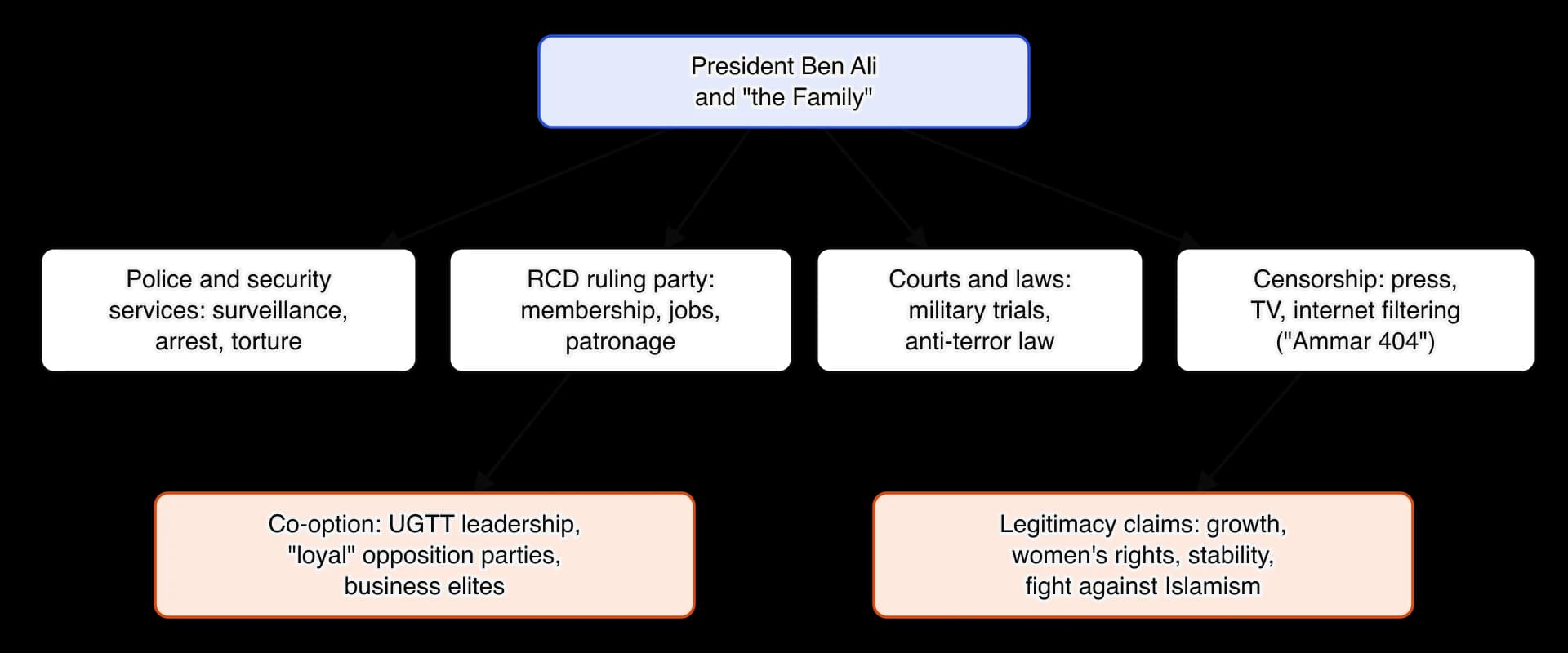
The diagram of the Ben Ali system shows that repression was only one of its tools. The RCD claimed about two million members in a population of about ten million, and party membership was often the route to a job, a loan, a licence or a place in a state school. The UGTT's national leadership was co-opted, although many of its regional and local branches remained independent and militant. A few "loyal" opposition parties were allowed seats in parliament after 1994 to give an appearance of pluralism.
Elections were held regularly but were never free. Ben Ali was re-elected in 1994, 1999, 2004 and 2009, each time with official results close to 90 per cent or above. A constitutional referendum in May 2002, officially approved by 99.5 per cent, removed the limit of three presidential terms and raised the maximum age for a candidate to 75, opening the way for Ben Ali to stay in power for life.
The regime also used law against its opponents. After the al-Qaeda bombing of the synagogue in Djerba in April 2002 and the attacks of 11 September 2001 in the USA, Tunisia passed a broad anti-terrorism law in December 2003. Human rights groups recorded its use against young men accused of religious activism, including those who had only watched Islamist websites. Women who wore the hijab in schools and public offices could be harassed or dismissed under a government circular of 1981, which was enforced more strictly in the 1990s and 2000s.
Censorship under Ben Ali covered every medium. Newspapers and television stations were either state-owned or owned by people close to the regime, and the few opposition weeklies were often seized. Foreign newspapers that criticised the president were withheld from sale. Journalists such as Taoufik Ben Brik, who went on hunger strike in 2000 and was imprisoned in 2009–2010, were harassed, beaten and jailed.
Tunisia was also one of the first countries to censor the internet systematically. The state-controlled Tunisian Internet Agency filtered traffic, and blocked pages displayed an error message, "404 Not Found". Tunisians nicknamed the censor "Ammar 404", as if it were a person. YouTube and the video site Dailymotion were blocked from 2007–2008, along with many human rights and opposition websites. Facebook was briefly blocked in 2008 but then reopened, which made it the main space for sharing information and video.
The human rights situation remained dire in Tunisia, where President Zine el-Abidine Ben Ali and the ruling Democratic Constitutional Rally party (RCD) dominate political life. The government frequently uses the threat of terrorism and religious extremism as a pretext to crack down on peaceful dissent, while state security agents use surveillance, arbitrary detention, and physical aggression to intimidate and persecute those whom the government deems to be a "threat."
Human Rights Watch, World Report 2011, chapter on Tunisia, covering events of 2010, published January 2011. Human Rights Watch is an international non-governmental organisation based in New York whose purpose is to expose abuses, so it selects evidence of repression rather than describing the regime as a whole. Its value lies in its research over many years and its concrete examples; its report also notes that activists turned to the internet because the physical space for protest was closed to them.
Corruption grew in the 2000s, and it was concentrated in the president's own circle. Ben Ali married Leila Trabelsi, his second wife, in 1992, and her ten brothers and sisters and their children, together with the families of Ben Ali's children from his first marriage, built up large business empires. They acquired banks, an airline, hotels, car dealerships, radio stations and land, often by pressuring owners to sell or by winning state contracts and licences without competition.
A study published by the World Bank in 2014, after the fall of the regime, examined 220 firms confiscated from the Ben Ali clan. It found that by 2010 these firms produced less than 1 per cent of private-sector jobs but took about 21 per cent of all private-sector profits, largely because regulations and licences were designed to protect them from competition. Tunisians knew the general picture long before, but the press could not report it.
President Ben Ali's extended family is often cited as the nexus of Tunisian corruption. Often referred to as a quasi-mafia, an oblique mention of "the Family" is enough to indicate which family you mean. Seemingly half of the Tunisian business community can claim a Ben Ali connection through marriage, and many of these relations are reported to have made the most of their lineage.
US Embassy Tunis, diplomatic cable 08TUNIS679, "Corruption in Tunisia: What's Yours is Mine", 23 June 2008, classified secret; published by WikiLeaks in December 2010. The cable was written for the State Department in Washington, not for the public, and it relies on conversations with Tunisian business people and officials, many of them rumours, as the ambassador admits. It is valuable as evidence of how widely the corruption of the Trabelsis was discussed in private, and its publication in December 2010, days before the protests began, confirmed for Tunisians what they had only whispered.
Western governments knew about the repression and corruption but continued to support Ben Ali. France, Tunisia's largest trading partner, praised its economic record and its protection of women's rights, and the USA valued its cooperation against terrorism after 2001. For the regime, this support was a source of legitimacy; for its opponents, it was one more reason to distrust promises of reform from outside.
Ben Ali inherited an economy in crisis. In 1986 Bourguiba's government had accepted a structural adjustment programme from the International Monetary Fund (IMF) in return for loans: it cut subsidies, devalued the currency and opened the economy to trade. Ben Ali continued these reforms. State firms were privatised, foreign investors were offered tax breaks in export zones, and in 1995 Tunisia signed an association agreement with the European Union that phased out tariffs on industrial goods by 2008.
The headline results were good. Growth averaged about 5 per cent a year in the 2000s, poverty fell by official measures, and the IMF and World Bank praised Tunisia as a model reformer. Tourism, textiles, olive oil and car and electrical components for European factories brought in foreign currency. The regime used this record, together with its education and women's rights policies, to present Tunisia as a modern, stable success.
The growth was very unequal by region. Most investment, tourism and export industry was on the coast, in Tunis, the Sahel (the region around Sousse and Monastir, home of both Bourguiba and Ben Ali) and Sfax. The interior and the south-west, including the governorates of Sidi Bouzid, Kasserine and Gafsa, depended on farming and phosphate mining and received much less public investment, fewer jobs and worse roads, hospitals and schools.
Coastal regions (Tunis, Sahel, Sfax) | Interior regions (Sidi Bouzid, Kasserine, Gafsa) | |
|---|---|---|
Main economic activity | Tourism, export manufacturing, services, government | Farming, phosphate mining, informal trade |
Share of investment | Most private and foreign investment and most public spending | Little private investment; dependent on state jobs and the phosphate company |
Unemployment, 2010 | About 13 per cent in Tunis and much of the coast | Around 28 per cent in the central governorates, higher among young people |
Links to the regime | Home regions of the political and business elite | Little influence in Tunis; seen by the regime as a security problem |
Data on regional unemployment: national statistics and World Bank figures as reported in the press in 2011 (Al-Ahram, 2011). Exact regional figures vary by source and definition.
Unemployment was officially about 13 per cent in 2010, but it fell most heavily on the young. The expansion of universities, one of the regime's proudest achievements, produced far more graduates than the economy could employ. According to the World Bank, the unemployment rate of university graduates rose from about 5 per cent in 1994 to around 20 per cent by the end of the 2000s (estimates for 2009–2010 range from about 19 to 23 per cent, depending on the measure), and by 2011 graduates had a higher unemployment rate than any other education group. Many young people worked in the informal economy as street traders, smugglers or day labourers, where they were exposed to police harassment and demands for bribes.
Rising world food prices in 2007–2008 and again in 2010 squeezed poor households further, although Tunisia subsidised bread and other staples. The combination of education, unemployment and visible corruption was politically explosive, because young people had been promised that study would bring a job and could see that connections, not merit, decided who got one.
The clearest sign of trouble before 2010 came from the phosphate-mining region of Gafsa. In January 2008 the Gafsa Phosphate Company, the region's main employer, published the results of a recruitment competition. Local people believed the jobs had gone to those with connections and bribes, and protests began in the town of Redeyef. They grew into six months of sit-ins, strikes and demonstrations led by unemployed young people, their families and local UGTT teachers' union activists, against the wishes of the UGTT's national leadership.
The regime sealed off the region and crushed the movement by June 2008. At least three people died, hundreds were arrested, and about 200 people were prosecuted, many of whom reported torture. A journalist who filmed the protests for an Italy-based Tunisian satellite channel, Fahem Boukadous, was sentenced to four years in prison in 2010. Because the press was silent, few Tunisians outside the region knew the details; but the protests showed that the interior could rise, that local union branches would lead, and that grievances over jobs could become demands for dignity and justice.
By 2010 several channels carried ideas of rights, democracy and resistance to Tunisians despite censorship. They help to explain how local grievances became a national movement.
The Tunisian Human Rights League (LTDH), founded in 1976 and the oldest human rights organisation in Africa and the Arab world, kept documenting abuses despite constant harassment. Lawyers, organised in the national bar, defended political prisoners and became one of the most outspoken professions. In October 2005, while Tunisia hosted the UN World Summit on the Information Society, eight opposition figures went on hunger strike. Their supporters formed the 18 October Collective, which for the first time brought together secular liberals, leftists and Islamists from Ennahda. Its members agreed common positions on women's rights, freedom of conscience and the relationship between religion and the state, which made cooperation after 2011 easier.
The Qatar-based satellite channel Al Jazeera, which broadcast in Arabic across the region from 1996, gave Tunisians news that their own media suppressed and invited exiled opposition leaders to speak. The online magazine Nawaat, founded in 2004 by Tunisian activists abroad, published reports on corruption and repression, and in late 2010 it put the US embassy cables about Tunisia online on a site it called TuniLeaks.
Popular culture carried the same message. In November 2010 the young rapper Hamada Ben Amor, known as El Général, posted a song online called "Rais Lebled" ("Head of State"). Addressed directly to Ben Ali, it described police violence, poverty and corruption in everyday language. It spread quickly among young people, and El Général was arrested in early January 2011 and released a few days later after protests.
The most famous slogan of the revolution, "Ash-shaʿb yurīd isqāṭ an-niẓām" ("The people want the fall of the regime"), drew on a familiar line by the Tunisian poet Abu al-Qasim al-Shabbi (1909–1934), usually translated as "If, one day, the people wish to live, fate must respond". The line is part of the Tunisian national anthem, so protesters could present their demands as patriotic.
Ideas also travelled outward from Tunisia. Within days of Ben Ali's fall, protesters in Egypt began their own uprising on 25 January 2011, using the same slogans and methods; Hosni Mubarak resigned on 11 February. Protests followed in Libya, Yemen, Bahrain and Syria. The term Arab Spring became the common name for this wave. Its outcomes were very different: civil wars in Libya, Syria and Yemen, a military takeover in Egypt in 2013 and repression in Bahrain, which is why Tunisia came to be seen as an exception.
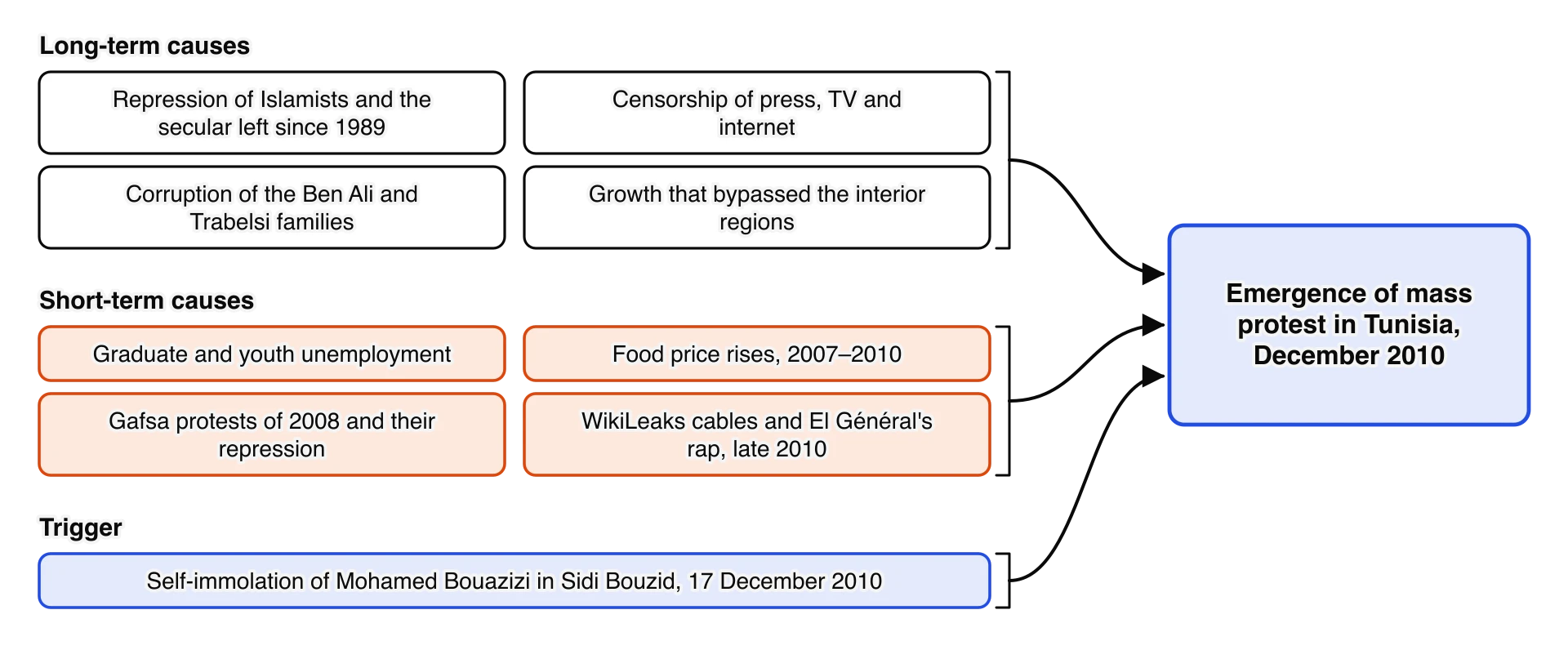
The diagram of causes separates conditions from the trigger. Repression and censorship meant that grievances could not be expressed through elections, a free press or legal protest, so when protest came it was aimed at the regime itself. Unemployment and regional inequality gave the movement its first and most determined supporters, the young people of the interior. Corruption joined the two, because it made economic failure look like the result of theft by the ruling family rather than bad luck.
Revolutionary ideas and new media explain why the protests in 2010 spread so much faster than those of Gafsa in 2008, which had the same causes but were isolated. In 2010 mobile phone videos, Facebook and Al Jazeera carried the news to the coast and the capital within days.
Tunisians call the uprising the Winter Revolution or the Revolution of Freedom and Dignity. Western media called it the "Jasmine Revolution", after Tunisia's national flower, but many Tunisians dislike the name because Ben Ali's own propaganda had used the jasmine image for his seizure of power in 1987, and because it makes a violent uprising in which hundreds died sound gentle.
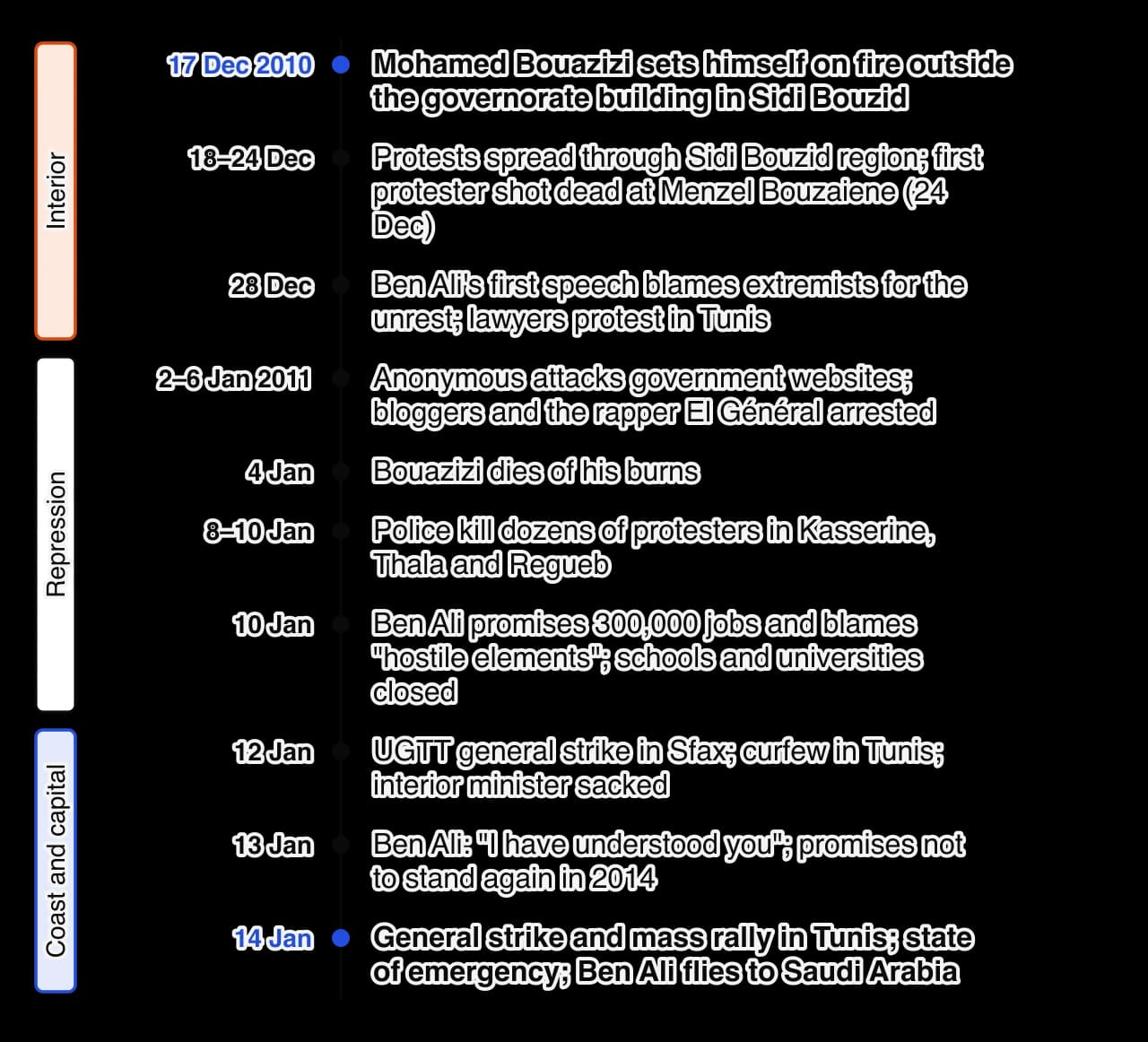
Mohamed Bouazizi was a 26-year-old street vendor in Sidi Bouzid, a town in the central interior. On the morning of 17 December 2010 a municipal inspector confiscated his cart of fruit and vegetables and its scales, apparently because he had no licence. He went to the town hall and then to the governorate building to complain, was refused a hearing, and set himself on fire outside the governorate. He died of his burns on 4 January 2011.
Bouazizi's relatives and neighbours gathered outside the governorate the same day, and his cousin filmed the protest on a mobile phone and posted the footage on Facebook. That evening Al Jazeera broadcast it. The story of a young man humiliated by officials for trying to earn a living was one that many people in the interior recognised from their own lives, so the protests spread quickly to nearby towns. On 24 December police shot dead a protester in Menzel Bouzaiene, the first death of the uprising.
 YouTube
The regime first treated the protests as a local security problem. Police used tear gas and then live ammunition, and the state media ignored or minimised the unrest. The worst violence came on 8–10 January 2011 in Kasserine, Thala and Regueb, where police, including snipers, killed dozens of people. Funerals became new demonstrations. Each death was filmed and shared, and the footage drew more people into the protests.
Ben Ali visited Bouazizi in hospital on 28 December and gave his first televised speech the same day, promising action on jobs but warning that the law would be applied firmly against a minority of troublemakers. In a second speech on 10 January he announced 300,000 new jobs by the end of 2012 while describing the protesters as "hostile elements in the pay of foreigners". Schools and universities were closed. These speeches combined concessions with threats, and the protests continued after each of them.
Abroad, the regime's friends were slow to react. On 11 January 2011 the French foreign minister, Michèle Alliot-Marie, told the French National Assembly that France could share the know-how of its security forces to help Tunisia handle the situation. Her words caused outrage once Ben Ali fell and contributed to her resignation in February 2011.
The movement became a national revolution when organised groups on the coast joined it. Lawyers, who had demonstrated in Tunis from late December, were beaten by police in protests outside the courts. Teachers and other members of UGTT regional unions organised marches. On 12 January the UGTT's regional union called a general strike in Sfax, Tunisia's second city, and tens of thousands marched; that night a curfew was imposed on Tunis and Ben Ali sacked his interior minister.
On the evening of 13 January Ben Ali made his third and last speech, speaking in Tunisian Arabic rather than formal Arabic for the first time. He promised not to stand for president again in 2014, ordered the police to stop firing live ammunition, promised lower food prices and announced an end to internet censorship. Within minutes, blocked websites such as YouTube became accessible.
I have understood you. … Enough violence. … I won't accept that another drop of blood of a Tunisian be spilled. … There will not be presidency for life.
Zine El Abidine Ben Ali, televised address to the nation, 13 January 2011, as translated in The Christian Science Monitor, 13 January 2011. Ben Ali's purpose was to stop the protests by appearing to listen, and the choice of everyday dialect was meant to sound close to the people. As a source it shows that by 13 January the regime was forced to answer the protesters' grievances, over police killings, prices, censorship and his own indefinite rule, and how far a ruler of 23 years would go to stay in office. Tunisian and French commentators noted the echo of the French president Charles de Gaulle's "Je vous ai compris" to the settlers of Algeria in 1958.
On 14 January, despite the concessions, the UGTT's general strike in Tunis brought tens of thousands of people to Avenue Habib Bourguiba, in front of the Ministry of the Interior, the symbol of the police state. Crowds chanted "Dégage!" ("Get out!"). In the afternoon the government declared a state of emergency, and in the early evening Ben Ali flew out of the country with his family. France reportedly refused to receive him, and he landed in Jeddah, Saudi Arabia, where he lived until his death in 2019.
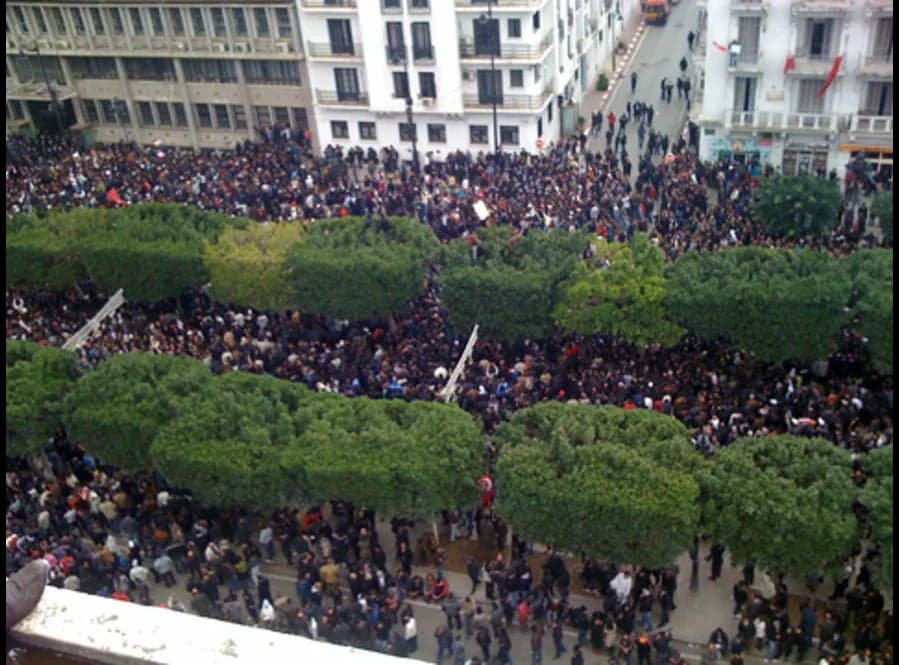
The photograph of 14 January shows the scale of the rally in the capital, but its crowd was only the final stage of a movement that began four weeks earlier in the interior. A national fact-finding commission led by the lawyer Taoufik Bouderbala reported in May 2012 that 338 people had been killed and 2,147 injured during the uprising and its immediate aftermath; about two-thirds of the dead had been shot. The total includes 86 deaths in prisons, many during riots and escapes, and members of the security forces and the army. Later official lists recognised fewer victims, and the count remains disputed.
Unlike the police, the army did not fire on crowds in January 2011. It was small (estimates range from about 30,000 to 35,000 soldiers), professional and kept out of politics by both Bourguiba and Ben Ali, who relied on the police and the presidential guard instead. Many accounts claim that the army chief of staff, General Rachid Ammar, refused an order to shoot protesters; Ammar himself later denied that such an order was given to him in that form, and historians treat the story with caution. What is clear is that the army deployed to protect public buildings, did not defend the president, and was trusted by protesters in a way the police were not.
Ben Ali's departure did not end the revolution. Prime Minister Mohamed Ghannouchi (no relation of Rached Ghannouchi) at first claimed the presidency himself; the next day the Constitutional Council named the speaker of parliament, Fouad Mebazaa, interim president, as the constitution required. Ghannouchi formed a "national unity" government that kept RCD ministers in the key posts. Protesters saw this as the old regime without its leader.
In late January 2011 a "Caravan of Liberation" of young people from the interior marched to Tunis and occupied the Kasbah square outside the prime minister's office. A second, larger occupation from 20 February forced Ghannouchi to resign on 27 February. These Kasbah sit-ins showed that the protest movement could keep challenging authority after the dictator had gone. The new prime minister, Béji Caïd Essebsi, an 84-year-old veteran minister from the Bourguiba era, agreed to the movement's central demand: instead of presidential elections under the old constitution, Tunisians would elect a National Constituent Assembly to write a new one.
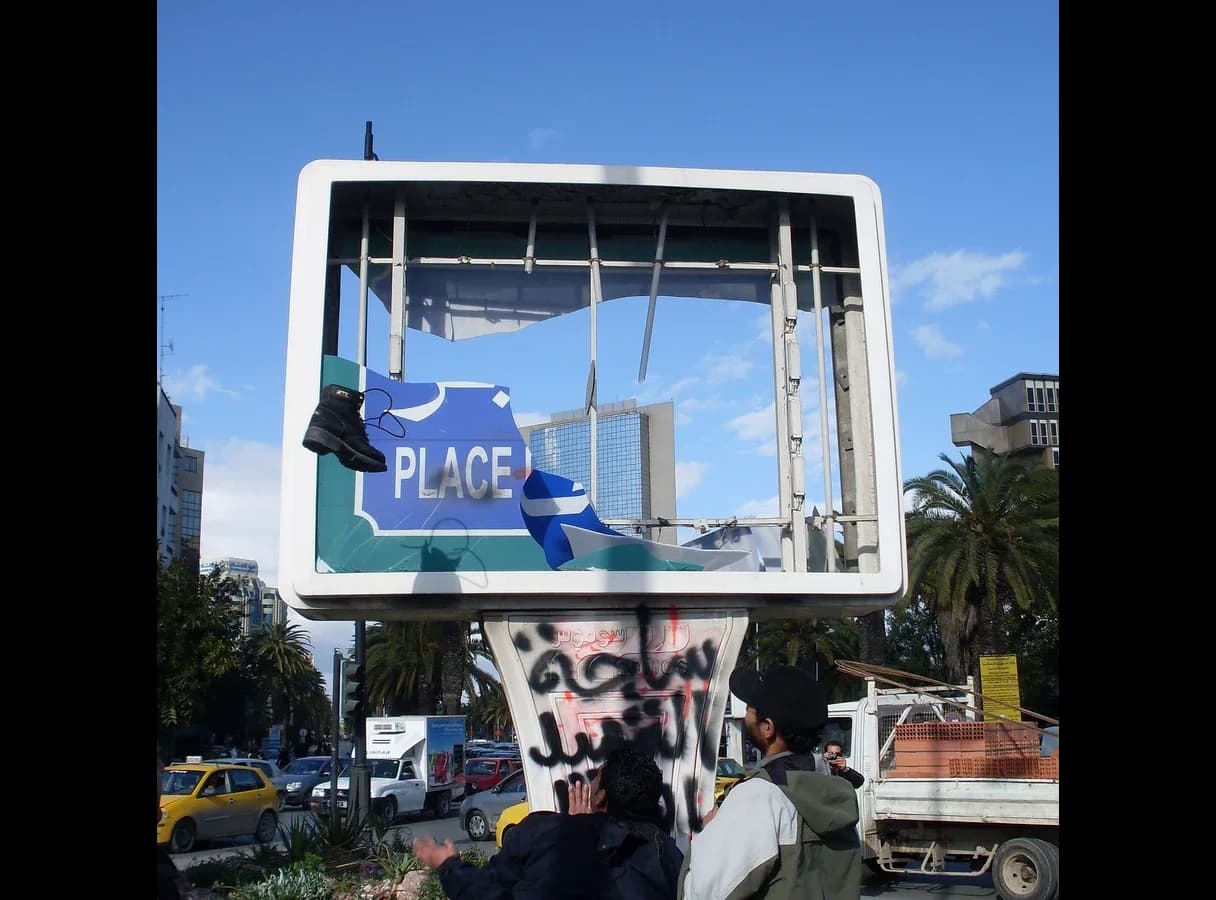
In the weeks after 14 January the institutions of the Ben Ali state were dismantled. The secret police (the State Security Directorate) was dissolved, a general amnesty freed political prisoners, Ennahda was legalised on 1 March 2011, and a court dissolved the RCD on 9 March and confiscated its assets. A body chaired by the law professor Yadh Ben Achour, the Higher Authority for the Realisation of the Objectives of the Revolution, brought together parties, unions and civil-society groups to prepare the electoral law, and an independent electoral commission, the ISIE, replaced the interior ministry as organiser of elections.
The role of social media in the Tunisian revolution has been debated since the first weeks of 2011, when some Western commentators called it a "Facebook revolution" or a "Twitter revolution".
By late 2010 about 2 million Tunisians, roughly a fifth of the population, used Facebook, according to commonly cited estimates. Because YouTube was blocked and Facebook was not, Facebook became the place where videos of protests and police violence were posted, shared and discussed. Mobile phones made almost every protester a potential reporter. Activists collected the clips, added dates and places, and passed them to Al Jazeera and France 24, which rebroadcast them by satellite into Tunisian homes. Satellite television then reached people who did not use the internet.
Bloggers. Lina Ben Mhenni, a young linguistics lecturer who wrote the blog A Tunisian Girl, travelled to Sidi Bouzid, Regueb and Kasserine in early January 2011 and posted photographs of the dead and wounded under her own name, at a time when most journalists could not reach the interior.
Arrests. The blogger Slim Amamou was arrested on 6 January 2011 along with other activists and the rapper El Général. Freed on 13 January, Amamou briefly served as secretary of state for youth in the interim government.
Hacktivism. The international online collective Anonymous launched "Operation Tunisia" in early January 2011, blocking government websites with denial-of-service attacks.
The regime's response. The state tried to fight back online: Tunisians found that their Facebook and email passwords were being stolen by government-controlled code, and Facebook's security team changed its systems to protect Tunisian users.
Social media clearly mattered. It broke the regime's control of information, allowed news from the interior to reach the coast within hours, and turned local incidents into national scandals. Philip Howard and Muzammil Hussain, in Democracy's Fourth Wave? Digital Media and the Arab Spring (2013), argue that digital media were a necessary condition of the Arab uprisings: they did not cause discontent, but they gave people networks and information that made coordinated protest possible.
Other historians and political scientists stress older forms of organisation. Facebook did not call the general strikes; the UGTT's regional unions did, using their offices, members and experience from Gafsa in 2008. Lawyers protested as a profession. Many protesters in the interior had no internet access, and they learned of events through satellite television, mobile phone calls and word of mouth. Online activism was led by a small, educated, urban group, while the people who faced the police in Kasserine and Thala were mostly poor young men.
Factor | What it did in December 2010 – January 2011 | Limits |
|---|---|---|
Facebook and mobile phones | Spread videos of protests and police violence; linked activists across regions | About a fifth of Tunisians used Facebook; did not organise strikes or crowds by itself |
Satellite television (Al Jazeera, France 24) | Rebroadcast amateur footage into homes across Tunisia and the Arab world | Depended on footage from activists; Al Jazeera had its own political agenda as a Qatari-funded channel |
UGTT regional unions | Organised marches and the general strikes of 12 and 14 January | National leadership joined late; local branches acted first |
Lawyers and professional bodies | Gave the movement respectability on the coast and in the capital | Small numbers |
The protests of 2010–2011 were not religious. Their slogans demanded jobs, dignity and freedom and the fall of Ben Ali; Islamist slogans were rare, and Ennahda, whose leaders were in prison or exile, played little part. Rached Ghannouchi returned from London on 30 January 2011 to a welcome from thousands of supporters. He presented Ennahda as a moderate party that accepted democracy, compared it to the Justice and Development Party (AKP) then governing Türkiye (officially "Turkey" in English until 2022), and promised that it would respect the Code of Personal Status.
Many secular Tunisians, especially women and the educated middle class of Tunis and the coast, feared that Ennahda would use democracy to impose religious rules. Secularism had been part of the state's identity since Bourguiba, and the left, the UGTT and many liberals saw the Ben Ali era's repression of Islamists as regrettable in method but justified in aim. Islamists, for their part, remembered two decades of prison, torture and exile at the hands of a state that called itself modern and secular.
The National Constituent Assembly election of 23 October 2011 was the first free election in Tunisia's history. Turnout was about half of the eligible population, and observers judged the vote free and fair.
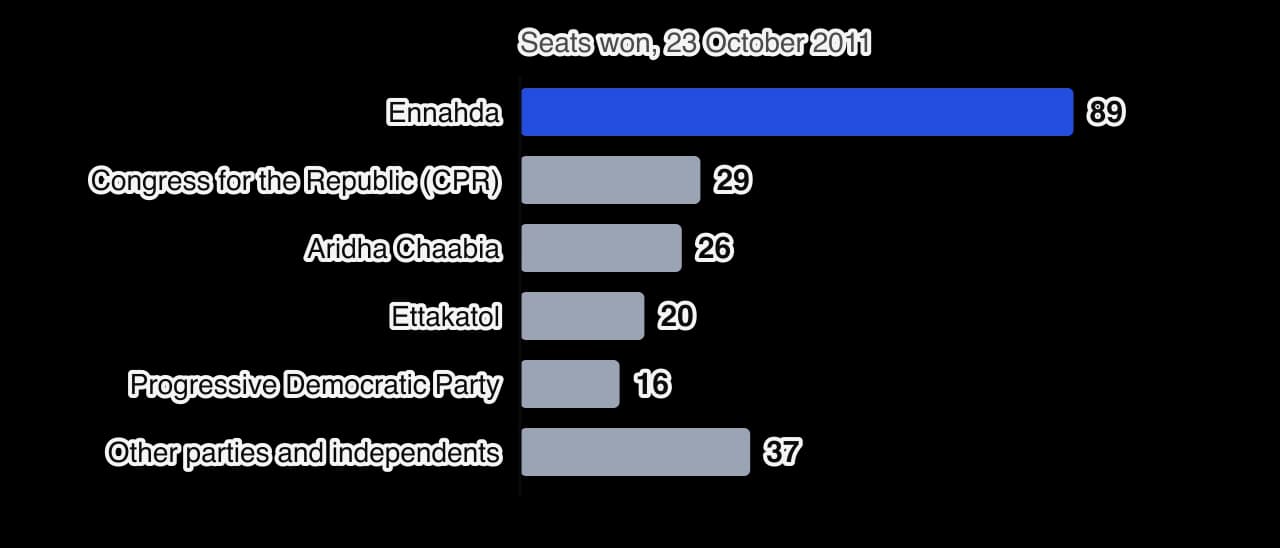
Ennahda's victory reflected its organisation, its reputation as the regime's main victim and its support among religious and poorer voters. It formed a coalition, the Troika, with two secular centre-left parties: Moncef Marzouki's Congress for the Republic (CPR) and Mustapha Ben Jafar's Ettakatol. Marzouki, a human rights activist who had been in exile, became interim president; Ben Jafar became speaker of the assembly; and Ennahda's Hamadi Jebali became prime minister. The coalition was itself a sign that Islamists and secularists could share power, an outcome made possible by the contacts of the 18 October Collective.
The freedom of the revolution brought religious conflict into the open. Salafism, a strict movement that seeks to return to the practice of the first generations of Muslims, grew quickly among young men in poor districts, many of them released from prison in the 2011 amnesty. Some Salafists attacked art exhibitions, bars and Sufi shrines, and at Manouba University in 2011–2012 students campaigned for women to be allowed to wear the face veil (niqab) in class and in tests. The jihadist group Ansar al-Sharia ("Supporters of Sharia"), founded in April 2011 by Seifallah Ben Hassine (Abu Iyadh), a veteran of the war in Afghanistan, attacked the US embassy in Tunis on 14 September 2012 during protests against an anti-Islam film made in the USA.
Secularists accused Ennahda of tolerating this violence because it did not want to lose Salafist voters. Two debates over the new constitution sharpened the conflict. Some Ennahda members wanted sharia named as a source of law, but in March 2012 the party leadership agreed to keep the wording of the 1959 constitution, which called Islam Tunisia's religion without mentioning sharia. In August 2012 a draft article described women as "complementary" to men in the family, rather than equal; thousands of women demonstrated on 13 August, National Women's Day, and the wording was dropped.
The crisis became violent in 2013. On 6 February Chokri Belaïd, a leading figure of the secular left-wing Popular Front and a sharp critic of Ennahda, was shot dead outside his home in Tunis. Prime Minister Jebali resigned after his own party rejected his plan for a non-party government, and Ali Laarayedh of Ennahda replaced him. On 25 July 2013, Republic Day, Mohamed Brahmi, another opposition member of the assembly, was killed with the same weapon. Investigators linked both murders to jihadists connected with Ansar al-Sharia, which the government declared a terrorist organisation in August 2013. Days later, eight soldiers were killed by jihadists in the Mount Chaambi area near the Algerian border.
Opposition deputies walked out of the assembly, and tens of thousands joined a sit-in outside its building in Bardo, demanding the resignation of the government and the dissolution of the assembly. In early August the speaker suspended the assembly's work. The events in Egypt sharpened fears on both sides: on 3 July 2013 the Egyptian army had overthrown the elected Islamist president Mohamed Morsi, with the support of mass protests, and killed hundreds of his supporters in August. Tunisian secularists saw a possible way to remove Ennahda; Ennahda saw what could happen to it if it refused to compromise.
The crisis of 2013 was resolved by four civil-society organisations, known as the National Dialogue Quartet: the UGTT, led by Houcine Abassi; the employers' federation UTICA; the Tunisian Human Rights League; and the national Order of Lawyers. Between them they represented workers, business, human rights and the law, and they had a membership and authority no party could match. In September 2013 they proposed a roadmap. Talks between the parties opened in October 2013 and reached agreement by December: the Ennahda-led government would resign in favour of a non-party government, the assembly would finish the constitution, and elections would follow under a new electoral body.

Ennahda's acceptance is the key to the outcome. The party gave up power without losing an election, under pressure from the street, the UGTT and the fear of an Egyptian-style coup, but also because Ghannouchi judged that a compromise would protect the party's long-term place in politics. Ali Laarayedh resigned in January 2014, and an engineer and former industry minister, Mehdi Jomaa, led a technocratic government until the elections.
The Norwegian Nobel Committee has decided that the Nobel Peace Prize for 2015 is to be awarded to the Tunisian National Dialogue Quartet for its decisive contribution to the building of a pluralistic democracy in Tunisia in the wake of the Jasmine Revolution of 2011. The Quartet was formed in the summer of 2013 when the democratization process was in danger of collapsing as a result of political assassinations and widespread social unrest.
Norwegian Nobel Committee, press release announcing the Nobel Peace Prize for 2015, October 2015. The committee wrote to honour the Quartet and to encourage democracy in a region where the other uprisings had ended in war or renewed dictatorship, so it stresses success and dialogue. It is strong evidence of how the transition was seen internationally in 2015; it says little about the economic grievances of the interior, and its use of the "Jasmine Revolution" label shows an outside perspective.
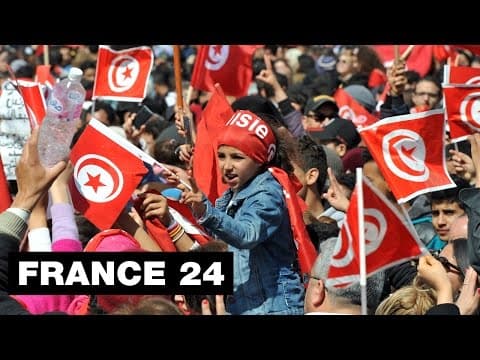 YouTube
The National Constituent Assembly adopted the new constitution on 26 January 2014 by 200 votes to 12, with 4 abstentions, far more than the two-thirds required. It was a compromise between Islamist and secular demands. Article 1, kept from 1959, describes Islam as Tunisia's religion; Article 2 defines Tunisia as a civil state.
Article 1. Tunisia is a free, independent, sovereign state; its religion is Islam, its language Arabic, and its system is republican. … Article 2. Tunisia is a civil state based on citizenship, the will of the people, and the supremacy of law. … Article 6. The state is the guardian of religion. It guarantees freedom of conscience and belief, the free exercise of religious practices and the neutrality of mosques and places of worship from all partisan instrumentalisation.
Constitution of the Tunisian Republic, adopted 26 January 2014, Articles 1, 2 and 6, English translation published by the Constitute Project. As a legal text agreed by a deliberately divided assembly, it records what Islamists and secularists could both accept; the ambiguity of Article 1 ("its religion" can refer to the state or to Tunisia) was intended. It shows the formal settlement of the religious question, but not how the articles would be applied by courts and governments.
The constitution created a semi-presidential system, with power shared between an elected president, responsible mainly for defence and foreign affairs, and a prime minister responsible to parliament. It guaranteed freedom of expression, association and assembly, banned torture, and set up independent bodies for elections, the media, human rights and good governance. A law on transitional justice in December 2013 created the Truth and Dignity Commission, chaired by the human rights activist Sihem Bensedrine, to investigate abuses committed by the state from 1955 to 2013 and to propose reparations. It began receiving complaints in December 2014.
The parliamentary election of 26 October 2014 was won by Nidaa Tounes ("Call of Tunisia"), a party founded in 2012 by Béji Caïd Essebsi to unite secular opponents of Ennahda. It included trade unionists, liberals, leftists and many former members of the RCD.
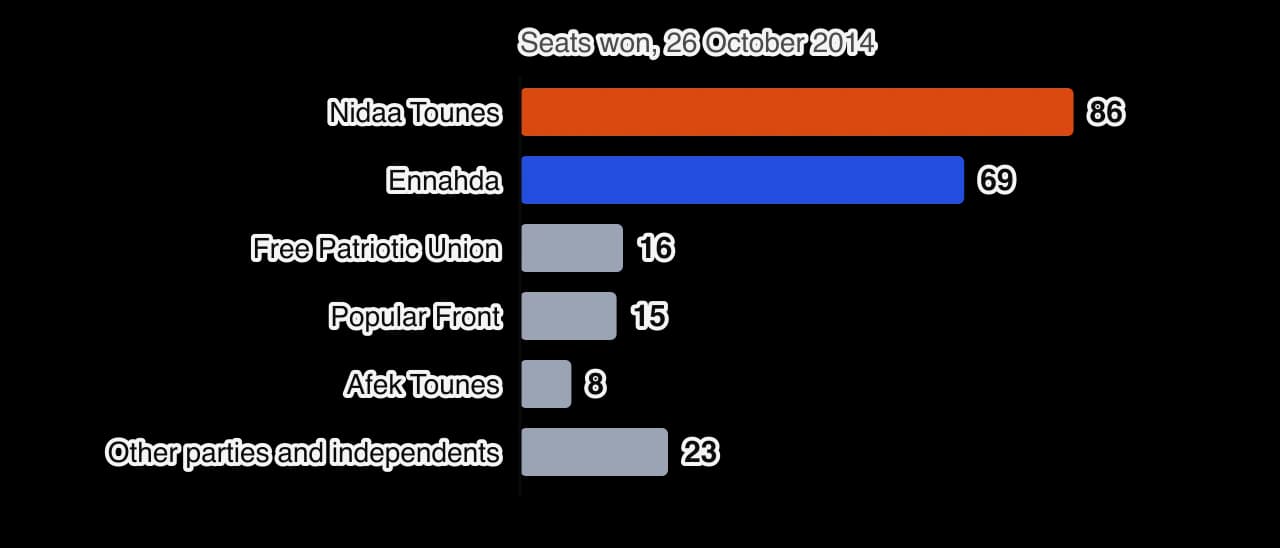
Essebsi then won the presidential election, defeating Moncef Marzouki in the run-off on 21 December 2014 with about 56 per cent of the vote. Ennahda did not put forward a presidential candidate. In February 2015 it joined a coalition government led by Nidaa Tounes, despite the bitterness of the 2014 campaign. In Freedom in the World 2015, the US-based organisation Freedom House rated Tunisia "Free", the first Arab country to receive that rating in decades.
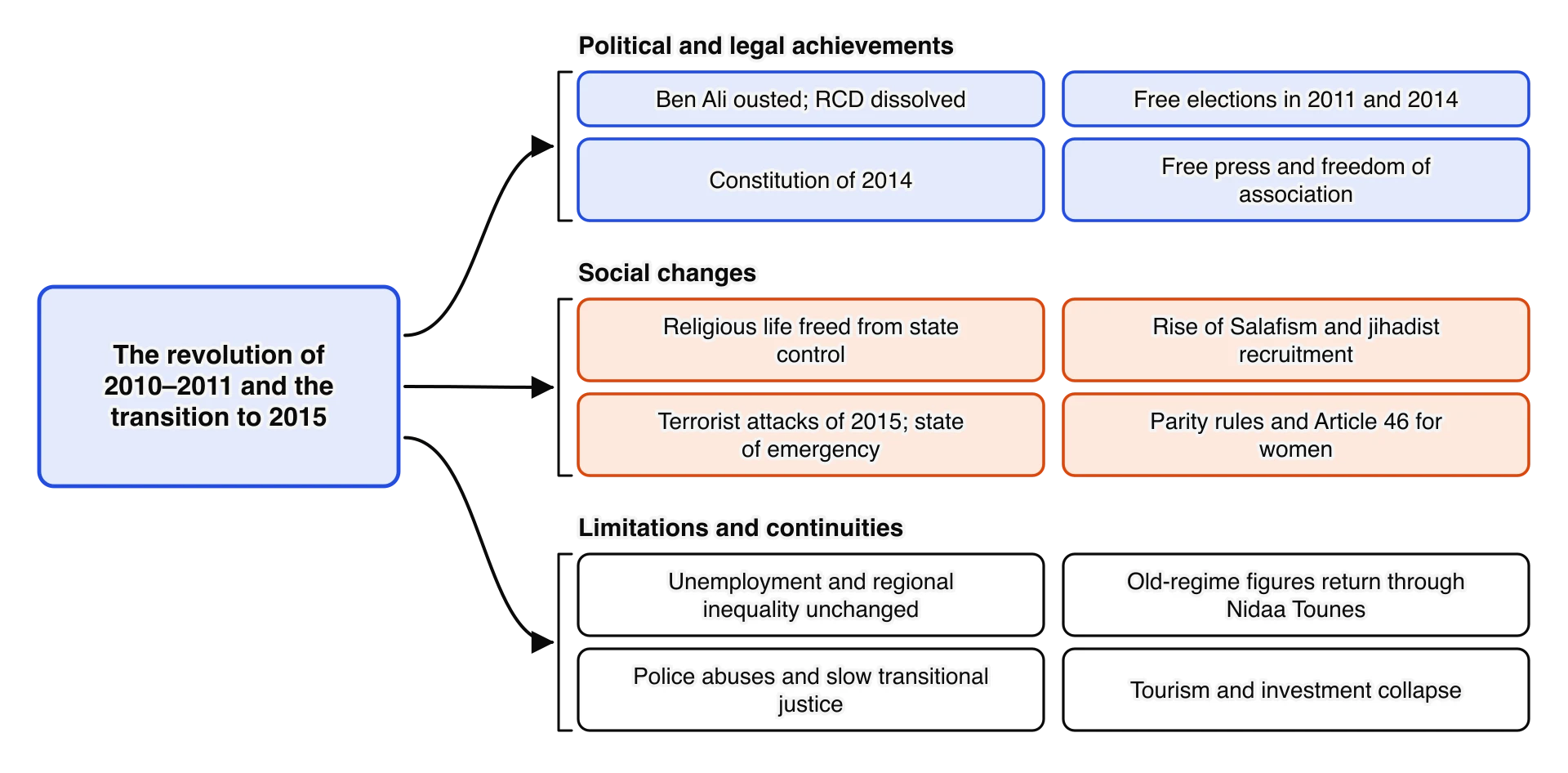
The political settlement had clear limits. Nidaa Tounes brought back many officials of the Ben Ali era, and Essebsi himself had served as interior minister under Bourguiba and as speaker of parliament under Ben Ali in 1990–1991. In July 2015 President Essebsi proposed an "economic reconciliation" law offering amnesty to businessmen and officials accused of corruption under Ben Ali in exchange for repayment. Young activists launched the campaign Manich Msamah ("I will not forgive") against it, arguing that it undermined the Truth and Dignity Commission.
The security services were never fully reformed. Human rights groups continued to report torture and deaths in custody after 2011, and police unions became a powerful lobby against prosecutions of officers for the killings of 2010–2011. Few of those responsible for the deaths of protesters were convicted; most received light sentences from military courts.
Daily life changed in important ways after 2011. Tunisians could criticise the president, join parties and associations, read an uncensored press and use the internet freely. Thousands of new associations were registered. Religious life was freed from state control: the hijab could be worn in schools and offices, and the mosques, whose imams had been appointed and their sermons supervised by the state, were opened to preachers of every kind.
The opening of religious space also allowed radicalisation. In 2011–2012 Salafist preachers took over several hundred mosques, by some government counts, and Ansar al-Sharia organised charity work, rallies and recruitment in poor districts. After 2013 many young jihadists went abroad. Tunisians became one of the largest national groups of foreign fighters in the wars in Syria, Iraq and Libya: a UN working group reported in July 2015 that more than 5,500 Tunisians had joined armed groups there, and other estimates range from about 3,000 to 7,000.
Historians and analysts explain this paradox in several ways. Unemployment and the marginalisation of the interior and of poor suburbs such as Ettadhamen in Tunis remained after 2011, so the revolution disappointed many of the young people who had made it. Decades of state control of religion had left little room for trained religious teachers, so many young people learned Islam from satellite channels and the internet. The collapse of the Libyan state in 2011 gave jihadists training camps and weapons next door. And the new freedom of association and speech, combined with weak and distrusted security forces, made recruitment easier than under Ben Ali.
Jihadist violence in Tunisia rose from the small insurgency around Mount Chaambi, near the Algerian border, from late 2012 to attacks on civilians in 2015. On 18 March 2015 gunmen attacked the Bardo National Museum in Tunis, killing 22 people, most of them foreign tourists. On 26 June 2015 a gunman killed 38 people, 30 of them British, at a beach hotel near Sousse. The so-called Islamic State group claimed both attacks. On 24 November 2015 a suicide bomber killed 12 members of the presidential guard on a bus in central Tunis, and the government declared a state of emergency.
The attacks devastated tourism, which employed hundreds of thousands of Tunisians directly and indirectly. Western governments advised their citizens not to travel, and foreign arrivals and hotel revenues fell sharply in 2015–2016. The government responded with new security measures: a new counter-terrorism law in July 2015 that allowed the death penalty, the closure of dozens of mosques accused of incitement, and a wall and trench along part of the Libyan border. Human rights groups warned that some of these measures repeated the methods of the Ben Ali era.
The economic demands of 2010–2011 were the least satisfied. Unemployment rose after the revolution to about 18 per cent in 2011 and remained around 15 per cent in 2015; graduate unemployment stayed above 30 per cent in some years. Strikes, sit-ins and road blockades in the phosphate basin and the interior were frequent, and in January 2016, five years after the revolution, protests in Kasserine over jobs spread across the country. Governments, weakened by instability, made little progress on the regional inequality that had started the uprising.
Tunisian women had more legal rights in 1989 than women in most of the Arab world, because of the Code of Personal Status of 1956. Both Bourguiba and Ben Ali practised what historians call state feminism: rights for women were granted from above by the state, which used them as proof of its modernity at home and abroad, while independent women's organisations were controlled. Ben Ali extended some rights, for example in 1993 allowing Tunisian mothers married to foreigners to pass their nationality to children born abroad (with the father's consent), and he used women's rights to win Western support, presenting his regime as the alternative to Islamists who would take those rights away.
Women who opposed the regime gained little from this. Women activists such as the lawyer Radhia Nasraoui were harassed and assaulted, and women who wore the hijab could be dismissed from public jobs or turned away from universities. Rural women in the interior, most of them in farming and informal work, shared in few of the benefits of the coastal economy.
Women took part in every stage of the uprising: as bloggers such as Lina Ben Mhenni, as lawyers and teachers in the demonstrations, as mothers of the dead who led funeral marches and later campaigned for justice, and as students and unemployed graduates. In April 2011 the Higher Authority adopted a rule of vertical gender parity for the Constituent Assembly election: every party list had to alternate men and women. Because most lists were headed by men, women won only about a quarter of the 217 seats in October 2011 (sources give between 49 and 59 women, depending on when they were counted); the share rose to about 31 per cent as replacements took seats. Most of these women were members of Ennahda, which had the largest lists.
Secular women's groups, such as the Tunisian Association of Democratic Women (ATFD), saw Ennahda's rise as a threat, and the "complementarity" draft of August 2012 seemed to confirm their fears. Their protests showed that women's rights, once granted by the state, had become a cause that women defended for themselves. Women in Ennahda, some of whom had been imprisoned under Ben Ali or had lost their jobs for wearing the hijab, argued that the revolution had freed religious women too, and that a veiled woman could be a member of parliament.
The state commits to protect women's accrued rights and work to strengthen and develop those rights. The state guarantees the equality of opportunities between women and men to have access to all levels of responsibility in all domains. The state works to attain parity between women and men in elected Assemblies. The state shall take all necessary measures in order to eradicate violence against women.
Constitution of the Tunisian Republic, adopted 26 January 2014, Article 46, English translation published by the Constitute Project. Article 21 adds that "all citizens, male and female, have equal rights and duties, and are equal before the law without any discrimination". The article was the product of pressure by women's organisations and of negotiation with Ennahda; its words "accrued rights" protect the gains of 1956 against reversal. As a constitutional text it records commitments, not outcomes.
Other legal gains followed. In 2014 Tunisia officially notified the United Nations that it had withdrawn its specific reservations to CEDAW, the UN convention on women's rights, although it kept a general declaration on Islam. In the 2014 election women won about a third of the seats in parliament. However, important inequalities remained in 2015. Inheritance still followed Islamic law, giving daughters half the share of sons; a comprehensive law on violence against women was passed only in 2017; and women's unemployment was much higher than men's, especially among graduates and in the interior.
Under Ben Ali (1989–2010) | After the revolution (2011–2015) | |
|---|---|---|
Legal status | Code of Personal Status; rights granted from above | Code kept; Articles 21 and 46 of the constitution add equality and parity commitments |
Political participation | Women in parliament chosen through the RCD | Parity rules; about a quarter of seats in 2011 and about a third in 2014 |
Religious women | Hijab restricted in schools and public offices | Free to wear the hijab; veiled women in parliament |
Activism | Independent women's groups watched and controlled | Women's organisations free to campaign, as in August 2012 |
Limits | Rural and poor women gained little | Inheritance inequality, violence, unemployment and rural poverty continue |
A judgement on what the protest movement achieved depends on which aspect of Tunisian life is examined and from whose perspective. The table of continuity and change compares the Ben Ali era with Tunisia in 2015.
Aspect | Change | Continuity |
|---|---|---|
Political system | Free elections, a democratic constitution, peaceful transfer of power | Many old-regime officials back in office through Nidaa Tounes; president aged 88 from the Bourguiba generation |
Civil liberties | Free press, associations and parties; no internet censorship | Police abuses; state of emergency from November 2015 |
Religion | Islamists legal and in government; religious freedom | Secular–Islamist distrust; state control of mosques partly restored after 2015 |
Economy | Corrupt family firms confiscated | Unemployment, regional inequality and dependence on Europe unchanged; tourism collapsed |
Women | Constitutional parity and equality guarantees; more women in parliament | Inheritance law; violence; economic exclusion of rural women |
For the activists of Tunis and the political parties, the revolution achieved its central political aim: an end to dictatorship. For the unemployed young people of Sidi Bouzid and Kasserine, whose demands for work and dignity started it, much less changed. Many of them called the post-2011 period an "unfinished revolution".
Tunisians and outsiders saw the revolution in very different ways at the time. For the regime, the protests were the work of extremists and foreign agents, as Ben Ali's speech of 10 January claimed. For the young people of the interior, it was a revolt for dignity and work. For the UGTT, lawyers and the urban middle class, it was a democratic revolution against a police state. Western governments, which had backed Ben Ali until his last day, quickly presented themselves as supporters of the revolution.
… in Tunisia, where the will of the people proved more powerful than the writ of a dictator. … The United States of America stands with the people of Tunisia, and supports the democratic aspirations of all people.
Barack Obama, President of the United States, State of the Union address to Congress, 25 January 2011. The speech was given eleven days after Ben Ali's flight, on the day the Egyptian uprising began, to an American audience. Its claim that the USA "stands with the people of Tunisia" should be read against the American support for Ben Ali recorded in the embassy cables; it shows how quickly outside powers moved to align themselves with the winners and how the Tunisian revolution was being read as part of a wider Arab movement.
Historians and political scientists explain the outbreak in different ways. Structural explanations stress the economy. The Marxist scholar Gilbert Achcar, in The People Want: A Radical Exploration of the Arab Uprising (2013), argues that the uprisings came from a long blockage of development across the region: rentier and patrimonial states, combined with neoliberal reforms, produced growth without jobs and above all mass youth unemployment.
Political explanations focus on the regime. Béatrice Hibou, in The Force of Obedience: The Political Economy of Repression in Tunisia (French 2006; English 2011), argues that Ben Ali's domination worked less through open terror than through everyday economic mechanisms (credit, jobs, tax, charity funds and party membership) that bound Tunisians into a "security pact": order and consumption in return for obedience. On this view, the revolution came when the regime could no longer deliver its side of the pact, especially to the young and the interior.
Other writers explain why the protests succeeded in Tunisia when similar grievances did not bring down other regimes. Lisa Anderson, in "Demystifying the Arab Spring" (Foreign Affairs, 2011), points to Tunisia's large educated middle class, its strong labour movement and an army kept out of politics, which refused to save the president.
In early 2011 journalists often described the uprising as a social media revolution. Howard and Hussain (2013), comparing 16 countries of the region, conclude that digital media were neither the most nor the least important cause of the uprisings, but that they were consistently among the necessary conditions for successful mobilisation. Sceptics, among them the writer Evgeny Morozov in The Net Delusion (2011), warned against "cyber-utopianism" and pointed out that authoritarian states also use the internet for surveillance and propaganda, as the Ben Ali regime did. Most historians now take a middle position: social media connected people and broke censorship, but the revolution depended on offline organisations, especially the UGTT, and on satellite television.
The most important debate concerns why Tunisia alone achieved a democratic transition by 2015.
Historian | Work | Argument | Evidence stressed |
|---|---|---|---|
Alfred Stepan | "Tunisia's Transition and the Twin Tolerations", Journal of Democracy (2012) | Secularists and Islamists learned to accept each other's role in politics before 2011 ("twin tolerations") | The 18 October Collective; the Troika coalition; the compromise on Article 1 |
Safwan Masri | Tunisia: An Arab Anomaly (2017) | Tunisia is a historical anomaly, not a model: a long reformist tradition, Bourguiba's education system and women's rights produced an exceptional society | Mass education; the Code of Personal Status; a strong UGTT; a moderate religious tradition |
Monica Marks | "Convince, Coerce, or Compromise? Ennahda's Approach to Tunisia's Constitution", Brookings Doha Center (2014) | Ennahda compromised for strategic reasons, under pressure from secular opponents and civil society and with Egypt as a warning | Ennahda's concessions on sharia, "complementarity" and the government's resignation in 2014 |
Norwegian Nobel Committee (a contemporary view) | Press release, 2015 | Civil society, led by the Quartet, rescued the transition through dialogue | The National Dialogue of 2013; the 2014 constitution and elections |
These explanations can be combined. Long-term conditions (education, a strong union, a small professional army, the legacy of the Code of Personal Status) made a democratic outcome possible; the choices of leaders in 2013, especially Ennahda's decision to give up power and the UGTT's decision to mediate, made it happen. Critics of the "exception" argument note that the economic failures of the transition and the reversal of 2021 show that Tunisia's democracy was more fragile than the praise of 2015 suggested.
Inquiry question: "To what extent was unemployment the main reason for the emergence of protest in Tunisia?" (Practice set written in the style of the IB.)
Source A: US Embassy Tunis, the American diplomatic mission, in a classified cable to the State Department, "Corruption in Tunisia: What's Yours is Mine" (23 June 2008), published by WikiLeaks in December 2010. Reference numbers to other cables are omitted. [GOT: Government of Tunisia]
According to Transparency International's annual survey and Embassy contacts' observations, corruption in Tunisia is getting worse. Whether it's cash, services, land, property, or yes, even your yacht, President Ben Ali's family is rumored to covet it and reportedly gets what it wants. … The economic impact is clear, with Tunisian investors — fearing the long-arm of "the Family" — forgoing new investments, keeping domestic investment rates low and unemployment high. These persistent rumors of corruption, coupled with rising inflation and continued unemployment, have helped to fuel frustration with the GOT and have contributed to recent protests in southwestern Tunisia. With those at the top believed to be the worst offenders, and likely to remain in power, there are no checks in the system.
Source B: Human Rights Watch, an international human rights organisation, in its annual World Report 2011, chapter on Tunisia (January 2011), covering events of 2010.
On July 6, 2010, the Gafsa Appeals Court sentenced journalist Fahem Boukadous in an unfair trial to four years in prison for "participating in a criminal association with the intention of harming people and their property" and "spreading information liable to disrupt public order." The apparent motive behind his prosecution was his coverage in 2008 for El-Hiwar el Tounsi, an Italy-based satellite television channel, of demonstrations and social unrest in the Gafsa mining region that led to the prosecution of about 200 persons, many of whom reported torture and ill-treatment in detention.
Source C: Zine El Abidine Ben Ali, President of Tunisia, in a televised address to the nation (10 January 2011), English translation (machine-assisted, from the French version) published by the website al-bab.com.
These incidents are the work of a small group of hostile elements who are offended by the success of Tunisia … These ill-intentioned elements have used the issue of unemployment, exploiting an isolated act of desperation, as happens in all societies and in many situations. … All these policies and all these programmes are commensurate with the policies adopted in different countries, which all suffer from unemployment, a phenomenon not specific to Tunisia and Tunisia is not the most affected by the matter.
Inquiry question: "To what extent was civil society responsible for the success of Tunisia's democratic transition by 2015?" Use the extract from the Norwegian Nobel Committee's press release of October 2015 in the section on political and legal changes as the source.
I can explain how Bourguiba's rule, the Code of Personal Status and the "medical coup" of 1987 shaped Tunisia before 1989.
I can describe how the Ben Ali regime used repression, co-option and censorship, with specific examples from the 1989 elections to 2010.
I can explain the role of corruption and "the Family" in turning economic grievance into opposition to the regime.
I can explain how economic reform produced growth on the coast but unemployment and poverty in the interior, and why graduate unemployment mattered.
I can explain the significance of the Gafsa protests of 2008.
I can explain how human rights groups, the 18 October Collective, satellite television, the internet and music spread revolutionary ideas.
I can narrate the Winter Revolution from 17 December 2010 to 14 January 2011 and explain the roles of the interior, the UGTT, lawyers and the army.
I can explain what happened after Ben Ali's flight, including the Kasbah sit-ins and the dismantling of the RCD state.
I can weigh the importance of social media against other factors in the revolution.
I can explain the conflict between secularists and Islamists from 2011 to 2013, including the Troika, Salafism and the assassinations of 2013.
I can explain how the National Dialogue Quartet, the 2014 constitution and the 2014 elections changed Tunisian politics, and the limits of those changes.
I can explain the rise of radicalisation and terrorism after 2011 and its consequences.
I can assess how far the role and status of women changed between 1989 and 2015, and for which women.
I can outline the views of historians on the causes of the revolution, the role of social media and the "Tunisian exception".
I can analyse the content, context and perspectives of sources such as Ben Ali's speeches, the US embassy cable, Human Rights Watch reports and the 2014 constitution.