TS1 Conflict (from 750 CE onwards)
Why conflicts from 750 CE to the present broke out, what decided them, how they affected people's lives and how peace was made, and how this thematic study is studied and examined.
- IB History
- SL and HL
What TS1 covers
From the subject guide: what you need to know and be able to do.
Thematic study: examples of conflict from different regions, compared in paper 2.
4 subtopics in Conflict (from 750 CE onwards)
Each one has its own page once something is published for it.
- TS1.1Why did conflict emerge?notes
- TS1.2What determined the outcome of the conflict?notes
- TS1.3How did the conflict affect people’s lives?notes
- TS1.4How was peace established?notes
An overview of TS1 Conflict (from 750 CE onwards)
Conflict is a thematic study of organised violence between states or groups over land, power, resources, religion or ideas, from 750 CE to the present. It covers wars of every kind: wars of conquest, religious wars, civil wars, wars between great powers and wars of independence, from all four regions of the world. Instead of following one war in depth, it compares several, to find out what conflicts have in common and why they differ.
Four guiding questions
The thematic study is organised around four guiding questions, each with its own page. The diagram of the guiding questions shows how they follow the life of a conflict, from the reasons it broke out to the settlement that ended it.
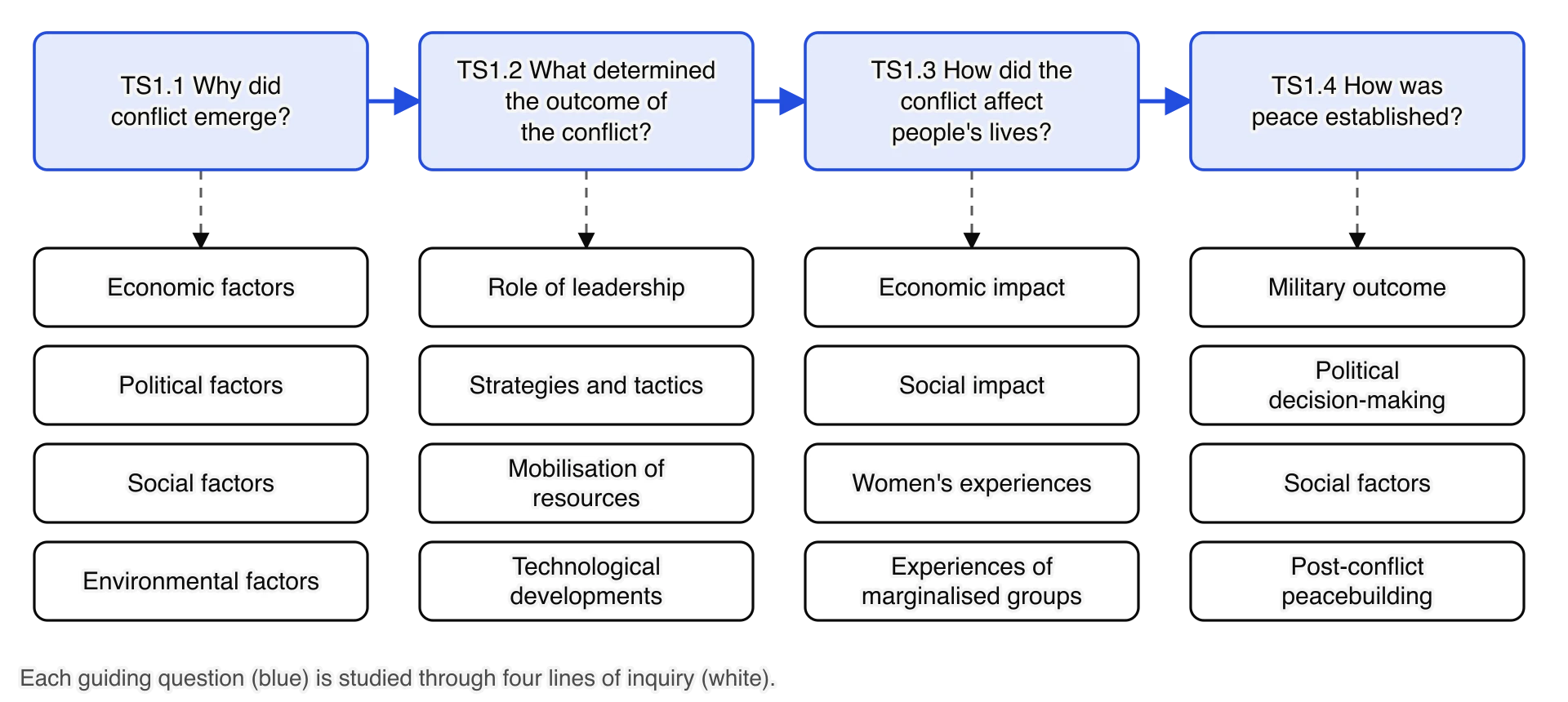
The questions are connected. The causes of a war shaped how it was fought; the way it ended shaped the peace; and the effects on people's lives, such as hunger, displacement and new roles for women, often decided whether a peace was accepted.
The core conflicts
No conflicts are fixed in advance: any well-evidenced conflict after 750 can be studied. The pages follow six core conflicts throughout, chosen to cover all four regions and nearly nine hundred years, with shorter examples from many others. The table of the core conflicts lists them.
Conflict | Region | Kind of conflict |
|---|---|---|
The Crusades (1095–1192) | Europe; Africa and the Middle East | Religious war and war of conquest |
The Mongol conquest of Song China (1235–1279) | Asia and Oceania | War of conquest by a steppe empire |
The US Civil War (1861–1865) | The Americas | Civil war |
The First World War (1914–1918) | Europe, with fronts in Africa, Asia and the Middle East | War between great powers |
The Second World War in Asia and the Pacific (1937–1945) | Asia and Oceania | War of imperial expansion and world war |
The Algerian War of Independence (1954–1962) | Africa and the Middle East | War of independence |
Each guiding question develops one of the core conflicts in more depth: the outbreak of the First World War for why conflict emerged, the Union victory in the US Civil War for what determined the outcome, civilian life in the war in Asia and the Pacific for the effects on people, and the ending of the Algerian War for how peace was established.
Big ideas that run through the thematic study
Conflicts have several causes, and the weight of each differs from case to case. Economic, political, social and environmental pressures made wars possible, but a war began only when particular leaders decided to fight. Explaining any conflict means showing how conditions and decisions combined, and judging which mattered most.
Outcomes were seldom inevitable. The side with more people, money and industry usually won long wars, but only once it had organised those resources, and leadership, strategy, technology, chance and outside intervention all played a part. Historians argue over whether "big battalions" or contingency best explain victory, as in the debate over why the Union won.
Conflict reached far beyond the battlefield. From the twentieth century onwards wars often killed more civilians than soldiers, and total war extended the power of the state over daily life. Women gained new work and sometimes political rights but also suffered sexual violence; minorities, colonised peoples and the enslaved were often persecuted as suspected enemies, yet wartime service also became an argument for equal rights. The experiences of women and marginalised groups are lines of inquiry in their own right.
Ending the fighting was not the same as making peace. Historians distinguish negative peace, the absence of fighting, from positive peace, a settlement that also brings justice and reconciliation, and most settlements achieved the first more fully than the second. Every one of the four historical concepts applies: causes and consequences, change and continuity in people's lives, the perspectives of winners, losers and civilians, and the significance of each war for what followed.
How the thematic study is studied and examined
All students, at SL and HL, take one of the four thematic studies: Conflict, Innovation and transformation (both from 750 CE), Authoritarian rule and Popular movements (both from 1750). The thematic study takes about 80 teaching hours, the largest part of the SL programme. There is no set list of examples. Teachers choose the conflicts, which may include recent ones, and students need examples from at least two of the four regions (Africa and the Middle East; the Americas; Asia and Oceania; Europe). It is the part of IB History that builds skill in making connections between different examples.
The thematic study is assessed by Paper 2 (1 hour 45 minutes, 25 marks; 40 per cent of the SL grade and 25 per cent of the HL grade), the same paper at SL and HL. Section A sets two questions on the historical concepts, of which students answer one (6 marks) using one example from their thematic study. Section B sets two questions on each thematic study; students choose one and answer both parts. The IB's published sample for Conflict shows the form. Part A: "Explain how conflict can affect the experience of a marginalized group. Use one example from your thematic study in your response." (4 marks). Part B: "To what extent has the mobilization of resources been the most important factor in determining the outcome of conflict? Use examples from at least two different conflicts in at least two regions to support your response." (15 marks).
Carry on with TS1 in Augment
With a free account, Augment remembers where you stopped and what you have practiced.