Explain how leadership, strategy and tactics, resources and technology determined the outcomes of conflicts from the Crusades to Algeria, and weigh them.
Each is in the History glossary, with every other term in the subject.
A warship with a flight deck from which aircraft take off and land, which became the most important type of warship in the Pacific War.
The Armée de Libération Nationale, the armed wing of the FLN during the Algerian War, with guerrilla units inside Algeria and a larger army based in Tunisia and Morocco.
The Union strategy proposed by General Winfield Scott in 1861: a naval blockade of the Confederate coast and control of the Mississippi River to split and strangle the Confederacy.
An agreement between the sides in a war to stop fighting while the terms of peace are worked out. It ends the fighting but is not itself a peace settlement.
A strategy of wearing down the enemy's soldiers, equipment and will through continuous losses instead of seeking one decisive battle. It favours the side with greater reserves.
The French offensive of 1959–1960 under General Maurice Challe, in which mobile forces with helicopters destroyed ALN units inside Algeria region by region.
An alliance of states, rulers or armed groups that fight together while keeping their own interests and commanders.
Fighting by using different weapons and branches (infantry, artillery, tanks, aircraft) together so that each covers the weaknesses of the others.
Historians explain the outcome of a conflict through the decisions of its leaders, the strategies and tactics of its armies, the resources each side could mobilise and the technology available to them. Comparing conflicts from different centuries and regions, such as the Mongol conquest of Song China, the Union victory in the US Civil War and the French withdrawal from Algeria, shows which explanations of victory and defeat hold true in general and which depend on the particular war.
With a free account, Augment remembers where you stopped and what you have practiced.
The grouping of merchant ships to sail together under the protection of warships, which made them harder for submarines to find and attack.
A medieval siege engine whose throwing arm is swung by a heavy falling weight, able to throw larger stones further and more accurately than engines worked by pulling teams.
Lincoln's order, in force from 1 January 1863, declaring enslaved people in areas in rebellion free and allowing Black men to serve in the Union armed forces.
The agreements signed by France and the Algerian provisional government on 18 March 1962 that set a ceasefire, a vote on self-determination and the terms of Algerian independence and cooperation with France.
The failed seizure of power in Algiers on 21–26 April 1961 by four French generals who opposed de Gaulle's move towards Algerian self-determination.
The Provisional Government of the Algerian Republic, set up by the FLN in exile in September 1958 to speak for Algeria in diplomacy and, later, in negotiations with France.
The paper dollar issued by the Union government under the Legal Tender Act of 1862, not backed by gold, used to help pay for the Civil War.
The German plan of August 1916 to greatly increase the production of guns, shells and other munitions by directing industry and labour to the war.
The series of Allied attacks on the Western Front from the Battle of Amiens on 8 August 1918 to the armistice of 11 November 1918, which drove the German army back.
The forced seizure of goods, animals or labour for military use; in the Confederacy, the army's taking of food, livestock and enslaved labourers.
The advantage of a side whose forces are positioned between its enemies or inside a territory, so that it can move troops between fronts by shorter routes than the enemy.
In the medieval Islamic world, a grant of the tax revenue from an area of land to a soldier or commander in return for military service.
The American strategy in the Pacific from 1943 of capturing selected islands as bases while bypassing and isolating strongly held Japanese positions.
The Confederate strategy of using Europe's dependence on Southern cotton to force Britain and France to recognise the Confederacy and break the Union blockade.
The argument, made by historians such as Gary Sheffield, that the British army learned from its costly failures on the Western Front and became highly effective by 1918.
The principles an armed force follows about how to fight: how units are organised, how weapons work together and how commanders decide.
The fortified barrier of electrified fences, minefields and radar built by France along Algeria's border with Tunisia from 1957 to stop ALN fighters and arms crossing.
The French counter-insurgency method in Algeria of dividing the country into a grid of sectors, each permanently held by its own garrison.
A settlement into which the French army moved rural Algerians during the Algerian War to cut the guerrillas off from the population; later estimates put the number moved at about two million.
The series of German attacks on the Western Front from March to July 1918, which gained ground but failed to win the war before American troops arrived.
The false claim, spread by German nationalists after 1918, that the German army had not been defeated in the field but betrayed by revolutionaries and politicians at home.
A plan for winning a war or campaign as a whole: which enemy forces or places to attack, in what order and for what political aim.
The methods used to win a particular battle or engagement: how troops are arranged and moved and how weapons are combined.
A war in which states direct their whole economies and populations to the war effort, and in which civilians, industry and food supplies become targets.
The truce agreed in September 1192 between Richard I and Saladin that ended the Third Crusade: the crusaders kept the coast from Tyre to Jaffa, Jerusalem stayed under Muslim rule, and Christian pilgrims could visit it.
The segregated regiments of Black soldiers, most of them formerly enslaved, who served in the Union army under white officers from 1863.
The sinking of merchant ships, including neutral ones, without warning by submarines; resumed by Germany on 1 February 1917, it helped bring the USA into the First World War.
The dynasty proclaimed by the Mongol ruler Khubilai Khan in 1271, which ruled all of China after the conquest of the Song in 1279 until 1368.
Before explaining an outcome, a historian has to say what it was. The obvious answer is that one side won and the other lost, but many wars ended less clearly. Some ended in a stalemate, in which neither side could defeat the other and both accepted a compromise. Others produced a political result that was the opposite of the military balance on the ground.
The Prussian general and theorist Carl von Clausewitz argued in On War (published in 1832) that war is a continuation of politics by other means. His point was that a war is fought for a political aim, so it is won only when that aim is achieved. A side that wins battles but cannot reach its political aim has not won the war. The distinction matters in every conflict from the Crusades to Algeria.
Type of outcome | What it means | Core example |
|---|---|---|
Decisive military victory | One side destroys or forces the surrender of the other's armed forces and state | The Mongol conquest of Song China, completed at Yamen in 1279; Union victory in 1865 |
Victory by exhaustion | One side wins because the other can no longer continue, without its armies being destroyed | Germany's request for an armistice in 1918; Japan's surrender in August 1945 |
Stalemate and compromise | Neither side can achieve its aims; both accept a negotiated settlement | The Third Crusade, ended by the Treaty of Jaffa (1192): the crusaders kept the coast but not Jerusalem |
Political victory despite military defeat | The weaker side loses most battles but achieves its political aim | The FLN in Algeria: militarily weakened by 1960, independent in 1962 |
The same war can also have different outcomes for different groups. The First Crusade (1096–1099) was a victory for the crusaders and the new Latin states it created, but for the Muslim and Jewish populations of Jerusalem, massacred when the city fell on 15 July 1099, it was a catastrophe. For Algerian harkis, who had fought for France, independence in 1962 brought reprisals and exile. Explaining "the outcome" therefore means saying whose outcome is meant.
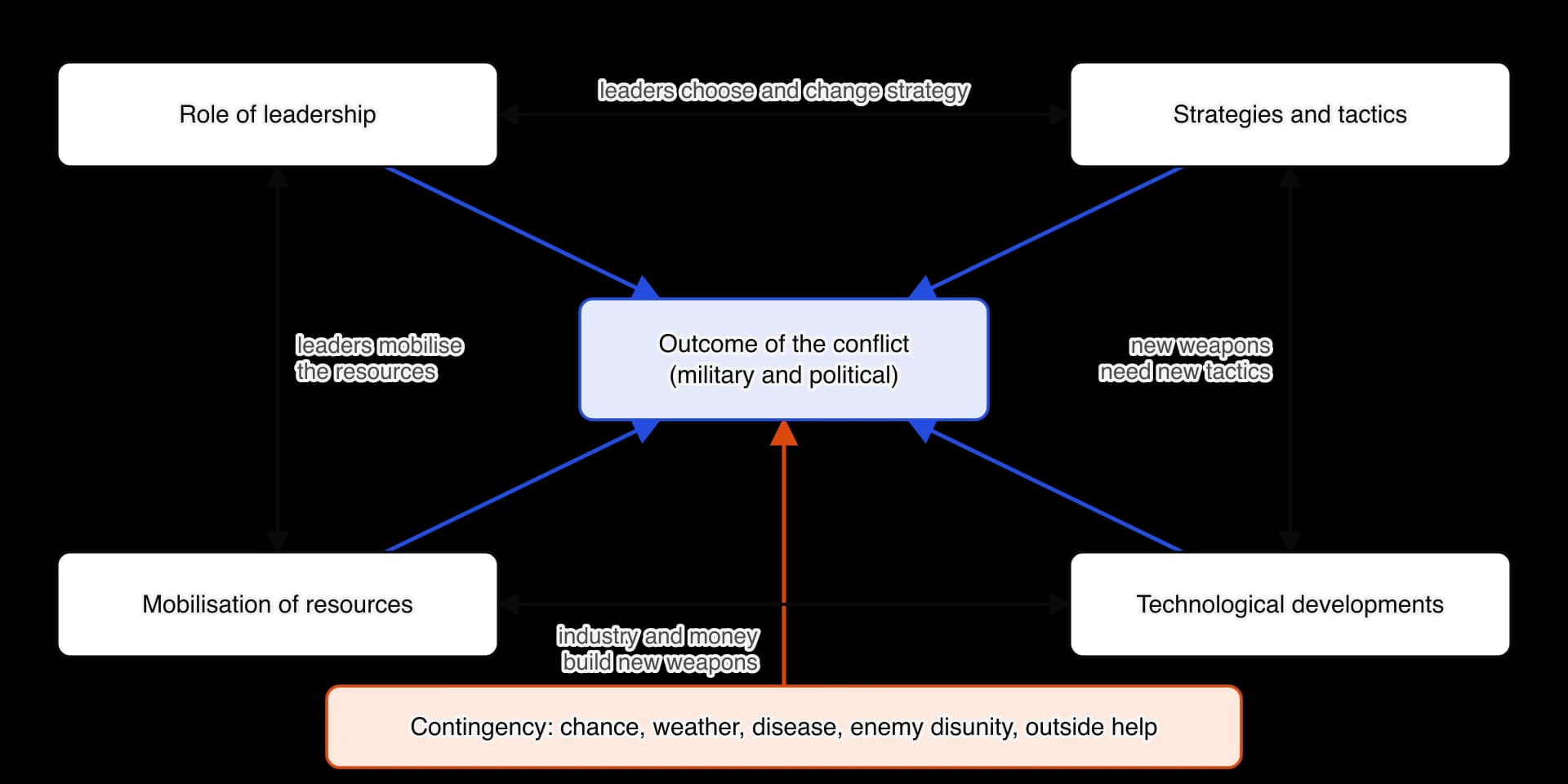
Historians usually explain victory and defeat through four groups of factors. Leadership covers the decisions of commanders and political leaders. Strategies and tactics are the plans for winning the war as a whole and for fighting battles. Mobilisation of resources is the organisation of people, money, food and industry for war. Technological developments are new weapons, transport and communications. To these must be added contingency: events that no side controlled, such as the death of a ruler, a storm or an epidemic.
The diagram of the four factors shows why they are hard to separate. Resources do nothing until leaders mobilise them, and a strategy works only if it matches the resources available. A new weapon matters only when it is built in large numbers and used with new tactics. The most convincing explanations of an outcome therefore show how the factors combined, and then judge which one made the decisive difference in that war.
Leadership in war works at two levels. Military leaders plan campaigns, choose when and where to fight, adapt to the enemy and keep their troops' morale. Political leaders set the aims of the war, hold together alliances and home fronts, raise money and soldiers, and decide when to negotiate. In medieval wars the two roles were often held by one person, such as a king or sultan who led his army in the field; in modern wars they were usually separate, and the relationship between generals and politicians became a factor in its own right.
Good leadership cannot create resources that do not exist, and the old saying that victory goes to the "big battalions" expresses the view that leaders matter less than numbers. Leadership is most convincing as an explanation when the two sides were roughly balanced, when a leader adapted faster than the enemy, or when a political decision, not a battle, ended the war.
Saladin (Salah al-Din Yusuf ibn Ayyub) was a Kurdish commander who became ruler of Egypt in 1169–1171 and then brought Damascus (1174), Aleppo (1183) and, by agreement, Mosul (1186) under his authority. Before him the Muslim rulers of Syria and Egypt had rarely acted together against the crusader states. He used the idea of jihad, a duty to defend and recover Muslim lands, to give his coalition of emirs a common cause. On 4 July 1187 he destroyed the army of the Kingdom of Jerusalem at Hattin, and Jerusalem surrendered on 2 October 1187.
The Third Crusade (1189–1192) was the Latin Christian response. Its most effective leader, Richard I of England, arrived in June 1191 and helped to take the port of Acre after a two-year siege. On the march south along the coast, he kept his army in a tight column with infantry and crossbowmen shielding the knights from Saladin's mounted archers. At Arsuf on 7 September 1191 he launched a controlled charge that drove Saladin's army from the field.
Richard twice advanced to within about 20 kilometres of Jerusalem, in January and June 1192, and twice turned back. His advisers argued that even if the crusaders took the city they could not hold it once most of them sailed home. Saladin, for his part, struggled to keep his emirs in the field after years of campaigning. The Treaty of Jaffa (2 September 1192) recognised the stalemate: a three-year truce left the crusaders the coast from Tyre to Jaffa, while Jerusalem stayed under Muslim rule with access for Christian pilgrims.
The Third Crusade shows both the power and the limits of leadership. Saladin's unification of Egypt and Syria made the victory at Hattin possible, and Richard's tactical skill recovered the coast. Neither could overcome the problems that leadership could not solve: for Richard, the distance from Europe and the temporary nature of a crusading army; for Saladin, the limits of a coalition held together by personal loyalty.
The contrast between Mongol and Song leadership helps to explain how the Song, with a far larger population and economy, lost their state. When the Great Khan Möngke died in 1259 during a campaign in Sichuan, the invasion stopped and the Mongol princes fought a civil war over the succession. The winner, Khubilai, was more familiar with China than any earlier Mongol ruler. He used Chinese advisers, adopted the Chinese dynastic name Yuan in 1271 and built his army around Chinese infantry, engineers and sailors as well as Mongol cavalry.
Khubilai also used politics as a weapon. The Song general Liu Zheng, who defected to the Mongols in 1261, advised him to concentrate on the fortress of Xiangyang and to build a navy. Song commanders who surrendered were offered good treatment: Lü Wenhuan, who surrendered Xiangyang in 1273, was given command of the city, and other members of his family then went over to the Mongols with their garrisons. Bayan, the commander of the final campaign of 1274–1276, offered terms to cities that surrendered.
Song leadership, by contrast, was divided. The chief minister Jia Sidao dominated the court from 1260, and historians have long blamed him for hiding bad news from the emperor and for rivalries among commanders that weakened the relief of Xiangyang. Some recent historians argue that he was made a scapegoat by later writers and that the Song state faced deeper problems of finance and defence. Either way, the Song were led by a court divided by faction and, after 1274, by child emperors.
Leadership on the Western Front is usually judged through the generals, such as Douglas Haig for Britain and Erich Ludendorff for Germany, whose costly battles are the subject of a long debate among historians. Coalition management and the relationship between generals and governments also mattered. After the German breakthrough of March 1918, the Allies agreed at Doullens on 26 March to give Foch the coordination of their armies on the Western Front, and in April he became commander-in-chief of the Allied armies there. In Germany, Hindenburg and Ludendorff dominated government from August 1916, and the historian Martin Kitchen called this a "silent dictatorship". Military leaders made political decisions, such as unrestricted submarine warfare in 1917, without the restraint of civilian government. In Britain and France, by contrast, civilian leaders such as David Lloyd George and Georges Clemenceau kept control of war policy.
In Algeria, political leadership determined the outcome. Charles de Gaulle returned to power in June 1958, brought back by a crisis in which the army and settlers in Algiers had defied the government in Paris. Many of them expected him to keep Algeria French. He first expanded the war and launched an economic development programme, the Constantine Plan, but by 1959 he had concluded that holding Algeria cost France more than it was worth.
In a broadcast on 16 September 1959 he offered Algerians self-determination: once the fighting was over, they would choose between full integration with France, association with it, or independence. He then faced down two revolts by settlers and officers who felt betrayed, the "barricades week" of January 1960 and the generals' putsch of April 1961. Between them, in January 1961, he won a referendum in which about 75 per cent of voters approved self-determination. Without his decision and his authority over the army, the war could have continued for years.
The FLN (Front de Libération Nationale), the Algerian independence movement, was led collectively, and its leaders were often in conflict. Abane Ramdane, the organiser of its 1956 programme, was killed by fellow FLN leaders in 1957. Its success came less from any individual commander than from a strategy that kept its political aim fixed through military defeat.
A strategy is a plan for winning a war or a campaign as a whole: which enemy forces or places to attack, in what order, and with what political aim. Tactics are the methods used to win a particular battle: how troops are arranged, how they move and how different weapons are combined. A side can win battles with good tactics and still lose a war through bad strategy, as Germany did in 1918.
Strategies succeed when they match the resources available and the political aim of the war. The Confederacy needed only to survive, so a defensive strategy suited it; the Union had to conquer a territory the size of western Europe. The FLN in Algeria could not defeat the French army, so its strategy aimed at political pressure, not military victory.
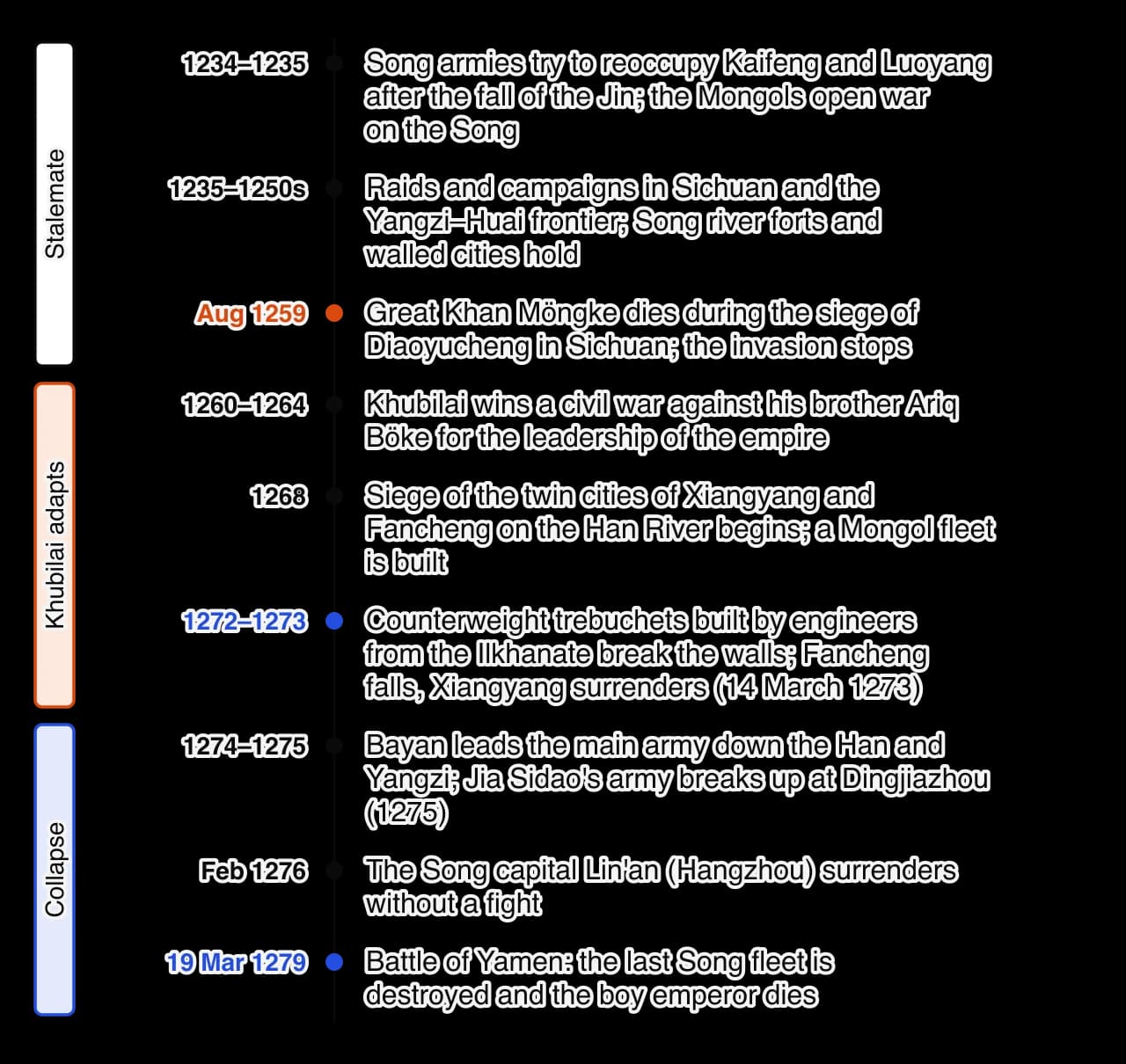
The early Mongol conquests relied on mounted archers, speed and terror against cities that refused to surrender. These methods worked poorly in southern China, a land of rice paddies, rivers, mountains and strongly walled cities. For more than thirty years after 1235 the Song defended a line of river fortresses along the Yangzi and its tributaries, and Mongol campaigns produced raids and sieges but no breakthrough.
Under Khubilai the Mongols changed their strategy. They chose one decisive target, the twin cities of Xiangyang and Fancheng on the Han River, which controlled the route south to the Yangzi. From 1268 they surrounded the cities with a ring of forts and a fleet of river ships to block supplies, and drove off repeated Song relief attempts. After Xiangyang fell in 1273, Bayan led the army and fleet down the Han and the Yangzi, and the Song defence collapsed within three years. The vertical timeline of the conquest shows how long the stalemate lasted and how quickly the end came once the strategy changed.
Germany's plan for 1914, based on the earlier Schlieffen Plan, was a strategy of manoeuvre: to defeat France in about six weeks by sweeping through Belgium, and then to turn against Russia. It failed at the Battle of the Marne in September 1914. By the end of the year a line of trenches ran from the Channel to Switzerland, and neither side could break through it.
For the next three years both sides fought a war of attrition. At Verdun in 1916, the German commander Falkenhayn aimed to inflict such heavy losses on the French army that France would give up. At the Somme in the same year, the British and French tried to break through and to wear down the German army; on its first day, 1 July 1916, the British army suffered about 57,000 casualties, including about 19,000 dead. Attrition favoured the side with more men and materials, which by 1917 was clearly the Allies.
The Allies also fought a strategy of economic warfare. The British naval blockade cut Germany's imports of food, fertiliser and raw materials. Germany replied with submarine warfare against shipping to Britain, which in 1917 brought the United States into the war. Tactics changed too. In the Spring Offensives of March–July 1918, German storm troops used infiltration tactics: short, intense bombardments followed by small groups bypassing strongpoints. They gained more ground than any attack since 1914 but had no clear strategic target, outran their supplies and cost Germany about 690,000 casualties by July, losses its army could no longer replace.
Japan's strategy in December 1941 was to seize the oil, rubber and tin of Southeast Asia, build a defensive perimeter across the Pacific, and make the war so costly for the United States that it would accept a negotiated peace. The strategy depended on a short war. After the Japanese defeat at Midway in June 1942 and the long struggle for Guadalcanal (August 1942–February 1943), the initiative passed to the United States.
The United States advanced on two lines: through the central Pacific under Admiral Chester Nimitz and through New Guinea and the Philippines under General Douglas MacArthur. American submarines sank most of Japan's merchant fleet, cutting off the oil and raw materials that had been the reason for the war. From late 1944, B-29 bombers based in the Marianas burned Japan's cities; the raid on Tokyo of 9–10 March 1945 killed about 100,000 people.
In China, the Nationalist government of Jiang Jieshi (Chiang Kai-shek) followed a strategy of trading space for time: retreating into the interior, to the wartime capital of Chongqing, instead of seeking decisive battles it could not win. The Chinese Communists fought a guerrilla war behind Japanese lines in the north. Neither drove Japan out, but together they kept hundreds of thousands of Japanese troops in China throughout the war. In Burma, the British Fourteenth Army under William Slim, most of whose soldiers came from India and Africa, defeated the Japanese invasion of India at Imphal and Kohima in 1944 and reconquered Burma in 1945, using supply by air to fight through jungle and the monsoon.
The FLN began its war on 1 November 1954 with small attacks across Algeria. Its army, the ALN, could not hold territory against the French, so it fought a guerrilla war in the mountains and, in 1956–1957, a campaign of bombings and assassinations in Algiers. Its aim was to make Algeria ungovernable and to draw international attention to the cause of independence.
The French army answered with counter-insurgency. It divided Algeria into a grid of sectors, each with a garrison (quadrillage). It moved rural Algerians into regroupment camps to separate them from the guerrillas; later estimates put the number moved at about two million. In the Battle of Algiers (January–October 1957), paratroops under General Jacques Massu broke the FLN network in the city, using the systematic torture of prisoners. The Morice Line, an electrified fence with minefields built along the Tunisian border in 1957, cut the ALN inside Algeria off from its units abroad. In 1959–1960 the Challe Plan, named after General Maurice Challe, sent mobile forces with helicopters to destroy ALN units region by region.
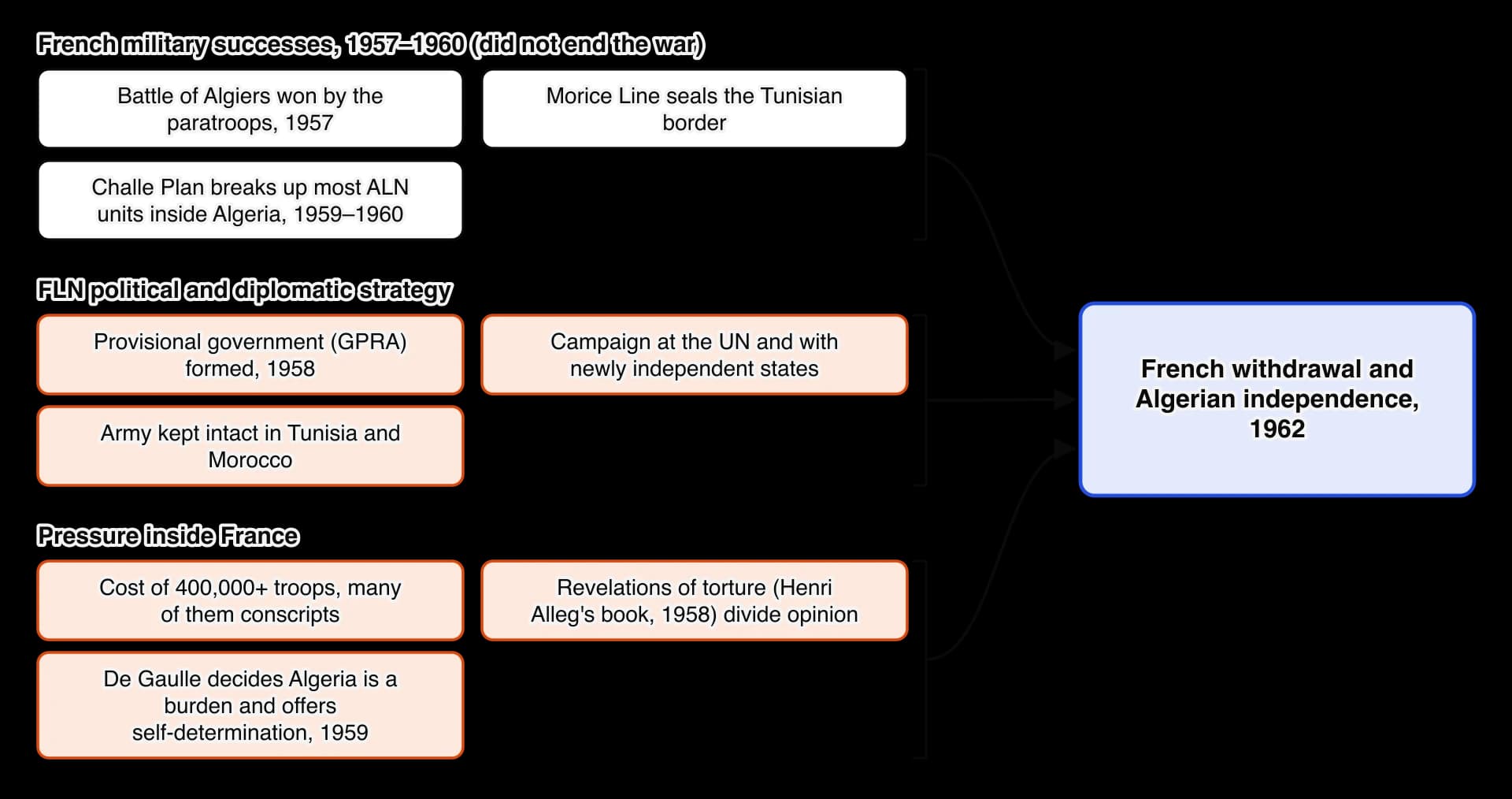
By 1960 the ALN inside Algeria had been reduced to scattered groups. The diagram of the French withdrawal shows why this military success did not decide the war. The methods that won it, torture and the mass removal of villagers, turned opinion in France and abroad against the war, and the FLN's political and diplomatic strategy, led from September 1958 by a provisional government in exile (the GPRA), continued untouched by military defeat. The outcome was settled by the Évian Accords of March 1962, a ceasefire and agreement that led to independence after referendums in France (April 1962) and Algeria (July 1962).
Henri Alleg, a communist journalist arrested and tortured by paratroops in Algiers in 1957, described his experience in La Question (1958). The French government banned the book, but it circulated widely and helped to make torture a public scandal. Revelations of this kind cost the war the support of many French intellectuals, Church leaders and conscripts' families, which mattered more to the outcome than any defeat in the field.
Wars are fought with people, food, money, weapons and transport. The side with more of them has an advantage, but only if it can organise them for war. This organisation is called mobilisation. In a long war, the ability to keep producing soldiers and supplies after the first armies are destroyed usually matters more than the size of those first armies.
In the nineteenth and twentieth centuries mobilisation reached the whole of society, and historians call such conflicts total war: wars in which states direct their entire economies and populations to the war effort and in which civilians, factories and food supplies become targets. Medieval rulers could mobilise far less. Their armies were raised for a season through personal and feudal obligations, and they depended on what could be carried, bought or taken along the way.
The crusaders fought thousands of kilometres from home, and supply was their greatest problem. During the First Crusade the army that besieged Antioch from October 1097 to June 1098 suffered famine through the winter, and many horses died. At Jerusalem in June 1099 the crusaders were short of water and timber until Genoese ships arrived at Jaffa; their timber was used to build the siege towers that took the city on 15 July.
Supply also set the limits of the Third Crusade. Richard I's army depended on the fleet that moved along the coast beside it, which is one reason why he kept to the coast and why an advance inland to Jerusalem seemed so dangerous. Saladin had the resources of Egypt and Syria close at hand, but his troops were paid through grants of land revenue (iqta) and expected to return to their estates after a campaigning season. Both sides were limited less by the size of their populations than by their ability to keep an army in the field.
The Mongols began as a people of perhaps one million, far fewer than the Song with a population of about 60 million or more. Their army was organised in units of ten, a hundred, a thousand and ten thousand, which made it possible to absorb soldiers from conquered peoples. By the 1260s most of the soldiers fighting the Song were not Mongols but northern Chinese, Jurchen and other subjects of the Mongol state, along with Song soldiers and sailors who had changed sides.
Khubilai mobilised the resources of north China, conquered from the Jin dynasty in 1234, to build the fleet of thousands of river ships that blockaded Xiangyang. He drew on the wider Mongol empire for experts: the engineers who built the counterweight trebuchets came from the Ilkhanate in Iran. The Mongol victory shows that the side with fewer resources at the start could win by capturing and using the enemy's own.
 YouTube
In 1914 the Allies (above all Britain, France and Russia, with their empires) controlled far more resources than the Central Powers (Germany, Austria-Hungary and, from October 1914, the Ottoman Empire). The economic historians Stephen Broadberry and Mark Harrison calculate that the Allies had about 5.2 times the population, 11.5 times the territory and 2.9 times the economic output of the Central Powers in 1914. Britain and France also drew on their empires: more than a million soldiers from India served overseas, and France recruited hundreds of thousands of soldiers and workers from its African and Asian colonies.
Resource, 1914 | Allies compared with Central Powers |
|---|---|
Population | About 5.2 times as large |
Territory | About 11.5 times as large |
Economic output (GDP) | About 2.9 times as large |
Data: Stephen Broadberry and Mark Harrison (eds), The Economics of World War I (2005). Allied totals include the colonial empires; the advantage among the great powers alone was smaller.
Mobilisation also reached into the home fronts. Britain raised about 2.5 million volunteers through recruiting campaigns and posters before the Military Service Act of January 1916 introduced conscription. After a shortage of shells in 1915, a new Ministry of Munitions under David Lloyd George expanded arms production, and by 1918 nearly a million women worked in munitions. Governments took powers over industry, transport and the press (in Britain through the Defence of the Realm Act of 1914), used propaganda to keep civilians working and, as food ran short, introduced rationing: bread in Germany from 1915, sugar, meat and butter in Britain in 1918.
Germany was the most efficient mobiliser of the war. Its industry produced the guns and shells that held off larger Allied armies for four years, and in 1916 the Hindenburg Programme set out to double munitions output. But the British naval blockade cut Germany off from imported food, fertiliser and raw materials. After the poor potato harvest of 1916, the "turnip winter" of 1916–1917 left many German civilians living on turnips. Estimates of German civilian deaths caused by the blockade range from about 424,000 to the official German figure of 763,000; historians disagree because hunger worked together with disease, including the influenza epidemic of 1918.
The German leadership tried to answer the blockade with its own. The chain of the U-boat gamble shows how this decision changed the balance of resources.
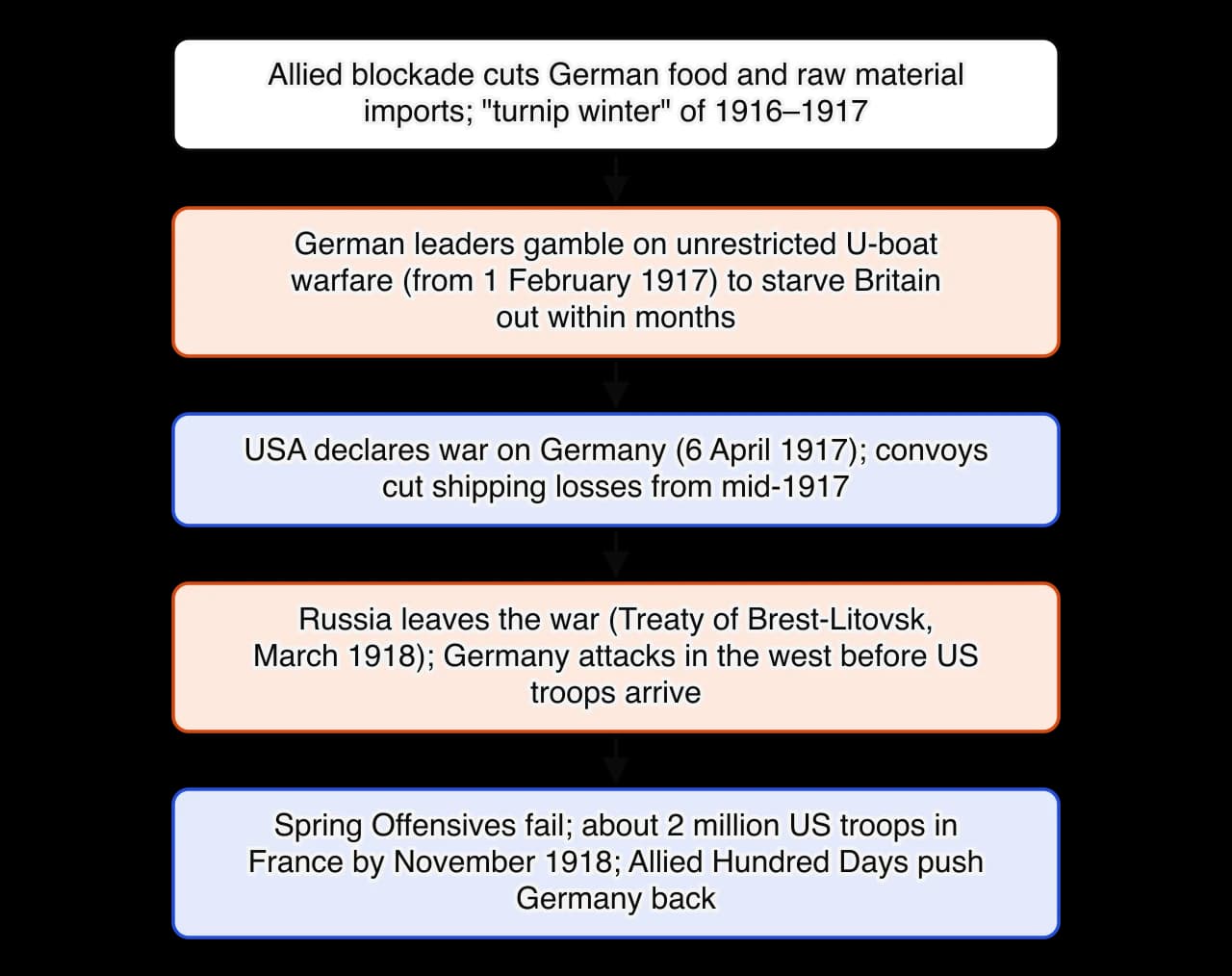
Unrestricted submarine warfare, resumed on 1 February 1917, sank many ships, but the convoy system introduced by Britain from mid-1917 reduced losses, and the campaign brought the United States into the war on 6 April 1917. American loans, food and, from 1918, soldiers gave the Allies reserves that Germany could not match. The collapse of Russia in 1917 freed German divisions for one last offensive in the west, but they could not win before the Americans arrived.
By August 1918 the German army was exhausted and short of men, horses and food, and the home front was failing too. Hunger had already caused mass strikes in German cities in 1917 and January 1918, and at the end of October 1918 sailors of the High Seas Fleet refused to sail on a final attack, a mutiny that spread to Kiel at the start of November.
Ludendorff, who directed the German war effort, later described the first day of the Allied offensive at Amiens.
August 8th was the black day of the German Army in the history of this war. … whole bodies of our men had surrendered to single troopers, or isolated squadrons. … Our war machine was no longer efficient.
Erich Ludendorff, My War Memories, 1914–1918, English translation, 1919. Ludendorff wrote soon after Germany's defeat, and the memoirs defend his own command. In the same passage he reports, and endorses, a battalion commander's view that the trouble came from "the spirit of insubordination" that drafts brought with them from home, an early form of the claim that the army had been betrayed by the home front. The extract is valuable as evidence that German commanders saw the collapse of morale as decisive in August 1918, but it is a limited guide to the causes of that collapse.
 YouTube
Japan went to war with the United States in December 1941 knowing it was far weaker. American output was nearly five times Japan's in 1938, according to the estimates of Mark Harrison, and Japan imported most of its oil, much of it from the United States until the embargo of 1941. The Japanese naval commander Isoroku Yamamoto is reported to have told the prime minister that the navy could win victories for six months to a year but had no confidence after that.
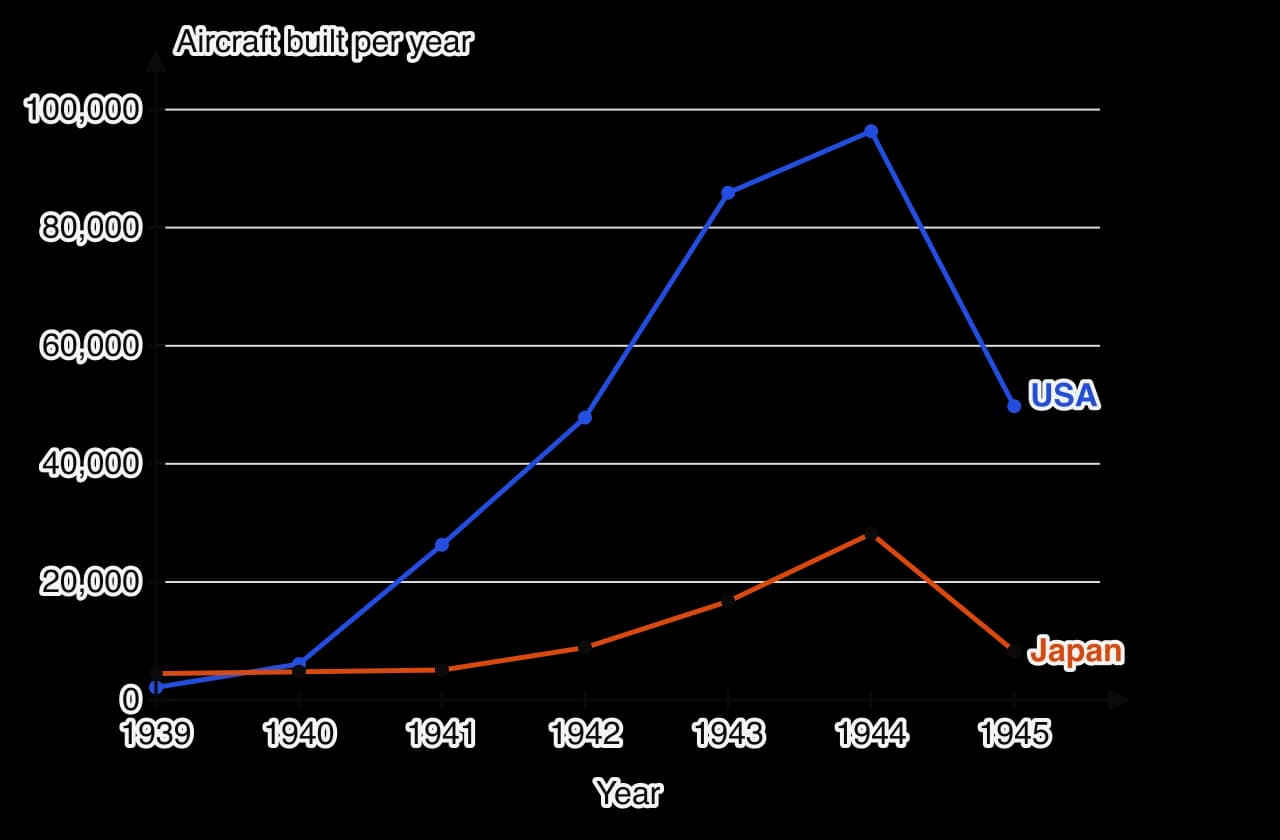
The line graph of aircraft production shows the gap that opened from 1942. Japan expanded its output more than fivefold between 1941 and 1944, but the United States built more than three aircraft for each Japanese one in 1944, as well as supplying Britain, the Soviet Union and China. The same pattern held for ships: the United States commissioned dozens of aircraft carriers during the war, while Japan could not replace the four large carriers it lost at Midway. American submarines and aircraft sank most of Japan's merchant fleet, so the oil and raw materials of Southeast Asia could not reach Japanese factories.
Resources also explain the importance of China. The war in China, which began in July 1937, absorbed much of the Japanese army: hundreds of thousands of Japanese troops remained there until 1945. The historian Rana Mitter argues in China's War with Japan, 1937–1945 (2013) that Chinese resistance, at enormous cost, was a major contribution to Allied victory that Western accounts long overlooked.
France had overwhelming material superiority in Algeria. It deployed more than 400,000 troops by 1956–1957, many of them young conscripts, with aircraft, helicopters and artillery, against an ALN that never had more than a few tens of thousands of fighters inside Algeria. Yet France gave up Algeria in 1962. What France ran short of was a political resource, the willingness of voters, conscripts and governments to go on paying for a war whose methods many found shameful and whose purpose many no longer accepted.
New technology changes how wars are fought: what weapons can destroy, how fast armies move, how far commanders can see and communicate, and how wounded soldiers are treated. It is tempting to explain outcomes through a single new weapon, such as the tank or the atomic bomb. In practice technology decided outcomes only under three conditions: one side had it and the other did not (or could not answer it), it was produced in large enough numbers, and armies changed their tactics and organisation to use it.
Chinese armies had used traction trebuchets, throwing engines worked by teams of men pulling ropes, for centuries. The counterweight trebuchet, in which a heavy box of earth or stones swings the throwing arm, could throw much heavier stones further and more accurately. It was developed in the eastern Mediterranean and Middle East in the twelfth century and was used in the sieges of the Crusades.
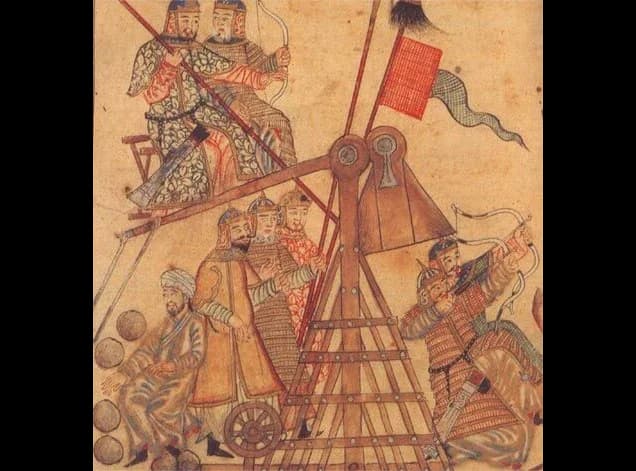
In 1271–1272 Khubilai asked his relative Abaqa, ruler of the Ilkhanate in Iran, for experts in these engines. Two Muslim engineers, Ismail and Ala al-Din, travelled to China and built counterweight trebuchets at Xiangyang. Their stones broke the defences of Fancheng, which was stormed early in 1273, and then struck Xiangyang itself, which surrendered on 14 March 1273. Chinese writers later called these machines "Muslim trebuchets" (huihui pao).
The trebuchets ended a siege that blockade had not ended in five years, so they were a decisive technology at Xiangyang. But the Mongols could use them only because their empire linked China to the Middle East, and only because the blockade by forts and ships had already isolated the cities. Technology, the mobilisation of foreign expertise and strategy worked together.
Gunpowder weapons gradually changed war after 1300. In the Horn of Africa, the Ethiopian–Adal War (1529–1543) shows how a new weapon could decide a war and how a counter could reverse the result. Ahmad ibn Ibrahim al-Ghazi, the leader of the Muslim Sultanate of Adal, used matchlock firearms and gunners obtained through the Ottoman Empire to defeat the Christian Ethiopian army in 1529 and occupy much of the Ethiopian highlands. In 1541 about 400 Portuguese musketeers landed to help Ethiopia, and in February 1543 Ahmad was killed at the battle of Wayna Daga. Firearms first gave Adal its victory and then, in the hands of an outside ally, helped Ethiopia to recover.
On the Western Front between 1914 and 1917, technology favoured defence. Machine guns, barbed wire and quick-firing artillery made attacks across open ground very costly, while railways let defenders bring reserves to a threatened sector faster than attackers could advance on foot. New weapons such as poison gas (first used on a large scale by Germany at Ypres in April 1915) and the tank (first used by Britain on the Somme on 15 September 1916) did not break the deadlock on their own.
Technology | First major use | Why it did not decide the war at first | How it mattered by 1918 |
|---|---|---|---|
Poison gas | Ypres, April 1915 | Both sides soon had gas masks and gas of their own; wind could blow it back | A routine part of artillery bombardments, used to disrupt enemy guns and reserves |
Tank | Somme, September 1916 | Few in number, slow and unreliable; often broke down | Hundreds used with infantry, artillery and aircraft at Amiens (August 1918) |
Aircraft | Reconnaissance from 1914 | Early aircraft carried little and were vulnerable | Spotting for artillery, photographing trenches, attacking troops |
Artillery methods | Creeping barrage from 1916 | Guns lacked accuracy; long bombardments gave warning of attacks | Guns aimed by map and sound-ranging without warning shots, so attacks came by surprise |
By 1918 the British, French and Dominion armies had learned to combine these weapons. At Amiens on 8 August 1918, the opening of the Allied Hundred Days Offensive, a surprise attack with more than 500 tanks, aircraft and accurately aimed artillery advanced about 11 kilometres in a day. The change was less a new weapon than a new method of using several together, called combined arms. It was the fruit of resources (the factories that built the tanks, guns and shells) and of leadership (the commanders who learned from earlier failures).
Technology also changed how armies were moved, commanded and kept alive. The US Civil War was the first major war in which railways and the electric telegraph shaped strategy across a continent. In September 1863 the Confederacy moved most of James Longstreet's corps by rail from Virginia to northern Georgia in time for its victory at Chickamauga. The Union answered on a larger scale: from 25 September about 20,000 soldiers of two corps travelled about 1,900 kilometres (1,200 miles) by rail from Virginia to the Chattanooga front, the first arriving within a week. Lincoln followed the war from the telegraph office of the War Department, and Grant used the telegraph in 1864 to coordinate armies hundreds of kilometres apart.
The Union could build and repair its railways, and the Confederacy, with little iron industry, could not replace worn-out rails and locomotives, so its transport system decayed as the war went on. Here technology and resources were the same advantage seen from two sides.
Medicine was a technology of war as well. Until the twentieth century disease killed more soldiers than battle, and it still threatened armies in the tropics in the 1940s. In Burma in 1943, the British and Indian forces lost far more men to sickness, above all malaria, than to wounds. Slim's Fourteenth Army cut these losses with the anti-malarial drug mepacrine, which officers had to see their men take every day, and by treating the sick in forward areas instead of sending them back to India. The Japanese army that attacked Imphal in 1944, short of food and medicine, lost very heavily to starvation and disease during its retreat.
In the Pacific War, aircraft carriers replaced battleships as the most important warships, and both sides knew it. At Midway on 4 June 1942, American codebreakers had read enough of the Japanese naval code to warn Admiral Nimitz of the attack, so American carriers were waiting. American dive-bombers sank the Japanese carriers Akagi, Kaga, Sōryū and Hiryū for the loss of one American carrier, the Yorktown. Intelligence, a technology of signals and analysis more than of weapons, allowed a weaker American fleet to surprise a stronger one.
Later in the war, American radar, aircraft and submarines outclassed Japan's, and production let the United States replace its losses while Japan could not. The last technology of the war was the atomic bomb. On 6 August 1945 an American B-29 dropped a uranium bomb on Hiroshima; on 9 August a plutonium bomb was dropped on Nagasaki. On 8 August the Soviet Union declared war on Japan and on 9 August invaded Manchuria. On 15 August Emperor Hirohito broadcast Japan's surrender to his people.
Hirohito's broadcast named the "new and most cruel bomb" as a reason for ending the war, but did not mention the Soviet declaration of war, although a second rescript to the armed forces on 17 August did. American investigators who interviewed Japanese leaders soon after the war reached a different conclusion again.
… it seems clear that, even without the atomic bombing attacks, air supremacy over Japan could have exerted sufficient pressure to bring about unconditional surrender and obviate the need for invasion. … certainly prior to 31 December 1945, and in all probability prior to 1 November 1945, Japan would have surrendered even if the atomic bombs had not been dropped, even if Russia had not entered the war, and even if no invasion had been planned or contemplated.
United States Strategic Bombing Survey, Summary Report (Pacific War), 1 July 1946. The Survey was set up by the US government to judge the effects of bombing, and its findings supported the case of air-power advocates who wanted an independent air force (created in 1947). Historians have since questioned how far the testimony of Japanese leaders supports its confident conclusion. The extract is valuable because it treats the bombs as only the last of many pressures, blockade and conventional bombing above all, but it shows a perspective shaped by the interests of the people who wrote it.
In Algeria the French army had every technological advantage: aircraft, artillery, radio and, above all, helicopters, which it used on a larger scale than any army before it to move troops quickly into mountain areas where the ALN hid. The electrified Morice Line, watched by radar, made it very hard for ALN units in Tunisia to cross into Algeria. These technologies helped France to win the military war by 1960. They could not change the political outcome, which depended on opinion in France, in Algeria and at the United Nations.
The US Civil War began in April 1861 after eleven slave states seceded from the United States and formed the Confederate States of America. The Union (the United States government under President Abraham Lincoln) fought to restore the country; the Confederacy, under President Jefferson Davis, fought to win independence and to protect slavery. The war lasted four years, killed about 620,000–750,000 soldiers, and ended with the surrender of the main Confederate armies in April–May 1865. Because all four lines of inquiry can be seen at work in it, it is a useful test of how they combine.
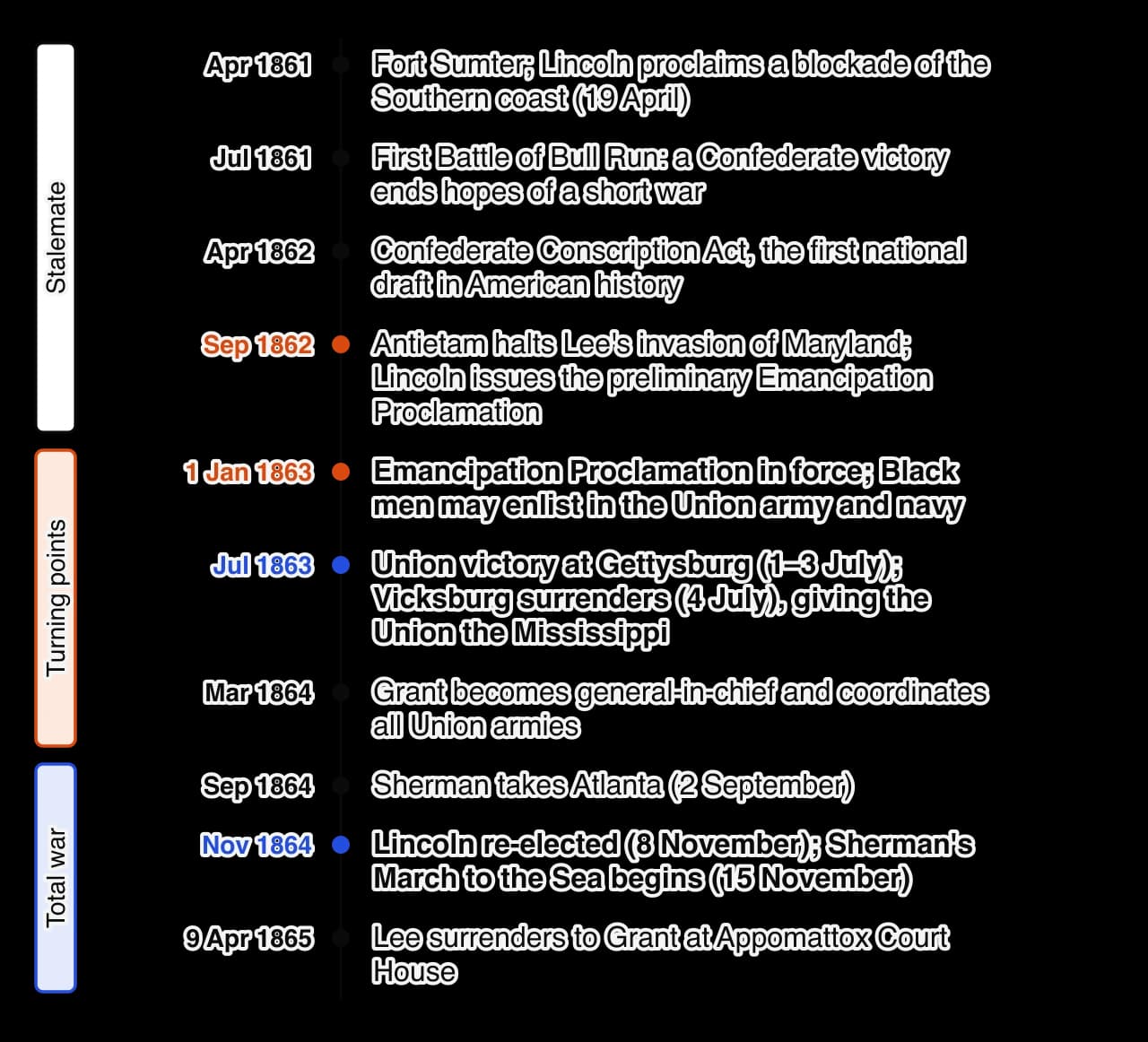
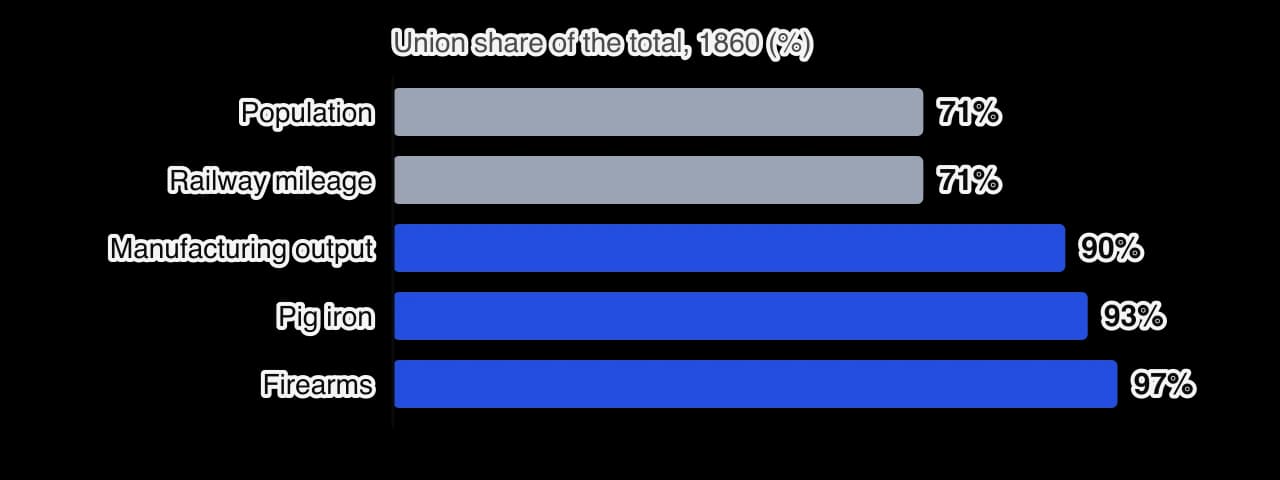
On paper the Union had a crushing advantage. The bar chart of Union resources shows that it had about 22 million people against about 9 million in the Confederacy, of whom about 3.5 million were enslaved and could not be made soldiers. It had most of the country's factories, railways, shipping and banks, and almost all of its production of iron and firearms.
The Confederacy still had real advantages. It needed only to defend itself, while the Union had to invade and occupy a territory of about 750,000 square miles. It could fight on interior lines, moving troops between fronts faster than the Union could. Its soldiers were defending their own homes, and many of its best officers, including Robert E. Lee, had trained in the US Army. Wars of independence had been won before by weaker sides: the American colonists had defeated Britain in 1783. Most Confederate leaders expected that the North would tire of the war long before its resources were exhausted.
The Union's advantages counted because it mobilised them for a long war, and the Confederacy could not. The Union paid for the war through a mix of borrowing, the first federal income tax (1861–1862) and paper money: the Legal Tender Act of February 1862 created the greenback dollar. Its prices rose by about 80 per cent during the war. The Confederacy had little gold, a weak tax system and a cotton economy cut off by blockade, so it printed money: prices in the Confederacy rose by about 9,000 per cent.
Both sides introduced conscription. The Confederacy passed the first national draft in American history in April 1862, and the Union followed in March 1863. Both met resistance: in New York the draft riots of July 1863 killed more than 100 people. In the South, conscription and the seizure of food and enslaved labourers by the army (impressment) fell hardest on poor white farmers. A law of October 1862 that exempted one white man on plantations with twenty or more enslaved people led to complaints of "a rich man's war and a poor man's fight". Food shortages caused a bread riot in Richmond, the Confederate capital, in April 1863, and desertion rose as soldiers' families suffered.
At the start of the war, General Winfield Scott proposed what newspapers called the Anaconda Plan: a naval blockade of the Southern coast and a campaign to control the Mississippi River, which would split the Confederacy and squeeze it economically. Lincoln proclaimed the blockade on 19 April 1861. It was porous at first, but as the navy grew and captured Southern ports, fewer blockade-runners got through and Southern trade shrank to a small fraction of its pre-war level.
King Cotton diplomacy failed. British mills held large stocks from the record crop of 1860, found other supplies in India and Egypt, and depended on Northern grain. The British government considered offering to mediate in the autumn of 1862, but the Union victory at Antietam in September and the Emancipation Proclamation that followed made intervention politically difficult: Britain had abolished slavery and much of its public would not support a war on behalf of a slaveholding state.
The decisive campaigns were fought in the West as much as in Virginia. Ulysses S. Grant took Forts Henry and Donelson in Tennessee in February 1862, and on 4 July 1863, the day after the Union victory at Gettysburg in Pennsylvania, he captured Vicksburg, the last Confederate stronghold on the Mississippi. The Confederacy was cut in two, as the Anaconda Plan had intended.
For the first two years Confederate generalship was usually better. Lee won a series of victories in Virginia, at the Seven Days (1862), Second Bull Run (1862), Fredericksburg (1862) and Chancellorsville (1863), against Union commanders such as George McClellan, who was reluctant to risk his army. Lee's two invasions of the North, however, ended in costly defeats at Antietam and Gettysburg, and his aggressive style lost men the Confederacy could not replace.
Lincoln is often judged the better war leader of the two presidents. He kept the slave states of Kentucky, Maryland, Missouri and Delaware in the Union, held together a party of radicals and moderates, changed the aims of the war through emancipation and, after a long search, found in Grant a commander who would fight continuously. In March 1864 Grant became general-in-chief and coordinated all Union armies to attack at once, so that the Confederacy could not move troops between threatened fronts. Davis, by contrast, quarrelled with several of his generals and with state governors such as Joseph Brown of Georgia, who resisted conscription and kept troops and supplies for their own states.
Emancipation turned the Confederacy's labour force into a Union resource. From the first months of the war enslaved people escaped to Union lines, and by refusing to return them Union commanders weakened the Southern economy. Lincoln issued the preliminary Emancipation Proclamation in September 1862 as a war measure, and the final proclamation came into force on 1 January 1863.
I do order and declare that all persons held as slaves within said designated States, and parts of States, are, and henceforward shall be free … And I further declare and make known, that such persons of suitable condition, will be received into the armed service of the United States to garrison forts, positions, stations, and other places, and to man vessels of all sorts in said service.
Abraham Lincoln, Emancipation Proclamation, 1 January 1863 (National Archives, United States). Lincoln justified the proclamation "upon military necessity" because, as president, he could act against slavery only as a war measure. It applied only to areas in rebellion, not to the loyal slave states, so on the day it was issued it freed few people in practice. Its value as a source lies in showing how emancipation and the recruitment of Black soldiers were joined as a strategy for winning the war.
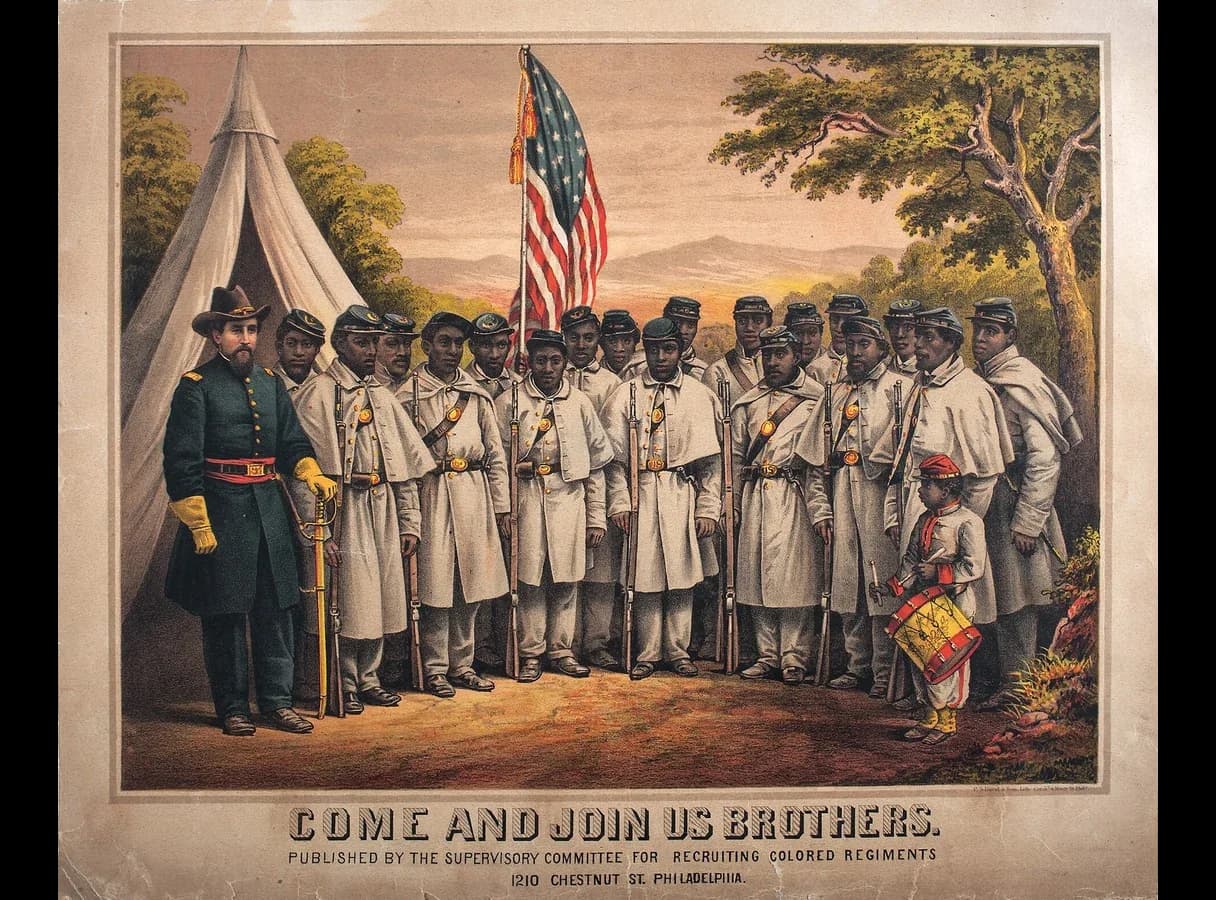
About 179,000 Black men served in the Union army, around 10 per cent of its soldiers by the end of the war, and about 19,000 in the navy. Most had been enslaved. They served in segregated regiments of the United States Colored Troops under white officers, and until 1864 were paid less than white soldiers. The recruiting poster Come and Join Us Brothers was aimed at free Black men in the North.
The scholar and activist W. E. B. Du Bois argued in Black Reconstruction in America (1935) that the movement of enslaved people to Union lines amounted to a "general strike" that withdrew labour from the Confederacy and decided the war. Later historians have built on his argument, showing that enslaved people were active in shaping the outcome of the war as well as being freed by it.
The vertical timeline of the war shows that even after Gettysburg and Vicksburg the result was not certain. In the summer of 1864 Grant's campaign in Virginia cost more than 50,000 Union casualties in about six weeks and ended in a siege of Petersburg, and many Northerners wanted a negotiated peace. The Democratic candidate in the presidential election of November 1864, George McClellan, stood on a platform that called for an end to the fighting, and Lincoln expected to lose.
The capture of Atlanta by William T. Sherman on 2 September 1864 changed Northern opinion, and Lincoln won the election on 8 November. Sherman then marched his army from Atlanta to the coast at Savannah, living off the land and destroying railways, factories, crops and property across a band of Georgia about 60 miles wide. He explained his purpose in a telegram to Grant.
Until we can repopulate Georgia, it is useless for us to occupy it; but the utter destruction of its roads, houses, and people, will cripple their military resources. … I can make this march, and make Georgia howl!
William T. Sherman, telegram to Ulysses S. Grant, 9 October 1864, as printed in Sherman's Memoirs (1875). Sherman was persuading his superior to approve a risky plan, so he stressed its military logic. "People" here meant the economic and civilian support of the Confederate war effort. The march itself destroyed property far more than lives. The telegram shows how the Union had come to treat the resources and morale of Southern civilians as military targets, the essence of total war.
After the march through Georgia and the Carolinas, and a final campaign in Virginia, Lee abandoned Petersburg and Richmond and surrendered at Appomattox Court House on 9 April 1865. The next day he issued a farewell order to his army.
After four years of arduous service marked by unsurpassed courage and fortitude, the Army of Northern Virginia has been compelled to yield to overwhelming numbers and resources.
Robert E. Lee, General Order No. 9, Appomattox Court House, 10 April 1865 (drafted by his aide Charles Marshall). Lee wrote to comfort defeated soldiers, and his explanation, that they had been beaten by numbers, not by better fighting, protected their honour. After the war, supporters of the "Lost Cause" interpretation used this argument to claim that the Confederacy had been noble and had never been truly defeated on the battlefield. As evidence of why the Union won, the order states one view, not a proven conclusion.
Resources made Union victory possible but did not make it certain. The Union had the same advantages in 1862, when it was losing, as in 1865. They became decisive only once Lincoln and Grant had a strategy to use them everywhere at once, once emancipation had turned enslaved people into Union soldiers and workers, and once the victories of 1864 kept Northern voters willing to continue. The Confederacy, for its part, was weakened by divisions between its states, by the burden of the war on poor whites and by the resistance of the enslaved people on whom its economy depended.
Some causes of victory and defeat fit none of the four lines of inquiry. Contingency is the role of events that were not planned or predictable: the death of a ruler, a storm, an epidemic, a lucky discovery of enemy plans. Historians who stress contingency argue that outcomes which look inevitable afterwards were uncertain at the time.
The success of the First Crusade surprised contemporaries, and the weakness of its opponents explains much of it. In 1092 the powerful Seljuk sultan Malik Shah and his chief minister Nizam al-Mulk both died, and the Seljuk lands fell into wars between rival princes. The Fatimid caliphate in Egypt, a Shi'a state, was the enemy of the Sunni Seljuks and saw the crusaders at first as a possible ally against them; in 1098 the Fatimids took Jerusalem from Seljuk vassals, only to lose it to the crusaders a year later. No Muslim ruler led a united response.
Chance also played its part. At Antioch in June 1098 the crusaders, besieged by a large relief army under Kerbogha of Mosul, were starving. The discovery of what they believed was the Holy Lance, the spear that pierced Christ, raised their morale, and when they attacked on 28 June the divided relief army broke up. Byzantine help at Nicaea in 1097 and the arrival of Genoese ships at Jaffa in 1099 were further forms of outside support.
The death of Möngke in 1259 halted the Mongol invasion of the Song for almost a decade, while his brothers fought for the succession. In the Third Crusade, the German emperor Frederick Barbarossa drowned crossing a river in Anatolia in June 1190, and most of his large army broke up before reaching the Holy Land. Disease killed many more soldiers than battle in most wars before the twentieth century: about two-thirds of the soldiers who died in the US Civil War died of disease.
Many wars were decided by states that joined them part of the way through. The entry of the United States in 1917 and of the Soviet Union against Japan in August 1945 tipped balances that were already moving. The Portuguese musketeers sent to Ethiopia in 1541 turned the Ethiopian–Adal War in Ethiopia's favour. In Algeria, support from Egypt, Tunisia and Morocco, which gave the ALN bases and arms, and pressure from the United States and the United Nations helped the FLN to survive military defeat. Outside intervention is usually best treated as a result of diplomacy and resources: states joined the side that offered them most, or that their own interests demanded.
The comparative table of the core cases sets out how each line of inquiry worked in each conflict and which factor did most to decide the outcome. The judgements in the last column are arguments, not settled facts, and each can be challenged with evidence.
Conflict (region) | Outcome | Leadership | Strategies and tactics | Resources | Technology | Most decisive factor |
|---|---|---|---|---|---|---|
First and Third Crusades, 1096–1192 (Europe; Middle East) | 1099: crusader victory. 1192: stalemate, Treaty of Jaffa | Saladin unites Egypt and Syria; Richard I wins Arsuf | Sieges; fighting march at Arsuf | Supply over long distances; armies that went home | Siege towers and trebuchets on both sides | Muslim disunity in 1099; in 1192 the balance of leadership and supply |
Mongol conquest of the Song, 1235–1279 (Asia) | Complete Mongol victory | Khubilai adapts; Song court divided | From raids to blockade, siege and river war | Conquered peoples, Chinese troops and ships, Song defectors | Counterweight trebuchets at Xiangyang | Khubilai's adaptation of strategy and use of others' resources |
US Civil War, 1861–1865 (Americas) | Complete Union victory | Lee strong early; Lincoln and Grant from 1864 | Blockade, Mississippi, total war in 1864 | Union far ahead in men and industry; emancipation | Railways, rifles, telegraph, ironclads on both sides | Resources, made decisive by strategy and emancipation |
First World War, 1914–1918 (Europe) | Allied victory by German exhaustion; armistice | Unified Allied command in 1918; German military rule | Attrition, blockade, U-boats; combined arms in 1918 | Allies far stronger, especially after US entry | Machine guns favour defence; tanks and artillery methods by 1918 | Resources, through attrition and blockade |
Second World War in Asia and the Pacific, 1937–1945 (Asia and Oceania) | Japanese surrender, August 1945 | Japanese gamble on a short war | Island-hopping; submarine war; Chinese resistance | US industry several times larger | Carriers, codebreaking, atomic bomb | US industrial power, with China tying down Japan's army |
Algerian War, 1954–1962 (Africa and the Middle East) | FLN political victory; French withdrawal | De Gaulle chooses to leave | Guerrilla war and diplomacy against counter-insurgency | France far stronger materially | French helicopters and barriers | Political will and diplomacy |
Three patterns stand out from the comparison. First, long wars between industrialised states, such as the US Civil War, the First World War and the Pacific War, were decided mainly by the mobilisation of resources. The weaker side could win battles and campaigns, but could not keep fighting once the stronger side had organised its economy for war. In each case the weaker side had gambled on a short war, and the gamble failed.
Second, in medieval wars, where no state could mobilise its whole society, leadership, logistics and the unity or disunity of the enemy mattered more. The Mongols won with fewer people of their own, and the crusaders won in 1099 despite their distance from home. In both cases a leader or army used the divisions of the enemy and adapted faster to the conditions of the war.
Third, in wars of independence and other wars between unequal sides, such as Algeria, the outcome was political. The stronger side could win militarily and still lose if its people would not keep paying for the war. Here resources were necessary but not sufficient, and the decisive factor was the will to continue.
Technology appears in every case but rarely as the decisive factor. It mattered most when one side could build it and the other could not answer it, as with the trebuchets at Xiangyang. In industrial wars it was an expression of resources: the side with more factories built more aircraft, tanks and ships.
Explanations of victory and defeat are contested because they carry meaning for the people involved. Defeated sides have often explained their defeat in ways that protect their honour, and victors in ways that confirm their values. Historians' explanations also reflect the questions of their own time, from Cold War interest in guerrilla war to recent interest in the experience of the enslaved and the colonised.
The debate over the Union victory is the classic case of the argument between structural explanations, which stress resources, and explanations that stress choices, chance and morale.
Historian or school | Argument | Evidence stressed |
|---|---|---|
"Lost Cause" writers, e.g. Edward Pollard, The Lost Cause (1866), and Jubal Early | The Confederacy was overwhelmed by numbers and resources, not outfought | Lee's farewell order; Union numerical superiority. Now rejected for downplaying slavery and Confederate defeats in battle |
Richard N. Current, "God and the Strongest Battalions" (1960) | Northern economic superiority made Union victory almost certain once the war became long | Population, industry, finance and railways |
David Herbert Donald, "Died of Democracy" (1960) | The Confederacy was weakened by its own individualism: states' rights, elections and resistance to central control | Quarrels between Davis and state governors; resistance to conscription |
Richard Beringer and others, Why the South Lost the Civil War (1986) | The Confederacy lost because its sense of nationhood and will to fight were weak, and collapsed under defeat | Desertion, war-weariness, doubts about slavery and religion after 1863 |
James McPherson, Battle Cry of Freedom (1988) | The outcome was contingent: it turned on military events at key moments, which could have gone differently | Antietam (1862), Gettysburg and Vicksburg (1863), the fall of Atlanta before the 1864 election |
Gary Gallagher, The Confederate War (1997) | Confederate nationalism and will were strong; the South lost because its armies were defeated | Soldiers' letters; Lee's army as the focus of Confederate loyalty until 1865 |
W. E. B. Du Bois, Black Reconstruction in America (1935) | Enslaved people decided the war by leaving the plantations and serving the Union | Flight to Union lines; about 179,000 Black soldiers |
The perspectives are easier to weigh when they are seen as answers to different questions. Current explains why the Confederacy could not easily win a long war; McPherson explains why the Union actually won it when it did; Beringer, Donald and Gallagher argue about whether the Confederacy defeated itself; Du Bois shows who did much of the work of defeating it. Most historians today combine the Union's resources with McPherson's emphasis on contingency, and reject the "Lost Cause" view as an argument made to defend the Confederacy's reputation.
For much of the twentieth century, British popular memory saw the generals of the Western Front as incompetent and careless with their soldiers' lives, an image summed up in the phrase "lions led by donkeys" used as the epigraph of Alan Clark's The Donkeys (1961). John Terraine, in Douglas Haig: The Educated Soldier (1963), replied that attrition was unavoidable against a strong enemy in a continental war and that Haig's armies won the decisive battles of 1918. Gary Sheffield, in Forgotten Victory (2001), argues that the British army went through a learning curve and by 1918 had become one of the most effective armies in the world.
Other historians put more weight on economics. Niall Ferguson, in The Pity of War (1998), argues that Germany used its resources more efficiently and inflicted more casualties than it suffered, so the Allies won through economic superiority more than military skill. Broadberry and Harrison show the scale of that superiority. David Stevenson, in With Our Backs to the Wall (2011), argues that victory in 1918 came from a combination of Allied learning, American resources, logistics and the internal collapse of Germany. These views can be combined: resources gave the Allies time to learn, and learning let them use their resources effectively.
A different perspective came from the defeated. German nationalists after 1918, including Ludendorff and Hindenburg, claimed that the German army had not been defeated in the field but "stabbed in the back" by revolutionaries and politicians at home. Historians reject this stab-in-the-back myth: the German army had been in retreat since August 1918, and it was Ludendorff himself who demanded an armistice at the end of September. The myth matters because nationalists, and later the Nazis, used it to attack the Weimar Republic and the peace settlement.
Historians agree that Japan had lost the war by the summer of 1945 but disagree about what made its leaders accept surrender in August. Sadao Asada (1998) and Richard Frank, in Downfall (1999), argue that the atomic bombs were decisive, because they gave the emperor and the peace faction a reason to surrender that the army could accept. Tsuyoshi Hasegawa, in Racing the Enemy (2005), argues that the Soviet declaration of war mattered more, because it ended Japanese hopes of Soviet mediation and threatened a Soviet occupation. The wider perspectives on the use of the atomic bombs, from decision-makers to survivors, are a separate debate of their own.
Alistair Horne, in A Savage War of Peace (1977), presents the French army as having largely won the military war by 1960, and explains the outcome through de Gaulle's decisions, the cost of the war and the damage done to France by torture. Matthew Connelly, in A Diplomatic Revolution (2002), argues that the FLN won mainly through international diplomacy: by turning Algeria into a question for the United Nations, the Arab states, the newly independent countries of Africa and Asia and the superpowers, it made French rule impossible to defend internationally. Horne explains why France chose to leave; Connelly explains how the FLN made staying too costly.
A second Part A question on this guiding question could ask: Explain why a militarily stronger side lost a conflict. Use one example from your thematic study in your response. [4] The Algerian War is the obvious example; a strong answer explains two reasons (for example, the FLN's diplomatic strategy and the loss of political support in France) and links each to the decision to withdraw.
I can explain different kinds of outcome, including the difference between a military and a political outcome.
I can explain how military and political leadership affected outcomes, using Saladin and Richard I, Khubilai Khan, the First World War commanders and de Gaulle.
I can distinguish strategy from tactics and explain attrition, blockade, island-hopping, guerrilla warfare and counter-insurgency with examples.
I can explain how the mobilisation of people, money, industry and allies shaped the outcomes of the First World War and the Pacific War.
I can explain why France lost Algeria despite its military and material superiority.
I can explain how technology, including weapons, railways, the telegraph and medicine, affected outcomes at Xiangyang, in the US Civil War, on the Western Front, in the Pacific and in Algeria, and why it rarely decided a war alone.
I can explain why the Union won the US Civil War, weighing resources, strategy, leadership, emancipation and contingency.
I can explain how contingency, enemy disunity and outside intervention affected outcomes, including in the First Crusade.
I can compare the core conflicts and identify patterns in what decided them.
I can outline and weigh historians' perspectives on the Union victory, the Allied victory in 1918, the Japanese surrender and the Algerian War.
I can analyse a primary source on the outcome of a war for its content, context and purpose.
I can plan an essay on what determined the outcome of conflicts, using examples from two regions and reaching a judgement.