2 Human resource management
Explain how organisations plan, structure, lead, motivate and communicate with their workforce, and analyse how people shape and resist change at work.
- IB Business Management
- SL and HL
What 2 covers
From the subject guide: what you need to know and be able to do.
How organisations plan, structure, lead, motivate and communicate with their workforce.
7 subtopics in Human resource management
Each one has its own page once something is published for it.
- 2.1Introduction to human resource management76 questions · notes
- 2.2Organisational structure49 questions · notes
- 2.3Leadership and management52 questions · notes
- 2.4Motivation and demotivation99 questions · notes
- 2.5Organisational (corporate) cultureHL only38 questions · notes
- 2.6Communication46 questions · notes
- 2.7Industrial/employee relationsHL only34 questions · notes
An overview of 2 Human resource management
Human resource management (HRM) studies how organisations plan, organise, lead, motivate and communicate with the people who work for them, and how they manage change and conflict at work. Every organisation depends on its employees, and for most businesses labour is one of the largest costs, so the way people are managed affects productivity, quality, customer service and profit.
Questions that frame the unit
The unit returns again and again to a few practical questions about people at work.
Why does a business that pays well still lose its best employees to competitors?
Should decisions be taken by a few senior managers or pushed down to the people closest to customers?
What makes a good leader in a crisis, and is it the same as in a period of steady growth?
Why do employees resist changes that managers believe will benefit everyone?
Why do some mergers fail even when the numbers suggest they should succeed?
What the unit covers
The unit has seven subtopics. Five are studied at SL and HL; two are HL only.
Subtopic | Main question it answers | Level |
|---|---|---|
2.1 Introduction to human resource management | How does a business plan its workforce, what shapes those plans, and how can it manage employees’ resistance to change? | SL and HL |
2.2 Organisational structure | How is authority divided in an organisation, and which structure suits it as its environment changes? | SL and HL |
2.3 Leadership and management | What do managers and leaders do, and which leadership style suits which situation? | SL and HL |
2.4 Motivation and demotivation | What makes people want to work well, and which rewards and training put the theories into practice? | SL and HL |
2.5 Organisational (corporate) culture | What are the shared values of an organisation, and why do cultures clash when organisations change? | HL only |
2.6 Communication | Which method of communication suits a given situation, and what stops a message getting through? | SL and HL |
2.7 Industrial/employee relations | Why do employers and employees come into conflict, and how are disputes resolved? | HL only |
How the subtopics connect
The unit starts with workforce planning: forecasting how many employees a business needs, with which skills, when and where. The plan follows from the business’s objectives and growth strategy, and it is shaped by internal factors such as finance and technology and by external factors such as demographic change, labour mobility and the gig economy. Introduction to HRM also explains resistance to change, a theme that runs through every later subtopic.
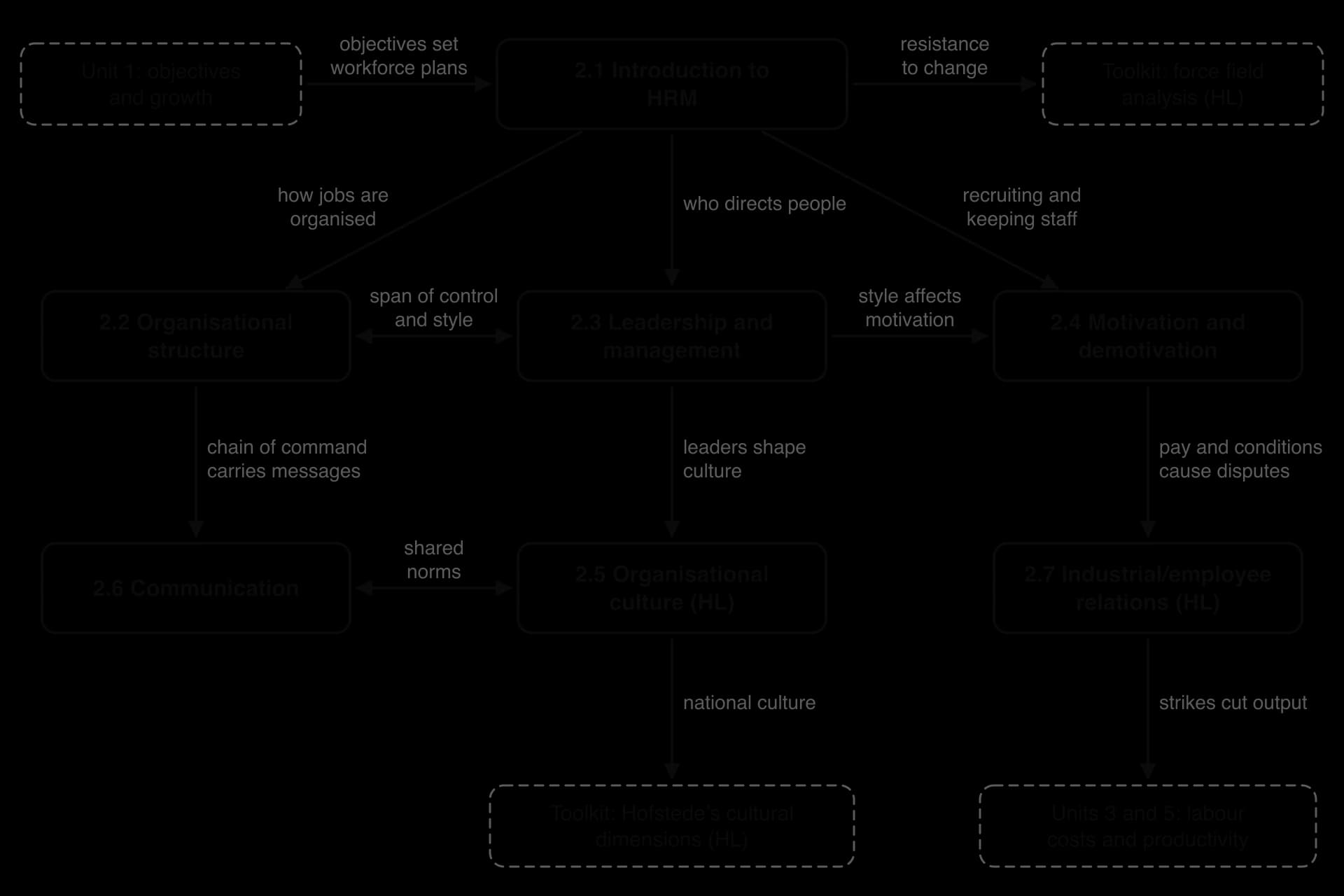
The concept map shows three subtopics that follow directly from workforce planning. Organisational structure sets out how jobs are grouped and who reports to whom. Its span of control and levels of hierarchy affect which leadership style is practical: a manager with thirty direct reports cannot supervise each one closely. Leadership in turn affects motivation, because a style that gives employees a say in decisions meets different needs from one that relies on instructions and close control.
Structure and communication are closely linked. A long chain of command means messages pass through many people, so they are slower and more likely to be distorted, while a flat structure makes horizontal communication easier. At HL, organisational culture adds the shared values and habits that shape how people communicate and how leaders behave, and it explains why a change of leader or a merger can unsettle an organisation.
Motivation links to industrial relations, studied at HL. When pay, job security or working conditions fall short of what employees expect, conflict follows, and it may take the form of collective bargaining or a strike. Disputes affect costs and output, so the unit connects directly to finance and to operations. Among the toolkit tools, a STEEPLE analysis organises the external factors that shape HR planning, and descriptive statistics summarise HR data such as absence rates and survey results.
Change, creativity, ethics and sustainability in the unit
The key concepts take a particular form in the unit, because each one depends on the behaviour of people.
Key concept | How it shows up in the unit |
|---|---|
Change | People drive change in organisations, and people resist it. New structures, remote and hybrid working and automation all change how work is done, and their success depends on how managers involve and support employees. |
Creativity | Creative employees can be essential to a business’s success. Structures that allow delegation and empowerment, and leadership styles that invite ideas, make it more likely that employees contribute them. |
Ethics | Ethical HR systems, such as fair pay, safe conditions, honest communication and fair treatment in redundancy, can improve performance as well as reputation. Ethical questions also arise in zero-hours contracts and in how layoffs are communicated. |
Sustainability | The way people behave at work can bring lasting positive change, for example when employees take responsibility for reducing waste. Retaining skilled staff and investing in training is also a form of social sustainability. |
How SL and HL differ
HL students study everything SL students study, plus two HL-only subtopics and HL-only parts of three SL subtopics. The HL-only subtopics are:
2.5 Organisational (corporate) culture: the meaning of culture, Handy’s four types (power, role, task and person cultures), and the culture clashes that follow mergers, growth or a change of leader.
2.7 Industrial/employee relations: the sources of conflict at work, the approaches employees and employers take, and methods of resolving disputes such as conciliation and arbitration.
The SL subtopics with HL-only parts are:
SL subtopic | What HL adds |
|---|---|
2.2 Organisational structure | Changes in organisational structures: project-based organisation and Handy’s shamrock organisation, with flexible and remote work patterns. |
2.3 Leadership and management | Scientific management and intuitive management: deciding from data and analysis, or from experience and judgment. |
2.4 Motivation and demotivation | Four more theories (McClelland’s acquired needs theory, Deci and Ryan’s self-determination theory, equity theory and expectancy theory); calculating and interpreting labour turnover; types of appraisal; methods of recruitment; and internal versus external recruitment. |
Two HL toolkit tools are used often with the unit. Force field analysis weighs the forces driving and resisting a change, and Hofstede’s cultural dimensions compare national cultures, which helps explain differences in leadership, communication and motivation between countries.
Assessment
Unit 2 is examined in Paper 1 and Paper 2. Its SL content can appear in either paper at both levels; the HL-only content (culture, industrial relations and the HL parts of structure, leadership and motivation) appears only in Paper 2 at HL and in Paper 3, never in Paper 1. Most questions are qualitative and set in the case: explaining why employees resist a change, analysing the effect of delayering, or evaluating a leadership style or a set of rewards for a named group of workers.
Constructing an organisation chart from a description is a common short question, and so is identifying the span of control or chain of command on one. At HL, calculating labour turnover and commenting on the result is the unit’s main calculation. In 10-mark answers, the motivation theories and leadership styles are used as tools to support a judgment, for example on whether a business should introduce performance-related pay.
Studying the unit
Flashcards for 2
The official decks for this part of the syllabus.
- 2.1 Introduction to human resource management192 cards
- 2.2 Organisational structure135 cards
- 2.3 Leadership and management156 cards
- 2.4 Motivation and demotivation282 cards
- 2.5 Organisational (corporate) culture149 cards
- 2.6 Communication141 cards
- 2.7 Industrial/employee relations150 cards
Carry on with 2 in Augment
With a free account, Augment remembers where you stopped and what you have practiced.