Distinguish management from leadership, explain Fayol’s functions of management, evaluate the five leadership styles in context and (HL) explain scientific and intuitive thinking in management.
Each is in the Business glossary, with every other term in the subject.
A leadership style in which the leader makes decisions alone, without consulting employees, and expects instructions to be followed, with close supervision and one-way communication.
A leadership style in which the leader involves employees in decision-making by sharing information, discussing options and taking account of their views, with two-way communication.
The five activities that, according to Henri Fayol (1916), make up the work of every manager: planning, organising, commanding, coordinating and controlling.
An approach to management decision-making based on a manager’s experience, instinct, feelings and judgment rather than on systematic analysis of data.
A leadership style in which the leader sets broad objectives and gives employees the freedom to make most decisions about how to achieve them, with minimal direction or supervision.
The ability to influence, inspire and motivate others to work willingly towards a vision or a set of goals, whether or not the leader holds a formal position.
A model developed by Tannenbaum and Schmidt (1958) that arranges leadership styles along a line according to the balance between the leader’s use of authority and the freedom given to employees.
Define management and leadership, and distinguish between them.
Explain the functions of management, using Fayol’s five functions and management by objectives.
Describe the qualities associated with effective leaders.
Explain the features of autocratic, paternalistic, democratic, laissez-faire and situational leadership.
Analyse how a leadership style affects motivation, the speed of decisions and the quality of decisions.
Evaluate the appropriateness of each leadership style in a given situation.
Explain scientific and intuitive thinking in management, and when each is appropriate (HL).
Every organisation, from a family restaurant to a multinational company, needs people who plan its work, organise its resources and direct its employees. Management is about getting tasks done efficiently through other people; leadership is about influencing and inspiring people to work towards a shared goal. Both shape how productive, motivated and adaptable a workforce is, so they sit at the centre of human resource management (HRM).
Leadership links closely to the key concepts. Leaders start and steer change, they decide how much room employees have for creativity, and their choices about how to treat people raise questions of ethics. A leader who builds trust and develops staff also supports the long-term sustainability of the organisation, because its success does not then depend on one person.
52 exam-style questions on this subtopic, written in the style of the IB papers. The first has its markscheme open. Counted on
Jadran Marine Works
[1] Jadran Marine Works (JMW) is a private limited company that repairs and refits yachts in Split, Croatia. It employs 160 people, including 55 highly skilled welders, carpenters and marine electricians. Many of them trained at JMW as apprentices and have worked there for over ten years. In 2024 JMW made a loss for the second year running, mainly because refits were finished late and customers claimed compensation.
[2] In January 2025 the owners appointed Davor Kovač as managing director. Davor holds a short meeting every Monday at which he tells each supervisor which yachts their teams will work on and the deadline for each job. Overtime must now be approved by Davor personally. Supervisors are no longer invited to suggest how jobs should be organized, and Davor walks the yard every afternoon to check progress himself.
[3] By the end of 2025 the average refit time had fallen from 21 days to 16 days and compensation claims had almost stopped. However, nine skilled workers resigned during the year, and several of them joined a competitor in Rijeka. Marija Babić, a supervisor with 18 years at JMW, says: “The yard runs on time, but nobody tells Davor when there is a better way to do a job any more. People just keep their heads down.”
[4] Marija has suggested that Davor should hold monthly team meetings at which workers can propose improvements, and should allow experienced supervisors to plan their own teams’ work. Davor is worried that this would slow decisions down and that late deliveries would return.
Define the term leadership.
2 marks
Award [1] for a partial definition that shows some understanding, e.g. “being in charge of people” or “telling people what to do”.
The official deck for this part of the syllabus.
Define management.
What is a manager?
With a free account, Augment remembers where you stopped and what you have practiced.
The way in which a leader makes decisions, communicates with and directs employees, especially how far employees are involved in decision-making.
The process of planning, organising, directing and controlling an organisation’s resources so that it achieves its objectives efficiently and effectively.
An approach to management, introduced by Peter Drucker, in which managers and employees agree specific objectives for each person and team that support the organisation’s overall objectives, and review performance against them.
A leadership style in which the leader makes decisions in what they believe are the best interests of employees, often after consulting them, and looks after their welfare in return for loyalty.
An approach to management decision-making based on the systematic collection and analysis of data, measurement and evidence, so that decisions are logical and can be justified.
An approach to leadership in which the leader adapts their style to the situation, especially to the competence and commitment of employees and the nature of the task, as in the Hersey–Blanchard model.
Scope: Both SL and HL study management and leadership, Fayol’s functions of management and the five leadership styles (autocratic, paternalistic, democratic, laissez-faire and situational). HL adds scientific and intuitive thinking in management: deciding on the basis of data and analysis, or on experience and judgment.
A manager is a person responsible for the work of others and for the use of an organisation’s resources: its people, money, machinery, materials and time. Managers decide what needs to be done, who will do it and how well it has been done. Their authority usually comes from their position in the organisational structure, which gives them the right to make decisions and to give instructions.
Two words in the definition matter. Efficiency means using as few resources as possible for a given result, for example serving more customers per hour with the same staff. Effectiveness means achieving the right result: meeting the organisation’s objectives. A manager can be efficient without being effective, for instance by running a production line at low cost while making a product customers no longer want.
Most medium and large organisations have three levels of management, each with a different time horizon and kind of decision.
Level | Typical job titles | Main focus |
|---|---|---|
Senior (top) management | Chief executive officer (CEO), managing director, directors | Long-term strategy, the organisation’s mission and objectives, major investments |
Middle management | Heads of department, regional managers, store managers | Turning strategy into departmental plans and targets; coordinating teams |
Junior management and supervisors | Team leaders, supervisors, shift managers | Day-to-day running of tasks; organising rotas; solving immediate problems |
Senior managers spend more of their time on planning and on dealing with people outside the organisation, such as investors and government. Supervisors spend more of their time directing and checking work. The number of levels depends on the span of control used in each layer: a business with wide spans of control needs fewer managers.
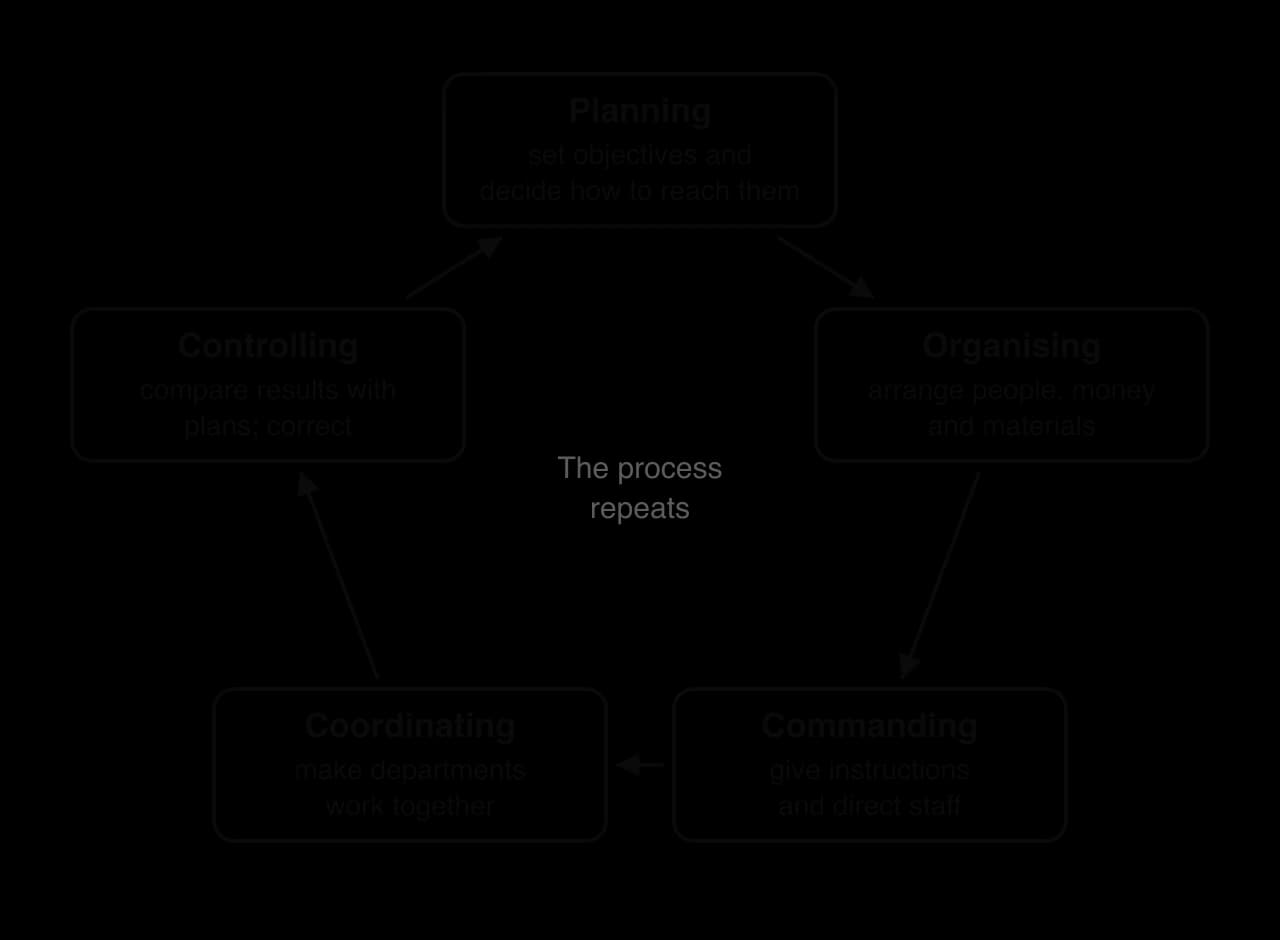
Henri Fayol (1841–1925), a French mining engineer and director, was one of the first writers to describe what managers actually do. In Administration industrielle et générale (1916) he argued that management is a set of activities common to every organisation, whatever it produces. Fayol’s functions of management are still the basis of most descriptions of a manager’s job.
The diagram shows the functions as a continuous cycle. Each one depends on the one before it, and the last one, controlling, feeds information back into planning.
Planning (Fayol’s prévoyance, “looking ahead”): setting objectives and deciding the actions, resources and timescales needed to reach them. A supermarket chain planning to open twenty stores must forecast sales, budget the costs and decide where to open them.
Organising: arranging the people, finance, equipment and materials the plan needs, and deciding who does what. This includes designing jobs, choosing the structure and recruiting staff.
Commanding: giving instructions and directing employees so that the work is carried out. Fayol meant more than giving orders; he stressed that a manager should know the staff well and set a good example. Modern textbooks often call this function “directing” or “leading”.
Coordinating: making sure that the work of different people and departments fits together, so that, for example, the marketing department does not promote a product before operations can make enough of it.
Controlling: checking performance against the plan, finding the reasons for any difference and taking corrective action. Budgets, sales targets and quality checks are all tools of control.
Fayol’s model has lasted because it is simple and applies to almost any organisation. It also has limits. It describes what managers should do, not what they actually spend their days doing, which later research found was often a rush of short meetings, interruptions and conversations. It also says little about motivating people or about creativity, which matter more in modern service and knowledge-based businesses than in the mines Fayol managed.
Peter Drucker (1909–2005), an Austrian-born American writer, introduced management by objectives (MBO) in The Practice of Management (1954). In MBO, the organisation’s overall objectives are broken down into objectives for each department, team and individual, which managers and employees agree together. Progress is then reviewed against these agreed targets.
MBO links planning and controlling directly to every employee’s work. Because staff help set their own targets, they understand how their work contributes to the whole and are more likely to feel committed to it. The approach works best when the objectives are specific and measurable, as in SMART objectives. Its main weakness is that people may focus on what is measured and neglect what is not, such as helping colleagues or long-term quality.
Leadership is the ability to influence other people so that they work willingly towards a goal. A leader sets a direction, explains why it matters and gains the commitment of others to it. Leaders may hold a formal position, but they need not: an experienced employee whom colleagues follow without any formal authority is also showing leadership.
The two roles overlap. Most managers also need to lead, and most leaders also need to manage. The distinction is still useful, because it separates two kinds of work: keeping an organisation running well (management) and moving it in a new direction (leadership). The American writer John Kotter put it this way: management is about coping with complexity, leadership is about coping with change.
Managers | Leaders | |
|---|---|---|
Main focus | Systems, procedures and tasks: getting today’s work done | People and direction: where the organisation should go next |
Time horizon | Short and medium term (this month’s targets, this year’s budget) | Long term (a vision for several years) |
Source of influence | Formal authority from a position in the hierarchy | Personal qualities, trust and the ability to inspire; may have no formal position |
Approach to change | Maintains stability; improves existing ways of working | Starts and drives change; questions existing ways of working |
Approach to risk | Minimises risk through planning and control | Accepts risk in pursuit of the vision |
How they get results | Planning, organising and controlling | Communicating a vision, motivating and empowering people |
Typical question | “How and when should this be done?” | “What should we do, and why?” |
Early research on leadership tried to find a fixed list of traits that all great leaders share. No single list has ever fitted every successful leader, and many qualities can be learned, which is why businesses spend heavily on leadership training. Some qualities do appear again and again in studies of effective leaders.
Quality | Why it matters |
|---|---|
Vision | A clear picture of where the organisation should be in the future gives employees a purpose and a reason to accept change. |
Communication skills | A vision only motivates people if it is explained clearly, repeated and linked to their own work. |
Integrity | Honesty and consistency between words and actions build trust; employees follow leaders they believe. |
Emotional intelligence | Understanding one’s own emotions and those of others helps a leader handle conflict, give feedback and support staff. |
Decisiveness | Leaders must make choices with incomplete information and accept responsibility for them. |
Resilience | Setbacks are common, especially during change; a leader who recovers quickly keeps the team going. |
Willingness to learn | Markets and technology change, so a leader who keeps learning and accepts being wrong adapts faster. |
Ability to delegate | Passing authority to others develops them and frees the leader to focus on direction rather than detail. |
The qualities that matter most depend on the situation. Decisiveness is vital in a crisis, while listening and patience matter more when leading highly skilled professionals. This idea, that there is no single best way to lead, runs through the study of leadership styles.
A leadership style is the way a leader usually makes decisions and relates to the people they lead. Styles differ above all in how much authority the leader keeps and how much freedom employees have to take part in decisions. Choosing a style is one of the most important decisions a leader makes, because it affects motivation, the speed and quality of decisions, and how employees respond to change.
A useful way to compare styles is the leadership continuum, developed by Robert Tannenbaum and Warren Schmidt in 1958. It shows styles as points along a line rather than separate boxes. At one end the leader makes every decision; at the other the team decides with little interference from the leader.
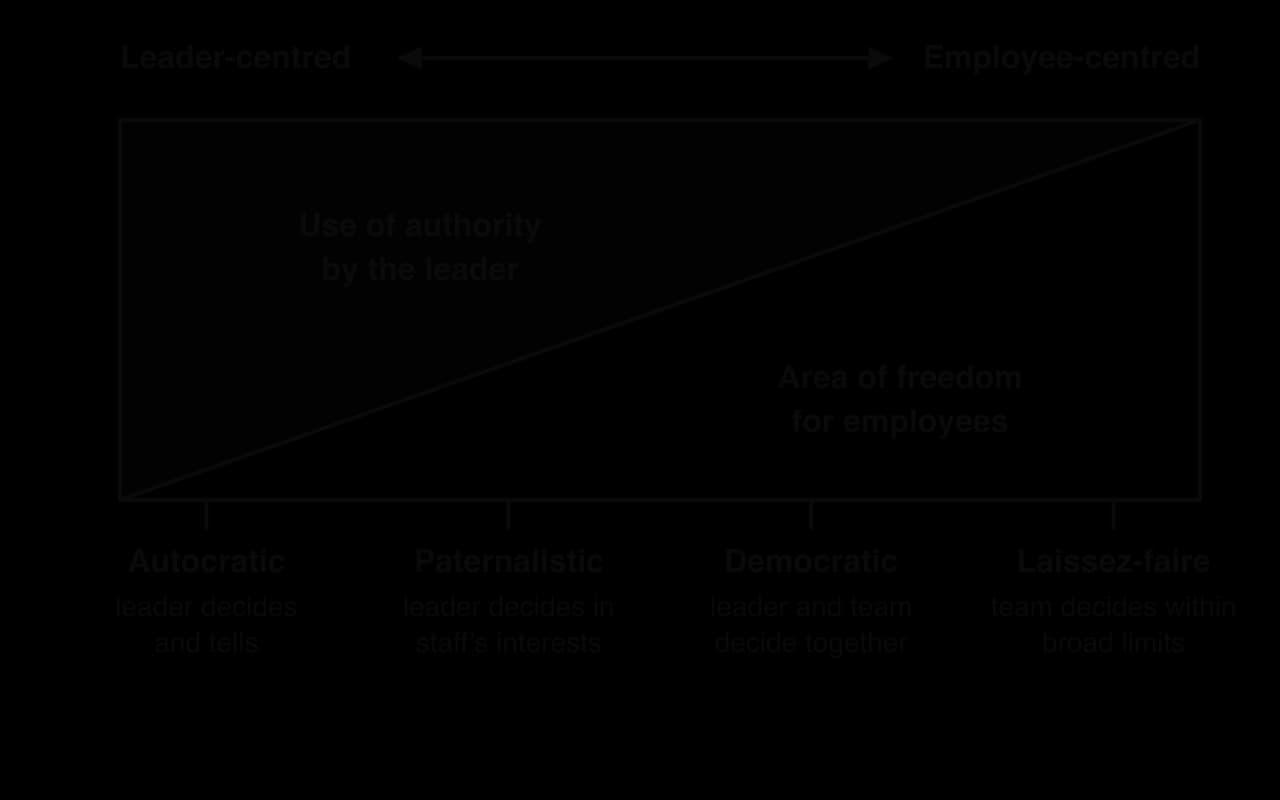
The diagram places the four main styles on the continuum. Autocratic leaders sit at the left, where almost all authority stays with the leader. Paternalistic leaders also decide, but in what they judge to be employees’ interests and often after consulting them. Democratic leaders share decisions with the team, and laissez-faire leaders sit at the far right, leaving most decisions to employees. Situational leadership has no fixed position: the leader moves along the continuum to fit the situation.
 YouTube
An autocratic (or authoritarian) leader makes decisions alone and expects employees to carry out instructions without question. Communication flows mainly downwards, from leader to staff, and there is little consultation. The leader sets objectives, decides methods and checks closely that work is done as instructed.
Autocratic leadership can work well when decisions must be taken fast, when the cost of a mistake is high, or when employees are new, unskilled or need clear direction. Examples include emergency services during an incident, an aircraft crew in an emergency, or a factory where strict safety procedures must be followed exactly. It is also common in businesses facing a crisis, where a new leader takes control quickly.
Elon Musk’s leadership of Twitter (now X) after he bought the company in October 2022 is a widely reported example. About half of the workforce of roughly 7,500 was laid off in early November, and around two weeks later the remaining staff were told to commit to “extremely hardcore” work or leave. Hundreds resigned, and the company later had about 1,500 employees.
Advantages | Disadvantages |
|---|---|
Fast decisions, because nobody else needs to be consulted. | Employees have no say, so motivation and commitment can fall, especially among skilled staff. |
Clear lines of authority and responsibility: everyone knows who decides. | The business loses the ideas and knowledge of its employees, so decisions may be worse. |
Effective in a crisis or where safety requires strict rules. | Can lead to higher labour turnover and absence. |
Suits large numbers of unskilled or new workers who need direction. | Heavy dependence on one person: the business struggles if the leader is absent or wrong. |
Close control helps keep standards consistent. | Staff may become passive and unwilling to take initiative. |
Autocratic leadership is most appropriate in the short term, in urgent or dangerous situations and with inexperienced staff. It is least appropriate where the business depends on the creativity and judgment of skilled employees, such as software development or design, because those people expect to be involved and often leave when they are not.
A paternalistic leader behaves like a parent towards employees (from the Latin pater, father). The leader makes the decisions, but in what they believe are the employees’ best interests, and often explains the decisions and consults staff before making them. Paternalistic leaders care about employees’ welfare and usually provide good working conditions, benefits and security, and in return expect loyalty and obedience.
Paternalistic leadership sits between autocratic and democratic leadership on the continuum. Employees may be consulted, but the final decision stays with the leader. The style is common in family businesses and in cultures where people expect leaders to look after their staff, as in many Asian, Middle Eastern and Latin American organisations.
Tata Steel in India is a well-documented historical example. Long before labour laws required it, the company introduced an eight-hour working day (1912), free medical care (1915), a provident fund for retirement savings (1920), maternity benefits (1928) and profit-sharing bonuses (1934) for its workers in Jamshedpur. Historians describe this as paternalism: the company decided what its workers needed and provided it, expecting a loyal and stable workforce in return.
Advantages | Disadvantages |
|---|---|
Employees feel cared for, which can build loyalty and lower labour turnover. | Employees are still not trusted to make decisions, which can feel patronising to skilled staff. |
Meets employees’ needs for security and belonging, which links to Maslow’s lower and middle levels of need. | Can create dependence: staff wait to be told what to do and take little initiative. |
Decisions are explained, so they are more readily accepted than under autocratic leadership. | Welfare benefits are costly, and the leader’s view of “what is best” may not match what employees want. |
Suits cultures and family firms where employees look to the leader for guidance. | If the leader breaks promises of security (for example through redundancies), trust collapses quickly. |
Paternalistic leadership is most appropriate where employees value security and guidance, and where the leader genuinely understands their needs. It suits motivation at the level of security and belonging, but it gives little scope for responsibility and self-development, so it is less effective for highly skilled, independent employees.
A democratic (or participative) leader involves employees in decision-making. The leader shares information, invites ideas and discusses options with the team before a decision is made. In some democratic organisations decisions are taken by a vote; in others the leader consults widely and then decides, which is sometimes called consultative leadership.
Democratic leadership works best when employees are skilled, have knowledge the leader lacks and are willing to take part. It is common in professional organisations, creative industries and businesses that rely on teams. It requires good two-way communication and enough time for discussion.
Semco, a Brazilian engineering company, became internationally known for democratic management after Ricardo Semler took control from his father in 1980. During a downturn in 1990, employees were given the right to approve every item of expenditure and accepted wage cuts in return for a larger share of profits. Semler described the approach in the bestselling book Maverick (1993).
Advantages | Disadvantages |
|---|---|
Uses the knowledge and ideas of employees, so decisions may be better informed. | Decisions take longer, which can be costly when the business must act quickly. |
Employees who take part in a decision are more committed to carrying it out. | Consultation can be a pretence if the leader has already decided, which damages trust. |
Meets higher-level needs for recognition and responsibility, which links to Herzberg’s motivators. | Some employees do not want responsibility or lack the skills to contribute. |
Encourages creativity and helps employees accept change. | Confidential decisions (redundancies, takeovers) cannot always be shared. |
Develops future leaders by giving staff experience of decisions. | Group decisions can blur responsibility: when everyone decided, nobody is accountable. |
Democratic leadership is most appropriate for skilled, motivated teams, for decisions that employees must carry out and accept, and where time allows discussion. It is less suitable in a crisis or where employees lack the knowledge to judge the options.
A laissez-faire leader (from the French for “let do” or “leave alone”) gives employees broad goals and then leaves them to decide how to achieve them. The leader provides resources and advice when asked, but intervenes very little. Employees have a high degree of freedom and responsibility for their own work.
Laissez-faire leadership can be very effective with highly skilled, self-motivated employees, such as researchers, designers, software engineers or university academics. These employees are often intrinsically motivated: they enjoy the work itself and perform best when trusted. With inexperienced or unmotivated staff, however, the same style can lead to confusion, missed deadlines and conflict.
W. L. Gore & Associates, the US maker of Gore-Tex fabrics, has used a similar approach since 1967. Employees, all called associates, have no assigned bosses and no fixed chains of command; teams form around new products and opportunities, and leaders emerge when colleagues choose to follow them. The approach depends on recruiting people who can work with little direction.
Advantages | Disadvantages |
|---|---|
High freedom encourages creativity and innovation. | Lack of direction can lead to confusion, duplication of work and missed deadlines. |
Motivates skilled, independent employees who value autonomy (links to empowerment). | Unsuitable for inexperienced staff, who need guidance. |
Frees the leader to focus on strategy and external relationships. | Conflicts may go unresolved, and informal leaders may take control. |
Develops employees’ decision-making skills. | The leader may appear uninterested or absent, which can demotivate staff. |
Laissez-faire leadership is most appropriate for small teams of experts working on creative or research tasks with clear overall goals. It is often a poor choice for large organisations with routine work, and it can fail even with skilled staff if nobody coordinates their efforts.
Situational leadership starts from the idea that there is no single best style. An effective leader changes their style to fit the situation: the task, the urgency of the decision and, above all, the people being led. The same manager might give detailed instructions to a new employee in the morning and leave an experienced colleague to decide alone in the afternoon.
The best-known model of situational leadership was developed by Paul Hersey and Ken Blanchard in the late 1960s. It describes leader behaviour on two dimensions: directive behaviour (telling people what to do, how and when, and checking that they do it) and supportive behaviour (listening, encouraging, explaining and involving people). Combining high and low levels of each gives four styles.
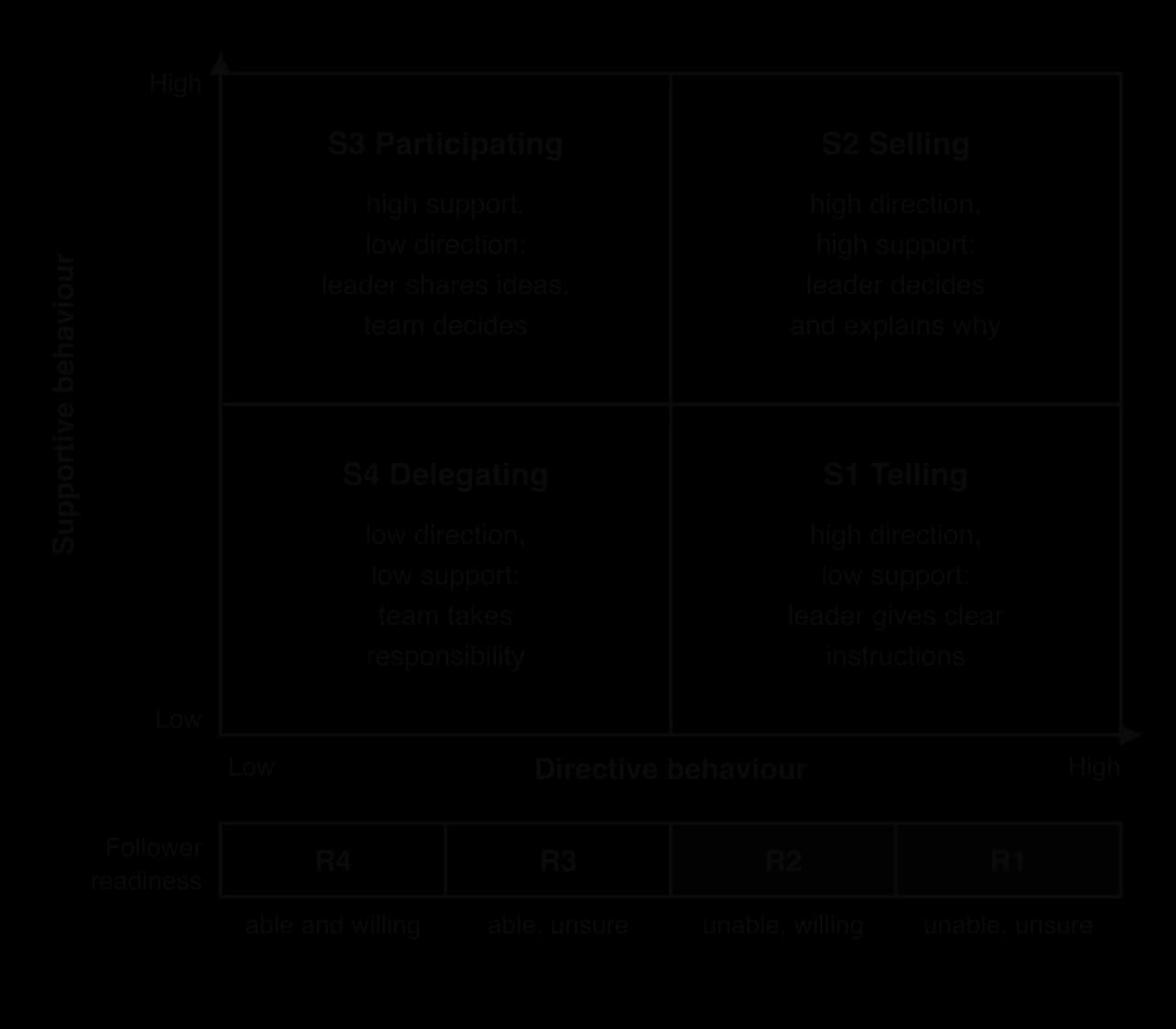
The grid shows the four styles and, underneath, the level of follower readiness each one suits. Readiness combines ability (knowledge and skills for the task) and willingness (confidence and commitment).
Follower readiness | Description | Matching style | What the leader does |
|---|---|---|---|
R1 | Unable and unwilling or insecure: new to the task, lacks confidence | S1 Telling (directing) | Gives clear, specific instructions and supervises closely |
R2 | Unable but willing: keen but still learning | S2 Selling (coaching) | Still decides, but explains decisions, answers questions and encourages |
R3 | Able but unwilling or insecure: has the skills but lacks confidence or motivation | S3 Participating (supporting) | Shares decisions with the employee, listens and builds confidence |
R4 | Able and willing: experienced and confident | S4 Delegating | Hands over responsibility for decisions and checks results only occasionally |
Situational leadership links to the other styles. Telling is close to autocratic leadership, selling to paternalistic, participating to democratic and delegating to laissez-faire. The difference is that the situational leader moves between them deliberately, and expects to move towards delegating as employees develop.
Another situational model, proposed by Fred Fiedler in the 1960s, argues that leaders have a fixed natural style, so the organisation should match leaders to situations rather than expect leaders to change. The two models together show the main debate about situational leadership: whether leaders can genuinely change their behaviour.
Advantages | Disadvantages |
|---|---|
Flexible: the style fits each employee and task, so it avoids the weaknesses of using one style everywhere. | Demands a lot from the leader, who must judge each person’s readiness accurately and switch styles. |
Develops employees, because leaders move them towards delegation as they improve. | Employees may see different treatment as unfair or inconsistent. |
Easy to understand and widely used in management training. | Some leaders find it hard to change their natural style (Fiedler’s criticism). |
Responds well to changing situations, such as a crisis or a new project. | The model simplifies people into four categories; readiness can change from task to task. |
The table brings the five styles together. It is a summary, not a set of fixed rules: real leaders combine features of several styles.
Autocratic | Paternalistic | Democratic | Laissez-faire | Situational | |
|---|---|---|---|---|---|
Who decides | Leader alone | Leader, after explaining and perhaps consulting | Leader and team together | Mainly employees, within broad goals | Depends on the situation |
Communication | One-way, top-down | Mainly top-down, with explanation | Two-way | Mainly horizontal, between employees | Varies |
Speed of decisions | Fast | Fairly fast | Slow | Varies; can be slow | Matched to urgency |
Effect on motivation | Low for skilled staff; acceptable for those wanting direction | Security and loyalty; little responsibility | High commitment and recognition | High for experts; low for others | High if the match is right |
Most suitable when | Crisis, safety, unskilled or new staff | Family firms, staff who value security | Skilled teams, time to discuss, need for acceptance | Experts on creative or research tasks | Mixed teams and changing tasks |
Main risk | Resentment, loss of ideas | Dependence, cost | Delay, unclear accountability | Lack of direction | Inconsistency |
Since no style is best in every case, a leader’s choice depends on several factors. Evaluating a leadership style means weighing these factors for the particular business and situation.
The task and the time available. Routine, urgent or dangerous tasks favour more autocratic styles; complex, creative tasks with time for discussion favour democratic or laissez-faire styles.
The employees. Skilled, experienced and motivated employees respond well to being involved; new or unskilled employees often need direction first.
The size and structure of the organisation. A tall structure with narrow spans of control suits close supervision; a flat structure with wide spans of control forces leaders to rely on delegation.
The leader’s own personality and skills. A leader who is uncomfortable sharing decisions may struggle to lead democratically, however suitable the situation.
The culture of the organisation. In a business with a tradition of consultation, a sudden switch to autocratic leadership is likely to meet resistance to change.
National culture. Expectations of leaders differ between countries. Where large differences in status between managers and staff are accepted, employees may expect leaders to decide, so paternalistic leadership is common; where hierarchy is less accepted, as in the Nordic countries, employees often expect to be consulted. Many Japanese companies traditionally use the ringi system, in which a proposal is circulated for comment and approval at each level before a decision is made.
The state of the business. A business in crisis may need fast, centralised decisions; a stable, successful business can afford wider participation.
The general judgment is that effective leaders are flexible. Most long-run evidence favours involving employees where possible, because commitment and ideas improve decisions. In the short run, or in a crisis, a more directive style can be justified, provided the leader explains why and returns to consultation once the crisis has passed.
Key concept | How it applies to leadership and management |
|---|---|
Change | Leaders set the direction for change and must win employees’ commitment to it; the choice of style affects how much resistance a change meets. |
Creativity | Democratic and laissez-faire styles give employees room to generate ideas; close autocratic control tends to discourage them. |
Ethics | Leaders decide how employees are treated and set an example of honest or dishonest behaviour; paternalistic leaders take moral responsibility for staff welfare. |
Sustainability | Leaders who develop others and share decisions make the organisation less dependent on one person, which supports long-term survival; leaders also decide how far the business pursues environmental and social goals. |
 YouTube
Every management function involves decisions, from choosing a supplier to launching a new product. Managers can reach these decisions in two broad ways. They can collect evidence, analyse it systematically and choose the option the evidence supports. Or they can rely on their experience and judgment and decide what “feels right”. In practice most managers use both, but the balance between them varies with the person, the business and the decision.
Scientific management in decision-making means basing decisions on data, measurement and logical analysis rather than on habit, opinion or instinct. The scientific manager defines the problem precisely, gathers relevant data, tests possible solutions and chooses the one the evidence supports, then reviews the result.
The idea goes back to Frederick Winslow Taylor (1856–1915), an American engineer who argued in The Principles of Scientific Management (1911) that every task has one best method, which managers can discover through careful measurement. Taylor’s own focus was on productivity and pay, and his theory of motivation, Taylor’s scientific management, belongs to the study of motivation. The broader legacy for decision-making is the belief that management decisions should rest on evidence.
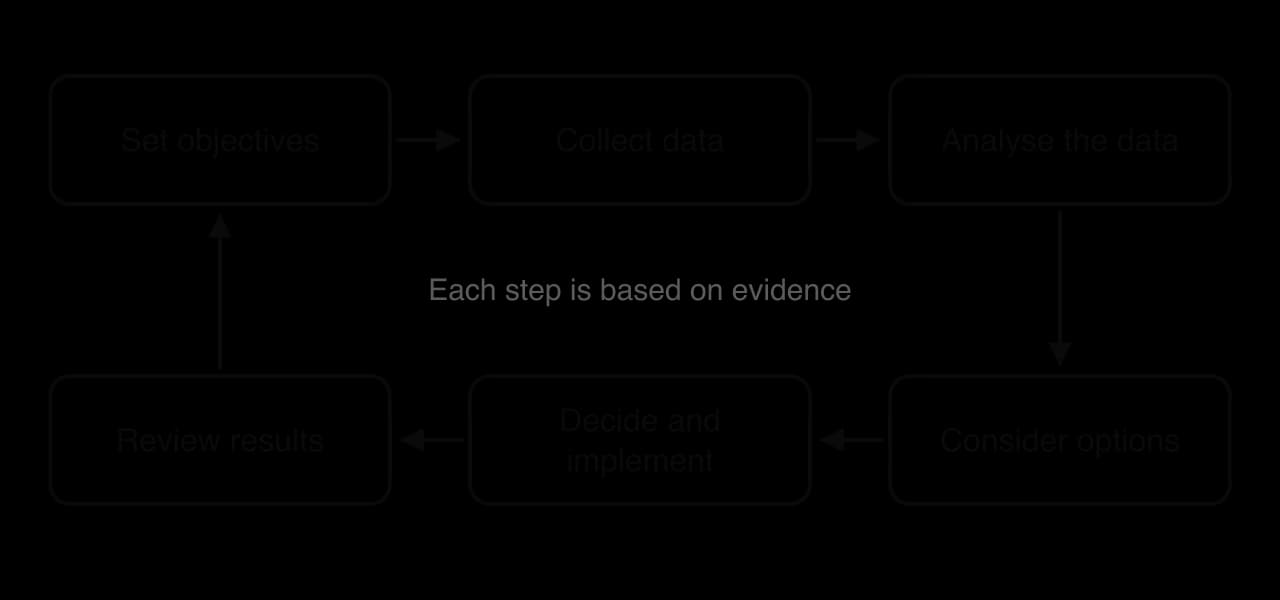
The cycle shows the stages of a scientific decision. Managers start from a clear objective, collect quantitative and qualitative data, analyse it with tools such as break-even analysis, investment appraisal, decision trees or market research, compare the options and choose. After implementation, the results are measured and become data for the next decision.
Modern technology has made scientific decision-making far more common. Businesses can test two versions of a website on different customers and keep the one that sells more, track every sale through loyalty cards, and analyse large data sets with software. This approach is often called data-driven or evidence-based management.
Google’s Project Oxygen applied scientific thinking to management itself. The company began with the hypothesis that managers make little difference to team performance, then analysed over 10,000 data points from performance reviews and feedback surveys, plus interviews with employees. The data showed the opposite: teams with highly effective managers achieved better results, were happier and had lower turnover. Google identified ten behaviours of its best managers, such as being a good coach and empowering the team without micromanaging, and built its manager training around them.
Strengths | Limitations |
|---|---|
Decisions rest on evidence, so they are more likely to be accurate and can be explained to stakeholders. | Collecting and analysing data takes time and money. |
Reduces the effect of personal bias, prejudice and wishful thinking. | Data describe the past; they may not predict a new market or a sudden change. |
Results can be measured and reviewed, so the business learns. | Some important factors (morale, brand image, ethics) are hard to measure and may be ignored. |
Easier to justify to investors, lenders and boards. | Too much analysis can delay decisions (“analysis paralysis”) while competitors act. |
Suits large, repeated decisions where data exist (pricing, stock levels, staffing). | Data can be incomplete, out of date or biased, giving false confidence. |
Intuitive management means making decisions on the basis of experience, instinct and judgment, often quickly and without formal analysis. Intuition is not guesswork. It draws on knowledge built up over years, which allows an experienced manager to recognise patterns and sense the right answer before being able to explain it.
Intuition matters most where data are scarce or cannot answer the question: a completely new product, a fast-changing market or a decision that depends on taste, such as fashion or design. It also plays a part in judging people, for example in recruitment, and in creativity, where new ideas often come before any evidence that they will work.
The launch of the Sony Walkman is a classic example. Sony’s co-founder Masaru Ibuka asked engineers for a small, playback-only cassette player he could use while travelling, and the company, under Akio Morita’s leadership, launched the TPS-L2 in Japan on 1 July 1979. No market for personal stereo players existed to research, and the product could not record, which many thought customers would reject. Sony expected to sell about 5,000 a month; it sold more than 30,000 in the first two months.
Strengths | Limitations |
|---|---|
Fast: useful when decisions cannot wait for data. | Can be wrong, and is hard to check or justify to others. |
Works where no data exist, such as a new product or market. | Open to personal bias, overconfidence and past habits that no longer fit. |
Draws on deep experience and tacit knowledge that data may miss. | Depends on the individual; a new or inexperienced manager has little intuition to draw on. |
Encourages bold, creative decisions that analysis might reject. | Successful intuitive decisions are remembered; failed ones are often forgotten, so its record is overstated. |
Cheap, because no research is needed. | Hard for investors, lenders and regulators to accept as a basis for large decisions. |
The appropriate balance depends on the decision. Scientific thinking suits decisions that are large, repeated or measurable, and where data are available and time allows analysis. Intuitive thinking suits decisions that are new, urgent or creative, where data are missing or of limited use.
Factor | Favours scientific thinking | Favours intuitive thinking |
|---|---|---|
Data | Reliable data are available | Little or no relevant data |
Time | Time to collect and analyse | Decision needed quickly |
Type of decision | Routine, repeated, measurable (stock levels, pricing, rotas) | New, creative or one-off (a new product concept, a design) |
Cost of error | High, so evidence is worth the cost | Low, or the decision can easily be reversed |
Experience of the manager | Limited experience | Long experience of similar decisions |
Stakeholders | Investors or regulators expect justification | An owner-manager answers only to themselves |
Most effective managers combine scientific and intuitive thinking. Intuition often generates the idea or the hypothesis, and data then test it; or data narrow the options, and judgment chooses between them. A film studio, for example, may use audience data to decide how much to spend on marketing a film, while relying on the judgment of experienced producers to decide which scripts to make in the first place.
The choice between the two also links to leadership style. Scientific thinking fits democratic and situational leaders who want decisions that can be explained and discussed. Intuitive thinking is often associated with entrepreneurs and autocratic leaders who decide quickly and alone, although an intuitive leader can still consult others before acting.
Satya Nadella became chief executive officer of Microsoft on 4 February 2014, after leading its Cloud and Enterprise group. He took over a highly profitable business whose sales still depended heavily on Windows and Office for personal computers, at a time when computing was moving to smartphones and to the cloud. Microsoft had tried to catch up in smartphones by buying Nokia’s handset business, completed in April 2014.
Nadella’s early decisions show both sides of leadership. On the management side, he restructured the phone business: in fiscal year 2015 Microsoft recorded $10.0 billion of impairment, integration and restructuring costs, including $7.5 billion of write-downs related to phone hardware, and announced a plan to cut up to 7,800 jobs, mainly in that business. These are the planning, organising and controlling decisions of a manager correcting a failed strategy, and they were taken quickly from the top.
On the leadership side, Nadella set out a new direction and a new set of values. In 2015 he gave Microsoft a new mission, “to empower every person and every organization on the planet to achieve more”, and made a “growth mindset” (the belief that abilities can be developed through effort and learning) the centre of the company’s culture. A decade later his message was still that employees should be “learn-it-alls” rather than people who already know everything.
We must be learn-it-alls, willing to experiment, guided by evaluations, and committed to continuous improvement.
— Satya Nadella, Microsoft Annual Report 2025, shareholder letter
This approach moved Microsoft along the leadership continuum, away from leaders who hold all the answers and towards employees who are trusted to experiment and learn. It encouraged cooperation across divisions and with outside partners, including rivals: Microsoft released Office for Apple’s iPad in March 2014 and later invested heavily in open-source software and in partnerships on artificial intelligence. Nadella’s style is best described as situational. He was directive when cutting the phone business, but mainly democratic and coaching in building the culture.
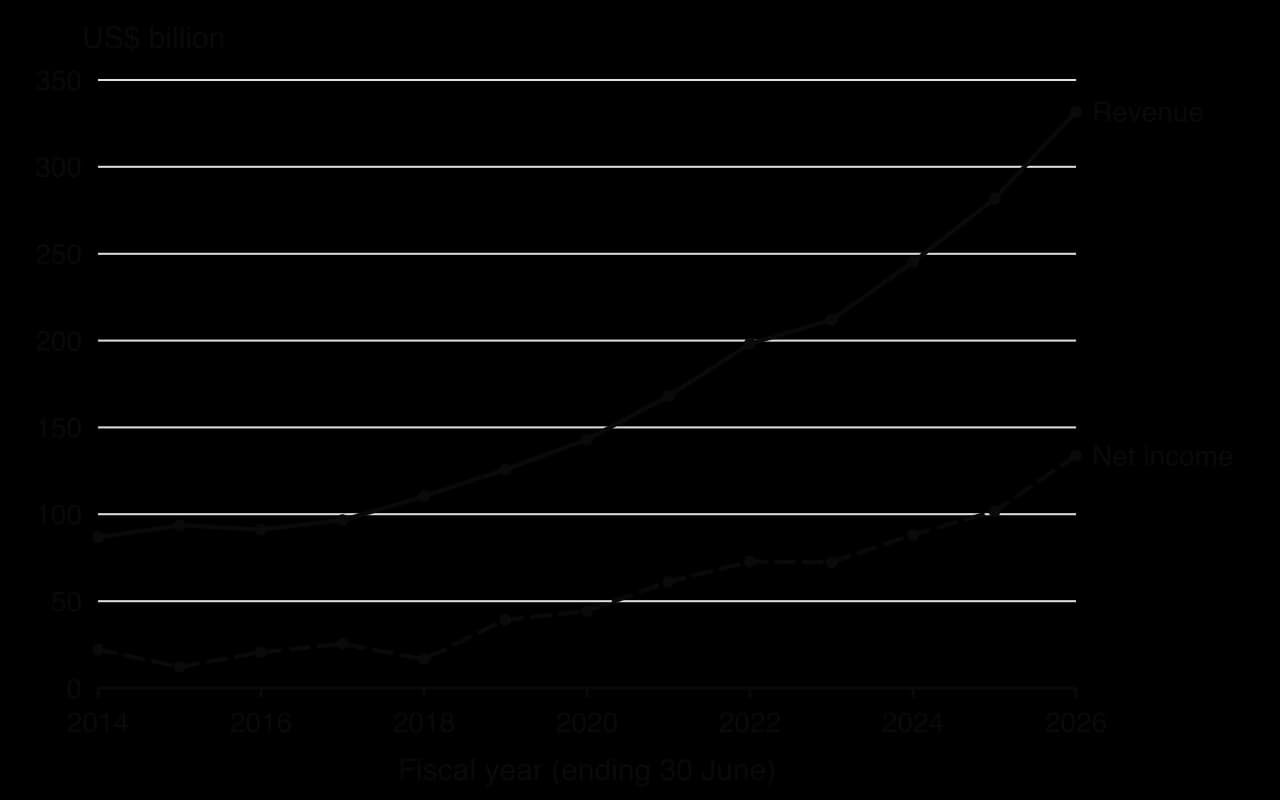
The financial results since 2014 have been very strong. Between fiscal years 2014 and 2026, revenue rose from $86.8 billion to $331.8 billion, an increase of about 282%, and net income rose about six times, from $22.1 billion to $133.7 billion. In fiscal year 2025 Azure, Microsoft’s cloud computing platform, passed $75 billion of revenue for the first time; in 2026 the company reported that it had passed $100 billion.
Fiscal year (ending 30 June) | Revenue ($ billion) | Net income ($ billion) | Net income as % of revenue |
|---|---|---|---|
2014 | 86.8 | 22.1 | 25.4% |
2015 | 93.6 | 12.2 | 13.0% |
2020 | 143.0 | 44.3 | 31.0% |
2025 | 281.7 | 101.8 | 36.1% |
2026 | 331.8 | 133.7 | 40.3% |
The case shows how leadership and management work together. The management decisions (writing off the phone business, cutting jobs) freed resources; the leadership decisions (a new mission and culture) shaped how employees used them. It also supports the argument that leaders who involve and develop employees can improve performance in a business that depends on knowledge and innovation.
The case has limits. Microsoft grew during a period when demand for cloud computing and then artificial intelligence rose across the whole industry, so not all of the growth can be credited to a change in leadership style. Profit figures also include one-off items in several years. The same leader who emphasised learning and empathy also made large redundancies, which shows that a single label rarely captures a real leader’s style.
Analyse why Nadella used a more directive style for the phone business and a more participative style for the culture change.
Explain the difference between Nadella’s role as a manager and his role as a leader, using evidence from the case.
To what extent can Microsoft’s financial results be attributed to its leadership style?
Sources: Microsoft, “Microsoft Board names Satya Nadella as CEO”, 4 February 2014; Microsoft Annual Reports 2014, 2015, 2020, 2023 and 2025; Microsoft FY26 fourth quarter earnings release, 29 July 2026.
Leadership and management appear in Paper 1 and Paper 2 at SL and HL, often linked to motivation, organisational structure or change. Short questions ask for definitions, the differences between management and leadership, or an explanation of a style applied to the case. Leadership styles can be evaluated in extended responses, so expect to judge which style suits a given business. At HL, questions on scientific and intuitive thinking ask you to explain or analyse, not to evaluate.
Extended responses on leadership reward applying more than one style to the case, using a model such as the continuum or Hersey–Blanchard, and a judgment about what the right style depends on.
Management is planning, organising, directing and controlling resources to achieve objectives efficiently; leadership is influencing and inspiring people to work willingly towards a goal.
Fayol described five functions of management: planning, organising, commanding, coordinating and controlling; Drucker’s management by objectives links individual targets to the organisation’s objectives.
Managers rely mainly on formal authority and focus on systems and the short term; leaders rely on trust and personal qualities and focus on people, vision and change.
Autocratic leaders decide alone; paternalistic leaders decide in employees’ interests; democratic leaders involve employees; laissez-faire leaders let employees decide within broad goals.
Situational leadership adapts the style to the task and to followers’ readiness, as in the Hersey–Blanchard model of telling, selling, participating and delegating.
The most appropriate style depends on the task, the urgency, the employees, the size and culture of the organisation and the national culture.
Scientific thinking bases decisions on data and analysis; intuitive thinking on experience and judgment; most managers combine them (HL).
I can define management and leadership and distinguish between them.
I can explain each of Fayol’s five functions of management and apply them to a business.
I can explain management by objectives and its main weakness.
I can describe qualities associated with effective leaders.
I can explain the features of autocratic, paternalistic, democratic, laissez-faire and situational leadership.
I can use the Hersey–Blanchard model to match a style to an employee’s readiness.
I can evaluate which leadership style suits a given business and explain what the choice depends on.
I can explain scientific and intuitive thinking in management and when each is appropriate (HL).
Award [2] for a full definition, e.g. the ability to influence, inspire and direct others towards achieving a vision or goals of an organization, for example by setting direction and motivating people.
Award [0] for a tautological answer that only repeats the term.
Candidates are not expected to word their definition exactly as above.
Outline two features of Davor’s autocratic leadership style (paragraph 2).
4 marks
Features shown in the case include:
Decisions are centralized with the leader: Davor alone decides which yachts each team works on and the deadlines; overtime needs his personal approval.
One-way (top-down) communication: the Monday meeting is used to give instructions rather than to consult; supervisors are no longer asked for suggestions.
Close supervision and control: Davor walks the yard every afternoon to check progress himself.
Little delegation or trust in subordinates: experienced supervisors with long service are not allowed to plan their teams’ work.
Accept any other relevant feature of autocratic leadership supported by paragraph 2.
Mark as 2 + 2. For each feature, award [1] for identifying a feature of autocratic leadership and [1] for outlining it with evidence from the case.
Award a maximum of [2] for a theoretical answer with no reference to JMW.
Explain two possible effects of Davor’s leadership style on JMW’s employees.
4 marks
Possible effects include:
Lower motivation and job satisfaction: skilled craftsmen who previously helped organize jobs are now excluded, so their esteem and self-actualization needs (Maslow) or recognition and responsibility (Herzberg’s motivators) are not met.
Higher labour turnover: nine skilled workers resigned in a year, several to a competitor in Rijeka; replacing trained welders and marine electricians is expensive and slow.
Loss of ideas and creativity: Marija says nobody suggests better ways of doing a job any more, so JMW loses the knowledge of long-serving staff.
Clearer expectations and greater urgency: employees know exactly which job to do and its deadline, which helped cut refit times from 21 to 16 days.
Accept any other relevant effect, positive or negative.
Mark as 2 + 2. For each effect, award [1] for identifying a relevant effect and [1] for explaining it in the context of JMW.
Award a maximum of [2] for a theoretical answer.
Discuss whether Davor should adopt a more democratic leadership style at JMW.
10 marks
Arguments for a more democratic style:
JMW’s workforce is highly skilled and experienced (55 specialists, many with over ten years’ service): such employees often respond better to consultation and can be trusted to plan their own work.
Nine skilled workers resigned in 2025. Recruiting and training replacements is costly, and losing staff to a competitor in Rijeka also strengthens that competitor. Involving staff may reduce labour turnover.
Monthly meetings would let JMW use the ideas of experienced supervisors such as Marija; improvements in working methods could cut refit times further.
Greater involvement could raise motivation (Herzberg’s motivators: responsibility, recognition; Maslow’s esteem needs), improving quality and commitment.
An autocratic style relies heavily on one person: if Davor is absent, decisions stop.
Arguments against (keeping the current style):
The autocratic style has worked on JMW’s main problem: refit times fell from 21 to 16 days and compensation claims almost stopped, after two years of losses.
Consultation takes time; in yacht refits with fixed customer deadlines, slow decisions may bring back late deliveries and compensation claims.
Davor has only been in post for one year; changing style quickly may signal weakness or confuse staff.
Not all workers may want involvement; some may prefer clear instructions.
Possible conclusion: a situational or partly democratic approach may be best, for example keeping Davor’s control over deadlines and overtime (where speed matters) while delegating the planning of how jobs are done to experienced supervisors and introducing Marija’s monthly meetings on a trial basis. Any well-supported judgement can achieve full marks.
Limitations that strong answers may note: we do not know why the nine workers left (pay may be a factor), whether the faster refits are due to Davor’s style or to other changes, or whether JMW is now profitable.
Marks should be allocated according to the markbands below.
Additional guidance:
A one-sided answer (only arguments for, or only against) may not be awarded more than [5].
An answer without a conclusion or judgement is usually limited to a maximum of [6].
To reach [9]–[10] the answer must explain at least one limitation of the case or stimulus material.
Markbands (10-mark extended response, Papers 1 and 2)
Marks | Level descriptor |
|---|---|
0 | The response does not reach the standard described below. |
1–2 | Little understanding of what the question demands. Business management tools and theories are barely used, or are irrelevant or inaccurate. Little or no reference to the stimulus material. No arguments are made. |
3–4 | Some understanding of what the question demands. Some use of tools and theories, but mostly inaccurate or not relevant. Use of the stimulus is superficial, often no more than the name of the organisation or person. Arguments are mostly unsubstantiated. |
5–6 | Understands what the question demands but addresses it only partially. Some relevant, accurate use of tools and theories. Some relevant use of the stimulus beyond names, but it does not effectively support the argument. Arguments are substantiated but mostly one-sided. |
7–8 | Mostly addresses what the question demands. Mostly relevant, accurate use of tools and theories. The stimulus generally supports the argument, with some lapses in clarity or relevance. Arguments are substantiated and show some balance. |
9–10 | Clear focus on what the question demands. Relevant, accurate use of tools and theories. Relevant stimulus material is integrated effectively to support the argument. Arguments are substantiated and balanced, and the limitations of the case or stimulus material are explained. |
A response with no judgement or conclusion is unlikely to reach the top band of a discuss, evaluate, examine or recommend question.
Amara Tea Estate
Grace Wanjiru owns Amara Tea Estate near Kericho, Kenya, which employs 210 tea pluckers and factory workers. Grace provides free housing on the estate, pays the school fees of workers’ children and visits sick employees at home. She meets the supervisors every week to hear their views, but she alone decides on wages, working hours and which fields are plucked. She often says: “I know what is best for my workers and their families.”
Younger workers, many of whom have finished secondary school, have begun asking for a say in how the estate is run, for example in the choice of new plucking machines.
Outline one feature of Grace’s paternalistic leadership style.
2 marks
Explain one advantage and one disadvantage for Amara Tea Estate of Grace’s paternalistic leadership style.
4 marks
Pixelforge is a games studio in Montreal, Canada, with 14 developers, artists and sound designers. Its founder, Étienne Roy, sets one goal for each year (in 2026, to release one new puzzle game) and then lets the team decide which ideas to develop, how to divide the work and when to work. He rarely attends their meetings unless he is asked to.
Explain two advantages for Pixelforge of Étienne’s laissez-faire leadership style.
4 marks