
Explain and evaluate the main theories of motivation, the financial and non-financial rewards and types of training that apply them, and (HL) labour turnover, appraisal and recruitment.
Each is in the Business glossary, with every other term in the subject.
An appraisal method in which an employee receives feedback on their performance from a range of people they work with, such as their manager, colleagues, subordinates and customers.
The situation in which employees are absent from work without a good reason, often measured as the percentage of working days lost, and a common sign of low motivation.
A formal process of reviewing an employee’s performance against agreed objectives, giving feedback and setting targets and development plans for the future.
A selection method in which candidates take part, over one or more days, in activities such as interviews, tests, group exercises, role plays and presentations while trained assessors observe them.
A payment to an employee, usually a percentage of the value of the sales they make, paid in addition to or instead of a basic salary.
A theory that people are most motivated, and most likely to be intrinsically motivated, when their basic psychological needs for autonomy, competence and relatedness are satisfied.
A reduction in an employee’s willingness to work hard or well, often caused by poor management, unfair treatment, job insecurity or unrewarding work.
Define motivation and demotivation, and explain the causes and effects of demotivation in the workplace.
Evaluate the motivation theories of Taylor, Maslow and Herzberg.
Evaluate McClelland’s acquired needs theory, Deci and Ryan’s self-determination theory, equity theory and expectancy theory (HL).
Explain how salaries, wages, commission, performance-related pay, profit-related pay, employee share ownership schemes and fringe payments motivate employees.
Explain how job enrichment, job rotation, job enlargement, empowerment, purpose and teamwork motivate employees.
Explain the advantages and disadvantages of induction, on-the-job and off-the-job training.
Calculate and interpret labour turnover, and explain its causes and consequences (HL).
Explain the types of appraisal and the methods of recruitment (HL).
Evaluate internal and external recruitment (HL).
Motivation is what makes employees willing to work hard, work well and stay with an organisation. A business can own the best equipment and the strongest brand, but its results still depend on the effort, care and ideas of its people, so motivating them is one of the main tasks of human resource management (HRM).
Motivation links closely to the key concepts. Rewards and working conditions raise questions of ethics, such as whether pay is fair and whether incentives push staff to cut corners. Motivated employees are a source of creativity, and businesses that keep their staff healthy, trained and committed build a workforce that supports sustainability in its social sense. Motivation also matters most at times of
99 exam-style questions on this subtopic, written in the style of the IB papers. The first has its markscheme open. Counted on
Mwendo Couriers
[1] Mwendo Couriers (MC) is a private limited company that delivers parcels for online retailers across Nairobi, Kenya. It was founded in 2016 by Chebet Rotich and now employs 140 motorcycle riders, 22 warehouse staff and 9 managers. Riders are paid a piece rate of KES 85 for each parcel delivered. There is no basic wage, and riders pay for their own fuel.
[2] Operations manager Peter Otieno runs MC using methods he describes as “scientific”. Each morning, delivery routes are planned by software that calculates the fastest sequence of stops. Riders must follow the route exactly, and a GPS tracker records any stop longer than four minutes. Peter believes that “riders are motivated by money, so the more they deliver, the more they earn, and everyone wins”.
[3] In 2025 the number of parcels delivered per rider rose by 11 %, but customer complaints about damaged parcels and rude riders doubled. Two riders were injured in road accidents after riding through red lights to keep to schedule. A local newspaper published an article titled “Racing for shillings”.
[4] Chebet is considering replacing the piece rate with a time rate of KES 450 per four-hour shift, plus a monthly bonus for riders with no complaints and no damaged parcels. Peter warns that output will fall and that MC’s prices, already the lowest in Nairobi, would have to rise.
Define the term piece rate.
2 marks
Award [1] for a partial definition that shows some understanding, e.g. “paid for what you make/deliver”.
Award [2] for a full definition, e.g. a payment system in which employees are paid a fixed amount for each unit of output they produce or complete (here, each parcel delivered), so that pay varies directly with output.
The official deck for this part of the syllabus.
Define motivation.
Motivation cannot be seen directly. State four types of behaviour managers use to judge whether an employee is motivated.
With a free account, Augment remembers where you stopped and what you have practiced.
A payment system, proposed by Taylor, in which workers who reach a standard output are paid a higher rate for every unit produced than workers who fall below the standard.
A scheme in which a company gives or sells its shares to employees, often on favourable terms, so that employees become part-owners of the business.
Giving employees the authority, resources and trust to make decisions about their own work and to solve problems without referring them to a manager.
A theory that employees compare the ratio of their outputs (rewards) to inputs (contributions) with that of a referent, and that perceived unfairness reduces motivation.
A theory that effort depends on the belief that effort leads to performance (expectancy), that performance leads to a reward (instrumentality), and on how much the reward is valued (valence).
Filling a vacancy with a person from outside the organisation, for example through advertisements, online platforms, agencies or headhunting.
The drive to do an activity in order to gain a separate outcome, such as pay, a bonus or praise, or to avoid a punishment.
Payments to employees in money, or with a monetary value, such as salaries, wages, commission, bonuses, shares and fringe payments.
An ongoing review of an employee’s performance that gives regular feedback and support to help them improve and develop, rather than to judge them.
Benefits in addition to wages or salary that have a monetary value, such as a company car, health insurance, pension contributions, staff discounts or subsidised meals.
The direct approach of a person working for another organisation, usually by a specialist recruiter, to persuade them to apply for a senior or specialist job.
A theory that the factors causing job satisfaction (motivators) differ from those causing dissatisfaction (hygiene factors), so removing dissatisfaction does not by itself motivate employees.
Aspects of a job’s context, such as pay, working conditions, job security, supervision and company policy, that cause dissatisfaction if inadequate but do not motivate when improved.
Training given to new employees to introduce them to the organisation, its culture, policies and procedures, their colleagues and their job.
Filling a vacancy with an existing employee of the organisation, for example by promotion or redeployment.
The drive to do an activity because it is interesting, enjoyable or meaningful in itself, rather than for a separate reward.
The process of studying a job to identify its tasks and responsibilities and the skills, knowledge and qualities needed to do it.
A document that sets out the title, purpose, main tasks, responsibilities and reporting relationships of a job.
Increasing the number and variety of tasks in a job, at a similar level of skill and responsibility.
Redesigning a job to give the employee greater responsibility, challenge and control over their work, for example by adding planning, decision-making and checking tasks.
Moving employees between different jobs or tasks at regular intervals, so that they gain a variety of experience and skills.
The percentage of a business’s workforce that leaves over a period, usually a year: number of staff leaving in a year divided by the average number of staff, multiplied by 100.
A theory that people are motivated by five levels of need (physiological, safety, social, esteem and self-actualisation), each becoming the main motivator once the levels below are largely satisfied.
A theory that people are motivated by three needs learned through experience, the needs for achievement, affiliation and power, and that the dominant need differs between individuals.
The internal and external forces that cause a person to act, and that determine the direction, intensity and persistence of their effort towards a goal.
Aspects of the work itself, such as achievement, recognition, responsibility, interesting work, advancement and personal growth, which create job satisfaction and motivate employees, according to Herzberg.
Ways of motivating employees that do not involve direct payment, such as job enrichment, job rotation, job enlargement, empowerment, purpose and teamwork.
Training that takes place away from the employee’s usual place of work, such as courses at a college, a training centre, a conference or online.
Training that takes place at the workplace while the employee is doing their job, for example through coaching, mentoring or shadowing an experienced colleague.
A payment system in which part of an employee’s pay, such as a bonus or pay rise, depends on how well they meet agreed targets or objectives.
A document that sets out the qualifications, experience, skills and personal qualities needed by the ideal candidate for a job, often divided into essential and desirable criteria.
A payment system in which employees are paid a fixed amount for each unit of output they produce.
A payment system in which employees receive a share of the business’s profits, usually as a bonus calculated as a percentage of their salary.
An employee’s sense that their work is meaningful and makes a positive difference to other people, the organisation or society.
A business that finds, screens and puts forward candidates for an employer’s vacancies in return for a fee.
A fixed amount of pay for a year’s work, usually paid in equal monthly instalments, regardless of the exact hours worked or output produced.
The highest level in Maslow’s hierarchy of needs: the need to fulfil one’s potential, for example through challenging, creative and meaningful work.
An appraisal method in which employees evaluate their own performance against their objectives, usually before discussing it with their manager.
The process of selecting, from all applicants for a job, the small number who best match the person specification and will be invited to interview or further selection.
A review at the end of a period, usually a year, that judges an employee’s overall performance against set criteria, often with a rating used for pay or promotion decisions.
The view that employees are motivated mainly by money, so output is maximised by studying tasks scientifically, training workers in the most efficient method and paying them according to output.
Organising employees into groups that work together and share responsibility for completing a task or meeting a goal.
The observation and timing of each step of a task in order to find the quickest efficient method of doing it and to set a standard time or output for the job.
A payment system in which employees are paid a fixed amount for each hour worked, often with a higher rate for overtime.
The process of improving employees’ knowledge, skills and attitudes so that they can perform their current or future jobs more effectively.
Payments to employees calculated according to the number of hours worked (a time rate) or the amount produced (a piece rate), usually paid weekly or monthly.
Motivation is the desire, energy and commitment that lead a person to act towards a goal. At work, a motivated employee chooses to put effort into the job, keeps going when the work is difficult, and cares about the quality of the result. Motivation is an internal state, so managers cannot see it directly; they infer it from behaviour such as output, quality, attendance and willingness to help colleagues.
Managers influence motivation through the way they design jobs, pay people, lead teams and treat employees. They cannot switch it on directly, which is why so many different theories try to explain what drives people at work. Each theory points managers towards different tools: some towards pay and targets, others towards recognition, responsibility or fairness.
Motivation can come from inside the work or from outside it. Intrinsic motivation comes from the work itself: an engineer who enjoys solving a hard design problem, or a nurse who finds meaning in caring for patients, is intrinsically motivated. Extrinsic motivation comes from rewards or pressures separate from the task, such as pay, bonuses, promotion, praise from a manager or the threat of losing a job.
Extrinsic rewards are easier for a business to control and to measure. They work well for routine tasks with clear output. Intrinsic motivation is harder to create, but it tends to last longer and to produce more creative and careful work, because the employee does not need a reward for each extra effort.
Motivated employees affect almost every measure of business performance. They tend to produce more in each hour, so productivity rises and the cost of each unit falls. They make fewer mistakes, so quality improves and less work is wasted. In service businesses, their attitude reaches customers directly and shapes repeat business and reputation.
Productivity and costs: more output from the same labour lowers unit costs and can raise profit.
Quality and customer service: careful, committed staff reduce errors, complaints and returns.
Attendance: motivated staff take fewer unexplained days off, so absenteeism is lower.
Retention: staff who are motivated are less likely to leave, which saves the cost of recruitment and training.
Ideas and change: motivated staff suggest improvements and accept new ways of working more readily.
Engagement at work is low worldwide. Only 12% of employees worldwide were “engaged” at work in 2009; the share rose to a peak of 23% in 2022 and 2023, then fell to 20% in 2025. Low engagement is estimated to cost the world economy about US$10 trillion a year in lost productivity, roughly 9% of global GDP.
Sources: Gallup, State of the Global Workplace: 2026 Report.
Demotivation is the loss of the desire to work well. A demotivated employee may still come to work and complete the basic tasks, but does the minimum, avoids extra responsibility and stops caring about results. Demotivation can affect one person, a team or a whole workforce, and it often spreads, because staff compare their treatment and talk to each other.
Cause | Why it demotivates |
|---|---|
Pay seen as unfair or too low | Employees compare their pay with colleagues, other firms and the cost of living; feeling underpaid breeds resentment. |
Poor management and leadership | Bullying, favouritism, constant criticism or a manager who never listens make staff withdraw effort. |
Lack of recognition | Good work that goes unnoticed gives employees no reason to repeat it. |
Job insecurity | Fear of redundancy or short, uncertain contracts makes staff anxious and less loyal. |
Boring, repetitive or meaningless work | Narrow tasks with no variety or purpose give little intrinsic satisfaction. |
Excessive workload or poor work–life balance | Long hours and pressure cause stress, burnout and illness. |
Lack of control and involvement | Staff who are never consulted feel their skills and ideas are wasted. |
No training or promotion prospects | Employees who cannot see a future in the business start looking elsewhere. |
Poor working conditions | Unsafe, uncomfortable or badly equipped workplaces signal that the employer does not care. |
Poorly managed change | Sudden reorganisations, relocations or new technology without explanation create resistance to change. |
Managers usually notice demotivation through its effects. Lateness and absenteeism rise, output falls, and the number of mistakes and customer complaints grows. Employees may refuse overtime, resist new ideas or become involved in conflict with managers and colleagues. In the end, demotivated staff leave, and the business pays to recruit and train replacements.
Demotivation is not always the fault of the employee or the immediate manager. It can be built into the system: a pay scheme that rewards the wrong behaviour, a structure with too many levels of approval, or a culture in which mistakes are punished. For this reason, managers who want to reduce demotivation need to look at how jobs, rewards and decisions are designed, and the motivation theories offer different ways of doing this.
Motivation theories fall into two broad groups. Content theories ask what motivates people: the needs or factors that drive behaviour. Maslow and Herzberg are content theories. Process theories ask how motivation works: how people decide how much effort to give and how they react to the rewards they receive. Taylor’s approach is older than both groups and rests on a simple assumption about money.
Theory | Main idea | Type |
|---|---|---|
Taylor (1911) | Workers are motivated mainly by money, so pay should be linked to output | Early scientific approach |
Maslow (1943) | People satisfy a hierarchy of five needs in order | Content |
Herzberg (1959) | Hygiene factors prevent dissatisfaction; motivators create satisfaction | Content |
Frederick Winslow Taylor was an American engineer who studied work in steel mills and factories at the end of the 19th century. In The Principles of Scientific Management, published in 1911, he argued that there is “one best way” to do every task, and that managers can find it by scientific study rather than by rule of thumb. His ideas, often called Taylor’s theory of motivation or Taylorism, shaped the mass production factories of the 20th century.
Taylor assumed that workers are “economic” people: they want to earn as much as possible for as little effort as possible. Left to themselves, he believed, workers deliberately work slowly, partly to protect their jobs and partly because they are paid the same whatever they produce. The answer was to link pay directly to output and to take decisions about how work is done away from workers and give them to managers.
Observing and measuring the task. A manager or specialist times each part of a job with a stopwatch and records each movement, in a time and motion study.
Finding the one best way. Unnecessary movements are removed, and the fastest efficient method becomes the standard for everyone.
Breaking the job into simple tasks. Each worker repeats one narrow task, which needs little skill and is quick to learn (specialisation).
Selecting and training workers. Workers suited to the task are chosen and trained in the standard method.
Setting a standard output and paying by results. Pay is linked to output through a piece rate, so workers who produce more earn more.
Separating planning from doing. Managers plan, set targets and supervise closely; workers carry out the instructions.
Taylor proposed a differential piece rate to make the link between pay and output stronger. Workers who reach the standard output in a day are paid a higher rate for every unit; workers who fall short are paid a lower rate. A small increase in output around the standard therefore brings a large increase in pay.
The diagram shows why Taylor expected the scheme to work. A worker producing 95 units earns $47.50, but one producing 100 units earns $70, so the last five units are worth $22.50. The scheme rewards workers who match the speed set by the time study and penalises those who do not.
Taylor’s methods spread quickly to manufacturing. Ford’s moving assembly line, introduced at its Highland Park plant in Michigan from 1913, broke car assembly into hundreds of short, timed tasks. Output rose sharply, but workers disliked the pace and repetition so much that by late 1913 the plant’s labour turnover had reached 380%: to increase the workforce by 100 people, Ford had to hire 963. In January 1914 the company responded by paying $5 for an eight-hour day, against a previous rate of $2.34 for nine hours, and applicants crowded outside the factory.
Sources: The Henry Ford museum, “Crowd of Applicants outside Highland Park Plant after Five Dollar Day Announcement, January 1914”.
Ford’s case supports Taylor’s view that money matters: the higher wage persuaded workers to accept work they disliked. It also shows a limit of his approach, because the repetitive work itself drove people away. Many modern businesses still use Taylor’s ideas, including fast-food kitchens with timed tasks, call centres that measure the length of each call, and delivery firms that track each driver’s stops per hour.
Strengths | Limitations |
|---|---|
Studying tasks scientifically can raise productivity and lower unit costs, especially in mass production. | Treats people as if money were the only motivator and ignores social needs, recognition and interest in the work. |
Clear standards, training and targets tell workers exactly what managers want. | Repetitive, narrow jobs cause boredom, absenteeism and high labour turnover. |
Linking pay to output rewards hard-working employees and is simple to measure where output can be counted. | Workers may sacrifice quality and safety for speed. |
Many of its tools (work study, standard times, piece rates) are still used in factories, warehouses and fast food. | Close supervision and the loss of control over the job can cause conflict with managers and trade unions. |
Gave managers a systematic method, rather than guesswork, for organising work. | Hard to apply to services, creative and knowledge work, where output is difficult to count and quality matters more than speed. |
Taylor’s methods met strong opposition in his own time. When a bonus system based on stopwatch timing was introduced at the Watertown Arsenal, a US government foundry, in 1911, the workforce walked out, and the US government later banned stopwatch timing in its own establishments. The evidence suggests that Taylor’s approach works best where tasks are simple, output is easy to measure and pay is the main reason people take the job. It works least well where employees need to use judgment, work with customers or come up with ideas.
Abraham Maslow was an American psychologist. In a paper published in 1943, “A Theory of Human Motivation”, he argued that people are motivated by a series of needs arranged in a hierarchy. Maslow’s hierarchy of needs is usually drawn as a pyramid with five levels, from basic physical needs at the bottom to personal growth at the top.
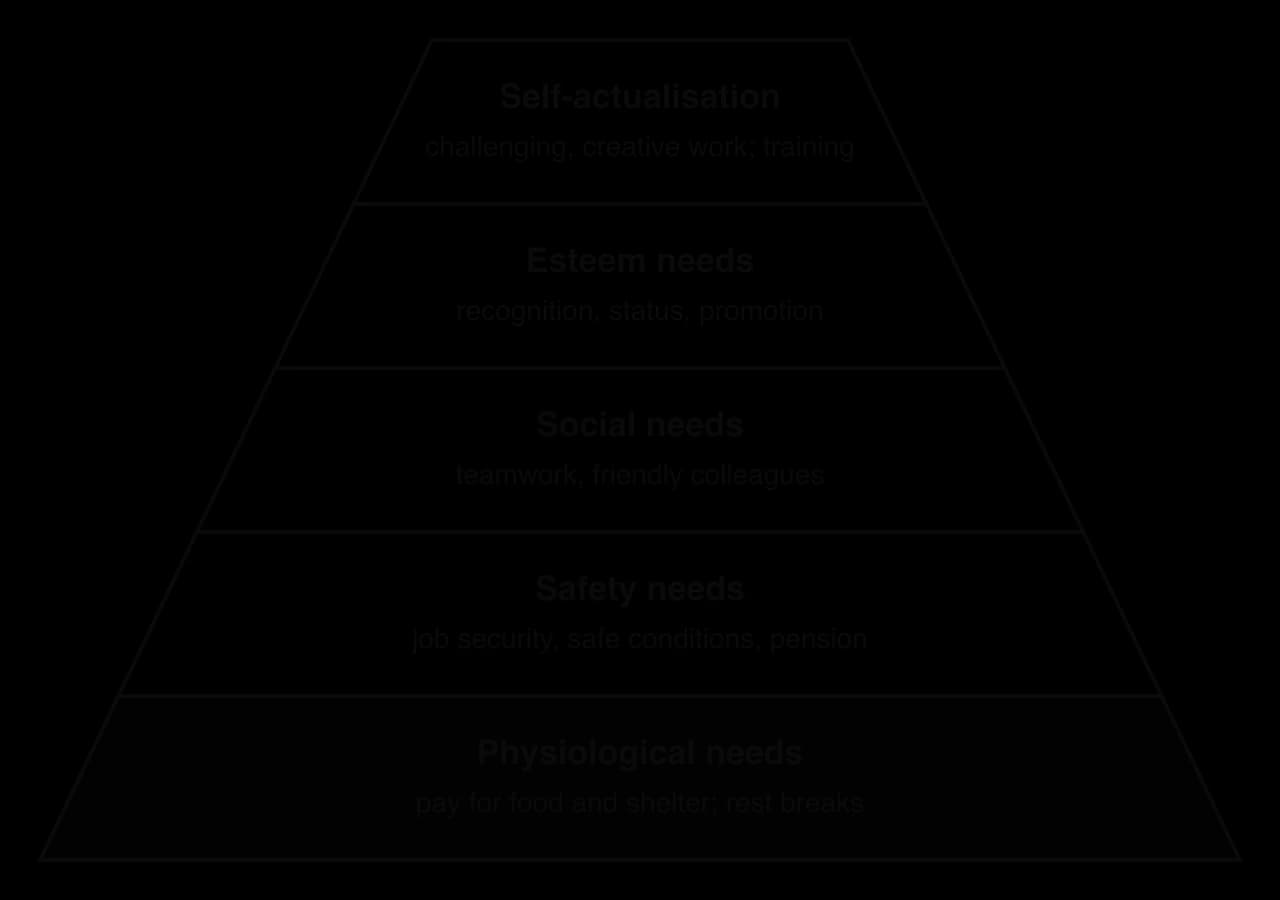
Level of need | Meaning | How a business can meet it |
|---|---|---|
Physiological | Basic needs for survival: food, water, shelter, rest | A wage or salary high enough to live on; rest breaks; a comfortable workplace; subsidised meals |
Safety | Protection from physical and financial harm; stability | Safe working conditions; secure contracts of employment; sick pay; pensions; health insurance; clear rules |
Social (love and belonging) | Friendship, acceptance and belonging to a group | Teamwork; social events; friendly colleagues; good communication; induction that welcomes new staff |
Esteem | Self-respect, status and the respect of others | Recognition and praise; job titles; promotion; awards; responsibility |
Self-actualisation | Reaching one’s full potential; personal growth | Challenging and creative work; training and development; chances to lead projects |
The lower four levels are sometimes called deficiency needs: people feel their absence and are driven to remove it. Self-actualisation is a growth need. Once people have their basic needs met, they look for work that lets them develop, and this need is never fully satisfied, because each achievement opens a new goal.
Maslow’s central idea is that a satisfied need no longer motivates. An employee who already earns enough to live comfortably is unlikely to work much harder for a little more pay, but may respond strongly to recognition or a chance of promotion. Managers therefore need to find out which level each employee has reached and offer rewards aimed at the next level up.
The hierarchy also predicts what happens when lower needs are threatened. If a business announces job cuts, safety needs suddenly return to the front of employees’ minds, and offers of challenging projects or team-building events will have little effect until job security is restored. Maslow did not claim that one level must be 100% satisfied before the next matters; he described each need as becoming dominant once the one beneath it is relatively well met.
The hierarchy is easy to understand and gives managers a useful reminder that people need different things at different times. It explains why pay rises lose their power once pay is comfortable, and why job insecurity can undo other attempts to motivate staff. It also encourages managers to offer a mix of rewards, rather than relying on money alone.
Little evidence for a fixed order. Research has found limited support for the five levels or for the idea that people move up them in order. Some people put esteem or creativity before security, as many artists and entrepreneurs do.
Individual differences. Two employees on the same pay may be at different levels because of their savings, family situation or personal values.
Cultural differences. The hierarchy reflects an individualistic, American view of the person. In more collectivist cultures, belonging to a group may matter more than self-actualisation, and the order of the levels may differ.
Needs overlap. Most people pursue several needs at once: a job may give pay, friendship and recognition at the same time.
Hard to measure. A manager cannot easily tell which level an employee has reached, and self-actualisation is vague and different for each person.
Unclear what “satisfied” means. The theory does not say how much pay or security is “enough”.
Maslow’s theory is best used as a framework for thinking about what employees might need, not as a precise prediction. It is most helpful when it points managers to an unmet lower-level need that blocks other rewards from working, as at Harbour View.
Frederick Herzberg was an American psychologist. In 1959 he and his colleagues published The Motivation to Work, based on interviews with 203 engineers and accountants in the Pittsburgh area of the United States. Each was asked to describe times when they had felt exceptionally good and exceptionally bad about their jobs. The things that made people feel good were different from the things that made them feel bad, which led Herzberg to his two-factor theory, also called motivation–hygiene theory.
Hygiene factors are features of the job’s environment, such as pay, working conditions, job security, company policy, the quality of supervision and relationships with colleagues. When they are poor, employees are dissatisfied; when they are good, employees are not dissatisfied, but they are not motivated either. Herzberg chose the word “hygiene” because, like cleanliness in a hospital, these factors prevent problems without creating health.
Motivators are part of the work itself: achievement, recognition for achievement, interesting work, responsibility, advancement and personal growth. When they are present, employees feel satisfied and are motivated to work harder and better. When they are absent, employees are not dissatisfied as such; they simply lack positive motivation.
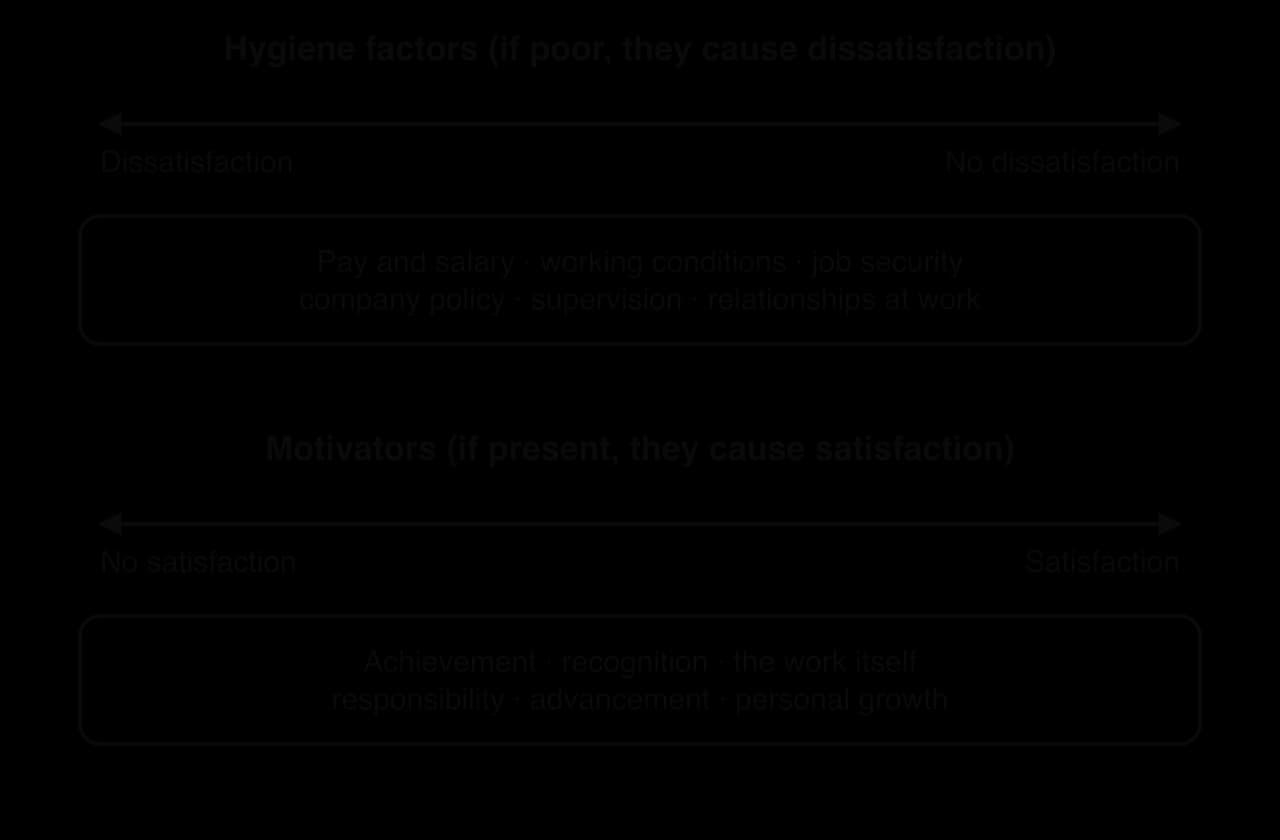
The diagram shows the key point of the theory. A single scale running from “very dissatisfied” to “very satisfied” would suggest that a pay rise could take an employee all the way to motivation. Herzberg’s two scales show that a pay rise can only remove dissatisfaction, while a different set of factors is needed to create satisfaction.
 YouTube
Herzberg distinguished between getting people to move and making them want to move. Managers can get movement through incentives and threats, but the effect stops when the incentive stops, and a larger reward is needed next time. Real motivation comes from within the person and is produced by the motivators. This idea is close to the distinction between extrinsic and intrinsic motivation.
Herzberg’s main practical recommendation was job enrichment: redesigning jobs to give employees a complete unit of work, more responsibility, more control over how they work and direct feedback on their results. Enriched jobs supply the motivators that narrow, Taylor-style jobs remove.
The two theories fit together closely. Herzberg’s hygiene factors match Maslow’s lower levels, and his motivators match the higher ones. Both suggest that pay and security are necessary but not sufficient, and that people need recognition and growth to give their best.
Maslow’s level | Herzberg’s factor | Examples |
|---|---|---|
Self-actualisation | Motivators | Personal growth, challenging work, responsibility |
Esteem | Motivators (and status as a hygiene factor) | Recognition, achievement, advancement |
Social | Hygiene factors | Relationships with colleagues and supervisors |
Safety | Hygiene factors | Job security, company policy, safe conditions |
Physiological | Hygiene factors | Pay, working conditions |
Herzberg’s theory has been very influential because it explains a common observation: businesses that raise pay or improve offices often see little change in effort, while jobs with more responsibility and recognition can transform it. It gives managers a practical tool, job enrichment, and warns them against relying on hygiene factors to motivate.
The method may have shaped the results. People tend to credit themselves for good experiences (“I achieved something”) and blame their surroundings for bad ones (“the company policy was unfair”). This could explain why the good and bad factors came out differently.
A narrow sample. The original study interviewed only professional engineers and accountants. Workers in routine, low-paid jobs may value pay much more highly.
Pay can motivate. A bonus that rewards a specific achievement is also a form of recognition, so pay can work as a motivator as well as a hygiene factor.
Satisfaction is not the same as performance. The theory assumes that satisfied employees work harder, but satisfied employees are not always more productive.
Costs and limits of job enrichment. Not every job can be enriched, and some employees prefer simple, predictable work.
The theory is most useful when a business has already met basic needs for pay and security and wants to raise effort and quality further. Where hygiene factors are poor, as in low-paid, insecure jobs, fixing them comes first; job enrichment will not make up for a wage that does not cover the rent.
Taylor | Maslow | Herzberg | |
|---|---|---|---|
View of employees | Economic: motivated by money | Driven by a series of needs, from survival to growth | Satisfied by the work itself; dissatisfied by its context |
Role of pay | The main motivator | Meets lower-level needs | A hygiene factor |
Main tools | Time and motion study, piece rates, close supervision | Rewards matched to each employee’s level of need | Job enrichment, recognition, responsibility |
Best suited to | Routine tasks with measurable output | Understanding why different employees respond to different rewards | Jobs where quality, initiative and commitment matter |
Main criticism | Ignores non-financial needs; dehumanising work | Little evidence of a fixed order; cultural bias | Small, professional sample; pay can motivate |
The three theories are best seen as complementary. Taylor explains why pay linked to output raises effort on simple tasks; Maslow explains why the same reward motivates some employees and not others; Herzberg explains why good pay and conditions are necessary but rarely enough. A business choosing how to motivate staff can use all three: pay fairly, check that security and conditions are adequate, then design jobs that offer responsibility and recognition.
David McClelland was an American psychologist who set out his ideas in The Achieving Society in 1961. McClelland’s acquired needs theory argues that everyone has three needs, achievement, affiliation and power, but that their strength differs from person to person. The needs are acquired, or learned, through life experience, upbringing and culture, rather than being fixed from birth. Each person usually has one dominant need, which shapes what motivates them and the roles they suit.
Need | People with this dominant need… | Are motivated by | Suitable roles | Risks |
|---|---|---|---|---|
Achievement (nAch) | want to excel, set moderately difficult goals, take calculated risks and like regular feedback | Challenging targets, feedback on performance, chances to solve problems | Sales, entrepreneurship, project work, research | May work alone, struggle to delegate, or lose interest in routine tasks |
Affiliation (nAff) | want to be liked and accepted, prefer cooperation to competition, avoid conflict | Teamwork, a friendly workplace, personal approval | Customer service, team roles, HR, care work | May avoid hard decisions or unpopular choices; may find criticism difficult |
Power (nPow) | want to influence and control others and to gain status | Authority, responsibility for people, status and recognition | Management and leadership roles | Personal power can become self-serving and damage the team |
McClelland distinguished between two forms of the need for power. Personal power is the wish to control others for one’s own benefit, which tends to damage teams. Institutional (or social) power is the wish to organise the efforts of others towards the organisation’s goals. McClelland found that the most effective senior managers combined a high need for institutional power with a lower need for affiliation, because they could make difficult decisions without worrying about being liked.
The theory helps managers match people to jobs and rewards. An employee with a strong need for achievement may thrive on a stretching sales target with weekly feedback, while a colleague with a strong need for affiliation may work best in a close team and be motivated by personal thanks. Recruitment and appraisal can be used to identify each employee’s dominant need. Because the needs are learned, training and experience can also strengthen them, for example by giving a promising employee small leadership tasks before a promotion.
The theory also warns that a top performer is not always a good manager. A salesperson with a high need for achievement may be promoted to sales manager and then become frustrated, because success now depends on others rather than on personal effort. In the terms of the theory, the new role needs institutional power more than achievement.
Strength: explains individual differences. Unlike Maslow, it accepts that different people are driven by different needs, so it helps managers tailor rewards.
Strength: useful for selection and development. It links motivation to job roles, leadership potential and training.
Limitation: hard to measure. McClelland measured needs through people’s interpretations of pictures, a method that is time-consuming and open to the tester’s judgment.
Limitation: incomplete. Three needs leave out other influences, such as pay and job security.
Limitation: needs change. A person’s dominant need may shift with age, family circumstances or the job itself, so a single assessment can mislead.
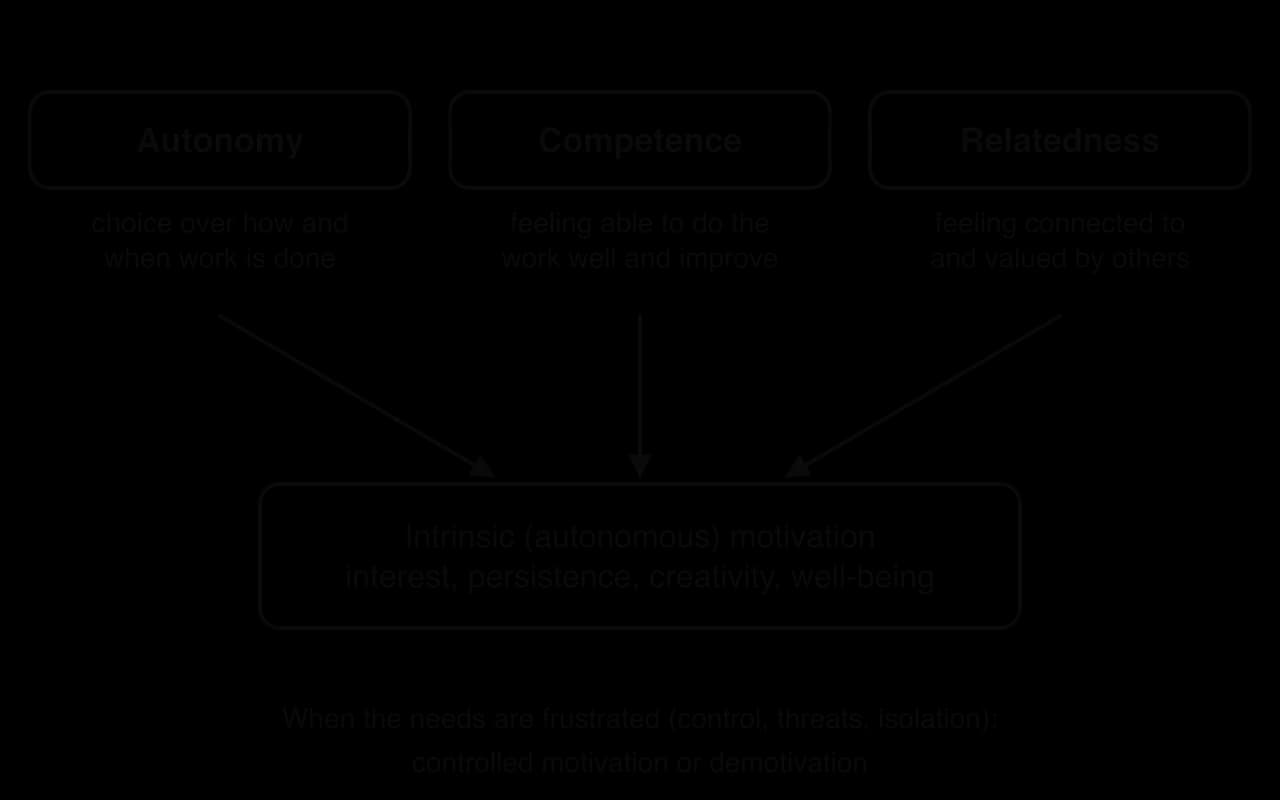
Edward Deci and Richard Ryan are American psychologists who developed self-determination theory from the 1970s onwards and set it out fully in a book in 1985. The theory places intrinsic and extrinsic motivation at its centre. It argues that people are naturally curious and keen to develop, and that intrinsic motivation flourishes when three basic psychological needs are met: autonomy, competence and relatedness.
Autonomy: the need to feel in control of one’s own actions and to have choice over how, when and with whom work is done. Autonomy does not mean working alone; it means acting willingly rather than under pressure.
Competence: the need to feel effective and capable, to master tasks and to see one’s skills grow. Tasks that are too easy bore people; tasks that are impossibly hard defeat them.
Relatedness: the need to feel connected to others, to care for them and to be cared for, and to belong to a group whose goals matter.
Deci’s early experiments in 1971 asked students to solve puzzles. One group was paid for each puzzle solved and another was not. When the payments stopped and the students were left alone with the puzzles, those who had been paid spent less of their free time on them than those who had never been paid. The reward seemed to change the activity from something done for interest into something done for money.
This finding, often called the crowding-out effect, has an important lesson for managers. Rewards that people experience as controlling, offered only on condition that a task is done, can reduce intrinsic motivation for interesting tasks. Rewards that people experience as information about their competence, such as unexpected recognition or feedback, can strengthen it. The effect matters most for tasks that are already interesting; for dull, routine tasks, extrinsic rewards cause less harm.
The theory does not treat all extrinsic motivation as the same. It describes a continuum. At one end is controlled motivation: acting to gain a reward or avoid a punishment, or out of guilt. At the other end is autonomous motivation: acting because the activity is enjoyable, or because the person understands and accepts its value. An employee who completes safety checks only because a supervisor watches is controlled; one who completes them because she understands why they protect colleagues is autonomous, even though the task itself is not enjoyable.
Managers can move employees towards autonomous motivation by explaining the reasons for tasks, offering choice where possible, giving feedback that builds competence and creating teams in which people feel valued. The software company Atlassian, for example, runs ShipIt, an event in which employees have 24 hours to build anything they choose, often with colleagues from other teams, and present the results.
Sources: Atlassian, “ShipIt” (atlassian.com).
Strength: strong evidence base. Many studies in workplaces, schools and health care support the link between the three needs and motivation and well-being.
Strength: guides modern management. It explains why autonomy, purpose and feedback motivate knowledge workers and creative staff, and it supports empowerment and job enrichment.
Strength: warns about incentives. It helps managers avoid reward schemes that reduce interest in creative work.
Limitation: harder to apply to routine work. Some jobs offer little scope for autonomy, and some employees prefer clear instructions.
Limitation: cultural differences. The value placed on individual choice differs between cultures, although the theory argues that autonomy means acting willingly, which is possible within a group.
Limitation: no simple rule. It does not tell managers exactly how much autonomy to give or which rewards will be seen as controlling.
John Stacey Adams, an American psychologist, published equity theory in 1963. The theory argues that employees are motivated by fairness. Each employee compares what they put into a job and what they get out of it with what a chosen comparison person, called the referent, puts in and gets out. If the two ratios seem equal, the employee feels fairly treated; if not, they feel inequity and act to reduce it.
Inputs are everything an employee brings to the job: effort, time, skills, qualifications, experience, loyalty and the sacrifices they make. Outputs are everything they receive: pay, bonuses, fringe payments, recognition, status, promotion and job security. The referent can be a colleague doing the same job, a person in a similar job in another business, a friend, or the employee’s own past experience.
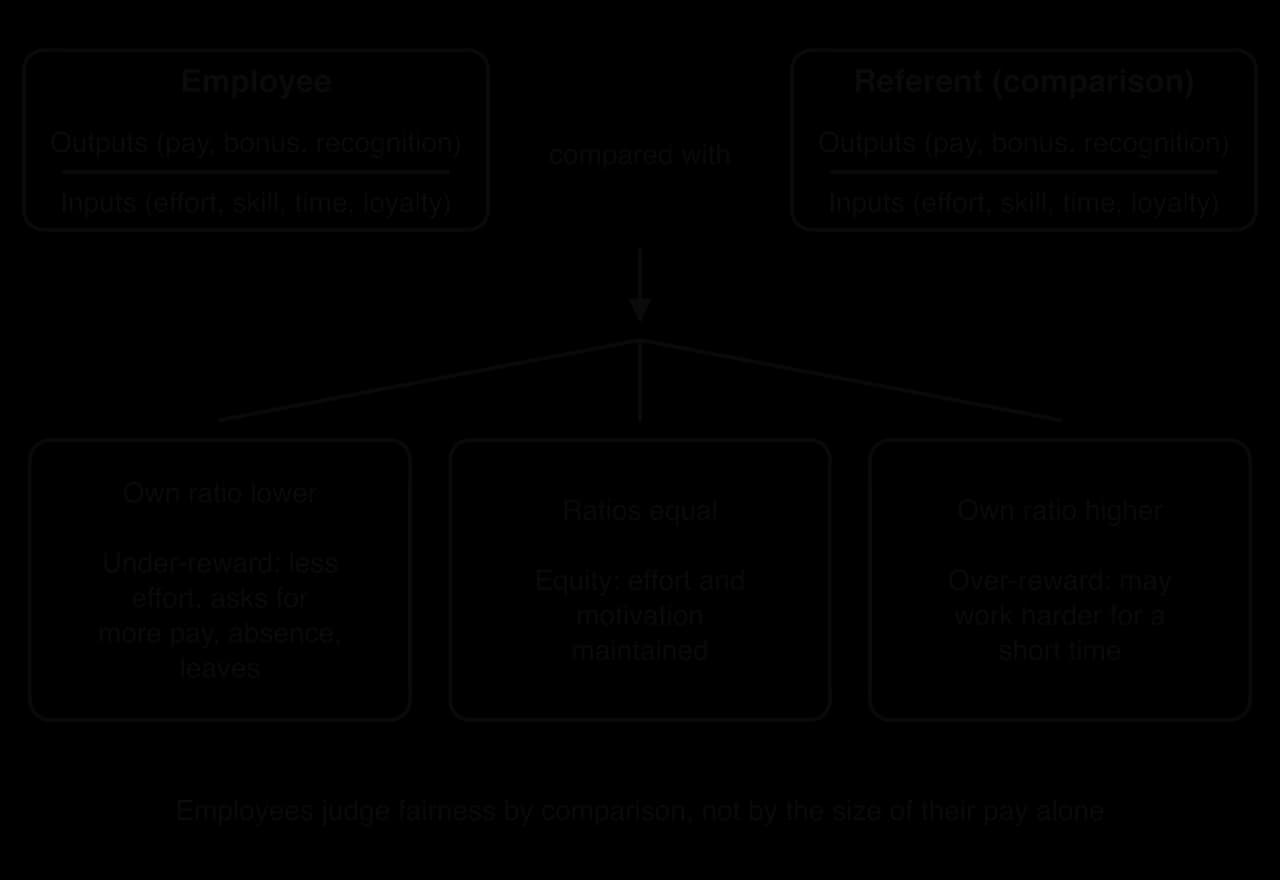
Reduce inputs: work more slowly, refuse overtime or stop helping colleagues.
Seek more outputs: ask for a pay rise, a promotion or better conditions.
Change the comparison: decide the referent is not really comparable, or choose a different referent.
Distort perceptions: persuade themselves that their work is easier, or the referent’s harder, than it is.
Leave: resign, or ask to move to a different job or team.
Over-reward also creates inequity, but employees tolerate it more easily. They may work harder for a while, or simply decide that they deserve the extra reward. Under-reward produces the stronger and longer-lasting reaction, which is why pay secrecy, unexplained bonuses and large gaps in pay between staff and executives can damage motivation. Chief executives of large US companies earned about 20 times the pay of an average worker in 1965 and about 300 times by 2015.
Sources: BBC News, “The boss who put everyone on 70K”, 28 February 2020.
Strength: explains everyday reactions. It explains why employees care about relative pay, why pay secrecy causes suspicion and why fairness in promotions matters.
Strength: practical guidance. It supports clear pay structures, transparent criteria for bonuses and consistent treatment across teams.
Limitation: perceptions are subjective. Managers cannot easily know who an employee’s referent is or how they value their own inputs.
Limitation: individuals differ. Some people are more sensitive to inequity than others, and some accept differences they see as earned.
Limitation: focuses on the negative. It explains demotivation from unfairness better than it explains how to create positive motivation.
Victor Vroom, a Canadian psychologist working in the United States, set out expectancy theory in Work and Motivation in 1964. The theory treats motivation as a rational choice. An employee decides how much effort to give by asking three questions: if I try, will I succeed? If I succeed, will I be rewarded? And do I want the reward?
Expectancy (E): the belief that effort will lead to the required performance. It is high when the employee has the skills, resources and support to reach the target, and low when the target seems impossible.
Instrumentality (I): the belief that good performance will actually be rewarded. It is low when managers break promises, when rewards depend on luck or favouritism, or when the link between performance and reward is unclear.
Valence (V): the value the employee places on the reward. A bonus is highly valued by an employee saving for a house; extra holiday may matter more to a parent of young children.
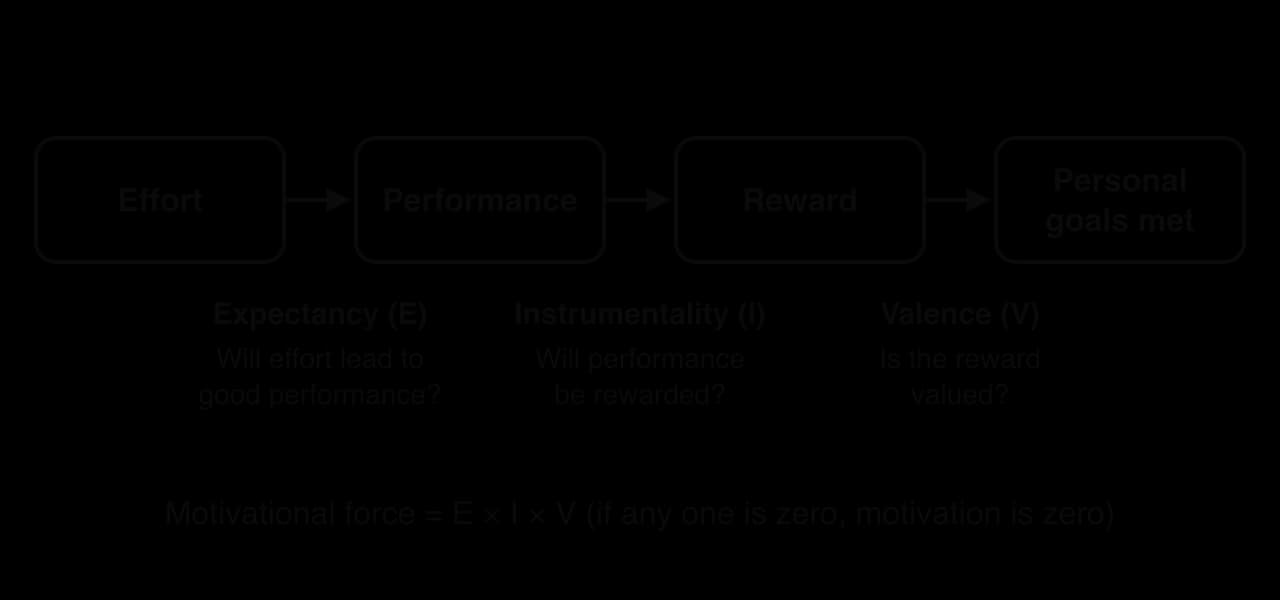
Because the three elements are multiplied, motivation is zero if any one of them is zero. A generous bonus for a target that employees believe they cannot reach motivates nobody, and nor does an achievable target with a reward employees do not value. Expectancy and instrumentality are usually expressed as probabilities between 0 and 1, and valence as a score of how attractive the reward is.
Set targets that are challenging but achievable, and provide the training and resources to reach them (raising expectancy).
Make the link between performance and reward clear, automatic and consistent, and keep promises (raising instrumentality).
Find out what each employee values and, where possible, offer a choice of rewards (raising valence).
Strength: explains why reward schemes fail. It shows managers exactly where a scheme breaks down: the target, the trust or the reward.
Strength: recognises individual differences. Valence differs between people, so the theory supports flexible rewards.
Limitation: assumes rational calculation. Employees rarely work out probabilities; habit, emotion and loyalty also shape effort.
Limitation: hard to measure. Expectancy, instrumentality and valence are personal beliefs that are difficult to quantify reliably.
Limitation: complex to apply. Tailoring targets and rewards to each employee takes time and can raise equity concerns.
Theory | Key question | Main lesson for managers | Main weakness |
|---|---|---|---|
McClelland | Which need drives this person most? | Match roles and rewards to each employee’s dominant need | Needs are hard to measure |
Deci and Ryan | Are autonomy, competence and relatedness met? | Build intrinsic motivation; avoid controlling rewards for interesting tasks | Harder to apply to routine work |
Adams | Is my treatment fair compared with others? | Keep pay and promotion transparent and consistent | Perceptions are subjective |
Vroom | Can I succeed, will I be rewarded, do I want the reward? | Set achievable targets, keep promises and offer valued rewards | Assumes employees calculate rationally |
The HL theories help explain the results of the SL theories. Equity theory explains why a pay rise for one group can demotivate another, and expectancy theory explains why a bonus scheme that looks generous fails. Self-determination theory explains why Herzberg’s motivators work, and McClelland explains why Maslow’s single hierarchy does not fit every individual.
Financial rewards are the payments employees receive in money or with a money value. They meet physiological and safety needs in Maslow’s hierarchy and are hygiene factors in Herzberg’s theory. They are also the main tool of Taylor’s approach. Businesses usually combine a basic payment, a salary or wage, with one or more incentive payments that link reward to performance.
A salary is a fixed annual amount, usually paid monthly, that does not change with the number of hours worked or the amount produced. Salaries are common for managers, professionals and office staff, whose output is hard to count and who may need to work extra hours at busy times.
A salary gives employees a predictable income and meets their need for security, and it is simple for the business to budget for. It also suggests trust and status. Its weakness is that it gives no direct reward for extra effort, so businesses often add bonuses, performance-related pay or promotion to motivate salaried staff.
Wages are payments for work, usually paid weekly or monthly, that vary with the hours worked or the amount produced. Wages are common for manual, retail and hospitality jobs. They are calculated in two main ways.
A time rate pays a fixed amount for each hour worked. Hours beyond the normal working week may be paid as overtime at a higher rate, such as one and a half times the normal rate. Time rates are fair to employees when output is hard to measure or depends on things outside their control, such as the number of customers entering a shop. They do not reward effort directly, so they need supervision to maintain productivity.
A piece rate pays a fixed amount for each unit produced, so pay rises with output. It is Taylor’s preferred method and suits work where output is easy to count, such as harvesting fruit, sewing garments or assembling components. A study of a large US car-windscreen company that switched its installers from hourly wages to piece rates in the mid-1990s found that output per worker rose by between 20% and 36%, and that about half of the gain was passed on to workers as higher pay.
Sources: Lazear, E. P., “Performance Pay and Productivity”, NBER Working Paper 5672, 1996.
Piece rates have clear risks. Workers may rush and produce more faulty units, so quality checks are needed. Pay can fall through no fault of the worker, for example when a machine breaks down, which damages security. Many countries also require that piece-rate workers earn at least the minimum wage for the hours they work.
Commission is a payment to salespeople based on the value of the sales they make, usually a percentage of sales revenue. Many salespeople receive a basic salary plus commission, which gives them some security and a strong incentive to sell more. In some jobs, such as estate agency and car sales, commission can be most of the employee’s income.
Commission links pay directly to results, rewards the most successful staff and keeps costs in line with revenue, because the business pays more only when it sells more. It can also encourage aggressive selling, a focus on short-term sales over long-term customer relationships, and competition between colleagues instead of teamwork. In 2016 US regulators fined Wells Fargo a total of US$185 million after its employees, under pressure to meet sales targets and earn bonuses, opened about two million bank and credit card accounts that customers may not have authorised.
Sources: Consumer Financial Protection Bureau, press release, 8 September 2016.
Performance-related pay (PRP) links part of an employee’s pay to an assessment of their performance against agreed targets or objectives. It is often paid as an annual bonus or a pay rise that depends on the result of an appraisal. Unlike commission, PRP can reward many kinds of performance, such as customer satisfaction, project completion or quality, so it is used for managers, teachers, civil servants and other staff whose output is not a simple count of sales.
PRP rewards high performers and focuses effort on the business’s objectives. It works only if employees believe the targets are achievable and the assessment is fair. Its problems are that performance is often judged by a manager, which can seem subjective or unfair; that targets can distort behaviour, as staff focus on what is measured and neglect what is not; and that the bonuses may be too small to change behaviour. PRP for interesting, creative work may also reduce intrinsic motivation, because employees start to work for the bonus rather than for the interest of the task.
Profit-related pay gives employees a share of the business’s profit, usually as an annual bonus calculated as a percentage of salary. Because everyone gains when the business does well, it encourages employees to think about costs, quality and customers, and to cooperate rather than compete. It meets esteem and belonging needs as well as financial ones, because it treats employees as partners in the business’s success.
The John Lewis Partnership in the UK, which is owned by a trust on behalf of its employees, pays every partner the same percentage of salary as an annual bonus when profits allow. The bonus has historically ranged from about 5% to 20% of salary, but it fell to 2% in 2020, and in 2021 the business paid no bonus for the first time since 1953. The case shows the main weakness of profit-related pay: the link between one employee’s effort and the company’s profit is weak, and the bonus can disappear for reasons outside employees’ control.
Sources: John Lewis Partnership annual reports, summarised in “John Lewis Partnership”, Wikipedia (accessed October 2026).
An employee share ownership scheme gives employees shares in the company, or lets them buy shares at a discount. As shareholders, employees gain when the share price rises and may receive dividends, so their interests become closer to those of the owners. Schemes are often designed so that shares are released over several years, which encourages employees to stay.
Starbucks has given share options, and later share grants, to its employees, whom it calls partners, since 1991 through a scheme called Bean Stock. It was unusual because eligible part-time staff take part as well as full-time staff. Today’s grants turn into Starbucks shares over two years, half after the first year and half after the second, as long as the partner is still employed. Share schemes can build loyalty and a sense of ownership, but the value of shares can fall, individual employees have little effect on the share price, and the schemes are available only to companies with shares, mainly larger ones.
Sources: Howard Schultz, testimony to the US Senate HELP Committee, 2023; Starbucks, Bean Stock information for partners (starbucksbenefits.com).
Fringe payments, also called fringe benefits or perks, are rewards with a money value that are given in addition to pay. Examples include company cars, health insurance, pension contributions, subsidised meals, gym membership, childcare, staff discounts, free travel and extra paid holiday. They help businesses attract and keep staff, meet safety and physiological needs, and can be cheaper for the business than an equivalent pay rise because of bulk buying or tax rules.
In Herzberg’s terms, most fringe payments are hygiene factors: employees expect them once they are offered and are dissatisfied if they are removed, but they rarely raise effort. Their value also differs between employees. Childcare support matters to parents but not to others, which is why some businesses offer a menu of benefits from which each employee chooses.
Reward | How it motivates | Theory link | Main advantage | Main disadvantage |
|---|---|---|---|---|
Salary | Security and status | Maslow (safety); Herzberg (hygiene) | Predictable for both sides | No direct reward for extra effort |
Time rate | Pay for hours worked; overtime | Maslow (physiological, safety) | Fair when output is hard to measure | Needs supervision; rewards time, not effort |
Piece rate | More output brings more pay | Taylor | Raises output on countable tasks | Quality may fall; income insecure |
Commission | More sales bring more pay | Taylor | Costs rise only with sales | Pressure selling; short-term focus |
Performance-related pay | Reward for meeting targets | Herzberg (recognition) | Focuses effort on objectives | Assessment may seem unfair; distorts behaviour |
Profit-related pay | Shared success | Maslow (belonging) | Encourages cooperation | Weak link between individual effort and profit |
Employee share ownership | Part-ownership; long-term gain | Maslow (esteem) | Builds loyalty and retention | Share price may fall; only for companies with shares |
Fringe payments | Extra security and comfort | Herzberg (hygiene) | Helps recruit and retain staff | Expected, not motivating; value differs |
Non-financial rewards motivate employees through the design of their work, the way they are treated and the opportunities they are given, rather than through money. They target the higher levels of Maslow’s hierarchy and provide Herzberg’s motivators. They often cost less than financial rewards, but they need careful management and do not suit every employee or every job.
Job enlargement increases the number of tasks in a job, at a similar level of difficulty and responsibility. A supermarket worker who used to stack shelves might also take deliveries, check prices and work on the checkout. This is horizontal change: the job becomes wider, but not deeper.
More variety can reduce the boredom of narrow, repetitive work and make the employee more flexible for the business. Critics argue that adding more tasks of the same kind does little to motivate and may simply increase the workload, so employees may see it as “more work for the same pay”.
Job rotation moves employees between different jobs or tasks at regular intervals, for example every week or month. A factory worker might spend one week on assembly, the next on packing and the next on quality checking. Graduate trainee schemes often use rotation to give new managers experience of several departments.
Rotation reduces boredom, builds a multi-skilled workforce that can cover for absent colleagues, and helps employees understand how the business fits together. Its drawbacks are the cost of training staff for several jobs, a short-term fall in productivity while they learn, and the fact that rotating between equally dull tasks may not motivate at all.
Job enrichment gives employees more responsibility, more control over how they work and more challenging tasks, often including planning and checking their own work. Herzberg recommended it as the main way to provide motivators. This is vertical change: the job becomes deeper, as some decisions that used to belong to a supervisor move to the employee.
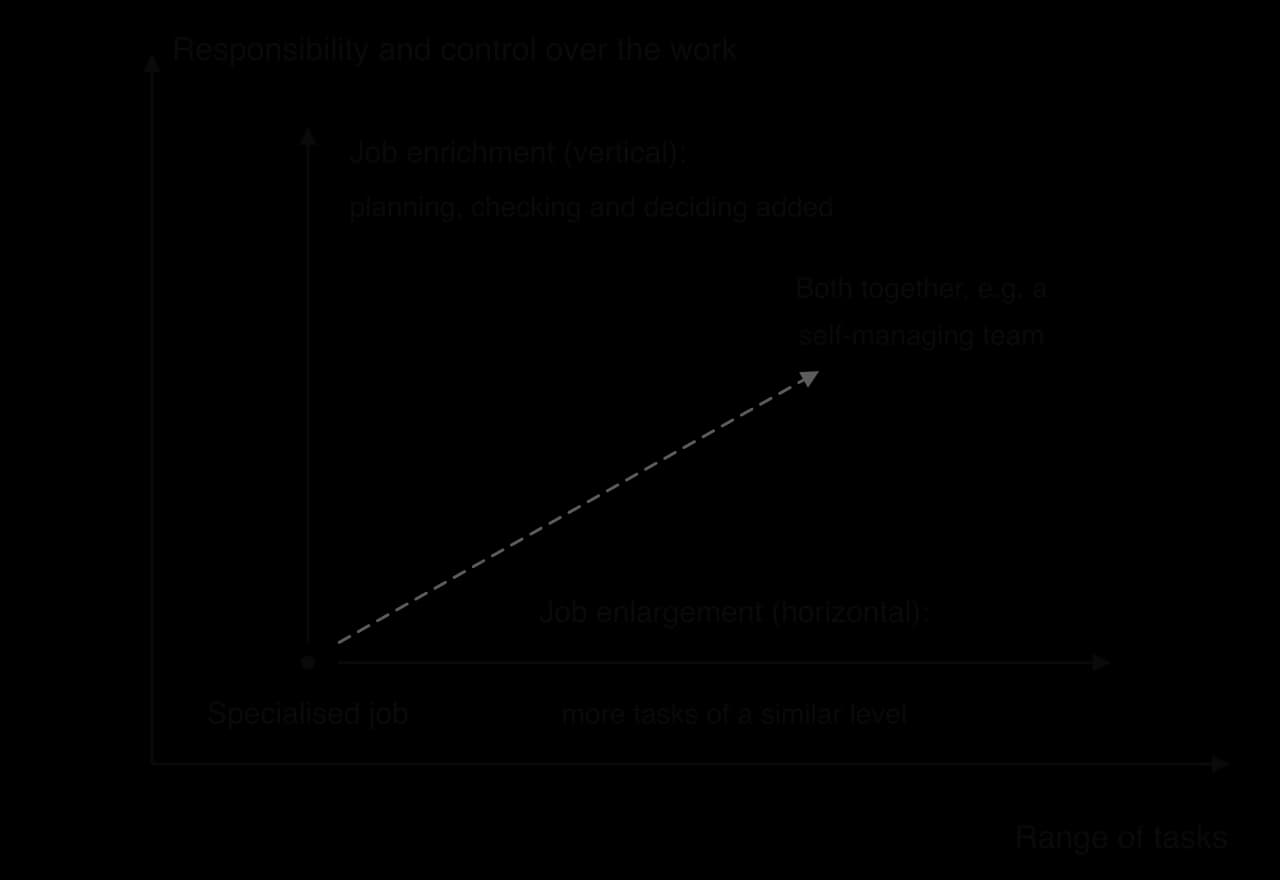
The diagram shows how the three types of job redesign differ. Enlargement moves a job along the range of tasks; enrichment moves it up the scale of responsibility; a self-managing team that builds a complete product does both. Job rotation is different again: the job itself does not change, but the employee moves between jobs.
Enrichment can raise motivation, quality and initiative, and reduce the need for supervisors. It also has costs: employees need training, some prefer simpler work, and they may expect higher pay for higher responsibility, which raises questions of fairness.
Empowerment gives employees the authority to make decisions about their own work without asking a manager first. It goes further than delegation, which passes a task to a subordinate: an empowered employee decides how to do the work and how to solve problems. Empowerment meets esteem and self-actualisation needs, provides responsibility as a motivator and supports autonomy.
The Ritz-Carlton hotel company became known for a rule that allowed every member of staff to spend up to US$2,000 per incident to resolve a guest’s problem without approval from a manager. Many problems can be solved with little or no money, so the rule matters mainly because it shows staff that they are trusted to use their judgment. Empowerment can speed up decisions and improve customer service, but it needs well-trained staff, clear limits and managers who are willing to let go of control.
Sources: Forbes coverage of Ritz-Carlton’s service policy (2009), summarised in A. Toporek, “The Ritz-Carlton’s famous $2,000 rule”, Customers That Stick.
Purpose is the sense that one’s work matters: that it helps customers, colleagues, a community or the environment. Employees who see how their work makes a difference are often more motivated than those who see only a task and a pay packet. Purpose is a strong motivator in health care, education and charities, but any business can strengthen it by showing employees the effect of their work, for example by sharing feedback from customers or linking jobs to the business’s mission and its commitment to corporate social responsibility.
Purpose links to Maslow’s self-actualisation and to Herzberg’s “work itself”. It can also attract staff who share the business’s values. Its limits are that it does not replace fair pay, that some jobs offer little obvious purpose, and that employees quickly become cynical if the stated purpose does not match the way the business behaves.
Teamwork organises employees into groups that share responsibility for a task, a product or a group of customers. Teams meet social needs, allow members to learn from each other and can give the group control over how work is shared, which combines job enlargement and enrichment. Volvo’s car plant at Kalmar in Sweden, opened in 1974, replaced the moving assembly line with about 25 production teams, each of which organised itself and set its own pace as long as it met its production goal for the shift.
Sources: “Volvo Kalmar Assembly”, Wikipedia (accessed October 2026), citing Dagens Nyheter, 1994.
Teamwork can raise motivation, quality and problem-solving, and team members can cover for each other. It can also create problems: some members may let others do the work, conflict can arise, decisions can take longer, and strong team loyalty can make the team resist outside ideas. The Kalmar plant closed in 1994, which suggests that team-based assembly is not always cheaper than a well-run line.
Financial rewards | Non-financial rewards | |
|---|---|---|
Needs met | Mainly lower-level needs; Herzberg’s hygiene factors | Mainly higher-level needs; Herzberg’s motivators |
Speed of effect | Quick and easy to understand | Slower; depend on job redesign and culture |
Cost | Direct, often large and continuing | Often lower, but training and management time are needed |
Measurement | Easy to link to measurable output | Harder to measure the effect |
Duration | Effect may fade, and staff come to expect it | Can create longer-lasting, intrinsic motivation |
Risks | Short-term focus; unethical behaviour to hit targets | Extra responsibility without extra pay may seem unfair |
Most businesses need both. Financial rewards must first be fair and sufficient, because no amount of recognition or purpose will motivate employees who cannot pay their bills or who feel underpaid compared with others. Once pay is adequate, non-financial rewards usually do more to raise effort, quality and loyalty.
The best mix depends on several factors: the type of work (routine and measurable, or creative and complex); the employees’ circumstances and values; the business’s finances and objectives; its leadership style, since empowerment fits a democratic style better than an autocratic one; and the national culture. A cash-strapped start-up may rely on purpose, autonomy and shares, while a large factory may use piece rates combined with teamwork.
Training develops the knowledge, skills and attitudes employees need to do their jobs well. It raises productivity and quality, prepares staff for new technology and change, and builds a pool of employees ready for promotion. It is also a motivator: it meets esteem and self-actualisation needs and provides Herzberg’s personal growth. Employees who are trained feel valued and are more likely to stay.
Induction training introduces new employees to the organisation. It typically covers the business’s history, objectives and culture, health and safety rules, the layout of the workplace, key policies, the employee’s role and the people they will work with. It may last a few hours or several weeks, depending on the job.
Good induction helps new staff become productive more quickly, reduces mistakes and accidents, and makes them feel welcome, which meets social needs. Many employees who leave a job do so in their first months, so effective induction can reduce labour turnover. Its costs are the time of trainers and new staff, and an induction that is too long or too general can bore new employees who want to start working.
On-the-job training takes place while the employee is doing the job, in the normal workplace. Common methods include learning by watching an experienced colleague (shadowing), coaching by a supervisor, mentoring, and job rotation. Apprenticeships combine on-the-job training with periods of study.
On-the-job training is usually cheaper, is directly relevant to the job and to the business’s own equipment and methods, and allows the employee to keep producing while learning. Its weaknesses are that the trainer may pass on bad habits, the trainer’s own work is disrupted, mistakes happen with real customers or products, and the employee learns only how the business already does things.
Off-the-job training takes place away from the employee’s normal work, either in a training centre within the business or outside it, for example at a college, a conference or through an online course. McDonald’s runs Hamburger University, a training centre founded in 1961 that trains restaurant managers, mid-level managers and franchise owners in operations, leadership and customer service. More than 275,000 people have graduated from it, and it has campuses in several countries, including Tokyo, London, Sydney and Shanghai.
Sources: “Hamburger University”, Wikipedia (accessed October 2026).
Off-the-job training can be delivered by specialists, can teach new ideas and wider skills, and allows employees to learn without the pressure of real customers. It is often more expensive, takes the employee away from work, and may be less relevant to the specific job. Employees who gain recognised qualifications may also be recruited by competitors, a risk that sometimes discourages businesses from training at all.
Induction | On-the-job | Off-the-job | |
|---|---|---|---|
Who | New employees | Any employee, at work | Any employee, away from work |
Main purpose | Settle new staff in quickly and safely | Develop practical, job-specific skills | Develop specialist, wider or new skills |
Cost | Low to medium | Usually low | Usually high |
Advantages | Faster productivity; fewer early resignations | Relevant; employee keeps working | Expert trainers; no pressure from real work |
Disadvantages | Time-consuming; can overload new staff with information | Bad habits passed on; disrupts the trainer | Lost working time; trained staff may leave |
Businesses also distinguish between cognitive training, which develops thinking skills such as problem-solving, decision-making and planning, and behavioural training, which develops how employees act and interact, such as communication, customer service, teamwork and leadership. Both can be delivered on or off the job.
Labour turnover measures the rate at which employees leave a business over a period, usually a year. A rate that is too high suggests problems with motivation, pay, management or recruitment, and it raises costs. A rate that is too low can also be a problem, because the business gains few new ideas and may find it hard to reduce its workforce when demand falls.
The average number of staff is usually found by adding the number of employees at the start of the year to the number at the end, and dividing by two. Leavers include people who resign, retire, are dismissed or are made redundant, although some businesses also calculate a separate rate for voluntary leavers only, because resignations are the clearest sign of motivation problems.
Some industries normally have much higher labour turnover than others. Jobs in hotels, restaurants and retail are often part-time, low-paid and filled by students or seasonal workers, so many staff leave each year. Public sector jobs tend to offer more security, pensions and clear career paths, so fewer staff leave.
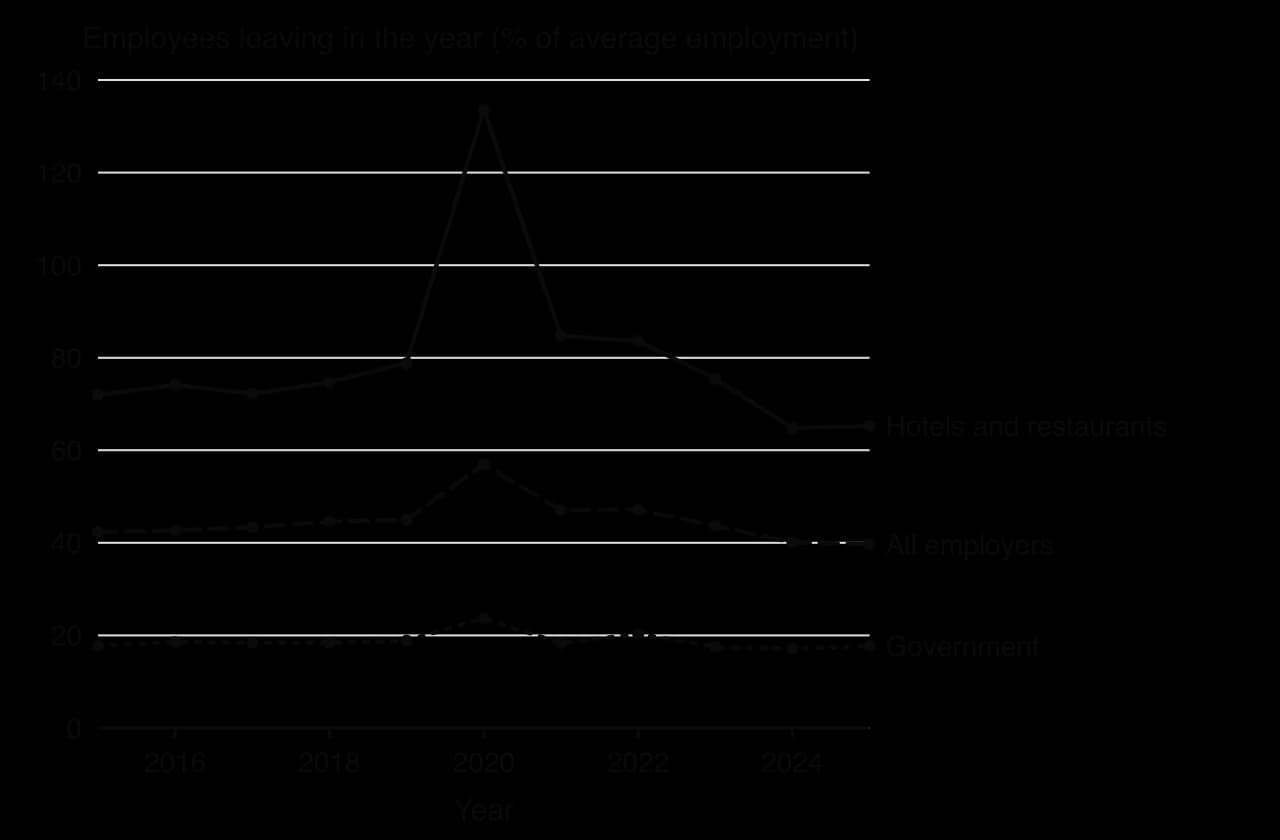
The chart shows that in 2025 employers in accommodation and food services in the United States lost staff equal to about 65% of their average workforce, compared with about 40% for all employers and 18% in government. A labour turnover of 30% would be worrying for a government department but excellent for a restaurant chain, so the rate must always be judged against the industry and the business’s own past.
Internal causes | External causes |
|---|---|
Low pay or pay seen as unfair compared with colleagues | Higher wages offered by competitors |
Poor management, leadership or working relationships | Low unemployment, so other jobs are easy to find |
Little training or few promotion prospects | Better transport or teleworking opening up jobs further away |
Boring work, heavy workloads or stress | Seasonal patterns (tourism, agriculture, retail at holidays) |
Poor recruitment that hires people unsuited to the job | Changes in the gig economy and attitudes to job-hopping |
Weak induction, so new staff leave early | Relocation of families, retirement in an ageing workforce |
Higher costs: advertising, recruitment agency fees, interviewing and induction for each replacement.
Lost productivity: vacancies are left unfilled, and new staff take time to reach full speed.
Lower quality and service: inexperienced staff make more mistakes, and customers lose familiar faces.
Lower morale: remaining staff cover vacancies and train newcomers, which adds to their workload and may lead them to leave too.
Lost knowledge: experienced staff take skills, customer relationships and ideas to competitors.
Some labour turnover has benefits. New employees bring fresh ideas and skills, the business can replace poor performers, and turnover lets a business reduce its workforce without redundancies. For businesses that rely on cheap, low-skilled labour, accepting high turnover can even be cheaper than paying higher wages, although the hidden costs of poor service are easy to underestimate.
Pay competitive wages and review pay structures for fairness (Herzberg’s hygiene factors; Adams’s equity theory).
Improve recruitment and selection, so that new staff are suited to the job, and provide a thorough induction.
Offer training and clear promotion paths (Maslow’s esteem and self-actualisation; competence in self-determination theory).
Use non-financial rewards such as job enrichment, empowerment and teamwork.
Offer flexible working, such as flexi-time, part-time or hybrid working, to help staff balance work and family.
Hold exit interviews and staff surveys to find out why people leave, and act on the findings.
Appraisal is the regular, formal review of an employee’s performance, usually by their line manager. It compares performance with agreed objectives, gives feedback, identifies training needs and sets new targets. Appraisal can also provide the evidence for performance-related pay and promotion decisions.
Feedback and recognition: employees learn what they do well and what to improve, which meets esteem needs and builds competence.
Setting objectives: individual targets are linked to the business’s objectives, which raises expectancy and focuses effort.
Identifying training needs: gaps in skills are identified and training is planned.
Rewards and promotion: appraisal results inform pay rises, bonuses and promotion decisions.
Two-way communication: employees can raise problems, ideas and career goals with their manager.
Workforce planning: the business learns which employees are ready for promotion and where skills are short.
Formative appraisal is an ongoing process of feedback during the year, designed to help the employee improve and develop. It is usually informal and frequent, such as regular conversations between employee and manager. It does not usually lead to a grade or a pay decision.
Formative appraisal allows problems to be fixed quickly and supports learning and motivation. In 2012 the software company Adobe replaced its annual performance reviews and ratings with “Check-in”, an ongoing, two-way conversation in which employees and managers discuss performance, goals and career growth during the year. Adobe said that the old system had been bureaucratic and that ranking staff for pay had left many feeling undervalued. Formative appraisal takes up managers’ time, depends heavily on their skill at giving feedback, and gives less evidence for pay decisions.
Sources: Adobe, “How Adobe continues to inspire great performance and support career growth” (adobe.com).
Summative appraisal judges an employee’s performance over a whole period, usually a year, against set criteria. It often ends with a rating or grade and is used to make decisions about pay, bonuses, promotion or, in some cases, dismissal.
Summative appraisal provides clear records, links performance to rewards and helps the business compare employees. Its weaknesses are that feedback comes too late to fix problems, the annual meeting can cause anxiety, ratings can seem unfair or be influenced by recent events or personal bias, and a low rating can demotivate.
360-degree feedback collects views on an employee’s performance from everyone who works with them: their manager, colleagues at the same level, subordinates and sometimes customers or suppliers. The responses are usually anonymous and are often collected through a questionnaire. It is common for managers, whose skills in leading and communicating are seen best by those they work with.
360-degree feedback gives a fuller and more balanced picture than one manager’s view and can show managers how their behaviour affects others. It is, however, time-consuming and costly to organise, anonymous comments can be unfair or hurtful, colleagues may agree to give each other good reviews, and the volume of feedback can be hard to act on.
Self-appraisal asks employees to assess their own performance against their objectives, often by completing a form before a meeting with their manager. The employee identifies strengths, weaknesses and training needs, and the manager then discusses the assessment with them.
Self-appraisal involves employees and gives them some control over the process, which supports autonomy and commitment to the targets that follow. It encourages reflection and is cheap to run. Its main weakness is that people may overrate or underrate themselves, so it is usually combined with another method.
Type | Who assesses | When | Main advantage | Main disadvantage |
|---|---|---|---|---|
Formative | Manager, with the employee | Throughout the year | Supports improvement as it happens | Time-consuming; less evidence for pay decisions |
Summative | Manager | End of the period | Clear basis for pay and promotion | Feedback too late; can demotivate |
360-degree feedback | Manager, colleagues, subordinates, customers | Usually yearly | Rounded, balanced picture | Costly; comments may be biased |
Self-appraisal | The employee | Before an appraisal meeting | Involves and empowers the employee | Self-assessment may be inaccurate |
The best type depends on the purpose. A business that wants to develop staff and encourage learning will favour formative appraisal and self-appraisal; one that needs evidence for pay decisions will need summative appraisal; one that wants to develop leaders may use 360-degree feedback. Many organisations combine them, for example with ongoing formative conversations and a short summative review at the end of the year.
Recruitment is the process of attracting suitable candidates to apply for a job, and selection is the process of choosing the best of them. Both follow from workforce planning, which identifies how many employees with which skills the business will need. A well-run process brings in employees who fit the job and the organisation, which reduces labour turnover and raises motivation.
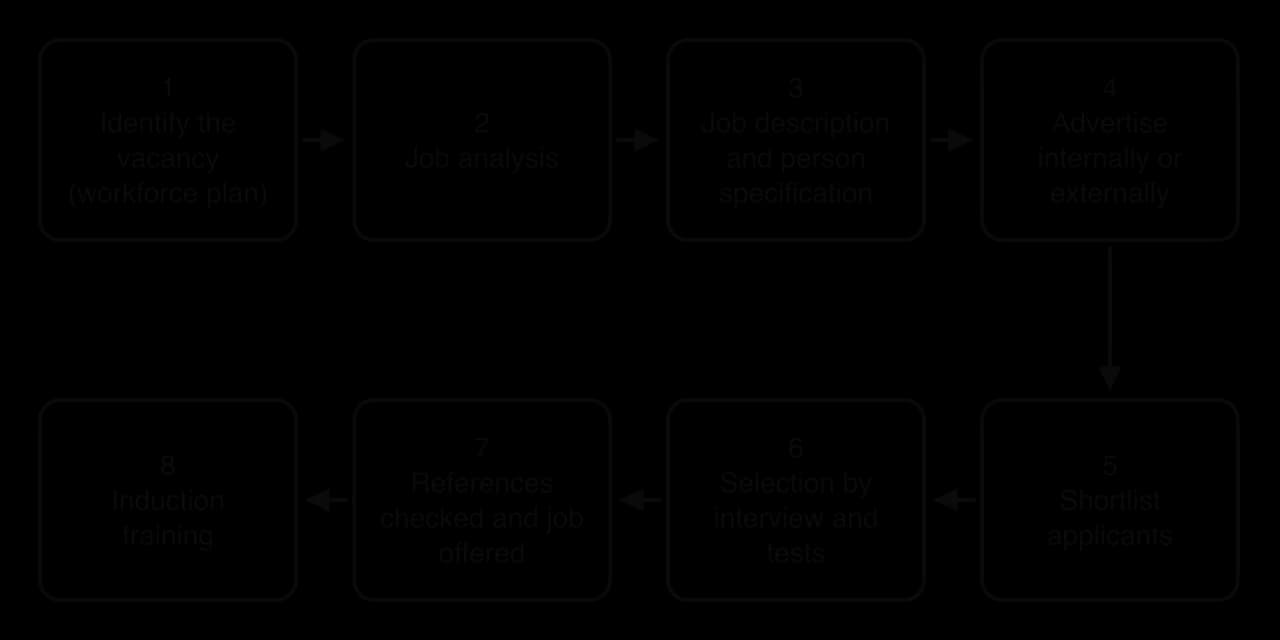
When a vacancy appears, the business first carries out a job analysis to find out what the job involves and what it takes to do it well. The analysis produces two documents. The job description describes the job; the person specification describes the ideal person to do it.
A job description usually includes the job title, the department and location, who the job holder reports to and who reports to them, the main tasks and responsibilities, and the pay and conditions. A person specification lists the qualifications, experience, skills and personal qualities required, often divided into “essential” and “desirable” criteria, so that applicants can be compared fairly.
The two documents are used throughout the process: to write the job advertisement, to shortlist applicants, to plan interview questions and, after appointment, to set objectives and appraise performance.
Method | Description | Advantages | Disadvantages |
|---|---|---|---|
Job advertisements (print, company website) | Vacancies published in newspapers, trade magazines or on the business’s own careers page | Reach a defined audience; the website is cheap | Print is costly; may attract many unsuitable applicants |
Online job platforms | Job boards and professional networks such as LinkedIn and Indeed | Wide, fast and often global reach; easy to apply | Very large numbers of applications to screen |
Recruitment agencies | Specialist firms find and screen candidates for a fee | Save time; expertise in the labour market | Fees can be a large share of the first year’s salary |
Headhunting | A specialist approaches a successful person in another business directly | Reaches top people who are not looking for a job | Very expensive; may need a high salary to tempt them |
Employee referrals | Current employees recommend people they know | Cheap; referred candidates often fit well and stay longer | Can reduce diversity and create favouritism |
Social media | Vacancies and employer brand promoted on social platforms | Cheap; reaches younger and passive candidates | Hard to target; reputation risks from public comments |
Job fairs and university visits | Employers meet potential applicants at events | Direct contact with many students or graduates | Costly in staff time; suits mainly graduate or entry roles |
Job centres and government agencies | Public employment services advertise vacancies | Free; reach unemployed workers | Mainly suit lower-skilled vacancies |
Technology has changed recruitment. Many large employers now screen applicants online. Unilever, for example, has used online games and video interviews assessed with the help of artificial intelligence to screen graduate applicants. Such methods process large numbers of applications quickly and cheaply, but they raise ethical questions about fairness and bias, and HireVue, a supplier of AI interview software, removed its facial analysis function in 2020 after criticism from researchers and candidates.
Sources: “HireVue”, Wikipedia (accessed October 2026), citing Business Insider (2017) and Wired.
After the closing date, applications are compared with the person specification. Shortlisting reduces them to a small number of candidates who best meet the essential criteria, who are then invited to the selection stage. Common selection methods include interviews (one-to-one or by a panel), aptitude, skills and psychometric tests, work samples such as a presentation or a trial shift, and assessment centres.
Interviews are cheap and allow both sides to ask questions, but interviewers can be swayed by first impressions and personal bias. Tests give more objective evidence of ability. Assessment centres are the most thorough, and the most expensive, method.
The final stages are checking references from previous employers or teachers, making a job offer and agreeing a contract of employment. Induction training then helps the new employee settle in.
A business can fill a vacancy with someone who already works for it or with someone from outside. Internal recruitment fills the job through promotion or by moving an employee to a new role, often after advertising on the intranet or noticeboards. External recruitment looks outside the organisation, using methods such as advertisements, online platforms, agencies and headhunting.
Mary Barra shows how far internal recruitment can go. She joined General Motors in 1980, aged 18, as a student on a work-and-study programme, and held a series of engineering and management roles before becoming chief executive in January 2014. She was the first woman to lead one of the three large US car makers.
Sources: “Mary Barra”, Wikipedia (accessed October 2026).
Internal recruitment | External recruitment | |
|---|---|---|
Cost and speed | Usually cheaper and faster: little advertising, shorter induction | More expensive and slower: advertising, agency fees, full induction |
Knowledge of the candidate | Managers already know the candidate’s performance and attitude, so the risk of a poor choice is lower | Candidates are less known, so selection carries more risk |
Motivation | Shows that promotion is possible, which motivates other staff (esteem; expectancy) | Existing staff passed over for the job may be demotivated |
Ideas and skills | No new ideas or experience from outside; may reinforce the existing culture | Brings new skills, ideas and experience from other organisations |
Pool of candidates | Limited to existing employees | A much wider pool, so the best candidate is more likely to be found |
Knock-on effects | Creates another vacancy that must also be filled | No knock-on vacancy |
Settling in | Candidate already knows the culture, systems and people | Needs time to learn the culture and build relationships |
Internal recruitment is generally the better choice when the business has capable staff ready for promotion, when knowledge of its products, customers and culture matters, when it wants to show staff that loyalty is rewarded, and when time and money are short. It supports motivation and retention, and it reduces the risk of a poor appointment.
External recruitment is generally the better choice when the business needs skills or experience it does not have, such as expertise in a new technology or a new market; when it is in crisis or needs a change of direction and wants a leader with fresh ideas; when it is growing quickly and needs more people than it can promote; and when it wants a more diverse workforce. Many organisations advertise internally and externally at the same time, so that existing staff can compete with outside candidates on equal terms.
The decision therefore depends on the job (routine or senior, specialist or general), the skills available inside the business, the need for change, the cost and time available, the state of the labour market and the business’s culture. A business that always recruits internally risks becoming inward-looking; one that always recruits externally risks demotivating staff who see no route to promotion.
Key concept | How it applies to motivation |
|---|---|
Change | Restructuring, new technology and new working patterns such as hybrid work change what motivates employees. Employees who are trained, consulted and empowered are more likely to accept change. |
Creativity | Intrinsic motivation, autonomy and empowerment encourage new ideas. Controlling rewards and narrow, Taylor-style jobs tend to discourage creativity. |
Ethics | Incentives can encourage unethical behaviour, as at Wells Fargo. Fair pay, honest appraisal, unbiased recruitment and the ethics of monitoring employees are all ethical questions for HR. |
Sustainability | Socially sustainable businesses look after employees’ well-being, training and job security, which reduces labour turnover and keeps skills in the business for the long term. |
Gravity Payments is a privately owned credit-card payment processing company based in Seattle, United States, founded in 2004 by brothers Dan and Lucas Price. On 13 April 2015, Dan Price, the chief executive, told the company’s 120 employees that over the next three years he would raise every employee’s salary to at least US$70,000 a year. To help pay for the rises, he immediately cut his own salary from US$1.1 million to US$70,000.
The decision was a large financial reward by any measure. About a third of the workforce had their salaries doubled. Price said he had been influenced by research on how income affects well-being, and by a friend who was struggling to pay rising rent in Seattle on a salary of about US$40,000. To fund the change, he sold shares, emptied his retirement accounts and mortgaged his two homes, putting about US$3 million into the business.
The announcement brought huge publicity. Gravity received 4,500 job applications in the first week, and new customer enquiries rose from about 30 a month to 2,000 within two weeks. There was also criticism: some customers objected to what they saw as a political statement, and two senior employees resigned because they felt that the pay of junior staff had risen too far, too fast. Shortly after the announcement, Lucas Price, who owned 30% of the company, sued his brother, claiming that Dan had paid himself excessive compensation; Dan Price won the case in 2016.
Measure | Before the change | After the change |
|---|---|---|
Number of employees | 120 (April 2015) | About 240 (August 2022) |
Value of payments processed in a year | US$3.8 billion | US$10.2 billion (2020) |
Customer retention | 91% (three-year average to 2015) | 95% (second quarter of 2015) |
Employees who had bought a home | Less than 1% | More than 10% (2020) |
Babies born to employees | 0–2 a year | More than 40 in about four and a half years |
Minimum salary | US$70,000 target, phased in over three years | US$80,000 (2022) |
Sources: Inc. magazine, P. Keegan, “Here’s What Really Happened at That Company That Set a $70,000 Minimum Wage”, 21 October 2015; BBC News, S. Hegarty, “The boss who put everyone on 70K”, 28 February 2020; GeekWire, T. Soper, 17 August 2022. Most post-2015 figures were reported by the company.
Five years after the announcement, the company reported that headcount had doubled and that the value of payments it processed had risen from US$3.8 billion to US$10.2 billion a year. Price also reported that employees’ voluntary contributions to their pension funds had more than doubled and that 70% of employees said they had paid off debt. By 2022 the minimum salary had risen to US$80,000, and the company reported record revenue in 2021.
 YouTube
Maslow’s hierarchy helps explain the reported changes in employees’ lives. Many junior staff had been struggling to meet physiological and safety needs in one of the most expensive cities in the United States. The higher salary allowed them to move closer to work, buy homes, pay off debt and start families, so their attention could move to higher needs. Rosita Barlow, the company’s director of sales, said that once money was no longer at the front of employees’ minds, they could be more passionate about what motivated them, which is close to Maslow’s idea of moving up the hierarchy.
Herzberg’s theory gives a more cautious reading. Pay is a hygiene factor, so the rise should have removed dissatisfaction rather than created motivation. Price’s own explanation fits this view: he said that higher salaries did not change staff motivation, because they were already motivated, but increased what he called their “capability” by removing financial stress. On this reading, the pay rise worked by removing a serious hygiene problem, and the existing motivators, such as interesting work and a sense of purpose, did the rest.
Taylor’s theory fits the case least well. The rise was not linked to output: every employee received at least the same minimum regardless of individual performance. Gravity’s results therefore came from a fixed salary that did not depend on output. The case shows that pay can affect performance in ways that have nothing to do with piece rates, by improving security, health and loyalty, which reduces labour turnover and the costs that come with it.
The two senior employees who resigned compared their ratio of outputs to inputs with that of junior colleagues. Their own pay had not changed, but junior staff with fewer skills and less experience now earned similar amounts. Their ratio of outputs to inputs had therefore fallen relative to their referents, so they felt under-rewarded and acted to restore equity by leaving. A pay rise for one group can demotivate another group whose pay stays the same, because employees judge fairness by comparison.
The case needs careful interpretation. Gravity is a small, privately owned company, so it does not publish audited accounts, and most of the figures after 2015 come from the company or from Dan Price himself. The publicity brought in many new customers and applicants, so part of the growth may have come from free marketing rather than from motivation. The payment processing industry also grew quickly in this period, and Gravity could afford the rises partly because Price cut his own very high salary, an option few businesses have.
The business also faced later difficulties. In 2020, when card payments fell sharply during the pandemic, employees took temporary pay cuts to avoid lay-offs. The company said staff had proposed the cuts, although some employees told a newspaper that the choice was a pay cut or lay-offs; by August 2020 salaries had been restored and the lost pay repaid.
In August 2022 Dan Price resigned as chief executive while facing criminal charges, which he denied; he was replaced by Tammi Kroll, who had joined the company in 2015 after leaving a senior job at Yahoo. The pay policy continued under new leadership, which suggests that it had become part of the business’s identity rather than depending on one person.
Sources: Inc. magazine, 21 October 2015; BBC News, 28 February 2020; GeekWire, 17 August 2022; “Gravity Payments”, Wikipedia (accessed October 2026), citing The Seattle Times (2020), for the 2020 pay cuts.
Explain, using Maslow’s hierarchy of needs, why the pay rise may have had a larger effect on junior employees than on senior ones.
Using Herzberg’s two-factor theory, analyse whether the US$70,000 minimum salary was a motivator or a hygiene factor for Gravity’s employees.
Examine the extent to which other businesses could achieve similar results by raising their minimum pay.
Questions on motivation appear on Paper 1 and Paper 2 at SL and HL, mainly as short “define” and “explain” questions and through Section B extended responses that ask you to evaluate rewards or theories in a case. HL students may also be asked to calculate labour turnover on Paper 2, to discuss recruitment or appraisal, or to consider how a social enterprise motivates its staff and volunteers on Paper 3.
Definitions earn full marks only when they are precise: for hygiene factors, both the examples and the effect (preventing dissatisfaction but not motivating) are needed.
Each point in an “explain” answer needs a reward that is identified and then developed with the case: here, the boredom on the line and the experienced bakers who left.
Paper 3 is set in a social enterprise, so motivation questions there focus on staff and volunteers who are not mainly driven by pay. Use the resource materials to identify what each group needs.
Motivation is the drive that determines how hard and how well employees work; demotivation lowers productivity, quality and attendance and raises labour turnover.
Taylor saw workers as motivated by money and used time and motion study and piece rates; his methods raise output on routine tasks but ignore non-financial needs.
Maslow’s hierarchy has five levels of need, and Herzberg separated hygiene factors, which prevent dissatisfaction, from motivators, which create satisfaction.
HL: McClelland stresses individual differences in three needs; Deci and Ryan show that autonomy, competence and relatedness build intrinsic motivation; Adams shows that fairness is judged by comparison; Vroom shows that motivation = expectancy × instrumentality × valence.
Financial rewards (salary, wages, commission, PRP, profit-related pay, share ownership, fringe payments) meet lower-level needs; non-financial rewards (job enrichment, rotation, enlargement, empowerment, purpose, teamwork) meet higher-level needs.
Induction, on-the-job and off-the-job training raise skills and motivation, at different costs.
HL: labour turnover = number of staff leaving in a year ÷ average number of staff × 100, and must be compared with the industry and past years.
HL: appraisal can be formative, summative, 360-degree or self-appraisal, and internal recruitment is cheaper and motivating while external recruitment brings new skills and ideas.
I can define motivation, demotivation, intrinsic motivation and extrinsic motivation.
I can explain the causes and effects of demotivation.
I can explain and evaluate Taylor’s, Maslow’s and Herzberg’s theories, and draw Maslow’s hierarchy and Herzberg’s two factors.
I can evaluate McClelland’s, Deci and Ryan’s, Adams’s and Vroom’s theories (HL).
I can calculate pay under time rates, piece rates and commission.
I can explain how each financial and non-financial reward motivates and link it to a theory.
I can explain induction, on-the-job and off-the-job training, with their advantages and disadvantages.
I can calculate and comment on labour turnover (HL).
I can explain the types of appraisal and the methods of recruitment (HL).
I can evaluate internal and external recruitment for a given vacancy (HL).
Candidates are not expected to word their definition exactly as above.
Explain two features of Taylor’s scientific management that are evident at MC (paragraph 2).
4 marks
Features evident at MC include:
Payment by results / economic man: Taylor assumed workers are motivated mainly by money; Peter believes “riders are motivated by money” and pays KES 85 per parcel.
Finding “the one best way”: Taylor used time-and-motion study to find the most efficient method; MC’s software calculates the fastest route and riders must follow it exactly.
Close supervision and control: Taylor recommended close monitoring of workers; GPS trackers record any stop longer than four minutes.
Separation of planning from doing: managers (and software) plan the work; riders simply carry it out.
Accept any other relevant feature applied to MC.
Mark as 2 + 2: award [1] for identifying a feature of Taylor’s approach and [1] for explaining how it is evident at MC.
Award a maximum of [2] for a theoretical answer with no reference to MC.
Explain two problems that MC’s piece-rate system may have caused (paragraph 3).
4 marks
Problems include:
Quality has been sacrificed for quantity: riders are paid per parcel, not for care, so complaints about damaged parcels doubled even though deliveries per rider rose 11 %.
Health and safety risks: riders rush to complete more deliveries; two were injured after riding through red lights, which may lead to legal costs and the loss of staff.
Poor customer service: rushing leads to rude behaviour, which damages MC’s relationship with the online retailers it serves.
Damage to reputation / ethics: the newspaper article “Racing for shillings” may harm MC’s image with retailers, customers and potential recruits.
Insecurity of income: with no basic wage and riders paying for fuel, pay is unpredictable, so security needs are unmet, which may raise stress and staff turnover.
Accept any other relevant problem.
Mark as 2 + 2: award [1] for identifying a problem and [1] for explaining it with reference to MC.
Using motivation theories, discuss whether MC should replace the piece rate with a time rate and a quality bonus (paragraph 4).
10 marks
Arguments for the change:
Maslow: a guaranteed KES 450 per shift meets riders’ physiological and safety needs; at present income is uncertain and riders pay their own fuel, so security needs are unmet.
Herzberg: pay is a hygiene factor; a fair, stable wage may remove dissatisfaction, while a bonus linked to no complaints could act as recognition (a motivator) for good work.
The bonus rewards quality rather than speed, addressing the doubling of complaints and damaged parcels.
Safety: riders no longer have an incentive to ride through red lights; fewer accidents means fewer injuries, lost riders and legal risks.
Ethics and reputation: responding to “Racing for shillings” may protect MC’s relationships with online retailers, who may not want their brand associated with unsafe delivery.
Arguments against the change:
Taylor: if riders are motivated mainly by money, removing the link between pay and output may reduce the number of parcels delivered, as Peter warns; the 11 % productivity gain could be lost.
Labour costs per parcel may rise; MC competes on having the lowest prices in Nairobi, so its competitive advantage could be weakened if prices rise.
A time rate needs more supervision of effort; the existing GPS tracking may make riders feel controlled rather than trusted, limiting any motivational gain.
Some fast, high-earning riders may earn less and leave.
A monthly bonus may be too far in the future to influence daily behaviour; complaints may also be outside a rider’s control (for example, poor packaging by the retailer).
Possible conclusion: MC could adopt the change, perhaps with a smaller time rate plus a reduced piece rate, so that both quantity and quality are rewarded; or pilot it with some riders first. Any well-supported judgement can achieve full marks.
Limitations of the case: no data on the cost of the change, on how much riders currently earn per shift, or on how many parcels a rider delivers in four hours.
Marks should be allocated according to the markbands.
Additional guidance: a one-sided answer is unlikely to exceed [5]. If no motivation theory is used, award a maximum of [4]. An answer without a conclusion is unlikely to exceed [6].
Markbands (10-mark extended response, Papers 1 and 2)
Marks | Level descriptor |
|---|---|
0 | The response does not reach the standard described below. |
1–2 | Little understanding of what the question demands. Business management tools and theories are barely used, or are irrelevant or inaccurate. Little or no reference to the stimulus material. No arguments are made. |
3–4 | Some understanding of what the question demands. Some use of tools and theories, but mostly inaccurate or not relevant. Use of the stimulus is superficial, often no more than the name of the organisation or person. Arguments are mostly unsubstantiated. |
5–6 | Understands what the question demands but addresses it only partially. Some relevant, accurate use of tools and theories. Some relevant use of the stimulus beyond names, but it does not effectively support the argument. Arguments are substantiated but mostly one-sided. |
7–8 | Mostly addresses what the question demands. Mostly relevant, accurate use of tools and theories. The stimulus generally supports the argument, with some lapses in clarity or relevance. Arguments are substantiated and show some balance. |
9–10 | Clear focus on what the question demands. Relevant, accurate use of tools and theories. Relevant stimulus material is integrated effectively to support the argument. Arguments are substantiated and balanced, and the limitations of the case or stimulus material are explained. |
A response with no judgement or conclusion is unlikely to reach the top band of a discuss, evaluate, examine or recommend question.
Pinheiro Dental
[1] Pinheiro Dental (PD) is a partnership of three dentists, Ana, Rafael and Beatriz Pinheiro, that runs four clinics in Belo Horizonte, Brazil. PD employs 12 dental hygienists, 18 dental assistants and 9 receptionists. Most staff are paid a monthly salary that is 5 % above the average for the city.
[2] A staff survey in 2025 showed that morale was low. Hygienists said that they had no say in how appointments were scheduled, that their skills in preventive care were not used, and that “the dentists only notice us when something goes wrong”. Receptionists complained about an old booking system that regularly crashed, and assistants complained that two clinics had no staff room.
[3] Rafael wants to give every employee a 10 % pay rise, costing BRL 480 000 a year. He argues that “people work for money”. Beatriz disagrees. She proposes to spend part of the money on a new booking system and staff rooms, and to enrich the hygienists’ jobs: each hygienist would run their own preventive-care clinic for patients one day a week and present their results at a monthly partners’ meeting.
[4] The partners must decide before PD opens a fifth clinic next year, when it will need to recruit eight more staff in a competitive labour market.
Define the term job enrichment.
2 marks
Using Herzberg’s motivation–hygiene theory, explain two reasons for the low morale at PD (paragraph 2).
4 marks
Using Herzberg’s motivation–hygiene theory and one other motivation theory, discuss Rafael’s and Beatriz’s proposals for improving motivation at PD.
10 marks
Rangimarie Hot Pools
[1] Rangimarie Hot Pools (RHP) is a geothermal spa and wellness centre near Rotorua, New Zealand. It is owned by a Māori land trust and employs 65 permanent staff, rising to 110 in the summer season. Seasonal staff are mostly students and backpackers on short contracts.
[2] General manager Mere Tipene has noticed that seasonal staff rarely stay for the full season. Exit comments include: “I never knew how many shifts I would get next week”, “permanent staff had their own group and we were left out”, and “I spent three months handing out towels”.
[3] Mere has proposed three changes for next season. First, every seasonal employee will be guaranteed at least 30 hours a week. Second, seasonal and permanent staff will work in mixed teams, each with a team leader. Third, seasonal staff will rotate every two weeks between reception, the towel desk, the café and guiding guests through the pools. RHP also plans to offer all staff fringe payments, including free use of the pools and a 30 % discount on spa treatments for family members.
Define the term fringe payments.
2 marks
Using Maslow’s hierarchy of needs, explain how two of Mere’s proposals could improve the motivation of seasonal staff (paragraph 3).
6 marks
Explain one advantage and one disadvantage for RHP of rotating seasonal staff between jobs.
4 marks