Notes on 2.1 Introduction to human resource management
Learning objectives
Define human resource management (HRM) and workforce planning.
Explain the role of HRM at each stage of the human resource cycle, from recruitment to dismissal and redundancy.
Distinguish between full-time, part-time, temporary and zero-hours contracts of employment.
Explain the internal factors that influence human resource planning.
Explain the external factors that influence human resource planning, including demographic change, labour mobility, immigration, flexible working and the gig economy.
Explain the reasons why employees resist change in the workplace.
Evaluate HR strategies for reducing the impact of change and resistance to change.
Recommend a suitable approach to managing change for a given business.
Introduction
Every business depends on people: the staff who make its products, serve its customers and take its decisions. Human resource management (HRM) is the business function that plans, finds, develops and looks after those people, so that the organisation has the right workforce to meet its objectives at a cost it can afford.
Employees carry out organisational change, and their response to it often decides whether it succeeds. HR decisions raise questions of ethics (how fairly workers are hired, treated and dismissed), depend on creativity (new ways of working, such as hybrid work), and affect social sustainability, because secure, fairly paid work supports families and communities over the long term.
What human resource management is
Human resources are the people who work for an organisation, together with their skills, knowledge and experience. In many businesses they are also one of the largest costs: wages, salaries, pensions and training often make up a large share of total costs, especially in tertiary sector businesses such as hospitals, schools, banks and restaurants.
HRM is one of the four business functions, alongside finance, marketing and operations. It supports the other three. Marketing cannot launch a product without trained sales staff, operations cannot raise output without enough skilled workers, and finance needs HR to forecast the wage bill accurately.
Why HRM matters for productivity and costs
Good HRM raises productivity, the output produced per worker or per hour. Workers who are well selected, well trained and well motivated make fewer mistakes, need less supervision and work faster. Poor HRM has the opposite effect: a business that recruits the wrong people or fails to keep good ones loses output while vacancies are open, pays again to recruit and train replacements, and may suffer lower quality and weaker customer service.
HRM also controls costs directly. Workforce planning stops a business paying for staff it does not need, while flexible contracts allow it to match staff numbers to demand. Avoiding legal disputes over unfair treatment saves compensation payments and protects the firm's reputation as an employer, which in turn makes recruitment easier and cheaper.
Role of HRM | What HR managers do | Effect on the business |
|---|---|---|
Planning | Forecast how many workers with which skills are needed, when and where | Avoids shortages that halt production and surpluses that waste money |
Recruitment and selection | Attract applicants and choose the most suitable | Better-quality staff, lower labour turnover |
Training and development | Build skills through induction and ongoing training | Higher productivity and quality; staff ready for promotion |
Appraisal and reward | Review performance; set pay and benefits | Motivation, retention and fair treatment |
Employee relations and welfare | Handle grievances, health and safety, consultation | Fewer disputes and absences; legal compliance |
Release | Manage dismissal, redundancy and retirement fairly | Lower legal risk; protects morale of remaining staff |
The table shows that HRM touches every stage of an employee's working life. The common thread is the match between the workforce and the needs of the business, in numbers, skills and attitudes.
Workforce planning
A business cannot hire skilled staff overnight. An airline that wants more pilots or a hospital that wants more specialist nurses may need months or years to find and train them. Workforce planning (also called human resource planning) is the process of forecasting the people a business will need and planning how to provide them.
Workforce planning starts from the objectives and strategy of the business. A plan to open ten new stores, to automate a factory or to enter a foreign market changes the number and type of workers needed. HR managers then compare the forecast demand for labour with the forecast supply.
Labour demand: how many workers are needed, with which skills and qualifications, at what times of the year and in which locations. It depends on forecast sales, planned growth, new technology and productivity.
Internal labour supply: the current workforce, adjusted for expected leavers (resignations, retirements, dismissals), promotions and transfers. The rate of labour turnover is a key input.
External labour supply: the workers available in the labour market, which depends on unemployment, education and training in the economy, migration and the wages offered by competitors.
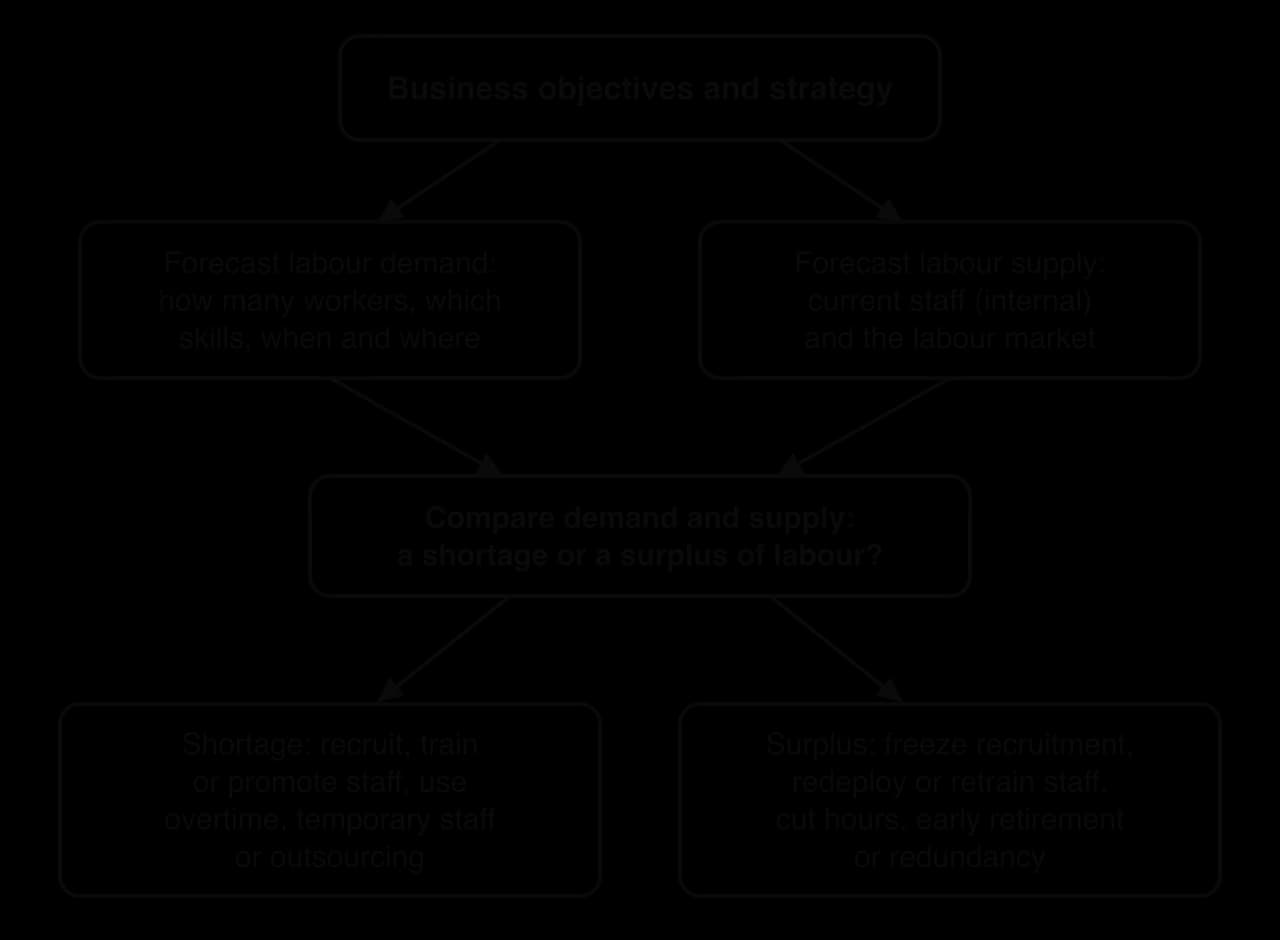
The flow chart shows that the comparison leads to one of two problems. A shortage of labour is closed by recruiting, training or promoting staff, by using overtime or temporary workers, or by outsourcing work to another firm. A surplus is closed by freezing recruitment, redeploying or retraining staff, offering early retirement or, as a last resort, making workers redundant.
The human resource cycle
The stages of HRM follow an employee from the moment a vacancy is identified to the day the employee leaves. Each departure feeds back into workforce planning, so the stages form a cycle.
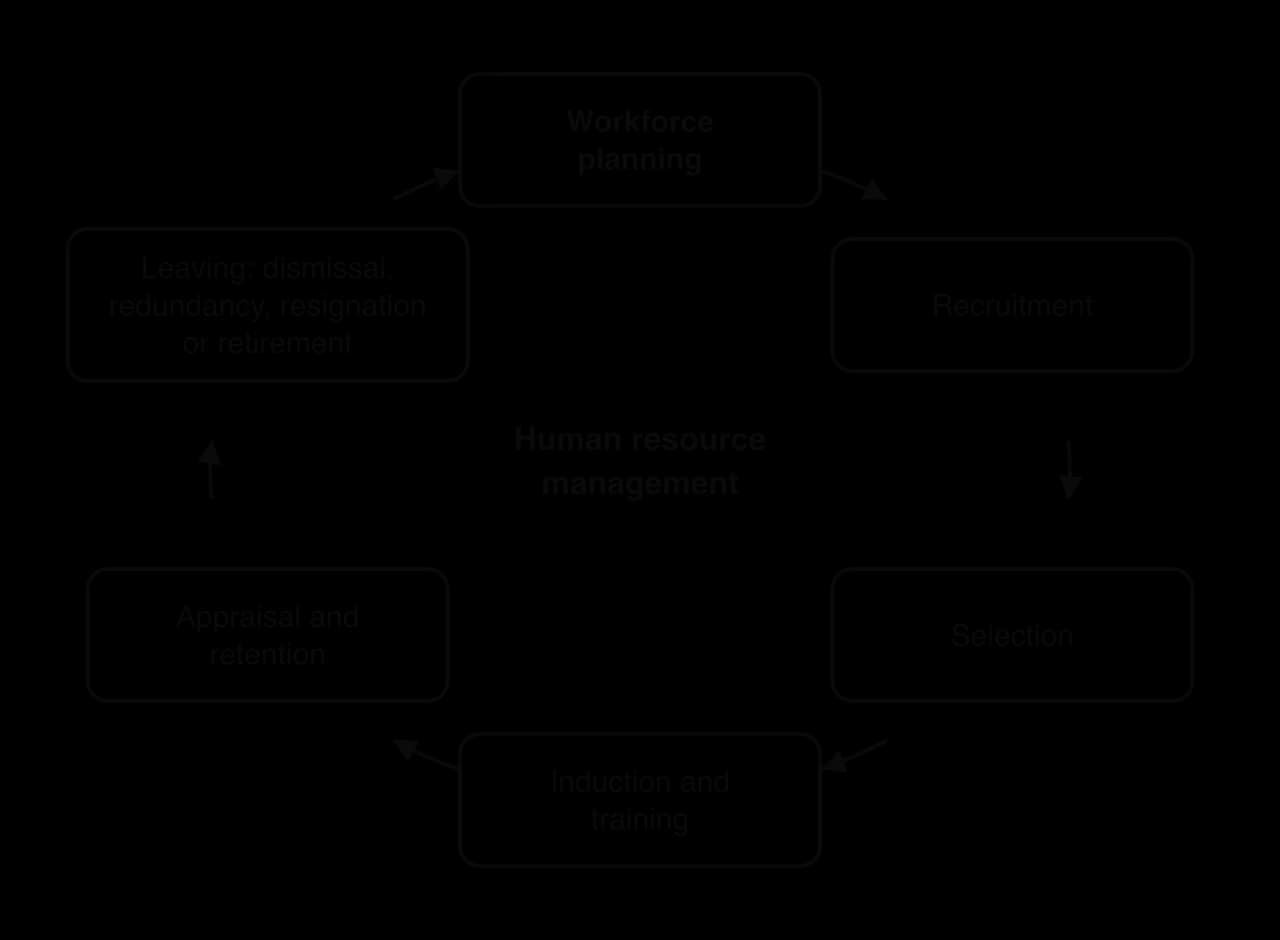
The cycle shows why HR decisions are linked. A poor selection decision leads to more training costs, weaker appraisals and an early departure, which restarts the cycle at extra cost. A strong induction and fair appraisal make it more likely that good employees stay, which reduces the need to recruit.
Recruitment and selection
Recruitment is the process of identifying a vacancy and attracting suitable applicants for it. A business first decides what the job involves and what kind of person it needs, then advertises the job, either to existing employees (internal recruitment) or to people outside the business (external recruitment).
Selection follows recruitment. Managers compare the applicants against the requirements of the job, using application forms, interviews, tests and references, and choose the person most likely to perform well and stay. Recruitment widens the pool of candidates; selection narrows it to one.
Both stages are expensive, so mistakes are costly. Many employers now use online application systems and automated screening to handle large numbers of applicants. This saves time but raises ethical questions if software filters out good candidates unfairly, for example by penalising gaps in employment caused by illness or caring duties.
Induction, training and appraisal
New employees go through induction training, which introduces them to the business, its rules, its culture and their colleagues. Later, training develops their skills, either on the job or away from it, and appraisal reviews their performance against agreed targets. These stages are developed in detail with motivation, because they shape how committed employees feel as well as what they can do.
Retention
Every employee who leaves takes skills and experience away and creates a new vacancy to fill. Retention is the ability of a business to keep its employees. Businesses improve retention with competitive pay, training and promotion opportunities, flexible working, good management and a positive working culture.
Retention matters most for skilled staff who are hard to replace, such as software engineers or specialist nurses. Some labour turnover is healthy, because new staff bring new ideas, but high turnover raises recruitment and training costs and damages service quality.
Dismissal and redundancy
Employees leave by resigning, by retiring, or because the employer ends the contract. The employer can end a contract in two very different ways, and the difference matters legally and ethically.
Dismissal happens when an employer ends an employee's contract because of the employee: poor performance after warnings, serious misconduct such as theft or violence, or a breach of the contract. Most countries require a fair reason and a fair procedure. A dismissal without one is an unfair dismissal, and the employee can claim compensation or reinstatement at an employment tribunal or labour court.
Redundancy happens when the job itself is no longer needed. A factory closes, a branch merges with another, or a machine or software takes over a task. The employee has done nothing wrong, so redundant workers are usually entitled to notice and to redundancy pay based on their length of service.
Dismissal | Redundancy | |
|---|---|---|
Reason | The employee's misconduct, poor performance or breach of contract | The job is no longer needed (closure, restructuring, automation, falling demand) |
Employee at fault? | Usually yes | No |
Compensation | None if fair; compensation if the dismissal is unfair | Redundancy pay, often based on length of service |
Can the job be refilled? | Yes, by a new employee | Not normally, because the job no longer exists |
Main HR task | Follow a fair procedure: warnings, records, a hearing | Consult staff, select fairly, offer redeployment, support those who leave |
Redundancy programmes are among the most difficult tasks in HRM. The way a business treats those who leave shapes the morale of those who stay. Consultation, fair selection criteria, help with finding new jobs (outplacement) and generous terms reduce the damage, though they add to the short-term cost.
Contracts of employment
Every employee has a contract of employment, a legal agreement that sets out the rights and duties of both sides. It usually states the job title, the hours, the pay, holidays, notice periods and the place of work. The type of contract determines how flexible the arrangement is for the employer and how secure it is for the worker.
Full-time employment is the traditional arrangement: a permanent contract for a full working week, typically 35–40 hours. Part-time employment covers fewer hours, such as school hours or weekends. A temporary contract lasts for a fixed period or until a task is finished, such as a summer job or cover for maternity leave. A zero-hours contract guarantees no hours at all: the employer offers work when it is needed and the worker is paid only for the hours worked.
Contract | Advantages for the employer | Disadvantages for the employer | Effect on the worker |
|---|---|---|---|
Full-time, permanent | Commitment and loyalty; time to build skills; easier to plan | Highest fixed labour cost; hard to reduce hours when demand falls | Security and benefits; less flexibility |
Part-time | Covers peak times (lunch, weekends); access to parents, students and older workers | More staff to train and manage; harder communication | Fits around other commitments; lower income and sometimes fewer promotions |
Temporary or fixed-term | Covers seasonal peaks, projects or absences; no long-term commitment | Less loyalty; training is lost when the contract ends | Experience and income, but little security |
Zero-hours | Labour cost varies exactly with demand | Workers may refuse shifts or leave; low commitment; reputational risk | Flexibility for some; uncertain income for many |
The table shows a trade-off between flexibility for the employer and security for the worker. Flexible contracts turn labour into something closer to a variable cost, which protects the business when demand is uncertain. The cost is lower commitment, higher labour turnover and, in some cases, criticism that the business shifts its risk onto low-paid workers, an ethical issue that has led some governments to restrict zero-hours work.
Internal factors that influence human resource planning
Internal factors arise inside the business, so managers can influence them directly. They change the number of workers needed, the skills required and the way staff are organised.
Internal factor | How it influences the HR plan | Short example |
|---|---|---|
Business objectives and strategy | Growth needs more staff; cost-cutting needs fewer; a new market needs new skills such as languages | A retailer that moves online needs fewer cashiers and more warehouse and IT staff |
Finance available | The budget limits how many staff can be hired, what they are paid and how much is spent on training | A start-up may use freelancers until its funding allows permanent hires |
Organisational structure | A flatter structure needs fewer middle managers but more staff able to take decisions | Delayering creates redundancies and new training needs |
Labour turnover | High turnover raises the number of recruits needed each year | Fast-food chains plan constant recruitment because many staff leave within a year |
Technology adopted | Automation replaces some jobs and creates others that need new skills | Self-service tills reduce cashier roles and add technician and support roles |
Employee motivation and culture | Motivated staff stay longer and need less supervision; a culture that values flexibility shapes contracts and working patterns | A firm known for training and promotion from within needs fewer external recruits |
Internal factors interact. A decision to automate (technology) is often driven by the objective of cutting costs, it may be limited by the finance available, and its success depends on whether the remaining workforce accepts the change. For this reason HR managers take part in strategic planning from the start rather than reacting once decisions have been made.
External factors that influence human resource planning
External factors arise outside the business. Managers cannot control them, but they can forecast them and plan for them. The most important ones are changes in the population, in how easily workers move, in the law, in working patterns and in technology.
Demographic change
Demographic change is a change in the size or structure of a population: its age profile, birth rate, life expectancy, gender balance or ethnic mix. The most important demographic trend for many employers is the ageing of the population, caused by falling birth rates and longer lives.
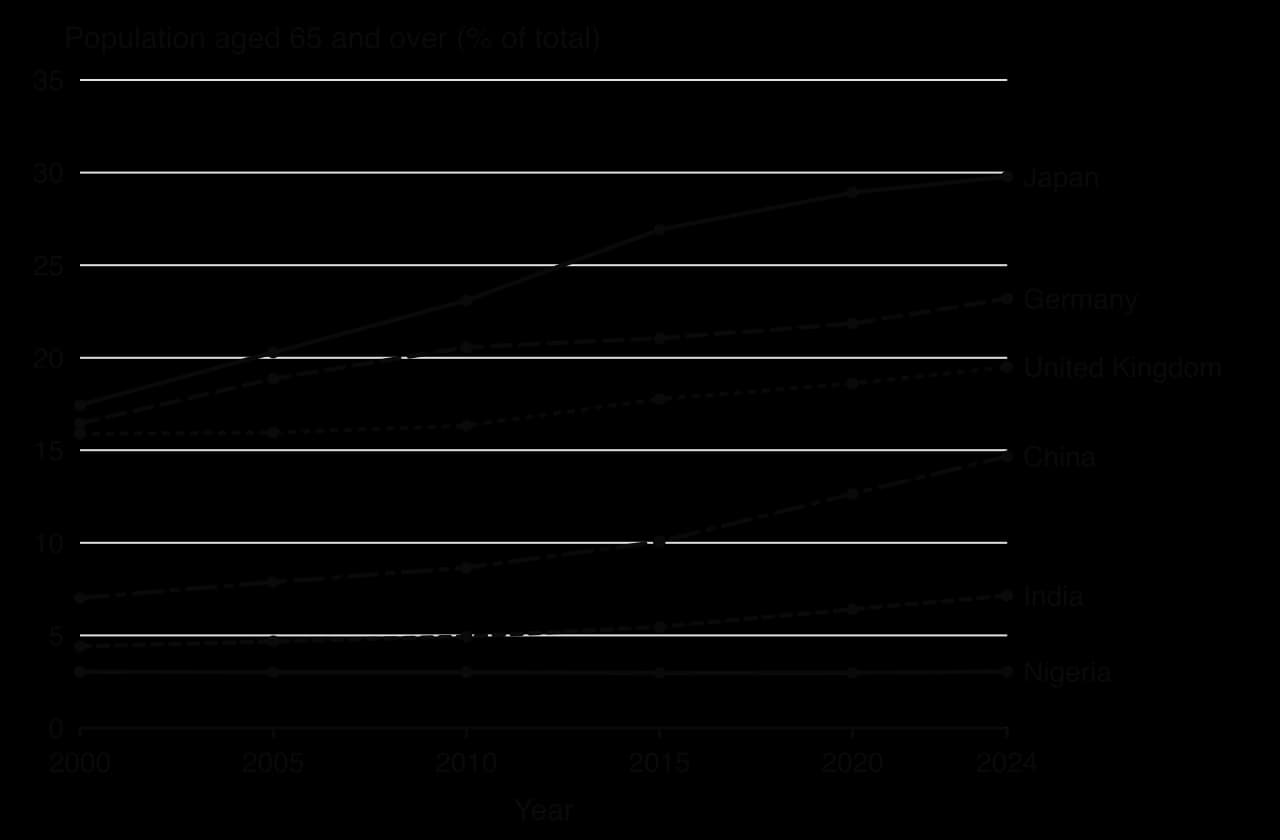
The chart shows that almost 30% of Japan's population was aged 65 or over in 2024, against about 3% in Nigeria. In ageing countries, fewer young people enter the labour market each year and more workers retire, so employers face shortages, especially of skilled staff. HR plans respond by recruiting older workers, delaying retirement, offering flexible hours that suit older employees and carers, automating tasks, and recruiting from abroad.
An ageing population also changes demand. Health care, social care and leisure for older customers grow, so businesses in those sectors need more staff at the same time as the supply of young workers shrinks. In countries with young, fast-growing populations the challenge is the reverse: creating enough jobs and training young people quickly enough to fill skilled roles.
Labour mobility
Labour mobility is the ease with which workers move between jobs. It has two forms. Occupational mobility is the ability to move from one type of job to another, which depends on skills, qualifications and retraining. Geographical mobility is the ability to move from one place to another for work, which depends on housing costs, family ties, language and transport.
High labour mobility helps employers fill vacancies, because workers can retrain or move to where the jobs are. It also makes retention harder, because skilled workers can leave easily for better offers. Low mobility creates shortages in some regions or occupations even when unemployment is high elsewhere, and forces businesses to train their own staff or to locate near the workers they need.
Immigration and migration rules
Immigration is the movement of people into a country to live and work. Migrant workers fill shortages in sectors such as health care, construction, agriculture and hospitality, and bring skills and languages that domestic workers may lack. Emigration has the opposite effect: when skilled workers leave, employers in their home country lose them.
Migration rules change the external labour supply quickly. In the United Kingdom, free movement for workers from the European Union ended at the end of 2020; since then, apart from Irish citizens, workers coming to the UK must meet the requirements of a points-based immigration system, and most employers need a sponsor licence to hire from abroad. Employers in sectors that relied on EU workers had to raise pay, recruit locally, automate or apply for sponsorship, each of which changed their HR plans and costs.
Sources: UK Home Office, "The UK's points-based immigration system: an introduction for employers", GOV.UK, accessed 2026.
Employment legislation
Laws set minimum standards that every HR plan must meet: a minimum wage, maximum working hours, holiday entitlements, health and safety rules, anti-discrimination law and rules on dismissal and redundancy. A rise in the minimum wage raises labour costs for businesses with many low-paid workers, such as retailers, cafés and care homes.
In the United Kingdom, the National Living Wage for workers aged 21 and over rose from £12.21 an hour to £12.71 an hour in April 2026, an increase of about 4.1%. A café paying many staff at this rate must either accept lower profit, raise prices, improve productivity or plan for fewer hours, and each option has consequences for the HR plan.
Sources: GOV.UK, "National Minimum Wage and National Living Wage rates", accessed October 2026.
Flexible working
Flexible working covers any working pattern other than fixed hours at a fixed workplace. It includes part-time work, job sharing, compressed hours (a full week in four longer days), flexi-time, teleworking and hybrid working. Flexible working widens the pool of applicants, because parents, carers, students and older workers can take jobs that fixed hours would rule out.
Teleworking, also called remote working, means working away from the employer's premises, usually from home, using digital technology. Hybrid working combines the two: employees split their week between the workplace and home. Remote and hybrid work spread quickly during the COVID-19 pandemic and stayed common afterwards in office jobs.
For employers, flexible working can cut office costs, widen recruitment beyond commuting distance and improve retention, because many employees value flexibility highly. The drawbacks are harder supervision and communication, weaker team relationships and less informal learning for new staff. Many employers now choose the balance between office and remote work as part of their HR strategy, and changes to that balance can meet strong resistance.
The gig economy
The gig economy is a labour market in which people work on short-term tasks ("gigs") rather than in permanent jobs, often found through digital platforms. Ride-hailing drivers, food delivery riders and freelance designers paid per task are examples. For businesses, gig workers are a flexible labour supply that can be called on when demand rises and costs nothing when demand falls.
The employment status of gig workers is a major legal and ethical issue. In February 2021 the UK Supreme Court ruled in Uber BV v Aslam that Uber drivers were "workers", not self-employed contractors, and so were entitled to at least the minimum wage and paid holiday. Rulings like this raise the cost of gig work and push platform businesses to rethink their HR models.
Sources: Uber BV and others v Aslam and others [2021] UKSC 5, 19 February 2021.
Technology and automation
Automation is the use of machines, robots and software to carry out tasks that people used to do. It reduces the demand for some jobs (checkout operators, data entry clerks, some warehouse roles) and increases the demand for others (technicians, programmers, data analysts). HR plans must forecast which roles will shrink, how many workers can be retrained, and which new skills must be recruited.
Technology also changes how HR works. Online recruitment, video interviews and HR software make it easier to advertise jobs, track applications and record performance. The same tools allow closer monitoring of employees, which can raise trust and privacy concerns.
Labour market conditions
When unemployment is high, many people apply for each vacancy, wages rise slowly and recruitment is easier and cheaper. When unemployment is low, employers compete for workers, so they must offer higher pay, better conditions or training, and retention becomes a priority. The state of the economy therefore changes both the cost of an HR plan and the actions it contains.
Resistance to change in the workplace
Businesses change all the time: they adopt new technology, restructure, relocate, merge or change working patterns. Change management is the process of planning, introducing and supporting such changes so that they succeed. One of its main challenges is resistance to change, the unwillingness of employees to accept a change, shown in complaints, low morale, slow adoption, absence, resignations or industrial action.
Resistance is a normal human reaction rather than a sign of bad employees. People build routines, relationships and skills around the way things are done, and a change can threaten all three. It can also be useful, because resistance sometimes shows managers a flaw in the plan that they had missed.
Why employees resist change
In 1979, John Kotter and Leonard Schlesinger identified four common reasons for resistance: self-interest, misunderstanding and lack of trust, different assessments of the situation, and a low tolerance for change. Other reasons follow from these.
Reason | Explanation | Example |
|---|---|---|
Self-interest | Employees expect to lose something they value: pay, status, power, perks or their job | A manager whose layer is removed in a restructuring loses authority and promotion prospects |
Fear of the unknown | People cannot predict how the change will affect them, so they assume the worst | Rumours of automation lead staff to fear redundancy before any decision is made |
Misunderstanding and low trust | Employees do not understand the reasons or doubt what managers say, often after past broken promises | Staff believe a "temporary" pay freeze will become permanent |
Different assessments | Employees judge the costs and benefits differently from managers, sometimes with good reason | Engineers believe new software will slow production, not speed it up |
Low tolerance of change | Some people find change stressful and fear they will not cope with new skills or routines | An experienced worker worries about learning a new digital system |
Loss of security, pay or status | Changes to contracts, shifts or roles threaten income and position | A move to zero-hours contracts or the loss of overtime pay |
Habit and comfort | Established routines feel easier and safer | Staff keep using old procedures alongside a new system |
Poor communication | Changes announced suddenly, without explanation or consultation, create anger | A new policy announced by email with no chance to ask questions |
The reasons often overlap. A worker who fears redundancy (self-interest) and does not trust management (low trust) is likely to resist strongly, especially if the change was announced without warning (poor communication). Identifying the main reason matters, because each one calls for a different response.
 YouTube
HR strategies for reducing the impact of change
Kotter and Schlesinger also described six approaches managers can use to reduce resistance. They range from slow approaches that involve employees closely to fast approaches that impose the change.
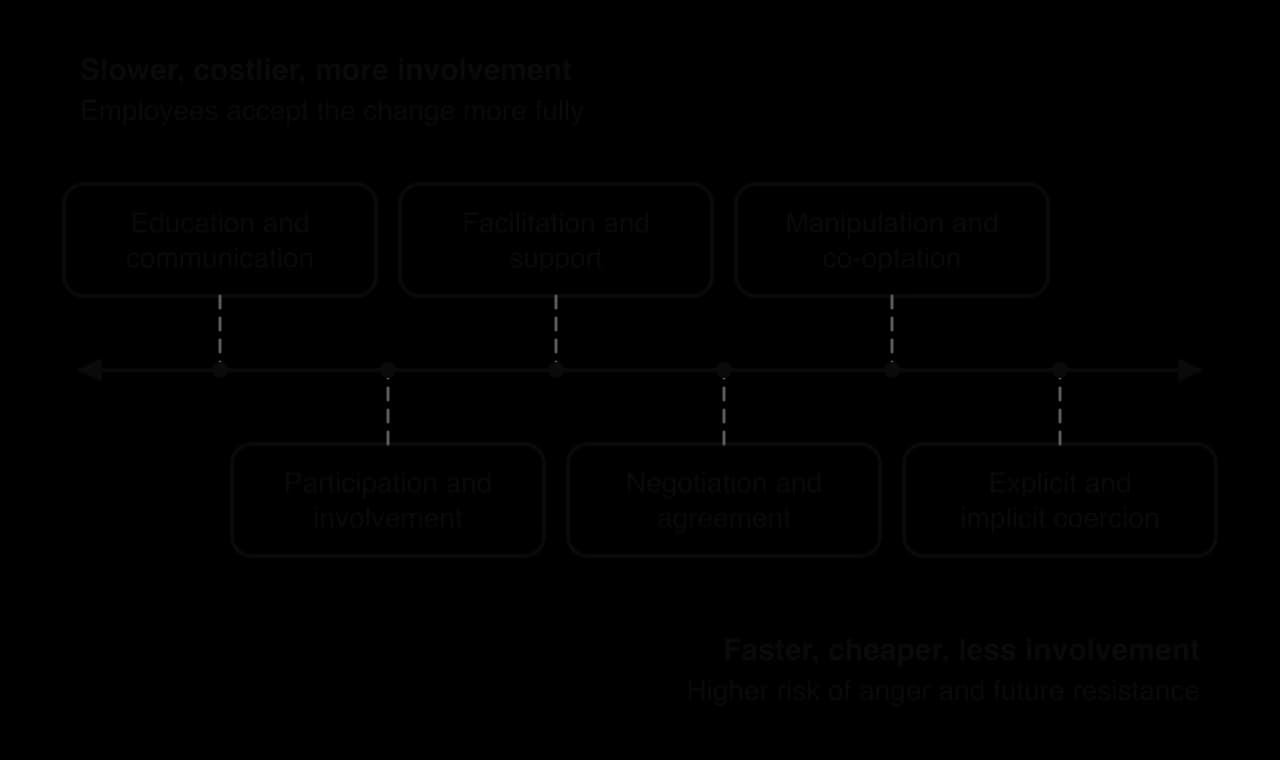
The diagram shows a trade-off between speed and acceptance. Managers often combine several approaches, for example explaining the change to everyone, involving key staff in planning it, training those who need new skills, and negotiating with a trade union over pay.
Education and communication
Education and communication means explaining the reasons for the change, the evidence behind it and what it means for each employee, through meetings, briefings, question sessions and written information. It works best when resistance comes from misunderstanding or a lack of information.
Once employees are persuaded, they often help to carry out the change. The approach takes time, and it fails if employees understand the change perfectly well but still lose from it, or if they do not trust the people explaining it.
Participation and involvement
Participation and involvement means giving employees a role in designing and introducing the change, for example through working groups, consultation or pilot schemes. People are more committed to changes they have helped to shape, and employees often have practical knowledge that improves the plan.
The drawbacks are time and the risk of a weaker plan if participants push for their own interests. It suits changes where managers lack some of the information they need and where the commitment of staff is essential to success.
Facilitation and support
Facilitation and support helps employees cope with the change: training in new skills, time off after a demanding period, counselling and emotional support, and practical help such as equipment for home working. It suits resistance caused by fear and anxiety, or a low tolerance for change.
Support can be expensive and slow, and it does not work if employees simply lose from the change. It is most effective alongside education and communication.
Negotiation and agreement
Negotiation and agreement offers employees something in return for accepting the change: higher pay, a bonus, a guarantee of no compulsory redundancies, or better terms for those who leave. It is common where a powerful group, such as a trade union, will clearly lose from the change and can block it.
Negotiation can avoid strikes and secure agreement relatively quickly, but it can be expensive, and it may encourage other groups to demand payment before accepting future changes.
Manipulation and co-optation
Manipulation means presenting information selectively, or creating a sense of crisis, to make employees accept a change. Co-optation means giving a leader of the resisting group a symbolic role in the change (a seat on a planning committee, for example) to win support without real participation. Manipulation and co-optation can be quick and cheap.
The risk is high. If employees realise they have been manipulated, trust collapses and future changes meet even stronger resistance. The approach also raises clear ethical questions about honesty towards staff.
Explicit and implicit coercion
Explicit and implicit coercion forces the change through, using the authority of managers and the threat of consequences: loss of promotion, transfer, dismissal or redundancy for those who do not comply. Explicit coercion states the threat openly; implicit coercion makes it clear without saying it.
Coercion is fast and can overcome any resistance in the short term, which makes it tempting in a crisis when speed is essential. Its costs come later: resentment, low motivation, loss of talented staff who can find work elsewhere, and a damaged reputation as an employer.
Leadership, change agents and phased implementation
Beyond the six approaches, how a change is led matters. A respected leader who explains a clear vision of why the change is needed can win support that a memo cannot. A change agent is a person, inside or outside the business, given responsibility for leading and supporting a change: an experienced manager, a team of "change champions" in each department, or an outside consultant.
Phased implementation introduces a change in stages, through a pilot in one site or team before it is rolled out everywhere. A pilot tests the plan, lets problems be fixed early and gives staff time to adjust. Its drawback is that the full benefits arrive more slowly, and a long period with two systems running side by side can be costly.
Evaluation: which approach to use
Approach | Speed | Cost | Risk to trust | Best used when |
|---|---|---|---|---|
Education and communication | Slow | Low to medium | Low | Resistance comes from a lack of information or misunderstanding |
Participation and involvement | Slow | Medium | Low | Managers need employees' knowledge and commitment |
Facilitation and support | Slow to medium | Medium to high | Low | Resistance comes from fear, anxiety or a skills gap |
Negotiation and agreement | Medium | High | Medium | A powerful group will clearly lose and can block the change |
Manipulation and co-optation | Fast | Low | High | Other approaches have failed or are too costly; rarely ethical |
Explicit and implicit coercion | Fast | Low at first | Very high | Speed is essential (a crisis) and managers have the power to enforce it |
No single approach is best. The right choice depends on the reason for resistance, the urgency of the change (a business facing collapse may not have time to consult), the power of the resisters (a union that can strike must be negotiated with), the information managers hold (if staff know more, participation improves the plan), the culture of the organisation and its leadership style, and the cost the business can afford.
In the long run, approaches that build understanding and trust tend to produce more lasting change, because employees who accept a change help it to succeed. Coercion may achieve compliance, but it can leave a legacy of distrust that makes every later change harder. Many successful businesses therefore use the slower approaches first and keep the faster ones for genuine emergencies.
Case study: Amazon's return to the office
Amazon is one of the largest employers in the world, with about 1.5 million employees, more than 350,000 of them in corporate (office) jobs, most in the United States. During the COVID-19 pandemic many of its corporate staff worked from home, and by 2024 the company required them to be in the office at least three days a week.
On 16 September 2024, chief executive Andy Jassy sent a message to staff titled "Strengthening our culture and teams". It announced that corporate employees would return to the office five days a week, as before the pandemic, from 2 January 2025. Jassy argued that working together in person made collaboration, brainstorming and inventing simpler and more effective, and strengthened the company's culture. The same message asked each part of the business to raise the ratio of individual contributors to managers by at least 15% by the end of March 2025, to remove layers of management, and opened a "Bureaucracy Mailbox" for staff to report unnecessary processes.
How employees responded
Many employees resisted. Within days, Blind, an anonymous professional social network, surveyed 2,585 verified Amazon employees in the United States. The results showed widespread dissatisfaction and a high stated intention to leave.
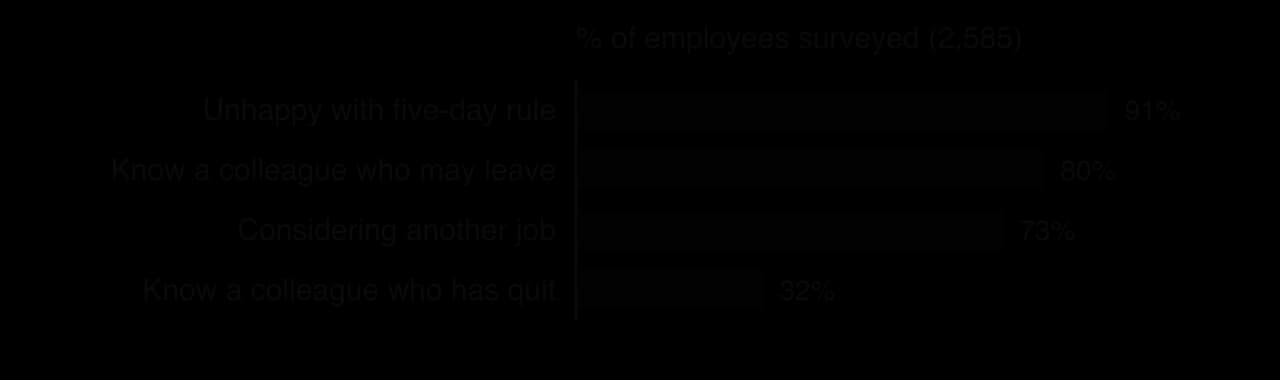
Kotter and Schlesinger's reasons help to explain the reaction. Self-interest is the most likely cause: employees who had organised their lives around hybrid working stood to lose time and money through longer commuting and childcare costs, and some had moved further from an office. Employees who believed they were at least as productive at home made a different assessment of the evidence from their chief executive. Because the change was combined with a target to reduce the number of managers, some staff may also have feared for their jobs, a sign of low trust that a memo alone cannot overcome.
Which approaches Amazon used
Amazon relied mainly on education and communication combined with explicit coercion. The memo explained the reasons for the change and gave more than three months' notice, but it presented the decision as final rather than open to negotiation, which relies on the authority of senior management. There was little participation and involvement in the decision itself, although the Bureaucracy Mailbox invited staff to suggest improvements to other processes.
Approach | Used by Amazon? | Evidence from the case |
|---|---|---|
Education and communication | Yes | A memo from the chief executive explained the reasons and gave more than three months' notice |
Participation and involvement | Little | The decision was made by senior management; staff were invited only to report bureaucracy |
Facilitation and support | Partly | Staff whose offices were not ready could keep hybrid working until space was available |
Negotiation and agreement | No | No incentives were offered in exchange for accepting the change |
Explicit and implicit coercion | Yes | The policy was presented as final, backed by the authority of senior management |
Implementation exposed a practical problem. In December 2024 it was reported that Amazon had delayed the five-day return in at least seven US cities, including Dallas, Atlanta, Houston, Nashville and parts of New York, for up to four months, because some offices had been rearranged for part-time attendance and could not yet seat everyone. Employees affected could continue hybrid working until their office was ready, an example of phased implementation forced by circumstances rather than chosen in advance. Amazon said that the majority of office workers would have a desk on 2 January.
What the case shows, and its limits
The case shows the trade-off between speed and acceptance. A coercive approach let Amazon change the working pattern of hundreds of thousands of people on a single date, and a large, well-known employer can afford to lose some staff because it can attract replacements. The cost is the risk of losing experienced employees who have other options, especially skilled engineers, and of weaker motivation among those who stay. Workforce planning was also tested: the plan required office space that did not yet exist in some cities.
The evidence has limits. The Blind survey was anonymous and self-selecting, so employees who were unhappy were more likely to respond, and saying that one is considering another job is not the same as leaving. The effect of the policy on productivity, innovation and labour turnover will only be clear over several years, and Amazon may judge success by its own measures of culture and speed of decision-making.
Which of Kotter and Schlesinger's reasons for resistance best explains the reaction of Amazon's employees? Justify the choice.
Explain why Amazon may have chosen coercion rather than participation and involvement.
How might the policy affect Amazon's ability to recruit and retain skilled employees in a tight labour market?
Sources: Amazon, "Message from CEO Andy Jassy: Strengthening our culture and teams", 16 September 2024; Blind, "Amazon RTO" survey, 24 September 2024; heise online, reporting Bloomberg, 19 December 2024.
Exam practice
Human resource management appears in both Paper 1 and Paper 2. Short questions ask for definitions of terms such as workforce planning, redundancy or the gig economy, and for explanations of factors or reasons applied to the case. Extended questions usually ask you to evaluate or recommend an HR strategy for managing change.
A definition earns full marks when it is precise and not circular: "being made redundant" does not define redundancy. Adding the contrast with the employee's performance shows that you understand the term.
Calculations like this test workforce planning. A follow-up question might ask you to explain how CallLink could reduce the number of compulsory redundancies, for example through a recruitment freeze, voluntary redundancy or retraining staff for other roles.
Summary
Human resource management plans, recruits, selects, develops, rewards, retains and releases the people an organisation needs to meet its objectives.
Workforce planning forecasts labour demand (numbers, skills, timing and location) and compares it with internal and external supply to show a shortage or surplus.
Dismissal ends a contract because of the employee; redundancy ends it because the job is no longer needed.
Full-time, part-time, temporary and zero-hours contracts trade flexibility for the employer against security for the worker.
Internal factors (objectives, finance, structure, labour turnover, technology, culture) and external factors (demographic change, labour mobility, immigration, legislation, flexible working, the gig economy, automation, the labour market) shape the HR plan.
Employees resist change through self-interest, fear, low trust, different assessments, low tolerance of change and poor communication.
Kotter and Schlesinger's six approaches range from slow, involving methods that build acceptance to fast, coercive methods that risk lasting distrust; the right mix depends on the reason for resistance, urgency, power, cost and culture.
Self-check
- To do:
I can define human resource management and workforce planning.
- To do:
I can calculate the number of staff a business needs to recruit, or make redundant, from a workforce plan.
- To do:
I can explain the role of HRM at each stage of the human resource cycle.
- To do:
I can distinguish between dismissal and redundancy, and between different contracts of employment.
- To do:
I can explain internal and external factors that influence human resource planning, with real examples.
- To do:
I can explain why employees resist change in the workplace.
- To do:
I can evaluate Kotter and Schlesinger's six approaches to reducing resistance to change.
- To do:
I can recommend a suitable approach to managing change for a given business and justify it.