Explain the communication process, distinguish formal and informal methods, evaluate the most suitable method in a given situation, and explain the barriers to communication and how to overcome them.
Each is in the Business glossary, with every other term in the subject.
Factors that prevent or distort the transfer of a message between a sender and a receiver, so that it is not received or understood as intended.
The transfer of information, ideas or instructions from a sender to a receiver through a medium, so that the message is received and understood as intended.
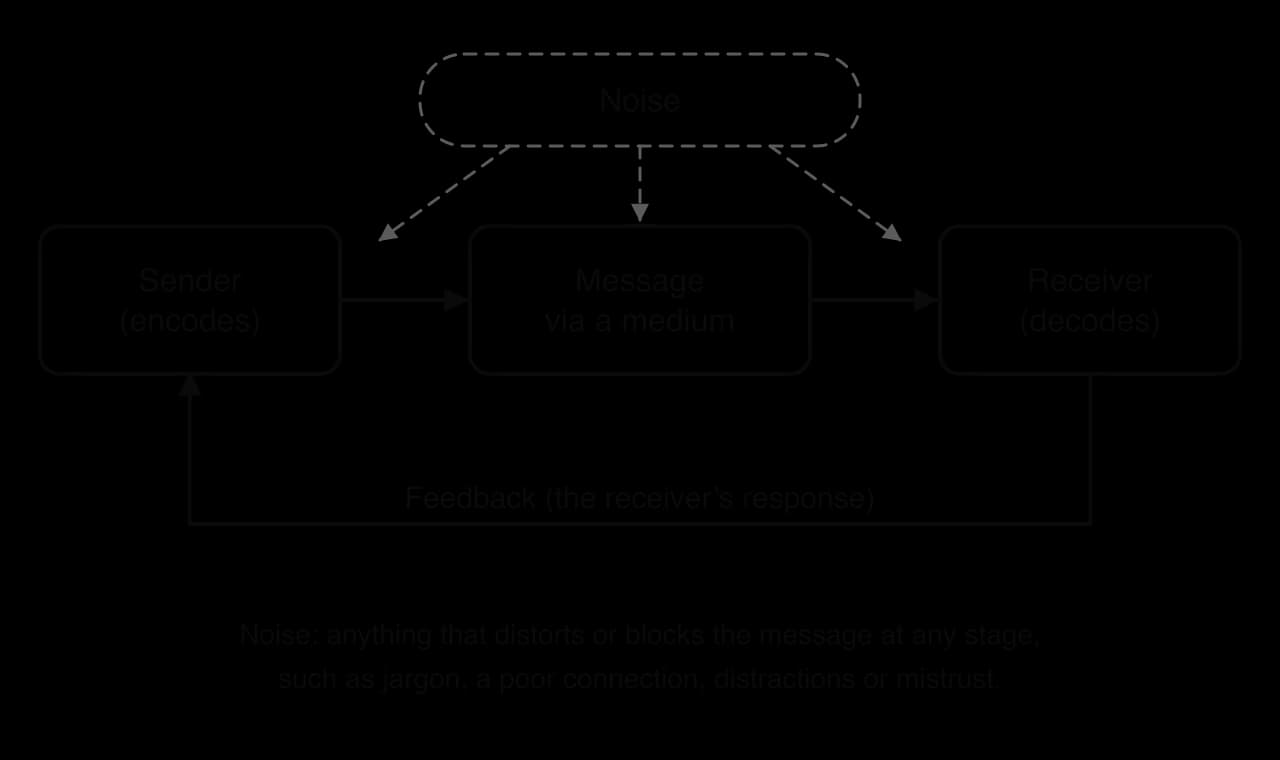
The stages through which a message passes: a sender encodes it, sends it through a medium to a receiver who decodes it, and feedback returns, with noise able to interfere at every stage.
The transfer of messages using digital technology, such as email, intranets, instant messaging, collaboration platforms, video conferencing and social media.
The response of the receiver to a message, which confirms to the sender whether the message has been received and correctly understood.
Communication through the official channels of an organisation, following the chain of command or agreed procedures, such as reports, minutes of meetings, official emails and announcements.
The informal and unofficial network of communication between employees through which information and rumours spread quickly across an organisation.
Define communication and describe the communication process (sender, message, medium, receiver, feedback and noise).
Distinguish between formal and informal communication, including the grapevine.
Distinguish between vertical and horizontal communication, and between internal and external communication.
Describe written, oral, visual, electronic and non-verbal methods of communication.
Explain the factors that determine the most suitable method of communication.
Evaluate formal and informal methods of communication for an organisation in a given situation.
Explain the barriers to communication and ways to overcome them.
Communication is the transfer of information, ideas and instructions from one person or group to another so that they are understood. Every business activity depends on it: managers set objectives and give instructions, employees report problems and suggest improvements, and the business informs customers, suppliers, investors and the government about what it is doing.
Communication connects the four key concepts. A business going through change must explain the reasons for it, or employees resist; creativity depends on ideas moving freely between people and departments; ethics arises in how honestly and respectfully a business communicates bad news; and the shift to electronic and remote communication affects sustainability, for example by reducing business travel.
46 exam-style questions on this subtopic, written in the style of the IB papers. The first has its markscheme open. Counted on
Coastline Dental
[1] Coastline Dental (CD) is a private limited company that owns nine dental clinics along the coast of Queensland, Australia. It employs 38 dentists, 52 dental nurses and 20 receptionists. CD’s mission statement is “gentle, affordable dental care for every family on the coast”.
[2] The population of CD’s area is changing. Many retired people have moved to the coast, while young families increasingly work long hours and cannot attend appointments during the day. Dental nurses are hard to find: several have moved to Brisbane, where pay is higher, and CD’s recruitment advertisements now take three months to fill a vacancy.
[3] Managing director Olivia Brennan wants to open every clinic from 07:00 to 20:00, six days a week, instead of 08:30 to 17:00, five days a week. She also wants to replace paper patient files with a cloud-based records system that patients can use to book online. She believes these changes will increase revenue and help CD compete with a new chain of low-cost clinics.
[4] Staff reaction has been mixed. Some younger dentists like the idea of choosing their own shifts. However, many dental nurses have children and fear being given evening shifts. The receptionists, most aged over 50, are worried that online booking will make their jobs unnecessary. At a staff meeting, one receptionist said: “We were told about this by email on a Friday afternoon. Nobody asked us what patients actually want.”
[5] Olivia is considering introducing flexi-time: staff would agree the total hours they work each week but choose, within limits, when they start and finish. The receptionists would be retrained as “patient care coordinators” who help older patients use the new booking system.
Define the term flexi-time.
2 marks
The official deck for this part of the syllabus.
Define communication.
When has communication actually taken place?
With a free account, Augment remembers where you stopped and what you have practiced.
Communication between people at the same level of hierarchy, often in different departments, in order to coordinate their work; also called lateral communication.
Communication outside the official channels of an organisation, through personal and social contacts between employees, such as conversations at breaks, private message groups and the grapevine.
The situation in which a person receives more information than they can process effectively, so that important messages are missed or decisions are delayed.
Specialist or technical language used by a particular profession or group, which people outside that group may not understand.
The method or channel through which a message is sent, such as a meeting, a telephone call, an email, a report, a video call or a notice board.
The information, instruction or idea that a sender transmits to a receiver; an effective message is accurate, clear, complete and suited to its audience.
Any interference that prevents a message from being received or understood as the sender intended, such as physical sound, technical faults, unclear language or the receiver’s emotions.
The transfer of meaning without words, through body language, facial expressions, gestures, eye contact, tone of voice and appearance.
The transfer of messages using the spoken word, such as face-to-face conversations, meetings, presentations, telephone calls and video calls, which allows immediate feedback.
The person or group for whom a message is intended, who decodes it and interprets its meaning.
The person or group who starts a communication by encoding an idea into a message and choosing the medium through which to send it.
Communication between different levels of hierarchy in an organisation, either downwards from managers to subordinates or upwards from subordinates to managers.
The transfer of messages using images, such as charts, graphs, diagrams, infographics, photographs, videos, signs and symbols.
The transfer of messages using written words, on paper or on screen, such as letters, reports, memos, minutes and emails, which gives a permanent record.
Communication has taken place only when the receiver has understood the message in the way the sender intended. Sending an email is not the same as communicating: if the email is unread, misread or ignored, no communication has happened. For this reason, businesses judge communication by its effect (whether people know what to do and act on it), not by the amount of information sent.
Effective communication brings clear benefits to a business. The table summarises the main ones, and the problems that appear when communication fails.
Area | Effective communication | Poor communication |
|---|---|---|
Coordination | Departments work towards the same objectives; tasks are done once and in the right order. | Duplicated work, missed deadlines, departments working against each other. |
Decision-making | Managers receive accurate, timely information from below and from outside the business. | Decisions based on incomplete or out-of-date information. |
Motivation | Employees feel informed, listened to and valued. | Rumours, uncertainty and low morale; higher absenteeism and labour turnover. |
Change | Reasons for change are understood, so resistance to change is lower. | Fear of the unknown and stronger resistance. |
External image | Customers, investors and the public trust the business. | Complaints, bad publicity and damage to the brand. |
Communication links closely to other parts of human resource management. Leaders rely on it to direct and inspire people, and the leadership style a manager adopts shapes how much two-way communication takes place: an autocratic leadership style mainly sends instructions downwards, while democratic leadership invites ideas and comments from employees. The organisational structure sets the routes that formal messages follow.
The communication process describes the stages through which a message passes from the person who sends it to the person who receives it. The model is a simple way to analyse where communication works and where it breaks down.
The diagram shows six elements. Each one is a possible point of failure, which is why the model is useful for diagnosing problems.
Sender: the person or group who starts the communication. The sender encodes the idea, turning it into words, numbers, images or gestures that the receiver should understand.
Message: the information, instruction or idea being sent. A clear message is accurate, complete, concise and suited to its audience.
Medium: the method or channel used to carry the message, such as a face-to-face meeting, an email, a report, a video call or a notice board.
Receiver: the person or group for whom the message is intended. The receiver decodes the message, interpreting its meaning.
Feedback: the receiver’s response, which tells the sender whether the message has been received and understood.
Noise: anything that distorts, interrupts or blocks the message at any stage.
Feedback turns one-way communication into two-way communication. In one-way communication (a notice on a board, a recorded announcement) the sender has no way of checking understanding. In two-way communication (a conversation, a meeting, a reply to an email) the receiver can ask questions and the sender can correct misunderstandings. Two-way communication is slower, but it is more accurate and it makes the receiver feel involved.
Noise is a broad idea. It includes physical noise (machinery in a factory, a poor internet connection), but also anything that distorts meaning: technical words the receiver does not know, a message that is too long, a receiver who is distracted or who distrusts the sender. Most of the barriers to communication are forms of noise.
Communication in an organisation travels through two kinds of channel. Formal communication uses the official routes set by the business; informal communication uses the unofficial contacts between people that exist in every workplace.
Formal communication is planned and controlled by management. It carries instructions, policies, targets, performance data and official announcements, and it usually leaves a record (a written document, an email or the minutes of a meeting). Because it follows the organisational structure, its routes can be traced on an organisation chart.
Informal communication happens whenever people talk outside the official structure: in the canteen, in a team chat that is not run by managers, on the way home. It is fast and flexible, and it carries opinions and feelings as well as facts. It cannot be controlled by managers, but it can be influenced by them.
The grapevine is the informal network through which information, opinion and rumour spread between employees. It crosses departments and levels of hierarchy freely, ignoring the lines on the organisation chart.
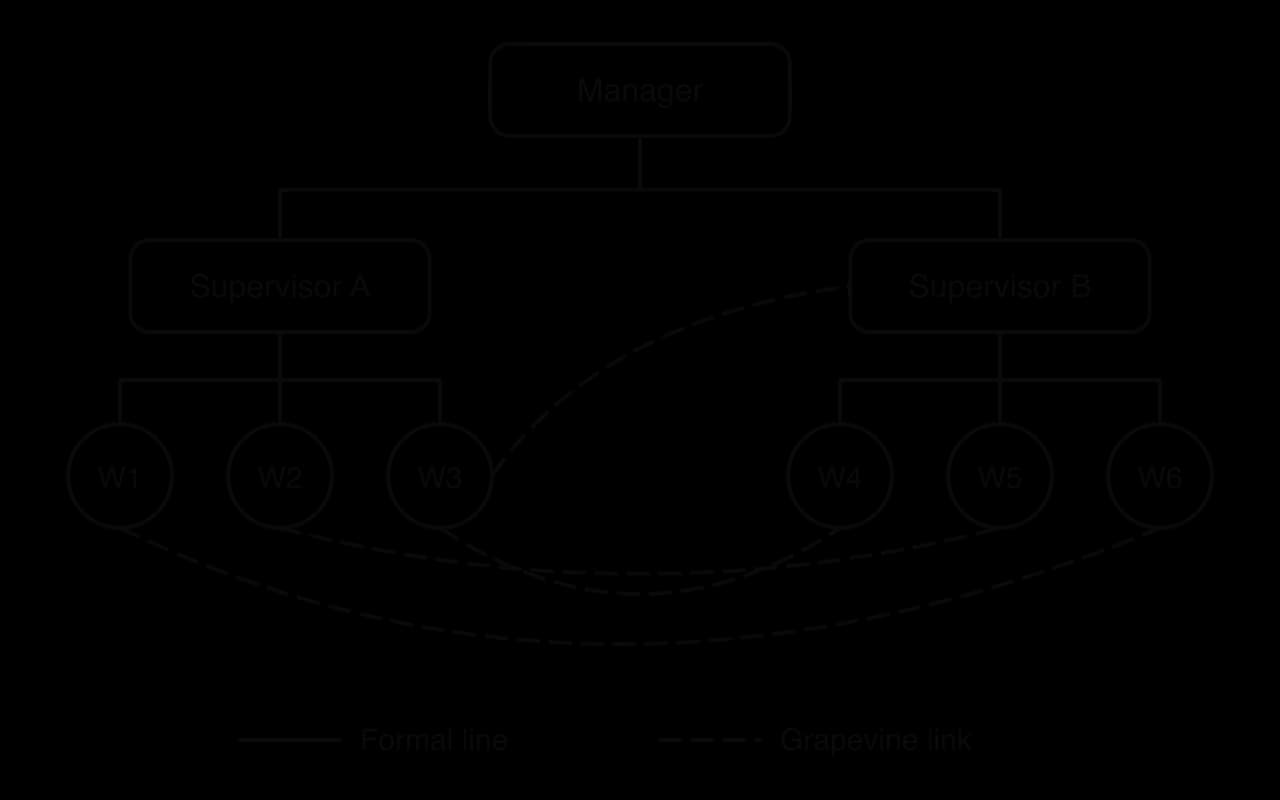
The diagram shows why the grapevine is so fast: it does not have to pass up and down the chain of command, and each person may pass a message to several others. Its weakness is accuracy. A message is retold many times, details are lost or added, and rumours mix with facts. When employees feel that formal communication is slow or dishonest, they rely on the grapevine even more.
Managers cannot remove the grapevine, but they can use it and reduce its harm. Telling employees quickly and honestly about important decisions leaves less room for rumour. Some managers listen to the grapevine to learn about problems early, such as rising frustration over workloads, before these reach formal complaints.
Formal communication | Informal communication | |
|---|---|---|
Strengths | Accurate and consistent; authorised by management; leaves a record for legal or reference purposes; clear accountability for what was said. | Fast; flexible; builds relationships and trust; lets employees raise concerns they would not put in writing; spreads practical know-how. |
Limitations | Can be slow, especially in tall structures; may feel impersonal; can discourage honest upward feedback; may become too much paperwork. | Can be inaccurate; spreads rumours and gossip; no record; can exclude some employees; may undermine managers’ authority. |
Best suited to | Contracts, policies, legal and safety information, performance results, decisions that affect jobs or pay. | Building team spirit, sharing ideas, sensing employees’ views, solving small problems quickly. |
In practice, organisations need both. Formal communication gives accuracy and accountability; informal communication gives speed and human contact. The balance depends on the size of the business (a small start-up relies mostly on informal contact, a large public company needs formal procedures), the type of message (legal and sensitive information must be formal), the organisational culture and the trust between managers and employees.
The loss of NASA’s Mars Climate Orbiter in September 1999 shows how both channels can fail at once. Software written by the contractor Lockheed Martin gave thruster data in pound-force seconds, although the formal interface specification required newton-seconds. Some navigators noticed that the trajectory looked wrong, but their concerns were set aside because they had not been documented on the required form, and the spacecraft was lost on arrival at Mars. The formal specification was not followed in the software, while the formal reporting procedure was applied so strictly that the informal warnings were not acted on.
Sources: NASA Mars Climate Orbiter Mishap Investigation Board, Phase I Report (November 1999), as summarised in “Mars Climate Orbiter”, Wikipedia.
Formal communication also has a direction. The direction depends on where the sender and receiver sit in the organisational structure, and each direction has a different purpose. The organisation chart in the figure shows vertical communication running down and up the chain of command, and horizontal communication linking directors at the same level.
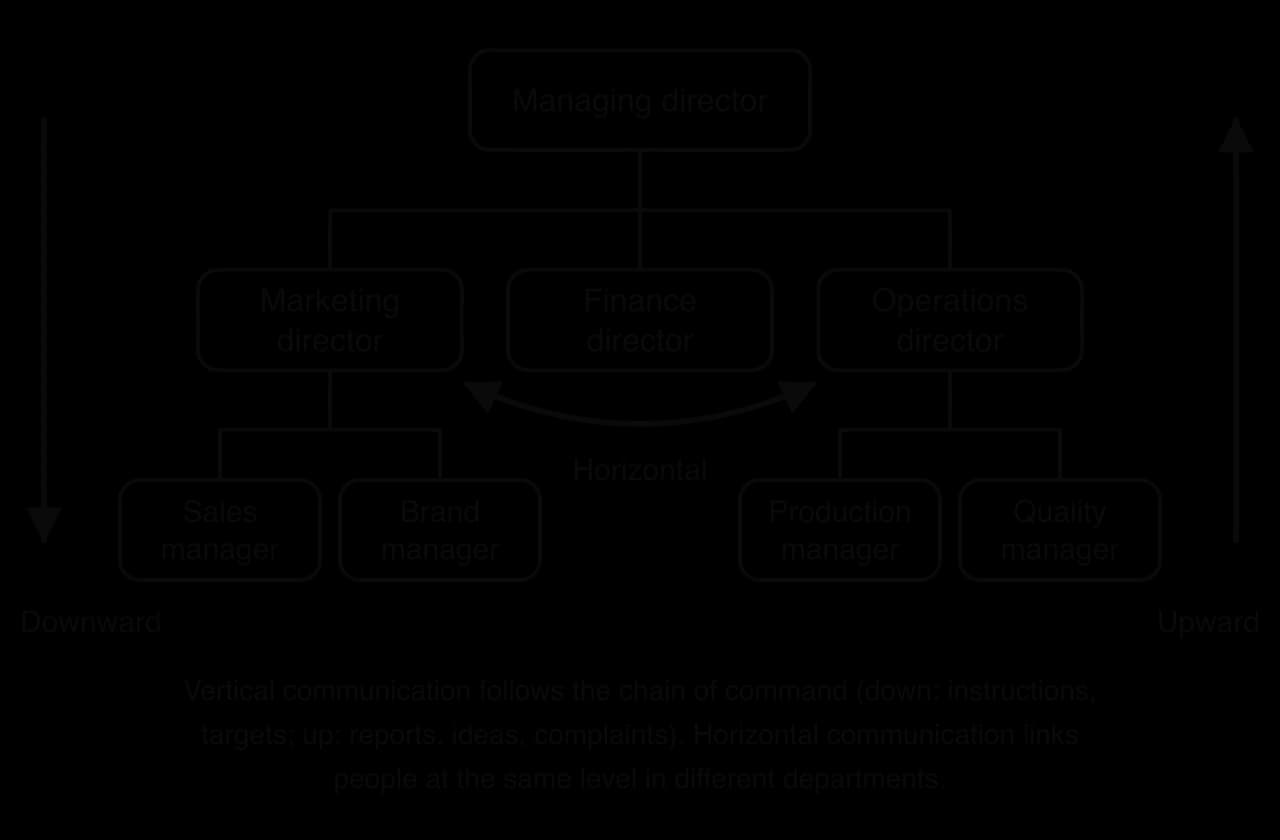
Vertical communication travels up or down the levels of hierarchy. Downward communication carries instructions, objectives, targets, policies and feedback on performance from managers to subordinates. Upward communication carries reports, results, suggestions, questions and complaints from employees to managers.
Many organisations are good at downward communication and weak at upward communication. Employees may fear that bad news will be blamed on them, or believe that their ideas will be ignored. Upward communication matters because the people closest to customers and production often notice problems first. Suggestion schemes, staff surveys, regular one-to-one meetings and open-door policies are ways to strengthen it. The number of levels of hierarchy also matters: in a tall structure messages pass through more people, so they travel more slowly and change more along the way.
Horizontal communication, also called lateral communication, takes place between people at the same level of hierarchy, usually in different departments: the marketing director discussing a product launch with the operations director, or two supervisors arranging shift cover. It coordinates the work of departments without every question going up to a senior manager and back down again.
Diagonal communication, which crosses both departments and levels, such as a sales assistant contacting the finance manager directly about a customer’s invoice. It is fast, but it bypasses the line manager, so it can cause confusion over authority unless the organisation’s culture accepts it. Project teams and a matrix structure depend heavily on horizontal and diagonal communication.
Internal communication takes place between people within the organisation: employees, managers and directors. External communication takes place between the organisation and outsiders: customers, suppliers, banks, investors, the media, the government and pressure groups. External communication includes advertising and public relations, letters to customers, annual reports to shareholders and tax returns to the government.
The two are connected. Employees are often the first people customers speak to, so if internal communication fails (staff do not know about a new price, a delay or a product fault), external communication fails too. A business announcing job cuts, for example, needs to tell its employees before the news appears in the media, or it damages trust inside and outside the organisation.
The method of communication is the form the message takes and the medium used to send it. Methods are usually grouped into five types: written, oral, visual, electronic and non-verbal. Many real messages combine several, such as a video call (oral and visual, through an electronic medium) with a written summary sent afterwards.
Written communication uses words on paper or on screen: letters, memos, reports, minutes of meetings, contracts, notices, newsletters, policy documents and emails. Its main strength is that it gives a permanent record that can be checked later, which matters for contracts, legal requirements and complex information such as financial results. The reader can also reread it at their own pace.
Written communication also has limitations. Feedback is slow or absent, so misunderstandings may not be discovered. Writing a clear report takes time and skill. Written messages lack tone of voice and body language, so a short email can seem rude when the sender only meant to be brief. Long documents may not be read at all.
Oral communication uses the spoken word: face-to-face conversations, meetings, interviews, presentations, telephone calls and video calls. It allows immediate feedback, so questions are answered and misunderstandings corrected at once. Tone of voice and, in face-to-face or video communication, facial expression add meaning and show empathy, which makes oral communication the best choice for sensitive matters such as appraisals, disciplinary issues or telling an employee that their job is at risk.
Oral communication leaves no permanent record unless notes or minutes are taken, so people may later remember different versions of what was agreed. Large meetings are expensive in employees’ time, and dominant individuals may stop quieter people from speaking. Information given orally is also easily forgotten if it is complex, which is why important oral messages are often followed by a written summary.
Visual communication uses images rather than (or alongside) words: charts and graphs, diagrams, infographics, photographs, videos, signs and symbols. Visual methods make complex data easier to understand (a line chart of monthly sales shows a trend faster than a table of figures) and they work across languages, which is why safety signs use standard symbols. They are also memorable and attract attention.
Visual communication can oversimplify, and a badly designed chart (a distorted scale, unclear labels) can mislead. Images can also be interpreted differently by people from different cultures. Visuals work best as support for written or oral messages, not as a complete replacement for them.
Electronic communication uses information and communication technology: email, the company intranet, instant messaging, collaboration platforms such as Microsoft Teams and Slack, video conferencing, text messages and social media. In October 2023 Microsoft reported more than 320 million monthly active users of Teams, which shows how far collaboration platforms have become a standard workplace medium.
Sources: Microsoft, FY2024 first-quarter earnings conference call (October 2023).
Electronic methods are fast and cheap, reach many people at once, work across distances and time zones, and support hybrid working and teleworking. Messages can be stored and searched, and shared documents let several people work on the same file. However, electronic communication depends on reliable technology and on employees having the skills and equipment to use it. It can create far more messages than people can read, it raises concerns about data security and privacy, and constant notifications make it harder for employees to separate work from home life.
Non-verbal communication is communication without words: facial expressions, eye contact, gestures, posture, tone of voice, physical distance, dress and even the layout of an office. It often carries more emotional meaning than the words themselves. A manager who praises a team while checking a phone sends a mixed message, and employees tend to believe the non-verbal signal.
Non-verbal signals differ between cultures. Direct eye contact, for example, shows honesty and confidence in some cultures but can seem disrespectful in others, and the same hand gesture may be friendly in one country and offensive in another. Managers in a multinational company therefore need cultural awareness, and electronic communication by text removes non-verbal cues altogether, which is one reason written messages are more easily misread.
Method | Examples | Main strengths | Main limitations |
|---|---|---|---|
Written | Reports, letters, memos, minutes, contracts | Permanent record; suits detailed or legal information; can be reread | Slow feedback; no tone of voice; time-consuming to write; may go unread |
Oral | Meetings, interviews, presentations, phone and video calls | Immediate feedback; shows tone and empathy; good for sensitive issues | No record unless minuted; easily forgotten; meetings cost time |
Visual | Charts, infographics, signs, videos | Makes data clear; crosses language barriers; memorable | Can oversimplify or mislead; open to different interpretations |
Electronic | Email, intranet, Teams/Slack, video conferencing | Fast; cheap; reaches many people across distance and time zones; searchable | Information overload; depends on technology; security risks; no body language in text |
Non-verbal | Body language, facial expression, tone, dress | Shows feelings and sincerity; reinforces spoken messages | Easily misread, especially across cultures; can contradict the words |
 YouTube
No single method is best. Managers choose the method that suits the message, the receiver and the situation, and they often combine methods so that one makes up for the limitations of another. The main factors are set out in the table.
Factor | Question to ask | Effect on the choice |
|---|---|---|
Urgency | How quickly must the receiver know? | Urgent messages need fast methods: a phone call, an instant message, an alarm, a meeting. |
Audience | How many receivers, and who are they? | One person: a conversation. Thousands of employees in many locations: email, intranet or a live video broadcast. Customers: advertising, social media, letters. |
Confidentiality and sensitivity | Is the message private or emotionally difficult? | Sensitive news (redundancy, discipline, health) needs a private, face-to-face or one-to-one video conversation, followed by a written confirmation. |
Need for a record | Must the message be kept or proved later? | Contracts, policies, warnings and safety rules must be written down. |
Need for feedback | Does the sender need to check understanding or collect views? | Two-way methods (meetings, interviews, surveys) rather than notices or announcements. |
Complexity | Is the content detailed or technical? | Complex data suits a written report with charts, perhaps presented in a meeting. |
Cost | What will the method cost in money and time? | A meeting of 20 managers costs many hours of salaries; an email costs almost nothing to send but may not be read. |
Distance and time zones | Where are the sender and receivers? | Dispersed teams rely on electronic and asynchronous methods (recorded videos, shared documents) so that people can respond in their own working hours. |
These factors often pull in different directions. An email to every employee is fast and cheap but impersonal; a face-to-face meeting with each employee is personal but slow and costly. The skill lies in matching the method to what matters most for that message.
Whether a formal or informal method is more appropriate depends on the situation. Formal methods are essential when accuracy, consistency and a record matter: a change to employment contracts, a new safety procedure, a product recall or the announcement of redundancies. In these situations an informal approach risks inconsistent versions of the message, legal problems and the impression that the business is hiding something.
Informal methods are often better for building relationships and for collecting honest views. A manager who chats with staff during a shift may learn more about a problem than a formal survey would show, and a quick message on a team chat solves a small coordination problem faster than a memo. Informal contact is also important during change, when employees want reassurance from people they trust.
The most effective approach usually combines the two. A business announcing a major change might use a formal announcement (consistent and recorded), team meetings led by line managers (two-way and personal), a written question-and-answer page on the intranet (a reference for later), and informal conversations with supervisors (reassurance and early warning of concerns). The right mix depends on:
The nature of the message: legal, sensitive or complex messages need formal, recorded methods.
The size and structure of the organisation: small businesses with a flat structure can rely more on informal contact; large organisations with many sites need formal systems.
The organisational culture and level of trust: where employees trust managers, informal communication supports formal messages; where trust is low, the grapevine fills the gap with rumour.
The leadership style: democratic and paternalistic leaders tend to use more two-way and informal communication than autocratic leaders.
Time and cost: in an emergency, speed comes first; for a long-term change, investing time in face-to-face communication reduces resistance later.
Barriers to communication are the obstacles that stop a message from being received, understood or acted on as the sender intended. In terms of the communication process, a barrier can arise with the sender (poor encoding), the message (unclear or too long), the medium (unsuitable or failing), the receiver (poor listening, emotions) or the lack of feedback.
Communication fails when the sender and receiver do not share a language, or when the sender uses words the receiver does not understand. Jargon is a particular problem: specialist terms are efficient between experts, but they confuse anyone outside the group. A finance manager who tells sales staff that “the acid test ratio is below one” may be understood by other accountants but not by the people who need to act.
In organisations that operate across countries, employees may work in a second or third language, so idioms, abbreviations and humour are easily misread. The barrier is overcome by using plain language, explaining necessary technical terms, using translation or bilingual staff where needed, and checking understanding through feedback.
People from different cultures may interpret the same words, gestures and silences differently. The anthropologist Edward Hall distinguished between low-context cultures, where meaning is stated directly in words, and high-context cultures, where much of the meaning lies in the relationship, the setting and what is left unsaid. A manager from a low-context culture may see a direct “no” as honest, while a colleague from a high-context culture may find it rude and prefer an indirect reply.
Cultural differences also affect upward communication. In cultures where managers are treated with great respect, employees may be reluctant to question an instruction or report a mistake. The barrier is reduced by cultural awareness training, clear agreed conventions (such as written confirmation of decisions), mixed teams that build understanding over time, and managers who actively invite questions.
Information overload occurs when people receive more information than they can process, so important messages are missed, delayed or misunderstood. Electronic methods have made it much easier to send messages, so the volume of email, chat messages, meeting invitations and notifications has grown faster than people’s ability to deal with them.

The chart shows how much of the working day communication can consume. In Microsoft’s 2023 survey of 31,000 workers in 31 markets, 68% said they did not have enough uninterrupted focus time during the working day, and respondents ranked inefficient meetings as their main disruption to productivity. Businesses reduce overload by agreeing rules on email and chat use (who to copy in, expected response times), holding fewer and shorter meetings with clear agendas, using summaries and clear subject lines, and filtering information so that each person receives what is relevant to their role.
Sources: Microsoft, Work Trend Index Annual Report, “Will AI Fix Work?” (May 2023), survey of 31,000 people in 31 markets, February–March 2023.
Physical noise (machinery, a busy shop floor, an open-plan office) makes oral communication difficult, and technical noise (a poor connection on a video call, an email filtered as spam) distorts or blocks electronic messages. A poorly chosen medium is a related barrier: a long email to employees who rarely use a computer, or a notice board in a warehouse that nobody passes. The remedies are to choose the medium that suits the receiver, to remove or reduce sources of noise (a quiet room for meetings, better equipment), and to repeat important messages through more than one channel.
In a tall organisational structure a message from the top may pass through many people before it reaches the employees who must act on it. At each level it may be shortened, delayed, reinterpreted or filtered, so the final version can be very different from the original. Upward messages are filtered too: bad news is often softened at each level, so senior managers may hear about a problem late.
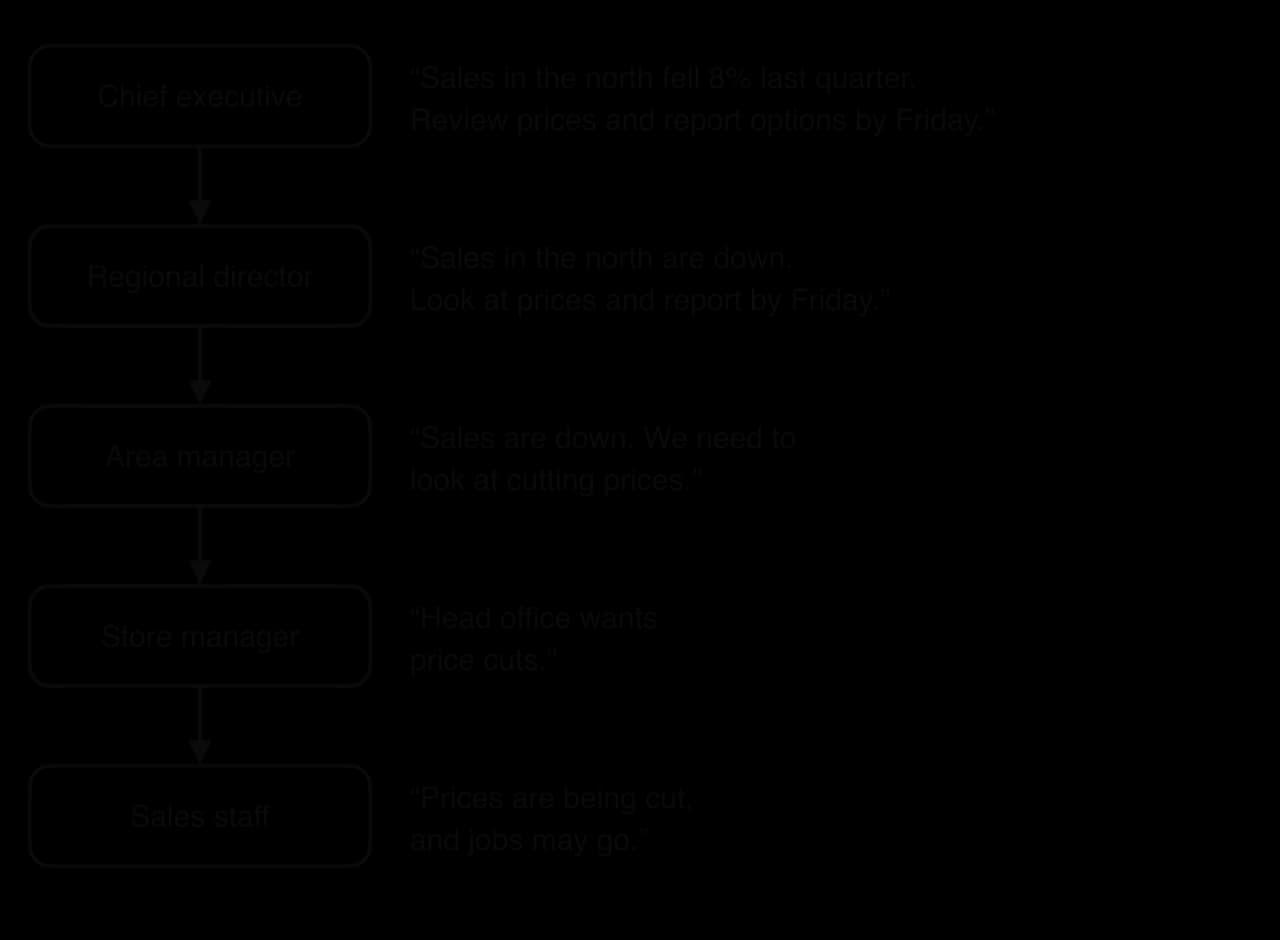
The diagram shows how a request to review prices turns into fear of job cuts after four retellings. Ways to overcome this barrier include delayering (removing levels of hierarchy), communicating directly with all employees on important matters (a message from the chief executive to everyone at once, followed by team briefings), widening the span of control, and encouraging feedback so that distortions are discovered.
Communication needs active listening, and receivers who are busy, distracted or uninterested may hear the words but miss the meaning. People also tend to hear what they expect: an employee who already believes that management cannot be trusted may read a neutral message as a threat. These barriers are reduced by choosing the right time for important messages, keeping messages short and clear, asking the receiver to summarise what they have understood, and training managers and employees in listening skills.
Strong emotions such as anger, fear or anxiety, and poor relationships between sender and receiver, distort how messages are sent and received. During redundancies or a takeover, employees are anxious and may interpret every message as bad news. A manager who is angry may encode a message aggressively, provoking a defensive response. A history of broken promises makes employees doubt even accurate information.
Trust is built over time through consistent, honest communication, but a single badly handled message can damage it. Managers reduce emotional barriers by communicating sensitive news early and face to face, showing empathy, allowing time for questions, and following up in writing. Where relations are very poor, a respected third party such as an employee representative may be needed to carry messages between the two sides.
Organisations that depend on electronic communication are exposed when the technology fails: a network outage, a crashed collaboration platform, a cyber attack or a power cut can stop internal and external communication at once. Employees who lack digital skills or equipment face a permanent version of the same barrier. Businesses reduce the risk with backup systems, alternative channels (such as a phone tree or text alerts), training, and ensuring that every employee has the equipment needed to receive important messages.
When employees work in different buildings, cities or countries, face-to-face communication becomes difficult and expensive, and teams spread across time zones may have only a few overlapping working hours. Questions wait overnight for an answer, decisions slow down and remote employees can feel excluded from informal conversations at head office. The remedies include video conferencing, shared online documents, recorded briefings that people watch when convenient, agreed “core hours” for meetings, and occasional in-person meetings to build relationships.
Barrier | Effect | Ways to overcome it |
|---|---|---|
Language and jargon | Message not understood, or understood wrongly | Plain language; explain technical terms; translation; check understanding |
Cultural differences | Words, gestures and silences interpreted differently; reluctance to question | Cultural awareness training; agreed conventions; invite questions; written confirmation |
Information overload | Important messages missed; slower decisions; stress | Rules on email and chat; fewer, shorter meetings; filter and summarise information |
Noise and unsuitable medium | Message distorted or never received | Match medium to receiver; reduce noise; repeat key messages through several channels |
Long chains of command | Delay and distortion as messages pass through many levels | Delayering; direct communication from senior managers; team briefings; feedback |
Poor listening | Words heard but meaning missed | Good timing; short, clear messages; ask receivers to summarise; listening training |
Emotions, attitudes and trust | Messages distrusted or read as threats | Early, honest, face-to-face communication; empathy; time for questions; follow-up in writing |
Technology failure | Communication stops; some employees excluded | Backup systems; alternative channels; training and equipment |
Physical distance and time zones | Slow responses; remote staff feel excluded | Video conferencing; shared documents; recorded briefings; core hours; occasional meetings in person |
Key concept | How it applies to communication |
|---|---|
Change | Change succeeds only if people understand why it is happening and what it means for them. Explaining change early, through two-way methods, is one of the main ways of reducing resistance to change. Technology also changes communication itself, from memos to email to collaboration platforms. |
Creativity | New ideas come from people sharing knowledge across departments and levels. Horizontal and upward communication, informal contact and open meetings support creativity; a culture where only downward instructions flow does not. |
Ethics | Honesty, respect and privacy are ethical questions in communication: telling employees the truth about the future of their jobs, giving bad news in person, not misleading customers or investors, and protecting personal data. |
Sustainability | Video conferencing and electronic documents reduce travel and paper use. Socially, clear and respectful communication supports employees’ well-being, while constant out-of-hours messaging can harm it. |
Better.com is a US online mortgage lender based in New York, backed by investors including SoftBank. Its business had grown rapidly during the boom in mortgage refinancing in 2020 and 2021, and it planned to become a listed company through a merger with a special-purpose acquisition company. At the end of 2021 the management decided to cut its workforce sharply.
On 1 December 2021, chief executive Vishal Garg held a brief video call with more than 900 employees, about 9% of the workforce. He told them that everyone on the call was part of “the unlucky group” being laid off. Their employment ended with immediate effect, and their access to company systems was cut off. The layoffs came shortly before the holiday season and a day after the company had received about US$750 million in cash from its investors.
Date | Event |
|---|---|
1 December 2021 | More than 900 employees (about 9% of the workforce) laid off on one video call |
Early December 2021 | Garg says online that some of those dismissed had been “stealing” from colleagues and customers by working too few hours |
7 December 2021 | Garg publishes an apology letter to the remaining employees |
10 December 2021 | Garg takes time off from running the company |
January 2022 | Garg returns as chief executive |
March 2022 | About 3,000 further jobs cut in the US and India |
2023 | Worldwide workforce of about 950, down from about 11,000 in 2020 |
Sources: Fortune (6 December 2021); HCAMag (7 December 2021), reporting CNN; The New York Times (10 December 2021; 18 January 2022); TechCrunch (8 March 2022); “Better.com”, Wikipedia, accessed October 2026; Freddie Mac 30-year fixed mortgage rate via FRED (MORTGAGE30US).
In his apology, Garg wrote: “I own the decision to do the layoffs, but in communicating it I blundered the execution.” He also admitted: “I failed to show the appropriate amount of respect and appreciation for the individuals who were affected.” The apology was addressed to the employees who remained, not to those who had lost their jobs. The case was reported by news media around the world as an example of how not to announce redundancies.
 YouTube
The case is about the method of communication, not only the decision. Reducing the workforce may have been a reasonable response to falling demand, and the chief executive himself separated the decision from the way it was communicated. Using the communication process, the sender (the chief executive) chose a medium (one large video call) that was fast and consistent, so everybody received the same message at the same time. But the medium removed almost every chance of feedback: hundreds of people could not ask questions, and the message was encoded in a way that showed little empathy.
Each factor for choosing a method pointed towards a different approach. The message was highly sensitive and personal, so it called for private conversations with line managers, supported by a written letter setting out terms and next steps. Urgency was low: the decision had been planned, so there was time to prepare managers and arrange individual meetings. A record was needed, and a mass call provided none for individual employees. The only factors the call satisfied were speed and cost, which mattered more to the sender than to the receivers.
The consequences show why communication is an ethical issue as well as a practical one. Remaining employees saw how colleagues had been treated and worried that they would be next, a direct threat to motivation and trust. The chief executive’s later public comments added emotional noise to every further message from management. External communication suffered too: customers, investors preparing for the listing and potential recruits all formed a view of the company from the coverage. Much of the criticism in the media concerned the way the job cuts were announced rather than the cuts themselves.
The case should not be read as proof that video calls are always the wrong method. With hybrid and remote working, a one-to-one video call with an employee’s own manager may be the most personal method available. The problem lay in the combination of a mass audience, no individual contact, no opportunity for questions, harsh language and poor timing. Better.com’s later difficulties also had other causes, above all the fall in mortgage demand as the average US 30-year mortgage rate rose from about 3.1% in December 2021 to about 7% in October 2022, so the case cannot show how much of the company’s decline was due to communication alone.
Using the factors that affect the choice of method, explain why one large video call was an unsuitable way to announce the layoffs.
Which barriers to communication made the chief executive’s later messages to remaining staff less effective?
Suggest a communication plan for a business that must make 9% of its workforce redundant, half of whom work remotely.
Definitions earn full marks when they are precise and not circular. “Communication that is formal” is not a definition of formal communication; “communication through the official channels of an organisation, following the chain of command” is.
Communication is the transfer of a message from a sender to a receiver through a medium, so that it is understood as intended; feedback confirms understanding and noise distorts it.
Formal communication follows official channels and gives accuracy and a record; informal communication, including the grapevine, is fast and personal but can spread rumours.
Vertical communication travels up and down the chain of command; horizontal (lateral) communication links people at the same level; external communication links the business with outsiders.
Written, oral, visual, electronic and non-verbal methods each have strengths and limitations, and most messages are best sent through a combination.
The choice of method depends on urgency, audience, sensitivity, the need for a record and for feedback, complexity, cost, and distance.
Barriers include language and jargon, cultural differences, information overload, noise, long chains of command, poor listening, emotions and trust, technology failure, and distance and time zones; each has practical remedies.
Communicating sensitive news is an ethical issue: the method and tone affect motivation, trust and the business’s reputation.
I can define communication and describe each element of the communication process, including feedback and noise.
I can distinguish between formal and informal communication and explain the role of the grapevine.
I can distinguish between vertical, horizontal, internal and external communication.
I can describe written, oral, visual, electronic and non-verbal methods with examples.
I can explain the factors that determine the most suitable method of communication.
I can evaluate formal and informal methods of communication for an organisation in a given situation.
I can explain at least eight barriers to communication and how each can be overcome.
I can apply the communication process to a real case such as Better.com.
Award [1] for a partial definition that shows some understanding, e.g. “flexible working hours” or “workers choose their hours”.
Award [2] for a full definition, e.g. a working arrangement in which employees work an agreed total number of hours but can choose, within limits set by the employer, when they start and finish work (often around fixed “core” hours).
Award [0] for a tautological answer that only repeats the term.
Candidates are not expected to word their definition exactly as above.
Explain two external factors that are influencing CD’s human resource planning (paragraph 2).
4 marks
Factors include:
Demographic change: more retired people on the coast increases demand for dental care (and for help with online booking), while young families need early or late appointments, so CD needs staff at different times.
Labour mobility (geographical): dental nurses moving to Brisbane for higher pay creates shortages; CD must plan for vacancies that take three months to fill, e.g. by retaining or training its own staff.
Changing working patterns / expectations: younger dentists want to choose their shifts, so flexible working affects how CD plans its rotas.
Competition: the new low-cost chain pressures CD to extend hours, affecting the number of staff needed.
Mark as 2 + 2. For each factor, award [1] for identifying a relevant external factor and [1] for explaining how it affects CD’s HR planning.
Award a maximum of [2] for a theoretical answer with no application to CD.
Explain two reasons why some of CD’s staff may resist the proposed changes (paragraph 4).
4 marks
Disruption to family life / self-interest: dental nurses with children fear evening shifts; the change threatens their work–life balance.
Job insecurity: receptionists fear online booking will make their jobs unnecessary.
Poor communication and lack of consultation: the change was announced by email on a Friday afternoon and “nobody asked us”, so staff feel ignored and distrust management.
Fear of the unknown / lack of skills: older receptionists may lack confidence with cloud-based software.
Mark as 2 + 2. Award [1] for each relevant reason and [1] for explaining it in the context of CD.
Discuss whether introducing flexi-time and retraining the receptionists will reduce resistance to change at CD.
10 marks
Arguments that it will reduce resistance:
Flexi-time addresses the main fear of dental nurses (evening shifts clashing with childcare) by giving them some control over their hours, which may also help CD keep nurses who might otherwise move to Brisbane.
Younger dentists already want to choose their shifts, so flexi-time builds on support that exists.
Retraining receptionists as “patient care coordinators” removes the threat of redundancy, uses their experience with older patients and gives them a new, valued role (status is protected).
Both measures show that management listens, which may rebuild trust after the poorly communicated email.
They fit the mission statement of caring for “every family on the coast”, including older patients who struggle with online booking.
Arguments that it may not be enough:
Flexi-time only works “within limits”: someone must cover 07:00 and 20:00 shifts six days a week; if too many nurses choose daytime hours, conflict and resentment may follow.
Communication remains the root problem: without consultation and clear explanation of why the change is needed (competition, demographic change), staff may still resist.
Retraining costs money and time, and some receptionists may lack confidence or not want the new role.
Managing rotas across nine clinics becomes more complex; extended hours may require hiring more nurses, who are scarce.
Other strategies may be needed alongside: involvement in planning rotas, negotiation (premium pay for unsocial hours), phased introduction (pilot in one clinic), support for staff during the change.
Possible conclusion: flexi-time and retraining are likely to reduce resistance because they target the specific fears of each group, but only if combined with genuine consultation and possibly extra pay for evening shifts. Any well-supported judgement can reach full marks.
Limitations of the case: no information on the costs of retraining or extended hours, how many nurses would accept evening work, or patient demand for early and late appointments.
Additional guidance: Marks should be allocated according to the markbands. A one-sided answer is unlikely to exceed [5]. If only one of the two measures (flexi-time or retraining) is considered, award a maximum of [5]. A response without a conclusion is unlikely to exceed [6].
Markbands (10-mark extended response, Papers 1 and 2)
Marks | Level descriptor |
|---|---|
0 | The response does not reach the standard described below. |
1–2 | Little understanding of what the question demands. Business management tools and theories are barely used, or are irrelevant or inaccurate. Little or no reference to the stimulus material. No arguments are made. |
3–4 | Some understanding of what the question demands. Some use of tools and theories, but mostly inaccurate or not relevant. Use of the stimulus is superficial, often no more than the name of the organisation or person. Arguments are mostly unsubstantiated. |
5–6 | Understands what the question demands but addresses it only partially. Some relevant, accurate use of tools and theories. Some relevant use of the stimulus beyond names, but it does not effectively support the argument. Arguments are substantiated but mostly one-sided. |
7–8 | Mostly addresses what the question demands. Mostly relevant, accurate use of tools and theories. The stimulus generally supports the argument, with some lapses in clarity or relevance. Arguments are substantiated and show some balance. |
9–10 | Clear focus on what the question demands. Relevant, accurate use of tools and theories. Relevant stimulus material is integrated effectively to support the argument. Arguments are substantiated and balanced, and the limitations of the case or stimulus material are explained. |
A response with no judgement or conclusion is unlikely to reach the top band of a discuss, evaluate, examine or recommend question.
Jal Seva is an Indian NGO that installs and maintains village water pumps in Rajasthan. To cut administrative costs, its director, Meera Joshi, plans to merge its six district offices into two regional hubs and to replace paper reports with a mobile app that field workers use to log repairs. Field workers learnt about the plan from a local newspaper before Meera had told them. Several have since said they will look for jobs with the state water department.
Explain how education and communication could reduce field workers’ resistance to the changes at Jal Seva.
4 marks
Explain one limitation of relying only on education and communication to manage this change.
2 marks
Ogunleye Ekwueme & Co
[1] Ogunleye Ekwueme & Co (OEC) is an accounting partnership in Lagos, Nigeria, with 14 partners and 160 staff. It audits large private companies and is known for formal procedures, long working hours and a strict dress code. In January 2026 OEC agreed to merge with Ikoyi Advisory, a smaller firm of 55 staff that specializes in tax advice for technology start-ups.
[2] Ikoyi Advisory’s staff are on average 12 years younger than OEC’s. They work flexible hours, often from home, and are used to making decisions quickly in small teams. OEC’s senior partner, Funmilayo Ogunleye, has said that after the merger “there will be one firm and one way of doing things: ours”. All staff will move into OEC’s office on Victoria Island and follow its procedures and working hours.
[3] Since the announcement, three of Ikoyi Advisory’s best tax consultants have accepted offers from rival firms. Others complain that they learnt about the move to OEC’s office from a client. Meanwhile, some OEC audit managers fear that Ikoyi’s tax specialists will be promoted ahead of them, because tax advice is the faster-growing and more profitable service.
[4] Chidi Ekwueme, OEC’s HR partner, believes OEC needs a plan to keep staff from both firms. He suggests a joint committee of staff from both firms to agree working practices, a review of flexible working for all staff, and a written promotion policy based on clear criteria. Funmilayo thinks this is unnecessary: “People who do not like it can leave. Lagos has plenty of accountants.”
Define the term merger.
2 marks
Explain two reasons why staff at Ikoyi Advisory may resist the merger (paragraphs 2 and 3).
4 marks
Explain two reasons why OEC’s own audit managers may also resist the merger.
4 marks
Evaluate Chidi’s proposals for reducing resistance to change after the merger (paragraph 4).
10 marks