Notes on 2.7 Industrial/employee relations
Learning objectives
Define industrial relations and describe the roles of trade unions, employee representatives and employer associations.
Explain the main sources of conflict in the workplace.
Explain how collective bargaining works and why a settlement is possible.
Evaluate the approaches employees take in a dispute: collective bargaining, work-to-rule, overtime bans, go-slows and strike action.
Evaluate the approaches employers take in a dispute: collective bargaining, threats of redundancies, changes of contract, closure and lockouts.
Evaluate conciliation and arbitration as methods of resolving conflict.
Evaluate employee participation and industrial democracy, no-strike agreements and single-union agreements.
Apply these ideas to a real dispute and recommend an approach in a given situation.
Introduction
Industrial relations are the relationships between the managers of an organisation and its employees, and the organisations that represent them, such as trade unions. When these relations are good, disagreements are settled by discussion; when they break down, the result can be strikes, lockouts and closures that harm employees, the business, its customers and the wider economy.
Industrial relations raise questions of ethics (how far an employer may go to cut costs, or a union to press its claim), of change (most disputes are about how the gains and costs of change are shared, from automation to restructuring) and of sustainability, because a business whose employees are underpaid, insecure or in conflict with management is unlikely to remain successful in the long term.
What industrial relations are
Employers and employees need each other, but their interests differ. Employers want to control costs, raise productivity and keep the flexibility to change how work is done; employees want fair pay, secure jobs, safe conditions and a say in decisions that affect them. Industrial relations describe how these differences are handled, both day to day and when a serious dispute arises.
The term “industrial relations” comes from the era of large factories and strong unions; “employee relations” is often used today because it covers all workplaces, including offices, shops and services, and non-unionised employees as well as union members. Both describe the same relationship.
Two views of conflict at work
Managers approach industrial relations differently depending on how they see conflict. In the unitary view, the business is one team with shared goals, so conflict is a sign of poor communication or troublemakers, and unions are unnecessary. In the pluralist view, the business contains groups with genuinely different interests, so some conflict is normal, and it is best managed through recognised channels such as collective bargaining with a union.
The view managers hold shapes their response to a dispute. A unitary manager is more likely to resist union recognition and use the threat of dismissal or redundancy; a pluralist manager is more likely to negotiate and to use conciliation. Neither view is complete: shared goals do exist (the survival of the business protects jobs), but so do real differences over how its revenue is shared between wages, investment and profit for shareholders.
The parties in industrial relations
Trade unions
A trade union is an organisation of employees formed to protect and improve the pay, conditions and job security of its members. One employee alone has little bargaining power against a large employer; acting together, employees can negotiate as equals, because the employer cannot easily replace all of them at once.
Trade unions perform several roles for their members:
Collective bargaining: negotiating pay, hours, holidays, pensions and working conditions on behalf of all members.
Representation: supporting individual members in grievances, disciplinary hearings, dismissals and appeals.
Health and safety: monitoring working conditions and pressing for improvements.
Protecting jobs: negotiating over redundancies, restructuring and the introduction of new technology.
Services and advice: legal advice, training and, in some unions, financial support such as strike pay.
Influencing government: campaigning for laws on the minimum wage, working hours, employment rights and public services.
Unions are commonly grouped into types, although many modern unions combine features of several. Craft unions represent workers with a particular skill across industries (for example, electricians). Industrial unions represent most workers in one industry, such as the United Auto Workers (UAW) in US car making. General unions recruit workers from many industries and skill levels. Professional or white-collar unions represent groups such as teachers, nurses, pilots and civil servants. In Japan, unions are mostly enterprise unions, organised company by company rather than by industry.
Employee representatives
An employee representative is an employee elected or appointed to speak for colleagues in dealings with management. In unionised workplaces, a union representative (often called a shop steward) is the first point of contact for members and raises their concerns with managers. Many countries also require elected representatives for consultation on redundancies or health and safety, whether or not a union is recognised.
In much of Europe, employees elect a works council, a body that management must inform and consult on issues such as working hours, restructuring and new technology. Works councils are part of the wider idea of employee participation and industrial democracy.
Employer associations
An employer association is an organisation of employers, usually in the same industry, that represents their interests. Employer associations negotiate with unions on behalf of their members where bargaining takes place for a whole industry (as is common in Germany and Scandinavia), advise members on employment law and good practice, and lobby the government.
Governments and independent public bodies also take part. They set the legal framework (rules on strike ballots, minimum notice, consultation and unfair dismissal), and many provide independent services to help settle disputes, such as Acas (the Advisory, Conciliation and Arbitration Service) in the UK and the Fair Work Commission in Australia.
Sources of conflict in the workplace
Conflict in the workplace arises when employers and employees disagree over the terms of work or over a decision that affects them. Most conflicts are settled informally, but some become formal disputes. The main sources of conflict are set out in turn, with the reasons each causes disagreement.
Pay and conditions
Pay is the most common source of disputes. Employees compare their pay with the cost of living, with other workers and with the business’s profits and executive pay. When inflation is high, a pay rise below inflation is a cut in real pay, so unions push for larger rises just as employers face higher costs too. Disputes also arise over pensions, holidays, sick pay and bonuses.
Between June 2022 and November 2024, UK rail workers in the RMT, ASLEF and other unions held a long series of strikes. The disputes began over pay rises far below inflation, offered alongside changes to working practices, and were finally settled with deals such as a pay increase of about 15% over three years for train drivers, accepted in September 2024.
Why do pay disputes become more common when inflation is high?
When prices rise quickly, a pay rise smaller than the rate of inflation leaves employees able to buy less than before, so they press for larger rises. At the same time, employers face rising costs for materials and energy and want to limit wage costs. Both sides feel they are losing, so the gap between claim and offer widens and disputes become more likely, as in many countries in 2022 and 2023.
Job security, change and restructuring
Employees fear redundancy, so any plan to close a site, merge departments, outsource work or reduce the workforce is likely to cause conflict. Restructuring often also changes job roles, locations and reporting lines. How the change is introduced matters as much as the change itself: consultation and support reduce resistance to change, while sudden announcements increase it.
Working hours and flexibility
Disagreements arise over the length of the working week, compulsory overtime, shift patterns, weekend work, the right to work from home and contracts that give employees no guaranteed hours, such as zero-hours contracts. Employers want flexibility to match staffing to demand; employees want predictable hours and income.
Health and safety
Employees have a right to a safe workplace, and unions often raise concerns about dangerous equipment, excessive workloads, stress, harassment or exposure to hazards. Disputes become serious when employees believe managers are putting cost savings ahead of safety.
Management style
An autocratic leadership style, poor communication, unfair treatment or a culture of blame can turn small disagreements into disputes. Employees who feel they are not listened to are more likely to take collective action. A change of manager or owner who introduces a harder style is a common trigger.
Discrimination and fair treatment
Conflict arises when employees believe they are treated unfairly because of gender, ethnicity, age, disability, religion or other characteristics, for example in pay, promotion or dismissal. Equal pay claims, in which groups of mainly female employees argue that their work is of equal value to that of better-paid male colleagues, are a well-known example.
Technology and automation
New technology can raise productivity, but it can also replace jobs, change skills and increase the monitoring of employees. Automation and artificial intelligence are therefore growing sources of conflict. In October 2024, about 47,000 members of the International Longshoremen’s Association went on strike for three days at 36 ports on the US East and Gulf Coasts, demanding large pay rises and a complete ban on automated equipment. In 2023, Hollywood screenwriters in the Writers Guild of America struck for about five months, and their final contract included limits on the use of generative AI to replace writers or reduce their pay.
Sources: “2022–2024 United Kingdom railway strikes”, “2024 United States port strike” and “2023 Writers Guild of America strike”, Wikipedia, accessed October 2026, citing AP, Bloomberg, CNN and the WGA.
Source of conflict | Employer’s typical position | Employees’ typical position |
|---|---|---|
Pay and conditions | Control costs to stay competitive and profitable | Rises at least in line with inflation and a fair share of profits |
Job security and restructuring | Freedom to cut jobs, close sites or outsource | Protection from redundancy; consultation; fair redundancy pay |
Working hours | Flexible hours that match demand | Predictable hours; limits on compulsory overtime |
Health and safety | Safety at reasonable cost | Safety as a priority, whatever the cost |
Management style | Right to manage | Respect, fairness and a voice in decisions |
Discrimination | Compliance with the law | Equal treatment in pay, promotion and dismissal |
Technology and automation | Higher productivity and lower costs | Job protection, retraining and a share of the gains |
Collective bargaining
Collective bargaining is the negotiation of pay and conditions between employers and representatives of a group of employees, usually a trade union. It is an approach used by both sides, and it is the normal way that industrial relations work where unions are recognised. All other approaches to a dispute, from an overtime ban to a lockout, are ways of putting pressure on the other side during or after collective bargaining.
Bargaining can take place at different levels: for a whole industry or country (common in Germany, Sweden and Austria), for one company, or for one workplace. Industry-level bargaining reduces competition between firms on wages, while company-level bargaining lets pay reflect each firm’s circumstances. The outcome is a collective agreement that covers all the employees in the group, often after a vote of union members.

The flow chart shows the usual stages. The union presents a claim, the employer replies with an offer, and both sides make concessions until they agree. If they cannot agree, the dispute may go to a third party (conciliation, then perhaps arbitration), or one side may take industrial action to pressure the other into a better offer.
Why a settlement is usually possible
Each side starts with an opening position and has a limit beyond which it will not go, called its resistance point. The union opens high but knows the lowest settlement its members will accept; the employer opens low but knows the most it can afford to pay. If the employer’s resistance point is above the union’s, there is a range of outcomes both can accept, called the settlement zone.
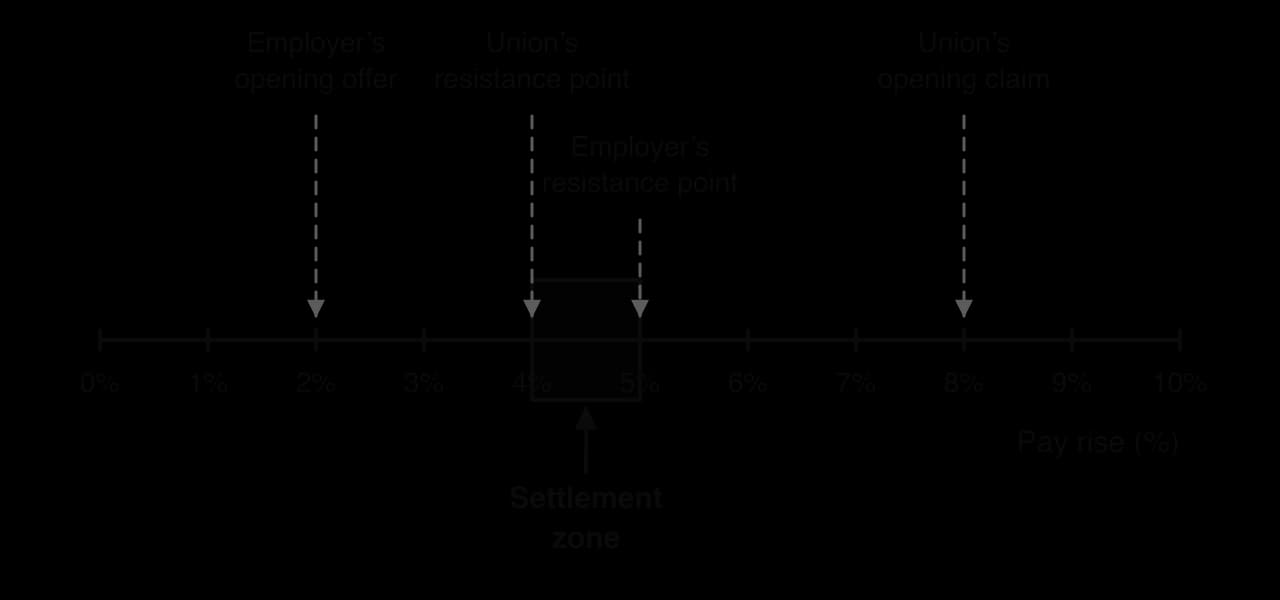
The diagram shows why opening positions are rarely the final outcome. Where the settlement falls inside the zone depends on bargaining power.
A union has more power when most employees are members, when the employer cannot easily replace them, when demand for the product is strong, when labour is scarce, and when it has funds to support members on strike. An employer has more power when unemployment is high, when work can be moved elsewhere, and when it holds large stocks of finished goods. If there is no overlap at all, a settlement needs one side to move its resistance point, which is what industrial action and third-party help aim to achieve.
Evaluation of collective bargaining
For employees, collective bargaining gives far more power than individual negotiation, and it usually raises pay and improves conditions. For employers, it saves time (one negotiation instead of thousands), gives stable agreements for a fixed period, and offers a recognised channel for concerns before they become disputes. A well-run bargaining relationship also builds trust and makes change easier to agree.
On the other hand, collective bargaining can raise labour costs and reduce flexibility, because the employer cannot easily change terms during the agreement. Negotiations can be slow and adversarial, and they may give little weight to the differences between individual employees. Its success depends on the bargaining power of each side, the skill and trust of the negotiators, the financial position of the business and the legal framework, including whether employers must recognise unions at all.
Approaches to conflict by employees
When negotiation alone does not produce an acceptable offer, employees may take industrial action: collective action intended to put pressure on the employer. Actions range from mild forms that reduce output a little to all-out strikes that stop production entirely.
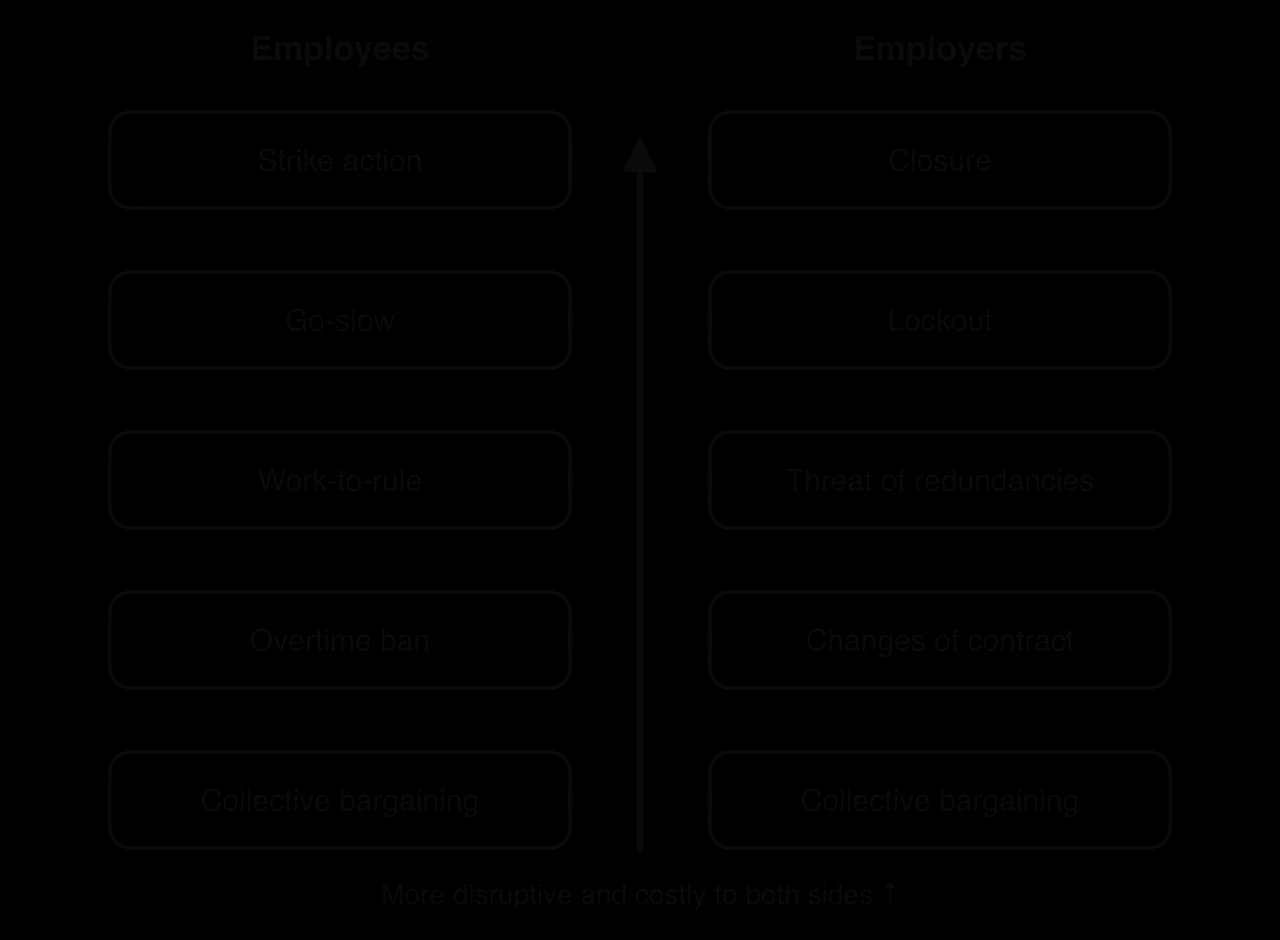
The diagram shows that industrial action usually escalates in steps. Starting with milder action keeps employees’ pay largely intact and leaves room to negotiate, while showing the employer that the union is serious. Escalation to a strike is a much bigger decision for both sides.
Overtime ban
In an overtime ban, employees refuse to work any hours beyond their contracted hours. Employees lose overtime pay but keep their basic wage, and the action is effective where the employer relies on overtime to meet demand. In 2023, for example, the UK train drivers’ union ASLEF held several overtime bans at train companies in England, which led to cancelled services because the companies depended on drivers working rest days.
Work-to-rule
In a work-to-rule, employees do exactly what their contract and the official rules require and nothing more: they follow every procedure to the letter, take every permitted break, refuse voluntary tasks and stop doing the extra things that normally keep the workplace running smoothly. The result is that work slows down, which shows how much the business depends on employees’ goodwill.
A work-to-rule is attractive to unions because employees remain at work, are paid in full and are difficult to discipline, since they are doing nothing outside their contracts. It is less effective where jobs are tightly defined, and it can damage relationships if it continues for a long time.
Go-slow
In a go-slow, employees deliberately work more slowly than normal while staying at work. Output falls and orders are delayed, but employees continue to be paid. A go-slow is harder to justify than a work-to-rule, because employees are not fully performing their contracts, so employers may treat it as a breach of contract and respond with disciplinary action or deductions from pay.
Strike action
A strike is the refusal of employees to work. It is the strongest form of industrial action because it can stop production or service completely, but it is also the most costly for employees, who lose their pay for every day on strike unless the union pays strike pay from its funds.
Strikes take several forms. An all-out strike stops work indefinitely until a settlement is reached. A selective or rolling strike targets particular sites or days, so a few employees create disruption for the whole business while the union conserves its funds. An official strike has the backing of the union, usually after a ballot of members; an unofficial (wildcat) strike does not, and in many countries strikers then lose legal protection. Laws often require secret ballots, minimum turnouts and notice periods before a lawful strike.
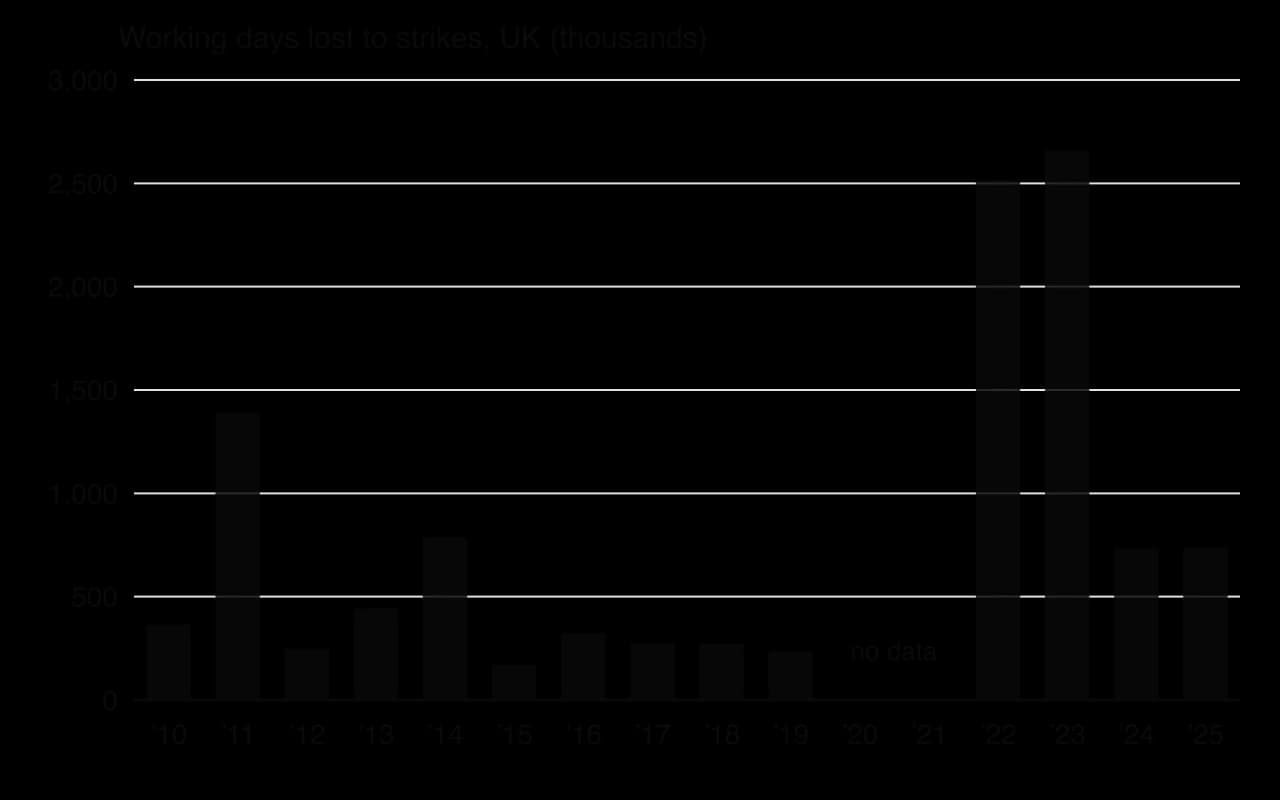
The chart puts recent strikes in context. After years of fewer than 800,000 working days lost a year (except in 2011, when public sector workers struck over pensions), the UK lost about 2.5 million working days in 2022 and 2.7 million in 2023, the highest levels since 1989. These figures are still far below those of earlier decades: 29.5 million days were lost in 1979 and 27.1 million in 1984, the year of the miners’ strike.
Sources: Office for National Statistics, Labour disputes: working days lost due to strike action, UK, series BBFW (annual data, 1891–2025; no data collected for most of 2020 and 2021).
Evaluation of employees’ approaches
Approach | Advantages for employees | Disadvantages and risks |
|---|---|---|
Collective bargaining | Strength in numbers; no loss of pay; builds a lasting relationship | Results depend on bargaining power; can be slow |
Overtime ban | Basic pay kept; low risk; effective where overtime is relied on | Loss of overtime pay; little effect if the employer can cope |
Work-to-rule | Full pay; hard to discipline; shows the value of goodwill | Slow to take effect; damages goodwill over time |
Go-slow | Pay largely kept while output falls | May breach contracts; risk of discipline or pay deductions |
Strike | Maximum pressure; can stop the business; attracts public attention | Lost wages; risk of losing public support, customers and jobs; employer may relocate or automate |
The effectiveness of employee action depends on bargaining power. Action works best when the business cannot easily replace the employees or the output, when demand is strong, when the timing is damaging (before a busy season or a product launch) and when the public sympathises. It is weaker when unemployment is high, when the employer holds large stocks or can move work abroad, and when the action harms customers who then switch to competitors. In the long term, frequent strikes may encourage the employer to invest in automation or relocate, reducing the jobs the union set out to protect.
Approaches to conflict by employers
Employers also have a range of approaches, from negotiation to closing the business. As with employees, the harsher approaches put more pressure on the other side but carry greater costs and risks, including legal, ethical and reputational ones.
Collective bargaining
For employers, collective bargaining is usually the first and preferred approach. Making a reasonable offer, explaining the business’s finances openly and trading concessions (a pay rise in return for more flexible working, for example) often settles a dispute at low cost. An employer may also try to reach employees directly with an offer, in the hope that members will vote to accept it against the union’s advice.
Threats of redundancies
An employer may warn that, if the union’s demands are met or industrial action continues, it will have to cut jobs because costs will be too high or orders will be lost. When the threat reflects real financial pressure, it helps employees understand the limits of what the business can pay. When it is used only as a bargaining tactic, it damages trust and motivation, and in many countries collective redundancies require formal consultation with employee representatives, which limits how the threat can be used.
Changes of contract
An employer may change employees’ contracts of employment, for example by cutting pay, removing overtime rates, changing shift patterns or reducing pension benefits. Where employees refuse to agree, some employers dismiss them and offer re-employment on the new terms, a practice known as “fire and rehire”. This can cut costs quickly but causes intense resentment, and employment law in many countries limits it or requires consultation.
In March 2022, P&O Ferries dismissed about 800 UK seafarers with immediate effect on a video call and replaced them with agency crew employed through a third-party supplier, without consulting the crew or their unions. The chief executive later told a UK parliamentary committee that the company had acted unlawfully by dismissing the crew without consultation. The case led to strong political criticism and damaged the company’s reputation, showing the risks of using changes of contract without negotiation.
Sources: “P&O Ferries”, Wikipedia, accessed October 2026, citing BBC News (17 and 24 March 2022) and Sky News (25 March 2022).
Closure
In the most serious disputes, an employer may threaten to close, or actually close, a workplace, moving production elsewhere or leaving the market. Closure is a credible threat when the site is unprofitable or when the business has other locations, as many multinational companies do. It ends the dispute, but it is costly: redundancy payments, lost skills, lost customers and damage to the employer’s reputation and relations at its other sites.
Lockouts
A lockout is the employer’s equivalent of a strike: the employer stops employees from working, and stops paying them, until they accept its terms. Lockouts are used to put pressure on the union, to take control of the timing of a dispute, or to end costly partial action such as a work-to-rule.
In October 2011, after months of strikes and work bans by pilots, engineers and baggage handlers, Qantas grounded its entire mainline fleet and announced that it would lock out the employees involved. About 600 flights were expected to be cancelled, affecting up to 80,000 passengers. About 33 hours after the grounding, the industrial tribunal Fair Work Australia ordered all industrial action by both sides to end, and the remaining issues were later decided by the tribunal through arbitration. Qantas said the unions’ industrial action had cost it A$194 million.
Sources: “2011 Qantas industrial disputes”, Wikipedia, accessed October 2026, citing Qantas (29 October 2011), The Sydney Morning Herald, The Daily Telegraph (Sydney) and ABC.
Evaluation of employers’ approaches
Approach | Advantages for the employer | Disadvantages and risks |
|---|---|---|
Collective bargaining | Low cost; keeps goodwill; stable agreements | May lead to higher labour costs; slow |
Threats of redundancies | Shows the financial limits; may persuade members to accept | Lowers trust and motivation; legal duties to consult; may push good staff to leave |
Changes of contract | Cuts costs quickly; increases flexibility | Resentment, legal challenges, strikes; damage to employer brand and recruitment |
Closure | Ends the dispute; may cut costs if the site is unprofitable | Redundancy costs; lost skills and customers; damage to reputation and relations elsewhere |
Lockout | Employer controls the timing; no wages paid; ends costly partial action | Lost output and revenue; customer anger; government intervention; long-term bitterness |
The best approach for an employer depends on its bargaining power and its objectives. A business that needs skilled, motivated employees for the long term (a hospital, a technology firm, an airline that competes on service) gains more from negotiation than from confrontation, because harsh tactics raise labour turnover and damage motivation for years. A business facing a short-term crisis, or one whose employees are easily replaced, may be more willing to use threats or contract changes, but it still faces legal limits, reputational risks and ethical questions about how employees are treated.
Approaches to conflict resolution
Because disputes are costly for both sides, businesses, unions and governments have developed ways to resolve conflict without industrial action, or to stop it once it has begun. Some, such as conciliation and arbitration, deal with a dispute that has already started. Others, such as industrial democracy and no-strike agreements, aim to prevent disputes or to make them easier to settle.
Conciliation
Conciliation is a process in which an independent third party helps the two sides in a dispute to talk to each other and reach their own agreement. The conciliator does not decide the outcome; their role is to listen to both sides, clarify the real issues, carry messages and suggest possible compromises. Any agreement belongs to the parties themselves.
In the UK, Acas provides free and confidential conciliation. In 2025–26 it helped employers and trade unions in hundreds of collective disputes, reaching a settlement or clear progress towards one in 93% of cases, and it handled more than 150,000 notifications of individual disputes through early conciliation. Some writers distinguish mediation, in which the third party makes formal, non-binding recommendations, from conciliation, which is mainly about restoring communication; both leave the final decision to the parties.
Sources: Acas, Annual Report and Accounts 2025 to 2026.
Conciliation is cheap, quick to arrange, confidential and voluntary, and because the parties reach their own agreement they are more likely to keep to it. It often succeeds because a neutral person can lower emotions, correct misunderstandings and help each side find a way to move without losing face. Its limitation is that it depends on both sides being willing to compromise: if their positions are too far apart, or one side refuses to move, conciliation cannot force a settlement.
Arbitration
Arbitration is a process in which an independent third party, the arbitrator, listens to both sides and then decides the outcome of the dispute. Before arbitration starts, the two sides agree whether the decision (the award) will be binding, so that both must accept it, or non-binding, so that it is a recommendation. In some countries, labour courts or tribunals can arbitrate even without the agreement of both sides, as Fair Work Australia did in the Qantas dispute.
In conventional arbitration, the arbitrator can choose any outcome, and often “splits the difference”. Knowing this, each side may keep an extreme position, expecting a compromise in the middle. Pendulum arbitration (also called final-offer arbitration) removes this incentive: the arbitrator must choose either the union’s final claim or the employer’s final offer, with nothing in between. Each side therefore has a reason to make a reasonable final offer, because an extreme one is likely to lose.
Arbitration guarantees a decision, so it ends a dispute that conciliation could not settle, and it avoids the costs of continued industrial action. However, it takes the outcome out of the parties’ hands. The losing side may resent the award, especially if it is binding, and relations may suffer. Arbitration also depends on both sides trusting the arbitrator’s independence and expertise, and it can encourage the parties to rely on a third party rather than build their own bargaining relationship.
Conciliation | Arbitration | |
|---|---|---|
Role of third party | Helps the parties communicate and find their own agreement | Hears both sides and decides the outcome |
Who decides | The parties | The arbitrator |
Is the result binding? | Only if the parties agree to it | Binding if agreed in advance (or ordered by law) |
Main strength | Voluntary agreement that both sides own | Guarantees an end to the dispute |
Main limitation | Fails if neither side will move | Loser may resent an imposed outcome |
Employee participation and industrial democracy
Employee participation means involving employees in decisions that affect their work. It ranges from informal consultation (managers asking for views) through suggestion schemes, quality circles and joint consultation committees, to formal rights to be informed and consulted through works councils, and to seats for employee representatives on the board. The more say employees have, the more likely they are to understand and accept difficult decisions, which reduces conflict.
Industrial democracy is the strongest form of participation, in which employees share in the control of the organisation, usually through elected representatives on its governing board. The best-known system is codetermination (Mitbestimmung) in Germany. Under a 1976 law, companies with more than 2,000 employees must give half of the seats on their supervisory board to employee representatives, while the chair, appointed by shareholders, has the casting vote. Companies with more than 500 employees must give employees one third of the seats, and most workplaces may elect a works council with rights to be consulted on matters such as working hours and dismissals.
Sources: “Codetermination in Germany”, Wikipedia, accessed October 2026, on the Mitbestimmungsgesetz (1976) and the Drittelbeteiligungsgesetz (2004).
Supporters argue that participation improves decisions (employees know the work best), raises motivation and commitment, and makes change easier because employees have helped shape it. Under codetermination, restructuring is negotiated rather than imposed, which may explain why German industrial relations are often described as cooperative. Participation also links to motivation theory: it gives employees responsibility and recognition, which writers such as Herzberg see as motivators.
Critics argue that participation slows decision-making, may give employees access to confidential information, and can lead boards to protect existing jobs at the expense of necessary change. Its effects also depend on whether it is genuine: consultation that ignores employees’ views can increase mistrust. Economists disagree about the overall effect of codetermination on productivity, with some studies finding gains and others finding efficiency losses. Participation works best where managers are willing to share information and accept challenge, which links to a democratic leadership style and a culture of trust.
No-strike agreements
A no-strike agreement is an agreement in which a union promises not to take strike action during the period of the agreement, usually in return for benefits such as better pay, job security or a guarantee that unresolved disputes will go to (often pendulum) arbitration. Some groups of employees are also prevented from striking by law, such as police officers in the UK, but that is a legal ban rather than an agreement.
For employers, a no-strike agreement brings stability, which is valuable when production lines, supply chains or customers depend on continuous operation. It also helps attract investment, because investors know that output will not be stopped. For employees, it may secure better terms and avoid the loss of pay that strikes bring. The main drawback for employees is that the union gives up its strongest source of bargaining power, so it may struggle to win improvements later. Such agreements may also not be legally enforceable, and they cannot prevent unofficial action if employees become very dissatisfied.
Single-union agreements
A single-union agreement is an agreement in which an employer recognises only one trade union to represent all employees at a workplace, instead of several unions for different groups. Where many unions are recognised, the employer may have to negotiate separately with each, unions may compete for members, and a dispute involving one small group can stop a whole plant.
Nissan’s car plant in Sunderland, UK, is a well-known example. In April 1985, before production began, Nissan agreed with the Amalgamated Engineering Union that it would be the only recognised union at the plant. Nissan says the arrangement gives it a more flexible workforce and reports that no working time has been lost to industrial disputes in more than 30 years. Critics argue that a single union, chosen by the employer, may represent employees weakly and give them little choice.
Sources: “Nissan Motor Manufacturing UK”, Wikipedia, accessed October 2026.
Single-union agreements simplify negotiation, reduce disputes between unions over who represents whom, and make flexible working easier because job boundaries between different unions’ members disappear. They are often combined with no-strike clauses, pendulum arbitration and a company council for consultation. The disadvantages are that employees lose the choice of union, specialist groups (such as skilled maintenance workers) may feel their interests are ignored, and if the employer has chosen the union, employees may doubt its independence.
Evaluation: which approach to conflict resolution?
Approach | When it works best | Main limitation |
|---|---|---|
Conciliation | Both sides want a settlement but communication has broken down | Cannot force an agreement |
Arbitration | Talks have failed and both sides need an end to the dispute | Imposed outcome may be resented |
Employee participation and industrial democracy | Long-term prevention of conflict; managing major change | Slower decisions; only works if genuine |
No-strike agreement | Continuous operations that cannot afford stoppages | Union loses its strongest pressure; not always enforceable |
Single-union agreement | New sites; firms wanting flexible working and simple bargaining | Less choice and possibly weaker representation for employees |
No single approach suits every situation. Conciliation and arbitration deal with disputes that have already arisen, so they treat symptoms; participation, industrial democracy and single-union and no-strike agreements change the structure of the relationship, so they aim to prevent conflict. The best combination depends on the legal framework and traditions of the country (codetermination is law in Germany but rare in the US), the size of the business and how continuous its operations are, the strength and attitude of the unions, the level of trust between the two sides, the leadership style and organisational culture, and the state of the economy.
In general, approaches that give employees a genuine voice tend to produce more lasting results than approaches that suppress conflict, because the underlying sources of disagreement (pay, security, change) do not disappear when strikes are ruled out. A business that combines fair negotiation, real participation and access to independent conciliation is usually better placed than one that relies on threats or bans.
 YouTube
Case study: the UAW “Stand Up Strike” at Ford, GM and Stellantis (2023)
The United Auto Workers (UAW) represents hourly production workers at the three largest US car makers, Ford, General Motors (GM) and Stellantis, whose collective agreements all expired in September 2023. The union, led by its newly elected president Shawn Fain, entered bargaining with large demands: pay rises totalling 46% over the agreement, the end of the “two-tier” system under which newer workers earned much less than longer-serving colleagues, the return of cost-of-living adjustments, better pensions and protection against plant closures during the shift to electric vehicles.
Several sources of conflict lay behind these demands. Workers had given up overtime and retirement benefits after the 2008 financial crisis, and saw the companies’ later profits as a chance to recover them. Inflation had reduced real wages. The move to electric vehicles also threatened jobs, because electric vehicles need fewer workers to assemble, and many battery plants were being built as joint ventures outside the existing agreements.
The employers argued that higher labour costs would make them less competitive. Analysts put UAW labour costs at about $65 an hour, against about $45 at Tesla and $55 at Toyota’s US plants. Ford’s chief executive said that the union’s original proposal would have bankrupted the company.
A new form of strike action
On 15 September 2023 the UAW began its first strike against all three companies at once. Instead of an all-out strike, it called out about 13,000 workers at one assembly plant of each company, then added plants every week or so, choosing targets according to how negotiations with each company were going. The union called this a “stand-up strike”. At its peak almost 50,000 workers were on strike, including at some of the companies’ most profitable truck plants.
Date (2023) | Event |
|---|---|
15 September | Strike begins at one plant of each company (about 13,000 workers) |
22 September | Strike extended to 38 GM and Stellantis parts distribution centres (5,600 workers) |
26 September | President Biden joins a picket line in Michigan, the first sitting US president to do so |
29 September – 28 October | Further plants added, including Ford’s Kentucky Truck Plant (8,700 workers); about 50,000 on strike at the peak |
25, 28 and 30 October | Tentative agreements with Ford, Stellantis and GM; strikes end after 46 days |
16–17 November | Members ratify the agreements: Ford 69.3%, Stellantis about 69%, GM 54.7% in favour |
The tactic used the union’s strengths. By striking at a few plants at a time, it kept most members working and paid, so its strike fund lasted longer, while the interconnected supply chains of the car makers spread the disruption far beyond the plants on strike. Uncertainty about which plants would be next made it hard for the companies to plan. Targeting each company according to its progress at the table also set the three against each other, rewarding the one that moved first.
The employers responded with their own pressure. Within a week, Ford and GM had laid off more than 2,500 non-striking workers at other plants, saying that the strikes had cut off parts. The union called the layoffs a pressure tactic and supported those workers from its strike fund, which raised the cost of the dispute for the union.
The outcome and its costs
The agreements, which run for about four and a half years, gave large gains to members. At Ford, base pay rose by 25% over the agreement, including 11% immediately, and cost-of-living adjustments returned. All three agreements ended the two-tier system: at Ford, temporary workers who had earned $16.67 an hour moved to a minimum of $24.91, an increase of about 49%, and workers employed by 2023 could reach $40.82 an hour by the end of the agreement.
Company | Reported effect of the strike on 2023 profit | Other reported effects |
|---|---|---|
Ford | About US$1.7 billion of profit lost | About 100,000 fewer vehicles sold; about US$8.8 billion of extra labour costs over the agreement |
General Motors | About US$1.1 billion lower profit before interest and taxes | — |
Stellantis | Less than US$800 million of pre-tax profit | About US$3.3 billion of lost net revenue; about 50,000 vehicles |
Sources: NPR (18 and 20 September 2023); company results as reported by CBS News Detroit (30 November 2023) and Modern Distribution Management (1 December 2023); “2023 United Auto Workers strike”, Wikipedia, accessed October 2026, citing the UAW, AP, Reuters, the Detroit Free Press and The New York Times.
Analysis
The case shows collective bargaining and strike action working as the theory predicts. Both sides opened far apart, and the settlement (25% at Ford) fell well short of the union’s opening claim of 46% but far above what the companies had first wanted to pay. The stand-up strike raised the cost of disagreement for the companies until their resistance points moved, while keeping the union’s own costs low. The employers’ layoffs of non-striking workers put pressure on the union, but strikes at highly profitable truck plants and public and political support, including the president’s visit to a picket line, strengthened the union’s bargaining power.
The costs to both sides were large. The companies lost about US$3.6 billion of profit between them, and their labour costs will be permanently higher. Members lost weeks of wages, although they were supported by strike pay. The GM vote, with only 54.7% in favour, shows that many members believed more could have been won, a reminder that a union’s negotiators must also manage the expectations of their own members. In the long term, higher labour costs may push the companies to invest more in automation or to build more production in lower-cost locations, the outcome the union most wants to avoid.
Limits of the case
The UAW case took place in unusual conditions: high profits, a tight labour market, high inflation and strong political support for unions. A union with fewer members, weaker finances or less public sympathy could not easily copy the tactic. The figures for lost profit are the companies’ own estimates and include effects that are hard to separate, such as a Canadian strike at Stellantis. The long-term effects on jobs and competitiveness will only be clear over several years.
Explain why the “stand-up strike” gave the UAW more bargaining power than an all-out strike would have done.
Evaluate the employers’ approaches to the dispute, including the layoffs of non-striking workers.
To what extent could conciliation or pendulum arbitration have produced a similar outcome at lower cost?
Exam practice
The forms of industrial action are easily confused because they describe similar actions. A work-to-rule keeps strictly to the rules; a go-slow reduces the pace of work; an overtime ban refuses extra hours; a strike stops work entirely.
Paper 3 sets industrial relations in the context of a social enterprise, where employees may also be members or owners and the enterprise’s mission shapes what approaches are acceptable.
Summary
Industrial (employee) relations are the relationships between management and employees and their representatives, including how pay and conditions are agreed and how disputes are handled.
Trade unions, employee representatives and employer associations represent the two sides; governments set the legal framework and provide independent bodies such as Acas.
Conflict arises over pay and conditions, job security and restructuring, working hours, health and safety, management style, discrimination, and technology and automation.
Collective bargaining is the normal approach of both sides; a settlement is possible when the two sides’ resistance points overlap, and bargaining power decides where they settle.
Employees may use overtime bans, work-to-rule, go-slows and strikes; employers may use threats of redundancies, changes of contract, closure and lockouts. Harsher approaches add pressure but raise costs for both sides.
Conciliation helps the two sides reach their own agreement; arbitration hands the decision to a third party, and pendulum arbitration forces a choice between the final positions.
Employee participation, industrial democracy, no-strike agreements and single-union agreements aim to prevent conflict; their success depends on trust, culture, the law and how genuine they are.
Self-check
- To do:
I can define industrial relations and describe the roles of trade unions, employee representatives and employer associations.
- To do:
I can explain at least six sources of conflict in the workplace with examples.
- To do:
I can explain how collective bargaining works and use the idea of resistance points and a settlement zone.
- To do:
I can distinguish between an overtime ban, a work-to-rule, a go-slow and a strike, and evaluate each.
- To do:
I can evaluate threats of redundancies, changes of contract, closure and lockouts as employers’ approaches.
- To do:
I can distinguish between conciliation and arbitration, including pendulum arbitration, and evaluate both.
- To do:
I can evaluate employee participation and industrial democracy, no-strike agreements and single-union agreements.
- To do:
I can apply these ideas to a real dispute such as the 2023 UAW strike and recommend an approach in a given case.