3 Finance and accounts
Explain how businesses fund, record, measure and plan their finances, from sources of finance and final accounts to ratios, cash flow forecasts and investment appraisal.
- IB Business Management
- SL and HL
What 3 covers
From the subject guide: what you need to know and be able to do.
Where a business’s money comes from, how costs, revenue and accounts work, and how to judge its financial health and investments.
9 subtopics in Finance and accounts
Each one has its own page once something is published for it.
- 3.1Introduction to finance29 questions · notes
- 3.2Sources of finance108 questions · notes
- 3.3Costs and revenues109 questions · notes
- 3.4Final accounts70 questions · notes
- 3.5Profitability and liquidity ratio analysis78 questions · notes
- 3.6Efficiency ratio analysisHL only45 questions · notes
- 3.7Cash flow92 questions · notes
- 3.8Investment appraisal81 questions · notes
- 3.9BudgetsHL only35 questions · notes
An overview of 3 Finance and accounts
Finance and accounts studies how a business pays for what it needs, records what it earns and spends, measures how well it is performing, and plans its money for the future. Every organisation, whether it aims for profit or not, needs enough finance to operate and enough cash to pay its bills on time, and its owners, lenders and managers all judge it partly by its accounts.
Questions that frame the unit
The unit answers questions that owners, lenders, investors and managers ask about any business.
Why do some profitable businesses run out of cash and fail?
Is it better to fund an expansion by borrowing or by selling shares?
How can two businesses with the same sales revenue be in very different financial health?
Which of two investment projects is worth more, and how far can the forecasts behind them be trusted?
How can investors tell whether a company’s accounts give a fair picture of its performance?
What the unit covers
The unit has nine subtopics. Seven are studied at SL and HL; two are HL only.
Subtopic | Main question it answers | Level |
|---|---|---|
3.1 Introduction to finance | Why does a business need finance, and how does capital expenditure differ from revenue expenditure? | SL and HL |
3.2 Sources of finance | Where can a business get finance, and which source suits a given purpose and time frame? | SL and HL |
3.3 Costs and revenues | How do costs behave as output changes, and where does a business’s revenue come from? | SL and HL |
3.4 Final accounts | How are a business’s profit and its assets, liabilities and equity recorded, and who uses the accounts? | SL and HL |
3.5 Profitability and liquidity ratio analysis | How profitable is the business, can it pay its short-term debts, and how could it improve? | SL and HL |
3.6 Efficiency ratio analysis | How well does the business manage its stock, debtors and creditors, and how much does it rely on borrowing? | HL only |
3.7 Cash flow | Why do profit and cash differ, and how can a business forecast and solve cash flow problems? | SL and HL |
3.8 Investment appraisal | Is an investment worth its cost, and which of several projects should a business choose? | SL and HL |
3.9 Budgets | How does a business plan and control its spending and revenue, and what do variances show? | HL only |
How the subtopics connect
The unit starts with the two types of spending: capital expenditure on assets that last more than a year, and revenue expenditure on the day-to-day costs of running the business. Each needs a matching source of finance. The sources of finance range from retained profit and overdrafts to share capital and loan capital, and the right choice depends on the purpose, the amount, the time frame and the business’s legal form.
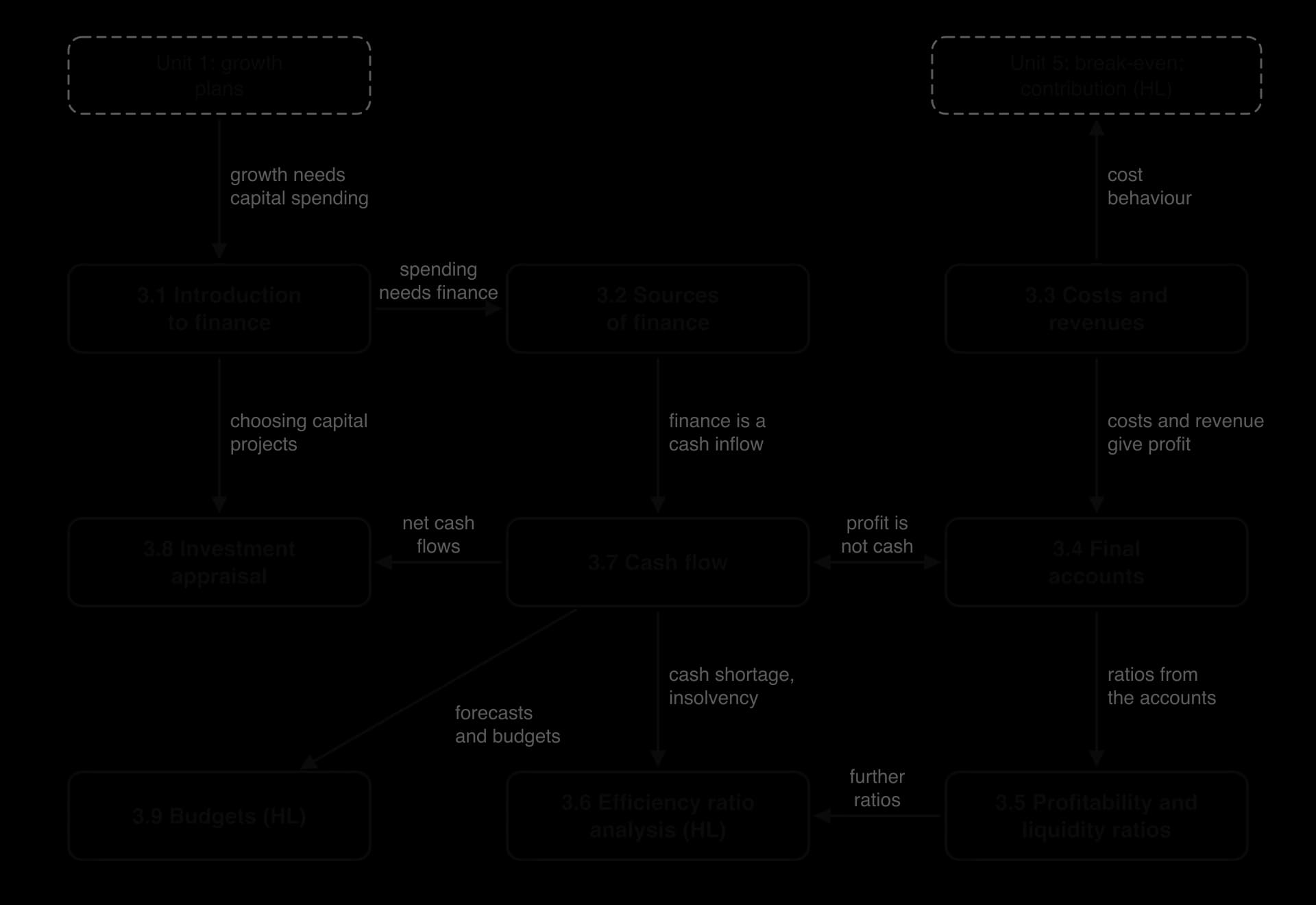
The concept map shows two routes through the unit. The first starts from fixed costs, variable costs and revenue streams. Costs and revenues over a year make up the statement of profit or loss, and what the business owns and owes at the end of the year makes up the statement of financial position. Ratio analysis then uses the two statements to judge profitability and liquidity, and at HL also efficiency and gearing. The same cost classifications are used in break-even analysis in operations management.
The second route runs through cash flow. Finance raised from loans or shares is a cash inflow, and a cash flow forecast shows whether the business will have enough cash month by month. Profit and cash differ because of credit sales and purchases, capital spending and loan repayments, so a business can be profitable and still run out of cash. Forecast net cash flows are also the starting point of investment appraisal, which decides which capital projects are worth their cost.
The unit connects closely to the rest of the course. A growth plan from unit 1 needs finance and an investment decision; a marketing plan needs a budget; and labour costs from human resource management appear in the accounts. Among the toolkit tools, the Boston Consulting Group matrix links products to cash flow, since products with high market share in slow-growing markets often fund newer products, and descriptive statistics summarise financial data over time.
Change, creativity, ethics and sustainability in the unit
Key concept | How it shows up in the unit |
|---|---|
Change | Changes in a business’s structure change the finance it can raise and use. A sole trader that becomes a company can sell shares; a business that grows quickly may be short of working capital; rising interest rates make loans more expensive. |
Creativity | Creativity in finance has mixed effects. New sources such as crowdfunding and microfinance give start-ups access to funds that banks would not lend, while creative presentation of accounts, such as window dressing, can mislead the stakeholders who rely on them. |
Ethics | Ethical accounting means presenting the accounts honestly and transparently. Creative accounting and fraud can bring down a business, as the collapse of Wirecard in 2020 showed, while paying suppliers on time and taxes in full builds trust. |
Sustainability | Ethical financial practice is itself a form of sustainable behaviour, because a business that keeps the trust of lenders, investors and suppliers can keep operating. Investment appraisal increasingly weighs environmental factors alongside payback and returns. |
How SL and HL differ
HL students study everything SL students study, plus two HL-only subtopics and HL-only parts of two SL subtopics. The HL-only subtopics are:
3.6 Efficiency ratio analysis: stock turnover, debtor days, creditor days and the gearing ratio, strategies to improve them, and the difference between insolvency and bankruptcy.
3.9 Budgets: cost centres and profit centres, constructing a budget, calculating and interpreting variances, and the role of budgets in decision-making.
The SL subtopics with HL-only parts are:
SL subtopic | What HL adds |
|---|---|
3.4 Final accounts | Depreciation by the straight-line method and the units of production method, and the appropriateness of each method for a given asset. |
3.8 Investment appraisal | Net present value, which allows for the time value of money by discounting future net cash flows with the discount factors provided. |
HL students also use contribution as a toolkit tool, to decide whether to make or buy a component and to compare contribution costing with absorption costing. It builds on the classification of costs into fixed and variable.
Assessment
Unit 3 is examined in Paper 1 and Paper 2, and is the main source of the calculations in Paper 2, whose stimulus material has a quantitative focus. Its SL content can appear in either paper at both levels, although Paper 1 includes only minor calculations. The HL-only content (efficiency ratios, budgets, depreciation and net present value) appears only in Paper 2 at HL and in Paper 3, never in Paper 1.
The unit produces three kinds of question. Calculations ask for ratios, payback periods, average rates of return, working capital or, at HL, depreciation, NPV and variances, usually followed by a request to comment on the result. Constructions ask students to prepare or complete a statement of profit or loss, a statement of financial position or a cash flow forecast in the standard layout. Extended responses ask students to evaluate a source of finance, a strategy for a cash flow problem or a choice between investment projects, using both the numbers and qualitative factors.
Studying the unit
Flashcards for 3
The official decks for this part of the syllabus.
- 3.1 Introduction to finance64 cards
- 3.2 Sources of finance140 cards
- 3.3 Costs and revenues113 cards
- 3.4 Final accounts218 cards
- 3.5 Profitability and liquidity ratio analysis152 cards
- 3.6 Efficiency ratio analysis130 cards
- 3.7 Cash flow144 cards
- 3.8 Investment appraisal129 cards
- 3.9 Budgets132 cards
Carry on with 3 in Augment
With a free account, Augment remembers where you stopped and what you have practiced.