Explain how each internal and external source of finance works, its cost, its advantages and disadvantages, and recommend appropriate short- or long-term sources for a given business situation.
Each is in the Business glossary, with every other term in the subject.
A wealthy individual who invests their own money in a small, new business with high growth potential, usually in return for a share of the ownership.
An asset that a borrower pledges to a lender as security for a loan, which the lender can take and sell if the loan is not repaid.
Raising finance from a large number of people, each contributing a relatively small amount, usually through an online platform, in return for a reward, shares, interest or nothing.
A long-term loan certificate (bond) issued by a company to investors, paying a fixed rate of interest and repaid on a stated date.
Money raised from people or organisations outside the business, such as shareholders, banks, suppliers, investors and other lenders.
A sum of money given by a government or public body to a business for a specific purpose, which does not have to be repaid if its conditions are met.
The price paid for borrowing money, expressed as a percentage of the amount borrowed per year; for a lender or saver, the reward for lending.
Money raised from within the business or from its owner, such as personal funds, retained profit and the sale of assets.
Define internal and external sources of finance, and short-term and long-term finance.
Explain how personal funds, retained profit, the sale of assets and sale and leaseback provide finance.
Explain how share capital, loan capital, overdrafts, trade credit, crowdfunding, leasing, microfinance and business angels provide finance.
Describe other sources of finance: mortgages, debentures, venture capital, government grants and subsidies.
Calculate the cost of simple loans, overdrafts and trade credit discounts.
Distinguish between share capital and loan capital.
Evaluate the appropriateness of short- or long-term sources of finance for a given situation.
Recommend a source of finance for a business, using the factors that affect the choice.
A business can raise finance in many ways: from its owners, from its own profits, from banks, from suppliers, from investors or from members of the public. Each source of finance has a cost, a time limit and consequences for who controls the business, so choosing the wrong one can make a sound business plan fail.
Sources of finance are changing quickly. Online platforms have made crowdfunding possible for small firms, and microfinance has brought credit to people with no access to banks, which links finance to creativity and to sustainability. Lenders and investors also judge a business by its ethics: a lender may refuse to finance a project that harms the environment or the local community.
108 exam-style questions on this subtopic, written in the style of the IB papers. The first has its markscheme open. Counted on
Rangoli Textiles
[1] Rangoli Textiles Ltd (Rangoli) is a private limited company in Surat, India, owned by the Mehta family. It weaves and dyes cotton fabric for clothing brands in India and Europe. Demand from European brands for organic cotton fabric has grown quickly, and Rangoli’s factory has been running at full capacity since 2024.
[2] In 2025 Rangoli took out a long-term bank loan to buy new looms. Its finance director, Kavita Rao, now proposes building a second factory in 2026 at a cost of ₹500 million. The bank has offered a further 10-year loan at 11 % interest a year.
[3] Rohan Mehta, the chairman, would rather avoid more debt. A private investor has offered to buy new shares in Rangoli for ₹500 million, which would give her 30 % of the company and a seat on the board. Several family shareholders are unhappy about giving up this much control.
Table 1: Extracts from Rangoli’s statements of financial position as at 31 March (₹ million)
2024 | 2025 | |
|---|---|---|
Non-current liabilities | 180 | 420 |
Share capital | 300 | 300 |
Retained earnings | 220 | 280 |
Table 2: Other information
Gearing ratio, 2024 | 25.71 % |
The official deck for this part of the syllabus.
What are sources of finance?
State the two ways in which sources of finance are classified.
With a free account, Augment remembers where you stopped and what you have practiced.
A contract that allows a business to use an asset owned by another firm (the lessor) in return for regular payments, without buying the asset.
Money borrowed from a bank or other lender for a set period, which must be repaid, usually in instalments, together with interest.
Finance available to a business for more than five years or permanently, such as share capital, mortgages, debentures and retained profit, used mainly for non-current assets and expansion.
Financial services, mainly small loans, provided to people on low incomes who cannot obtain credit from traditional banks, usually to start or expand a small business.
A long-term loan to buy land or buildings, secured on the property, which the lender can take if repayments are not made.
A flexible short-term facility that allows a business to withdraw more money from its bank account than it holds, up to an agreed limit, paying interest only on the amount overdrawn.
The owner's own savings or personal money invested in the business; the main source of start-up capital for sole traders.
The profit left after tax and dividends have been paid, which is kept in the business and can be reinvested.
The sale of an asset, usually property, to another party, which then leases it back to the seller, so that the business receives cash but continues to use the asset.
Raising finance by selling items the business owns and no longer needs, such as unused buildings, land, machinery or vehicles, or a part of the business.
The money a company raises by selling shares to investors, who become part-owners (shareholders) of the company; it is not repaid and carries no interest.
Finance that must be repaid within one year, such as an overdraft or trade credit, used mainly to pay for working capital.
The ways in which a business obtains the money it needs, either from within the business (internal sources) or from outside it (external sources).
A payment from the government to a business that reduces its costs of production or the price of its product, usually paid on a continuing basis.
An agreement with a supplier to receive goods or services now and pay for them later, typically within 30 to 90 days.
Finance provided by specialist investment firms to new or fast-growing businesses with high potential but high risk, in return for a share of the ownership.
Scope: Sources of finance covers the internal and external sources a business can use, how each works, and how to judge which short- or long-term source suits a particular situation. The content is the same at SL and HL.
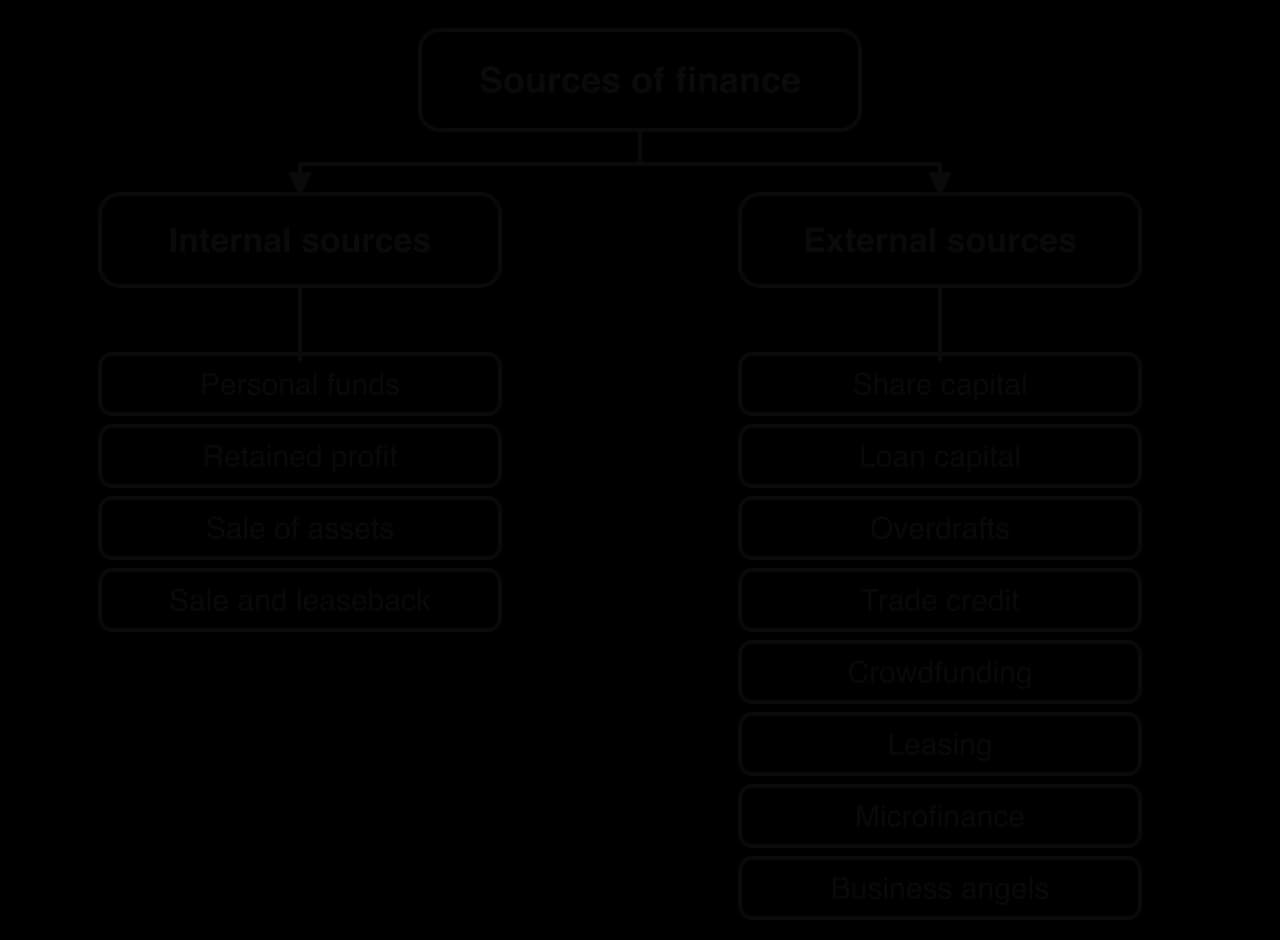
Sources of finance are classified in two ways. The first is where the money comes from: from inside the business and its owner, or from outside. The second is how long the money is available for: a few weeks or months, a few years, or permanently.
Internal sources of finance come from the business itself or, for a sole trader, from the owner's own money. They include personal funds, retained profit and the sale of assets. External sources of finance come from people and organisations outside the business: shareholders, banks, suppliers, leasing companies, investors and the public.
Internal sources usually cost nothing in interest and leave the owners in full control, but they are limited by how much the business has already earned or owns. External sources can provide far larger sums, but they bring costs (interest, dividends, fees) or obligations (repayment, giving up part of the ownership).
 YouTube
Personal funds are the owner's own savings, or money from selling personal possessions, put into the business. They are the most common source of start-up capital for a sole trader, who is a single person owning and running an unincorporated business. A person opening a hair salon, for instance, may use savings from previous employment to buy chairs, mirrors and equipment.
Using personal funds has clear benefits. There is no interest to pay, nothing has to be repaid by a set date, and the owner keeps full control. Investing one's own money also shows commitment: banks and investors are more willing to lend to an entrepreneur who has risked their own savings.
The limitation is the amount. Few people have enough savings to finance a large business, and putting all of one's savings into a new venture is risky. A sole trader has unlimited liability, so if the business fails the owner can lose both the savings invested and personal possessions such as a house or car.
Strictly, personal funds are internal finance only for a sole trader, because the owner and the business are the same person in law. When an owner of a company puts personal money into it, the company usually receives it as share capital or as a loan from the owner.
Retained profit is the part of a business's profit after tax that is kept in the business rather than paid to the owners. A company can either pay its profit to shareholders as dividends or keep it to reinvest, for example in new equipment, research or expansion. It is the most important source of finance for many established businesses.
Retained profit has no interest cost, does not have to be repaid and does not dilute the owners' control. It is also permanent: once retained, the money stays available for long-term uses. Its drawbacks are that it is only available to businesses that make a profit, so a new or loss-making business has none, and that keeping profit in the business means shareholders receive smaller dividends, which may make them unhappy.
Some highly profitable companies retain all their profit for many years. Alphabet, the owner of Google, paid no dividends at all until April 2024, when its board approved the start of a cash dividend programme with a first dividend of US$0.20 per share. Until then its shareholders were rewarded only by the rise in the value of their shares, while the company reinvested its profit.
Sources: Alphabet Inc., Form 8-K, 25 April 2024.
A business can raise money by selling assets it no longer needs, such as unused land, old machinery, vehicles or a division that no longer fits its strategy. This sale of assets turns something the business owns into cash.
Selling assets that are no longer used has no cost and may also reduce running costs such as maintenance and insurance. However, only assets the business does not need can be sold without harming its operations, and an established business has a limited number of them. Assets sold in a hurry, for instance by a business short of cash, often fetch a low price. Once an asset is sold, the source cannot be used again.
Sale and leaseback is a special form of the sale of assets. The business sells an asset, usually a building, to an investor such as a property company, and immediately leases it back for an agreed number of years. The business receives a large sum of cash but keeps using the asset, paying rent to the new owner.
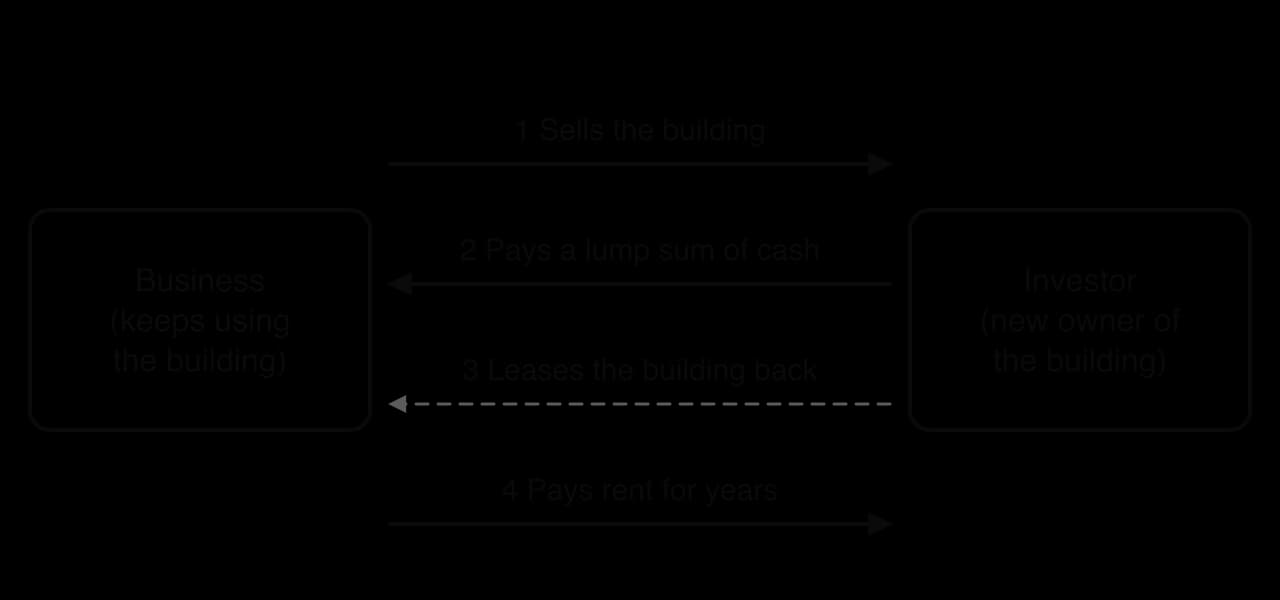
The flow diagram shows the two exchanges. In the first, ownership passes to the investor in return for cash. In the second, the business gains the right to use the building in return for rent. Sale and leaseback suits businesses that own valuable property and need cash for expansion or to repay debt, such as retailers and hotel groups.
Sale and leaseback is therefore a trade-off between cash now and costs later. It works well when the cash can be invested in something that earns more than the rent costs, and badly when it is used only to cover losses.
Internal source | Main advantages | Main disadvantages | Who can use it |
|---|---|---|---|
Personal funds | No interest; owner keeps control; shows commitment to lenders | Usually small; owner risks personal wealth | Sole traders and other owners, especially at start-up |
Retained profit | No interest; no repayment; no loss of control; permanent | Only if profitable; smaller dividends for owners | Established, profitable businesses |
Sale of assets | No interest; may cut running costs | Only unneeded assets; may sell cheaply; one-off | Businesses with surplus assets |
Sale and leaseback | Large sum; keeps use of the asset | Rent raises costs for years; loses the asset and any rise in its value | Businesses owning valuable property |
Share capital is the money a company raises by selling shares in its ownership. Each share gives its holder, the shareholder, part-ownership of the company, usually a vote at the annual general meeting and the right to a share of any profit paid out as dividends. Only companies can raise share capital; sole traders and partnerships cannot sell shares.
A privately held company can sell shares only to people it chooses, such as family, friends, employees or private investors. A publicly held company can sell shares to the general public on a stock exchange, first through an initial public offering (IPO) and later through further share issues. A rights issue offers new shares to existing shareholders, usually at a discount, in proportion to the shares they already hold.
Share capital is permanent: the company never has to pay it back, and it pays no interest. Dividends are paid only if the directors decide the company can afford them, so in a bad year the company can pay nothing. This makes share capital suitable for long-term, risky projects. The costs are a loss of control, because new shareholders gain votes and a claim on future profits, and for publicly held companies the high costs of issuing shares and of publishing detailed accounts. A large share issue can also lead to a hostile takeover if one investor builds up a controlling stake.
A company raises share capital only when it sells new shares. When the chip designer Arm Holdings listed on the Nasdaq stock exchange in September 2023, the 95.5 million shares sold at US$51 each, worth about US$4.9 billion, were all sold by its controlling shareholder, SoftBank Group. The prospectus stated that Arm itself would receive none of the money. The IPO changed who owned Arm but raised no finance for the company.
Sources: Arm Holdings plc, prospectus (Form 424B4), 14 September 2023.
Loan capital is money borrowed from a bank or other lender for a fixed period, usually between one and ten years, and repaid in instalments with interest. A business might take a five-year bank loan to buy vehicles or equipment. The cost of borrowing is interest, a percentage of the amount borrowed charged each year.
The interest rate may be fixed for the whole loan or variable, rising and falling with the central bank's interest rate. A fixed rate makes repayments predictable; a variable rate is often lower at the start but leaves the business exposed if rates rise.
Lenders want to be sure they will get their money back. They usually ask for collateral, an asset the lender can take and sell if the borrower fails to repay. Collateral is also called security. A new business with few assets may be refused a loan, or charged a higher interest rate, because the lender's risk is greater.
Loans have several advantages. The business knows how much it will repay and when, which helps planning; the owners keep control, because lenders do not become owners; and interest is often lower than the return shareholders expect. The disadvantages are that interest and repayments must be paid whatever happens to sales, that collateral can be lost if the business cannot pay, and that a business with heavy borrowing becomes riskier. The share of a business's long-term finance that comes from loans rather than equity is called gearing; a highly geared business can struggle when interest rates rise.
Two special forms of long-term borrowing are used for large sums. A mortgage is a long-term loan, often for 15–25 years, used to buy land or buildings, with the property itself as collateral.
A debenture is a long-term loan to a company from investors who buy the company's bonds: the company pays them a fixed rate of interest each year and repays the full amount on a set date. Bonds are mainly issued by large companies and governments, because investors need to trust that the issuer will still exist when repayment is due.
An overdraft allows a business to take more money out of its bank account than it has in it, up to an agreed limit. The business pays interest only on the amount it is overdrawn and only for the days it is overdrawn, so it is a flexible way to cover short gaps between paying bills and receiving cash from customers. A shop might use its overdraft in the months before a busy season, when it is paying for extra stock that will sell later.
Overdrafts are quick to arrange and flexible, which makes them ideal for working capital. Their drawbacks are that interest rates are usually higher than on loans, and that the bank can reduce the limit or ask for the overdraft to be repaid at short notice. A business that relies on its overdraft to pay for long-term assets is therefore taking a serious risk.
Trade credit is an agreement with a supplier to receive goods or services now and pay for them later, typically within 30 to 90 days. A restaurant that receives food from a wholesaler on 30-day terms can cook and sell the meals before it has to pay for the ingredients. In effect, the supplier is lending the business money for the length of the credit period.
Trade credit usually charges no interest and helps cash flow, because money from sales can come in before payment goes out. It is available to most businesses once they have a record of paying on time. The limitations are that new businesses may be refused credit, that late payment damages relationships and can lead suppliers to demand cash on delivery, and that taking the full credit period may mean losing a discount for paying early.
Many suppliers offer a discount for prompt payment, for example 2% off if the invoice is paid within 10 days instead of 60. On a $20,000 invoice, the discount is $400. A business that takes the full 60 days keeps its $19,600 for 50 extra days but gives up $400 to do so.
Expressed as a yearly rate, giving up the discount costs about 0.02 ÷ 0.98 × 365 ÷ 50 ≈ 14.9% a year, more than many bank loans. Trade credit is free only when no early-payment discount is offered.
Crowdfunding is raising finance from a large number of people, each contributing a small amount, usually through an online platform such as Kickstarter, Indiegogo or Crowdcube. The business presents its idea, sets a target and a deadline, and invites the public to contribute. On many platforms, the money is collected only if the target is reached.
There are four main types of crowdfunding, which differ in what contributors receive:
Reward crowdfunding: contributors receive a product or a gift, often the product itself before it reaches shops. It is a form of pre-selling.
Equity crowdfunding: contributors receive shares in the business, so they become part-owners.
Debt crowdfunding (peer-to-peer lending): contributors lend money and are repaid with interest.
Donation crowdfunding: contributors give money to a cause or social enterprise and expect nothing in return.
Crowdfunding gives access to finance for businesses that banks and investors turn down, and it tests the market at the same time: if thousands of people pay in advance, there is real demand. A successful campaign also creates publicity and a community of early customers. The disadvantages are that most campaigns fail to reach their target, that the idea is exposed publicly to competitors before it is protected, and that platforms take fees. With reward crowdfunding, the business must then deliver what it has promised, often at a price fixed long before its costs are known.
 YouTube
Leasing is a contract that allows a business to use an asset, such as a vehicle, machine, photocopier or aircraft, in return for regular payments to the owner (the lessor), without buying it. At the end of the lease the asset is returned, the lease is renewed, or the business may have the option to buy it.
Leasing avoids a large payment at the start, so the business keeps its cash for other uses, and the lessor often maintains and replaces the asset, which helps with equipment that goes out of date quickly. Its disadvantages are that the total of the lease payments is usually more than the purchase price, that the business never owns the asset (unless it buys it at the end), and that ending a lease early can be expensive. Airlines are major users of leasing: AerCap, based in Ireland, describes itself as the world's largest owner of commercial aircraft, engines and helicopters, which it leases to airlines around the world.
Sources: AerCap Holdings N.V., company website, 2026.
Microfinance providers give small loans and other financial services to people on low incomes who cannot get credit from ordinary banks, often because they have no collateral or credit history. The loans, sometimes called microcredit, are typically used to start or expand very small businesses such as market stalls, tailoring or small-scale farming, and are usually repaid in small regular instalments within about a year, so microfinance is a short-term source. Many microfinance providers are social enterprises or non-governmental organisations.
Grameen Bank in Bangladesh is the best-known example. It lends without collateral; instead, borrowers meet regularly at village centres, where repayments are made. In 2026 it had about 10.63 million borrower members, about 97% of them women, served through more than 2,500 branches. By lending mostly to women, microfinance providers aim to raise household incomes and give women more economic independence.
Sources: Grameen Bank, "Introduction", 2026.
Microfinance helps reduce poverty and supports entrepreneurship where banks do not operate. Its limitations are that the amounts are small, that interest rates can be high because small loans are costly to administer, and that borrowers who take several loans at once can fall into debt. Its success depends on how responsibly providers lend.
Business angels are wealthy individuals who invest their own money in small, new businesses with high growth potential, usually in return for a share of the ownership. Many are successful entrepreneurs themselves, so they often bring advice, experience and useful contacts as well as money. A business angel might invest $100,000 in a start-up in return for a 20% stake.
Business angels are willing to take risks that banks will not, and their advice can be as valuable as their money. The main costs are the loss of part of the ownership and of some control, since angels may want a say in decisions, and the difficulty of finding an angel who believes in the idea. An angel will also expect a large return on success, usually by selling the stake later.
Venture capital is finance provided by specialist firms (venture capitalists) to young, fast-growing businesses in return for shares, usually larger sums than business angels invest. Venture capitalists invest money collected from pension funds and other investors, take seats on the board and expect to sell their stake at a profit within a few years. They accept high risk because a few big successes pay for many failures.
Governments also provide finance. A government grant is money given for a specific purpose that does not have to be repaid, as long as the conditions are met, such as creating jobs in a poor region or cutting emissions. In July 2025, Tata Steel began building an electric arc furnace at its Port Talbot steelworks in Wales, made possible by a £500 million UK Government grant; the government forecast that the furnace would cut the site's carbon emissions by about 90%.
Sources: UK Government, "5,000 jobs secured as construction starts on Port Talbot green steel project", 14 July 2025.
A subsidy is a payment that lowers a business's costs on a continuing basis, for example to keep public transport fares low or to support farmers.
The two main long-term external sources are share capital and loan capital, which are often called equity finance and debt finance. They differ in who provides the money, what the provider receives, and what happens if the business does badly.
Feature | Share capital (equity) | Loan capital (debt) |
|---|---|---|
Provider | Shareholders, who become part-owners | Banks and other lenders, who do not own the business |
Reward for the provider | Dividends (if declared) and a rise in the share price | Interest at an agreed rate |
Repayment | Never repaid while the company exists | Repaid by an agreed date |
If profits fall | Dividends can be cut to zero | Interest and repayments must still be paid |
Control | New shareholders gain votes; control is diluted | Owners keep control; lenders may impose conditions |
Security | None needed | Usually collateral |
Who can use it | Companies only | Any business with a good credit record |
The second way to classify sources is by how long the finance is available. Short-term finance must be repaid within a year and is used mainly for working capital. Long-term finance is available for more than five years, or permanently, and is used for buying non-current assets and for expansion. Between the two, medium-term finance, available for one to five years, is used for equipment and vehicles.
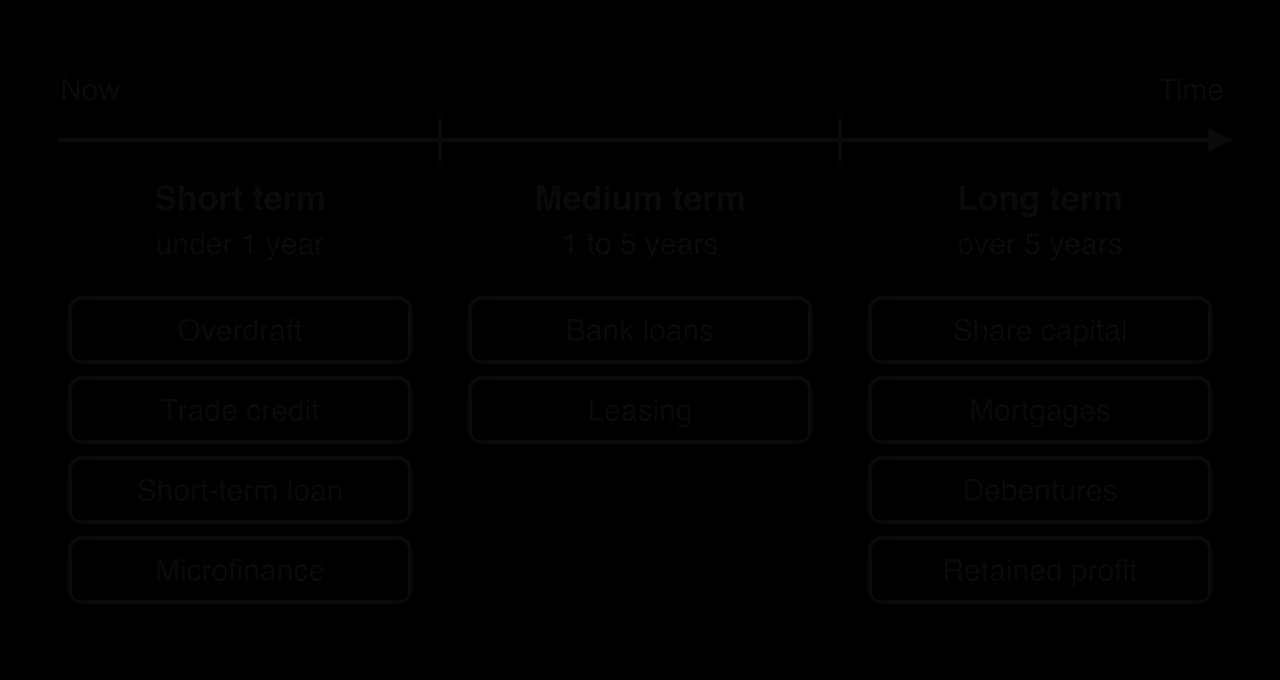
A sound principle is to match the time frame of the finance to the life of what it pays for. A building used for 30 years should be paid for with finance that does not have to be repaid quickly, such as share capital, a mortgage or retained profit. Stock that will be sold within weeks can be paid for with trade credit or an overdraft. Leasing and bank loans suit assets that last a few years, such as computers and vans.
Mismatches cause problems in both directions. Financing a long-term asset with short-term borrowing creates a liquidity risk: the money must be repaid before the asset has earned it back, so the business may be unable to pay. Financing a temporary need with long-term finance is wasteful: the business pays interest or gives away ownership for years to cover a gap of a few months.
No source of finance is best in every situation. Managers choose by weighing several factors, and the right answer for one business can be the wrong one for another.
What the money is for, and how long it is needed, is the first test. Working capital and seasonal needs suit short-term sources; vehicles and equipment suit medium-term loans or leasing; buildings, acquisitions and long research projects suit long-term sources.
Small sums can come from personal funds, an overdraft or trade credit. Large sums may only be available through share issues, bonds or large loans, and the costs of arranging these (legal fees, a prospectus) make them worthwhile only for big amounts.
Each source has a cost: interest on loans and overdrafts, dividends and loss of future profits on shares, rent on leases, fees on crowdfunding, and the lost dividend or lost interest on internal funds (their opportunity cost). Managers compare these costs with the return they expect from the project.
Only companies can issue shares, and only publicly held companies can sell them to the public. Sole traders and partnerships rely on personal funds, loans, overdrafts, trade credit and leasing. Small and new businesses with no trading record find bank loans hard to obtain, so they turn to personal funds, business angels, crowdfunding or microfinance. Large, established firms can use retained profit and issue bonds.
A business that already has large loans will find further borrowing expensive or impossible, because lenders see the risk of non-payment rising; it may have to use share capital instead. The risk of the project also matters: a risky research project suits share capital or venture capital, because dividends can be cut if it fails, whereas a fixed loan must be repaid regardless.
Owners who want to keep control avoid selling shares to outsiders and prefer loans or internal sources. A founder who sells a large stake to venture capitalists or business angels may find them influencing, or even overruling, key decisions.
Some sources can be adjusted as needs change: an overdraft is used only when needed, and a lease can be renewed or ended. Others are fixed commitments: a loan has a fixed repayment schedule, and a sale and leaseback commits the business to rent for many years.
When interest rates are high, borrowing is expensive and businesses prefer retained profit or share capital. When share prices are low, selling shares raises less money for each share of ownership given away. In a recession, banks lend more cautiously, and businesses with weak profits may be refused credit altogether.
In practice, businesses combine several sources. A start-up may begin with personal funds and a small loan, add business angels or crowdfunding as it grows, and later rely on retained profit and share issues. The best combination depends on the purpose and time frame of the spending, the amount, the legal form and size of the business, its existing debts, how much control the owners want to keep, and the cost of each source at the time, which changes with interest rates and the state of the economy.
Stakeholders weigh these choices differently. Shareholders gain from loans if the project earns more than the interest, but lose if repayments threaten the business; employees and suppliers want the business to avoid risky borrowing that could lead to failure; lenders want security and a record of profits. A good recommendation states which source fits best, why, and what could make a different source better.
Pebble Technology, based in Palo Alto in the United States and led by its founder Eric Migicovsky, made smartwatches with long-lasting e-paper screens that connected to smartphones. Before Pebble, the team had sold an earlier watch, inPulse. Hardware start-ups need large sums before they can sell anything, for design, moulds, components and manufacturing, and Pebble had failed to raise enough from venture capitalists. In April 2012 it turned to reward crowdfunding on Kickstarter.
The first campaign asked for US$100,000. Backers who pledged US$115 (US$99 for the first 200) would receive a Pebble watch. By the deadline in May 2012, 68,929 backers had pledged US$10,266,845, more than 100 times the target. In 2015 a second campaign, for the Pebble Time, set a US$500,000 target and raised US$20,338,986 from 78,471 backers, about 40 times its target. A third campaign in 2016, for the Pebble 2, Time 2 and Core, raised US$12,779,843 from 66,673 backers.
Campaign | Target (US$) | Pledged (US$) | Backers | Average pledge (US$) |
|---|---|---|---|---|
Pebble (2012) | 100,000 | 10,266,845 | 68,929 | 148.95 |
Pebble Time (2015) | 500,000 | 20,338,986 | 78,471 | 259.19 |
Pebble 2, Time 2 and Core (2016) | not available | 12,779,843 | 66,673 | 191.68 |
Sources: Kickstarter project pages and statistics for each campaign.
Crowdfunding gave Pebble three things a bank loan could not. It raised millions without giving away any ownership or paying interest. It proved that there was demand, which made the business more attractive to investors: in May 2013 Pebble raised US$15 million of venture capital in a round led by Charles River Ventures. And it gave Pebble publicity and a loyal community of users who also wrote apps for the watch.
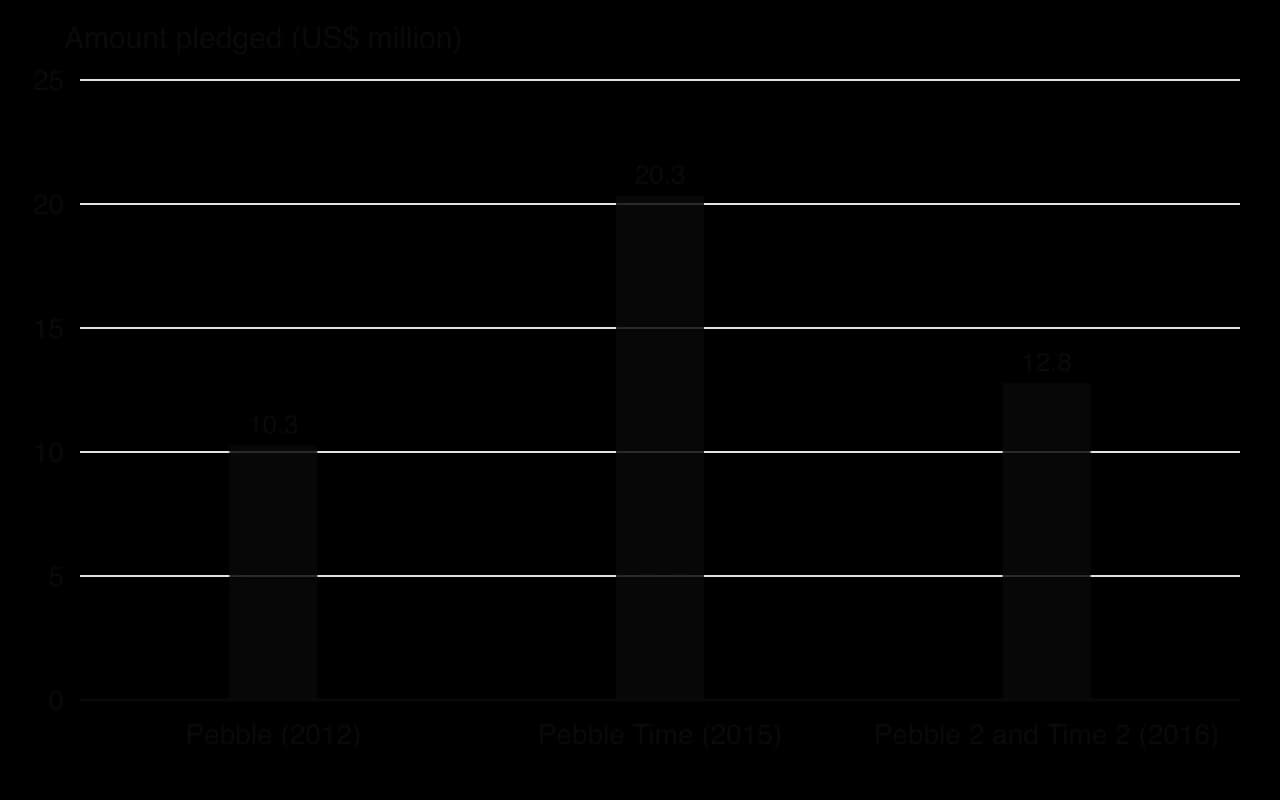
Reward crowdfunding also has a limit that the Pebble case shows clearly. The money raised was mainly payment in advance for watches. Each pledge came with an obligation to make and deliver a product, at a price fixed before production costs were known, so much of the money was spent on producing the very watches it paid for. It did not provide permanent finance for research, staff and the running of the business, and it could not be repeated for ever: the third campaign raised about 37% less than the second.
By 2016 the smartwatch market had become crowded with larger, better-financed competitors. On 7 December 2016, Pebble announced that it could no longer operate as an independent business, after shipping more than 2 million watches. It stopped making devices, and backers of the 2016 campaign who had not received their rewards were promised full refunds. Fitbit bought certain assets of the business, mainly its software and intellectual property, for US$23.4 million in cash, and some of Pebble's staff joined Fitbit.
The case suggests that crowdfunding is an excellent way to launch a product and test a market, but a poor substitute for long-term finance. A business that relies on pre-orders must keep winning new pre-orders to fund its costs, and when growth slows it needs share capital, retained profit or loans to survive. The data has limits: the amounts pledged are not the same as the money Pebble received after platform fees and payment failures, and the reasons for Pebble's failure also include competition and its costs, which crowdfunding figures do not show.
Explain why reward crowdfunding was a suitable source of finance for Pebble in 2012.
Analyse the difference between the US$20.3 million raised on Kickstarter in 2015 and the US$15 million of venture capital raised in 2013.
Explain why crowdfunding alone could not secure Pebble's future.
Sources: Kickstarter, project statistics for "Pebble: E-Paper Watch for iPhone and Android" (2012), "Pebble Time" (2015) and "Pebble 2, Time 2 + All-New Pebble Core" (2016); Pebble, "Pebble's Next Step" (blog), 7 December 2016; Fitbit, Inc., Form 10-K for 2016; Crowdfund Insider, 17 May 2013.
"Explain two" questions want two distinct points, each applied to the case.
Calculation questions on sources of finance usually compare the cost of two options. Show the formula and each step, and state the answer with its unit.
Internal sources (personal funds, retained profit, sale of assets, sale and leaseback) use money the business or owner already has; they cost no interest but are limited in size.
External sources (share capital, loan capital, overdrafts, trade credit, crowdfunding, leasing, microfinance, business angels, venture capital, grants) can provide larger sums but bring costs or loss of control.
Share capital is permanent and has no fixed cost but dilutes ownership; loan capital keeps control but must be repaid with interest.
Overdrafts and trade credit suit short-term working capital needs; loans and leasing suit medium-term assets; share capital, mortgages, debentures and retained profit suit long-term investment.
The time frame of the finance should match the life of what it pays for.
The choice of source depends on purpose, amount, cost, legal form and size, existing debt, control, flexibility and the state of the economy.
I can define internal and external sources of finance and short-term and long-term finance.
I can explain how each internal source works, with its advantages and disadvantages.
I can explain how each external source works, including who can use it and what it costs.
I can describe mortgages, debentures, venture capital, government grants and subsidies.
I can calculate the interest on a loan or an overdraft and the value of a trade credit discount.
I can distinguish between share capital and loan capital.
I can evaluate whether a short- or long-term source is appropriate for a given situation.
I can recommend and justify a source of finance for a business in a case.
Profit before interest and tax, year to 31 March 2025
₹150 million |
Average gearing ratio of Indian textile manufacturers | 35.00 % |
Define the term gearing.
2 marks
Award [1] for a partial definition that shows some understanding, e.g. the amount of borrowing / debt a business has.
Award [2] for a full definition, e.g. the proportion of a business’s capital employed (long-term finance) that comes from non-current liabilities (long-term loans) rather than from equity, showing how far the business depends on borrowing.
Candidates are not expected to word their definition exactly as above.
Using Table 1, calculate Rangoli’s gearing ratio for 2025 (show all your working).
2 marks
= 42.00 %
Award [1] for correct working and [1] for the correct answer with the % sign.
Calculate Rangoli’s gearing ratio if the second factory were financed entirely by the bank loan (paragraph 2). Assume all other figures stay at their 2025 values (show all your working).
2 marks
Explain two possible consequences for Rangoli of the increase in its gearing ratio between 2024 and 2025.
4 marks
Higher interest costs: more of Rangoli’s ₹150 million PBIT is used for interest, reducing profit available for the Mehta family as dividends or retained profit.
Greater risk if interest rates rise or sales fall: interest must be paid whatever the level of sales, so a fall in European demand would hit profit harder.
Harder or costlier to borrow again: at 42.00 % Rangoli is above the industry average of 35.00 %, so lenders may charge a higher rate or ask for more collateral.
Benefit: the family kept full control, and if the new looms earn a return above the interest rate, returns to shareholders rise.
Accept any other relevant consequence.
Mark as 2 + 2. For each consequence, award [1] for identifying it and [1] for explaining it in the context of Rangoli. Award a maximum of [2] for a theoretical answer.
Discuss whether Rangoli should finance the second factory with the bank loan or by selling new shares to the private investor.
10 marks
For the bank loan:
The Mehta family keeps full ownership and control; no outside board member.
Interest is a known cost (₹55 million a year at 11 % on ₹500 million) and is tax-deductible; once repaid, all future profit stays with the family.
Strong demand for organic cotton fabric and a factory already at full capacity suggest the investment should generate the cash to cover interest and repayments.
If the return on the new factory is above 11 %, gearing magnifies the returns to shareholders.
Against the bank loan / for the share issue:
Gearing would rise from 42.00 % to 61.33 %, well above the industry average of 35.00 % and above the usual 50 % threshold for a highly geared business: a high-risk position.
Interest of ₹55 million on top of existing interest would take a large share of PBIT of ₹150 million.
Demand from European brands may fall (economic slowdown, currency changes), and interest must still be paid.
With the share issue, gearing would fall to 28.00 % (420 ÷ 1 500 × 100); there is no interest or repayment, and the investor may bring expertise and contacts with European brands.
However, selling 30 % of the company dilutes the family’s control, and the investor will expect dividends; some family shareholders already object.
Other options: a smaller loan combined with retained profit; a smaller share issue; leasing equipment; delaying the factory until the 2025 loan is partly repaid.
Possible conclusion: given the jump to 61.33 %, many candidates may judge the share issue (or a mix of finance) less risky, but a well-argued case for the loan, based on strong demand and control, can also earn full marks.
Limitations: no forecast of the new factory’s returns or of interest rates; the investor’s terms beyond 30 % are unclear; only two years of data.
Marks should be allocated according to the markbands below.
Additional guidance:
If only one source of finance is discussed, award a maximum of [5].
Baltic Freight Solutions
[1] Baltic Freight Solutions (BFS) is a logistics company based in Riga, Latvia. It stores and transports goods for food retailers and online sellers in the Baltic states. In 2025 BFS borrowed €1.5m, at an interest rate of 7 % a year, to buy a fleet of refrigerated trucks.
[2] Later in 2025 BFS lost its contract with a supermarket chain, and its warehouse in Daugavpils has been empty since September. The warehouse has a book value of €2.0m and still costs BFS €80 000 a year in security, insurance and maintenance.
[3] The finance director, Ilze Kalniņa, proposes selling the warehouse for €2.0m. She would use €600 000 to clear BFS’s bank overdraft and €1.4m to repay part of its long-term loans. The operations director, Andris Ozols, disagrees: online sales in the region are growing quickly and he believes BFS could win new storage contracts within a year. Property prices in Daugavpils are currently low.
Table 1: Extracts from BFS’s final accounts for the years ending 31 December (€000)
2024 | 2025 | |
|---|---|---|
Sales revenue | 7 200 | 8 000 |
Profit before interest and tax | 1 080 | 900 |
Cash | 320 | 150 |
Debtors | 1 100 | 1 350 |
Stock | 80 | 100 |
Current liabilities (including bank overdraft) | 1 000 | 1 600 |
Non-current liabilities | 3 000 | 4 500 |
Equity | 6 000 | 6 500 |
In 2025 the bank overdraft was €600 000.
Table 2: Selected ratios for BFS in 2024
Ratio | 2024 |
|---|---|
Profit margin | 15.00 % |
ROCE | 12.00 % |
Acid-test ratio | 1.42 |
Using Table 1, calculate BFS’s return on capital employed (ROCE) for 2025 (show all your working).
2 marks
Using Table 1, calculate BFS’s acid-test ratio for 2025 (show all your working).
2 marks
Using Tables 1 and 2 and your answers to (a) and (b), comment on the changes in BFS’s profitability and liquidity between 2024 and 2025.
4 marks
Evaluate Ilze Kalniņa’s proposal to sell the Daugavpils warehouse.
10 marks
Nakamura Precision makes metal parts for robot arms in Nagoya, Japan. On 31 March 2026 its current assets were ¥480m, of which ¥200m was stock, and its current liabilities were ¥400m, including a bank overdraft of ¥160m. The finance manager, Kenji Ota, proposes replacing the whole overdraft with a five-year bank loan of ¥160m.
Calculate Nakamura Precision’s current ratio and acid-test ratio before and after the overdraft is replaced (show all your working).
4 marks
Explain why replacing the overdraft improves these ratios but does not improve Nakamura Precision’s cash position.
2 marks
Explain one disadvantage to Nakamura Precision of replacing the overdraft with a five-year loan.
2 marks
= 61.33 %
Award [1] for correct working and [1] for the correct answer. Accept OFR from (b)(i).
If the response makes no use of the gearing figures (Tables 1 and 2 or the answers to (b)), award a maximum of [4].
A response without a conclusion is usually limited to [6].
Markbands (10-mark extended response, Papers 1 and 2)
Marks | Level descriptor |
|---|---|
0 | The response does not reach the standard described below. |
1–2 | Little understanding of what the question demands. Business management tools and theories are barely used, or are irrelevant or inaccurate. Little or no reference to the stimulus material. No arguments are made. |
3–4 | Some understanding of what the question demands. Some use of tools and theories, but mostly inaccurate or not relevant. Use of the stimulus is superficial, often no more than the name of the organisation or person. Arguments are mostly unsubstantiated. |
5–6 | Understands what the question demands but addresses it only partially. Some relevant, accurate use of tools and theories. Some relevant use of the stimulus beyond names, but it does not effectively support the argument. Arguments are substantiated but mostly one-sided. |
7–8 | Mostly addresses what the question demands. Mostly relevant, accurate use of tools and theories. The stimulus generally supports the argument, with some lapses in clarity or relevance. Arguments are substantiated and show some balance. |
9–10 | Clear focus on what the question demands. Relevant, accurate use of tools and theories. Relevant stimulus material is integrated effectively to support the argument. Arguments are substantiated and balanced, and the limitations of the case or stimulus material are explained. |
A response with no judgement or conclusion is unlikely to reach the top band of a discuss, evaluate, examine or recommend question.