Explain why businesses need finance and distinguish capital expenditure from revenue expenditure, including how each is recorded in the final accounts and why the difference matters.
Each is in the Business glossary, with every other term in the subject.
Spending on non-current assets, such as buildings, machinery and vehicles, that will be used in the business for more than one year.
The money a business obtains and manages to pay for its activities; also the business function responsible for raising, planning, recording and controlling that money.
Spending on the day-to-day running costs of a business, such as wages, rent, utilities and raw materials, whose benefit is used up within the year.
The finance needed to set up a new business and pay for its first assets and costs before it generates enough revenue to cover them.
Define finance, start-up capital, capital expenditure and revenue expenditure.
Explain the main reasons why businesses need finance.
Distinguish between capital expenditure and revenue expenditure, using examples.
Classify items of spending as capital or revenue expenditure and justify the classification.
Explain how capital and revenue expenditure appear in the statement of financial position and the statement of profit or loss.
Explain why the distinction matters for profit, for decisions about finance and for ethical accounting.
Every business needs money to start, to run from day to day and to grow. Finance is the function that plans how much money the business needs, finds it and controls how it is spent. A useful first step is to sort spending into two kinds: spending on things that last for years, such as buildings and machinery, and spending on the everyday running of the business, such as wages and electricity.
The way a business finances and records its spending shapes its future. Spending on new technology is often a response to change in markets, and how honestly spending is recorded is a question of ethics: a business that disguises running costs as long-term spending makes its profit look higher than it really is.
29 exam-style questions on this subtopic, written in the style of the IB papers. The first has its markscheme open. Counted on
Danforth Strength Club is a gym in Toronto, Canada. In January 2026 it paid CAD 180 000 in cash for new strength and cardio equipment. The owners expect the equipment to attract new members and to last for at least eight years. Table 1 shows the gym’s quarterly cash flow forecast for 2026.
Table 1: Danforth Strength Club quarterly cash flow forecast, 2026 (CAD 000)
Q1 | Q2 | Q3 | Q4 | |
|---|---|---|---|---|
Opening balance | 200 | |||
Membership fees | 95 | 110 | 120 | 125 |
Operating costs | 80 | 80 | 80 | 80 |
New equipment | 180 |
Using Table 1, calculate the closing balance at the end of each quarter of 2026 (show all your working).
3 marks
The official deck for this part of the syllabus.
Define finance (two meanings).
Give one example of how each of these functions depends on the finance function: marketing, operations and human resources.
With a free account, Augment remembers where you stopped and what you have practiced.
In business management, finance has two related meanings. It is the money a business raises to pay for its activities, and it is the business function (finance and accounts) that manages that money. The finance function works with the other business functions: marketing needs a budget for promotion, operations needs money for machinery and materials, and human resources needs money for wages and training.
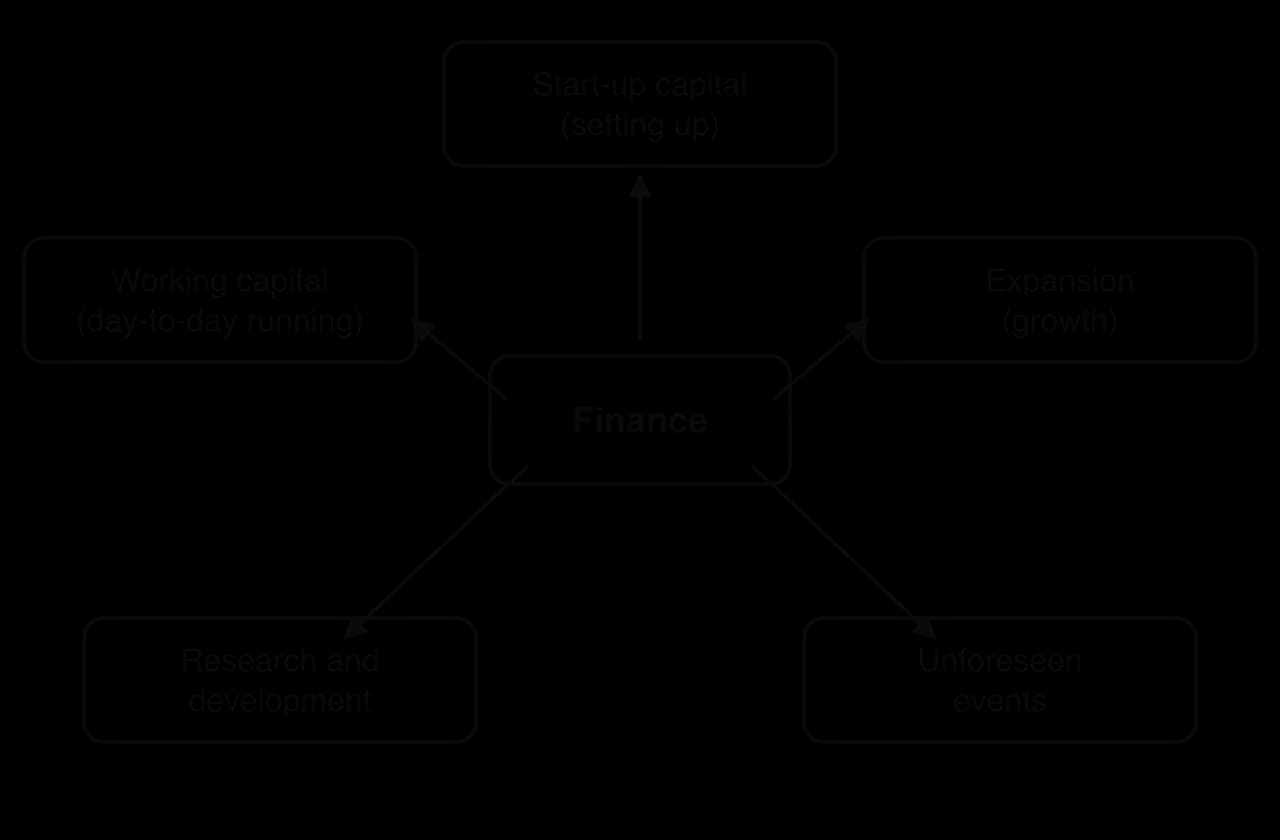
Businesses need finance for five main reasons. The reasons differ in how much money is needed, for how long, and how risky the spending is, so each tends to suit different sources of finance.
A new business must pay for many things before it earns any revenue: premises, equipment, an opening stock of materials or goods, legal registration, a website and early marketing. The money used to pay for these is start-up capital. An entrepreneur setting up a café, for example, may need to fit out the premises, buy a coffee machine and furniture, and pay the first months of rent before the café has served a single customer.
Start-up capital is hard to raise because a new business has no trading record. Lenders cannot see whether it will make a profit, so many entrepreneurs rely at first on their own savings or on family and friends.
Once trading starts, a business needs money to pay for its day-to-day running: wages, rent, utility bills and supplies. Customers often pay later than the business has to pay its own bills, so the business needs a cushion of money to cover the gap. This money is working capital, the difference between current assets and current liabilities. Even a profitable business can fail if it runs out of working capital, because suppliers and employees must be paid on time.
Businesses that want to grow need finance to open new outlets, build larger factories, enter new markets or buy other businesses. Expansion usually requires large sums that the business cannot pay for from its day-to-day revenue, and the returns arrive only over several years.
Expansion projects can be very large even for established firms. Bosch, the German engineering company, is investing about US$2 billion to convert its plant in Roseville, California, into a factory for silicon carbide chips, with up to US$225 million of support from the US government under a funding agreement signed in July 2026. Spending on this scale is planned years ahead and paid for with long-term finance, because the new factory will earn revenue only over many years.
Sources: US National Institute of Standards and Technology, "Department of Commerce announces direct funding agreement with Bosch for up to $225 million", July 2026.
Many businesses spend money developing new products and processes long before they can sell them. A pharmaceutical company may spend years testing a medicine that might never be approved, and a technology company must keep improving its products to stay ahead of competitors. Research and development is a risky use of finance, because the spending happens now and the revenue, if any, comes later. It is closely linked to creativity, since new ideas need money to become products.
Businesses also need finance to survive problems they cannot plan for: a fall in sales during a recession, a fire or flood, a strike at a key supplier, or a sudden rise in energy prices. A business with savings or an agreed source of emergency borrowing can keep paying its bills while it recovers.
Capital expenditure is spending on items the business will use for more than one year. These items are non-current assets: land and buildings, machinery, vehicles, computer systems, and fixtures and fittings such as shop counters. Spending that improves or extends the life of an existing asset, such as adding an extension to a factory, also counts as capital expenditure.
Capital expenditure has four typical features. It is usually large, it happens only occasionally, it is planned in advance, and it brings benefits over many years. Because of this, capital expenditure is usually paid for with long-term finance, such as share capital, long-term loans or retained profit, rather than with money that must be repaid within months.
Capital expenditure is also called capex. Decisions about it are among the most important a business makes, because they commit the business for years. A hotel chain that builds a new hotel cannot easily change its mind once the building is finished. For this reason, managers use investment appraisal to estimate whether a large capital project will earn back more than it costs.
Type of business | Examples of capital expenditure |
|---|---|
Café | Coffee machine, ovens, furniture, shop fitting |
Car manufacturer | Factory buildings, robots on the assembly line, paint shop |
Delivery firm | Vans, warehouse, sorting machines, tracking software bought outright |
School | New classroom block, science laboratory equipment, minibus |
Hospital | Scanners, operating theatres, ambulances |
The table shows that what counts as capital expenditure depends on what the business does with the item. A van bought by a delivery firm is capital expenditure because the firm will use it for years. The same van bought by a car dealer to resell is part of the dealer's stock, so it is not capital expenditure for the dealer.
Revenue expenditure is spending on the day-to-day running of the business. The items bought are used up within the year, or the service is received and finished within the year. Typical examples are wages and salaries, rent, electricity and water, raw materials, advertising, insurance, and repairs and maintenance that keep existing assets working.
Revenue expenditure is regular, often smaller per item, and necessary to keep the business operating. It is usually paid for from the revenue the business earns from its sales, or from short-term finance such as an overdraft or trade credit when the timing of payments does not match the timing of income.
Revenue expenditure is recorded as expenses in the statement of profit or loss for the period in which it happens. This means every dollar of revenue expenditure reduces the profit of that year.
The test is the time over which the business benefits. If the spending creates or improves an asset the business will use for more than a year, it is capital expenditure. If the benefit is used up within the year, it is revenue expenditure.
Feature | Capital expenditure | Revenue expenditure |
|---|---|---|
What is bought | Non-current assets used for more than one year | Goods and services used up within the year |
Examples | Buildings, machinery, vehicles, computer systems | Wages, rent, utilities, raw materials, advertising, repairs |
How often | Occasional, planned | Regular, recurring |
Usual size | Large sums per item | Smaller sums per item, large in total |
Where recorded | Statement of financial position (as an asset) | Statement of profit or loss (as an expense) |
Effect on this year's profit | Only the part used up this year reduces profit | All of it reduces this year's profit |
Usual source of finance | Long-term: share capital, loans, retained profit | Short-term: sales revenue, overdraft, trade credit |
Most items are easy to classify, but some need care. The same kind of spending can fall on either side depending on what it does to the asset and how long its benefit lasts.
Repairs versus improvements. Replacing a broken window in a shop is revenue expenditure, because it restores the asset to its previous condition. Adding a new glass shopfront that makes the shop larger is capital expenditure, because it improves the asset.
Buying versus renting. Buying a delivery van is capital expenditure. Leasing the same van for a monthly payment is revenue expenditure, because the business pays for the use of the van in each period rather than owning it.
Software bought versus software subscribed to. A business that buys a licence for a computer system it will use for years makes capital expenditure. A monthly subscription to an online accounting service is revenue expenditure.
Costs of getting an asset ready. Delivery and installation of a new machine are part of its capital expenditure, because they are needed to bring the asset into use. Electricity to run the machine afterwards is revenue expenditure.
 YouTube
The two types of spending are recorded in different final accounts. Capital expenditure is recorded in the statement of financial position (also called the balance sheet), which shows what the business owns and owes at a point in time. Revenue expenditure is recorded in the statement of profit or loss, which shows the revenue and costs of a period, usually a year.
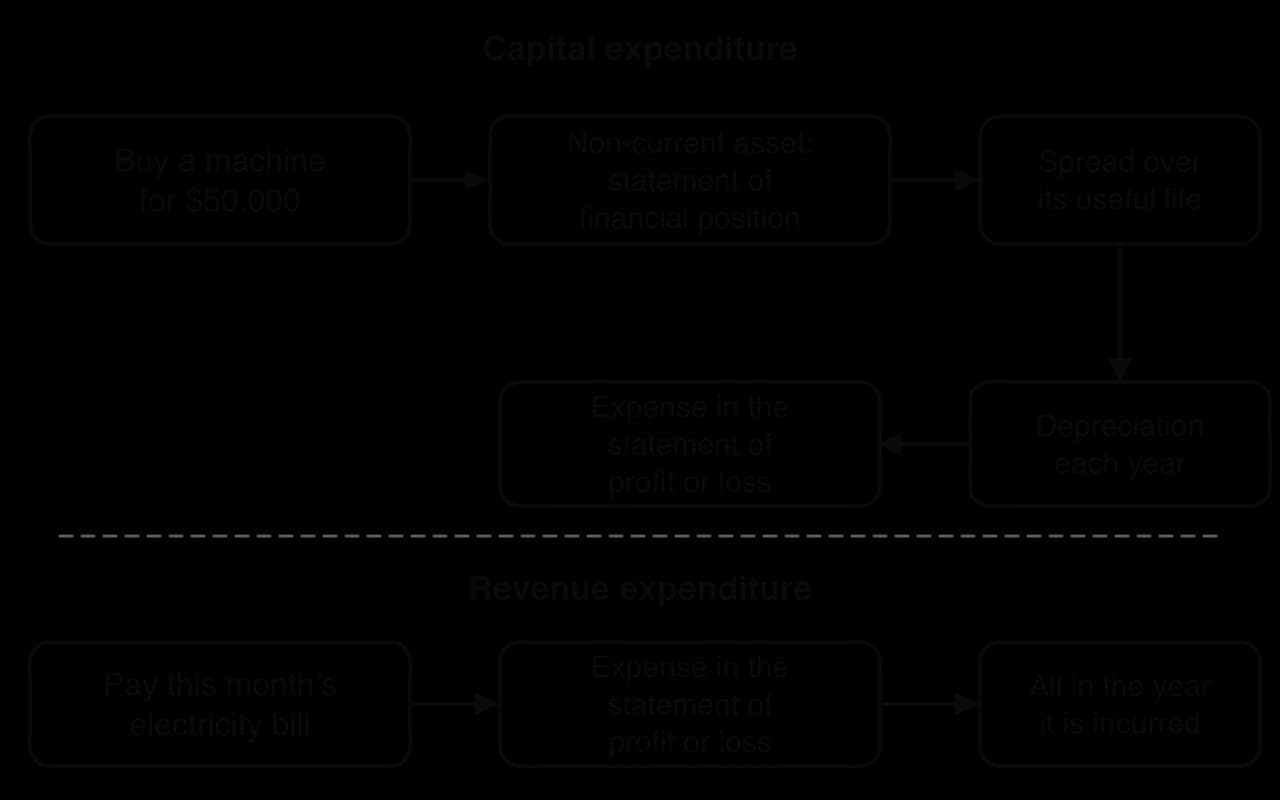
The flow diagram shows why the two are treated differently. When a business buys a machine for $50,000 that will last five years, it would be misleading to charge the whole $50,000 against the profit of the first year, since the machine will help to earn revenue in all five years. Instead, the machine is shown as a non-current asset, and its cost is spread across its useful life. The share charged each year is called depreciation, and it appears as an expense in the statement of profit or loss. In the statement of financial position, the machine is shown at its cost minus the depreciation charged so far.
Revenue expenditure has no lasting value, so all of it is charged as an expense in the year it is incurred. A business's electricity bill for March is an expense of that year; nothing is left to record as an asset afterwards.
Profit is meant to measure how well a business performed in one period. Charging the full cost of long-lasting assets against one year would make that year look poor and later years look better than they were. Spreading capital expenditure over the years in which the asset is used matches each year's costs with the revenue those costs help to earn.
Capital expenditure is large and pays back slowly, so it should be financed from long-term sources. A business that pays for a new factory with an overdraft, which the bank can ask to be repaid at short notice, risks a cash crisis. Revenue expenditure recurs every month and should be covered by sales revenue, with short-term sources filling temporary gaps. Matching the sources of finance to the type of spending is one of the most common decisions finance managers make.
Capital expenditure uses a large amount of cash at one time, while its benefits arrive slowly. A business that spends heavily on capital projects can therefore be profitable and still short of cash flow. Planning capital expenditure carefully, and keeping enough working capital for daily running, helps the business pay its bills on time.
Because revenue expenditure reduces profit immediately and capital expenditure does not, a business can make its profit look higher by recording running costs as capital expenditure. This is a form of creative accounting that misleads shareholders, lenders and employees. In 2002, the US Securities and Exchange Commission charged the telecommunications company WorldCom with transferring ordinary operating costs, the fees it paid to use other companies' networks, into its capital accounts. The SEC alleged that this overstated WorldCom's income before tax by about US$3.055 billion in 2001.
Sources: US Securities and Exchange Commission, complaint against WorldCom, Inc., 2002.
Key concept | How it applies to capital and revenue expenditure |
|---|---|
Change | New technology, rules or customer demand force businesses to replace assets, so capital expenditure often comes in waves after a change (for example, new equipment to meet emissions rules). |
Creativity | Spending on research and development and on new processes turns ideas into products; how it is financed decides whether ideas can be developed at all. |
Ethics | Recording revenue expenditure as capital expenditure inflates profit and misleads stakeholders, as in the WorldCom case. |
Sustainability | Capital expenditure on energy-efficient buildings and machinery can cut future revenue expenditure on energy and reduce emissions. |
Taiwan Semiconductor Manufacturing Company (TSMC) is the world's largest contract manufacturer of computer chips. It makes chips designed by other companies, for smartphones, data centres and cars, in factories called fabs. A modern fab costs billions of dollars to build and equip, and its machines must be replaced every few years as chip technology advances, so TSMC is one of the most capital-intensive businesses in the world.
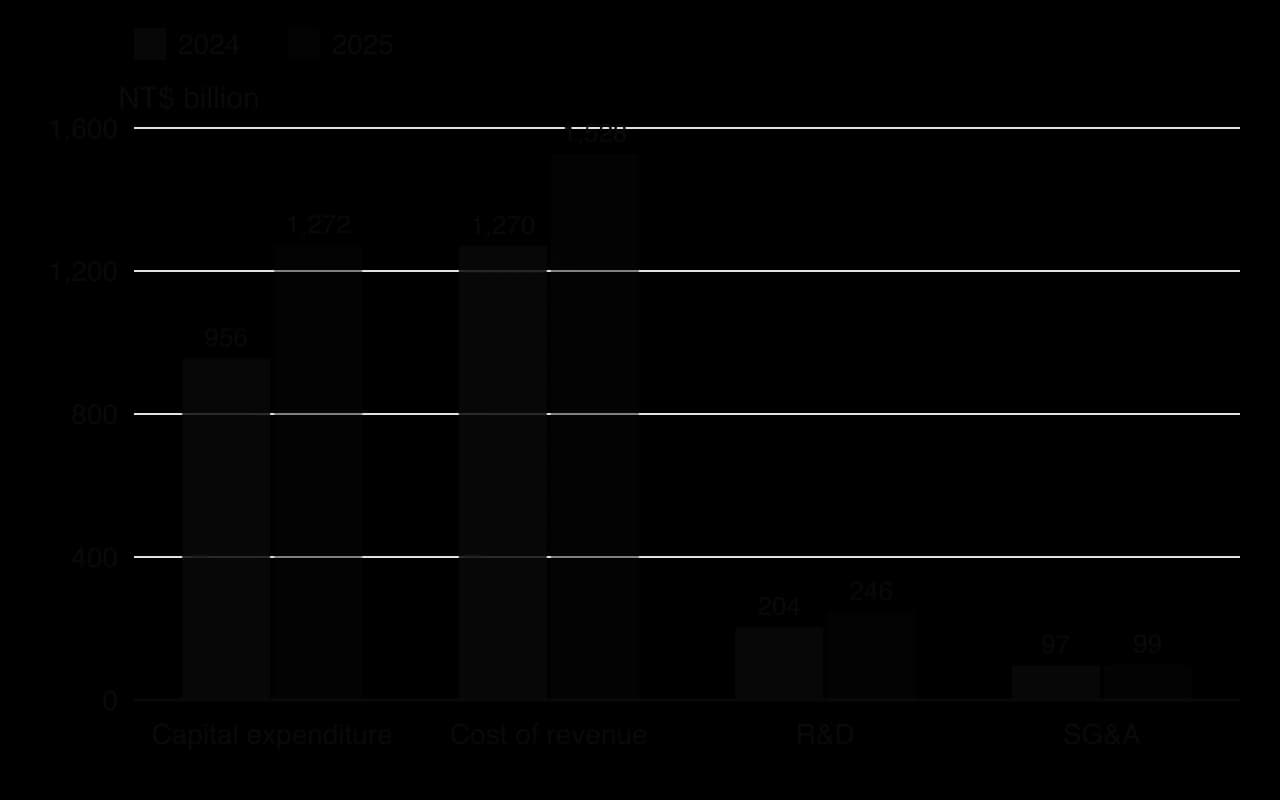
In 2025, TSMC's net revenue was NT$3,809 billion (about US$122 billion), 31.6% more than in 2024. In the same year its capital expenditure was NT$1,272 billion, or US$40.9 billion. Capital expenditure was equal to about a third of revenue in both 2024 and 2025, so for every NT$100 of chips it sold, TSMC spent about NT$33 on new fabs and equipment.
TSMC, NT$ billion | 2024 | 2025 |
|---|---|---|
Net revenue | 2,894.31 | 3,809.05 |
Capital expenditure | 956.01 | 1,272.41 |
Cost of revenue | 1,269.96 | 1,527.76 |
Research and development | 204.18 | 246.43 |
Selling, general and administrative expenses | 96.89 | 99.22 |
Depreciation and amortisation | 662.80 | 688.10 |
Source: TSMC, 4Q25 Management Report, 15 January 2026.
The table separates the two types of spending. Capital expenditure buys fabs and machines that TSMC will use for years, so it is recorded as non-current assets in the statement of financial position. Cost of revenue, research and development, and selling and administrative expenses are charged in the statement of profit or loss in the year they are incurred. Research and development is a large revenue expenditure for TSMC because it must develop each new generation of chip-making technology before customers will order it.
Past capital expenditure reaches TSMC's statement of profit or loss through depreciation. In 2025 depreciation and amortisation were NT$688 billion, much of it charged as part of the cost of making chips. Because TSMC's capital expenditure (NT$1,272 billion) was nearly twice its depreciation (NT$688 billion), the value of its non-current assets kept growing, because new fabs were being added faster than the old ones were being written off.
TSMC finances most of this spending internally. In 2025 its operating activities generated NT$2,275 billion of cash, enough to pay for all its capital expenditure and still leave NT$1,003 billion of free cash flow, part of which was paid to shareholders as dividends. A smaller chip maker without TSMC's profits would have to borrow or issue shares to fund spending on this scale, which is one reason why only a few firms can compete in advanced chip manufacturing.
The case shows the risks as well as the strengths of heavy capital expenditure. TSMC commits money years before the chips are sold, based on forecasts of demand from customers in artificial intelligence and smartphones. Its new fabs in Arizona, Kumamoto (Japan) and Dresden (Germany) are more expensive to run than its plants in Taiwan; TSMC reported that its overseas fabs reduced its gross margin in 2025. If demand fell, TSMC would still carry the depreciation on its new fabs, so its profit would fall faster than its sales.
The limits of the data should be kept in mind. The figures are for two years only, are in Taiwan dollars, and come from the company's own report; they show how much TSMC spent, not whether each project will earn a good return.
Explain why TSMC's spending on new fabs is capital expenditure while its spending on research and development is revenue expenditure.
Analyse how TSMC's capital expenditure in 2025 will affect its statement of profit or loss in later years.
Explain why TSMC can finance its capital expenditure internally while a smaller competitor might not be able to.
Sources: TSMC, 4Q25 Management Report and full-year 2025 results, 15 January 2026.
Structured questions combine the definitions with the case. A typical question asks for the distinction and an application to the business described.
Finance is the money a business raises and manages, and the function that plans and controls it.
Businesses need finance for start-up capital, working capital, expansion, research and development, and unforeseen events.
Capital expenditure is spending on non-current assets used for more than one year; revenue expenditure is spending on day-to-day running costs used up within the year.
The test is how long the business benefits, not how much the item costs.
Capital expenditure is recorded in the statement of financial position and reaches profit gradually through depreciation; revenue expenditure is an expense in the statement of profit or loss in full.
Capital expenditure is best financed from long-term sources and revenue expenditure from revenue and short-term sources.
Recording revenue expenditure as capital expenditure overstates profit and is unethical.
I can define finance, start-up capital, capital expenditure and revenue expenditure.
I can explain five reasons why businesses need finance.
I can distinguish capital expenditure from revenue expenditure with examples.
I can classify items of spending and justify each classification, including borderline cases.
I can explain where each type of spending appears in the final accounts and how it affects profit.
I can explain why capital expenditure should be matched with long-term finance.
I can explain why disguising revenue expenditure as capital expenditure is unethical.
(CAD 000) | Q1 | Q2 | Q3 | Q4 |
|---|---|---|---|---|
Opening balance | 200 | 35 | 65 | 105 |
Total cash inflows | 95 | 110 | 120 | 125 |
Total cash outflows | 260 | 80 | 80 | 80 |
Net cash flow | (165) | 30 | 40 | 45 |
Closing balance | 35 | 65 | 105 | 150 |
Closing balance = opening balance + net cash flow, and each closing balance becomes the next quarter’s opening balance.
Award [1] for correct net cash flows, [1] for carrying the closing balance forward as the next opening balance, and [1] for all four closing balances correct (CAD 35 000, CAD 65 000, CAD 105 000, CAD 150 000). Apply OFR.
With reference to Danforth Strength Club, explain the relationship between investment, profit and cash flow.
4 marks
Investment (capital expenditure) is an immediate cash outflow: the CAD 180 000 paid in Q1 makes net cash flow negative (CAD 165 000) and reduces the balance from CAD 200 000 to CAD 35 000.
The equipment is a non-current asset used for at least eight years, so its cost is not charged as an expense against Q1’s profit in full; the gym may report a profit in Q1 even though its cash fell sharply.
The returns from the investment come later and gradually: membership fees rise from CAD 95 000 to CAD 125 000 a quarter, increasing both profit and cash inflows, so the cash balance rebuilds to CAD 150 000 by Q4.
So in the short term investment worsens cash flow, while it is expected to improve profit and cash flow in the longer term; the gym must have enough cash or finance to survive the gap.
Award [1] for showing that investment is an immediate cash outflow, [1] for showing that profit and cash inflows from the investment come later, and [1]–[2] for using the club’s figures to explain the relationship.
Award a maximum of [2] for a theoretical answer with no reference to Danforth Strength Club.
Daan de Vries plans to open Nomad Pedals, a bicycle repair business in Utrecht, the Netherlands. He will rent a small workshop and also run a van that repairs bicycles at customers’ homes and offices. His estimated start-up costs are shown in Table 1. Daan has savings of €12 000 and his parents have agreed to lend him €5 000.
Table 1: Nomad Pedals’ estimated start-up costs
Item | Cost (€) |
|---|---|
Second-hand van, converted into a mobile workshop | 18 000 |
Tools and repair stands | 6 500 |
Workshop rent deposit (three months at €1 200) | 3 600 |
Initial stock of spare parts | 4 200 |
Website and branding | 1 700 |
Calculate the amount of additional finance Daan needs to start Nomad Pedals (show all your working).
2 marks
Identify two items in Table 1 that are capital expenditure.
2 marks
Explain two challenges, other than raising finance, that Daan may face in starting Nomad Pedals.
4 marks
Kahu Surf School
[1] Tama Kahu is a sole trader who runs Kahu Surf School (KSS) on the beach at Raglan, on the west coast of New Zealand. Tama, a former national surfing champion, opened KSS in 2019 using NZ$35 000 of his personal savings. He spent most of this on 20 surfboards, 30 wetsuits and a trailer to carry the boards. Lessons are sold online and most customers are tourists from Auckland and Hamilton.
[2] KSS is seasonal. From November to March it runs up to six lessons a day, and Tama employs two instructors. Each summer month KSS pays about NZ$7 200 in instructors’ wages, NZ$350 for its beach-use permit from the local council, NZ$420 for public liability insurance and about NZ$300 for surf wax, board repairs and fuel. From May to August revenue falls by more than 70 %, but the insurance and permit still have to be paid.
[3] Tama wants to grow KSS. Many tourists without cars have told him that Raglan is difficult to reach, so he plans to offer “surf day trips” that include transport from Hamilton. For this he needs a 12-seat minibus costing NZ$48 000. He also expects to need extra cash for advertising and wages during the first season of day trips, before the new service becomes known.
[4] Tama has two options for obtaining the minibus. His bank has offered a five-year loan of NZ$48 000 at 9 % interest a year, with repayments of about NZ$1 000 a month. The bank would require Tama’s house as collateral. Alternatively, a vehicle company would lease him a new minibus for NZ$1 150 a month for four years, including servicing and insurance. At the end of the lease the minibus would be returned. Tama’s partner, Mere, is worried about putting their house at risk, but Tama says that after five years “we would at least own something”.
Define the term capital expenditure.
2 marks
Using examples from paragraphs 1 and 2, distinguish between capital expenditure and revenue expenditure for KSS.
4 marks
Explain two reasons why Tama needs finance for KSS (paragraphs 2 and 3).
4 marks
Discuss whether Tama should use the bank loan or the lease to obtain the minibus.
10 marks