7 Human development
An overview of the human development context: the questions it asks, its eight areas of study, how they connect to each other, to the approaches and to the concepts, and how the topic is assessed.
- IB Psychology
- SL and HL
What 7 covers
From the subject guide: what you need to know and be able to do.
Models of cognitive, social, moral or language development, and the development of self.
8 subtopics in Human development
Each one has its own page once something is published for it.
- 7.1Brain developmentnotes
- 7.2Sociocultural factors in developmentnotes
- 7.3Stage theories and continuous modelsnotes
- 7.4Theory of mindnotes
- 7.5Attachmentnotes
- 7.6Enculturation of social normsnotes
- 7.7Peer influencenotes
- 7.8Role of childhood experiencesnotes
Key terms introduced here
Each is in the Psychology glossary, with every other term in the subject.
- Development of self
The process by which a person comes to understand who they are, including their self-concept, self-esteem and identity, shaped by attachment, culture, peers and childhood experiences.
- Developmental psychology
The branch of psychology that studies how and why behaviour, thinking, emotions and the self change across the lifespan, especially from infancy to adolescence.
- Identity
A person’s sense of who they are as an individual and as a member of social groups, including the values, roles and commitments that give them continuity over time.
- Self-concept
A person’s overall set of beliefs about who they are, including their characteristics, abilities, roles and relationships.
- Self-esteem
The evaluative part of the self-concept: how positively or negatively a person judges their own worth.
An overview of 7 Human development
Developmental psychology studies how and why behaviour, thinking and the self change over time, especially from infancy to adolescence. Human development is one of the four contexts of the course: a real-world setting in which the biological, cognitive and sociocultural approaches are applied and evaluated through the six concepts.
The topic has two parts. Models of development explain how children’s abilities change, using cognitive, social, moral or language development as examples; the main example is cognitive development, with moral development as a contrast. Development of self explains how a person’s self-concept, self-esteem and identity form through relationships, culture, peers and early experiences.
The questions human development tries to answer
How much of development reflects biological maturation, and how much reflects experience, and how do the two interact?
Does development happen in distinct stages, or through gradual, continuous change?
Are there periods in childhood when particular experiences matter most, and can later experience make up for what was missed?
Which parts of development are universal, and which depend on culture, family and social circumstances?
How can researchers know what infants and young children understand, when they cannot yet explain themselves?
How do relationships with carers and peers, and the norms of a culture, shape the person a child becomes?
The subtopics
Subtopic | What it covers |
|---|---|
7.1 Brain development | How the brain matures from infancy to early adulthood (synaptogenesis, pruning, myelination, the late-maturing prefrontal cortex), critical and sensitive periods, and the role of neuroplasticity |
7.2 Sociocultural factors in development | Vygotsky’s sociocultural theory (zone of proximal development, scaffolding), Bronfenbrenner’s ecological systems theory, parenting across cultures, socioeconomic status and schooling |
7.3 Stage theories and continuous models | Piaget’s and Kohlberg’s stage theories (and, more briefly, Erikson’s), information-processing accounts and Siegler’s overlapping waves, and how effective each kind of model is |
7.4 Theory of mind | Understanding that others have beliefs and desires, how it develops, how it is measured (false-belief tasks and others), what helps it develop, differences across cultures, and its role in development and cognition |
7.5 Attachment | Bowlby’s attachment theory, deprivation and privation, the Strange Situation and attachment types, sensitivity and temperament, cultural variation, and attachment in the development of self |
7.6 Enculturation of social norms | How children internalise their culture’s norms of self, gender, emotional display and morality |
7.7 Peer influence | How peers shape the developing self through conformity, social identity and social learning; identity formation; group socialisation theory; the adolescent brain’s sensitivity to peers; and peers online |
7.8 Role of childhood experiences | Adverse childhood experiences, toxic stress, institutional deprivation, poverty and war, and resilience and protective factors, with their long-term effects on the self |
How the subtopics connect
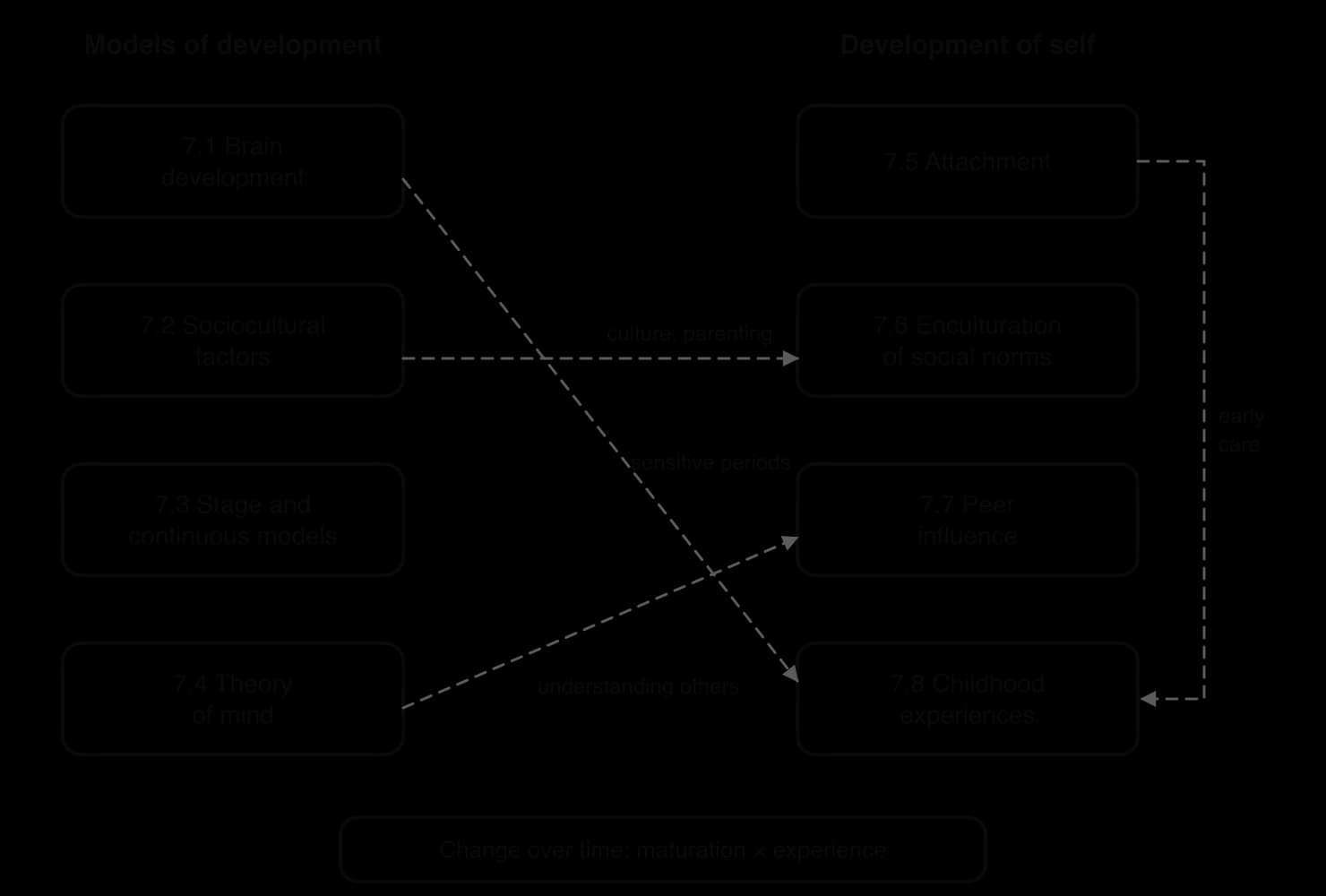
The models of development provide the tools for understanding the development of self. Brain maturation and neuroplasticity explain why early experiences, including deprivation and adversity, can have lasting effects, and why adolescents are especially sensitive to peers. Sociocultural theory and research on parenting and culture explain how children come to share the norms of their community, which is the process studied as enculturation. Theory of mind is needed for close relationships, for keeping secrets and for seeing oneself through others’ eyes, so it supports peer relationships and a self-concept that takes account of how others see the person.
Two debates run through every subtopic. The first is the interaction of maturation and experience: the brain matures on a biological timetable, but what it develops depends on care, language and culture. The second is universality and culture: many milestones, such as false-belief understanding and secure attachment, are found in every culture studied, while their timing and form vary with the culture a child grows up in.
Links to the concepts and the rest of the course
Change is the most central concept in human development, because development is itself a process of change over time. The same evidence is often evaluated through several concepts, and some are especially useful in this context.
Concept | How it applies in human development |
|---|---|
Change | Is a change the result of maturation, experience or intervention? Is it gradual or stage-like? Can early effects be reversed? |
Measurement | Infants and young children cannot report on their own thinking, so researchers infer it from looking times, false-belief tasks, the Strange Situation or brain scans |
Causality | Most developmental factors, such as poverty, parenting or institutional care, cannot be manipulated, so researchers use longitudinal, natural and quasi-experimental designs |
Bias | Classic theories were built on Western, often male, middle-class samples; deficit framing of low-income families and autistic people |
Perspective | Universal stage theories versus sociocultural accounts; biological versus social explanations |
Responsibility | Research with children and vulnerable groups, consent through parents, and the social consequences of findings about families |
The context draws on all three approaches. From the biological approach it uses neuroplasticity, brain imaging and chemical messengers such as cortisol in stress. From the cognitive approach it uses schema theory (Piaget’s schemas, internal working models) and cognitive models of information processing. From the sociocultural approach it uses enculturation, social learning theory, conformity, social identity theory and cultural dimensions. Explanations that combine the approaches are stronger than single-approach ones, because development always involves a maturing body in a social and cultural world.
The class practical for this context is an observation, which suits developmental research: much of what is known about children comes from watching them play, interact with carers or solve problems. Ethics are especially important when observing children, and naturalistic observation in a school practical is limited to settings where people expect to be seen.
How SL and HL differ
SL and HL students study the same eight areas of study in human development, at the same depth, and sit the same Papers 1 and 2. HL students build on this content in the HL extensions. The extension on the role of culture develops the cross-cultural research on development, such as parenting, attachment and theory of mind across cultures, and the challenges of researching culture.
The extension on motivation links to children’s learning and the effects of rewards, and the extension on technology to topics such as screen use in childhood and adolescence. HL students are assessed on the extensions in Paper 3, where the sources may be set in the human development context. Data analysis and interpretation is studied by SL and HL students but assessed only at HL, in Paper 3, where sources may come from developmental research.
Assessment
Component | How human development can appear |
|---|---|
Paper 1 Section B | An unseen scenario set in human development, such as a child learning at school or a teenager influenced by friends, to which an approach term (for example social learning theory, neuroplasticity or schema theory) must be applied |
Paper 1 Section C | A concept-based essay on one of the eight areas of study, for example evaluating strategies used to measure theory of mind, or discussing causality in research on childhood experiences |
Paper 2 Section A | Questions on the observation class practical, when it is the practical chosen for the paper |
Paper 2 Section B | An unseen developmental study, such as an observation of parent–child interaction or a false-belief experiment, evaluated through two or more concepts |
Paper 3 (HL only) | Sources on culture, motivation or technology that may be set in the human development context |
Carry on with 7 in Augment
With a free account, Augment remembers where you stopped and what you have practiced.