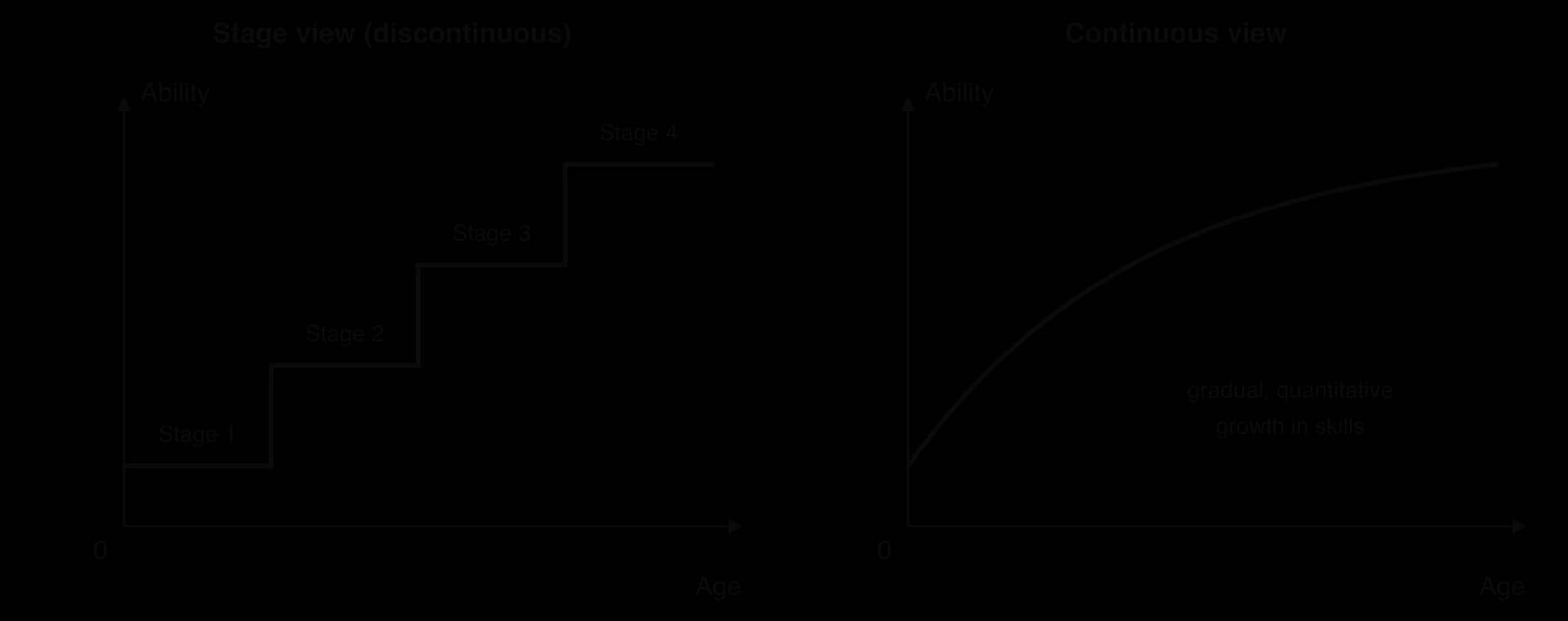
Compare stage theories and continuous models of development, describe and evaluate Piaget’s and Kohlberg’s theories, and judge how well each view explains developmental change.
Each is in the Psychology glossary, with every other term in the subject.
The understanding that a quantity such as number, mass or volume stays the same when its appearance changes, as long as nothing is added or taken away.
A model proposing that development is a gradual, cumulative process of quantitative change in knowledge, skills and processing capacity rather than a sequence of distinct stages.
In Piaget’s theory, the young child’s difficulty in distinguishing their own point of view from that of others, so that they assume others see and think as they do.
A stage theory proposing that moral reasoning develops through three levels (preconventional, conventional and postconventional), each with two stages, in a fixed and universal order.
The understanding that objects continue to exist even when they cannot be seen, heard or touched; in Piaget’s theory it develops in the sensorimotor stage.
Siegler’s continuous model in which children use several strategies at the same time and gradually shift towards more efficient ones, so each strategy’s frequency rises and falls like a wave.
A stage theory proposing that children construct knowledge through assimilation and accommodation, passing through sensorimotor, preoperational, concrete operational and formal operational stages in a fixed order.
Explain the difference between stage theories and continuous models of development.
Describe Piaget’s theory of cognitive development, including schemas, assimilation, accommodation and the four stages.
Evaluate Piaget’s theory using research on infants’ and children’s competence and on cultural variation.
Describe Kohlberg’s theory of moral development and evaluate it with reference to gender and cultural bias.
Describe Erikson’s psychosocial stage theory and evaluate it as a stage theory.
Describe continuous models of development, including information-processing accounts and Siegler’s overlapping waves theory.
Discuss the effectiveness of stage theories and continuous models in understanding development.
Analyse how the design of a task can affect conclusions about children’s abilities.
Evaluate research in this area with reference to measurement, bias, change and perspective.
Children change enormously between birth and adulthood in how they think, reason about right and wrong, and use language. Developmental psychologists disagree about the shape of this change: some describe it as a series of distinct stages, each with its own way of thinking, while others see a gradual, continuous accumulation of knowledge and skills. Which picture is more accurate matters in practice, because it affects what teachers expect of children of a given age and how they teach them.
This area of developmental psychology draws on the cognitive approach, especially schema theory and the information-processing approach, and on brain maturation from the biological approach. Its central concept is
With a free account, Augment remembers where you stopped and what you have practiced.
A theory proposing that development passes through a fixed, universal sequence of qualitatively different periods (stages), each with a distinct way of thinking or behaving.
A stage theory claims that development passes through a fixed sequence of periods, each with a qualitatively different way of thinking or behaving. A child in one stage does not simply know less than a child in the next; they think in a different way. Change between stages is relatively rapid, and within a stage behaviour is fairly stable. The usual image is a staircase.
A continuous model claims that development is a gradual, quantitative process: children acquire more knowledge, process information faster and more efficiently, and gradually improve their strategies. There are no sudden reorganisations of the whole mind, only steady growth, often at different rates in different areas. The usual image is a ramp or a smooth curve.
The two views make testable predictions. If development is stage-like, abilities that belong to the same stage should appear at about the same time (concurrence), the order of stages should be the same in every culture (invariant sequence), and children should rarely be found between two ways of thinking. If development is continuous, abilities should appear at different times depending on the task and the child’s experience, and children should often show a mixture of more and less advanced thinking. Research on Piaget’s and Kohlberg’s theories and on continuous models tests these predictions.
Question | Stage theories | Continuous models |
|---|---|---|
What changes? | The kind of thinking (qualitative change) | The amount of knowledge, speed and skill (quantitative change) |
How fast? | Relatively sudden transitions between stable stages | Gradual, steady growth |
Order | Fixed and universal sequence | May vary between areas, children and cultures |
Main driver | Maturation interacting with the child’s own activity | Learning, practice, experience and growth in processing capacity |
Examples | Piaget (cognitive), Kohlberg (moral), Erikson (psychosocial) | Information-processing accounts, Siegler’s overlapping waves, learning theories, Vygotsky (often placed here) |
Jean Piaget (1896–1980), a Swiss biologist and psychologist, produced the most influential stage theory in psychology. He studied children, including his own three, by giving them problems and asking them to explain their answers, a technique called the clinical method. Piaget’s theory holds that children are active learners who construct their understanding of the world by acting on it, and that their thinking passes through four universal stages.
Piaget described knowledge as organised into schemas: mental structures that represent an object, action or concept and guide how a person deals with it. A baby has a “sucking” schema and a “grasping” schema; an older child has schemas for “dog”, “money” or “addition”. The concept of schema is the same one used in schema theory in the cognitive approach, but Piaget used it to explain how knowledge develops rather than how it affects memory.
Schemas change through two complementary processes. In assimilation, new information is fitted into an existing schema, as when a toddler who knows dogs calls a cat a “dog”. In accommodation, an existing schema is changed, or a new one is created, because the new information does not fit, as when the toddler learns that cats are a different kind of animal. Piaget argued that children seek a balance between their schemas and their experience. When new experience does not fit, the child is in a state of disequilibrium, and accommodation restores balance, a process he called equilibration. Equilibration drives development from one stage to the next.
 YouTube
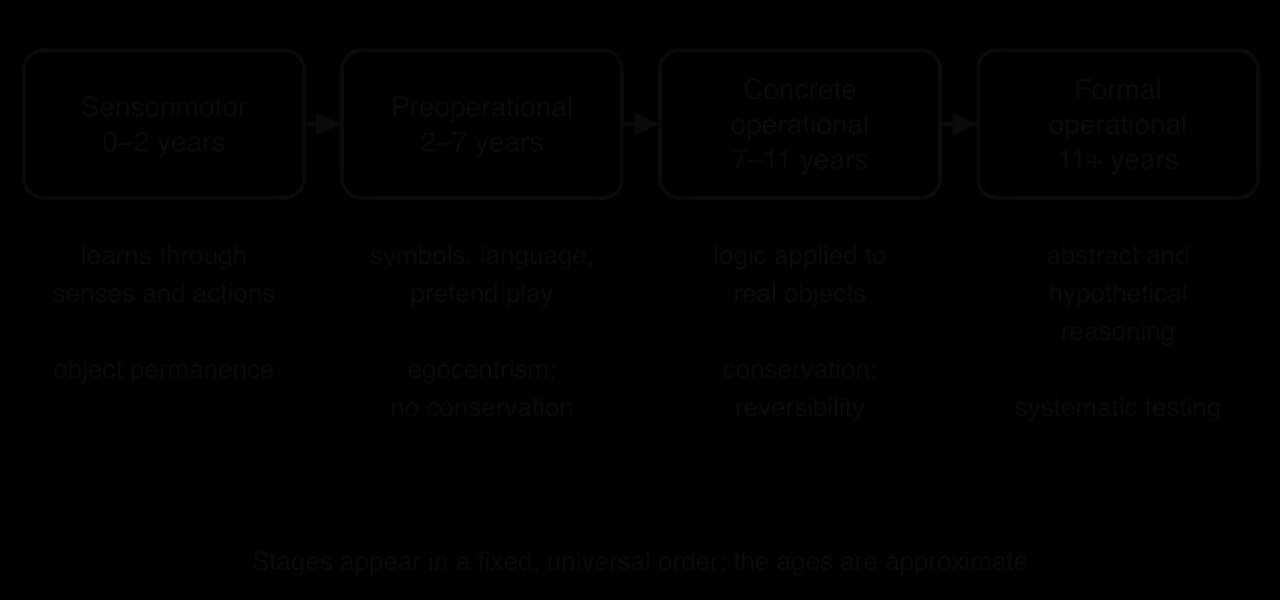
In the sensorimotor stage, infants understand the world through their senses and actions: looking, sucking, grasping and moving. At first they have no mental representations of objects that are not present. The major achievement of this stage is object permanence, the understanding that objects continue to exist when they cannot be seen. Piaget observed that before about 8 months, infants stop reaching for a toy as soon as it is covered by a cloth, as if it no longer exists. By the end of the stage, children can represent objects and events mentally, which allows imitation of absent people and the first use of words as symbols.
In the preoperational stage, children can use symbols: language, drawing and pretend play expand rapidly. Their thinking is, however, dominated by how things look, and they cannot yet carry out operations, logical mental actions that can be reversed. Two limitations define the stage. The first is egocentrism: the difficulty of taking any point of view other than one’s own. In the three mountains task, described by Piaget and Inhelder in 1956, children were shown a model of three mountains and asked to choose a picture showing what a doll on the other side would see. Children under about 7 tended to choose the picture of their own view.
The second limitation is the failure of conservation: the understanding that the quantity of something does not change when its appearance changes. In the classic liquid task, a child agrees that two identical glasses contain the same amount of water. The water from one glass is then poured into a taller, thinner glass, and the child is asked again whether the amounts are the same. Preoperational children usually say the tall glass has more, because the water is higher.
Piaget explained this by centration (attending to one dimension, height, and ignoring another, width) and by a lack of reversibility (not realising that pouring the water back would restore the original state).
In the concrete operational stage, children can carry out logical operations, but only on concrete objects and situations they can see or imagine. They now conserve, starting with number and moving later to mass, weight and volume; Piaget called this gradual spread across materials horizontal décalage. They can also classify objects into hierarchies and arrange them in order (seriation). Abstract or hypothetical problems, such as “if all purple elephants can fly…”, still cause difficulty.
In the formal operational stage, adolescents can reason about abstract ideas and hypothetical possibilities. They can think systematically, generating hypotheses and testing them one variable at a time. In the pendulum task, described by Inhelder and Piaget in 1958, participants were asked what determines how fast a pendulum swings: the length of the string, the weight, the height from which it is dropped or the force of the push. Formal operational thinkers varied one factor at a time while holding the others constant and discovered that only length matters; younger children changed several factors at once and drew inconsistent conclusions.
 YouTube
Piaget’s observations have been replicated many times: when his tasks are given in his way, children of the ages he described do behave as he reported. The debate is about what the behaviour means. Many later researchers argued that his tasks made heavy demands on language, memory and social understanding, so children failed for reasons unrelated to the ability being tested. When tasks were redesigned to make sense to children, abilities often appeared earlier than Piaget claimed.
Piaget measured object permanence by whether infants searched for a hidden object, which requires planning and coordinated reaching as well as knowing the object still exists. Baillargeon and DeVos (1991) used the violation-of-expectation paradigm instead, which measures looking time: infants look longer at events that surprise them.
Infants aged 3½ months watched a short or a tall carrot slide behind a screen that had a window in its upper half. The short carrot should pass unseen beneath the window, but the tall one should appear in it. When the tall carrot failed to appear, the infants looked reliably longer, suggesting that they represented the hidden carrot’s height and expected to see it.
If this interpretation is correct, infants understand that hidden objects continue to exist several months before they search for them, which challenges the claim that object permanence is built gradually through sensorimotor action. Critics point out that longer looking might reflect a perceptual preference for novelty or complexity rather than surprise based on knowledge, so the finding shows something about infants’ expectations without proving they have the concept as an older child does.
Hughes (1975) argued that the three mountains task was confusing because children had no reason to care what the doll saw. He built two intersecting walls forming a cross, placed a policeman doll so that it could see into some of the sections, and asked children aged 3½ to 5 to hide a boy doll where the policeman could not see him.
Because children understand hiding, the task made sense to them. About 90% of the children hid the boy correctly, even when a second policeman was added and the boy had to be hidden from both. This suggests that young children can take another’s visual perspective much earlier than Piaget claimed, when the task is meaningful to them.
In the standard conservation task, the experimenter asks the same question twice: before and after the transformation. Samuel and Bryant (1984) tested 252 children aged 5 to 8½ on conservation of number, mass and volume. Children made fewer errors when they were asked the question only once, after the transformation, than in the standard two-question version. A plausible explanation is that being asked the same question twice suggests to a child that the first answer was wrong, so they change it. This was a direct test of an idea that McGarrigle and Donaldson had raised a decade earlier.
In everyday conversation, when an adult repeats a question, it usually means the first answer was not the one wanted. Young children use this conversational rule, so after watching an adult change the display and then hearing the same question again, they reasonably infer that the answer should change. The error may therefore show good social reasoning applied to the wrong situation rather than a failure of logic.
Piaget’s theory may also overestimate older participants. Many adolescents and adults do not use formal operational reasoning on Piagetian tasks: studies of college students in the United States have found that a large proportion fail tasks such as the pendulum problem. Piaget later accepted that formal operations might appear only in areas of a person’s expertise, which weakens the claim that the stage is a general, universal way of thinking.
Dasen (1975) gave concrete operational tasks to 190 children aged 6 to 14 in three cultures: Inuit communities in Canada, Aboriginal communities in Australia and Ebrié villages in Côte d’Ivoire. He predicted, from their ways of life, that children in nomadic hunting communities would develop spatial concepts faster, while children in settled farming communities, who store and exchange food, would develop conservation of quantity faster. The results largely supported this. The sequence of stages appears similar across cultures, but the timing of particular abilities depends on what the culture makes useful, which is hard to reconcile with a single, general stage that applies to all content at once.
Piagetian claim | Challenge | What the challenge shows |
|---|---|---|
Object permanence develops gradually through action, by about 8–12 months | Baillargeon and DeVos (1991): 3½-month-olds looked longer at an impossible event | Earlier competence when the measure does not require searching |
Preoperational children are egocentric | Hughes (1975): most 3½- to 5-year-olds hid a doll from a policeman | Earlier perspective-taking when the task makes human sense |
Preoperational children cannot conserve | McGarrigle and Donaldson (1974); Samuel and Bryant (1984) | The social meaning of the task affects children’s answers |
Formal operations are reached by all adolescents | Many adults fail formal operational tasks | The final stage is not universal and may be domain-specific |
Stages are universal in timing and content | Dasen (1975): timing of concrete operations depends on ecological demands | The sequence may be universal but the timing is cultural |
James McGarrigle and Margaret Donaldson aimed to test whether young children’s failure on Piaget’s number conservation task reflected a genuine inability to conserve, or the way the task was presented. Their hypothesis was that when an adult deliberately changes the arrangement of objects and then asks a question, children infer that the adult expects a different answer, so they say the number has changed.
The participants were 80 children aged 4 to 6 years from schools in Edinburgh, Scotland. The study was a laboratory experiment with a repeated measures design: every child took part in two conditions, and the order of conditions was counterbalanced so that half the children did each condition first.
Standard condition (intentional transformation). The experimenter showed the child two equal rows of counters, side by side, and asked whether there were the same number in each row. The experimenter then deliberately spread out one row so that it was longer and repeated the question.
“Naughty teddy” condition (accidental transformation). The procedure was the same, but after the first question a teddy bear glove puppet, “naughty teddy”, came out of a box and “messed up” the toys, spreading out one row as if by accident. The experimenter then put the teddy away and repeated the question.
The independent variable was whether the change to the row was intentional (by the experimenter) or apparently accidental (by naughty teddy). The dependent variable was whether the child conserved, operationalised as stating that the two rows still had the same number after the transformation.
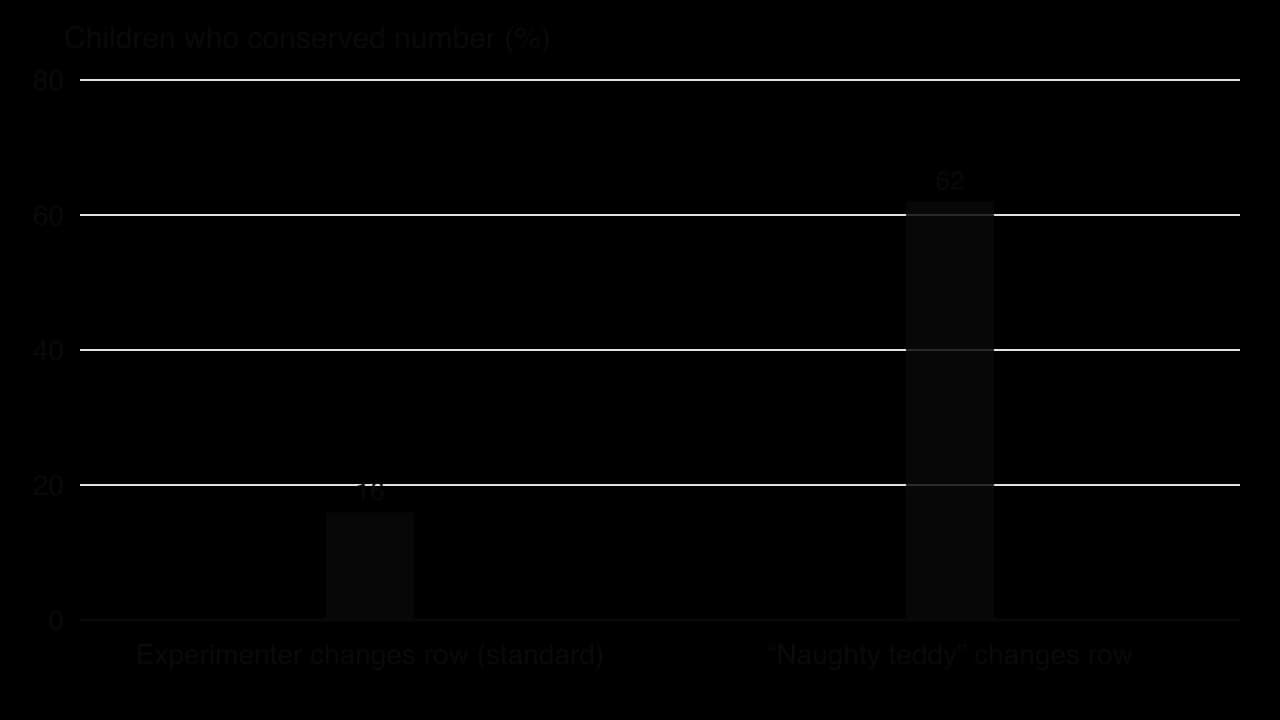
When the experimenter changed the row deliberately, only 16% of the children conserved number. When naughty teddy appeared to change it by accident, 62% conserved. The physical transformation was the same in both conditions; only its apparent intention differed.
Sources: McGarrigle, J. and Donaldson, M. (1974). Conservation accidents. _Cognition, 3(4), 341–350._
Many children aged 4 to 6 can conserve number, which is earlier than Piaget claimed. Their failure on the standard task is at least partly an artefact of the procedure: children interpret an adult’s deliberate action and repeated question as a sign that something relevant has changed. Donaldson (1978) developed this into a wider argument that young children reason well when a task makes “human sense”, that is, when it fits their understanding of people’s intentions, and that Piaget’s tasks were often disembedded from this kind of meaning.
The study shows that task design affects the measured ability, but the evidence can be read in more than one way. Moore and Frye (1986) suggested that in the naughty teddy condition children may simply have been distracted by the puppet and not noticed that the row had changed, so they said “the same” without understanding conservation. If so, some of the apparent conservation was a failure to attend to the change. The teddy condition therefore raises its own question of construct validity.
Because the physical change and the questions were the same in both conditions, and the order of conditions was counterbalanced, the difference in conservation can be attributed to the manipulation of intention rather than to order effects or practice. This is strong causal evidence that the social meaning of a task influences children’s answers. It does not show what in the standard task misleads children, which later studies such as Samuel and Bryant (1984) investigated.
The sample of 80 Scottish children is small and culturally narrow, and the study tested number conservation only, the earliest form to appear in Piaget’s account. The children were tested by unfamiliar adults in a school setting, which may itself have increased their tendency to look for the answer the adult wanted, a form of demand characteristics. Even so, the finding has been influential precisely because it identifies a demand characteristic in Piaget’s own procedure.
Lawrence Kohlberg (1927–1987) extended Piaget’s approach to moral reasoning. In his doctoral research (1958) he presented boys aged 10 to 16 from the Chicago area with moral dilemmas and analysed how they justified their answers, not what they decided. Kohlberg’s theory proposes three levels of moral reasoning, each with two stages, through which people pass in a fixed order. Progress depends on cognitive development and on opportunities to take others’ perspectives.
The best-known dilemma concerns a man called Heinz, whose wife is dying of cancer. A pharmacist has developed a drug that might save her but charges ten times what it costs to make. Heinz can raise only half the money, the pharmacist refuses to lower the price or let him pay later, and Heinz breaks in and steals the drug. Participants are asked whether Heinz should have done this, and why. Both “yes” and “no” can be given at any stage; the stage is identified from the reasoning.
Level | Stage | Basis of moral reasoning | Example justification about Heinz |
|---|---|---|---|
Preconventional (most children under about 9) | 1. Obedience and punishment | Avoiding punishment | “He shouldn’t steal; he’ll be put in prison.” |
2. Self-interest | What benefits oneself; fair exchange | “He should; he needs his wife, and the pharmacist is greedy.” | |
Conventional (most adolescents and adults) | 3. Interpersonal accord | Being a good person; approval of others | “A good husband would do anything to save his wife.” |
4. Authority and social order | Upholding laws and duties | “Stealing is against the law; if everyone did it, society would collapse.” | |
Postconventional (a minority of adults) | 5. Social contract | Laws as agreements that should serve human welfare | “The right to life is more important than property law.” |
6. Universal ethical principles | Self-chosen principles of justice and human dignity | “Any human life has the same value, whoever’s it is.” |
Kohlberg and colleagues tested the invariant sequence with a longitudinal design. Colby et al. (1983) followed 58 of the original boys over 20 years, interviewing them six times. Participants moved through the stages in the predicted order, almost never skipped a stage and rarely moved backwards, which supports the claim of an invariant sequence in this sample. Stages 5 and 6 were rare: stage 6 was so rarely found that Kohlberg later stopped scoring it.
Carol Gilligan (1982), a colleague of Kohlberg, argued that the theory is androcentric: it was built on an all-male sample and treats an abstract ethic of justice (rights, rules, fairness) as the highest form of morality. She proposed that many women reason from an ethic of care, focused on relationships, responsibility and avoiding harm, which Kohlberg’s scoring placed at stage 3. Later research has generally found small or no sex differences in Kohlberg scores when education and occupation are controlled, but Gilligan’s critique showed that the theory’s definition of moral maturity reflects one perspective on morality.
Snarey (1985) reviewed cross-cultural studies of Kohlberg’s theory carried out in a wide range of countries. Stages 1 to 4 were found in most cultures and the sequence was generally supported, but postconventional reasoning was rare or absent in many traditional, rural and village societies. Snarey and others argued that this may reflect bias in the scoring system, which rewards reasoning based on individual rights typical of Western, urban, educated populations, rather than a lack of moral maturity. Moral reasoning centred on community, duty and the sacred may be scored as “conventional” even when it is sophisticated.
A further limitation concerns the link between reasoning and behaviour. The Moral Judgment Interview measures how people reason about hypothetical dilemmas, not what they do in real situations. People at the same stage can act very differently, and real moral behaviour also depends on emotions, empathy and the social situation. Kohlberg’s theory is therefore a theory of the development of moral reasoning, not of moral behaviour as a whole.
Erik Erikson (1950) proposed a stage theory of psychosocial development that covers the whole lifespan, from infancy to old age. Where Piaget and Kohlberg described how thinking and reasoning change, Erikson described how personality and a person’s sense of self develop through relationships with other people. Each of his eight stages is defined by a psychosocial crisis, a conflict between two possible outcomes that becomes central at a particular age because of the person’s maturation and the demands their society makes of them.
A favourable resolution of a crisis gives the person a lasting strength, which Erikson called a virtue, such as hope after the first stage or competence after the fourth. An unfavourable resolution leaves a weakness that can make later crises harder. The stages occur in a fixed order, and each builds on those before it, but a person moves on to the next stage with age whether or not the previous crisis has been fully resolved. Earlier conflicts can also return later in life.
Approximate age | Psychosocial crisis | Key relationships | Strength from a favourable resolution |
|---|---|---|---|
Infancy (under 1) | Trust versus mistrust | Mother or main caregiver | Hope |
Toddlerhood (1–2) | Autonomy versus shame and doubt | Parents | Will |
Early childhood (3–6) | Initiative versus guilt | Family | Purpose |
Middle childhood (7–10) | Industry versus inferiority | School, neighbourhood | Competence |
Adolescence (11–19) | Identity versus role confusion | Peers, role models | Fidelity |
Early adulthood (20–44) | Intimacy versus isolation | Friends, partners | Love |
Middle adulthood (45–64) | Generativity versus stagnation | Household, workplace | Care |
Late adulthood (65 and over) | Ego integrity versus despair | Humankind | Wisdom |
Erikson’s stages differ from Piaget’s in what drives them. Piaget’s stages are new cognitive structures that the child constructs, so a child cannot reach the next stage without the reasoning of the one before. Erikson’s stages are driven by age-related social expectations as well as maturation: every society expects young children to gain control over their bodies, school-age children to master the skills their culture values, and adolescents to decide who they are. His ideas were shaped partly by fieldwork with two Native American communities, the Oglala Lakota and the Yurok, in which he studied how child-rearing prepared children for the adult roles of their community.
The fifth stage, identity versus role confusion, has had the most influence on research. Marcia’s identity statuses turned it into four measurable positions based on exploration and commitment, and research on peer influence uses them to study adolescent identity. The earlier stages have also been linked to attachment research, since trust versus mistrust describes the same first relationship that attachment theory studies.
The main weakness of Erikson’s theory is measurement. The crises are described in broad terms, and the theory does not say exactly what behaviour shows that a crisis has been resolved, or what causes a crisis to be resolved well or badly. Much of the original evidence came from Erikson’s clinical case studies and biographical writing rather than from systematic data. This makes the theory difficult to test, so it is scientifically weaker than Piaget’s or Kohlberg’s theories, whose claims about sequence and timing can be tested directly with tasks and interviews.
The theory also raises questions of bias. It was based mainly on the development of European and American males, and the adolescent task of choosing an individual identity reflects an individualist ideal. In cultures where identity is defined mainly by family roles, or where adult roles are decided by elders, the identity crisis may take a different form or be less central. The fixed ages also describe a typical life course in the societies Erikson studied, while education, work and family formation happen at very different ages across cultures and historical periods.
As a model of development, Erikson’s theory is therefore most effective as a broad description of the social challenges that recur across the lifespan, and least effective as a testable explanation of change. Its value lies in widening the study of development beyond childhood and beyond cognition, and in linking personal development to the expectations of a person’s culture.
Continuous models explain the same changes that Piaget described, such as the appearance of conservation or systematic reasoning, without proposing general stages. They treat development as the gradual growth of specific skills, knowledge and processing capacity. Three families of continuous model are important: information-processing accounts, Siegler’s overlapping waves theory and learning-based accounts.
The information-processing approach treats the mind as a system that takes in, stores, transforms and retrieves information, as in cognitive models of memory such as the working memory model. Applied to development, it asks which parts of this system improve with age. Three changes are well established. Children process information faster; they can hold and manipulate more information in working memory; and they acquire better strategies, such as rehearsal and organisation, for using their limited capacity.
Kail (1991) combined data from 72 published studies, giving 1,826 pairs of response times in which children or adolescents were compared with adults on the same task. Children’s response times were slower than adults’ by a consistent proportion across very different tasks, and the difference shrank with age in a smooth, exponential pattern: fast change in childhood, slower change in adolescence. A general increase in processing speed of this kind is a continuous change, linked to biological maturation such as myelination, and it can explain why many abilities improve together without proposing qualitatively new stages.
From this perspective, a 5-year-old who fails a conservation task may lack the working memory capacity to keep both the height and the width of the liquid in mind at once, or may not yet have learned a strategy for comparing quantities. With more capacity or better strategies, performance improves gradually. Some theorists, called neo-Piagetians, such as Robbie Case, combined the two views: they kept Piaget’s broad stages but explained the movement between them through growth in working memory capacity.
Robert Siegler (1996) argued that the staircase image of development is misleading. When he watched individual children solve the same kind of problem many times, for example simple addition sums, he found that each child used several strategies at once: counting everything from one, counting on from the larger number, or retrieving the answer from memory. The child chose among these from trial to trial, depending on the problem. With experience, the more efficient strategies were used more often and the less efficient ones faded, but older strategies rarely disappeared completely.
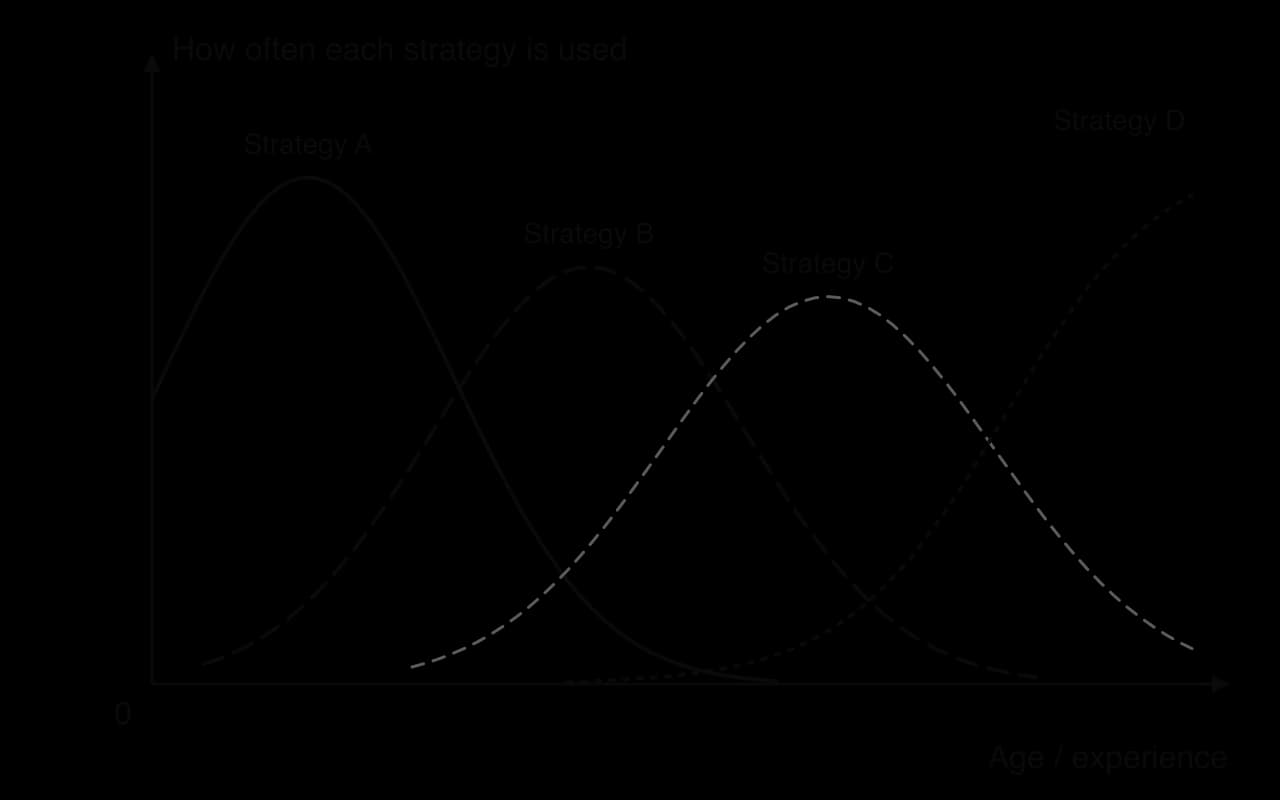
Siegler developed the microgenetic method to study change as it happens: the same children are observed on many trials over a short period, with careful recording of the strategy used on each trial. This method shows variability that cross-sectional comparisons of age groups hide. When average performance of 5-year-olds is compared with that of 7-year-olds, the result can look like a sudden jump; when individual children are followed closely, the change is usually gradual and mixed. Siegler explained development through variation (generating several strategies), selection (choosing the most effective) and retention (keeping those that work), borrowing ideas from evolutionary biology.
Research within this framework also shows that some changes can be fast. Opfer and Siegler (2007) studied 7- to 8-year-olds who were estimating where numbers belong on a line from 0 to 1,000. Children who received feedback on the numbers for which their immature estimates were most wrong often switched to a more accurate, adult-like representation after a single feedback trial, and the change spread across the whole number range. This shows that a continuous model can include rapid reorganisation in a specific area, which narrows the gap between the two views.
Learning theories such as operant conditioning and social learning theory are also continuous models. They explain development as the gradual accumulation of learned behaviours through reinforcement and observation, with no built-in stages. Vygotsky’s sociocultural theory is often placed with the continuous models because it describes development as the gradual internalisation of skills learned through social interaction in the zone of proximal development, and because it expects the course of development to vary between cultures. Vygotsky did describe some age-related crises and transitions, so his position is not purely continuous, but he rejected the idea of universal stages driven by the individual child’s own activity.
In this debate, “effectiveness” means how well each kind of model describes, explains and predicts development, and how useful it is in practice. Each has clear strengths and weaknesses, and much current research suggests that development has both stage-like and continuous features depending on the level at which it is studied.
Criterion | Stage theories (Piaget, Kohlberg) | Continuous models (information processing, overlapping waves) |
|---|---|---|
Description | Capture broad, real age-related differences in thinking that are found in many cultures | Capture variability within children and gradual change that age averages hide |
Explanation | Mechanisms (equilibration, perspective-taking) are vague and hard to test | Specific mechanisms (processing speed, working memory, strategy selection) that can be measured |
Prediction | Predict concurrence and invariant sequence; concurrence often fails (décalage, domain differences); sequence largely supported | Predict gradual, task-specific change; can struggle to explain why some changes are broad and fairly rapid |
Evidence on timing | Often underestimate young children (McGarrigle and Donaldson, Baillargeon) and overestimate adolescents | Allow timing to vary with tasks and experience |
Culture | Claim universality; timing and final stages vary across cultures (Dasen, Snarey) | Expect variation with experience and schooling; less focus on universal patterns |
Application | Influential in education: readiness, discovery learning, age-appropriate curricula | Inform teaching of specific strategies, reducing cognitive load, adaptive feedback |
Stage theories remain valuable as broad descriptions. Children in every culture studied do pass through recognisable changes in thinking, and the order of Piaget’s and Kohlberg’s stages has generally held up. Their weakness is the claim that each stage is a single, general structure that appears at a predictable age across all content. The evidence of horizontal décalage, task effects and cultural variation in timing suggests that abilities develop more piecemeal than a strict stage model allows.
Continuous models offer more precise, testable mechanisms and fit the variability seen when individual children are studied closely. Their weakness is that they can describe change in very specific tasks without explaining why some developmental changes are broad, appear across many tasks at about the same time, and occur in a similar order across cultures. They also give less attention to the qualitative differences that children and adults themselves notice in how they think.
Both kinds of model involve all three approaches. Piaget saw development as an interaction between biological maturation and the child’s experience, and he described it in cognitive terms (schemas and operations). Information-processing accounts link cognitive changes in speed and working memory to biological maturation of the brain, such as myelination and synaptic pruning during childhood and adolescence. The slow maturation of the prefrontal cortex into early adulthood is consistent with the gradual development of planning and systematic reasoning that Piaget associated with formal operations, although brain development is continuous rather than stage-like.
Sociocultural factors affect both the timing and the content of development. Schooling teaches the cultural tools that formal operational tasks require, and Dasen’s findings show that a community’s way of life shapes which concrete operational abilities develop first. Kohlberg’s highest stages are found mainly among people with higher education in urban societies, which suggests that experience with abstract debate and diverse perspectives contributes to postconventional reasoning. An effective account of development therefore combines maturation, cognitive mechanisms and cultural experience rather than relying on any one of them.
The central lesson of research on stage theories concerns measurement. Children’s abilities are constructs that cannot be observed directly, so they must be inferred from performance on tasks. Every task adds demands of its own: language, memory, motivation, understanding of what the adult wants. Piaget’s clinical method relied heavily on children’s verbal explanations, which favours older and more articulate children. The violation-of-expectation paradigm avoids language but relies on interpreting looking time, which is open to other explanations. Using several tasks with different demands to measure the same ability (a form of triangulation) gives the most convincing evidence.
Piaget’s theory was based mainly on observations of Swiss children, including his own, and Kohlberg’s on American boys. Both proposed universal stages from narrow samples, and both have been criticised for defining the end point of development by the values of educated Western adults: abstract scientific reasoning in Piaget’s case and individual rights in Kohlberg’s. This is a form of cultural bias, and in Kohlberg’s case gender bias. Cross-cultural research such as Dasen (1975) and Snarey (1985) has been essential in separating what is universal (the broad sequence) from what is cultural (the timing and the highest stages).
Stage theories and continuous models are, at root, different accounts of change. Stage theories emphasise reorganisation driven by maturation and the child’s own activity, which implies that teaching cannot move a child into a stage before they are ready. Continuous models emphasise learning and practice, which implies that targeted teaching can speed up development. Training studies have shown that conservation can be taught to some preoperational children, especially those close to the transition, which supports a role for experience, although Piagetians argue that such training works only when the child is nearly ready.
Each model reflects a theoretical perspective. Piaget and Kohlberg took a constructivist view of an individual child discovering the world; information-processing models take the perspective of the mind as a computer; Vygotsky took a sociocultural perspective. Each highlights some aspects of development and neglects others. Many researchers now argue for a more integrated view in which development is continuous at the level of mechanisms but shows stage-like patterns at the level of broad age periods.
Concept | Key point for this area |
|---|---|
Measurement | Conclusions about children’s abilities depend on task demands (McGarrigle and Donaldson; Baillargeon and DeVos; Moore and Frye) |
Bias | Western, male and educated samples defined the end points of development (Gilligan; Snarey; Dasen) |
Change | Qualitative reorganisation versus gradual quantitative growth; the role of maturation versus teaching |
Perspective | Constructivist, information-processing and sociocultural perspectives each explain part of development |
Causality | Age is not a cause: age differences must be explained by maturation, experience or both |
This area can appear in Paper 1 Section B as a scenario about children’s thinking or moral reasoning, to be explained with a stage theory or a continuous model, and in Section C as an essay on “the effectiveness of stage theories and continuous models in understanding development” through a concept such as measurement, bias or change. Studies of children’s reasoning are also typical stimuli for Paper 2 Section B.
Stage theories describe development as a fixed, universal sequence of qualitatively different stages; continuous models describe gradual, quantitative growth in knowledge, speed and strategies.
Piaget proposed that children construct knowledge through assimilation and accommodation, passing through sensorimotor, preoperational, concrete operational and formal operational stages.
Key Piagetian concepts include object permanence, egocentrism and conservation, tested by tasks such as the three mountains and liquid conservation tasks.
McGarrigle and Donaldson (1974) found that 62% of 4- to 6-year-olds conserved number when a “naughty teddy” changed the row, against 16% when the experimenter did, showing the influence of task design.
Baillargeon and DeVos (1991) and Hughes (1975) suggest that object permanence and perspective-taking appear earlier than Piaget claimed; formal operations are less universal than he claimed.
Kohlberg described three levels of moral reasoning; the sequence was supported longitudinally, but Gilligan (1982) and Snarey (1985) identified gender and cultural bias in how moral maturity was defined.
Erikson described eight psychosocial crises across the lifespan; the theory is influential but broad and hard to test, and it reflects an individualist ideal of identity.
Continuous models include information-processing accounts (faster processing, greater working memory capacity, better strategies) and Siegler’s overlapping waves theory.
Development tends to look stage-like when broad age groups are compared and continuous when individual children are followed closely; each model explains part of development.
I can explain the difference between stage theories and continuous models of development.
I can describe Piaget’s theory, including schemas, assimilation, accommodation and the four stages.
I can evaluate Piaget’s theory using research on children’s competence and cultural variation.
I can describe and evaluate McGarrigle and Donaldson (1974).
I can describe Kohlberg’s theory and evaluate it with reference to gender and cultural bias.
I can describe and evaluate Erikson’s psychosocial stage theory.
I can describe information-processing accounts and Siegler’s overlapping waves theory.
I can discuss the effectiveness of stage theories and continuous models.
I can evaluate research in this area with reference to measurement, bias, change and perspective.