Explain how social interaction, culture, parenting and socioeconomic status shape development, using Vygotsky’s and Bronfenbrenner’s theories, and evaluate the research.
Each is in the Psychology glossary, with every other term in the subject.
The psychological tools (such as language, number systems and writing) and material tools (such as calculators or maps) that a culture provides and that shape how its members think.
Bronfenbrenner’s model in which development is shaped by interacting environmental systems nested around the child: microsystem, mesosystem, exosystem, macrosystem and chronosystem.
Any person, or tool, with greater understanding or skill than the learner for a particular task, who can guide the learner through the zone of proximal development.
A parent’s general pattern of child-rearing, usually described by warmth and control; for example authoritative, authoritarian, permissive or uninvolved.
Temporary, adjustable support from a more knowledgeable person that lets a learner complete a task they could not complete alone, gradually withdrawn as the learner becomes competent.
Vygotsky’s theory that cognitive development results from social interaction with more knowledgeable people and from learning to use the cultural tools of one’s community, such as language.
The gap between what a learner can do independently and what they can do with guidance from a more knowledgeable person; the range in which teaching is most effective.
Explain how sociocultural factors influence development, with reference to social interaction, culture, parenting and socioeconomic status.
Describe Vygotsky’s sociocultural theory, including the zone of proximal development, scaffolding, the more knowledgeable other and cultural tools.
Describe Bronfenbrenner’s ecological systems theory and apply it to a child’s development.
Explain how parenting styles and their effects vary across cultures.
Describe and evaluate Hart and Risley’s research on early language environments and the debate about the “word gap”.
Discuss how biological, cognitive and sociocultural factors interact in development.
Evaluate research on sociocultural factors in development with reference to causality, measurement, bias and perspective.
Apply sociocultural explanations of development to an unfamiliar scenario.
Children develop inside families, schools, communities and cultures, and these social settings shape what they learn, how fast they learn it and what kind of person they become. Sociocultural factors in development are the influences that come from other people and from the culture a child grows up in: the way adults talk to and teach children, the values and practices of the community, parenting, schooling and the family’s economic circumstances.
This area of developmental psychology draws on the sociocultural approach, especially enculturation (learning the norms of one’s own culture) and social learning theory (learning by observing others), and on cultural dimensions such as individualism and
With a free account, Augment remembers where you stopped and what you have practiced.
Lev Vygotsky (1896–1934) was a Russian psychologist who argued that a child’s thinking develops first between people and only later inside the child. In his view, higher mental functions such as voluntary attention, planning, logical memory and reasoning begin as shared activities with parents, teachers and older children. Through repeated participation, the child takes these activities over and carries them out alone. Development is therefore shaped by the social and cultural world the child takes part in, as well as by processes inside the child.
Vygotsky described this as the movement from the interpsychological plane (between people) to the intrapsychological plane (within the individual). A child who has been helped many times to count objects by an adult pointing and naming the numbers later points and counts alone, and later still counts silently. The process by which shared activity becomes individual thinking is called internalisation. Internalisation is a gradual transformation rather than simple copying, because the child reconstructs the activity in a form that works for them.
This view contrasts with Piaget’s theory, in which the child is mainly an independent explorer who constructs knowledge by acting on objects and whose development follows universal stages. Vygotsky did not deny the role of maturation and individual activity, but he placed social interaction and culture at the centre. Because culture provides the content and the tools of thinking, he expected the course of development to differ between cultures rather than to follow one universal sequence.
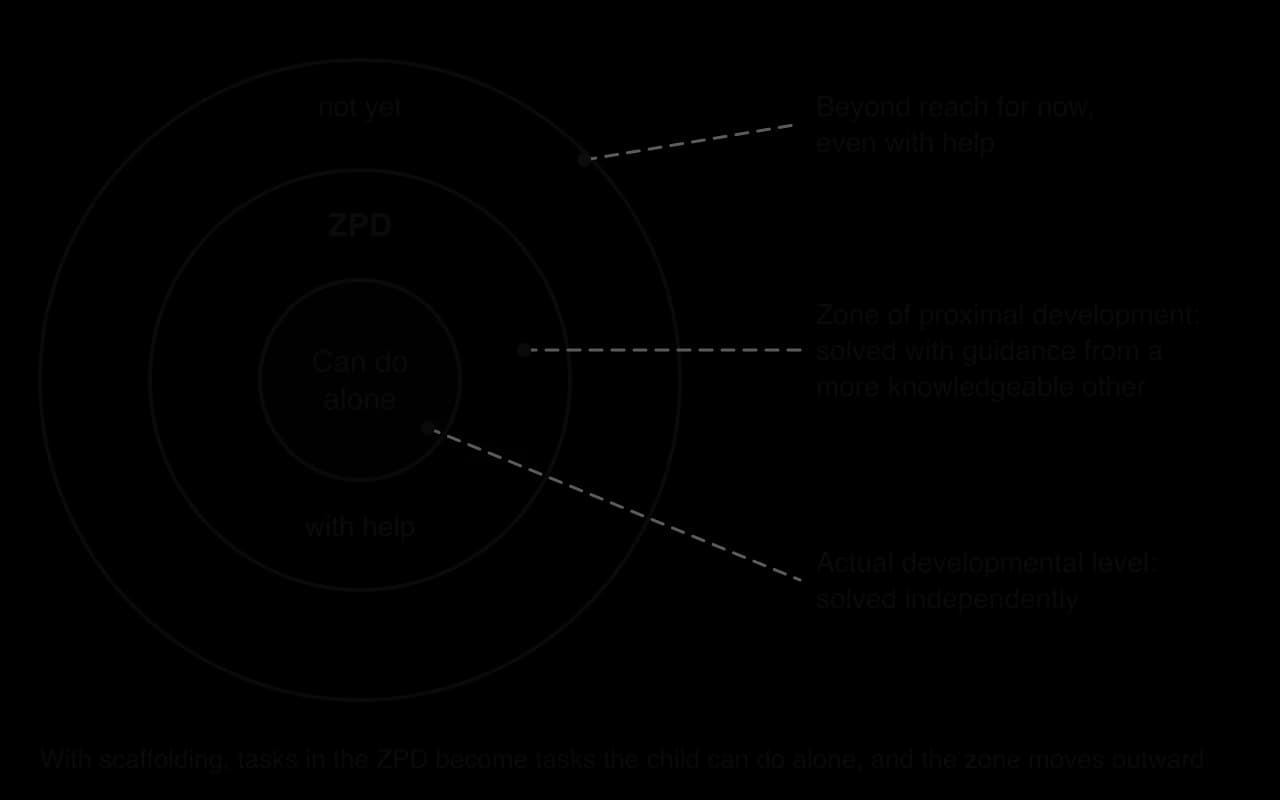
Vygotsky’s best-known idea is the zone of proximal development (ZPD). At any moment a child has an actual developmental level, the problems they can solve alone, and a potential developmental level, the problems they can solve with help. The gap between these two levels is the ZPD. It contains the abilities that are “in the process of maturing”: not yet independent, but within reach.
the distance between the actual developmental level as determined by independent problem solving and the level of potential development as determined through problem solving under adult guidance or in collaboration with more capable peers
— Vygotsky, Mind in Society (1978), p. 86
The ZPD changes how development is measured and taught. Two children who both score the same on a test taken alone may differ greatly in how much they can achieve with a hint; Vygotsky argued that the second measure says more about what the child is ready to learn next. For teaching, the ZPD implies that instruction should lead development rather than wait for it. Tasks the child can already do teach little, and tasks far beyond the zone produce failure; instruction is most useful when it targets the zone.
The help that makes learning in the ZPD possible comes from a more knowledgeable other (MKO). This is anyone with a better understanding or greater skill than the learner for the task in question: a parent, teacher or coach, but also an older sibling, a classmate who has grasped an idea, or, in some modern discussions, a computer program that gives adaptive feedback. The MKO is defined by the task, not by age or status: a 12-year-old can be the MKO for a parent learning to use a new app.
Vygotsky argued that people do not think with bare brains but with cultural tools: the symbol systems and objects that a culture has developed over history and passes on to its children. Psychological tools include language, counting systems, writing, maps, diagrams, calendars and memory aids; material tools include the abacus, the calculator and, today, the smartphone. Learning to use these tools changes the way a child thinks. A child who has learned to write a shopping list can remember far more than one who cannot, because the list does part of the remembering.
Language is the most important cultural tool. It begins as social speech used to communicate with others. Around the age of three, many children begin to talk aloud to themselves while they play or solve problems (“this piece goes… no, here”). Vygotsky called this private speech and saw it as a sign that social speech was turning into a tool for guiding one’s own behaviour. With age, private speech becomes quieter and shorter and is eventually internalised as inner speech, the silent verbal thinking of older children and adults. Piaget had interpreted the same self-talk as a sign of egocentrism; Vygotsky saw it as a step towards self-regulation.
Research on child street vendors in Recife, Brazil, illustrates how cultural tools shape thinking. Carraher, Carraher and Schliemann (1985) found that working children solved arithmetic problems much more accurately during real sales than when the same numbers were presented as school-style written sums. In the market they used mental strategies, such as grouping and repeated addition, that suited their work; at school they tried to apply written procedures they had not mastered. The children’s competence was real but tied to the tools and practices of their everyday activity.
Vygotsky described the ZPD but said little about exactly how adults help children through it. The term scaffolding was introduced later by Wood, Bruner and Ross (1976), who compared the adult’s help to the temporary structure put up around a building: it supports the work while it is being built and is taken away once the structure can stand alone. Good scaffolding gives as much help as the child needs and no more, and it is withdrawn gradually as the child becomes competent.
Wood, Bruner and Ross studied 30 children aged 3, 4 and 5, each tutored individually by the same adult while building a pyramid from 21 interlocking wooden blocks, a task too difficult for them to complete alone. The tutor followed a rule: when the child struggled, give more specific help; when the child succeeded, step back and give less. From observing the sessions, the researchers described six functions of scaffolding.
Function | What the tutor does | Example in a block-building task |
|---|---|---|
Recruitment | Gets the child interested and engaged in the task | Shows the finished pyramid and invites the child to make one |
Reduction in degrees of freedom | Simplifies the task so the child can manage it | Hands over only the pieces needed for the next step |
Direction maintenance | Keeps the child focused on the goal | Reminds the child what they are trying to build |
Marking critical features | Points out what matters and where errors are | “These two pieces only fit if the peg faces up.” |
Frustration control | Keeps the task from becoming stressful | Encourages and praises effort after a failed attempt |
Demonstration | Models a solution for the child to imitate | Fits one pair of blocks together slowly while the child watches |
Sources: Wood, D., Bruner, J. S. and Ross, G. (1976). The role of tutoring in problem solving. _Journal of Child Psychology and Psychiatry, 17(2), 89–100._
Older children needed less help than younger ones, and the 3-year-olds in particular needed the tutor to recruit and hold their attention. The central idea, now called contingent tutoring, comes from a related study by Wood and Middleton (1975), in which 4-year-olds built a block model with their mothers. The mothers whose children learned most were those who increased the specificity of their help after a failure and reduced it after a success, so that the help tracked the child’s performance moment by moment.
Freund (1990) tested whether working in the ZPD with a parent produces more learning than working alone. Sixty 3- and 5-year-olds had to sort miniature furniture into the rooms of a doll’s house. Some worked with their mothers; others practised alone and received corrective feedback from the experimenter at the end. When the children were later tested alone on a harder sorting task, those who had worked with their mothers produced more correct, adult-like groupings. Mothers gave more guidance to younger children and when the task became harder, which is scaffolding adjusted to the child’s ZPD.
Sources: Freund, L. S. (1990). Maternal regulation of children’s problem-solving behavior and its impact on children’s performance. _Child Development, 61(1), 113–126._
 YouTube
Barbara Rogoff extended Vygotsky’s ideas by studying how children learn in different cultural communities. She uses the term guided participation for the many ways children learn by taking part in the real activities of their community with others, not only through direct instruction.
In many Indigenous communities of the Americas, such as Mayan communities in Guatemala and Mexico, children are present during adult work and community events and learn largely by watching closely and joining in when ready. Rogoff and colleagues (2003) called this intent participation and contrasted it with the style common in Western schooling, in which adults separate children from adult work and transmit knowledge through lessons and questions.
This research shows that scaffolding in the form described by Wood, Bruner and Ross, a single adult giving verbal instructions to a single child, is one cultural pattern among several. In communities where learning by observing is valued, a parent may say little, and a child who asks many questions may be seen as impolite. Researchers who measure only verbal scaffolding could therefore conclude, wrongly, that such parents do not support their children’s learning. This is an example of imposed etic measurement, in which a concept from one culture is applied to another without checking that it means the same thing.
Vygotsky focused on the child’s immediate interactions with more skilled people. Urie Bronfenbrenner (1979) proposed a wider framework for organising all the environmental influences on development. His ecological systems theory places the child at the centre of a set of nested systems, from the people the child meets every day to the values and laws of the whole society. Each system influences the child directly or through its effects on the systems inside it.

System | What it contains | Example of an influence on development |
|---|---|---|
Microsystem | Settings where the child interacts face to face: family, school class, peer group, carers | A teacher who scaffolds reading in small groups |
Mesosystem | The links between microsystems | Parents and teachers who communicate regularly about homework |
Exosystem | Settings the child is not in but which affect them | A parent’s long or unpredictable working hours reduce time for conversation at home |
Macrosystem | The wider culture: values, beliefs, laws, economic system | Cultural beliefs about whether young children should be talked to as conversation partners |
Chronosystem | Change over time, in the child’s life and in history | Starting school, a parent’s divorce, or growing up during a pandemic |
The model has two main strengths. First, it reminds researchers that no single factor acts alone: the effect of a parenting practice may depend on the neighbourhood, the school and the cultural meaning of that practice. Second, it shows where interventions can act. A programme to improve children’s language can work in the microsystem (coaching parents to talk with their babies), the mesosystem (home visits by nursery staff), the exosystem (paid parental leave) or the macrosystem (public campaigns and funding for early education).
Bronfenbrenner later revised the theory as the bioecological model, adding the child’s own biological characteristics, such as temperament and health, and the importance of proximal processes: regular, increasingly complex interactions between the child and the people and objects around them. This revision answered the criticism that the original theory described environments in detail but said little about the developing person. It also makes the theory an interactionist one: development results from the person and the environment acting on each other over time.
Ecological systems theory is better described as a framework than a testable theory. It tells researchers where to look for influences but does not predict which influence will matter most for a particular outcome, or how strongly. Almost any finding can be fitted into one of the systems, which makes the theory hard to falsify. Its value lies in organising research and guiding interventions rather than in explaining a specific developmental change.
The framework also creates a problem of measurement. Exosystem and macrosystem influences are distant and diffuse, so they are usually measured through broad indicators such as family income or country of residence. These indicators bundle many different experiences together, which makes it difficult to establish which part of the environment caused an effect. Even so, the theory has had a strong influence on policy, including the design of the US Head Start programme, which Bronfenbrenner helped to plan and which works with families and communities as well as with children.
Parents are the most direct sociocultural influence on young children. Diana Baumrind studied middle-class families in California in the 1960s and identified three broad patterns of parenting, defined by how warm and responsive parents were and how much control and maturity they demanded. Maccoby and Martin (1983) added a fourth pattern, giving the familiar model of four parenting styles.
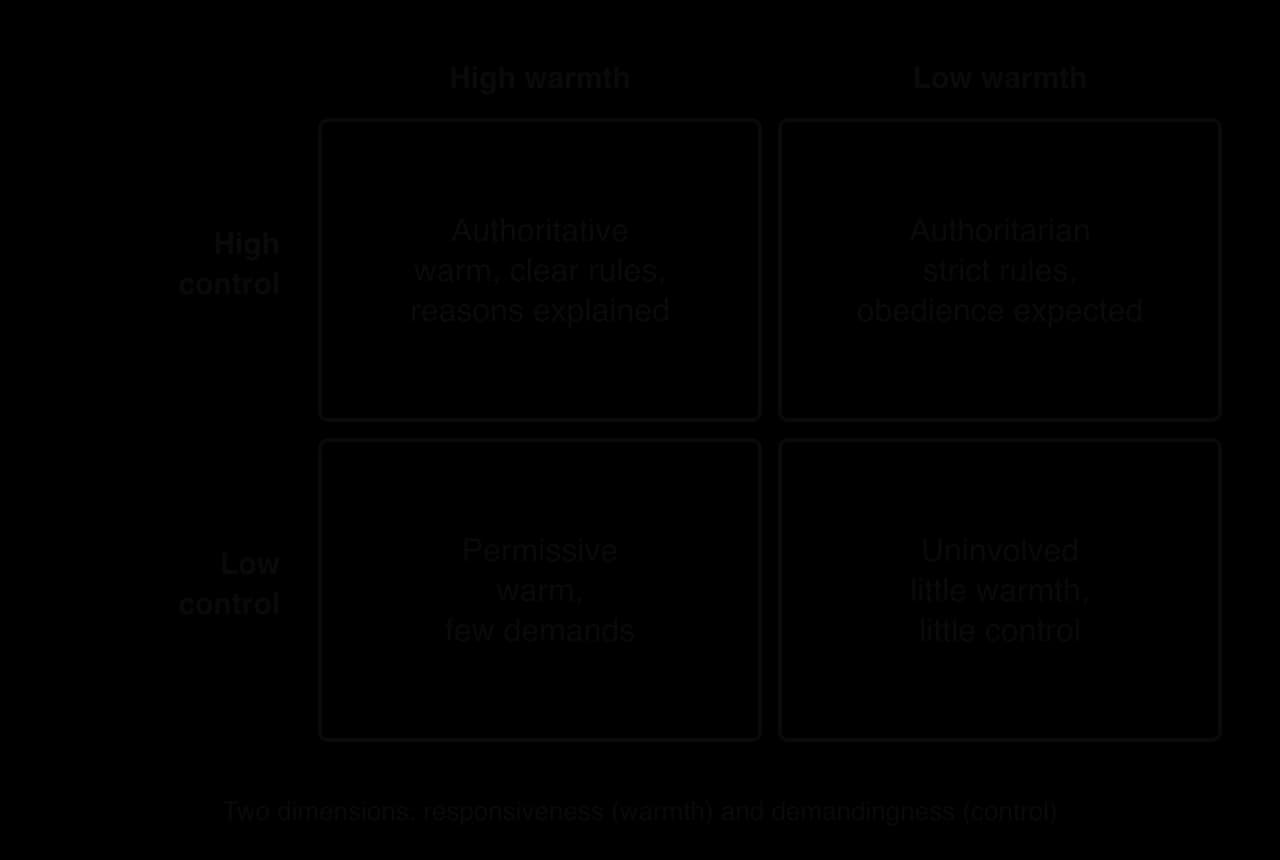
In studies of European American families, the authoritative style is usually associated with the best outcomes: higher school achievement, better self-regulation and fewer behaviour problems. Dornbusch et al. (1987) surveyed 7,836 high school students in the San Francisco Bay Area and found that authoritative parenting was positively associated with grades, while authoritarian and permissive parenting were negatively associated with them. Steinberg et al. (1992) followed about 6,400 students aged 14–18 for a year and found that authoritative parenting predicted better school performance and engagement, partly because authoritative parents were more involved in their children’s schooling.
The same research revealed an important exception. In the Dornbusch study the typology predicted grades best among white students and less well in other ethnic groups. Asian American students often reported more authoritarian parenting, yet had high average grades. If authoritarian parenting were harmful in itself, this pattern would be hard to explain.
Ruth Chao (1994) argued that the problem lies in the categories themselves. She gave immigrant Chinese mothers and European American mothers of preschool children standard measures of parental control and authoritative–authoritarian style, plus new items based on the Chinese concept of guan (to govern, but also to care for) and chiao shun (training). Chinese mothers scored higher on control and authoritarian items, but even after these scores and the mothers’ education were taken into account, they scored significantly higher on “training” beliefs.
Chao argued that in this cultural context strict control is part of a warm, involved relationship in which parents invest heavily in their children’s education, rather than a sign of rejection or hostility. Western measures capture the strictness but miss the meaning, so they misclassify Chinese parenting as authoritarian. This is an argument about bias in measurement: the categories were developed in one culture and then applied to others as if they meant the same thing everywhere, an example of ethnocentrism.
Keller et al. (2004) showed how differences in parenting from the first months of life lead to different developmental pathways. The researchers observed mothers with their 3-month-old babies in three communities: Nso farming families in rural Cameroon, urban middle-class families in Athens, Greece, and middle-class families in Costa Rica. They then tested the same children at 18–20 months.
Community | Parenting at 3 months | Earlier developmental achievement at 18–20 months |
|---|---|---|
Nso farmers (Cameroon) | Proximal: much body contact and stimulation; the baby is carried and held | Self-regulation: complying with an adult’s request without supervision |
Urban middle class (Athens, Greece) | Distal: face-to-face contact and object play; much talk focused on the baby | Self-recognition: recognising themselves in a mirror |
Middle class (Costa Rica) | A mixture of proximal and distal practices | Between the other two groups on both measures |
Sources: Keller, H. et al. (2004). Developmental consequences of early parenting experiences: self-recognition and self-regulation in three cultural communities. _Child Development, 75(6), 1745–1760._
The table shows that each community’s parenting supported the competence its culture values. Nso parenting supports an interdependent orientation, in which fitting in and obeying elders matter, and Greek middle-class parenting supports an independent orientation, in which a separate, self-aware individual matters. The study therefore suggests that there is no single “best” timetable of development, because development is adapted to the cultural context. Because culture was not manipulated, the study is a quasi-experiment, so other differences between the communities could also contribute.
A child interprets a parent’s behaviour through the norms of their culture and community. Where strict supervision is common and is understood as a sign of care and investment, a child is likely to read it as concern. Where it is uncommon and contrasts with the freedom given to peers, the same rule may be read as rejection or lack of trust. Because children’s responses depend on this interpretation, the effect of a parenting practice depends on its cultural context, which is a cognitive factor (interpretation) interacting with a sociocultural one (norms).
Socioeconomic status (SES) is a family’s position in society based on income, parents’ education and occupation. It is one of the strongest predictors of children’s development: on average, children from low-SES families score lower on tests of language, memory and school readiness when they start school, and the gap often widens later. SES is not a single cause, though. It is a summary label for many different experiences that tend to go together, such as the amount of conversation at home, access to books and nurseries, housing quality, neighbourhood safety, nutrition and the level of stress parents are under.
Psychologists therefore ask which parts of the low-SES environment affect development, and how. Two broad pathways have been proposed. In the family stress pathway, financial pressure raises parents’ stress and conflict, which makes harsh or inconsistent parenting more likely and reduces warm interaction. In the investment pathway, families with more resources can invest more in learning materials, activities and time. Both pathways run through the child’s microsystem, which is why parenting and language input are often studied as the links between poverty and outcomes.
Hoff (2003) tested one specific pathway. She recorded 33 high-SES and 30 mid-SES mothers interacting naturally with their 2-year-old children at two visits ten weeks apart. The high-SES children’s productive vocabularies grew more over the ten weeks, and differences in the mothers’ speech, such as the number of words and the variety and length of their utterances, fully accounted for this difference. The finding suggests that SES affects early vocabulary at least partly through the language children hear, rather than through income itself.
Later research suggests that the quality of interaction matters as much as the quantity of words. Romeo et al. (2018) used home audio recordings from 36 children aged 4–6 from a range of SES backgrounds and then scanned the children with fMRI while they listened to stories. Children who had experienced more conversational turns with adults (back-and-forth exchanges) showed greater activation in Broca’s area, the left frontal language region, and this activation helped to explain the link between their language experience and their verbal skills. The number of conversational turns predicted brain activation over and above SES, IQ and the number of adult words alone.
 YouTube
Noble et al. (2015) studied 1,099 typically developing children and young people aged 3 to 20 in the United States, using MRI to measure the surface area of the cortex. Family income was associated with cortical surface area, independently of the participants’ genetic ancestry. The relationship was logarithmic: among children from the poorest families, small differences in income went with relatively large differences in surface area, whereas among richer families, the same increase in income made little difference. The associations were strongest in regions that support language, reading, executive functions and spatial skills.
This study shows how a sociocultural factor can be linked to brain maturation, one of the biological processes of development. It does not show that poverty causes the differences, because the design is correlational and income is linked to many other variables, such as parental education, stress, nutrition and exposure to pollution. The finding fits the idea of experience-dependent plasticity, in which the brain is shaped by the experiences available to it, but it cannot separate experience from other influences.
Formal schooling is a cultural institution that teaches particular cultural tools, such as literacy, written arithmetic and abstract classification. Separating the effect of schooling from the effect of age is difficult, because older children have both lived longer and had more schooling. Cahan and Cohen (1989) solved this with a school cut-off design: they compared children in Jerusalem schools who were almost the same age but in different school grades because their birthdays fell just before or just after the date that decides school entry. Schooling turned out to be the main factor behind the rise in intelligence test scores with age, and its effect was larger on verbal than on nonverbal tests.
Cross-cultural research supports this conclusion. In communities where many children do not attend school, unschooled children often perform poorly on Western cognitive tests of classification or logical syllogisms, but this reflects unfamiliarity with the tasks and the cultural tools they require rather than a lack of reasoning ability. The Brazilian street vendors studied by Carraher and colleagues solved real problems competently with the tools of their own practice. These findings suggest that schooling teaches particular, culturally valued ways of thinking, such as abstract classification and written calculation.
Betty Hart and Todd Risley aimed to find out why children from low-income families in Kansas started school with smaller vocabularies than children from professional families, despite an early-education programme. They wanted to describe how much and what kind of language children heard in their everyday family lives in the first three years, and whether differences in this experience were related to later language development.
The study was a longitudinal naturalistic observation. The researchers recruited 42 families with a young child in Kansas, United States, and grouped them by SES as professional, working-class (middle and lower SES) or families receiving welfare. Starting from when the children were under a year old (about 7–9 months) until they were 3 years old, an observer visited each home once a month and recorded one hour of everyday family interaction. Observers made audio recordings and written notes and did not take part in the interaction.
The recordings were transcribed and coded. The main measure of language input was the number of words addressed to the child per hour. The researchers also coded features of the interaction, such as the proportion of encouragements (“That’s right”) and prohibitions (“Stop that”), and recorded the children’s own vocabulary growth from their speech in the recordings. Measures of the children’s vocabulary and IQ at age 3 were related to the measures of language input.
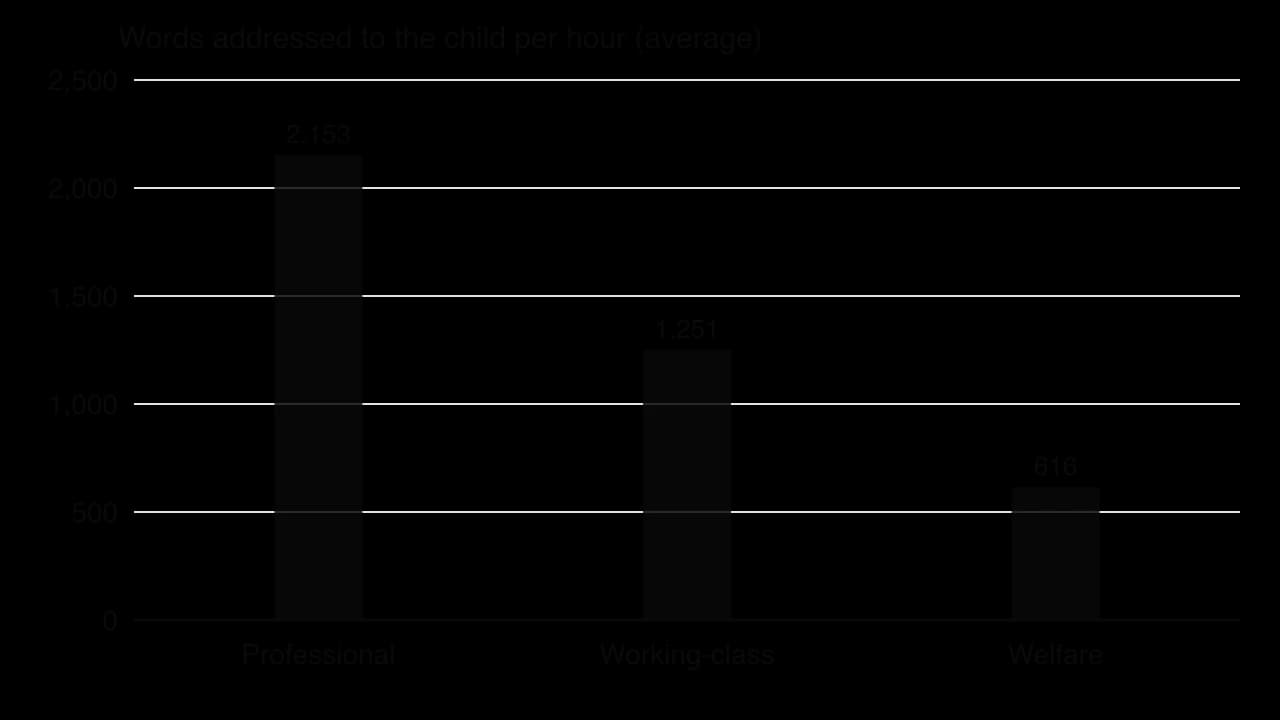
Large differences appeared between the groups. Children in professional families heard on average 2,153 words per hour, children in working-class families 1,251, and children in welfare families 616. Hart and Risley extrapolated these hourly rates to a child’s waking hours and estimated that by age 4 a child in a professional family would have heard about 45 million words, a child in a working-class family about 26 million and a child in a welfare family about 13 million. The difference of roughly 30 million words between the extreme groups became known as the “30 million word gap”.
The children’s own vocabularies differed in a similar way. At age 3, children in professional families had an average recorded vocabulary of about 1,116 words, compared with about 525 words for children in welfare families. Professional parents also gave more encouragements relative to prohibitions. The amount of talk children heard was strongly related to the rate of their vocabulary growth and to their IQ at age 3.
In a follow-up, Walker et al. (1994) assessed 32 of the children between the ages of 5 and 10. The SES-related differences in early language predicted the children’s later verbal ability, language skills and school achievement test scores up to the third grade.
Sources: Hart, B. and Risley, T. R. (1995). _Meaningful Differences in the Everyday Experience of Young American Children. Baltimore: Paul H. Brookes. Walker, D. et al. (1994). Prediction of school outcomes based on early language production and socioeconomic factors. Child Development, 65(2), 606–621._
Hart and Risley concluded that the amount of language children hear in the first three years differs greatly between families of different SES, and that these differences in everyday experience help to explain differences in vocabulary and later school success. Because the differences appeared before school, they argued that early intervention should focus on increasing the amount of talk addressed to young children at home. The study became the basis for many parent-coaching programmes and public campaigns encouraging parents to “talk, read and sing” with babies.
The main measure counted words spoken by the main caregivers to the child during one hour a month, with an observer present. This operationalisation has several weaknesses. One hour a month is a very small sample of a child’s life; the presence of an observer may have changed how parents behaved (a form of the Hawthorne effect); and speech by siblings, other relatives and neighbours, and speech overheard by the child, was not counted. Because the measure was based on a particular idea of what a good language environment looks like, it could underestimate the language experience of children in families where talk is spread across many people.
Sperry, Sperry and Miller (2019) tested this directly. They combined ethnographic fieldwork with home observations of 42 children aged 18–48 months in five American communities across the socioeconomic range. When all speech from all caregivers and bystanders was counted, they did not find that poor children heard far fewer words; some low-income communities had very rich verbal environments, and variation within each SES group was larger than variation between groups.
Gilkerson et al. (2017), using all-day automated recordings, still found that lower-SES children heard fewer adult words and took part in fewer conversational turns, but within-group variability was high and the gap was much smaller than 30 million words, closer to 4 million.
The sample was small (42 families) and drawn from one region of the United States. The groups also differed in ethnicity: most welfare families were African American, so SES and ethnicity were confounded. Critics argue that the study took the speech style of white professional families as the standard and treated other styles as deficient. This deficit framing is a form of cultural bias, because in many communities children learn language mainly by listening to multi-party conversations rather than through one-to-one talk with a parent.
The study is correlational: SES, language input and child vocabulary were measured, not manipulated. Parents who talk more may also differ in other ways, such as their own vocabulary or genetic factors that influence language, and talkative children may elicit more speech from parents (bidirectional ambiguity). Evidence from intervention studies and from Romeo et al. (2018) suggests that interaction does matter, but the size of the effect is uncertain. The study also raises a question of responsibility: a dramatic, widely publicised figure such as “30 million words” can stigmatise low-income parents and lead to programmes that try to change families’ cultural practices rather than address poverty itself.
Sociocultural factors rarely act alone. They shape development by changing the experiences a child has, and these experiences affect cognitive processes and the developing brain. In turn, the child’s own characteristics affect how others respond to them. An explanation that names only one approach is therefore reductionist; most current research takes an interactionist view.
Approach | Contribution to development | Example of interaction with sociocultural factors |
|---|---|---|
Sociocultural | Social interaction, cultural tools, parenting, schooling, SES | Conversational turns with adults provide the input from which children build language |
Cognitive | Attention, memory, language and schemas that the child builds and uses | Private speech turns social language into a tool for self-regulation; schooling teaches strategies for memory and classification |
Biological | Brain maturation, neuroplasticity, temperament, genetic predispositions | Noble et al. linked income to cortical surface area; Romeo et al. linked conversational turns to activity in Broca’s area |
Temperament is a good example of the child’s contribution. A calm, sociable baby may draw more conversation from adults than an irritable or withdrawn one, so the same parent may provide different input to different children. Genetic factors may also contribute to both the parents’ and the child’s verbal ability, which means that part of the correlation between parental talk and child vocabulary may be genetic rather than environmental. The gene–environment interaction perspective suggests that some children are more sensitive to their environment than others, so a sociocultural factor may matter more for some children than for others.
Bronfenbrenner’s bioecological model and Vygotsky’s theory both accommodate this interaction. Vygotsky saw the “natural line” of biological maturation and the “cultural line” of social learning as interwoven in development. The bioecological model places the child’s biological characteristics inside the same system as family and culture. Both theories therefore treat the child as an active participant in a social world.
Most research on sociocultural factors is correlational or quasi-experimental, because researchers cannot randomly assign children to families, cultures or income levels. This makes it difficult to establish that a sociocultural factor causes a developmental outcome. Family income is linked to parental education, neighbourhood, nutrition and genetic factors, any of which could explain an association. Stronger designs exist: natural experiments such as the school cut-off design of Cahan and Cohen (1989), longitudinal studies that follow the same children over time, and randomised intervention studies that change one part of the environment, such as coaching parents to have more conversations with their child.
Experimental studies of scaffolding provide the clearest causal evidence at the level of the microsystem. In Freund’s study, the comparison between children who worked with their mothers and those who worked alone showed that guided interaction improved later independent performance. Such studies are short and take place in laboratory-like settings, though, so they show that scaffolding can cause learning, not how much of real development it explains.
Social interaction is difficult to measure. Observational studies must decide what to count (words, turns, questions, instructions), when and for how long to observe, and whose speech to include. Each choice reflects assumptions about what matters, and Hart and Risley’s choice to count only speech addressed to the child produced a very different picture from Sperry et al.’s choice to count all speech. The ZPD raises a measurement problem of its own: it is defined by what a child can do with help, which depends on the kind and amount of help given, so there is no single standard way to measure it.
Much of the research on parenting styles and language environments has been carried out with European American families and then used as a standard against which other families are judged. This risks cultural bias in two ways: the categories may not fit other cultures, as Chao showed for Chinese parenting, and practices that differ from the standard may be labelled as deficits. Research by Rogoff and by Keller and colleagues shows that different communities organise children’s learning in different, culturally adaptive ways. At the same time, studies with participants from Cameroon, Brazil, Guatemala and Israel show that this field has gone further than many areas of psychology in including non-WEIRD samples.
Sociocultural theories adopt a perspective in which development is shaped by, and specific to, a cultural context. This contrasts with stage theories such as Piaget’s, which describe a universal sequence driven mainly by maturation and the child’s own activity. Each perspective captures part of the picture. Some developmental changes, such as the appearance of language and the understanding of other minds, occur in every culture, while their timing, form and content vary. A full account of development needs both the universal processes and the cultural variation, which is why sociocultural explanations are best combined with biological and cognitive ones.
Concept | How it applies to sociocultural factors in development |
|---|---|
Causality | Correlational and quasi-experimental designs dominate; natural experiments and interventions give stronger evidence |
Measurement | What to count as social interaction, and how to measure a zone of proximal development |
Bias | Western middle-class practices used as the standard; deficit framing of low-SES and minority families |
Perspective | Universal stages versus culturally specific developmental pathways |
Responsibility | Research on poverty and parenting is socially sensitive and can stigmatise families |
Change | Interventions in the microsystem and policy changes in the macrosystem can change developmental outcomes |
In the human development context, sociocultural factors can appear in Paper 1 Section B, as a scenario about a child or group of children to which a sociocultural theory or concept must be applied, and in Section C, as a concept-based essay on “the influence of sociocultural factors on development”. Paper 2 Section B may present a study such as an observation of parent–child interaction to evaluate through the concepts.
Sociocultural factors in development include social interaction, cultural tools, parenting, schooling and socioeconomic status.
Vygotsky argued that higher mental functions begin as shared activity and are internalised; language is the central cultural tool, and private speech becomes inner speech.
The zone of proximal development is the gap between what a child can do alone and with help; a more knowledgeable other supports learning within it.
Scaffolding (Wood, Bruner and Ross, 1976) is contingent support that is withdrawn as the child becomes competent; Freund (1990) found that children who worked with their mothers improved more than those who worked alone.
Bronfenbrenner’s ecological systems theory organises influences into micro-, meso-, exo-, macro- and chronosystems; it is a useful framework but hard to test.
Parenting styles are defined by warmth and control; the authoritative style predicts good outcomes in Western samples, but Chao (1994) and Keller et al. (2004) showed that the categories and timetables differ across cultures.
Hart and Risley (1995) reported large SES differences in words heard per hour and vocabulary, but Sperry et al. (2019) did not find the “30 million word gap” when all speech was counted.
Sociocultural factors interact with cognitive and biological ones, as research linking income and conversational experience to brain structure and activity shows.
Evaluation centres on causality (mostly correlational designs), measurement (what counts as interaction), bias (Western norms as the standard) and perspective (universal versus culture-specific development).
I can explain how social interaction, culture, parenting and socioeconomic status influence development.
I can describe Vygotsky’s sociocultural theory, including the ZPD, scaffolding, the more knowledgeable other and cultural tools.
I can describe Bronfenbrenner’s ecological systems theory and apply it to a child’s situation.
I can explain why parenting styles and their effects differ across cultures.
I can describe and evaluate Hart and Risley (1995) and the debate about the word gap.
I can discuss how biological, cognitive and sociocultural factors interact in development.
I can evaluate research in this area with reference to causality, measurement, bias and perspective.
I can apply a sociocultural explanation of development to an unfamiliar scenario.