 YouTube
Explain how social norms become part of a child’s self through enculturation, using research on self-construal, gender, emotion and morality, and evaluate it through the concepts.
Each is in the Psychology glossary, with every other term in the subject.
Culturally learned norms about which emotions may be shown, how strongly, and to whom in a particular situation.
A set of behaviours, attitudes and activities that a culture considers appropriate for males or for females, learned through socialisation from early childhood.
A cognitive theory that children build mental frameworks of what their culture links with each gender and then use them to guide attention, memory and their own behaviour.
A view of the self as a separate, unique individual defined by personal traits, preferences and achievements, more common in individualist cultures.
A view of the self as connected to others and defined by relationships, roles and group memberships, more common in collectivist cultures.
The distinction between moral rules, judged to be wrong everywhere because they concern harm, rights or justice, and conventional rules, judged to be local customs that authorities could change.
Explain how the enculturation of social norms contributes to the development of self.
Describe independent and interdependent self-construals and explain how children acquire them.
Explain how gender roles, display rules and moral norms become part of a child’s self, with reference to research.
Explain how biological, cognitive and sociocultural factors interact in the enculturation of norms.
Describe and evaluate the study of autobiographical memory and self-description by Wang (2004).
Discuss research on the enculturation of social norms with reference to measurement, causality, bias and change.
Apply the enculturation of social norms to unseen situations in human development.
A child’s sense of who they are, their self-concept, does not develop in a cultural vacuum. Whether children describe themselves by their personal qualities (“I’m clever”) or by their relationships (“I’m my grandmother’s helper”), what they believe boys and girls should do, and which emotions they think they may show are all shaped by the social norms of the culture they grow up in.
This area of study belongs to the human development context and to the development of self. It draws on approach terms from the sociocultural approach (enculturation, social learning theory, cultural dimensions) and the cognitive approach (schema theory), and shows how they interact with biological maturation.
With a free account, Augment remembers where you stopped and what you have practiced.
Scope: An area of study in the human development context (development of self), studied at SL and HL: the role of enculturation of social norms in the development of self. It applies the approach term enculturation, alongside social learning theory and cultural dimensions, to self-concept, gender, emotion and morality.
Enculturation is the process by which people learn the norms, values and behaviours of their own culture through agents such as family, peers, school and media. The mechanisms include modelling, reinforcement, guided participation and the building of schemas, each described by a different theory of enculturation.
The developmental question is different. It asks how norms that start outside the child, in other people’s expectations, end up inside the child as part of who they are. A three-year-old shares a toy because a parent insists; a ten-year-old shares because “that’s the kind of person I am”. This move from external rule to personal value is called internalisation, and it is what makes a norm part of the self.
YouTubeDevelopmental psychologists usually describe internalisation in three broad steps. First, the child conforms to a norm because of immediate consequences: praise, disapproval or punishment. Second, the child understands the norm and follows it when adults are watching. Third, the norm becomes part of the child’s self-concept, so that breaking it produces guilt or shame even when nobody would know. The speed of this process depends on the child’s cognitive development, on how consistently the norm is modelled and on the warmth of the relationship with the adults who model it.
No single approach explains how norms become part of the self. The sociocultural approach supplies the content (which norms) and the agents (who passes them on). The cognitive approach explains how children organise that content into schemas about themselves and use those schemas to guide attention and memory. The biological approach sets the timetable: the gradual maturation of the prefrontal cortex through childhood and adolescence supports the self-control needed to follow norms when nobody is watching, and temperament influences how strongly a child reacts to approval and disapproval.
Approach | Role in the enculturation of norms | Example |
|---|---|---|
Sociocultural | Supplies the norms and the agents; modelling and reinforcement | Parents praising modest behaviour; peers mocking cross-gender play |
Cognitive | Schemas about the self and about gender organise what is noticed and remembered | A girl remembering better what other girls in a story did |
Biological | Maturation of self-regulation; temperament; universal capacity to imitate | A fearful toddler internalising rules about not touching forbidden toys more quickly |
Hazel Markus and Shinobu Kitayama (1991) proposed that cultures differ in the way they define the self. In many Western, individualist cultures, the self is seen as a separate, bounded unit defined by stable inner attributes such as abilities, preferences and personality traits. In many East Asian, African and Latin American cultures, which are more collectivist, the self is seen as fundamentally connected to others and defined by relationships, roles and group memberships.
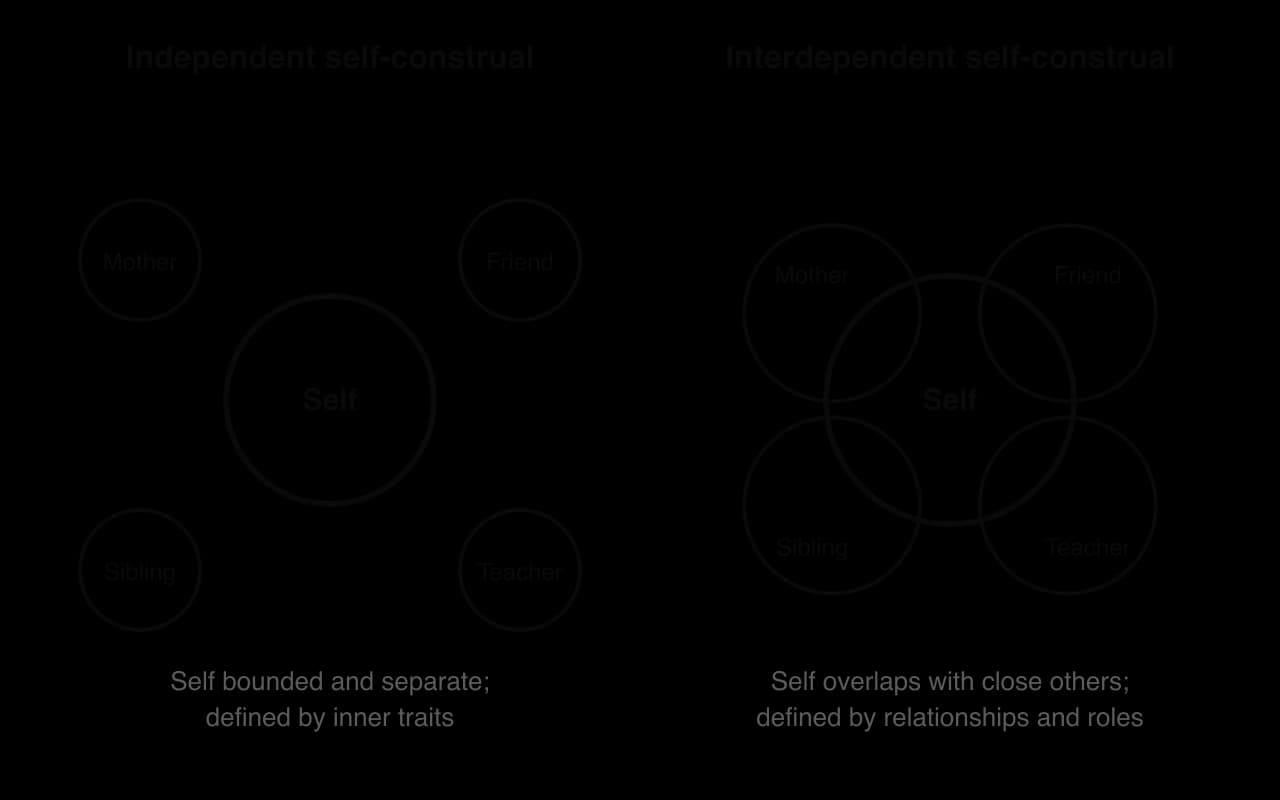
The two self-construals have different consequences for behaviour. A person with an independent self-construal tends to value expressing personal opinions, standing out and feeling good about themselves. A person with an interdependent self-construal tends to value fitting in, adjusting to others, fulfilling role obligations and self-improvement rather than self-enhancement.
Self-construals link the dimension of individualism and collectivism at the level of whole cultures to the self of each individual child. They are learned through everyday practices that rarely look like teaching. Parents in more individualist settings often ask young children what they want, praise them for personal achievements, and encourage them to express their feelings and opinions. Parents in more interdependent settings more often stress the child’s place in the family, proper behaviour towards others and the feelings of others.
One powerful practice is the way parents talk with children about past events. When a parent asks a child how she felt when she jumped off a dock into a lake and what she liked best, the child learns that their own feelings and preferences are the important part of an experience. When a parent instead stresses what everyone did together and what the child should learn from it, the child learns that relationships and proper conduct are central. Children take on these styles and use them to tell their own stories, which is why the content of their autobiographical memory reflects the culture they grow up in.
Every culture has norms about what males and females should do, wear, feel and become. A gender role is the set of behaviours and attitudes a culture considers appropriate for each sex. Children learn these norms very early, and by the age of two or three most can label their own gender. Gender identity then becomes one of the most important parts of the self-concept, and children begin to seek out activities and companions that fit it.
Adults treat infants according to their beliefs about gender long before the infant has any gender role of their own. Smith and Lloyd (1978) videotaped 32 mothers of first-born infants playing with an unfamiliar six-month-old baby. The same babies were presented sometimes in boys’ clothes with a boy’s name and sometimes in girls’ clothes with a girl’s name. Mothers’ first choice of toy depended on the sex they believed the baby to be, and babies seen as boys were verbally encouraged to be more physically active. Because the real baby was the same, the difference in treatment must have come from the adults’ gender norms.
 YouTube
Parents’ reactions continue the process. Fagot’s home observations of toddlers found parents responding more positively to sex-typed play and more negatively to cross-sex play, while believing that they treated sons and daughters the same. Modelling adds a further channel: in Bandura, Ross and Ross’s (1961) study of aggression, boys copied more physical aggression from a male model than from a female model, which suggests that children pay particular attention to models of their own sex.
Social learning accounts explain how children are shaped by others, but they do not explain why children often hold more rigid gender stereotypes than their parents. Gender schema theory, developed by Sandra Bem (1981) and by Carol Martin and Charles Halverson (1981), adds a cognitive mechanism. Once children know their own gender, they build schemas of what their culture links with “boys” and “girls”, sort new information into these categories, and pay more attention to, and remember better, information about their own gender.
The theory explains why gender norms are self-reinforcing. A boy who has learned that “dolls are for girls” will avoid dolls even without anyone discouraging him, and may misremember a picture of a boy playing with a doll as a girl. The content of the schema is cultural, but the process of building and using it is cognitive, so the theory is a clear case of the cognitive and sociocultural approaches working together.
Children also learn which feelings they may show, to whom and how strongly. These display rules are part of the self because they shape how children experience and present their own emotions. A child who has learned that showing anger to elders is shameful does not simply hide anger; over time the child may come to see themselves as a calm, respectful person.
Saarni (1984) studied how children learn the display rule “look pleased when given a gift, even if it disappoints”. Children who expected an attractive reward for helping an adult were instead given a dull baby toy, and their faces and behaviour were videotaped. The youngest children, especially boys, were more likely to show negative reactions, while older children, especially girls, were more likely to keep a positive expression. Saarni explained the age and sex differences through children’s growing awareness of the rule, their ability to carry it out and their motivation to do so, all of which are learned.
The sex difference in Saarni’s results is itself evidence of enculturation: girls are often expected to be more concerned with others’ feelings, so they may receive more encouragement to manage their expressions. Cultures also differ in which emotions they encourage. Many East Asian families place less value on high-energy positive emotions such as excitement and more on calm contentment, while many American families value excitement more highly.
Children also learn which rules are moral and which are matters of custom. Elliot Turiel’s social domain theory proposes that by the preschool years children distinguish moral rules, which concern harm, fairness and rights and would be wrong even if an adult allowed them, from conventional rules, such as wearing a uniform or calling teachers by their surnames, which depend on authority and context. This is the moral–conventional distinction.
Cross-cultural research shows that where the line falls is enculturated. In Shweder, Mahapatra and Miller’s comparison of Oriya Hindu and American children and adults, practices such as a widow eating fish were treated as serious moral wrongs in Odisha but as harmless personal choices in Chicago. For the development of self, children learn both the rules themselves and which of them define a good person. A child whose family treats food and purity rules as moral is likely to experience breaking them as a threat to their moral identity, whereas a child who has learned them as customs would see the same act as a lapse in manners.
Some prosocial tendencies may develop before norms are taught. Warneken and Tomasello (2008) found that 20-month-old infants who were given a material reward for helping later helped less than infants who had been praised or not rewarded, which suggests that early helping is intrinsically motivated and that enculturation builds on, and can even undermine, a biological readiness to help.
Qi Wang aimed to find out how early culture-specific self-concepts appear in childhood. She predicted that European American children would tell longer, more detailed, emotional and self-focused memories and describe themselves through private, positive and abstract traits, while Chinese children would tell briefer memories focused on social interactions and describe themselves through social roles, specific behaviours and a modest tone. She also predicted that the differences would grow with age.
The study was a quasi-experiment with two independent variables: culture (European American or Chinese) and age group. Participants were 93 European American children from Ithaca, New York, and 87 Chinese children from Beijing, 180 in all, in three age groups: preschool (about 4 years), kindergarten (about 6 years) and second grade (about 8 years). All came from middle-class families; all the Chinese children were only children, while most American children had siblings.
Female interviewers who were native speakers of each language spent several days in the children’s classrooms so that the children became familiar with them, then interviewed each child individually at school for about 20 minutes. Children were asked to recall four events: their last birthday, a time a parent scolded them, something special they had done recently and their earliest memory. They then described themselves, first in answer to an open request to say as much as they could about themselves and then by completing sentences beginning “I am…”.
Interviews were transcribed and coded in the original language by research assistants from each culture who did not know the hypotheses. Memories were coded for length, specificity, references to emotion, autonomous orientation (references to the child’s own preferences, opinions and choices) and the ratio of references to other people versus the self. Self-descriptions were coded as private (personal qualities), collective (group memberships) or public (relationships with others); positive, negative or neutral; abstract (traits) or specific (situation-bound behaviours). A fifth of the material was coded twice to check inter-rater reliability, which was high (correlations of .85 to .99).
American children’s memories were longer and more specific, contained more references to their own emotions and more autonomous orientation, while Chinese children’s memories more often centred on social interactions and daily routines and referred proportionally more to other people than to the self. Contrary to prediction, American children mentioned more people in their memories, which Wang suggested may reflect their larger families.
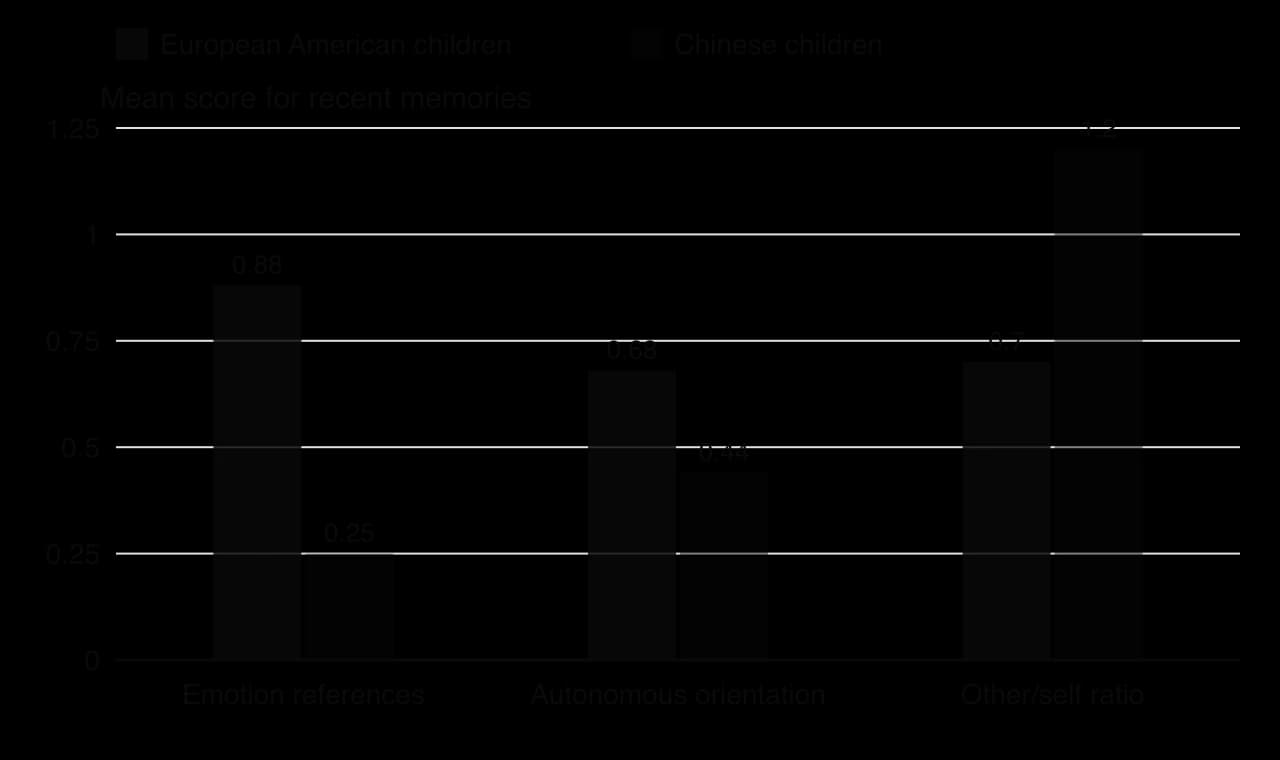
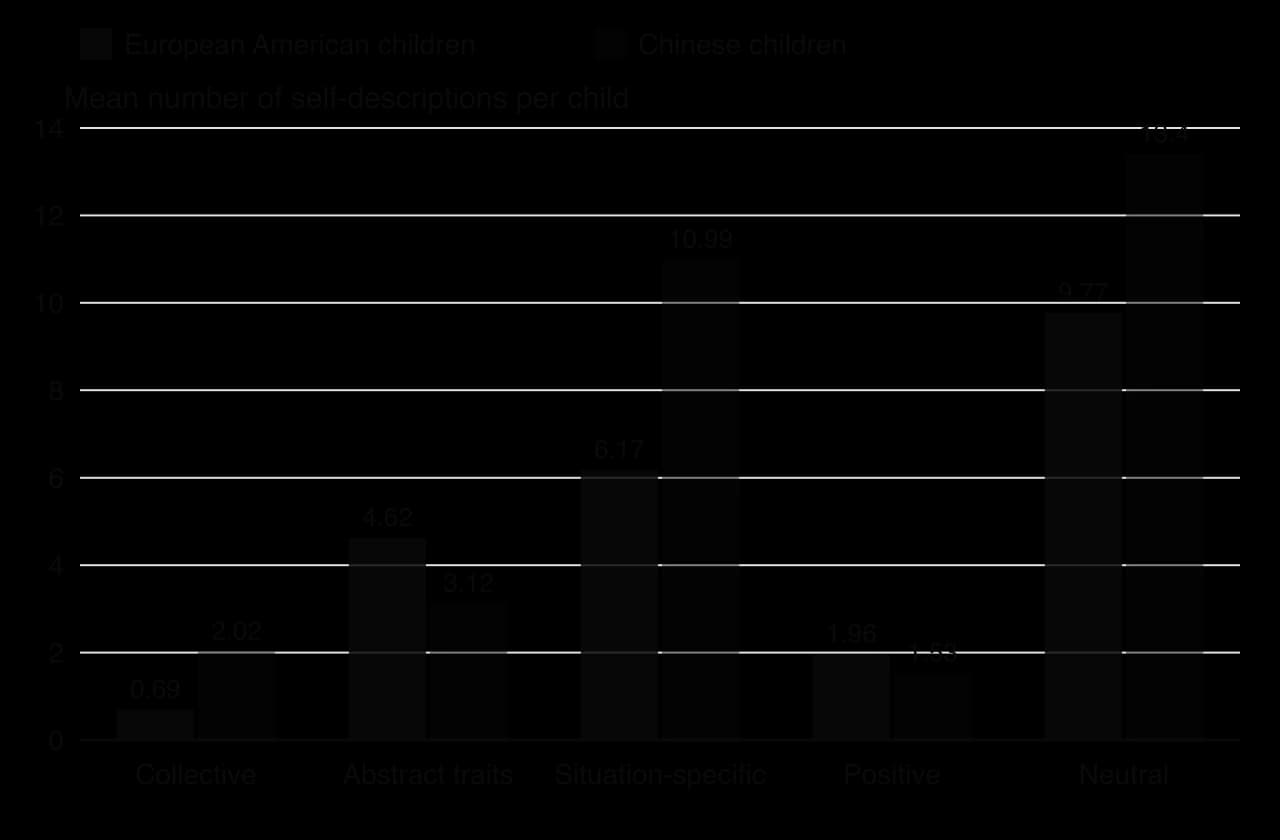
Self-descriptions showed the same cultural pattern. American children described themselves more through private attributes, abstract traits and positive evaluations (“I’m smart”, “I’m funny”); Chinese children more through group memberships, situation-specific behaviours and a neutral tone (“I play chess with my dad”, “I am a second grader”). Several differences, such as the gap in private and collective self-descriptions, were largest in the second graders. The age of children’s earliest memories did not differ between cultures.
Sources: Wang, Q. (2004). The emergence of cultural self-constructs: Autobiographical memory and self-description in European American and Chinese children. _Developmental Psychology, 40(1), 3–15._
Wang concluded that culture-specific self-concepts, independent in the American children and interdependent in the Chinese children, are already visible by about age three or four and become stronger with age. She proposed that a main channel of this enculturation is the way parents talk with children about shared past experiences: American mothers tend to elaborate on the child’s own feelings and actions, while Chinese mothers tend to emphasise proper conduct and the people involved. Through these conversations children learn what is worth remembering about themselves, which builds the self-construal their culture favours.
The study measured the self through children’s own words rather than a questionnaire, which suits young children and avoids imposing adult categories. Coding open-ended narratives involves judgement, but coders were blind to the hypotheses and inter-rater reliability was high. Measuring length raised a problem of measurement equivalence, since English was counted in words and Chinese in characters; Wang addressed this by citing earlier work showing that these counts correlate very highly with the number of ideas expressed in each language.
Culture cannot be randomly assigned, so other differences between the samples may explain the results. All the Chinese children were only children, while most American children had siblings, a confound Wang herself noted when explaining the number of people mentioned. The samples also differed in city, school system and language. The study did not measure parent–child conversations, so the proposed mechanism is supported by other research rather than by this study’s data.
Using native-speaking interviewers and coders, and coding in the original language, reduced the risk that one culture’s responses were misread through the other culture’s categories. However, each culture is represented by middle-class children from one city, so treating the results as typical of “American” or “Chinese” children would be an ecological fallacy. China has also changed rapidly since the data were collected, and the norms of urban Chinese families today may be more individualist.
The children were interviewed in a familiar school setting by people they already knew, after the interviewers had spent time in their classrooms, which reduced stress for young participants. A wider responsibility lies in reporting: describing one culture’s children as “less emotional” or “less confident” would turn a difference in norms into a deficit. Wang presents both patterns as meaningful systems of self, each adapted to its culture.
Researchers have used self-description tasks (“I am…” sentences), autobiographical memories, behavioural tasks (such as Saarni’s disappointing gift), toy choices and parents’ reports. Each captures one aspect of the self, and each has weaknesses: young children have limited language, self-description tasks reward verbal fluency, and observations can be affected by the presence of a researcher. Using several measures together, as Wang did with memories and self-descriptions, is a form of triangulation that strengthens conclusions when the measures agree.
Most studies compare existing cultural groups or observe families as they are, so they are correlational or quasi-experimental. The “baby X” design is an important exception: by presenting the same baby as a boy or a girl, Smith and Lloyd showed that adults’ gender beliefs cause differences in how they treat infants. Even so, showing that adults behave differently is not the same as showing that this treatment produces the child’s later gender role. Children are also active: they select activities, seek out same-sex peers and build their own schemas, so they help create the environments that then enculturate them.
The independent–interdependent distinction has been very influential but is easily overstated. Oyserman, Coon and Kemmelmeier (2002) analysed many studies of individualism and collectivism and found that European Americans were, on average, more individualist and less collectivist than people from other countries, but they were not less collectivist than Japanese or Korean participants, and among Asian groups only Chinese participants showed large differences. Treating whole regions as “independent” or “interdependent” therefore risks cultural bias and stereotyping, and research based on WEIRD samples may describe the West’s own self-concept as the norm.
Social norms change over generations, and so do the selves built from them. Gender norms in many countries have shifted since the observations of the 1970s; urbanisation, smaller families and social media have changed childhood in China and elsewhere. Children are now often enculturated into several sets of norms at once: family, school, national and online. Research describing a culture at one point in time may therefore not describe the same culture a generation later, which is a reason for repeated and longitudinal research.
Concept | Application to the enculturation of social norms |
|---|---|
Measurement | Self-description and memory coding need equivalent measures across languages; triangulating memories, self-descriptions and behaviour strengthens conclusions |
Causality | Quasi-experiments cannot isolate culture from family size, city or schooling; the baby X design shows adult beliefs cause different treatment |
Bias | Independent–interdependent contrasts can be overstated, as Oyserman and colleagues’ meta-analyses show; single-city samples risk the ecological fallacy |
Change | Norms and selves change across generations; children are enculturated into several cultures at once |
Perspective | Biological (temperament, maturation), cognitive (schemas) and sociocultural (agents, norms) factors interact |
Responsibility | Avoiding deficit language when comparing cultures; protecting young participants |
The enculturation of social norms is an area of study in human development, so it can be the setting for a Paper 1 Section B question, in which an approach term such as enculturation or social learning theory is applied to an unseen developmental scenario, and for a Paper 1 Section C essay, which asks about the area of study through one of the six concepts.
The enculturation of social norms explains how norms that start in other people’s expectations become part of a child’s self through internalisation.
Biological maturation, cognitive schemas and sociocultural agents interact: culture supplies the norms, cognition organises them, biology sets the pace.
Markus and Kitayama distinguished independent self-construals (traits, uniqueness) from interdependent ones (relationships, roles); children acquire them through everyday practices such as talking about the past.
Gender roles are enculturated through adults’ expectations, as in Smith and Lloyd’s baby X study, reinforcement and modelling, and maintained by children’s own gender schemas.
Display rules, such as hiding disappointment at a disappointing gift in Saarni’s study, and the line between moral and conventional rules are also learned.
Wang (2004) found independent self-concepts in American children and interdependent ones in Chinese children from about age four, with differences growing with age.
Research faces problems of measurement (verbal tasks, equivalence), causality (quasi-experimental confounds) and bias (overstated cultural contrasts, single-city samples).
I can explain how the enculturation of social norms contributes to the development of self, including internalisation.
I can describe independent and interdependent self-construals and explain how children acquire them.
I can explain how gender roles, display rules and moral norms become part of the self, with research.
I can explain how biological, cognitive and sociocultural factors interact in this process.
I can describe and evaluate Wang (2004).
I can discuss research in this area with reference to measurement, causality, bias and change.
I can apply the enculturation of social norms to an unseen scenario and plan a concept-based essay on it.