Explain how peers shape the developing self, from conformity, social identity and social learning to the adolescent brain and social media, and evaluate research on peer influence through causality, measurement and responsibility.
Each is in the Psychology glossary, with every other term in the subject.
Harris’s theory that children are socialised mainly by identifying with and adapting to their peer groups outside the home, rather than by the way their parents bring them up.
One of four positions in Marcia’s model of adolescent identity (diffusion, foreclosure, moratorium, achievement), defined by whether a person has explored options and made commitments.
A group of people of roughly the same age and social status who interact regularly and influence one another, such as classmates or friends.
The effect that people of similar age and status have on an individual’s attitudes, values and behaviour, through direct pressure, example or the wish to fit in.
A region deep in the forebrain, including the nucleus accumbens, that forms part of the brain’s reward system and responds to anticipated and received rewards, including social ones.
Describe how the role of peers in development changes from childhood to adolescence.
Explain how peer influence contributes to the development of self, including identity and self-esteem.
Explain peer influence using conformity, social identity theory and social learning theory.
Describe and evaluate group socialisation theory.
Explain why adolescents are especially sensitive to peers, with reference to brain development and the reward system.
Describe and evaluate Gardner and Steinberg’s (2005) experiment on peers and risk taking.
Discuss peer influence through social media and across cultures.
Evaluate research on peer influence with reference to causality, measurement and responsibility.
Peer influence is the effect that people of a similar age have on a person’s attitudes, values and behaviour. It shapes everyday choices, such as clothes, music and slang, and decisions with serious consequences, such as whether a teenager smokes, drives dangerously or works hard at school. Peers also shape how young people see themselves: whether they feel accepted, which groups they identify with and who they want to become.
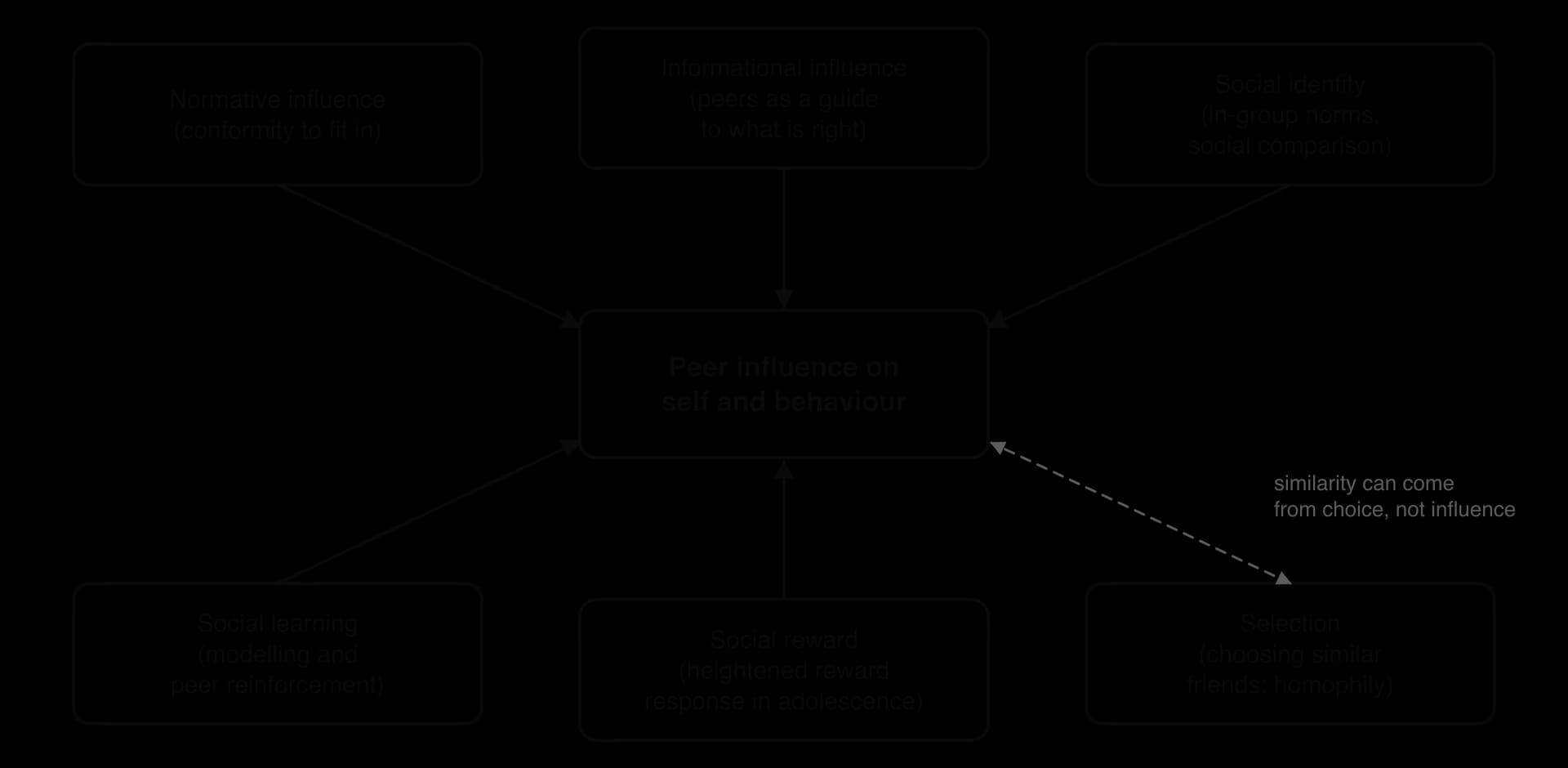
Peer influence draws on several approach terms. Conformity explains why individuals adopt a group’s behaviour, social identity theory explains why belonging to a group affects the self, and social learning theory explains how behaviour is copied from peers who are seen as models. Biological research on the adolescent brain explains why the teenage years are a period of particular sensitivity. Studying how peers affect the self raises questions of causality, because friends may be similar because they chose each other, and of
With a free account, Augment remembers where you stopped and what you have practiced.
A peer group is a group of people of roughly equal age and status who interact regularly. Parents dominate the social world of infants, but from the start of school children spend more and more time with peers, and by adolescence many spend more waking hours with friends than with family. The influence of the peer group grows with this time, and its nature changes.
In early childhood, peers are mainly play partners, and friendships are based on shared activities. In middle childhood, friendships come to depend on loyalty and trust, and children begin to compare themselves with classmates. In adolescence, peers become a central source of emotional support, information and self-evaluation. Groups become more structured, with small tight friendship groups and larger “crowds” defined by reputation and style, such as sporty, academic or alternative.
This shift matters for the self because adolescence is a period of identity formation. Erik Erikson described the main task of adolescence as resolving a conflict between identity and role confusion: young people try out different values, roles and relationships to answer the question “who am I?”. Peers provide the audience, the models and the feedback for these experiments.
James Marcia developed Erikson’s idea into four identity statuses, based on whether a young person has explored alternatives and whether they have committed to a set of values and goals. Peers influence both dimensions: they introduce new options to explore and they reward or punish the commitments a young person makes.
Identity status | Exploration | Commitment | Example |
|---|---|---|---|
Diffusion | Little | None | A 15-year-old who has not thought about future goals and drifts between friendship groups. |
Foreclosure | Little | Strong | A student who adopts the career and values chosen by parents or by one peer group without questioning them. |
Moratorium | Active | Not yet | A student trying out different groups, interests and beliefs before deciding. |
Achievement | Has explored | Strong | A young adult who has considered alternatives and chosen values and goals of their own. |
Marcia’s statuses describe a process rather than fixed stages, and research suggests that many people move back and forth between them. They are also based on a Western ideal of an individually chosen identity. In cultures where identity is more strongly defined by family roles, “foreclosure” may describe a valued, not a premature, outcome, so the model carries a risk of cultural bias.
Peers are the main comparison group for judging one’s own abilities, looks and popularity. Leon Festinger’s social comparison theory proposed that people evaluate themselves by comparing themselves with similar others, especially when there is no objective standard. In adolescence, when appearance and social status become important and the self-concept is changing quickly, these comparisons have a large effect on self-esteem. Acceptance by peers is associated with higher self-esteem, while rejection and bullying are associated with lower self-esteem, loneliness and later mental health problems.
Several processes from the sociocultural and cognitive approaches explain how peers change a young person’s behaviour and self-concept. Each is an approach term with its own theory and evidence; in human development the question is how they act on young people as they form a sense of self.
Conformity is a change in behaviour or belief to match a group, caused by real or imagined group pressure. Normative social influence produces conformity to be liked and accepted; informational social influence produces conformity because the group seems to know what is right. Adolescents in a new school or a new friendship group may adopt its style and opinions through normative influence; when they are unsure how to behave at a party or how much to drink, they may follow peers as a source of information.
According to social identity theory, part of the self-concept comes from the groups a person belongs to. Membership of a peer group becomes a social identity, and adolescents adopt the group’s norms because they are part of who they are, not just to avoid rejection. Social identity theory also explains the in-group favouritism and rivalry between crowds and schools. In Tajfel’s minimal group experiments, carried out with 14- and 15-year-old schoolboys in Bristol, boys favoured members of their own group even when the groups were based on trivial criteria, which shows how readily adolescents form in-group loyalties.
Social learning theory explains how behaviour is learned by observing models. Peers are powerful models because they are similar to the observer, which increases identification and the observer’s belief that they could perform the behaviour too (self-efficacy). Peers also deliver reinforcement directly: laughter, approval and status reward some behaviours, and teasing or exclusion punish others. Through vicarious reinforcement, a teenager who sees a friend gain status by vaping may expect the same reward.
Friends are similar in many ways, from music taste to substance use and school effort. This similarity can arise because friends influence each other (socialisation) or because young people choose friends who are already like them, a tendency called homophily (selection). Longitudinal studies that measure behaviour before and after friendships form find that both processes operate. This distinction is central to evaluating peer influence research, because a correlation between a teenager’s behaviour and their friends’ behaviour does not show that the friends caused it.
Process | Core idea | Example in development |
|---|---|---|
Normative influence (conformity) | Fitting in to be accepted | Adopting a friendship group’s clothing style in Year 9 |
Informational influence (conformity) | Following peers in uncertain situations | Copying classmates’ approach to a new kind of homework |
Social identity | Group membership becomes part of the self | Defining oneself as “one of the skaters” and adopting the group’s values |
Social learning | Observing and imitating similar models; peer reinforcement | Starting to vape after seeing popular peers do so |
Selection (homophily) | Choosing friends who are already similar | Academically keen students forming friendships with each other |
The most radical claim about peers came from Judith Rich Harris (1995) in her article “Where is the child’s environment?”. Harris argued that, apart from the genes they pass on, parents have much less lasting influence on their children’s personality than most people assume, and that children are socialised mainly by their peer groups outside the home. She called this group socialisation theory.
Behaviour is context-specific. Children learn separately how to behave at home and how to behave outside it, and what they learn at home does not automatically transfer to school or the playground.
Children identify with groups of peers. Using self-categorisation from social identity theory, Harris argued that children take on the norms of the peer group they identify with, and that groups also push members to differentiate themselves from other groups.
Evidence from immigrant families. Children of immigrant parents typically come to speak the language of the host country with the accent of their peers, not their parents, and adopt peer norms that differ from home.
Evidence from behaviour genetics. Twin and adoption studies find that the shared family environment, the part that makes siblings in the same home similar, explains little of the variation in adult personality.
Harris’s theory forced developmental psychologists to take peers seriously and to test claims about parenting with designs that control for genes. Its weakness is that it understates the role of parents. Parents influence which neighbourhood a child lives in, which school they attend and, often, which peers they meet, so parental influence may work partly through peers. Parents also affect outcomes that behaviour genetic studies of personality do not capture well, such as attachment security, values and educational attainment. Most researchers now see parents and peers as interacting influences rather than rivals.
Peer influence is present across the lifespan, but the evidence suggests that susceptibility rises in early adolescence and falls through the late teens. The pattern depends on what is being measured and on whose influence is being compared.
Steinberg and Monahan (2007) developed a self-report measure that separates willingness to resist peers from willingness to behave antisocially. Pooling data from four ethnically and socio-economically diverse US samples, more than 3,600 people aged 10–30, they found that resistance to peer influence increased in a roughly straight line between the ages of 14 and 18, with little change between 10 and 14 or between 18 and 30. Middle adolescence is therefore the period in which young people develop most of their ability to stand up to peers.
Knoll et al. (2015) tested 563 visitors to the Science Museum in London, aged 8–59. Participants rated how risky everyday situations were, such as crossing a road while texting, then saw ratings supposedly given by a group of teenagers or a group of adults, and rated the situation again. Every age group moved its ratings towards those of the other group, but the size of the shift fell with age.
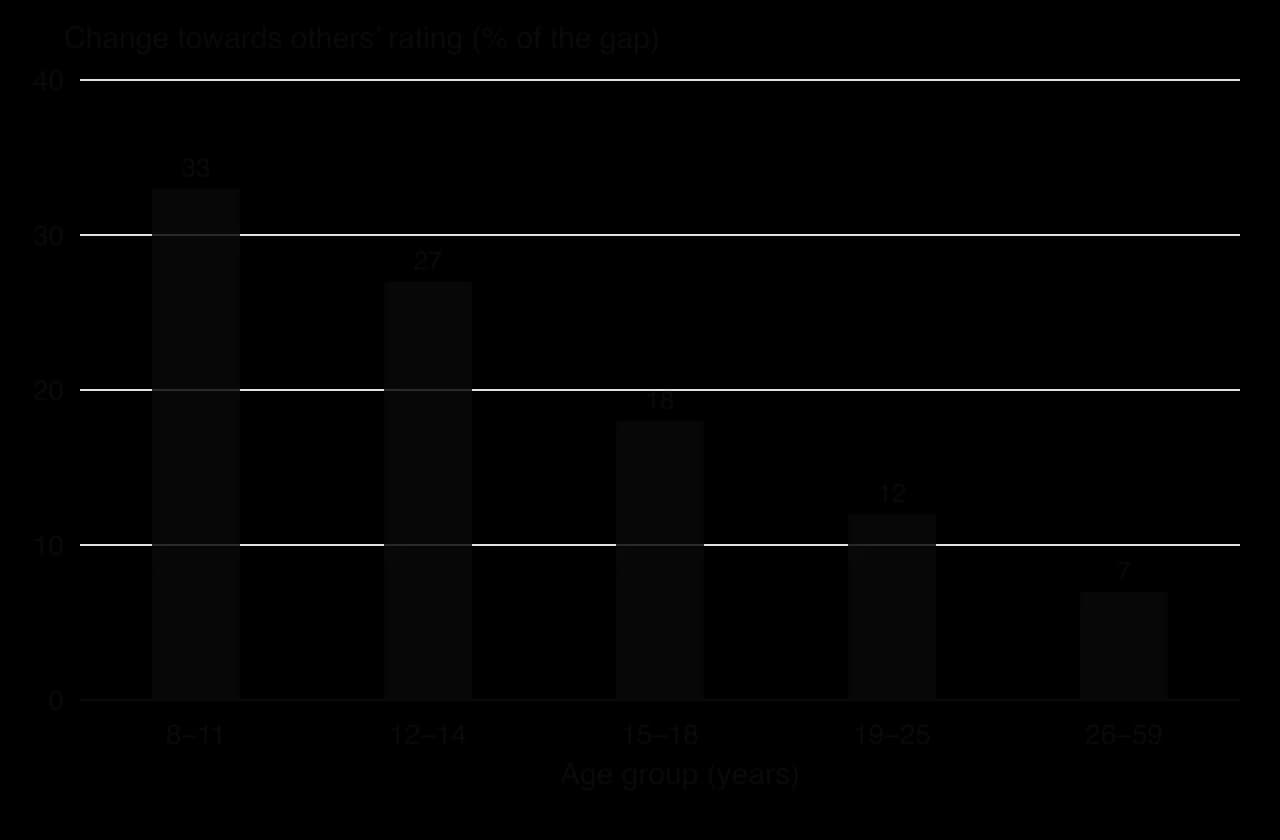
The more striking finding concerned the source. Children, young adults and adults were more influenced by adults’ ratings than by teenagers’. Only young adolescents, aged 12–14, were more influenced by teenagers than by adults, and 15–18-year-olds did not distinguish between the two. The study suggests that early adolescence is when the opinions of peers start to outweigh those of adults.
Biological research helps to explain why adolescents are so sensitive to peers. The brain changes substantially during adolescence through synaptic pruning, myelination and changes in the dopamine system, and different regions mature on different timetables. The changes in the reward system are the ones most closely linked to peer influence.
The dual systems model proposes two interacting systems. A socio-emotional system, centred on the ventral striatum and other parts of the reward system, becomes much more responsive around puberty, increasing sensation seeking and sensitivity to rewards, including social rewards. A cognitive control system, centred on the prefrontal cortex, matures gradually into the mid-20s. During the years when reward sensitivity has risen but control is still developing, adolescents are more likely to take risks, especially in emotionally charged situations such as being with friends.
Steinberg et al. (2018) found the same developmental pattern in more than 5,000 people aged 10–30 in 11 countries, from Kenya and Jordan to China and Colombia, which suggests a biological basis that culture modifies.
Chein et al. (2011) used functional magnetic resonance imaging to study 40 participants: 14 adolescents aged 14–18, 14 young adults aged 19–22 and 12 adults aged 24–29. In a simulated driving game, participants decided at each yellow light whether to stop or run the light, risking a crash. They played one block alone and one block while two friends of the same sex watched from the next room.
Only the adolescents took more risks when watched by peers, and only the adolescents showed greater activity in the ventral striatum and orbitofrontal cortex in the peer condition, which predicted their risky choices. Activity in prefrontal control regions was lower in adolescents than in adults but did not change with the presence of peers.
The study suggests that the presence of peers increases the reward value of a risky choice for adolescents, while their capacity for control stays the same. This links the sociocultural process, being watched by friends, to a biological mechanism, increased reward sensitivity, and so to the observable behaviour.
 YouTube
These biological findings fit the idea that adolescence is a sensitive period for social learning, in which the brain is especially responsive to social information because of neuroplasticity. A brain that responds strongly to peers’ approval helps young people learn the norms of the adult social world they are entering. The same sensitivity is what makes negative peer environments, such as bullying or groups that reward violence, especially harmful at this age.
Gardner and Steinberg aimed to test experimentally whether the presence of peers increases risk taking, risk preference and risky decision-making, and whether this effect is stronger in adolescents than in adults. Most earlier evidence was correlational, showing that teenagers take more risks in groups, for example that teenage drivers crash more often with teenage passengers; an experiment was needed to show whether peers cause the increase.
The study was a laboratory experiment with a 3 × 2 independent measures design. The 306 participants, from the United States, were in three age groups: adolescents aged 13–16, youths aged 18–22 and adults aged 24 or over. Within each age group, participants were randomly allocated to complete the tasks either alone or in a group with two same-aged peers, whom they had brought with them as friends.
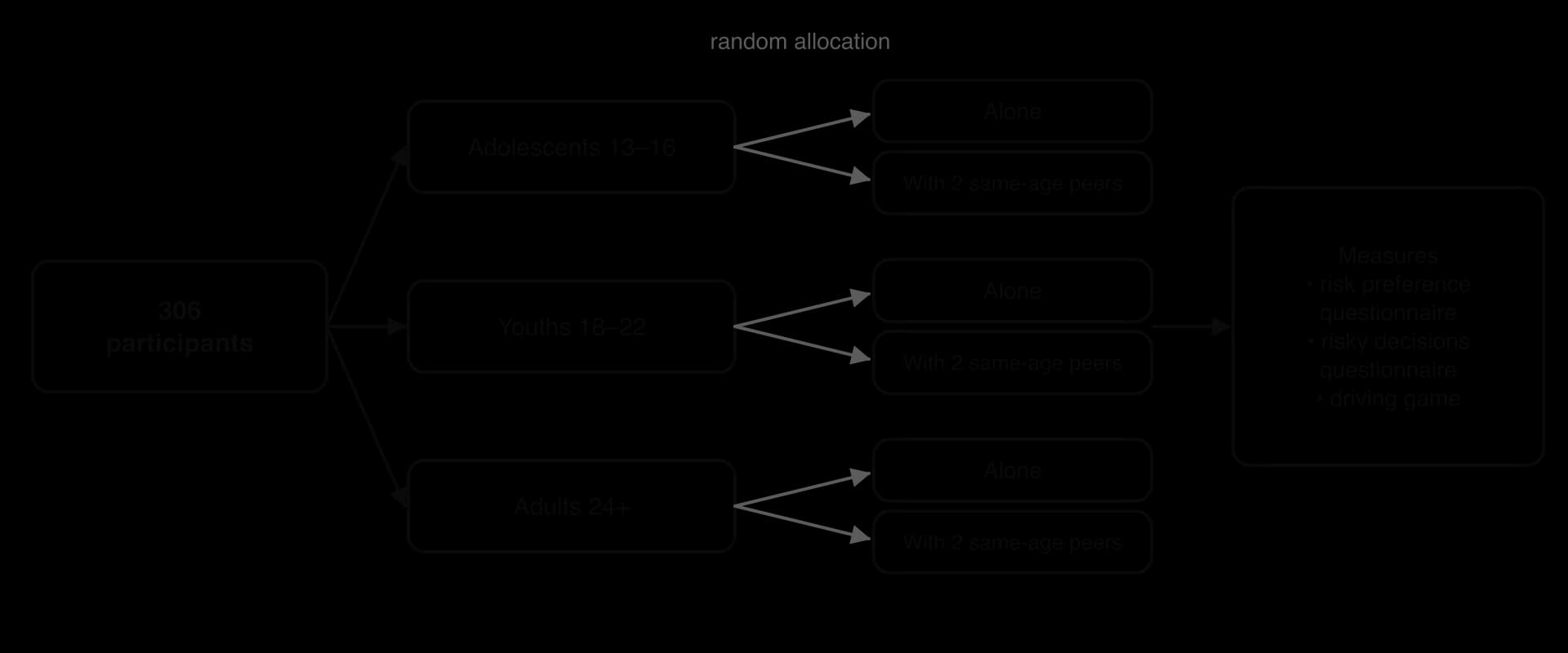
Risk was operationalised in three ways. Two questionnaires measured risk preference (attitudes to risky activities) and risky decision-making (choices in hypothetical dilemmas, including how much weight was given to benefits versus costs). The behavioural measure was a computer driving game in which a car approached a traffic light that turned yellow; the player chose how long to keep driving to earn points, knowing that the light could turn red at any moment and cause a crash that cancelled the points for that round. In the peer condition, the friends were present while the participant played and made the decisions.
Risk taking and risky decision-making decreased with age: adolescents took the most risks and adults the fewest.
Participants in all age groups took more risks in the driving game, focused more on the benefits than the costs of risky behaviour and made riskier decisions when with peers than when alone.
The peer effect on risk taking and risky decision-making was stronger in adolescents and youths than in adults; for adults, the presence of peers made relatively little difference.
The researchers concluded that adolescents are more inclined towards risky behaviour than adults, and that peer influence plays an important causal role in explaining adolescent risk taking. The presence of peers seems to shift the balance of a decision towards its rewards, which fits the later neural evidence from Chein et al. (2011) that peers increase reward-related brain activity in adolescents.
Because participants in each age group were randomly allocated to the alone or peer condition, differences in risk taking between the two conditions can be attributed to the presence of peers rather than to personality. This makes the study much stronger evidence than correlations between friends’ behaviour, which cannot separate influence from selection. Age itself was not manipulated, so differences between age groups could reflect cohort or other differences as well as development.
A driving game with points, in a laboratory, has low mundane realism: there is no real danger, and the “risk” is losing points. The questionnaires rely on self-reports about hypothetical situations, which may be affected by social desirability, especially when friends are present. The study shows how peers change decisions in a game, which supports but does not prove a causal role in real crashes. Using three different measures that gave the same pattern is a form of triangulation that increases confidence in the finding.
All participants were from the United States, and peers were the participant’s own friends, which increases realism but means the groups differed in how close and how influential the friends were. Peer effects may depend on cultural norms about risk and about the authority of adults over adolescents, so the size of the effect may not generalise to other cultures. The later 11-country study of sensation seeking suggests that the underlying developmental pattern is widespread, but it did not test peer presence directly.
The study involved minors, so parental consent was needed as well as the adolescents’ own agreement. Encouraging risky choices in a game carries little risk of harm. Research on peer effects is also cited in support of graduated driver licensing, under which many US states limit the number of teenage passengers that newly licensed drivers may carry.
Sources: Gardner, M. & Steinberg, L. (2005). Peer influence on risk taking, risk preference, and risky decision making in adolescence and adulthood: an experimental study. _Developmental Psychology, 41(4), 625–635._
 YouTube
For many adolescents, much contact with peers now happens through social media. These platforms make peer feedback constant, public and countable, in the form of likes, comments, followers and views, and they allow comparison with large numbers of peers and with edited images of their lives. In a 2024 survey of 1,391 US teenagers aged 13–17, about nine in ten used YouTube, about six in ten used TikTok and Instagram, 55% used Snapchat, and nearly half said they were online “almost constantly”, up from 24% a decade earlier.
Sources: Pew Research Center, Teens, Social Media and Technology (2024).
Sherman et al. (2016) built a simulated Instagram feed to study the effect of likes. Adolescents in an fMRI scanner viewed photos, some of them showing risky behaviour such as drinking or smoking, that had supposedly been liked by many or by few peers. They were more likely to like photos that already had many likes, for neutral and risky photos alike. Viewing photos with many likes was associated with greater activity in regions linked to reward, social cognition, imitation and attention, and viewing risky photos was associated with lower activity in cognitive-control regions.
The study shows conformity, a form of informational and normative influence, operating through a simple number, and it links online peer influence to the same reward-system mechanism found in the driving studies. The photos and the likes were artificial, and liking a photo is a low-cost behaviour, so the study cannot show that online endorsement changes offline behaviour.
Social comparison is easier online, where images are selected and edited. The evidence on social media and adolescent well-being is mostly correlational and the average associations are small, but they may be larger at particular ages. Orben et al. (2022) analysed two large UK datasets. Longitudinal analysis of 17,409 participants aged 10–21 found developmental “windows of sensitivity” in which higher estimated social media use predicted lower life satisfaction a year later: at 11–13 for girls, at 14–15 for boys, and at 19 for both. Lower life satisfaction also predicted later increases in social media use, so the relationship runs in both directions.
These windows correspond roughly to the timing of puberty, which comes earlier for girls, and to the transition to adulthood at 19, which suggests that the effects of online peers depend on developmental stage. The data are self-reported estimates of time spent online, which is a crude measure of what young people actually do and see, and the effects remain small at the population level.
Most research on peer influence comes from the United States and Western Europe, where adolescence is often seen as a time of growing independence from parents. In many cultures, family obligation remains strong in adolescence and adults have more say in young people’s friendships, which may reduce the relative weight of peers. The dual systems research suggests that the biological sensitivity is widespread, but which behaviours peers reward differs between cultures and over time.
Research on shyness in China shows how peer values depend on the wider culture. Chen et al. (2005) compared three cohorts of Chinese primary school children, around 10 years old, assessed in 1990, 1998 and 2002, during China’s rapid transition to a market economy. In the 1990 cohort, shy, sensitive behaviour, which fitted traditional values of self-restraint, was associated with social and academic success. By the 1998 cohort the associations had weakened, and in the 2002 cohort shyness was associated with peer rejection, school problems and depression. As the wider culture came to value assertiveness, peers began to reject a trait they had once valued.
The finding is important for understanding peer influence on the self: the same personal characteristic can lead to acceptance or rejection depending on the norms of the peer group, and those norms are shaped by the culture. It also shows change across historical time, a reminder that research on peers from one period may not describe the next generation.
Peer influence is a clear case where explanations from different approaches are needed together. The adolescent brain is especially responsive to social reward (biological); young people form beliefs about what their peers do and approve of, and these beliefs may be inaccurate (cognitive); and the norms of the peer group and the wider culture decide which behaviours are rewarded (sociocultural).
Approach | Factor | Evidence |
|---|---|---|
Biological | Heightened reward sensitivity with slower-maturing control; neuroplasticity in adolescence | Chein et al. (2011); Steinberg et al. (2018); Sherman et al. (2016) |
Cognitive | Social comparison; beliefs about peer norms; identity exploration | Marcia’s identity statuses; Knoll et al. (2015) |
Sociocultural | Conformity, social identity and social learning in peer groups; cultural values | Gardner and Steinberg (2005); Harris’s group socialisation theory; Chen et al. (2005) |
The approaches interact. Being watched by friends (a social situation) increases activity in the reward system (biological), which changes how the costs and benefits of a decision are weighed (cognitive). The behaviours that peers reward are set by group norms that change with culture and history. Treating adolescent risk taking as only “brain immaturity” or only “bad friends” is reductionist.
The main challenge is separating peer influence from selection. Friends may be similar because they influence each other, because they chose each other, or because they share the same environment, such as a neighbourhood with easy access to alcohol. Laboratory experiments such as Gardner and Steinberg (2005) establish that peers can cause changes in risk taking, while longitudinal studies of friendship networks show that both selection and influence occur in real life. Neither design alone answers how much real-world behaviour peers cause.
Peer influence is measured with laboratory games, ratings of hypothetical situations, self-report scales such as Steinberg and Monahan’s resistance to peer influence measure, and reports from friends. Laboratory tasks have strong control but low mundane realism; self-reports of how much one resists peers may reflect how adolescents want to see themselves. Brain imaging adds a biological measure, but activity in the ventral striatum is interpreted as “reward” through reverse inference, and samples in imaging studies are small (40 in Chein et al., 2011).
The evidence points to early and middle adolescence as the period when peers matter most, when sensitivity to peers rises and resistance develops most quickly between 14 and 18. Adolescence is therefore a period of opportunity as well as risk, because programmes that use peers as positive models, or that correct mistaken beliefs about what peers actually do, may be especially effective at these ages. Peer norms also change across historical time, as Chen et al.’s Chinese cohorts show.
Most participants in peer influence research are under 18, so researchers need parental consent and the young person’s own assent, and must avoid encouraging harmful behaviour. Studies involving risky photos or driving games must avoid normalising risk. There is also a responsibility in how findings are communicated: describing teenagers as having “broken brains” can stigmatise them and be used to justify excessive control, while ignoring the evidence on peers can lead to policies, such as unrestricted teenage passengers for new drivers, that put them at risk.
Most studies use samples from the United States and Western Europe, which are WEIRD samples: Western, educated, industrialised, rich and democratic. Findings from such samples may not describe adolescents in cultures with different family structures and values. Social media research also ages quickly, because platforms and how young people use them change faster than studies can be published.
Peer influence can appear in Paper 1 Section B as an unseen scenario, often asking you to explain a young person’s behaviour or change using an approach term such as conformity, social identity theory or social learning theory. In Section C it can be combined with any concept; causality and responsibility fit particularly well.
Peers become more important through childhood and adolescence, as sources of identity, comparison, support and norms.
Peer influence works through conformity, social identity, social learning and social reward; similarity between friends can also come from selection (homophily).
Marcia’s identity statuses describe adolescent exploration and commitment, in which peers provide options and feedback.
Harris’s group socialisation theory argues that children are socialised mainly by peers outside the home, but it underestimates the indirect role of parents.
Resistance to peer influence rises mainly between 14 and 18; only 12–14-year-olds were more influenced by teenagers than by adults about risk.
The dual systems model and Chein et al. (2011) suggest that peers increase reward-system activity in adolescents, increasing risk taking.
Gardner and Steinberg (2005) showed experimentally that peers increase risk taking, especially in adolescents and youths.
Likes on social media act as peer influence, and associations with well-being are small, two-directional and age-dependent.
Peer values depend on culture and historical change, as shown by the changing status of shy children in China.
I can describe how the role of peers changes from childhood to adolescence.
I can explain how peers contribute to identity, social comparison and self-esteem.
I can explain peer influence using conformity, social identity theory and social learning theory, and distinguish influence from selection.
I can describe and evaluate group socialisation theory.
I can explain how brain development makes adolescents sensitive to peers.
I can describe and evaluate Gardner and Steinberg (2005).
I can discuss peer influence through social media and across cultures.
I can evaluate peer influence research with reference to causality, measurement and responsibility.