6 Health and well-being
Health and well-being applies the approaches to mental health disorders and health problems: what explains them, why rates differ between groups, and how they can be prevented and treated.
- IB Psychology
- SL and HL
What 6 covers
From the subject guide: what you need to know and be able to do.
Mental health disorders, health problems, and how they are prevented and treated.
10 subtopics in Health and well-being
Each one has its own page once something is published for it.
- 6.1Biological explanations of mental health disordersnotes
- 6.2Cognitive models of mental health disordersnotes
- 6.3Cultural differences in mental healthnotes
- 6.4Environmental factors in mental health disordersnotes
- 6.5Prevalence of health problemsnotes
- 6.6Social learning and healthnotes
- 6.7Stress and healthnotes
- 6.8Biological treatment of a disordernotes
- 6.9Psychological treatment of a disordernotes
- 6.10Prevention and treatment of a health problemnotes
Key terms introduced here
Each is in the Psychology glossary, with every other term in the subject.
- Anxiety disorder
A group of mental health disorders characterised by excessive, persistent fear or worry that is out of proportion to real danger and leads to avoidance, such as panic disorder and phobias.
- Diagnosis
The process of identifying a disorder by comparing a person’s symptoms, their duration and their effects with the criteria of a classification system such as DSM-5-TR or ICD-11.
- Diagnostic and Statistical Manual of Mental Disorders
The American Psychiatric Association’s classification of mental health disorders, now DSM-5-TR (2022), which defines each disorder by its symptoms, their duration and their effect on functioning.
- Eating disorder
A mental health disorder involving persistent disturbance of eating and of how body weight and shape are experienced, such as anorexia nervosa, bulimia nervosa and binge-eating disorder.
- Health problem
A condition that harms physical health and is strongly influenced by behaviour and the environment, such as obesity, drug misuse or problematic social media use.
- Major depressive disorder
A mental health disorder involving depressed mood or loss of interest or pleasure for at least two weeks, with symptoms such as sleep and appetite changes, fatigue, worthlessness and poor concentration.
- Mental health
A state of psychological and emotional well-being in which a person can cope with the normal stresses of life, work productively and contribute to their community; more than the absence of a disorder.
- Mental health disorder
A pattern of thoughts, emotions and behaviour that causes significant distress or impairment in daily functioning and meets agreed diagnostic criteria, such as those of DSM-5-TR or ICD-11.
- Obsessive-compulsive disorder
A mental health disorder involving unwanted, intrusive thoughts (obsessions) and repetitive behaviours or mental acts (compulsions) performed to reduce the anxiety they cause.
- Phobia
An anxiety disorder involving an intense, irrational fear of a specific object or situation, such as heights or spiders, which the person avoids or endures with great distress.
- Post-traumatic stress disorder
A mental health disorder that can follow a traumatic event, involving intrusive memories, avoidance of reminders, negative changes in mood and thinking, and heightened arousal.
- Schizophrenia
A mental health disorder involving psychosis, such as hallucinations and delusions, together with disorganised thinking and reduced motivation and emotional expression.
- Well-being
A person’s self-reported sense that their life is pleasant, satisfying and meaningful; subjective, but measurable reliably by self-report.
An overview of 6 Health and well-being
Health and well-being is the context in which psychology is applied to illness and to living well. It studies mental health disorders such as depression, health problems such as obesity and addiction, and the ways both can be prevented and treated.
The context treats mind and body as one system. Chronic stress raises blood pressure and suppresses the immune system; physical illness affects mood; and behaviours such as eating, drinking and smoking are shaped by thoughts, feelings and social influences. Mental health and physical health can be assessed fairly objectively, through diagnosis and medical measures, while well-being is people’s own sense that their life is going well. Being free of a disorder is not the same as having high well-being, and both matter.
Well-being is usually measured by asking people to rate how satisfied they are with their life and how often they feel positive and negative emotions.
A mental health disorder is a pattern of thoughts, emotions and behaviour that causes significant distress or impairment and meets agreed criteria, usually those of the Diagnostic and Statistical Manual of Mental Disorders (DSM-5-TR) or the World Health Organization’s ICD-11. A health problem is a condition that harms physical health and is strongly influenced by behaviour, such as obesity, drug misuse or social media addiction.
Questions the topic tries to answer
Why do some people develop a mental health disorder such as depression while others in similar situations do not?
How much do genes, brain chemistry, ways of thinking, life events and social conditions each contribute, and how do they interact?
Why do recorded rates of disorders and health problems differ between countries, cultures and groups, and change over time?
How do stress, social influence and the environment shape health behaviours such as eating, smoking and drug use?
How effective are biological and psychological treatments, and how should effectiveness be measured?
What works in preventing health problems, and why do people find healthy behaviour change so hard?
The subtopics
The topic has three groups of subtopics. Major depressive disorder is the main disorder across the topic, with post-traumatic stress disorder, panic disorder, other anxiety disorders and schizophrenia used for comparison; obesity and addiction, especially tobacco addiction, are the main health problems.
Subtopic | What it covers |
|---|---|
6.1 Biological explanations of mental health disorders | Genes, neurotransmitters, stress hormones, brain structure and inflammation as explanations of depression, with PTSD for comparison, and their limits |
6.2 Cognitive models of mental health disorders | Beck’s model, hopelessness theory, rumination and biases in attention and memory, with panic disorder for comparison; the value of cognitive models |
6.3 Cultural differences in mental health | Why prevalence differs between cultures; culture and the expression, diagnosis and treatment of distress |
6.4 Environmental factors in mental health disorders | Life events, childhood adversity, poverty, isolation and the physical environment |
6.5 Prevalence of health problems | How prevalence is measured, and why rates of obesity, tobacco use, drug misuse and social media addiction change over time and differ between populations |
6.6 Social learning and health | How modelling and social norms shape health behaviours such as eating and smoking |
6.7 Stress and health | The stress response (the SAM system and HPA axis), models of stress, and how chronic stress affects immunity, the heart, eating and smoking |
6.8 Biological treatment of a disorder | How antidepressants and other biological treatments, such as ECT, rTMS and ketamine, work and how effective they are |
6.9 Psychological treatment of a disorder | How therapies such as cognitive behavioural therapy work, how effective they are and how they compare with drugs |
6.10 Prevention and treatment of a health problem | How effective strategies to prevent or treat obesity and tobacco addiction are, from campaigns, nudges, taxes and incentives to lifestyle programmes, medication and surgery, and the barriers to change |
The disorders named in the topic
Disorder | Main features |
|---|---|
Major depressive disorder | At least two weeks of depressed mood or loss of interest, with symptoms such as sleep and appetite changes, fatigue, worthlessness and poor concentration |
Anxiety disorders (including phobias) | Excessive, persistent fear or worry that is out of proportion to real danger and leads to avoidance |
Post-traumatic stress disorder (PTSD) | After a traumatic event: intrusive memories, avoidance, negative changes in mood and thinking, and heightened arousal |
Obsessive-compulsive disorder (OCD) | Unwanted, intrusive thoughts (obsessions) and repetitive acts performed to reduce the anxiety they cause (compulsions) |
Eating disorders | Persistent disturbances of eating and of how body weight and shape are experienced, as in anorexia and bulimia nervosa |
Schizophrenia | Psychosis, including hallucinations and delusions, with disorganised thinking and reduced motivation and emotional expression |
How the subtopics connect
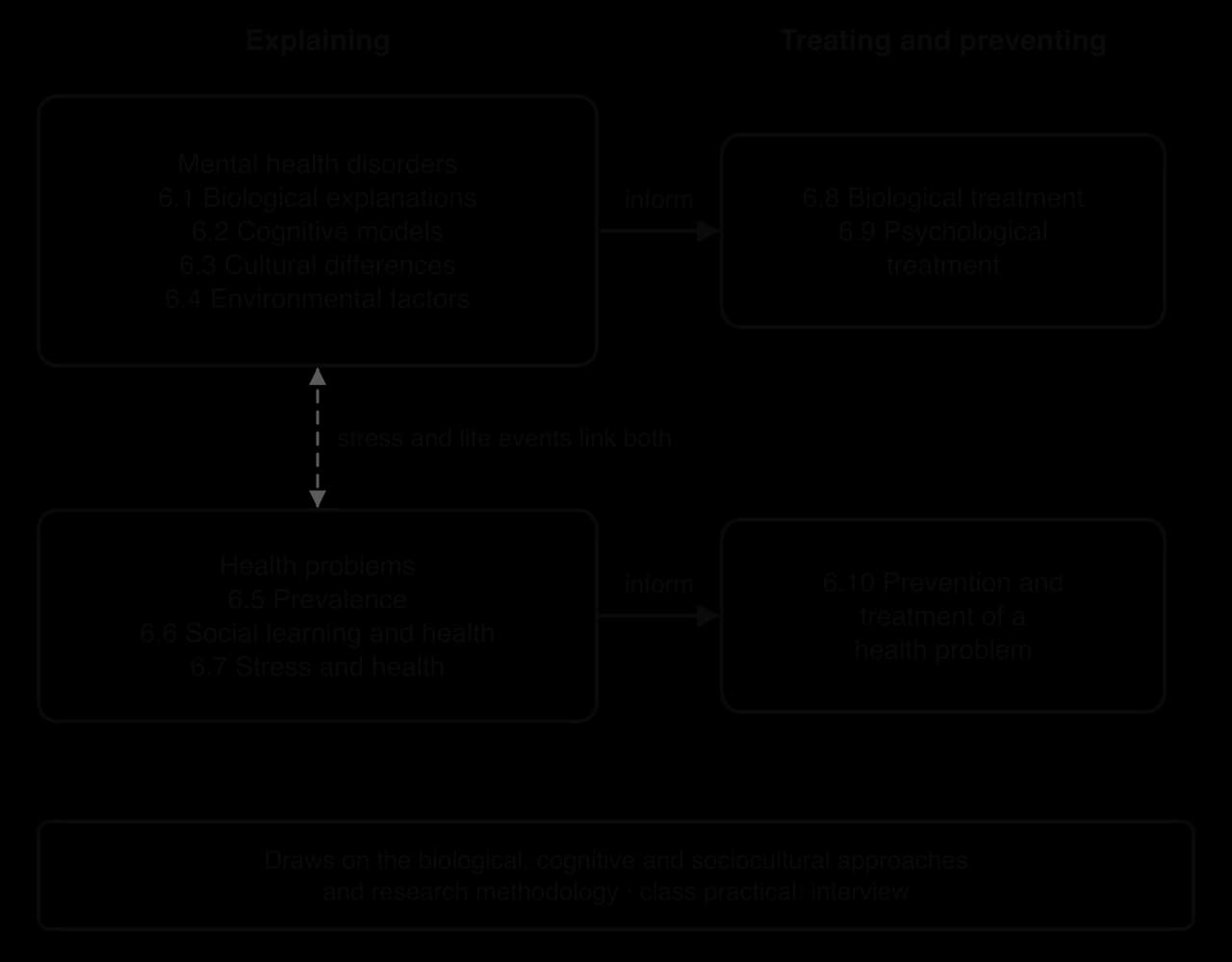
The first four subtopics explain mental health disorders from the biological, cognitive and sociocultural approaches. They are best read together, because each explains a different part of the same process: a genetic or cognitive vulnerability, triggered by an environmental stressor, expressed in culturally shaped ways. The diathesis-stress model is the framework that joins them. The treatment subtopics follow from them: antidepressants were developed from biological explanations, and cognitive behavioural therapy from cognitive models.
The health-problem subtopics explain why behaviours such as overeating and smoking spread and persist, through social learning, stress and changes in the environment. Their findings are applied in prevention, which is why the last subtopic asks what works and why change is hard. Stress links the two halves: stressful life events trigger depression, and chronic stress also affects the immune system and health behaviours.
Links to the concepts and the rest of the course
Concept | Where it appears in health and well-being |
|---|---|
Causality | Is negative thinking a cause or a symptom? Does poverty cause depression or does depression lower income? Does a drug’s effect show what caused the disorder? |
Measurement | Diagnosis by interview and questionnaire, prevalence surveys across cultures, self-reported life events and well-being, BMI as a measure of obesity |
Bias | Cultural and gender bias in diagnosis; publication bias in drug trials; samples drawn from Western populations |
Perspective | Biological, cognitive and sociocultural explanations of the same disorder; reductionist versus holistic and Indigenous views of health |
Change | Changing prevalence over time; treatment effectiveness; prevention and the barriers to behaviour change |
Responsibility | Ethics of research with vulnerable people; stigma; placebo and wait-list controls in treatment trials; health policy |
The context uses terms from all three approaches: chemical messengers, genetic inheritance, neurotransmission and the diathesis-stress model from the biological approach; cognitive models and schema theory from the cognitive approach; and cultural dimensions, the emic and etic approaches, acculturation and social learning theory from the sociocultural approach. Research methodology matters throughout, since much of the evidence comes from twin studies, cohort studies, randomised controlled trials and cross-cultural surveys. The class practical linked to this context is the interview, which suits research on people’s experience of health and illness.
How SL and HL differ
SL and HL students study the same health and well-being content and sit the same Papers 1 and 2. HL students go further through the HL extensions: culture (for example, how culture shapes help-seeking and the adaptation of therapies), motivation (for example, motivation to change health behaviour) and technology (for example, internet-delivered therapy and the effects of social media on mental health). HL students apply this to unseen sources, often set in the health context, in Paper 3.
Assessment
Paper 1 Section B: a short scenario may be set in health and well-being and ask how an approach term, such as the diathesis-stress model, schema theory or social learning theory, applies to it.
Paper 1 Section C: one of the two essay questions may be set in this context, combining an area of study, such as biological explanations or environmental factors, with a concept such as causality or perspective.
Paper 2 Section A: when the interview is the class practical examined, the questions concern the interview used in that practical, which is linked to this context.
Paper 2 Section B: the unseen study may come from health and well-being research, such as a trial of a treatment or a survey of health behaviour.
Paper 3 (HL): sources may explore the role of culture, motivation or technology in health and well-being, for example technology and the mental health of students.
Carry on with 6 in Augment
With a free account, Augment remembers where you stopped and what you have practiced.