 YouTube
Explain how cognitive behavioural therapy and other psychological treatments reduce depression and anxiety, and evaluate their effectiveness against drugs, over time and across cultures, using trials and meta-analyses.
Each is in the Psychology glossary, with every other term in the subject.
A psychological treatment for depression that helps people schedule and carry out rewarding and meaningful activities, reducing avoidance and increasing contact with positive reinforcement.
A planned activity in cognitive behavioural therapy in which a client tests a negative prediction in real life, so that the belief can be checked against what actually happens.
A structured, time-limited psychological treatment in which client and therapist work together to identify and change the unhelpful thoughts and behaviours that maintain a disorder.
A technique in cognitive behavioural therapy in which a client identifies negative automatic thoughts, examines the evidence for and against them and replaces them with more balanced alternatives.
The working relationship in cognitive behavioural therapy in which client and therapist act as a team, treating the client’s beliefs as hypotheses to be tested against evidence rather than as facts.
A behavioural treatment for obsessive-compulsive disorder in which a person is exposed to situations that trigger obsessions and helped not to perform the compulsions that usually reduce the anxiety.
A behavioural treatment in which a person is repeatedly and safely confronted with a feared object, situation or memory, without escape or avoidance, until the fear response weakens.
Describe the main features of a psychological treatment and how it differs from a biological treatment.
Explain how cognitive behavioural therapy treats major depressive disorder, including cognitive restructuring, behavioural activation and relapse prevention.
Explain why testing a psychological treatment is harder than testing a drug, including the choice of control condition.
Describe the aim, method, results and conclusions of DeRubeis et al. (2005) and Hollon et al. (2005), and evaluate the trial.
Analyse evidence on the effectiveness of CBT and other psychological treatments from trials and meta-analyses.
Describe behavioural activation, interpersonal therapy, mindfulness-based cognitive therapy, exposure therapy, systematic desensitisation and internet-based CBT.
Compare and contrast psychological treatment with biological and combined treatment of depression.
Discuss how culture affects psychological treatment, including cultural adaptation and lay-delivered therapy.
Evaluate psychological treatments with reference to change, causality, measurement, bias, perspective and responsibility.
A psychological treatment reduces the symptoms of a mental health disorder by changing how a person thinks, behaves, feels or relates to other people, through structured work with a trained practitioner. For major depressive disorder, the most researched psychological treatment is cognitive behavioural therapy (CBT), which grew out of Beck’s cognitive model of depression and is recommended alongside antidepressants in most national guidelines.
Psychological treatments draw on approach terms from across the course:
With a free account, Augment remembers where you stopped and what you have practiced.
A list of feared situations, ranked by the person from least to most anxiety-provoking, which is worked through step by step in systematic desensitisation or graded exposure.
Cognitive behavioural therapy delivered through structured online modules or an app, either with brief support from a therapist (guided) or entirely as self-help (unguided).
A structured, time-limited psychological treatment that treats depression by improving current relationships, focusing on grief, disputes, role transitions or social isolation.
A way of paying attention, on purpose and without judgement, to present-moment experience, including thoughts and feelings, which are noticed as passing events rather than facts.
A group treatment combining mindfulness meditation with elements of cognitive therapy, designed to prevent relapse in people who have recovered from recurrent depression.
A treatment of a mental health disorder that works by changing a person’s thoughts, emotions, behaviour or relationships through structured contact with a trained practitioner, rather than by acting directly on the body.
A questioning technique used in cognitive therapy in which the therapist asks open questions that lead clients to examine the evidence for their own beliefs, rather than telling them what to think.
A behavioural therapy for phobias in which a person learns relaxation and then works up a hierarchy of feared situations while relaxed, so that the fear response is replaced by calm.
The delivery of a treatment by people without specialist qualifications, such as trained lay counsellors or community health workers, under specialist supervision, to widen access where specialists are scarce.
The collaborative relationship between client and therapist, made up of agreement on the goals and tasks of therapy and the emotional bond between them.
A structured written log used in cognitive behavioural therapy to note a situation, the automatic thoughts and feelings it triggered, the evidence for and against the thoughts and a more balanced alternative.
Psychological treatments are often called psychotherapies or talking therapies. They assume that the way a person thinks, acts and relates to others helps to cause or maintain their symptoms, and that changing these will reduce them. Unlike a biological treatment, they do not act on the brain directly, although successful therapy is followed by measurable changes in brain activity.
Modern psychological treatments for depression share several features. They are structured (each session has an agenda), time-limited (often 8–20 sessions), based on an explicit model of what maintains the disorder, and tested in randomised trials. They also share what are called common factors: a warm and trusting relationship, a credible explanation of the problem, and the hope that things can change.
The relationship between client and therapist is called the therapeutic alliance: the agreement on goals and tasks and the emotional bond between them. Across many kinds of therapy, a stronger alliance is associated with better outcomes, which raises the question of how much of any therapy’s effect comes from its specific techniques and how much from these shared ingredients.
Treatment | What it targets | Main techniques |
|---|---|---|
Cognitive behavioural therapy (CBT) | Negative thoughts and beliefs, and the behaviour that maintains them | Thought records, cognitive restructuring, behavioural activation, behavioural experiments |
Behavioural activation (BA) | Withdrawal, avoidance and loss of rewarding activity | Activity monitoring and scheduling, reducing avoidance |
Interpersonal therapy (IPT) | Current relationship problems | Working on grief, disputes, role transitions or isolation |
Mindfulness-based cognitive therapy (MBCT) | Relapse through rumination | Group mindfulness practice; seeing thoughts as passing events |
Exposure therapy and systematic desensitisation | Learned fear and avoidance (anxiety disorders) | Graded, repeated contact with feared situations |
The table shows that the treatments target different parts of the same problem. CBT works mainly on thoughts and behaviour, IPT on relationships, and exposure-based treatments on learned fear. All of them are delivered as structured programmes and can be compared directly in trials.
YouTubeCBT for depression applies Beck’s cognitive model. In this model, people vulnerable to depression hold negative self-schemas, such as “I am only worth something if I succeed”, formed partly through early experience. A stressful event that matches the schema activates it, producing negative automatic thoughts about the self, the world and the future (the cognitive triad). The thoughts are maintained by cognitive distortions, such as overgeneralising from one failure.
CBT adds a behavioural part to this picture. Depressed people withdraw from friends, activities and work. Withdrawal reduces contact with positive reinforcement, so there are fewer experiences that could disconfirm the negative thoughts, and more time for rumination. The result is a maintenance cycle in which thoughts, feelings and behaviour keep each other going.
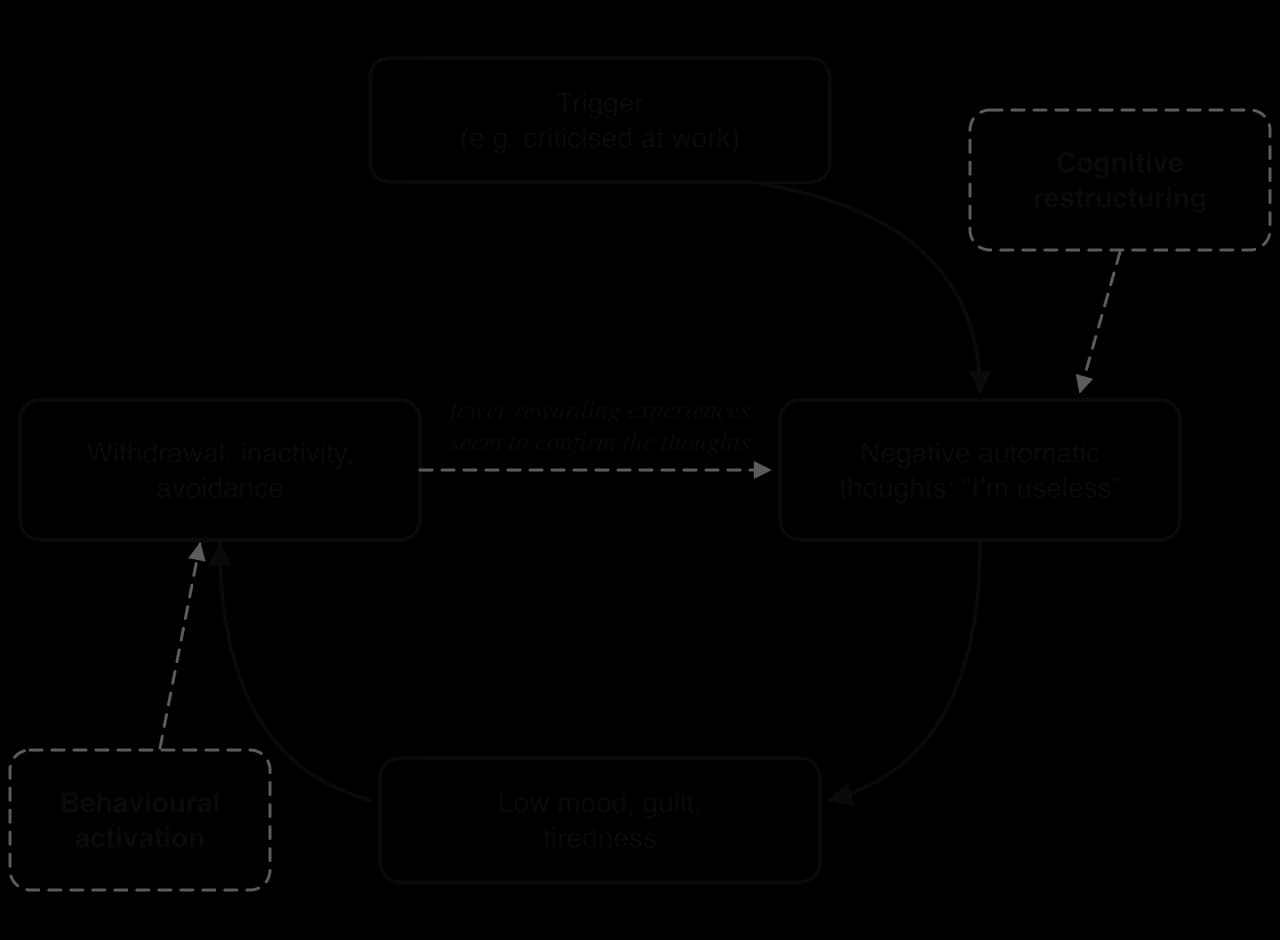
The figure shows the two points at which CBT intervenes. Cognitive techniques target the thoughts directly; behavioural techniques target withdrawal and avoidance. A change at either point can weaken the whole cycle, which is why the cognitive and behavioural parts are combined.
CBT for depression usually involves 12 to 20 weekly sessions of about 50 minutes, individually or in groups, with homework between sessions. It is collaborative: client and therapist treat the client’s beliefs as hypotheses to be tested rather than facts to be argued about. This stance is called collaborative empiricism.
Phase | What client and therapist do | Example (a hypothetical client, Amira, 19) |
|---|---|---|
1. Assessment and formulation | Measure symptoms (for example with the Beck Depression Inventory); agree goals; draw a shared diagram of how the client’s thoughts, feelings and behaviour maintain the depression; explain the CBT model | Amira sees that since failing a university module she has stopped seeing friends, which leaves more time to go over her failure |
2. Behavioural activation | Record daily activity and mood; schedule small, achievable activities that bring pleasure or a sense of achievement | She plans a 20-minute walk with her sister and rates her mood before and after |
3. Identifying thoughts | Use thought records to catch negative automatic thoughts, the situations that trigger them and the feelings that follow | “My tutor didn’t reply to my email: she thinks I’m hopeless” |
4. Cognitive restructuring | Examine the evidence for and against a thought through questioning; write a more balanced alternative; re-rate the strength of belief and mood | “She replies late to everyone; she praised my last essay. One failed module doesn’t make me hopeless” |
5. Behavioural experiments | Test a prediction in real life instead of debating it | She predicts nobody will reply if she messages her friends; she messages three and two reply |
6. Core beliefs | Work on the deeper schemas behind repeated thoughts | “I’m only worth something if I succeed” becomes a more flexible belief |
7. Relapse prevention | Review what helped; identify early warning signs and high-risk situations; write a plan | If she starts cancelling plans and staying in bed, she restarts activity scheduling |
Cognitive restructuring is the central cognitive technique. The client learns to notice negative automatic thoughts, usually by keeping a thought record, a written log of situations, thoughts, feelings and the evidence for and against each thought. The therapist uses Socratic questioning rather than telling the client what to think: “What is the evidence for this thought? Is there another explanation? What would I say to a friend who thought this?”
Situation | Automatic thought (belief 0–100%) | Feeling (0–100) | Evidence for | Evidence against | Balanced thought (belief) | Feeling now |
|---|---|---|---|---|---|---|
Friend cancelled our plans | “She doesn’t want to see me; nobody likes me” (90%) | Sad 80, lonely 75 | She cancelled last month too | She said her mother is ill; she suggested another day; two other friends messaged this week | “She has a family problem; some people do want to see me” (70%) | Sad 40, lonely 35 |
The thought record shows that restructuring aims at a more accurate thought rather than a cheerful one. The client’s distress falls because the new thought fits the evidence better. With practice, clients learn to question their thoughts without the therapist, which is one explanation of why CBT’s effects can last after therapy ends.
Behavioural activation targets the behavioural half of the cycle. The client monitors daily activities and mood, notices that mood is lower during inactivity and higher during some activities, and then schedules activities that bring pleasure or a sense of achievement, starting with small, easy steps. The logic comes from operant conditioning: depression reduces contact with rewarding experiences, and increasing activity restores it, whether or not the client feels like it at first.
A behavioural experiment combines the cognitive and behavioural parts. Instead of debating whether a prediction is true (“If I go to the party nobody will talk to me”), the client tests it in real life and records what happens. Because the evidence comes from the client’s own experience rather than the therapist’s arguments, it is often more convincing.
Because depression often recurs, the last sessions of CBT focus on preventing relapse. Client and therapist review which techniques helped, identify early warning signs (such as cancelling plans or sleeping late), list high-risk situations (such as deadlines at work or anniversaries of a loss) and write a plan for what to do if symptoms return. Some services offer “booster” sessions after the course ends.
 YouTube
Psychological treatments are tested in randomised controlled trials, like drugs, but three problems make the test harder. There is no true placebo for a conversation; neither client nor therapist can be blind to which treatment is being given; and the treatment is delivered by people, whose skill varies. Each problem affects how confidently a trial’s result can be attributed to the therapy itself.
The size of a therapy’s effect depends heavily on what it is compared with, and a weak comparison makes a therapy look more effective than a strong one does.
Control condition | What the control group receives | Main problem |
|---|---|---|
Wait-list | Nothing until the trial ends, then the therapy (wait-listing) | People told to wait may make fewer efforts to help themselves, so wait-lists can make a therapy look more effective than it is |
Usual care | Whatever care people would normally receive, such as visits to a family doctor | Varies between studies and countries |
Attention or psychological placebo | Regular supportive contact without the specific techniques | Hard to make convincing; supportive contact is itself partly therapeutic |
Pill placebo | An inactive tablet with clinical management, used when therapy is compared with a drug | Only the drug comparison is blinded |
Another active treatment | A different therapy or a drug | Shows relative, not absolute, effectiveness |
Wait-list controls are the most common in psychotherapy research and the most likely to inflate effects. A meta-analysis by Cuijpers et al. (2019) found that the average effect size of psychotherapies for adult depression against control groups was g = 0.70, but fell to g = 0.31 once low-quality studies, publication bias and wait-list comparisons were taken into account. Only 23% of the studies were judged to be at low risk of bias.
Because clients know they are receiving therapy, their expectations can affect self-reported outcomes such as the Beck Depression Inventory. Trials reduce this problem by using outcome raters who do not know which treatment each client received, but they cannot remove it. Outcomes also differ between therapists, so a trial using highly trained therapists may overestimate what therapy achieves in everyday services.
A further problem is researcher allegiance. Trials are often run by the people who developed or champion a therapy, and these trials tend to find larger effects for that therapy. Trials therefore record sessions and rate a sample of them to check treatment fidelity, whether the therapy was delivered as described.
Earlier research, especially the NIMH Treatment of Depression Collaborative Research Program, had suggested that antidepressants were more effective than cognitive therapy for severe depression. DeRubeis and colleagues aimed to compare cognitive therapy (CT, the form of CBT developed by Beck) with antidepressant medication for moderate to severe major depressive disorder, using experienced therapists and a placebo control. Hollon and colleagues then followed the patients who responded, to test whether CT has an enduring effect that lasts after treatment ends.
The trial was run at research clinics at the University of Pennsylvania in Philadelphia and Vanderbilt University in Nashville, USA. 240 outpatients aged 18 to 70 with moderate to severe major depressive disorder were randomly allocated to one of three conditions: 16 weeks of medication (the SSRI paroxetine, with lithium or desipramine added if needed; n = 120), 16 weeks of individual cognitive therapy (n = 60), or 8 weeks of pill placebo (n = 60). The placebo condition was limited to 8 weeks because withholding active treatment from severely depressed people for longer was judged unethical.
The main outcome was the HRSD, rated by assessors who did not know the patients’ treatment. Response and remission were defined from HRSD scores. Medication and placebo were given double-blind; cognitive therapy could not be blinded.
In the continuation phase reported by Hollon et al. (2005), the 104 patients who had responded (57.8% of those originally allocated) were followed for 12 months. Responders to CT stopped treatment, with up to three booster sessions allowed. Responders to medication were randomly allocated either to continue the drug at full dose or to be switched, double-blind, to placebo. Relapse was defined as a return of symptoms meeting the criteria for major depression for at least two weeks, or an HRSD score of 14 or more.
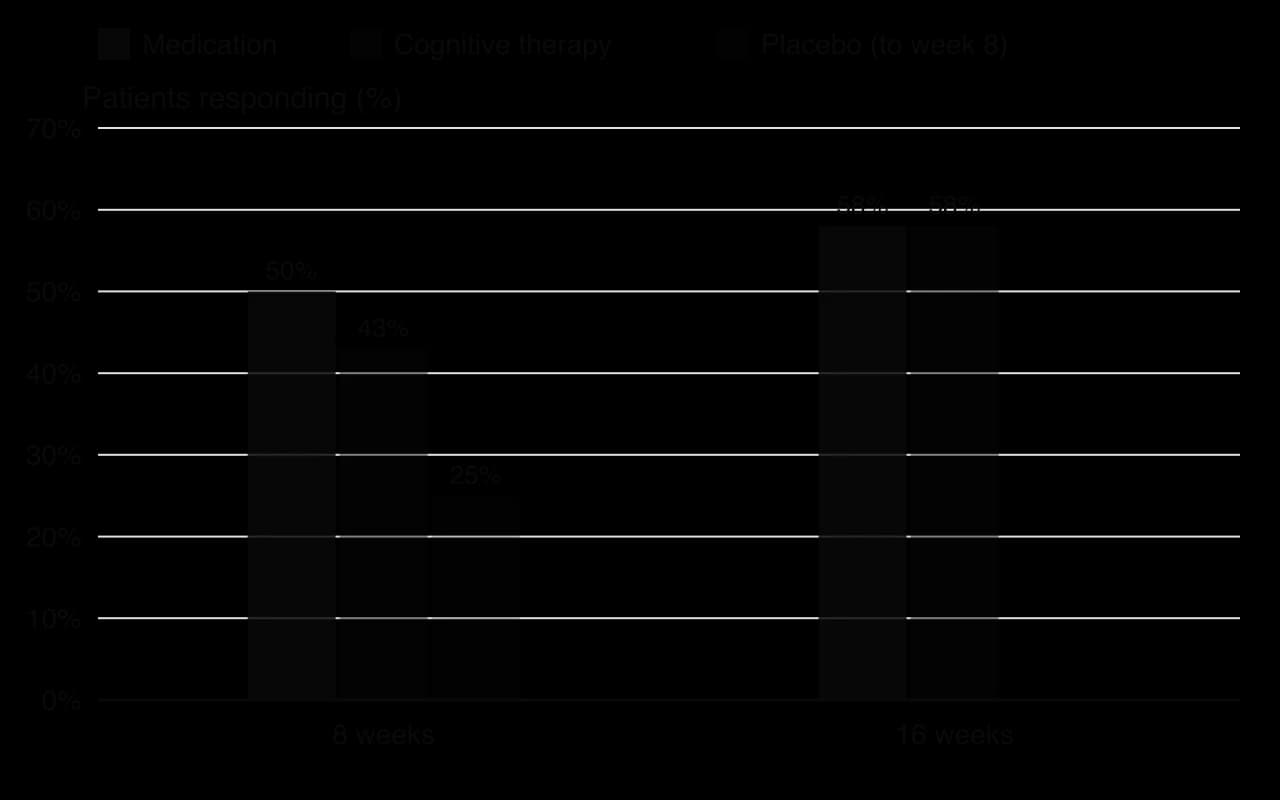
At 8 weeks, response rates were 50% on medication, 43% in cognitive therapy and 25% on placebo. The advantage over placebo was statistically significant for medication and a non-significant trend for cognitive therapy.
At 16 weeks, response was 58% in both active treatments; remission was 46% on medication and 40% in cognitive therapy.
The two treatments did not differ overall, but at Vanderbilt, where the cognitive therapists were less experienced, medication did better than cognitive therapy.
In the 12 months after treatment, 30.8% of patients withdrawn from CT relapsed, compared with 76.2% of those withdrawn from medication onto placebo and 47.2% of those who kept taking medication.
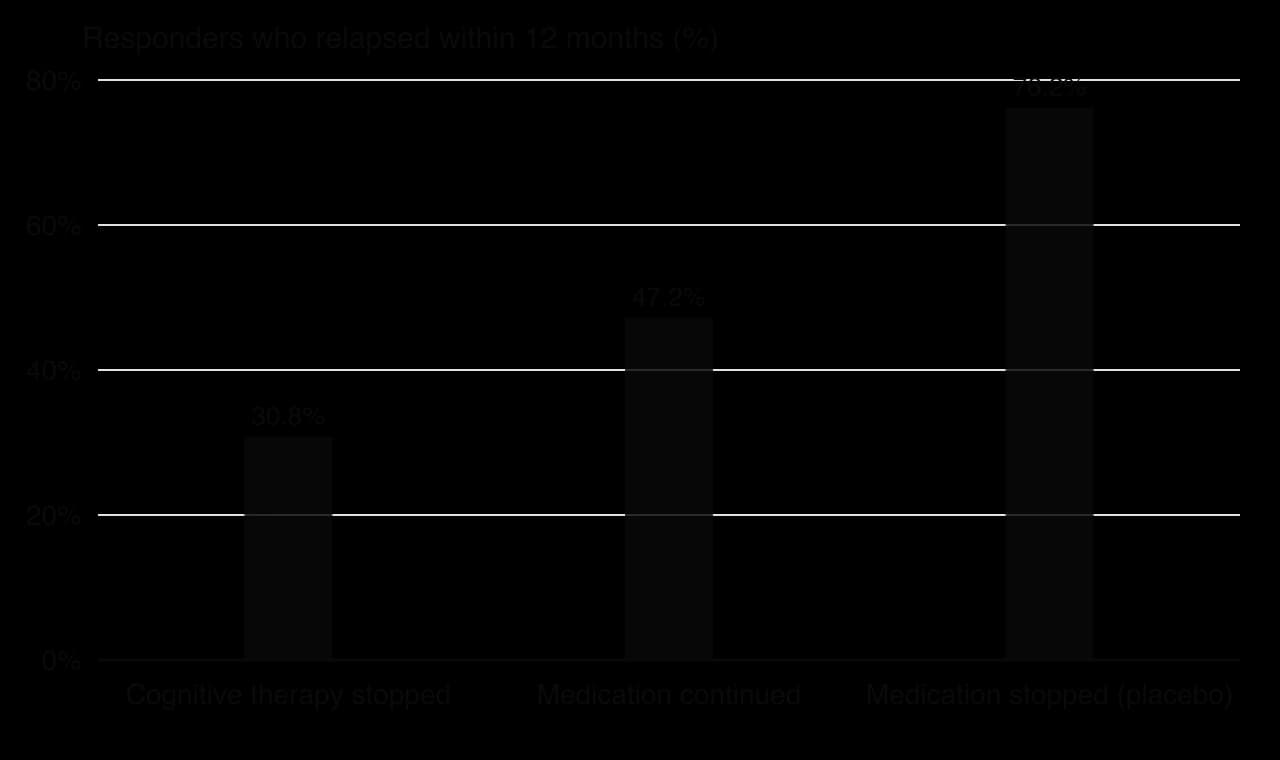
DeRubeis and colleagues concluded that cognitive therapy can be as effective as medication for the initial treatment of moderate to severe depression, but that this may depend on a high level of therapist experience or expertise. Hollon and colleagues concluded that cognitive therapy has an enduring effect that extends beyond the end of treatment, and seems to protect against relapse as well as staying on medication does.
Sources: DeRubeis, R. J., Hollon, S. D., Amsterdam, J. D., et al. (2005). Cognitive therapy vs medications in the treatment of moderate to severe depression. _Archives of General Psychiatry, 62(4), 409–416. Hollon, S. D., DeRubeis, R. J., Shelton, R. C., et al. (2005). Prevention of relapse following cognitive therapy vs medications in moderate to severe depression. Archives of General Psychiatry, 62(4), 417–422._
Random allocation to three conditions, a placebo group and blind outcome raters make this a strong test of short-term effectiveness. The placebo comparison was only eight weeks long, however, so there is no placebo comparison at 16 weeks, when CT caught up with medication; the 16-week result shows that CT and medication were equal, not how much either added to natural recovery.
The relapse comparison is less well controlled. Medication responders were randomly allocated to continue or stop, so that comparison is controlled. But patients were not randomly allocated to become CT responders: people who responded to CT may differ from people who responded to medication, for example in severity or personality. With only 104 responders split into three groups, the groups were also small.
The HRSD was scored by assessors unaware of treatment, which reduces researcher bias. Clients in CT knew their treatment, so their expectations may have affected how they described their symptoms, but the same is true of everyday treatment. The definitions of response, remission and relapse were set in advance and are standard, so the results can be compared with other trials.
The cognitive therapists were highly trained and supervised, and the result at Vanderbilt, where they were less experienced, shows that outcomes depend on skill. Most CBT in everyday services is delivered by less experienced staff in fewer sessions, so this trial may show the best that CT can do rather than what it usually does. The sample was American and recruited through research clinics, so it may not represent people in other cultures or in primary care.
Giving a placebo to people with moderate to severe depression raises ethical questions, because their condition can worsen and suicide risk is raised. The researchers limited the placebo period to eight weeks, monitored patients closely and obtained informed consent. The same problem arose in the continuation phase, where some medication responders were switched to placebo and 76.2% of them relapsed. The trial shows the cost-benefit judgement at the centre of responsibility: a placebo control makes causal conclusions possible but exposes some participants to risk.
Elkin et al. (1989) randomly allocated 250 outpatients with major depression at three US sites to 16 weeks of CBT, interpersonal therapy (IPT), the tricyclic antidepressant imipramine with clinical management, or a pill placebo with clinical management (regular supportive meetings with a psychiatrist). All four groups improved. In the full sample there were few significant differences between treatments, and there was limited evidence that IPT, and none that CBT, was better than placebo with clinical management.
Differences appeared only for the more severely depressed patients, among whom imipramine was clearly effective, IPT showed some advantage and CBT did not, a finding that influenced treatment guidelines for many years. Supporters of CBT later argued that the result may have reflected how CBT was delivered at some sites rather than what it could achieve, a claim that DeRubeis et al. (2005) set out to test with experienced therapists.
A single trial can be misleading, so researchers combine many in a meta-analysis. Cuijpers et al. (2013) analysed 115 studies of CBT for adult depression. Against control groups, the average effect size was g = 0.71, a medium to large effect. However, there were strong signs of publication bias: after statistical adjustment for it, the effect size fell to 0.53, and higher-quality studies found an effect of 0.53 against 0.90 in lower-quality studies.
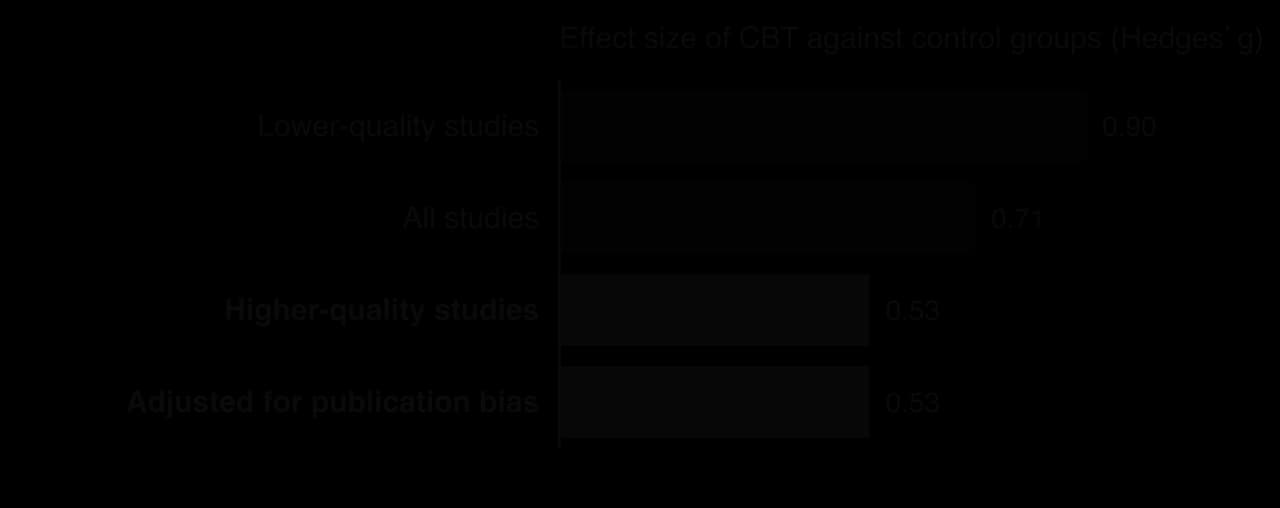
The chart shows that CBT clearly works, but that early estimates overstated how well. Cuijpers et al. also found no evidence that CBT was more or less effective than other psychotherapies or than medication, and that combined treatment was more effective than medication alone. CBT has the largest body of evidence of any psychological treatment for depression, but other well-defined therapies come close to its effectiveness.
Trials show efficacy under ideal conditions; services need effectiveness in everyday practice. England’s Improving Access to Psychological Therapies programme (now NHS Talking Therapies) offers CBT and other recommended therapies to hundreds of thousands of people a year and publishes outcome data for almost every patient. Clark et al. (2018) analysed these public data and found that how services were organised mattered: services that treated a higher proportion of referrals, gave more sessions, had shorter waiting times and fewer missed appointments achieved better recovery rates, while social deprivation predicted poorer outcomes.
The analysis shows that the effectiveness of a psychological treatment depends on more than its techniques. Waiting times, the number of sessions and the circumstances of the people treated all affect the change that therapy produces in a real population, which is a point about treatment effectiveness as much as about CBT.
Behavioural activation can be delivered on its own, without the cognitive techniques of CBT. It treats depression as a loss of rewarding activity and an increase in avoidance, and works only on behaviour: scheduling activities, breaking tasks into small steps and reducing avoidance. Because it is simpler to learn, it can be taught to therapists with less training.
Dimidjian et al. (2006) randomly allocated 241 adults with major depressive disorder to behavioural activation, cognitive therapy, the antidepressant paroxetine or pill placebo. Among the more severely depressed patients, behavioural activation was as effective as medication, and both did significantly better than cognitive therapy. This raises the question of whether the cognitive techniques of CBT are necessary, or whether much of its effect comes from the behavioural part.
Interpersonal therapy (IPT), developed by Klerman and Weissman, treats depression as closely linked to current relationships. Over about 12 to 16 sessions it focuses on one of four problem areas: grief after a death, disputes with a partner or family member, role transitions such as becoming a parent, losing a job or migrating, and isolation or a lack of close relationships. The therapist helps the client understand the link between mood and the problem area and find new ways of dealing with it.
Bolton et al. (2003) tested group IPT in a cluster randomised trial in 30 villages in rural Uganda. Adults with depression in the intervention villages attended weekly 90-minute group sessions for 16 weeks, led by local facilitators; control villages received no intervention. Before treatment, 86% of the intervention group and 94% of the control group met the criteria for major depression; afterwards, 6.5% and 54.7% did. Depression and impaired functioning had been measured with scales adapted and validated locally, which is important for measurement in a culture where Western questionnaires had not been used before.
Mindfulness-based cognitive therapy (MBCT), developed by Segal, Williams and Teasdale, is designed to prevent relapse in people who have recovered from recurrent depression. It combines mindfulness meditation with elements of cognitive therapy in about eight weekly group sessions with daily home practice. Instead of challenging thoughts, it teaches people to notice them as passing mental events (“thoughts are not facts”), so that a dip in mood is less likely to set off the rumination that can lead to a new episode.
Teasdale et al. (2000) randomly allocated 145 recovered patients to continue their usual treatment or to receive MBCT in addition, and followed them for 60 weeks. MBCT significantly reduced relapse for patients with three or more previous episodes, who made up 77% of the sample, but not for those with only two. In the PREVENT trial, Kuyken et al. (2015) randomly allocated 424 patients on maintenance antidepressants to continue their medication or to receive MBCT with support to reduce it. Over two years the time to relapse did not differ between the two groups, so MBCT offers an alternative for people who want to stop long-term medication.
Kuyken et al. (2016) combined individual patient data from nine trials with 1,258 patients and found that MBCT reduced the risk of relapse within 60 weeks compared with not receiving MBCT, with a hazard ratio of 0.69, roughly a third lower risk. Many of the researchers had developed MBCT or trained people in it, which they declared, so allegiance is a possible source of bias.
Therapy | Main target | Typical length | Key evidence | Main limitation |
|---|---|---|---|---|
CBT | Negative thoughts and schemas, plus behaviour | 12–20 sessions | DeRubeis et al. (2005): equal to medication with expert therapists; Hollon et al. (2005): lower relapse | Depends on therapist skill; needs effort and homework |
Behavioural activation | Avoidance and loss of reward | Up to 24 sessions over 16 weeks in trials | Dimidjian et al. (2006): as effective as medication for more severe depression | Does not target beliefs directly; fewer long-term data |
Interpersonal therapy | Current relationship problems | 12–16 sessions | Elkin et al. (1989): comparable to CBT; Bolton et al. (2003): group IPT in Uganda | Less suitable when problems are not mainly interpersonal |
MBCT | Relapse through rumination | 8 group sessions | Teasdale et al. (2000): fewer relapses for three or more episodes; Kuyken et al. (2015): similar to maintenance medication | For prevention, not acute depression; needs regular practice |
The same principles are applied to disorders other than depression, and anxiety disorders show particularly clearly how a psychological treatment follows from a psychological explanation. Phobias, obsessive-compulsive disorder and post-traumatic stress disorder are all maintained by avoidance: the person escapes or avoids what they fear, so they never learn that it is safe, and the fear persists.
Systematic desensitisation is a behavioural therapy for phobias based on classical conditioning. Its origin is a study by Jones (1924) of a three-year-old boy, Peter, who was afraid of a white rabbit. Jones gave Peter food he liked while the rabbit was brought gradually closer over many sessions, until he could touch it without fear. Wolpe (1958) developed this into a standard therapy, arguing that a person cannot be relaxed and afraid at the same time, so relaxation can be conditioned to replace fear, a process called counterconditioning.
Systematic desensitisation has three stages. The client first learns a relaxation technique, such as progressive muscle relaxation. Client and therapist then build a fear hierarchy, a list of feared situations ranked from least to most frightening. Finally, the client works up the hierarchy, in imagination or in real life, moving to the next step only when they can stay relaxed at the current one.
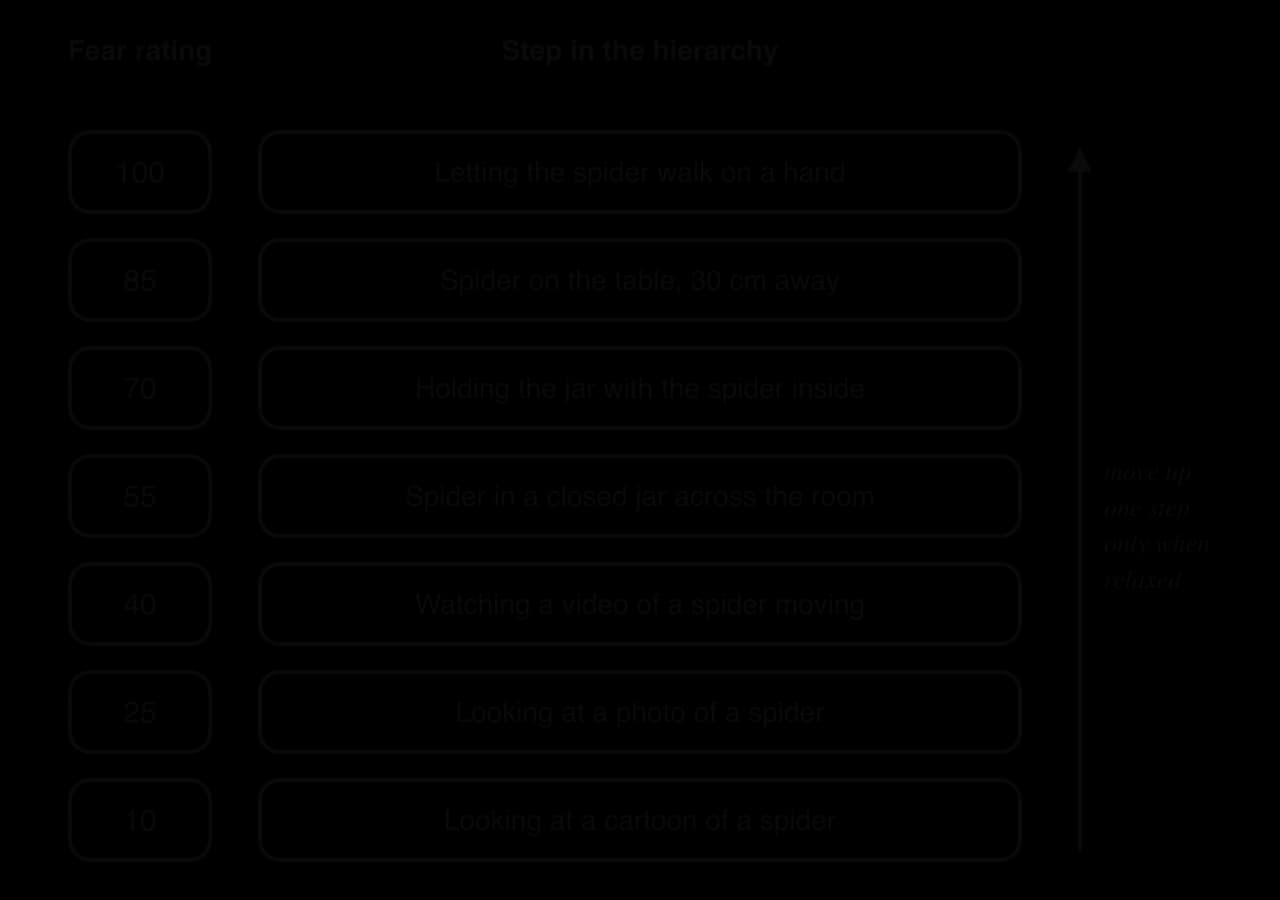
Exposure therapy is the main psychological treatment for anxiety disorders today. The person is repeatedly confronted with what they fear, without escaping or avoiding it, until the fear decreases. Exposure can be graded, like systematic desensitisation but usually without formal relaxation, or intensive. Öst (1989) described a one-session treatment for specific phobias combining exposure in real life with modelling, lasting on average 2.1 hours; in a series of 20 patients, 90% were much improved or completely recovered at follow-up about four years later. This was a case series with no control group, but later controlled trials supported the approach.
For obsessive-compulsive disorder, the standard treatment is exposure and response prevention (ERP): the person is exposed to what triggers their obsessions (for example, touching a door handle) and prevented from carrying out the compulsion (washing their hands), so they learn that anxiety falls without the ritual. For post-traumatic stress disorder, trauma-focused CBT and prolonged exposure help the person approach memories and reminders of the trauma that they have been avoiding. Exposure can now also be delivered with virtual reality exposure therapy.
A major limitation of psychological treatment is access: there are too few trained therapists, waiting lists are long, and many people do not want to visit a clinic. Internet-based CBT (iCBT) presents the content of CBT as online modules or an app, with exercises such as thought records and activity scheduling. It can be guided, with brief support from a therapist by message or phone, or unguided self-help. CBT can also be delivered by video call (teletherapy).
Andersson and Cuijpers (2009) combined 12 studies with 2,446 participants and found a moderate overall effect of computerised and internet-based treatments for depression (d = 0.41). Guided programmes had a larger effect (d = 0.61) than unguided ones (d = 0.25). Karyotaki et al. (2021) later analysed individual data from 39 trials with 9,751 participants and found that both guided and unguided iCBT were more effective than control conditions; guided iCBT was better for people with moderate to severe depression, while unguided iCBT was about as effective for people with mild symptoms.
iCBT can reach more people at lower cost, but dropout is high without human support, and most trials have used volunteers who are comfortable with technology and willing to sign up online, which may limit generalisability. Its success also suggests that the specific techniques of CBT carry some of its effect, since they work even without a face-to-face relationship, although guidance still adds to it.
Psychological treatment and biological treatment are the two main options for depression, and comparing them is one of the main ways of judging what each adds. In the short term they are about equally effective for most patients, and the differences lie in durability, side effects, access and how well they can be tested.
Psychological treatment (CBT) | Antidepressants | |
|---|---|---|
How it works | Changes thoughts, behaviour and skills; brain changes follow | Changes neurotransmission and plasticity; cognitive changes may follow |
Short-term effectiveness | About equal to drugs for most patients; depends on therapist skill | About equal to CBT; clearest benefit over placebo in very severe depression |
After treatment stops | Lower relapse: Hollon et al. (2005) found 30.8% after CT vs 76.2% after medication was withdrawn | Relapse risk rises when the drug is stopped; protection lasts while it is taken |
Side effects | Few physical effects; can be emotionally demanding | Nausea, sexual difficulties, emotional numbing, discontinuation symptoms |
Time and effort | Weekly sessions and homework over several months | A daily tablet; 2–6 weeks to work |
Access and cost | Needs trained therapists; waiting lists; iCBT and lay counsellors help | Cheap and available in primary care almost everywhere |
Client’s role | Active and collaborative | Mostly passive |
Testing | No true placebo; client and therapist cannot be blind | Pill placebo and double-blinding possible |
Combined treatment uses both together. In the meta-analysis by Cuijpers et al. (2013), combined treatment was significantly more effective than medication alone (g = 0.49). One explanation is that the two act on different parts of the problem: a drug may lift severe symptoms enough for a person to engage with therapy, and therapy teaches skills that continue to protect after treatment ends. For moderate to severe depression, many guidelines therefore recommend combining them, while for mild depression a psychological treatment alone is usually offered first.
Most psychological treatments were developed in North America and Europe, and they rest on cultural assumptions: that distress is best understood as individual thoughts and feelings, that talking openly about them to a stranger is acceptable, and that the goal of therapy is personal independence. In cultures where distress is expressed through the body, where the family is central to decisions, or where seeking help carries strong stigma, an unadapted therapy may be less acceptable and less effective.
Culturally adapted treatment changes the language, examples, delivery or goals of a therapy to fit the culture of the people receiving it, while keeping its active ingredients. In a meta-analysis of 76 studies, Griner and Smith (2006) found a moderate benefit of culturally adapted interventions (d = 0.45). Interventions targeted at one specific cultural group were four times more effective than those given to mixed groups, and interventions in clients’ own language (when this was not English) were twice as effective as those in English.
In many low- and middle-income countries there are very few psychiatrists or psychologists, so most people with depression receive no treatment. One response is task-sharing: training people without professional qualifications to deliver a simplified, structured therapy under supervision. Patel et al. (2017) tested the Healthy Activity Program (HAP), a brief behavioural activation treatment delivered by lay counsellors, in ten primary health centres in Goa, India. 495 adults with moderately severe to severe depression were randomly allocated to enhanced usual care alone or enhanced usual care plus HAP, with outcomes assessed by researchers who did not know the allocation.
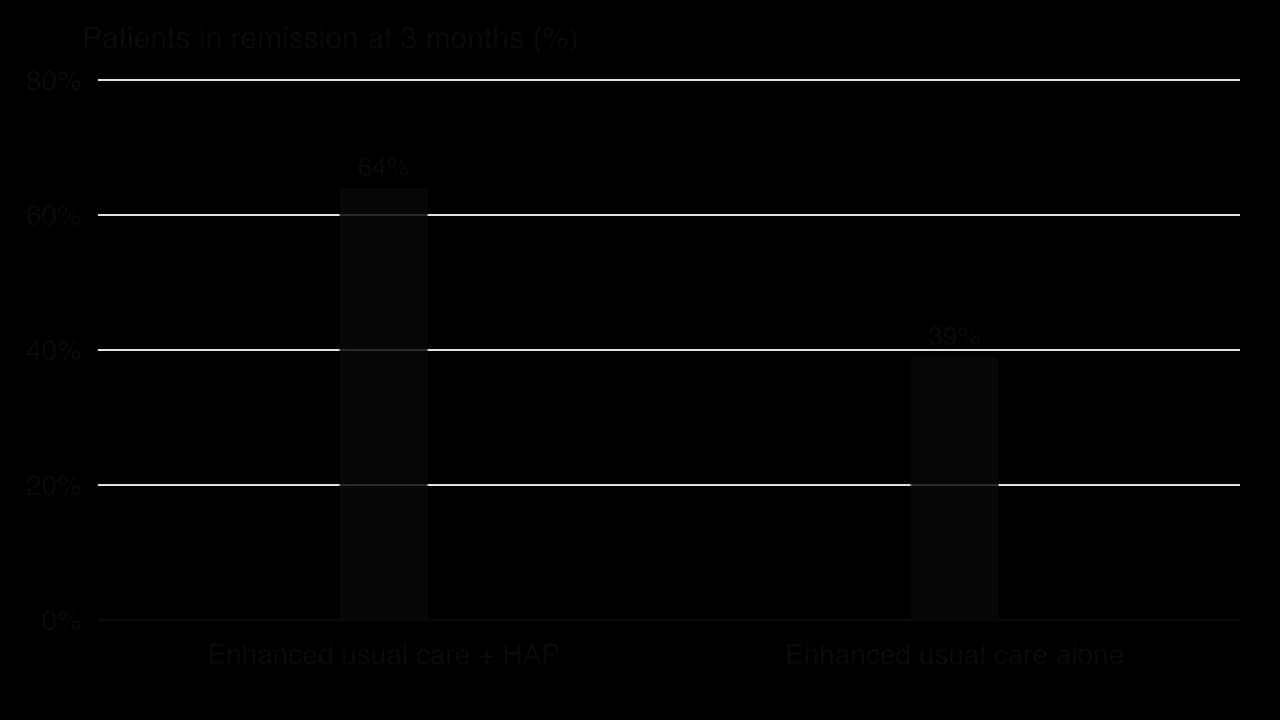
At three months, 64% of the HAP group were in remission, compared with 39% of the usual-care group, and HAP also reduced symptom severity, disability, days off work and suicidal thoughts. The treatment had been developed for the local setting and was judged cost-effective there; a 12-month follow-up found the benefits were sustained. Other task-sharing programmes, such as the Friendship Bench in Zimbabwe, where trained lay health workers deliver problem-solving therapy, have reported similar success.
These trials show that the core of an effective psychological treatment can transfer across cultures if it is adapted and delivered by people from the community. They also raise questions of measurement: symptom questionnaires developed in the West have to be translated and validated locally, as they were in Goa and Uganda, before their cut-offs can be trusted.
Psychological treatments aim at deliberate change in thinking and behaviour, and their main advantage over medication is the durability of that change. The lower relapse rate after cognitive therapy in Hollon et al. (2005), and the effect of MBCT in recurrent depression, both show this. One explanation is that clients learn skills, such as questioning automatic thoughts and scheduling activity, which they keep using; another is that CBT changes negative self-schemas, the vulnerability that Beck’s model proposes.
There are also barriers to change. Therapy requires motivation, concentration and effort, which severe depression reduces; many people drop out; and change in an individual’s thinking does not remove poverty, discrimination or abusive relationships that may be causing the depression. At the level of a population, the change therapy can produce is limited by access, as the waiting-time findings of Clark et al. (2018) show.
Randomised trials allow causal conclusions about therapy, but they are weaker than drug trials. Clients and therapists cannot be blind, so expectations can influence outcomes; wait-list controls inflate effects; and the therapist’s skill and allegiance can act as confounding variables, which is why correcting for these problems roughly halved the average effect of psychotherapy in the analysis by Cuijpers et al. (2019).
A second causal question is why therapy works. If CBT works by changing thoughts, then the cognitive techniques should matter; but in Dimidjian et al. (2006) behavioural activation alone was as effective as medication and more effective than cognitive therapy for severe depression, and common factors such as the therapeutic alliance predict outcomes across therapies. As with drugs, the success of a cognitive treatment does not prove that negative thinking caused the depression.
Most outcomes are symptom scales: clinician-rated scales such as the HRSD, or self-report scales such as the Beck Depression Inventory and the PHQ-9. Self-report is vulnerable to expectancy and social desirability, especially when clients have invested time in therapy and want to please the therapist. Response, remission and relapse are cut-offs that can be defined in different ways. Follow-up periods are often short, although durability is the main claimed advantage of therapy.
Measurement also raises a cultural question. Scales developed in the USA or Europe may not capture how distress is expressed elsewhere, which is why trials such as Bolton et al. (2003) and Patel et al. (2017) adapted and validated their measures locally.
Each therapy reflects a perspective: CBT the cognitive approach, behavioural activation and exposure the behaviourist tradition, IPT a sociocultural focus on relationships. The success of all of them, and of medication, supports a biopsychosocial model in which depression can be changed at several levels. Culturally adapted and lay-delivered treatments bring local perspectives into therapy, while the export of unadapted Western therapies risks imposing one culture’s view of the self.
Publication bias and researcher allegiance inflate the apparent effects of psychotherapy, as they do for drugs; Cuijpers et al. (2013) found strong signs of publication bias in CBT research. Most trial participants have been from Western countries, educated and willing to talk about their feelings, so results may not transfer to other groups without adaptation.
Therapists hold power over vulnerable clients and must obtain informed consent, protect confidentiality and avoid harm. Therapy research raises the ethics of withholding treatment: wait-list and placebo groups receive less help during the trial, which DeRubeis et al. (2005) addressed by limiting placebo to eight weeks. There is also a responsibility not to locate all problems in individuals’ thinking: telling a person who is depressed because of poverty or discrimination that their thoughts are “distorted” can shift the blame onto them. Task-sharing programmes show a different kind of responsibility, to make effective treatment available where few people can currently get it.
Concept | Strength of psychological treatment or its research | Limitation |
|---|---|---|
Change | Lasting change: lower relapse after CT ends; MBCT prevents relapse | Needs motivation and effort; cannot change social causes; access limits change at population level |
Causality | RCTs with blind raters show therapy is effective | No blinding of clients or therapists; wait-list controls inflate effects; unclear which ingredient works |
Measurement | Standard scales; locally validated measures in cross-cultural trials | Self-report bias; varying cut-offs; short follow-ups |
Perspective | Several therapies from different approaches all work, supporting a biopsychosocial view | Unadapted Western therapies may not fit other cultures |
Bias | Meta-analyses can correct for publication bias and study quality | Publication bias; allegiance; Western, educated samples |
Responsibility | Few physical side effects; task-sharing widens access | Withholding treatment from control groups; risk of blaming individuals for social problems |
A psychological treatment reduces symptoms by changing thoughts, behaviour, emotions or relationships through structured work with a trained practitioner; common factors such as the therapeutic alliance contribute to every therapy.
CBT for depression applies Beck’s cognitive model: cognitive restructuring targets negative automatic thoughts, behavioural activation targets withdrawal, behavioural experiments test predictions and relapse prevention plans for the future.
Testing therapy is harder than testing drugs: there is no true placebo or blinding, and wait-list controls, therapist skill and allegiance can inflate effects.
DeRubeis et al. (2005) found cognitive therapy as effective as medication for moderate to severe depression (58% response in both at 16 weeks) with expert therapists; Hollon et al. (2005) found lower relapse after CT ended (30.8%) than after medication was stopped (76.2%).
Meta-analyses show CBT is clearly effective, but effects shrink in high-quality studies and after correcting for publication bias; other therapies such as behavioural activation and IPT come close.
MBCT prevents relapse in recurrent depression; exposure therapy, systematic desensitisation and ERP treat anxiety disorders by ending avoidance; internet-based CBT widens access, especially when guided.
Psychological treatment and medication are about equally effective in the short term; CBT’s benefit lasts longer, and combined treatment is more effective than medication alone.
Culturally adapted and lay-delivered therapies, such as the Healthy Activity Program in Goa and group IPT in Uganda, show that psychological treatment can work across cultures when it is adapted.
I can describe what a psychological treatment is and how it differs from a biological treatment.
I can explain how CBT treats depression, including cognitive restructuring, behavioural activation, behavioural experiments and relapse prevention.
I can explain why psychological treatments are harder to test than drugs and how the choice of control condition affects results.
I can describe the aim, method, results and conclusions of DeRubeis et al. (2005) and Hollon et al. (2005) and evaluate the trial.
I can use meta-analyses and other trials to discuss how effective CBT and other therapies are.
I can describe behavioural activation, IPT, MBCT, exposure therapy, systematic desensitisation and internet-based CBT.
I can compare and contrast psychological, biological and combined treatment of depression.
I can discuss how culture affects psychological treatment, with examples of cultural adaptation and task-sharing.
I can evaluate psychological treatments with reference to change, causality, measurement, bias, perspective and responsibility.